Overflowing Attack Potential
             Scoring Defence-in-Depth
                     Defence-in-


                   Javier Tallón Guerri
                     11ICCC - Turkey
2
3
4
1.Buffer overflows, a bit of background

2.Reviewing and bypassing defence-in-
  depth techniques

3.Impact in the CC

4.What to do?


                                          5
1.Buffer overflows, a bit of background

2.Reviewing and bypassing defence-in-
  depth techniques

3.Impact in the CC

4.What to do?


                                          6
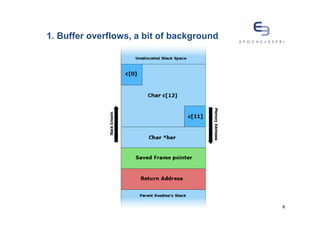
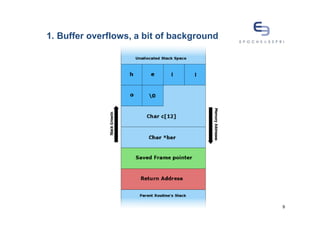
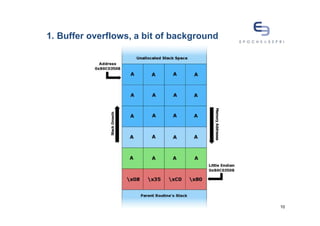
1. Buffer overflows, a bit of background


 You know... The classic stack overflow….

       #include <string.h>
       void foo (char *bar) {
                 char c[12];
                 strcpy(c, bar); // no bounds checking...
       }

        int main (int argc, char **argv) {
                  foo(argv[1]);
       }


                                                            7
1. Buffer overflows, a bit of background


                                           8
1. Buffer overflows, a bit of background


                                           9
1. Buffer overflows, a bit of background


                                           10
1. Buffer overflows, a bit of background


 There are also heap and integer
 overflows….


                                           11
1. Buffer overflows, a bit of background


 Could lead to arbitrary code execution


                                           12
1. Buffer overflows, a bit of background


 Those were the old days…


 Very few problems for the attacker:
    Null bytes
    Shellcode size and other constraints
    Shellcode development                  13
1.Buffer overflows, a bit of background

2.Reviewing defence-in-depth techniques

3.Impact in the CC

4.What to do?


                                          14
2. Reviewing defence-in-depth techniques

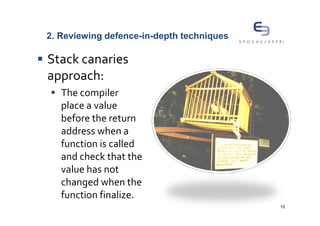
Stack canaries
approach:
   The compiler
   place a value
   before the return
   address when a
   function is called
   and check that the
   value has not
   changed when the
   function finalize.
                                           15
2. Reviewing defence-in-depth techniques


  Bypassing stack canaries:

     Implementation can be not correct
     It can be a statistical problem


                                           16
2. Reviewing defence-in-depth techniques


  Bypassing stack canaries:

     Windows: SEH overwriting
        Protected by SafeSEH and so on…
     Unix: Other (more complex)
     techniques…


                                           17
2. Reviewing defence-in-depth techniques


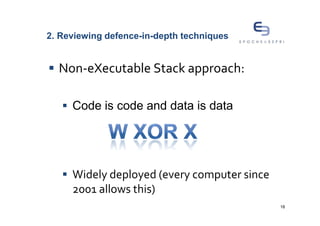
  Non-eXecutable Stack approach:

     Code is code and data is data


     Widely deployed (every computer since
     2001 allows this)
                                             18
2. Reviewing defence-in-depth techniques


  Bypassing Non-eXecutable Stack:

     Save the payload in the heap
     Return into libc attacks


                                           19
2. Reviewing defence-in-depth techniques


  64bits hardware resolves the
  problem:

     In 64 bits computers, arguments
     are loaded from registers, not from
     the stack.
     Return into libc attack is not
     possible
                                           20
2. Reviewing defence-in-depth techniques


  64bits hardware resolves the
  problem:


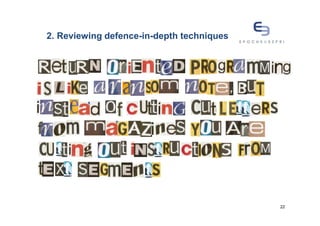
     Borrowed Code Chunks or
     Return Oriented Programming


                                           21
2. Reviewing defence-in-depth techniques


                                           22
2. Reviewing defence-in-depth techniques


  ASLR (Address Space Layout
  Randomization) approach:

     The code is loaded in different
     memory regions each time


                                           23
2. Reviewing defence-in-depth techniques


  Bypassing ASLR:

     It could be an statistical question


                                           24
2. Reviewing defence-in-depth techniques


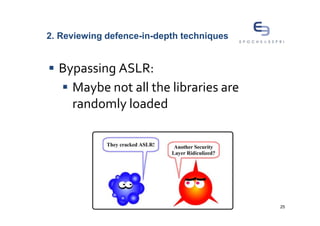
  Bypassing ASLR:
    Maybe not all the libraries are
    randomly loaded


                                           25
2. Reviewing defence-in-depth techniques


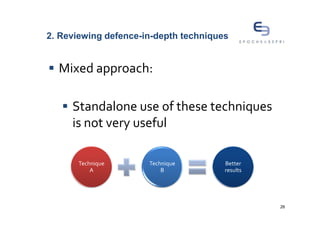
  Mixed approach:

     Standalone use of these techniques
     is not very useful

       Technique      Technique        Better
           A              B            results


                                                 26
2. Reviewing defence-in-depth techniques


  Non-eXecutable Stack + ASLR:

     Make very difficult the return
     attacks.


                                           27
2. Reviewing defence-in-depth techniques


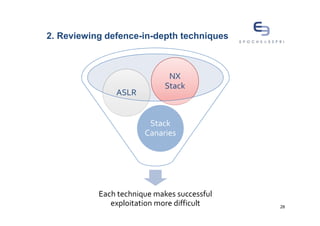
                              NX
                             Stack
               ASLR


                        Stack
                       Canaries


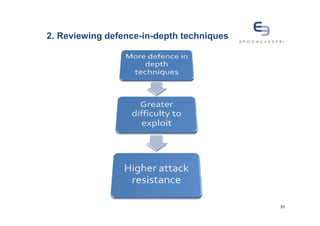
           Each technique makes successful
              exploitation more difficult    28
2. Reviewing defence-in-depth techniques


  There are more defence-in-depth
  techniques


  Attackers always develop techniques
  to bypass the new countermeasures


                                           29
2. Reviewing defence-in-depth techniques


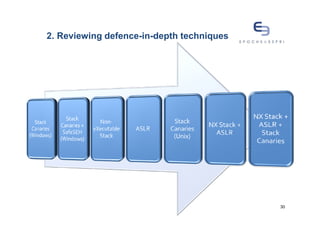
                                           30
2. Reviewing defence-in-depth techniques


                                           31
1.Buffer overflows, a bit of background

2.Reviewing defence-in-depth techniques

3.Impact in the CC

4.What to do?


                                          32
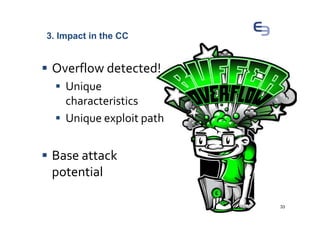
3. Impact in the CC


 Overflow detected!
    Unique
    characteristics
    Unique exploit path


 Base attack
 potential

                          33
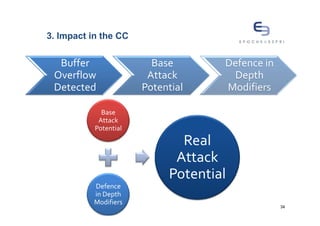
3. Impact in the CC


  Buffer                 Base       Defence in
 Overflow               Attack       Depth
 Detected              Potential    Modifiers

             Base
            Attack
           Potential

                              Real
                             Attack
                            Potential
           Defence
           in Depth
           Modifiers
                                                 34
3. Impact in the CC


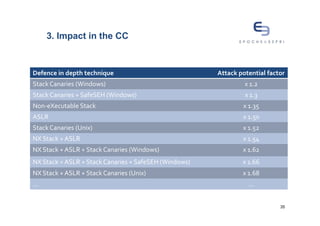
Defence in depth technique                             Attack potential factor
Stack Canaries (Windows)                                        x 1.2
Stack Canaries + SafeSEH (Windows)                              x 1.3
Non-eXecutable Stack                                           x 1.35
ASLR                                                           x 1.50
Stack Canaries (Unix)                                          x 1.52
NX Stack + ASLR                                                x 1.54
NX Stack + ASLR + Stack Canaries (Windows)                     x 1.62
NX Stack + ASLR + Stack Canaries + SafeSEH (Windows)           x 1.66
NX Stack + ASLR + Stack Canaries (Unix)                        x 1.68
…                                                                …


                                                                            35
1.Buffer overflows, a bit of background

2.Reviewing defence-in-depth techniques

3.Impact in the CC

4.What to do?


                                          36
4. What to do?


                 37
4. What to do?


                 38
4. What to do?


                 39
4. What to do?


   Whenever it is possible

   Through compiler

   Through Operating System
                              40
4. What to do?


                 41
Thanks for your attention!
                attention!

Javier Tallón

Epoche & Espri, S.L.
Avda. de la Vega, 1
28108, Alcobendas,
Madrid, Spain.

eval@epoche.es

                             42

Overflowing attack potential, scoring defence in-depth

  • 1.
    Overflowing Attack Potential Scoring Defence-in-Depth Defence-in- Javier Tallón Guerri 11ICCC - Turkey
  • 2.
  • 3.
  • 4.
  • 5.
    1.Buffer overflows, abit of background 2.Reviewing and bypassing defence-in- depth techniques 3.Impact in the CC 4.What to do? 5
  • 6.
    1.Buffer overflows, abit of background 2.Reviewing and bypassing defence-in- depth techniques 3.Impact in the CC 4.What to do? 6
  • 7.
    1. Buffer overflows,a bit of background You know... The classic stack overflow…. #include <string.h> void foo (char *bar) { char c[12]; strcpy(c, bar); // no bounds checking... } int main (int argc, char **argv) { foo(argv[1]); } 7
  • 8.
    1. Buffer overflows,a bit of background 8
  • 9.
    1. Buffer overflows,a bit of background 9
  • 10.
    1. Buffer overflows,a bit of background 10
  • 11.
    1. Buffer overflows,a bit of background There are also heap and integer overflows…. 11
  • 12.
    1. Buffer overflows,a bit of background Could lead to arbitrary code execution 12
  • 13.
    1. Buffer overflows,a bit of background Those were the old days… Very few problems for the attacker: Null bytes Shellcode size and other constraints Shellcode development 13
  • 14.
    1.Buffer overflows, abit of background 2.Reviewing defence-in-depth techniques 3.Impact in the CC 4.What to do? 14
  • 15.
    2. Reviewing defence-in-depthtechniques Stack canaries approach: The compiler place a value before the return address when a function is called and check that the value has not changed when the function finalize. 15
  • 16.
    2. Reviewing defence-in-depthtechniques Bypassing stack canaries: Implementation can be not correct It can be a statistical problem 16
  • 17.
    2. Reviewing defence-in-depthtechniques Bypassing stack canaries: Windows: SEH overwriting Protected by SafeSEH and so on… Unix: Other (more complex) techniques… 17
  • 18.
    2. Reviewing defence-in-depthtechniques Non-eXecutable Stack approach: Code is code and data is data Widely deployed (every computer since 2001 allows this) 18
  • 19.
    2. Reviewing defence-in-depthtechniques Bypassing Non-eXecutable Stack: Save the payload in the heap Return into libc attacks 19
  • 20.
    2. Reviewing defence-in-depthtechniques 64bits hardware resolves the problem: In 64 bits computers, arguments are loaded from registers, not from the stack. Return into libc attack is not possible 20
  • 21.
    2. Reviewing defence-in-depthtechniques 64bits hardware resolves the problem: Borrowed Code Chunks or Return Oriented Programming 21
  • 22.
  • 23.
    2. Reviewing defence-in-depthtechniques ASLR (Address Space Layout Randomization) approach: The code is loaded in different memory regions each time 23
  • 24.
    2. Reviewing defence-in-depthtechniques Bypassing ASLR: It could be an statistical question 24
  • 25.
    2. Reviewing defence-in-depthtechniques Bypassing ASLR: Maybe not all the libraries are randomly loaded 25
  • 26.
    2. Reviewing defence-in-depthtechniques Mixed approach: Standalone use of these techniques is not very useful Technique Technique Better A B results 26
  • 27.
    2. Reviewing defence-in-depthtechniques Non-eXecutable Stack + ASLR: Make very difficult the return attacks. 27
  • 28.
    2. Reviewing defence-in-depthtechniques NX Stack ASLR Stack Canaries Each technique makes successful exploitation more difficult 28
  • 29.
    2. Reviewing defence-in-depthtechniques There are more defence-in-depth techniques Attackers always develop techniques to bypass the new countermeasures 29
  • 30.
  • 31.
  • 32.
    1.Buffer overflows, abit of background 2.Reviewing defence-in-depth techniques 3.Impact in the CC 4.What to do? 32
  • 33.
    3. Impact inthe CC Overflow detected! Unique characteristics Unique exploit path Base attack potential 33
  • 34.
    3. Impact inthe CC Buffer Base Defence in Overflow Attack Depth Detected Potential Modifiers Base Attack Potential Real Attack Potential Defence in Depth Modifiers 34
  • 35.
    3. Impact inthe CC Defence in depth technique Attack potential factor Stack Canaries (Windows) x 1.2 Stack Canaries + SafeSEH (Windows) x 1.3 Non-eXecutable Stack x 1.35 ASLR x 1.50 Stack Canaries (Unix) x 1.52 NX Stack + ASLR x 1.54 NX Stack + ASLR + Stack Canaries (Windows) x 1.62 NX Stack + ASLR + Stack Canaries + SafeSEH (Windows) x 1.66 NX Stack + ASLR + Stack Canaries (Unix) x 1.68 … … 35
  • 36.
    1.Buffer overflows, abit of background 2.Reviewing defence-in-depth techniques 3.Impact in the CC 4.What to do? 36
  • 37.
    4. What todo? 37
  • 38.
    4. What todo? 38
  • 39.
    4. What todo? 39
  • 40.
    4. What todo? Whenever it is possible Through compiler Through Operating System 40
  • 41.
    4. What todo? 41
  • 42.
    Thanks for yourattention! attention! Javier Tallón Epoche & Espri, S.L. Avda. de la Vega, 1 28108, Alcobendas, Madrid, Spain. eval@epoche.es 42