Binary Exploitation 1
Buffer Overflows
(return-to-libc, ROP, Canaries, W^X, ASLR)
Chester Rebeiro
Indian Institute of Technology Madras
Parts of Malware
• Two parts
Subvert execution:
change the normal execution behavior of the
program
Payload:
the code which the attacker wants to execute
2
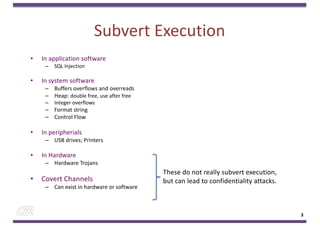
Subvert Execution
• In application software
– SQL Injection
• In system software
– Buffers overflows and overreads
– Heap: double free, use after free
– Integer overflows
– Format string
– Control Flow
• In peripherials
– USB drives; Printers
• In Hardware
– Hardware Trojans
• Covert Channels
– Can exist in hardware or software
3
These do not really subvert execution,
but can lead to confidentiality attacks.
Buffer Overflows in the Stack
• We need to first know how a stack is managed
http://insecure.org/stf/smashstack.html 4
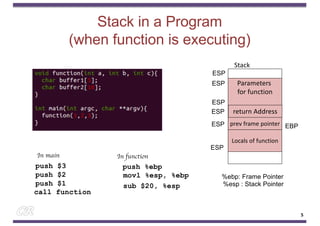
Stack in a Program
(when function is executing)
EBP
Parameters
for function
return Address
Locals of function
prev frame pointer
push $3
push $2
push $1
Stack
call function
push %ebp
movl %esp, %ebp
sub $20, %esp
%ebp: Frame Pointer
In main In function
ESP
ESP
ESP
ESP
ESP
ESP
%esp : Stack Pointer
5
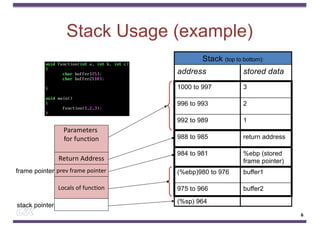
Stack Usage (example)
Stack (top to bottom):
address stored data
1000 to 997 3
996 to 993 2
992 to 989 1
988 to 985 return address
984 to 981 %ebp (stored
frame pointer)
(%ebp)980 to 976 buffer1
975 to 966 buffer2
(%sp) 964
stack pointer
Parameters
for function
Return Address
Locals of function
prev frame pointer
frame pointer
6
Stack Usage Contd.
Stack (top to bottom):
address stored data
1000 to 997 3
996 to 993 2
992 to 989 1
988 to 985 return address
984 to 981 %ebp (stored
frame pointer)
(%ebp)980 to 976 buffer1
975 to 966 buffer2
(%sp) 964
What is the output of the following?
• printf(“%x”, buffer2) : 966
• printf(“%x”, &buffer2[10])
976 à buffer1
Therefore buffer2[10] = buffer1[0]
A BUFFER OVERFLOW
7
Modifying the Return Address
buffer2[19] =
&arbitrary memory location
This causes execution of an
arbitrary memory location
instead of the standard return
Stack (top to bottom):
address stored data
1000 to 997 3
996 to 993 2
992 to 989 1
988 to 985
984 to 981 %ebp (stored
frame pointer)
(%ebp)980 to 976 buffer1
976 to 966 buffer2
(%sp) 964
Return Address
19
Arbitrary Location
8
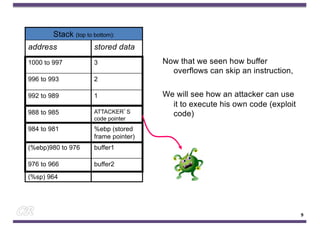
Now that we seen how buffer
overflows can skip an instruction,
We will see how an attacker can use
it to execute his own code (exploit
code)
Stack (top to bottom):
address stored data
1000 to 997 3
996 to 993 2
992 to 989 1
988 to 985 ATTACKER’S
code pointer
984 to 981 %ebp (stored
frame pointer)
(%ebp)980 to 976 buffer1
976 to 966 buffer2
(%sp) 964
9
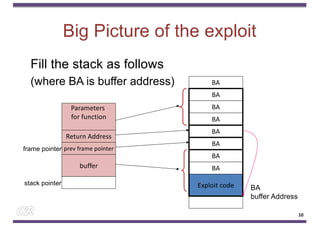
Big Picture of the exploit
Fill the stack as follows
(where BA is buffer address)
stack pointer
Parameters
for function
Return Address
buffer
prev frame pointer
frame pointer
Exploit code
BA
BA
buffer Address
BA
BA
BA
BA
BA
BA
BA
10
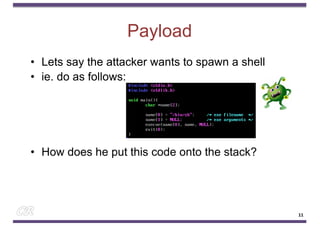
Payload
• Lets say the attacker wants to spawn a shell
• ie. do as follows:
• How does he put this code onto the stack?
11
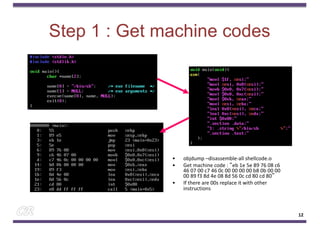
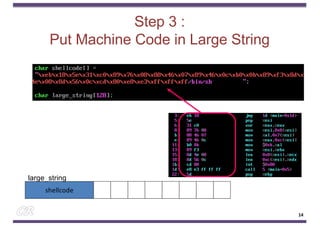
Step 1 : Get machine codes
• objdump –disassemble-all shellcode.o
• Get machine code : “eb 1e 5e 89 76 08 c6
46 07 00 c7 46 0c 00 00 00 00 b8 0b 00 00
00 89 f3 8d 4e 08 8d 56 0c cd 80 cd 80”
• If there are 00s replace it with other
instructions
12
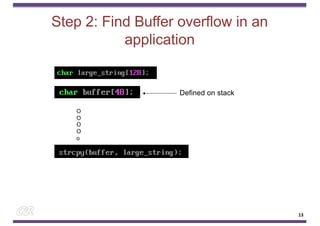
Step 2: Find Buffer overflow in an
application
O
O
O
O
o
Defined on stack
13
Step 3 :
Put Machine Code in Large String
shellcode
large_string
14
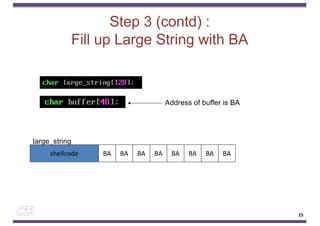
Step 3 (contd) :
Fill up Large String with BA
shellcode BA BA BA BA BA BA BA BA
large_string
Address of buffer is BA
15
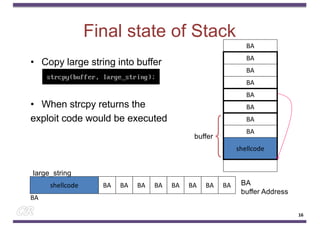
Final state of Stack
• Copy large string into buffer
• When strcpy returns the
exploit code would be executed
shellcode BA BA BA BA BA BA BA BA
large_string
shellcode
BA
BA
buffer Address
BA
BA
BA
BA
BA
BA
BA
buffer
BA
16
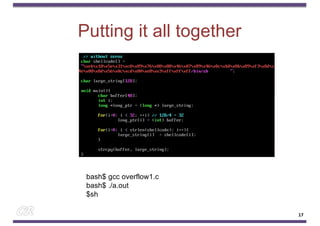
Putting it all together
bash$ gcc overflow1.c
bash$ ./a.out
$sh
17
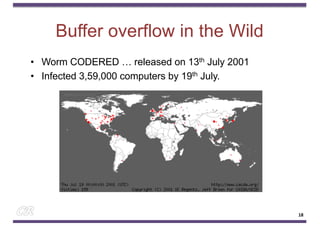
Buffer overflow in the Wild
• Worm CODERED … released on 13th July 2001
• Infected 3,59,000 computers by 19th July.
18
Defenses
• Eliminate program flaws that could lead to subverting of execution
Safer programming languages; Safer libraries; hardware enhancements;
static analysis
• If can’t eliminate, make it more difficult for malware to subvert
execution
W^X , ASLR, canaries
• If malware still manages to execute, try to detect its execution at
runtime
malware run-time detection techniques using learning techniques, ANN and malware signatures
• If can’t detect at runtime, try to restrict what the malware can do..
– Sandbox system
so that malware affects only part of the system; access control; virtualization; trustzone; SGX
– Track information flow
DIFT; ensure malware does not steal sensitive information
19
Preventing Buffer Overflows
with Canaries and W^X
20
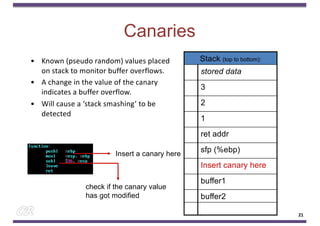
Canaries
Stack (top to bottom):
stored data
3
2
1
ret addr
sfp (%ebp)
Insert canary here
buffer1
buffer2
Insert a canary here
check if the canary value
has got modified
• Known (pseudo random) values placed
on stack to monitor buffer overflows.
• A change in the value of the canary
indicates a buffer overflow.
• Will cause a ‘stack smashing’ to be
detected
21
Canaries and gcc
22
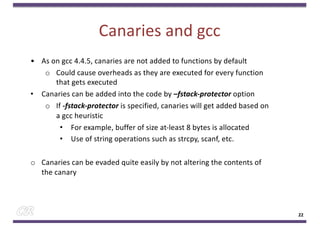
• As on gcc 4.4.5, canaries are not added to functions by default
o Could cause overheads as they are executed for every function
that gets executed
• Canaries can be added into the code by –fstack-protector option
o If -fstack-protector is specified, canaries will get added based on
a gcc heuristic
• For example, buffer of size at-least 8 bytes is allocated
• Use of string operations such as strcpy, scanf, etc.
o Canaries can be evaded quite easily by not altering the contents of
the canary
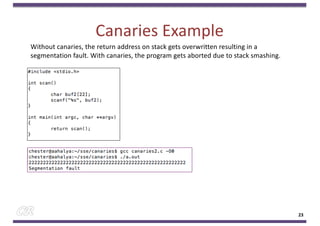
Canaries Example
23
Without canaries, the return address on stack gets overwritten resulting in a
segmentation fault. With canaries, the program gets aborted due to stack smashing.
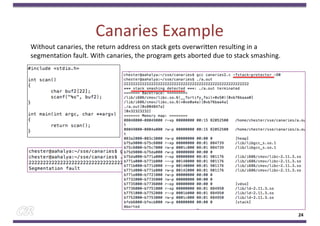
Canaries Example
24
Without canaries, the return address on stack gets overwritten resulting in a
segmentation fault. With canaries, the program gets aborted due to stack smashing.
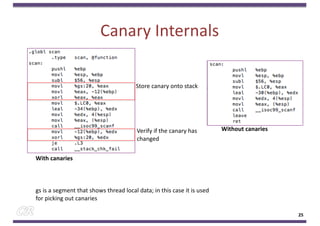
Canary Internals
25
Store canary onto stack
Verify if the canary has
changed
Without canaries
With canaries
gs is a segment that shows thread local data; in this case it is used
for picking out canaries
Non Executable Stacks (W^X)
• In Intel/AMD processors, ND/NX bit present to mark non code
regions as non-executable.
– Exception raised when code in a page marked W^X executes
• Works for most programs
– Supported by Linux kernel from 2004
– Supported by Windows XP service pack 1 and Windows Server 2003
• Called DEP – Data Execution Prevention
• Does not work for some programs that NEED to execute from the
stack.
– Eg. JIT Compiler, constructs assembly code from external data and then
executes it.
(Need to disable the W^X bit, to get this to work)
26
26
Will non executable
stack prevent buffer
overflow attacks ?
Return – to – LibC Attacks
(Bypassing non-executable stack
during exploitation using return-
to-libc attacks)
27
https://css.csail.mit.edu/6.858/2010/readings/return-to-libc.pdf 27
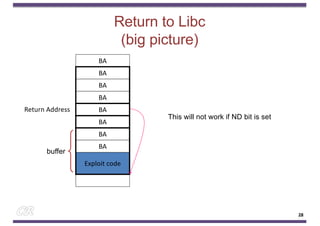
Return to Libc
(big picture)
Exploit code
BA
BA
BA
BA
BA
BA
BA
BA
buffer
This will not work if ND bit is set
Return Address
28
28
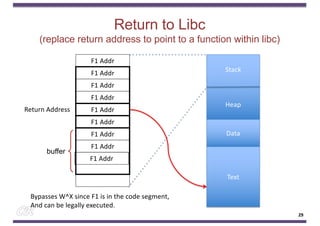
Return to Libc
(replace return address to point to a function within libc)
F1 Addr
F1 Addr
F1 Addr
F1 Addr
F1 Addr
F1 Addr
F1 Addr
F1 Addr
buffer
Return Address
29
F1 Addr
Stack
Heap
Data
Text
Bypasses W^X since F1 is in the code segment,
And can be legally executed.
29
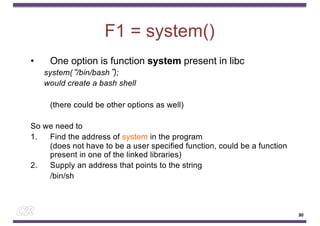
F1 = system()
• One option is function system present in libc
system(“/bin/bash”);
would create a bash shell
(there could be other options as well)
So we need to
1. Find the address of system in the program
(does not have to be a user specified function, could be a function
present in one of the linked libraries)
2. Supply an address that points to the string
/bin/sh
30
30
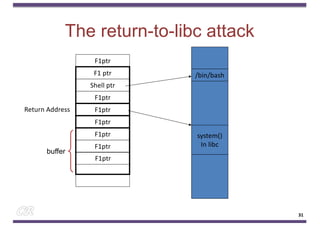
The return-to-libc attack
F1ptr
F1ptr
F1ptr
F1ptr
F1ptr
Shell ptr
F1 ptr
F1ptr
buffer
F1ptr
Return Address
system()
In libc
/bin/bash
31
31
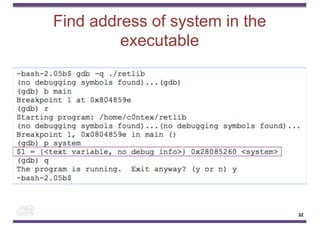
Find address of system in the
executable
32
32
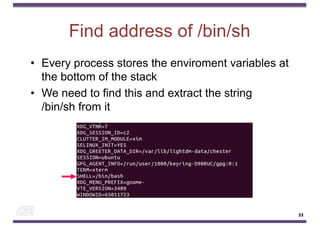
Find address of /bin/sh
• Every process stores the enviroment variables at
the bottom of the stack
• We need to find this and extract the string
/bin/sh from it
33
33
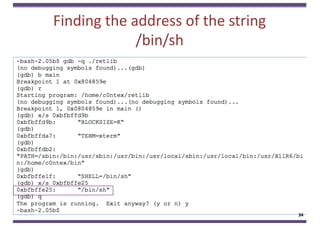
Finding the address of the string
/bin/sh
34
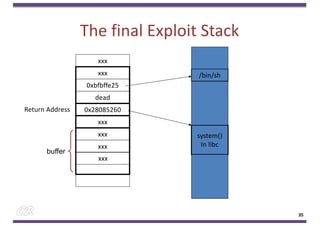
The final Exploit Stack
xxx
xxx
xxx
0x28085260
dead
0xbfbffe25
xxx
xxx
buffer
xxx
Return Address
system()
In libc
/bin/sh
35
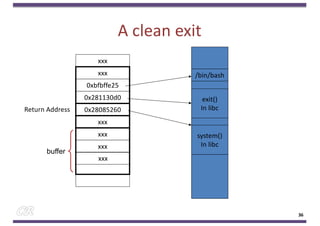
A clean exit
xxx
xxx
xxx
0x28085260
0x281130d0
0xbfbffe25
xxx
xxx
buffer
xxx
Return Address
system()
In libc
/bin/bash
exit()
In libc
36
Limitation of ret2libc
Limitation on what the attacker can do
(only restricted to certain functions in the library)
These functions could be removed from the library
37
37
Return Oriented Programming
(ROP)
38
Return Oriented Programming Attacks
• Discovered by Hovav Shacham of Stanford University
• Subverts execution to libc
– As with the regular ret-2-libc, can be used with non executable stacks since the
instructions can be legally execute
– Unlike ret-2-libc does not require to execute functions in libc (can execute any
arbitrary code)
39
The Geometry of Innocent Flesh on the Bone: Return-into-libc without Function Calls
(on the x86
Target Payload
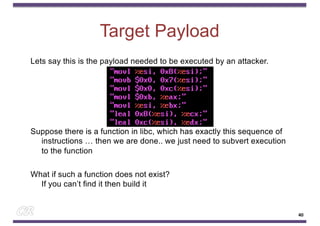
Lets say this is the payload needed to be executed by an attacker.
Suppose there is a function in libc, which has exactly this sequence of
instructions … then we are done.. we just need to subvert execution
to the function
What if such a function does not exist?
If you can’t find it then build it
40
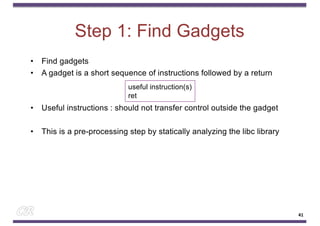
Step 1: Find Gadgets
• Find gadgets
• A gadget is a short sequence of instructions followed by a return
• Useful instructions : should not transfer control outside the gadget
• This is a pre-processing step by statically analyzing the libc library
useful instruction(s)
ret
41
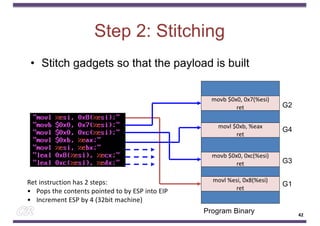
Step 2: Stitching
• Stitch gadgets so that the payload is built
Program Binary
movl %esi, 0x8(%esi)
ret
G1
movb $0x0, 0x7(%esi)
ret G2
movb $0x0, 0xc(%esi)
ret G3
movl $0xb, %eax
ret
G4
42
Ret instruction has 2 steps:
• Pops the contents pointed to by ESP into EIP
• Increment ESP by 4 (32bit machine)
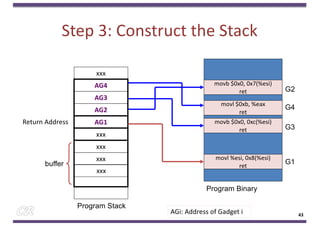
Step 3: Construct the Stack
43
xxx
xxx
xxx
AG1
AG2
AG3
AG4
xxx
buffer
xxx
Return Address
Program Binary
movl %esi, 0x8(%esi)
ret
G1
movb $0x0, 0x7(%esi)
ret G2
movb $0x0, 0xc(%esi)
ret G3
movl $0xb, %eax
ret
G4
Program Stack
AGi: Address of Gadget i
Finding Gadgets
• Static analysis of libc
• To find
1. A set of instructions that end in a ret (0xc3)
The instructions can be intended (put in by the compiler) or unintended
2. Besides ret, none of the instructions transfer control out of the
gadget
44
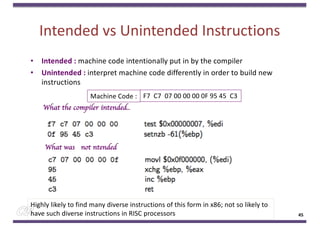
Intended vs Unintended Instructions
• Intended : machine code intentionally put in by the compiler
• Unintended : interpret machine code differently in order to build new
instructions
45
F7 C7 07 00 00 00 0F 95 45 C3
Machine Code :
What the compiler intended..
What was not ntended
Highly likely to find many diverse instructions of this form in x86; not so likely to
have such diverse instructions in RISC processors
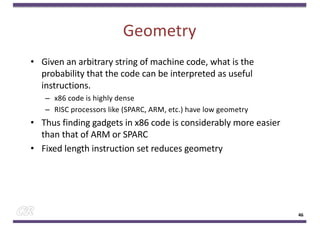
Geometry
• Given an arbitrary string of machine code, what is the
probability that the code can be interpreted as useful
instructions.
– x86 code is highly dense
– RISC processors like (SPARC, ARM, etc.) have low geometry
• Thus finding gadgets in x86 code is considerably more easier
than that of ARM or SPARC
• Fixed length instruction set reduces geometry
46
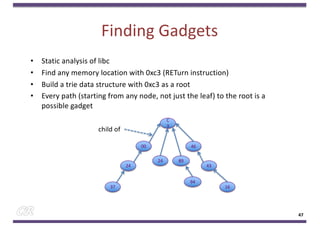
Finding Gadgets
• Static analysis of libc
• Find any memory location with 0xc3 (RETurn instruction)
• Build a trie data structure with 0xc3 as a root
• Every path (starting from any node, not just the leaf) to the root is a
possible gadget
47
C
3
00
24
37
24
46
43
16
89
94
child of
Finding Gadgets
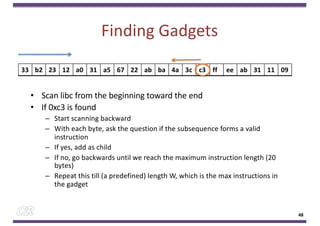
• Scan libc from the beginning toward the end
• If 0xc3 is found
– Start scanning backward
– With each byte, ask the question if the subsequence forms a valid
instruction
– If yes, add as child
– If no, go backwards until we reach the maximum instruction length (20
bytes)
– Repeat this till (a predefined) length W, which is the max instructions in
the gadget
48
33 b2 23 12 a0 31 a5 67 22 ab ba 4a 3c c3 ff ee ab 31 11 09
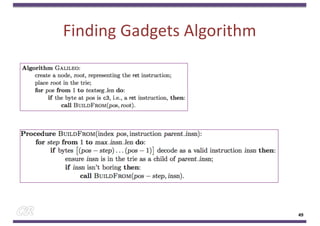
Finding Gadgets Algorithm
49
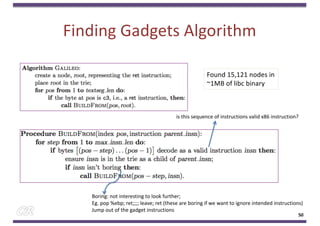
Finding Gadgets Algorithm
50
is this sequence of instructions valid x86 instruction?
Boring: not interesting to look further;
Eg. pop %ebp; ret;;;; leave; ret (these are boring if we want to ignore intended instructions)
Jump out of the gadget instructions
Found 15,121 nodes in
~1MB of libc binary
More about Gadgets
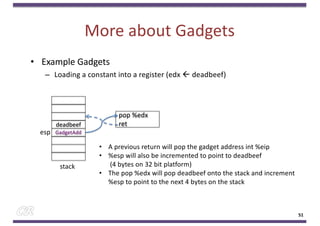
• Example Gadgets
– Loading a constant into a register (edx ß deadbeef)
51
deadbeef
GadgetAdd
stack
pop %edx
ret
esp
• A previous return will pop the gadget address int %eip
• %esp will also be incremented to point to deadbeef
(4 bytes on 32 bit platform)
• The pop %edx will pop deadbeef onto the stack and increment
%esp to point to the next 4 bytes on the stack
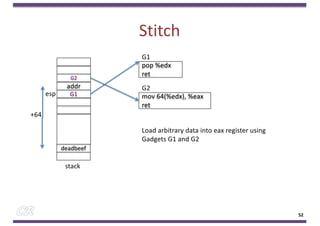
Stitch
52
pop %edx
ret
G1
mov 64(%edx), %eax
ret
G2
G2
addr
G1
stack
esp
deadbeef
+64
Load arbitrary data into eax register using
Gadgets G1 and G2
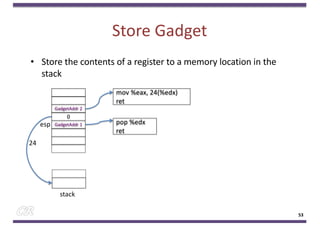
Store Gadget
• Store the contents of a register to a memory location in the
stack
53
GadgetAddr 2
0
GadgetAddr 1
stack
pop %edx
ret
esp
mov %eax, 24(%edx)
ret
24
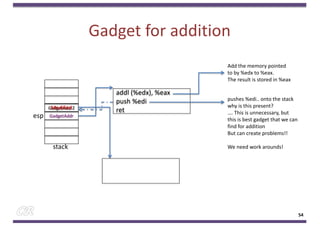
Gadget for addition
54
addl (%edx), %eax
push %edi
ret
Add the memory pointed
to by %edx to %eax.
The result is stored in %eax
pushes %edi.. onto the stack
why is this present?
…. This is unnecessary, but
this is best gadget that we can
find for addition
But can create problems!!
We need work arounds!
GadgetAddr2
GadgetAddr
stack
esp
Modified
Gadget for addition
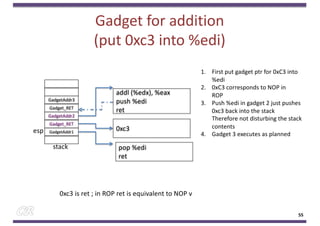
(put 0xc3 into %edi)
55
addl (%edx), %eax
push %edi
ret
1. First put gadget ptr for 0xC3 into
%edi
2. 0xC3 corresponds to NOP in
ROP
3. Push %edi in gadget 2 just pushes
0xc3 back into the stack
Therefore not disturbing the stack
contents
4. Gadget 3 executes as planned
GadgetAddr3
Gadget_RET
GadgetAddr2
Gadget_RET
GadgetAddr1
stack
esp 0xc3
0xc3 is ret ; in ROP ret is equivalent to NOP v
pop %edi
ret
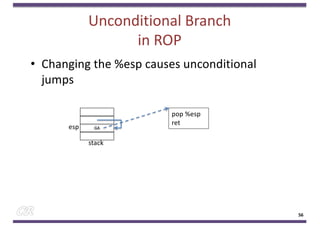
Unconditional Branch
in ROP
• Changing the %esp causes unconditional
jumps
56
GA
stack
esp
pop %esp
ret
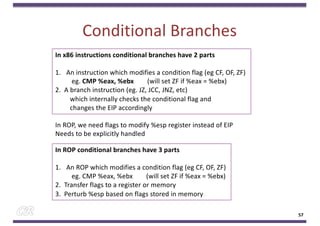
Conditional Branches
57
In x86 instructions conditional branches have 2 parts
1. An instruction which modifies a condition flag (eg CF, OF, ZF)
eg. CMP %eax, %ebx (will set ZF if %eax = %ebx)
2. A branch instruction (eg. JZ, JCC, JNZ, etc)
which internally checks the conditional flag and
changes the EIP accordingly
In ROP conditional branches have 3 parts
1. An ROP which modifies a condition flag (eg CF, OF, ZF)
eg. CMP %eax, %ebx (will set ZF if %eax = %ebx)
2. Transfer flags to a register or memory
3. Perturb %esp based on flags stored in memory
In ROP, we need flags to modify %esp register instead of EIP
Needs to be explicitly handled
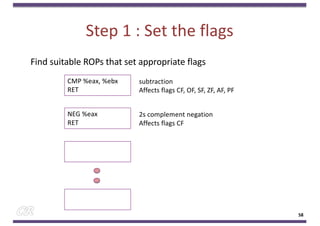
Step 1 : Set the flags
Find suitable ROPs that set appropriate flags
58
CMP %eax, %ebx
RET
subtraction
Affects flags CF, OF, SF, ZF, AF, PF
NEG %eax
RET
2s complement negation
Affects flags CF
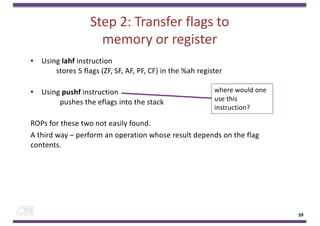
Step 2: Transfer flags to
memory or register
• Using lahf instruction
stores 5 flags (ZF, SF, AF, PF, CF) in the %ah register
• Using pushf instruction
pushes the eflags into the stack
ROPs for these two not easily found.
A third way – perform an operation whose result depends on the flag
contents.
59
where would one
use this
instruction?
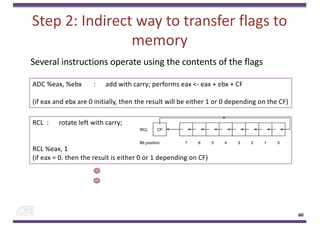
Step 2: Indirect way to transfer flags to
memory
Several instructions operate using the contents of the flags
60
ADC %eax, %ebx : add with carry; performs eax <- eax + ebx + CF
(if eax and ebx are 0 initially, then the result will be either 1 or 0 depending on the CF)
RCL : rotate left with carry;
RCL %eax, 1
(if eax = 0. then the result is either 0 or 1 depending on CF)
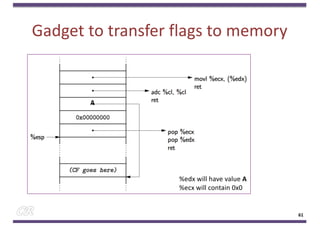
Gadget to transfer flags to memory
61
%edx will have value A
%ecx will contain 0x0
A
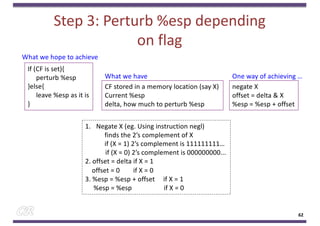
Step 3: Perturb %esp depending
on flag
62
If (CF is set){
perturb %esp
}else{
leave %esp as it is
}
What we hope to achieve
CF stored in a memory location (say X)
Current %esp
delta, how much to perturb %esp
What we have
negate X
offset = delta & X
%esp = %esp + offset
One way of achieving …
1. Negate X (eg. Using instruction negl)
finds the 2’s complement of X
if (X = 1) 2’s complement is 111111111…
if (X = 0) 2’s complement is 000000000...
2. offset = delta if X = 1
offset = 0 if X = 0
3. %esp = %esp + offset if X = 1
%esp = %esp if X = 0
Turing Complete
• Gadgets can do much more…
invoke libc functions,
invoke system calls, ...
• For x86, gadgets are said to be turning complete
– Can program just about anything with gadgets
• For RISC processors, more difficult to find gadgets
– Instructions are fixed width
– Therefore can’t find unintentional instructions
• Tools available to find gadgets automatically
Eg. ROPGadget (https://github.com/JonathanSalwan/ROPgadget)
Ropper (https://github.com/sashs/Ropper)
63
Address Space Layout Randomization
(ASLR)
64
The Attacker’s Plan
• Find the bug in the source code (for eg. Kernel) that can be
exploited
– Eyeballing
– Noticing something in the patches
– Following CVE
• Use that bug to insert malicious code to perform something
nefarious
– Such as getting root privileges in the kernel
Attacker depends upon knowning where these functions reside in
memory. Assumes that many systems use the same address mapping.
Therefore one exploit may spread easily
65
Address Space Randomization
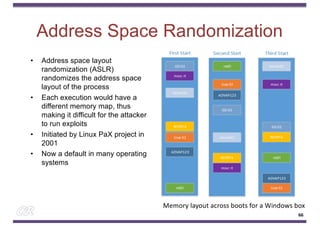
• Address space layout
randomization (ASLR)
randomizes the address space
layout of the process
• Each execution would have a
different memory map, thus
making it difficult for the attacker
to run exploits
• Initiated by Linux PaX project in
2001
• Now a default in many operating
systems
66
Memory layout across boots for a Windows box
ASLR in the Linux Kernel
• Locations of the base, libraries, heap, and stack can be randomized in a
process’ address space
• Built into the Linux kernel and controlled by
/proc/sys/kernel/randomize_va_space
• randomize_va_space can take 3 values
0 : disable ASLR
1 : positions of stack, VDSO, shared memory regions are randomized
the data segment is immediately after the executable code
2 : (default setting) setting 1 as well as the data segment location is
randomized
67
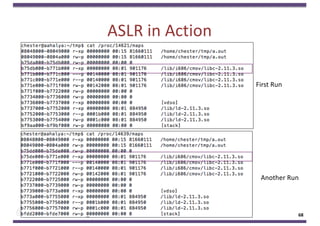
ASLR in Action
68
First Run
Another Run
ASLR in the Linux Kernel
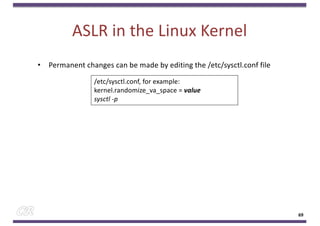
• Permanent changes can be made by editing the /etc/sysctl.conf file
69
/etc/sysctl.conf, for example:
kernel.randomize_va_space = value
sysctl -p
Internals : Making code relocatable
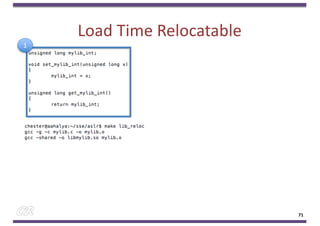
• Load time relocatable
– where the loader modifies a program executable so
that all addresses are adjusted properly
– Relocatable code
• Slow load time since executable code needs to be modified.
• Requires a writeable code segment, which could pose
problems
• PIE : position independent executable
– a.k.a PIC (position independent code)
– code that executes properly irrespective of its absolute address
– Used extensively in shared libraries
• Easy to find a location where to load them without overlapping with
other modules
70
Load Time Relocatable
71
1
Load Time Relocatable
72
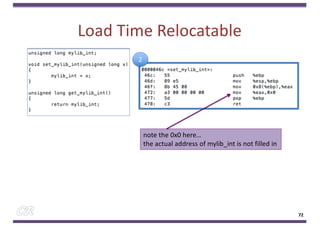
note the 0x0 here…
the actual address of mylib_int is not filled in
2
Load Time Relocatable
73
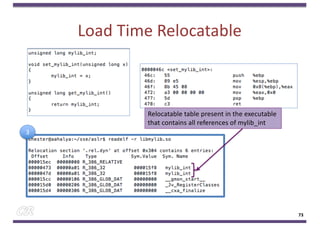
Relocatable table present in the executable
that contains all references of mylib_int
3
Load Time Relocatable
74
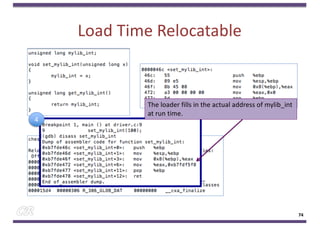
The loader fills in the actual address of mylib_int
at run time.
4
Load Time Relocatable
75
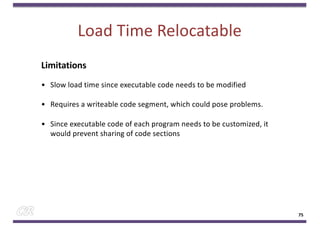
Limitations
• Slow load time since executable code needs to be modified
• Requires a writeable code segment, which could pose problems.
• Since executable code of each program needs to be customized, it
would prevent sharing of code sections
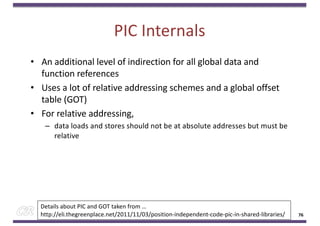
PIC Internals
• An additional level of indirection for all global data and
function references
• Uses a lot of relative addressing schemes and a global offset
table (GOT)
• For relative addressing,
– data loads and stores should not be at absolute addresses but must be
relative
76
Details about PIC and GOT taken from …
http://eli.thegreenplace.net/2011/11/03/position-independent-code-pic-in-shared-libraries/
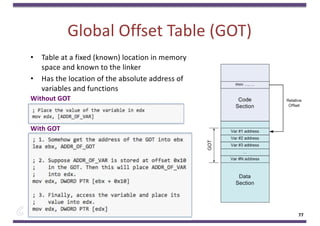
Global Offset Table (GOT)
• Table at a fixed (known) location in memory
space and known to the linker
• Has the location of the absolute address of
variables and functions
77
Without GOT
With GOT
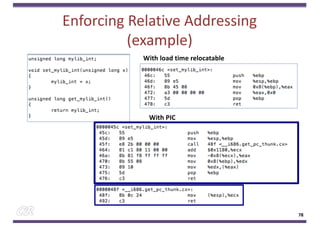
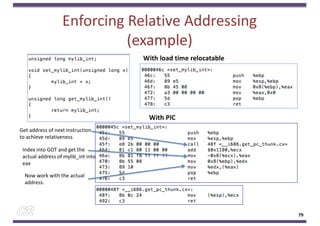
Enforcing Relative Addressing
(example)
78
With load time relocatable
With PIC
Enforcing Relative Addressing
(example)
79
With load time relocatable
With PIC
Get address of next instruction
to achieve relativeness
Index into GOT and get the
actual address of mylib_int into
eax
Now work with the actual
address.
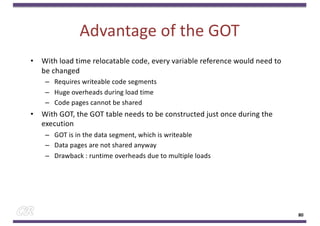
Advantage of the GOT
• With load time relocatable code, every variable reference would need to
be changed
– Requires writeable code segments
– Huge overheads during load time
– Code pages cannot be shared
• With GOT, the GOT table needs to be constructed just once during the
execution
– GOT is in the data segment, which is writeable
– Data pages are not shared anyway
– Drawback : runtime overheads due to multiple loads
80
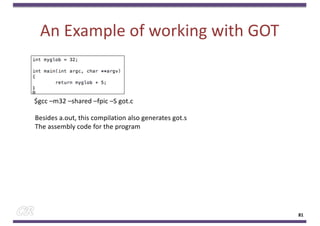
An Example of working with GOT
81
$gcc –m32 –shared –fpic –S got.c
Besides a.out, this compilation also generates got.s
The assembly code for the program
82
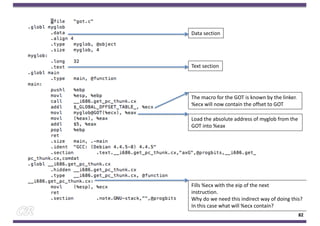
Data section
Text section
Fills %ecx with the eip of the next
instruction.
Why do we need this indirect way of doing this?
In this case what will %ecx contain?
The macro for the GOT is known by the linker.
%ecx will now contain the offset to GOT
Load the absolute address of myglob from the
GOT into %eax
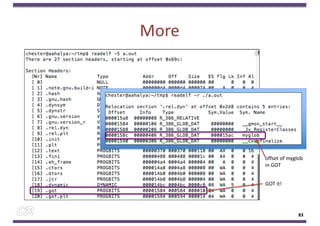
More
83
offset of myglob
in GOT
GOT it!
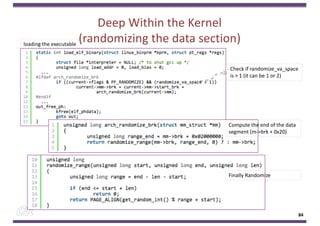
Deep Within the Kernel
(randomizing the data section)
84
loading the executable
Check if randomize_va_space
is > 1 (it can be 1 or 2)
Compute the end of the data
segment (m->brk + 0x20)
Finally Randomize
Function Calls in PIC
• Theoretically could be done similar with the data…
– call instruction gets location from GOT entry that is filled in during load
time (this process is called binding)
– In practice, this is time consuming. Much more functions than global
variables. Most functions in libraries are unused
• Lazy binding scheme
– Delay binding till invocation of the function
– Uses a double indirection – PLT – procedure linkage table in addition
to GOT
85
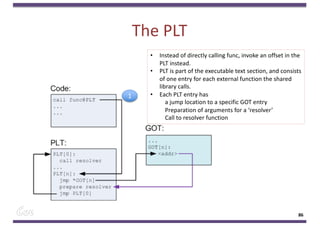
The PLT
86
1
• Instead of directly calling func, invoke an offset in the
PLT instead.
• PLT is part of the executable text section, and consists
of one entry for each external function the shared
library calls.
• Each PLT entry has
a jump location to a specific GOT entry
Preparation of arguments for a ‘resolver’
Call to resolver function
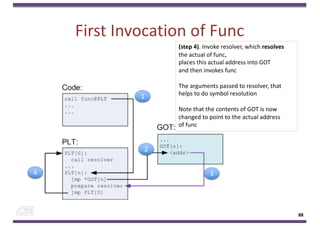
First Invocation of Func
First Invocation of fun
87
1
2
(steps 2 and 3)
On first invocation of func, PLT[n]
jumps to GOT[n], which simply jumps
back to PLT[n]
3
First Invocation of Func
88
1
2
(step 4). Invoke resolver, which resolves
the actual of func,
places this actual address into GOT
and then invokes func
The arguments passed to resolver, that
helps to do symbol resolution
Note that the contents of GOT is now
changed to point to the actual address
of func
3
4
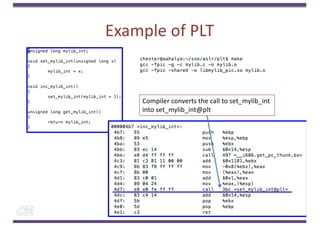
Example of PLT
89
Compiler converts the call to set_mylib_int
into set_mylib_int@plt
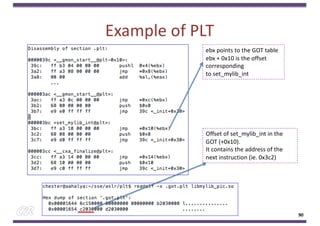
Example of PLT
90
ebx points to the GOT table
ebx + 0x10 is the offset
corresponding
to set_mylib_int
Offset of set_mylib_int in the
GOT (+0x10).
It contains the address of the
next instruction (ie. 0x3c2)
Example of PLT
91
Push arguments for the
resolver.
Jump to the first entry of the PLT
Ie. PLT[0]
Jump to the resolver, which
resolves the actual address
of set_mylib_int and fills it
into the GOT
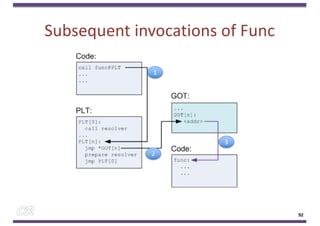
Subsequent invocations of Func
92
1
2
3
Advantages
• Functions are relocatable, therefore good for ASLR
• Functions resolved only on need, therefore saves
time during the load phase
93
Bypassing ASLR
• Brute force
• Return-to-PLT
• Overwriting the GOT
• Timing Attacks
94
Safer Programming Languages,
and Compiler Techniques
95
Other Precautions for buffer overflows
• Enforce memory safety in programming language
– Example java, C# (slow and not feasible for system programming)
• Cannot replace C and C++.
(Too much software already developed in C / C++)
– Newer languages like Rust seem promising
• Use securer libraries. For example C11 annex K, gets_s, strcpy_s,
strncpy_s, etc.
(_s is for secure)
96
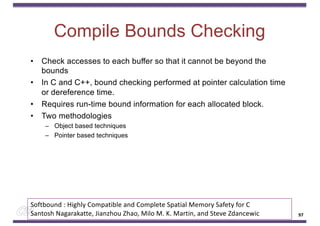
Compile Bounds Checking
• Check accesses to each buffer so that it cannot be beyond the
bounds
• In C and C++, bound checking performed at pointer calculation time
or dereference time.
• Requires run-time bound information for each allocated block.
• Two methodologies
– Object based techniques
– Pointer based techniques
97
Softbound : Highly Compatible and Complete Spatial Memory Safety for C
Santosh Nagarakatte, Jianzhou Zhao, Milo M. K. Martin, and Steve Zdancewic
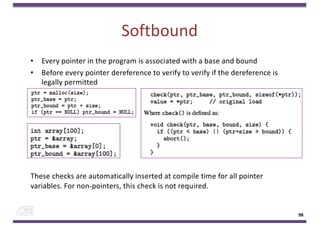
Softbound
• Every pointer in the program is associated with a base and bound
• Before every pointer dereference to verify to verify if the dereference is
legally permitted
These checks are automatically inserted at compile time for all pointer
variables. For non-pointers, this check is not required.
98
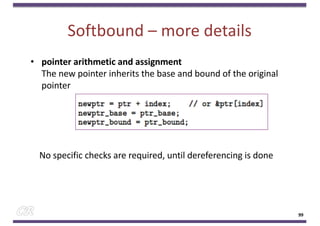
Softbound – more details
• pointer arithmetic and assignment
The new pointer inherits the base and bound of the original
pointer
No specific checks are required, until dereferencing is done
99
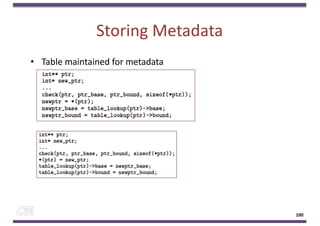
Storing Metadata
• Table maintained for metadata
100
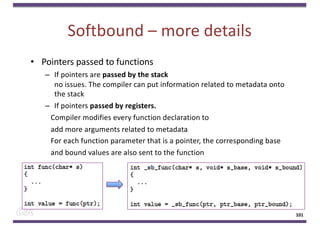
Softbound – more details
• Pointers passed to functions
– If pointers are passed by the stack
no issues. The compiler can put information related to metadata onto
the stack
– If pointers passed by registers.
Compiler modifies every function declaration to
add more arguments related to metadata
For each function parameter that is a pointer, the corresponding base
and bound values are also sent to the function
101
Buffer Overflows in cybersecurity notes .pdf

  • 1.
    Binary Exploitation 1 BufferOverflows (return-to-libc, ROP, Canaries, W^X, ASLR) Chester Rebeiro Indian Institute of Technology Madras
  • 2.
    Parts of Malware •Two parts Subvert execution: change the normal execution behavior of the program Payload: the code which the attacker wants to execute 2
  • 3.
    Subvert Execution • Inapplication software – SQL Injection • In system software – Buffers overflows and overreads – Heap: double free, use after free – Integer overflows – Format string – Control Flow • In peripherials – USB drives; Printers • In Hardware – Hardware Trojans • Covert Channels – Can exist in hardware or software 3 These do not really subvert execution, but can lead to confidentiality attacks.
  • 4.
    Buffer Overflows inthe Stack • We need to first know how a stack is managed http://insecure.org/stf/smashstack.html 4
  • 5.
    Stack in aProgram (when function is executing) EBP Parameters for function return Address Locals of function prev frame pointer push $3 push $2 push $1 Stack call function push %ebp movl %esp, %ebp sub $20, %esp %ebp: Frame Pointer In main In function ESP ESP ESP ESP ESP ESP %esp : Stack Pointer 5
  • 6.
    Stack Usage (example) Stack(top to bottom): address stored data 1000 to 997 3 996 to 993 2 992 to 989 1 988 to 985 return address 984 to 981 %ebp (stored frame pointer) (%ebp)980 to 976 buffer1 975 to 966 buffer2 (%sp) 964 stack pointer Parameters for function Return Address Locals of function prev frame pointer frame pointer 6
  • 7.
    Stack Usage Contd. Stack(top to bottom): address stored data 1000 to 997 3 996 to 993 2 992 to 989 1 988 to 985 return address 984 to 981 %ebp (stored frame pointer) (%ebp)980 to 976 buffer1 975 to 966 buffer2 (%sp) 964 What is the output of the following? • printf(“%x”, buffer2) : 966 • printf(“%x”, &buffer2[10]) 976 à buffer1 Therefore buffer2[10] = buffer1[0] A BUFFER OVERFLOW 7
  • 8.
    Modifying the ReturnAddress buffer2[19] = &arbitrary memory location This causes execution of an arbitrary memory location instead of the standard return Stack (top to bottom): address stored data 1000 to 997 3 996 to 993 2 992 to 989 1 988 to 985 984 to 981 %ebp (stored frame pointer) (%ebp)980 to 976 buffer1 976 to 966 buffer2 (%sp) 964 Return Address 19 Arbitrary Location 8
  • 9.
    Now that weseen how buffer overflows can skip an instruction, We will see how an attacker can use it to execute his own code (exploit code) Stack (top to bottom): address stored data 1000 to 997 3 996 to 993 2 992 to 989 1 988 to 985 ATTACKER’S code pointer 984 to 981 %ebp (stored frame pointer) (%ebp)980 to 976 buffer1 976 to 966 buffer2 (%sp) 964 9
  • 10.
    Big Picture ofthe exploit Fill the stack as follows (where BA is buffer address) stack pointer Parameters for function Return Address buffer prev frame pointer frame pointer Exploit code BA BA buffer Address BA BA BA BA BA BA BA 10
  • 11.
    Payload • Lets saythe attacker wants to spawn a shell • ie. do as follows: • How does he put this code onto the stack? 11
  • 12.
    Step 1 :Get machine codes • objdump –disassemble-all shellcode.o • Get machine code : “eb 1e 5e 89 76 08 c6 46 07 00 c7 46 0c 00 00 00 00 b8 0b 00 00 00 89 f3 8d 4e 08 8d 56 0c cd 80 cd 80” • If there are 00s replace it with other instructions 12
  • 13.
    Step 2: FindBuffer overflow in an application O O O O o Defined on stack 13
  • 14.
    Step 3 : PutMachine Code in Large String shellcode large_string 14
  • 15.
    Step 3 (contd): Fill up Large String with BA shellcode BA BA BA BA BA BA BA BA large_string Address of buffer is BA 15
  • 16.
    Final state ofStack • Copy large string into buffer • When strcpy returns the exploit code would be executed shellcode BA BA BA BA BA BA BA BA large_string shellcode BA BA buffer Address BA BA BA BA BA BA BA buffer BA 16
  • 17.
    Putting it alltogether bash$ gcc overflow1.c bash$ ./a.out $sh 17
  • 18.
    Buffer overflow inthe Wild • Worm CODERED … released on 13th July 2001 • Infected 3,59,000 computers by 19th July. 18
  • 19.
    Defenses • Eliminate programflaws that could lead to subverting of execution Safer programming languages; Safer libraries; hardware enhancements; static analysis • If can’t eliminate, make it more difficult for malware to subvert execution W^X , ASLR, canaries • If malware still manages to execute, try to detect its execution at runtime malware run-time detection techniques using learning techniques, ANN and malware signatures • If can’t detect at runtime, try to restrict what the malware can do.. – Sandbox system so that malware affects only part of the system; access control; virtualization; trustzone; SGX – Track information flow DIFT; ensure malware does not steal sensitive information 19
  • 20.
  • 21.
    Canaries Stack (top tobottom): stored data 3 2 1 ret addr sfp (%ebp) Insert canary here buffer1 buffer2 Insert a canary here check if the canary value has got modified • Known (pseudo random) values placed on stack to monitor buffer overflows. • A change in the value of the canary indicates a buffer overflow. • Will cause a ‘stack smashing’ to be detected 21
  • 22.
    Canaries and gcc 22 •As on gcc 4.4.5, canaries are not added to functions by default o Could cause overheads as they are executed for every function that gets executed • Canaries can be added into the code by –fstack-protector option o If -fstack-protector is specified, canaries will get added based on a gcc heuristic • For example, buffer of size at-least 8 bytes is allocated • Use of string operations such as strcpy, scanf, etc. o Canaries can be evaded quite easily by not altering the contents of the canary
  • 23.
    Canaries Example 23 Without canaries,the return address on stack gets overwritten resulting in a segmentation fault. With canaries, the program gets aborted due to stack smashing.
  • 24.
    Canaries Example 24 Without canaries,the return address on stack gets overwritten resulting in a segmentation fault. With canaries, the program gets aborted due to stack smashing.
  • 25.
    Canary Internals 25 Store canaryonto stack Verify if the canary has changed Without canaries With canaries gs is a segment that shows thread local data; in this case it is used for picking out canaries
  • 26.
    Non Executable Stacks(W^X) • In Intel/AMD processors, ND/NX bit present to mark non code regions as non-executable. – Exception raised when code in a page marked W^X executes • Works for most programs – Supported by Linux kernel from 2004 – Supported by Windows XP service pack 1 and Windows Server 2003 • Called DEP – Data Execution Prevention • Does not work for some programs that NEED to execute from the stack. – Eg. JIT Compiler, constructs assembly code from external data and then executes it. (Need to disable the W^X bit, to get this to work) 26 26
  • 27.
    Will non executable stackprevent buffer overflow attacks ? Return – to – LibC Attacks (Bypassing non-executable stack during exploitation using return- to-libc attacks) 27 https://css.csail.mit.edu/6.858/2010/readings/return-to-libc.pdf 27
  • 28.
    Return to Libc (bigpicture) Exploit code BA BA BA BA BA BA BA BA buffer This will not work if ND bit is set Return Address 28 28
  • 29.
    Return to Libc (replacereturn address to point to a function within libc) F1 Addr F1 Addr F1 Addr F1 Addr F1 Addr F1 Addr F1 Addr F1 Addr buffer Return Address 29 F1 Addr Stack Heap Data Text Bypasses W^X since F1 is in the code segment, And can be legally executed. 29
  • 30.
    F1 = system() •One option is function system present in libc system(“/bin/bash”); would create a bash shell (there could be other options as well) So we need to 1. Find the address of system in the program (does not have to be a user specified function, could be a function present in one of the linked libraries) 2. Supply an address that points to the string /bin/sh 30 30
  • 31.
    The return-to-libc attack F1ptr F1ptr F1ptr F1ptr F1ptr Shellptr F1 ptr F1ptr buffer F1ptr Return Address system() In libc /bin/bash 31 31
  • 32.
    Find address ofsystem in the executable 32 32
  • 33.
    Find address of/bin/sh • Every process stores the enviroment variables at the bottom of the stack • We need to find this and extract the string /bin/sh from it 33 33
  • 34.
    Finding the addressof the string /bin/sh 34
  • 35.
    The final ExploitStack xxx xxx xxx 0x28085260 dead 0xbfbffe25 xxx xxx buffer xxx Return Address system() In libc /bin/sh 35
  • 36.
  • 37.
    Limitation of ret2libc Limitationon what the attacker can do (only restricted to certain functions in the library) These functions could be removed from the library 37 37
  • 38.
  • 39.
    Return Oriented ProgrammingAttacks • Discovered by Hovav Shacham of Stanford University • Subverts execution to libc – As with the regular ret-2-libc, can be used with non executable stacks since the instructions can be legally execute – Unlike ret-2-libc does not require to execute functions in libc (can execute any arbitrary code) 39 The Geometry of Innocent Flesh on the Bone: Return-into-libc without Function Calls (on the x86
  • 40.
    Target Payload Lets saythis is the payload needed to be executed by an attacker. Suppose there is a function in libc, which has exactly this sequence of instructions … then we are done.. we just need to subvert execution to the function What if such a function does not exist? If you can’t find it then build it 40
  • 41.
    Step 1: FindGadgets • Find gadgets • A gadget is a short sequence of instructions followed by a return • Useful instructions : should not transfer control outside the gadget • This is a pre-processing step by statically analyzing the libc library useful instruction(s) ret 41
  • 42.
    Step 2: Stitching •Stitch gadgets so that the payload is built Program Binary movl %esi, 0x8(%esi) ret G1 movb $0x0, 0x7(%esi) ret G2 movb $0x0, 0xc(%esi) ret G3 movl $0xb, %eax ret G4 42 Ret instruction has 2 steps: • Pops the contents pointed to by ESP into EIP • Increment ESP by 4 (32bit machine)
  • 43.
    Step 3: Constructthe Stack 43 xxx xxx xxx AG1 AG2 AG3 AG4 xxx buffer xxx Return Address Program Binary movl %esi, 0x8(%esi) ret G1 movb $0x0, 0x7(%esi) ret G2 movb $0x0, 0xc(%esi) ret G3 movl $0xb, %eax ret G4 Program Stack AGi: Address of Gadget i
  • 44.
    Finding Gadgets • Staticanalysis of libc • To find 1. A set of instructions that end in a ret (0xc3) The instructions can be intended (put in by the compiler) or unintended 2. Besides ret, none of the instructions transfer control out of the gadget 44
  • 45.
    Intended vs UnintendedInstructions • Intended : machine code intentionally put in by the compiler • Unintended : interpret machine code differently in order to build new instructions 45 F7 C7 07 00 00 00 0F 95 45 C3 Machine Code : What the compiler intended.. What was not ntended Highly likely to find many diverse instructions of this form in x86; not so likely to have such diverse instructions in RISC processors
  • 46.
    Geometry • Given anarbitrary string of machine code, what is the probability that the code can be interpreted as useful instructions. – x86 code is highly dense – RISC processors like (SPARC, ARM, etc.) have low geometry • Thus finding gadgets in x86 code is considerably more easier than that of ARM or SPARC • Fixed length instruction set reduces geometry 46
  • 47.
    Finding Gadgets • Staticanalysis of libc • Find any memory location with 0xc3 (RETurn instruction) • Build a trie data structure with 0xc3 as a root • Every path (starting from any node, not just the leaf) to the root is a possible gadget 47 C 3 00 24 37 24 46 43 16 89 94 child of
  • 48.
    Finding Gadgets • Scanlibc from the beginning toward the end • If 0xc3 is found – Start scanning backward – With each byte, ask the question if the subsequence forms a valid instruction – If yes, add as child – If no, go backwards until we reach the maximum instruction length (20 bytes) – Repeat this till (a predefined) length W, which is the max instructions in the gadget 48 33 b2 23 12 a0 31 a5 67 22 ab ba 4a 3c c3 ff ee ab 31 11 09
  • 49.
  • 50.
    Finding Gadgets Algorithm 50 isthis sequence of instructions valid x86 instruction? Boring: not interesting to look further; Eg. pop %ebp; ret;;;; leave; ret (these are boring if we want to ignore intended instructions) Jump out of the gadget instructions Found 15,121 nodes in ~1MB of libc binary
  • 51.
    More about Gadgets •Example Gadgets – Loading a constant into a register (edx ß deadbeef) 51 deadbeef GadgetAdd stack pop %edx ret esp • A previous return will pop the gadget address int %eip • %esp will also be incremented to point to deadbeef (4 bytes on 32 bit platform) • The pop %edx will pop deadbeef onto the stack and increment %esp to point to the next 4 bytes on the stack
  • 52.
    Stitch 52 pop %edx ret G1 mov 64(%edx),%eax ret G2 G2 addr G1 stack esp deadbeef +64 Load arbitrary data into eax register using Gadgets G1 and G2
  • 53.
    Store Gadget • Storethe contents of a register to a memory location in the stack 53 GadgetAddr 2 0 GadgetAddr 1 stack pop %edx ret esp mov %eax, 24(%edx) ret 24
  • 54.
    Gadget for addition 54 addl(%edx), %eax push %edi ret Add the memory pointed to by %edx to %eax. The result is stored in %eax pushes %edi.. onto the stack why is this present? …. This is unnecessary, but this is best gadget that we can find for addition But can create problems!! We need work arounds! GadgetAddr2 GadgetAddr stack esp Modified
  • 55.
    Gadget for addition (put0xc3 into %edi) 55 addl (%edx), %eax push %edi ret 1. First put gadget ptr for 0xC3 into %edi 2. 0xC3 corresponds to NOP in ROP 3. Push %edi in gadget 2 just pushes 0xc3 back into the stack Therefore not disturbing the stack contents 4. Gadget 3 executes as planned GadgetAddr3 Gadget_RET GadgetAddr2 Gadget_RET GadgetAddr1 stack esp 0xc3 0xc3 is ret ; in ROP ret is equivalent to NOP v pop %edi ret
  • 56.
    Unconditional Branch in ROP •Changing the %esp causes unconditional jumps 56 GA stack esp pop %esp ret
  • 57.
    Conditional Branches 57 In x86instructions conditional branches have 2 parts 1. An instruction which modifies a condition flag (eg CF, OF, ZF) eg. CMP %eax, %ebx (will set ZF if %eax = %ebx) 2. A branch instruction (eg. JZ, JCC, JNZ, etc) which internally checks the conditional flag and changes the EIP accordingly In ROP conditional branches have 3 parts 1. An ROP which modifies a condition flag (eg CF, OF, ZF) eg. CMP %eax, %ebx (will set ZF if %eax = %ebx) 2. Transfer flags to a register or memory 3. Perturb %esp based on flags stored in memory In ROP, we need flags to modify %esp register instead of EIP Needs to be explicitly handled
  • 58.
    Step 1 :Set the flags Find suitable ROPs that set appropriate flags 58 CMP %eax, %ebx RET subtraction Affects flags CF, OF, SF, ZF, AF, PF NEG %eax RET 2s complement negation Affects flags CF
  • 59.
    Step 2: Transferflags to memory or register • Using lahf instruction stores 5 flags (ZF, SF, AF, PF, CF) in the %ah register • Using pushf instruction pushes the eflags into the stack ROPs for these two not easily found. A third way – perform an operation whose result depends on the flag contents. 59 where would one use this instruction?
  • 60.
    Step 2: Indirectway to transfer flags to memory Several instructions operate using the contents of the flags 60 ADC %eax, %ebx : add with carry; performs eax <- eax + ebx + CF (if eax and ebx are 0 initially, then the result will be either 1 or 0 depending on the CF) RCL : rotate left with carry; RCL %eax, 1 (if eax = 0. then the result is either 0 or 1 depending on CF)
  • 61.
    Gadget to transferflags to memory 61 %edx will have value A %ecx will contain 0x0 A
  • 62.
    Step 3: Perturb%esp depending on flag 62 If (CF is set){ perturb %esp }else{ leave %esp as it is } What we hope to achieve CF stored in a memory location (say X) Current %esp delta, how much to perturb %esp What we have negate X offset = delta & X %esp = %esp + offset One way of achieving … 1. Negate X (eg. Using instruction negl) finds the 2’s complement of X if (X = 1) 2’s complement is 111111111… if (X = 0) 2’s complement is 000000000... 2. offset = delta if X = 1 offset = 0 if X = 0 3. %esp = %esp + offset if X = 1 %esp = %esp if X = 0
  • 63.
    Turing Complete • Gadgetscan do much more… invoke libc functions, invoke system calls, ... • For x86, gadgets are said to be turning complete – Can program just about anything with gadgets • For RISC processors, more difficult to find gadgets – Instructions are fixed width – Therefore can’t find unintentional instructions • Tools available to find gadgets automatically Eg. ROPGadget (https://github.com/JonathanSalwan/ROPgadget) Ropper (https://github.com/sashs/Ropper) 63
  • 64.
    Address Space LayoutRandomization (ASLR) 64
  • 65.
    The Attacker’s Plan •Find the bug in the source code (for eg. Kernel) that can be exploited – Eyeballing – Noticing something in the patches – Following CVE • Use that bug to insert malicious code to perform something nefarious – Such as getting root privileges in the kernel Attacker depends upon knowning where these functions reside in memory. Assumes that many systems use the same address mapping. Therefore one exploit may spread easily 65
  • 66.
    Address Space Randomization •Address space layout randomization (ASLR) randomizes the address space layout of the process • Each execution would have a different memory map, thus making it difficult for the attacker to run exploits • Initiated by Linux PaX project in 2001 • Now a default in many operating systems 66 Memory layout across boots for a Windows box
  • 67.
    ASLR in theLinux Kernel • Locations of the base, libraries, heap, and stack can be randomized in a process’ address space • Built into the Linux kernel and controlled by /proc/sys/kernel/randomize_va_space • randomize_va_space can take 3 values 0 : disable ASLR 1 : positions of stack, VDSO, shared memory regions are randomized the data segment is immediately after the executable code 2 : (default setting) setting 1 as well as the data segment location is randomized 67
  • 68.
    ASLR in Action 68 FirstRun Another Run
  • 69.
    ASLR in theLinux Kernel • Permanent changes can be made by editing the /etc/sysctl.conf file 69 /etc/sysctl.conf, for example: kernel.randomize_va_space = value sysctl -p
  • 70.
    Internals : Makingcode relocatable • Load time relocatable – where the loader modifies a program executable so that all addresses are adjusted properly – Relocatable code • Slow load time since executable code needs to be modified. • Requires a writeable code segment, which could pose problems • PIE : position independent executable – a.k.a PIC (position independent code) – code that executes properly irrespective of its absolute address – Used extensively in shared libraries • Easy to find a location where to load them without overlapping with other modules 70
  • 71.
  • 72.
    Load Time Relocatable 72 notethe 0x0 here… the actual address of mylib_int is not filled in 2
  • 73.
    Load Time Relocatable 73 Relocatabletable present in the executable that contains all references of mylib_int 3
  • 74.
    Load Time Relocatable 74 Theloader fills in the actual address of mylib_int at run time. 4
  • 75.
    Load Time Relocatable 75 Limitations •Slow load time since executable code needs to be modified • Requires a writeable code segment, which could pose problems. • Since executable code of each program needs to be customized, it would prevent sharing of code sections
  • 76.
    PIC Internals • Anadditional level of indirection for all global data and function references • Uses a lot of relative addressing schemes and a global offset table (GOT) • For relative addressing, – data loads and stores should not be at absolute addresses but must be relative 76 Details about PIC and GOT taken from … http://eli.thegreenplace.net/2011/11/03/position-independent-code-pic-in-shared-libraries/
  • 77.
    Global Offset Table(GOT) • Table at a fixed (known) location in memory space and known to the linker • Has the location of the absolute address of variables and functions 77 Without GOT With GOT
  • 78.
  • 79.
    Enforcing Relative Addressing (example) 79 Withload time relocatable With PIC Get address of next instruction to achieve relativeness Index into GOT and get the actual address of mylib_int into eax Now work with the actual address.
  • 80.
    Advantage of theGOT • With load time relocatable code, every variable reference would need to be changed – Requires writeable code segments – Huge overheads during load time – Code pages cannot be shared • With GOT, the GOT table needs to be constructed just once during the execution – GOT is in the data segment, which is writeable – Data pages are not shared anyway – Drawback : runtime overheads due to multiple loads 80
  • 81.
    An Example ofworking with GOT 81 $gcc –m32 –shared –fpic –S got.c Besides a.out, this compilation also generates got.s The assembly code for the program
  • 82.
    82 Data section Text section Fills%ecx with the eip of the next instruction. Why do we need this indirect way of doing this? In this case what will %ecx contain? The macro for the GOT is known by the linker. %ecx will now contain the offset to GOT Load the absolute address of myglob from the GOT into %eax
  • 83.
  • 84.
    Deep Within theKernel (randomizing the data section) 84 loading the executable Check if randomize_va_space is > 1 (it can be 1 or 2) Compute the end of the data segment (m->brk + 0x20) Finally Randomize
  • 85.
    Function Calls inPIC • Theoretically could be done similar with the data… – call instruction gets location from GOT entry that is filled in during load time (this process is called binding) – In practice, this is time consuming. Much more functions than global variables. Most functions in libraries are unused • Lazy binding scheme – Delay binding till invocation of the function – Uses a double indirection – PLT – procedure linkage table in addition to GOT 85
  • 86.
    The PLT 86 1 • Insteadof directly calling func, invoke an offset in the PLT instead. • PLT is part of the executable text section, and consists of one entry for each external function the shared library calls. • Each PLT entry has a jump location to a specific GOT entry Preparation of arguments for a ‘resolver’ Call to resolver function
  • 87.
    First Invocation ofFunc First Invocation of fun 87 1 2 (steps 2 and 3) On first invocation of func, PLT[n] jumps to GOT[n], which simply jumps back to PLT[n] 3
  • 88.
    First Invocation ofFunc 88 1 2 (step 4). Invoke resolver, which resolves the actual of func, places this actual address into GOT and then invokes func The arguments passed to resolver, that helps to do symbol resolution Note that the contents of GOT is now changed to point to the actual address of func 3 4
  • 89.
    Example of PLT 89 Compilerconverts the call to set_mylib_int into set_mylib_int@plt
  • 90.
    Example of PLT 90 ebxpoints to the GOT table ebx + 0x10 is the offset corresponding to set_mylib_int Offset of set_mylib_int in the GOT (+0x10). It contains the address of the next instruction (ie. 0x3c2)
  • 91.
    Example of PLT 91 Pusharguments for the resolver. Jump to the first entry of the PLT Ie. PLT[0] Jump to the resolver, which resolves the actual address of set_mylib_int and fills it into the GOT
  • 92.
  • 93.
    Advantages • Functions arerelocatable, therefore good for ASLR • Functions resolved only on need, therefore saves time during the load phase 93
  • 94.
    Bypassing ASLR • Bruteforce • Return-to-PLT • Overwriting the GOT • Timing Attacks 94
  • 95.
    Safer Programming Languages, andCompiler Techniques 95
  • 96.
    Other Precautions forbuffer overflows • Enforce memory safety in programming language – Example java, C# (slow and not feasible for system programming) • Cannot replace C and C++. (Too much software already developed in C / C++) – Newer languages like Rust seem promising • Use securer libraries. For example C11 annex K, gets_s, strcpy_s, strncpy_s, etc. (_s is for secure) 96
  • 97.
    Compile Bounds Checking •Check accesses to each buffer so that it cannot be beyond the bounds • In C and C++, bound checking performed at pointer calculation time or dereference time. • Requires run-time bound information for each allocated block. • Two methodologies – Object based techniques – Pointer based techniques 97 Softbound : Highly Compatible and Complete Spatial Memory Safety for C Santosh Nagarakatte, Jianzhou Zhao, Milo M. K. Martin, and Steve Zdancewic
  • 98.
    Softbound • Every pointerin the program is associated with a base and bound • Before every pointer dereference to verify to verify if the dereference is legally permitted These checks are automatically inserted at compile time for all pointer variables. For non-pointers, this check is not required. 98
  • 99.
    Softbound – moredetails • pointer arithmetic and assignment The new pointer inherits the base and bound of the original pointer No specific checks are required, until dereferencing is done 99
  • 100.
    Storing Metadata • Tablemaintained for metadata 100
  • 101.
    Softbound – moredetails • Pointers passed to functions – If pointers are passed by the stack no issues. The compiler can put information related to metadata onto the stack – If pointers passed by registers. Compiler modifies every function declaration to add more arguments related to metadata For each function parameter that is a pointer, the corresponding base and bound values are also sent to the function 101