TRANSMISSION LINE
• What is it?
• Uses?
• Practical Application?
*Coaxial cable *Microstrip *Stripline
*Balanced lines *Twisted pair *Star quad
*Over-Head Trasnmission Line
*Cables
OVER HEAD POWER LINES
 What are they?
 What are they used for?
 Materials?
 Use?
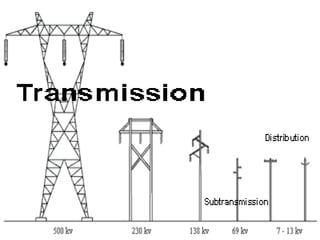
 Operating Voltages?
CLASSIFICATION OF OHTL
 Low Voltage <1000 volts
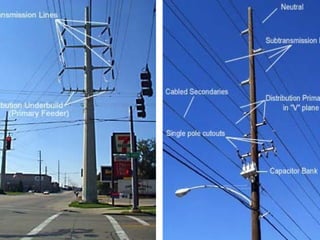
 Medium Voltage(Distribution) b/w 1kv-33kv
 High Voltage(subtransmission) <100 kv
*Use?
• Extra High Voltage Transmission >230 kv
-800 kv
• Ultra High Voltage Transmission >800 kv
CONDUCTOR
A conductor is a material that facilitates
the flow of electricity (or electric current)
through a transmission line.
• Copper
• Steel
• Aluminium
• ACSR
COPPER
• Abundantly available.
• Excellent conductor.
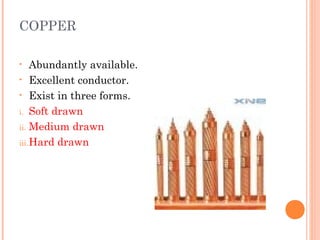
• Exist in three forms.
i. Soft drawn
ii. Medium drawn
iii.Hard drawn
COPPER
 Soft-drawn copper conductors are commonly used in
short transmission line spans and to ground
electrical systems. They are flexible and resistant to
breaking even under high stress.
 Medium-drawn copper conductors are used for
medium-range distribution lines.
 Hard-drawn copper conductors are used in longer
spans (greater than 200 feet) and are the strongest of
the three. Their strength, however, makes them
inflexible and often difficult to work with.
STEEL
• Not much effective.
• Rusts.(Due to which steel conductors are hardly used
alone)
• Steel conductors are commonly galvanized.
(coated with a layer of zinc to counteract their
rusting tendency)
• Three to five times stronger than copper.
conductors, and can be used for longer spans
with fewer supports.
ALUMINIUM
• Higher thermal expansion..
• Lower strength.
• Less than half the conductivity of copper..
• Light weight.(less sag)
• Cheap.
Aluminum conductors are commonly used for
higher-voltage overhead transmission lines,
power cables, busbars, motors, heating elements,
heat sinks and foil windings.
ACSR CONDUCTOR
• Steel-Reinforced Aluminium
• Used in medium-, high- and extra-high-voltage (EHV)
transmission lines.
• High-strength
• High-capacity
• Exhibit excellent conductivity
• Light weight(used in overhead transmission lines,
river crossings and longer spans)
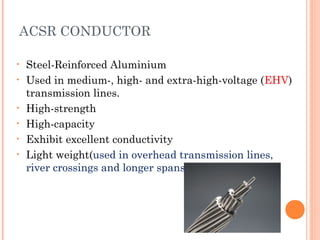
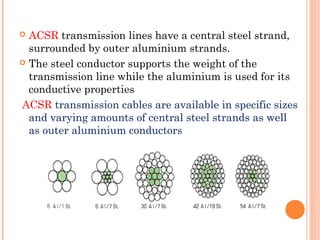
 ACSR transmission lines have a central steel strand,
surrounded by outer aluminium strands.
 The steel conductor supports the weight of the
transmission line while the aluminium is used for its
conductive properties
ACSR transmission cables are available in specific sizes
and varying amounts of central steel strands as well
as outer aluminium conductors
TYPES OF OHTL W.R.T
CONSTRUCTION
Bundle conductors
Ground wires
Insulated conductors
Circuits
BUNDLE CONDUCTORS
GROUND WIRES
INSULATED CONDUCTORS
CIRCUITS
FURTHER APPLICATIONS
Used to supply
transmitting antennas
For Train power

Over head power lines

  • 1.
    TRANSMISSION LINE • Whatis it? • Uses? • Practical Application? *Coaxial cable *Microstrip *Stripline *Balanced lines *Twisted pair *Star quad *Over-Head Trasnmission Line *Cables
  • 2.
    OVER HEAD POWERLINES  What are they?  What are they used for?  Materials?  Use?  Operating Voltages?
  • 3.
    CLASSIFICATION OF OHTL Low Voltage <1000 volts  Medium Voltage(Distribution) b/w 1kv-33kv  High Voltage(subtransmission) <100 kv *Use? • Extra High Voltage Transmission >230 kv -800 kv • Ultra High Voltage Transmission >800 kv
  • 6.
    CONDUCTOR A conductor isa material that facilitates the flow of electricity (or electric current) through a transmission line. • Copper • Steel • Aluminium • ACSR
  • 7.
    COPPER • Abundantly available. •Excellent conductor. • Exist in three forms. i. Soft drawn ii. Medium drawn iii.Hard drawn
  • 8.
    COPPER  Soft-drawn copperconductors are commonly used in short transmission line spans and to ground electrical systems. They are flexible and resistant to breaking even under high stress.  Medium-drawn copper conductors are used for medium-range distribution lines.  Hard-drawn copper conductors are used in longer spans (greater than 200 feet) and are the strongest of the three. Their strength, however, makes them inflexible and often difficult to work with.
  • 9.
    STEEL • Not mucheffective. • Rusts.(Due to which steel conductors are hardly used alone) • Steel conductors are commonly galvanized. (coated with a layer of zinc to counteract their rusting tendency) • Three to five times stronger than copper. conductors, and can be used for longer spans with fewer supports.
  • 10.
    ALUMINIUM • Higher thermalexpansion.. • Lower strength. • Less than half the conductivity of copper.. • Light weight.(less sag) • Cheap. Aluminum conductors are commonly used for higher-voltage overhead transmission lines, power cables, busbars, motors, heating elements, heat sinks and foil windings.
  • 11.
    ACSR CONDUCTOR • Steel-ReinforcedAluminium • Used in medium-, high- and extra-high-voltage (EHV) transmission lines. • High-strength • High-capacity • Exhibit excellent conductivity • Light weight(used in overhead transmission lines, river crossings and longer spans)
  • 12.
     ACSR transmissionlines have a central steel strand, surrounded by outer aluminium strands.  The steel conductor supports the weight of the transmission line while the aluminium is used for its conductive properties ACSR transmission cables are available in specific sizes and varying amounts of central steel strands as well as outer aluminium conductors
  • 13.
    TYPES OF OHTLW.R.T CONSTRUCTION Bundle conductors Ground wires Insulated conductors Circuits
  • 14.
  • 15.
  • 16.
  • 17.
  • 18.
    FURTHER APPLICATIONS Used tosupply transmitting antennas For Train power