Design of Overhead Transmission line
Conductor material
Prepared By
1
General Considerations
Electrical Considerations for T.L. Design:
• Low voltage drop
• Minimum power loss for high efficiency of
power transmission.
• The line should have sufficient current
carrying capacity so that the power can be
transmitted without excessive voltage drop
or overheating.
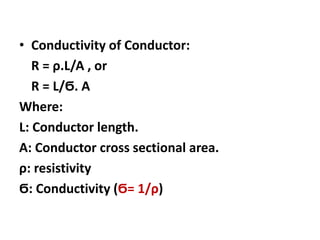
• Conductivity of Conductor:
R = ρ.L/A , or
R = L/Ϭ. A
Where:
L: Conductor length.
A: Conductor cross sectional area.
ρ: resistivity
Ϭ: Conductivity (Ϭ= 1/ρ)
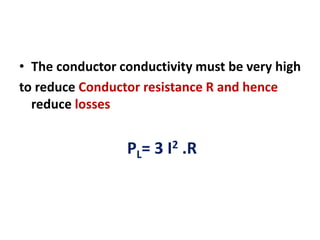
• The conductor conductivity must be very high
to reduce Conductor resistance R and hence
reduce losses
PL= 3 I2 .R
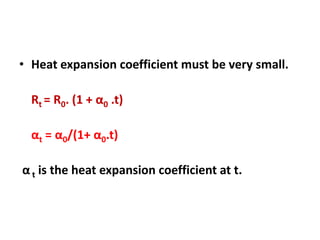
• Heat expansion coefficient must be very small.
Rt = R0. (1 + α0 .t)
αt = α0/(1+ α0.t)
α t is the heat expansion coefficient at t.
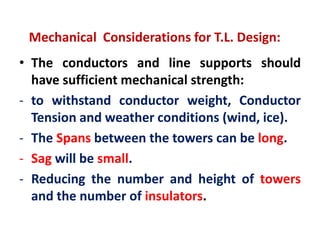
Mechanical Considerations for T.L. Design:
• The conductors and line supports should
have sufficient mechanical strength:
- to withstand conductor weight, Conductor
Tension and weather conditions (wind, ice).
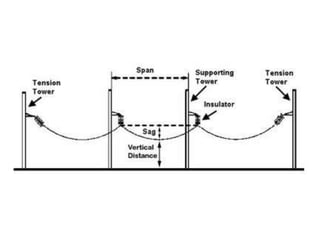
- The Spans between the towers can be long.
- Sag will be small.
- Reducing the number and height of towers
and the number of insulators.
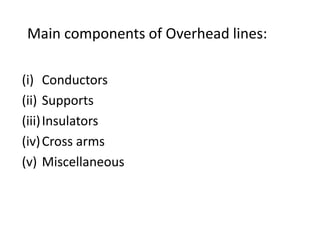
Main components of Overhead lines:
(i) Conductors
(ii) Supports
(iii)Insulators
(iv)Cross arms
(v) Miscellaneous
CONDUCTOR MATERIALS
Properties :- (i) High electrical conductivity.
(ii) High tensile strength in order to withstand mechanical
stresses.
(iii) Low cost so that it can be used for long distances
(iv) Low specific gravity so that weight per unit volume is small.
Commonly used conductor materials:-
a)Copper
b) Aluminium
c)Steel-cored aluminium
d) Galvanised steel
e)Cadmium copper
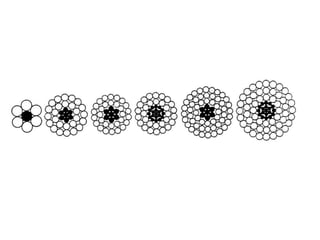
Conductors are preferably stranded to increase flexibility.
(a) Copper
• High electrical conductivity
• Greater tensile strength
• Hard drawn copper used
• High current density
• Smaller cross-sectional area required
High cost & non availability
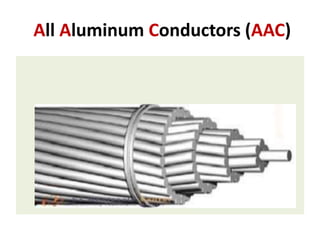
All Aluminum Conductors (AAC)
(b) Aluminium
• Cheaper & light in weight, for small span
• Small conductivity & tensile strength (60% of
copper)
• Cross-sectional area of conductor larger than
copper(Aluminium diameter= 1.26 times of
copper)
• Higher tower with greater sag
• Specific gravity lower than copper
• Larger cross-arms required
• Not suitable for long distance transmission
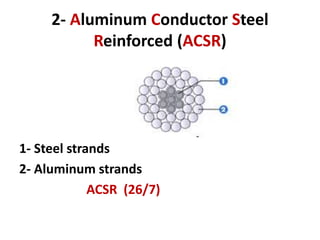
2- Aluminum Conductor Steel
Reinforced (ACSR)
1- Steel strands
2- Aluminum strands
ACSR (26/7)
(c) Steel cored aluminium:
• To increase stregth of aliminium conductors
reinforced with a core of galvanised steel
wires
• Abbreviated as ACSR(Aluminium condutor
steel reinforced)
Advantages of ACSR
• High mechanical strength can be utilized by
using spans of larger lengths.
• Tower of smaller height can be used
• A reduction in the number of supports also
include reduction in insulators and the risk of
lines outage due to flash over or faults is
reduced.
• losses are reduced due to larger diameter of
conductor.
• High current carrying capacity.
(d) Galvanised steel
• Very high tensile strength
• Long spans
• Rural areas
• Cheap
• Poor conductivity & high resistance
• Not suitable for transmitting large power over
a long distance
(e) Cadmium Copper
• Addition of 1% or 2% cadmium to copper
• Increased tensile strength by 50% than pure
copper
• Conductivity reduced by 15% below that of
pure copper
• Economical for lines of small cross-section due
to high cost of cadmium

50 ohms.ppt

  • 1.
    Design of OverheadTransmission line Conductor material Prepared By 1
  • 2.
    General Considerations Electrical Considerationsfor T.L. Design: • Low voltage drop • Minimum power loss for high efficiency of power transmission. • The line should have sufficient current carrying capacity so that the power can be transmitted without excessive voltage drop or overheating.
  • 3.
    • Conductivity ofConductor: R = ρ.L/A , or R = L/Ϭ. A Where: L: Conductor length. A: Conductor cross sectional area. ρ: resistivity Ϭ: Conductivity (Ϭ= 1/ρ)
  • 4.
    • The conductorconductivity must be very high to reduce Conductor resistance R and hence reduce losses PL= 3 I2 .R
  • 5.
    • Heat expansioncoefficient must be very small. Rt = R0. (1 + α0 .t) αt = α0/(1+ α0.t) α t is the heat expansion coefficient at t.
  • 6.
    Mechanical Considerations forT.L. Design: • The conductors and line supports should have sufficient mechanical strength: - to withstand conductor weight, Conductor Tension and weather conditions (wind, ice). - The Spans between the towers can be long. - Sag will be small. - Reducing the number and height of towers and the number of insulators.
  • 8.
    Main components ofOverhead lines: (i) Conductors (ii) Supports (iii)Insulators (iv)Cross arms (v) Miscellaneous
  • 9.
  • 10.
    Properties :- (i)High electrical conductivity. (ii) High tensile strength in order to withstand mechanical stresses. (iii) Low cost so that it can be used for long distances (iv) Low specific gravity so that weight per unit volume is small. Commonly used conductor materials:- a)Copper b) Aluminium c)Steel-cored aluminium d) Galvanised steel e)Cadmium copper Conductors are preferably stranded to increase flexibility.
  • 11.
    (a) Copper • Highelectrical conductivity • Greater tensile strength • Hard drawn copper used • High current density • Smaller cross-sectional area required High cost & non availability
  • 12.
  • 13.
    (b) Aluminium • Cheaper& light in weight, for small span • Small conductivity & tensile strength (60% of copper) • Cross-sectional area of conductor larger than copper(Aluminium diameter= 1.26 times of copper) • Higher tower with greater sag • Specific gravity lower than copper • Larger cross-arms required • Not suitable for long distance transmission
  • 14.
    2- Aluminum ConductorSteel Reinforced (ACSR) 1- Steel strands 2- Aluminum strands ACSR (26/7)
  • 16.
    (c) Steel coredaluminium: • To increase stregth of aliminium conductors reinforced with a core of galvanised steel wires • Abbreviated as ACSR(Aluminium condutor steel reinforced)
  • 17.
    Advantages of ACSR •High mechanical strength can be utilized by using spans of larger lengths. • Tower of smaller height can be used • A reduction in the number of supports also include reduction in insulators and the risk of lines outage due to flash over or faults is reduced. • losses are reduced due to larger diameter of conductor. • High current carrying capacity.
  • 18.
    (d) Galvanised steel •Very high tensile strength • Long spans • Rural areas • Cheap • Poor conductivity & high resistance • Not suitable for transmitting large power over a long distance
  • 19.
    (e) Cadmium Copper •Addition of 1% or 2% cadmium to copper • Increased tensile strength by 50% than pure copper • Conductivity reduced by 15% below that of pure copper • Economical for lines of small cross-section due to high cost of cadmium