Effective Outgoing Officer
       Transitioning
  Student Leadership Advocates
Student Organization Summit 2012
Today’s Agenda

•   The Importance of Transitioning
•   Effective Transitioning Practices
•   Long Term Transitioning Plans
•   Personal Transitioning Activities
Introductions
Please stand up and share your:
• Name
• Year
• Organization and role
• One thing you hope to get out of this breakout
  session!
Why is Transitioning
               Important?
• Student organization timelines are short
  – One year terms with four year visions
• Continued organizational improvement
• Organizational consistency
• Benefits organization’s morale
Important Elements
• Gain mutual respect and support for each
  other’s opinions and goals
• Set agreed to goals and objectives for the
  outcome of transitioning
• Include tasks/operations basics as well as
  visioning and goal setting!
• It is a mutual process – do not dominate
• Ideally, transitioning is a full-term process!
Challenge (Incoming)
• The process
• Yourself
• Strive to make it better
  – Always room for improvement
  – Look at it as an opportunity
• Leave a lasting impression
Support (Outgoing)
•   Be a sounding board
•   Be honest & realistic about the job
•   YOU are needed
•   If you didn’t get re-elected
    – Don’t let it become a barrier
    – Go the extra mile to let the person know you’re
      there
    – Understand that things happen for a reason, and
      another door will be opened if you allow it.
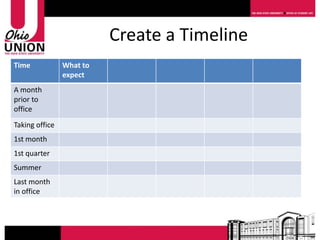
Create a Timeline
Time            What to
                expect
A month
prior to
office
Taking office
1st month
1st quarter
Summer
Last month
in office
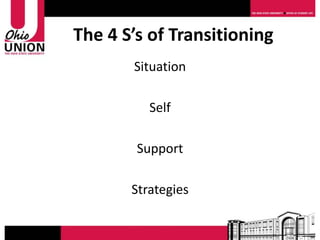
The 4 S’s of Transitioning
       Situation

          Self

        Support

       Strategies
Methods of Execution
•   One-on-One Meetings
•   Group Meetings
•   Written Forms (online/electronic/paper)
•   Retreat
•   Facilitated Programs

• Troubleshooting: What if you plan these things
  and your like-officer doesn’t participate?
Strategic Transition Planning
• Keeping thorough documentation throughout
  officer term – don’t assume people know!
• Do SWOT analysis after events and/or mid
  year
• Keep track of contacts and successful
  processes
• Program Summary Forms
  – Example: Student Alumni Council
ACTIVITY!
          Personal Transition Strategies
• Write down:
  – How your current officer transition works.
  – The questions and concerns you have about your
    transition process.
• Break up into groups to discuss and problem
  solve.
  – SLA facilitators will walk around to assist
Key Ingredients
• Passing on advice and taking advice
• Many different methods but written is more
  sustainable
• What else? Other ideas from your own
  experience?
ACTIVITY!
         Countdown Letter to Your Successor
5 of your favorite things about the position
   (position you held, position you hold, or
   position you want to hold)
4 things that happened during your term that
   you didn’t expect in your role or 4 things
   that you will expect to do in your role.
3 pieces of advice you have for the next person
   in your role or that you would like to receive
   from the outgoing person in the role.
Countdown Letter Continued…

2 positive observations of the person coming in
  or leading the role and how you think that has
  been helpful to the position.
1 goal that you have set for yourself in regards
  to your involvement in the organization.

When you are finished, we have an envelope you
       can put it in to send to the person.
Overview
• Officer Transitioning is critical to your organization’s
  success.
• The process will take time. It is a full-term
  commitment!
• YOU are important to the process.
• Sharing advice and information is invaluable.
• RESOURCES:
   – SLA facilitators for workshops or transition sessions
   – Your Advisor – can provide continuity/perspective
   – Coca-Cola Retreat Packages for officer retreats!
Questions?
Continue the Conversation
• Contact SLA
  – http://ohiounion.osu.edu/get_involved/csls/sla
  – Email advisor Melissa Rocco at rocco.18@osu.edu
  – Talk to one of us today!
• Websites:
  – Coca-Cola Retreat Packages:
    http://ohiounion.osu.edu/get_involved/csls/retreat_p
    ackages
  – Student Org General Resources:
    http://ohiounion.osu.edu/get_involved/student_orga
    nizations/resources

Outgoing officer transition

  • 1.
    Effective Outgoing Officer Transitioning Student Leadership Advocates Student Organization Summit 2012
  • 2.
    Today’s Agenda • The Importance of Transitioning • Effective Transitioning Practices • Long Term Transitioning Plans • Personal Transitioning Activities
  • 3.
    Introductions Please stand upand share your: • Name • Year • Organization and role • One thing you hope to get out of this breakout session!
  • 4.
    Why is Transitioning Important? • Student organization timelines are short – One year terms with four year visions • Continued organizational improvement • Organizational consistency • Benefits organization’s morale
  • 5.
    Important Elements • Gainmutual respect and support for each other’s opinions and goals • Set agreed to goals and objectives for the outcome of transitioning • Include tasks/operations basics as well as visioning and goal setting! • It is a mutual process – do not dominate • Ideally, transitioning is a full-term process!
  • 6.
    Challenge (Incoming) • Theprocess • Yourself • Strive to make it better – Always room for improvement – Look at it as an opportunity • Leave a lasting impression
  • 7.
    Support (Outgoing) • Be a sounding board • Be honest & realistic about the job • YOU are needed • If you didn’t get re-elected – Don’t let it become a barrier – Go the extra mile to let the person know you’re there – Understand that things happen for a reason, and another door will be opened if you allow it.
  • 8.
    Create a Timeline Time What to expect A month prior to office Taking office 1st month 1st quarter Summer Last month in office
  • 9.
    The 4 S’sof Transitioning Situation Self Support Strategies
  • 10.
    Methods of Execution • One-on-One Meetings • Group Meetings • Written Forms (online/electronic/paper) • Retreat • Facilitated Programs • Troubleshooting: What if you plan these things and your like-officer doesn’t participate?
  • 11.
    Strategic Transition Planning •Keeping thorough documentation throughout officer term – don’t assume people know! • Do SWOT analysis after events and/or mid year • Keep track of contacts and successful processes • Program Summary Forms – Example: Student Alumni Council
  • 12.
    ACTIVITY! Personal Transition Strategies • Write down: – How your current officer transition works. – The questions and concerns you have about your transition process. • Break up into groups to discuss and problem solve. – SLA facilitators will walk around to assist
  • 13.
    Key Ingredients • Passingon advice and taking advice • Many different methods but written is more sustainable • What else? Other ideas from your own experience?
  • 14.
    ACTIVITY! Countdown Letter to Your Successor 5 of your favorite things about the position (position you held, position you hold, or position you want to hold) 4 things that happened during your term that you didn’t expect in your role or 4 things that you will expect to do in your role. 3 pieces of advice you have for the next person in your role or that you would like to receive from the outgoing person in the role.
  • 15.
    Countdown Letter Continued… 2positive observations of the person coming in or leading the role and how you think that has been helpful to the position. 1 goal that you have set for yourself in regards to your involvement in the organization. When you are finished, we have an envelope you can put it in to send to the person.
  • 16.
    Overview • Officer Transitioningis critical to your organization’s success. • The process will take time. It is a full-term commitment! • YOU are important to the process. • Sharing advice and information is invaluable. • RESOURCES: – SLA facilitators for workshops or transition sessions – Your Advisor – can provide continuity/perspective – Coca-Cola Retreat Packages for officer retreats!
  • 17.
  • 18.
    Continue the Conversation •Contact SLA – http://ohiounion.osu.edu/get_involved/csls/sla – Email advisor Melissa Rocco at rocco.18@osu.edu – Talk to one of us today! • Websites: – Coca-Cola Retreat Packages: http://ohiounion.osu.edu/get_involved/csls/retreat_p ackages – Student Org General Resources: http://ohiounion.osu.edu/get_involved/student_orga nizations/resources

Editor's Notes

  • #7  More of an FYI point – this is what we’re sharing with the incoming officers during their transitions Emphasize that this is what you should invite your incoming officer to do with what was established under your time
  • #9 Think back to when you took office. What was a huge adjustment? What would you have wished to have known prior to taking office? Think about you last quarter in office and how smoothly it went. What is expected of your position throughout the quarter. (Break it down each quarter by week, or biweekly.)
  • #10 What to consider when engaging in officer transitions:Situation: What is the current state of your organization of the office that you hold? What is this new person getting themselves into?Self: How has your experience been in your role?Support: What kind of support did you need/use during your time as an officer? What support can you provide for the new person moving forward?Strategies: What advice do you have for the new officer? What worked for you that they could continue? What would you suggest be done differently?
  • #11 Answer: this is why Transitioning is a full-term process!!One-on-One meetings may be the most useful ways of transitioning. You can easy meet up for a lunch or coffee and discuss different aspects of the job. In this setting, both can feel comfortable asking questions and not pressured to come up with all of the facets of the position in one sitting. I would recommend meeting at least three times one-on-one to strengthen the rapport between one another as well as giving the incoming member more opportunities to think of various questions.
  • #12 Documentation should include basics like job descriptions, calendars, outlines of events, etc.
  • #13 Bring back to large group to share any ideas/questions
  • #14 1) A great way of starting to build a strong transitioning program is to create a folder on your computer. Put all of the documents that were given to you on it, and as your term progresses, add any document that you use. After several people add to it, the folder will have a plethora of ideas and tools for the incoming position.