OUTCOMES RESEARCH
BY JULIE HUSSEY
Outcomes Research
Outcomes research seeks to understand the end results of particular
health care practices and interventions (John Hopkins Medicine, 2016).
End results include effects that people experience and care about, such
as change in the ability to function. In particular, for individuals with
chronic conditions, where a cure is not always possible, end results
include quality of life as well as mortality.
Outcomes Research
 Linking the care people get to the outcomes they experience, outcomes
research has become the key to developing better ways to monitor and
improve the quality of care.
 Outcomes can be grouped according to care-related, patient-related and
performance-related.
 Outcome-based measurements are a means used to establish evidence-
based practice and to evaluate the care delivered (Schmidt & Brown,
2015).
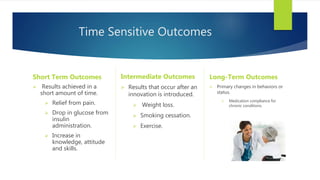
Time Sensitive Outcomes
Short Term Outcomes
 Results achieved in a
short amount of time.
 Relief from pain.
 Drop in glucose from
insulin
administration.
 Increase in
knowledge, attitude
and skills.
Intermediate Outcomes
 Results that occur after an
innovation is introduced.
 Weight loss.
 Smoking cessation.
 Exercise.
Long-Term Outcomes
 Primary changes in behaviors or
status.
 Medication compliance for
chronic conditions.
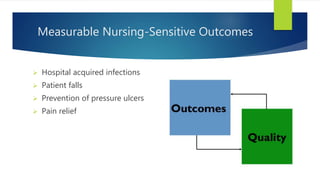
Measurable Nursing-Sensitive Outcomes
 Hospital acquired infections
 Patient falls
 Prevention of pressure ulcers
 Pain relief
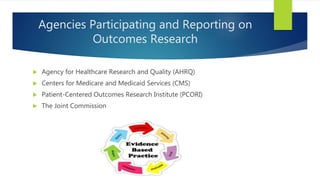
Agencies Participating and Reporting on
Outcomes Research
 Agency for Healthcare Research and Quality (AHRQ)
 Centers for Medicare and Medicaid Services (CMS)
 Patient-Centered Outcomes Research Institute (PCORI)
 The Joint Commission
Patient-Centered Outcomes Research
Institute (2016)
 The mission of the PCORI is broad and complex that includes:
 Increase quantity, quality, and timeliness of research information
 Speed implementation and use of evidence
 Influence research funded by others
 Supporting these goals are five mutually reinforcing imperatives:
 Research: PCORI funds a comprehensive agenda of high-quality patient-centered comparative
clinical effectiveness research and evaluate its impact.
 Engagement: PCORI engages patients, caregivers, clinicians, and other healthcare stakeholders in
the entire research process, from topic generation to dissemination and implementation of results,
and in all their activities.
 Dissemination: PCORI disseminates findings from their research to all stakeholders and support its
implementation.
 Methods: PCORI develops and promote rigorous patient-centered research methods, standards,
and best practices.
 Infrastructure: PCORI promotes and facilitates the development of a sustainable infrastructure for
conducting patient-centered outcomes research.
Agency for Healthcare Quality and
Research (2016)
The Agency for Healthcare Research and Quality (AHRQ), through its
Evidence-Based Practice Centers (EPCs), sponsors the development of
various reports to assist public- and private-sector organizations in their
efforts to improve the quality of health care in the United States. These
reports provide comprehensive, science-based information on common,
costly medical conditions and new health care technologies and strategies.
The EPCs review all relevant scientific literature on a wide spectrum of
clinical and health services topics.
Wasteful Research
Research studies that spread untruths or biases that scare people into
creating larger problems for the public at large. An example, of this the that
vaccines cause autism.
Several studies I found that were wasteful included effects of Swedish
massage on rabbits, monitoring the growth of grass and comparing the
love of mothers for their children in comparison to their animals. All of
this money spent could have been put into more valuable research.
References
Agency for Healthcare Research and Quality (AHRQ). (2016) Retrieved from
http://www.ahrq.gov/research/findings/index.html
John Hopkins Medicine. (2016). Retrieved from
http://www.hopkinsmedicine.org/gim/research/method/outcomes.html
Patient-Centered Outcomes Research Institute (PCORI). (2015). Retrieved from
http://www.pcori.org/about-us/what-we-do/what-drives-our-work
Schmidt, N. A., & Brown, J. M. (2015). Evidence-based practice for nurses:
Appraisal and application of research (3rd ed.). Burlington, MA: Jones & Bartlett
Learning.

Outcomes research

  • 1.
  • 2.
    Outcomes Research Outcomes researchseeks to understand the end results of particular health care practices and interventions (John Hopkins Medicine, 2016). End results include effects that people experience and care about, such as change in the ability to function. In particular, for individuals with chronic conditions, where a cure is not always possible, end results include quality of life as well as mortality.
  • 3.
    Outcomes Research  Linkingthe care people get to the outcomes they experience, outcomes research has become the key to developing better ways to monitor and improve the quality of care.  Outcomes can be grouped according to care-related, patient-related and performance-related.  Outcome-based measurements are a means used to establish evidence- based practice and to evaluate the care delivered (Schmidt & Brown, 2015).
  • 4.
    Time Sensitive Outcomes ShortTerm Outcomes  Results achieved in a short amount of time.  Relief from pain.  Drop in glucose from insulin administration.  Increase in knowledge, attitude and skills. Intermediate Outcomes  Results that occur after an innovation is introduced.  Weight loss.  Smoking cessation.  Exercise. Long-Term Outcomes  Primary changes in behaviors or status.  Medication compliance for chronic conditions.
  • 5.
    Measurable Nursing-Sensitive Outcomes Hospital acquired infections  Patient falls  Prevention of pressure ulcers  Pain relief
  • 6.
    Agencies Participating andReporting on Outcomes Research  Agency for Healthcare Research and Quality (AHRQ)  Centers for Medicare and Medicaid Services (CMS)  Patient-Centered Outcomes Research Institute (PCORI)  The Joint Commission
  • 7.
    Patient-Centered Outcomes Research Institute(2016)  The mission of the PCORI is broad and complex that includes:  Increase quantity, quality, and timeliness of research information  Speed implementation and use of evidence  Influence research funded by others  Supporting these goals are five mutually reinforcing imperatives:  Research: PCORI funds a comprehensive agenda of high-quality patient-centered comparative clinical effectiveness research and evaluate its impact.  Engagement: PCORI engages patients, caregivers, clinicians, and other healthcare stakeholders in the entire research process, from topic generation to dissemination and implementation of results, and in all their activities.  Dissemination: PCORI disseminates findings from their research to all stakeholders and support its implementation.  Methods: PCORI develops and promote rigorous patient-centered research methods, standards, and best practices.  Infrastructure: PCORI promotes and facilitates the development of a sustainable infrastructure for conducting patient-centered outcomes research.
  • 8.
    Agency for HealthcareQuality and Research (2016) The Agency for Healthcare Research and Quality (AHRQ), through its Evidence-Based Practice Centers (EPCs), sponsors the development of various reports to assist public- and private-sector organizations in their efforts to improve the quality of health care in the United States. These reports provide comprehensive, science-based information on common, costly medical conditions and new health care technologies and strategies. The EPCs review all relevant scientific literature on a wide spectrum of clinical and health services topics.
  • 9.
    Wasteful Research Research studiesthat spread untruths or biases that scare people into creating larger problems for the public at large. An example, of this the that vaccines cause autism. Several studies I found that were wasteful included effects of Swedish massage on rabbits, monitoring the growth of grass and comparing the love of mothers for their children in comparison to their animals. All of this money spent could have been put into more valuable research.
  • 10.
    References Agency for HealthcareResearch and Quality (AHRQ). (2016) Retrieved from http://www.ahrq.gov/research/findings/index.html John Hopkins Medicine. (2016). Retrieved from http://www.hopkinsmedicine.org/gim/research/method/outcomes.html Patient-Centered Outcomes Research Institute (PCORI). (2015). Retrieved from http://www.pcori.org/about-us/what-we-do/what-drives-our-work Schmidt, N. A., & Brown, J. M. (2015). Evidence-based practice for nurses: Appraisal and application of research (3rd ed.). Burlington, MA: Jones & Bartlett Learning.