Unit-III
Outcome Research
Objectives
• At the completion of this unit learners will be able to:
• Define the terms related to outcome research
• Discuss basis of outcome research with relation to Donabedian‟s
theory.
• Describe methods/approaches/types of outcome research.
• Understand methodologies of outcome research.
Outcomes Research
• Outcomes research seeks to understand the end results of particular health
care practices and interventions (John Hopkins Medicine, 2016).
• End results include effects that people experience and care about, such as
change in the ability to function.
• In particular, for individuals with chronic conditions, where a cure is not
always possible, end results include quality of life as well as mortality.
Outcomes Research
Linking the care people get to the outcomes they experience, outcomes
research has become the key to developing better ways to monitor and
improve the quality of care.
Outcomes can be grouped according to care-related, patient-related and
performance-related.
Outcome-based measurements are a means used to establish evidence-
based practice and to evaluate the care delivered (Schmidt & Brown, 2015).
Outcomes Research
• Outcomes research is a broad umbrella term without a consistent definition.
• It tends to describe research that is concerned with the effectiveness of public-
health interventions and health services; that is, the outcomes of these services.
• Aimed at assessing the quality and effectiveness of health care as measured by
the attainment of a specified end result or outcome.
• Measures include parameters such as improved health, lowered morbidity or
mortality, and improvement of abnormal states (such as elevated blood
pressure).
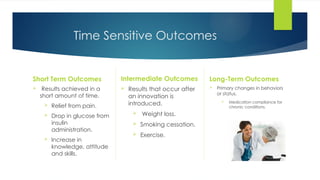
Time Sensitive Outcomes
Short Term Outcomes
 Results achieved in a
short amount of time.
 Relief from pain.
 Drop in glucose from
insulin
administration.
 Increase in
knowledge, attitude
and skills.
Intermediate Outcomes
 Results that occur after
an innovation is
introduced.
 Weight loss.
 Smoking cessation.
 Exercise.
Long-Term Outcomes
 Primary changes in behaviors
or status.
 Medication compliance for
chronic conditions.
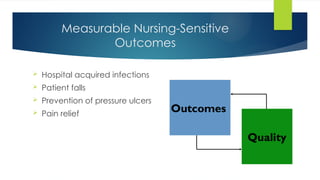
Measurable Nursing-Sensitive
Outcomes
 Hospital acquired infections
 Patient falls
 Prevention of pressure ulcers
 Pain relief
Agencies Participating and Reporting
on Outcomes Research
 Agency for Healthcare Research and Quality (AHRQ)
 Centers for Medicare and Medicaid Services (CMS)
 Patient-Centered Outcomes Research Institute (PCORI)
 The Joint Commission
Patient-Centered Outcomes Research
Institute (2016)
 The mission of the PCORI is broad and complex that includes:
 Increase quantity, quality, and timeliness of research information
 Speed implementation and use of evidence
 Influence research funded by others
 Supporting these goals are five mutually reinforcing imperatives:
 Research: PCORI funds a comprehensive agenda of high-quality patient-centered comparative
clinical effectiveness research and evaluate its impact.
 Engagement: PCORI engages patients, caregivers, clinicians, and other healthcare stakeholders in the
entire research process, from topic generation to dissemination and implementation of results, and in all
their activities.
 Dissemination: PCORI disseminates findings from their research to all stakeholders and support its
implementation.
 Methods: PCORI develops and promote rigorous patient-centered research methods, standards, and
best practices.
 Infrastructure: PCORI promotes and facilitates the development of a sustainable infrastructure for
conducting patient-centered outcomes research.
Theoretical Basis of Outcomes Research
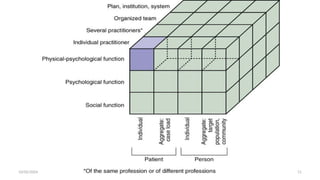
• The theorist Avedis Donabedian (1966) proposed a theory of
quality health care and the process of evaluating it.
• The three dimensions of the model are health, subjects of care,
and providers of care.
• The concept of health has Three aspects; Physical-physiological
function, Psychological function, and Social function.
10/02/2024 10
10/02/2024 11
Cont.…
• The concept subjects of care has two primary aspects: patient and person.
• A patient is defined as someone who has already gained access to some care,
and a person as someone who may or may not have gained access to care.
• Each of these concepts is further categorized by the concepts individual and
aggregate.
• Within patient, the aggregate is a caseload; within person, the aggregate is a
target population or a community.
12
Cont.…
• The concept providers of care shows levels of aggregation and organization of
providers.
• The first level is the individual practitioner. At this level, consideration is given to
the individual provider rather than others who might be involved in the subject’s
care, whether individual or aggregate.
• As the levels progress, providers of care include several practitioners, who might
be of the same profession or different professions and “who may be providing care
concurrently, as individuals, or jointly, as a team”.
• At higher levels of aggregation, the provider of care is institutions, programs, or
the healthcare system as a whole
10/02/2024 13
Agency for Healthcare Research and Quality (AHRQ). (2016) Retrieved
from http://www.ahrq.gov/research/findings/index.html
John Hopkins Medicine. (2016). Retrieved from
http://www.hopkinsmedicine.org/gim/research/method/outcomes.html
Patient-Centered Outcomes Research Institute (PCORI). (2015). Retrieved
from http://www.pcori.org/about-us/what-we-do/what-drives-
our-work
Schmidt, N. A., & Brown, J. M. (2015). Evidence-based practice for nurses:
Appraisal and application of research (3rd ed.). Burlington, MA:
Jones & Bartlett Learning.

Action Research post RN BSN Nursing.ppt,

  • 1.
  • 2.
    Objectives • At thecompletion of this unit learners will be able to: • Define the terms related to outcome research • Discuss basis of outcome research with relation to Donabedian‟s theory. • Describe methods/approaches/types of outcome research. • Understand methodologies of outcome research.
  • 3.
    Outcomes Research • Outcomesresearch seeks to understand the end results of particular health care practices and interventions (John Hopkins Medicine, 2016). • End results include effects that people experience and care about, such as change in the ability to function. • In particular, for individuals with chronic conditions, where a cure is not always possible, end results include quality of life as well as mortality.
  • 4.
    Outcomes Research Linking thecare people get to the outcomes they experience, outcomes research has become the key to developing better ways to monitor and improve the quality of care. Outcomes can be grouped according to care-related, patient-related and performance-related. Outcome-based measurements are a means used to establish evidence- based practice and to evaluate the care delivered (Schmidt & Brown, 2015).
  • 5.
    Outcomes Research • Outcomesresearch is a broad umbrella term without a consistent definition. • It tends to describe research that is concerned with the effectiveness of public- health interventions and health services; that is, the outcomes of these services. • Aimed at assessing the quality and effectiveness of health care as measured by the attainment of a specified end result or outcome. • Measures include parameters such as improved health, lowered morbidity or mortality, and improvement of abnormal states (such as elevated blood pressure).
  • 6.
    Time Sensitive Outcomes ShortTerm Outcomes  Results achieved in a short amount of time.  Relief from pain.  Drop in glucose from insulin administration.  Increase in knowledge, attitude and skills. Intermediate Outcomes  Results that occur after an innovation is introduced.  Weight loss.  Smoking cessation.  Exercise. Long-Term Outcomes  Primary changes in behaviors or status.  Medication compliance for chronic conditions.
  • 7.
    Measurable Nursing-Sensitive Outcomes  Hospitalacquired infections  Patient falls  Prevention of pressure ulcers  Pain relief
  • 8.
    Agencies Participating andReporting on Outcomes Research  Agency for Healthcare Research and Quality (AHRQ)  Centers for Medicare and Medicaid Services (CMS)  Patient-Centered Outcomes Research Institute (PCORI)  The Joint Commission
  • 9.
    Patient-Centered Outcomes Research Institute(2016)  The mission of the PCORI is broad and complex that includes:  Increase quantity, quality, and timeliness of research information  Speed implementation and use of evidence  Influence research funded by others  Supporting these goals are five mutually reinforcing imperatives:  Research: PCORI funds a comprehensive agenda of high-quality patient-centered comparative clinical effectiveness research and evaluate its impact.  Engagement: PCORI engages patients, caregivers, clinicians, and other healthcare stakeholders in the entire research process, from topic generation to dissemination and implementation of results, and in all their activities.  Dissemination: PCORI disseminates findings from their research to all stakeholders and support its implementation.  Methods: PCORI develops and promote rigorous patient-centered research methods, standards, and best practices.  Infrastructure: PCORI promotes and facilitates the development of a sustainable infrastructure for conducting patient-centered outcomes research.
  • 10.
    Theoretical Basis ofOutcomes Research • The theorist Avedis Donabedian (1966) proposed a theory of quality health care and the process of evaluating it. • The three dimensions of the model are health, subjects of care, and providers of care. • The concept of health has Three aspects; Physical-physiological function, Psychological function, and Social function. 10/02/2024 10
  • 11.
  • 12.
    Cont.… • The conceptsubjects of care has two primary aspects: patient and person. • A patient is defined as someone who has already gained access to some care, and a person as someone who may or may not have gained access to care. • Each of these concepts is further categorized by the concepts individual and aggregate. • Within patient, the aggregate is a caseload; within person, the aggregate is a target population or a community. 12
  • 13.
    Cont.… • The conceptproviders of care shows levels of aggregation and organization of providers. • The first level is the individual practitioner. At this level, consideration is given to the individual provider rather than others who might be involved in the subject’s care, whether individual or aggregate. • As the levels progress, providers of care include several practitioners, who might be of the same profession or different professions and “who may be providing care concurrently, as individuals, or jointly, as a team”. • At higher levels of aggregation, the provider of care is institutions, programs, or the healthcare system as a whole 10/02/2024 13
  • 19.
    Agency for HealthcareResearch and Quality (AHRQ). (2016) Retrieved from http://www.ahrq.gov/research/findings/index.html John Hopkins Medicine. (2016). Retrieved from http://www.hopkinsmedicine.org/gim/research/method/outcomes.html Patient-Centered Outcomes Research Institute (PCORI). (2015). Retrieved from http://www.pcori.org/about-us/what-we-do/what-drives- our-work Schmidt, N. A., & Brown, J. M. (2015). Evidence-based practice for nurses: Appraisal and application of research (3rd ed.). Burlington, MA: Jones & Bartlett Learning.