Strategic Management II Strategic Objectives Strategy Concepts
Strategic Objectives Strategic objectives are more definitive statements of the criteria for mission accomplishments.  The firm must determine the strategic objectives that will accomplish its mission in its complex external and internal environments.
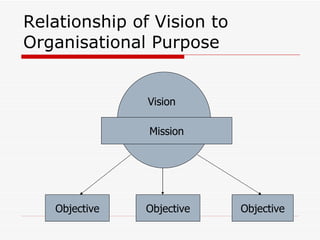
Relationship of Vision to Organisational Purpose Mission Vision Objective Objective Objective
Framing Strategic Objectives Strategic   objectives  typically, though not always, have multi-year timeframes for their achievement and are multi-functional, i.e. they require concerted efforts by people from many different parts of the company.
Strategic Objectives Features 1.  Is it measurable or verifiable?  2.  Is it achievable or feasible?  3.  Is it flexible or adaptable?  4.  Does it stretch your people without breaking them?  6.  Is it clear, easy to understand, and inviting to achieve?
Strategic Objectives To be the lowest cost producer of aluminum.  Alcan Aluminum To become the most the most competitive enterprise in the world being # 1 or # 2 in market share in every business the company is in.  General Electrics
Strategic Objectives Examples “To attain 1 billion customers worldwide”
Strategic Objectives Examples “To safely deliver a hot, quality pizza in 30 minutes or less at a fair and a reasonable profit.”  Domino’s Pizza “To achieve 100% total customer satisfaction… every day. In every restaurant … for every customer.”  McDonald’s
“ 30% of the company’s annual sales must come from products fewer than 4 years old” More than 55,000  products , leadership in major markets: consumer and office; display and graphics; electr and comn; health care; industrial and transportation; safety, security protection services.  3M  has the ability to apply their technologies–in combination–to meet endless customer needs.  Scotch®, Post-it®, Scotchgard™, Thinsulate™, Scotch-Brite®, Filtrete™, Command™ and Nexcare™ are brands that people love and trust.
What is Strategy “ Strategy is about being different. It means deliberately choosing a different set of activities to deliver a unique mix of value” -  Hamel & Prahalad
Concept of Firm’s Business  A firm needs a well-defined scope & growth direction, that objectives alone do not meet this need, & that additional decision rules are required if the firm is to have orderly & profitable growth. Such decision rules have been defined as strategy or concept of a firms business.
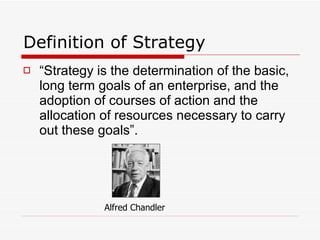
Definition of Strategy “ Strategy is the determination of the basic, long term goals of an enterprise, and the adoption of courses of action and the allocation of resources necessary to carry out these goals”.    Alfred Chandler
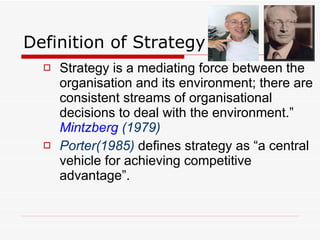
Definition of Strategy Strategy is a mediating force between the organisation and its environment; there are consistent streams of organisational decisions to deal with the environment.”  Mintzberg   (1979)   Porter(1985)  defines strategy as “a central vehicle for achieving competitive advantage”.
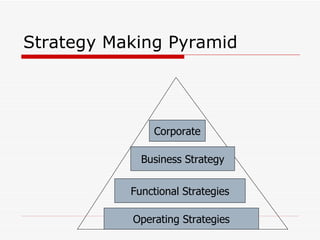
Strategy Making Pyramid Corporate Business Strategy Functional Strategies Operating Strategies
Corporate Strategy Concerns how a diversified company intends to establish business positions in different industries & the actions and approaches employed to improve the performance of the group of businesses the company has diversified into.
Business Strategy Actions and approaches crafted by management in one specific line of business. The central strategic issue is how to build a stronger long-term competitive position. A business strategy is powerful if it produces a sizeable and sustainable competitive advantage.
Functional Strategy Running a major functional activity within a business – R&D, manufacturing, customer service, distribution, finance, human resources & so on.  A business needs as many functional strategies as it has major activities.
Operating Strategy Manage key organizational units within a business (plants, sales, districts, distribution centers). How to perform strategically significant operating tasks (materials purchasing, inventory control, maintenance, advertising campaigns).
The Essence Of Strategy  by  C. Markides He states that the essence of strategy is to make choices on three critical issues: whom to target as customers and whom not to target,  what to offer these customers & what not to offer – and to do all this –  what activities to perform and what not to perform.
Explicit Decisions Dr Markides emphasis the need for an organization to make clear explicit decision on these three issues because the choices it makes become the parameters within which people are free to operate, experiment and innovate.
Parameters He argues these decisions have to be made by top management – they cannot simply emerge. And these parameters are decided at the top, with input and feedback from everybody in the organization.
Questioning Attitude He clarifies that what a company must do every year is not plan, but question the choices made in case changes in the environment have made them invalid.  He argues that what is needed more active thinking and more questioning attitude.
Is Strategy Necessary? In a world where products & technologies are fast changing. The alternative to strategy is to have no rules beyond the simple decision to look for profitable prospects.
Merits of Having No Strategy Savings in time & money & executive talent. The field of potential opportunities will not be restricted to firm’s objectives & strategy. Reap full advantage of the “delay principle”.
Demerits of Having No Strategy No rules to guide search for new opportunity. Internally the R&D has no guidelines, the acquisition department lacks focus. Staff will lack the depth of knowledge in any particular area needed for analysis. Lack an internal ability to anticipate change.  Risk of acting at cross-purposes. E.G conflict between marketing & production managers.

Strat Mgt Part Ii

  • 1.
    Strategic Management IIStrategic Objectives Strategy Concepts
  • 2.
    Strategic Objectives Strategicobjectives are more definitive statements of the criteria for mission accomplishments. The firm must determine the strategic objectives that will accomplish its mission in its complex external and internal environments.
  • 3.
    Relationship of Visionto Organisational Purpose Mission Vision Objective Objective Objective
  • 4.
    Framing Strategic ObjectivesStrategic objectives typically, though not always, have multi-year timeframes for their achievement and are multi-functional, i.e. they require concerted efforts by people from many different parts of the company.
  • 5.
    Strategic Objectives Features1. Is it measurable or verifiable? 2.  Is it achievable or feasible? 3.  Is it flexible or adaptable? 4.  Does it stretch your people without breaking them? 6.  Is it clear, easy to understand, and inviting to achieve?
  • 6.
    Strategic Objectives Tobe the lowest cost producer of aluminum. Alcan Aluminum To become the most the most competitive enterprise in the world being # 1 or # 2 in market share in every business the company is in. General Electrics
  • 7.
    Strategic Objectives Examples“To attain 1 billion customers worldwide”
  • 8.
    Strategic Objectives Examples“To safely deliver a hot, quality pizza in 30 minutes or less at a fair and a reasonable profit.” Domino’s Pizza “To achieve 100% total customer satisfaction… every day. In every restaurant … for every customer.” McDonald’s
  • 9.
    “ 30% ofthe company’s annual sales must come from products fewer than 4 years old” More than 55,000 products , leadership in major markets: consumer and office; display and graphics; electr and comn; health care; industrial and transportation; safety, security protection services. 3M has the ability to apply their technologies–in combination–to meet endless customer needs. Scotch®, Post-it®, Scotchgard™, Thinsulate™, Scotch-Brite®, Filtrete™, Command™ and Nexcare™ are brands that people love and trust.
  • 10.
    What is Strategy“ Strategy is about being different. It means deliberately choosing a different set of activities to deliver a unique mix of value” - Hamel & Prahalad
  • 11.
    Concept of Firm’sBusiness A firm needs a well-defined scope & growth direction, that objectives alone do not meet this need, & that additional decision rules are required if the firm is to have orderly & profitable growth. Such decision rules have been defined as strategy or concept of a firms business.
  • 12.
    Definition of Strategy“ Strategy is the determination of the basic, long term goals of an enterprise, and the adoption of courses of action and the allocation of resources necessary to carry out these goals”. Alfred Chandler
  • 13.
    Definition of StrategyStrategy is a mediating force between the organisation and its environment; there are consistent streams of organisational decisions to deal with the environment.” Mintzberg (1979) Porter(1985) defines strategy as “a central vehicle for achieving competitive advantage”.
  • 14.
    Strategy Making PyramidCorporate Business Strategy Functional Strategies Operating Strategies
  • 15.
    Corporate Strategy Concernshow a diversified company intends to establish business positions in different industries & the actions and approaches employed to improve the performance of the group of businesses the company has diversified into.
  • 16.
    Business Strategy Actionsand approaches crafted by management in one specific line of business. The central strategic issue is how to build a stronger long-term competitive position. A business strategy is powerful if it produces a sizeable and sustainable competitive advantage.
  • 17.
    Functional Strategy Runninga major functional activity within a business – R&D, manufacturing, customer service, distribution, finance, human resources & so on. A business needs as many functional strategies as it has major activities.
  • 18.
    Operating Strategy Managekey organizational units within a business (plants, sales, districts, distribution centers). How to perform strategically significant operating tasks (materials purchasing, inventory control, maintenance, advertising campaigns).
  • 19.
    The Essence OfStrategy by C. Markides He states that the essence of strategy is to make choices on three critical issues: whom to target as customers and whom not to target, what to offer these customers & what not to offer – and to do all this – what activities to perform and what not to perform.
  • 20.
    Explicit Decisions DrMarkides emphasis the need for an organization to make clear explicit decision on these three issues because the choices it makes become the parameters within which people are free to operate, experiment and innovate.
  • 21.
    Parameters He arguesthese decisions have to be made by top management – they cannot simply emerge. And these parameters are decided at the top, with input and feedback from everybody in the organization.
  • 22.
    Questioning Attitude Heclarifies that what a company must do every year is not plan, but question the choices made in case changes in the environment have made them invalid. He argues that what is needed more active thinking and more questioning attitude.
  • 23.
    Is Strategy Necessary?In a world where products & technologies are fast changing. The alternative to strategy is to have no rules beyond the simple decision to look for profitable prospects.
  • 24.
    Merits of HavingNo Strategy Savings in time & money & executive talent. The field of potential opportunities will not be restricted to firm’s objectives & strategy. Reap full advantage of the “delay principle”.
  • 25.
    Demerits of HavingNo Strategy No rules to guide search for new opportunity. Internally the R&D has no guidelines, the acquisition department lacks focus. Staff will lack the depth of knowledge in any particular area needed for analysis. Lack an internal ability to anticipate change. Risk of acting at cross-purposes. E.G conflict between marketing & production managers.

Editor's Notes

  • #9 They represent the first three Domino's Pizza stores. The plan was to add a dot for every new store, however, with Domino's current store count over 7,000, that would have been quite impossible to continue.