Group 1:
Camille TAPER, Federica MEMOLA,
  Daniela VELEZ, Dina KAKULE
Summary
• Desire to increase sales in Europe through
  steps, therefore:
• PR Strategy  “Act Local, Think Local”
• Difference in consumption between USA & EU
  – US: 135L
  – EU: 45L
• Concerns expressed by various government
  agencies (EU, UK, …)
• Coke is trying to increase its local response
• Hold its market share by understanding local
  differences.
Question 1: Why did Coke engage in
   foreign direct investments in Europe?
• In order to improve the market position through
  several tactics:
  – Assembly, production and other facilities closer to the
    market where they are trying to sell  results in lower
    expenditure for the company
  – Investment in bottling factories also closer to the market
    (local)
  – Increasing marketing expenditure (advertising) to
    increase awareness, and lowered the Coke price
Question 2: How did Coke improve its
      factor conditions in Europe?
• Took several steps in various countries:
 Actions directly related to LLC (land labour &
capital)
  – Replace local franchisers with market-driven sellers
  Eg: France: new marketing manager
        • Advertising increased & price lowered  consumption
          increased
  Eg: England: New bottlers  Cadbury Schweppes
        • Along with other marketing programs  sales tripled
  Eg: Germany: Ditto to England’s strategy
    •     Faster results  Largest & most profitable market
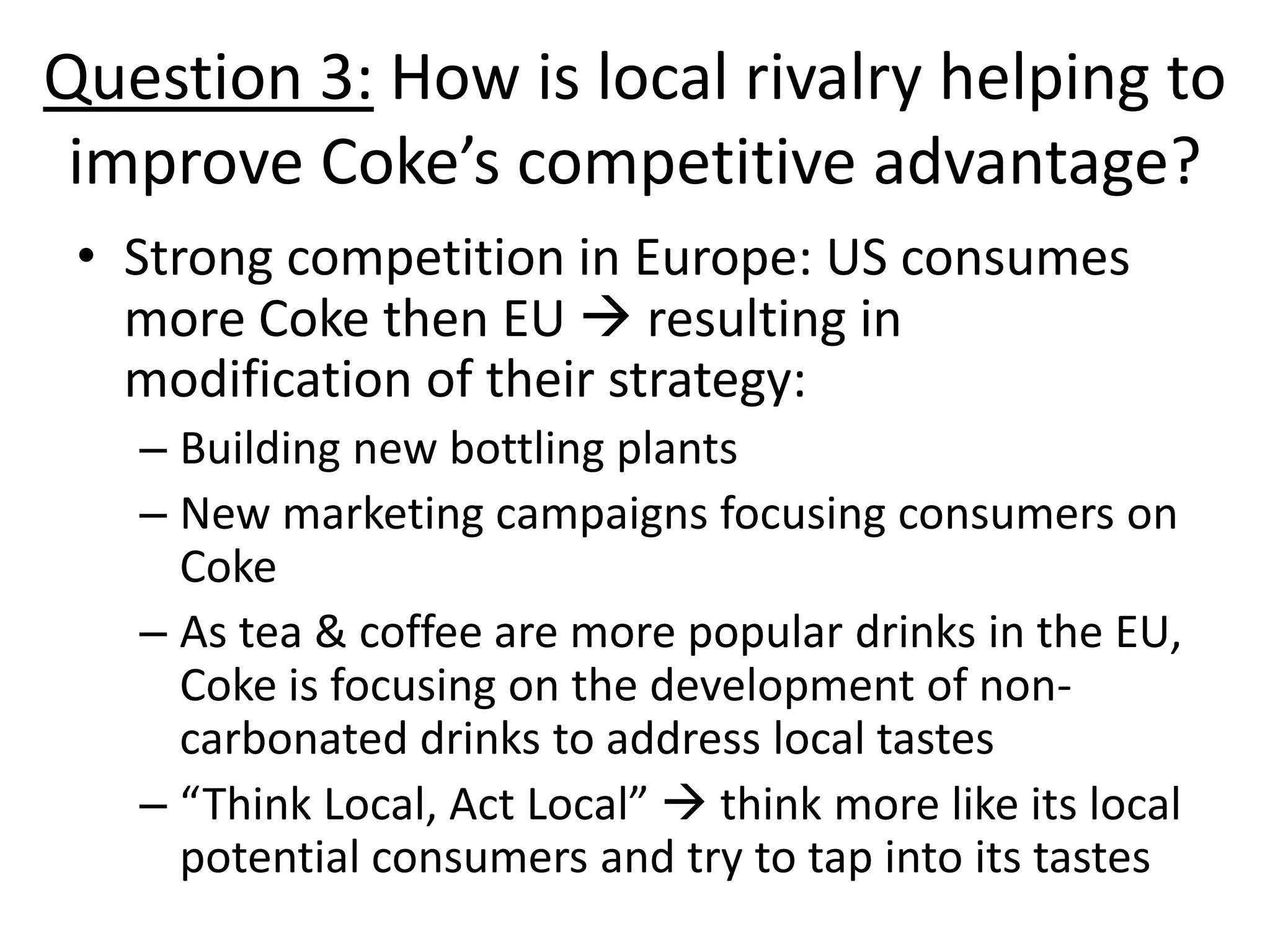
Question 3: How is local rivalry helping to
 improve Coke’s competitive advantage?
 • Strong competition in Europe: US consumes
   more Coke then EU  resulting in
   modification of their strategy:
   – Building new bottling plants
   – New marketing campaigns focusing consumers on
     Coke
   – As tea & coffee are more popular drinks in the EU,
     Coke is focusing on the development of non-
     carbonated drinks to address local tastes
   – “Think Local, Act Local”  think more like its local
     potential consumers and try to tap into its tastes
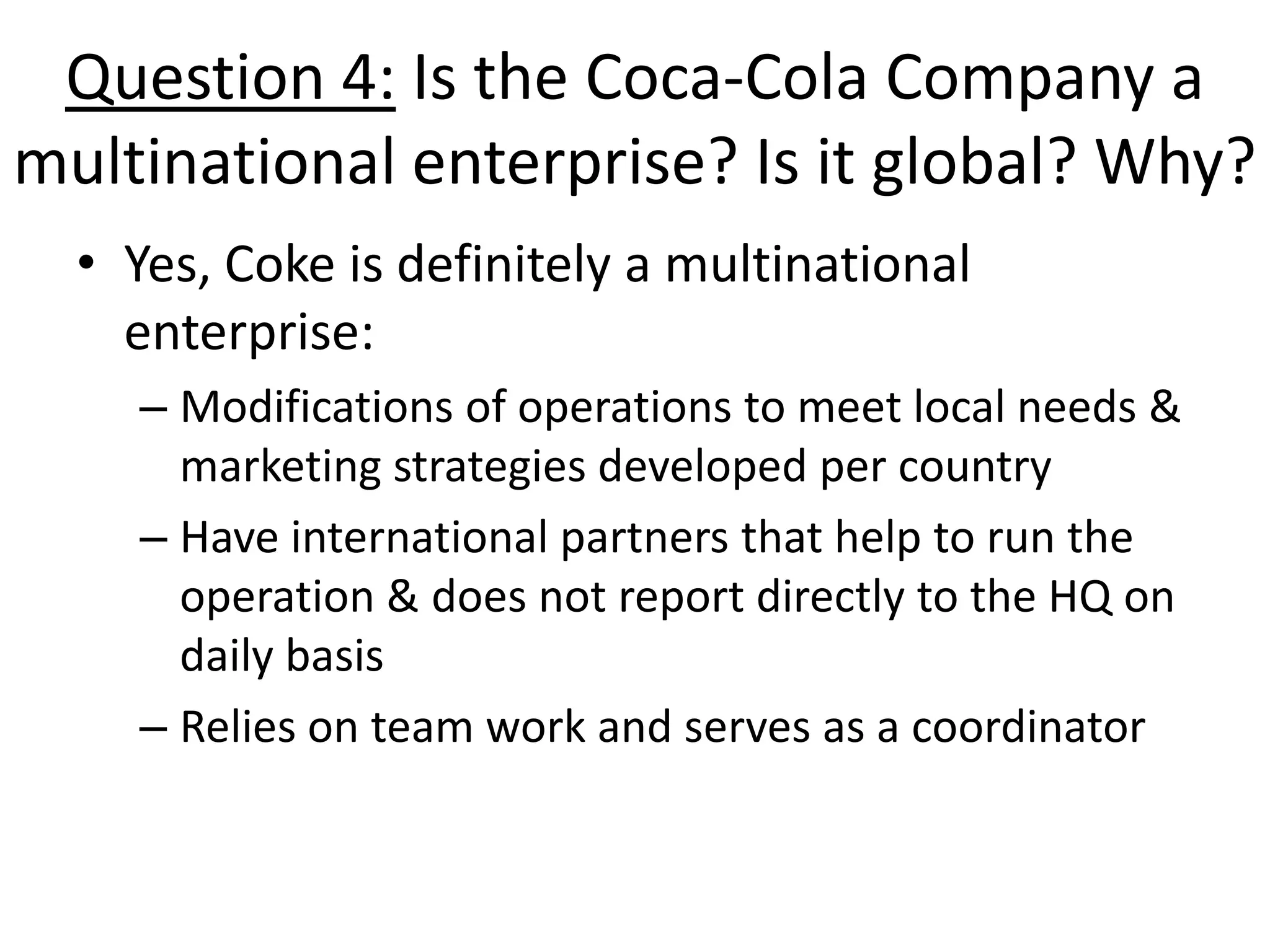
Question 4: Is the Coca-Cola Company a
multinational enterprise? Is it global? Why?
  • Yes, Coke is definitely a multinational
    enterprise:
    – Modifications of operations to meet local needs &
      marketing strategies developed per country
    – Have international partners that help to run the
      operation & does not report directly to the HQ on
      daily basis
    – Relies on team work and serves as a coordinator
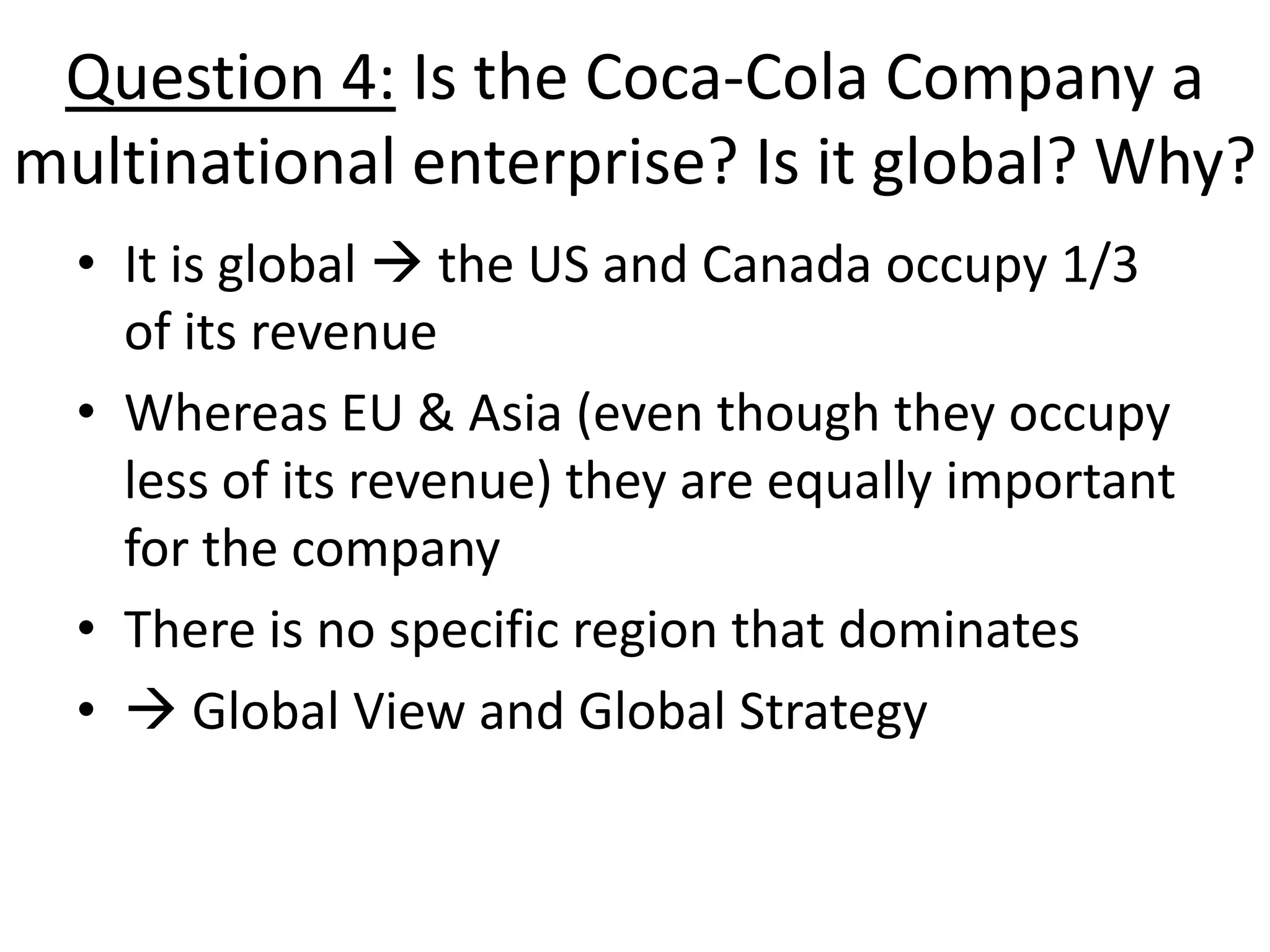
Question 4: Is the Coca-Cola Company a
multinational enterprise? Is it global? Why?
  • It is global  the US and Canada occupy 1/3
    of its revenue
  • Whereas EU & Asia (even though they occupy
    less of its revenue) they are equally important
    for the company
  • There is no specific region that dominates
  •  Global View and Global Strategy

Coca Cola case study

  • 1.
    Group 1: Camille TAPER,Federica MEMOLA, Daniela VELEZ, Dina KAKULE
  • 2.
    Summary • Desire toincrease sales in Europe through steps, therefore: • PR Strategy  “Act Local, Think Local” • Difference in consumption between USA & EU – US: 135L – EU: 45L • Concerns expressed by various government agencies (EU, UK, …) • Coke is trying to increase its local response • Hold its market share by understanding local differences.
  • 3.
    Question 1: Whydid Coke engage in foreign direct investments in Europe? • In order to improve the market position through several tactics: – Assembly, production and other facilities closer to the market where they are trying to sell  results in lower expenditure for the company – Investment in bottling factories also closer to the market (local) – Increasing marketing expenditure (advertising) to increase awareness, and lowered the Coke price
  • 4.
    Question 2: Howdid Coke improve its factor conditions in Europe? • Took several steps in various countries:  Actions directly related to LLC (land labour & capital) – Replace local franchisers with market-driven sellers Eg: France: new marketing manager • Advertising increased & price lowered  consumption increased Eg: England: New bottlers  Cadbury Schweppes • Along with other marketing programs  sales tripled Eg: Germany: Ditto to England’s strategy • Faster results  Largest & most profitable market
  • 5.
    Question 3: Howis local rivalry helping to improve Coke’s competitive advantage? • Strong competition in Europe: US consumes more Coke then EU  resulting in modification of their strategy: – Building new bottling plants – New marketing campaigns focusing consumers on Coke – As tea & coffee are more popular drinks in the EU, Coke is focusing on the development of non- carbonated drinks to address local tastes – “Think Local, Act Local”  think more like its local potential consumers and try to tap into its tastes
  • 6.
    Question 4: Isthe Coca-Cola Company a multinational enterprise? Is it global? Why? • Yes, Coke is definitely a multinational enterprise: – Modifications of operations to meet local needs & marketing strategies developed per country – Have international partners that help to run the operation & does not report directly to the HQ on daily basis – Relies on team work and serves as a coordinator
  • 7.
    Question 4: Isthe Coca-Cola Company a multinational enterprise? Is it global? Why? • It is global  the US and Canada occupy 1/3 of its revenue • Whereas EU & Asia (even though they occupy less of its revenue) they are equally important for the company • There is no specific region that dominates •  Global View and Global Strategy