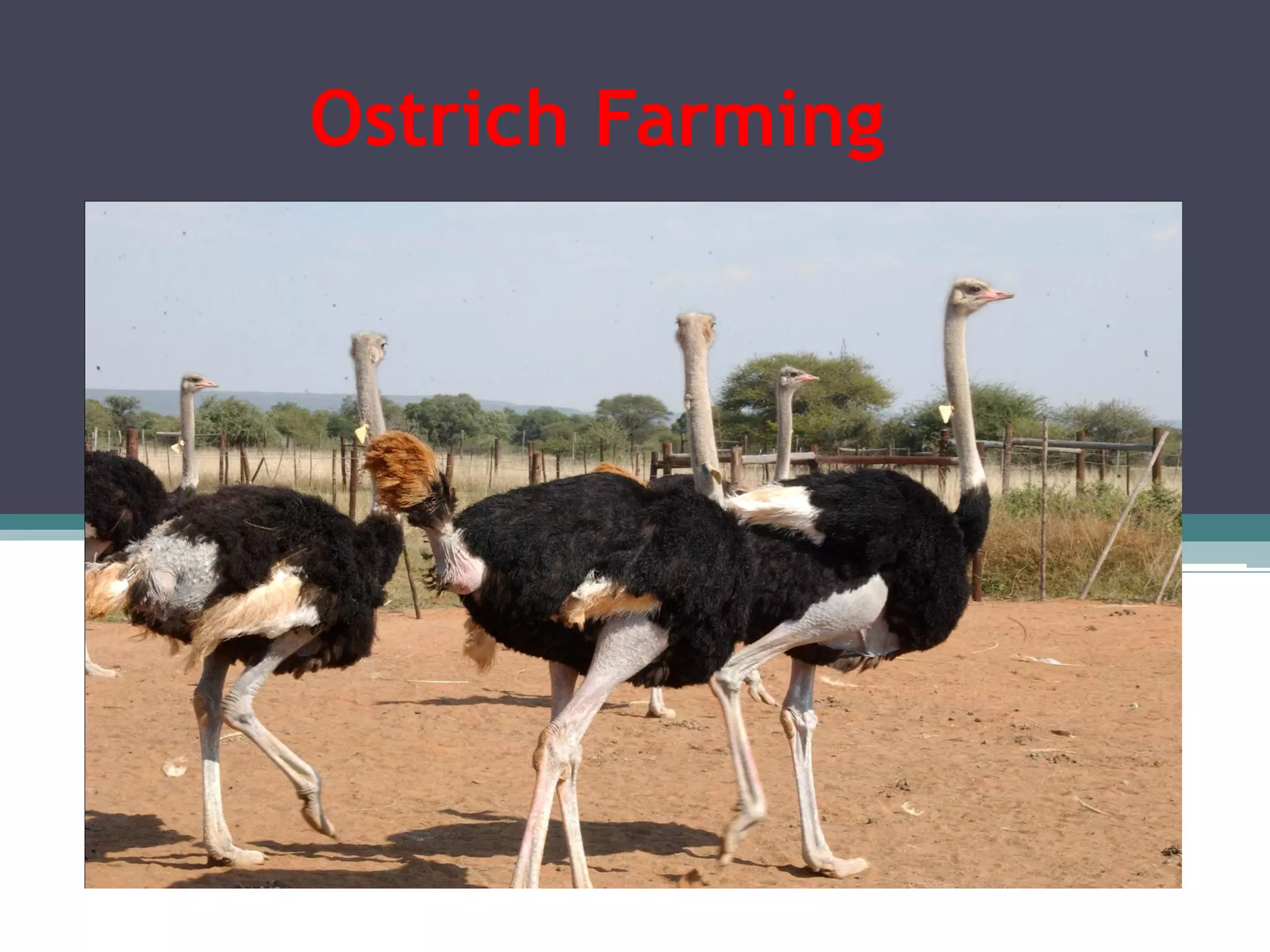
Ostrich Farming
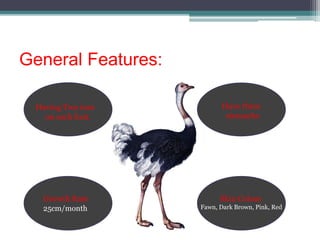
General Features:
Having Two toes
on each foot.
Have three
stomachs
Growth Rate
25cm/month
Skin Colour
Fawn, Dark Brown, Pink, Red
Height
2.1 to 2.8 m
No Crop
No
Gallbladder
Secretes urine &
feces separately
Male Copulatory Organ
20 cm ≈ 8 inches
Weigh
63 to 145 Kg
Basic Instructions Before Starting
Ostrich Farm:
Each ostrich require 60-80 squire feet space inside the
house.
It would be better if the floor of the house become made
of sand or soil.
The ostrich housing place will be located in a sandy
location.
Make the house in quite and calm place.
It will be far from the residential area.
Prevent the entrance to unwanted animals and people.
Clean the house as frequently as possible to keep the
bird healthy and disease free.
The shelter should be designed so that birds must enter
confidently.
Farming Precautions
Hatching Precautions:
Store eggs at 55-65 degrees 70% humidity for up to 7 days
before incubating.
While in storage or incubation the eggs should be turned
daily.
When Incubation start then maintain 25% humidity &
warm up at 1 degree per hour till 98 degrees.
Newly hatched chicks should be kept at a temperature of
around 95 degrees while older chicks can be kept at 80.
Candling of the egg can be done 5-7 days after
incubation.
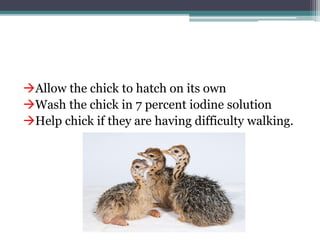
Allow the chick to hatch on its own
Wash the chick in 7 percent iodine solution
Help chick if they are having difficulty walking.
Providing Nutrition:
Give the chicks alfalfa and clover cuttings without
the stems.
The cuttings should not be wilted.
Provide grit and gravel for proper digestion.
Serve meal several times a day in shallow dishes
when chicks are old enough.
Place water for your ostriches in shallow containers.
Put something shiny into the water for the first few
days.
Add vitamin supplements to chicks diet for the first
few weeks.
The Brooder
Maintain the temperature within the brooder at
88℉ to 92℉ during the first ten days. Then until week
three lower it to 80℉ to 85℉. After week 3, the
brooder's temperature should 70℉ to 80℉.
Clean the brooder every day to keep the ostriches
healthy. Provide a washable mat that can't be eaten by
the chicks. Do not provide any litter hay or sawdust at
the bottom of the brooder since baby ostriches can eat
these items and die.
Ostrich chicks need 40 square feet of pen space per
chick so the chicks can run and properly develop.
Vaccination:
At present, there are no recommended vaccination
programs for ostrich. Vaccination for Eastern and
Western Encephalomyelitis and Clostridium
perfringens Types C and D may be useful but not
thoroughly tested.
Health Issues:
Mortality and health problems diagnosed
mainly in chicks due to cause include improper
brooding or nutrition, improper handling.
They can tolerate almost all types of weather
and environmental condition but for proper
growth and production they need a good house
or shelter for the ostriches.
Benefits of Ostrich Farming
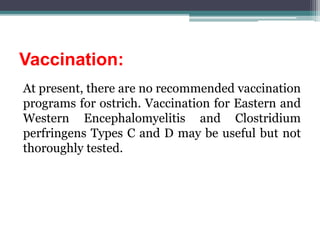
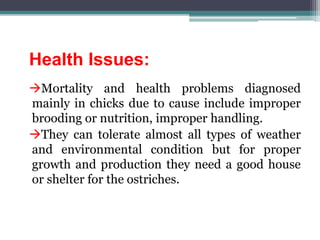
Highly resistant Having friendly behavior
Feather Products leather products
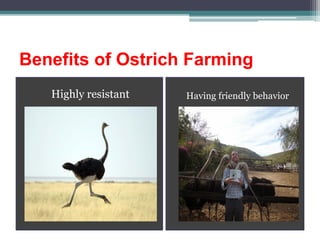
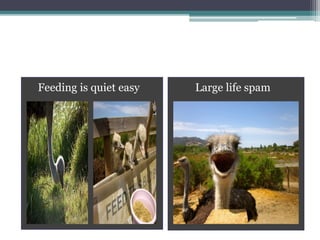
Feeding is quiet easy Large life spam
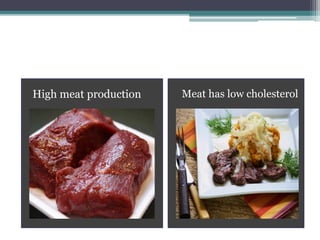
High meat production Meat has low cholesterol
Any Question
Dr.Fakhar-e-Alam

Ostrich Farming |Management, Benefits, Scope

  • 1.
  • 2.
    General Features: Having Twotoes on each foot. Have three stomachs Growth Rate 25cm/month Skin Colour Fawn, Dark Brown, Pink, Red
  • 3.
    Height 2.1 to 2.8m No Crop No Gallbladder Secretes urine & feces separately Male Copulatory Organ 20 cm ≈ 8 inches Weigh 63 to 145 Kg
  • 4.
    Basic Instructions BeforeStarting Ostrich Farm: Each ostrich require 60-80 squire feet space inside the house. It would be better if the floor of the house become made of sand or soil. The ostrich housing place will be located in a sandy location. Make the house in quite and calm place. It will be far from the residential area. Prevent the entrance to unwanted animals and people. Clean the house as frequently as possible to keep the bird healthy and disease free. The shelter should be designed so that birds must enter confidently.
  • 5.
    Farming Precautions Hatching Precautions: Storeeggs at 55-65 degrees 70% humidity for up to 7 days before incubating. While in storage or incubation the eggs should be turned daily. When Incubation start then maintain 25% humidity & warm up at 1 degree per hour till 98 degrees. Newly hatched chicks should be kept at a temperature of around 95 degrees while older chicks can be kept at 80. Candling of the egg can be done 5-7 days after incubation.
  • 6.
    Allow the chickto hatch on its own Wash the chick in 7 percent iodine solution Help chick if they are having difficulty walking.
  • 7.
    Providing Nutrition: Give thechicks alfalfa and clover cuttings without the stems. The cuttings should not be wilted. Provide grit and gravel for proper digestion. Serve meal several times a day in shallow dishes when chicks are old enough. Place water for your ostriches in shallow containers. Put something shiny into the water for the first few days. Add vitamin supplements to chicks diet for the first few weeks.
  • 8.
    The Brooder Maintain thetemperature within the brooder at 88℉ to 92℉ during the first ten days. Then until week three lower it to 80℉ to 85℉. After week 3, the brooder's temperature should 70℉ to 80℉. Clean the brooder every day to keep the ostriches healthy. Provide a washable mat that can't be eaten by the chicks. Do not provide any litter hay or sawdust at the bottom of the brooder since baby ostriches can eat these items and die. Ostrich chicks need 40 square feet of pen space per chick so the chicks can run and properly develop.
  • 9.
    Vaccination: At present, thereare no recommended vaccination programs for ostrich. Vaccination for Eastern and Western Encephalomyelitis and Clostridium perfringens Types C and D may be useful but not thoroughly tested.
  • 10.
    Health Issues: Mortality andhealth problems diagnosed mainly in chicks due to cause include improper brooding or nutrition, improper handling. They can tolerate almost all types of weather and environmental condition but for proper growth and production they need a good house or shelter for the ostriches.
  • 11.
    Benefits of OstrichFarming Highly resistant Having friendly behavior
  • 12.
  • 13.
    Feeding is quieteasy Large life spam
  • 14.
    High meat productionMeat has low cholesterol
  • 15.