OSTEOSARCOMA
DR. PREETHAM .N
ORTHOPAEDICS PG
GANDHI MEDICAL COLLEGE
Highly malignant bone Tx characterised by
invariable formation of neoplastic osteoid and
tumor tissue
Cell of origin :common multipotential mesenchymal cell
osteoblatic
chondroblastic
fibroblastic
Neoplastic osteoid
tissue and bone
ETIOLOGY
Predisposing factors Exciting factors
Age : peak 2nd decade
BIMODAL ..after 60 yrs
Virus:RNA –harvey&
moloney mouse
sarcoma virus
DNA: Polyoma, SV 40
Sex : m>f Radiation: > 2000 rads
latent period 3 to 4 yrs
Site: metaphysis
fe>ti>ph >>> jaws
Chemical : Be,20
methyl
cholanthrene,Cu
chelated amino
fluorene
 Unicameral bone cyst
 Aneurysmal bone cyst
 Ewing’s sarcoma
Osteosarcoma
 Enchondroma
 Osteoblastoma
 Chondroblastoma
 Fibrous dysplasia
METAPHYSIS
 Osteosarcoma
 Bone cysts
 Osteoblastoma
 Osteochondroma
 Enchondroma
 Aneurysmal bone cyst
GROSS PATHOLOGY
Metaphyseal large tumor with destruction of inner
cortex and extends into sub periosteal space
SCLEROSING TYPE & LYTIC TYPE
Consistency---- stony hard to soft and gritty
 The colour of the tumor reflects its components.
 Bluish white- cartilaginous.
 White- fibrous.
 Yellowish white- osteoid.
 Bony necrotic areas, cystic cavities
 Large vascular channels & haemorrhage
 Medullary cavity extension >> found in xray
Eventually periosteal penetration and soft tissue
extension
Barriers to joint--- growth plate, articular
cartilage
Pulmonary deposits
MICROSCOPY
 Microscopic appearance is variable
 Absolute criteria include(LICHTENSTEIN)
 Sarcomatous stroma
 Direct formation of tumor osteoid and bone by
malignant connective tissue
 Best evidence of malignancy is seen in the
advancing borders
 The central portions of the tumor are routinely
the most sclerotic where formation of
neoplastic bone is most pronounced.
 As the anaplastic cells become enclosed in
new bone, they become small and rounded,
and thus may be unsuitable for diagnosis.
Therefore the peripheral zones are most
suitable for diagnosis.
Prognostic significance in
differentiation of primary
bone sarcomas
DAHLIN subtypes of
osteosarcoma
Osteoblastic
Chondroblastic
Fibrobalstic variants of osteosarcoma
CLASSIFFICATION
 Primary
 conventional osteosarcoma
 low-grade intramedullary osteosarcoma
 parosteal osteosarcoma
 periosteal osteosarcoma
 high-grade surface osteosarcoma
 telangiectatic osteosarcoma
 small cell osteosarcoma.
CENTRAL PERIPHERAL
INTRAMEDULLARY
HIGH GRADE (conventional)
LOW GRADE
JUXTACORTICAL
PAROSTEAL
PERIOSTEAL
TELANGIECTATIC HIGH GRADE SURFACE
SMALL CELL
 Secondary
Paget’s disease
Radiation induced
HEPARIN
CYCLOSERINE
chronic osteomyelitis
bone infarcts
osteogenesis imperfecta
CONVENTIONAL
OSTEOSARCOMA
 It is the most common type of osteosarcoma.
 It is classified based on dominant
histopathology as:
 Osteoblastic
 Fibroblastic
 Chondroblastic
 Radiographically, the bone involved in
conventional osteosarcoma may be lytic,
sclerotic or show a mixed response.
 It begins in an intramedullary location but may
break through the cortex and form a soft tissue
mass.
Low-grade intramedullary
osteosarcoma
 indolent course with relatively benign features on
roentgenogram
 As the name implies, it is located in an intramedullary
location and only erodes through the cortex very late
 Microscopically, it consists of slightly atypical spindle
cells producing slightly irregular osseous trabeculae.
Periosteal osteosarcoma
intermediate-grade malignancy that arises on the
surface of the bone
 The most common locations are the diaphyses of the
femur and tibia
 It occurs in a slightly older and broader age group
 Histological examination of periosteal osteosarcoma
demonstrates strands of osteoid-producing spindle
cells radiating between lobules of cartilage
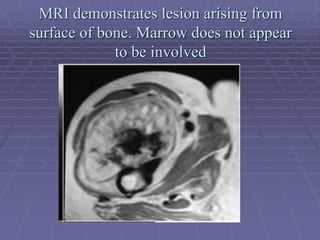
femur of 67-year-old woman with periosteal
osteosarcoma
MRI demonstrates lesion arising from
surface of bone. Marrow does not appear
to be involved
GROSS APPEARANCE
Typical microscopic appearance of
periosteal osteosarcoma. Lobules of
malignant cartilage are separated by
malignant spindle cells producing osteoid.
TELANGIECTATIC
OSTEOSARCOMA
 expansible, aggressive lesion simulating an
anurysmal bone cyst and composed of loculated
blood filled spaces, partially lined by malignant cells
producing sparse osteoid formation.
 These features account for its radiographic features of
a purely lytic lesion which shows none of the
sclerotic changes associated with conventional
osteosarcoma.
Small cell osteosarcoma
 It is a rare variant.
 High-grade lesion that consists of small blue
cells that may resemble Ewing sarcoma or
lymphoma.
 Cytogenetic and immunohistochemistry
studies sometimes are needed to differentiate
these lesions.
 This variant seems to have a worse prognosis
than the conventional osteosarcoma.
Parosteal osteosarcoma
 Parosteal osteosarcoma also is a rare, low-grade
malignancy
 It arises on the surface of the bone and invades
the medullary cavity only at a late stage
 It has a peculiar tendency to occur as a lobulated
ossified mass on the posterior aspect of the distal
femur
Anteroposterior and lateral
roentgenograms of parosteal
osteosarcoma arising in its most
common location – Lower end of femur
High-grade surface
osteosarcoma
 High-grade surface osteosarcoma is the least common
type of osteosarcoma
 It is an aggressive tumor arising on the outer aspect of
the cortex
 Roentgenograms show an invasive lesion with ill-
defined borders
 Like conventional osteosarcoma, the microscopic
appearance is that of a high-grade tumor with
hypercellularity, mitotic figures, and marked nuclear
pleomorphism
 Unlike parosteal osteosarcoma, medullary
involvement is common at the time of diagnosis.
Secondary osteosarcomas
 Secondary osteosarcomas occur at the site of
another disease process.
 almost half of the osteosarcomas in patients
over 50 years of age.
 Prognosis –poor than primary osteosarcoma
 They include
 Paget disease
 Previous radiation treatment
 fibrous dysplasia
 bone infarcts
 Osteochondromas
 chronic osteomyelitis
 dedifferentiated chondrosarcomas
 osteogenesis imperfecta
Paget's osteosarcoma
 Paget's osteosarcoma most commonly occurs in
patients between the sixth and eighth decades of life.
 The incidence of osteosarcoma in Paget disease is
approximately 1%
 Femur>humerus>pelvis>skull>tibia. Can be
multicentric
 Pain,swelling at the site of old #
 # Failure to unite
 Xray: mixed blastic and lytic changes
 :cortical destruction
 :lung deposits
 Osteoclastic multinucleated giant cells can
be seen
Radiation-induced osteosarcoma
 Radiation-induced osteosarcoma occurs in
approximately 1% of patients who have been
treated with over 2500 cGy.
 Occurs in unusual locations such as the skull,
spine, clavicle, ribs, scapula, and pelvis.
 Internal radiaion- radium
 External radiation- megavoltage/ orthovoltage
 Mc- radiation >3000 rads for benign GCT
 Highly osteogenic,sclerosing,profuse osteoid
and new bone formation
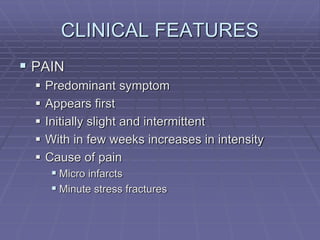
CLINICAL FEATURES
 PAIN
 Predominant symptom
 Appears first
 Initially slight and intermittent
 With in few weeks increases in intensity
 Cause of pain
 Micro infarcts
 Minute stress fractures
 SWELLING
 2ND most common complaint.
 Present in 90% of high grade osteosarcomas
 Skin over is
 Stretched
 Shiny
 Dilated veins
 Local rise of temperature
 Consistency is firm to hard.
 crepitus --#
 Joint mobility normal initially later restricted
 Constitutional Sx and signs of inflammtion
rare
RADIOGRAPHIC FINDINGS
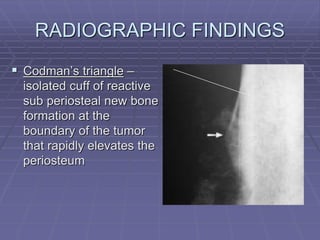
 Codman’s triangle –
isolated cuff of reactive
sub periosteal new bone
formation at the
boundary of the tumor
that rapidly elevates the
periosteum
RADIOGRAPHIC FINDINGS
 Sun burst appearance
– spicules of new
bone formation seem
radiating from a point.
It is due to new bone
formation along the
blood vessels
 LONGITUDINAL LAMINATIONS:
Longitudinal periosteal laminations follow
the course of intramedullary lesion.
BIOPSY
 Biopsy should be done only after clinical, laboratory,
and roentgenographic examinations are complete.
 Regardless of whether a needle biopsy or an open
biopsy is done, the biopsy track should be considered
contaminated with tumor cells.
 If a tourniquet is used, the limb may be elevated
before inflation but should not be exsanguinated by
compression. Care should be taken to contaminate as
little tissue as possible.
BIOPSY
 Transverse incisions should be avoided
because they are extremely difficult or
impossible to excise with the specimen.
 The deep incision should go through a single
muscle compartment rather than contaminating
an intermuscular plane.
 Major neurovascular structures should be
avoided.
 Soft tissue extension of a bone lesion should
be sampled.
BIOPSY
 If a tourniquet has been used it should be
deflated and meticulous hemostasis ensured
before closure, since a hematoma would be
contaminated with tumor cells
 If a drain is used, it should exit in line with the
incision so that the drain track also can be
easily excised en bloc with the tumor
CT SCAN
 Useful for evaluation
 Differentiate b/w infection and tumor
 Exact area of cortical break
 Soft tissue extension, medullary spread,
proximity to NV bundle
 Detect skip lesions
MRI SCAN
 Better contrast discrimination
 Can be performed in any plane
 Ideal for medullary marrow assessment
ANGIOGRAPHY
 Accurate method of of detecting and
measuring extent of occult soft tissue
extension.
 Reactive zone is seen in the early arterial
phase.
.
 Intrinsic vascularity is seen as the tumor blush
in the late venous phase.
 Also assess any major vessel
involvement by the tumor.
 Arterial phase is useful in detecting sub-
clinical recurrences.
 It also helps in gauging the clinical
response to chemotherapy.
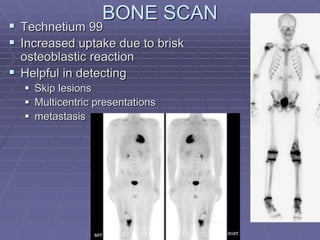
BONE SCAN
 Technetium 99
 Increased uptake due to brisk
osteoblastic reaction
 Helpful in detecting
 Skip lesions
 Multicentric presentations
 metastasis
BIO-CHEMICAL MARKERS
 Serum ALP
 It is increased as the tumor has neoplastic
osteoblasts
 Useful in prognosis and follow up
 Falls to near normal after surgical resection
 Persistence indicates, metastasis, recurrence,
residual or spreading nature
BIO-CHEMICAL MARKERS
 Osteocalcin – A
 Recently identified, vitamin K dependant, calcium
binding carboxy glutamic acid containing protein
 May be of value in diagnosis of heavily bone
producing types
 Anti-human osteosarcoma monoclonal anti
bodies
 Detected by immunochemistry
 These anti-bodies to sarcoma cell surface antigens
are specific to osteosarcoma.
METASTASIS
 Primary route is hematogenous and mainly
occurs to lungs
 Other sites include
 Brain
 Liver
 Lymph node
TREATMENT
 The 5 year survival rate which was below
20% is now 60-80%.
 This can be attributed to the use of
 Newer chemotherapeutic regimens
 Mega voltage radiotherapy
 Aggressive pulmonary resection
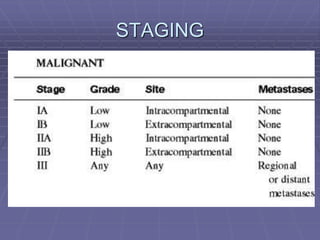
STAGING
 ENNEKING SYSTEM
GENERAL CONSIDERATIONS
 Establishment of diagnosis by needle
biopsy or incisional biopsy. Due to fear of
tumor spillage frozen section if available
should be utilized.
 Resection of primary tumor and
reconstruction
 Adjuvants
 Chemotherapy
 Radiotherapy
 Rehabilitation
AMPUTATIONS
 This provides the definitive surgical treatment for
osteosarcoma.
 Level of amputation is the most important factor
to be decided:
 For upper end of tibia above knee amputation
 For lower end of femur still controversial. Hip
disarticulation is the safer option compared to high a/k
 Upper end of femur – hind quarter amputation
 Proximal humerus – fore quarter amputation
LIMB SPARING SURGERIES
 No major neuro-vascular involvement.
 Wide resection of affected bone with normal
cuff in all directions.
 Adequate motor reconstruction and soft tissue
coverage
 PHASES OF THE PROCEDURE
 Resection of the tumor
 Skeletal reconstruction
 Soft tissue and muscle transfers
Reconstructive procedures
 arthrodesis
 osteoarticular allograft reconstruction,
 endoprosthetic reconstruction,
 allograft-prosthesis composite reconstruction
 rotationalplasty
Arthrodesis
 Osteoarticular allografts
 advantages: ability to replace ligaments, tendons, and
intraarticular structures.
 complications:nonunion at the graft-host junction,
fatigue fracture, articular collapse, dislocation,
degenerative joint disease, and failure of ligament and
tendon attachments.
 a temporary measure to preserve an adjacent physis
 A proximal tibial osteoarticular allograft could be used
in an immature patient in an attempt to preserve the
distal femoral physis until skeletal maturity. This could
be converted later to an endoprosthetic reconstruction
when it becomes necessary.
 Allograft-prosthesis composites
 They avoid the complications of degenerative joint disease and
articular collapse, while still preserving the ability to attach
soft-tissue structures directly, such as the patella tendon or the
hip abductors.
 They are associated, however, with fatigue fracture, infection,
and nonunion at the graft-host junction.
 main indication for an allograft-prosthesis composite is an
inadequate length of remaining host bone to secure the stem of
an endoprosthesis.
 Endoprosthetic reconstruction
 advantage -immediate stability that allows for quicker
rehabilitation with immediate full weight bearing.

 Most endoprostheses are modular, allowing for incremental
limb lengthening as an immature patient grows.
 Polyethylene wear
 Fatigue fractures
 Considerations for Pediatric Patients
 future limb-length inequality must be considered.
 For patients who are near skeletal maturity, the reconstructed
limb can be lengthened 1 cm at the initial procedure. Also,
epiphysiodesis of the contralateral limb can be done at the
appropriate age to preserve limb-length equality .
 expandable prostheses currently is gaining
support.
 it uses energy stored in a compressed spring to allow for future
expansion of the prosthesis as the child grows.
 When a leg-length discrepancy develops, the child is scheduled for an
expansion .
 The procedure is done in the fluoroscopy suite with the patient under
light sedation.
 The locking mechanism on the prosthesis is identified using
fluoroscopy, and an electromagnetic coil is placed over the patient's
leg at that level.
 The electromagnetic coil is activated for 20 seconds, which heats an
element in the prosthesis, melting a small segment of polyethylene and
allowing controlled expansion of the spring. The leg lengths are
reevaluated under fluoroscopy, and the procedure is repeated one or
two times as necessary. We have been able to gain 0.5 to 1.5 cm during
each scheduled expansion session. Expansion sessions can be
scheduled 4 weeks apart if needed to allow the operated leg to “catch
up.” After the expansion sessions, patients usually are able to
ambulate immediately without an assistive device.
Group AI—Lesion in distal femur. The
distal femur, knee joint, and proximal
tibia are resected; the lower leg is
rotated 180 degrees; and the tibia is
joined to the remaining femur
Group AII—Lesion in the
proximal tibia. The distalmost
femur, knee joint, and proximal
tibia are resected. After rotation
of 180 degrees, the distal tibia is
joined to the distal femur
Group BI—Lesion in the
proximal femur sparing
the hip joint and gluteal
muscles. The upper femur
and hip joint are resected,
and the leg is rotated 180
degrees. The distal femur
is joined to the pelvis so
that the knee functions as
the hip, and the ankle
functions as the knee
Group BIII—Lesion in
the midfemur. The entire
femur is resected. The
tibia is attached to the
pelvis using an
endoprosthesis
Rotationplasty
CHEMOTHERAPY
 It was previously used for end stage disease.
 Now with the advent of neo-adjuvant
chemotherapy it is given for all cases both pre
and post operatively.
 It is based on the principle that all patients
have undetectable micro-metastasis on
presentation.
 Multi drug ,multi cycle therapy is used.
NEO-ADJUVANT
CHEMOTHERAPY
 Advantages
 Eliminates micro or macro metastasis
 Causes necrosis of primary tumor
 Reduces tumor size and vascularity
 Widens tumor free surgical margin
 Prevent local recurrence
 Prognostic indicator
 Disadvantages
 Delayed wound healing
 Infection
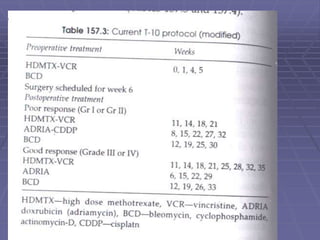
CHEMOTHERAPUTIC DRUGS
 High dose methotrexate (HDMTX) – 8-12gms/m. sq
 Leucoverin 10-15mg Q6H (20hrs after HDMTX)
 BCD
 Bleomycin – 15mg/m. sq/day
 Cyclophosphamide – 600mg/m. sq/day
 Dactinomicin – 600 mcg/m sq/day
 Adriamycin – 30mg/m sq/day
 Cisplatin – 120mg/m sq /day
RADIOTHERAPY
 Osteosarcomas were previously regarded to
be radio resistant.
 Mega-voltage radiotherapy is used.
 Used in surgically inaccessible areas.
 Radiotherapy of osteosarcoma has not been
found to be successful in either reliably
controlling local recurrences or preventing
pulmonary metastasis.
 6000-8000 rads are given as 230/day or
1000/week.
 In the pre operative period about 1000rads are
given which reduces the viability of tumor
cells which may disseminate in the blood
stream during the procedure.
Immuno-therapy
 New method of treatment
 Adjuvant value
 Efficacy is still under study
 Agents include
 BCG – bacilli calmette-guerine
 Cornybactirium parvum toxin
 Coleys toxin – combination of heat killed
mixture of strep. Pyogenous and serratia
marcescens
 Vaccine prepared from the patients own
tumor cell
Pulmonary mets
 Pulmonary resection: chemotherapy
reduces the size of primary tx and lung
deposits, making resection easy
 Large mets- lobectomy / wedge resection
 Contraindications: wide spread mets
 :poor general condition
 :3 or more pulmonary foci
References
 Samuel L Turek 4th edition
 Campbell 12th edition
THANK YOU

osteosarcoma

  • 1.
  • 2.
    Highly malignant boneTx characterised by invariable formation of neoplastic osteoid and tumor tissue Cell of origin :common multipotential mesenchymal cell osteoblatic chondroblastic fibroblastic Neoplastic osteoid tissue and bone
  • 3.
    ETIOLOGY Predisposing factors Excitingfactors Age : peak 2nd decade BIMODAL ..after 60 yrs Virus:RNA –harvey& moloney mouse sarcoma virus DNA: Polyoma, SV 40 Sex : m>f Radiation: > 2000 rads latent period 3 to 4 yrs Site: metaphysis fe>ti>ph >>> jaws Chemical : Be,20 methyl cholanthrene,Cu chelated amino fluorene
  • 4.
     Unicameral bonecyst  Aneurysmal bone cyst  Ewing’s sarcoma Osteosarcoma  Enchondroma  Osteoblastoma  Chondroblastoma  Fibrous dysplasia
  • 5.
    METAPHYSIS  Osteosarcoma  Bonecysts  Osteoblastoma  Osteochondroma  Enchondroma  Aneurysmal bone cyst
  • 6.
    GROSS PATHOLOGY Metaphyseal largetumor with destruction of inner cortex and extends into sub periosteal space SCLEROSING TYPE & LYTIC TYPE Consistency---- stony hard to soft and gritty  The colour of the tumor reflects its components.  Bluish white- cartilaginous.  White- fibrous.  Yellowish white- osteoid.
  • 8.
     Bony necroticareas, cystic cavities  Large vascular channels & haemorrhage  Medullary cavity extension >> found in xray
  • 9.
    Eventually periosteal penetrationand soft tissue extension Barriers to joint--- growth plate, articular cartilage Pulmonary deposits
  • 10.
    MICROSCOPY  Microscopic appearanceis variable  Absolute criteria include(LICHTENSTEIN)  Sarcomatous stroma  Direct formation of tumor osteoid and bone by malignant connective tissue  Best evidence of malignancy is seen in the advancing borders
  • 11.
     The centralportions of the tumor are routinely the most sclerotic where formation of neoplastic bone is most pronounced.  As the anaplastic cells become enclosed in new bone, they become small and rounded, and thus may be unsuitable for diagnosis. Therefore the peripheral zones are most suitable for diagnosis.
  • 13.
    Prognostic significance in differentiationof primary bone sarcomas DAHLIN subtypes of osteosarcoma Osteoblastic Chondroblastic Fibrobalstic variants of osteosarcoma
  • 14.
    CLASSIFFICATION  Primary  conventionalosteosarcoma  low-grade intramedullary osteosarcoma  parosteal osteosarcoma  periosteal osteosarcoma  high-grade surface osteosarcoma  telangiectatic osteosarcoma  small cell osteosarcoma. CENTRAL PERIPHERAL INTRAMEDULLARY HIGH GRADE (conventional) LOW GRADE JUXTACORTICAL PAROSTEAL PERIOSTEAL TELANGIECTATIC HIGH GRADE SURFACE SMALL CELL
  • 15.
     Secondary Paget’s disease Radiationinduced HEPARIN CYCLOSERINE chronic osteomyelitis bone infarcts osteogenesis imperfecta
  • 16.
    CONVENTIONAL OSTEOSARCOMA  It isthe most common type of osteosarcoma.  It is classified based on dominant histopathology as:  Osteoblastic  Fibroblastic  Chondroblastic
  • 17.
     Radiographically, thebone involved in conventional osteosarcoma may be lytic, sclerotic or show a mixed response.  It begins in an intramedullary location but may break through the cortex and form a soft tissue mass.
  • 18.
    Low-grade intramedullary osteosarcoma  indolentcourse with relatively benign features on roentgenogram  As the name implies, it is located in an intramedullary location and only erodes through the cortex very late  Microscopically, it consists of slightly atypical spindle cells producing slightly irregular osseous trabeculae.
  • 19.
    Periosteal osteosarcoma intermediate-grade malignancythat arises on the surface of the bone  The most common locations are the diaphyses of the femur and tibia  It occurs in a slightly older and broader age group  Histological examination of periosteal osteosarcoma demonstrates strands of osteoid-producing spindle cells radiating between lobules of cartilage
  • 20.
    femur of 67-year-oldwoman with periosteal osteosarcoma
  • 21.
    MRI demonstrates lesionarising from surface of bone. Marrow does not appear to be involved
  • 22.
  • 23.
    Typical microscopic appearanceof periosteal osteosarcoma. Lobules of malignant cartilage are separated by malignant spindle cells producing osteoid.
  • 24.
    TELANGIECTATIC OSTEOSARCOMA  expansible, aggressivelesion simulating an anurysmal bone cyst and composed of loculated blood filled spaces, partially lined by malignant cells producing sparse osteoid formation.  These features account for its radiographic features of a purely lytic lesion which shows none of the sclerotic changes associated with conventional osteosarcoma.
  • 25.
    Small cell osteosarcoma It is a rare variant.  High-grade lesion that consists of small blue cells that may resemble Ewing sarcoma or lymphoma.
  • 26.
     Cytogenetic andimmunohistochemistry studies sometimes are needed to differentiate these lesions.  This variant seems to have a worse prognosis than the conventional osteosarcoma.
  • 27.
    Parosteal osteosarcoma  Parostealosteosarcoma also is a rare, low-grade malignancy  It arises on the surface of the bone and invades the medullary cavity only at a late stage  It has a peculiar tendency to occur as a lobulated ossified mass on the posterior aspect of the distal femur
  • 28.
    Anteroposterior and lateral roentgenogramsof parosteal osteosarcoma arising in its most common location – Lower end of femur
  • 29.
    High-grade surface osteosarcoma  High-gradesurface osteosarcoma is the least common type of osteosarcoma  It is an aggressive tumor arising on the outer aspect of the cortex  Roentgenograms show an invasive lesion with ill- defined borders  Like conventional osteosarcoma, the microscopic appearance is that of a high-grade tumor with hypercellularity, mitotic figures, and marked nuclear pleomorphism  Unlike parosteal osteosarcoma, medullary involvement is common at the time of diagnosis.
  • 30.
    Secondary osteosarcomas  Secondaryosteosarcomas occur at the site of another disease process.  almost half of the osteosarcomas in patients over 50 years of age.  Prognosis –poor than primary osteosarcoma
  • 31.
     They include Paget disease  Previous radiation treatment  fibrous dysplasia  bone infarcts  Osteochondromas  chronic osteomyelitis  dedifferentiated chondrosarcomas  osteogenesis imperfecta
  • 32.
    Paget's osteosarcoma  Paget'sosteosarcoma most commonly occurs in patients between the sixth and eighth decades of life.  The incidence of osteosarcoma in Paget disease is approximately 1%  Femur>humerus>pelvis>skull>tibia. Can be multicentric
  • 33.
     Pain,swelling atthe site of old #  # Failure to unite  Xray: mixed blastic and lytic changes  :cortical destruction  :lung deposits  Osteoclastic multinucleated giant cells can be seen
  • 34.
    Radiation-induced osteosarcoma  Radiation-inducedosteosarcoma occurs in approximately 1% of patients who have been treated with over 2500 cGy.  Occurs in unusual locations such as the skull, spine, clavicle, ribs, scapula, and pelvis.  Internal radiaion- radium  External radiation- megavoltage/ orthovoltage  Mc- radiation >3000 rads for benign GCT  Highly osteogenic,sclerosing,profuse osteoid and new bone formation
  • 35.
    CLINICAL FEATURES  PAIN Predominant symptom  Appears first  Initially slight and intermittent  With in few weeks increases in intensity  Cause of pain  Micro infarcts  Minute stress fractures
  • 36.
     SWELLING  2NDmost common complaint.  Present in 90% of high grade osteosarcomas  Skin over is  Stretched  Shiny  Dilated veins  Local rise of temperature  Consistency is firm to hard.  crepitus --#  Joint mobility normal initially later restricted  Constitutional Sx and signs of inflammtion rare
  • 38.
    RADIOGRAPHIC FINDINGS  Codman’striangle – isolated cuff of reactive sub periosteal new bone formation at the boundary of the tumor that rapidly elevates the periosteum
  • 39.
    RADIOGRAPHIC FINDINGS  Sunburst appearance – spicules of new bone formation seem radiating from a point. It is due to new bone formation along the blood vessels
  • 40.
     LONGITUDINAL LAMINATIONS: Longitudinalperiosteal laminations follow the course of intramedullary lesion.
  • 41.
    BIOPSY  Biopsy shouldbe done only after clinical, laboratory, and roentgenographic examinations are complete.  Regardless of whether a needle biopsy or an open biopsy is done, the biopsy track should be considered contaminated with tumor cells.  If a tourniquet is used, the limb may be elevated before inflation but should not be exsanguinated by compression. Care should be taken to contaminate as little tissue as possible.
  • 42.
    BIOPSY  Transverse incisionsshould be avoided because they are extremely difficult or impossible to excise with the specimen.  The deep incision should go through a single muscle compartment rather than contaminating an intermuscular plane.  Major neurovascular structures should be avoided.  Soft tissue extension of a bone lesion should be sampled.
  • 43.
    BIOPSY  If atourniquet has been used it should be deflated and meticulous hemostasis ensured before closure, since a hematoma would be contaminated with tumor cells  If a drain is used, it should exit in line with the incision so that the drain track also can be easily excised en bloc with the tumor
  • 45.
    CT SCAN  Usefulfor evaluation  Differentiate b/w infection and tumor  Exact area of cortical break  Soft tissue extension, medullary spread, proximity to NV bundle  Detect skip lesions
  • 46.
    MRI SCAN  Bettercontrast discrimination  Can be performed in any plane  Ideal for medullary marrow assessment
  • 47.
    ANGIOGRAPHY  Accurate methodof of detecting and measuring extent of occult soft tissue extension.  Reactive zone is seen in the early arterial phase. .  Intrinsic vascularity is seen as the tumor blush in the late venous phase.
  • 48.
     Also assessany major vessel involvement by the tumor.  Arterial phase is useful in detecting sub- clinical recurrences.  It also helps in gauging the clinical response to chemotherapy.
  • 49.
    BONE SCAN  Technetium99  Increased uptake due to brisk osteoblastic reaction  Helpful in detecting  Skip lesions  Multicentric presentations  metastasis
  • 50.
    BIO-CHEMICAL MARKERS  SerumALP  It is increased as the tumor has neoplastic osteoblasts  Useful in prognosis and follow up  Falls to near normal after surgical resection  Persistence indicates, metastasis, recurrence, residual or spreading nature
  • 51.
    BIO-CHEMICAL MARKERS  Osteocalcin– A  Recently identified, vitamin K dependant, calcium binding carboxy glutamic acid containing protein  May be of value in diagnosis of heavily bone producing types  Anti-human osteosarcoma monoclonal anti bodies  Detected by immunochemistry  These anti-bodies to sarcoma cell surface antigens are specific to osteosarcoma.
  • 52.
    METASTASIS  Primary routeis hematogenous and mainly occurs to lungs  Other sites include  Brain  Liver  Lymph node
  • 53.
  • 54.
     The 5year survival rate which was below 20% is now 60-80%.  This can be attributed to the use of  Newer chemotherapeutic regimens  Mega voltage radiotherapy  Aggressive pulmonary resection
  • 55.
  • 56.
    GENERAL CONSIDERATIONS  Establishmentof diagnosis by needle biopsy or incisional biopsy. Due to fear of tumor spillage frozen section if available should be utilized.  Resection of primary tumor and reconstruction  Adjuvants  Chemotherapy  Radiotherapy  Rehabilitation
  • 58.
    AMPUTATIONS  This providesthe definitive surgical treatment for osteosarcoma.  Level of amputation is the most important factor to be decided:  For upper end of tibia above knee amputation  For lower end of femur still controversial. Hip disarticulation is the safer option compared to high a/k  Upper end of femur – hind quarter amputation  Proximal humerus – fore quarter amputation
  • 59.
    LIMB SPARING SURGERIES No major neuro-vascular involvement.  Wide resection of affected bone with normal cuff in all directions.  Adequate motor reconstruction and soft tissue coverage
  • 60.
     PHASES OFTHE PROCEDURE  Resection of the tumor  Skeletal reconstruction  Soft tissue and muscle transfers
  • 61.
    Reconstructive procedures  arthrodesis osteoarticular allograft reconstruction,  endoprosthetic reconstruction,  allograft-prosthesis composite reconstruction  rotationalplasty
  • 63.
  • 64.
     Osteoarticular allografts advantages: ability to replace ligaments, tendons, and intraarticular structures.  complications:nonunion at the graft-host junction, fatigue fracture, articular collapse, dislocation, degenerative joint disease, and failure of ligament and tendon attachments.  a temporary measure to preserve an adjacent physis  A proximal tibial osteoarticular allograft could be used in an immature patient in an attempt to preserve the distal femoral physis until skeletal maturity. This could be converted later to an endoprosthetic reconstruction when it becomes necessary.
  • 65.
     Allograft-prosthesis composites They avoid the complications of degenerative joint disease and articular collapse, while still preserving the ability to attach soft-tissue structures directly, such as the patella tendon or the hip abductors.  They are associated, however, with fatigue fracture, infection, and nonunion at the graft-host junction.  main indication for an allograft-prosthesis composite is an inadequate length of remaining host bone to secure the stem of an endoprosthesis.
  • 68.
     Endoprosthetic reconstruction advantage -immediate stability that allows for quicker rehabilitation with immediate full weight bearing.   Most endoprostheses are modular, allowing for incremental limb lengthening as an immature patient grows.  Polyethylene wear  Fatigue fractures
  • 70.
     Considerations forPediatric Patients  future limb-length inequality must be considered.  For patients who are near skeletal maturity, the reconstructed limb can be lengthened 1 cm at the initial procedure. Also, epiphysiodesis of the contralateral limb can be done at the appropriate age to preserve limb-length equality .  expandable prostheses currently is gaining support.
  • 74.
     it usesenergy stored in a compressed spring to allow for future expansion of the prosthesis as the child grows.  When a leg-length discrepancy develops, the child is scheduled for an expansion .  The procedure is done in the fluoroscopy suite with the patient under light sedation.  The locking mechanism on the prosthesis is identified using fluoroscopy, and an electromagnetic coil is placed over the patient's leg at that level.  The electromagnetic coil is activated for 20 seconds, which heats an element in the prosthesis, melting a small segment of polyethylene and allowing controlled expansion of the spring. The leg lengths are reevaluated under fluoroscopy, and the procedure is repeated one or two times as necessary. We have been able to gain 0.5 to 1.5 cm during each scheduled expansion session. Expansion sessions can be scheduled 4 weeks apart if needed to allow the operated leg to “catch up.” After the expansion sessions, patients usually are able to ambulate immediately without an assistive device.
  • 75.
    Group AI—Lesion indistal femur. The distal femur, knee joint, and proximal tibia are resected; the lower leg is rotated 180 degrees; and the tibia is joined to the remaining femur
  • 76.
    Group AII—Lesion inthe proximal tibia. The distalmost femur, knee joint, and proximal tibia are resected. After rotation of 180 degrees, the distal tibia is joined to the distal femur
  • 77.
    Group BI—Lesion inthe proximal femur sparing the hip joint and gluteal muscles. The upper femur and hip joint are resected, and the leg is rotated 180 degrees. The distal femur is joined to the pelvis so that the knee functions as the hip, and the ankle functions as the knee
  • 78.
    Group BIII—Lesion in themidfemur. The entire femur is resected. The tibia is attached to the pelvis using an endoprosthesis
  • 79.
  • 81.
    CHEMOTHERAPY  It waspreviously used for end stage disease.  Now with the advent of neo-adjuvant chemotherapy it is given for all cases both pre and post operatively.
  • 82.
     It isbased on the principle that all patients have undetectable micro-metastasis on presentation.  Multi drug ,multi cycle therapy is used.
  • 83.
    NEO-ADJUVANT CHEMOTHERAPY  Advantages  Eliminatesmicro or macro metastasis  Causes necrosis of primary tumor  Reduces tumor size and vascularity  Widens tumor free surgical margin  Prevent local recurrence  Prognostic indicator  Disadvantages  Delayed wound healing  Infection
  • 84.
    CHEMOTHERAPUTIC DRUGS  Highdose methotrexate (HDMTX) – 8-12gms/m. sq  Leucoverin 10-15mg Q6H (20hrs after HDMTX)  BCD  Bleomycin – 15mg/m. sq/day  Cyclophosphamide – 600mg/m. sq/day  Dactinomicin – 600 mcg/m sq/day  Adriamycin – 30mg/m sq/day  Cisplatin – 120mg/m sq /day
  • 86.
    RADIOTHERAPY  Osteosarcomas werepreviously regarded to be radio resistant.  Mega-voltage radiotherapy is used.  Used in surgically inaccessible areas.  Radiotherapy of osteosarcoma has not been found to be successful in either reliably controlling local recurrences or preventing pulmonary metastasis.
  • 87.
     6000-8000 radsare given as 230/day or 1000/week.  In the pre operative period about 1000rads are given which reduces the viability of tumor cells which may disseminate in the blood stream during the procedure.
  • 88.
    Immuno-therapy  New methodof treatment  Adjuvant value  Efficacy is still under study  Agents include  BCG – bacilli calmette-guerine  Cornybactirium parvum toxin  Coleys toxin – combination of heat killed mixture of strep. Pyogenous and serratia marcescens  Vaccine prepared from the patients own tumor cell
  • 89.
    Pulmonary mets  Pulmonaryresection: chemotherapy reduces the size of primary tx and lung deposits, making resection easy  Large mets- lobectomy / wedge resection  Contraindications: wide spread mets  :poor general condition  :3 or more pulmonary foci
  • 90.
    References  Samuel LTurek 4th edition  Campbell 12th edition
  • 91.