
Joint Contractures Resulting From
Prolonged Immobilization: Etiology, Prevention,
and Management
Journal Club
Presented by :
Ahmed Reda Noaman
Orthopedic Surgery Resident (R2)
Abdallah Jomaa El Azanki
Orthopedic Surgery As. Lecturer
- Review article
- Published in Journal of American Acadermy of Orthopedic
Surgeons , 2017
- Department of Orthopedic Surgery , Brown university , Alpert
Medical School , Providence , RI , USA .
Authors
Christopher T. Born, MD
Joseph A. Gil, MD
Avi D. Goodman, MD
ABOUT THE ARTICLE
What the research question ?
Joint contractures , How to prevent and manage ?
What did they do ?
They reviewed about 41 study about :
 - Precautions
- conservative treatment
- Surgical management
EVIDENCE BASED
MEDICINE
This article revied many studies with majority of
“Level II & IV” of EBS
EBM levelNo. of studies
Level I2
Level II11
Level III7
Level IV15
Level V6
ABSTRACT
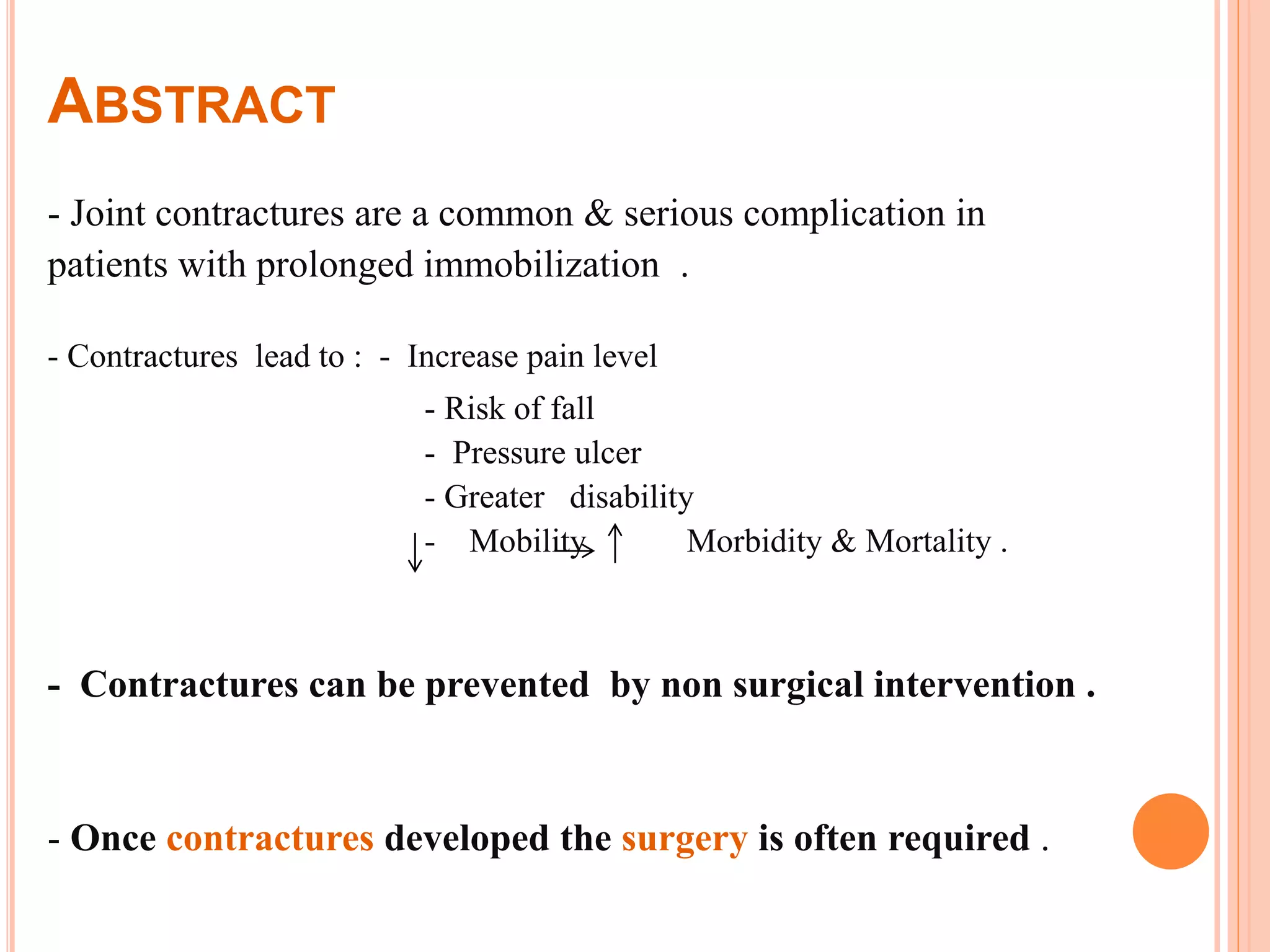
- Joint contractures are a common & serious complication in
patients with prolonged immobilization .
- Contractures lead to : - Increase pain level
- Risk of fall
- Pressure ulcer
- Greater disability
- Mobility Morbidity & Mortality .
- Contractures can be prevented by non surgical intervention .
- Once contractures developed the surgery is often required .
ETIOLOGY, RISK FACTORS, &
PATHOPHYSIOLOGY
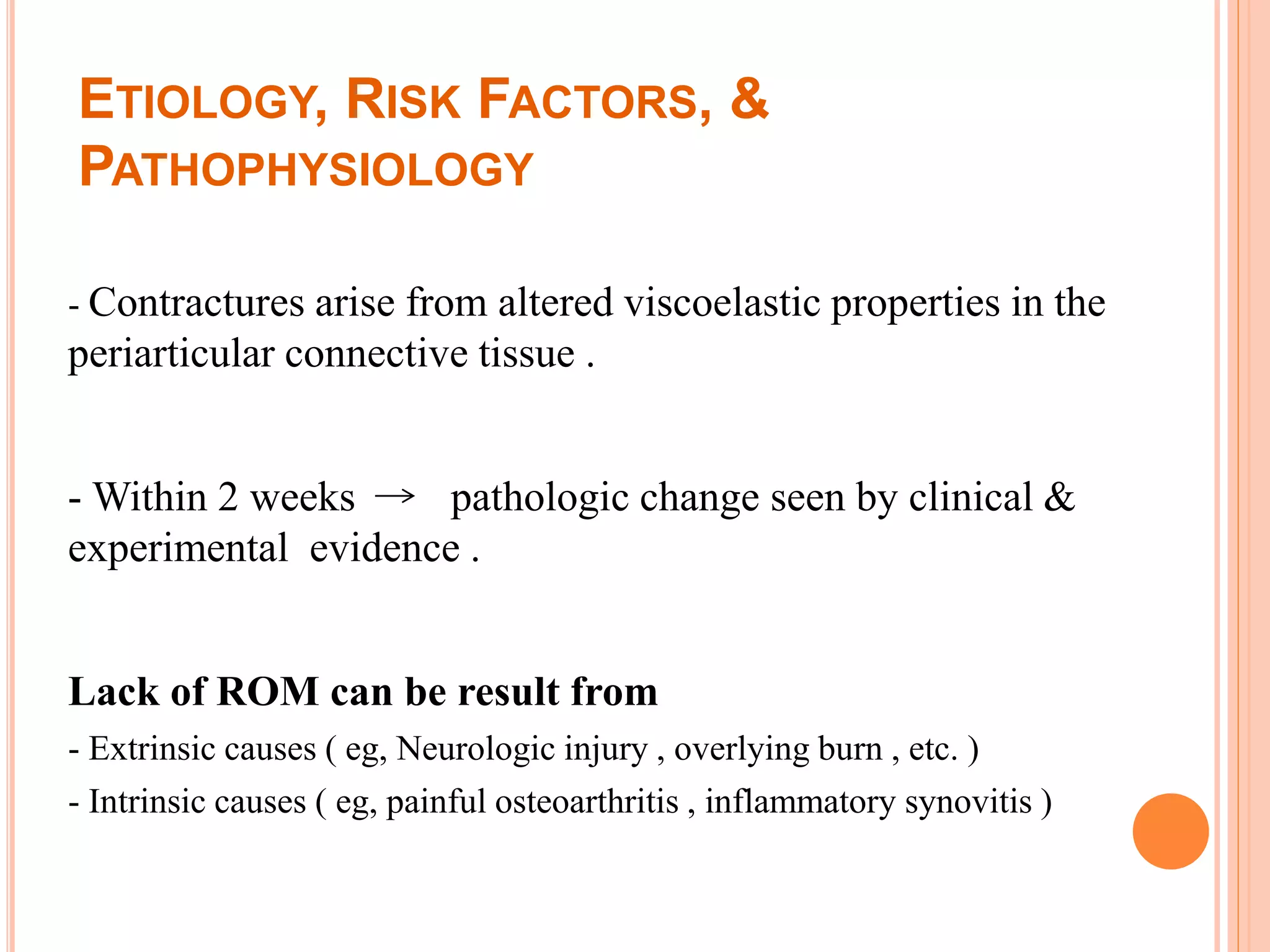
- Contractures arise from altered viscoelastic properties in the
periarticular connective tissue .
- Within 2 weeks pathologic change seen by clinical &
experimental evidence .
Lack of ROM can be result from
- Extrinsic causes ( eg, Neurologic injury , overlying burn , etc. )
- Intrinsic causes ( eg, painful osteoarthritis , inflammatory synovitis )
PATHOPHYSIOLOGY
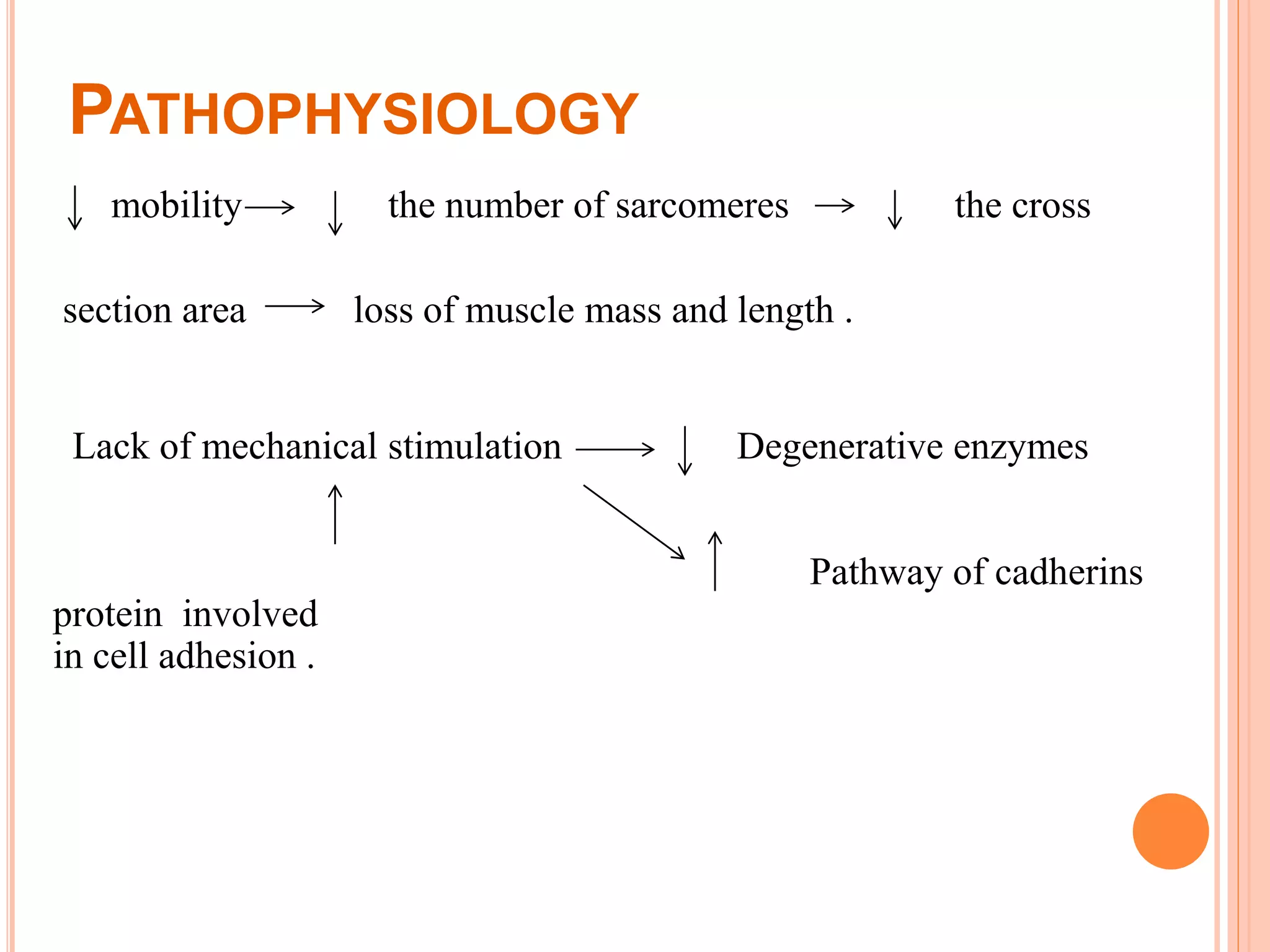
mobility the number of sarcomeres the cross
section area loss of muscle mass and length .
Lack of mechanical stimulation Degenerative enzymes
Pathway of cadherins
protein involved
in cell adhesion .
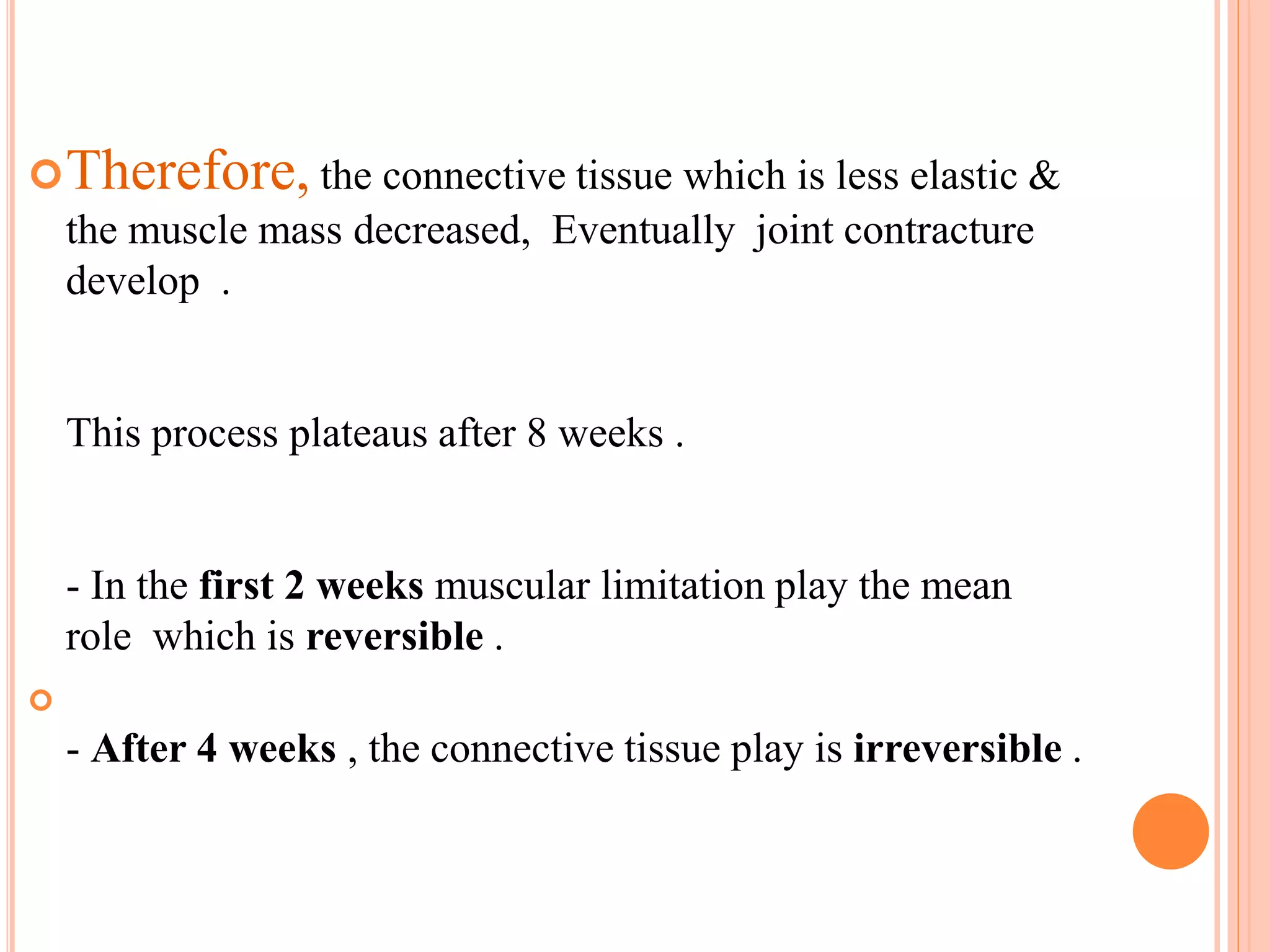
Therefore, the connective tissue which is less elastic &
the muscle mass decreased, Eventually joint contracture
develop .
This process plateaus after 8 weeks .
- In the first 2 weeks muscular limitation play the mean
role which is reversible .

- After 4 weeks , the connective tissue play is irreversible .
PREVENTION AND NON SURGICAL
MANAGEMENT
- Passive stretching
- Continuous passive motion
- Splinting
- Serial casting
- Neuromuscular Electrical
Stimulation
- Botulinum toxin injection
PASSIVE STRETCHING
- Passive stretching is frequently the first line of nonsurgical intervention .
- Williams 1990 , prevent loss of sarcomeres & muscle atrophy (30 min P.S)
- Morris et al 2008 , found that the ICU stay was shorter with P. Stretching
In contrast,
Katalinic et al 2010 , evaluate 35 studies and found that no
clinically relevant effect on joint mobility over time.
CONTINUOUS PASSIVE MOTION
- Griffiths et al 1995 found that CPM diminished protein
loss and msfiber atrophy , But it did not prevent
muscle wasting .
- Chaudhry and Bhandari 2015 , concluded that CPM had
no value after TKA (Cochrane review) .
SPLINTING
- Meyers 2010 , splinting was useful in prevention of equinus
contractures in ICU patients,
- Splinting should be interrupted with stretching of the
antagonist muscles.
- Glinas et al 2000 , Splinting restores functional ROM in 11 of
22 patients with post-traumatic elbow flexion contracture .
SERIAL CASTING
- Singer et al 2004 , Pohl et al 2002
said that serial casting is useful in management of equinus
cntracture in patient with spastic flexion contracture ( Brain
injury & CP )
In contrast ,
Moseley et al 2008: Gains in ROM resulting from serial
casting for post-traumatic elbow contracture diminished over
time.
- Improvement was 22° after casting but only 2° of gained
motion persist at 4 weeks follow up .
NEUROMUSCULAR ELECTRICAL
STIMULATION
- Williams et al 1998 - rat soleus model
Accelerating reduction of sarcomeres compared with
immobilization alone
- Pandyan et al 1997
management of wrist flexion contractures on a stroke patient…
ROM returning to baseline at 2-week follow-up.
BOTULINUM TOXIN
Produced by Clostridium botulinum, botulinum toxin prevents presynaptic
release of acetylcholine and subsequently causes temporary muscle
paralysis .
Hesse et al 1996 , found that injection of botulinum decreased chronic
hemiparetic spasticity and improved gait .
Booth et al 2003 , it gives better results when used with serial casting to
manage the spastic equinus contracture
Although, these results appear promising, the patients were not followed up
SURGICAL MANAGEMENT
- Once contractures developed (with without previous
precautions) Surgery is often required .
- The goals of surgical interventions
restore motion
muscular balance
Surgery
Soulder Elbow Knee Ankle
Shoulder
Arthroscopic capsular release
50 patients included
33 post-traumatic , 6 after fracture , 11 idiopathic
4 patients require open capsular release due to persistent stiffness
Elbow
Open capsulotomy Arthroscopic release
15 patients included
61% improvement
3 patients develop transient
nerve palsy
12 patients included
Flexion contracture improved
from 38° to 3° ,
and supination improved
from 45° to 84°
1 PIN palsy reported
1 persistent stiffness reported
Knee
Arthroscopic management
19 patients included
routine arthrofibrosis gained 38° of flexion and 11°
of extension
infrapateller contracture syndrome gained 31 ° of
flexion and 14 ° of extension .
4 patients required additional surgery for persistent stiffness
Ankle
The technique was performed
through transverse incision
57 patients included
(97 ankles )
mild to moderate
< 20 °
2 patients
( 4 ankles)
reported recurrence
triple hemisection
technique
Severe cases
> 20 °
18 patients were included in
this study ( 25 ankles )
At 25 months
2 recurrences
no tendon ruptures
1. What is the research question and why was it asked ?
2. What is the study type (design)?
3. Selection issues
4. What did they do? Methods
5. What are the study results and outcome factors and how are they measured?
6. What important potential confounders are considered?
7. What is the statistical method in the study?
8. Statistical results
9. What is conclusions about the research question?
10. Study limitations?
11. How do you apply the findings into your daily clinical practice or research?
Joints contractures #dr_azanki

Joints contractures #dr_azanki

  • 1.
    Joint Contractures ResultingFrom Prolonged Immobilization: Etiology, Prevention, and Management Journal Club Presented by : Ahmed Reda Noaman Orthopedic Surgery Resident (R2) Abdallah Jomaa El Azanki Orthopedic Surgery As. Lecturer
  • 2.
    - Review article -Published in Journal of American Acadermy of Orthopedic Surgeons , 2017 - Department of Orthopedic Surgery , Brown university , Alpert Medical School , Providence , RI , USA . Authors Christopher T. Born, MD Joseph A. Gil, MD Avi D. Goodman, MD
  • 3.
    ABOUT THE ARTICLE Whatthe research question ? Joint contractures , How to prevent and manage ? What did they do ? They reviewed about 41 study about :  - Precautions - conservative treatment - Surgical management
  • 4.
    EVIDENCE BASED MEDICINE This articlerevied many studies with majority of “Level II & IV” of EBS EBM levelNo. of studies Level I2 Level II11 Level III7 Level IV15 Level V6
  • 5.
    ABSTRACT - Joint contracturesare a common & serious complication in patients with prolonged immobilization . - Contractures lead to : - Increase pain level - Risk of fall - Pressure ulcer - Greater disability - Mobility Morbidity & Mortality . - Contractures can be prevented by non surgical intervention . - Once contractures developed the surgery is often required .
  • 6.
    ETIOLOGY, RISK FACTORS,& PATHOPHYSIOLOGY - Contractures arise from altered viscoelastic properties in the periarticular connective tissue . - Within 2 weeks pathologic change seen by clinical & experimental evidence . Lack of ROM can be result from - Extrinsic causes ( eg, Neurologic injury , overlying burn , etc. ) - Intrinsic causes ( eg, painful osteoarthritis , inflammatory synovitis )
  • 7.
    PATHOPHYSIOLOGY mobility the numberof sarcomeres the cross section area loss of muscle mass and length . Lack of mechanical stimulation Degenerative enzymes Pathway of cadherins protein involved in cell adhesion .
  • 8.
    Therefore, the connectivetissue which is less elastic & the muscle mass decreased, Eventually joint contracture develop . This process plateaus after 8 weeks . - In the first 2 weeks muscular limitation play the mean role which is reversible .  - After 4 weeks , the connective tissue play is irreversible .
  • 9.
    PREVENTION AND NONSURGICAL MANAGEMENT - Passive stretching - Continuous passive motion - Splinting - Serial casting - Neuromuscular Electrical Stimulation - Botulinum toxin injection
  • 10.
    PASSIVE STRETCHING - Passivestretching is frequently the first line of nonsurgical intervention . - Williams 1990 , prevent loss of sarcomeres & muscle atrophy (30 min P.S) - Morris et al 2008 , found that the ICU stay was shorter with P. Stretching In contrast, Katalinic et al 2010 , evaluate 35 studies and found that no clinically relevant effect on joint mobility over time.
  • 11.
    CONTINUOUS PASSIVE MOTION -Griffiths et al 1995 found that CPM diminished protein loss and msfiber atrophy , But it did not prevent muscle wasting . - Chaudhry and Bhandari 2015 , concluded that CPM had no value after TKA (Cochrane review) .
  • 12.
    SPLINTING - Meyers 2010, splinting was useful in prevention of equinus contractures in ICU patients, - Splinting should be interrupted with stretching of the antagonist muscles. - Glinas et al 2000 , Splinting restores functional ROM in 11 of 22 patients with post-traumatic elbow flexion contracture .
  • 13.
    SERIAL CASTING - Singeret al 2004 , Pohl et al 2002 said that serial casting is useful in management of equinus cntracture in patient with spastic flexion contracture ( Brain injury & CP ) In contrast , Moseley et al 2008: Gains in ROM resulting from serial casting for post-traumatic elbow contracture diminished over time. - Improvement was 22° after casting but only 2° of gained motion persist at 4 weeks follow up .
  • 14.
    NEUROMUSCULAR ELECTRICAL STIMULATION - Williamset al 1998 - rat soleus model Accelerating reduction of sarcomeres compared with immobilization alone - Pandyan et al 1997 management of wrist flexion contractures on a stroke patient… ROM returning to baseline at 2-week follow-up.
  • 15.
    BOTULINUM TOXIN Produced byClostridium botulinum, botulinum toxin prevents presynaptic release of acetylcholine and subsequently causes temporary muscle paralysis . Hesse et al 1996 , found that injection of botulinum decreased chronic hemiparetic spasticity and improved gait . Booth et al 2003 , it gives better results when used with serial casting to manage the spastic equinus contracture Although, these results appear promising, the patients were not followed up
  • 16.
    SURGICAL MANAGEMENT - Oncecontractures developed (with without previous precautions) Surgery is often required . - The goals of surgical interventions restore motion muscular balance
  • 17.
  • 18.
    Shoulder Arthroscopic capsular release 50patients included 33 post-traumatic , 6 after fracture , 11 idiopathic 4 patients require open capsular release due to persistent stiffness
  • 19.
    Elbow Open capsulotomy Arthroscopicrelease 15 patients included 61% improvement 3 patients develop transient nerve palsy 12 patients included Flexion contracture improved from 38° to 3° , and supination improved from 45° to 84° 1 PIN palsy reported 1 persistent stiffness reported
  • 20.
    Knee Arthroscopic management 19 patientsincluded routine arthrofibrosis gained 38° of flexion and 11° of extension infrapateller contracture syndrome gained 31 ° of flexion and 14 ° of extension . 4 patients required additional surgery for persistent stiffness
  • 21.
    Ankle The technique wasperformed through transverse incision 57 patients included (97 ankles ) mild to moderate < 20 ° 2 patients ( 4 ankles) reported recurrence triple hemisection technique Severe cases > 20 ° 18 patients were included in this study ( 25 ankles ) At 25 months 2 recurrences no tendon ruptures
  • 22.
    1. What isthe research question and why was it asked ? 2. What is the study type (design)? 3. Selection issues 4. What did they do? Methods 5. What are the study results and outcome factors and how are they measured? 6. What important potential confounders are considered? 7. What is the statistical method in the study? 8. Statistical results 9. What is conclusions about the research question? 10. Study limitations? 11. How do you apply the findings into your daily clinical practice or research?