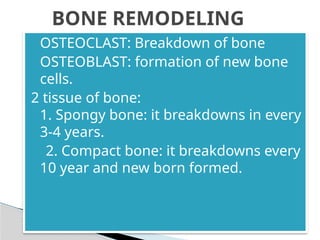
• OSTEOCLAST: Breakdownof bone
OSTEOBLAST: formation of new bone
cells.
2 tissue of bone:
1. Spongy bone: it breakdowns in every
3-4 years.
2. Compact bone: it breakdowns every
10 year and new born formed.
BONE REMODELING
3.
In boneremodeling, 3 things are very
important.
1. PARATHYROID HORMONE
2. CALCITONIN
3. VITAMIN D
4.
Release ofPTH occurs from Parathyroid
gland gland. Whenever, the serum
Calcium level is low, PTH releses in the
blood, and absorbs in bone.
PARATHYROID HORMONE
5.
A hormonereleses from the thyroid
Gland. It activates when serum
calcium level is high. And calcitonin
helps to transfer the calcium to
bone from blood.
CALCITONIN
6.
Vitamin Dincreases the absorption of
Calcium. It increases in blood and calcitonin
activates and send calcium to bone
Thus, for bone absroption [blood to bone] and
reabsorption [bone to blood] these 3 factors
are important.
VITAMIN D
7.
Osteoporosis causesbones to
become weak and brittle fragile
so brittle that a fall or even mild
stresses such as bending over or
coughing can cause a fracture.
OSTEOPOROSIS
8.
Osteo refersto Bone
Poros refers to formation of pore
INTRODUCTION
9.
Primary osteoporosis.Primary
osteoporosis occurs in women after
menopause and in men later in life, but
it is not merely a consequence of aging
but of failure to develop optimal peak
bone mass during childhood,
adolescence, and young adulthood.
.
CLASSIFICATION
10.
Secondary osteoporosis.Secondary
osteoporosis is the result
of medications or other conditions
and diseases that affect bone
metabolism
11.
Genetics. Small-framed,non-
obese Asian women of slight build are at
risk for low peak bone mineral
density; African American women are less
susceptible to osteoporosis.
Age. Osteoporosis occurs in men at
a lower rate and at an older age, as it is
believed that testosterone and estrogen are
important in achieving and maintaining
bone mass, so risk for osteoporosis
increases with increasing age.
CAUSES
12.
Menopause, dueto low amount
of estrogen, serum calcium level
decreases, then automatically
bone re-absorption occurs due to
which calcium start moving from
bone to blood.
Lack of physical activity
Smoking
Alcohol consumption.
Physical exercise.A sedentary lifestyle,
lack of weight-bearing exercise, and low
weight and body mass index increases
the risk for osteoporosis because bones
need stress for bone maintenance.
Nutrition. A low calcium intake, low
vitamin D intake, high phosphate
intake, and inadequate calories reduce
nutrients needed for bone remodeling
15.
Lifestyle choices.Too much consumption
of caffeine and alcohol, smoking, and lack
of exposure to sunlight reduces
osteogenesis in bone remodeling.
Medications. Intake
of corticosteroids, anti seizure
medications, heparin, and thyroid
hormone affects calcium absorption and
metabolism.
16.
Osteoporosis hasbeen called as ‘Silent diseases
'because bone mass is being loss from many
years without any sign and symptoms.
Back pain
Fractures. The first clinical manifestation of
osteoporosis may be fractures.
CLINICAL MENIFESTATION
17.
Kyphosis. Thegradual collapse of a
vertebra is asymptomatic, and is called
progressive Kyphosis or “dowager’s
hump” associated with loss of height.
Decreased calcitonin. Calcitonin, which
inhibits bone resorption and promotes
bone formation, is decreased.
Decreased estrogen. Estrogen, which
inhibits bone breakdown, decreases with
aging.
Increased parathyroid
hormone. Parathyroid hormone
increases with aging, increasing bone
turnover and resorption.
18.
Dual-energy X-rayAbsorptiometry
(DXA). Osteoporosis is diagnosed by
DXA, which provides information
about BMD at the spine and hip.
T score is measured. Less or equal to
2.5 indicates osteoporosis.
BMD testing. BMD testing is useful in
identifying osteopenic and
osteoporotic bone and in assessing
response to therapy.
DIAGNOSTIC EVALUATION
19.
Laboratory studies.Laboratory studies such as
serum calcium, serum phosphate, serum alkaline
phosphatase, urine calcium excretion, hematocrit,
erythrocyte sedimentation rate, and x-ray studies
are used to exclude other possible disorders that
contribute to bone loss.
Bisphosphonates. They maintain serum calcium
level and preven reabsorption of
calcium.Bisphosphonates that include daily or
weekly oral preparations of alendronate or
risedronate, monthly oral preparations
of ibandronate, or yearly intravenous infusions
of zoledronic acid increase bone mass and
decrease bone loss by inhibiting osteoclast
function.
20.
Pharmacologic Therapy
The first-line medications and other
medications used to treat and prevent
osteoporosis include:
Calcium supplements with vitamin D. To
ensure adequate calcium intake, a calcium
supplement with vitamin D may be prescribed
and taken with meals or with a beverage high
in vitamin C to promote absorption, but these
supplements should not be taken at the same
day as bisphosphonates.
MEDICAL MANAGEMENT
21.
Calcitonin. Calcitonindirectly inhibits osteoclasts
thereby reducing bone loss and increasing bone
mineral density, and is administered by nasal
spray or
by subcutaneous or intramuscular injection.
Selective estrogen receptor modulators
(SERMs). SERMs such as raloxifene, reduce the
risk of osteporosis by preserving bone mineral
density without estrogenic effects on the uterus.
Teriparatide. Teriparatide is a subcutaneously
administered anabolic agent that is administered
once daily, and as a recombinant PTH, it
stimulates osteoblasts to build bone matrix and
facilitates overall calcium absorption.
22.
Diet. Adiet rich in calcium and vitamin
D throughout life, with an increased
calcium intake during adolescence at least
1200mg and postmenopausal women may
need 1500mg daily.
Milk. Cheese and yogurt are rich in calcium.
Exercise. Regular weight-bearing
exercise promotes bone formation, such as
a 20-30-minute.
NON PHARMACOLOGICAL
23.
Alcohol, caffeineintake should be avoided.
Women with low body weight [those with
eating disorder] should receive appropriate
evaluation.
Dietary counseling.
24.
Joint replacement.Joint replacement is
a surgery to replace all or part of a joint
with a man-made joint called prosthesis.
Closed or open reduction with internal
fixation. Open reduction, internal
fixation involves the implementation of
implants to guide the healing process of a
bone, as well as the open reduction, or
setting, of the bone, while closed
reduction is a procedure to set or reduce a
broken bone without surgery
SURGICAL MANAGEMENT
25.
Acute painrelated to fracture
and muscle spasm.
Impaired physical mobility.
Self care deficit.
Imbalanced nutrition pattern.
Risk for constipation related to immobility or
development of illus.
Risk for injury additional fractures related to
osteoporosis.
Deficient knowledge about the osteoporotic
process and treatment regimen.
NURSING DIAGNOSIS
26.
Diet. Identifycalcium and vitamin D rich
foods and discuss calcium supplements.
Exercise. Engage in weight-bearing exercise
daily.
Lifestyle. Modify lifestyle choices: avoid
smoking, alcohol, caffeine, and carbonated
beverages.
Posture. Demonstrate good body mechanics.
Early detection. Participate in screening for
osteoporosis.
Discharge and Home Care Guidelines
27.
Brunner &suddarth’s Textbook of medical-
surgical nursing.11th edition. • Web site: -
www.nursing4all.com
www.nursingcaste.com
REFRENCES:
![OSTEOPOROSIS
MANI KAUSHAL
MSC[N]2ND
YEAR](https://image.slidesharecdn.com/osteoporosis-250618180350-5703d14e/85/OSTEOPOROSIS-pptxxxxxxxxxxxxxxxxxxxxxxxxxxx-1-320.jpg)
![OSTEOPOROSIS
MANI KAUSHAL
MSC[N]2ND
YEAR](https://image.slidesharecdn.com/osteoporosis-250618180350-5703d14e/75/OSTEOPOROSIS-pptxxxxxxxxxxxxxxxxxxxxxxxxxxx-1-2048.jpg)
![ Vitamin D increases the absorption of
Calcium. It increases in blood and calcitonin
activates and send calcium to bone
Thus, for bone absroption [blood to bone] and
reabsorption [bone to blood] these 3 factors
are important.
VITAMIN D](https://image.slidesharecdn.com/osteoporosis-250618180350-5703d14e/85/OSTEOPOROSIS-pptxxxxxxxxxxxxxxxxxxxxxxxxxxx-6-320.jpg)
![ Alcohol, caffeine intake should be avoided.
Women with low body weight [those with
eating disorder] should receive appropriate
evaluation.
Dietary counseling.](https://image.slidesharecdn.com/osteoporosis-250618180350-5703d14e/85/OSTEOPOROSIS-pptxxxxxxxxxxxxxxxxxxxxxxxxxxx-23-320.jpg)