Osteoporosis- Investigations
& Recent advances
Moderator - Dr. Jayant Jain
Presenter - Dr. Karthik M V
CLINICAL FEATURES
M/C presentation – Fragility fractures
Most common sites :-
• HIP (neck of femur, IT fracture)
• WRIST (Colle’s fracture )
• Vertebrae (Compression fracture )
• Proximal Humerus fracture
CLINICAL FEATURES
• Chronic low backache
• Progressive loss of height associated with
vertebra deformities
• Appearance of thoracic
• kyphosis
• (DOWAGER’S HUMP )
X-Ray
• loss of trabecular definition
• thinning of the cortices
• Compression fractures of the vertebral bodies
• Radiography doesn’t reveal osteoporotic changes until they affect the
cortical bone
• Cortical bone is not affected by osteoporosis until > 30% bone loss
occurred
Spinal Deformity Index
• Percentage height reductions are used to grade fractures as
• Grade 0 – Normal vertebra
• Grade 1 - Mild (20–25% reduction in height)
• Grade 2 - Moderate (25–40% reduction in height)
• Grade 3 - Severe (>40% height reduction).
• Moderate and severe vertebral fractures predicts future Hip fracture
Spinal Deformity Index
• The scores are then added up for T4–L4 vertebrae.
• The spinal deformity index (SDI) value ranges between 0 and 39,
higher the SDI greater is chance of incident fracture
• Normal difference in anterior and posterior
heights of vertebral body is taken as 1–3 mm
• A difference of more than or equal to 4 mm is
abnormal
• The biconcave pattern of vertebrae commonly
referred to as fish vertebrae
• Fish vertebrae are seen in osteoporosis, Paget’s
disease, osteomalacia and hyperparathyroidism
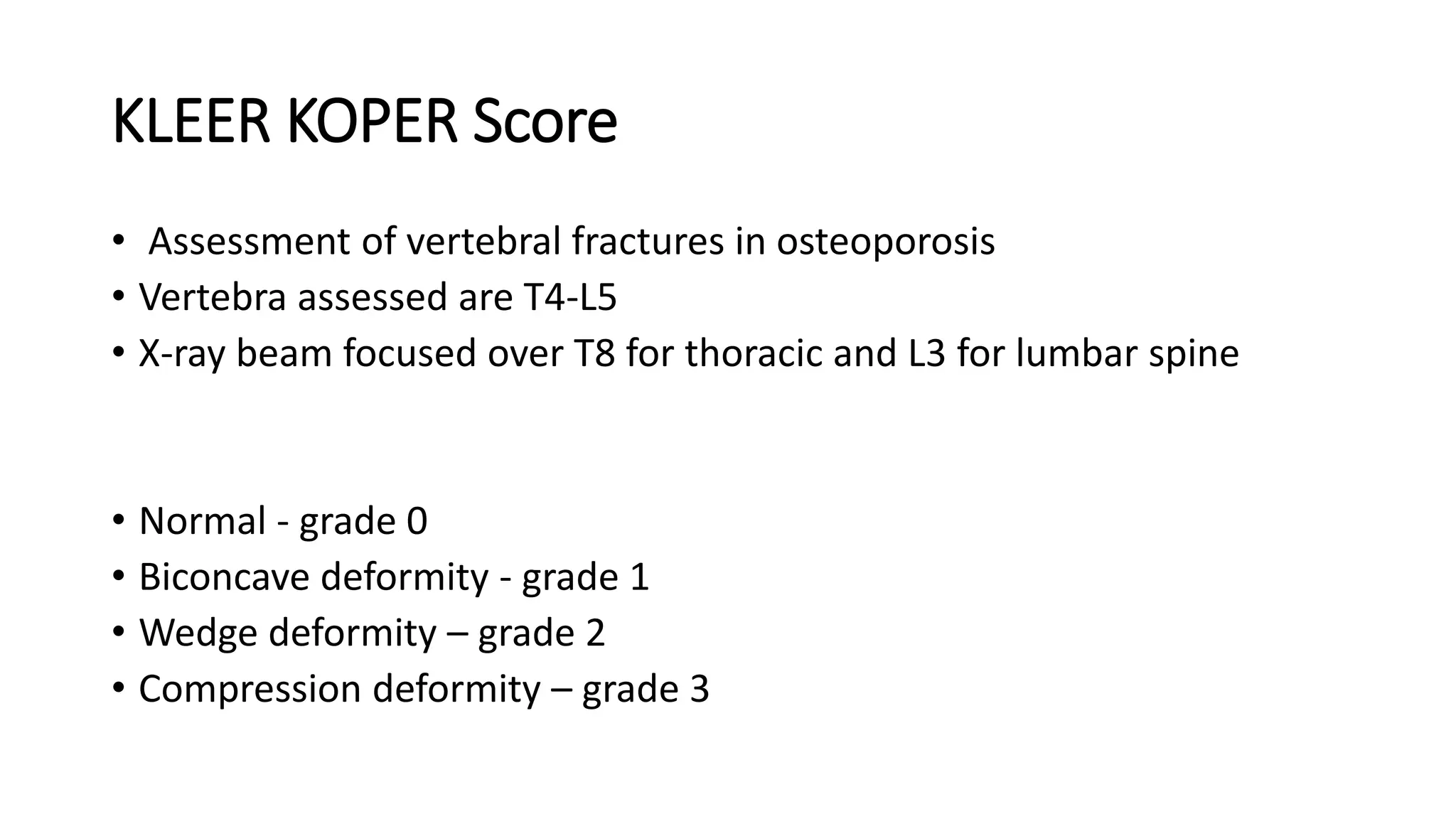
KLEER KOPER Score
• Assessment of vertebral fractures in osteoporosis
• Vertebra assessed are T4-L5
• X-ray beam focused over T8 for thoracic and L3 for lumbar spine
• Normal - grade 0
• Biconcave deformity - grade 1
• Wedge deformity – grade 2
• Compression deformity – grade 3
• Minimum score -0
(normal)
• Maximum score -42
• Higher the score,
greater the impact of
osteoporosis
Singh index
The trabecular pattern of the proximal end of the femur
is an excellent indicator of the severity of the
osteoporosis
Singh Index
• Based on the completeness and presence of tensile and compressive
trabeculae in proximal femur the index divides femurs radiologically
into six grades
• PRIMARY COMPRESSIVE GROUP
• Major weight bearing trabeculae
• Thickest and most densely packed
• Appears accentuated in osteoporosis
• Last to be obliterated
• Grade 6: All normal trabecular groups are visible
• Grade 5: Prominent Ward triangle
• Grade 4: Marked reduction, but continuous tensile trabeculae.
Secondary compressive trabeculae lost (Equivocal evidence)
• Grade 3 (definite osteoporosis): Definite break in the continuity of
tensile trabeculae
• Grade 2: Primary tensile trabeculae remnants visible along lateral
cortex, rest vanish.(Marked osteoporosis)
• Grade 1: Essentially empty proximal femur (Severe Osteoporosis)
Investigations
• Primary aim is to confirm the diagnosis of osteoporosis
• To assess fracture risk and to exclude secondary causes of
osteoporosis
INVESTIGATIONS
• 1. Full Blood Count And Erythrocyte Sedimentation Rate (ESR)
• 2. Serum Calcium, Phosphate
• 3. Alkaline Phosphatase
• 4. Renal Function test
• 5. Plain X-rays: Lateral Thoracolumbar Spine Or Hip (As
Indicated)
• 6. Parathyroid Hormone (PTH) If Serum Calcium Level Is High
More Than 10.5% Mg.
Other Investigations To Rule Out Secondary Causes Like
Free Triiodothyronine (Ft4)
Thyroid Stimulating Hormone (TSH)
Investigation
• Single Photon absorptiometry-
• Involves passing a high energy photon from a radioactive source
through a peripheral bone such as radius or calcaneus.
• Bone density was estimated based on degree of attenuation of the
beam
Single Photon absorptiometry-
DUAL ENERGY X-RAY ABSORPTIOMETRY (DEXA)
• Gold standard in measuring BMD
• BMD – average concentration of mineral per square unit area of bone
• Two X-ray beams with different levels aimed at pt’s bone, Soft tissue
absorption is subtracted out, BMD can be determined from the
absorption of each beam by bone
• It affords fast, reliable and accurate measurement of bone mass so is
commonly used in screening population
• Z-score compares patient’s value to an age-matched and sex-
matched reference range
• young adults and postmenopausal females less than 50 years of age
• T-score is a comparison to mean bone mass of young adult normal
individuals defined as healthy women population 20–40 years of age
• T-score may be called young adult z-score
• T-scores are used to both predict fracture risk and classify disease
status as in WHO definition
The central DEXA sites of the hip and spine are commonly preferred
• Higher precision
• The quantity of trabecular bone at central sites is usually indicative of
the osteoporosis burden, and hence fracture risk
• Bone loss begins early in the trabecular bone as it is highly
metabolically active is predominant in central skeleton
Pitfalls in DEXA
• Osteophytes may yield a falsely elevated bone mass
• Lateral spine scan is still limited in accuracy by soft tissue attenuation
due to greater thickness and nonuniformity of soft tissues in this
projection
DEXA
T DEXA should be
Considered for patients over the age of 50 years
who suffer a fragility fracture
Quantitative Ultrasound (QUS)
• Heel is validated skeletal site for Qus
• Qus of Calcaneus in postmenopausal women to predict hip, vertebral
fracture and in men > 65 years to predict hip fractures
Quantitative Computed Tomography (QCT)
• Measures BMD as true volume density (in g/cm3 )
• Not influenced by bone size
• Used in both Childrens and adults
• Most sensitive –measures trabecular bone within vertebral body
• Advantage – low cost than Dexa
- portability
Prevention of osteoporosis
• Exercises
• Balanced Nutrition
• Avoid tobacco and alcohol consumption
• Yearly BMD assessment especially in females
• Calcium rich diet
MANAGEMENT
• Four major goals:
1. To prevent fracture
2. To stabilize bone mass or achieve increased bone mass
3. To relieve symptoms of fractures and skeletal deformity
4. To maximize physical function
MANAGEMENT
Non Pharmacological prevention
- Nutrition
- Life style modification
- Prevention of fall
- Hip protectors
Non-Pharmacologic Treatment
• Diet changes-
• -A well balanced diet with adequate calcium and vitamin D is
essential for healthy bone.
• -Calcium contributor - Dairy products like milk, yogurt, cheese
• -Most vitamin D comes from sun induced skin conversion Vitamin D
contributors - fatty fish, few unfortified foods.
LIFESTYLE MODIFICATIONS
• Physical activity weight bearing and muscle strengthening
exercises
• Exercise improves bone strength by 30%to 50%
• Cessation of smoking, alcohol
• Adequate sun exposure
Non-Pharmacologic Treatment
Prevention of falls
- Exercises like balance training, lower limb strengthening exercises
- Correction of sensory impairment like correction of low vision and
hearing impairments
Hip protectors- Prevent direct impact on hip
The recommended daily dosage of elemental calcium is:
• VIT D – good source is sunlight exposing 20% of body surface for
30min between 10am – 3pm
Pharmacological treatment
• ANTIRESORPTIVE AGENTS
 Bisphosphonates
 Calcitonin
 SERM
 Denosumab
• STIMULATING BONE FORMATION
 Sodium Fluoride
 PTH (Teriparatide)
 Vit D analogues
• Dual action
 Strontium Ranelate
Pharmacological Treatment of osteoporosis
1. Anti-resoptives
Bisphosphonates
• Analogues of pyrophosphate
• First line of treatment in osteoporosis
• MOA – Inhibit osteoclast activity and resorption of bone
- Disruption of ruffled bodies of osteoclast
- this allow osteoblast activity to improve BMD
• Non Nitrogen containing
- they inhibit osteoclastic activity by producing toxic analogs of ATP
(competes with natural ATP) causes apoptosis
- Examples – Clodronate, etidronate
• Nitrogen Containing
- they inhibit the prenylation and function of GTP binding proteins required
for osteoclast formation, function and survival
- They alter cholesterol metabolism in osteoclast by inhibiting the enzyme
farnesyl diphosphate synthase
- Examples – alendronate, pamidronate, risedronate.
• 1st Generation – Etidronate & Tiludronate
• 2nd Generation - Alendronate, Pamidronate, Ibandronate
• 3rd Generation – Risedronate, Zoledronate
Adverse effects
1. Oesophageal irritation ( taken with glass of water & upright 30min)
2. Upper GI syndrome
3. Rash and Iritis
4. Renal impairment
5. Insufficiency fractures (Bisphosphonate-induced subtrochanteric
fractures
6. Jaw Osteonecrosis
7. Oesophageal Ca
Atypical fractures
• Bone “freezing/ Arrest” effect
• Microcrack keep accumulating in the bone and do not get repaired for
absence of remodeling
• These are transverse fractures without thickening of the cortices
• The risk to fracture reduces rapidly as the treatment with drug is
discontinued
Atypical fractures
• 2. SERMS (Selective Estrogen Receptor Modulators)
• Provides beneficial effects of estrogen
• Two SERMs are used currently in postmenopausal women: Raloxifene
(60 mg/d) and Tamoxifen
• MOA – decreases resorption through action on estrogen receptors
• Adverse effects
- DVT
- Stroke
- Hot flashes
Hormonal Replacement therapy
• MOA – Estrogen effective in inhibiting bone resorption, increases
BMD by binding to estrogen receptors and blocking the production of
specific cytokine that increase osteoclast
• Adverse Effects
• Combined estrogen and progesterone – risk of breast cancer, MI,
stroke and venous thromboembolism
• Estrogen alone – risk for stroke and Venous thromboembolic events
Calcitonin
• Available as Daily nasal spray or Subcutaneous injection
• MOA – decreases osteoclastic activity
• Reserved in pt who refuse or in whom estrogen is
contraindicated
• Intranasal spray available as 200IU of drug
• Side effects – Nasal discomfort, nasal mucosal
congestion, epistaxis
DENOSUMAB
• Humanised Monoclonal antibody directed against the Nuclear factor
– Kappa B ligand ( RANK L) which is key mediator of resorptive phase
in bone remodelling
• It decreases the resorption by inhibiting the osteoclast activity
• Approved dosage is 60mg given subcutaneously every 6 months
• Osteoblast secrete RANK Ligand to regulate
the activation and differentiation of
Osteoclasts that then affect remodelling
• Denosumab is a drug which inhibits RANK
ligand and prevent bone resorption
• Used in Osteoporosis
Adverse reactions
• Dysregulation of immune system
• Hypocalcemia
• Cellulitis
• Skin Rash
TERIPARATIDE
• Recombinant human PTH
• When given continuously associated with increased osteoblastic
activity and osteoblastic turnover -> net bone loss
• Intermittent administration of low-dose PTH enhances osteoblast
activity and bone formation
• Used for treatment of patients with osteoporosis (both men &
women) at high risk of fracture (BMD<-3.5) and those with pre-
existing fragility fractures.
• Dosage - 20 mcg/day Subcutaneous, should not bet taken > 2 years
• Serum calcium are monitored at 1, 6, and 12 months
• Contraindications - Hypercalcemia, h/o radiation, bone tumors or
mets
Sodium Fluoride
• Potent mitogenic agent for osteoblast
• Dose – 20-30mg daily
• Low therapeutic window
• The routine use of fluoride is not recommended.
• Adverse effects- Gastric irritation
Strontium ranelate
• Strontium is a divalent alkaline element that is combined with ranelic
acid
• Strontium usually acts as calcium agonist
• Within bone and calcified tissues it is adsorbed on surface of
hydroxyapatite crystals and may participate in bone mineralization.
• Dual action, increasing bone formation and decreasing resorption
• Recommended daily dose is one 2 g sachet once daily
• Contraindicated in pt with Renal disease, DVT
Surgical treatment of osteoporosis
• FRAGILITY FRACTURES – as per WHO fractures caused by injury that
would be insufficient to fracture a normal bone with the result of
reduced compression and/or torsional strength on bone
• Fractures due to minimal trauma such as fall from height
• Typical osteoporosis fracture include vertebral fractures, Hip fracture
(neck of femur, inter trochanteric fractures), Distal radius fractures,
Proximal humerus fractures
• Due to cortical thinning – only two screw threads are engaged in
cortex (normally 4-5 screw threads are to be engaged)
• Principles of internal Fixation in Osteoporosis is
1. Use of Load sharing implants
2. Wide buttress
3. Locking compression plates
4. Bone Augmentation
5. Impaction and compression
Locking Plates/Screws
• In normal bone, bicortical fixation is not necessary with locking
screws
• In osteoporotic bone, bicortical fixation of locking screws can enhance
the torsional stability of the construct
~3x More stable with
bicortical fixation
Recent advances In Osteoporosis
• NEW RISK ASSESSMENT TOOLS
• Pharmacological treatments
• Surgical Advances
New Risk assessment tools
• American SOF-study of osteoporosis fracture group -> predicts 10
years risk of Hip fractures
• FRAX tool used in postmenopausal females, age > 65 years
• Both FRAX and SOF models demonstrated that older people with Low
BMD and h/o fragility fracture at high risk of sustaining further
fragility fracture
FRAX tool
Q Fracture
• It has some similarities to FRAX,
estimates 10 year risk of fracture
• Advantage – no requirement of
Densiometry
Recent advances in pharmacological treatment
• Anti Resorptive agents
1. Cathepsin k inhibitor – Odanacatib
2. Glucagon like peptide 2
3. Newer SERM – Lasofoxifene
4. Osteoprotegerin
5. C – src kinase inhibitors
Cathepsin k inhibitor
• Cathepsin K is a lysosomal enzyme produce by osteoclast help in bone
resorption
• Drug - Odanacatib
• Long half life, weekly administration
• Dose – 50mg/week
• Side effects – scleroderma like skin changes
Glucagon - like peptide 2
• Intestinal polypeptide hormone released in response to food intake
• Bone remodelling occurs in response to circadian rhythm and
increases with nocturnal fasting
• Bone resorption peaks at night
• GLP-2 at night reduces bone resorption
Newer SERM – Lasofoxifene
• Dose – 0.5mg/day
• Improves BMD over 5 years Lumbar spine by 3.1 %, femoral neck by
2.7%
OSTEOPROTEGERIN
• Decoy receptor for RANKL
C – SRC Kinase Inhibitors
• The non-receptor tyrosine kinase c –src is required for development
of ruffled body in osteoclast (last step)
• Inhibit bone resorption
• Saracatinib –orally available
Recent advances in pharmacological treatment
• Anabolic Agents
1. Calcium sensing receptors and Calcilytics
2. Exogenous PTH – Abaloparatide
3. Statins
Calcium sensing receptors and Calcilytics
• These receptors are located on parathyroid gland and kidney, calcium
homeostasis
• Calcium sensing receptor antagonist – Calcilytics –Ronacaleret, inhibit
receptor, releasing PTH pulse following each dose
Exogenous PTH
• Abaloparatide is synthetic analogue of PTH – related protein
• PTH and PTHr bind to PTH 1 receptor (PTH1R)
• PTH1R has two conformations – R(0) and RG
• R(0) – prolonged stimulation
• RG - Transient responses - Abaloparatide
Statins
• Widely used to lower serum cholesterol
• It also enhances BMP-2 gene expression and bone formation
• Ex – Simvastatin, lovastatin, mevastatin
Surgical Recent Advances
• Kyphoplasty
• All vertebral compression # without neurological deficits are treated
conservatively for 3 weeks
• Percutaneous Vertebroplasty and kyphoplasty play a role in fracture
which doesn’t respond to Non operative treatment
• Kyphoplasty is different than vertebroplasty in that a cavity is created
by expansion ballon and bone cement injected with less pressure
Vertebroplasty
• Impregnation of polymethyl methacrylate into
the vertebral body is called Vertebroplasty
• Pain relief and rehabilitation
• Extradural extravasation of bone cement that
would cause neurological compromise
• Formation of cement emboli that may migrate
in the spinal canal
Kyphoplasty
• More effective
• Inflating a balloon inside the vertebra restoring
vertebral height and then bone cement is injected
into the balloon
• concerns of compression fractures of adjacent
vertebrae
• Indications
- Painful fractures with a back pain
- Compression fracture due to osteoporosis
- Adjacent vertebra of a fractured and treated one
(D12-L1) as preventive
References
• Turek’s orthopaedics – 7th edition
• Rockwood and Green’s – 8th edition
• Manish Kumar Varshney textbook of orthopaedics
• Apley & Solomon’s system of orthopaedics
• GS Kulkarni textbook of orthopaedics
THANK YOU

Osteoporosis treatment & Recent updates.pptx

  • 1.
    Osteoporosis- Investigations & Recentadvances Moderator - Dr. Jayant Jain Presenter - Dr. Karthik M V
  • 3.
    CLINICAL FEATURES M/C presentation– Fragility fractures Most common sites :- • HIP (neck of femur, IT fracture) • WRIST (Colle’s fracture ) • Vertebrae (Compression fracture ) • Proximal Humerus fracture
  • 5.
    CLINICAL FEATURES • Chroniclow backache • Progressive loss of height associated with vertebra deformities • Appearance of thoracic • kyphosis • (DOWAGER’S HUMP )
  • 7.
    X-Ray • loss oftrabecular definition • thinning of the cortices • Compression fractures of the vertebral bodies
  • 8.
    • Radiography doesn’treveal osteoporotic changes until they affect the cortical bone • Cortical bone is not affected by osteoporosis until > 30% bone loss occurred
  • 9.
    Spinal Deformity Index •Percentage height reductions are used to grade fractures as • Grade 0 – Normal vertebra • Grade 1 - Mild (20–25% reduction in height) • Grade 2 - Moderate (25–40% reduction in height) • Grade 3 - Severe (>40% height reduction). • Moderate and severe vertebral fractures predicts future Hip fracture
  • 10.
    Spinal Deformity Index •The scores are then added up for T4–L4 vertebrae. • The spinal deformity index (SDI) value ranges between 0 and 39, higher the SDI greater is chance of incident fracture
  • 11.
    • Normal differencein anterior and posterior heights of vertebral body is taken as 1–3 mm • A difference of more than or equal to 4 mm is abnormal • The biconcave pattern of vertebrae commonly referred to as fish vertebrae • Fish vertebrae are seen in osteoporosis, Paget’s disease, osteomalacia and hyperparathyroidism
  • 12.
    KLEER KOPER Score •Assessment of vertebral fractures in osteoporosis • Vertebra assessed are T4-L5 • X-ray beam focused over T8 for thoracic and L3 for lumbar spine • Normal - grade 0 • Biconcave deformity - grade 1 • Wedge deformity – grade 2 • Compression deformity – grade 3
  • 13.
    • Minimum score-0 (normal) • Maximum score -42 • Higher the score, greater the impact of osteoporosis
  • 14.
    Singh index The trabecularpattern of the proximal end of the femur is an excellent indicator of the severity of the osteoporosis
  • 15.
    Singh Index • Basedon the completeness and presence of tensile and compressive trabeculae in proximal femur the index divides femurs radiologically into six grades • PRIMARY COMPRESSIVE GROUP • Major weight bearing trabeculae • Thickest and most densely packed • Appears accentuated in osteoporosis • Last to be obliterated
  • 17.
    • Grade 6:All normal trabecular groups are visible • Grade 5: Prominent Ward triangle • Grade 4: Marked reduction, but continuous tensile trabeculae. Secondary compressive trabeculae lost (Equivocal evidence) • Grade 3 (definite osteoporosis): Definite break in the continuity of tensile trabeculae • Grade 2: Primary tensile trabeculae remnants visible along lateral cortex, rest vanish.(Marked osteoporosis) • Grade 1: Essentially empty proximal femur (Severe Osteoporosis)
  • 18.
    Investigations • Primary aimis to confirm the diagnosis of osteoporosis • To assess fracture risk and to exclude secondary causes of osteoporosis
  • 19.
    INVESTIGATIONS • 1. FullBlood Count And Erythrocyte Sedimentation Rate (ESR) • 2. Serum Calcium, Phosphate • 3. Alkaline Phosphatase • 4. Renal Function test • 5. Plain X-rays: Lateral Thoracolumbar Spine Or Hip (As Indicated) • 6. Parathyroid Hormone (PTH) If Serum Calcium Level Is High More Than 10.5% Mg. Other Investigations To Rule Out Secondary Causes Like Free Triiodothyronine (Ft4) Thyroid Stimulating Hormone (TSH)
  • 20.
    Investigation • Single Photonabsorptiometry- • Involves passing a high energy photon from a radioactive source through a peripheral bone such as radius or calcaneus. • Bone density was estimated based on degree of attenuation of the beam
  • 21.
  • 22.
    DUAL ENERGY X-RAYABSORPTIOMETRY (DEXA) • Gold standard in measuring BMD • BMD – average concentration of mineral per square unit area of bone • Two X-ray beams with different levels aimed at pt’s bone, Soft tissue absorption is subtracted out, BMD can be determined from the absorption of each beam by bone • It affords fast, reliable and accurate measurement of bone mass so is commonly used in screening population
  • 23.
    • Z-score comparespatient’s value to an age-matched and sex- matched reference range • young adults and postmenopausal females less than 50 years of age • T-score is a comparison to mean bone mass of young adult normal individuals defined as healthy women population 20–40 years of age • T-score may be called young adult z-score • T-scores are used to both predict fracture risk and classify disease status as in WHO definition
  • 25.
    The central DEXAsites of the hip and spine are commonly preferred • Higher precision • The quantity of trabecular bone at central sites is usually indicative of the osteoporosis burden, and hence fracture risk • Bone loss begins early in the trabecular bone as it is highly metabolically active is predominant in central skeleton
  • 26.
    Pitfalls in DEXA •Osteophytes may yield a falsely elevated bone mass • Lateral spine scan is still limited in accuracy by soft tissue attenuation due to greater thickness and nonuniformity of soft tissues in this projection
  • 28.
    DEXA T DEXA shouldbe Considered for patients over the age of 50 years who suffer a fragility fracture
  • 30.
    Quantitative Ultrasound (QUS) •Heel is validated skeletal site for Qus • Qus of Calcaneus in postmenopausal women to predict hip, vertebral fracture and in men > 65 years to predict hip fractures
  • 31.
    Quantitative Computed Tomography(QCT) • Measures BMD as true volume density (in g/cm3 ) • Not influenced by bone size • Used in both Childrens and adults • Most sensitive –measures trabecular bone within vertebral body • Advantage – low cost than Dexa - portability
  • 32.
    Prevention of osteoporosis •Exercises • Balanced Nutrition • Avoid tobacco and alcohol consumption • Yearly BMD assessment especially in females • Calcium rich diet
  • 33.
    MANAGEMENT • Four majorgoals: 1. To prevent fracture 2. To stabilize bone mass or achieve increased bone mass 3. To relieve symptoms of fractures and skeletal deformity 4. To maximize physical function
  • 34.
    MANAGEMENT Non Pharmacological prevention -Nutrition - Life style modification - Prevention of fall - Hip protectors
  • 35.
    Non-Pharmacologic Treatment • Dietchanges- • -A well balanced diet with adequate calcium and vitamin D is essential for healthy bone. • -Calcium contributor - Dairy products like milk, yogurt, cheese • -Most vitamin D comes from sun induced skin conversion Vitamin D contributors - fatty fish, few unfortified foods.
  • 36.
    LIFESTYLE MODIFICATIONS • Physicalactivity weight bearing and muscle strengthening exercises • Exercise improves bone strength by 30%to 50% • Cessation of smoking, alcohol • Adequate sun exposure
  • 37.
    Non-Pharmacologic Treatment Prevention offalls - Exercises like balance training, lower limb strengthening exercises - Correction of sensory impairment like correction of low vision and hearing impairments Hip protectors- Prevent direct impact on hip
  • 38.
    The recommended dailydosage of elemental calcium is: • VIT D – good source is sunlight exposing 20% of body surface for 30min between 10am – 3pm
  • 39.
    Pharmacological treatment • ANTIRESORPTIVEAGENTS  Bisphosphonates  Calcitonin  SERM  Denosumab • STIMULATING BONE FORMATION  Sodium Fluoride  PTH (Teriparatide)  Vit D analogues • Dual action  Strontium Ranelate
  • 40.
    Pharmacological Treatment ofosteoporosis 1. Anti-resoptives Bisphosphonates • Analogues of pyrophosphate • First line of treatment in osteoporosis • MOA – Inhibit osteoclast activity and resorption of bone - Disruption of ruffled bodies of osteoclast - this allow osteoblast activity to improve BMD
  • 41.
    • Non Nitrogencontaining - they inhibit osteoclastic activity by producing toxic analogs of ATP (competes with natural ATP) causes apoptosis - Examples – Clodronate, etidronate • Nitrogen Containing - they inhibit the prenylation and function of GTP binding proteins required for osteoclast formation, function and survival - They alter cholesterol metabolism in osteoclast by inhibiting the enzyme farnesyl diphosphate synthase - Examples – alendronate, pamidronate, risedronate.
  • 42.
    • 1st Generation– Etidronate & Tiludronate • 2nd Generation - Alendronate, Pamidronate, Ibandronate • 3rd Generation – Risedronate, Zoledronate
  • 44.
    Adverse effects 1. Oesophagealirritation ( taken with glass of water & upright 30min) 2. Upper GI syndrome 3. Rash and Iritis 4. Renal impairment 5. Insufficiency fractures (Bisphosphonate-induced subtrochanteric fractures 6. Jaw Osteonecrosis 7. Oesophageal Ca
  • 45.
    Atypical fractures • Bone“freezing/ Arrest” effect • Microcrack keep accumulating in the bone and do not get repaired for absence of remodeling • These are transverse fractures without thickening of the cortices • The risk to fracture reduces rapidly as the treatment with drug is discontinued
  • 46.
  • 47.
    • 2. SERMS(Selective Estrogen Receptor Modulators) • Provides beneficial effects of estrogen • Two SERMs are used currently in postmenopausal women: Raloxifene (60 mg/d) and Tamoxifen • MOA – decreases resorption through action on estrogen receptors • Adverse effects - DVT - Stroke - Hot flashes
  • 48.
    Hormonal Replacement therapy •MOA – Estrogen effective in inhibiting bone resorption, increases BMD by binding to estrogen receptors and blocking the production of specific cytokine that increase osteoclast • Adverse Effects • Combined estrogen and progesterone – risk of breast cancer, MI, stroke and venous thromboembolism • Estrogen alone – risk for stroke and Venous thromboembolic events
  • 49.
    Calcitonin • Available asDaily nasal spray or Subcutaneous injection • MOA – decreases osteoclastic activity • Reserved in pt who refuse or in whom estrogen is contraindicated • Intranasal spray available as 200IU of drug • Side effects – Nasal discomfort, nasal mucosal congestion, epistaxis
  • 50.
    DENOSUMAB • Humanised Monoclonalantibody directed against the Nuclear factor – Kappa B ligand ( RANK L) which is key mediator of resorptive phase in bone remodelling • It decreases the resorption by inhibiting the osteoclast activity • Approved dosage is 60mg given subcutaneously every 6 months
  • 51.
    • Osteoblast secreteRANK Ligand to regulate the activation and differentiation of Osteoclasts that then affect remodelling • Denosumab is a drug which inhibits RANK ligand and prevent bone resorption • Used in Osteoporosis
  • 52.
    Adverse reactions • Dysregulationof immune system • Hypocalcemia • Cellulitis • Skin Rash
  • 53.
    TERIPARATIDE • Recombinant humanPTH • When given continuously associated with increased osteoblastic activity and osteoblastic turnover -> net bone loss • Intermittent administration of low-dose PTH enhances osteoblast activity and bone formation • Used for treatment of patients with osteoporosis (both men & women) at high risk of fracture (BMD<-3.5) and those with pre- existing fragility fractures.
  • 54.
    • Dosage -20 mcg/day Subcutaneous, should not bet taken > 2 years • Serum calcium are monitored at 1, 6, and 12 months • Contraindications - Hypercalcemia, h/o radiation, bone tumors or mets
  • 55.
    Sodium Fluoride • Potentmitogenic agent for osteoblast • Dose – 20-30mg daily • Low therapeutic window • The routine use of fluoride is not recommended. • Adverse effects- Gastric irritation
  • 56.
    Strontium ranelate • Strontiumis a divalent alkaline element that is combined with ranelic acid • Strontium usually acts as calcium agonist • Within bone and calcified tissues it is adsorbed on surface of hydroxyapatite crystals and may participate in bone mineralization. • Dual action, increasing bone formation and decreasing resorption • Recommended daily dose is one 2 g sachet once daily • Contraindicated in pt with Renal disease, DVT
  • 57.
    Surgical treatment ofosteoporosis • FRAGILITY FRACTURES – as per WHO fractures caused by injury that would be insufficient to fracture a normal bone with the result of reduced compression and/or torsional strength on bone • Fractures due to minimal trauma such as fall from height • Typical osteoporosis fracture include vertebral fractures, Hip fracture (neck of femur, inter trochanteric fractures), Distal radius fractures, Proximal humerus fractures
  • 58.
    • Due tocortical thinning – only two screw threads are engaged in cortex (normally 4-5 screw threads are to be engaged) • Principles of internal Fixation in Osteoporosis is 1. Use of Load sharing implants 2. Wide buttress 3. Locking compression plates 4. Bone Augmentation 5. Impaction and compression
  • 60.
    Locking Plates/Screws • Innormal bone, bicortical fixation is not necessary with locking screws • In osteoporotic bone, bicortical fixation of locking screws can enhance the torsional stability of the construct ~3x More stable with bicortical fixation
  • 61.
    Recent advances InOsteoporosis • NEW RISK ASSESSMENT TOOLS • Pharmacological treatments • Surgical Advances
  • 62.
    New Risk assessmenttools • American SOF-study of osteoporosis fracture group -> predicts 10 years risk of Hip fractures • FRAX tool used in postmenopausal females, age > 65 years • Both FRAX and SOF models demonstrated that older people with Low BMD and h/o fragility fracture at high risk of sustaining further fragility fracture
  • 63.
  • 64.
    Q Fracture • Ithas some similarities to FRAX, estimates 10 year risk of fracture • Advantage – no requirement of Densiometry
  • 65.
    Recent advances inpharmacological treatment • Anti Resorptive agents 1. Cathepsin k inhibitor – Odanacatib 2. Glucagon like peptide 2 3. Newer SERM – Lasofoxifene 4. Osteoprotegerin 5. C – src kinase inhibitors
  • 66.
    Cathepsin k inhibitor •Cathepsin K is a lysosomal enzyme produce by osteoclast help in bone resorption • Drug - Odanacatib • Long half life, weekly administration • Dose – 50mg/week • Side effects – scleroderma like skin changes
  • 67.
    Glucagon - likepeptide 2 • Intestinal polypeptide hormone released in response to food intake • Bone remodelling occurs in response to circadian rhythm and increases with nocturnal fasting • Bone resorption peaks at night • GLP-2 at night reduces bone resorption
  • 68.
    Newer SERM –Lasofoxifene • Dose – 0.5mg/day • Improves BMD over 5 years Lumbar spine by 3.1 %, femoral neck by 2.7% OSTEOPROTEGERIN • Decoy receptor for RANKL
  • 69.
    C – SRCKinase Inhibitors • The non-receptor tyrosine kinase c –src is required for development of ruffled body in osteoclast (last step) • Inhibit bone resorption • Saracatinib –orally available
  • 70.
    Recent advances inpharmacological treatment • Anabolic Agents 1. Calcium sensing receptors and Calcilytics 2. Exogenous PTH – Abaloparatide 3. Statins
  • 71.
    Calcium sensing receptorsand Calcilytics • These receptors are located on parathyroid gland and kidney, calcium homeostasis • Calcium sensing receptor antagonist – Calcilytics –Ronacaleret, inhibit receptor, releasing PTH pulse following each dose
  • 72.
    Exogenous PTH • Abaloparatideis synthetic analogue of PTH – related protein • PTH and PTHr bind to PTH 1 receptor (PTH1R) • PTH1R has two conformations – R(0) and RG • R(0) – prolonged stimulation • RG - Transient responses - Abaloparatide Statins • Widely used to lower serum cholesterol • It also enhances BMP-2 gene expression and bone formation • Ex – Simvastatin, lovastatin, mevastatin
  • 73.
    Surgical Recent Advances •Kyphoplasty • All vertebral compression # without neurological deficits are treated conservatively for 3 weeks • Percutaneous Vertebroplasty and kyphoplasty play a role in fracture which doesn’t respond to Non operative treatment • Kyphoplasty is different than vertebroplasty in that a cavity is created by expansion ballon and bone cement injected with less pressure
  • 74.
    Vertebroplasty • Impregnation ofpolymethyl methacrylate into the vertebral body is called Vertebroplasty • Pain relief and rehabilitation • Extradural extravasation of bone cement that would cause neurological compromise • Formation of cement emboli that may migrate in the spinal canal
  • 75.
    Kyphoplasty • More effective •Inflating a balloon inside the vertebra restoring vertebral height and then bone cement is injected into the balloon • concerns of compression fractures of adjacent vertebrae • Indications - Painful fractures with a back pain - Compression fracture due to osteoporosis - Adjacent vertebra of a fractured and treated one (D12-L1) as preventive
  • 76.
    References • Turek’s orthopaedics– 7th edition • Rockwood and Green’s – 8th edition • Manish Kumar Varshney textbook of orthopaedics • Apley & Solomon’s system of orthopaedics • GS Kulkarni textbook of orthopaedics
  • 77.