1
Relates to Lab 4. This module covers link state
routing and the Open Shortest Path First (OSPF)
routing protocol.
Dynamic Routing Protocols II
OSPF
2
Distance Vector vs. Link State Routing
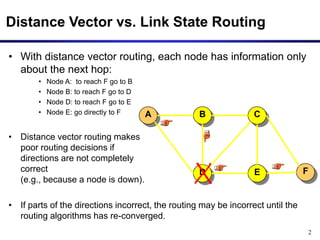
• With distance vector routing, each node has information only
about the next hop:
• Node A: to reach F go to B
• Node B: to reach F go to D
• Node D: to reach F go to E
• Node E: go directly to F
• Distance vector routing makes
poor routing decisions if
directions are not completely
correct
(e.g., because a node is down).
• If parts of the directions incorrect, the routing may be incorrect until the
routing algorithms has re-converged.
A B C
D E F
3
Distance Vector vs. Link State Routing
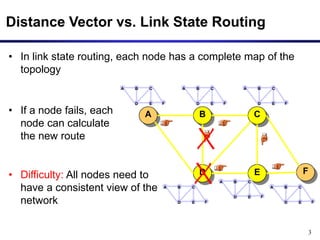
• In link state routing, each node has a complete map of the
topology
• If a node fails, each
node can calculate
the new route
• Difficulty: All nodes need to
have a consistent view of the
network
A B C
D E F
A B C
D E F
A B C
D E F
A B C
D E F
A B C
D E F
A B C
D E F
A B C
D E F
4
Link State Routing: Properties
• Each node requires complete topology information
• Link state information must be flooded to all nodes
• Guaranteed to converge
5
Link State Routing: Basic princples
1. Each router establishes a relationship (“adjacency”) with
its neighbors
2.Each router generates link state advertisements (LSAs)
which are distributed to all routers
LSA = (link id, state of the link, cost, neighbors of the link)
3. Each router maintains a database of all received LSAs
(topological database or link state database), which
describes the network as a graph with weighted edges
4. Each router uses its link state database to run a shortest
path algorithm (Dijikstra’s algorithm) to produce the
shortest path to each network
6
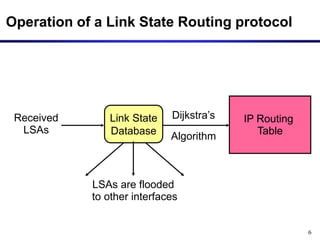
Operation of a Link State Routing protocol
Received
LSAs
IP Routing
Table
Dijkstra’s
Algorithm
Link State
Database
LSAs are flooded
to other interfaces
7
Dijkstra’s Shortest Path Algorithm for a Graph
Input: Graph (N,E) with
N the set of nodes and E the set of edges
dvw link cost (dvw = infinity if (v,w)  E, dvv = 0)
s source node.
Output: Dn cost of the least-cost path from node s to node n
M = {s};
for each n  M
Dn = dsn;
while (M  all nodes) do
Find w  M for which Dw = min{Dj ; j  M};
Add w to M;
for each n  M
Dn = minw [ Dn, Dw + dwn ];
Update route;
enddo
8
OSPF
• OSPF = Open Shortest Path First
• The OSPF routing protocol is the most important link state
routing protocol on the Internet
• The complexity of OSPF is significant
• History:
– 1989: RFC 1131 OSPF Version 1
– 1991: RFC1247 OSPF Version 2
– 1994: RFC 1583 OSPF Version 2 (revised)
– 1997: RFC 2178 OSPF Version 2 (revised)
– 1998: RFC 2328 OSPF Version 2 (current version)
9
Features of OSPF
• Provides authentication of routing messages
• Enables load balancing by allowing traffic to be split evenly
across routes with equal cost
• Type-of-Service routing allows to setup different routes
dependent on the TOS field
• Supports subnetting
• Supports multicasting
• Allows hierarchical routing
10
Example Network
10.1.1.0 / 24
.1 .2 .2
10.10.10.1
10.1.4.0 / 24
1
0
.
1
.
2
.
0
/
2
4
.1
.4
10.1.7.0 / 24
10.1.6.0
/
24
10.1.3.0
/
24
10.1.5.0/24
1
0
.
1
.
8
.
0
/
2
4
.3
.3 .5
.2
.3
.5
.5
.4
.4
.6
.6
10.10.10.2 10.10.10.4 10.10.10.6
10.10.10.2 10.10.10.5
Router IDs are
selected
independent of
interface addresses
3
4 2
5
1
1
3
2
•Link costs are called Metric
• Metric is in the range [0 , 216]
• Metric can be asymmetric
11
10.1.1.0 / 24
.1 .2 .2
10.10.10.1
10.1.4.0 / 24
1
0
.
1
.
2
.
0
/
2
4
.1
10.1.3.0
/
24
10.1.5.0/24
.3
.3
.2
.3
10.10.10.2
10.10.10.3
Link State Advertisement (LSA)
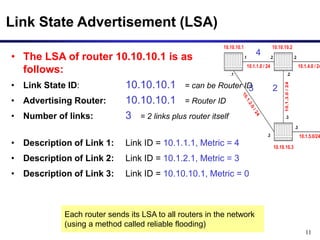
• The LSA of router 10.10.10.1 is as
follows:
• Link State ID: 10.10.10.1 = can be Router ID
• Advertising Router: 10.10.10.1 = Router ID
• Number of links: 3 = 2 links plus router itself
• Description of Link 1: Link ID = 10.1.1.1, Metric = 4
• Description of Link 2: Link ID = 10.1.2.1, Metric = 3
• Description of Link 3: Link ID = 10.10.10.1, Metric = 0
3
4
2
Each router sends its LSA to all routers in the network
(using a method called reliable flooding)
12
Network and Link State Database
10.1.1.0 / 24
.1 .2 .2
10.10.10.1
10.1.4.0 / 24
1
0
.
1
.
2
.
0
/
2
4
.1
.4
10.1.7.0 / 24
10.1.6.0
/
24
10.1.3.0
/
24
10.1.5.0/24
1
0
.
1
.
8
.
0
/
2
4
.3
.3 .5
.2
.3
.5
.5
.4
.4
.6
.6
10.10.10.2 10.10.10.4 10.10.10.6
10.10.10.2 10.10.10.5
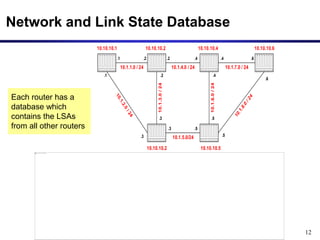
Each router has a
database which
contains the LSAs
from all other routers
13
Link State Database
• The collection of all LSAs is called the link-state database
• Each router has and identical link-state database
– Useful for debugging: Each router has a complete description of
the network
• If neighboring routers discover each other for the first time,
they will exchange their link-state databases
• The link-state databases are synchronized using reliable
flooding
14
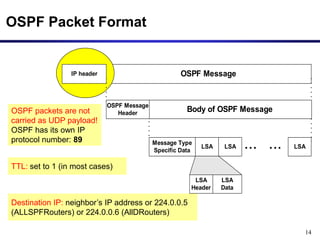
OSPF Packet Format
OSPF Message
IP header
Body of OSPF Message
OSPF Message
Header
Message Type
Specific Data
LSA LSA
LSA ...
LSA
Header
LSA
Data
...
Destination IP: neighbor’s IP address or 224.0.0.5
(ALLSPFRouters) or 224.0.0.6 (AllDRouters)
TTL: set to 1 (in most cases)
OSPF packets are not
carried as UDP payload!
OSPF has its own IP
protocol number: 89
15
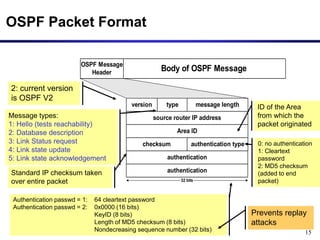
OSPF Packet Format
source router IP address
authentication
authentication
32 bits
version type message length
Area ID
checksum authentication type
Body of OSPF Message
OSPF Message
Header
2: current version
is OSPF V2
Message types:
1: Hello (tests reachability)
2: Database description
3: Link Status request
4: Link state update
5: Link state acknowledgement
ID of the Area
from which the
packet originated
Standard IP checksum taken
over entire packet
0: no authentication
1: Cleartext
password
2: MD5 checksum
(added to end
packet)
Authentication passwd = 1: 64 cleartext password
Authentication passwd = 2: 0x0000 (16 bits)
KeyID (8 bits)
Length of MD5 checksum (8 bits)
Nondecreasing sequence number (32 bits)
Prevents replay
attacks
16
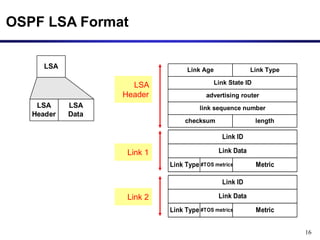
OSPF LSA Format
Link State ID
link sequence number
advertising router
Link Age Link Type
checksum length
Link ID
Link Data
Link Type Metric
#TOS metrics
LSA
LSA
Header
LSA
Data
Link ID
Link Data
Link Type Metric
#TOS metrics
LSA
Header
Link 1
Link 2
17
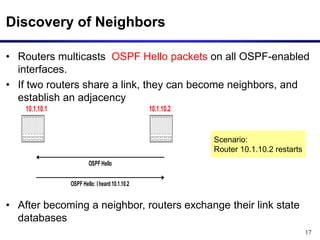
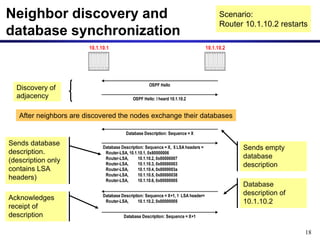
Discovery of Neighbors
• Routers multicasts OSPF Hello packets on all OSPF-enabled
interfaces.
• If two routers share a link, they can become neighbors, and
establish an adjacency
• After becoming a neighbor, routers exchange their link state
databases
OSPF Hello
OSPF Hello: Iheard 10.1.10.2
10.1.10.1 10.1.10.2
Scenario:
Router 10.1.10.2 restarts
18
Neighbor discovery and
database synchronization
OSPF Hello
OSPF Hello: I heard 10.1.10.2
Database Description: Sequence = X
10.1.10.1 10.1.10.2
Database Description: Sequence = X, 5 LSA headers =
Router-LSA, 10.1.10.1, 0x80000006
Router-LSA, 10.1.10.2, 0x80000007
Router-LSA, 10.1.10.3, 0x80000003
Router-LSA, 10.1.10.4, 0x8000003a
Router-LSA, 10.1.10.5, 0x80000038
Router-LSA, 10.1.10.6, 0x80000005
Database Description: Sequence = X+1, 1 LSA header=
Router-LSA, 10.1.10.2, 0x80000005
Database Description: Sequence = X+1
Sends empty
database
description
Scenario:
Router 10.1.10.2 restarts
Discovery of
adjacency
Sends database
description.
(description only
contains LSA
headers)
Database
description of
10.1.10.2
Acknowledges
receipt of
description
After neighbors are discovered the nodes exchange their databases
19
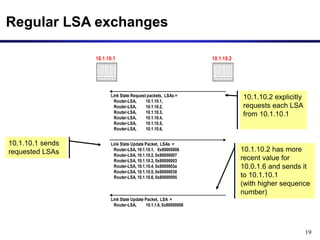
Regular LSA exchanges
10.1.10.1 10.1.10.2
Link State Request packets, LSAs =
Router-LSA, 10.1.10.1,
Router-LSA, 10.1.10.2,
Router-LSA, 10.1.10.3,
Router-LSA, 10.1.10.4,
Router-LSA, 10.1.10.5,
Router-LSA, 10.1.10.6,
Link State Update Packet, LSA =
Router-LSA, 10.1.1.6, 0x80000006
Link State Update Packet, LSAs =
Router-LSA, 10.1.10.1, 0x80000006
Router-LSA, 10.1.10.2, 0x80000007
Router-LSA, 10.1.10.3, 0x80000003
Router-LSA, 10.1.10.4, 0x8000003a
Router-LSA, 10.1.10.5, 0x80000038
Router-LSA, 10.1.10.6, 0x80000005
10.1.10.2 explicitly
requests each LSA
from 10.1.10.1
10.1.10.1 sends
requested LSAs 10.1.10.2 has more
recent value for
10.0.1.6 and sends it
to 10.1.10.1
(with higher sequence
number)
20
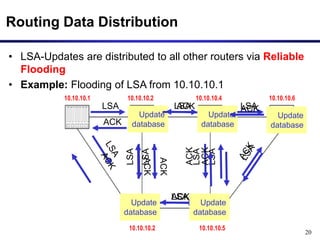
Routing Data Distribution
• LSA-Updates are distributed to all other routers via Reliable
Flooding
• Example: Flooding of LSA from 10.10.10.1
10.10.10.1 10.10.10.2 10.10.10.4 10.10.10.6
10.10.10.2 10.10.10.5
LSA
Update
database
Update
database
ACK
LSA
LSA LSA
Update
database
Update
database
ACK
Update
database
21
Dissemination of LSA-Update
• A router sends and refloods LSA-Updates, whenever the
topology or link cost changes. (If a received LSA does not
contain new information, the router will not flood the packet)
• Exception: Infrequently (every 30 minutes), a router will flood
LSAs even if there are no new changes.
• Acknowledgements of LSA-updates:
• explicit ACK, or
• implicit via reception of an LSA-Update
22
Autonomous Systems
• An autonomous system is a region of the Internet that is
administered by a single entity.
• Examples of autonomous regions are:
• UVA’s campus network
• MCI’s backbone network
• Regional Internet Service Provider
• Routing is done differently within an autonomous system
(intradomain routing) and between autonomous system
(interdomain routing).
23
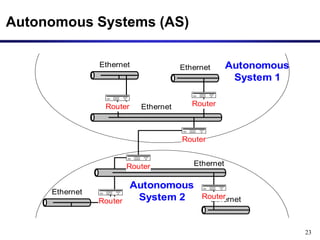
Autonomous Systems (AS)
Ethernet
Router
Ethernet
Ethernet
Router
Router
Ethernet
Ethernet
Ethernet
Router
Router
Router
Autonomous
System 2
Autonomous
System 1
24
BGP
• BGP = Border Gateway Protocol
• Currently in version 4
• Note: In the context of BGP, a gateway is nothing else but an
IP router that connects autonomous systems.
• Interdomain routing protocol for routing between autonomous
systems
• Uses TCP to send routing messages
• BGP is neither a link state, nor a distance vector protocol.
Routing messages in BGP contain complete routes.
• Network administrators can specify routing policies
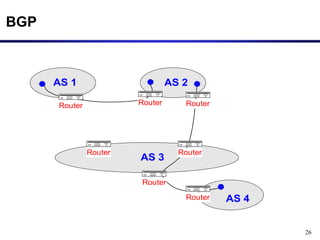
25
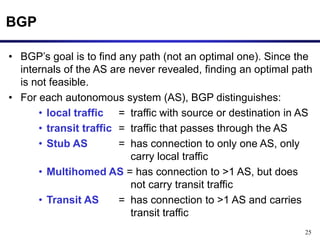
BGP
• BGP’s goal is to find any path (not an optimal one). Since the
internals of the AS are never revealed, finding an optimal path
is not feasible.
• For each autonomous system (AS), BGP distinguishes:
• local traffic = traffic with source or destination in AS
• transit traffic = traffic that passes through the AS
• Stub AS = has connection to only one AS, only
carry local traffic
• Multihomed AS = has connection to >1 AS, but does
not carry transit traffic
• Transit AS = has connection to >1 AS and carries
transit traffic
26
BGP
AS 1 AS 2
AS 3
Router
AS 4
Router
Router Router
Router
Router
Router

module11-ospf.ppt

  • 1.
    1 Relates to Lab4. This module covers link state routing and the Open Shortest Path First (OSPF) routing protocol. Dynamic Routing Protocols II OSPF
  • 2.
    2 Distance Vector vs.Link State Routing • With distance vector routing, each node has information only about the next hop: • Node A: to reach F go to B • Node B: to reach F go to D • Node D: to reach F go to E • Node E: go directly to F • Distance vector routing makes poor routing decisions if directions are not completely correct (e.g., because a node is down). • If parts of the directions incorrect, the routing may be incorrect until the routing algorithms has re-converged. A B C D E F
  • 3.
    3 Distance Vector vs.Link State Routing • In link state routing, each node has a complete map of the topology • If a node fails, each node can calculate the new route • Difficulty: All nodes need to have a consistent view of the network A B C D E F A B C D E F A B C D E F A B C D E F A B C D E F A B C D E F A B C D E F
  • 4.
    4 Link State Routing:Properties • Each node requires complete topology information • Link state information must be flooded to all nodes • Guaranteed to converge
  • 5.
    5 Link State Routing:Basic princples 1. Each router establishes a relationship (“adjacency”) with its neighbors 2.Each router generates link state advertisements (LSAs) which are distributed to all routers LSA = (link id, state of the link, cost, neighbors of the link) 3. Each router maintains a database of all received LSAs (topological database or link state database), which describes the network as a graph with weighted edges 4. Each router uses its link state database to run a shortest path algorithm (Dijikstra’s algorithm) to produce the shortest path to each network
  • 6.
    6 Operation of aLink State Routing protocol Received LSAs IP Routing Table Dijkstra’s Algorithm Link State Database LSAs are flooded to other interfaces
  • 7.
    7 Dijkstra’s Shortest PathAlgorithm for a Graph Input: Graph (N,E) with N the set of nodes and E the set of edges dvw link cost (dvw = infinity if (v,w)  E, dvv = 0) s source node. Output: Dn cost of the least-cost path from node s to node n M = {s}; for each n  M Dn = dsn; while (M  all nodes) do Find w  M for which Dw = min{Dj ; j  M}; Add w to M; for each n  M Dn = minw [ Dn, Dw + dwn ]; Update route; enddo
  • 8.
    8 OSPF • OSPF =Open Shortest Path First • The OSPF routing protocol is the most important link state routing protocol on the Internet • The complexity of OSPF is significant • History: – 1989: RFC 1131 OSPF Version 1 – 1991: RFC1247 OSPF Version 2 – 1994: RFC 1583 OSPF Version 2 (revised) – 1997: RFC 2178 OSPF Version 2 (revised) – 1998: RFC 2328 OSPF Version 2 (current version)
  • 9.
    9 Features of OSPF •Provides authentication of routing messages • Enables load balancing by allowing traffic to be split evenly across routes with equal cost • Type-of-Service routing allows to setup different routes dependent on the TOS field • Supports subnetting • Supports multicasting • Allows hierarchical routing
  • 10.
    10 Example Network 10.1.1.0 /24 .1 .2 .2 10.10.10.1 10.1.4.0 / 24 1 0 . 1 . 2 . 0 / 2 4 .1 .4 10.1.7.0 / 24 10.1.6.0 / 24 10.1.3.0 / 24 10.1.5.0/24 1 0 . 1 . 8 . 0 / 2 4 .3 .3 .5 .2 .3 .5 .5 .4 .4 .6 .6 10.10.10.2 10.10.10.4 10.10.10.6 10.10.10.2 10.10.10.5 Router IDs are selected independent of interface addresses 3 4 2 5 1 1 3 2 •Link costs are called Metric • Metric is in the range [0 , 216] • Metric can be asymmetric
  • 11.
    11 10.1.1.0 / 24 .1.2 .2 10.10.10.1 10.1.4.0 / 24 1 0 . 1 . 2 . 0 / 2 4 .1 10.1.3.0 / 24 10.1.5.0/24 .3 .3 .2 .3 10.10.10.2 10.10.10.3 Link State Advertisement (LSA) • The LSA of router 10.10.10.1 is as follows: • Link State ID: 10.10.10.1 = can be Router ID • Advertising Router: 10.10.10.1 = Router ID • Number of links: 3 = 2 links plus router itself • Description of Link 1: Link ID = 10.1.1.1, Metric = 4 • Description of Link 2: Link ID = 10.1.2.1, Metric = 3 • Description of Link 3: Link ID = 10.10.10.1, Metric = 0 3 4 2 Each router sends its LSA to all routers in the network (using a method called reliable flooding)
  • 12.
    12 Network and LinkState Database 10.1.1.0 / 24 .1 .2 .2 10.10.10.1 10.1.4.0 / 24 1 0 . 1 . 2 . 0 / 2 4 .1 .4 10.1.7.0 / 24 10.1.6.0 / 24 10.1.3.0 / 24 10.1.5.0/24 1 0 . 1 . 8 . 0 / 2 4 .3 .3 .5 .2 .3 .5 .5 .4 .4 .6 .6 10.10.10.2 10.10.10.4 10.10.10.6 10.10.10.2 10.10.10.5 Each router has a database which contains the LSAs from all other routers
  • 13.
    13 Link State Database •The collection of all LSAs is called the link-state database • Each router has and identical link-state database – Useful for debugging: Each router has a complete description of the network • If neighboring routers discover each other for the first time, they will exchange their link-state databases • The link-state databases are synchronized using reliable flooding
  • 14.
    14 OSPF Packet Format OSPFMessage IP header Body of OSPF Message OSPF Message Header Message Type Specific Data LSA LSA LSA ... LSA Header LSA Data ... Destination IP: neighbor’s IP address or 224.0.0.5 (ALLSPFRouters) or 224.0.0.6 (AllDRouters) TTL: set to 1 (in most cases) OSPF packets are not carried as UDP payload! OSPF has its own IP protocol number: 89
  • 15.
    15 OSPF Packet Format sourcerouter IP address authentication authentication 32 bits version type message length Area ID checksum authentication type Body of OSPF Message OSPF Message Header 2: current version is OSPF V2 Message types: 1: Hello (tests reachability) 2: Database description 3: Link Status request 4: Link state update 5: Link state acknowledgement ID of the Area from which the packet originated Standard IP checksum taken over entire packet 0: no authentication 1: Cleartext password 2: MD5 checksum (added to end packet) Authentication passwd = 1: 64 cleartext password Authentication passwd = 2: 0x0000 (16 bits) KeyID (8 bits) Length of MD5 checksum (8 bits) Nondecreasing sequence number (32 bits) Prevents replay attacks
  • 16.
    16 OSPF LSA Format LinkState ID link sequence number advertising router Link Age Link Type checksum length Link ID Link Data Link Type Metric #TOS metrics LSA LSA Header LSA Data Link ID Link Data Link Type Metric #TOS metrics LSA Header Link 1 Link 2
  • 17.
    17 Discovery of Neighbors •Routers multicasts OSPF Hello packets on all OSPF-enabled interfaces. • If two routers share a link, they can become neighbors, and establish an adjacency • After becoming a neighbor, routers exchange their link state databases OSPF Hello OSPF Hello: Iheard 10.1.10.2 10.1.10.1 10.1.10.2 Scenario: Router 10.1.10.2 restarts
  • 18.
    18 Neighbor discovery and databasesynchronization OSPF Hello OSPF Hello: I heard 10.1.10.2 Database Description: Sequence = X 10.1.10.1 10.1.10.2 Database Description: Sequence = X, 5 LSA headers = Router-LSA, 10.1.10.1, 0x80000006 Router-LSA, 10.1.10.2, 0x80000007 Router-LSA, 10.1.10.3, 0x80000003 Router-LSA, 10.1.10.4, 0x8000003a Router-LSA, 10.1.10.5, 0x80000038 Router-LSA, 10.1.10.6, 0x80000005 Database Description: Sequence = X+1, 1 LSA header= Router-LSA, 10.1.10.2, 0x80000005 Database Description: Sequence = X+1 Sends empty database description Scenario: Router 10.1.10.2 restarts Discovery of adjacency Sends database description. (description only contains LSA headers) Database description of 10.1.10.2 Acknowledges receipt of description After neighbors are discovered the nodes exchange their databases
  • 19.
    19 Regular LSA exchanges 10.1.10.110.1.10.2 Link State Request packets, LSAs = Router-LSA, 10.1.10.1, Router-LSA, 10.1.10.2, Router-LSA, 10.1.10.3, Router-LSA, 10.1.10.4, Router-LSA, 10.1.10.5, Router-LSA, 10.1.10.6, Link State Update Packet, LSA = Router-LSA, 10.1.1.6, 0x80000006 Link State Update Packet, LSAs = Router-LSA, 10.1.10.1, 0x80000006 Router-LSA, 10.1.10.2, 0x80000007 Router-LSA, 10.1.10.3, 0x80000003 Router-LSA, 10.1.10.4, 0x8000003a Router-LSA, 10.1.10.5, 0x80000038 Router-LSA, 10.1.10.6, 0x80000005 10.1.10.2 explicitly requests each LSA from 10.1.10.1 10.1.10.1 sends requested LSAs 10.1.10.2 has more recent value for 10.0.1.6 and sends it to 10.1.10.1 (with higher sequence number)
  • 20.
    20 Routing Data Distribution •LSA-Updates are distributed to all other routers via Reliable Flooding • Example: Flooding of LSA from 10.10.10.1 10.10.10.1 10.10.10.2 10.10.10.4 10.10.10.6 10.10.10.2 10.10.10.5 LSA Update database Update database ACK LSA LSA LSA Update database Update database ACK Update database
  • 21.
    21 Dissemination of LSA-Update •A router sends and refloods LSA-Updates, whenever the topology or link cost changes. (If a received LSA does not contain new information, the router will not flood the packet) • Exception: Infrequently (every 30 minutes), a router will flood LSAs even if there are no new changes. • Acknowledgements of LSA-updates: • explicit ACK, or • implicit via reception of an LSA-Update
  • 22.
    22 Autonomous Systems • Anautonomous system is a region of the Internet that is administered by a single entity. • Examples of autonomous regions are: • UVA’s campus network • MCI’s backbone network • Regional Internet Service Provider • Routing is done differently within an autonomous system (intradomain routing) and between autonomous system (interdomain routing).
  • 23.
  • 24.
    24 BGP • BGP =Border Gateway Protocol • Currently in version 4 • Note: In the context of BGP, a gateway is nothing else but an IP router that connects autonomous systems. • Interdomain routing protocol for routing between autonomous systems • Uses TCP to send routing messages • BGP is neither a link state, nor a distance vector protocol. Routing messages in BGP contain complete routes. • Network administrators can specify routing policies
  • 25.
    25 BGP • BGP’s goalis to find any path (not an optimal one). Since the internals of the AS are never revealed, finding an optimal path is not feasible. • For each autonomous system (AS), BGP distinguishes: • local traffic = traffic with source or destination in AS • transit traffic = traffic that passes through the AS • Stub AS = has connection to only one AS, only carry local traffic • Multihomed AS = has connection to >1 AS, but does not carry transit traffic • Transit AS = has connection to >1 AS and carries transit traffic
  • 26.
    26 BGP AS 1 AS2 AS 3 Router AS 4 Router Router Router Router Router Router