OSPF Stub Areas
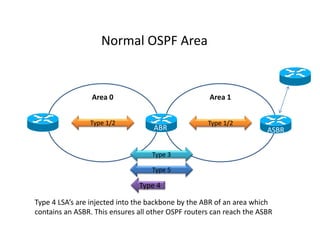
Area 0
Type 1/2
Area 1
Type 1/2
Type 3
Type 5
Type 4
ASBR
Type 4 LSA’s are injected into the backbone by the ABR of an area which
contains an ASBR. This ensures all other OSPF routers can reach the ASBR
ABR
Normal OSPF Area
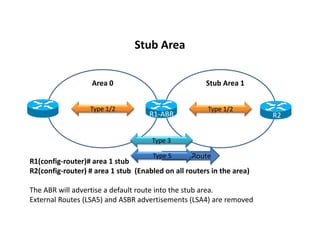
Area 0
Type 1/2
Stub Area 1
Type 1/2
Type 3
R1(config-router)# area 1 stub
R2(config-router) # area 1 stub (Enabled on all routers in the area)
The ABR will advertise a default route into the stub area.
External Routes (LSA5) and ASBR advertisements (LSA4) are removed
R1-ABR
Default Route
Stub Area
R2
Type 5
Area 0
Type 1/2
Stub Area 1
Type 1/2
Type 3
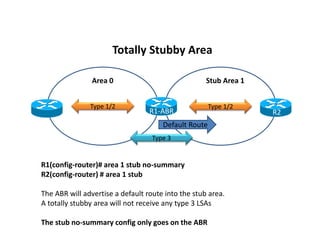
R1(config-router)# area 1 stub no-summary
R2(config-router) # area 1 stub
The ABR will advertise a default route into the stub area.
A totally stubby area will not receive any type 3 LSAs
The stub no-summary config only goes on the ABR
R1-ABR
Default Route
Totally Stubby Area
R2
Area 0
Type 1/2
Stub Area 1
Type 1/2
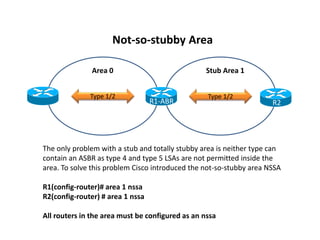
The only problem with a stub and totally stubby area is neither type can
contain an ASBR as type 4 and type 5 LSAs are not permitted inside the
area. To solve this problem Cisco introduced the not-so-stubby area NSSA
R1(config-router)# area 1 nssa
R2(config-router) # area 1 nssa
All routers in the area must be configured as an nssa
Not-so-stubby Area
R1-ABR R2
Area 0
Type 1/2
Stub Area 1
Type 1/2
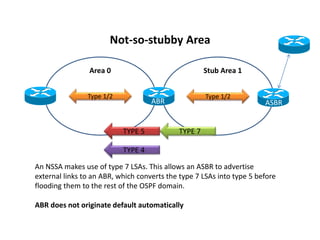
An NSSA makes use of type 7 LSAs. This allows an ASBR to advertise
external links to an ABR, which converts the type 7 LSAs into type 5 before
flooding them to the rest of the OSPF domain.
ABR does not originate default automatically
ABR
Not-so-stubby Area
ASBR
TYPE 7TYPE 5
TYPE 4
Area 0
Type 1/2
Stub Area 1
Type 1/2
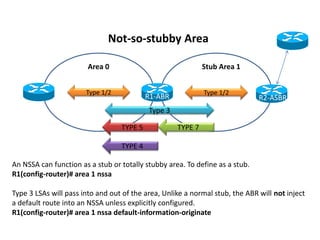
An NSSA can function as a stub or totally stubby area. To define as a stub.
R1(config-router)# area 1 nssa
Type 3 LSAs will pass into and out of the area, Unlike a normal stub, the ABR will not inject
a default route into an NSSA unless explicitly configured.
R1(config-router)# area 1 nssa default-information-originate
R1-ABR
Not-so-stubby Area
R2-ASBR
TYPE 7TYPE 5
TYPE 4
Type 3
Area 0
Type 1/2
Stub Area 1
Type 1/2
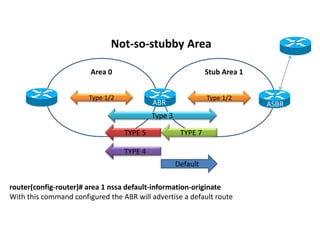
router(config-router)# area 1 nssa default-information-originate
With this command configured the ABR will advertise a default route
ABR
Not-so-stubby Area
ASBR
TYPE 7TYPE 5
TYPE 4
Type 3
Default
Area 0
Type 1/2
Stub Area 1
Type 1/2
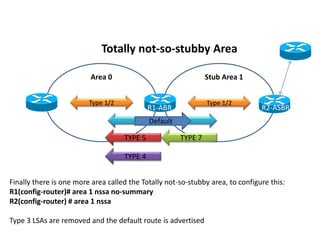
Finally there is one more area called the Totally not-so-stubby area, to configure this:
R1(config-router)# area 1 nssa no-summary
R2(config-router) # area 1 nssa
Type 3 LSAs are removed and the default route is advertised
R1-ABR
Totally not-so-stubby Area
R2-ASBR
TYPE 7TYPE 5
TYPE 4
Type 3Default

Ospf area types

  • 1.
  • 2.
    Area 0 Type 1/2 Area1 Type 1/2 Type 3 Type 5 Type 4 ASBR Type 4 LSA’s are injected into the backbone by the ABR of an area which contains an ASBR. This ensures all other OSPF routers can reach the ASBR ABR Normal OSPF Area
  • 3.
    Area 0 Type 1/2 StubArea 1 Type 1/2 Type 3 R1(config-router)# area 1 stub R2(config-router) # area 1 stub (Enabled on all routers in the area) The ABR will advertise a default route into the stub area. External Routes (LSA5) and ASBR advertisements (LSA4) are removed R1-ABR Default Route Stub Area R2 Type 5
  • 4.
    Area 0 Type 1/2 StubArea 1 Type 1/2 Type 3 R1(config-router)# area 1 stub no-summary R2(config-router) # area 1 stub The ABR will advertise a default route into the stub area. A totally stubby area will not receive any type 3 LSAs The stub no-summary config only goes on the ABR R1-ABR Default Route Totally Stubby Area R2
  • 5.
    Area 0 Type 1/2 StubArea 1 Type 1/2 The only problem with a stub and totally stubby area is neither type can contain an ASBR as type 4 and type 5 LSAs are not permitted inside the area. To solve this problem Cisco introduced the not-so-stubby area NSSA R1(config-router)# area 1 nssa R2(config-router) # area 1 nssa All routers in the area must be configured as an nssa Not-so-stubby Area R1-ABR R2
  • 6.
    Area 0 Type 1/2 StubArea 1 Type 1/2 An NSSA makes use of type 7 LSAs. This allows an ASBR to advertise external links to an ABR, which converts the type 7 LSAs into type 5 before flooding them to the rest of the OSPF domain. ABR does not originate default automatically ABR Not-so-stubby Area ASBR TYPE 7TYPE 5 TYPE 4
  • 7.
    Area 0 Type 1/2 StubArea 1 Type 1/2 An NSSA can function as a stub or totally stubby area. To define as a stub. R1(config-router)# area 1 nssa Type 3 LSAs will pass into and out of the area, Unlike a normal stub, the ABR will not inject a default route into an NSSA unless explicitly configured. R1(config-router)# area 1 nssa default-information-originate R1-ABR Not-so-stubby Area R2-ASBR TYPE 7TYPE 5 TYPE 4 Type 3
  • 8.
    Area 0 Type 1/2 StubArea 1 Type 1/2 router(config-router)# area 1 nssa default-information-originate With this command configured the ABR will advertise a default route ABR Not-so-stubby Area ASBR TYPE 7TYPE 5 TYPE 4 Type 3 Default
  • 9.
    Area 0 Type 1/2 StubArea 1 Type 1/2 Finally there is one more area called the Totally not-so-stubby area, to configure this: R1(config-router)# area 1 nssa no-summary R2(config-router) # area 1 nssa Type 3 LSAs are removed and the default route is advertised R1-ABR Totally not-so-stubby Area R2-ASBR TYPE 7TYPE 5 TYPE 4 Type 3Default