OSCOLA Referencing
Jackie Hanes, Academic Librarian
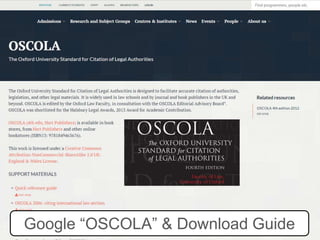
Google “OSCOLA” & Download Guide
Golden Rules
1. Consistency – be consistent in your referencing
2. Consideration for the reader – be kind to your reader
• OSCOLA is not a comprehensive referencing style
• When in doubt, follow the ‘general rules’ and keep a similar style
Footnote.1
1. Footnotes are a numbered referencing style
2. Insert superscript numbers in main body of text
3. Insert footnote number at end of sentence - after punctuation
4. Include full reference in corresponding footnote on page
5. Complete with a full-stop at end of footnote.
Bibliography
• Complete list of sources cited in your work
•Table of Authorities: primary sources (cases & legislation)
•Bibliography: secondary sources (books & articles)
• Copy and paste references from footnotes to bibliography
• Change author from firstname surname to surname initial
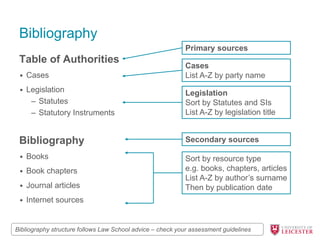
Bibliography
Table of Authorities
• Cases
• Legislation
– Statutes
– Statutory Instruments
Bibliography
• Books
• Book chapters
• Journal articles
• Internet sources
Primary sources
Cases
List A-Z by party name
Legislation
Sort by Statutes and SIs
List A-Z by legislation title
Sort by resource type
e.g. books, chapters, articles
List A-Z by author’s surname
Then by publication date
Secondary sources
Bibliography structure follows Law School advice – check your assessment guidelines
Example Bibliography
Table of Authorities
Cases
Lucasfilm Ltd v Ainsworth [2011] UKSC 39, [2012] 1 AC 208
Tyburn Productions Ltd v Conan Doyle [1990] 3 WLR 167 (Ch)
Statutes
Copyright, Designs and Patents Act 1988
Statutory Instruments
Copyright (Industrial Designs) Rules 1949, SI 1949/2367
Bibliography
Books
Webley L, Legal Writing (3rd edn, Routledge 2013)
Book chapters
Handler P, ‘Legal History’ in Dawn Watkins and Mandy Burton (eds), Research Methods in Law (Routledge 2013)
Journal articles
Moscona R, ‘Stormtroopers Suffer Crushing Defeat in English Court’ (2010) 22 IP&TLJ 19
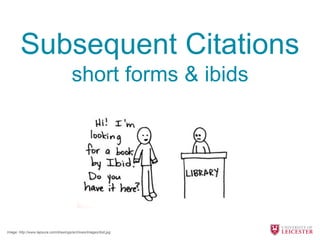
Subsequent Citations
short forms & ibids
Image: http://www.lapsura.com/drawings/archives/images/ibid.jpg
Subsequent citations
1. Lucasfilm Ltd v Ainsworth [2011] UKSC 39, [2012] 1 AC 208.
2. Copyright, Designs and Patents Act 1988 (CDPA 1988).
3. Ron Moscona, ‘Stormtroopers Suffer Crushing Defeat in English Court’ (2010) 22 IP&TLJ
19.
4. ibid 22.
5. CDPA 1988, s 5B.
6. Lucasfilm (n 1) [44].
7. Moscona (n 3) 21.
Footnote 3 at page 22
Footnote 2 at section 5B
Footnote 1 at para 44
Footnote 3 at page 21
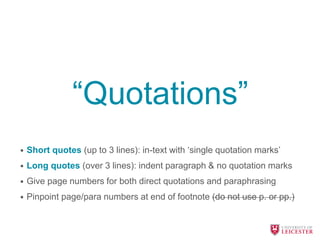
“Quotations”
• Short quotes (up to 3 lines): in-text with ‘single quotation marks’
• Long quotes (over 3 lines): indent paragraph & no quotation marks
• Give page numbers for both direct quotations and paraphrasing
• Pinpoint page/para numbers at end of footnote (do not use p. or pp.)
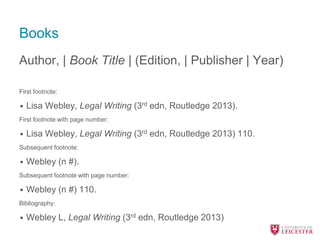
Books
Author, | Book Title | (Edition, | Publisher | Year)
First footnote:
• Lisa Webley, Legal Writing (3rd edn, Routledge 2013).
First footnote with page number:
• Lisa Webley, Legal Writing (3rd edn, Routledge 2013) 110.
Subsequent footnote:
• Webley (n #).
Subsequent footnote with page number:
• Webley (n #) 110.
Bibliography:
• Webley L, Legal Writing (3rd edn, Routledge 2013)
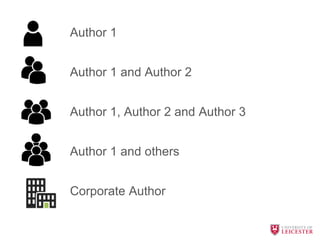
Author 1
Author 1 and Author 2
Author 1, Author 2 and Author 3
Author 1 and others
Corporate Author
Chapters
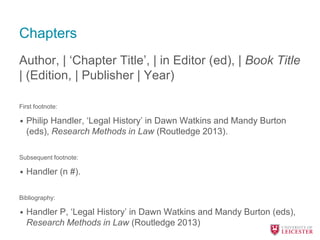
Author, | ‘Chapter Title’, | in Editor (ed), | Book Title
| (Edition, | Publisher | Year)
First footnote:
• Philip Handler, ‘Legal History’ in Dawn Watkins and Mandy Burton
(eds), Research Methods in Law (Routledge 2013).
Subsequent footnote:
• Handler (n #).
Bibliography:
• Handler P, ‘Legal History’ in Dawn Watkins and Mandy Burton (eds),
Research Methods in Law (Routledge 2013)
Articles
Author, | ‘Article Title’ | [(Year)] | Vol | Abbrev | First Page
First footnote:
• Graham Virgo, ‘Why Study Law?’ (2011) 11 LIM 221.
First footnote with page number:
• Graham Virgo, ‘Why Study Law?’ (2011) 11 LIM 221, 223.
Subsequent footnote:
• Virgo (n #).
Subsequent footnote with page number:
• Virgo (n #) 223.
Bibliography:
• Virgo G, ‘Why Study Law?’ (2011) 11 LIM 221
Online Sources
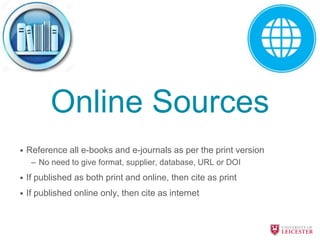
• Reference all e-books and e-journals as per the print version
– No need to give format, supplier, database, URL or DOI
• If published as both print and online, then cite as print
• If published online only, then cite as internet
Websites
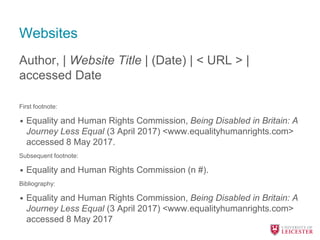
Author, | Website Title | (Date) | < URL > |
accessed Date
First footnote:
• Equality and Human Rights Commission, Being Disabled in Britain: A
Journey Less Equal (3 April 2017) <www.equalityhumanrights.com>
accessed 8 May 2017.
Subsequent footnote:
• Equality and Human Rights Commission (n #).
Bibliography:
• Equality and Human Rights Commission, Being Disabled in Britain: A
Journey Less Equal (3 April 2017) <www.equalityhumanrights.com>
accessed 8 May 2017
Blogs
Author, | ‘Webpage Title’ | (Website Title, | Date) |
< URL > | accessed Date
First footnote:
• Brian Meli, ‘May the 4th Be With Your Brand: A Legal Guide to Making
Star Wars Tributes’ (LegalMatter, 27 April 2015) <
www.legalmatterblog.com > accessed 28 May 2017.
Subsequent footnote:
• Meli (n #).
Bibliography:
• Meli B, ‘May the 4th Be With Your Brand: A Legal Guide to Making
Star Wars Tributes’ (LegalMatter, 27 April 2015) <
www.legalmatterblog.com > accessed 28 May 2017
Case Name | Citation
• All cases are referenced by case name and citation
• Two types of citation: Neutral and Law Report citations
• Neutral: [Year] | Abbrev for Court | Case Number
• Law Report: [(Year)] | Volume | Abbrev of Report | First Page
• ECLI citations (like Neutral citations) for ECJ and ECHR cases
ICLR
• The Law Reports
• Appeal Cases, Chancery, Family, Queens Bench
WLR
• Weekly Law Reports
All ER
• All England Law Reports
Law
Reports
• Other law reports
• Transcript of judgments
Practice Direction (Citation of Authorities) [2012] 1 WLR 780
UK cases - with a neutral citation
Case Name | Neutral Citation, | Report Citation
First footnote:
• Lucasfilm Ltd v Ainsworth [2011] UKSC 39, [2012] 1 AC 208.
If case name given in main text:
• [2011] UKSC 39, [2012] 1 AC 208.
Subsequent footnote:
• Lucasfilm (n #).
Table of Authorities:
• Lucasfilm Ltd v Ainsworth [2011] UKSC 39, [2012] 1 AC 208
UK cases – without a neutral citation
Case Name | Report Citation | (Court)
First footnote:
• Tyburn Productions Ltd v Conan Doyle [1990] 3 WLR 167 (Ch).
If case name given in main text:
• [1990] 3 WLR 167 (Ch).
Subsequent footnote:
• Tyburn (n #).
Table of Authorities:
• Tyburn Productions Ltd v Conan Doyle [1990] 3 WLR 167 (Ch)
Pinpoints, pages and paragraphs
• Case Name | Citation, | Page
– Lucasfilm Ltd v Ainsworth [2011] UKSC 39, [2012] 1 AC 208, 228.
• Case Name | Citation | [Paragraph]
– Lucasfilm Ltd v Ainsworth [2011] UKSC 39, [2012] 1 AC 208 [47].
• Case Name | Citation | [Paragraph] | (Judge)
– Lucasfilm Ltd v Ainsworth [2011] UKSC 39, [2012] 1 AC 208 [42]-[44]
(Lord Walker SCJ).
Judges and judgments
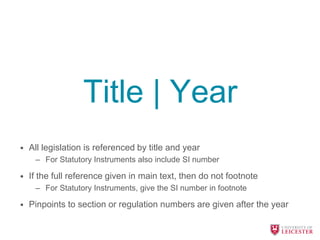
Title | Year
• All legislation is referenced by title and year
– For Statutory Instruments also include SI number
• If the full reference given in main text, then do not footnote
– For Statutory Instruments, give the SI number in footnote
• Pinpoints to section or regulation numbers are given after the year
Statutes
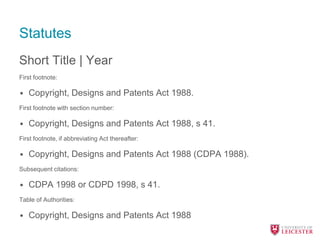
Short Title | Year
First footnote:
• Copyright, Designs and Patents Act 1988.
First footnote with section number:
• Copyright, Designs and Patents Act 1988, s 41.
First footnote, if abbreviating Act thereafter:
• Copyright, Designs and Patents Act 1988 (CDPA 1988).
Subsequent citations:
• CDPA 1998 or CDPD 1998, s 41.
Table of Authorities:
• Copyright, Designs and Patents Act 1988
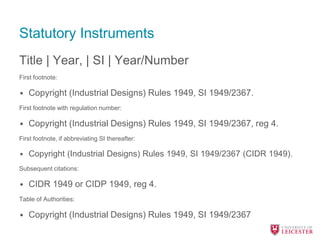
Statutory Instruments
Title | Year, | SI | Year/Number
First footnote:
• Copyright (Industrial Designs) Rules 1949, SI 1949/2367.
First footnote with regulation number:
• Copyright (Industrial Designs) Rules 1949, SI 1949/2367, reg 4.
First footnote, if abbreviating SI thereafter:
• Copyright (Industrial Designs) Rules 1949, SI 1949/2367 (CIDR 1949).
Subsequent citations:
• CIDR 1949 or CIDP 1949, reg 4.
Table of Authorities:
• Copyright (Industrial Designs) Rules 1949, SI 1949/2367
Help
• OSCOLA referencing guide on Library website
– includes further examples and online tutorials
• Email librarians@le.ac.uk or Telephone 0116 252 2055
• Book a Librarian: appointment with law librarian
• We do not offer a proof reading or reference checking service

Introduction to OSCOLA

  • 1.
  • 2.
    Google “OSCOLA” &Download Guide
  • 3.
    Golden Rules 1. Consistency– be consistent in your referencing 2. Consideration for the reader – be kind to your reader • OSCOLA is not a comprehensive referencing style • When in doubt, follow the ‘general rules’ and keep a similar style
  • 4.
    Footnote.1 1. Footnotes area numbered referencing style 2. Insert superscript numbers in main body of text 3. Insert footnote number at end of sentence - after punctuation 4. Include full reference in corresponding footnote on page 5. Complete with a full-stop at end of footnote.
  • 6.
    Bibliography • Complete listof sources cited in your work •Table of Authorities: primary sources (cases & legislation) •Bibliography: secondary sources (books & articles) • Copy and paste references from footnotes to bibliography • Change author from firstname surname to surname initial
  • 7.
    Bibliography Table of Authorities •Cases • Legislation – Statutes – Statutory Instruments Bibliography • Books • Book chapters • Journal articles • Internet sources Primary sources Cases List A-Z by party name Legislation Sort by Statutes and SIs List A-Z by legislation title Sort by resource type e.g. books, chapters, articles List A-Z by author’s surname Then by publication date Secondary sources Bibliography structure follows Law School advice – check your assessment guidelines
  • 8.
    Example Bibliography Table ofAuthorities Cases Lucasfilm Ltd v Ainsworth [2011] UKSC 39, [2012] 1 AC 208 Tyburn Productions Ltd v Conan Doyle [1990] 3 WLR 167 (Ch) Statutes Copyright, Designs and Patents Act 1988 Statutory Instruments Copyright (Industrial Designs) Rules 1949, SI 1949/2367 Bibliography Books Webley L, Legal Writing (3rd edn, Routledge 2013) Book chapters Handler P, ‘Legal History’ in Dawn Watkins and Mandy Burton (eds), Research Methods in Law (Routledge 2013) Journal articles Moscona R, ‘Stormtroopers Suffer Crushing Defeat in English Court’ (2010) 22 IP&TLJ 19
  • 9.
    Subsequent Citations short forms& ibids Image: http://www.lapsura.com/drawings/archives/images/ibid.jpg
  • 10.
    Subsequent citations 1. LucasfilmLtd v Ainsworth [2011] UKSC 39, [2012] 1 AC 208. 2. Copyright, Designs and Patents Act 1988 (CDPA 1988). 3. Ron Moscona, ‘Stormtroopers Suffer Crushing Defeat in English Court’ (2010) 22 IP&TLJ 19. 4. ibid 22. 5. CDPA 1988, s 5B. 6. Lucasfilm (n 1) [44]. 7. Moscona (n 3) 21. Footnote 3 at page 22 Footnote 2 at section 5B Footnote 1 at para 44 Footnote 3 at page 21
  • 11.
    “Quotations” • Short quotes(up to 3 lines): in-text with ‘single quotation marks’ • Long quotes (over 3 lines): indent paragraph & no quotation marks • Give page numbers for both direct quotations and paraphrasing • Pinpoint page/para numbers at end of footnote (do not use p. or pp.)
  • 12.
    Books Author, | BookTitle | (Edition, | Publisher | Year) First footnote: • Lisa Webley, Legal Writing (3rd edn, Routledge 2013). First footnote with page number: • Lisa Webley, Legal Writing (3rd edn, Routledge 2013) 110. Subsequent footnote: • Webley (n #). Subsequent footnote with page number: • Webley (n #) 110. Bibliography: • Webley L, Legal Writing (3rd edn, Routledge 2013)
  • 13.
    Author 1 Author 1and Author 2 Author 1, Author 2 and Author 3 Author 1 and others Corporate Author
  • 14.
    Chapters Author, | ‘ChapterTitle’, | in Editor (ed), | Book Title | (Edition, | Publisher | Year) First footnote: • Philip Handler, ‘Legal History’ in Dawn Watkins and Mandy Burton (eds), Research Methods in Law (Routledge 2013). Subsequent footnote: • Handler (n #). Bibliography: • Handler P, ‘Legal History’ in Dawn Watkins and Mandy Burton (eds), Research Methods in Law (Routledge 2013)
  • 15.
    Articles Author, | ‘ArticleTitle’ | [(Year)] | Vol | Abbrev | First Page First footnote: • Graham Virgo, ‘Why Study Law?’ (2011) 11 LIM 221. First footnote with page number: • Graham Virgo, ‘Why Study Law?’ (2011) 11 LIM 221, 223. Subsequent footnote: • Virgo (n #). Subsequent footnote with page number: • Virgo (n #) 223. Bibliography: • Virgo G, ‘Why Study Law?’ (2011) 11 LIM 221
  • 16.
    Online Sources • Referenceall e-books and e-journals as per the print version – No need to give format, supplier, database, URL or DOI • If published as both print and online, then cite as print • If published online only, then cite as internet
  • 17.
    Websites Author, | WebsiteTitle | (Date) | < URL > | accessed Date First footnote: • Equality and Human Rights Commission, Being Disabled in Britain: A Journey Less Equal (3 April 2017) <www.equalityhumanrights.com> accessed 8 May 2017. Subsequent footnote: • Equality and Human Rights Commission (n #). Bibliography: • Equality and Human Rights Commission, Being Disabled in Britain: A Journey Less Equal (3 April 2017) <www.equalityhumanrights.com> accessed 8 May 2017
  • 18.
    Blogs Author, | ‘WebpageTitle’ | (Website Title, | Date) | < URL > | accessed Date First footnote: • Brian Meli, ‘May the 4th Be With Your Brand: A Legal Guide to Making Star Wars Tributes’ (LegalMatter, 27 April 2015) < www.legalmatterblog.com > accessed 28 May 2017. Subsequent footnote: • Meli (n #). Bibliography: • Meli B, ‘May the 4th Be With Your Brand: A Legal Guide to Making Star Wars Tributes’ (LegalMatter, 27 April 2015) < www.legalmatterblog.com > accessed 28 May 2017
  • 19.
    Case Name |Citation • All cases are referenced by case name and citation • Two types of citation: Neutral and Law Report citations • Neutral: [Year] | Abbrev for Court | Case Number • Law Report: [(Year)] | Volume | Abbrev of Report | First Page • ECLI citations (like Neutral citations) for ECJ and ECHR cases
  • 20.
    ICLR • The LawReports • Appeal Cases, Chancery, Family, Queens Bench WLR • Weekly Law Reports All ER • All England Law Reports Law Reports • Other law reports • Transcript of judgments Practice Direction (Citation of Authorities) [2012] 1 WLR 780
  • 21.
    UK cases -with a neutral citation Case Name | Neutral Citation, | Report Citation First footnote: • Lucasfilm Ltd v Ainsworth [2011] UKSC 39, [2012] 1 AC 208. If case name given in main text: • [2011] UKSC 39, [2012] 1 AC 208. Subsequent footnote: • Lucasfilm (n #). Table of Authorities: • Lucasfilm Ltd v Ainsworth [2011] UKSC 39, [2012] 1 AC 208
  • 22.
    UK cases –without a neutral citation Case Name | Report Citation | (Court) First footnote: • Tyburn Productions Ltd v Conan Doyle [1990] 3 WLR 167 (Ch). If case name given in main text: • [1990] 3 WLR 167 (Ch). Subsequent footnote: • Tyburn (n #). Table of Authorities: • Tyburn Productions Ltd v Conan Doyle [1990] 3 WLR 167 (Ch)
  • 23.
    Pinpoints, pages andparagraphs • Case Name | Citation, | Page – Lucasfilm Ltd v Ainsworth [2011] UKSC 39, [2012] 1 AC 208, 228. • Case Name | Citation | [Paragraph] – Lucasfilm Ltd v Ainsworth [2011] UKSC 39, [2012] 1 AC 208 [47]. • Case Name | Citation | [Paragraph] | (Judge) – Lucasfilm Ltd v Ainsworth [2011] UKSC 39, [2012] 1 AC 208 [42]-[44] (Lord Walker SCJ). Judges and judgments
  • 24.
    Title | Year •All legislation is referenced by title and year – For Statutory Instruments also include SI number • If the full reference given in main text, then do not footnote – For Statutory Instruments, give the SI number in footnote • Pinpoints to section or regulation numbers are given after the year
  • 25.
    Statutes Short Title |Year First footnote: • Copyright, Designs and Patents Act 1988. First footnote with section number: • Copyright, Designs and Patents Act 1988, s 41. First footnote, if abbreviating Act thereafter: • Copyright, Designs and Patents Act 1988 (CDPA 1988). Subsequent citations: • CDPA 1998 or CDPD 1998, s 41. Table of Authorities: • Copyright, Designs and Patents Act 1988
  • 26.
    Statutory Instruments Title |Year, | SI | Year/Number First footnote: • Copyright (Industrial Designs) Rules 1949, SI 1949/2367. First footnote with regulation number: • Copyright (Industrial Designs) Rules 1949, SI 1949/2367, reg 4. First footnote, if abbreviating SI thereafter: • Copyright (Industrial Designs) Rules 1949, SI 1949/2367 (CIDR 1949). Subsequent citations: • CIDR 1949 or CIDP 1949, reg 4. Table of Authorities: • Copyright (Industrial Designs) Rules 1949, SI 1949/2367
  • 27.
    Help • OSCOLA referencingguide on Library website – includes further examples and online tutorials • Email librarians@le.ac.uk or Telephone 0116 252 2055 • Book a Librarian: appointment with law librarian • We do not offer a proof reading or reference checking service

Editor's Notes

  • #3 OSCOLA is the Oxford University Standard for the Citation of Legal Authorities. It is the industry standard referencing style used in UK law schools and by legal publishers. The official OSCOLA guide is a 60 page PDF document, available as a free download from Oxford University’s website. Simply Google the word OSCOLA to find a link to the webpage. There are actually two OSCOLA guides: the main guide (4th edition) covers UK and European Law; whereas International Law is covered in a supplementary guide. There are many ‘Quick Guides’ to OSCOLA, including one on our own website, but only the official version is the definitive guide, so I recommend that your download and maybe print a copy for yourself.
  • #4 OSCOLA opens with the statement: There are two golden rules for the citation of legal authorities. One is consistency. The other is consideration for the reader. As students of law, your reader is your tutor, the person marking your essay. Always attempt to reference. You will lose more marks for not referencing at all, than having a go, and making the odd mistake. And be consistent - even if you consistently make mistakes. Any inconsistency in your referencing will draw attention to your mistakes, and your reader is more likely to notice them. Although OSCOLA extends to a massive 60 pages, it is not a comprehensive guide. OSCOLA covers traditional academic and legal sources very well – your standard books, articles, cases and legislation. But it does cover the internet and new media very well at all. For example, OSCOLA had no advice on how reference a recent Netflix documentary. If you want to reference something not covered by OSCOLA, then you should follow the ‘General Principles’ and try to maintain your consistency.
  • #5 OSCOLA is a numbered footnote referencing style. Footnote numbers are inserted in the main body of your essay; and the full reference is written in the corresponding footnote at the bottom of the page. When you insert the footnote number, it should normally go at the end of your sentence, after the punctuation. The footnote number is inserted as a small superscript number – Word formats this automatically for you. When you reference is finished, you should complete it with a full-stop at the end of the footnote.
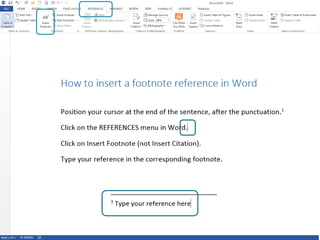
  • #6 Microsoft Word has good footnote referencing functionality. Write your essay as normal. When you need to reference something, position your cursor at the end of the sentence, after the full-stop. [ANIMATION) Click on the References menu [ANIMATION], and then click on Insert Footnote [ANIMATION]. Type your reference into the corresponding footnote and close with a full-stop [ANIMATION]. Word has lots of referencing tools, so be sure to use Insert Footnote, and not Insert Citation or Cite While You Write. In case you are wondering, these do not output in OSCOLA style. On a similar note, you may have friends studying other subjects who use bibliographic software such as RefWorks, Mendeley or Cite This For Me to do their referencing for them. I have tested a number of these tools, and in my opinion they do not adequately output in the OSCOLA referencing style. The only one I would recommend in EndNote, and even then, only to PhD students.
  • #7 The bibliography is a complete list of sources cited in your work. The official OSCOLA guide does not require a separate bibliography for essays and articles; but the law school generally requires one for all assessed essays and dissertations. Therefore, please check your assessment guidelines carefully. If you do need to include a bibliography, it should be split into two main sections: First, the Table of Authorities for your primary sources, the cases and legislation cited; and second the Bibliography for your secondary sources, the books, journal articles and websites cited. Creating the bibliography is pretty simple: you just need to copy and paste the reference from the footnote to the bibliography. For many of the secondary sources, you also need to change the order of the author’s name from firstname surname to surname initial. As we go through, I’ll show you examples in both footnote and bibliography style.
  • #8 The structure of the bibliography becomes more complicated. The Table of Authorities is divided into sections for cases and legislation, with separate sections for statutes and statutory instruments. Within each of these sections, the references are alphabetically by title. Although we are not covering foreign and international materials in this workshop, if you do include them in your work, your table of authorities needs to be further subdivided by jurisdiction, for example international cases, European cases, UK cases and US cases. The Bibliography is also divided into sections by content type, with separate sections for books, book chapters, official publications, journal articles and internet sources. Again, the references in these sections are organised alphabetically by author’s surname. If you have more than one reference by the same author (in the same section), you should organise them by publication date (with the oldest first), and if more than one in the same year, by title.
  • #9 Here is an example of a bibliography showing different types of material.
  • #10 Have you come across the word ibid when reading a book or article? Ibid is latin for ibidem, and it means ‘in the same place’. It’s a common tool used in footnote referencing to mean ‘the same as the immediately preceding footnote’. Footnote referencing styles also use shortened forms of a reference when they are repeated later on in an essay (but not in the immediately preceding footnote). This is generally known as subsequent citations. Short forms and ibids are used in subsequent citations, to make the footnotes less cumbersome, and most importantly for you, to reduce your overall word count. Did you know that your footnotes count towards your overall word count?
  • #11 This is an example of short forms and ibids in action. Don’t worry about the actual references at the moment – I’ll give you examples of these later on in the workshop. Footnote 4, says ibid 22. This means the same as footnote 3, at page 22. So Moscona Stormtroupers, at page 22. Footnote 5, says CDPA 1988, s 5B. CDPA is an abbreviation for Copyright, Designs and Patents Act, and the abbreviation was previously given in footnote 2. So this reference means the same as footnote 2, at section 5B. Footnote 6, says Lucasfilm (n 1) [44]. Lucasfilm is a short form of the case Lucasfilm v Ainsworth. N 1 is a cross-reference to footnote number 1. This is where you find the full citation. So this reference means the Lucasfilm case, the same as footnote 1, at paragraph 44. Footnote 7, says Moscona (n 3) 21. Moscona is a short form of Moscona’s Stormtroupers article. N 3 is a cross-reference to footnote number 3. This is where you find the full citation. So this reference means the Moscona article, the same as footnote 3, at page 21. If this is as clear as mud now, hopefully it will be clearer by the end of the workshop.
  • #12 You may wish to quote directly from sources, or to closely paraphrase them. If you do this, you need to give the page or paragraph number in your footnote. For short quotes, up to 3 lines in length, include the quote in the main body of your text in single quotation marks. For longer quotes, over 3 lines in length, you need to present the quote in an indented paragraph, and you do not use any quotation marks. In OSCOLA page numbers stand alone – do not use p. pp. or page; paragraph numbers are typically shown in square brackets. OSCOLA is a referencing style that uses minimal punctuation. Try to avoid using too many quotations in your essay – quotations use up your word count. Also, your lecturers have all read the sources before - they are more interested in your analysis of the source, and this is where you’ll score top marks.
  • #13 We’ll start by referencing some of the key secondary sources. The general rule for referencing books is author’s name and the title of book, in italics; followed by the edition, publisher and year, all in round brackets. You only need to include the edition if it’s the second edition of later. You can abbreviate some publishers, for example OUP is Oxford University Press. And you don’t need to include the place of publication. In our example, in the first full footnote, Lisa Webley is the author, Legal Writing is the title, and it’s the 3rd edition, published by Routledge, in 2013. If you are quoting, and want to pinpoint to a page number, then simple add the page number to the end of the footnote. For subsequent footnotes, you shorten to just the author’s surname, so Webley; and then you insert a cross-reference to the full footnote, so in brackets, n for footnote, and the hash for the number of the footnote. You can also add a page number to the end if required. In the bibliography, simple copy and paste the full reference from the footnote to the bibliography, and swap the format of the author’s name to surname initial.
  • #14 OSCOLA does have a few more rules about authors, in particular, how you cite multiple authors. If an item has one, two or three authors, then you should cite all the authors; if an item has four or more authors, then you should cite just the first author and the words ‘and others’. This is one of the few times that law chooses the English language over Latin. You may know of other referencing styles which use ‘et al’ the Latin for ‘and others’. OSCOLA uses ‘and others’ instead of ‘et al’. You may also wish to cite sources written by an organisation rather than an individual, for example a government department, charity or company. These organisational authors are known as corporate authors, and you should just cite the organisation’s name in full. These rules about authors apply to both the footnote and the bibliography.
  • #15 Next we’ll look at referencing book chapters. In OSCOLA, these are called contributions to edited works, but are generally collections of essays by different authors in a single book. The rule for referencing chapters is similar to books, except you start with author of the chapter, and the title of the chapter, in a single quotation marks. Then you have the word ‘in’ and follow with the reference for the whole book as before. The editors name and the title of book, in italics; followed by the edition, publisher and year. In our example, Philip Handler is the author, and Legal History is the title of chapter; the editors of the whole book are Dawn Watkins and Mandy Burton, the title of the book is Research Methods in Law, and it was published by Routledge in 2013. It’s a first edition, so no need to include an edition statement. For subsequent footnotes, you shorten to just the author’s surname, so Handler; and again cross reference to the footnote number. You can include page numbers at the end of the footnote if required. In the bibliography, simple copy and paste the full reference from the footnote to the bibliography, and swap the format of the author’s name to surname initial. Only the author of the chapter changes format, not the editors of the whole book.
  • #16 Journal articles are the other major source of academic literature. The rule for referencing articles is similar to chapters, except that the title of the journal is normally abbreviated. We start with the author of the article and the title of the article, in a single quotation mark. Then follows the citation for the journal article, which normally includes the year in brackets, an abbreviation for the journal title, and the first page number of the article. If the article is from a journal with a volume number, then the year is in round brackets; of the journal does not have a volume number, then the year is in square brackets. If you are citing from a non-law journal, then it may not have a legal abbreviation. In this case use the full journal title, in normal not italic type. In our example, Graham Virgo is the author, and Why Study Law is the title of article. It was published in the year 2011, in volume 11, of the journal Legal Information Management, and it started on page 221. If you want to add a page number for a quotation, simply add a comma at the end of the footnote, and then add your page number pinpoint. For subsequent footnotes, you shorten to just the author’s surname, so Virgo and again cross reference to the footnote and page number if required. In the bibliography, simple copy and paste the full reference from the footnote to the bibliography, and swap the format of the author’s name to surname initial.
  • #17 So we’ve looked at how to reference print books and journal articles, but so much of the library’s content is available online now, so how do we reference ebooks and ejournals? The good news is that OSCOLA doesn’t care if you read the book or article in print or electronic format – you should reference all ebooks and ejournals as if you were referencing the print version. There is no need to include the format, supplier or web address. The only time you need to acknowledge online sources is if they are published online only, and have no print equivalent. Then you need to include the web address and accessed date. I’ve got a couple of examples on the new few slides. OSCOLA’s guidance on referencing online sources is quite scant, and most of the enquiries I get about OSCOLA are about how to reference online sources.
  • #18 Here we have an example of a website, but this might also include a report that is only available on a website. We start like a book reference, with the author’s name and the website title, in italics. You may find more corporate authors rather than individual author with websites. You should then add the publication date of the website, in brackets. This may be a year or a specific date (in day month year format). If the publication date is not known, then omit this from the reference. Finally, you need to add the web address, followed by the word accessed, and the date that you read the webpage, again in day month year format. In our example, the Equality and Human Rights Commission is the author, Being Disabled in Britain is the report title, it was published on 3 April 2017, at the given web address, and I read the report on 8 May 2017. For subsequent footnotes, you can shorten to the author’s name and cross reference to the footnote number. In the bibliography, simply copy and paste the full reference from the footnote to the bibliography. In this example, there is no need to change the format of the author’s name, because it is a corporate author.
  • #19 Finally, we have an example of a blog. This combines the referencing styles of a journal article and a website. We start like a journal reference, with the author’s name and the title of the blog post, in single quotation marks. Then in round brackets we have the title of the blog in italics, and the date of the blog post. Finally, we have the web address, followed by the word accessed, and the date that you read the blog post, again in day month year format. In our example, the Brian Meli is the author, May the 4th is the blog post title, it was published on 27 April 2015, at the given web address, and I read the blog post on 8 May 2017. For subsequent footnotes, you can shorten to the author’s name and cross reference to the footnote number. In the bibliography, simply copy and paste the full reference from the footnote to the bibliography, and change the format of the author’s name if required.
  • #22 In this example we reference a post-2001 case – one with a neutral citation. In the footnote, the case name, Lucas Film and Ainsworth, are in italics, followed by the neutral citation (2011 UKSC 39), a comma, and then the law report citation (2012 1 AC 208). If you give the full case name in the main body of your text, you do not need to repeat it in your footnote, so you only include the citations. For subsequent citations, you can shorten to the first or main case name, e.g. Lucas Film, in italics, and then cross-reference to the full footnote number. For the bibliography, or table of authorities, simply copy and paste the footnote, but remove the italics from the case name.
  • #23 In the next example we reference a pre-2001 case – one without a neutral citation. In the footnote, the case name, Tyburn and Conan Doyle are in italics, followed by the law report citation (1990 3 WLR 167), and at the end, an abbreviation for the court, in brackets. If you give the full case name in the main body of your text, you do not need to repeat it in your footnote, so you only include the citation and court. For subsequent citations, you can shorten to the first or main case name, e.g. Tyburn, in italics, and then cross-reference to the full footnote number. For the bibliography, or table of authorities, simply copy and paste the footnote, but remove the italics from the case name.
  • #24 If you are quoting from cases, you will need to pinpoint to the page in the law report, or the paragraph in the judgment. If you are pinpointing to a page number, simply put a comma at the end of your footnote, and then add the page number. If you are pinpointing to a paragraph number, simply put the paragraph number in square brackets at the end of your footnote. Remember you do not need to write p or para before the numbers. If you are directly quoting a judge, then you will also need to include the judges name, in brackets, after the paragraph number. There are formal ways of referring to a judge by name. These are covered in much more detail in the full OSCOLA guide.
  • #25 Finally, we will look at legislation. The general rule for referencing legislation is the title of Act and the year of publication. For statutory instruments you also need to include the SI number. If you give the full title of the legislation in the main body of your text, then you don’t have to repeat this information in your footnote. Therefore, it’s quite common not to footnote legislation, but you do need to remember to include it in your bibliography. You can also pinpoint to specific parts of legislation: sections, parts, regulations, schedules. This is simply given after the year, at the end of the reference.
  • #26 Here is an example of how to reference an Act or Statute. The footnote reference is simply the short title of the act, and the year, so Copyright Designs and Patents Act 1988. If you want to pinpoint to a section number, place a comma after the year, then the letter s, followed by a space, and then the section number, so here we have comma s space 41, for section 41. The most common abbreviations for legislation are s for section, sub-s for subsection, sch for schedule, r for rule and reg for regulation. It is common to refer to acts by abbreviations or acronyms. If you use an abbreviation, you should give a full reference first, and then add the abbreviation in brackets afterwards. So, Copyright Designs and Patents Act 1988 and in brackets CDPA 1988. Thereafter, you can use the abbreviation for subsequent citations, so CDPA 1988, and add section number pinpoints if required too. For Acts, the reference is the same in both the footnote and bibliography, so simply copy and paste from the footnote to the bibliography. Remember to include all Acts referred to in your essay, especially any mentioned in full but footnoted.
  • #27 The final example is of a Statutory Instrument. This is subordinate legislation and may also be called rules, regulations and orders. The footnote reference starts the same as an Act, the title and year, so Copyright (Industrial Designs) Rules 1949. Then you put a comma, and follow with SI and the year and number of the instrument, so SI 1949/2367. Again, you can pinpoint to specific part of the SI by placing a comma at the end of the footnote, then the prefix reg, followed by the the regulation number; so here we have comma, space, reg, space, 4, for regulation 4. And you can refer to SIs by abbreviations too. Again, you should give a full reference first, and then add the abbreviation in brackets afterwards. So, Copyright Industrial Designs Rules 1949, SI 1949/2367, and CIDR 1949 in brackets afterwards. The rules for the bibliography are the same too. Simply copy and paste from the footnote to the bibliography.