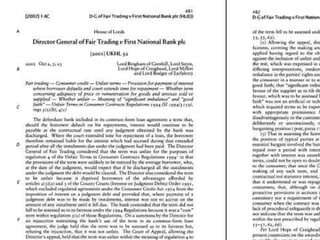
Introduction to OSCOLA referencing
Jackie Hanes, Learning & Teaching Services Librarian
Intended learning outcomes
• Find the OSCOLA referencing guides;
• Understand a footnote referencing style;
• Reference primary and secondary legal sources:
– Books, journal articles and webpages
– UK legislation and case law
– For both footnotes and bibliography
• Reference pages numbers for direct quotations
• Use short forms and ibids for subsequent citations
• Create a bibliography and table of authorities
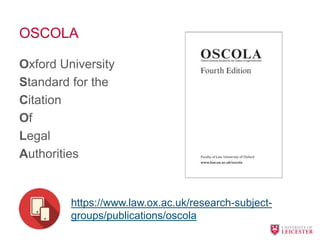
OSCOLA
Oxford University
Standard for the
Citation
Of
Legal
Authorities
https://www.law.ox.ac.uk/research-subject-
groups/publications/oscola
Golden rules of OSCOLA
• OSCOLA does not purport to be comprehensive,
but gives rules and examples for the main UK
legal primary sources, and for many types of
secondary sources;
• When citing materials not mentioned in
OSCOLA, use the general principles … as a
guide, and try to maintain consistency.
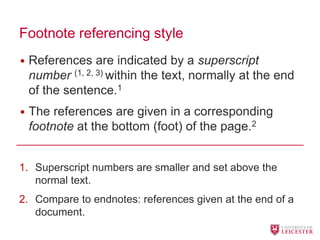
Footnote referencing style
• References are indicated by a superscript
number (1, 2, 3) within the text, normally at the end
of the sentence.1
• The references are given in a corresponding
footnote at the bottom (foot) of the page.2
1. Superscript numbers are smaller and set above the
normal text.
2. Compare to endnotes: references given at the end of a
document.
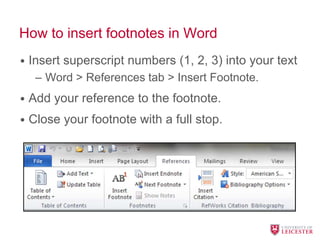
How to insert footnotes in Word
• Insert superscript numbers (1, 2, 3) into your text
– Word > References tab > Insert Footnote.
• Add your reference to the footnote.
• Close your footnote with a full stop.
Quotations
• Short quotations (up to three lines of text),
should be incorporated into the text, within 'single
quotation marks‘;
• Longer quotations (over three lines of text),
should be presented in an indented paragraph,
without quotation marks.
Page numbers
• Page or paragraph numbers should be included
at the end of the footnote, for both direct
(quotations) or indirect (paraphrasing)
quotations;
• Page numbers should not be included in the
table of authorities or bibliography.
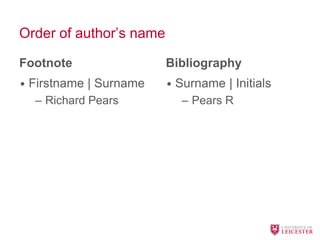
Order of author’s name
Footnote
• Firstname | Surname
– Richard Pears
Bibliography
• Surname | Initials
– Pears R
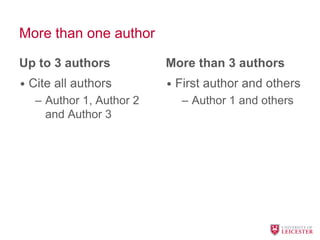
More than one author
Up to 3 authors
• Cite all authors
– Author 1, Author 2
and Author 3
More than 3 authors
• First author and others
– Author 1 and others
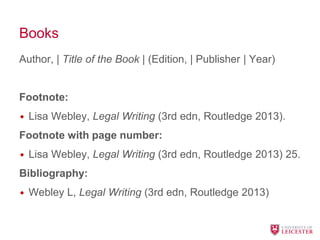
Books
Author, | Title of the Book | (Edition, | Publisher | Year)
Footnote:
• Lisa Webley, Legal Writing (3rd edn, Routledge 2013).
Footnote with page number:
• Lisa Webley, Legal Writing (3rd edn, Routledge 2013) 25.
Bibliography:
• Webley L, Legal Writing (3rd edn, Routledge 2013)
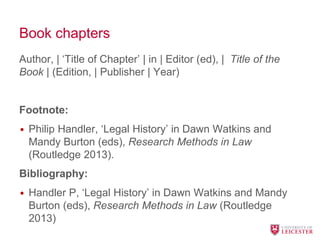
Book chapters
Author, | ‘Title of Chapter’ | in | Editor (ed), | Title of the
Book | (Edition, | Publisher | Year)
Footnote:
• Philip Handler, ‘Legal History’ in Dawn Watkins and
Mandy Burton (eds), Research Methods in Law
(Routledge 2013).
Bibliography:
• Handler P, ‘Legal History’ in Dawn Watkins and Mandy
Burton (eds), Research Methods in Law (Routledge
2013)
eBooks
• If the ebook provides the same page numbers as in the
printed publication, cite the ebook as if it was the printed
book;
• If the ebook has no page numbers, follow the normal
book (or edited book) citation form, including the ebook
type/edition before the publisher:
Example
• Author, | Title of the Book | (Edition | eBook edn |
Publisher | Year);
Journal articles
Author, | ‘Title of Article’ | [(Year)] | Volume | Abbreviation |
First Page
Footnote:
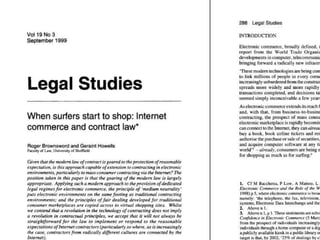
• Graham Virgo, ‘Why Study Law: the Relevance of Legal
Information’ (2011) 11 LIM 221.
Bibliography:
• Virgo G, ‘Why Study Law: the Relevance of Legal
Information’ (2011) 11 LIM 221
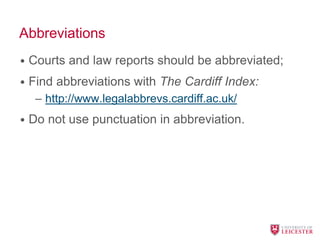
Abbreviations
• Where possible abbreviate the journal title;
• Find abbreviations with The Cardiff Index:
– http://www.legalabbrevs.cardiff.ac.uk/
• Do not use punctuation in abbreviation;
• If no abbreviation, then use the full journal title.
Websites
Author, | ‘Title of Webpage’ | (Title of Website, | Date) | <
URL > | accessed Date
Footnote:
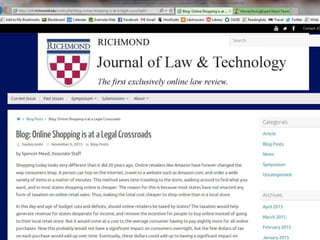
• Liz Fisher, ‘Gov.UK?’ (UK Constitutional Law Association Blog,
9 May 2013) < http://ukconstitutionallaw.org/2013/05/09/liz-
fisher-gov-uk/ > accessed 1 May 2015.
Bibliography:
• Fisher L, ‘Gov.UK?’ (UK Constitutional Law Association Blog,
9 May 2013) < http://ukconstitutionallaw.org/2013/05/09/liz-
fisher-gov-uk/ > accessed 1 May 2015
Secondary referencing
• Citing a book or article that you have read about, but not
read the original work;
• Best academic practice is to obtain the original material
and cite it directly, otherwise:
• Secondary reference | (as cited in | primary reference)
– Bernard Hibbitts, ‘The Technology of Law’ (2010) 102 Law
Libr J 101 (as cited in Graham Virgo, ‘Why Study Law: the
Relevance of Legal Information’ (2011) 11 LIM 221, 225)
UK Cases
• Cases after 2001
– Neutral citation, Report citation
• Cases before 2001
– Report citation (Court)
• Cases before 1865
– Nominate report citation, English Report citation
Case citations
Neutral Citations
• [Year]
• Court
• Number
Law Report Citations
• [(Year)]
• Volume
• Law Report
• First Page
Guide to neutral citations
Abbreviations
• Courts and law reports should be abbreviated;
• Find abbreviations with The Cardiff Index:
– http://www.legalabbrevs.cardiff.ac.uk/
• Do not use punctuation in abbreviation.
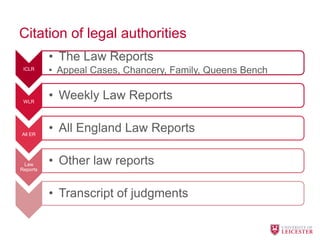
Citation of legal authorities
ICLR
• The Law Reports
• Appeal Cases, Chancery, Family, Queens Bench
WLR
• Weekly Law Reports
All ER
• All England Law Reports
Law
Reports
• Other law reports
• Transcript of judgments
Cases after 2001 (neutral citation)
• Case Name | Neutral Citation, | Report Citation
– Lucasfilm Ltd v Ainsworth [2011] UKSC 39, [2012] 1 AC 208
• Case Name | Neutral Citation, | Report Citation, | Page
– Lucasfilm Ltd v Ainsworth [2011] UKSC 39, [2012] 1 AC 208,
210-12
• Case Name | Neutral Citation, | Report Citation, | [Para]
– Lucasfilm Ltd v Ainsworth [2011] UKSC 39, [2012] 1 AC 208 [8]
Cases before 2001
• Case Name | Report Citation (Court)
– Newspaper Licensing Agency Ltd v Marks & Spencer Plc
[2001] Ch 257 (CA)
• Case Name | Report Citation (Court), | Page
– Newspaper Licensing Agency Ltd v Marks & Spencer Plc
[2001] Ch 257 (CA), 260
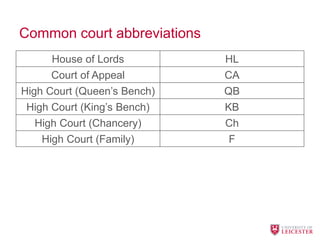
Common court abbreviations
House of Lords HL
Court of Appeal CA
High Court (Queen’s Bench) QB
High Court (King’s Bench) KB
High Court (Chancery) Ch
High Court (Family) F
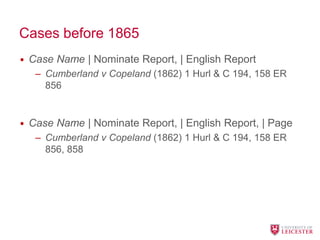
Cases before 1865
• Case Name | Nominate Report, | English Report
– Cumberland v Copeland (1862) 1 Hurl & C 194, 158 ER
856
• Case Name | Nominate Report, | English Report, | Page
– Cumberland v Copeland (1862) 1 Hurl & C 194, 158 ER
856, 858
Note on footnotes
• If the full case name (e.g. Lucasfilm Ltd v
Ainsworth)1 is given in the text of the essay, then
the footnote need only include the citation:
1. [2011] UKSC 39, [2012] 1 AC 208
• Remember to include the full reference in the
Table of Authorities at the end of your work.
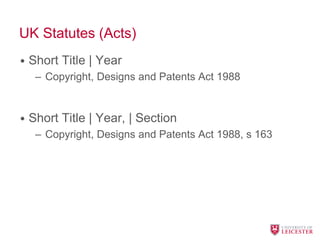
UK Statutes (Acts)
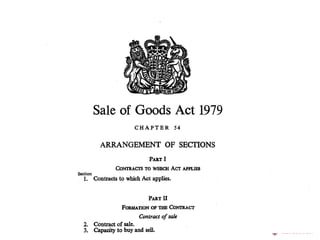
• Short Title | Year
– Copyright, Designs and Patents Act 1988
• Short Title | Year, | Section
– Copyright, Designs and Patents Act 1988, s 163
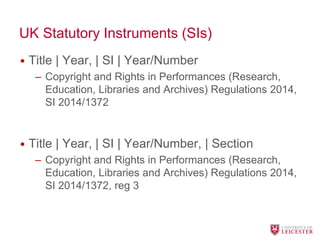
UK Statutory Instruments (SIs)
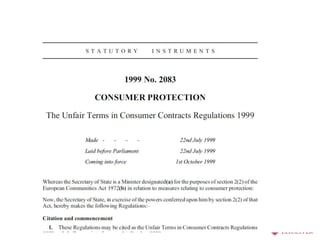
• Title | Year, | SI | Year/Number
– Copyright and Rights in Performances (Research,
Education, Libraries and Archives) Regulations 2014,
SI 2014/1372
• Title | Year, | SI | Year/Number, | Section
– Copyright and Rights in Performances (Research,
Education, Libraries and Archives) Regulations 2014,
SI 2014/1372, reg 3
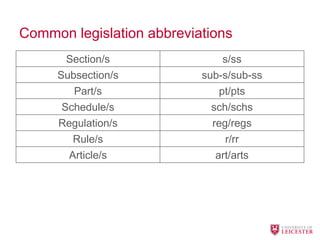
Common legislation abbreviations
Section/s s/ss
Subsection/s sub-s/sub-ss
Part/s pt/pts
Schedule/s sch/schs
Regulation/s reg/regs
Rule/s r/rr
Article/s art/arts
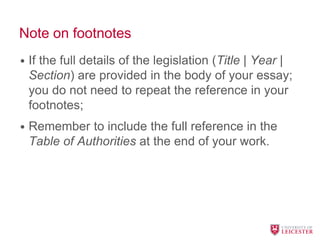
Note on footnotes
• If the full details of the legislation (Title | Year |
Section) are provided in the body of your essay;
you do not need to repeat the reference in your
footnotes;
• Remember to include the full reference in the
Table of Authorities at the end of your work.
Subsequent citations
• Always reference material in full in the first
citation;
• Subsequent citations can be shortened, and
cross-referenced to the first (full) footnote;
• Commonly known as short forms and ibids.
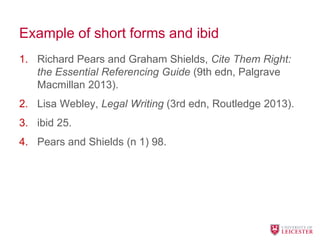
Example of short forms and ibid
1. Richard Pears and Graham Shields, Cite Them Right:
the Essential Referencing Guide (9th edn, Palgrave
Macmillan 2013).
2. Lisa Webley, Legal Writing (3rd edn, Routledge 2013).
3. ibid 25.
4. Pears and Shields (n 1) 98.
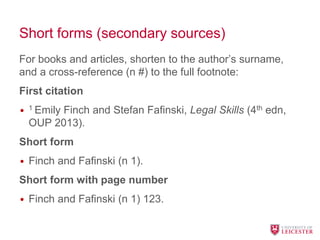
Short forms (secondary sources)
For books and articles, shorten to the author’s surname,
and a cross-reference (n #) to the full footnote:
First citation
• 1 Emily Finch and Stefan Fafinski, Legal Skills (4th edn,
OUP 2013).
Short form
• Finch and Fafinski (n 1).
Short form with page number
• Finch and Fafinski (n 1) 123.
Short forms (case law)
For case law, shorten to the first party name, and cross-
reference (n #) to the full footnote:
First citation
• 2 Lucasfilm Ltd v Ainsworth [2011] UKSC 39, [2012] 1 AC 208.
Short form
• Lucasfilm (n 2).
Short form with page number
• Lucasfilm (n 2) 210-12.
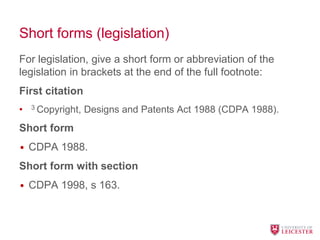
Short forms (legislation)
For legislation, give a short form or abbreviation of the
legislation in brackets at the end of the full footnote:
First citation
• 3 Copyright, Designs and Patents Act 1988 (CDPA 1988).
Short form
• CDPA 1988.
Short form with section
• CDPA 1998, s 163.
ibid
• An abbreviation for ibidem, meaning ‘in the same place’;
• Repeat citation in immediately preceding footnote.
First citation
• 4 Emily Finch and Stefan Fafinski, Legal Skills (4th edn, OUP
2013).
Short form
• 5 ibid.
Short form with page number
• 5 ibid 123.
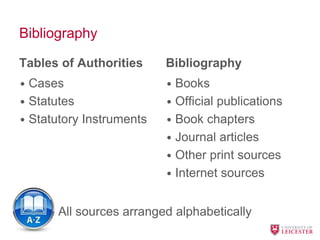
Bibliography
Tables of Authorities
• Cases
• Statutes
• Statutory Instruments
Bibliography
• Books
• Official publications
• Book chapters
• Journal articles
• Other print sources
• Internet sources
All sources arranged alphabetically
Speed referencing exercise
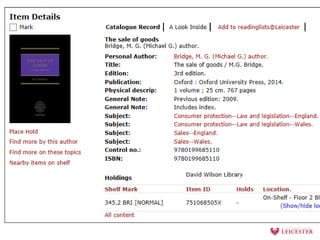
• You have 90 seconds to reference the item before you;
• Write your answer on the worksheet provided;
• After 90 seconds another item will display on screen;
• There are 6 items to be referenced in total;
• Answers will be provided at the end of the exercise.
Questions and contacts
• Jackie Hanes
• Subject Librarian
• librarians@le.ac.uk
• 0116 252 2055
• Book a Librarian

Introduction to OSCOLA referencing 2016

  • 1.
    Introduction to OSCOLAreferencing Jackie Hanes, Learning & Teaching Services Librarian
  • 2.
    Intended learning outcomes •Find the OSCOLA referencing guides; • Understand a footnote referencing style; • Reference primary and secondary legal sources: – Books, journal articles and webpages – UK legislation and case law – For both footnotes and bibliography • Reference pages numbers for direct quotations • Use short forms and ibids for subsequent citations • Create a bibliography and table of authorities
  • 3.
    OSCOLA Oxford University Standard forthe Citation Of Legal Authorities https://www.law.ox.ac.uk/research-subject- groups/publications/oscola
  • 4.
    Golden rules ofOSCOLA • OSCOLA does not purport to be comprehensive, but gives rules and examples for the main UK legal primary sources, and for many types of secondary sources; • When citing materials not mentioned in OSCOLA, use the general principles … as a guide, and try to maintain consistency.
  • 5.
    Footnote referencing style •References are indicated by a superscript number (1, 2, 3) within the text, normally at the end of the sentence.1 • The references are given in a corresponding footnote at the bottom (foot) of the page.2 1. Superscript numbers are smaller and set above the normal text. 2. Compare to endnotes: references given at the end of a document.
  • 6.
    How to insertfootnotes in Word • Insert superscript numbers (1, 2, 3) into your text – Word > References tab > Insert Footnote. • Add your reference to the footnote. • Close your footnote with a full stop.
  • 7.
    Quotations • Short quotations(up to three lines of text), should be incorporated into the text, within 'single quotation marks‘; • Longer quotations (over three lines of text), should be presented in an indented paragraph, without quotation marks.
  • 8.
    Page numbers • Pageor paragraph numbers should be included at the end of the footnote, for both direct (quotations) or indirect (paraphrasing) quotations; • Page numbers should not be included in the table of authorities or bibliography.
  • 9.
    Order of author’sname Footnote • Firstname | Surname – Richard Pears Bibliography • Surname | Initials – Pears R
  • 10.
    More than oneauthor Up to 3 authors • Cite all authors – Author 1, Author 2 and Author 3 More than 3 authors • First author and others – Author 1 and others
  • 11.
    Books Author, | Titleof the Book | (Edition, | Publisher | Year) Footnote: • Lisa Webley, Legal Writing (3rd edn, Routledge 2013). Footnote with page number: • Lisa Webley, Legal Writing (3rd edn, Routledge 2013) 25. Bibliography: • Webley L, Legal Writing (3rd edn, Routledge 2013)
  • 12.
    Book chapters Author, |‘Title of Chapter’ | in | Editor (ed), | Title of the Book | (Edition, | Publisher | Year) Footnote: • Philip Handler, ‘Legal History’ in Dawn Watkins and Mandy Burton (eds), Research Methods in Law (Routledge 2013). Bibliography: • Handler P, ‘Legal History’ in Dawn Watkins and Mandy Burton (eds), Research Methods in Law (Routledge 2013)
  • 13.
    eBooks • If theebook provides the same page numbers as in the printed publication, cite the ebook as if it was the printed book; • If the ebook has no page numbers, follow the normal book (or edited book) citation form, including the ebook type/edition before the publisher: Example • Author, | Title of the Book | (Edition | eBook edn | Publisher | Year);
  • 14.
    Journal articles Author, |‘Title of Article’ | [(Year)] | Volume | Abbreviation | First Page Footnote: • Graham Virgo, ‘Why Study Law: the Relevance of Legal Information’ (2011) 11 LIM 221. Bibliography: • Virgo G, ‘Why Study Law: the Relevance of Legal Information’ (2011) 11 LIM 221
  • 15.
    Abbreviations • Where possibleabbreviate the journal title; • Find abbreviations with The Cardiff Index: – http://www.legalabbrevs.cardiff.ac.uk/ • Do not use punctuation in abbreviation; • If no abbreviation, then use the full journal title.
  • 16.
    Websites Author, | ‘Titleof Webpage’ | (Title of Website, | Date) | < URL > | accessed Date Footnote: • Liz Fisher, ‘Gov.UK?’ (UK Constitutional Law Association Blog, 9 May 2013) < http://ukconstitutionallaw.org/2013/05/09/liz- fisher-gov-uk/ > accessed 1 May 2015. Bibliography: • Fisher L, ‘Gov.UK?’ (UK Constitutional Law Association Blog, 9 May 2013) < http://ukconstitutionallaw.org/2013/05/09/liz- fisher-gov-uk/ > accessed 1 May 2015
  • 17.
    Secondary referencing • Citinga book or article that you have read about, but not read the original work; • Best academic practice is to obtain the original material and cite it directly, otherwise: • Secondary reference | (as cited in | primary reference) – Bernard Hibbitts, ‘The Technology of Law’ (2010) 102 Law Libr J 101 (as cited in Graham Virgo, ‘Why Study Law: the Relevance of Legal Information’ (2011) 11 LIM 221, 225)
  • 18.
    UK Cases • Casesafter 2001 – Neutral citation, Report citation • Cases before 2001 – Report citation (Court) • Cases before 1865 – Nominate report citation, English Report citation
  • 19.
    Case citations Neutral Citations •[Year] • Court • Number Law Report Citations • [(Year)] • Volume • Law Report • First Page Guide to neutral citations
  • 20.
    Abbreviations • Courts andlaw reports should be abbreviated; • Find abbreviations with The Cardiff Index: – http://www.legalabbrevs.cardiff.ac.uk/ • Do not use punctuation in abbreviation.
  • 21.
    Citation of legalauthorities ICLR • The Law Reports • Appeal Cases, Chancery, Family, Queens Bench WLR • Weekly Law Reports All ER • All England Law Reports Law Reports • Other law reports • Transcript of judgments
  • 22.
    Cases after 2001(neutral citation) • Case Name | Neutral Citation, | Report Citation – Lucasfilm Ltd v Ainsworth [2011] UKSC 39, [2012] 1 AC 208 • Case Name | Neutral Citation, | Report Citation, | Page – Lucasfilm Ltd v Ainsworth [2011] UKSC 39, [2012] 1 AC 208, 210-12 • Case Name | Neutral Citation, | Report Citation, | [Para] – Lucasfilm Ltd v Ainsworth [2011] UKSC 39, [2012] 1 AC 208 [8]
  • 23.
    Cases before 2001 •Case Name | Report Citation (Court) – Newspaper Licensing Agency Ltd v Marks & Spencer Plc [2001] Ch 257 (CA) • Case Name | Report Citation (Court), | Page – Newspaper Licensing Agency Ltd v Marks & Spencer Plc [2001] Ch 257 (CA), 260
  • 24.
    Common court abbreviations Houseof Lords HL Court of Appeal CA High Court (Queen’s Bench) QB High Court (King’s Bench) KB High Court (Chancery) Ch High Court (Family) F
  • 25.
    Cases before 1865 •Case Name | Nominate Report, | English Report – Cumberland v Copeland (1862) 1 Hurl & C 194, 158 ER 856 • Case Name | Nominate Report, | English Report, | Page – Cumberland v Copeland (1862) 1 Hurl & C 194, 158 ER 856, 858
  • 26.
    Note on footnotes •If the full case name (e.g. Lucasfilm Ltd v Ainsworth)1 is given in the text of the essay, then the footnote need only include the citation: 1. [2011] UKSC 39, [2012] 1 AC 208 • Remember to include the full reference in the Table of Authorities at the end of your work.
  • 27.
    UK Statutes (Acts) •Short Title | Year – Copyright, Designs and Patents Act 1988 • Short Title | Year, | Section – Copyright, Designs and Patents Act 1988, s 163
  • 28.
    UK Statutory Instruments(SIs) • Title | Year, | SI | Year/Number – Copyright and Rights in Performances (Research, Education, Libraries and Archives) Regulations 2014, SI 2014/1372 • Title | Year, | SI | Year/Number, | Section – Copyright and Rights in Performances (Research, Education, Libraries and Archives) Regulations 2014, SI 2014/1372, reg 3
  • 29.
    Common legislation abbreviations Section/ss/ss Subsection/s sub-s/sub-ss Part/s pt/pts Schedule/s sch/schs Regulation/s reg/regs Rule/s r/rr Article/s art/arts
  • 30.
    Note on footnotes •If the full details of the legislation (Title | Year | Section) are provided in the body of your essay; you do not need to repeat the reference in your footnotes; • Remember to include the full reference in the Table of Authorities at the end of your work.
  • 31.
    Subsequent citations • Alwaysreference material in full in the first citation; • Subsequent citations can be shortened, and cross-referenced to the first (full) footnote; • Commonly known as short forms and ibids.
  • 32.
    Example of shortforms and ibid 1. Richard Pears and Graham Shields, Cite Them Right: the Essential Referencing Guide (9th edn, Palgrave Macmillan 2013). 2. Lisa Webley, Legal Writing (3rd edn, Routledge 2013). 3. ibid 25. 4. Pears and Shields (n 1) 98.
  • 33.
    Short forms (secondarysources) For books and articles, shorten to the author’s surname, and a cross-reference (n #) to the full footnote: First citation • 1 Emily Finch and Stefan Fafinski, Legal Skills (4th edn, OUP 2013). Short form • Finch and Fafinski (n 1). Short form with page number • Finch and Fafinski (n 1) 123.
  • 34.
    Short forms (caselaw) For case law, shorten to the first party name, and cross- reference (n #) to the full footnote: First citation • 2 Lucasfilm Ltd v Ainsworth [2011] UKSC 39, [2012] 1 AC 208. Short form • Lucasfilm (n 2). Short form with page number • Lucasfilm (n 2) 210-12.
  • 35.
    Short forms (legislation) Forlegislation, give a short form or abbreviation of the legislation in brackets at the end of the full footnote: First citation • 3 Copyright, Designs and Patents Act 1988 (CDPA 1988). Short form • CDPA 1988. Short form with section • CDPA 1998, s 163.
  • 36.
    ibid • An abbreviationfor ibidem, meaning ‘in the same place’; • Repeat citation in immediately preceding footnote. First citation • 4 Emily Finch and Stefan Fafinski, Legal Skills (4th edn, OUP 2013). Short form • 5 ibid. Short form with page number • 5 ibid 123.
  • 37.
    Bibliography Tables of Authorities •Cases • Statutes • Statutory Instruments Bibliography • Books • Official publications • Book chapters • Journal articles • Other print sources • Internet sources All sources arranged alphabetically
  • 38.
    Speed referencing exercise •You have 90 seconds to reference the item before you; • Write your answer on the worksheet provided; • After 90 seconds another item will display on screen; • There are 6 items to be referenced in total; • Answers will be provided at the end of the exercise.
  • 45.
    Questions and contacts •Jackie Hanes • Subject Librarian • librarians@le.ac.uk • 0116 252 2055 • Book a Librarian

Editor's Notes

  • #4 4th edition for UK and EU materials 3rd edition for international primary sources
  • #22 The 2012 practice direction on the citation of legal authorities, states that the ICLR’s law reports should be used in preference
  • #36 Cross-reference to the full footnote is not normally necessary.
  • #38 Information taken from ‘Assessment and Examinations Handbook 2015’ and ‘Preparing Your Table of Authorities and Bibliography’. Tables of authorities and bibliography are not included in the word count.