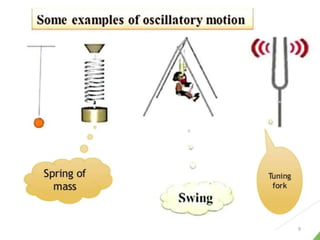
OSCILLATIONS
Overview
- Types of motion
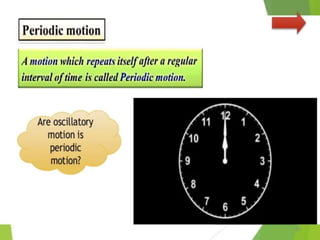
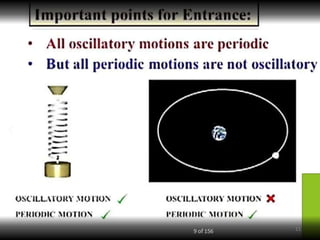
- Periodic motion
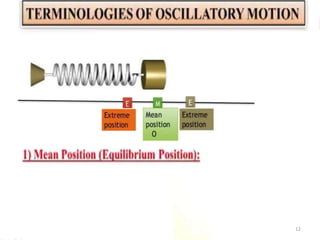
- Terminologies in Oscillations
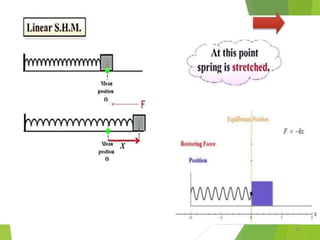
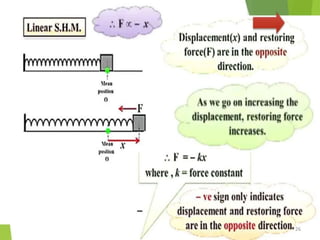
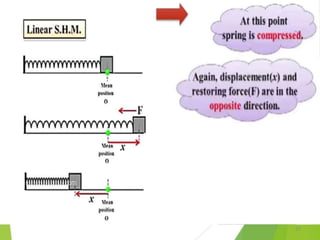
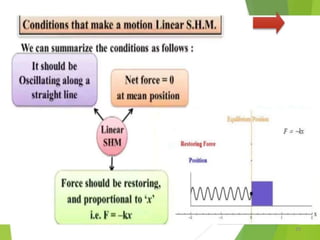
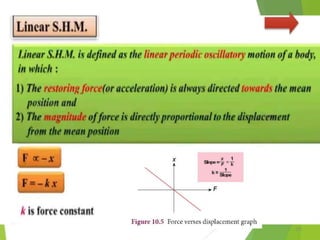
- Simple Harmonic Motion - Linear SHM – Oscillations due to a spring
- Combination of springs
- Angular SHM
- Energies in SHM- Kinetic, Potential
- Examples of SHM – Oscillations due to spring, Simple pendulum,
Oscillation of liquid in a U-tube
- Free Oscillation
- Damped Oscillation
- Forced Oscillation – Resonance
2
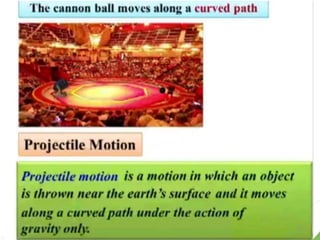
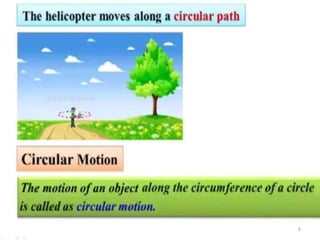
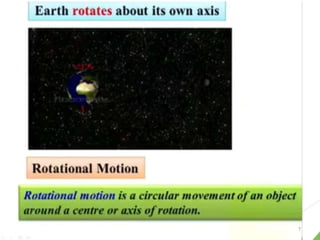
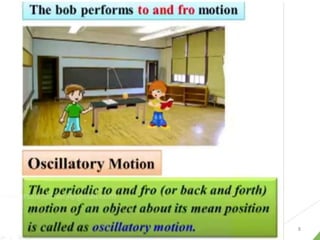
TYPES OF MOTION
3
4
5
6
7
8
9
10
11
12
13
14
15
16
17
18
19
20
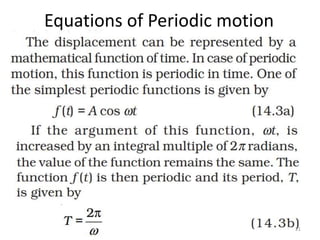
Equations of Periodic motion
21
SIMPLE HARMONIC MOTION
22
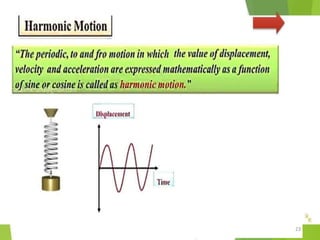
23
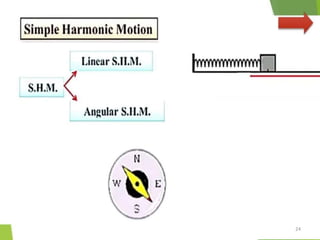
24
25
26
27
28
29
30
31
32
33
34
35
36
37
38
39
40
41
42
43
44
45
46
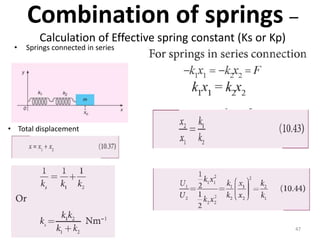
Combination of springs –
Calculation of Effective spring constant (Ks or Kp)
47
• Springs connected in series
• Total displacement
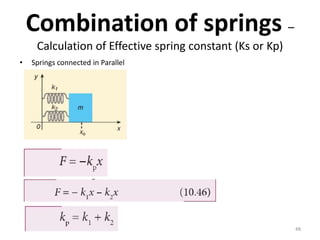
Combination of springs –
Calculation of Effective spring constant (Ks or Kp)
48
• Springs connected in Parallel
49
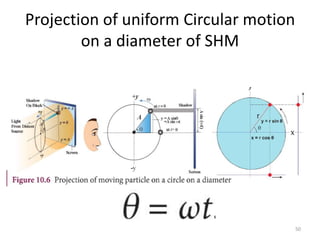
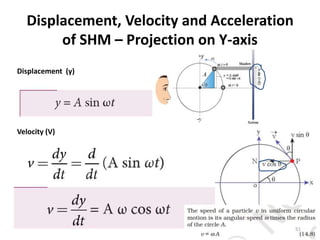
Projection of uniform Circular motion
on a diameter of SHM
50
Displacement, Velocity and Acceleration
of SHM – Projection on Y-axis
Displacement (y)
Velocity (V)
51
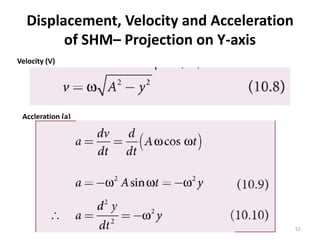
Displacement, Velocity and Acceleration
of SHM– Projection on Y-axis
Velocity (V)
Accleration (a)
52
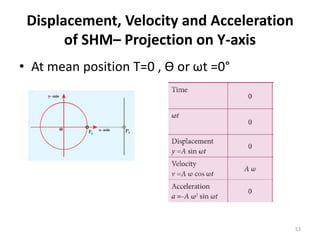
Displacement, Velocity and Acceleration
of SHM– Projection on Y-axis
• At mean position T=0 , Ɵ or ωt =0°
53
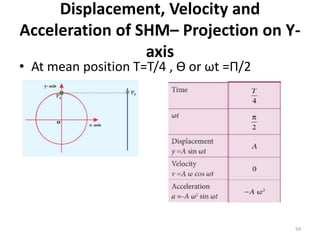
Displacement, Velocity and
Acceleration of SHM– Projection on Y-
axis
• At mean position T=T/4 , Ɵ or ωt =Π/2
54
Displacement, Velocity and
Acceleration of SHM– Projection on Y-
axis
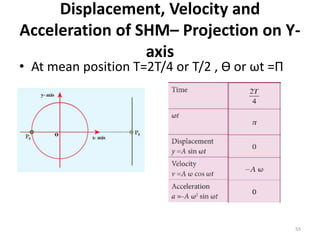
• At mean position T=2T/4 or T/2 , Ɵ or ωt =Π
55
Displacement, Velocity and
Acceleration of SHM– Projection on Y-
axis
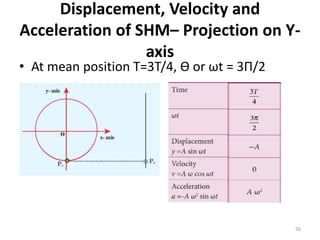
• At mean position T=3T/4, Ɵ or ωt = 3Π/2
56
Displacement, Velocity and
Acceleration of SHM– Projection on Y-
axis
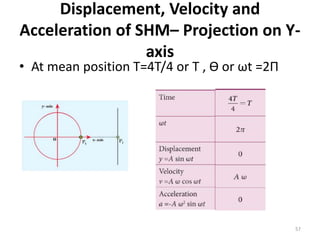
• At mean position T=4T/4 or T , Ɵ or ωt =2Π
57
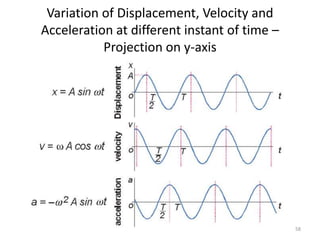
Variation of Displacement, Velocity and
Acceleration at different instant of time –
Projection on y-axis
58
59
60
61
62
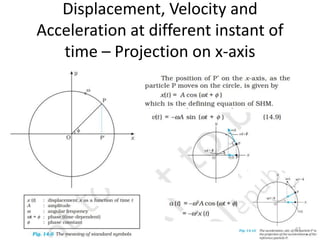
Displacement, Velocity and
Acceleration at different instant of
time – Projection on x-axis
63
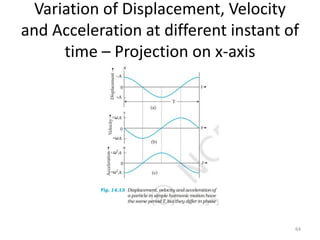
Variation of Displacement, Velocity
and Acceleration at different instant of
time – Projection on x-axis
64
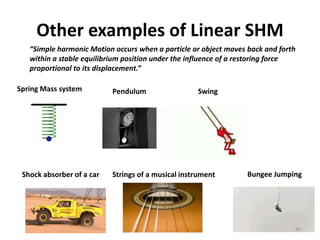
Other examples of Linear SHM
“Simple harmonic Motion occurs when a particle or object moves back and forth
within a stable equilibrium position under the influence of a restoring force
proportional to its displacement.”
Spring Mass system Pendulum Swing
Shock absorber of a car Strings of a musical instrument Bungee Jumping
65
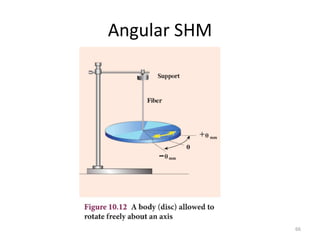
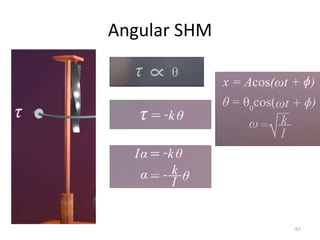
Angular SHM
66
Angular SHM
67
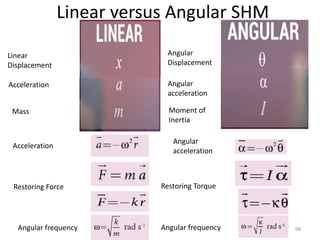
Linear versus Angular SHM
Linear
Displacement
Acceleration
Mass Moment of
Inertia
Angular
acceleration
Angular
Displacement
Acceleration
Angular
acceleration
Restoring Force Restoring Torque
Angular frequency Angular frequency 68
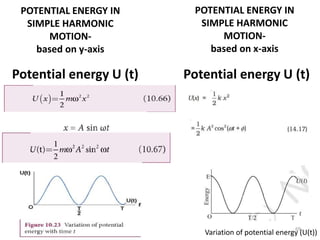
POTENTIAL ENERGY IN
SIMPLE HARMONIC
MOTION-
based on y-axis
Potential energy U (t)
POTENTIAL ENERGY IN
SIMPLE HARMONIC
MOTION-
based on x-axis
Potential energy U (t)
Variation of potential energy (U(t))
69
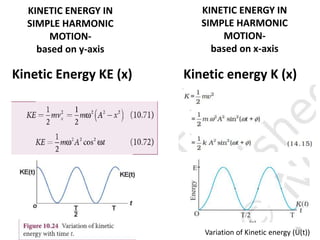
KINETIC ENERGY IN
SIMPLE HARMONIC
MOTION-
based on y-axis
Kinetic Energy KE (x)
KINETIC ENERGY IN
SIMPLE HARMONIC
MOTION-
based on x-axis
Kinetic energy K (x)
Variation of Kinetic energy (U(t))
70
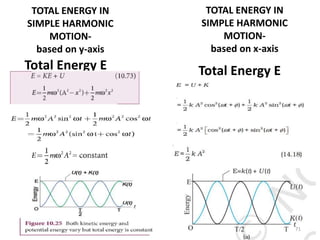
TOTAL ENERGY IN
SIMPLE HARMONIC
MOTION-
based on y-axis
Total Energy E
TOTAL ENERGY IN
SIMPLE HARMONIC
MOTION-
based on x-axis
Total Energy E
71
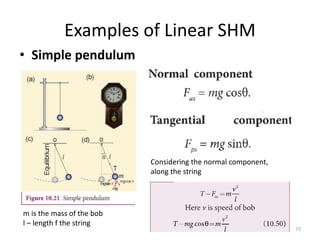
Examples of Linear SHM
• Simple pendulum
Considering the normal component,
along the string
72
m is the mass of the bob
l – length f the string
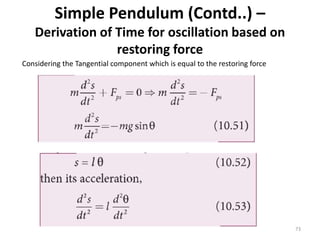
Simple Pendulum (Contd..) –
Derivation of Time for oscillation based on
restoring force
73
Considering the Tangential component which is equal to the restoring force
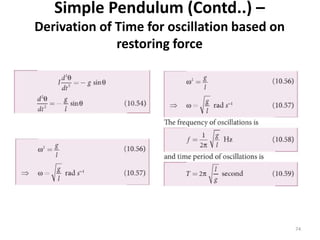
Simple Pendulum (Contd..) –
Derivation of Time for oscillation based on
restoring force
74
Simple Pendulum (Contd..) –
Derivation of Time for oscillation
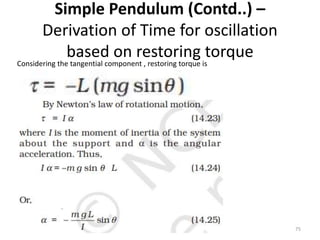
based on restoring torque
75
Considering the tangential component , restoring torque is
Simple Pendulum (Contd..) –
Derivation of Time for oscillation
based on Restoring Torque
76
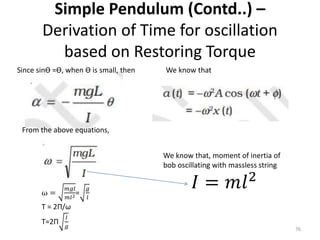
Since sinƟ =Ɵ, when Ɵ is small, then We know that
From the above equations,
We know that, moment of inertia of
bob oscillating with massless string
𝐼 = 𝑚𝑙2
ω =
𝑚𝑔𝑙
𝑚𝑙2=
𝑔
𝑙
T = 2Π/ω
T=2Π
𝑙
𝑔
Oscillation of a liquid in U-tube –
Time period for oscillating about a mean position
77
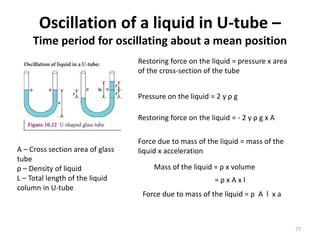
Restoring force on the liquid = pressure x area
of the cross-section of the tube
Pressure on the liquid = 2 y ρ g
A – Cross section area of glass
tube
ρ – Density of liquid
L – Total length of the liquid
column in U-tube
Restoring force on the liquid = - 2 y ρ g x A
Force due to mass of the liquid = mass of the
liquid x acceleration
Mass of the liquid = ρ x volume
= ρ x A x l
Force due to mass of the liquid = ρ A l x a
Oscillation of a liquid in U-tube –
Time period for oscillating about a mean position
78
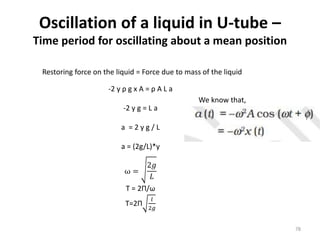
Restoring force on the liquid = Force due to mass of the liquid
-2 y ρ g x A = ρ A L a
-2 y g = L a
a = 2 y g / L
a = (2g/L)*y
We know that,
ω =
2𝑔
𝐿
T = 2Π/ω
T=2Π
𝑙
2𝑔
Free oscillations
• The free oscillation possesses constant
amplitude and period without any external force
to set the oscillation.
• Ideally, free oscillation does not undergo
damping. But in all-natural systems damping is
observed unless and until any constant external
force is supplied to overcome damping.
• In such a system, the amplitude, frequency and
energy all remain constant.
79
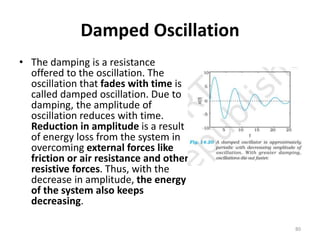
Damped Oscillation
• The damping is a resistance
offered to the oscillation. The
oscillation that fades with time is
called damped oscillation. Due to
damping, the amplitude of
oscillation reduces with time.
Reduction in amplitude is a result
of energy loss from the system in
overcoming external forces like
friction or air resistance and other
resistive forces. Thus, with the
decrease in amplitude, the energy
of the system also keeps
decreasing.
80
Damped oscillation –
Derivation of Displacement and Mechanical energy
81
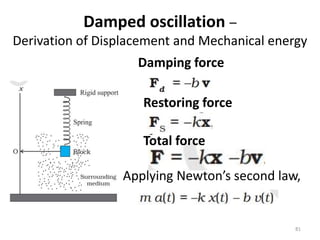
Damping force
Restoring force
Total force
Applying Newton’s second law,
Damped oscillation –
Derivation of Displacement and Mechanical energy
82
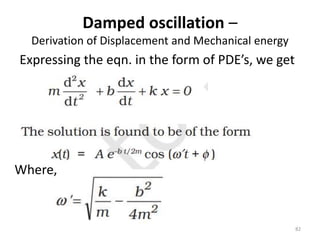
Expressing the eqn. in the form of PDE’s, we get
Where,
Damped oscillation –
Derivation of Displacement and Mechanical energy
83
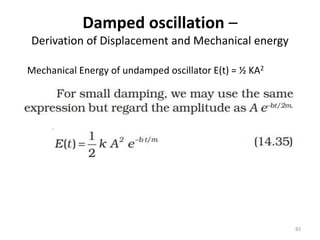
Mechanical Energy of undamped oscillator E(t) = ½ KA2
Forced Oscillations
• When a body oscillates by being influenced by
an external periodic force, it is called forced
oscillation. Here, the amplitude of oscillation,
experiences damping but remains constant
due to the external energy supplied to the
system.
• For example, when you push someone on a
swing, you have to keep periodically pushing
them so that the swing doesn’t reduce.
84
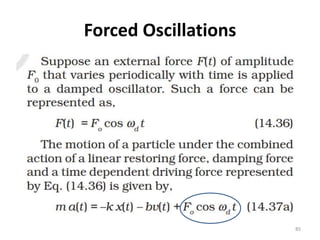
Forced Oscillations
85
Forced Oscillations
86
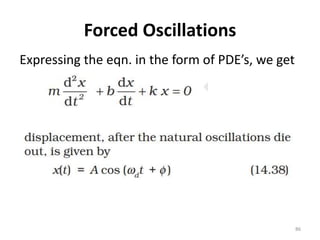
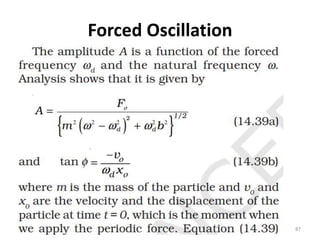
Expressing the eqn. in the form of PDE’s, we get
Forced Oscillation
87
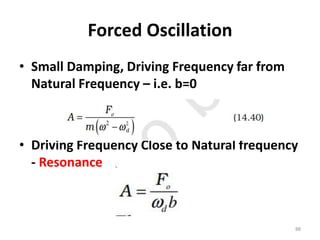
Forced Oscillation
• Small Damping, Driving Frequency far from
Natural Frequency – i.e. b=0
• Driving Frequency Close to Natural frequency
- Resonance
88
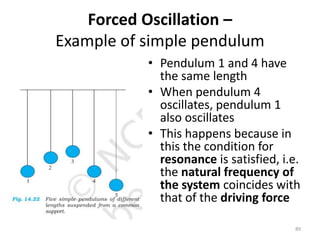
Forced Oscillation –
Example of simple pendulum
• Pendulum 1 and 4 have
the same length
• When pendulum 4
oscillates, pendulum 1
also oscillates
• This happens because in
this the condition for
resonance is satisfied, i.e.
the natural frequency of
the system coincides with
that of the driving force
89
Thank you
90

OSCILLATIONS.pptx

  • 1.
  • 2.
    Overview - Types ofmotion - Periodic motion - Terminologies in Oscillations - Simple Harmonic Motion - Linear SHM – Oscillations due to a spring - Combination of springs - Angular SHM - Energies in SHM- Kinetic, Potential - Examples of SHM – Oscillations due to spring, Simple pendulum, Oscillation of liquid in a U-tube - Free Oscillation - Damped Oscillation - Forced Oscillation – Resonance 2
  • 3.
  • 4.
  • 5.
  • 6.
  • 7.
  • 8.
  • 9.
  • 10.
  • 11.
  • 12.
  • 13.
  • 14.
  • 15.
  • 16.
  • 17.
  • 18.
  • 19.
  • 20.
  • 21.
  • 22.
  • 23.
  • 24.
  • 25.
  • 26.
  • 27.
  • 28.
  • 29.
  • 30.
  • 31.
  • 32.
  • 33.
  • 34.
  • 35.
  • 36.
  • 37.
  • 38.
  • 39.
  • 40.
  • 41.
  • 42.
  • 43.
  • 44.
  • 45.
  • 46.
  • 47.
    Combination of springs– Calculation of Effective spring constant (Ks or Kp) 47 • Springs connected in series • Total displacement
  • 48.
    Combination of springs– Calculation of Effective spring constant (Ks or Kp) 48 • Springs connected in Parallel
  • 49.
  • 50.
    Projection of uniformCircular motion on a diameter of SHM 50
  • 51.
    Displacement, Velocity andAcceleration of SHM – Projection on Y-axis Displacement (y) Velocity (V) 51
  • 52.
    Displacement, Velocity andAcceleration of SHM– Projection on Y-axis Velocity (V) Accleration (a) 52
  • 53.
    Displacement, Velocity andAcceleration of SHM– Projection on Y-axis • At mean position T=0 , Ɵ or ωt =0° 53
  • 54.
    Displacement, Velocity and Accelerationof SHM– Projection on Y- axis • At mean position T=T/4 , Ɵ or ωt =Π/2 54
  • 55.
    Displacement, Velocity and Accelerationof SHM– Projection on Y- axis • At mean position T=2T/4 or T/2 , Ɵ or ωt =Π 55
  • 56.
    Displacement, Velocity and Accelerationof SHM– Projection on Y- axis • At mean position T=3T/4, Ɵ or ωt = 3Π/2 56
  • 57.
    Displacement, Velocity and Accelerationof SHM– Projection on Y- axis • At mean position T=4T/4 or T , Ɵ or ωt =2Π 57
  • 58.
    Variation of Displacement,Velocity and Acceleration at different instant of time – Projection on y-axis 58
  • 59.
  • 60.
  • 61.
  • 62.
  • 63.
    Displacement, Velocity and Accelerationat different instant of time – Projection on x-axis 63
  • 64.
    Variation of Displacement,Velocity and Acceleration at different instant of time – Projection on x-axis 64
  • 65.
    Other examples ofLinear SHM “Simple harmonic Motion occurs when a particle or object moves back and forth within a stable equilibrium position under the influence of a restoring force proportional to its displacement.” Spring Mass system Pendulum Swing Shock absorber of a car Strings of a musical instrument Bungee Jumping 65
  • 66.
  • 67.
  • 68.
    Linear versus AngularSHM Linear Displacement Acceleration Mass Moment of Inertia Angular acceleration Angular Displacement Acceleration Angular acceleration Restoring Force Restoring Torque Angular frequency Angular frequency 68
  • 69.
    POTENTIAL ENERGY IN SIMPLEHARMONIC MOTION- based on y-axis Potential energy U (t) POTENTIAL ENERGY IN SIMPLE HARMONIC MOTION- based on x-axis Potential energy U (t) Variation of potential energy (U(t)) 69
  • 70.
    KINETIC ENERGY IN SIMPLEHARMONIC MOTION- based on y-axis Kinetic Energy KE (x) KINETIC ENERGY IN SIMPLE HARMONIC MOTION- based on x-axis Kinetic energy K (x) Variation of Kinetic energy (U(t)) 70
  • 71.
    TOTAL ENERGY IN SIMPLEHARMONIC MOTION- based on y-axis Total Energy E TOTAL ENERGY IN SIMPLE HARMONIC MOTION- based on x-axis Total Energy E 71
  • 72.
    Examples of LinearSHM • Simple pendulum Considering the normal component, along the string 72 m is the mass of the bob l – length f the string
  • 73.
    Simple Pendulum (Contd..)– Derivation of Time for oscillation based on restoring force 73 Considering the Tangential component which is equal to the restoring force
  • 74.
    Simple Pendulum (Contd..)– Derivation of Time for oscillation based on restoring force 74
  • 75.
    Simple Pendulum (Contd..)– Derivation of Time for oscillation based on restoring torque 75 Considering the tangential component , restoring torque is
  • 76.
    Simple Pendulum (Contd..)– Derivation of Time for oscillation based on Restoring Torque 76 Since sinƟ =Ɵ, when Ɵ is small, then We know that From the above equations, We know that, moment of inertia of bob oscillating with massless string 𝐼 = 𝑚𝑙2 ω = 𝑚𝑔𝑙 𝑚𝑙2= 𝑔 𝑙 T = 2Π/ω T=2Π 𝑙 𝑔
  • 77.
    Oscillation of aliquid in U-tube – Time period for oscillating about a mean position 77 Restoring force on the liquid = pressure x area of the cross-section of the tube Pressure on the liquid = 2 y ρ g A – Cross section area of glass tube ρ – Density of liquid L – Total length of the liquid column in U-tube Restoring force on the liquid = - 2 y ρ g x A Force due to mass of the liquid = mass of the liquid x acceleration Mass of the liquid = ρ x volume = ρ x A x l Force due to mass of the liquid = ρ A l x a
  • 78.
    Oscillation of aliquid in U-tube – Time period for oscillating about a mean position 78 Restoring force on the liquid = Force due to mass of the liquid -2 y ρ g x A = ρ A L a -2 y g = L a a = 2 y g / L a = (2g/L)*y We know that, ω = 2𝑔 𝐿 T = 2Π/ω T=2Π 𝑙 2𝑔
  • 79.
    Free oscillations • Thefree oscillation possesses constant amplitude and period without any external force to set the oscillation. • Ideally, free oscillation does not undergo damping. But in all-natural systems damping is observed unless and until any constant external force is supplied to overcome damping. • In such a system, the amplitude, frequency and energy all remain constant. 79
  • 80.
    Damped Oscillation • Thedamping is a resistance offered to the oscillation. The oscillation that fades with time is called damped oscillation. Due to damping, the amplitude of oscillation reduces with time. Reduction in amplitude is a result of energy loss from the system in overcoming external forces like friction or air resistance and other resistive forces. Thus, with the decrease in amplitude, the energy of the system also keeps decreasing. 80
  • 81.
    Damped oscillation – Derivationof Displacement and Mechanical energy 81 Damping force Restoring force Total force Applying Newton’s second law,
  • 82.
    Damped oscillation – Derivationof Displacement and Mechanical energy 82 Expressing the eqn. in the form of PDE’s, we get Where,
  • 83.
    Damped oscillation – Derivationof Displacement and Mechanical energy 83 Mechanical Energy of undamped oscillator E(t) = ½ KA2
  • 84.
    Forced Oscillations • Whena body oscillates by being influenced by an external periodic force, it is called forced oscillation. Here, the amplitude of oscillation, experiences damping but remains constant due to the external energy supplied to the system. • For example, when you push someone on a swing, you have to keep periodically pushing them so that the swing doesn’t reduce. 84
  • 85.
  • 86.
    Forced Oscillations 86 Expressing theeqn. in the form of PDE’s, we get
  • 87.
  • 88.
    Forced Oscillation • SmallDamping, Driving Frequency far from Natural Frequency – i.e. b=0 • Driving Frequency Close to Natural frequency - Resonance 88
  • 89.
    Forced Oscillation – Exampleof simple pendulum • Pendulum 1 and 4 have the same length • When pendulum 4 oscillates, pendulum 1 also oscillates • This happens because in this the condition for resonance is satisfied, i.e. the natural frequency of the system coincides with that of the driving force 89
  • 90.