End of 4
End of 4th
th
year OSCE
year OSCE
- Surgery -
- Surgery -
20 – 03- 2007
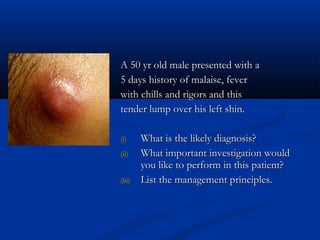
A 50 yr old male presented with a
5 days history of malaise, fever
with chills and rigors and this
tender lump over his left shin.
(i)
(i) What is the likely diagnosis?
What is the likely diagnosis?
(ii)
(ii) What important investigation would
What important investigation would
you like to perform in this patient?
(iii)
(iii) List the management principles.
List the management principles.
 Answer
Answer
(i)
(i) An abscess
An abscess
(ii)
(ii) Random/fasting blood sugar
Random/fasting blood sugar
(iii)
(iii) Mx
Mx
- adequate analgesia & antipyretics
- broad spectrum IV antibiotics
- Adequate incision & adequate drainage under
- Adequate incision & adequate drainage under GA
GA
- break into all loculi
- remove pyogenic membrane
- send pus for culture + ABST
- clean the cavity with
- clean the cavity with N.saline/ Povidone Iodine
N.saline/ Povidone Iodine (Betadine)
(Betadine)
- Leave open , partially insert a gauze wick
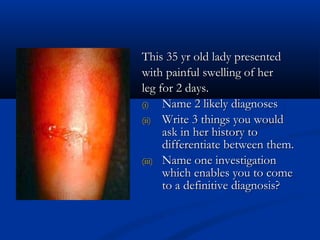
This 35 yr old lady presented
with painful swelling of her
leg for 2 days.
leg for 2 days.
(i)
(i) Name 2 likely diagnoses
Name 2 likely diagnoses
(ii)
(ii) Write 3 things you would
Write 3 things you would
ask in her history to
differentiate between them.
(iii)
(iii) Name one investigation
Name one investigation
which enables you to come
to a definitive diagnosis?
(i) Cellulitis , DVT
(ii)
(ii) Any preceding injury
Any preceding injury
history of DM
history of DM
prolonged immobilization
Use of OCP
Use of OCP
Varicose veins
Varicose veins
(iii)
(iii) Duplex scan of LL
Duplex scan of LL
Mx of Cellulitis
Mx of Cellulitis
 REMAIN
REMAIN
R = Rest
R = Rest
E = elevation of the limb
M = mobilization
M = mobilization
A = Antibiotics, antipyretics, analgesia
I = Immunization against tetanus
N = Nutrition
N = Nutrition
Tubes
Tubes
An intercostal tube connected to an underwater
seal drainage bottle given.
(i)
(i) Write 2 indications of use.
Write 2 indications of use.
(ii)
(ii) Name 2 complications of this.
Name 2 complications of this.
(iii)
(iii) After inserting this to a patient, as the HO
After inserting this to a patient, as the HO
name 3 things you would assess in this patient.
(i)
(i) Indications--- 1. therapeutic –
Indications--- 1. therapeutic – pneumo/haemothorax
pneumo/haemothorax
2. prophylactic –
2. prophylactic – post op in cardio-thoracic Sx
post op in cardio-thoracic Sx
(ii)
(ii) Complications--- 1. during insertion
Complications--- 1. during insertion
2. maintenance
2. maintenance
3. during removal
3. during removal
(iii)
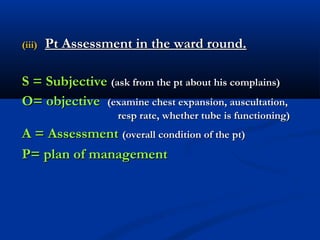
(iii) Pt Assessment in the ward round.
Pt Assessment in the ward round.
S = Subjective
S = Subjective (ask from the pt about his complains)
(ask from the pt about his complains)
O= objective
O= objective (examine chest expansion, auscultation,
(examine chest expansion, auscultation,
resp rate, whether tube is functioning)
A = Assessment
A = Assessment (overall condition of the pt)
(overall condition of the pt)
P= plan of management
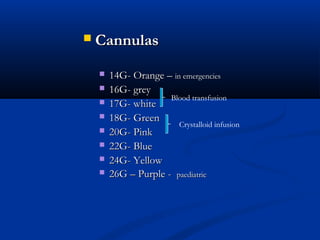
 Cannulas
Cannulas
 14G- Orange –
14G- Orange – in emergencies
in emergencies
 16G- grey
16G- grey
 17G- white
17G- white
 18G- Green
18G- Green
 20G- Pink
20G- Pink
 22G- Blue
22G- Blue
 24G- Yellow
24G- Yellow
 26G – Purple -
26G – Purple - paediatric
paediatric
Blood transfusion
Crystalloid infusion
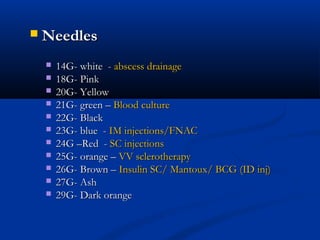
 Needles
Needles
 14G- white -
14G- white - abscess drainage
abscess drainage
 18G- Pink
18G- Pink
 20G- Yellow
20G- Yellow
 21G- green –
21G- green – Blood culture
Blood culture
 22G- Black
22G- Black
 23G- blue -
23G- blue - IM injections/FNAC
IM injections/FNAC
 24G –Red -
24G –Red - SC injections
SC injections
 25G- orange –
25G- orange – VV sclerotherapy
VV sclerotherapy
 26G- Brown –
26G- Brown – Insulin SC/ Mantoux/ BCG (ID inj)
Insulin SC/ Mantoux/ BCG (ID inj)
 27G- Ash
27G- Ash
 29G- Dark orange
29G- Dark orange
Neuro surgery
Neuro surgery
 What’s the lesion?
What’s the lesion?
 Which condition
Which condition
produces this
produces this
characteristic lesion?
 What’s the underlying
What’s the underlying
cause for this condition?
 How do you manage this
How do you manage this
patient?
patient?
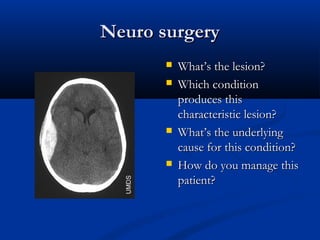
 A hyper dense, biconvex shaped area in the right
A hyper dense, biconvex shaped area in the right
tempero-parietal region.
 Right sided
Right sided, Acute
, Acute Extra dural Haemorrhage
Extra dural Haemorrhage
 Damage to the middle meningeal artery. Parietal
Damage to the middle meningeal artery. Parietal
bone fracture maybe the cause for this injury but
not always.
not always.
 Resuscitation, HIO, craniotomy
Resuscitation, HIO, craniotomy
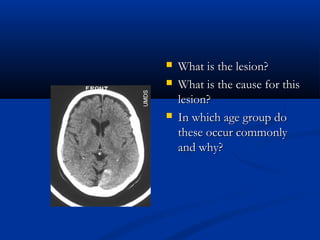
 What is the lesion?
What is the lesion?
 What is the cause for this
What is the cause for this
lesion?
lesion?
 In which age group do
In which age group do
these occur commonly
and why?
and why?
 Crescent shape, small hyper dense area in left
Crescent shape, small hyper dense area in left
tempero- parietal region.
 Left sided
Left sided Acute
Acute SDH
SDH
 In elderly because there subdural space is
In elderly because there subdural space is
enlarged in them due to brain atrophy.
 What’s the lesion?
What’s the lesion?
 What could be the
What could be the
underlying brain
underlying brain
condition?
condition?
 What are the causes?
What are the causes?
 Hypodense crescentic area in left temporal area.
Hypodense crescentic area in left temporal area.
 Left sided
Left sided Chronic
Chronic SDH
SDH
 - Alcoholics
- Alcoholics
- child abuse
- child abuse
- elderly following recurrent falls
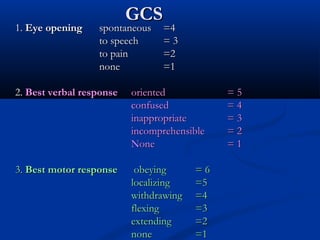
GCS
GCS
1.
1. Eye opening
Eye opening spontaneous
spontaneous =4
=4
to speech
to speech = 3
= 3
to pain
to pain =2
=2
none
none =1
=1
2.
2. Best verbal response
Best verbal response oriented
oriented = 5
= 5
confused
confused = 4
= 4
inappropriate
inappropriate = 3
= 3
incomprehensible
incomprehensible = 2
= 2
None
None = 1
= 1
3.
3. Best motor response
Best motor response obeying
obeying = 6
= 6
localizing
localizing =5
=5
withdrawing
withdrawing =4
=4
flexing
flexing =3
=3
extending
extending =2
=2
none
none =1
=1
Criteria for admission after head injury
o Altered level of consciousness
o Skull fracture
o Neurological symptoms or signs
o Difficult assessment - drugs, alcohol
o No responsible carer
Indications for CT scan
 GCS less than 13 at any point since the injury
 Suspected open or depressed skull fracture
 Any sign of basal skull fracture
 Post-traumatic seizure
 Focal neurological deficit
If GCS ≤ 8 ,
Req intubation & ventilation
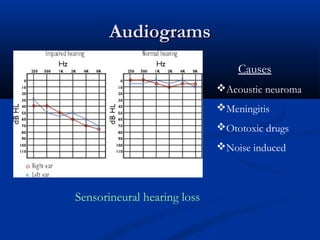
Audiograms
Audiograms
Sensorineural hearing loss
Causes
Acoustic neuroma
Meningitis
Ototoxic drugs
Noise induced
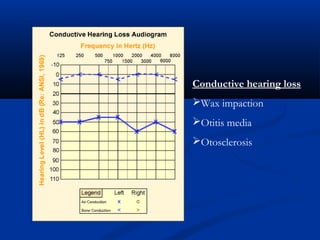
Conductive hearing loss
Wax impaction
Otitis media
Otosclerosis
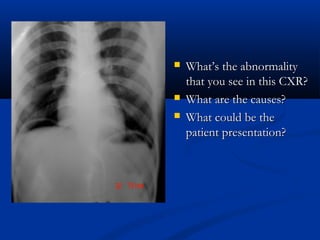
 What’s the abnormality
What’s the abnormality
that you see in this CXR?
 What are the causes?
What are the causes?
 What could be the
What could be the
patient presentation?
 There’s air under the diaphragm
There’s air under the diaphragm
 Perforation of a hollow viscus
Perforation of a hollow viscus
- bowel perforation
- bowel perforation
- perforated peptic ulcer
- ruptured appendix
- ruptured appendix
 Acute severe abdominal pain, guarding and
Acute severe abdominal pain, guarding and
board like rigidity
board like rigidity
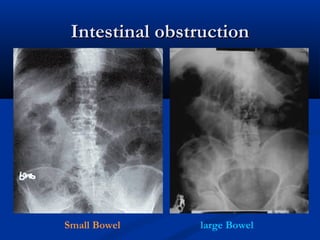
Intestinal obstruction
Small Bowel large Bowel
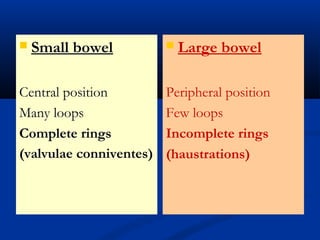
 Small bowel
Central position
Many loops
Complete rings
(valvulae conniventes)
 Large bowel
Peripheral position
Few loops
Incomplete rings
(haustrations)
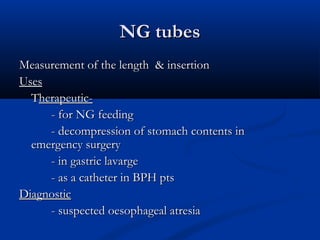
NG tubes
NG tubes
Measurement of the length & insertion
Uses
Uses
T
Therapeutic-
herapeutic-
- for NG feeding
- for NG feeding
- decompression of stomach contents in
emergency surgery
emergency surgery
- in gastric lavarge
- as a catheter in BPH pts
Diagnostic
Diagnostic
- suspected oesophageal atresia
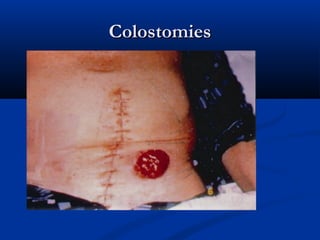
Colostomies
Colostomies
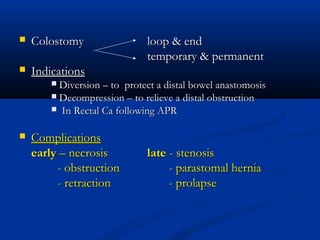
 Colostomy
Colostomy loop & end
loop & end
temporary & permanent
 Indications
Indications
 Diversion – to protect a distal bowel anastomosis
Diversion – to protect a distal bowel anastomosis
 Decompression – to relieve a distal obstruction
Decompression – to relieve a distal obstruction
 In Rectal Ca following APR
In Rectal Ca following APR
 Complications
Complications
early
early – necrosis
– necrosis late
late - stenosis
- stenosis
- obstruction
- obstruction - parastomal hernia
- parastomal hernia
- retraction
- retraction - prolapse
- prolapse
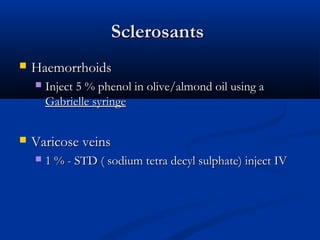
Sclerosants
Sclerosants
 Haemorrhoids
Haemorrhoids
 Inject 5 % phenol in olive/almond oil using a
Inject 5 % phenol in olive/almond oil using a
Gabrielle syringe
Gabrielle syringe
 Varicose veins
Varicose veins
 1 % - STD ( sodium tetra decyl sulphate) inject IV
1 % - STD ( sodium tetra decyl sulphate) inject IV
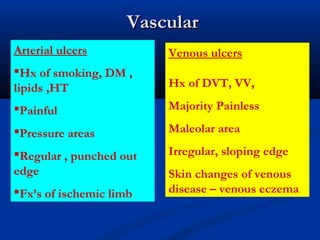
Vascular
Vascular
Arterial ulcers
Hx of smoking, DM ,
lipids ,HT
Painful
Pressure areas
Regular , punched out
edge
Fx’s of ischemic limb
Venous ulcers
Hx of DVT, VV,
Majority Painless
Maleolar area
Irregular, sloping edge
Skin changes of venous
disease – venous eczema
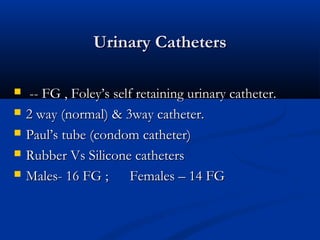
Urinary Catheters
Urinary Catheters
 -- FG , Foley’s self retaining urinary catheter.
-- FG , Foley’s self retaining urinary catheter.
 2 way (normal) & 3way catheter.
2 way (normal) & 3way catheter.
 Paul’s tube (condom catheter)
Paul’s tube (condom catheter)
 Rubber Vs Silicone catheters
Rubber Vs Silicone catheters
 Males- 16 FG ; Females – 14 FG
Males- 16 FG ; Females – 14 FG
Uses
Uses
 2 way catheters,
2 way catheters,
 To measure the urine output
To measure the urine output
 investigations – MCUG
investigations – MCUG
 to relieve an acute retention of urine
to relieve an acute retention of urine
 Hydrostatic reduction of an intussuception in children
Hydrostatic reduction of an intussuception in children
 3 way,
3 way,
 For continuous irrigation of bladder following prostatectomy
For continuous irrigation of bladder following prostatectomy
 Paul’s tube (condom catheter)
Paul’s tube (condom catheter)
 In male pts with urinary incontinence
In male pts with urinary incontinence
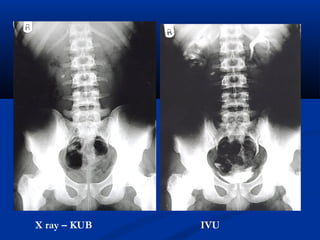
X ray – KUB IVU
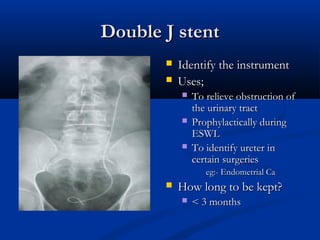
Double J stent
Double J stent
 Identify the instrument
Identify the instrument
 Uses;
Uses;
 To relieve obstruction of
To relieve obstruction of
the urinary tract
the urinary tract
 Prophylactically during
Prophylactically during
ESWL
ESWL
 To identify ureter in
To identify ureter in
certain surgeries
certain surgeries
eg:- Endometrial Ca
eg:- Endometrial Ca
 How long to be kept?
How long to be kept?
 < 3 months
< 3 months
Internal fixators
Internal fixators
Indications
Indications
 Intra-articular fractures - to stabilise anatomical reduction
Intra-articular fractures - to stabilise anatomical reduction
 Repair of blood vessels and nerves - to protect vascular and
Repair of blood vessels and nerves - to protect vascular and
nerve repair
nerve repair
 Multiple injuries
Multiple injuries
 Elderly patients - to allow early mobilisation
Elderly patients - to allow early mobilisation
 Long bone fractures - tibia, femur and humerus
Long bone fractures - tibia, femur and humerus
 Failure of conservative management
Failure of conservative management
 Pathological fractures
Pathological fractures
 Fractures that require open reduction
Fractures that require open reduction
 Unstable fractures
Unstable fractures
Complications
Complications
 Infection
Infection
 Non-union
Non-union
 Implant failure
Implant failure
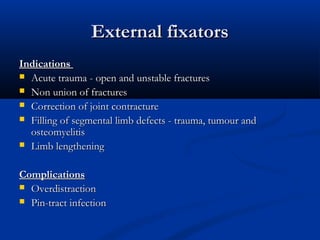
External fixators
External fixators
Indications
Indications
 Acute trauma - open and unstable fractures
Acute trauma - open and unstable fractures
 Non union of fractures
Non union of fractures
 Correction of joint contracture
Correction of joint contracture
 Filling of segmental limb defects - trauma, tumour and
Filling of segmental limb defects - trauma, tumour and
osteomyelitis
osteomyelitis
 Limb lengthening
Limb lengthening
Complications
Complications
 Overdistraction
Overdistraction
 Pin-tract infection
Pin-tract infection
fractures
fractures
 Important fractures
Important fractures
 Colle’s – below elbow POP cast upto the metacarpal heads,
Colle’s – below elbow POP cast upto the metacarpal heads,
sparing the thumb
sparing the thumb
 Scaphoid – “ glass holding” position
Scaphoid – “ glass holding” position
 Know about;
Know about;
 Xray identification of Colle’s ,supracondylar, NOF
Xray identification of Colle’s ,supracondylar, NOF
 A patient with a POP cast to his Right
A patient with a POP cast to his Right
forearm in the A&E unit.
 During the ward round how to assess the
During the ward round how to assess the
cast?
cast?
Look for 6p’s of acute limb ischemia
- Pain
- Pain
- pallor
- pallor
- perishing cold
- perishing cold
- paraesthesia
- paraesthesia
- paralysis
- paralysis
- pulseless
- pulseless
The patient has pain on passive movements of the
fingers. What is your main worry?
Compartment syndrome
What is the immediate management
Full thickness , full length splitting of the POP
elevation of the limb
immediate
immediate Fasciotomy.
Fasciotomy.
CS –can also occur in circumferential full thickness
burns
burns
- requires
- requires Escharotomy
Escharotomy
 A 42 yr old school teacher presents with a 3
A 42 yr old school teacher presents with a 3
months history of tingling and numbness of
her Right hand which is worst at night.
 What is the most likely diagnosis?
What is the most likely diagnosis?
 Write 2 possible causes
Write 2 possible causes
 What is the most important investigation you
What is the most important investigation you
would like to perform to confirm your diagnosis?
 What are the management options?
What are the management options?
 Carpal tunnel syndrome
Carpal tunnel syndrome
 DM , hypothyroidism , obesity , Acromegaly,
DM , hypothyroidism , obesity , Acromegaly,
Amyloidosis
Amyloidosis
 Nerve conduction studies
Nerve conduction studies
 Weight reduction
Weight reduction
correct the underlying causes (DM, hypothyroid)
Diuretics
Diuretics
Decompression surgery if failing above
Post op fever
Post op fever
 1
1st
st
24 hrs of Sx
24 hrs of Sx
- Metobolic response to trauma
- Reactions to blood transfusions & anesthetic drugs
 D2
D2
-
- Lung atelectasis
Lung atelectasis
 D3-D5
D3-D5
- Local sepsis – cannula site , catheter, wound
Local sepsis – cannula site , catheter, wound
infections
infections
 D5-D7
D5-D7
- DVT , leaking bowel anastomosis
DVT , leaking bowel anastomosis
 >1 week
>1 week
- Distant sepsis – hepatic,cerebral, deep seated
abscesses
abscesses
ET tubes
ET tubes
 Cuffed & uncuffed
Cuffed & uncuffed
 Uncuffed – in children
Uncuffed – in children
 Size (internal diameter mm) = Age
Size (internal diameter mm) = Age + 4
+ 4
4
4
 Male – (8-9.5) ; female – (7-8)
Male – (8-9.5) ; female – (7-8)
 In place for <7 days – risk of tracheal stenosis
In place for <7 days – risk of tracheal stenosis
 Prevented by doing a tracheostomy
Prevented by doing a tracheostomy
Uses of ET tubes
Uses of ET tubes
 Maintain airway
Maintain airway
 For ventilation (IPPV)
For ventilation (IPPV)
 Prevent aspiration (cuffed)
Prevent aspiration (cuffed)
 Give drugs – adrenaline
Give drugs – adrenaline
- atropine
- atropine
- naloxone
- naloxone
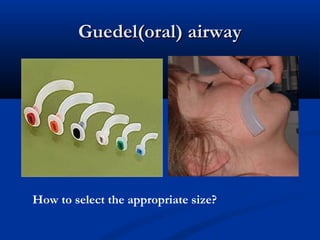
Guedel(oral) airway
Guedel(oral) airway
How to select the appropriate size?
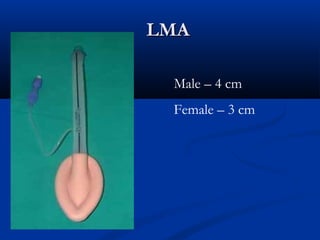
LMA
LMA
Male – 4 cm
Female – 3 cm
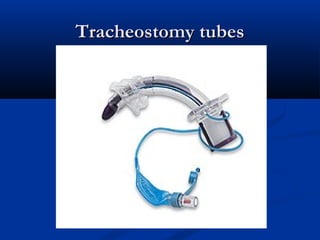
Tracheostomy tubes
Tracheostomy tubes
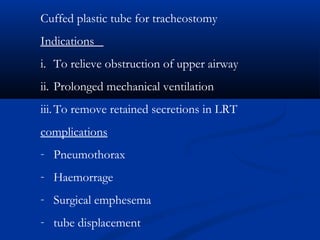
Cuffed plastic tube for tracheostomy
Indications
i. To relieve obstruction of upper airway
ii. Prolonged mechanical ventilation
iii.To remove retained secretions in LRT
complications
- Pneumothorax
- Haemorrage
- Surgical emphesema
- tube displacement
CPR
CPR
 Changes in 2005 ALS guidelines
Changes in 2005 ALS guidelines
 CPR rate – 30:2 ( not 15: 2)
CPR rate – 30:2 ( not 15: 2)
 All 3 DC shocks – 360J each
All 3 DC shocks – 360J each
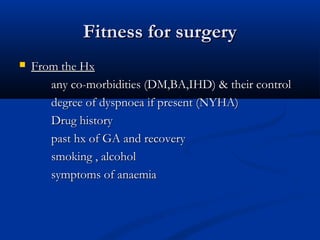
Fitness for surgery
Fitness for surgery
 From the Hx
From the Hx
any co-morbidities (DM,BA,IHD) & their control
degree of dyspnoea if present (NYHA)
Drug history
Drug history
past hx of GA and recovery
smoking , alcohol
smoking , alcohol
symptoms of anaemia
symptoms of anaemia
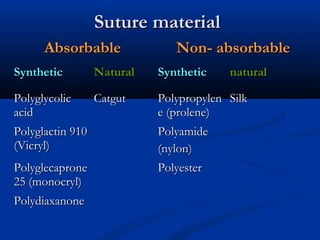
Suture material
Suture material
Absorbable
Absorbable Non- absorbable
Non- absorbable
Synthetic
Synthetic Natural
Natural Synthetic
Synthetic natural
natural
Polyglycolic
Polyglycolic
acid
acid
Catgut
Catgut Polypropylen
Polypropylen
e (prolene)
e (prolene)
Silk
Silk
Polyglactin 910
Polyglactin 910
(Vicryl)
(Vicryl)
Polyamide
Polyamide
(nylon)
(nylon)
Polyglecaprone
Polyglecaprone
25 (monocryl)
25 (monocryl)
Polyester
Polyester
Polydiaxanone
Polydiaxanone
Thank you
Thank you

✓ OSCE Surgical.pdf

  • 1.
    End of 4 Endof 4th th year OSCE year OSCE - Surgery - - Surgery - 20 – 03- 2007
  • 2.
    A 50 yrold male presented with a A 50 yr old male presented with a 5 days history of malaise, fever 5 days history of malaise, fever with chills and rigors and this with chills and rigors and this tender lump over his left shin. tender lump over his left shin. (i) (i) What is the likely diagnosis? What is the likely diagnosis? (ii) (ii) What important investigation would What important investigation would you like to perform in this patient? you like to perform in this patient? (iii) (iii) List the management principles. List the management principles.
  • 3.
     Answer Answer (i) (i) Anabscess An abscess (ii) (ii) Random/fasting blood sugar Random/fasting blood sugar (iii) (iii) Mx Mx - adequate analgesia & antipyretics - adequate analgesia & antipyretics - broad spectrum IV antibiotics - broad spectrum IV antibiotics - Adequate incision & adequate drainage under - Adequate incision & adequate drainage under GA GA - break into all loculi - break into all loculi - remove pyogenic membrane - remove pyogenic membrane - send pus for culture + ABST - send pus for culture + ABST - clean the cavity with - clean the cavity with N.saline/ Povidone Iodine N.saline/ Povidone Iodine (Betadine) (Betadine) - Leave open , partially insert a gauze wick - Leave open , partially insert a gauze wick
  • 4.
    This 35 yrold lady presented This 35 yr old lady presented with painful swelling of her with painful swelling of her leg for 2 days. leg for 2 days. (i) (i) Name 2 likely diagnoses Name 2 likely diagnoses (ii) (ii) Write 3 things you would Write 3 things you would ask in her history to ask in her history to differentiate between them. differentiate between them. (iii) (iii) Name one investigation Name one investigation which enables you to come which enables you to come to a definitive diagnosis? to a definitive diagnosis?
  • 5.
    (i) Cellulitis ,DVT (i) Cellulitis , DVT (ii) (ii) Any preceding injury Any preceding injury history of DM history of DM prolonged immobilization prolonged immobilization Use of OCP Use of OCP Varicose veins Varicose veins (iii) (iii) Duplex scan of LL Duplex scan of LL
  • 6.
    Mx of Cellulitis Mxof Cellulitis  REMAIN REMAIN R = Rest R = Rest E = elevation of the limb E = elevation of the limb M = mobilization M = mobilization A = Antibiotics, antipyretics, analgesia A = Antibiotics, antipyretics, analgesia I = Immunization against tetanus I = Immunization against tetanus N = Nutrition N = Nutrition
  • 7.
    Tubes Tubes An intercostal tubeconnected to an underwater An intercostal tube connected to an underwater seal drainage bottle given. seal drainage bottle given. (i) (i) Write 2 indications of use. Write 2 indications of use. (ii) (ii) Name 2 complications of this. Name 2 complications of this. (iii) (iii) After inserting this to a patient, as the HO After inserting this to a patient, as the HO name 3 things you would assess in this patient. name 3 things you would assess in this patient.
  • 8.
    (i) (i) Indications--- 1.therapeutic – Indications--- 1. therapeutic – pneumo/haemothorax pneumo/haemothorax 2. prophylactic – 2. prophylactic – post op in cardio-thoracic Sx post op in cardio-thoracic Sx (ii) (ii) Complications--- 1. during insertion Complications--- 1. during insertion 2. maintenance 2. maintenance 3. during removal 3. during removal
  • 9.
    (iii) (iii) Pt Assessmentin the ward round. Pt Assessment in the ward round. S = Subjective S = Subjective (ask from the pt about his complains) (ask from the pt about his complains) O= objective O= objective (examine chest expansion, auscultation, (examine chest expansion, auscultation, resp rate, whether tube is functioning) resp rate, whether tube is functioning) A = Assessment A = Assessment (overall condition of the pt) (overall condition of the pt) P= plan of management P= plan of management
  • 10.
     Cannulas Cannulas  14G-Orange – 14G- Orange – in emergencies in emergencies  16G- grey 16G- grey  17G- white 17G- white  18G- Green 18G- Green  20G- Pink 20G- Pink  22G- Blue 22G- Blue  24G- Yellow 24G- Yellow  26G – Purple - 26G – Purple - paediatric paediatric Blood transfusion Crystalloid infusion
  • 11.
     Needles Needles  14G-white - 14G- white - abscess drainage abscess drainage  18G- Pink 18G- Pink  20G- Yellow 20G- Yellow  21G- green – 21G- green – Blood culture Blood culture  22G- Black 22G- Black  23G- blue - 23G- blue - IM injections/FNAC IM injections/FNAC  24G –Red - 24G –Red - SC injections SC injections  25G- orange – 25G- orange – VV sclerotherapy VV sclerotherapy  26G- Brown – 26G- Brown – Insulin SC/ Mantoux/ BCG (ID inj) Insulin SC/ Mantoux/ BCG (ID inj)  27G- Ash 27G- Ash  29G- Dark orange 29G- Dark orange
  • 12.
    Neuro surgery Neuro surgery What’s the lesion? What’s the lesion?  Which condition Which condition produces this produces this characteristic lesion? characteristic lesion?  What’s the underlying What’s the underlying cause for this condition? cause for this condition?  How do you manage this How do you manage this patient? patient?
  • 13.
     A hyperdense, biconvex shaped area in the right A hyper dense, biconvex shaped area in the right tempero-parietal region. tempero-parietal region.  Right sided Right sided, Acute , Acute Extra dural Haemorrhage Extra dural Haemorrhage  Damage to the middle meningeal artery. Parietal Damage to the middle meningeal artery. Parietal bone fracture maybe the cause for this injury but bone fracture maybe the cause for this injury but not always. not always.  Resuscitation, HIO, craniotomy Resuscitation, HIO, craniotomy
  • 14.
     What isthe lesion? What is the lesion?  What is the cause for this What is the cause for this lesion? lesion?  In which age group do In which age group do these occur commonly these occur commonly and why? and why?
  • 15.
     Crescent shape,small hyper dense area in left Crescent shape, small hyper dense area in left tempero- parietal region. tempero- parietal region.  Left sided Left sided Acute Acute SDH SDH  In elderly because there subdural space is In elderly because there subdural space is enlarged in them due to brain atrophy. enlarged in them due to brain atrophy.
  • 16.
     What’s thelesion? What’s the lesion?  What could be the What could be the underlying brain underlying brain condition? condition?  What are the causes? What are the causes?
  • 17.
     Hypodense crescenticarea in left temporal area. Hypodense crescentic area in left temporal area.  Left sided Left sided Chronic Chronic SDH SDH  - Alcoholics - Alcoholics - child abuse - child abuse - elderly following recurrent falls - elderly following recurrent falls
  • 18.
    GCS GCS 1. 1. Eye opening Eyeopening spontaneous spontaneous =4 =4 to speech to speech = 3 = 3 to pain to pain =2 =2 none none =1 =1 2. 2. Best verbal response Best verbal response oriented oriented = 5 = 5 confused confused = 4 = 4 inappropriate inappropriate = 3 = 3 incomprehensible incomprehensible = 2 = 2 None None = 1 = 1 3. 3. Best motor response Best motor response obeying obeying = 6 = 6 localizing localizing =5 =5 withdrawing withdrawing =4 =4 flexing flexing =3 =3 extending extending =2 =2 none none =1 =1
  • 19.
    Criteria for admissionafter head injury o Altered level of consciousness o Skull fracture o Neurological symptoms or signs o Difficult assessment - drugs, alcohol o No responsible carer
  • 20.
    Indications for CTscan  GCS less than 13 at any point since the injury  Suspected open or depressed skull fracture  Any sign of basal skull fracture  Post-traumatic seizure  Focal neurological deficit If GCS ≤ 8 , Req intubation & ventilation
  • 21.
    Audiograms Audiograms Sensorineural hearing loss Causes Acousticneuroma Meningitis Ototoxic drugs Noise induced
  • 22.
    Conductive hearing loss Waximpaction Otitis media Otosclerosis
  • 23.
     What’s theabnormality What’s the abnormality that you see in this CXR? that you see in this CXR?  What are the causes? What are the causes?  What could be the What could be the patient presentation? patient presentation?
  • 24.
     There’s airunder the diaphragm There’s air under the diaphragm  Perforation of a hollow viscus Perforation of a hollow viscus - bowel perforation - bowel perforation - perforated peptic ulcer - perforated peptic ulcer - ruptured appendix - ruptured appendix  Acute severe abdominal pain, guarding and Acute severe abdominal pain, guarding and board like rigidity board like rigidity
  • 25.
  • 26.
     Small bowel Centralposition Many loops Complete rings (valvulae conniventes)  Large bowel Peripheral position Few loops Incomplete rings (haustrations)
  • 27.
    NG tubes NG tubes Measurementof the length & insertion Measurement of the length & insertion Uses Uses T Therapeutic- herapeutic- - for NG feeding - for NG feeding - decompression of stomach contents in - decompression of stomach contents in emergency surgery emergency surgery - in gastric lavarge - in gastric lavarge - as a catheter in BPH pts - as a catheter in BPH pts Diagnostic Diagnostic - suspected oesophageal atresia - suspected oesophageal atresia
  • 28.
  • 29.
     Colostomy Colostomy loop& end loop & end temporary & permanent temporary & permanent  Indications Indications  Diversion – to protect a distal bowel anastomosis Diversion – to protect a distal bowel anastomosis  Decompression – to relieve a distal obstruction Decompression – to relieve a distal obstruction  In Rectal Ca following APR In Rectal Ca following APR  Complications Complications early early – necrosis – necrosis late late - stenosis - stenosis - obstruction - obstruction - parastomal hernia - parastomal hernia - retraction - retraction - prolapse - prolapse
  • 30.
    Sclerosants Sclerosants  Haemorrhoids Haemorrhoids  Inject5 % phenol in olive/almond oil using a Inject 5 % phenol in olive/almond oil using a Gabrielle syringe Gabrielle syringe  Varicose veins Varicose veins  1 % - STD ( sodium tetra decyl sulphate) inject IV 1 % - STD ( sodium tetra decyl sulphate) inject IV
  • 31.
    Vascular Vascular Arterial ulcers Hx ofsmoking, DM , lipids ,HT Painful Pressure areas Regular , punched out edge Fx’s of ischemic limb Venous ulcers Hx of DVT, VV, Majority Painless Maleolar area Irregular, sloping edge Skin changes of venous disease – venous eczema
  • 32.
    Urinary Catheters Urinary Catheters -- FG , Foley’s self retaining urinary catheter. -- FG , Foley’s self retaining urinary catheter.  2 way (normal) & 3way catheter. 2 way (normal) & 3way catheter.  Paul’s tube (condom catheter) Paul’s tube (condom catheter)  Rubber Vs Silicone catheters Rubber Vs Silicone catheters  Males- 16 FG ; Females – 14 FG Males- 16 FG ; Females – 14 FG
  • 33.
    Uses Uses  2 waycatheters, 2 way catheters,  To measure the urine output To measure the urine output  investigations – MCUG investigations – MCUG  to relieve an acute retention of urine to relieve an acute retention of urine  Hydrostatic reduction of an intussuception in children Hydrostatic reduction of an intussuception in children  3 way, 3 way,  For continuous irrigation of bladder following prostatectomy For continuous irrigation of bladder following prostatectomy  Paul’s tube (condom catheter) Paul’s tube (condom catheter)  In male pts with urinary incontinence In male pts with urinary incontinence
  • 34.
    X ray –KUB IVU
  • 35.
    Double J stent DoubleJ stent  Identify the instrument Identify the instrument  Uses; Uses;  To relieve obstruction of To relieve obstruction of the urinary tract the urinary tract  Prophylactically during Prophylactically during ESWL ESWL  To identify ureter in To identify ureter in certain surgeries certain surgeries eg:- Endometrial Ca eg:- Endometrial Ca  How long to be kept? How long to be kept?  < 3 months < 3 months
  • 36.
    Internal fixators Internal fixators Indications Indications Intra-articular fractures - to stabilise anatomical reduction Intra-articular fractures - to stabilise anatomical reduction  Repair of blood vessels and nerves - to protect vascular and Repair of blood vessels and nerves - to protect vascular and nerve repair nerve repair  Multiple injuries Multiple injuries  Elderly patients - to allow early mobilisation Elderly patients - to allow early mobilisation  Long bone fractures - tibia, femur and humerus Long bone fractures - tibia, femur and humerus  Failure of conservative management Failure of conservative management  Pathological fractures Pathological fractures  Fractures that require open reduction Fractures that require open reduction  Unstable fractures Unstable fractures Complications Complications  Infection Infection  Non-union Non-union  Implant failure Implant failure
  • 37.
    External fixators External fixators Indications Indications Acute trauma - open and unstable fractures Acute trauma - open and unstable fractures  Non union of fractures Non union of fractures  Correction of joint contracture Correction of joint contracture  Filling of segmental limb defects - trauma, tumour and Filling of segmental limb defects - trauma, tumour and osteomyelitis osteomyelitis  Limb lengthening Limb lengthening Complications Complications  Overdistraction Overdistraction  Pin-tract infection Pin-tract infection
  • 38.
    fractures fractures  Important fractures Importantfractures  Colle’s – below elbow POP cast upto the metacarpal heads, Colle’s – below elbow POP cast upto the metacarpal heads, sparing the thumb sparing the thumb  Scaphoid – “ glass holding” position Scaphoid – “ glass holding” position  Know about; Know about;  Xray identification of Colle’s ,supracondylar, NOF Xray identification of Colle’s ,supracondylar, NOF
  • 39.
     A patientwith a POP cast to his Right A patient with a POP cast to his Right forearm in the A&E unit. forearm in the A&E unit.  During the ward round how to assess the During the ward round how to assess the cast? cast? Look for 6p’s of acute limb ischemia Look for 6p’s of acute limb ischemia - Pain - Pain - pallor - pallor - perishing cold - perishing cold - paraesthesia - paraesthesia - paralysis - paralysis - pulseless - pulseless
  • 40.
    The patient haspain on passive movements of the The patient has pain on passive movements of the fingers. What is your main worry? fingers. What is your main worry? Compartment syndrome Compartment syndrome What is the immediate management What is the immediate management Full thickness , full length splitting of the POP Full thickness , full length splitting of the POP elevation of the limb elevation of the limb immediate immediate Fasciotomy. Fasciotomy. CS –can also occur in circumferential full thickness CS –can also occur in circumferential full thickness burns burns - requires - requires Escharotomy Escharotomy
  • 41.
     A 42yr old school teacher presents with a 3 A 42 yr old school teacher presents with a 3 months history of tingling and numbness of months history of tingling and numbness of her Right hand which is worst at night. her Right hand which is worst at night.  What is the most likely diagnosis? What is the most likely diagnosis?  Write 2 possible causes Write 2 possible causes  What is the most important investigation you What is the most important investigation you would like to perform to confirm your diagnosis? would like to perform to confirm your diagnosis?  What are the management options? What are the management options?
  • 42.
     Carpal tunnelsyndrome Carpal tunnel syndrome  DM , hypothyroidism , obesity , Acromegaly, DM , hypothyroidism , obesity , Acromegaly, Amyloidosis Amyloidosis  Nerve conduction studies Nerve conduction studies  Weight reduction Weight reduction correct the underlying causes (DM, hypothyroid) correct the underlying causes (DM, hypothyroid) Diuretics Diuretics Decompression surgery if failing above Decompression surgery if failing above
  • 43.
    Post op fever Postop fever  1 1st st 24 hrs of Sx 24 hrs of Sx - Metobolic response to trauma - Metobolic response to trauma - Reactions to blood transfusions & anesthetic drugs - Reactions to blood transfusions & anesthetic drugs  D2 D2 - - Lung atelectasis Lung atelectasis  D3-D5 D3-D5 - Local sepsis – cannula site , catheter, wound Local sepsis – cannula site , catheter, wound infections infections  D5-D7 D5-D7 - DVT , leaking bowel anastomosis DVT , leaking bowel anastomosis  >1 week >1 week - Distant sepsis – hepatic,cerebral, deep seated - Distant sepsis – hepatic,cerebral, deep seated abscesses abscesses
  • 44.
    ET tubes ET tubes Cuffed & uncuffed Cuffed & uncuffed  Uncuffed – in children Uncuffed – in children  Size (internal diameter mm) = Age Size (internal diameter mm) = Age + 4 + 4 4 4  Male – (8-9.5) ; female – (7-8) Male – (8-9.5) ; female – (7-8)  In place for <7 days – risk of tracheal stenosis In place for <7 days – risk of tracheal stenosis  Prevented by doing a tracheostomy Prevented by doing a tracheostomy
  • 45.
    Uses of ETtubes Uses of ET tubes  Maintain airway Maintain airway  For ventilation (IPPV) For ventilation (IPPV)  Prevent aspiration (cuffed) Prevent aspiration (cuffed)  Give drugs – adrenaline Give drugs – adrenaline - atropine - atropine - naloxone - naloxone
  • 46.
    Guedel(oral) airway Guedel(oral) airway Howto select the appropriate size?
  • 47.
    LMA LMA Male – 4cm Female – 3 cm
  • 48.
  • 49.
    Cuffed plastic tubefor tracheostomy Indications i. To relieve obstruction of upper airway ii. Prolonged mechanical ventilation iii.To remove retained secretions in LRT complications - Pneumothorax - Haemorrage - Surgical emphesema - tube displacement
  • 50.
    CPR CPR  Changes in2005 ALS guidelines Changes in 2005 ALS guidelines  CPR rate – 30:2 ( not 15: 2) CPR rate – 30:2 ( not 15: 2)  All 3 DC shocks – 360J each All 3 DC shocks – 360J each
  • 51.
    Fitness for surgery Fitnessfor surgery  From the Hx From the Hx any co-morbidities (DM,BA,IHD) & their control any co-morbidities (DM,BA,IHD) & their control degree of dyspnoea if present (NYHA) degree of dyspnoea if present (NYHA) Drug history Drug history past hx of GA and recovery past hx of GA and recovery smoking , alcohol smoking , alcohol symptoms of anaemia symptoms of anaemia
  • 52.
    Suture material Suture material Absorbable AbsorbableNon- absorbable Non- absorbable Synthetic Synthetic Natural Natural Synthetic Synthetic natural natural Polyglycolic Polyglycolic acid acid Catgut Catgut Polypropylen Polypropylen e (prolene) e (prolene) Silk Silk Polyglactin 910 Polyglactin 910 (Vicryl) (Vicryl) Polyamide Polyamide (nylon) (nylon) Polyglecaprone Polyglecaprone 25 (monocryl) 25 (monocryl) Polyester Polyester Polydiaxanone Polydiaxanone
  • 53.