OSCE Picture test in
Obstetrics and Gynaecology
Dr. Okechukwu A. Ugwu
. About this instrument
a) It can be used for hindwater rupture of membrane F
b) Its use is associated with cord prolapse T
c) Its use is associated with foetal injury T
d) It can cause uterine hyperstimulation F
e) Its use is contraindicated in retroviral positive patients F
Prevention of ureteric injury
1. Generous surgical exposure T
2. Meticulous surgical technique T
3. IdentifIcation of Risk factors T
4. Ureteric stenting T
5. Pre operative IVU not necessary F
About this instrument
a) It is a high cavity forceps F
b) It is a non-rotational forceps and so can be used in the correction of
asynclitism F
c) It has a sliding lock T
d) The cervix should be at least 8cm dilated for its use F
e) It causes more maternal injury compared to the vacuum extractor T
Concerning this
a) It is a permanent measure of management F
b) Pregnancy is a contraindication F
c) It should be changed every 6 months F
d) It can be complicated by vaginal infection T
e) If it fails, surgery is indicated T
About the condition depicted below
a) It is common in postmenopausal women F
b) Cystic degeneration usually precedes hyaline degeneration F
c) The intraligamentary form can cause polycythaemia T
d) GnRH antagonists are useful in its management T
e) Iron deficiency anaemia secondary to chronic blood loss is an indication
for surgical management. **T
Features of delayed ureteric injury
Prolonged ileus T
Watery vaginal discharge T
Prolonged high output from drains T
Fever/sepsis. T
Persistent flank/ abdominal pain T
Flank mass T
Elevated creatinine or BUN T
About the
Instrument
1. They are indicated in maternal
exhaustion. -T
2. Bladder must be empty but the
catheter bulb need not deflated-F
3. Associated with more maternal
worries about the baby compared
to Vacuum. -F
4. Associated with lower APGAR scores
compared to vacuum.-F
5. Ideal traction of 30-45 lb.-T
6. Cervarix offers protection-F
7. May contain oncogenic subtypes of
HPV-T
8. Contraception is mandatory while
using podophyllin-T
9. Neonatal laryngeal papilomatosis is a
recognized potential problem.-T
10. Histology is necessary for diagnosis-
F
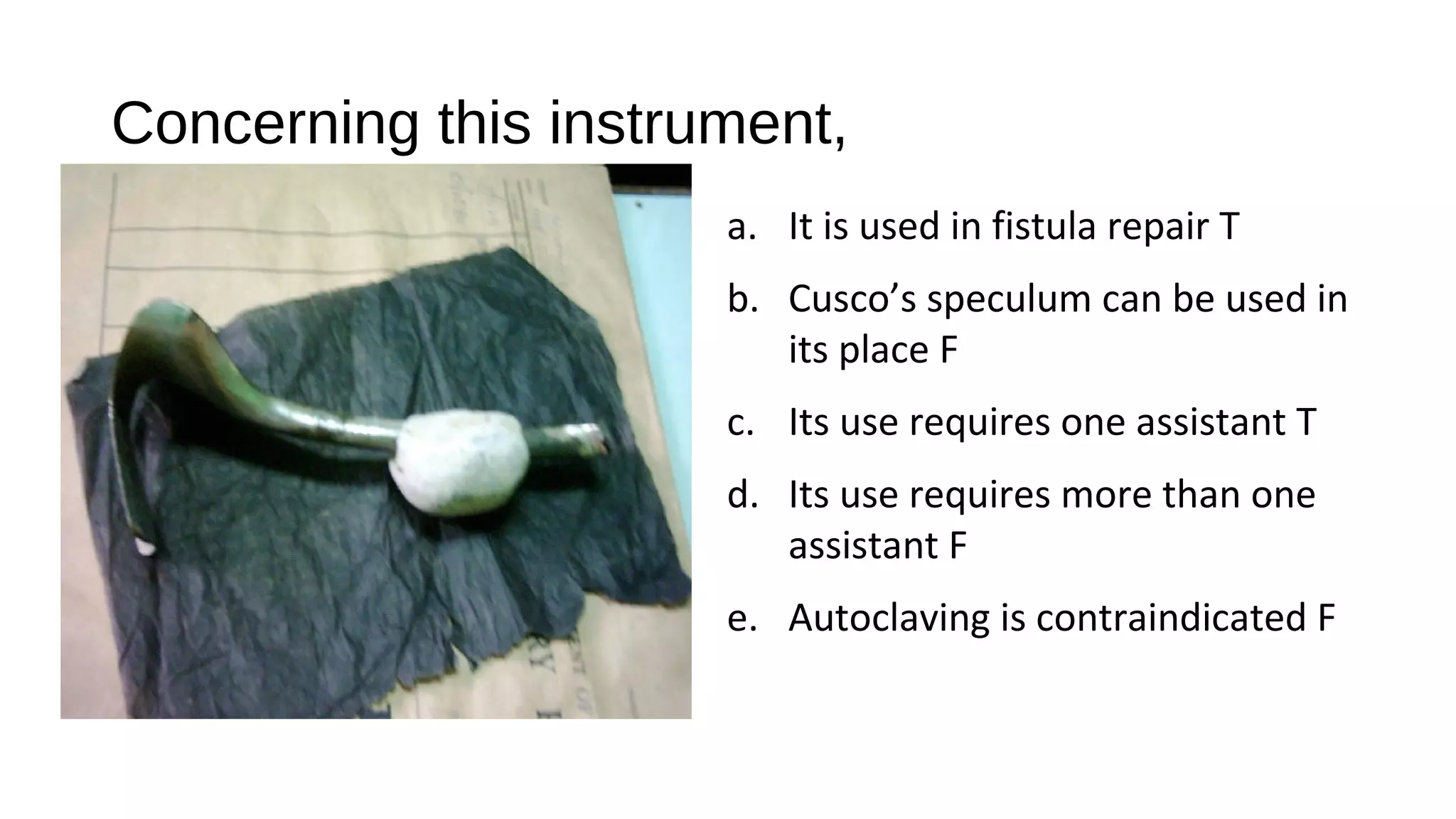
Concerning this instrument,
a. It is used in fistula repair T
b. Cusco’s speculum can be used in
its place F
c. Its use requires one assistant T
d. Its use requires more than one
assistant F
e. Autoclaving is contraindicated F
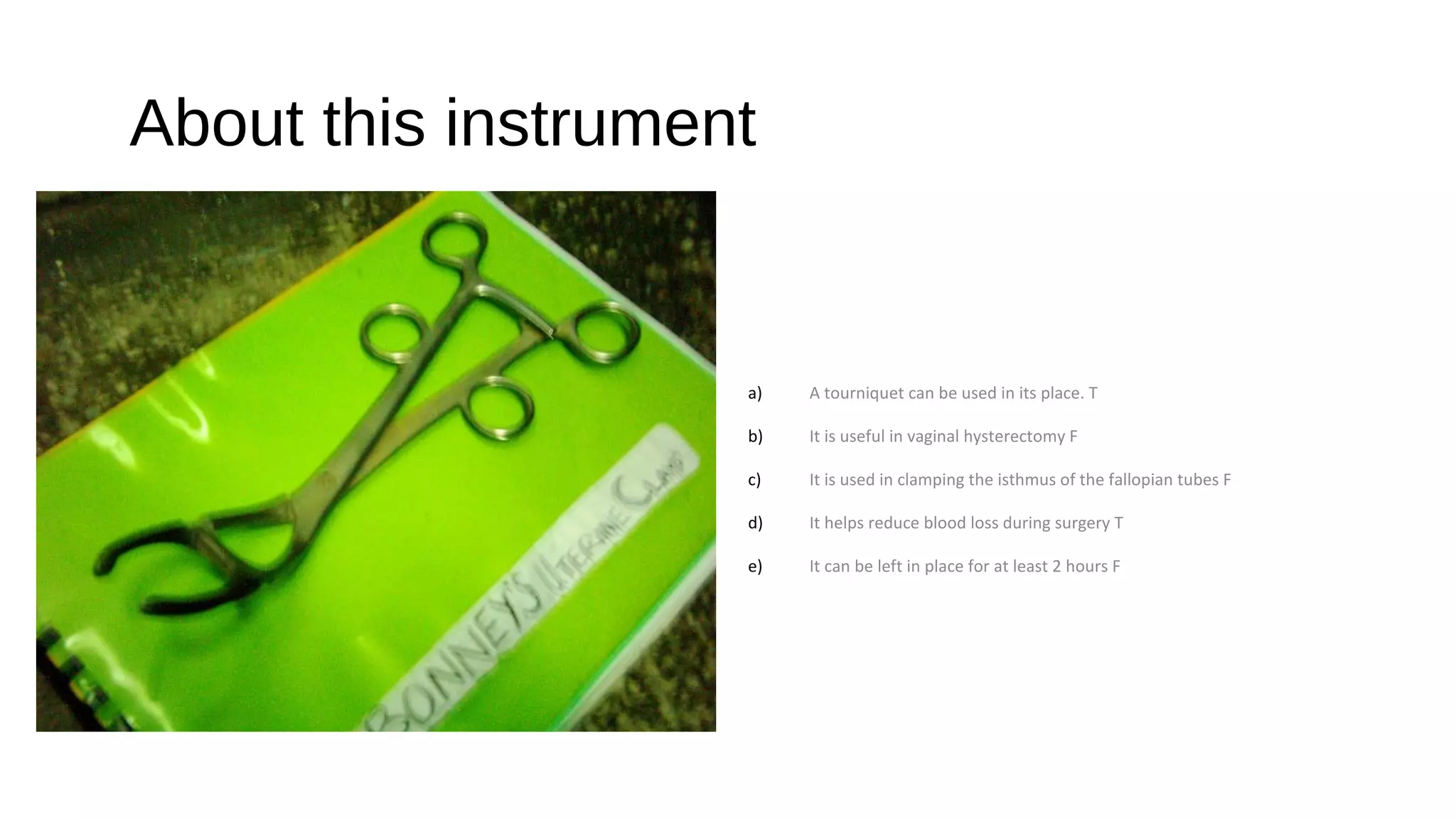
About this instrument
a) A tourniquet can be used in its place. T
b) It is useful in vaginal hysterectomy F
c) It is used in clamping the isthmus of the fallopian tubes F
d) It helps reduce blood loss during surgery T
e) It can be left in place for at least 2 hours F
Concerning the use of this instrument:
a. It is used to reduce the bisacromial diameter and allow for vaginal
delivery F
b. Cervix need not be fully dilated in experienced hands T
c. It is employed in the commonest type of destructive surgery. T
d. Continuous bladder drainage is essential after its use T
e. At least 2/5th of the fetal head must have gone into the maternal pelvis
if its use is indicated F
Concerning the picture shown and
intrapartum monitoring
a. The duration between two vertical lines on a
partograph is half hour. T
b. In the primigravida, the cervix dilates at a rate
of at least 1 cm/hr in the active phase T
c. The alert line is parallel and 4hours to the right
of the action line F
d. Vaginal examination is done four hourly. T
e. Plastic Pinnard stethoscope is better than the
metallic one in monitoring fetal heart rate. T
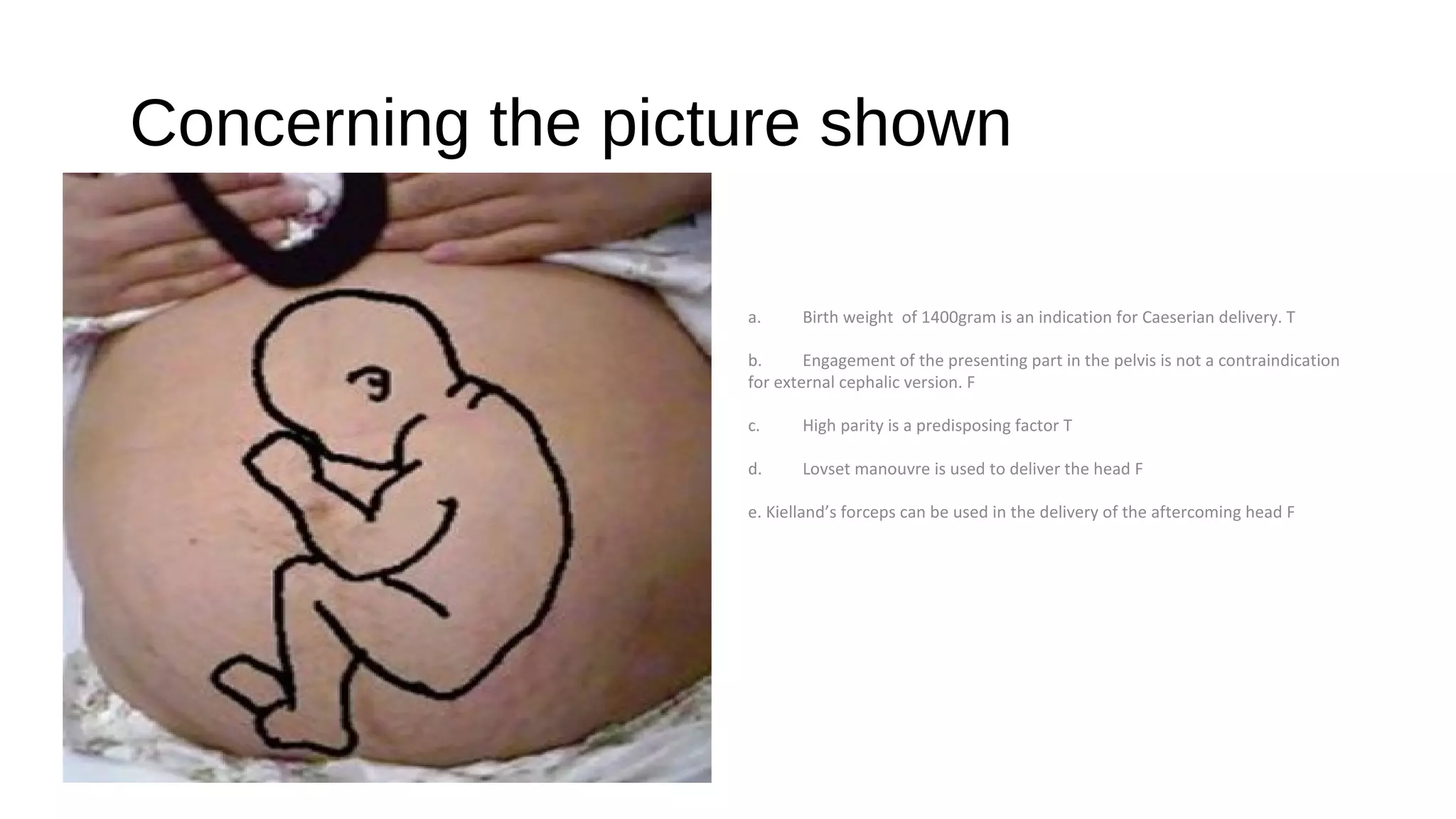
Concerning the picture shown
a. Birth weight of 1400gram is an indication for Caeserian delivery. T
b. Engagement of the presenting part in the pelvis is not a contraindication
for external cephalic version. F
c. High parity is a predisposing factor T
d. Lovset manouvre is used to deliver the head F
e. Kielland’s forceps can be used in the delivery of the aftercoming head F
Concerning uterine incisions during
Caesarean delivery
a. A is associated with less likelihood of adhesion formation to bowel or omentum T
b. A is more commonly used than B T
c. B allows for easy entry into the uterus when there is fibroid in the lower segment T
d. B is associated with less likelihood of subsequent uterine rupture during pregnancy F
e. A is indicated in the presence of carcinoma of the cervix F
A
B
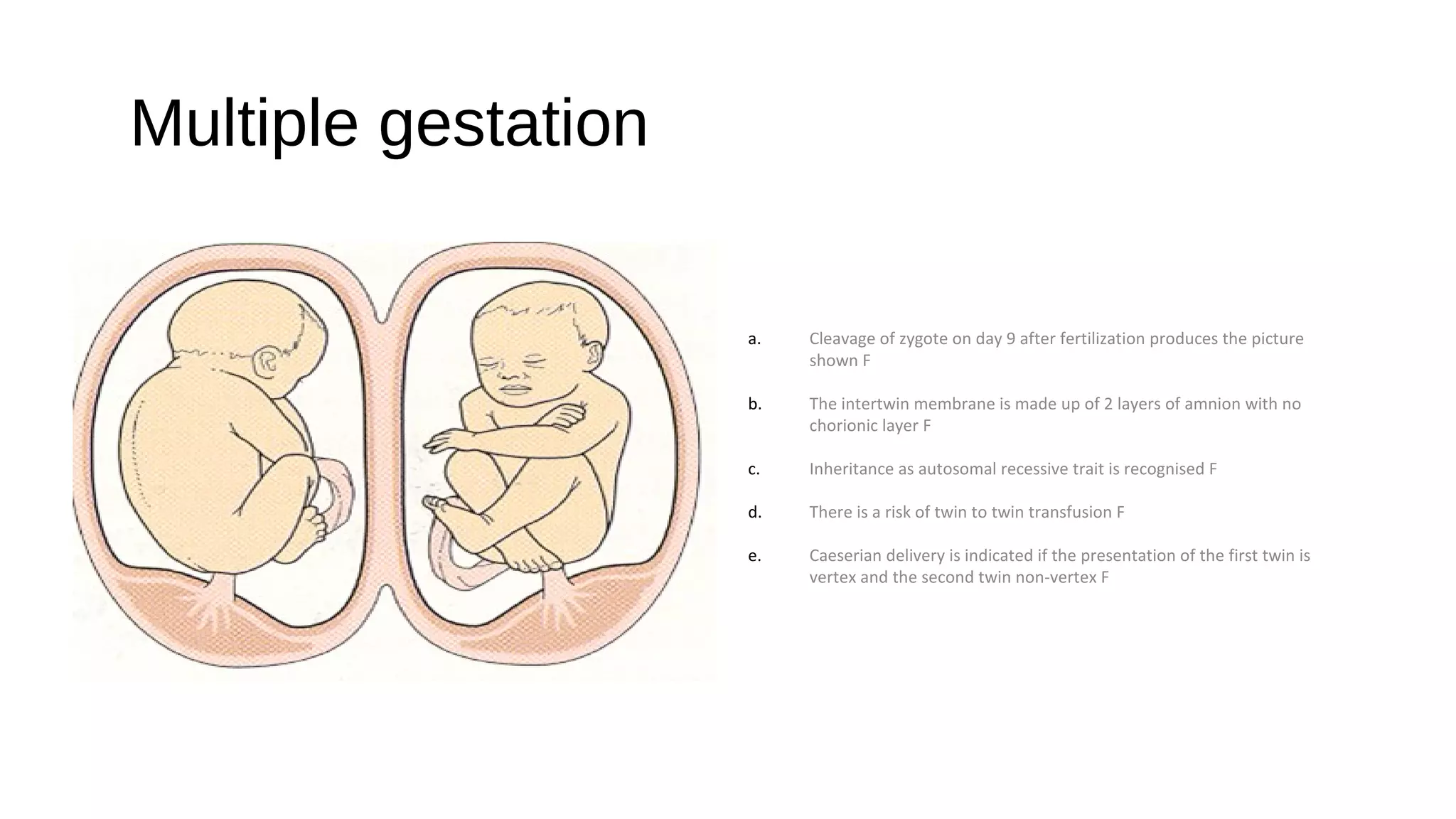
Multiple gestation
a. Cleavage of zygote on day 9 after fertilization produces the picture
shown F
b. The intertwin membrane is made up of 2 layers of amnion with no
chorionic layer F
c. Inheritance as autosomal recessive trait is recognised F
d. There is a risk of twin to twin transfusion F
e. Caeserian delivery is indicated if the presentation of the first twin is
vertex and the second twin non-vertex F
Concerning this picture
a. This is a complication of external cephalic
version T
b. Coagulation failure is a complication T
c. Foetal parts will be easily outlined on
palpation.F
d. The uterus will have a hard wooden
consistency on palpation T
e. Caeserian section should be performed if
the fetus is dead on presentation. F
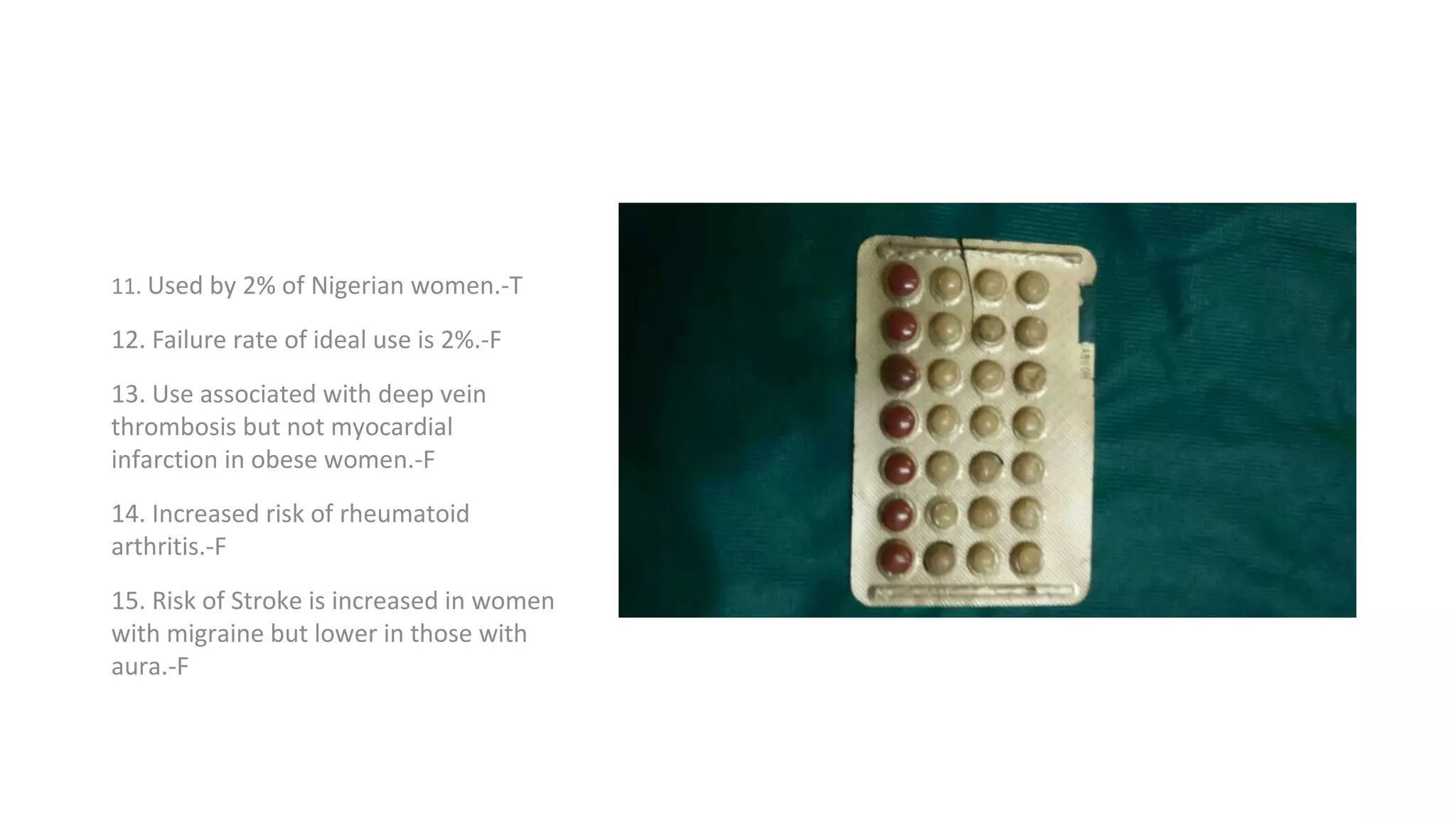
11. Used by 2% of Nigerian women.-T
12. Failure rate of ideal use is 2%.-F
13. Use associated with deep vein
thrombosis but not myocardial
infarction in obese women.-F
14. Increased risk of rheumatoid
arthritis.-F
15. Risk of Stroke is increased in women
with migraine but lower in those with
aura.-F
16. Outer ring needs to be held prior to
penetration.-T
17. Can be noisy and cumbersome-T
18. More likely to rupture than male
condom.-F
19. Contains spermicide-F
20. Failure rate of 5% with ideal use.-T
21. Sensitivity of 96%-F
22. Liquid based type make diagnosis of
HPV and Chlamydia possible-T
23. Abnormality found in 10% of all
samples-T
24. False negative result may be up to
70%-F
25. Nationwide programme has
reduced incidence of Ca. Cervix by 95%-
F
26. This is a Karman syringe- F
27. Volume of syringe is 50cc- F 60CC
28. 5-10mm cannula for 9-12weeks-F
29. Provides sunction pressure of about
640mmHg-T
30. Can be used for menstrual
regulation.-T
31. Size and rate of growth influenced by
sexual stimulation.- T
32. N. gonorrhoeae and Chlamydia
Trachomatis are most often isolated in
the abscesses-F -E.coli
33. Word Catheter has a role in
management.-T
34. Silver Nitrate ablation may be used
in treatment. -T
35. Biopsy is mandatory in patients
under 40years-F
36. Postdatism and malpresentation
may be complication-T
37. Oligohydramnios often associated-F
38. Defect results from malformation
around day 35 of embryonic life.-F 25
39. Late neonatal death is common.-F
EARLY
40. Folic acid supplementation may
reduce incidence.-T
41. Monoclonal in origin-T
42. Red degeneration is the commonest
form of degeneration-F
43. Only submucous type has been
shown to be linked with infertility-F
44. Uterine artery embolization not
recommended for women who wish to
preserve fertility. -T
45. Recurrence after myomectomy is
about 20%.-F 10-15
46. About 80% of patients are above
55years –F 65
47. Commonest site is labia minor-F
48. Two-thirds occur in women with
Lichen sclerosis-T
49. 4-8% of squamous cell type linked
with Paget disease.-F <1%
50. Stage 3 has 5-year survival rate of
about 75%.-T
51. Bilateral in about 25%-F
52. Stroma ovarii if parathyroid tissue is
demonstrated.-F
53. Immature variant accounts for 20%
of all ovarian malignancy in females less
than 20 years-T
54. Immature variant are commonly
bilateral-F
55. Squamous cell carcinoma is the most
common histology of malignant
transformation in mature variant.-T
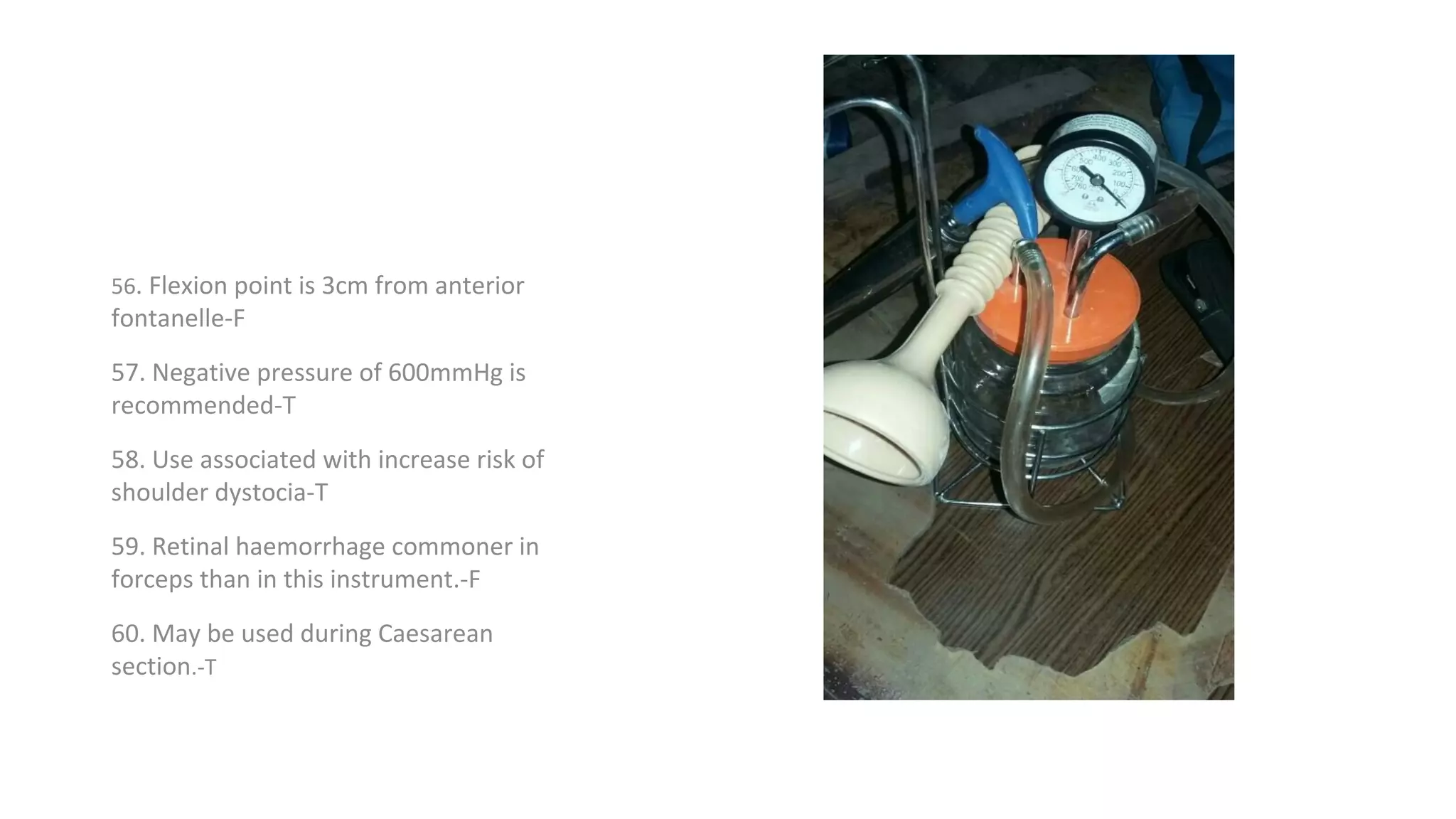
56. Flexion point is 3cm from anterior
fontanelle-F
57. Negative pressure of 600mmHg is
recommended-T
58. Use associated with increase risk of
shoulder dystocia-T
59. Retinal haemorrhage commoner in
forceps than in this instrument.-F
60. May be used during Caesarean
section.-T

Osce picture test in obstetrics and gynaecology

  • 1.
    OSCE Picture testin Obstetrics and Gynaecology Dr. Okechukwu A. Ugwu
  • 2.
    . About thisinstrument a) It can be used for hindwater rupture of membrane F b) Its use is associated with cord prolapse T c) Its use is associated with foetal injury T d) It can cause uterine hyperstimulation F e) Its use is contraindicated in retroviral positive patients F
  • 3.
    Prevention of uretericinjury 1. Generous surgical exposure T 2. Meticulous surgical technique T 3. IdentifIcation of Risk factors T 4. Ureteric stenting T 5. Pre operative IVU not necessary F
  • 4.
    About this instrument a)It is a high cavity forceps F b) It is a non-rotational forceps and so can be used in the correction of asynclitism F c) It has a sliding lock T d) The cervix should be at least 8cm dilated for its use F e) It causes more maternal injury compared to the vacuum extractor T
  • 5.
    Concerning this a) Itis a permanent measure of management F b) Pregnancy is a contraindication F c) It should be changed every 6 months F d) It can be complicated by vaginal infection T e) If it fails, surgery is indicated T
  • 6.
    About the conditiondepicted below a) It is common in postmenopausal women F b) Cystic degeneration usually precedes hyaline degeneration F c) The intraligamentary form can cause polycythaemia T d) GnRH antagonists are useful in its management T e) Iron deficiency anaemia secondary to chronic blood loss is an indication for surgical management. **T
  • 7.
    Features of delayedureteric injury Prolonged ileus T Watery vaginal discharge T Prolonged high output from drains T Fever/sepsis. T Persistent flank/ abdominal pain T Flank mass T Elevated creatinine or BUN T
  • 8.
    About the Instrument 1. Theyare indicated in maternal exhaustion. -T 2. Bladder must be empty but the catheter bulb need not deflated-F 3. Associated with more maternal worries about the baby compared to Vacuum. -F 4. Associated with lower APGAR scores compared to vacuum.-F 5. Ideal traction of 30-45 lb.-T
  • 9.
    6. Cervarix offersprotection-F 7. May contain oncogenic subtypes of HPV-T 8. Contraception is mandatory while using podophyllin-T 9. Neonatal laryngeal papilomatosis is a recognized potential problem.-T 10. Histology is necessary for diagnosis- F
  • 10.
    Concerning this instrument, a.It is used in fistula repair T b. Cusco’s speculum can be used in its place F c. Its use requires one assistant T d. Its use requires more than one assistant F e. Autoclaving is contraindicated F
  • 11.
    About this instrument a)A tourniquet can be used in its place. T b) It is useful in vaginal hysterectomy F c) It is used in clamping the isthmus of the fallopian tubes F d) It helps reduce blood loss during surgery T e) It can be left in place for at least 2 hours F
  • 12.
    Concerning the useof this instrument: a. It is used to reduce the bisacromial diameter and allow for vaginal delivery F b. Cervix need not be fully dilated in experienced hands T c. It is employed in the commonest type of destructive surgery. T d. Continuous bladder drainage is essential after its use T e. At least 2/5th of the fetal head must have gone into the maternal pelvis if its use is indicated F
  • 13.
    Concerning the pictureshown and intrapartum monitoring a. The duration between two vertical lines on a partograph is half hour. T b. In the primigravida, the cervix dilates at a rate of at least 1 cm/hr in the active phase T c. The alert line is parallel and 4hours to the right of the action line F d. Vaginal examination is done four hourly. T e. Plastic Pinnard stethoscope is better than the metallic one in monitoring fetal heart rate. T
  • 14.
    Concerning the pictureshown a. Birth weight of 1400gram is an indication for Caeserian delivery. T b. Engagement of the presenting part in the pelvis is not a contraindication for external cephalic version. F c. High parity is a predisposing factor T d. Lovset manouvre is used to deliver the head F e. Kielland’s forceps can be used in the delivery of the aftercoming head F
  • 15.
    Concerning uterine incisionsduring Caesarean delivery a. A is associated with less likelihood of adhesion formation to bowel or omentum T b. A is more commonly used than B T c. B allows for easy entry into the uterus when there is fibroid in the lower segment T d. B is associated with less likelihood of subsequent uterine rupture during pregnancy F e. A is indicated in the presence of carcinoma of the cervix F A B
  • 16.
    Multiple gestation a. Cleavageof zygote on day 9 after fertilization produces the picture shown F b. The intertwin membrane is made up of 2 layers of amnion with no chorionic layer F c. Inheritance as autosomal recessive trait is recognised F d. There is a risk of twin to twin transfusion F e. Caeserian delivery is indicated if the presentation of the first twin is vertex and the second twin non-vertex F
  • 17.
    Concerning this picture a.This is a complication of external cephalic version T b. Coagulation failure is a complication T c. Foetal parts will be easily outlined on palpation.F d. The uterus will have a hard wooden consistency on palpation T e. Caeserian section should be performed if the fetus is dead on presentation. F
  • 18.
    11. Used by2% of Nigerian women.-T 12. Failure rate of ideal use is 2%.-F 13. Use associated with deep vein thrombosis but not myocardial infarction in obese women.-F 14. Increased risk of rheumatoid arthritis.-F 15. Risk of Stroke is increased in women with migraine but lower in those with aura.-F
  • 19.
    16. Outer ringneeds to be held prior to penetration.-T 17. Can be noisy and cumbersome-T 18. More likely to rupture than male condom.-F 19. Contains spermicide-F 20. Failure rate of 5% with ideal use.-T
  • 20.
    21. Sensitivity of96%-F 22. Liquid based type make diagnosis of HPV and Chlamydia possible-T 23. Abnormality found in 10% of all samples-T 24. False negative result may be up to 70%-F 25. Nationwide programme has reduced incidence of Ca. Cervix by 95%- F
  • 21.
    26. This isa Karman syringe- F 27. Volume of syringe is 50cc- F 60CC 28. 5-10mm cannula for 9-12weeks-F 29. Provides sunction pressure of about 640mmHg-T 30. Can be used for menstrual regulation.-T
  • 22.
    31. Size andrate of growth influenced by sexual stimulation.- T 32. N. gonorrhoeae and Chlamydia Trachomatis are most often isolated in the abscesses-F -E.coli 33. Word Catheter has a role in management.-T 34. Silver Nitrate ablation may be used in treatment. -T 35. Biopsy is mandatory in patients under 40years-F
  • 23.
    36. Postdatism andmalpresentation may be complication-T 37. Oligohydramnios often associated-F 38. Defect results from malformation around day 35 of embryonic life.-F 25 39. Late neonatal death is common.-F EARLY 40. Folic acid supplementation may reduce incidence.-T
  • 24.
    41. Monoclonal inorigin-T 42. Red degeneration is the commonest form of degeneration-F 43. Only submucous type has been shown to be linked with infertility-F 44. Uterine artery embolization not recommended for women who wish to preserve fertility. -T 45. Recurrence after myomectomy is about 20%.-F 10-15
  • 25.
    46. About 80%of patients are above 55years –F 65 47. Commonest site is labia minor-F 48. Two-thirds occur in women with Lichen sclerosis-T 49. 4-8% of squamous cell type linked with Paget disease.-F <1% 50. Stage 3 has 5-year survival rate of about 75%.-T
  • 26.
    51. Bilateral inabout 25%-F 52. Stroma ovarii if parathyroid tissue is demonstrated.-F 53. Immature variant accounts for 20% of all ovarian malignancy in females less than 20 years-T 54. Immature variant are commonly bilateral-F 55. Squamous cell carcinoma is the most common histology of malignant transformation in mature variant.-T
  • 27.
    56. Flexion pointis 3cm from anterior fontanelle-F 57. Negative pressure of 600mmHg is recommended-T 58. Use associated with increase risk of shoulder dystocia-T 59. Retinal haemorrhage commoner in forceps than in this instrument.-F 60. May be used during Caesarean section.-T