Meconium
Aspiration
Syndrome
Facilitator : Dr Nkirote
Presenter: Dr Narang
Introduction of meconium
 The first intestinal discharge from newborns is
meconium, which is dark-green substance composed
of intestinal epithelial cells, lanugo, mucus and
intestinal secretions( eg. bile).
 Meconium is typically passed for 2-3 days after
birth.
 Sometimes, the fetus passes the meconium while it is
still in the womb.
 MAS is a complex syndrome that ranges in severity
from mild resp distress to severe resp failure and
PPHN.
Definition of MAS
 Meconium aspiration syndrome( MAS) is a
respiratory distress in a newborn who has
breathed( aspirated) meconium into the
lungs before or around the time of birth.
Causes of MAS
 Hypoxia in distressed baby
 Meconium Stained Liquor
 Uterine Infections
 Difficulty during labour
process- difficult extraction
Factors that promote the passage of
meconium in utero includes the following:
 Placental insufficiency
 Post dated pegnancy
 Maternal hypertension
 Pre-eclampsia
 Oligohydramnios
 Maternal drug abuse, especially of tobacco and cocaine
 Maternal infection/ chorioamnioitis
 Fetal distress
 Inadequate removal of meconium from the airway prior to
the first breath.
Pathophysiology of MAS
 History
 Presence of meconium in amniotic fluid.
 Green urine may be observed in newborns with
meconium aspiration syndrome less than 24 hours
after birth. (Meconium pigments can be absorbed
by the lungs and can be excreted in urine).
 Signs:
Severe respiratory distress may be present.
Presentation
 Symptoms include the following:
 Cyanosis
 End-expiratory grunting
 Nasal flaring
 Breathing problems like ( DIB, Apnoea and
Tachypnea)
 Barrel chest in the presence of air trapping
 rhonchi ( in some cases).
 Yellow-green staining of fingernails, umbilical cord
and skin may be observed.
Clinical features:
Diagnosis of MAS
 High risk infants may be identified by
fetal tachycardia or bradycardia
absence of fetal accelerations (upon CTG ) in utero
At birth, the infant may look cachexic and show signs
of yellowish meconium staining on skin, nail and the
umbillical cord.
These infants usually progress onto Infant Respiratory
distress syndrome within 4 hours.
 Investigations which can confirm the diagnosis are :
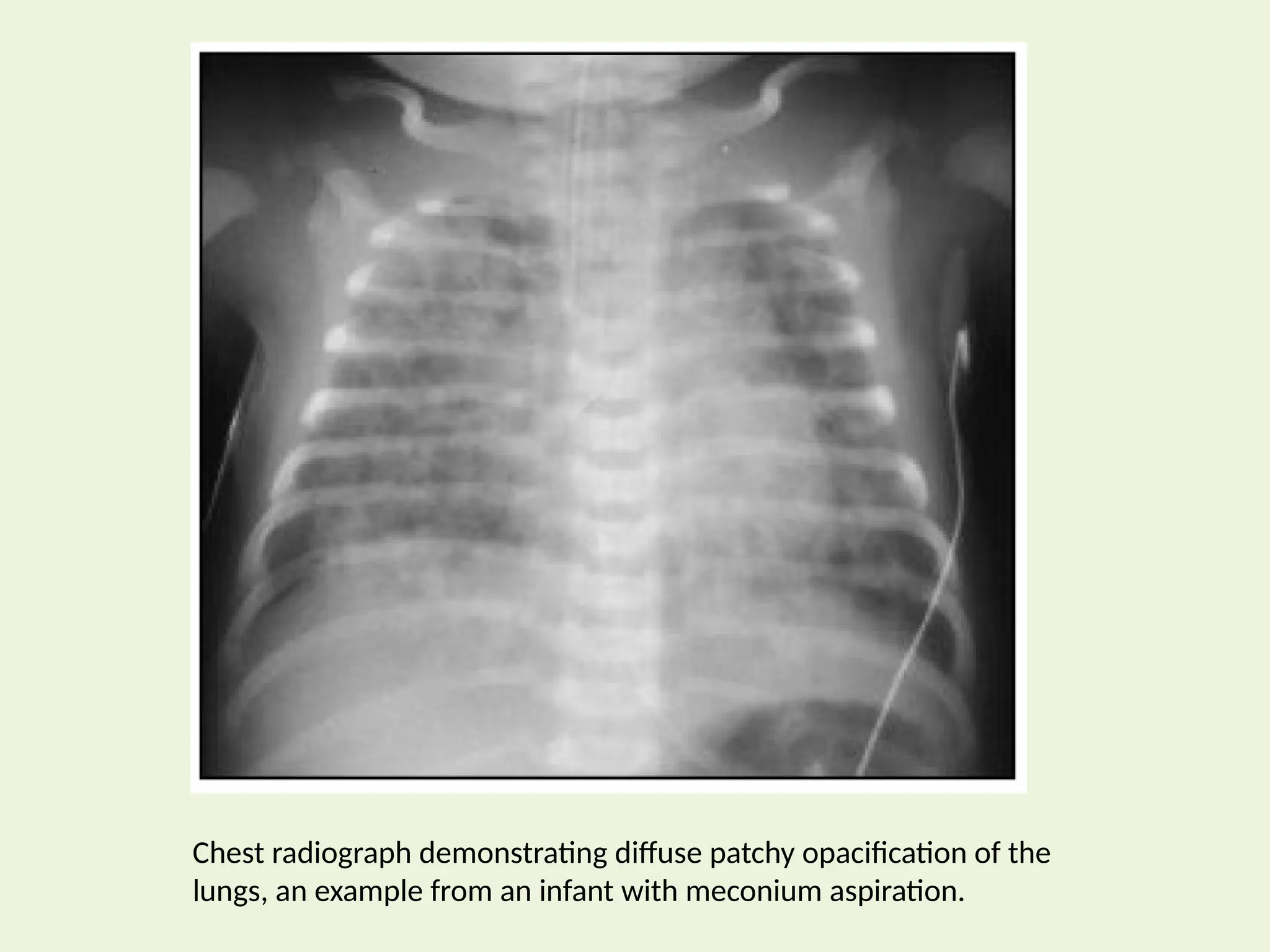
 Fetal chest x-ray, which will show hyperinflation,
diaphragmatic flattening, cardiomegaly, patchy
atelectasis and consolidation.
 ABG samples- pH, partial pressure of
oxygen( p02), partial pressure of CO2 ( pCO2).
Chest radiograph demonstrating diffuse patchy opacification of the
lungs, an example from an infant with meconium aspiration.
 Complete blood count: hemoglobin & hematocrit
level must be sufficient to ensure adequate oxygen-
carrying capacity.
 Serum electrolytes: obtain sodium, potassium and
calcium concentration when the infants with MAS
aged 24 hrs because the syndrome of
inappropriate secretion of antidiuretic
hormone( SIADH) and acute renal failure are
frequent complications of perinatal stress.
Preventive measures of MAS
 MAS is difficult to prevent.
 When there is meconium stained liquor, careful suctioning
of posterior pharynx after delivery of head decreases the
potential for aspiration of meconium.
immediate
of
aspirated
 When aspiration occurs, intubation
and suctioning of airway can
remove much meconium.
 Do not perform the following harmful techniques in
an attempt to prevent aspiration of meconium- stained
liquor:
- Squeezing of the chest of baby
-Inserting a finger into the mouth of baby.
Management of MAS
Prenatal:
1. Identification of high risk pregnancies
- recognition of predisposing maternal factors
- post dates pregnancy inductions as early as 41 weeks
2. Monitoring
- careful observation and fetal monitoring during labour
3. Amnioinfusion
-relieved umbilical cord compression during
labor -> reducing occurrence of variable fetal heart rate
decelerations
- efficiency not well demonstrated.
Delivery room
management Anticipate
the worst….
Be
Immediate Management
The American Academy of Pediatrics
Neonatal
Resuscitation
Program Steering Committee guidelines are as follows
If the baby is not vigorous:
 Suction the trachea immediately after delivery
 Suction for no longer than 5 seconds
 If no meconium is retrieved, do not repeat intubation and suction
 If meconium is retrieved and no bradycardia is present, reintubate
and suction
 If the heart rate is low, administer positive pressure ventilation and
consider suctioning again later.
If the baby is vigorous:
 Do not electively intubate
 Clear secretions and meconium from the mouth and nose
with a
bulb syringe or a large-bore suction catheter.
Dry, stimulate, reposition, and administer oxygen as necessary.
Transfer ill newborns with respiratory distress to NICU
General management
Continued care in the neonatal ICU (NICU)
 Maintain an optimal thermal environment
 Minimal handling to reduce agitation
thus
pulmonary
hypertension and right-to-left shunting causing hypoxia
and acidosis
 Insert umbilical artery to monitor blood pH and blood
gases without agitating the infant.
 Continue respiratory care: oxygen therapy or positive pressure
is crucial in maintaining adequate
arterial Oxygen saturation
( 90-95%) should be
ventilation
oxygenation.
maintained.
 Newborns are treated with antibiotics because of risk
of infection ( eg. X-pen and Gentamicin)
Supportive treatment
o IV Dextrose to prevent hypoglycemia.
o Fluid restriction (60-70 mL/kg/d) to prevent
cerebral and pulmonary edema
o Electrolytes to correct metabolic acidosis
o Protein, lipids, and vitamins to prevent deficiencies
For treatment of persistent pulmonary
hypertension of newborn( PPHN), inhaled
nitric oxide is the pulmonary vasodilator of
choice.
Surfactant Therapy:
Pulmonary surfactant is a mixture of lipids and proteins
which is secreted into the alveolar space by epithelial
type II cells. The main function of surfactant is to lower
the surface tension at the air/liquid interface within the
alveoli of the lung.
Replacing the Surfactant may reduce the severity of
disease and may decrease respiratory failure with
MAS within 6 hrs of 3doses , and decrease length of
hospital stay
Surfactant is delivered using an artificial airway or
breathing tube that is inserted into the trachea, or
windpipe,
One or two doses at 100mg/kg
Complications of MAS
 In mild cases, respiratory distress usually subsides in
2-4 days although tachypnea can persist for longer.
 Cerebral hypoxia may lead to long term neurological
damage.
 Aspiration pneumonia
 Brain damage due to lack of oxygen
 Collapsed lung (pneumothorax)
 Persistent pulmonary hypertension of newborn.
Prognosis of MAS
 Meconium aspiration accounts for a significant proportion of
neonatal deaths. Mortality rate is approx 5%.
 Residual lung problems are rare but include symptomatic
cough, wheezing, and persistent hyperinflation for up to five to
ten years.
 The ultimate prognosis depends on the extent of CNS injury
from asphyxia and the presence of associated problems such as
persistent pulmonary hypertension.
References
: Ranabhat, R.D & Niraula, H. A textbook of midwifery
& reproductive health (1st ed.). Kathmandu
 Tuitui, R. (2016) Manual of midwifery III (11th ed.).
Vidyarthi
 https://www.ncbi.nlm.nih.gov/pmc/articles/
PMC8005197/
Meconium-Aspiration-Syndrome presentation.pptx

Meconium-Aspiration-Syndrome presentation.pptx

  • 1.
  • 2.
    Introduction of meconium The first intestinal discharge from newborns is meconium, which is dark-green substance composed of intestinal epithelial cells, lanugo, mucus and intestinal secretions( eg. bile).  Meconium is typically passed for 2-3 days after birth.  Sometimes, the fetus passes the meconium while it is still in the womb.  MAS is a complex syndrome that ranges in severity from mild resp distress to severe resp failure and PPHN.
  • 3.
    Definition of MAS Meconium aspiration syndrome( MAS) is a respiratory distress in a newborn who has breathed( aspirated) meconium into the lungs before or around the time of birth.
  • 5.
    Causes of MAS Hypoxia in distressed baby  Meconium Stained Liquor  Uterine Infections  Difficulty during labour process- difficult extraction
  • 6.
    Factors that promotethe passage of meconium in utero includes the following:  Placental insufficiency  Post dated pegnancy  Maternal hypertension  Pre-eclampsia  Oligohydramnios  Maternal drug abuse, especially of tobacco and cocaine  Maternal infection/ chorioamnioitis  Fetal distress  Inadequate removal of meconium from the airway prior to the first breath.
  • 7.
  • 10.
     History  Presenceof meconium in amniotic fluid.  Green urine may be observed in newborns with meconium aspiration syndrome less than 24 hours after birth. (Meconium pigments can be absorbed by the lungs and can be excreted in urine).  Signs: Severe respiratory distress may be present. Presentation
  • 11.
     Symptoms includethe following:  Cyanosis  End-expiratory grunting  Nasal flaring  Breathing problems like ( DIB, Apnoea and Tachypnea)  Barrel chest in the presence of air trapping  rhonchi ( in some cases).  Yellow-green staining of fingernails, umbilical cord and skin may be observed.
  • 12.
  • 13.
    Diagnosis of MAS High risk infants may be identified by fetal tachycardia or bradycardia absence of fetal accelerations (upon CTG ) in utero At birth, the infant may look cachexic and show signs of yellowish meconium staining on skin, nail and the umbillical cord. These infants usually progress onto Infant Respiratory distress syndrome within 4 hours.
  • 14.
     Investigations whichcan confirm the diagnosis are :  Fetal chest x-ray, which will show hyperinflation, diaphragmatic flattening, cardiomegaly, patchy atelectasis and consolidation.  ABG samples- pH, partial pressure of oxygen( p02), partial pressure of CO2 ( pCO2).
  • 15.
    Chest radiograph demonstratingdiffuse patchy opacification of the lungs, an example from an infant with meconium aspiration.
  • 16.
     Complete bloodcount: hemoglobin & hematocrit level must be sufficient to ensure adequate oxygen- carrying capacity.  Serum electrolytes: obtain sodium, potassium and calcium concentration when the infants with MAS aged 24 hrs because the syndrome of inappropriate secretion of antidiuretic hormone( SIADH) and acute renal failure are frequent complications of perinatal stress.
  • 17.
    Preventive measures ofMAS  MAS is difficult to prevent.  When there is meconium stained liquor, careful suctioning of posterior pharynx after delivery of head decreases the potential for aspiration of meconium. immediate of aspirated  When aspiration occurs, intubation and suctioning of airway can remove much meconium.  Do not perform the following harmful techniques in an attempt to prevent aspiration of meconium- stained liquor: - Squeezing of the chest of baby -Inserting a finger into the mouth of baby.
  • 18.
    Management of MAS Prenatal: 1.Identification of high risk pregnancies - recognition of predisposing maternal factors - post dates pregnancy inductions as early as 41 weeks 2. Monitoring - careful observation and fetal monitoring during labour 3. Amnioinfusion -relieved umbilical cord compression during labor -> reducing occurrence of variable fetal heart rate decelerations - efficiency not well demonstrated.
  • 19.
  • 20.
    Immediate Management The AmericanAcademy of Pediatrics Neonatal Resuscitation Program Steering Committee guidelines are as follows If the baby is not vigorous:  Suction the trachea immediately after delivery  Suction for no longer than 5 seconds  If no meconium is retrieved, do not repeat intubation and suction  If meconium is retrieved and no bradycardia is present, reintubate and suction  If the heart rate is low, administer positive pressure ventilation and consider suctioning again later. If the baby is vigorous:  Do not electively intubate  Clear secretions and meconium from the mouth and nose with a bulb syringe or a large-bore suction catheter. Dry, stimulate, reposition, and administer oxygen as necessary. Transfer ill newborns with respiratory distress to NICU
  • 21.
    General management Continued carein the neonatal ICU (NICU)  Maintain an optimal thermal environment  Minimal handling to reduce agitation thus pulmonary hypertension and right-to-left shunting causing hypoxia and acidosis  Insert umbilical artery to monitor blood pH and blood gases without agitating the infant.  Continue respiratory care: oxygen therapy or positive pressure is crucial in maintaining adequate arterial Oxygen saturation ( 90-95%) should be ventilation oxygenation. maintained.  Newborns are treated with antibiotics because of risk of infection ( eg. X-pen and Gentamicin)
  • 22.
    Supportive treatment o IVDextrose to prevent hypoglycemia. o Fluid restriction (60-70 mL/kg/d) to prevent cerebral and pulmonary edema o Electrolytes to correct metabolic acidosis o Protein, lipids, and vitamins to prevent deficiencies For treatment of persistent pulmonary hypertension of newborn( PPHN), inhaled nitric oxide is the pulmonary vasodilator of choice.
  • 23.
    Surfactant Therapy: Pulmonary surfactantis a mixture of lipids and proteins which is secreted into the alveolar space by epithelial type II cells. The main function of surfactant is to lower the surface tension at the air/liquid interface within the alveoli of the lung. Replacing the Surfactant may reduce the severity of disease and may decrease respiratory failure with MAS within 6 hrs of 3doses , and decrease length of hospital stay Surfactant is delivered using an artificial airway or breathing tube that is inserted into the trachea, or windpipe, One or two doses at 100mg/kg
  • 24.
    Complications of MAS In mild cases, respiratory distress usually subsides in 2-4 days although tachypnea can persist for longer.  Cerebral hypoxia may lead to long term neurological damage.  Aspiration pneumonia  Brain damage due to lack of oxygen  Collapsed lung (pneumothorax)  Persistent pulmonary hypertension of newborn.
  • 25.
    Prognosis of MAS Meconium aspiration accounts for a significant proportion of neonatal deaths. Mortality rate is approx 5%.  Residual lung problems are rare but include symptomatic cough, wheezing, and persistent hyperinflation for up to five to ten years.  The ultimate prognosis depends on the extent of CNS injury from asphyxia and the presence of associated problems such as persistent pulmonary hypertension.
  • 26.
    References : Ranabhat, R.D& Niraula, H. A textbook of midwifery & reproductive health (1st ed.). Kathmandu  Tuitui, R. (2016) Manual of midwifery III (11th ed.). Vidyarthi  https://www.ncbi.nlm.nih.gov/pmc/articles/ PMC8005197/