EXTERN CONFERENCE
Extern Sirawit Suteetamrong
CASE HISTORY
ผู้ป่วยชายไทยอายุ 42 ปี
ภูมิลาเนาจังหวัดนครราชสีมา
สัญชาติไทย ศาสนาพุทธ
สิทธิการรักษา บัตรทองบุคคลทั่วไป
CHIEF COMPLAINT
ปวดสะโพกด้านซ้ายมากขึ้น 2ปี ก่อนมาโรงพยาบาล
PRESENT ILLNESS
2 ปีก่อนมาโรงพยาบาล ผู้ป่วยเริ่มมีอาการปวดที่บริเวณสะโพกด้านซ้าย (Pain score 3/10) ยัง
สามารถเดินได้ ทางานได้อยู่ อาการปวดจะเป็นมากขึ้นขณะเดินมากกว่าตอนอยู่เฉยๆ ไม่มีปวดร้าวไป
บริเวณอื่น ไม่มีประวัติประสบอุบัติเหตุบริเวณที่ปวด ไม่ได้ไปรับการรักษาที่โรงพยาบาล แต่ไปซื้อยาชุดมา
กินเอง อาการปวดลดลง
2 เดือนก่อนมาโรงพยาบาล อาการปวดที่บริเวณสะโพกด้านซ้ายเป็นมากขึ้น ปวดจนไม่สามารถเดินแบบ
ปกติได้ ไม่สามารถทางานต่อได้ (Pain score 9/10) ร่วมกับเริ่มมีอาการปวดที่บริเวณสะโพก
ด้านขวาร่วมด้วยเล็กน้อย (Pain score 3/10) ร่วมกับผู้ป่วยรู้สึกว่าขาด้านซ้ายสั้นกว่าด้านขวา ไม่
มีไข้ จึงมาโรงพยาบาล
PAST HISTORY
 U/D : HT on Amlodipine 2X1 oral p.c. เช้า
 ไม่มีประวัติแพ้ยา/แพ้อาหาร
 ไม่มีประวัติผ่าตัดมาก่อนหน้า
 ไม่มีประวัติประสบอุบัติเหตุบริเวณสะโพกทั้ง 2 ข้าง มาก่อนหน้า
PERSONAL HISTORY
มีประวัติใช้ยาชุด ไม่ทราบชนิด ติดต่อกันมาเป็นระยะเวลา 2 ปี
มีประวัติดื่มสุรามาเป็นระยะเวลา 27 ปี ครั้งละประมาน ขวดM150 x2ขวด ปัจจุบันเลิกดื่มมา
ได้ 2 เดือน
ไม่สูบบุหรี่
ไม่ใช้สารเสพย์ติด
งานประจา รับจ้างตัดอ้อย ปลูกมัน ยกของหนัก
FAMILY HISTORY
ไม่มีคนในครอบครัวที่มีอาการแบบเดียวกับผู้ป่วย
Vital signs:
• BP 128/78 BT 36.8 PR 72 RR 20
General appearance:
• Good consciousness , awake , well-cooperated
• HEENT:
• Not pale conjunctivae , Anicteric sclerae
PHYSICAL EXAMINATION
Chest:
• clear and equal breath sound both lungs
Heart:
Pulse full and regular , normal S1,S2 , no murmur
Abdomen:
Soft , Not tender
Musculoskeletal
Left Hip : Not tender , Limit ROM all direction due to pain
(especially when abduction)
Right Hip : Not tender , Full ROM
Back : Not tender , no stepping
Neurologic
GCS E4V5M6
Pupil 3 mm RTLBE, Full EOM
Motor power grade V all extremities
PHYSICAL EXAMINATION
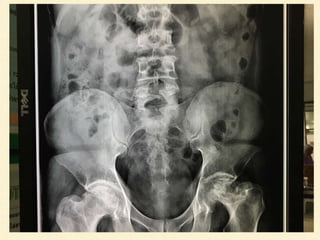
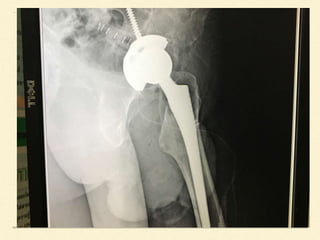
Film X-ray
DIAGNOSIS
Osteonecrosis of femoral head both
sides (More severe in Left side)
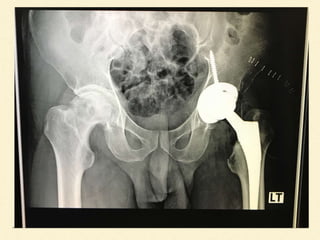
TREATMENT
Set OR for left total hip replacement
“Osteonecrosis of femoral
head ”
DEFINITION
The avascular state of the necrotic bone that result from
loss of circulation from numerous potential cause
Also known as avascular necrosis , aseptic necrosis ,
atraumatic necrosis , ischemic necrosis
EPIDEMIOLOGY
20,000 – 30,000 new cases per year in the United States
accounts for 10% of total hip arthroplasties performed
Average age at presentation is 35 to 50
bilateral hips involved 80% of the time
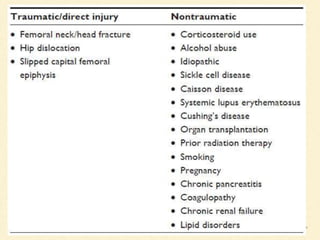
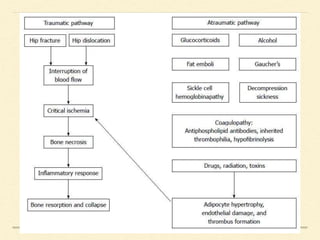
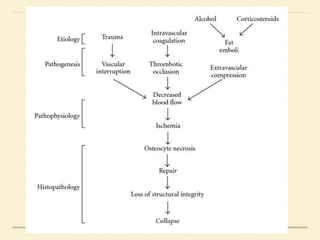
Etiology & Pathogenesis
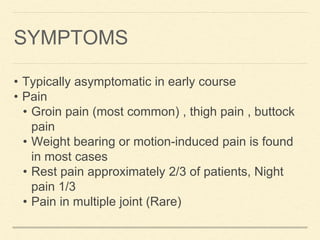
SYMPTOMS
• Typically asymptomatic in early course
• Pain
• Groin pain (most common) , thigh pain , buttock
pain
• Weight bearing or motion-induced pain is found
in most cases
• Rest pain approximately 2/3 of patients, Night
pain 1/3
• Pain in multiple joint (Rare)
PHYSICAL EXAM
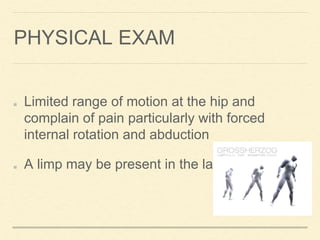
Limited range of motion at the hip and
complain of pain particularly with forced
internal rotation and abduction
A limp may be present in the late course
IMAGING
Plain radiography
AP view , frog-leg lateral view
MRI
Bone scan
PLAIN RADIOGRAPHY
May appear normal in early stage
Increased radiolucency in the femoral head
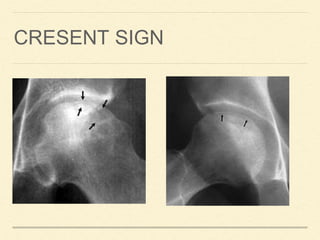
Pathognomonic crescent sign (Subchondral radiolucency)
Femoral head collapse
Severe arthritic changes
CRESENT SIGN
MRI
Imaging of choice for earlier stages of osteonecrosis of the
femoral head
Determination of the exact stage and extent of the
pathologic process without use of invasive method
Useful in following the progression of the asymptomatic
disease and in evaluating the efficacy of treatment
BONE SCAN
Bone scanning can occasionally be useful , when the
patient has a C/I to MRI or when assessing the status of
multiple other joint
The uptake of technetium-99m usually decreased in very
early stage and is variable or increased at a stage when
symptoms occur
CLASSIFICATION
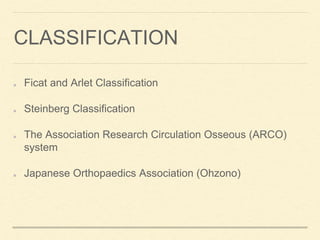
Ficat and Arlet Classification
Steinberg Classification
The Association Research Circulation Osseous (ARCO)
system
Japanese Orthopaedics Association (Ohzono)
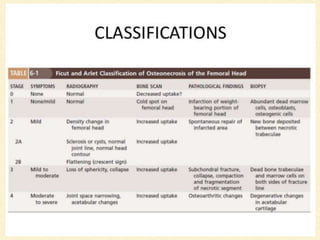
FICAT AND ARLET
CLASSIFICATION
TREATMENT
Non-operative treatment
Operative treatment
NON-OPERATIVE
TREATMENT
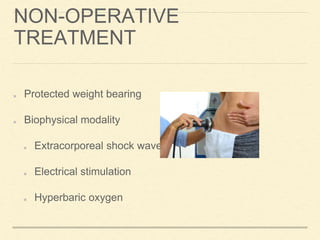
Protected weight bearing
Biophysical modality
Extracorporeal shock wave
Electrical stimulation
Hyperbaric oxygen
NON-OPERATIVE
TREATMENT
Pharmacological agent
Anticoagulant
Lipid-lowering agent
Diphosphonates
Growth factor
Antioxidants
Vasoactive substance
Hormones
OPERATIVE TREATMENT
Femoral head preserving Procedure
Core decompression
Core decompression with nonvascularized bone graft
Vascularized bone grafting
Concentrated stem cell
Rotational osteotomy
OPERATIVE TREATMENT
Hip arthroplasty
Total hip arthroplasty/replacement
Resurfacing arthroplasty
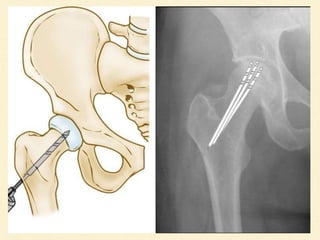
CORE DECOMPRESSION
Treatment of choice for
Ficat and Arlet I,IIA
reversible etiology
Simple to perform , very low complication
More effective than nonoperative treatment of early
Osteonecrosis of femoral head
CORE DECOMPRESSION
Reduce the intraosseus pressure in the femoral head
Restore Normal vascular flow
Subsequently alleviate the pain in the hip
TOTAL HIP
ARTHROPLASTY/REPLACEME
NT
I/C
Severe damage of the femoral head and acetabulum
An older and low-demand patient with extensive
involvement or collapse of the head
TOTAL HIP
ARTHROPLASTY/REPLACEME
NT
C/I
Young patient with early stage ONFH for whom treatment
option that save the femoral head are available
Patient with excessive risk for complication of THA
COMPLICATION
The natural history of AVN involves subchondral necrosis ,
subchondral fracture and collapse of bone, deformity of the
articular surface , and osteoarthritis
In later stages, sclerosis and total destruction of the joint
may occur
Nonunion of fracture and secondary muscle wasting are
potential complications

REFERENCES
“Thank you”

Ortho externconference

  • 1.
  • 2.
    CASE HISTORY ผู้ป่วยชายไทยอายุ 42ปี ภูมิลาเนาจังหวัดนครราชสีมา สัญชาติไทย ศาสนาพุทธ สิทธิการรักษา บัตรทองบุคคลทั่วไป
  • 3.
  • 4.
    PRESENT ILLNESS 2 ปีก่อนมาโรงพยาบาลผู้ป่วยเริ่มมีอาการปวดที่บริเวณสะโพกด้านซ้าย (Pain score 3/10) ยัง สามารถเดินได้ ทางานได้อยู่ อาการปวดจะเป็นมากขึ้นขณะเดินมากกว่าตอนอยู่เฉยๆ ไม่มีปวดร้าวไป บริเวณอื่น ไม่มีประวัติประสบอุบัติเหตุบริเวณที่ปวด ไม่ได้ไปรับการรักษาที่โรงพยาบาล แต่ไปซื้อยาชุดมา กินเอง อาการปวดลดลง 2 เดือนก่อนมาโรงพยาบาล อาการปวดที่บริเวณสะโพกด้านซ้ายเป็นมากขึ้น ปวดจนไม่สามารถเดินแบบ ปกติได้ ไม่สามารถทางานต่อได้ (Pain score 9/10) ร่วมกับเริ่มมีอาการปวดที่บริเวณสะโพก ด้านขวาร่วมด้วยเล็กน้อย (Pain score 3/10) ร่วมกับผู้ป่วยรู้สึกว่าขาด้านซ้ายสั้นกว่าด้านขวา ไม่ มีไข้ จึงมาโรงพยาบาล
  • 5.
    PAST HISTORY  U/D: HT on Amlodipine 2X1 oral p.c. เช้า  ไม่มีประวัติแพ้ยา/แพ้อาหาร  ไม่มีประวัติผ่าตัดมาก่อนหน้า  ไม่มีประวัติประสบอุบัติเหตุบริเวณสะโพกทั้ง 2 ข้าง มาก่อนหน้า
  • 6.
    PERSONAL HISTORY มีประวัติใช้ยาชุด ไม่ทราบชนิดติดต่อกันมาเป็นระยะเวลา 2 ปี มีประวัติดื่มสุรามาเป็นระยะเวลา 27 ปี ครั้งละประมาน ขวดM150 x2ขวด ปัจจุบันเลิกดื่มมา ได้ 2 เดือน ไม่สูบบุหรี่ ไม่ใช้สารเสพย์ติด งานประจา รับจ้างตัดอ้อย ปลูกมัน ยกของหนัก
  • 7.
  • 8.
    Vital signs: • BP128/78 BT 36.8 PR 72 RR 20 General appearance: • Good consciousness , awake , well-cooperated • HEENT: • Not pale conjunctivae , Anicteric sclerae PHYSICAL EXAMINATION
  • 9.
    PHYSICAL EXAMINATION Chest: • clearand equal breath sound both lungs Heart: Pulse full and regular , normal S1,S2 , no murmur Abdomen: Soft , Not tender
  • 10.
    Musculoskeletal Left Hip :Not tender , Limit ROM all direction due to pain (especially when abduction) Right Hip : Not tender , Full ROM Back : Not tender , no stepping Neurologic GCS E4V5M6 Pupil 3 mm RTLBE, Full EOM Motor power grade V all extremities PHYSICAL EXAMINATION
  • 11.
  • 13.
    DIAGNOSIS Osteonecrosis of femoralhead both sides (More severe in Left side)
  • 14.
    TREATMENT Set OR forleft total hip replacement
  • 17.
  • 18.
    DEFINITION The avascular stateof the necrotic bone that result from loss of circulation from numerous potential cause Also known as avascular necrosis , aseptic necrosis , atraumatic necrosis , ischemic necrosis
  • 19.
    EPIDEMIOLOGY 20,000 – 30,000new cases per year in the United States accounts for 10% of total hip arthroplasties performed Average age at presentation is 35 to 50 bilateral hips involved 80% of the time
  • 20.
  • 24.
    SYMPTOMS • Typically asymptomaticin early course • Pain • Groin pain (most common) , thigh pain , buttock pain • Weight bearing or motion-induced pain is found in most cases • Rest pain approximately 2/3 of patients, Night pain 1/3 • Pain in multiple joint (Rare)
  • 25.
    PHYSICAL EXAM Limited rangeof motion at the hip and complain of pain particularly with forced internal rotation and abduction A limp may be present in the late course
  • 26.
    IMAGING Plain radiography AP view, frog-leg lateral view MRI Bone scan
  • 27.
    PLAIN RADIOGRAPHY May appearnormal in early stage Increased radiolucency in the femoral head Pathognomonic crescent sign (Subchondral radiolucency) Femoral head collapse Severe arthritic changes
  • 28.
  • 29.
    MRI Imaging of choicefor earlier stages of osteonecrosis of the femoral head Determination of the exact stage and extent of the pathologic process without use of invasive method Useful in following the progression of the asymptomatic disease and in evaluating the efficacy of treatment
  • 30.
    BONE SCAN Bone scanningcan occasionally be useful , when the patient has a C/I to MRI or when assessing the status of multiple other joint The uptake of technetium-99m usually decreased in very early stage and is variable or increased at a stage when symptoms occur
  • 31.
    CLASSIFICATION Ficat and ArletClassification Steinberg Classification The Association Research Circulation Osseous (ARCO) system Japanese Orthopaedics Association (Ohzono)
  • 32.
  • 34.
  • 35.
    NON-OPERATIVE TREATMENT Protected weight bearing Biophysicalmodality Extracorporeal shock wave Electrical stimulation Hyperbaric oxygen
  • 36.
  • 37.
    OPERATIVE TREATMENT Femoral headpreserving Procedure Core decompression Core decompression with nonvascularized bone graft Vascularized bone grafting Concentrated stem cell Rotational osteotomy
  • 38.
    OPERATIVE TREATMENT Hip arthroplasty Totalhip arthroplasty/replacement Resurfacing arthroplasty
  • 39.
    CORE DECOMPRESSION Treatment ofchoice for Ficat and Arlet I,IIA reversible etiology Simple to perform , very low complication More effective than nonoperative treatment of early Osteonecrosis of femoral head
  • 40.
    CORE DECOMPRESSION Reduce theintraosseus pressure in the femoral head Restore Normal vascular flow Subsequently alleviate the pain in the hip
  • 42.
    TOTAL HIP ARTHROPLASTY/REPLACEME NT I/C Severe damageof the femoral head and acetabulum An older and low-demand patient with extensive involvement or collapse of the head
  • 43.
    TOTAL HIP ARTHROPLASTY/REPLACEME NT C/I Young patientwith early stage ONFH for whom treatment option that save the femoral head are available Patient with excessive risk for complication of THA
  • 44.
    COMPLICATION The natural historyof AVN involves subchondral necrosis , subchondral fracture and collapse of bone, deformity of the articular surface , and osteoarthritis In later stages, sclerosis and total destruction of the joint may occur Nonunion of fracture and secondary muscle wasting are potential complications
  • 45.
  • 46.