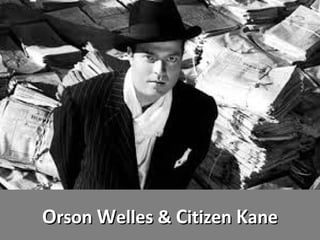
OOrsonrson WWelles &elles & CCitizenitizen KKaneane
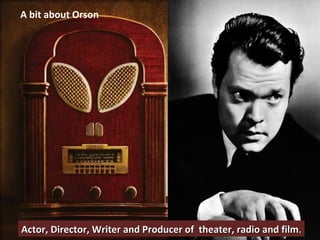
A bit about Orson
Actor, Director, Writer and Producer of theater, radio and filmActor, Director, Writer and Producer of theater, radio and film..
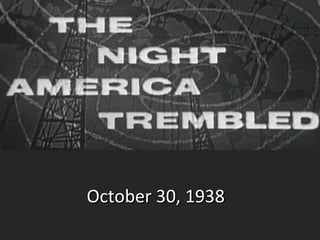
October 30, 1938October 30, 1938
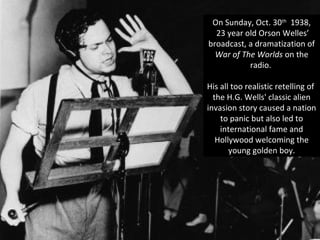
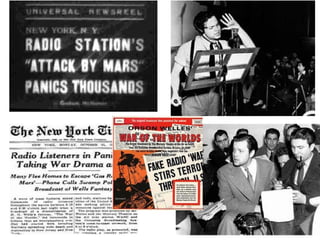
On Sunday, Oct. 30th
1938,
23 year old Orson Welles’
broadcast, a dramatization of
War of The Worlds on the
radio.
His all too realistic retelling of
the H.G. Wells' classic alien
invasion story caused a nation
to panic but also led to
international fame and
Hollywood welcoming the
young golden boy.
5
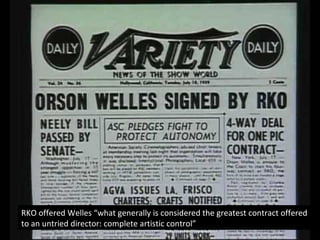
RKO offered Welles “what generally is considered the greatest contract offered
to an untried director: complete artistic control”.
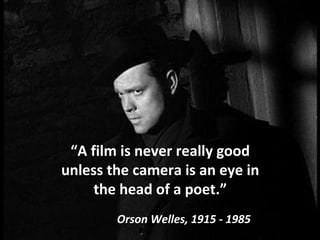
“A film is never really good
unless the camera is an eye in
the head of a poet.”
Orson Welles, 1915 - 1985
8
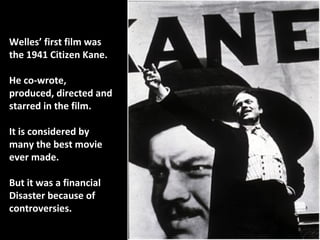
Welles’ first film wasWelles’ first film was
the 1941 Citizen Kane.the 1941 Citizen Kane.
He co-wrote,He co-wrote,
produced, directed andproduced, directed and
starred in the film.starred in the film.
It is considered byIt is considered by
many the best moviemany the best movie
ever made.ever made.
But it was a financialBut it was a financial
Disaster because ofDisaster because of
controversies.controversies.
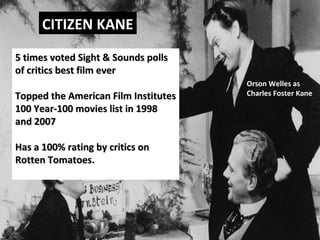
5 times voted Sight & Sounds polls5 times voted Sight & Sounds polls
of critics best film everof critics best film ever
Topped the American Film InstitutesTopped the American Film Institutes
100 Year-100 movies list in 1998100 Year-100 movies list in 1998
and 2007and 2007
Has a 100% rating by critics onHas a 100% rating by critics on
Rotten Tomatoes.Rotten Tomatoes.
Orson Welles as
Charles Foster Kane
CITIZEN KANECITIZEN KANE
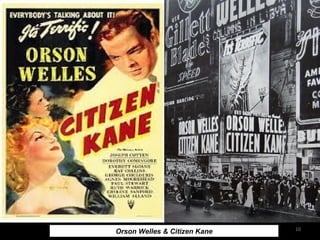
Orson Welles & Citizen Kane 10
11
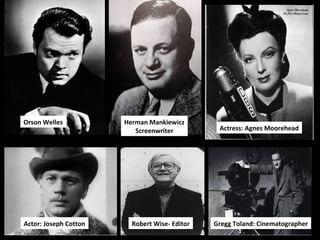
Actor: Joseph Cotton
Actress: Agnes Moorehead
Orson Welles
Robert Wise- Editor Gregg Toland: Cinematographer
Herman Mankiewicz
Screenwriter
12
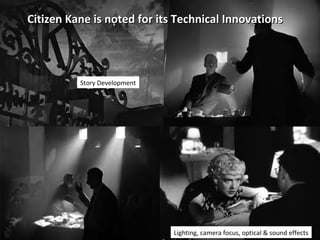
Citizen Kane is noted for its Technical InnovationsCitizen Kane is noted for its Technical Innovations
Lighting, camera focus, optical & sound effects
Story Development
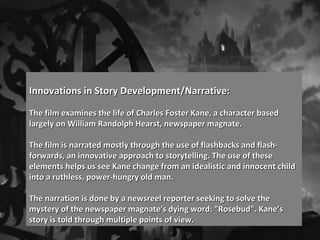
Innovations in Story Development/Narrative:Innovations in Story Development/Narrative:
The film examines the life of Charles Foster Kane, a character basedThe film examines the life of Charles Foster Kane, a character based
largely on William Randolph Hearst, newspaper magnate.largely on William Randolph Hearst, newspaper magnate.
The film is narrated mostly through the use of flashbacks and flash-The film is narrated mostly through the use of flashbacks and flash-
forwards, an innovative approach to storytelling. The use of theseforwards, an innovative approach to storytelling. The use of these
elements helps us see Kane change from an idealistic and innocent childelements helps us see Kane change from an idealistic and innocent child
into a ruthless, power-hungry old man.into a ruthless, power-hungry old man.
The narration is done by a newsreel reporter seeking to solve theThe narration is done by a newsreel reporter seeking to solve the
mystery of the newspaper magnate's dying word: "Rosebud". Kane’smystery of the newspaper magnate's dying word: "Rosebud". Kane’s
story is told through multiple points of view.story is told through multiple points of view.
14
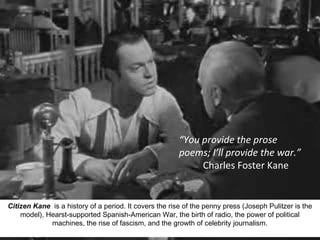
Citizen Kane is a history of a period. It covers the rise of the penny press (Joseph Pulitzer is the
model), Hearst-supported Spanish-American War, the birth of radio, the power of political
machines, the rise of fascism, and the growth of celebrity journalism.
“You provide the prose
poems; I’ll provide the war.”
Charles Foster Kane
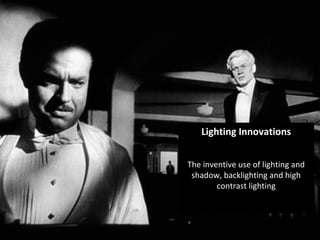
Lighting InnovationsLighting Innovations
The inventive use of lighting and
shadow, backlighting and high
contrast lighting
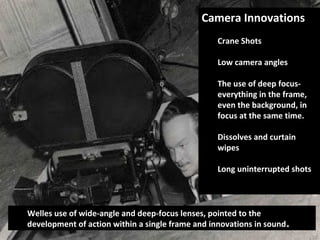
Camera InnovationsCamera Innovations
Crane Shots
Low camera angles
The use of deep focus-
everything in the frame,
even the background, in
focus at the same time.
Dissolves and curtain
wipes
Long uninterrupted shots
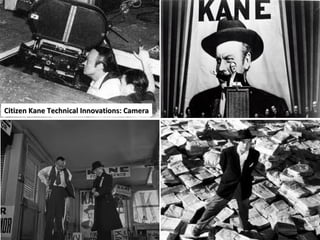
Welles use of wide-angle and deep-focus lenses, pointed to the
development of action within a single frame and innovations in sound.
17
Citizen Kane Technical Innovations: CameraCitizen Kane Technical Innovations: Camera
18
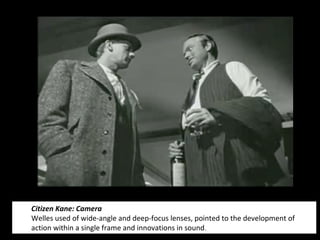
Citizen Kane: Camera
Welles used of wide-angle and deep-focus lenses, pointed to the development of
action within a single frame and innovations in sound.
19
Hearst vs. Citizen
Kane
Link with William Randolph
Hearst was Controversial
Any Brilliant Work of Art is a
Composite of Many Stories:
How the work was made,
The people involved,
The work itself, and
The work's legacy.
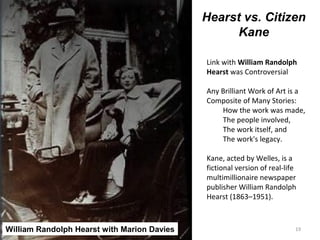
Kane, acted by Welles, is a
fictional version of real-life
multimillionaire newspaper
publisher William Randolph
Hearst (1863–1951).
William Randolph Hearst with Marion Davies
20
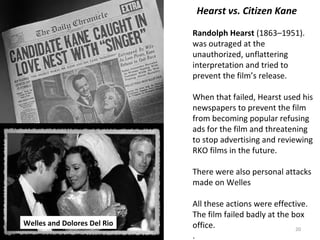
Hearst vs. Citizen Kane
Randolph Hearst (1863–1951).
was outraged at the
unauthorized, unflattering
interpretation and tried to
prevent the film’s release.
When that failed, Hearst used his
newspapers to prevent the film
from becoming popular refusing
ads for the film and threatening
to stop advertising and reviewing
RKO films in the future.
There were also personal attacks
made on Welles
All these actions were effective.
The film failed badly at the box
office.
.
Welles and Dolores Del Rio
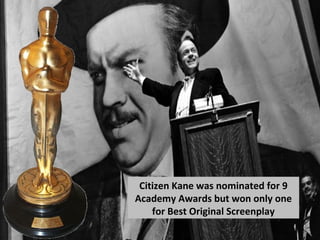
Citizen Kane was nominated for 9
Academy Awards but won only one
for Best Original Screenplay

Orson Welles & Citizen Kane

  • 1.
    OOrsonrson WWelles &elles& CCitizenitizen KKaneane
  • 2.
    A bit aboutOrson Actor, Director, Writer and Producer of theater, radio and filmActor, Director, Writer and Producer of theater, radio and film..
  • 3.
  • 4.
    On Sunday, Oct.30th 1938, 23 year old Orson Welles’ broadcast, a dramatization of War of The Worlds on the radio. His all too realistic retelling of the H.G. Wells' classic alien invasion story caused a nation to panic but also led to international fame and Hollywood welcoming the young golden boy.
  • 5.
  • 6.
    RKO offered Welles“what generally is considered the greatest contract offered to an untried director: complete artistic control”.
  • 7.
    “A film isnever really good unless the camera is an eye in the head of a poet.” Orson Welles, 1915 - 1985
  • 8.
    8 Welles’ first filmwasWelles’ first film was the 1941 Citizen Kane.the 1941 Citizen Kane. He co-wrote,He co-wrote, produced, directed andproduced, directed and starred in the film.starred in the film. It is considered byIt is considered by many the best moviemany the best movie ever made.ever made. But it was a financialBut it was a financial Disaster because ofDisaster because of controversies.controversies.
  • 9.
    5 times votedSight & Sounds polls5 times voted Sight & Sounds polls of critics best film everof critics best film ever Topped the American Film InstitutesTopped the American Film Institutes 100 Year-100 movies list in 1998100 Year-100 movies list in 1998 and 2007and 2007 Has a 100% rating by critics onHas a 100% rating by critics on Rotten Tomatoes.Rotten Tomatoes. Orson Welles as Charles Foster Kane CITIZEN KANECITIZEN KANE
  • 10.
    Orson Welles &Citizen Kane 10
  • 11.
    11 Actor: Joseph Cotton Actress:Agnes Moorehead Orson Welles Robert Wise- Editor Gregg Toland: Cinematographer Herman Mankiewicz Screenwriter
  • 12.
    12 Citizen Kane isnoted for its Technical InnovationsCitizen Kane is noted for its Technical Innovations Lighting, camera focus, optical & sound effects Story Development
  • 13.
    Innovations in StoryDevelopment/Narrative:Innovations in Story Development/Narrative: The film examines the life of Charles Foster Kane, a character basedThe film examines the life of Charles Foster Kane, a character based largely on William Randolph Hearst, newspaper magnate.largely on William Randolph Hearst, newspaper magnate. The film is narrated mostly through the use of flashbacks and flash-The film is narrated mostly through the use of flashbacks and flash- forwards, an innovative approach to storytelling. The use of theseforwards, an innovative approach to storytelling. The use of these elements helps us see Kane change from an idealistic and innocent childelements helps us see Kane change from an idealistic and innocent child into a ruthless, power-hungry old man.into a ruthless, power-hungry old man. The narration is done by a newsreel reporter seeking to solve theThe narration is done by a newsreel reporter seeking to solve the mystery of the newspaper magnate's dying word: "Rosebud". Kane’smystery of the newspaper magnate's dying word: "Rosebud". Kane’s story is told through multiple points of view.story is told through multiple points of view.
  • 14.
    14 Citizen Kane isa history of a period. It covers the rise of the penny press (Joseph Pulitzer is the model), Hearst-supported Spanish-American War, the birth of radio, the power of political machines, the rise of fascism, and the growth of celebrity journalism. “You provide the prose poems; I’ll provide the war.” Charles Foster Kane
  • 15.
    Lighting InnovationsLighting Innovations Theinventive use of lighting and shadow, backlighting and high contrast lighting
  • 16.
    Camera InnovationsCamera Innovations CraneShots Low camera angles The use of deep focus- everything in the frame, even the background, in focus at the same time. Dissolves and curtain wipes Long uninterrupted shots Welles use of wide-angle and deep-focus lenses, pointed to the development of action within a single frame and innovations in sound.
  • 17.
    17 Citizen Kane TechnicalInnovations: CameraCitizen Kane Technical Innovations: Camera
  • 18.
    18 Citizen Kane: Camera Wellesused of wide-angle and deep-focus lenses, pointed to the development of action within a single frame and innovations in sound.
  • 19.
    19 Hearst vs. Citizen Kane Linkwith William Randolph Hearst was Controversial Any Brilliant Work of Art is a Composite of Many Stories: How the work was made, The people involved, The work itself, and The work's legacy. Kane, acted by Welles, is a fictional version of real-life multimillionaire newspaper publisher William Randolph Hearst (1863–1951). William Randolph Hearst with Marion Davies
  • 20.
    20 Hearst vs. CitizenKane Randolph Hearst (1863–1951). was outraged at the unauthorized, unflattering interpretation and tried to prevent the film’s release. When that failed, Hearst used his newspapers to prevent the film from becoming popular refusing ads for the film and threatening to stop advertising and reviewing RKO films in the future. There were also personal attacks made on Welles All these actions were effective. The film failed badly at the box office. . Welles and Dolores Del Rio
  • 21.
    Citizen Kane wasnominated for 9 Academy Awards but won only one for Best Original Screenplay

Editor's Notes

  • #3 actor, director, writer and producer who worked in theater, radio and film.
  • #6 Orson Welles-Born in Wisconsin "Boy Genius” Abbey Players of Ireland Mercury Radio Theatre “War of the Worlds” 1938 Controversy Hired by RKO Given Almost Complete Independence Considered a Trouble-Maker Given free reign under RKO studios because of War of Worlds
  • #11 Citizen Kane trailer 1:50 The fictional version of real life multimillionaire William Randolph Hearst (1863-1951)
  • #13 Innovations in lighting, story development, camera use, sound, etc. images and words combines, deep focus, ceiling in shots, optical effects, sound effects
  • #15 Kane- War
  • #18 Innovations in lighting, story development, camera use, sound, etc.
  • #19 Kane Camera 18 sec
  • #21 Hearst's efforts to destroy Citizen Kane are legendary. He is said to have lobbied against it with the Academy of Motion Picture Arts and Sciences, the body which decides the Oscars, resulting in How Green Was My Valley winning best film in 1942 in its place. Hearst also kept adverts for the movie out of his many newspapers, and one of his allies in Hollywood is even said to have tried to buy the footage in order to burn it just prior to the movie's release. Another story is that FBI chief J Edgar Hoover launched a decade-long investigation into Welles as a result of Hearst's anger over the film.