Photography Ethical PerspectivePhotography Ethical Perspective
StereotypingStereotyping
Victims of ViolenceVictims of Violence
Rights to PrivacyRights to Privacy
Editorial ChoicesEditorial Choices
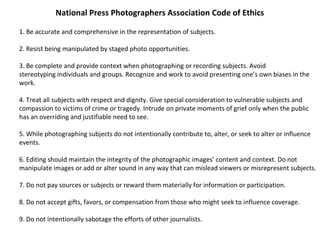
National Press Photographers Association Code of Ethics
1. Be accurate and comprehensive in the representation of subjects.
2. Resist being manipulated by staged photo opportunities.
3. Be complete and provide context when photographing or recording subjects. Avoid
stereotyping individuals and groups. Recognize and work to avoid presenting one’s own biases in the
work.
4. Treat all subjects with respect and dignity. Give special consideration to vulnerable subjects and
compassion to victims of crime or tragedy. Intrude on private moments of grief only when the public
has an overriding and justifiable need to see.
5. While photographing subjects do not intentionally contribute to, alter, or seek to alter or influence
events.
6. Editing should maintain the integrity of the photographic images’ content and context. Do not
manipulate images or add or alter sound in any way that can mislead viewers or misrepresent subjects.
7. Do not pay sources or subjects or reward them materially for information or participation.
8. Do not accept gifts, favors, or compensation from those who might seek to influence coverage.
9. Do not intentionally sabotage the efforts of other journalists.
Minority groups portrayed as Criminals? 3
Stereotypes: Media View?Stereotypes: Media View?
Katrina Aftermath: “Two residents wade
through chest-deep water after finding
bread and soda from a local grocery store.”
4
Stereotyping: “Finding food”Stereotyping: “Finding food”
2005 Photo by Dave Martin for the Associated Press
Caption for white people:
Caption Katrina Aftermath: “A young man walks through chest deep flood water after looting a
grocery store in New Orleans.” 5
Stereotyping: “Looting”Stereotyping: “Looting”
2005 Photo by Dave Martin for the Associated Press
FRED CHARTRAND / THE CANADIAN PRESS file photo
Lack of Coverage in Media: Missing Aboriginal Women in Canada
An RCMP study determined “there were 1,181 murdered or missing women in this
country over a 33-year period through 2012.”
7
Ethical Perspective Victims of Violence Rights to Privacy
Eddie Adams: Vietnam Atrocity
Vietnam war
the first war to
be televised
8
Ethical Perspective
Victims of Violence - Rights to Privacy
Vietnam war
the first war to
be televised
9
Ethical Issues: Violence and Privacy Often MeshEthical Issues: Violence and Privacy Often Mesh
Kent State Tragedy 1970 by John Filo
10
Ethical Perspective
Rights to PrivacyRights to Privacy
Dorothea Lange Photo
Florence Thompson
complained about her
privacy violation
Many profited from the
photograph
but Florence made
nothing
11
Ethical PerspectiveEthical Perspective
Victims of ViolenceVictims of Violence
Rights to PrivacyRights to Privacy
9/11 falling Man
Many Newspaper Did Not Publish
Because of Privacy Concerns
12
Ethical PerspectiveEthical Perspective
Victims of ViolenceVictims of Violence
Rights to PrivacyRights to Privacy
Oklahoma City Bombing
1995 Photo by Charles Porter
13
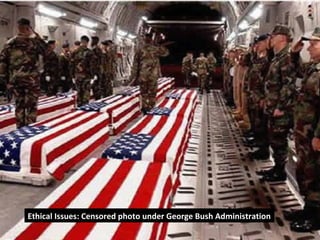
Ethical Issues: Censored photo under George Bush Administration
14
Government may try to
suppress, but
2003 Abu Ghraib
Rights to Privacy for Victims?
Digital Trophies Were Used Against Soldiers
15
Ethical Perspective: Double StandardsEthical Perspective: Double Standards
US did not want to show their war dead but did show pictures of
Saddam’s dead sons. However, Obama administration did not release
images of Bin Ladan dead.
Soldier’s identities covered by
Government
16
Decisions about what images are shown in mainstream media?
This photograph of Israeli children writing messages to children of Lebanon
on artillery shells bound for targets in Lebanon caused outrage and but was not seen
in regular media
What does future hold?What does future hold?

Photography Ethical Perspective

  • 1.
    Photography Ethical PerspectivePhotographyEthical Perspective StereotypingStereotyping Victims of ViolenceVictims of Violence Rights to PrivacyRights to Privacy Editorial ChoicesEditorial Choices
  • 2.
    National Press PhotographersAssociation Code of Ethics 1. Be accurate and comprehensive in the representation of subjects. 2. Resist being manipulated by staged photo opportunities. 3. Be complete and provide context when photographing or recording subjects. Avoid stereotyping individuals and groups. Recognize and work to avoid presenting one’s own biases in the work. 4. Treat all subjects with respect and dignity. Give special consideration to vulnerable subjects and compassion to victims of crime or tragedy. Intrude on private moments of grief only when the public has an overriding and justifiable need to see. 5. While photographing subjects do not intentionally contribute to, alter, or seek to alter or influence events. 6. Editing should maintain the integrity of the photographic images’ content and context. Do not manipulate images or add or alter sound in any way that can mislead viewers or misrepresent subjects. 7. Do not pay sources or subjects or reward them materially for information or participation. 8. Do not accept gifts, favors, or compensation from those who might seek to influence coverage. 9. Do not intentionally sabotage the efforts of other journalists.
  • 3.
    Minority groups portrayedas Criminals? 3 Stereotypes: Media View?Stereotypes: Media View?
  • 4.
    Katrina Aftermath: “Tworesidents wade through chest-deep water after finding bread and soda from a local grocery store.” 4 Stereotyping: “Finding food”Stereotyping: “Finding food” 2005 Photo by Dave Martin for the Associated Press Caption for white people:
  • 5.
    Caption Katrina Aftermath:“A young man walks through chest deep flood water after looting a grocery store in New Orleans.” 5 Stereotyping: “Looting”Stereotyping: “Looting” 2005 Photo by Dave Martin for the Associated Press
  • 6.
    FRED CHARTRAND /THE CANADIAN PRESS file photo Lack of Coverage in Media: Missing Aboriginal Women in Canada An RCMP study determined “there were 1,181 murdered or missing women in this country over a 33-year period through 2012.”
  • 7.
    7 Ethical Perspective Victimsof Violence Rights to Privacy Eddie Adams: Vietnam Atrocity Vietnam war the first war to be televised
  • 8.
    8 Ethical Perspective Victims ofViolence - Rights to Privacy Vietnam war the first war to be televised
  • 9.
    9 Ethical Issues: Violenceand Privacy Often MeshEthical Issues: Violence and Privacy Often Mesh Kent State Tragedy 1970 by John Filo
  • 10.
    10 Ethical Perspective Rights toPrivacyRights to Privacy Dorothea Lange Photo Florence Thompson complained about her privacy violation Many profited from the photograph but Florence made nothing
  • 11.
    11 Ethical PerspectiveEthical Perspective Victimsof ViolenceVictims of Violence Rights to PrivacyRights to Privacy 9/11 falling Man Many Newspaper Did Not Publish Because of Privacy Concerns
  • 12.
    12 Ethical PerspectiveEthical Perspective Victimsof ViolenceVictims of Violence Rights to PrivacyRights to Privacy Oklahoma City Bombing 1995 Photo by Charles Porter
  • 13.
    13 Ethical Issues: Censoredphoto under George Bush Administration
  • 14.
    14 Government may tryto suppress, but 2003 Abu Ghraib Rights to Privacy for Victims? Digital Trophies Were Used Against Soldiers
  • 15.
    15 Ethical Perspective: DoubleStandardsEthical Perspective: Double Standards US did not want to show their war dead but did show pictures of Saddam’s dead sons. However, Obama administration did not release images of Bin Ladan dead. Soldier’s identities covered by Government
  • 16.
    16 Decisions about whatimages are shown in mainstream media? This photograph of Israeli children writing messages to children of Lebanon on artillery shells bound for targets in Lebanon caused outrage and but was not seen in regular media
  • 18.
    What does futurehold?What does future hold?

Editor's Notes

  • #8 Ethical Perspectives -Utilitarian..for the greater good
  • #10 Kent State tragedy May 4th 1970
  • #12 9/11
  • #13 9/11
  • #14 As if there were no bodies
  • #15 2003 Abu Ghraib