The Duel side of the classical period
Table Of Content
 Introduction…………………………………………………………………….…….i
 What is classical Hollywood cinema…………………………………………………ii
 The 3 Act Structure………………………………………….……………..………...iii
 3 Systems of narrative films…………………………...............……………..……..iv
 Editing, Space and Time…………………………………………..………………….v
 Mise en scène………………………………………………….…..………..…….….vi
 Film Ending………………………………………………...……………..…………vii
 List of movies to refer……………………………..………………………..............viii
 Does Classical Hollywood style still exists?.............................................................ix
 How Classical cinema differed from alternative cinema?..........................................x
Introduction
Topic: The Duel side of the classical period
 Does classical Hollywood style still
exists?
 About the presentation:
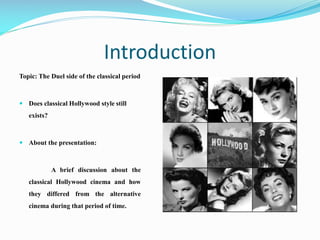
A brief discussion about the
classical Hollywood cinema and how
they differed from the alternative
cinema during that period of time.
Narrative is bound to human from the
prehistoric times till the present date.
Classical Narrative of Hollywood
 “A chain of events in a cause-effect relationship occurring in time and space” by
Bordwell and Thompson, Film art.
 The term classical Hollywood cinema was coined by David Bordwell, Janet Staiger
and Kristin Thompson.
 Over 40 yrs from 1917 to 1960s there were distinctive collection of movies which
had the similar way of story telling which was called the Classical Hollywood
cinema. The film style have a set of unwritten rules which was widely accepted by
the film makers
Casablanca
The 3 Act Structure
 Routine life (Introduction of the Problem)
 Problem solving (The character logically works through the problem creating a
story)
 Problem Resolved (end of the problem where the life comes back to normal)
3 Systems of narrative films
 Narrative logic
 Representation of time
 Representation of space
(BGM and Editing applies for all the three above)
(Lighting and camera movements play an important
role in classical Hollywood movies.)
Film Style
 The classical Hollywood style falls directly
in between Realism and Formalism.
 Although the film is shot in a controlled
environment by the directors orders the
environment has to look realistic and
believable to the viewers
Editing
 Editing plays a major role in films
because they are important to make
the film move forward.
 In classical period the Type of editing
which was mostly preferred was
continuity editing.
 The important goal of this type of
editing is to make the cuts invisible.
Space and Time
 The time and space are unified and liner to match the perception of reality in
the films
 For example: They prefer to take a 18o° shot to move around the characters
than using jump cuts.
Mise en scène
 The term was originated in theaters which means Staging a scene in a
aesthetical arrangement of actors, set, lightings, props that the audience sees in
a particular frame.
 The Mise en scène is designed by production designer in collaboration with the
Director of the film he is working in.
 Each element in the Mise en scène adds to the films mood to the Audience.
Film Endings
There are 3 types of Film Endings
 Cultural (example: The Guy wins his love)
 Counter Cultural (example: The lovers are separated)
 Soft Spot ( example: The death of the lead character)
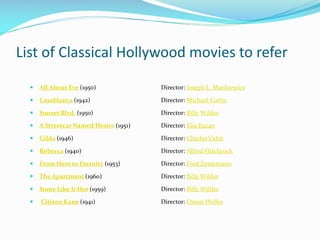
List of Classical Hollywood movies to refer
 All About Eve (1950) Director: Joseph L. Mankiewicz
 Casablanca (1942) Director: Michael Curtiz
 Sunset Blvd. (1950) Director: Billy Wilder
 A Streetcar Named Desire (1951) Director: Elia Kazan
 Gilda (1946) Director: Charles Vidor
 Rebecca (1940) Director: Alfred Hitchcock
 From Here to Eternity (1953) Director: Fred Zinnemann
 The Apartment (1960) Director: Billy Wilder
 Some Like It Hot (1959) Director: Billy Wilder
 Citizen Kane (1941) Director: Orson Welles
Does Classical Hollywood
style still exists?
One thing that never changed
 Classical Hollywood style still exists?
Despite all the historic changes we find a local variants in the
contemporary film style we are still dealing with a version of classical film making.
Eg: Avatar and many animated movies…….
How Classical cinema differed from alternative
cinema?
 The directors were bound to follow the Classical Hollywood style during
that period of time were there was few movies that called themselves
alternative cinema. One of them is “Psycho” by Alfred Hitchcock.
 Psycho can fall under the category “alternative cinema” which was
coined by Laura Mulvey for the films that divert from the typical
progression of a classical Hollywood film or what may be “pleasurable”
to the audience.
 Comparing classical Hollywood cinema with Alternative cinema
 Here I want to compare the classical Hollywood cinema in the movie
“Casablanca” And Alternative cinema of the same period “Psycho”.
 In “Casablanca”: a problem arises and the lead characters try to resolve
and the life returns to normal
 Whereas in “Psycho”: The lead
character who is a girl is killed
and the story investigates about
her murder.
 Psycho Is considered as the Father of horror films. Which broke the
classical Hollywood Style during 1960. The movie hit a great block
buster and its still used a reference for horror genre.
 The classical Hollywood period evolved from black and white to colour
during this period but Psycho was still a black and white film.
 What do you think the reason for the films success?
 Visual Pleasure and unexpected twists.
Summary
 Classical Hollywood style is so predictable
 In the development of the plot and the story every scene is motivated
 The classical movie answers all the questions in the story by the course
of the movie so by the end of a classical narrated cinema the audience
does not leave home with a startled feeling like most of the
contemporary films gives us today.
Conclusion
 The classical style is more like a formula of film making.
 It does not matter who the director is or the actor or the screen play writer
is, but the mainstream movies have a similar layout.
 The classical Hollywood style serves as a base for the contemporary films.
 It is been used unconsciously since the birth of cinema and we be in
existence far into the future.
Bibliography
 Book: The classical Hollywood cinema
Author: David Brodwell, Janet Staiger, Kristin thompson
 Book: Film and the Narrative Tradition
Author: John L.Fell
 Book: The way Hollywood tells it
author: David Bordwell
Sites:
 www.sparknotes.com/film/casablanca/section1.rhtml
 http://filmanalysisrobinson.wordpress.com/2013/03/15/psychos-nonconformity-to-classical-hollywood-films/
 http://pages.uoregon.edu/jlesage/Juliafolder/CLASSICALNARRATION.HTML

Classical hollywood cinema

  • 1.
    The Duel sideof the classical period
  • 2.
    Table Of Content Introduction…………………………………………………………………….…….i  What is classical Hollywood cinema…………………………………………………ii  The 3 Act Structure………………………………………….……………..………...iii  3 Systems of narrative films…………………………...............……………..……..iv  Editing, Space and Time…………………………………………..………………….v  Mise en scène………………………………………………….…..………..…….….vi  Film Ending………………………………………………...……………..…………vii  List of movies to refer……………………………..………………………..............viii  Does Classical Hollywood style still exists?.............................................................ix  How Classical cinema differed from alternative cinema?..........................................x
  • 3.
    Introduction Topic: The Duelside of the classical period  Does classical Hollywood style still exists?  About the presentation: A brief discussion about the classical Hollywood cinema and how they differed from the alternative cinema during that period of time.
  • 4.
    Narrative is boundto human from the prehistoric times till the present date.
  • 5.
    Classical Narrative ofHollywood  “A chain of events in a cause-effect relationship occurring in time and space” by Bordwell and Thompson, Film art.  The term classical Hollywood cinema was coined by David Bordwell, Janet Staiger and Kristin Thompson.  Over 40 yrs from 1917 to 1960s there were distinctive collection of movies which had the similar way of story telling which was called the Classical Hollywood cinema. The film style have a set of unwritten rules which was widely accepted by the film makers
  • 6.
  • 7.
    The 3 ActStructure  Routine life (Introduction of the Problem)  Problem solving (The character logically works through the problem creating a story)  Problem Resolved (end of the problem where the life comes back to normal)
  • 8.
    3 Systems ofnarrative films  Narrative logic  Representation of time  Representation of space (BGM and Editing applies for all the three above) (Lighting and camera movements play an important role in classical Hollywood movies.)
  • 9.
    Film Style  Theclassical Hollywood style falls directly in between Realism and Formalism.  Although the film is shot in a controlled environment by the directors orders the environment has to look realistic and believable to the viewers
  • 10.
    Editing  Editing playsa major role in films because they are important to make the film move forward.  In classical period the Type of editing which was mostly preferred was continuity editing.  The important goal of this type of editing is to make the cuts invisible.
  • 11.
    Space and Time The time and space are unified and liner to match the perception of reality in the films  For example: They prefer to take a 18o° shot to move around the characters than using jump cuts.
  • 12.
    Mise en scène The term was originated in theaters which means Staging a scene in a aesthetical arrangement of actors, set, lightings, props that the audience sees in a particular frame.  The Mise en scène is designed by production designer in collaboration with the Director of the film he is working in.  Each element in the Mise en scène adds to the films mood to the Audience.
  • 13.
    Film Endings There are3 types of Film Endings  Cultural (example: The Guy wins his love)  Counter Cultural (example: The lovers are separated)  Soft Spot ( example: The death of the lead character)
  • 14.
    List of ClassicalHollywood movies to refer  All About Eve (1950) Director: Joseph L. Mankiewicz  Casablanca (1942) Director: Michael Curtiz  Sunset Blvd. (1950) Director: Billy Wilder  A Streetcar Named Desire (1951) Director: Elia Kazan  Gilda (1946) Director: Charles Vidor  Rebecca (1940) Director: Alfred Hitchcock  From Here to Eternity (1953) Director: Fred Zinnemann  The Apartment (1960) Director: Billy Wilder  Some Like It Hot (1959) Director: Billy Wilder  Citizen Kane (1941) Director: Orson Welles
  • 15.
  • 16.
    One thing thatnever changed  Classical Hollywood style still exists? Despite all the historic changes we find a local variants in the contemporary film style we are still dealing with a version of classical film making. Eg: Avatar and many animated movies…….
  • 17.
    How Classical cinemadiffered from alternative cinema?  The directors were bound to follow the Classical Hollywood style during that period of time were there was few movies that called themselves alternative cinema. One of them is “Psycho” by Alfred Hitchcock.  Psycho can fall under the category “alternative cinema” which was coined by Laura Mulvey for the films that divert from the typical progression of a classical Hollywood film or what may be “pleasurable” to the audience.
  • 18.
     Comparing classicalHollywood cinema with Alternative cinema  Here I want to compare the classical Hollywood cinema in the movie “Casablanca” And Alternative cinema of the same period “Psycho”.  In “Casablanca”: a problem arises and the lead characters try to resolve and the life returns to normal  Whereas in “Psycho”: The lead character who is a girl is killed and the story investigates about her murder.
  • 19.
     Psycho Isconsidered as the Father of horror films. Which broke the classical Hollywood Style during 1960. The movie hit a great block buster and its still used a reference for horror genre.  The classical Hollywood period evolved from black and white to colour during this period but Psycho was still a black and white film.  What do you think the reason for the films success?  Visual Pleasure and unexpected twists.
  • 20.
    Summary  Classical Hollywoodstyle is so predictable  In the development of the plot and the story every scene is motivated  The classical movie answers all the questions in the story by the course of the movie so by the end of a classical narrated cinema the audience does not leave home with a startled feeling like most of the contemporary films gives us today.
  • 21.
    Conclusion  The classicalstyle is more like a formula of film making.  It does not matter who the director is or the actor or the screen play writer is, but the mainstream movies have a similar layout.  The classical Hollywood style serves as a base for the contemporary films.  It is been used unconsciously since the birth of cinema and we be in existence far into the future.
  • 22.
    Bibliography  Book: Theclassical Hollywood cinema Author: David Brodwell, Janet Staiger, Kristin thompson  Book: Film and the Narrative Tradition Author: John L.Fell  Book: The way Hollywood tells it author: David Bordwell Sites:  www.sparknotes.com/film/casablanca/section1.rhtml  http://filmanalysisrobinson.wordpress.com/2013/03/15/psychos-nonconformity-to-classical-hollywood-films/  http://pages.uoregon.edu/jlesage/Juliafolder/CLASSICALNARRATION.HTML