HHiissttoorriiccaall PPeerrssppeeccttiivvee
Throughout the evolution of ffiillmm mmaakkiinngg,, ssttuuddiioo 
eexxeeccuuttiivveess,, ddiirreeccttoorrss aanndd iinnvveennttoorrss hhaavvee wwoorrkkeedd 
ttoo kkeeeepp tthhee mmeeddiiuumm rreelleevvaanntt wwiitthh ccoonnttiinnuuaall 
aaddaappttaattiioonn
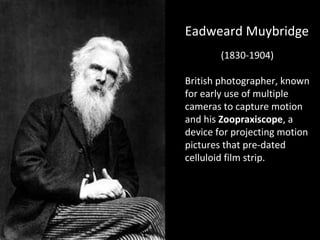
EEaaddwweeaarrdd MMuuyybbrriiddggee 
(1830-1904) 
British photographer, known 
for early use of multiple 
cameras to capture motion 
and his Zoopraxiscope, a 
device for projecting motion 
pictures that pre-dated 
celluloid film strip.
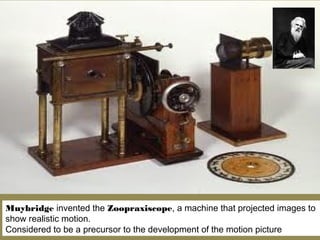
Muybridge invented the Zoopraxiscope, a machine that projected images to 
show realistic motion. 
Considered to be a precursor to the development of the motion picture 
5
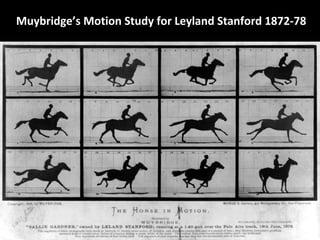
Muybridge’s Motion Study ffoorr LLeeyyllaanndd SSttaannffoorrdd 11887722--7788
EEaaddwweeaarrdd MMuuyybbrriiddggee,, 
7 
11887722 -- 11887788 
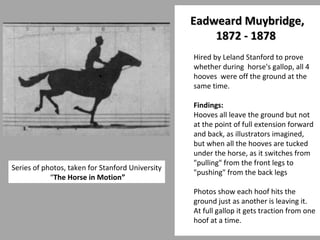
Hired by Leland Stanford to prove 
whether during horse's gallop, all 4 
hooves were off the ground at the 
same time. 
Findings: 
Hooves all leave the ground but not 
at the point of full extension forward 
and back, as illustrators imagined, 
but when all the hooves are tucked 
under the horse, as it switches from 
"pulling" from the front legs to 
"pushing" from the back legs 
Photos show each hoof hits the 
ground just as another is leaving it. 
At full gallop it gets traction from one 
hoof at a time. 
Series of photos, taken for Stanford University 
“The Horse in Motion”
8 
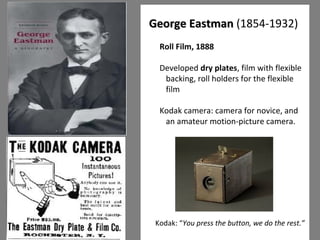
GGeeoorrggee EEaassttmmaann (1854-1932) 
Roll Film, 1888 
Developed dry plates, film with flexible 
backing, roll holders for the flexible 
film 
Kodak camera: camera for novice, and 
an amateur motion-picture camera. 
Kodak: “You press the button, we do the rest.”
9 
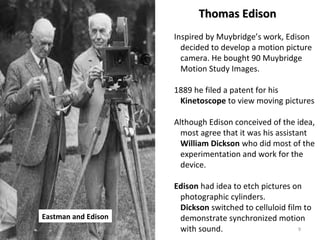
TThhoommaass EEddiissoonn 
Inspired by Muybridge’s work, Edison 
decided to develop a motion picture 
camera. He bought 90 Muybridge 
Motion Study Images. 
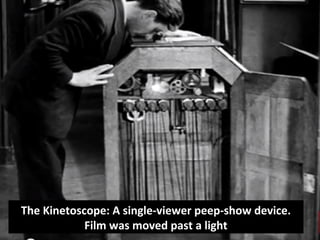
1889 he filed a patent for his 
Kinetoscope to view moving pictures 
Although Edison conceived of the idea, 
most agree that it was his assistant 
William Dickson who did most of the 
experimentation and work for the 
device. 
Edison had idea to etch pictures on 
photographic cylinders. 
Dickson switched to celluloid film to 
demonstrate synchronized motion 
with sound. 
Eastman and Edison
The Kinetoscope: A single-vviieewweerr ppeeeepp--sshhooww ddeevviiccee.. 
FFiillmm wwaass mmoovveedd ppaasstt aa lliigghhtt
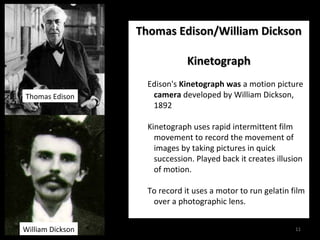
TThhoommaass EEddiissoonn//WWiilllliiaamm DDiicckkssoonn 
11 
KKiinneettooggrraapphh 
Edison's Kinetograph was a motion picture 
camera developed by William Dickson, 
1892 
Kinetograph uses rapid intermittent film 
movement to record the movement of 
images by taking pictures in quick 
succession. Played back it creates illusion 
of motion. 
To record it uses a motor to run gelatin film 
over a photographic lens. 
Thomas Edison 
William Dickson
12 
TThhoommaass EEddiissoonn -- 
KKiinneettooggrraapphh 
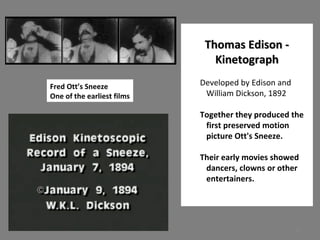
Developed by Edison and 
William Dickson, 1892 
Together they produced the 
first preserved motion 
picture Ott's Sneeze. 
Their early movies showed 
dancers, clowns or other 
entertainers. 
Fred Ott’s Sneeze 
One of the earliest films
EEddiissoonn//DDiicckkssoonn EEaarrllyy FFiillmmss 
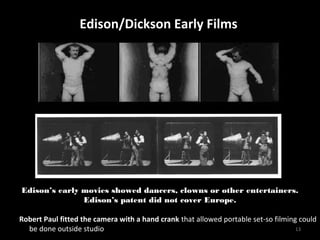
Edison’s early movies showed dancers, clowns or other entertainers. 
13 
Edison’s patent did not cover Europe. 
Robert Paul fitted the camera with a hand crank that allowed portable set-so filming could 
be done outside studio
LLuummiieerree BBrrootthheerrss 
15 
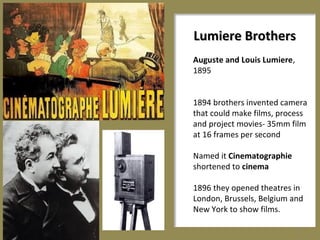
Auguste and Louis Lumiere, 
1895 
1894 brothers invented camera 
that could make films, process 
and project movies- 35mm film 
at 16 frames per second 
Named it Cinematographie 
shortened to cinema 
1896 they opened theatres in 
London, Brussels, Belgium and 
New York to show films.
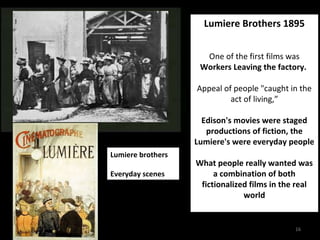
Lumiere Brothers 1895 
One of the first films was 
Workers Leaving the factory. 
Appeal of people "caught in the 
16 
act of living,” 
Edison's movies were staged 
productions of fiction, the 
Lumiere's were everyday people 
What people really wanted was 
a combination of both 
fictionalized films in the real 
world 
Lumiere brothers 
Everyday scenes
17 
GGeeoorrggee MMeelliieess 
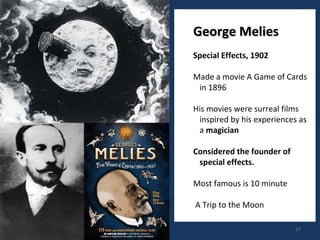
Special Effects, 1902 
Made a movie A Game of Cards 
in 1896 
His movies were surreal films 
inspired by his experiences as 
a magician 
Considered the founder of 
special effects. 
Most famous is 10 minute 
A Trip to the Moon
18 
AAccttiioonn--AAddvveennttuurreess 
EEddwwiinn PPoorrtteerr 
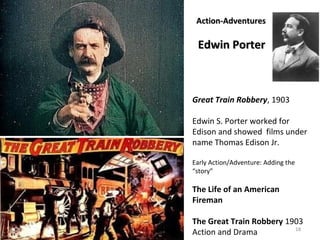
Great Train Robbery, 1903 
Edwin S. Porter worked for 
Edison and showed films under 
name Thomas Edison Jr. 
Early Action/Adventure: Adding the 
“story” 
The Life of an American 
Fireman 
The Great Train Robbery 1903 
Action and Drama
19 
Action-Adventures 
D.W. Griffith 
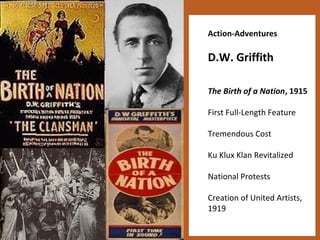
The Birth of a Nation, 1915 
First Full-Length Feature 
Tremendous Cost 
Ku Klux Klan Revitalized 
National Protests 
Creation of United Artists, 
1919
20 
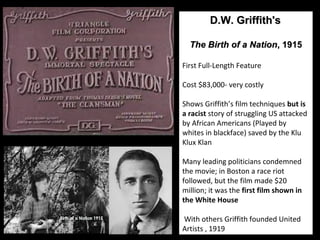
DD..WW.. GGrriiffffiitthh''ss 
TThhee BBiirrtthh ooff aa NNaattiioonn,, 11991155 
First Full-Length Feature 
Cost $83,000- very costly 
Shows Griffith’s film techniques but is 
a racist story of struggling US attacked 
by African Americans (Played by 
whites in blackface) saved by the Klu 
Klux Klan 
Many leading politicians condemned 
the movie; in Boston a race riot 
followed, but the film made $20 
million; it was the first film shown in 
the White House 
With others Griffith founded United 
Artists , 1919
21 
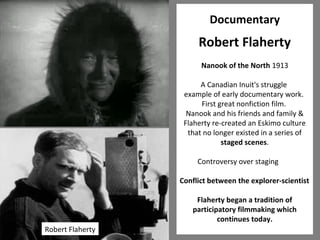
Documentary 
Robert Flaherty 
Nanook of the North 1913 
A Canadian Inuit's struggle 
example of early documentary work. 
First great nonfiction film. 
Nanook and his friends and family & 
Flaherty re-created an Eskimo culture 
that no longer existed in a series of 
staged scenes. 
Controversy over staging 
Conflict between the explorer-scientist 
Flaherty began a tradition of 
participatory filmmaking which 
continues today. 
Robert Flaherty
22 
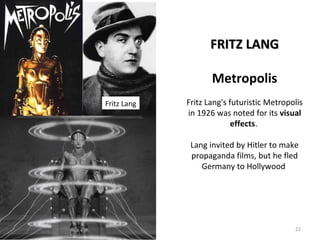
FFRRIITTZZ LLAANNGG 
Metropolis 
Fritz Lang's futuristic Metropolis 
in 1926 was noted for its visual 
effects. 
Lang invited by Hitler to make 
propaganda films, but he fled 
Germany to Hollywood 
Fritz Lang
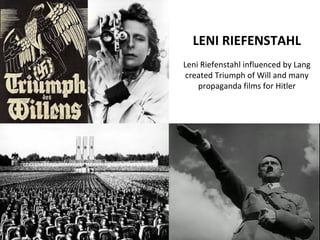
LENI RIEFENSTAHL 
Leni Riefenstahl influenced by Lang 
created Triumph of Will and many 
propaganda films for Hitler 
23
24 
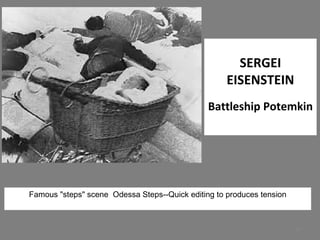
SERGEI 
EISENSTEIN 
Battleship Potemkin 
Famous "steps" scene Odessa Steps--Quick editing to produces tension
25 
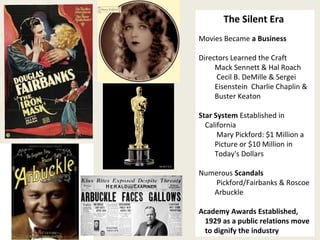
The Silent Era 
Movies Became a Business 
Directors Learned the Craft 
Mack Sennett & Hal Roach 
Cecil B. DeMille & Sergei 
Eisenstein Charlie Chaplin & 
Buster Keaton 
Star System Established in 
California 
Mary Pickford: $1 Million a 
Picture or $10 Million in 
Today's Dollars 
Numerous Scandals 
Pickford/Fairbanks & Roscoe 
Arbuckle 
Academy Awards Established, 
1929 as a public relations move 
to dignify the industry
SSyynncchhrroonniizziinngg 
26 
SSoouunndd 
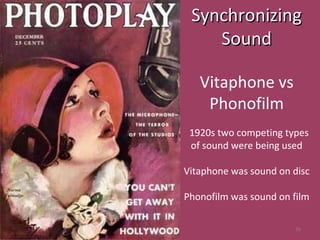
Vitaphone vs 
Phonofilm 
1920s two competing types 
of sound were being used 
Vitaphone was sound on disc 
Phonofilm was sound on film
27 
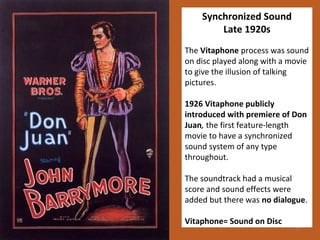
Synchronized Sound 
Late 1920s 
The Vitaphone process was sound 
on disc played along with a movie 
to give the illusion of talking 
pictures. 
1926 Vitaphone publicly 
introduced with premiere of Don 
Juan, the first feature-length 
movie to have a synchronized 
sound system of any type 
throughout. 
The soundtrack had a musical 
score and sound effects were 
added but there was no dialogue. 
Vitaphone= Sound on Disc
28 
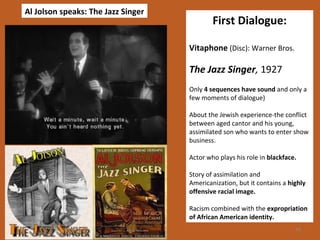
First Dialogue: 
Vitaphone (Disc): Warner Bros. 
The Jazz Singer, 1927 
Only 4 sequences have sound and only a 
few moments of dialogue) 
About the Jewish experience-the conflict 
between aged cantor and his young, 
assimilated son who wants to enter show 
business. 
Actor who plays his role in blackface. 
Story of assimilation and 
Americanization, but it contains a highly 
offensive racial image. 
Racism combined with the expropriation 
of African American identity. 
Al Jolson speaks: The Jazz Singer
29 
Sound on Disc : 1926-1931 
Vitaphone 
Weakness: cumbersome equipment, vulnerable to severe 
synchronization problems, inability to edit 
Sound on Film: 1923- 
Phonofilm 
Versions of Phonofilm followed: Movietone and later Photophone 
were eventually adopted 
Synchronization revived the slumping industry
30 
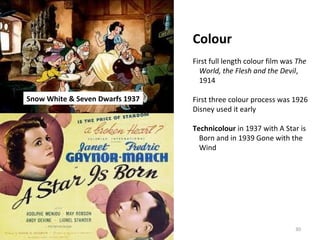
Colour 
First full length colour film was The 
World, the Flesh and the Devil, 
1914 
First three colour process was 1926 
Disney used it early 
Technicolour in 1937 with A Star is 
Born and in 1939 Gone with the 
Wind 
Snow White & Seven Dwarfs 1937
31 
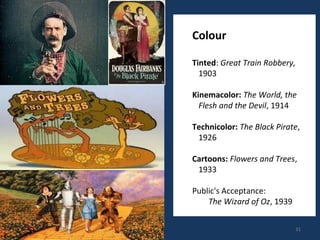
Colour 
Tinted: Great Train Robbery, 
1903 
Kinemacolor: The World, the 
Flesh and the Devil, 1914 
Technicolor: The Black Pirate, 
1926 
Cartoons: Flowers and Trees, 
1933 
Public's Acceptance: 
The Wizard of Oz, 1939
32 
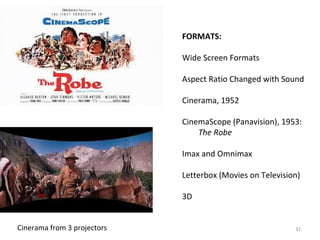
FORMATS: 
Wide Screen Formats 
Aspect Ratio Changed with Sound 
Cinerama, 1952 
CinemaScope (Panavision), 1953: 
The Robe 
Imax and Omnimax 
Letterbox (Movies on Television) 
3D 
Cinerama from 3 projectors
33 
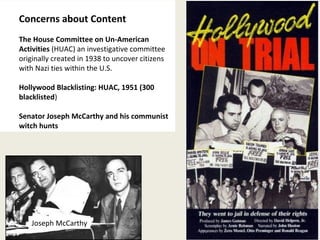
Concerns about Content 
The House Committee on Un-American 
Activities (HUAC) an investigative committee 
originally created in 1938 to uncover citizens 
with Nazi ties within the U.S. 
Hollywood Blacklisting: HUAC, 1951 (300 
blacklisted) 
Senator Joseph McCarthy and his communist 
witch hunts 
Joseph McCarthy
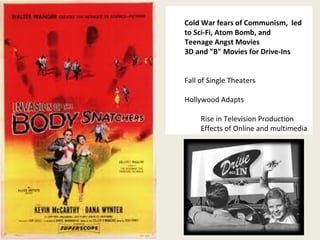
Cold War fears of Communism, led 
to Sci-Fi, Atom Bomb, and 
Teenage Angst Movies 
3D and "B" Movies for Drive-Ins 
34 
Fall of Single Theaters 
Hollywood Adapts 
Rise in Television Production 
Effects of Online and multimedia

Motion Pictures: Historical perspective

  • 1.
  • 2.
    Throughout the evolutionof ffiillmm mmaakkiinngg,, ssttuuddiioo eexxeeccuuttiivveess,, ddiirreeccttoorrss aanndd iinnvveennttoorrss hhaavvee wwoorrkkeedd ttoo kkeeeepp tthhee mmeeddiiuumm rreelleevvaanntt wwiitthh ccoonnttiinnuuaall aaddaappttaattiioonn
  • 4.
    EEaaddwweeaarrdd MMuuyybbrriiddggee (1830-1904) British photographer, known for early use of multiple cameras to capture motion and his Zoopraxiscope, a device for projecting motion pictures that pre-dated celluloid film strip.
  • 5.
    Muybridge invented theZoopraxiscope, a machine that projected images to show realistic motion. Considered to be a precursor to the development of the motion picture 5
  • 6.
    Muybridge’s Motion Studyffoorr LLeeyyllaanndd SSttaannffoorrdd 11887722--7788
  • 7.
    EEaaddwweeaarrdd MMuuyybbrriiddggee,, 7 11887722 -- 11887788 Hired by Leland Stanford to prove whether during horse's gallop, all 4 hooves were off the ground at the same time. Findings: Hooves all leave the ground but not at the point of full extension forward and back, as illustrators imagined, but when all the hooves are tucked under the horse, as it switches from "pulling" from the front legs to "pushing" from the back legs Photos show each hoof hits the ground just as another is leaving it. At full gallop it gets traction from one hoof at a time. Series of photos, taken for Stanford University “The Horse in Motion”
  • 8.
    8 GGeeoorrggee EEaassttmmaann(1854-1932) Roll Film, 1888 Developed dry plates, film with flexible backing, roll holders for the flexible film Kodak camera: camera for novice, and an amateur motion-picture camera. Kodak: “You press the button, we do the rest.”
  • 9.
    9 TThhoommaass EEddiissoonn Inspired by Muybridge’s work, Edison decided to develop a motion picture camera. He bought 90 Muybridge Motion Study Images. 1889 he filed a patent for his Kinetoscope to view moving pictures Although Edison conceived of the idea, most agree that it was his assistant William Dickson who did most of the experimentation and work for the device. Edison had idea to etch pictures on photographic cylinders. Dickson switched to celluloid film to demonstrate synchronized motion with sound. Eastman and Edison
  • 10.
    The Kinetoscope: Asingle-vviieewweerr ppeeeepp--sshhooww ddeevviiccee.. FFiillmm wwaass mmoovveedd ppaasstt aa lliigghhtt
  • 11.
    TThhoommaass EEddiissoonn//WWiilllliiaamm DDiicckkssoonn 11 KKiinneettooggrraapphh Edison's Kinetograph was a motion picture camera developed by William Dickson, 1892 Kinetograph uses rapid intermittent film movement to record the movement of images by taking pictures in quick succession. Played back it creates illusion of motion. To record it uses a motor to run gelatin film over a photographic lens. Thomas Edison William Dickson
  • 12.
    12 TThhoommaass EEddiissoonn-- KKiinneettooggrraapphh Developed by Edison and William Dickson, 1892 Together they produced the first preserved motion picture Ott's Sneeze. Their early movies showed dancers, clowns or other entertainers. Fred Ott’s Sneeze One of the earliest films
  • 13.
    EEddiissoonn//DDiicckkssoonn EEaarrllyy FFiillmmss Edison’s early movies showed dancers, clowns or other entertainers. 13 Edison’s patent did not cover Europe. Robert Paul fitted the camera with a hand crank that allowed portable set-so filming could be done outside studio
  • 15.
    LLuummiieerree BBrrootthheerrss 15 Auguste and Louis Lumiere, 1895 1894 brothers invented camera that could make films, process and project movies- 35mm film at 16 frames per second Named it Cinematographie shortened to cinema 1896 they opened theatres in London, Brussels, Belgium and New York to show films.
  • 16.
    Lumiere Brothers 1895 One of the first films was Workers Leaving the factory. Appeal of people "caught in the 16 act of living,” Edison's movies were staged productions of fiction, the Lumiere's were everyday people What people really wanted was a combination of both fictionalized films in the real world Lumiere brothers Everyday scenes
  • 17.
    17 GGeeoorrggee MMeelliieess Special Effects, 1902 Made a movie A Game of Cards in 1896 His movies were surreal films inspired by his experiences as a magician Considered the founder of special effects. Most famous is 10 minute A Trip to the Moon
  • 18.
    18 AAccttiioonn--AAddvveennttuurreess EEddwwiinnPPoorrtteerr Great Train Robbery, 1903 Edwin S. Porter worked for Edison and showed films under name Thomas Edison Jr. Early Action/Adventure: Adding the “story” The Life of an American Fireman The Great Train Robbery 1903 Action and Drama
  • 19.
    19 Action-Adventures D.W.Griffith The Birth of a Nation, 1915 First Full-Length Feature Tremendous Cost Ku Klux Klan Revitalized National Protests Creation of United Artists, 1919
  • 20.
    20 DD..WW.. GGrriiffffiitthh''ss TThhee BBiirrtthh ooff aa NNaattiioonn,, 11991155 First Full-Length Feature Cost $83,000- very costly Shows Griffith’s film techniques but is a racist story of struggling US attacked by African Americans (Played by whites in blackface) saved by the Klu Klux Klan Many leading politicians condemned the movie; in Boston a race riot followed, but the film made $20 million; it was the first film shown in the White House With others Griffith founded United Artists , 1919
  • 21.
    21 Documentary RobertFlaherty Nanook of the North 1913 A Canadian Inuit's struggle example of early documentary work. First great nonfiction film. Nanook and his friends and family & Flaherty re-created an Eskimo culture that no longer existed in a series of staged scenes. Controversy over staging Conflict between the explorer-scientist Flaherty began a tradition of participatory filmmaking which continues today. Robert Flaherty
  • 22.
    22 FFRRIITTZZ LLAANNGG Metropolis Fritz Lang's futuristic Metropolis in 1926 was noted for its visual effects. Lang invited by Hitler to make propaganda films, but he fled Germany to Hollywood Fritz Lang
  • 23.
    LENI RIEFENSTAHL LeniRiefenstahl influenced by Lang created Triumph of Will and many propaganda films for Hitler 23
  • 24.
    24 SERGEI EISENSTEIN Battleship Potemkin Famous "steps" scene Odessa Steps--Quick editing to produces tension
  • 25.
    25 The SilentEra Movies Became a Business Directors Learned the Craft Mack Sennett & Hal Roach Cecil B. DeMille & Sergei Eisenstein Charlie Chaplin & Buster Keaton Star System Established in California Mary Pickford: $1 Million a Picture or $10 Million in Today's Dollars Numerous Scandals Pickford/Fairbanks & Roscoe Arbuckle Academy Awards Established, 1929 as a public relations move to dignify the industry
  • 26.
    SSyynncchhrroonniizziinngg 26 SSoouunndd Vitaphone vs Phonofilm 1920s two competing types of sound were being used Vitaphone was sound on disc Phonofilm was sound on film
  • 27.
    27 Synchronized Sound Late 1920s The Vitaphone process was sound on disc played along with a movie to give the illusion of talking pictures. 1926 Vitaphone publicly introduced with premiere of Don Juan, the first feature-length movie to have a synchronized sound system of any type throughout. The soundtrack had a musical score and sound effects were added but there was no dialogue. Vitaphone= Sound on Disc
  • 28.
    28 First Dialogue: Vitaphone (Disc): Warner Bros. The Jazz Singer, 1927 Only 4 sequences have sound and only a few moments of dialogue) About the Jewish experience-the conflict between aged cantor and his young, assimilated son who wants to enter show business. Actor who plays his role in blackface. Story of assimilation and Americanization, but it contains a highly offensive racial image. Racism combined with the expropriation of African American identity. Al Jolson speaks: The Jazz Singer
  • 29.
    29 Sound onDisc : 1926-1931 Vitaphone Weakness: cumbersome equipment, vulnerable to severe synchronization problems, inability to edit Sound on Film: 1923- Phonofilm Versions of Phonofilm followed: Movietone and later Photophone were eventually adopted Synchronization revived the slumping industry
  • 30.
    30 Colour Firstfull length colour film was The World, the Flesh and the Devil, 1914 First three colour process was 1926 Disney used it early Technicolour in 1937 with A Star is Born and in 1939 Gone with the Wind Snow White & Seven Dwarfs 1937
  • 31.
    31 Colour Tinted:Great Train Robbery, 1903 Kinemacolor: The World, the Flesh and the Devil, 1914 Technicolor: The Black Pirate, 1926 Cartoons: Flowers and Trees, 1933 Public's Acceptance: The Wizard of Oz, 1939
  • 32.
    32 FORMATS: WideScreen Formats Aspect Ratio Changed with Sound Cinerama, 1952 CinemaScope (Panavision), 1953: The Robe Imax and Omnimax Letterbox (Movies on Television) 3D Cinerama from 3 projectors
  • 33.
    33 Concerns aboutContent The House Committee on Un-American Activities (HUAC) an investigative committee originally created in 1938 to uncover citizens with Nazi ties within the U.S. Hollywood Blacklisting: HUAC, 1951 (300 blacklisted) Senator Joseph McCarthy and his communist witch hunts Joseph McCarthy
  • 34.
    Cold War fearsof Communism, led to Sci-Fi, Atom Bomb, and Teenage Angst Movies 3D and "B" Movies for Drive-Ins 34 Fall of Single Theaters Hollywood Adapts Rise in Television Production Effects of Online and multimedia

Editor's Notes

  • #6 Conducted research to improve the chemistry of his development methods to better capture motion in his photography. Muybridge invented Zoopraxiscope, a machine similar to the Zoetrope, but that projected the images so the public could see realistic motion.System was, in many ways, a precursor to the development of the motion picture
  • #8 Conducted research to improve the chemistry of his development methods to better capture motion in his photography. Muybridge invented Zoopraxiscope, a machine similar to the Zoetrope, but that projected the images so the public could see realistic motion.System was, in many ways, a precursor to the development of the motion picture Muybridge Movie
  • #13 Thomas Edison in 1880s had the idea of etching pictures on his phonograph cylinders- assistant Dickson switched to celluloid film to demonstrate synchronized motion with sound - together they produced the first preserved motion picture Ott's Sneeze Ott's Sneeze clip
  • #14 Early Edison Films Edison’s patent did not cover Europe.
  • #16 The brothers opened theatres to show their films (cinemas). In the first 4 months of 1896 they had opened Cinématographe theatres in London, Brussels, Belgium and New York.
  • #17 The inventions of moviemaking is fraught with smoke and mirrors. Someone was constantly taking credit for advances and processes. The Lumiere's were good at being entrepreneurs and they succeeded in getting to the patent office first. Lumiere1895 clip
  • #19 GreatTrainRobbery..storytelling- action adventure
  • #21 Birthofnation
  • #22 Conflict between the explorer-scientist disciplined into giving facts and figures and the story-teller-turned-film-director who left out certain facts and emphasized others. Nanook movie
  • #23 metropolis
  • #25 Battleshippotemkin clip stairs
  • #27 Vitaphone was sound on disc played along with movie to give illusion of talking pictures Most in industry believed talkies couldn’t be profitable Jolson Jazz Singer clip
  • #28 Vitaphone was sound on disc played along with movie to give illusion of talking pictures Most in industry believed talkies couldn’t be profitable Jolson Jazz Singer clip
  • #29 Vitaphone was sound on disc played along with movie to give illusion of talking pictures Most in industry believed talkies couldn’t be profitable Jolson Jazz Singer clip