Auteur Theory

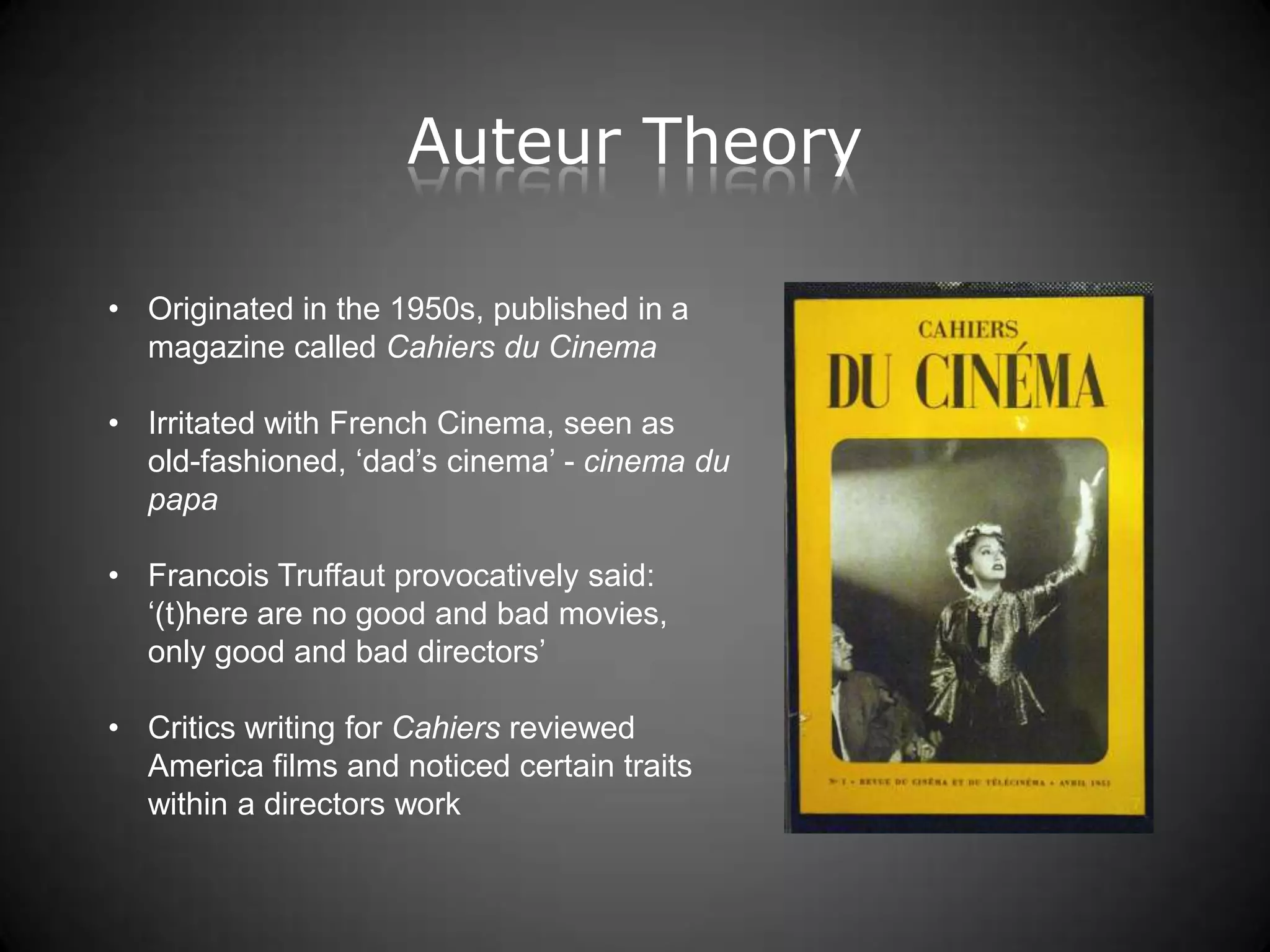
• Originated in the 1950s, published in a
  magazine called Cahiers du Cinema

• Irritated with French Cinema, seen as
  old-fashioned, „dad‟s cinema‟ - cinema du
  papa

• Francois Truffaut provocatively said:
  „(t)here are no good and bad movies,
  only good and bad directors‟

• Critics writing for Cahiers reviewed
  America films and noticed certain traits
  within a directors work
Auteur Theory

    • They encouraged directors to work
      within the studio system to imprint
      their name on creative work

    • Alexandre Astruci: „Use the camera
      like a pen‟…

    • Film as art, not just a piece of
      entertainment

    • Product of an individual‟s
      imagination
Auteur Theory
• Made a habit of attacking the most
  artistically respected French film makers

• Jean Luc Goddard: „ Your camera
  movements are ugly because your
  subjects are bad, your casts act badly
  because your dialogue is worthless; in a
  word, you don‟t know how to create
  cinema because you no longer know what
  it is.‟

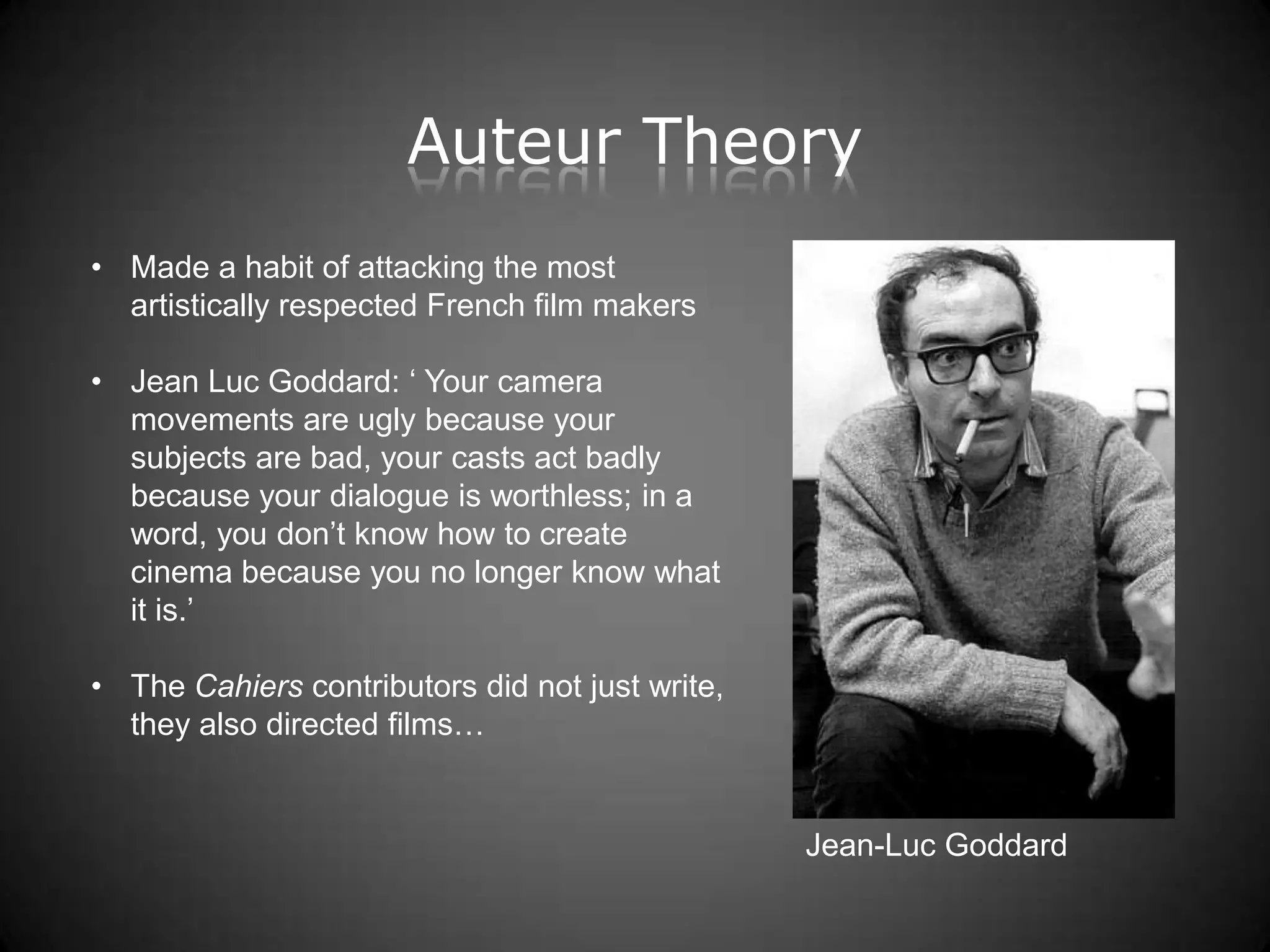
• The Cahiers contributors did not just write,
  they also directed films…


                                                 Jean-Luc Goddard
Auteur Theory
     •   Rivette made Paris Belongs to Us (1961)

     •   Goddard made Breathless (1960)

     •   Truffaut made The 400 Blows (1959)

     •   These films were known as French New Wave
         cinema

     •   The 400 Blows won the Grand Prize at the
         Cannes Film festival

     •   Goddard: “We won the day in having it
         acknowledged in principle that a film by
         Hitchcock, for example, is as important as a
         book by Aragon. Film auteurs, thanks to us
         have finally entered the history books.”
Auteur Theory
•   The director as Auteur had certainly been around
    before the 1960s, but these directors were few and
    far between, such as Tod Browning, (Freaks 1932)
    who was dubbed ‘the Edgar Allan Poe of the cinema‟

•   He made films such as „Dracula‟ in 1931 and was the
    king of the early horror genre

•   But these directors were not known as auteurs until
    the development of auteur theory in the late „50‟s &
    „60‟s

•   It was not until the end of the Studio System (started
    by The Paramount Decree 1949) in the late fifties
    and early sixties, that the director, had any chance of
    becoming an auteur because of the strict control that
    the studios held over the individual
Director of Auteur
      • Dictionary definition: „…dominates the
        film-making process‟ so much „…that it is
        appropriate to call the director the auteur,
        or author, of the motion picture

      • The theory also states that the director
        projects his or her own personal style
        onto the film as they are „…the primary
        person responsible for the creation of‟
        the film

      • However, another important aspect of
        this theory is the „…commonality of
        theme‟ that is seen in each of the films
        that the director makes
Traditional French Cinema
•   Large budgets

•   Established stars

•   Literary/historical characters (archetypal heroes)

•   Adaptations of classics (popular but little thematic originality)

•   Traditional narratives (classical construction and plot)

•   Domination of scripted dialogue (power of scriptwriter)

•   Big production machinery (crew and equipment)

•   Studio sets (artificial light and post synchronised sound)

•   Heavy technical equipment (not very versatile)

•   Commercial success and popular audiences (profitable, around 5-7M spectators)

•   Example: Les Enfants Terribles (1950)
French New Wave
• David Bordwell: „…to the proponents of the carefully polished
  French “cinema of quality,” the young directors must have
  seemed hopelessly sloppy.‟
• Casual look
• Actors improvised lines
• Relatively small budgets
• Co-productions and self-production
• New generation of young actors/ actresses playing young
  characters
• Original screenplays and/ or adaptations (auteur)
• Personal tone and themes (auteur)
• Modern tone
• Technical innovations at the service of the New Wave
• Natural sets/ location shooting
• Natural light - Studio lighting replaced with day light
• Example: Breathless (1960)
Andrew Sarris
• American film theorist, 1960s

• Used the French auteur theory
  to elevate American cinema

• Bar one or two European films,
  all good cinema came out of
  Hollywood

• This led to the notion of „good‟
  or great „directors‟ and the rest

• Not the intent use…
Andrew Sarris
       •   Recognising the film‟s „author‟
           does not necessarily make it a
           good film

       •   „The Three premise of the
           auteur theory may be
           visualised as three concentric
           circles, the outer circle as
           technique, the middle circle a
           personal style, and the inner
           circle interior meaning. The
           corresponding roles of the
           director may be designated as
           those of a technician, a stylist,
           and an auteur.‟
Concentric Circles

         Technician: Techniques

         Stylist: Personal style


         Auteur: Interior meaning
Hitchcock’s Circles
         • Technician: strict filming schedule
           and unusual camera angles. Total
           command over all elements.

         • Stylist: suspense, thriller genre,
           lovable rogue characters, gritty.

         • Auteur: Loneliness (Hitchcock
           was lonely as a child), The wrong
           man falsely accused (Hitchcock
           was accused wrongly by his
           father as a child.
Truffaut on Hitchcock
• The virtuoso editing

• The lyrical camera movements

• The droll humour

• The wrong man falsely accused

• Violence erupting at the times it
  was least expected

• The cool blonde (often
  emotionally tortured)

• Creation of cinematic tension
How To Recognise and Auteur
             • To be considered an auteur, a
               film-maker must have a body of
               work (oeuvre) which can be
               analysed for on-going themes
               and considerations, whether they
               occur intentionally or
               unintentionally

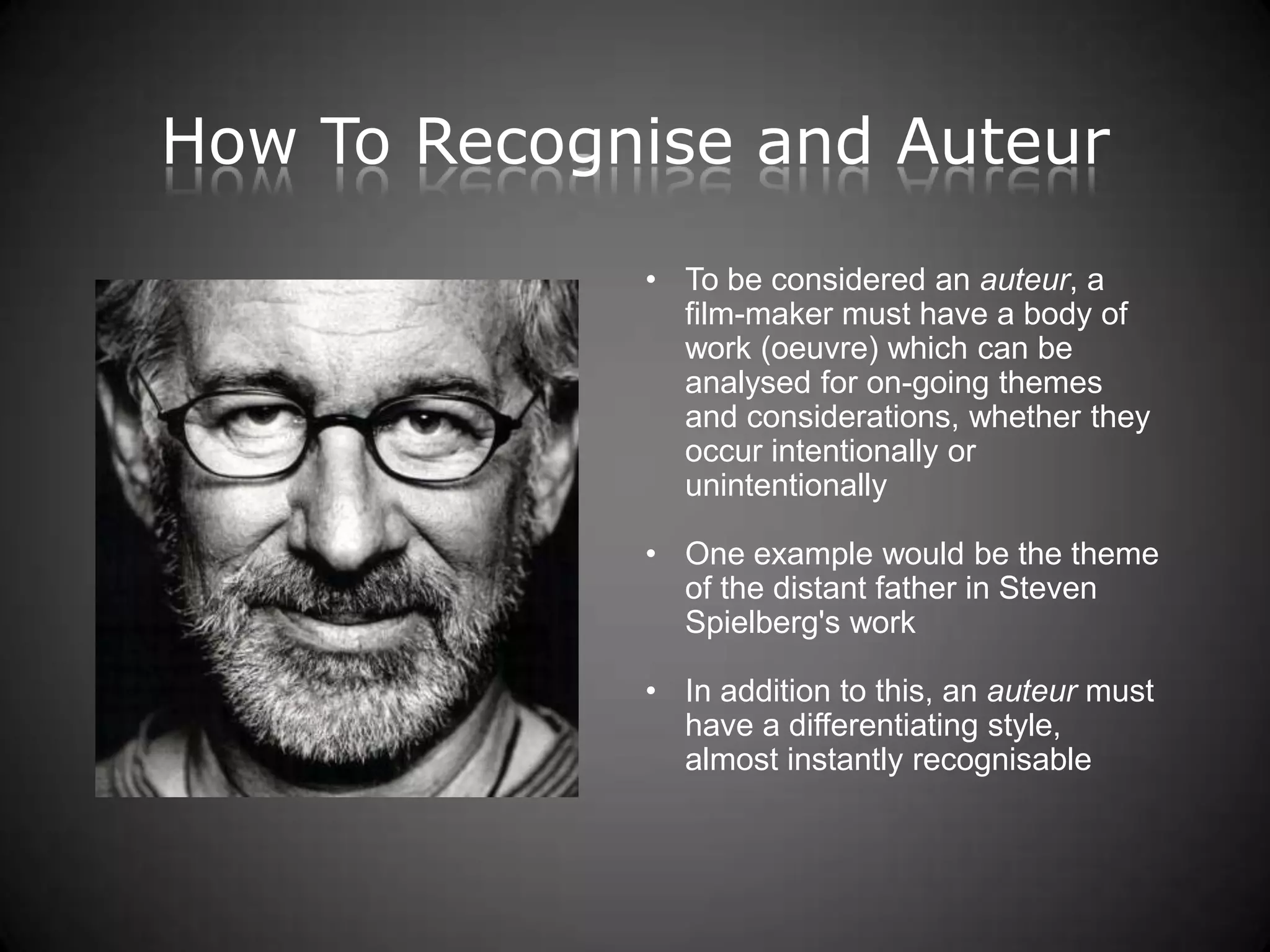
             • One example would be the theme
               of the distant father in Steven
               Spielberg's work

             • In addition to this, an auteur must
               have a differentiating style,
               almost instantly recognisable
Selling Films through Auteurs

Directors (auteurs) can be used to
sell films

. Tim Burton, Spike Lee, David
Lynch, Woody Allen, Martin
Scorsese, Francis Ford Coppola,
Ridley Scott or Steven Soderbergh
"brands."

. Often their names are on the top
of the poster to market to fans
Metteurs en Scene
•   François Truffaut argued that good directors are not necessarily auteurs

•   No authority and not personal „stamp‟

•   A good example is Peter Jackson, the director responsible primarily for the Lord
    of the Rings trilogy

•   Despite the fact he has previously written his own films, in adapting someone
    else‟s work he removes a certain amount of artistic control

•   Bound by economic pressures in which Hollywood places economic success
    over artistry

•   Jackson lacks over ridding themes, recognisable artistic design

•   No personal views included in his films


•   Good director but lacks the credentials to be called an auteur
Issues with Auteur Theory
• Films are a collaborative effort

• Ignores the role of writers, actors, musicians

• Praise for the director at the expense of everyone else

• The most powerful force in most films is the studio under which it
  is being made

• New Crticism, argued that making meaning out of what directors
  were attempting to portray was secondary to the actual
  visualisation on screen
Acting Auteurs
• Case being made for the actor as
  auteur
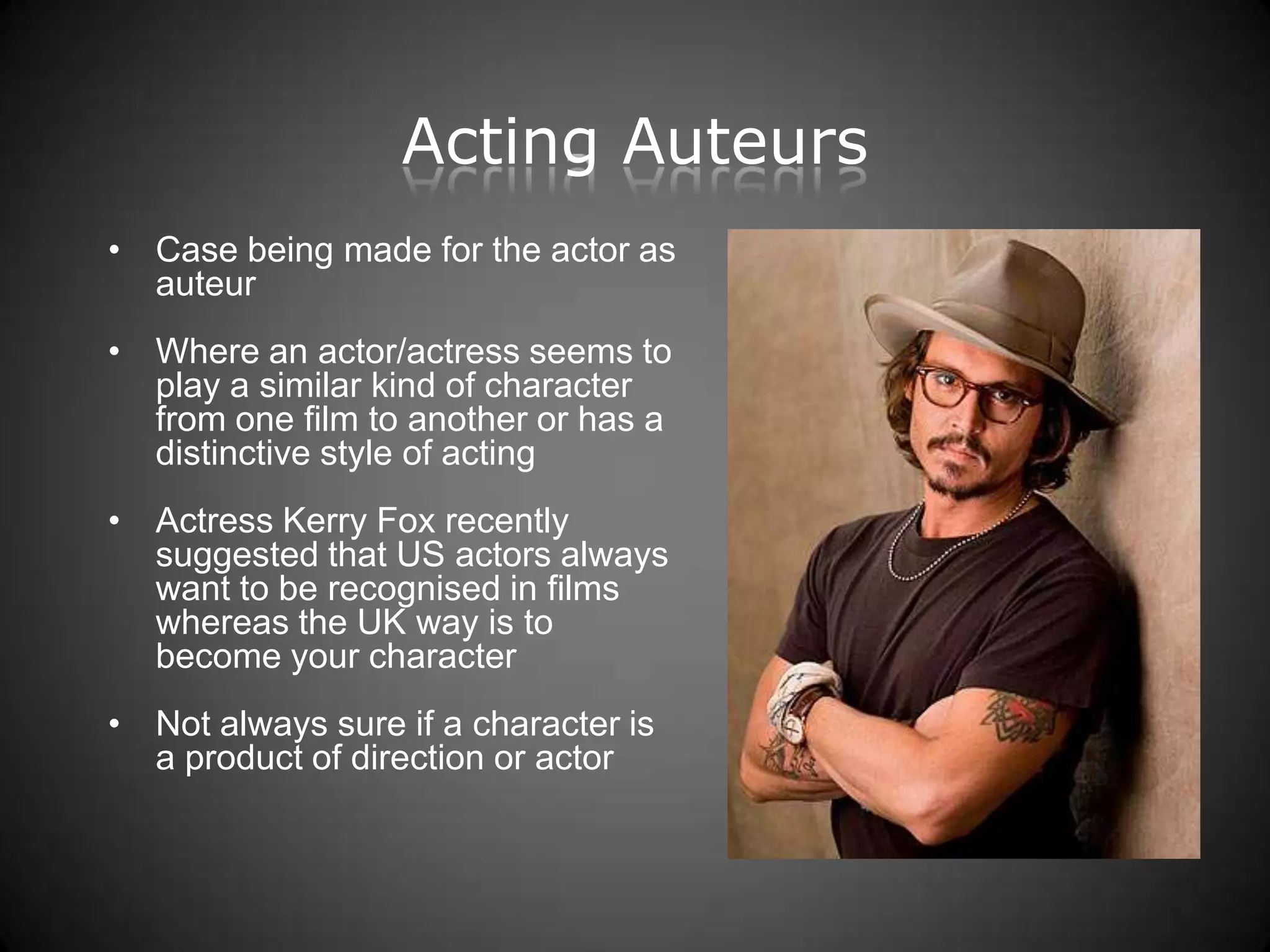
• Where an actor/actress seems to
  play a similar kind of character
  from one film to another or has a
  distinctive style of acting
• Actress Kerry Fox recently
  suggested that US actors always
  want to be recognised in films
  whereas the UK way is to
  become your character
• Not always sure if a character is
  a product of direction or actor

Auteur Theory (TV Y1)

  • 1.
    Auteur Theory • Originatedin the 1950s, published in a magazine called Cahiers du Cinema • Irritated with French Cinema, seen as old-fashioned, „dad‟s cinema‟ - cinema du papa • Francois Truffaut provocatively said: „(t)here are no good and bad movies, only good and bad directors‟ • Critics writing for Cahiers reviewed America films and noticed certain traits within a directors work
  • 2.
    Auteur Theory • They encouraged directors to work within the studio system to imprint their name on creative work • Alexandre Astruci: „Use the camera like a pen‟… • Film as art, not just a piece of entertainment • Product of an individual‟s imagination
  • 3.
    Auteur Theory • Madea habit of attacking the most artistically respected French film makers • Jean Luc Goddard: „ Your camera movements are ugly because your subjects are bad, your casts act badly because your dialogue is worthless; in a word, you don‟t know how to create cinema because you no longer know what it is.‟ • The Cahiers contributors did not just write, they also directed films… Jean-Luc Goddard
  • 4.
    Auteur Theory • Rivette made Paris Belongs to Us (1961) • Goddard made Breathless (1960) • Truffaut made The 400 Blows (1959) • These films were known as French New Wave cinema • The 400 Blows won the Grand Prize at the Cannes Film festival • Goddard: “We won the day in having it acknowledged in principle that a film by Hitchcock, for example, is as important as a book by Aragon. Film auteurs, thanks to us have finally entered the history books.”
  • 5.
    Auteur Theory • The director as Auteur had certainly been around before the 1960s, but these directors were few and far between, such as Tod Browning, (Freaks 1932) who was dubbed ‘the Edgar Allan Poe of the cinema‟ • He made films such as „Dracula‟ in 1931 and was the king of the early horror genre • But these directors were not known as auteurs until the development of auteur theory in the late „50‟s & „60‟s • It was not until the end of the Studio System (started by The Paramount Decree 1949) in the late fifties and early sixties, that the director, had any chance of becoming an auteur because of the strict control that the studios held over the individual
  • 6.
    Director of Auteur • Dictionary definition: „…dominates the film-making process‟ so much „…that it is appropriate to call the director the auteur, or author, of the motion picture • The theory also states that the director projects his or her own personal style onto the film as they are „…the primary person responsible for the creation of‟ the film • However, another important aspect of this theory is the „…commonality of theme‟ that is seen in each of the films that the director makes
  • 7.
    Traditional French Cinema • Large budgets • Established stars • Literary/historical characters (archetypal heroes) • Adaptations of classics (popular but little thematic originality) • Traditional narratives (classical construction and plot) • Domination of scripted dialogue (power of scriptwriter) • Big production machinery (crew and equipment) • Studio sets (artificial light and post synchronised sound) • Heavy technical equipment (not very versatile) • Commercial success and popular audiences (profitable, around 5-7M spectators) • Example: Les Enfants Terribles (1950)
  • 8.
    French New Wave •David Bordwell: „…to the proponents of the carefully polished French “cinema of quality,” the young directors must have seemed hopelessly sloppy.‟ • Casual look • Actors improvised lines • Relatively small budgets • Co-productions and self-production • New generation of young actors/ actresses playing young characters • Original screenplays and/ or adaptations (auteur) • Personal tone and themes (auteur) • Modern tone • Technical innovations at the service of the New Wave • Natural sets/ location shooting • Natural light - Studio lighting replaced with day light • Example: Breathless (1960)
  • 9.
    Andrew Sarris • Americanfilm theorist, 1960s • Used the French auteur theory to elevate American cinema • Bar one or two European films, all good cinema came out of Hollywood • This led to the notion of „good‟ or great „directors‟ and the rest • Not the intent use…
  • 10.
    Andrew Sarris • Recognising the film‟s „author‟ does not necessarily make it a good film • „The Three premise of the auteur theory may be visualised as three concentric circles, the outer circle as technique, the middle circle a personal style, and the inner circle interior meaning. The corresponding roles of the director may be designated as those of a technician, a stylist, and an auteur.‟
  • 11.
    Concentric Circles Technician: Techniques Stylist: Personal style Auteur: Interior meaning
  • 12.
    Hitchcock’s Circles • Technician: strict filming schedule and unusual camera angles. Total command over all elements. • Stylist: suspense, thriller genre, lovable rogue characters, gritty. • Auteur: Loneliness (Hitchcock was lonely as a child), The wrong man falsely accused (Hitchcock was accused wrongly by his father as a child.
  • 13.
    Truffaut on Hitchcock •The virtuoso editing • The lyrical camera movements • The droll humour • The wrong man falsely accused • Violence erupting at the times it was least expected • The cool blonde (often emotionally tortured) • Creation of cinematic tension
  • 14.
    How To Recogniseand Auteur • To be considered an auteur, a film-maker must have a body of work (oeuvre) which can be analysed for on-going themes and considerations, whether they occur intentionally or unintentionally • One example would be the theme of the distant father in Steven Spielberg's work • In addition to this, an auteur must have a differentiating style, almost instantly recognisable
  • 15.
    Selling Films throughAuteurs Directors (auteurs) can be used to sell films . Tim Burton, Spike Lee, David Lynch, Woody Allen, Martin Scorsese, Francis Ford Coppola, Ridley Scott or Steven Soderbergh "brands." . Often their names are on the top of the poster to market to fans
  • 16.
    Metteurs en Scene • François Truffaut argued that good directors are not necessarily auteurs • No authority and not personal „stamp‟ • A good example is Peter Jackson, the director responsible primarily for the Lord of the Rings trilogy • Despite the fact he has previously written his own films, in adapting someone else‟s work he removes a certain amount of artistic control • Bound by economic pressures in which Hollywood places economic success over artistry • Jackson lacks over ridding themes, recognisable artistic design • No personal views included in his films • Good director but lacks the credentials to be called an auteur
  • 17.
    Issues with AuteurTheory • Films are a collaborative effort • Ignores the role of writers, actors, musicians • Praise for the director at the expense of everyone else • The most powerful force in most films is the studio under which it is being made • New Crticism, argued that making meaning out of what directors were attempting to portray was secondary to the actual visualisation on screen
  • 18.
    Acting Auteurs • Casebeing made for the actor as auteur • Where an actor/actress seems to play a similar kind of character from one film to another or has a distinctive style of acting • Actress Kerry Fox recently suggested that US actors always want to be recognised in films whereas the UK way is to become your character • Not always sure if a character is a product of direction or actor