ME 212 Human Resources Development
         and Management
   Socializing, orienting, training
    and developing employees are
    processes that help new
    employee adapt to their
    organizations and work
    responsibilities.
       Socialization or on boarding is a
        process of adaptation that takes
        place as individuals attempt to
        learn the values and norms of
        work roles
       Socialization as a process made up
        three stages:
            pre arrival stage, encounter stage
             and metamorphosis
   Pre arrival stage where it
    recognizes that individuals arrive
    in an organization with a set of
    organizational values, attitudes
    and expectations;

   Encounter stage is where
    individuals confront possible
    dichotomy between their
    organizational expectations and
    reality; and

   Metamorphosis stage where the
    new employee must work out
    inconsistencies discovered
    during the encounter stage.
 These are activities that
  introduce new employees to
  the organization and their
  work units.
 It expands on information
  received during the
  recruitment and selection
  stages and helps reduce the
  initial anxiety employees usually
  feel when beginning a new job.
   Who is responsible for orienting
    the new employee?
       This can be done by the new
        employee’s supervisor, people from
        HR, through computer based
        program or by some combination
        thereof.
   What should be oriented?
       Organization’s objective, history,
        philosophy, procedures and rules;
        communicate relevant HRM policies
        such as work hours, pay procedures,
        overtime requirements and company
        benefits.
 The first few days on a new job
                         are packed with learning new skills,
                         new co-workers and new policies.
                        An employee handbook, a booklet
                         describing important aspects of
                         employment an employee needs to
                         know.
                        The handbook can provide the
                         employee an opportunity to learn
Source: alfaisal.edu     about the company and what it
                         provides for them and to
                         understand the information at
                         their own pace.
 The system sharing meaning
                                within the organization that
                                determines how employees act.
                               An employee who has been
                                properly socialized to the
                                organization’s culture knows
                                what acceptable behavior is and
                                what it is not for.
Source: philippineforum.org
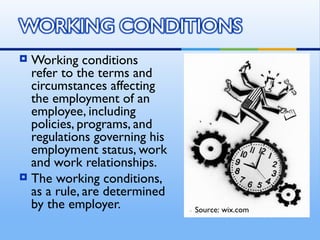
 Working conditions
  refer to the terms and
  circumstances affecting
  the employment of an
  employee, including
  policies, programs, and
  regulations governing his
  employment status, work
  and work relationships.
 The working conditions,
  as a rule, are determined
  by the employer.            Source: wix.com
   Normal Hours of Work –
    shall not exceed 8 hours a
    day as provided by law;
   Meal Periods-not less than
    60 minutes time-off for their
    regular meals;
   Night Shift Differential –
    Every employee shall be paid
     a night shift differential of
    not less than 10%of his
    regular wage for each hour,
    work performed bet. 10 pm
    and 6 am.
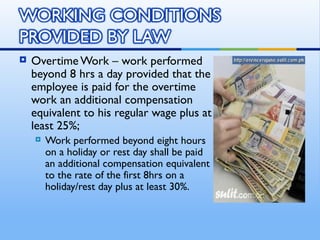
   Overtime Work – work performed
    beyond 8 hrs a day provided that the
    employee is paid for the overtime
    work an additional compensation
    equivalent to his regular wage plus at
    least 25%;
       Work performed beyond eight hours
        on a holiday or rest day shall be paid
        an additional compensation equivalent
        to the rate of the first 8hrs on a
        holiday/rest day plus at least 30%.
 Weekly Rest periods – it shall be
  the duty of every employer to
  provide each of his employee a rest
  period of not less than 24
  consecutive hrs after every six
  consecutive normal work days;
 Thirteenth-month pay required by
  PD851 is additional income based
  on wage but not part of wage. It is
  1/12 of the total basic salary earned
  by an employee within a calendar
  year.
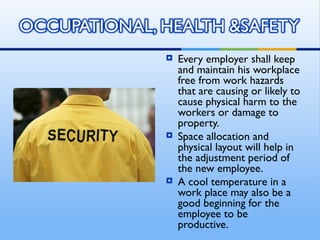
   Every employer shall keep
    and maintain his workplace
    free from work hazards
    that are causing or likely to
    cause physical harm to the
    workers or damage to
    property.
   Space allocation and
    physical layout will help in
    the adjustment period of
    the new employee.
   A cool temperature in a
    work place may also be a
    good beginning for the
    employee to be
    productive.
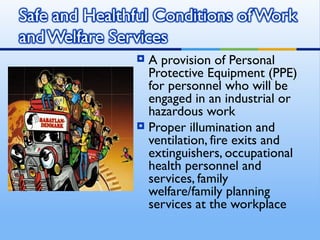
 A provision of Personal
  Protective Equipment (PPE)
  for personnel who will be
  engaged in an industrial or
  hazardous work
 Proper illumination and
  ventilation, fire exits and
  extinguishers, occupational
  health personnel and
  services, family
  welfare/family planning
  services at the workplace
   Human Resources Management, 10th ed.
          By David A. de Cenzo and Stephen P. Robbins
   Human Resource Management, 4th ed.
          By Raymond A. Noe, John R. Hollenbech, Barry Gerhart
           and Patrick M. Wright
   Everybody’s Labor Code, 2001 ed.
          By Cesario A. Azucena, Jr.
Presentor:

Orientation & Physical Condition

  • 1.
    ME 212 HumanResources Development and Management
  • 2.
    Socializing, orienting, training and developing employees are processes that help new employee adapt to their organizations and work responsibilities.  Socialization or on boarding is a process of adaptation that takes place as individuals attempt to learn the values and norms of work roles  Socialization as a process made up three stages:  pre arrival stage, encounter stage and metamorphosis
  • 3.
    Pre arrival stage where it recognizes that individuals arrive in an organization with a set of organizational values, attitudes and expectations;  Encounter stage is where individuals confront possible dichotomy between their organizational expectations and reality; and  Metamorphosis stage where the new employee must work out inconsistencies discovered during the encounter stage.
  • 4.
     These areactivities that introduce new employees to the organization and their work units.  It expands on information received during the recruitment and selection stages and helps reduce the initial anxiety employees usually feel when beginning a new job.
  • 5.
    Who is responsible for orienting the new employee?  This can be done by the new employee’s supervisor, people from HR, through computer based program or by some combination thereof.  What should be oriented?  Organization’s objective, history, philosophy, procedures and rules; communicate relevant HRM policies such as work hours, pay procedures, overtime requirements and company benefits.
  • 6.
     The firstfew days on a new job are packed with learning new skills, new co-workers and new policies.  An employee handbook, a booklet describing important aspects of employment an employee needs to know.  The handbook can provide the employee an opportunity to learn Source: alfaisal.edu about the company and what it provides for them and to understand the information at their own pace.
  • 7.
     The systemsharing meaning within the organization that determines how employees act.  An employee who has been properly socialized to the organization’s culture knows what acceptable behavior is and what it is not for. Source: philippineforum.org
  • 8.
     Working conditions refer to the terms and circumstances affecting the employment of an employee, including policies, programs, and regulations governing his employment status, work and work relationships.  The working conditions, as a rule, are determined by the employer. Source: wix.com
  • 9.
    Normal Hours of Work – shall not exceed 8 hours a day as provided by law;  Meal Periods-not less than 60 minutes time-off for their regular meals;  Night Shift Differential – Every employee shall be paid a night shift differential of not less than 10%of his regular wage for each hour, work performed bet. 10 pm and 6 am.
  • 10.
    Overtime Work – work performed beyond 8 hrs a day provided that the employee is paid for the overtime work an additional compensation equivalent to his regular wage plus at least 25%;  Work performed beyond eight hours on a holiday or rest day shall be paid an additional compensation equivalent to the rate of the first 8hrs on a holiday/rest day plus at least 30%.
  • 11.
     Weekly Restperiods – it shall be the duty of every employer to provide each of his employee a rest period of not less than 24 consecutive hrs after every six consecutive normal work days;  Thirteenth-month pay required by PD851 is additional income based on wage but not part of wage. It is 1/12 of the total basic salary earned by an employee within a calendar year.
  • 12.
    Every employer shall keep and maintain his workplace free from work hazards that are causing or likely to cause physical harm to the workers or damage to property.  Space allocation and physical layout will help in the adjustment period of the new employee.  A cool temperature in a work place may also be a good beginning for the employee to be productive.
  • 13.
     A provisionof Personal Protective Equipment (PPE) for personnel who will be engaged in an industrial or hazardous work  Proper illumination and ventilation, fire exits and extinguishers, occupational health personnel and services, family welfare/family planning services at the workplace
  • 14.
    Human Resources Management, 10th ed.  By David A. de Cenzo and Stephen P. Robbins  Human Resource Management, 4th ed.  By Raymond A. Noe, John R. Hollenbech, Barry Gerhart and Patrick M. Wright  Everybody’s Labor Code, 2001 ed.  By Cesario A. Azucena, Jr.
  • 15.