STAFFING
        Is a critical function concerned with the
 acquisition and deployment of the organization
 workforce. It looks at from the three perspectives
 namely, strategy and planning, the human
 resource, and the individual manager.
NATURE OF STAFFING


        STAFFING is a mutual process by which the
   individual and the organization become match to
   form the employment relationship.
IMPLICATIONS OF DEFINITION

     ORGANIZATION AND INDIVIDUAL PERSPECTIVE

        STAFFING is a mutual process that involves organization
         seeking individual as well as individual seeking
         organization.
        The ORGANIZATION PERSPECTIVE emphasizes staffing
         as activities undertaken to further the attainment of
         organizational goal such as survival, profitability and
         growth.
        The INDIVIDUAL PERSPECTIVE stresses the fact that
         individual seek jobs that they will find rewarding. And
         these individual are affected by their experiences in the
         staffing process.
   STAFFING AS A PROCESS OR SYSTEM

      STAFFING IS A PROCESS OR SYSTEM composed of a
       series of interrelated activities such as recruitment,
       selection, decision making and job offers.
      HIRING someone is the culmination of the staffing
       process.
      STAFFING is a process that establishes and governs the
       flow of applicants into the organization and within the
       organization.
There are many steps through which applicants flow from the
time they first enter the system to the time they become new
hires. These are:

  1st. The steps begin with the organization’s decision to fill a
  vacancy.
  2nd. Recruitment activities.
  3rd. Selection activities.
  4th. Evaluating and Decision making.
  5th. Acceptance of the job’s applicant.
   FORMING THE EMPLOYMENT RELATIONSHIP

      An emphasis on forming or entering into the employment
       relationship includes certain staffing decisions and
       excludes others. Both the organization and the individual
       must act positively to create a person/job match.
IMPORTANCE OF STAFFING

    The role of staffing is to anticipate and then fulfill the
     organization’s workforce needs in ways that contribute to the
     organizations mission and objectives.

    It will be responsible for the design and management of
     staffing systems, for the involvement of managers at critical
     points in these systems and for ensuring compliance with all
     applicable laws and regulations.
Exhibit 1.1 Survey Results Regarding Staffing and Other HR
                           Activities
                                                         % of    % of
                                                        Budget   Time


Staffing ……………………………………………………….                         19       15
Designadministration of employee benefit programs ..   15       10
Employee labor relations …………………………………..                13       18
Training ………………………………………………………                          11       9
Designadministration of employee compensation
           programs ………………………………………….                   9        10
Health, Safety and Security ……………………………….               8        6
Designadministration of programs in response to
           government regulations ………………………...          6        7
Performance Appraisal ……………………………………..                  5        7
Strategic Planning …………………………………………..                   4        7
Conducting other activities ………………………………...             10       11
STAFFING MODELS

    PERSON/JOB MATCH
       .
         This match seeks to align characteristic of
       individuals and jobs in ways that will result in
        desired HR outcomes.
         Comments such as these raise four important points
        about the person/job match.
1st. Jobs are characterized by their requirements and
embedded rewards.

2nd. Individuals are characterized by their level of
qualifications.

3rd. Degree of fit or match between the
characteristics of the job and the person.

4th. There are implied consequence for every match.
EXHIBIT 1.2 PERSON/JOB MATCH


          JOB

   Requirements                HR Outcomes
     Rewards

                               Attraction
  Match                        Performance
                               Retention
                  Impact
                               Attendance
                               Satisfaction
     PERSON                    Other

     KSAOs
    Motivations
Several points pertaining to staffing need to be made about the
  person/job matching model

1st. The concept shown in the model are not new.
2nd. The model emphasizing that the matching process involves
   a dual match of KSAOs to requirements and motivations to
   rewards.
3rd. Job requirement should usually be expressed in terms of
   both the tasks involved and the KSAOs thought necessary for
   performance of those task.
4th. Job requirement often extend beyond task and KSAO
   requirements.
Finally,
   The matching process can yield only so much by way of
   impacts on the HR outcomes.
PERSON/ORGANIZATION MATCH

 Often the organization seeks to determine not only on how well
 the person fits or match the job but also the organization.
EXHIBIT 1.3 PERSON/JOB MATCH


            Job
       Requirements
         Rewards
                               HR Outcomes

                               Attraction
                               Performance
                               Retention
    Match                      Attendance
                      Impact
                               Satisfaction
         Person                Other
        KSAOs
       Motivation
The ORGANIZATIONAL VALUES are norms of desirable
  attitudes and behaviors for the organization’s employee.

The NEW JOB DUTIES represents the task that may be added
  to the target job over time.

Flexibility concerns also enter into the staffing picture in terms of
  hiring persons who could perform MULTIPLE JOBS.

FUTURE JOBS represent forward thinking by the organization
  and person as to what job assignments the person might
  assume beyond the initial job.
STAFFING SYSTEM COMPONENTS

As noted, Staffing encompasses managing the flows of people into
  and within the organization.
EXHBIT 1.4 STAFFING SYSTEM COMPONENTS

    Applicant                                         Organization
    (Person)                                             (Job)


                             Recruitment
                   ( identification and attraction)


                            Selection
                   ( assessment and evaluation)


                           Employment
                ( decision making and final match)
Staffing begins with a joint interaction between the
applicant and the organization. The initial stage in staffing is
recruitment gradually, recruitment activities phase into the
selection stage and it’s accompanying activities and lastly, the
final component of staffing is employment. For the applicant,
The employment stage involve self-selection .
       It should be noted that the staffing components apply to
both external and internal staffing. In INTERNAL STAFFING,
the applicant is a current employee and the organization is the
current employer.
HUMAN RESOURCE MANAGEMENT

 PERSON/JOB MATCH
     It shows that all HR activities are directed toward
 creating and maintaining effective personjob matches as a
 way of having a positive impact on the HR outcomes.

 HR ACTIVITIES
      Each HR Activity is classified as a support or functional
 activity. Support activities include strategy and planning, job
 analysis, and measurement. Functional activities includes
 external staffing, internal staffing, training and development
 compensation, labor elations and work environment.
EXHIBIT 1.5 HUMAN RESOURCE MANAGEMENT MODEL
        Economic           Labor              Labor    Laws and
        Conditions        Markets            Unions   Regulations
                             External Influences


       HR activities                                  HR outcomes

 SUPPORT ACTIVITIES                    Job
         Strategy and
          Planning                 Requirements
         Job Analysis                Reward            Attraction
         Measurement                                  Performance
 FUNCTIONAL ACTIVITIES                                 Retention
         External                                     Attendance
            staffing                                  Satisfaction
         Internal
                                                         Other
            staffing                 Person
         Training and
           development               KSAOs
         Compensation
                                    Motivation
         Labor Elations
         Work
           Environment
INTERRELATIONSHIP AMONG ACTIVITIES
        While administered separately, the functional HR
 activities are highly interrelated and hence, must work in a
 concert with each other.


EXTERNAL INFLUENCES
      These influences are economic conditions, labor
 markets, labor unions and laws and regulations.

     Economic Condition influence the over all financial health
      of an organization.
   Labor Markets represents the external area in which the
    organization seek new employees and individuals offer their
    availability.

   Labor Unions negotiate with the organization about the
    terms and conditions of employment for their members,
    expressed in a written labor contract.

   Laws and Regulation serve to define (a) The nature of the
    employment relationship and (b) The limits of permissible
    and impermissible HR practices.
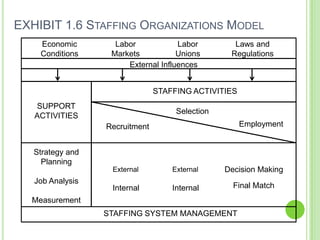
STAFFING ORGANIZATIONS


           Staffing is composed of support activities, staffing
 activities, external influences and staffing system
 management. The support activities are strategy and planning,
 job analysis and measurement, Recruitment and selection and
 employment from the staffing activities.
EXHIBIT 1.6 STAFFING ORGANIZATIONS MODEL
    Economic        Labor            Labor         Laws and
    Conditions     Markets           Unions       Regulations
                       External Influences


                                STAFFING ACTIVITIES
   SUPPORT
                                     Selection
   ACTIVITIES
                  Recruitment                         Employment


   Strategy and
     Planning
                   External         External     Decision Making
   Job Analysis
                   Internal         Internal       Final Match
  Measurement
                  STAFFING SYSTEM MANAGEMENT
THANK YOU FOR LISTENING :))))


                           #MJHY’

Staffing

  • 1.
    STAFFING Is a critical function concerned with the acquisition and deployment of the organization workforce. It looks at from the three perspectives namely, strategy and planning, the human resource, and the individual manager.
  • 2.
    NATURE OF STAFFING STAFFING is a mutual process by which the individual and the organization become match to form the employment relationship.
  • 3.
    IMPLICATIONS OF DEFINITION  ORGANIZATION AND INDIVIDUAL PERSPECTIVE STAFFING is a mutual process that involves organization seeking individual as well as individual seeking organization. The ORGANIZATION PERSPECTIVE emphasizes staffing as activities undertaken to further the attainment of organizational goal such as survival, profitability and growth. The INDIVIDUAL PERSPECTIVE stresses the fact that individual seek jobs that they will find rewarding. And these individual are affected by their experiences in the staffing process.
  • 4.
    STAFFING AS A PROCESS OR SYSTEM STAFFING IS A PROCESS OR SYSTEM composed of a series of interrelated activities such as recruitment, selection, decision making and job offers. HIRING someone is the culmination of the staffing process. STAFFING is a process that establishes and governs the flow of applicants into the organization and within the organization.
  • 5.
    There are manysteps through which applicants flow from the time they first enter the system to the time they become new hires. These are: 1st. The steps begin with the organization’s decision to fill a vacancy. 2nd. Recruitment activities. 3rd. Selection activities. 4th. Evaluating and Decision making. 5th. Acceptance of the job’s applicant.
  • 6.
    FORMING THE EMPLOYMENT RELATIONSHIP An emphasis on forming or entering into the employment relationship includes certain staffing decisions and excludes others. Both the organization and the individual must act positively to create a person/job match.
  • 7.
    IMPORTANCE OF STAFFING  The role of staffing is to anticipate and then fulfill the organization’s workforce needs in ways that contribute to the organizations mission and objectives.  It will be responsible for the design and management of staffing systems, for the involvement of managers at critical points in these systems and for ensuring compliance with all applicable laws and regulations.
  • 8.
    Exhibit 1.1 SurveyResults Regarding Staffing and Other HR Activities % of % of Budget Time Staffing ………………………………………………………. 19 15 Designadministration of employee benefit programs .. 15 10 Employee labor relations ………………………………….. 13 18 Training ……………………………………………………… 11 9 Designadministration of employee compensation programs …………………………………………. 9 10 Health, Safety and Security ………………………………. 8 6 Designadministration of programs in response to government regulations ………………………... 6 7 Performance Appraisal …………………………………….. 5 7 Strategic Planning ………………………………………….. 4 7 Conducting other activities ………………………………... 10 11
  • 9.
    STAFFING MODELS  PERSON/JOB MATCH . This match seeks to align characteristic of individuals and jobs in ways that will result in desired HR outcomes. Comments such as these raise four important points about the person/job match.
  • 10.
    1st. Jobs arecharacterized by their requirements and embedded rewards. 2nd. Individuals are characterized by their level of qualifications. 3rd. Degree of fit or match between the characteristics of the job and the person. 4th. There are implied consequence for every match.
  • 11.
    EXHIBIT 1.2 PERSON/JOBMATCH JOB Requirements HR Outcomes Rewards Attraction Match Performance Retention Impact Attendance Satisfaction PERSON Other KSAOs Motivations
  • 12.
    Several points pertainingto staffing need to be made about the person/job matching model 1st. The concept shown in the model are not new. 2nd. The model emphasizing that the matching process involves a dual match of KSAOs to requirements and motivations to rewards. 3rd. Job requirement should usually be expressed in terms of both the tasks involved and the KSAOs thought necessary for performance of those task. 4th. Job requirement often extend beyond task and KSAO requirements. Finally, The matching process can yield only so much by way of impacts on the HR outcomes.
  • 13.
    PERSON/ORGANIZATION MATCH Oftenthe organization seeks to determine not only on how well the person fits or match the job but also the organization.
  • 14.
    EXHIBIT 1.3 PERSON/JOBMATCH Job Requirements Rewards HR Outcomes Attraction Performance Retention Match Attendance Impact Satisfaction Person Other KSAOs Motivation
  • 15.
    The ORGANIZATIONAL VALUESare norms of desirable attitudes and behaviors for the organization’s employee. The NEW JOB DUTIES represents the task that may be added to the target job over time. Flexibility concerns also enter into the staffing picture in terms of hiring persons who could perform MULTIPLE JOBS. FUTURE JOBS represent forward thinking by the organization and person as to what job assignments the person might assume beyond the initial job.
  • 16.
    STAFFING SYSTEM COMPONENTS Asnoted, Staffing encompasses managing the flows of people into and within the organization.
  • 17.
    EXHBIT 1.4 STAFFINGSYSTEM COMPONENTS Applicant Organization (Person) (Job) Recruitment ( identification and attraction) Selection ( assessment and evaluation) Employment ( decision making and final match)
  • 18.
    Staffing begins witha joint interaction between the applicant and the organization. The initial stage in staffing is recruitment gradually, recruitment activities phase into the selection stage and it’s accompanying activities and lastly, the final component of staffing is employment. For the applicant, The employment stage involve self-selection . It should be noted that the staffing components apply to both external and internal staffing. In INTERNAL STAFFING, the applicant is a current employee and the organization is the current employer.
  • 19.
    HUMAN RESOURCE MANAGEMENT PERSON/JOB MATCH It shows that all HR activities are directed toward creating and maintaining effective personjob matches as a way of having a positive impact on the HR outcomes. HR ACTIVITIES Each HR Activity is classified as a support or functional activity. Support activities include strategy and planning, job analysis, and measurement. Functional activities includes external staffing, internal staffing, training and development compensation, labor elations and work environment.
  • 20.
    EXHIBIT 1.5 HUMANRESOURCE MANAGEMENT MODEL Economic Labor Labor Laws and Conditions Markets Unions Regulations External Influences HR activities HR outcomes SUPPORT ACTIVITIES Job Strategy and Planning Requirements Job Analysis Reward Attraction Measurement Performance FUNCTIONAL ACTIVITIES Retention External Attendance staffing Satisfaction Internal Other staffing Person Training and development KSAOs Compensation Motivation Labor Elations Work Environment
  • 21.
    INTERRELATIONSHIP AMONG ACTIVITIES While administered separately, the functional HR activities are highly interrelated and hence, must work in a concert with each other. EXTERNAL INFLUENCES These influences are economic conditions, labor markets, labor unions and laws and regulations.  Economic Condition influence the over all financial health of an organization.
  • 22.
    Labor Markets represents the external area in which the organization seek new employees and individuals offer their availability.  Labor Unions negotiate with the organization about the terms and conditions of employment for their members, expressed in a written labor contract.  Laws and Regulation serve to define (a) The nature of the employment relationship and (b) The limits of permissible and impermissible HR practices.
  • 23.
    STAFFING ORGANIZATIONS Staffing is composed of support activities, staffing activities, external influences and staffing system management. The support activities are strategy and planning, job analysis and measurement, Recruitment and selection and employment from the staffing activities.
  • 24.
    EXHIBIT 1.6 STAFFINGORGANIZATIONS MODEL Economic Labor Labor Laws and Conditions Markets Unions Regulations External Influences STAFFING ACTIVITIES SUPPORT Selection ACTIVITIES Recruitment Employment Strategy and Planning External External Decision Making Job Analysis Internal Internal Final Match Measurement STAFFING SYSTEM MANAGEMENT
  • 25.
    THANK YOU FORLISTENING :)))) #MJHY’