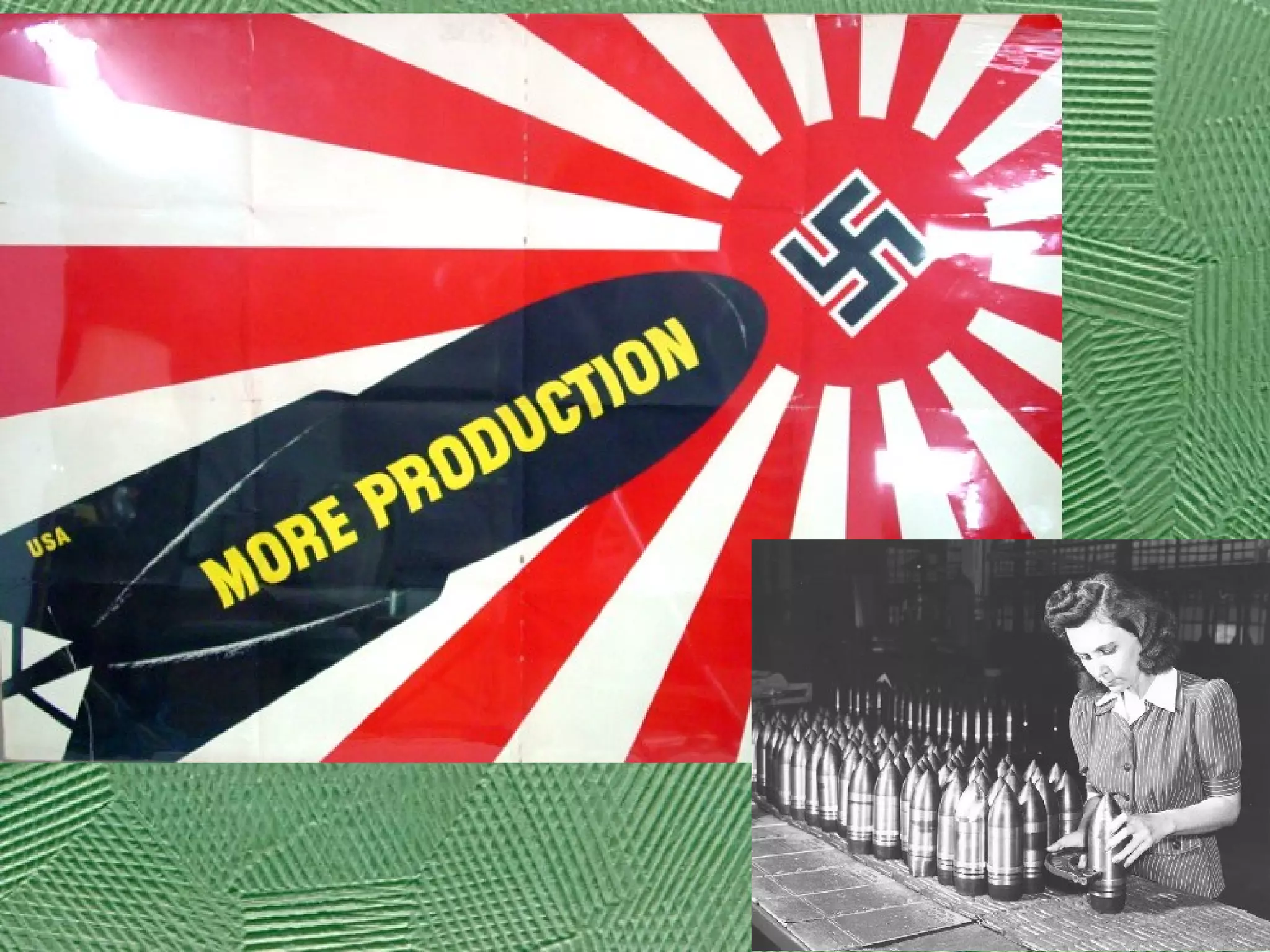
Organizing for Victory
Financing the War
• Government had a huge role in
the economy during WWII
• 1945 Federal Budget was
$95.2 billion, which was 10X
what it was in 1939
• National Debt was $258.6
billion,which was 6X greater
Taxes!...& Bonds
• Tax collections rose from $2.2
billion to $35.1 billion
• Mass taxation, not only on the
upper class, but also on the
middle class
• This was sold as a way for
citizens to show their
patriotism
• $135 Billion in war bonds
Bureaucracy
• Number of government workers
increased to 3.8 million during
WWII
– A 4X increase in number
– Far more job creation than the New
Deal!
• Leadership of federal agencies
moved from reformers during New
Deal to business executives
– Dollar a year men, because they
volunteered for government work as
corporate workers
Inflation
• Consumers had a lot more money to
spend, so producers began to
increase their prices: inflation!
• Office of Price Administration:
regulated the domestic economy
• By Feb. 1942, prices were rising by
2% a month; in April the OPA froze
prices and rents at their March
levels
• Congress passed the Anti-Inflation
Act, which stabilized prices, wages,
and salaries
War Production Board
• Awarded defense contracts
• Evaluated military and civilian
requests for scarce resources
• Oversaw the conversion of industry
to military production
• WPB encouraged businesses to
move to war production by granting
generous tax writeoffs that
guaranteed a profit and keeping the
factories open after the war
WPB and Efficiency
• WPB dealt with major corporations
rather than with small businesses
• The 56 largest corporations
received 3/4 of the war contracts,
and the top ten received 1/3 of
them!
• Large corporations became the
major form of output
• 1940: largest 100 companies
manufactured 30% of industrial
output; by 1945 it was 70%
What were they
producing?
• By 1945, business and gov’t
produced:
– 100,000 tanks
– 296,000 airplanes
– 15 million rifles and machine guns
– 64,000 landing craft
– 6,500 ships
• By 1944, the U.S. produced 2X what
the Axis powers did combined
End results:
• Government’s role was very large in
turning the economy around
• GDP went from $99.7 billion in
1940 to $211 billion in 1945
• Federal government was the driving
force during WWII, like it was in
the New Deal
• So it goes back to our question:
was it the New Deal or WWII that
got the US out of the
depression?????
Mobilization for War
• 15 million men and women in military by
end of WWII
• Draft boards had registered 31 million
men and women between 18-44
• Over half of men were rejected due to
things such as poor teeth, poor vision
• Race discrimination was prevalent:
700,000 African Americans fought in
segregated units
• Other groups were never segregated
Women in the War
• 350,000 women enlisted in the
armed services
• Served many roles from nurses to
volunteer services to volunteering
for actual duty
• Women were barred from combat
• Clerical work, communications, and
health care were most common
jobs
Jobs at Home
• The US faced a labor
shortage due to
large numbers of
military personnel
• 7 million new
workers were
available for industry
• “Rosie the Riveter”
• Women made up
36% of workforce in
1945, only 24% in
1940
Unequal Conditions
• Women were seen by many
men as a temporary fix until
the men came home from war
• Pay was not even close to
equal
• In shipyards: the top women
made about $7 an hour, while
the top men made $22
National War Labor
Board
• FDR set up the NWLB in 1942
• Established wages, hours, and working
conditions
• Had the authority to order government
seizure of plants that did not comply
• 40 plants were seized during the war
• Many minor disputes arose but were
averted by the NWLB (RR’s, miners)
• Union membership rose during WWII due
to perceptions that the situation was far
worse
Civil Rights During
Wartime
• Due to time constraint, I am
asking you to look at this
information on your own
• Please refer to your textbook,
pages 760-761 (you should
have already read this!!!)
Politics During Wartime
• FDR did not call for much social or
economic change during the early
years of WWII
• Republicans had made small gains
in Congress in 1942
• As a result, FDR agreed to drop
several New Deal Programs such as
the CCC and National Youth
Administration, which weren’t as
necessary due to full employment
Later during the war…
• FDR began to promise new social welfare
measures
• Lots of rhetorical speaking, Congress did
not necessarily support this
• One that did work was the GI Bill:
• Provided education, job training, medical
care, pensions, and mortgage loans for
men and women who served in armed
forces in WWII
• Later extended to Korean War Veterans
Election of 1944
• FDR called for a 4th term due to
WWII
• A new VP candidate was chosen:
Harry Truman, who was known
from his time in Congress for
heading a Senate investigation of
government efficiency in awarding
wartime defense contracts
Dewey
• Thomas Dewey was Republican candidate
– Only 42 y.o.
– Ran again in 1948
• Famous for fighting organized crime in NY
• Closest election since 1916, many were
concerned about FDR’s health
• 60% of FDR’s votes came from urban
areas, showing diversity of voters support
of him
– New Deal Coalition
Organizing for Victory

Organizing for Victory

  • 1.
  • 3.
    Financing the War •Government had a huge role in the economy during WWII • 1945 Federal Budget was $95.2 billion, which was 10X what it was in 1939 • National Debt was $258.6 billion,which was 6X greater
  • 4.
    Taxes!...& Bonds • Taxcollections rose from $2.2 billion to $35.1 billion • Mass taxation, not only on the upper class, but also on the middle class • This was sold as a way for citizens to show their patriotism • $135 Billion in war bonds
  • 6.
    Bureaucracy • Number ofgovernment workers increased to 3.8 million during WWII – A 4X increase in number – Far more job creation than the New Deal! • Leadership of federal agencies moved from reformers during New Deal to business executives – Dollar a year men, because they volunteered for government work as corporate workers
  • 7.
    Inflation • Consumers hada lot more money to spend, so producers began to increase their prices: inflation! • Office of Price Administration: regulated the domestic economy • By Feb. 1942, prices were rising by 2% a month; in April the OPA froze prices and rents at their March levels • Congress passed the Anti-Inflation Act, which stabilized prices, wages, and salaries
  • 8.
    War Production Board •Awarded defense contracts • Evaluated military and civilian requests for scarce resources • Oversaw the conversion of industry to military production • WPB encouraged businesses to move to war production by granting generous tax writeoffs that guaranteed a profit and keeping the factories open after the war
  • 9.
    WPB and Efficiency •WPB dealt with major corporations rather than with small businesses • The 56 largest corporations received 3/4 of the war contracts, and the top ten received 1/3 of them! • Large corporations became the major form of output • 1940: largest 100 companies manufactured 30% of industrial output; by 1945 it was 70%
  • 10.
    What were they producing? •By 1945, business and gov’t produced: – 100,000 tanks – 296,000 airplanes – 15 million rifles and machine guns – 64,000 landing craft – 6,500 ships • By 1944, the U.S. produced 2X what the Axis powers did combined
  • 12.
    End results: • Government’srole was very large in turning the economy around • GDP went from $99.7 billion in 1940 to $211 billion in 1945 • Federal government was the driving force during WWII, like it was in the New Deal • So it goes back to our question: was it the New Deal or WWII that got the US out of the depression?????
  • 13.
    Mobilization for War •15 million men and women in military by end of WWII • Draft boards had registered 31 million men and women between 18-44 • Over half of men were rejected due to things such as poor teeth, poor vision • Race discrimination was prevalent: 700,000 African Americans fought in segregated units • Other groups were never segregated
  • 14.
    Women in theWar • 350,000 women enlisted in the armed services • Served many roles from nurses to volunteer services to volunteering for actual duty • Women were barred from combat • Clerical work, communications, and health care were most common jobs
  • 15.
    Jobs at Home •The US faced a labor shortage due to large numbers of military personnel • 7 million new workers were available for industry • “Rosie the Riveter” • Women made up 36% of workforce in 1945, only 24% in 1940
  • 16.
    Unequal Conditions • Womenwere seen by many men as a temporary fix until the men came home from war • Pay was not even close to equal • In shipyards: the top women made about $7 an hour, while the top men made $22
  • 17.
    National War Labor Board •FDR set up the NWLB in 1942 • Established wages, hours, and working conditions • Had the authority to order government seizure of plants that did not comply • 40 plants were seized during the war • Many minor disputes arose but were averted by the NWLB (RR’s, miners) • Union membership rose during WWII due to perceptions that the situation was far worse
  • 18.
    Civil Rights During Wartime •Due to time constraint, I am asking you to look at this information on your own • Please refer to your textbook, pages 760-761 (you should have already read this!!!)
  • 19.
    Politics During Wartime •FDR did not call for much social or economic change during the early years of WWII • Republicans had made small gains in Congress in 1942 • As a result, FDR agreed to drop several New Deal Programs such as the CCC and National Youth Administration, which weren’t as necessary due to full employment
  • 20.
    Later during thewar… • FDR began to promise new social welfare measures • Lots of rhetorical speaking, Congress did not necessarily support this • One that did work was the GI Bill: • Provided education, job training, medical care, pensions, and mortgage loans for men and women who served in armed forces in WWII • Later extended to Korean War Veterans
  • 21.
    Election of 1944 •FDR called for a 4th term due to WWII • A new VP candidate was chosen: Harry Truman, who was known from his time in Congress for heading a Senate investigation of government efficiency in awarding wartime defense contracts
  • 22.
    Dewey • Thomas Deweywas Republican candidate – Only 42 y.o. – Ran again in 1948 • Famous for fighting organized crime in NY • Closest election since 1916, many were concerned about FDR’s health • 60% of FDR’s votes came from urban areas, showing diversity of voters support of him – New Deal Coalition