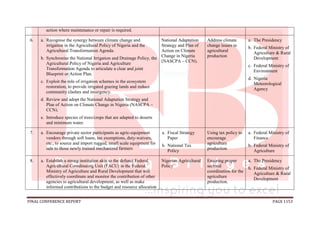
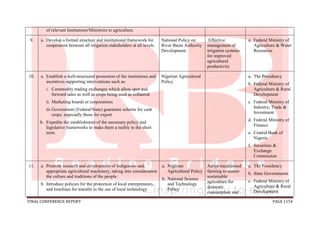
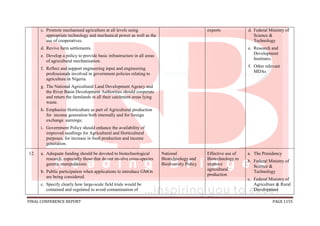
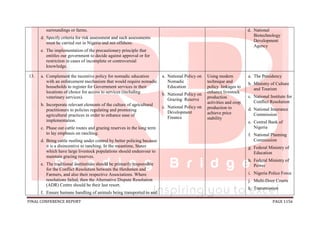
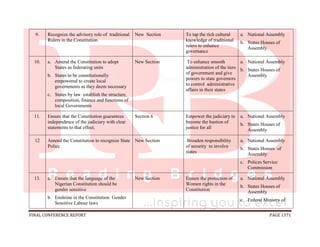
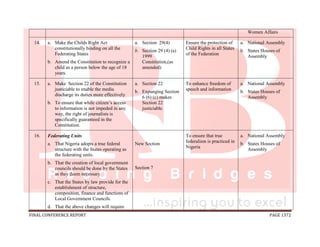
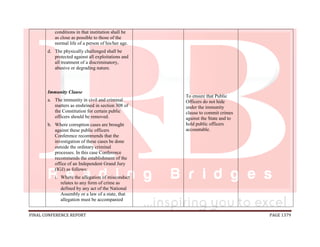
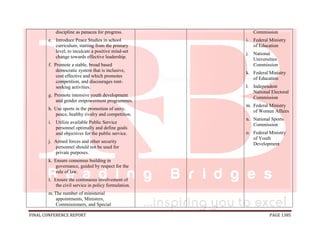
FINAL CONFERENCE REPORT PAGE 529
NATIONAL
CONFERENCE
2014
FINAL DRAFT OF
FINAL CONFERENCE REPORT PAGE 530
CONFERENCE REPORT
August 2014
CHAPTER ONE
INTRODUCTION
AGITATIONS FOR NATIONAL CONFERENCE:
A HISTORICAL OVERVIEW
1.1 BACKGROUND
FINAL CONFERENCE REPORT PAGE 531
1.1.1 The Federal Republic Nigeria with a population of approximately 170 million, located in West Africa, has 36 States, 774
Local Government Areas and the Federal Capital Territory, Abuja. The country has had a history of national dialogue that has
impacted on its constitutional and political development. In different phases of the 100 years of Nigeria as a nation from the

amalgamation of the Northern and Southern Protectorates on January 1, 1914 to the convocation of a National Conference in March
2014, the nature, character and prospects of national conferences have been turning points in the history of the country. Each phase
has had a defining moment as a result of the issues, demands, struggles and movements peculiar to it.
1.1.2 The history of constitutional and political development has shown that conferences for nation-building can be classified into
three: -Constitutional, National (non-sovereign) and Sovereign. A constitutional conference is concerned with the sole aim of
developing a constitutional framework or making proposals for constitutional changes within the existing constitutional framework. It
has limited scope – Constitution making for the purpose of nation-building, through which the rules and principles of political
pluralism, the role of the state, citizenship rights and duties, protection of fundamental human rights, etc., are defined
1.1.3 A National Conference is a formal platform for dialogue by constituent units of the nation convened by the national
government of a country to discuss issues or problems that inhibit national progress or challenge national cohesion. A National
Conference is expected to proffer appropriate solutions that will assist in moving the nation forward.
1.1.4 A Sovereign National Conference is the convocation of by and large, civil society organizations, workers’ unions, political
parties, professional associations, religious denominations, and government representatives to discuss and chart new ways forward for
the nation. As the word ‘sovereign’ suggests, the conference is not subject to the authority of the state and its outcome may supplant
FINAL CONFERENCE REPORT PAGE 532
and sweep away existing order while heralding an entirely new order. It has the capacity to take effective and effectual decisions
relating to the tenure, survival and/or limits of power of the existing regime. This means that a sovereign national conference is
interpreted as a transitional phase in the process of a mass struggle to carry out system or regime change.
1.1.5 The situation which leads to the convocation of a sovereign national conference arises from the thinking that the existing order
or regime, is incapable of solving economic and political problems and the institutions of the state are rather weak or ineffective to
assert authority while the democratic opposition is not strong enough to effect regime or system change. Where the convocation of a
Sovereign National Conference is unlikely, its proponents have advocated a Conference of Ethnic Nationalities particularly in an
ethnically plural society. Representatives of the ethnic nationalities are convened on a common platform to discuss and make
recommendations to Government about their common problems in order to achieve higher levels of mutual trust, understanding and
integration in nation-building.
1.1.6 The nature and character, relevance and legitimacy of the three types of national dialogue depend on the context- especially
the political situation in any country, and the considerations concerning future political development. Generally, a national dialogue
assists in creating environments of high trust and openness, with reflective and generative capacities for problem-solving, action-
planning and conflict resolution for the development of the society.
1.1.7 It will be recalled that the creation of the Kingdom of Great Britain on May, 1 1707, to include Wales and the Kingdom of
Scotland was the outcome of a National Dialogue which involved the constituent parts of the new political union. This creation was
the result of the Treaty of Union of July 22, 1706, which was ratified by both the Parliament of England and the Parliament of
FINAL CONFERENCE REPORT PAGE 533
Scotland which passed an Act of Union in 1707. The legislative structures of both territories were responsible for the formalization of
the amalgamation. The United States’ First and Second Congresses in 1774 and 1775 respectively, also held National Dialogues to
address issues related to their political development.
1.1.8 The Nigerian experience in the agitation for national conference began after amalgamation in January 1914. For this reason,
this chapter is divided into six sub-themes which mirror the agitation for National Conference: 1914-1945: Amalgamation and the
problem of nationhood; 1945-1960: Decolonization and the Agitation for Constitutional Reform and Independence; 1960-1966: Early
years of Independence; 1966-1999: Military regimes and the movement for democratization; 1999-2014: Democratic rule and the
agitation for sovereign national conference.
1.2 AMALGAMATIONAND THE PROBLEM OF NATIONHOOD
1.2.1 Nigerians under colonial rule were confronted with the task of building a new nation created by the British. The 1914
amalgamation of the Northern and Southern Protectorates that created the Nigerian nation was a British colonial initiative. This
provoked bitter controversy at the time, arousing the resentment of educated elite and of some British administrators. A number of
issues had agitated the early Nigerian nationalists. First, in spite of the amalgamation, colonial administration recognized the two
areas as autonomous parts and administered the territories separately. Second, the educated elites were excluded from colonial
administration. Early Nigerian nationalists began to advocate for a national dialogue to discuss the future political development of the
amalgamated territories as a single and unified Nigerian nation. They also demanded for participation in the management of their own
affairs.
FINAL CONFERENCE REPORT PAGE 534
1.2.2 The agitation of the early Nigerian nationalists did not receive positive attention from the British colonialists. At the end of the
First World War in 1918, representatives from the four British colonies in West Africa namely, Nigeria, Gold Coast (now Ghana),
Sierra Leone and the Gambia, organized the National Congress of British West Africa and held a conference in Accra in 1920. The
sub-regional conference urged the British to lay the basis for future self-determination, and demanded for a Legislative Council in
each territory, half of whose members should be elected Africans, African veto over taxation, separation of the judiciary from the
legislative arm of government, appointment and deposition of chiefs by their own people, abolition of racial discrimination in the
civil service, development of municipal government, repeal of certain ‘obnoxious’ Ordinances, and the establishment of a University
in West Africa.
1.2.2 The agitation of those early Nigerian nationalists did not receive positive official attention because they were not only
considered to be the source of political agitation, but the British imperialists feared that their aspiration to greater participation in
government had the ultimate aim of displacing British administration.
1.2.4 As a result of the Accra Conference of 1920, the British introduced a new Constitution (known as the Sir Hugh Clifford
Constitution)in 1922. The Constitution established a Legislative Council and introduced elective representation. This led to the
formation of the first Nigerian political party – the Nigerian National Democratic Party (NNDP) in 1923 led by Herbert Macaulay.
The party articulated nationalist issues which included the economic development of the natural resources of the country under
controlled private enterprise, and the Africanization of the civil service. However, Northern Nigeria was excluded from the
FINAL CONFERENCE REPORT PAGE 535
jurisdiction of the Legislative Council and was administered by the issuance of proclamations by the Governor until the introduction
of a new constitution at the end of the Second World War in 1945.
1.2.5 In the 1930s and up to the end of Second World War, Nigerian nationalists continued their agitation for a national dialogue for
the political restructuring of the country. The advocates of a national dialogue argued that the act of amalgamation was not a federal
idea but that there were strong integrative factors of inter-group relations that favoured the division of the country into a number of
units that could develop into components of a future federation. The nationalists argued that a federal system would enhance national
unity and integration of the component parts of the country, and agitated for the inclusion of the Northern Provinces in the Legislative
Council. While the colonial government did not convene a national conference, prior to the introduction of a new constitution,
nevertheless the country was divided into three regions in 1939 - the Northern, Western and Eastern Regions. This was a fundamental
and major step in restructuring.
1.3 DECOLONIZATION AND AGITATION FOR CONSTITUTIONAL REFORM AND INDEPENDENCE
1.3.1 In the different phases of the era of decolonization from 1945 to the attainment of independence in 1960, Nigerians agitated for
constitutional conference, self-government and the granting of independence. On the 6th
of December 1944, Sir Arthur Richards who
was the Governor of Nigeria, had in a dispatch to London, stated clearly that the problem of Nigeria was how to create a political
system that would advance political development in line with the interests being pursued by various Nigerian groups. In March 1945,
the constitutional proposals were embodied in a White Paper, published in the United Kingdom and Nigeria and this was submitted to
the Legislative Council on the 22nd
of that month. Nigerian nationalists agitated for a constitutional conference for the discussion of
FINAL CONFERENCE REPORT PAGE 536
the proposals on the grounds that the Nigerian representatives in the Council were over-persuaded by the benign atmosphere of
colonial domination. Following this agitation, a storm of criticism arose in the nationalist press over the demand for self-government.
1.3.2 In 1946, the Arthur Richards Constitution was introduced. At that time, Nigerian nationalists were already demanding
immediate full self-government. From the time the constitution came into effect in 1947, wartime developments have affected the
nationalist struggle. The nationalist movement had become a powerful force, capable of questioning, in action and as well as in
words, the constitutional, administrative and economic assumptions of the British authority. Nigerian nationalists were opposed to the
Constitution, partly because of its contents, and also because of the way in which it was introduced. In 1947, the three elected
representatives in the Legislative Council from Lagos boycotted the first session of the Council, and when they resumed sitting in
1948, they began to demand for quicker constitutional changes.
1.3.3 The Richards Constitution was designed to last for nine years. Sir Arthur Richards made the mistake of not consulting the
opinion of Nigerians over his constitutional proposals and found himself faced with a spate of bitter criticism from the nationalists.
On August 28, 1949, Sir John Macpherson took over as the Governor of Nigeria. In that same year, the colonial Government took the
initiatives in launching constitutional discussions. A Select Committee of the Legislative Council made recommendations to the
Governor regarding the steps to be taken for a review of the Richards Constitution with special reference to the methods to be
adopted for ascertaining the views of all sections of the population on the issues involved.
1.3.4 As Nigerian nationalists continued the agitation for a national constitutional conference, Governor Macpherson adopted a
policy of allowing Nigerians at every level to participate in putting forward suggestions for the country’s constitution through a series
FINAL CONFERENCE REPORT PAGE 537
of discussions held first at the village, then in the district, followed by provincial, regional and national conferences. After collating
views from the grassroots, the various Provincial Conferences made recommendations which were considered by Regional
Conferences. The views of the Regional Conferences were then considered by a Drafting Committee, and followed by the General
Constitutional Conference held in Ibadan in January 1950. The Constitutional Conference at Ibadan made recommendations, with
four minority reports attached, which were put before the regional Houses and the Legislative Council. The outcome of the
constitution review was the 1951 constitutional arrangement known as the 1951 Macpherson Constitution.
1.3.5 Because it came into being after an unprecedented process of consultation with the peoples of Nigeria as a whole, the
constitution granted some concessions to the nationalist agitation in that it offered a measure of responsible government and not self-
government to Nigerian nationalist leaders.
1.3.6 From 1953, the tempo and intensity of political agitation sharply increased. The nationalists argued that because of the
structural weaknesses and manifest deficiencies of the Constitution, they were determined to drastically review it, or in the
alternative, it should be the last colonial Constitution prescribing a dependent status for Nigeria. Although the Constitution was to
expire in five years; a motion was moved by Chief Anthony Enahoro of the Action Group in the House of Representatives on March
31, 1953 calling for the attainment of self-government in 1956. Although Northern legislators were not opposed to the motion, they
felt that the demand was too early. A critical fall-out from the debate on self-government was a walk-out from the Parliament and
resignations of some Ministers. These led to a constitutional crisis and the threats of disintegration of the country.
FINAL CONFERENCE REPORT PAGE 538
1.3.7 Following the crisis over the self-government motion, the Colonial Secretary, Oliver Lyttleton, convened a Constitutional
Conference in London from July 30 – August 22, 1953 to revise the 1951 Constitution. At the Conference, a federal constitution was
accepted by the leaders of the main political parties, and it was agreed that regions which so requested should have full internal self-
government in 1956. The work of the Conference was completed by a further Conference in Lagos from January to February 1954.
The outcome of the 1953 Constitutional Conference and the resumed Lagos Conference in 1954 established the Federal (Lyttleton)
Constitution of 1954. Federalism had been advocated at the 1950 Ibadan General Conference on constitution review but was rejected.
After the 1953 crisis, federalism was adopted as the solution to the political problems of the country.
1.3.8 The attainment of independence by Ghana on March 6, 1957 spurred Nigerian nationalists to take a fresh and bolder look at
the political future of the country. On March 26, 1957, a motion was unanimously passed in the House of Representatives setting
1959 as the year of independence for Nigeria within the British Commonwealth. The delegates to the Nigerian Constitutional
Conference in May and June 1957 in London were mandated to actualize the agitation. Nigerian leaders were at last united on an
issue which for six years had not only plagued all internal relationships but had also threatened the very existence of Nigeria as an
emergent national entity.
1.3.9 Strengthened with this new spirit of unity and common purpose, the leaders of the Nigerian delegation to the Constitutional
Conference presented a joint Memorandum requesting the British Government to grant the country independence in 1959, but the
Colonial Secretary, Mr. Lennox-Boyd did not favour the request. That notwithstanding, the Nigerian delegates still pressed further
their demand for self-government not later than April2, 1960. At the Conference, the Western and Eastern Regions were granted full
internal self-government in 1957.
FINAL CONFERENCE REPORT PAGE 539
1.3.10 The Nigerian Constitutional Conference resumed in London from September 29 to October 27, 1958. The outcome was
internal self-government in 1959, the Independence Constitution of 1960, and the granting of independence on October 1, 1960. The
period 1950 to 1959 represented a 10-year period of negotiations between the major stakeholders in the Nigerian nation-state project
and what they finally arrived at in the form of 1960 Constitution was, subject to minor, non-structural modifications, the only
legitimate basis of association of all the different nationalities in Nigeria. The fears of the minority in an unbalanced federal structure
and the creation of more regions were the issues that could not be resolved during the constitutional conferences before the attainment
of independence in 1960.
1.3.11 Minority fears of domination by the three powerful regions were expressed at the 1953 Constitutional Conference. It was at the
1957 Constitutional Conference that the British Colonial Secretary appointed a Commission headed by Henry Willinks to ascertain
the facts of the fears of minorities in Nigeria and proposing means to allay those fears; to advise what safeguards should be included
for this purpose in the Constitution; and as a last resort to the agitation, make a case for the creation of States. The report submitted is
known as the 1958 Willinks Commission Report. The Willinks Report was not given consideration during the Constitutional
Conference of 1960, which also worked out the final arrangements for the independence of Nigeria, and the ratification of the
resolution of the House of Assembly of Southern Cameroons to cease to be part of Nigeria from October 1, 1960 after a Plebescite in
which the Northern Cameroons opted to stay in Nigeria while the Southern Cameroon opted to be part of the Republic of Cameroon.
1.4 CONTINUED AGITATIONS IN THEEARLY YEARS OF INDEPENDENCE
FINAL CONFERENCE REPORT PAGE 540
1.4.1 In the early years of independence, minorities in the country continued their agitation for the creation of their States. In the
1960 and 1963 Constitutions, a federal system made up of strong regions and a centre with limited powers, was instituted. Both the
1960 (Independence) Constitution and the 1963 (Republican) Constitution were basically the same. The only differences were the
provisions for ceremonial President (1963) in place of the Queen of England (1960) and the judicial appeals system which terminated
with the Supreme Court (1963) rather than the Judicial Committee of the British Privy Council (1960). With this constitutional
arrangement, distinct features – especially the Republican status of Nigeria emerged.
1.4.2 Other important features of the 1960/63 Constitution included allowing for separate Constitutions for each Region in addition
to the Federal Government Constitution. Second, each region had its own separate Coat of Arms and Motto, in addition to that of the
nation. Third, each region established its own separate semi-independent Mission in the U.K. headed by an 'Agent-General'. Fourth,
the regional governments had Residual Power, that is, where any matter was not allocated to the Regions or the Federal Government
it automatically became a matter for Regional jurisdiction. One important feature of the 1960 Constitution is the extensive powers
granted the regions, making them effectively autonomous entities and the revenue arrangements which ensured that the regions had
the resources to carry out the immense responsibilities.
1.4.3 While Nigeria moved from one crisis to another within months after the attainment of independence, the minorities continued
their agitation for more States. The first manifestation of the crisis was the declaration of an emergency in the Region by the Federal
Government and the consequent take over of the Government of the region by the Federal Government. This was a seminal event. On
august 9, 1963, the Mid-West Region was created by constitutional means through a referendum and this led to a stronger agitation
for minority rights. Before 1960, about 9-15 demands for state creation were expressed including a Yoruba Central State, Ondo
FINAL CONFERENCE REPORT PAGE 541
Central and Mid-West from the Western Region; Cross River-Ogoja-Rivers States from the Eastern Region; and Middle Belt State
from the Northern Region. No other State apart from the Mid-West Region was created before the collapse of the First Republic in
January 1966.
1.5 MILITARY REGIMES AND THE AGITATIONS FOR DIALOGUE
1.5.1 The political process was distorted by military intervention following the bloody coup of January 15, 1966 led by Major
Chukwuma Kaduna Nzeogwu and a group of Majors, which overthrew the government of the Prime Minister, Sir Abubakar Tafawa
Balewa and ushered in the military regime of General Johnson Thomas Umunnakwe Aguiyi-Ironsi. In July of the same year, a
counter-coup ushered in the military regime of Lt. Col. Yakubu Gowon. The Gowon regime which, after prosecuting a bitter civil
war (1967 – 1970) failed to return the country to constitutional rule after series of promises to that effect, was overthrown in July
1975. The General Murtala/Obasanjo regime that took over from Gowon convened Constitutional Drafting Committee and
Constituent Assembly which returned the country to democratic rule. In October 1979, the Second Republic was inaugurated but
was overthrown in a coup in December 1983 that ushered in the military regime of General Muhammadu Buhari. In August 1985, the
regime was overthrown in a military coup that brought in the military regime of General Ibrahim Badamasi Babangida, whose
transition to civil rule failed leading to what many see as a political contraption where a civilian unelected Interim National
Government (ING) led by Chief Ernest Shonekan was instituted on August, 27 1993. The ING was overthrown on November, 18
1993, thus paving the way for the military regime of General Sani Abacha, whose sudden death in June 1998 ushered in the regime of
General Abdulsalam Abubakar that handed over power to a civilian government on May 29, 1999.
FINAL CONFERENCE REPORT PAGE 542
1.5.2 During the military regimes, Nigerians agitated for a return to democratic rule, as the years of military regimes also stirred
controversy about military intervention. The reasons for military intervention may be varied but the agitations for constitutional
conferences throughout the years of military rule was based on the fact that politics is and needs to be separated from the military,
which is considered to be a professional, a-political institution. This view derives from the duties and roles of the professional soldier
as subordinate to and subject to civil authority and control.
1.5.3 In response to the agitation for a national dialogue following the events of 1966, the military leadership of General Gowon
summoned an Ad Hoc Constitutional Conference in August 1966 to discuss the future political development of the country. The
summoning of the conference attracted extensive discussions in regional Consultative Committees, Leaders of Thought Conferences,
the Universities, and the Media. The technical character of the problems that were dealt with made the political discussions a well-
organized national debate that focused on a number of issues.
1.5.4 Four issues stood out in sharp contrast during the discussions: first, was the issue of creating more States, arising directly from
the problem of structural imbalance in the federation. Second, the form and unit of association within the federation was also hotly
debated. Third, the composition of the central authority equally exercised the Leaders of Thoughts nationwide. Fourth was the issue
of secession.
FINAL CONFERENCE REPORT PAGE 543
1.5.5 The other issues of resource control and equitable formula for revenue allocation, defense and foreign affairs, financing of the
centre, judiciary, armed forces and police, and other functions of the central authority were matters of both political and constitutional
interest in the drafting of a new constitution for the future political development of the nation.
1.5.6 The crucial question involved in the debate was the survival of the nation as a single entity and the extent to which the
constituent parts may contribute to the government of the whole. The peculiar problem of the post-January 1966 events had
threatened the dissolution and collapse of the nation-state project. The debate was therefore designed by the military regime of
Gowon to involve the public in discussing the federal issue as a means of furthering the preservation of the Nigerian nation-state.
1.5.7 Two developments in the post-January 1966 events influenced the summoning of an Ad hoc Constitutional Conference. First
of all, in the aftermath of the January 15, 1966 bloody military coup, General Aguiyi-Ironsi abolished the federal structure and
Regional Governments by promulgating the Unification Decree 34 of May 1966. With this decree, Nigeria ceased to be a federation
and was grouped into a number territorial areas called provinces, which led to the emergence of a unitary state. Second, after the coup
of July 1966, Gowon, reverted immediately to the federal system of government by repealing Decree 34 and restoring Regional
Governments. The events after July 1966 opened a national debate on the future of the federal state. The need to find a formula for
the continued association of the constituent units led to the proposals for a Constitutional Conference.
1.5.8 The inauguration of a Constitutional Conference was a fundamental advance in dealing with the complex national question.
On September 12, 1966 the Ad Hoc Constitutional Conference opened in Lagos. By the end of the month, a preliminary report was
submitted to the Supreme Military Council. It had the potential to go down as the most important of its kind in Nigerian history. This
FINAL CONFERENCE REPORT PAGE 544
is because the proposals presented by the regional delegations showed the extent to which the country had drifted apart, and was on
the brink of disintegration. The conference failed because the protracted deliberations on an acceptable formula for maintaining the
federation were prematurely ended with the news of renewed killings in the North and of retaliatory actions in the South. Though the
killings were tragic events that sought to undermine the nation-state project, the Gowon administration ruled out a complete break-up
of the country and suggested three possible constitutional arrangements that would enable Nigeria to remain as one nation: a
federation with a strong central government; a federation with a weak central government, or a confederation with no central
government.
1.5.9 The Constitutional Conference had deliberated on proposals from the four regions without deciding on any agreed strategy for
keeping Nigeria as an integral and indivisible unit. The positions of the Regions on almost all the four major issues – particularly the
form and unit of association differed considerably. The break-down of the Conference and the outbreak of the Nigerian civil war
changed the political landscape and reshaped the nature and form of the agitations for new constitutional arrangements.
1.5.10 During the constitutional talks, the Eastern Regional position was influenced to some extent, by the position of Lt. Col. Emeka
Odumegu-Ojukwu, who had his differences with Gowon. The personal conflict between the two army officers led to the deterioration
in the relations between Eastern Regional Government and the Federal Government. Both leaders traded words as to the real cause of
the breakdown of the Constitutional Conference. The only meeting that Ojukwu agreed to attend with Gowon was held outside the
country, at Aburi in Ghana, from January 4 -5, 1967 through the intervention of General Ankrah, who was the Head of the Military
Government of Ghana. Both Gowon and Ojukwu gave different accounts of the Aburi Accord. Ojukwu insisted on his own
FINAL CONFERENCE REPORT PAGE 545
interpretation of what had been decided at Aburi and accused the Federal Government of failing to honour agreements voluntarily
arrived at, and from then on, he kept repeating his slogan,” On Aburi we stand: there will be no compromise.”
1.5.11 The relevance and significance of the talks held in Aburi lies in the attempt by Gowon not to allow the Eastern Region to
secede. Gowon believed that the federation had been preserved at Aburi, while Ojukwu claimed the Aburi agreement gave him wide-
ranging powers to control the Government of the Eastern Region and even to secede from the federation if he chose to. The Aburi
talks were peace efforts in preventive diplomacy, which provided a paradigm of international support to statehood and security in the
first decade of Nigeria’s independence.
1.5.12 From March 1967 the relationship between Eastern Region and the Federal Government deteriorated to the point where the
East took over the Federal Departments and Parastatals, as well as the withholding of all federal taxes and revenue from 1 April 1967.
This was declared illegal and unconstitutional by the Federal Government, which in turn imposed various economic sanctions on the
Eastern Region. On May 30, 1967 an Eastern Regional Consultative Assembly mandated Ojukwu to declare the “Republic of Biafra.”
The failure of the Constitutional Conference and the Aburi talks plunged Nigeria into a 30-month civil war.
1.5.13 In the immediate post-war years, the Federal Military Government embarked upon a programme of Rehabilitation,
Reconstruction and Reconciliation in its nation-building efforts. Similarly, Nigerians began to agitate for a return to democratic rule
and on the need to hold constitutional talks as prelude to military disengagement from politics. The agitation raised a number of
issues about the role of the military, about civil-military relationships, and about the degree of civil authority over the military.
FINAL CONFERENCE REPORT PAGE 546
1.5.14 In September 1975, a 50-member Constitution Drafting Committee (CDC) was appointed by the military regime of General
Murtala Muhammed as part of the transition programme to democratic rule (49 members were eventually inaugurated). General
Muhammed was assassinated in February 1976, and was succeeded by General Olusegun Obasanjo, who convened a Constituent
Assembly in October 1977 to work out a constitutional framework from the report of the CDC. The outcome of the constitutional
talks was the 1979 Constitution made pursuant to the Constitution of the Federal Republic of Nigeria (Enactment) Decree No. 25 of
1978.
1.5.15 Again, in December 1983, the process of political development was distorted by another military intervention.
1.5.16 In spite of continued agitations for better constitutional rule, the Military regime of General Muhammadu Buhari focused its
attention on economic matters and moral re-awekening instead of addressing those agitations. It was the regime of General Babangida
that overthrew General Buhari in another military coup which, took up the challenge. The regime set up a Political Bureau under
Professor J. S. Cookey to:
(i) review Nigeria’s political history and identify the basic problems which have led to our failure in the past and suggest
ways of resolving and coping with these problems;
(ii) identify a basic philosophy of government which will determine goals and serve as a guide to the activities of
government;
FINAL CONFERENCE REPORT PAGE 547
(iii) collect relevant information and data for the Government as well as identify other political problems that may arise
from the debate;
(iv) gather, collate and evaluate the contributions of Nigerians to the search for a viable political future and provide
guidelines for the attainment of the consensus objectives; and
(v) deliberate on other political problems as may be referred to it from time to time.
1.5.17 The Bureau identified up to thirty issue-areas for public debate and ensured adequate participation by the citizens as it was
monitored at the Local Government level and coordinated at the State and national levels. The Bureau submitted its Report in 1987.
The work of the Political Bureau was followed by the inauguration of a Constitution Review Committee on September 7, 1987. In
view of the sad experiences arising from the politics of the Second Republic, the task of the Committee was to produce a document
which will prove acceptable, workable, adaptable, enduring and suitable to Nigeria’s particular circumstances, needs and
temperament as a people now and in the foreseeable future. A Constituent Assembly was then inaugurated. It submitted a Draft
Constitution after concluding deliberations on suitable constitutional arrangements for Nigeria. This gave birth to the 1989
Constitution of the Federal Republic of Nigeria.
1.5.18 A watershed in the agitation for constitutional change was the demand for a Sovereign National Conference following the
annulment of June 12, 1993 Presidential election by General Babangida. The annulment signaled the failure of the 1986 to 1993
political transition programme to the Third Republic. While the crisis forced the military President out of power unceremoniously, he
FINAL CONFERENCE REPORT PAGE 548
also, appointed an Interim National Government (ING) headed by an unelected civilian - Chief Ernest Shonekan. This generated
further crisis and intensified agitations for a Sovereign National Conference. The June 12 1993 Presidential election was the most
intriguing element in the military transition agenda to the Third Republic. The agitation for a Sovereign National Conference has
perhaps never been demonstrated so dramatically as in the contemporary history of Nigeria. Various sub-nationalities and ethno-
religious groups and other interests have unrelentingly been calling for the convocation of a Sovereign National Conference to
address the critical issues of political reforms, constitutional re-engineering, political restructuring and agitations for resource control.
There have also been complaints of marginalization, neglect and injustice.
1.5.19 The agitation for a Sovereign National Conference (SNC) in Nigeria coincided with similar demands across Africa. The
convocation in 1989 of National Conference of Civil Society Organizations in Benin Republic, which successfully declared itself
‘sovereign’ in place of the then existing state power provided a model for many agitators for the SNC in Nigeria. The Benin
Conference overturned the Constitution, supplanted the authority of President Kerekou and spear-headed elections which brought in a
new President. In February 1991, the National Conference of Congo was organized at the Convention Centre of Brazzaville under the
pressure of mass movements by the then President of the Republic, Denis Sassou-Nguesso. The delegates represented civil society
organizations including political parties, workers’ unions, professional organizations, religious denominations as well as Government
representatives.
1.5.20 As the military regime of General Abacha was resisted by civil society organizations, the National Democratic
Coalition (NADECO) was founded on March 15, 1994. It advocated the convocation of a Sovereign National Conference as one of
FINAL CONFERENCE REPORT PAGE 549
the steps to be taken towards an attempt at finding solutions to the problems of Nigeria. The proponents of the Conference insisted
that it is only through the initiative that Nigeria can wriggle out of the myriad of problems confronting it.
1.5.21 On June 26, 1994 General Abacha convened the National Constitutional Conference, which lasted until June 26, 1995.
The conference was concerned with the sole project of developing a constitutional framework for the Fourth Republic. The outcome
of that Conference was introduced as a Constitution on August 27, 1995 but was actually not promulgated into law before Abacha’s
death. Civil society organizations mounted campaigns against the National Constitutional Conference partly because of the problems
of June 12 and also because members were hand-picked individuals who would put up constitutional proposals along the lines
dictated by their military appointers
1.6 DEMOCRATIC RULE AND THE AGITATION FOR SOVEREIGN NATIONAL CONFERENCE
1.6.1 The return to civil rule on May 29, 1999 following the re-establishment of democratic governance did not lay to rest the
agitation for a Sovereign National Conference. The weaknesses of the 1999 Constitution had become more evident with various
peoples of Nigeria expressing concerns about its operation. From May 1999 when the Constitution came into effect, many had
challenged as a lie, the preamble to the Constitution which states:
“We the people of the Federal Republic of Nigeria having firmly and solemnly resolved, to live in unity and harmony as
one indivisible and indissoluble sovereign nation under God, dedicated to the promotion of inter-African solidarity, world
peace, international co-operation and understanding; and to provide for a Constitution for the purpose of promoting the
FINAL CONFERENCE REPORT PAGE 550
good government and welfare of all persons in our country, on the principles of freedom, equality and justice, and for the
purpose of consolidating the unity of our people; do hereby make, enact and give to ourselves the following Constitution.”
1.6.2 The proponents of a Sovereign National Conference continued to insist that this lie about “we the people...” must be resolved
through a national conference in order to have a People’s Constitution. In which case, the national conference should be seen as a
Constitution-making arrangement, and a platform for the fundamental definition of our nationhood and citizenship. They also pointed
out that rather than classify the proponents of national dialogue as agents of balkanization, Nigerian leaders must seize the
opportunity presented to work towards redesigning the foundation of the nation to enable it achieve its potentials as a strong,
prosperous and proud nation.
1.6.3 Against the backdrop of widespread pressures and agitation by Nigerians for opportunities to rethink the historical evolution,
context and basis of their continued existence in one Nigeria, President Olusegun Obasanjo convened a National Political Reform
Conference from February-July 2005. Among the issues of political reforms were: the federal structure, fiscal federalism ( especially
in relation to resource control), form of government, citizenship, accountability and ethics in government, the Independent National
Electoral Commission, political parties, reform of the electoral system, the economy, foreign policy and the environment.
1.6.4 Although the convocation of the conference provided the platform for national dialogue on important national issues,
prominent leaders of civil society organizations argued that the National Political Reform Conference was similar to the late General
Sani Abacha’s National Constitutional Conference of 1995, and that it was not based on systemic people-determined structure. The
leadership of the Conference of Nigerian Political Parties also questioned the rationale for the conference. As the debate intensified, a
FINAL CONFERENCE REPORT PAGE 551
new group known as the Pro-National Political Reform Conference Organization (PRONACO) organized a parallel Conference. The
PRONACO conference produced a report, including a model Constitution. But as it turned out, it lacked the capacity to implement or
enforce its decisions and recommendations.
1.6.5 With the skepticisms about the value of the National Political Reform Conference and its possible breakup before commencing
sitting, the civil society organizations continued their agitation for a Sovereign National Conference. In the end, the Conference
deliberated and treated more than 700 memoranda submitted by Nigerians, and arrived at near unanimity on 187 recommendations
out of 189 subjects decided upon. There was serious disagreement on only one subject, “Resource Control” and a sharp disagreement
on the tenure of the President and Governors.
1.6.6 The proponents of Sovereign National Conference continued their agitation for a National Roundtable. To them, the 2005
National Political Reform Conference was not the kind of national dialogue they have been advocating. The Committee of Patriots, a
group in the forefront of the agitation for convening a National Conference called on some personalities labelled, “Fathers of the
Nation” to lend their voices and appeal to the Presidency and members of the National Assembly to yield to the call for a National
Conference. The group strongly believed that “a National Conference will enable Nigerians from across ethnic and religious groups
to deliberate and agree on the terms and conditions on which they are to live together in peace and unity.” The group also
emphasized that a National Conference would help “to work out a programme for ensuring development, progress, justice, equality
and freedom for all Nigerians, and to adapt a Constitution whose source of authority, as the supreme law of the land, is the people,
acting in a Constituent Assembly (i.e. National Conference) and a referendum, otherwise called a People’s Constitution.” What the
group considered worrisome was the trend of events in the country and the nature and character of the political campaigns already
FINAL CONFERENCE REPORT PAGE 552
mounted for the 2015 elections, This in itself, should inform the basis for the convocation of a national conference so that the future
might not lead to chaos in the country.
1.6.7 In response to civil society agitation, the National Assembly in 2012 initiated efforts towards review of the 1999 Constitution.
The Senate Committee on Constitutional Review issued a statement through Senator Victor Ndoma-Egba calling:
“on the proponents of a conference by whatever name it is called to feel free to submit their views to the Committee. The
Committee reiterates the fact that there can be no other sovereignty that can be derived from the Constitution. While the
Senate recognizes the right of Nigerians to hold opinions and freely associate, the insistence by certain quarters for
Sovereign National Conference is untenable as there can only be one sovereignty.”
1.7 CONVOCATION OF THE NATIONAL CONFERENCE 2014
1.7.1 In response to the continued agitation for a National Dialogue, the Jonathan Administration constituted a high-powered
Committee on the Review of Outstanding Issues from Recent Constitutional Conference (2012) under Justice S. M. Belgore. The
Belgore Committee was mandated to examine the relvance and currency of the recommendations of the previous Conferences which
were not implemented, draft bills for consideration (where necessary) and propose policy guidelines for the implementation of those
recommendations.
1.7.2 On October 1, 2013, President Goodluck Ebele Jonathan in his Independence Day broadcast to the nation, declared the
intention of his Government to organize a National Dialogue as a way of resolving the intractable security and political crises in the
FINAL CONFERENCE REPORT PAGE 553
country. Government’s resolve to convene a National Dialogue amounted to the acknowledgement of the agitation for a conference to
find solutions to the myriad problems confronting the country, particularly those issues that continue to militate against national
cohesion and development.
1.7.3 The President set up a 13-member Presidential Advisory Committee on National Dialogue with Senator Femi Okurounmu as
Chairman and Dr. Akilu Indabawa as Secretary. The Committee, which was charged with designing the framework for the National
Dialogue toured 13 cities, 2 in each geo-political zone and the FCT Abuja and interacted with more than 7,000 Nigerians. It also
received thousands of memoranda from individuals, groups, and professional associations. The Committee submitted its report to the
President in December 2013. The President accepted the Committee’s recommendation for the convening of a National Conference.
1.7.4 President Jonathan inaugurated the National Conference on March 17, 2014 with Hon. Justice Idris Legbo Kutigi as Chairman,
Professor A. Bolaji Akinyemi as Deputy Chairman and Dr. (Mrs.) Valerie-Janette Azinge as Secretary. He described it as a historic
National Conference which promises to be another significant landmark in our efforts to strengthen national unity and consolidate
democratic governance in Nigeria. The Conference was inaugurated after the celebration of the centenary of the amalgamation of
Southern and Northern Protectorates of Nigeria in 1914. For this reason, President Jonathan in his address during the inauguration of
the 2014 National Conference pointed out that his administration convened the Conference because of his belief that the long-running
national debate on the best way forward for our country will not be in vain. The 2014 National Conference is expected to lay much
stronger foundation for faster development by building a more inclusive national consensus on the structure and guiding principles of
state that will guarantee the emergence of a more united, progressive, just, peaceful and prosperous Nigeria.
FINAL CONFERENCE REPORT PAGE 554
CHAPTER TWO
SURVEY OF NATIONAL/CONSTITUTIONAL CONFERENCES UP TO 2005
2.1 BACKGROUND
2.1.1 The search for equity and justice in economic independence, social cohesion, national integration and political stability has
been expressed continuously in the convocation of periodic Constitutional and/or National Conferences from the Colonial period to
the present.
2.1.2 Attempts at Constitution-making in Nigeria originated from the Instruments for the Amalgamation of the Colony of Lagos and
the Protectorates of Southern and Northern Nigeria, in 1914. Chronologically, there are distinct phases in this process with each phase
accommodating a number of constitutional developments leading to the gradual involvement of Nigerians in their own governance.
The last attempt at such exercises before the present National Conference was the National Political Reform Conference (NPRC)
convened by President Olusegun Obasanjo’s administration in 2005. The following were the major phases of Constitutional-making
that Nigeria passed through.
2.2 THE AMALGAMATION INSTRUMENTS
2.2.1 In the first phase, lasting 1914-1950, the British Colonial Office was the sole determinant for constitution-making for Nigeria,
and Nigerians were not even consulted on what was supposed to positively govern and transform their lives. For instance, as early as
FINAL CONFERENCE REPORT PAGE 555
1886 when Lagos Colony was separated from the Gold Coast, an Executive Council for the Lagos Colony was established. But the
Governor-General, Frederick Lugard had reduced the powers of the Executive Council to the status of a Legislature. In 1906, when
the Lagos Colony was merged with the Protectorate of Southern Nigeria, the competence of this Legislative Council was extended to
cover Lagos and the Southern Protectorate. In order to compensate the inhabitants of Lagos who were de jure British subjects and
enjoyed the rights of British citizens, a small Legislative Council for Lagos Colony was introduced for the purposes of enacting Laws
and scrutinising estimates and expenditure. The Legislative Council consisted of ten officials and six unofficial members.
2.2.2 The Amalgamation of 1914 was executed in three related Constitutional Instruments, namely: The (Nigerian Council) Order-
in-Council, 1912; the Letters Patent, 1913; and the Nigeria Protectorate Order-in-Council, 1913. These instruments were what could
be referred to as Nigeria’s first Constitution. The Nigerian Council was essentially an advisory body without any legislative powers.
It comprised of 24 official and 12 unofficial members. Six of the unofficial members were Europeans representing commerce,
shipping, mining and banking interests. The six African unofficial members included traditional rulers namely, the Sultan of Sokoto,
the Alafin of Oyo, the Emir of Kano, Chief Douglas Numa and two educated Nigerians representing Lagos and Calabar, respectively.
These constitutional instruments, especially the Letters Patent, vested executive power in one individual: the Governor, who acted at
his own discretion. Additionally, though there was a single Governor for the entire territory, both the North and South continued to
maintain different policies and concepts of colonial administration. Similarly, both the Executive and Legislative Councils were
dominated by British officials appointed by the Governor, to whom they owed allegiance, and did not involve Nigerians in
governance beyond merely seeking their advice and opinion whenever necessary.
2.3 THE CLIFFORD CONSTITUTION OF 1922
FINAL CONFERENCE REPORT PAGE 556
2.3.1 Constitutional Conference, as an aspect of African nationalism, started outside the continent by people who became convinced
and committed to the idea that the colonised needed support and guidance before they could give meaningful challenge to the
Colonial State. In this respect, the names of personalities such as, Edward Blyward and P.J. Jackson featured prominently. These
friends of Africa founded the National Congress of British West Africa, in 1920. After its Inaugural Conference in Accra led by a
well known Gold Coast Lawyer, Casely Hayford, and attended by the four British West African Colonies: Gambia, Gold Coast
(Ghana), Nigeria and Sierra Leon; the Congress decided to send a delegation to the Secretary of State for Colonies in London to
present the following demands:
1. The creation of Legislative Council for each Colony, with half of the members elected Africans;
2. Control of taxation by the African members of the Legislative Council;
3. Appointment and deposition of Chiefs should be done by their own people;
4. Abolition of racial discrimination in the Civil Service, and;
5. Establishment of a University in West Africa.
2.3.2 The Secretary of State, Lord Alfred Milner, turned down the demands. Frustrated delegates returned home only to be severely
insulted and criticized by the Colonial Governors of Gold Coast and Nigeria. Sir Hugh Clifford, the new Governor-General of Nigeria
who took over from Lord Lugard, accused the Nigerian members of the delegation of not being only unrepresentative of the Nigerian
people but also of being ignorant of the Nigerian conditions. He further asserted that the claims and pretensions of the delegation
were at variance with the natural development of independence, which in his opinion should be the goal of all true patriotic Nigerians.
FINAL CONFERENCE REPORT PAGE 557
2.3.3 In spite of his virulent attack against the National Congress for British West Africa’s demands for the Colonies, Clifford’s
Constitution of 1922 was the first in British West Africa that provided for elected African members on Legislative Council. The
Council consisted of 46 members, 27 of them were officials, and 19 unofficial. Out of the unofficial members, 3 were to be elected by
adult males in Lagos with a residential qualification of 12 months and a gross income of 100 pounds per annum, and one elected
member from Calabar.
2.3.4 An Executive Council provided for by the Constitution composed solely of British officials and Legislative Council whose
function was limited to the Colony and Southern Protectorate. For the Northern Protectorate, the legislative functions were vested in
the Governor. The restricted elective system into the legislature led to political agitations among educated Nigerians and
consequently to the emergence of political associations/parties. Herbert Macaulay formed the Nigerian National Democratic Party
(NNDP) in 1922. The Nigerian Youth Movement (NYM) was formed in 1938, and its disintegration led to the emergence of the
National Council of Nigeria and the Cameroons (NCNC) in 1944.
2.3.5 The West African Students’ Union in London submitted a memorandum in 1941 to the Governor of Nigeria, the Sultan of
Sokoto, the Oni of Ife, the Oba of Benin and the Alake of Egba land demanding for a Federal Constitution for Nigeria. The increasing
pressure for reform, mounted by Nigerian nationalists, succeeded in making the Governor, Sir Arthur Richards, to make proposals for
a new Constitution in order to promote national unity, provide adequate safeguards for the country’s diverse elements and secure
greater participation of the citizens in the management of their affairs.
2.4 THE RICHARDS CONSTITUTION OF 1946
FINAL CONFERENCE REPORT PAGE 558
2.4.1 The observable weaknesses of the Clifford’s Constitution made the Nigerian nationalists to put pressure on Sir Bernard
Bourdillon, the Governor General of Nigeria (1935-1943) to give them a new befitting Constitution. In response to the popular
demand and the increasing agitations for Constitutional reforms, a memorandum issued by Bourdillon on the future political
development of Nigeria made useful proposals on the formulation of a new Constitution for Nigeria. He set up three Regions, and
each had a Regional Assembly. This was the beginning of Nigerian Federalism. It was Sir Bernard Bourdillon who laid the
groundwork for the inclusion of the Regional System in the 1946 Constitution. Sir Arthur Richards, who succeeded Bourdillon as
Governor-General was the architect of the 1946 Constitution. He incorporated numerous proposals and created new innovations and
institutions including the following:
1. Single Legislative Council for the whole country. The North was no longer isolated from the Legislative Council as in the
Clifford’s Constitution;
2. For the first time, Constitutional provision allowed for a majority of unofficial members in the Legislative Council;
3. The principle of Regionalism was formally entrenched in the Constitution. Three Regions – Eastern, Northern and
Western Regions became officially recognised;
4. Regional Councils were introduced, and;
5. House of Chiefs was established in the Northern Region.
2.4.2 The Richards Constitution was severely criticised by many nationalist politicians who perceived it as a mere instrument of the
Colonial State meant to undermine the spirit of pan-Nigerianism and lay the foundations of intense inter-regional rivalry among
FINAL CONFERENCE REPORT PAGE 559
Nigerians. This was in addition to their outright condemnation of its sundry provisions but especially those relating to the Ordinances
on: Mineral, Public Land Acquisition, Crown Land, and Appointment and Deposition of Chiefs. The Richards’ Constitution became
increasingly vilified and unpopular.
2.5 THE MACPHERSON CONSTITUTION OF 1951
2.5.1 The pace of constitutional change accelerated after the promulgation of the Richards Constitution in 1946. The document was
suspended in 1950 as a fall-out of calls for greater autonomy. A Select Committee of the Legislative Council had been set up to
review the Constitution. This development led to series of Conferences which culminated in a new Constitution.
2.5.2 Between 1949 and 1950 Nigerians were consulted on new constitutional arrangements through questionnaires at Village and
District meetings, at Provincial and Divisional Conferences, at Regional Conferences, and finally at an inter-parliamentary Regional
Conference in Ibadan. It was at Ibadan that the Conference drafted the terms of a new Constitution in 1950; and a Draft Constitution
was subsequently adopted which formed the basis of the Nigeria (Constitution) Order in Council of 1951 otherwise known as the
Macpherson’s Constitution, named after the incumbent Governor-General, John Stuart Macpherson. The document established an
Executive Council and a Lieutenant-Governor appointed in each region. The existing Legislative Council was replaced by an
enlarged Central Legislature known as the House of Representatives, which had power to legislate for the peace, order and good
governance of the whole country, subject to the veto of the Secretary of State for the Colonies. Members of the House of
Representatives were elected formally from among their own communities where people were entitled to be registered as voters. And
FINAL CONFERENCE REPORT PAGE 560
for the first time, both the Central and the Regional Legislative Houses were composed of elected Nigerians who were also in the
majority.
2.5.3 The Macpherson Constitution gave renewed impetus to party activity and to political participation at the national level. The
period – early 1950s - also saw the evolution of political party-controlled administrations in the three Regions: NCNC in the East,
Northern Peoples’ Congress (NPC) in the North and Action Group (AG) in the West. However, the 1951 Constitution reflected the
increasing trend towards regionalism as the Regions ceased to be mere administrative units and became political entities.
2.5.4 The development of these regional political parties had resulted into intense regional rivalry among politicians. The threat
posed by the possibility of Nigeria’s break up subsequently led to the convocation of two additional Constitutional Conferences at
London and Lagos in 1953 and 1954 respectively, in order to review the Macpherson’s Constitution. At these Conferences, it was
agreed between representatives of the major political parties in the three Regions on the one hand, and the Secretary of State for the
Colonies on the other, to create the fullest possible authority for the Regions under a truly Federal Constitution. This decision gave
birth to the Lyttleton Constitution of 1954.
2.6 THE LYTTLETON CONSTITUTION OF 1954
2.6.1 As a result of the Oliver Lyttleton’s Constitution of 1954, Nigeria was divided into five component parts: Northern, Western
and Eastern Regions, the Southern Cameroons and the Federal Capital Territory of Lagos. All Legislative and Executive powers were
transferred to the Regions with some reserved exclusively and others in part for the Centre. The Eastern and Western Regions were to
achieve internal self-government in 1957 and the Northern Region in 1959. Most importantly, Nigerians virtually took over the
FINAL CONFERENCE REPORT PAGE 561
Legislative Houses. Though the system of franchise varied from Region to Region, generally the direct system of election replaced
the indirect system. Both the Governor-General and the Regional Governors ceased to be members of the Legislative Houses. A
Federal Supreme Court was established, as were a High Court of Lagos, and a High Court of the Regions and of the Southern
Cameroons.
2.6.2 The 1954 Constitution worked smoothly until 1957-1958 when there were further Constitutional Conferences in London at
which the Independence Constitution was proposed. Two important developments followed the 1957 Conference: the Eastern and
Western Regions achieved self-government on August 8, 1957; and Alhaji Abubakar Tafawa Balewa became Nigeria’s first Prime
Minister on September 2, 1957.
2.7 THE 1957 – 58 CONSTITUTIONAL CONFERENCES
2.7.1 The preparation of a new Federal Constitution for an Independent Nigeria was carried out at Conferences held at Lancaster
House in London in 1957 and 1958, which were presided over by The Rt. Hon. Alan Lennox-Boyd, M.P., the British Secretary of
State for Colonies. Nigerian delegates were selected to represent each Region and to reflect various shades of opinions. The
delegation was led by Sir Abubakar Tafawa Balewa of the NPC and included party leaders: Chief Obafemi Awolowo of the Action
Group, Dr. Nnamdi Azikiwe of the NCNC, and Sir Ahmadu Bello of the NPC, who were also Premiers of the Western, Eastern and
Northern Regions respectively.
2.7.2 The 1958 Constitutional Conference discussed the Independence Constitution and agreed to write in the Constitution a list of
Fundamental Rights to protect Nigerians against arbitrary use of power by government, its agents or organs. It was also agreed that
FINAL CONFERENCE REPORT PAGE 562
the Northern Region should attain self-government on March 15, 1959 and Nigeria should attain its Independence on October 1,
1960.
2.7.3 The period covering the first five years of Nigeria’s Independence, 1960-1965, during the First Republic, was the third phase
in the history of Constitution-making in Nigeria. It was an important turning point in the political development of the country. This
was the first time Nigerians took total control of their country’s internal and external affairs.
2.8 THE 1960 INDEPENDENCE CONSTITUTION
2.8.1 A Constitutional Conference was convened in 1960 in order to deliberate on the Draft of the Independence Constitution. The
Conference ratified the decision of the House of Assembly of the Southern Cameroons to cease to be part of Nigeria at Independence,
and also approved the Independence of Nigeria with full responsible status within the Commonwealth effective from October 1,
1960.
2.8.2 Both the Federal and the Regional Governments operated a bicameral Westminster Model of parliamentary system of
government. The Regions and their boundaries were safeguarded by an elaboration of boundaries. Appropriate measures were also
taken to protect and entrench important constitutional provisions, such as those relating to the Federal Framework, Fundamental
Rights, Citizenship and Revenue Allocation.
2.9 THE 1963 REPUBLICAN CONSTITUTION
FINAL CONFERENCE REPORT PAGE 563
2.9.1 The 1963 Constitution provided for a ceremonial President while the Head of Government was a Prime Minister. In the
regions, there were ceremonial Governors, while the Executive was headed by premiers. The National Parliament consisted of elected
Representatives and a Senate whose members were nominated from the Houses of Chiefs. In order to protect public funds, the
Parliament took some stringent measures such as placement of restrictions on withdrawals, debate, enactment of Appropriation Bill
and monitoring of Audit Reports on the Accounts of the Federation. Two types of Legislative Lists were entrenched, namely: the
Exclusive Legislative List for the Centre, and the Concurrent Legislative List for both the Centre and the Regions. The Supreme
Court became the highest appellate court instead of the Privy Council in London. A National Police Force was provided for, in
addition to the Native Authority Police.
2.9.2 Before the promulgation of the 1963 Constitution, there were numerous disturbing signs of discord, tension and disagreements,
leading the nation to slip into a series of crises: the Action Group crisis of 1962; the Revenue Allocation disputes; the Treasonable
Felony Trial of Chief Obafemi Awolowo and 20 leading members of his party; the Census Controversy of 1962-1964; the alignments
and realignments of political forces and parties before and after the 1964 Federal Elections; the dispute between the President and the
Prime Minister over the 1964 elections; the crisis in the Western Region elections of 1965; and the post-election violence that
followed. All these negative developments watered the seed of discord that eventually led to the fall of the First Republic through the
violent military intervention of January 15, 1966, and the emergence of General Johnson Thomas Umunnakwe Aguiyi-Ironsi as the
first military Head of State in Nigeria.
FINAL CONFERENCE REPORT PAGE 564
2.10 CONSTITUTIONAL CONFERENCES UNDER THE MILITARY
2.10.1 In February 1966, following the violent seizure of power by the military and the collapse of the First Republic, three important
Study Groups were set up by the new administration in order to examine Constitutional, Administrative and Institutional problems in
the Federation. The Study Group on Constitutional problems was to, among others, review all aspects of the 1963 Constitution
including – the structure, division of powers and the electoral as well as party political system; identify factors militating against
national unity and the emergence of Strong Central Government; and recommend possible safeguards. Before the Constitutional
Study Group made any progress, it was scuttled by the promulgation of the Constitution (Suspension and Modification) (No. 5)
Decree No. 34 of 1966.
2.11 THE UNIFICATION DECREE No. 34 of 1966
2.11.1 Under Decree No. 34 of 1966 promulgated by the General Ironsi regime, Nigeria ceased to be a Federation and instead came
to be known as “Republic of Nigeria”; the Regions were equally abolished and each came to be known as “Group of Provinces”
under a Military Governor appointed by the Head of the National Military Government; and a National Public Service was created
through the unification of all the existing Public Services in the Regions.
2.11.2 Lt. Colonel (Later General) Yakubu Gowon overthrew the Ironsi Military Government in another bloody coup d’état. Gowon
set up an Advisory Group of Civilians to advise his Government on appropriate Constitutional changes that could be easily
accommodated, considering the circumstances and mood of the nation. The Constitutional (Suspension and Modification) Decree 9 of
1966 returned the Political Structure of the country to the position before the promulgation of Decree 34. An Ad Hoc Constitutional
FINAL CONFERENCE REPORT PAGE 565
Conference of the Advisory Group of Civilians was convened on September 2, 1966 in Lagos. By the end of the month, a preliminary
report was submitted to the Supreme Military Council.
2.11.3 The proposals presented by the Regional Delegations showed the extent to which the country had drifted apart, and was at the
brink of disintegration. The Conference failed because the protracted deliberations on the acceptable formula for maintaining the
Federation were prematurely ended with the news of fresh outbreak of violence in the North, which was also echoed in the South.
The Gowon administration ruled out a complete break-up of the country and suggested three possible constitutional arrangements that
would enable Nigeria to remain as one nation: a Federation with a strong Central Government; a Federation with a weak Central
Government; or Confederation with no Central Government.
2.11.4 Gowon’s Constitutional Conference had deliberated on proposals from the four Regions without deciding on any agreed
programme for keeping Nigeria as an indivisible political entity. The positions of the Delegates from the Regions on the form of
association differed considerably. For instance, the Mid-west supported continued Federation with the existing four Regions, with
more regions in the future and with Lagos either as Federal Territory or as a separate State. The West and Lagos proposed a
Federation with more States on linguistic basis and with Lagos as a separate State. The East demanded a loose association of States
comprising the existing Regions. The North advocated for Nigeria to have strong autonomous States delegating powers to a Central
Authority for common services.
2.11.5 There were other important issues for the consideration of the Conference on which the regional delegates presented contrary
or even opposing views. These included the composition of Central Authority and the issue of secession. The adjournment of the
FINAL CONFERENCE REPORT PAGE 566
Conference on November 7, 1966 influenced the Supreme Military Council to issue a statement warning “that any attempt to use
force to split the country or to enable any part secede from it would be treasonable.” However, before deliberations were finalised
attempts to solve the constitutional impasse that broke up between the Federal Government and the Eastern Regional Government
shifted to Aburi in Ghana.
2.11.6 During the Constitutional Conference, the Eastern Regional delegates were greatly influenced by the position of Lt. Col.
Odumegu Ojukwu, who had irreconcilable differences with, and never recognised General Gowon as the Commander-in-Chief of the
Armed Forces of the Federal Republic of Nigeria and Head of Government. The seeming personal conflict between the two army
officers led to the rapid deterioration of relations between the Eastern Regional Government and the Federal Government. Both
leaders traded words as to the real cause of the break-down of the Constitutional Conference. The only meeting that Ojukwu agreed
to attend with Gowon was held outside Nigeria, at Aburi, on January 4-5, 1967, through the intervention of the Head of that country’s
Military Government, Lt. General Joseph Arthur Ankrah. Some agreements were reached and documented in what is popularly
called the ‘Aburi Accord’.
2.11.7 Regional considerations and conflicting interpretations made the implementation of the Aburi-Accord impossible. In response
to the stalemate, the Federal Military Government promulgated series of Decrees, which first vested the Legislative and Executive
powers of the Federation on the Supreme Military Council and fully restored the Executive and Legislative powers of the Regions,
and then further divided the Regions into a 12-State structure. It was in opposition to these constitutional developments that the then
Military Governor of the Eastern Region, Lt. Colonel Odumegu Ojukwu, declared the Region independent. Consequently, a Civil
War ensued which lasted 30 months.
FINAL CONFERENCE REPORT PAGE 567
2.11.8 After the war, General Gowon, set a 9-Point Programme for return to democratic civilian administration including:
reorganisation of the armed forces; national reconstruction; implementation of a National Development Plan; elimination of
corruption; creation of more States; revision of the revenue allocation formula; a new Constitution; national census; reorganisation of
party political system; and popular elections at both Federal and State levels. The failure of the Gowon regime to live up to
expectations, as evidenced by the indefinite postponement of the return to democratic civilian administration, increased peoples’
disenchantment with it and a total loss of confidence, culminating in another coup d’état which brought Brigadier (Later General)
Murtala Ramat Mohammed to power on July 29, 1975.
2.12 MURTALA CONSTITUTIONAL INITIATIVES
2.12.1 The new Military Government under General Murtala announced a 5-stage programme of transition to democratic civilian
administration including the setting up of a Constitution Drafting Committee (CDC) in September 1975, to produce and submit to the
Supreme Military Council a Draft Constitution. Members of the Committee were selected on the basis of two per State and were
learned Nigerians in disciplines relevant to constitution-making. At the inaugural meeting of the Committee, the Head of State gave
an insight into what the Supreme Military Council expected of the draft to be produced:
(a) A Federal System of government based on democracy and rule of law guaranteeing fundamental human rights;
(b) Establishment of genuine and truly national political parties;
(c) An Executive Presidential System of government;
FINAL CONFERENCE REPORT PAGE 568
(d) An Independent Judiciary;
(e) Establishment of Corrupt Practices Tribunal and Public Complaints Commission, and;
(f) Constitutional restrictions on the number of States to be created.
2.12.2 In August 1977, the Constituent Assembly Decree No. 50 of 1977 established a Constituent Assembly (CA), which comprised
elected and nominated Members to deliberate on the Draft Constitution drawn up by the CDC. During the debates at the Assembly,
the most controversial issues were those relating to the creation of new States; establishment of Federal Shari’a Court of Appeal; the
ban on corrupt public officers from contesting for or holding public offices for sometime, and the scope of the powers of the
Constituent Assembly, i.e. whether it was to deliberate on the Draft Constitution or to proceed to enact the Constitution after
deliberation. Despite the argument that a Representative Assembly possesses a legitimacy superior to that to be derived from the
stamp of any other authority (salus populi suprema lex), the Federal Military Government made 22 amendments to the Assembly’s
version of the Draft Constitution which the then Head of State, General Olusegun Obasanjo, said were meant to strengthen it and
ensure stability, progress and continuity. The issues relating to the amendments were popularly referred to, as the “No-Go-Areas”!
2.12.3 General Obasanjo promulgated the amended Draft Constitution presented to his regime into the 1979 Constitution. A General
election was held which, ushered in a civilian administration at Federal level and the 19 States of the Federation with Alhaji Shehu
Shagari as the elected President and a National Assembly comprising a Senate and House of Representatives at the centre. Similarly
19 State Governors were elected each with an elected State House of Assembly. The second Republic lasted four (4) years.
2.13 GENERAL BABANGIDA’S CONSTITUENT ASSEMBLY
FINAL CONFERENCE REPORT PAGE 569
2.13.1 The Military struck on December 31, 1983 exactly three months into President Shehu Shagari’s Second Term in office.
General Muhammadu Buhari emerged as the new Head of State. His regime introduced sweeping and austere economic and social
measures aimed at ridding the country’s political landscape of corruption and restoring sanity in the conduct of its affairs. The austere
economic policies of Buhari’s regime caused severe hardship across the country and a faction of the military took advantage of the
situation to stage a counter-coup which brought General Ibrahim Badamasi Babangida to power on August 27, 1985.
2.13.2 In January 1986, the Armed Forces Ruling Council (AFRC) under General Babangida established a Political Bureau to
sensitize Nigerians politically, receive and collate their ideas/opinions on a possible future political system. A Constitution Review
Committee (CRC) was also set up in September 1987, in order to examine the 1979 Constitution and make relevant amendments for
the consideration of Government. A Constituent Assembly similar to the one established in 1977 was set up comprising some elected
and nominated Members. The Assembly was mandated to deliberate on the CRC recommendations.
2.13.3 General Babangida’s Constituent Assembly did not bring any fundamental changes to the 1979 Constitution except for
the provision of a 2-Party System; establishment of Traditional Councils and conferring on States the powers to create Local
Government Development Areas (LGDAs). Others included provision of a list of the duties of the citizens; addition of three more
fundamental rights: to own property, to free medical care, and to education; establishment of Election Tribunals; a Chapter on Local
Government System; the Federal Capital Territory, Abuja; and restriction on citizens by registration or naturalization from holding
elective or appointive public offices.
2.13.4 The 1989 Constitution, as the document was referred to, despite the Constitution (Promulgation) Decree No. 12 of 1992
did not wholly become operational. Portions of it were promulgated piecemeal beginning with the Local Government (Basic
FINAL CONFERENCE REPORT PAGE 570
Constitutional and Transitional Provisions) Decree No. 15 of 1989 under which Local Government Councils were constituted; the
State Government (Basic Constitutional and Transitional Provisions) Decree No. 50 of 1991 under which Civilian Governors and
members of the Houses of Assembly were elected; and the Federal Government (Basic Constitutional and Transitional Provisions)
Decree under which the National Assembly was constituted and the Presidential Election of June12, 1993 was held. The annulment of
the results of that election by the Armed Forces Ruling Council set the stage for the commencement of another series of attempts at
fresh Constitutional-Conferences in Nigeria.
2.14 THE NATIONAL CONSTITUTIONAL CONFERENCE OF 1994/95
2.14.1 The annulment of the results of the June 12 Presidential Election by the Armed Forces Ruling Council created very serious
political and inter-regional problems. The fault-lines of differing identities across the country became suddenly sharpened and
solidified. General Babangida himself was consequently consumed in the flames of organized opposition and sustained protests against
military rule and militarism especially by individuals, groups and civil society organizations from the Southwest. He abdicated in
controversial circumstances on August 27, 1993 and installed a very successful and respected industrialist who did not have public
service background or political antecedents, Chief Ernest Shonekan, to head an Interim National Government (ING).
FINAL CONFERENCE REPORT PAGE 571
2.14.2 Chief Shonekan’s interim administration lasted only three months, and was challenged on many fronts (political and legal) for
its doubtful legitimacy, leading to its overthrow by the Minister of Defence, General Sani Abacha on November 17, 1993. With the
termination of the ING, the agitations for a return to Constitutional Government heightened. In response, the new Head of State
stressed the determination of his Administration to restore power to Civilians based on a transparent process of democracy. Amidst
incessant unceasing calls from several quarters for a Sovereign National Conference (SNC), General Abacha convened a National
Constitutional Conference in 1994.
2.14.3 Nation-wide non-partisan, indirect elections were held into the National Constitutional Conference on May 28, 1994 at
which 273 Delegates, each representing a Conference District, were elected to the Conference. In addition to the elected Conference
Delegates, the Provisional Ruling Council (PRC) nominated 96 other persons, three from each State of the Federation and three others
representing the Nigerian Labour Congress (NLC), the Nigerian Union of Teachers (NUT) and the National Union of Nigerian
Students (NUNS). The Head of State appointed both the Chairman of the Conference and his Deputyas well as Members of the
Conference Commission – the administrative organ established to manage the National Constitutional Conference.
2.14.4 The 369-member Conference was deliberately designed to avoid being dominated by a single group, interest or section
in the country. It brought together persons chosen on the platform of delineated constituencies small enough to facilitate the equal
participation of all. The nominated Delegates were drawn from a wide spectrum of the society such as professionals from law,
medicine and engineering. Other sectors represented included, religion, politics, academia, administration, banking, industry, the
armed forces, law enforcement and security services (retired personnel only), the media, traditional rulers, technocrats, local
community leaders and opinion moulders. However there was a huge gender deficit in the representation as only 8 out of 396
Delegates were females.
FINAL CONFERENCE REPORT PAGE 572
2.14.5 The National Constitutional Conference was boycotted by the vocal sections of the society that agitated for the
convocation of a Sovereign National Conference – i.e. – the civil society advocates including the Southwest-based National
Democratic Coalition (NADECO) and the mainstream political platform of the Southwest – the Afenifere. The Conference concluded
its assignment in 1995. The products of its deliberations included policy recommendations and a new Constitution that was never
promulgated. Elements of that Constitution that never saw the light of the day included the introduction of a hybrid political system
similar to the French model of a President subsisting with a Prime Minister. The Conference also came up with new initiatives that
have now been entrenched in Nigeria’s political landscape – the six (6) geo-political zones.
2.14.6 The failure to promulgate the new Constitution and the sudden death of General Abacha in 1998 after a controversial
attempt at self-succession, led to the emergence of General Abubakar Abdussalami as the new Head of State. The new Head of State
established a Constitution Review Committee which examined previous constitutional arrangements and made recommendations for a
new Constitution. The new Constitution was largely a re-enactment of the 1979 and 1989 Constitutions with few additions or
modifications. An election was held in 1999 which ushered in a new civilian democratic dispensation under President Olusegun
Obasanjo, a bi-cameral National Assembly at the federal level and 36 State Governors with State Houses of Assembly.
2.15 THE NATIONAL POLITICAL REFORM CONFERENCE OF 2005
2.15.1 President Olusegun Obasanjo convened a National Political Reform Conference (NPRC) in 2005 in recognition of
intensified calls for National Dialogue among Nigerians even with the new constitutional dispensation. Many Nigerians believed that
the 1999 Constitution was not good enough to usher in the kind of democratic governance that they fought for over the decades. The
FINAL CONFERENCE REPORT PAGE 573
weaknesses of the Constitution meant that, something drastic needed to have been done about. So the Obasanjo administration
responded by convening that Conference. The inaugural speech of the President on February 21, 2005 left no one in doubt as to the
reasons for convening the Conference.
2.15.2 According to the President, the convocation of the NPRC was an opportunity to: reassess, refocus, redefine and
redesign the political landscape of the country in a direction that would strengthen the bonds of unity, enhance the processes of
democratic consolidation, strengthen the structures so as to solidify those values that promote democracy, good governance and good
neighbourliness; and open boundless opportunities for all Nigerians to be, and to feel that they are part of the evolving political process
and socio-economic advancement.
2.15.3 In convening the NPRC, President Obasanjo totally rejected the idea of convoking a Sovereign National Conference or
a Conference of Ethnic Nationalities. He said:
“there were deafening calls for a Sovereign National Conference…We rejected the call for a Sovereign National
Conference. But we had remained open to constructive, positive and purposeful discourse on how to move the nation
forward…We are not at war with any constituency or interest group. Rather, we are laying bare, opportunities for all
Nigerians to be part of a historic process of working for sustained democracy, positive change and enduring
polity…Representation, utilizing extant structures of political demarcation and delineation is the most feasible today…We
believe that the idea of representation at this Conference solely by ethnic configuration is rather unrealistic, inequitable and
unworkable…It is my view that our country has gone beyond the antics and narrow interests of ethnic
entrepreneurs…Most Nigerians may have a permanent address in their villages but survive on the basis of other identities
at the places of work, business, leisure and other interaction and engagement. We should consolidate these positive webs
and networks of solidarity, compassion, tolerance, inclusion, organization, mobilisation and collective dedication to the
common good rather than reifying ethnicity in a nation and world that are rapidly changing. Pluralism is the order of the
day and globalisation, technology, modernization, and the politics of accommodation dictate that we must reject those
FINAL CONFERENCE REPORT PAGE 574
ideas and arguments that seek to divide us and establish the interests of ethnic entrepreneurs as the sole interest of the
people…The Nigerian State is not collapsing or exhausted, and our territorial integrity is fully intact and guaranteed. We
must not confuse what took place in a few African States where State structures had collapsed completely, thoroughly
compromised or totally lacked legitimacy with what our people need today. And, as we all know, the convening of a
Sovereign National Conference did not ensure democracy in those countries that had it…”
2.15.4 The establishment of the NPRC was consistent with the recommendations of an earlier Committee on Background
Paper for Political Reform chaired by the then Governor of Kaduna State, Ahmed Mohammed Makarfi, as mandated by the Council
of States. In addition to Makarfi’s Committee Report, other relevant materials including the Report of the All Party Committee on the
Review of the 1999 Constitution of the Federal Republic of Nigeria were made available to the Conference Secretariat. Delegates to
the NPRC were not left entirely alone to decide the boundaries of their jurisdiction. With the benefit of Obasanjo’s experience in
similar circumstances, during the Debates of the Constituent Assembly in 1977, some issues were regarded as settled ab initio, by
government. It was believed that Nigerians have generally reached consensus on those issues through – decades of political
engagements and contestation, dialogues, conflict and negotiation, networking, and confrontation with the stark realities that unite
Nigerians as a people. These issues were also recognised as being central to the unity of Nigeria as well as core to the stability,
security, peace, growth and the developmental process of the country. They included: the oneness of Nigeria; federalism and federal
system of government; presidentialism; multi-religiosity; federal character; popular participation; the Fundamental Objectives and
Directive Principles of State Policy; and Separation of Powers.
2.15.5 It was further advised that, the Conference was free to strengthen, update, and refine the settled issues as enumerated, in
its recommendations; but nothing should be done to undermine the national integrity and sovereignty or weaken the national cohesion
FINAL CONFERENCE REPORT PAGE 575
of the Nigerian State and society. Those mentioned areas were regarded to have constituted the bedrock of the unity, identity, and
political praxis of Nigerians. In view of the importance of Nigeria in Africa, Delegates were also advised to show unique foresight
and be insightful about African unity, cooperation, integration and development as envisaged in the African Union and NEPAD.
2.15.6 A closer examination of the Constitutional processes and procedures from colonial era to the present would reveal a
definite pattern of approach that dominated each of the differing political contexts in which the exercises took place. During the
colonial period, Constitutional efforts were geared towards keeping the natives under control in order to achieve maximum economic
benefits with minimal administrative cost. A system of divide-and-rule became most handy to use. In the long period of military rule,
Constitutional and/or National Conferences were used as a convenient excuse for self-perpetuation. It was only the Murtala/Obasanjo
administration that was found to be credible in this respect. Military leaders also tended to be too rigid in their desire to enact a
Constitution that will subjugate all component parts to the centre, with or without justification. The only attempt at Constitutional
Conference by a democratic government took place under President Olusegun Obasanjo in 2005. The vaulting ambition of the
President to elongate his tenure beyond what the Constitution approved, discredited the entire exercise.
2.15.7 President Obasanjo’s NPRC failed because it had to adjourn sine die as a result of some irreconsiliable issues such as
revenue sharing and introduction of a clause for a third term as against the usual two terms allowed by the 1979, 1989 and 1999
Constitutions. The National Assembly rejected the entire package of legislative and constitutional matters arising from the resolutions
of the Conference because of the determination of the Members to knock out the idea of third term. The agitations for a proper
National Conference thus persisted.
2.16 THE NATIONAL CONFERENCE OF 2014
FINAL CONFERENCE REPORT PAGE 576
2.16.1 In response to the persistent calls for a Conference, President Goodluck Ebele Jonathan decided to convene a National
Dialogue. In his 2013 Independence Anniversary Broadcast to the nation, the President announced the setting up of a 12-Member
Presidential Advisory Committee on National Dialogue under the Chairmanship of one of the advocates of a Sovereign National
Conference Senator Femi Okurounmu. The Committee was tasked with working out the framework of a national dialogue including
suggesting the appropriate name and nomenclature of the Dialogue, its legal framework, time frame, mode of representation, and
modalities of implementing the decisions of the Dialogue.
2.16.2 After three months of intensive work, the Okurounmu Committee submitted a Report to the Jonathan administration.
Government then convened the National Conference 2014 with a mandate to deliberate on all matters that militate against Nigerian’s
national unity and progress. Government accepted that the Conference should discuss any matter (s) that will help in strengthening
the unity of Nigeria. The only issue that was not allowed for deliberation at the Conference was the existence of Nigeria as an
indissoluble nation. The National Conference made up of 492 Delegates and a 6-Member Conference Management was inaugurated
by the President on 17th
March 2014. The Principal officers of the 2014 National Conference were Hon. Justice Idris Legbo Kutigi as
Chairman, Professor A. Bolaji Akinyemi as Deputy Chairman and Dr. (Mrs.) Valerie-Janette Azinge as Secretary.
CHAPTER THREE
FINAL CONFERENCE REPORT PAGE 577
CONTEMPORARY SOCIO-ECONOMIC AND POLITICAL CHALLENGES TO NATIONAL DEVELOPMENT AND
COHESION
3.1BACKGROUND
3.1.1 As the Union Jack was lowered and the Nigerian Green White Green flag hoisted in its place signifying the emergence
of the country as a sovereign political entity in 1960, the country’s potentials for greatness was not in doubt. The country’s
territories of over 923 thousand square kilometres presents a beautiful topography from the lush savannah grass land of the
north to the wetlands and forests of the south. Seventy per cent of these are arable land and they are well irrigated by a network
of rivers and lakes, a viable source of hydro-electric power, which constitutes 1.4 per cent of the land. Climatic conditions
ranged from the tropical, sub-tropical in the south to semi desert in the north supporting in all a very vibrant food and
agricultural system including the production of diverse food and cash crops, fish and animal husbandry and a natural habitat for
a wide variety of wild life. Agriculture was undoubtedly the mainstay of the economy, contributing about 58% of the GDP
even as country met the national food demand. The country was a net exporter of food.
3.1.2 The discovery of oil in commercial quantities at Oloibiri in 1956 puts Nigeria among the top ten countries of oil and gas
producing nations of the world. Besides oil are vast reserves of other mineral resources including some 800 million tons of
Iron, over 6 million tons of Tin, over 3.5 million tons of Manganese and 3.2 million tons of Columbite. The states of Kano,
Bauchi in the northern belt of the country are reported to have very rich reserves of Copper, with Uranium in Bauchi,
Adamawa, and Cross River States. Lead and Gold abound in Imo, Anambra, Plateau and Adamawa and in Oyo, Zamfara,
FINAL CONFERENCE REPORT PAGE 578
Kwara and Niger States. Over 100 million tons of Marble reserves exist in Kwara, the Federal Capital Territory, Niger, Edo,
Oyo, Plateau, and Kaduna States.
3.1.3 In addition to its vibrant agricultural sector Benue shares over 700 million tons of Limestone with the Anambra, Cross
River, Ogun, Bauchi, Sokoto and Kogi States. Several states of the country have huge deposits of Salt and Clay Reserves well
over the 200 million tons mark. Apart from the over 150 million tons of Feldspar reserve, there are also Gypsum and
Diatomite reserves that would last for some 20 years. As at 1999, the Federal Government has a total of 37 mineral resource
deposits in the country.
3.1.4 A large segment of Nigeria’s population is youthful and upwardly mobile. Even to limit the discourse to the huge
potentials of the Nigerian market alone would be to elude the wider picture in the sense that Nigeria is, in real terms, the
gateway to the regional economy of Western Africa. In all, the economy and people of Nigeria are very well positioned to take
advantage of continental and global business and market opportunities. A recent rebasing of the country’s Gross Domestic
Product (GDP) puts the economy as the largest in Africa and 26th
in the world. However, the challenge lies in how to deploy
these capacities in such a manner as to address the dire socio-economic conditions of the masses of Nigerian people while
promoting overall economic growth and development of the country.
3.1.5 Despite the abundant potentials for greatness, Nigeria had been facing some difficult challenges that inhibit national
cohesion, political development and socio-economic progress. These are the issues that we will address in this Chapter because
they provide the foundation for the deliberations at the National Conference 2014.
FINAL CONFERENCE REPORT PAGE 579
3.2 CHALLENGES TO NATIONAL COHESION
3.2.1 Modern nation-states tend to be pluralistic in the widest possible sense. Whilst this diversity can be a source of strength,
they have been known also to fuel mutual suspicion and constituted ready fodders for the embers of conflict. In drawing a
parallel for Nigeria, it is recognized that the country has over 350 ethno-cultural groupings. This multi-ethnicity has been
compounded by pronounced religious differences, exploited usually for political considerations by avid political classes in
contexts of extreme poverty and very low educational development among the mass of the populace. Whereas Nigeria is
supposed to be a secular state,” one nation bound in freedom, peace and unity”, the prevalence of religiosity and its related
nepotism at all levels, has effectively undermined the objectivity which secularity would have ordinarily imbued in national
politics.
3.2.2 A nation, simplicita, is a community of people sharing a common heritage, language, culture, religion etc. As stated at
the beginning of this sub-section modern nation-states tend to be pluralistic in the widest possible sense of the word. So, if by
nation-state we mean ‘a sovereign political entity’ whose territorial jurisdiction extends to all persons that share ethnic,
linguistic, cultural and historical traits and who identify themselves as constituting one nationality, then there are hardly any
such states in the contemporary international system. It is argued here therefore that what makes a nation-state a reality is
where there is a palpable concurrence, at some particular historical juncture, of identifiable inter-subjective allegiance by the
constituent nationalities of the given sovereign political entity.
FINAL CONFERENCE REPORT PAGE 580
3.2.3 In the light of the problems of insecurity and other ethno-political tendencies, a major facet of the challenge for
nationalcohesion lies in the state’s capacity to nip in the bud tendencies towards all forms of impunities by any persons or
groups. Such persons and groups have taken undue advantage of the inadequate presence of government in places like our
poorly manned borders, remote rural areas, etc. Their nefarious conducts such as cross- border banditry, terrorists’ attacks,
smuggling, illicit trans-border trafficking in drugs and human beings, etc have severely undermined the authority and
legitimacy of the Nigerian nation-state.
3.2.4 There is a positive correlation between the prospects for the realisation of the ideals of national cohesion and an
enlightened, educated population. The latter have the capacity to undertake a well-reasoned, rational and effective engagement
with the ethos of participatory democracy. An enlightened citizenry has all it takes to maintain the critical link between the
declarative purpose of government and the requisite positive action needed for their realisation.
3.2.5 In laying out the challenges to national cohesion, it is important to recognise those which are associated with the youth
population of Nigeria in the formulation and implementation of relevant youth development and empowerment programmes.
In addition to deploying the appropriate policies and programmes on educational, employment, etc., other youth related
policies such as sports development need to be even more rigorously pursued seeing that in Nigeria sports have emerged as a
major national unifier and a veritable tool for the advancement of the spirit of healthy competitive rivalry.
FINAL CONFERENCE REPORT PAGE 581
3.2.6 In the pursuit of the goals of attaining national cohesion, Nigeria will need to continue its priority of commitment to
welfare enhancing and pro-growth economic policies with the view to reducing the incidence of poverty. The associated
increased transactional flows will impact positively on citizens’ economic conditions, and galvanise even further the level of
inter-group mobility and interaction. This is the process that, as a matter of deliberate public policy, must be actively cultivated
and harnessed for national cohesion.
3.2.7 To increase the level of human interaction and transactional flows as a strategy for national cohesion, it is important to
escalate the pursuit of infrastructural development and to deploy these not only across the urban areas but the rural areas as
well. This will serve to open up the entire country and ensure even greater levels of inclusive socio-economic development.
3.2.8 Building a critical mass of nationalistic fervour around the ‘Nigerian Project’ is one important challenge to Nigeria’s
national cohesion. This essentially requires the creative development and communication of positive affirmative narratives in
support of our national unity and development irrespective of our socio-cultural diversity.
3.3 POLITICAL CHALLENGES
The Nigerian nation state currently faces a number of critical political issues. Most of these, euphemistically dubbed the
‘National Question’, were raised by diverse stakeholders across the country in the course of the national consultative meetings
of the Senator Okurounmu Pre-Conference Committee.
3.3.1 The clamour for a review of the Constitution: The country’s current socio-economic and political challenges are
traced to the defects in the Constitution, being the supreme document that mediates political activities and the processes of
FINAL CONFERENCE REPORT PAGE 582
governance. These processes which determine who exercises executive power, who makes laws, how do other players get their
voices heard, and how political and public office holders are made accountable.
3.3.2 It is known that even the most perfectly-crafted constitutions do not themselves automatically foster democracy, good
governance and the public good. Nonetheless, it is trite knowledge that where the Constitution is devoid of fundamental
deficiencies and the process of its evolution is legitimately rooted in the people, it acquires the necessary authority to regulate
affairs and interactions of the citizens without fair or favour, but with justice and equity. In this way, the much needed stability
between political contestation for power and the smooth running of government is established
3.3.3 Up till now, a truly acceptable constitution has not emerged to mediate the social contract between the constituent
nationalities of the country and the Nigerian state. This has caused critics of successive constitutions to dub the documents as
‘false Constitutions’. A valid charge indeed in view of the fact that our constitutions only emerged after public opinion
gathered through consultations have been subverted by the so-called ‘necessary amendments and inclusions’ under the
watchful eyes of the colonial administrators or their military successors in the post-independence Nigeria. The successive
constitutions have thus been vitiated by the absence of that critical organic connection which they are supposed to have had
with the spirit of the people in order to give meaning to their cry of ‘We the People…’.
3..3.4 In the final analysis, contemporary socio-economic and political challenges to national development and cohesion make
two interconnected demands on the Nigerian state and people: the need to set in motion and make an acceptable constitution,
FINAL CONFERENCE REPORT PAGE 583
and, the imperative to establish the much needed structural and institutional mechanisms which would facilitate the urgent
attainment of critical, people–centred economic growth and development.
3.3.5 Corruption remains the single most debilitating problem confronting Nigeria’s development efforts. Its corrosive impact
continues to undermine governance, stability and progress. It distorts and undermines efficient allocation of resources, and by
extension the country’s capacity for competitiveness. It reduces the net value of public spending as well as the quality of
services, public infrastructure, and the volume of tax revenues; and it encourages misappropriation and misallocation of
resources. Corruption smears the nation with the most odious of perceptions and further impedes economic growth by
discouraging investments both local and foreign. Politically, corruption desecrates the rule of law, respect for human rights,
public accountability and transparency. It undermines the electoral process; it creates and exacerbates the problem of
legitimacy for government and its institutions. It deepens income inequality and poverty even as it erodes the moral fabrics of
society and fans the embers of grievances and conflict while engendering trafficking in human and other illegal substances,
armed robberies and related violent crimes including terrorism.
3.3.6 The problem of corruption has been duly acknowledged by successive governments with efforts made to stem such
corruption. These efforts include in recent times the creation of several Anti-Corruption Agencies (ACA). These include the
Independent Corrupt Practices and other Related Offences Commission; the Code of Conduct Bureau and the Code of Conduct
Tribunal; the Economic and Financial Crimes Commission; the Nigerian Extractive Industries Transparency Initiative and the
Technical Unit on Governance and Anti-Corruption Reform. Others are the Bureau for Public Procurement and the Public
FINAL CONFERENCE REPORT PAGE 584
Complaints Commission. In the National Assembly, there are the Committees on Anti-Corruption, National Ethics, Values and
Ethics, Code of Conduct and Public Petitions.
3.3.7 These efforts notwithstanding, the malaise of corruption continue to ravage the country’s politics. The inability to curb
corruption can be attributed to a combination of factors including the lack of political will; especially in terms of bringing
perpetrators of corruption to book; the weakness of law enforcement; the varied limitations of judicial institutions and
processes; inadequate funding and the marked absence of synergy among ACAs; pervasive incidence of poverty; lack of social
security and safety nets; vulnerability of public sector workers to corruption due to low wage and a skewed reward system.
3.3.8 Nigeria’s ethnic groups are over 350. By definition, a minority ethnic group is one which is numerically lesser than
major ethnic groups of a given country. It may possess ethnic, religious or linguistic characteristics which differ from those of
the other groups. It usually shows a sense of solidarity directed towards preserving its culture, tradition, religion or language.
Over the years, the issue of the rights and freedoms of minorities and ethnic nationalities concerning marginalisation and
exclusion have come to constitute a serious challenge to national cohesion and development. The sustained agitations have
roots going back as far as the commencement of the amalgamation processes which culminated in the unification of the
Southern and Northern Protectorates and the Colony of Lagos in 1914. These invariably brought the various ethnic minorities
under the three dominant ethnic groups – the Hausa/Fulani, Ibo and Yoruba. It must be noted that minority/dominant ethnic
group consciousness and agitations are also exhibited at the sub-national levels. In all, the ethnic minority and the National
Question are, the products of the balkanisation of nationalities resulting in their spread across states and even international
boundaries. However, despite the provisions of constitutional safeguards for the protection of minorities and other forms of
FINAL CONFERENCE REPORT PAGE 585
discrimination, some minority groups have remained disadvantaged by lumping them together with powerful hegemonic
groups who monopolised political and economic power - thus provoking their persistent and consistent demands for the
creation of additional states and/or re-adjustment of boundaries in the existing states.
3.3.9 The challenge here, therefore, is on how to mitigate the issue of discrimination and marginalisation as well as those
petty rivalries existing in inter-ethnic relationships which tend to impact negatively on the living conditions of most members
of minority and other ethnic nationalities. In meeting this challenge however, the associated responsibility of managing
conflicts with the guiding principles and tenets of our federalism in mind is necessary
Devolution of powers
3.3.9 The structural composition of Nigeria’s federal system has increasingly come under critical scrutiny in recent years.
This has been accompanied in particular by agitations for a review of the legislative lists of the tiers of government with a
view to reducing the legislative powers at the federal level and devolving same to the federating units. As conceived, the
problem is that there is an over-concentration of power at the centre to the detriment of the federating units of the country. A
skewed power arrangement in favour of the federal government has greatly resulted in bloated administrative machinery at the
centre; with a disconnect between the centre and its developmental policies and the intended recipients at the grassroots.
Furthermore, the huge attraction which the perquisites of office at the centre offer has exacerbated the problems of
unconscionable socio-economic and political manipulations and corruption.
FINAL CONFERENCE REPORT PAGE 586
Fiscal federalism: revenue sharing, resource control and sharing formula
3.3.10 Fiscal federalism deals with how revenues are generated and distributed among the federating units in a Federation. The
present situation in which the Constitution empowers the Federal Government to keep custody and determine the terms and
manner of the allocation of the funds that accrue to the Federation Account is generally regarded as a negation of the principles
of fiscal federalism. This imbalance has been roundly criticised as fostering dysfunctional ties which have been adversely
affecting the capacities of the federating states to function effectively. Indeed, this situation has in fact pitched the states
against the federal government in some instances.
Reforms of the public service
3.3.11 There were calls for reform of the public sector particularly in the light of the disaffections with both the structure,
composition and functioning of the executive and the legislative arms of government. Many individuals and groups consider
them, as presently constituted, to be over- bloated, inefficient, wasteful and corrupt. There is a dire need to rationalise
government’s agencies, departments and parastatals in order to meet the exigencies of governance and deliver the dividend of
democracy to the citizenry. There were also concerns on the Judiciary expressing the urgent need for it to deal with the issues
of speedy administration of justice and other related matters such as prison reforms, and the capacity to enforce strict
adherence to the rule of law.
The challenge of an inclusive and participatory democracy
FINAL CONFERENCE REPORT PAGE 587
3.3.12 Nigerians from all walks of life recognise the link between an inclusive participatory democratic political system and
development. However, the country’s nascent democracy continues to be threatened by various forms of authoritarian rule, the
systematic narrowing up of the political space, extreme personalisation of power, corruption, gross human rights abuses and
the political exclusion of women, ethnic minorities, and the youth.
3.3.13 The stultifying effects of these are the root causes and the intensifiers of the crisis of national identity, conflicts,
politically-motivated violence including assassinations, kidnapping, arson, etc. They are also the causes of political apathy, the
weakening of our federalism, and the decaying of political institutions.
Accountability and transparency
3.3.14 The foregoing challenges threw up, an important issue for the country’s democratic arrangement revolving around the
notions of accountability and transparency. The challenge of consolidating democratic processes and institutions in the country
demands that governments manage the inter-election years in ways which assure easy and unrestricted access by the citizens to
information on their government’s activities. In effect, this requires that, with the exception of issues pertaining to national
security, all other information must be made available to the public upon demand. A necessary precondition for participatory
democracy is a well-informed citizenry functioning within the context of a society that guarantees freedom of expression,
freedom of association and a free media.
FINAL CONFERENCE REPORT PAGE 588
3.3.15 In this vein, the enactment of the Freedom of Information is laudable but at present functions less than optimally.
Consequently, information management and disseminating organisations and institutions both in the public and private sectors
function under varying degrees of impediments. Overall, a major gap in our body polity is the absence of mechanisms through
which the electorate could call the political class to order, and/or make them more accountable in public offices. Worse still,
the majority of the citizenry are uneducated and rural. Thus, Nigeria faces the problem of an ill equipped public to engage and
/or challenge autocracy and excesses in public office. This makes it easy for the corrupt politician to manipulate the public
conscience.
Political Parties and Electoral Systems
3.3.16 In discussing the challenges of Nigeria’s political system in general and especially the problems of weak democratic
institutions, special mention must be made of the state of the political party system in the country. It could be recalled that
political parties stand indicted in the crisis of the First Republic. Those parties, formed and managed along ethno-cultural lines,
exacerbated the then existing regional/ethnic fault-lines and schism in the country. Subsequent efforts at party formation
however tried with significant degrees of success to avoid this pitfall.
3.3.17 Despite the progress made in this regards however, the current political party system in Nigeria continues to be beset
with problems which include a lack of internal democracy and of accountability; poor funding and the absence of an ideology;
god-fatherism and a flagrant disregard for the rules of the game; the marginalisation of women and youth to mention but a few.
These problems in themselves have given rise to new fault-lines of their own; they have engendered profound alienation and
disaffection between and within political classes, threatening to heat up the polity in some instances, while actually leading to
FINAL CONFERENCE REPORT PAGE 589
the outbreak of violence in others as several electoral and post-electoral crises have shown. Almost invariably, in such
instances, it could be said that the notion of a free and fair election, the hall mark of a democratic political system, has been
vitiated.
3.3.18 There remains the critical challenge of improving the governance mechanism of political parties in Nigeria and making
it a functional instrument for the development of the country’s nascent democracy. As it is today, it has failed to be properly
focused and issue-driven with lack of commitment to faithfully respect party constitutions and guidelines, particularly in the
distribution of power and functions among its ranks.
3.3.19 The foregoing have serious implications for national development in terms of the prospect for evolving a systematic,
efficient and efficacious leadership recruitment/selection process, capable of crystallising the ideals of good governance, while
promoting the ideals of integrity, honesty, commitment to and respect for the rules of law, to an effective reward system as
well as disciplined approach to the management of the commonwealth.
The global facet of Nigeria’s development challenge
3.3.20 It is noteworthy that Nigerians are also very much concerned about the global facet of the challenges to their national
development and cohesion. The global economy is recognised as the terrain in which lies the prospect for growing, developing
FINAL CONFERENCE REPORT PAGE 590
and restoring the national economy to the position of wellness enough to guarantee citizens’ wellbeing. But the reality of
contemporary global political economy must be factored into whatever ambition that Nigeria has relative to the international
system. The global economy is in a dire situation, inevitably, Nigeria’s politico-economic and security malaise cannot possibly
be understood outside of the contemporary global crises. The enduring reality of the country’s economic dependence on the
international system makes it easy for any major global crisis to get refracted into the Nigerian socio-economic and political
milieu.
3.3.21 Furthermore, Nigerians will like to see a more focused, astute foreign policy which is in alignment with our national
interests and the means used to pursue them. Our role in global and continental diplomacy is recognized as are our contribution
to decolonisation, end to racism, apartheid and peace-keeping across the world. Happily, the Nigerian foreign policy
machinery, through the recent thrust of Economic and Investment Diplomacy which is a vital component of the
Transformation Agenda of President Goodluck Ebele Jonathan, has facilitated remarkable increase in the level of Foreign
Direct Investment (FDI) into Nigeria. According to the United Nations Conference on Trade and Development (UNCTAD),
Nigeria recorded 7.03 billion USD FDI inflow in 2012 and 8.9 billion USD in 2013. The World Bank reports that formal
remittance flows into Nigeria by her Diaspora in 2013 totalled 21 billion USD. This recent development which makes Nigeria
Africa’s number one FDI destination, has been described as a Nigeria-centric foreign policy, i.e. a policy which is driven
principally by the considerations of the prosperity and wellbeing of Nigerians at home and abroad.
3.3.22 It is germane to underscore the fact that the growth in the real sector of the Nigerian economy in recent times is due
largely to the synergy among the Ministry of Foreign Affairs, the Ministry of Industry, Trade and Investment and the National
FINAL CONFERENCE REPORT PAGE 591
Planning Commission to implement President Goodluck Jonathan’s mandate of enhanced FDI, poverty alleviation and job-
creation opportunities for Nigerians. The reforms in the power and infrastructure and the deployment of economic
diversification strategies into such areas like solid minerals, tourism, hospitality industry and agriculture, have also attracted
foreign investors into Nigeria. According to the latest World Bank General Household Survey (GHS) Report 2013, poverty rate
in Nigeria has declined to 33.1 percent due to sustained social safety programmes and improvement in hiring standards. The
report puts the population of poor Nigerians at 58 million, “more than half of which live in the northeast or northwest of the
country”.
3.3.23 Nigerians therefore called for a constitutional grounding and elucidation of key issues dealing with, among other things,
Nigeria’s participation in international organisations; treaties and international legal matters. Central to all of these is the urgent
imperative to review Nigeria’s international commitments including peace keeping, aid programmes, etc. Equally important is
the imperative of synergising the activities of all the relevant foreign policy making and implementing institutions across all the
ministries, departments and agencies of government as well as NGOs in Nigeria.
3.3.24 The National Conference 2014 was convened by President Goodluck Jonathan, GCFR in response to the call by
Nigerians to deliberate on the foregoing and the many other challenges confronting the Nigerian nation-state. The Conference
set up 20 Committees which addressed these and related matters and subsequently made recommendations for the deliberation
of the Plenary of the entire Conference Delegates. In the final analysis, the prospect for Nigeria’s socio-economic development
and cohesion will, to a large extent, be dependent on whether Nigerians are able to seize this moment not only to make
declaratory statements of purpose, but also to back same up with positive action.
FINAL CONFERENCE REPORT PAGE 592
3.4 SOCIO-ECONOMIC CHALLENGES
3.4.1 Nigeria’s development faces major socio-economic challenges. These challenges are numerous such as in the social
sector (healthcare delivery, education, housing, unemployment and social welfare, gender equity), underdevelopment of the
real sector as well as development of agriculture and solid minerals to diversify the economy, problems of infrastructural
development, managing economic liberalization, planning problems, and more. These will now be addressed.
Underdevelopment of the real sector
3.4.2 The challenge of national economic development, among other things, revolves around the prospect for unleashing a
process of structural transformation of the economy a key indication of which would be a palpable and progressive
industrialisation of the key sectors of the economy. There is strong evidence that Nigeria has made some progress in this
regard. From the early days of the Nigerian Enterprise and Indigenisation policy programmes to the establishment of the
Nigerian Industrial Development Bank (NIDB) and to the current National Industrial Revolution Plan (NIRP) to mention a
few, cross sectoral industrial capacities have without doubt been significantly enhanced.
3.4.3 However, a critical analysis of Nigeria’s economic profile will reveal that much more still needs to be done in this
regard. The GDP 2013 (rebased) indicates the dominance of the service sector with 52 % of the GDP. But the bulk of this
(32%) is trade-related, the remainder being contribution from ICT. Further, 20% of the labour force is said to be employed in
this very limited value-adding service sector. The extractive sector’s contribution to the GDP is 14%. This is mainly from the
FINAL CONFERENCE REPORT PAGE 593
extraction of crude oil. The manufacturing sector is a mere 8% of GDP, and taken together the industrial sector which
contributes 22 % of the GDP, employs only 10 % of the labour force. Agriculture employs 70 % of the Nigeria’s labour force
and yet makes only a 26 % contribution to the GDP.
3.4.4 In the light of foregoing statistics, the country’s level of industrialisation has had only modest transformative impact on
key sectors of the economy such as mining and agriculture in which the country has comparative advantage. This situation will
need to be resolutely addressed as the well-known effect of a fledgling, undeveloped real sector is the relegation of critical
facets of national economic activities to sub-optimal production levels. Failing to do this will only cause Nigeria’s exchange
relations with the international market in this era of knowledge-based, technologically driven and globalised economic
competition to be predicated on low value-added primary commodities in exchange for industrialised goods and services and
even household consumables.
Economic Diversification
3.4.5 Past experiences have shown excessive reliance on primary commodity export and its fluctuating prices that have
exposed the economy to vulnerabilities. At critical moments such as economic depression it undermines national income and
investment potentials, leaving the national economy chronically dependent on international financing, loans and aids. This in
fact was the genesis of our chronic indebtedness and the eventual macro-economic crisis which drove the country cap-in-hand
to the doorsteps of the London and Paris Clubs for financial bailouts in the 1980s. As our reliance on primary commodity
exports deepened, our national income plummeted in reflection of both the declining prices of primary commodities on the
international market and of other untoward dimensions of the crises of the global capitalist system at that time.
FINAL CONFERENCE REPORT PAGE 594
3.4.6 While progress has been made since 1960, nonetheless, there is the need to walk the talk of economic diversification
even further. The challenge is twofold: firstly, the strategic failure on the part of public policy to identify and develop other
growth centres (especially in the primary, extractive sectors where Nigeria has a natural comparative advantage), and;
secondly, lack of stimuli to ensure forward and backward linkages among the industrial sectors, particularly the agricultural
sector. Until recently, there was an almost exclusive focus on the extractive industries which was confined essentially to the oil
and gas sector with little or no link with the manufacturing and service sectors of the economy. Had there been this vital inter-
sectoral linkages at both vertical and horizontal levels, it would have fostered the requisite synergies for leveraging on
economies of scale; leakages and waste would have been drastically minimised; and there would have been a sustained
generation of critical multiplier-effects and the diversified, cross-sectoral impact would have led to spontaneous economic
growth and development.
3.4.7 It is important to raise the related problem of Nigeria’s food insecurity situation at this point. The country has moved
from being a net exporter of food in the 1960s to its current situation where billions of naira is expended annually on agro-food
imports. In some respects, the gross neglect of agriculture eventually became the bane of the Nigerian economy. The
agricultural sector accounted for more than 40 per cent of the pre-1973 GDP. In the following decade however, agricultural
output had declined 1.9 per cent with export dropping 7.9 per cent. Agricultural imports as a share of total imports went up
from 3 per cent in the 1960s to over 7 per cent in the 1980s. The downturn in the nation’s agricultural fortunes resulted from
the colossal loss of competitiveness among farm exports following the substantial appreciation of the naira from the 1970s up
FINAL CONFERENCE REPORT PAGE 595
until 1983. Compounding the crisis of the agricultural sector even further was the oil boom. As the country became awash with
petro-dollars, it came to be considered enervating and unproductive to engage in the rather ‘exerting’ primary sector.
3.4.8 Against this backdrop, the country gave less than its best, and thus failed, to extract the positives, whatever they were,
from such adopted economic policies and strategies as Indigenisation, Import Substitution, Industrialisation and the related
public sector reforms. Thus, development in the primary, secondary and tertiary sectors of the economy are essentially dictated
and directed by the external sector for the benefit of the countries who dictate policies and direct programmes that influence
the pattern of development in those sectors.
3.4.9 This lack of inter-sectoral linkages has led to low levels of Research and Development (R&D) in Nigeria’s industrial
and agricultural sectors. Unlike in other countries where R&D activities have transformed key agro-allied sectors (Malaysia’s
oil palm industry, for example), poor funding of R&D by both the private and public sectors and poor linkages between
research activities in universities and research institutes and the real sector has resulted in inadequate technological backup for
industry and agriculture in Nigeria.
3.5 THE SOCIAL SECTOR
3.5.1 The leading social challenges in Nigeria’s social sector are those pertaining to health, education, housing and social
security and the prospect for instituting equity and a gender-sensitive development. Health transcends the mere absence of
diseases and infirmity; it also includes the state of a total and complete physical, mental and social wellbeing of an individual.
FINAL CONFERENCE REPORT PAGE 596
At the national level, it encapsulates the general state of physiological, psychological, mental and emotional wellbeing of the
population. Over the years, successive administration have undertaken several schemes, policies and programmes in pursuit of
a healthy nation.
3.5.2 Notwithstanding the progress made in this regard, tertiary and primary health care delivery systems continue to face a
number of challenges thereby inhibiting the actualisation of the goal of making available affordable, accessible and functional
health care delivery system to the mass of Nigerians. In general, policy interventions, including the recent Universal Health
Coverage (UHC) by the year 2020, have faced problems which include decay and inequitable distribution of health care
infrastructure between urban and rural areas; inadequate financing mechanism for health insurance; deficiency in the current
Act of the National Health Insurance Scheme, which provides for the voluntary payment contribution by employees rather
than mandatory contribution and the mismanagement of resources.
3.5.3 The concerns about the health sector are related to the inadequacy of competent manpower, the problem of fake and
adulterated or sub-standard drugs, poor remuneration of medical personnel and the problem of incessant strikes by health
workers, unethical medical practices including medical negligence, quacks and unregistered hospitals and pharmaceutical
outlets. These challenges have proven intractable and costly in terms of human lives lost and in the significant outflow of
financial resources following the significant increase in recent years of Nigerian medical tourists.
3.5.4 Education is at the epicentre of the development process. It is the bedrock upon which rests our capacity for human
capital development and evolving a truly enlightened and competent citizenry. The educational system is pivotal to creating an
FINAL CONFERENCE REPORT PAGE 597
economy that is globally competitive and sustainable. Education is therefore a strategic national goal. And in recognition of
this, successive Nigerian governments have committed substantial human and material resources over the years to the sector in
order to meet Nigeria’s developmental needs. Some of the efforts in this regard are to be found in the recent review of the
National Policy of Education, the Curriculum Review across sectors, and the Needs Assessment leading to release of funds to
the sector to address challenges of infrastructure, capacity building, provision of scholarship, and development programmes
across the sector.
3.5.5 Some of the persisting challenges in the educational sector remain the low level of enrolment and retention in primary
schools with the attendant consequence of an estimated 10.5 million out-of-school children, being one of the highest rates in
the world; inadequate infrastructure; and dwindling learning facilities especially the inadequate utilisation of modern
technology at all levels. Other challenges are the unqualified teaching force, poor remuneration and lack of other incentives
leading to the problem of recruitment and retention of qualified teaches in critical subject area; incessant strikes and low
morale among academic and non-academic staff at the tertiary levels; weak regulatory mechanisms including inspectorate
services.
3.5.6 The related problems associated with the question of access to qualitative and affordable education is the wider, very
important issue of human capital development. Significant progress has been made as evident in the growing number of
educational and vocational training centres across the country. But Nigeria continues to face critical manpower challenges the
crux of which is the inadequacy of a critical mass of skilled labour to drive the cross-sectoral growth and development of the
economy.
FINAL CONFERENCE REPORT PAGE 598
3.5.7 This very serious and fundamental challenge for Nigeria lies in part with the design and implementation of policies that
will enhance the acquisition of knowledge, competence and creativity. There is also the related challenge of building
consensus and commitment around issues of vocational and technical educational development reform. This will serve to
bridge the gaps in policy while also addressing the costly disconnections across sectors that ordinarily should have been
functioning in synergy. As things stand presently, there are marked dissonances between the production and utilisation of the
trained products from conventional channels of formal educational institutions and those from vocational training institutions
and centres.
3.5.8 Where unemployment or under-employment is high, progressive human capital development is invariably undermined
because of the constraints exerted on income and investment that would have underwritten the cost of training and skills
acquisition. Unemployment and poverty is relatively high particularly among the youths. The most immediate implication of
this is that a significant proportion of this huge population are actually in the debilitating conditions of impoverishment alluded
to in the World Bank Report of 2014. The Report was consistent with other globally referenced reports that indicate the
persistently rising trajectory of the incidence of poverty in Nigeria from 46.3 % in 1985 to 80.2 % in 2010. Further, the
country’s Human Development Index (HDI) for 2012 which was 0.471 ranks Nigeria the 153rd
country out of 185 in the
world. This in reality implies that the bulk of the population are effectively excluded from active and qualitative participation
in the national economy. In fact, Nigeria is said to have one of the lowest labour participation rates (60 %) in the world.
FINAL CONFERENCE REPORT PAGE 599
3.5.9 A major socio-economic challenge for Nigerians is the problem of shelter. There is a National Housing Policy and
supporting implementation instrument in the form of the National Housing Programme. The policy and programme
frameworks conceive of the housing challenge in terms of ‘the process of providing safe, comfortable, attractive, functional,
affordable, and identifiable shelter in a proper setting within a neighbourhood, supported by continuous maintenance of the
built environment for the daily living activities of the individual or family within the community while reflecting their socio-
economic, cultural aspirations and preferences’. A number of options exist to help actualise the housing needs of the citizenry.
These include a National Housing Fund established by the National Housing Policy, primary and secondary mortgage
institutions, staff housing loans in both public and private sectors, loans from commercial banks and cooperative societies.
3.5.10 The existence of these support infrastructure notwithstanding, the prospect for accessible and affordable housing
continues to encounter problems associated with prohibitive costs of land; costs of building materials; high interest rates and
short tenure loans and mortgages which make such services unaffordable; absence or inadequate provision of infrastructural
services at affordable cost; and disregard as well as inadequate enforcement of standards leading to poor housing quality and
underlying the rising incidences of building collapse.
3.5.11 There are also other institutionally-related issues that have served to further compound the housing challenge in the
country. These include the inclusion of the Land Use Act in the Constitution which makes it inflexible and difficult to effect
necessary amendments, inadequate and out-dated compensation policies with respect to land acquired in pursuit of the public
good, lack of political will on the part of governments and relevant institutions to implement policy and enforcement standards
and the marked absence of coordination between and among tiers of government on matters of housing.
FINAL CONFERENCE REPORT PAGE 600
3.5.12 A growing segment of the Nigerian population is made up of the aged, retirees, unemployed, etc. It is estimated for
instance that about 5% of Nigerians, some 8 million people, belong to the category of elderly persons. The National Social
Development Policy of Nigeria 1989 defines the elderly as any person 65 years and above. It is recognised that there are
peculiar challenges associated with the conditions of living of this class of Nigerians for which development policies must
address. They include, among others, issues of poverty, and related problems of access to care, adequate nutrition, and
recreation facilities; the absence of nursing homes and specialised care, inadequate social workers and care givers, and gross
inadequacy of critical support infrastructure designed to meet the specialised needs of the elderly. The elderly face the problem
of stigmatisation, where old age is associated with illness and a burden on family and society; they are sometimes prone to
abuse, including associating old age with witchcraft, etc. Institutionally related problems have also compounded the issue in
view of the fact that a marked absence of a National Policy for Senior Citizens as well as a coordinating body or agency that
will collate and coordinate the affairs of the elderly.
3.5.13 Closely associated with the widely acknowledged youth bulge in the country is the challenge posed by unemployment
and underemployment. Worst hit in this regard are the growing number of young school-leavers from post-primary and tertiary
institutions, the out of school youths, the retrenched, etc. According to the National Bureau of Statistics, unemployment rose
from 8% in 2003 to 24% in 2013. In reference to youth (of the range of age 15-35years) unemployment, a 2012 NBS Youth
Survey puts unemployment at 54% of the youth population which is 69 million.
FINAL CONFERENCE REPORT PAGE 601
3.5.14 There is a National Policy on Employment as well as several government programmes and interventions targeting this
challenge. They include the National Directorate of Employment (NDE), the National Poverty Eradication Programme
(NAPEP) and interventions schemes like the SURE-P, among others. Notwithstanding, the problem of unemployment appears
to be on the increase. A number of challenges have combined to undermine these efforts including problem of policy
inconsistency and lack of continuity, the absence of inadequate provision of basic infrastructure such as transportation,
electricity, etc. Others include deficit in the educational curriculum resulting in the failure to equip beneficiaries with
appropriate skills for employment and job creation. Indeed the falling standard of education has undermined the training
received and the ultimate employability of school leavers.
3.5.15 At a time when the country is faced with diverse and far-reaching socio-economic and political challenges, it is
imperative to focus attention on how targeted interventions impact on the different needs of both men and women. This means
that at the realms of knowledge production as well as in the setting of development agenda for the country, public policy must
be sensitive to the pattern of distribution of socio-economic services, infrastructure and opportunities between and within men
and women, social classes, nationalities, and ultimately the federating units in the country.
3.5.16 The nexus between gender and development is now universally acknowledged. The UNDP for example posits that ‘if
development is not engendered, it is endangered’. The issue at stake is one of equity as well. For only in the inclusion of
gender-sensitive considerations will there be an understanding of and sensitivity to how the unequal power distribution
between men and women cuts across all facets of society. Gender issues, which are, usually, erroneously associated with
FINAL CONFERENCE REPORT PAGE 602
‘consideration for women issues’, actually concern themselves with those socially and culturally constructed differences
between men and women, boys and girls, which give them unequal value, opportunities.
3.5.17 The 1999 Constitution guarantees sex-based equality. There are in place ministries, departments and agencies (MDAs)
that seek to eschew discrimination, equal opportunities and access to women, children and other vulnerable groups. These
MDAs include the Ministry of Women Affairs, the Federal Character Commission, the Human Rights Commission, etc. The
country is also a party to several international conventions eschewing all forms of discrimination against all persons. All of
these are commendable measures.
3.5.18 However, the problem of gender inequity has remained largely unresolved because of the erroneous assumption that
these provisions automatically translate into the protection of women and the provision of equal opportunities to both women
and men. So, undoubtedly, progress has been made thanks to these measures and government’s commitment to affirmative
action. More women are now, more than ever before, represented at all levels and tiers of government and along the broad
spectrum of the private sector. But the reality is still that women remain grossly under-represented in governance: they
constitute less than 6% of elective positions, and less than 12% in appointive positions despite their numerical strength of
about half of the population of the country.
3.5.19 The economic dimensions of Nigeria’s gender challenge also present a disturbing picture. Over 80% of the population
live below the poverty line. Due to drawbacks associated with the incidence of cultural bias, patriarchy, religion, male
chauvinism, illiteracy, state and geography, the incidence of poverty and relative lack of opportunities are very high for
FINAL CONFERENCE REPORT PAGE 603
women and the girl-child. Public policies and programmes like Poverty Alleviation schemes have targeted women in several
respects. But much still needs to be done to assure equality of access to those critical wealth-creating infrastructures that would
maximise women’s contribution to the growth of the economy, particularly in the informal sector where they are
predominantly located. Women’s access to health-care delivery systems needs to be further enhanced. This point cannot be
overemphasised seeing that Nigeria is currently next to India with the second highest rate of maternal mortality.
Planning problems and the lack of continuity and synergies
3.5.20 In the past there were development plans covering designated government policies geared towards actualising national
economic objectives, like the development of industry, infrastructural facilities, welfare, etc. There were five such Plans
beginning with the First National Development Plan, 1962-67, (setting aside the earlier ‘national’ plans under the colonial
government, the 1946-55 Ten Year Plan of Development and Welfare {with plan revisions, 1951-55} and the 1955-60 plan
{later extended to 1962}). By late 1989 however, the concept of a fixed five-year plan had been scrapped by the government
of General Ibrahim Babangida in favour of a three-year ‘rolling plan’ with effect from the 1990-92 period in the context of a
more comprehensive fifteen to twenty-year plans.
3.5.21 Without gainsaying the progress made under successive Plans, it must be pointed out however that each had been
confronted with either one or a combination of problems that included poor funding, inadequate man-power for the execution
of the plans, as well as poor project planning and evaluation. Equally important is the low level of public involvement and
participation. There were also the problems with synergising policies across sectors and tiers of government, a problem that
was seriously compounded by lack of policy consistency and continuity.
FINAL CONFERENCE REPORT PAGE 604
3.5.22 It is being canvassed, and with good reason too, that a 20-year Perspective Plan be evolved to which all major
stakeholders would commit to serve both as a roadmap and benchmark in the pursuit of economic growths and development.
The need to rigorously pursue and commit to such a Plan cannot be over-emphasised when it is recalled that countries which
could be considered to be relatively within the same broad developmental categorisation as Nigeria – Brazil, South Korea,
Malaysia, Indonesia, India, Turkey, etc- had treaded that path, and have long forged ahead with the rapid transformation and
development of key drive sectors of their respective economies.
Managing economic liberalisation
3.5.23 The Nigerian economy has increasingly been liberalised. This is due to its structural composition as it is to her
commitment to the tenets of contemporary neoliberalism. Under the goading of global institutions like the World Bank, IMF
and the WTO, national barriers are being lifted in key economic and commercial areas to facilitate the unfettered flow of
capital investments and of goods and services.
3.5.24 In the light of the dearth of capital and investment in Nigeria, the quest to attract same is understandable. It is
imperative however to question the quality of investment we attract as well as implication of indiscriminately throwing our
markets wide open for access. As it is indigenous capital, entrepreneurs have come under unprecedented pressure of
competition from foreign goods and capital.
FINAL CONFERENCE REPORT PAGE 605
CHAPTER FOUR
CONFERENCE PROCEEDINGS
4.1 INAUGURATION OF THE CONFERENCE
4.1.1 The National Conference 2014 was inaugurated on 17th
March 2014 at the Auditorium of the National Judicial Institute (NJI)
Abuja by President Goodluck Ebele Jonathan, GCFR. The inauguration, which was attended by the 492 Delegates (except a few)
signaled the formal beginning of the Conference.
4.1.2 In his inaugural Address, the President told the Delegates that they were free to discuss any issue about Nigeria with particular
emphasis on finding solutions to the problems of national unity and development. He said that the Conference had no no-go-area
although he ruled out any discussion on breaking-up the country. The President emphasized that the Conference should come up with
strategies to strengthen rather than weaken Nigeria’s national unity, and enhance a participatory and inclusive democratic system of
Government. He urged the Delegates to recognize the need to move the country forward more than the narrow interests that define
our fault-lines.
4.1.3 The President charged the Conference to spell out the modalities for the implementation of its recommendations/resolutions.
He told the Delegates that they are free to suggest any constitutional arrangement they consider best for Nigeria. The President
thanked the National Assembly for introducing the provision for a referendum in the proposed amendment of the 1999 Constitution,
FINAL CONFERENCE REPORT PAGE 606
and declared that the amendment should be relevant to the National Conference if the need for a referendum arises at the end of
deliberations.
4.1.4 In the course of plenary debates on the President’s Inaugural Address, Delegates were sharply divided on modalities for
actualizing a constitutional amendment. While some Delegates posited that amendments to the Constitution are sufficient on their
own; others contended that amendments embedded in the 1999 Constitution would make it a new one. Another group of Delegates
insisted that a new provision in the Constitution would necessitate a referendum. Conference could not therefore reach a decision on
the matter at the time of putting this report together.
4.1.5 While urging the Delegates to conduct their deliberations in the best patriotic spirit, he informed them that, Government had
accepted the recommendations of the Okurounmu Advisory Committee on National Dialogue that decisions at the Conference should
be reached by consensus. Where consensus is not possible after many attempts, the President said decisions should be reached by
seventy-five per cent (75%) majority. He informed the Delegates that Government had designed this process of decision-making for
the National Conference in order to ensure inclusive and popular resolutions that can help in strengthening the bond of unity among
Nigerians. The President gave the Conference three months deadline within which to conclude its deliberations and submit a Report
to Government.
4.2 RULES OF PROCEDURE
4.2.1 As the National Conference settled down to business, Delegates considered and adopted, with amendments, the Draft Rules of
Procedure’ presented to them by the Conference Management. Highlights of the Rules of Procedure included the adoption of basic
rules to guide smooth deliberations, decision-making, working days and hours etc. In particular the Conference adopted a four
FINAL CONFERENCE REPORT PAGE 607
working days week – Mondays to Thursday and hours of business in two sessions – morning session (10 am to 2 pm) and afternoon
session (4 to 6 pm).
4.2.2 One issue in the Rules of Procedure that became very controversial was the decision-making procedures. Some Delegates
rejected the proposal to take decisions if consensus fails by 75% majority. They argued that decisions in any democratic setting are
normally arrived at by simple majority or in extreme cases where principles of inclusivity must prevail, by a two-thirds majority.
They opined that, arithmetically the 75% majority proposed as the benchmark for arriving at decisions when consensus is not
possible, is much high than the normal two-thirds. So they suggested that to avoid complications and confusion, decisions should be
reached where consensus is not possible by simple majority. They suggested that this would be consistent with the best democratic
practice.
4.2.3 Other Delegates supported the retention of the decision-making benchmark as proposed in the inaugural speech by the
President. They argued that the National Conference was not convened through a democratic process in the sense that all the
Delegates were nominated not elected. The President who convened the Conference, they further argued, did so by invoking his
powers under Section 5 of the 1999 Constitution, which gives him the power to institute any Committee, body or organ to advise him
on the smooth running of Government. In the opinion of those Delegates, the President therefore had the right to determine how that
body he instituted shall conduct the specific assignment he gave it. This, they said applied to the National Conference.
4.2.4 Another group of Delegates presented the view that if fundamental decisions are going to be made regarding the constitution,
policy and law of Nigeria, the most realistic option is to retain the 75 percent majority proposed by the President to ensure an
equitable, balanced and inclusive decision-making benchmark.
FINAL CONFERENCE REPORT PAGE 608
4.2.5 Following this controversy which tended to divide the Delegates along regional lines and posed a real threat to the take-off of
the Conference, Conference Management constituted a Committee of 50 very influential and seasoned leaders among the Delegates.
Membership of the Committee was drawn from all sections of the country and covered all demographic divisions represented at the
Conference. The Committee became known as ’50 Wise men/women’. This Committee met with the Management and after series of
brutally frank discussions, came up with a compromise – that where consensus is not possible, decisions should be arrived at by 70%
majority. The Committee took that position in recognition of the realities of the Conference’s composition and the need to put
national interest first over and above narrow interests consistent with Nigeria’s well-known fault-lines. This compromise was then
tabled at the Plenary. It was unanimously carried. .
4.3 GENERAL DEBATE ON THE PRESIDENT’S ADDRESS
4.3.1 Having adopted the Rules of Procedure (with amendments), the Conference went into business. The first two weeks were
devoted to general debate on the President’s Inaugural Address. Every Delegate was allowed to speak for three minutes. The
contributions dwelt on the general agenda of the Conference. All the Delegates spoke. Each bared his/her mind on issues that
appeared dear to him/her about the state of things in Nigeria. Many issues were raised and varied positions canvassed.
4.3.2 The General Debate was conducted in an atmosphere of matured discourse and mutual respect even where the points raised
and positions canvassed were sensitive along the divides. Some of the issues that were constantly raised by the Delegates in the
course of the General Debate included, but were not limited to the following: -
1. National Security and Defence;
2. Devolution of power from the central government to the federating units;
FINAL CONFERENCE REPORT PAGE 609
3. Political restructuring and a redefinition of the federating units;
4. Agriculture and Food Security;
5. Resource control and resource allocation;
6. Forms of government;
7. Deepening of democracy;
8. Party system and elections;
9. Accountability and transparency in government;
10. Poverty and wealth creation;
11. Economic development;
12. Religion and the state;
13. Public service;
14. Foreign Policy and Diaspora Matters;
15. Corruption and development;
16. Ethnic nationalities and minority question;
17. Civil society and the media;
18. Judiciary and law reform;
19. Transport, public works and Infrastructure – roads, aviation, waterways, etc;
21. Social sector and social welfare;
FINAL CONFERENCE REPORT PAGE 610
22. Education and culture;
23. Citizenship;
24. Immigration Matters and Cross-Border crimes;
25. Energy crisis; and
26. Land holdings and Land tenure.
4.3.3 After the General Debates were exhausted, the Conference went into the Committee stage where the bulk of the Conference
work was done. Delegates were distributed into 20 Committees. The contributions of the Delegates during the General Debate had
tremendously impacted on designing the Committees based on the major thematic issues which appeared to be the major areas of
concern on the basis on which, the Conference would be able to propose recommendations for moving Nigeria forward and
strengthening unity among its people. The 20 Committees established by the Conference were as follows:
1. Agriculture and Water Resources;
2. Citizenship, Immigration and Related Matters;
3. Civil Society, Labour and Sports;
4. Devolution of Power;
5. Economy, Trade and Investment;
6. Energy;
7. Environment;
8. Foreign Affairs and Diaspora Matters;
9. Judiciary, Law, Human Rights and Legal Reform
FINAL CONFERENCE REPORT PAGE 611
10. Land Tenure;
11. National Security;
12. Political Restructuring and Forms of Government;
13. Political Parties and Electoral Matters;
14. Politics and Governance;
15. Public Finance and Revenue;
16. Public Service;
17. Social Sector
18. Religion;
19. Science, Technology and Development; and
20. Transportation.
4.3.4 In posting the Delegates to the 20 Committees, each was asked to indicate three Committees of his/her preference. Conference
Management had a difficult task posting all the Delegates to their preferred Committees as most of them selected a few Committees
that had political leanings. Only a few Delegates indicated interests to serve on some of the Committees like Committee on Religion
– which was preferred by about 3% of the Delegates. Faced with such challenges, Conference Management ensured even distribution
of the Delegates to each of the Committees in such a way as to ensure that no one section of the country had 70% of members of each
of the Committees so that, if it comes to voting, consensus principles would be enforced and where that is not possible the 70%
benchmark would not be one-sided. As much as possible, the distribution of the Delegates was fairly even within respectable limits.
FINAL CONFERENCE REPORT PAGE 612
4.3.5 The Committees worked for a period of six (6) weeks and produced Reports which presented in the Plenary on the basis of
which Conference took decisions. These decisions are now presented in the chapter that follows.
CHAPTER FIVE
CONFERENCE RESOLUTIONS
5.0 INTRODUCTION
The National Conference having considered the reports of the 20 Committees adopted the following recommendations. These
are presented Committee by Committee as follows:
5.1 AGRICULTURE AND WATER RESOURCES
5.1.1 INSTITUTIONAL MANAGEMENT OF AGRICULTURAL PROGRAMMES
Conference believes that there are a few areas that need policy strengthening as captured below:
5.1.2 ROLES OF THE FEDERAL GOVERNMENT
FINAL CONFERENCE REPORT PAGE 613
1. Conference decided that the Federal Government should concern itself mainly with regulatory policy issues and articulation of
strategic national direction, providing guidance to State Governments and Agencies as well as formulation of foreign/international
policy interphase of the sector. The Federal Government shall lay down the fiscal and monetary regulations that will enhance investor
mobilization and interest in Nigerian agriculture, but also support an institutional structure that will enforce this arrangement. The
Federal Government should link its policy frameworks to the global policy dynamics that attracts foreign investors and aids/grants.
Part of the policy content should be to protect and grow the small holders, indigenous technologies and promote quality and standard
for value added products targeted for domestic and international markets.
2. Other areas that should be consigned to the Federal Government include Research and Development, regulation of seed
industry, Quarantine services, Agricultural Insurance, Strategic National Food Reserve, inventorization of land resources, Commodity
Development and Marketing Institutions, maintenance of fishing terminals and fisheries infrastructure, maintenance of large dams
and irrigation infrastructure, strategic intervention in the control of major land degradation such as desertification and water erosion,
land reclamation and development, monitoring and evaluation, central coordination of agricultural data gathering and information
management. The central government should also be exclusively responsible for inter-sectoral linkages and harmonization to
facilitate access to finance and input services delivery as well as enforce standards in conjunction with other relevant institutions, co-
ordination, monitoring and evaluation.
3. In addition, the Federal Government should confine itself to:
FINAL CONFERENCE REPORT PAGE 614
a) Agricultural Pricing Policy: The objective of which should be to provide remunerative prices to farmers for their products, to
stabilize prices and income for the farmers, to make the prices of the Nigerian agricultural products competitive to promote
exports, and to ensure that imported agricultural products do not have price advantages over local commodities.
b) Agricultural Trade Policy: To promote agricultural exports and discourage importation.
c) Infrastructure Development Policy: To provide infrastructure as part of general rural development aimed at making basic
amenities accessible to rural communities to facilitate agricultural production and the orderly conduct of rural enterprises.
4. Coordination, Monitoring and Evaluation
For the Federal Ministry of Agriculture and Rural Development to carry out the above functions effectively, Conference
proposed that the establishment of a National Agricultural Programme Coordinating Agency1
to be responsible for:
a) Providing technical support to the States in planning, formulating and designing agricultural programmes based on the States
priority and comparative advantage, working closely with the State agencies;
b) Monitoring special intervention programmes of the Federal Government in close collaboration with the States;
1
New Agency highlighted.
FINAL CONFERENCE REPORT PAGE 615
c) Assisting the States in carrying out periodic evaluation and particularly impact assessment of the State and Federal projects and
programmes;
d) Co-ordinating the gathering, up-dating and dissemination of national agricultural data including marketing and price information;
e) Maintaining a two-way track of information flow between the Federal and State Governments on the performance of Federal
Government policies in order to facilitate the initiation of corrective measures where necessary or desirable;
f) Co-ordinating the donor assisted programmes and projects and providing implementation support for such programmes.
5. Agricultural Research and Development: This is a key function of the Federal Government and should remain on the
Exclusive Legislative List. There are, presently, 18 agriculture-related Research Centres/ Institutes under the supervision of the
Federal Ministry of Agriculture and Rural Development. The fundamental issue that needs to be addressed is whether these Research
Centres are delivering or even capable of delivering on their respective mandates. With the exception of two or three, most of them
presently lack the requisite capacity (equipment and human) to carry out any meaningful research and are poorly linked to end users.
In any case, Conference is not persuaded that the Federal Government needs such a huge number of agricultural research institutes
with thinly spread resources. There may therefore be a good case to explore the rationalization of the system for greater efficiency
and higher productivity. To further enhance their research output and synergy and strengthen their contribution to national
development, all the Federal Agriculture-related Research Centres/Institutes should be formally linked with the Faculties of
Agriculture in the Federal Universities close to such Centres as is presently the case with the Institute of Agricultural Research and
FINAL CONFERENCE REPORT PAGE 616
Animal Production Research Institute (both in Samaru) with Ahmadu Bello University; Institute of Agricultural Research and
Training, Moor Plantation, Ibadan with Obafemi Awolowo University; and the Federal Root Crops Research Institute at Umudike
with the University of Agriculture, Umudike. In the same vein, the National Cereals Research Institute, Badeggi should be linked
with the Federal University of Science and Technology, Minna, Lake Chad Research Institute should be linked with the University of
Maiduguri, and the National Veterinary Research Institute, Vom should be linked with the University of Jos, etc.
6. The Agricultural Research Council of Nigeria was created principally to co-ordinate and harmonize the research
programmes, focus and activities of the 18 Agricultural Research Institutes under the supervision of the Federal Ministry of
Agriculture and Rural Development as assigned to it in the policy document. This function remains relevant and critical.
Unfortunately, the Council appears to have degenerated to a mere administrative link between the Institutes and the Ministry thereby
getting itself unduly involved with routine matters that are essentially within the domain of the Governing Boards of the respective
Institutes. Its statutory focus has therefore taken a back seat. There is urgent need to re-engineer and re-focus the Council for it to add
value to the system.
6. Market Information Gathering and Communication: The Federal Government should support the State to gather information
it requires for policy feedback and decision making in areas such as prices, quantities, location of sales, import of food, export of
food, value added activities, number of player and stakeholders in the agricultural sector. Most of the information should be
collected in collaboration with the private sector and bought in by the government for further policy and review and strengthening.
This activity is to be carried out by the new National Agricultural Programme Co-ordinating Agency.
FINAL CONFERENCE REPORT PAGE 617
7. Inter-Sectoral Linkages and Harmonization: Agricultural enablers cut across key Ministries, such as Works, Education,
Health, Defence, Youth/Women, Industries, Water Resources, etc. This is why the Federal Ministry of Agriculture and Rural
Development must have a strong institution akin to the defunct Federal Agricultural Coordinating Unit (FACU) that will
effectively coordinate and monitor the contribution of other agencies to agricultural development, as well as make informed
contributions to the budget and resource allocation of relevant Institutions/Ministries to agriculture.
8. The effective coordination of all Ministries, Departments, Agencies and Institutes involved in agricultural transformation is an
imperative otherwise the already existing duplications/overlaps will substantially increase. This has serious cost implications for
Government. Such coordination will also ensure they do not work at cross purposes.
9. SPECIAL PROJECTS Coordination
Nigeria as a client member to various international finance institutions leverage financial credit called concessional loans from
agencies like the World Bank, International Fund for Agricultural Development (IFAD), African Development Bank to fill some
developmental gaps and in most cases to catalyze development. Those facilities have two key components, namely, the financial
component (which is the loan) and the knowledge base component (which is technical support to Nigeria and which is more
important component). The recommended National Agricultural Coordinating Agency should ensure judicious use of the loan
proceed as well as handle replication and up-scaling of successes from the outcome of the technical assistance to States. A good
communication and knowledge management strategy is thus expected to be developed and coordinated for sharing and
dissemination of outcomes from donor-funded special interventions in agriculture. Close collaboration and linkages with the State
FINAL CONFERENCE REPORT PAGE 618
Government Agencies are critical to the success of the implementation of the national agricultural policies. It is imperative that
the Federal Government gives a strong lead in this direction.
5.1.3 THE ROLES OF STATE AND LOCAL GOVERNMENTS
The role of the States and Local Government rests on implementation of the policy directive of the Federal Government and
feedback to the FG on policy performance. The Federal Government should substantially divest itself from implementation of
activities in the field. In this context, all forms of extension work (including the strengthening of extension training institutions )
including agro-inputs/fertilizer sourcing and delivery, grazing reserves development and provision of water for livestock,
maintenance of buffer stocks of agricultural commodities, promotion of community-based and member-based rural development,
organisation and coordination of the collection of primary agricultural data, infrastructural support to extension, seed production at all
stages (parent stock, foundation and certified); adaptive research; and value addition through processing should substantially devolve
to the States and Local Governments. In this line, the States, and to a lower degree, Local Governments will be required to invest
directly in infrastructure including land acquisition for agricultural purposes. The other roles of States include promoting appropriate
investment environment that suits private sector involvement in agricultural and agro-business activities. The States should be
capturing and promoting comparative advantages found in their States with a view to converting them into a competitive advantage.
2. This process will be guided by land and economic mapping by the States. On this note, Conference decided that:
a) Governments, State and Local, being stake holders, should facilitate the revitalization of such a skills-acquisition/agricultural-
training center in each senatorial district in the country as an initiative towards the transformation of agriculture, making it
FINAL CONFERENCE REPORT PAGE 619
attractive to the youth and as a viable platform for job-creative/poverty alleviation. All the isolated institutions, programmes
set up to generate employment or create wealth that are working at cross purposes or duplicating each other should be
reviewed and rationalized to dovetail into this programme, and be operated as an umbrella National Scheme pursuing common
objectives;
b) Each centre should be sited on a piece of land twenty to fifty hectares in area, and equipped with a variety of agricultural
machinery: small scale tractors, power tillers, rice reapers, miniature harvesters, etc. and all unemployed youth, including fresh
school leavers, should be trained in their use for mechanized farming as a replacement for hand tools;
c) State and local Governments should encourage private sector participants as agric-equipment vendors through soft loans, tax
exemptions, duty-waivers, etc. to source and import rugged, small scale equipment for sale to those newly trained mechanized
farmers;
d) State and local governments, as stake holders, should facilitate access to farmlands for these young farmers even on
renewable-term basis, until they are able to acquire their own land;
e) As a matter of necessity, this initiative should facilitate the training of small-, middle-level and even big-time entrepreneurs for
growing, processing, manufacturing and transporting, and, in some cases, even for the exporting of the produce, bearing in
mind and utilizing all the facilities and processes that Information and Communication Technology has made available;
FINAL CONFERENCE REPORT PAGE 620
.
f) The initiative should set up a special section for training rural women in handcrafts, running cottage industries for
domesticated small scale production; and, at the same time, provide them with grants and soft loans, especially now that the
number of single parents and widows is continuously on the increase; and
g) At the onset, the initiative should direct all its efforts towards the production of food items, which will then be used for import
substitution for commodities like rice, wheat, tomatoes, fruit juices, fisheries etc. to reduce import bills and free the scarce
foreign exchange, thus also strengthening the value of the Naira.
3. Farmers-led Commodity Marketing Board: Prior to Nigeria political independence, the colonial administration was able to
sustain a sharp and robust focus on commodity development and marketing primarily in order to accelerate the resuscitation of British
industrial sector at the end of the second World War in 1945. This led to the establishment of Marketing Boards for all the major
commodities, viz: Cocoa, Oil Palm, Cotton and Groundnuts between 1947 and 1949.
4. Over the years, the national policy focus on the Commodity Marketing Boards became gradually weakened and compounded by
undue political interference undermining the management of the entire system. The introduction of the Structural Adjustment
Programme in 1986 wiped out this formal and structured market instrument without any reflection on the other services the
Marketing Boards were performing e.g. research and extension linkage and without any deep reflection on alternative market
information policy or strategy. The attempt by the Federal Government to establish three Agricultural Development and Marketing
Companies a decade ago did not succeed because it was supply-driven and not ‘demand-driven’. It is gratifying to note that the
present Agricultural Transformation Agenda has recognized this and intends to address this issue. Conference urges that this should
FINAL CONFERENCE REPORT PAGE 621
be given utmost priority and urgency. Government should support the development of Farmers-led Commodity Marketing and
demand-driven marketing organizations for the key commodity crops, viz: Cotton, Groundnuts, Cocoa and Oil Palm. For a start, such
marketing organizations should be promoted by the Federal Government, even if private sector-driven or, better still, be left entirely
to the private sector on strictly demand-driven basis or to inter-state regional economic groupings.
5. Agricultural Input Supply and Subsidy Management: The subsidy regime and management mechanism that has been put in
place by the current policy drive, (whereby the Government distribution system has been replaced with private sector-led system
utilizing input vouchers) appears to have substantially removed the operational bottlenecks and abuses associated with subsidy
management in agriculture generally and should be strengthened and sustained. There is however the need to strengthen effective
operational connectivity with the States in the service delivery so as to ensure sustainability. Provision of agricultural services and
activities are best left to the States with strong guidance and coordination from the centre.
5.1.4 AGRICULTURAL PRODUCTION AND PRESERVATION FOR FOOD SECURITY AND INDUSTRY
1. Agricultural Land Resources
a) Soil survey operations should be undertaken in a systematic manner, such that year after year contiguous Local Government
Areas and/or States should be surveyed with the aim of eventually having the entire country or zone covered by semi-detailed
and eventually detailed soil surveys, resulting in the production of useful, farmer friendly soil maps for each Local
Government Area in the country.
FINAL CONFERENCE REPORT PAGE 622
b) The Nigerian Soil Science Institute whose bill for its establishment is currently before the National Assembly, should promptly
be set up to regulate the training and professional practice of all aspects of Soil Science in the country.
c) Extensive enlightenment campaigns on the use of soil survey information for improved control of erosion, desertification, and
flood should be carried out in English and in local languages throughout the country using electronic and print media, as well
as agricultural extension agents.
d) There should be extensive needs assessment assignment of soil and water laboratories available in the country so as to
systematically upgrade at least two laboratories in each political zone in the country to serve as soil testing locations.
e) “Nigeria must guard against land grabbing and ensure that irrespective of purposes for which land is needed, land owners
whether individuals or communities, must not be dispossessed without due consultation and adequate compensation.”
2. Irrigation: Following extensive reviews of existing policies and challenges facing the desired application of irrigated agriculture
for increased food production, Conference decided that:
a) Manpower development (capacity building) and training programmes on the management, operation and maintenance of the
different components of large scale irrigation schemes (surface/non-pressurised and pressurised) should be intensified;
FINAL CONFERENCE REPORT PAGE 623
b) The coherent draft National Irrigation and Drainage Policy which provides the essential guidance necessary for irrigation
farming should be adopted without further delay. It provides for the expansion of irrigation schemes which is necessary to
drive the Agricultural Transformation Agenda. It also guarantees food security and the success of poverty alleviation
programmes, afforestation and reforestation programmes, the establishment of grazing zones, and efforts towards the
mitigation of the damaging impact of climate change through ecosystem restoration schemes;
c) There is an urgent need to develop a formal structure and institutional framework for cooperation between all irrigation
stakeholders at all levels;
d) A practical fee structure must be determined to ensure appropriate financial returns that ensure the availability of funds for
proper maintenance and improvement of completed irrigation systems; and
e) There should be diligent and holistic study of all the large dams in the country to determine their state and to take immediate
action where maintenance or repair is required.
5.1.5 IMPLICATIONS OF CLIMATE CHANGE FOR AGRICULTURE
1. The Agricultural Policy of Nigeria and the Agricultural Transformation Agenda should adequately recognise the synergy
between climate change and irrigation. The current policy document on its mandate, vision and mission statements is silent on the
impact of climate change on agricultural systems. There is no clear policy position on how to respond to the impact of climate change
FINAL CONFERENCE REPORT PAGE 624
on the overall objectives of the policy. Indeed the National Irrigation and Drainage policy, the Agricultural Policy of Nigeria and
Agriculture Transformation Agenda (ATA), should be synchronised to articulate a clear and joint Blueprint or Action Plan that
emphasizes the use of efficiently run irrigation schemes to combat the negative impacts of climate change on agriculture.
2. Furthermore, Government should involve the farmer, the herdsman, fisherman and the rural dweller in the design and
implementation of policies intended to address the most relevant problems of the soil degradation. The goals of sustainability can best
be achieved through a participatory “bottom up” approach as opposed to the current “top down” approach that is being used in most
projects.
a) The role of irrigation schemes in ecosystem restoration, provision of irrigated grazing lands and the reduction of community
clashes and insurgency should be fully exploited;
b) The National Adaptation Strategy and Plan of Action on Climate Change in Nigeria (NASCPA – CCN) is yet to be adopted as
a policy document for the country. It should be reviewed and adopted; and
c) Government policy should take advantage of climate change and desertification, and introduce species of trees/crops that are
adapted to deserts and minimum water. They should invest heavily into date palm plantations to develop its related industries
in communities with serious desert encroachment challenges.
5.1.6 MECHANISED AGRICULTURE
FINAL CONFERENCE REPORT PAGE 625
1. In view of the observed low capacity utilisation of available fertile land for agriculture and the need to bring more land under
cultivation for increased agricultural output, Conference decided as follows:
a) Promotion of research and development of indigenous and appropriate agricultural machinery taking into consideration the
culture and traditions of the people;
b) Government must introduce policies for the protection of local entrepreneurs, and timelines for transfer to the use of local
technology;
c) Promotion of mechanized agriculture at all levels using appropriate technology and mechanical power as well as the use of
cooperatives. This involves improvement of manual and animal traction tools, introduction of intermediate technology and
eventual graduation to the use of high-tech mechanical power as may be applicable in each locality;
d) Revival of farm settlements will provide large tracts of land for mechanisation. This will result in viable rural communities
with high agricultural production and agro-industrial centres;
e) Development of a policy to provide basic infrastructure in all areas of agricultural mechanisation. This is an important key to
unlocking the green economy for the well-being of Nigerians;
FINAL CONFERENCE REPORT PAGE 626
f) That Government policies relating to agriculture in Nigeria should reflect and support engineering input and engineering
professionals involved with agricultural practices;
g) The River Basin Development Authorities also have substantial farmlands in all their catchment areas lying waste and in some
cases the lands have been balkanized for personal use. Both the National Agricultural Land Development Agency and the
Authorities should cooperate and return the lands to the original intentions for which the lands were achieved;
h) The need to emphasize Horticulture as part of Agricultural production for income generation both internally and for foreign
exchange earnings; and
i) That Government Policy should enhance the availability of improved seedlings for Agricultural and Horticultural purposes for
increase in food production and income generation.
5.1.7 BIO-TECHNOLOGY
1. Conference decided as follows:
FINAL CONFERENCE REPORT PAGE 627
a) That adequate funding should be devoted to biotechnological research, especially those that do not involve cross-species
genetic manipulations; and
b) That action should be expedited on the passage of the Biosafety Bill to regulate trans-boundary movement of genetically
modified agricultural products and encourage development of improved varieties and breeds under ethical research
environment.
c) That the Bio-safety Bill should be reviewed to include the following:
i. Public participation: It should be obligatory to ensure public participation when applications to introduce GMOs are
being considered;
ii. The Bill should specify clearly how large-scale filed trials would be contained and regulated to avoid contamination of
surroundings or farms;
iii. Besides Environmental NGOs, Farmers organizations should be represented on the Governing Board;
iv. Risk Assessment: The Bill should state criteria for risk assessment and such assessments must be carried out in Nigeria
and not offshore;
FINAL CONFERENCE REPORT PAGE 628
v. Liability and Redress should be included in the Bill bearing in mind that this is a key part to implementing the Nagoya-
Kuala Lumpur Supplementary Protocol to the Cartagena Protocol on Bio-safety adopted in October 2010; and
vi. Precautionary principle: The Bill should include the implementation of the precautionary principle that entitles our
government to decide against approval or for restriction in cases of incomplete or controversial knowledge.
5.1.8 LIVESTOCK, GRAZING RESERVES, RANCHING (DOMESTICATION) AND FISHERIES
1. Conference decided that:
a) In the long term cattle routes and grazing reserves be phased out to lay emphasis on ranching. Cattle rustling is however a
disincentive to ranching and must be brought under control by better policing. In the meantime, States which have large
livestock populations should endeavour to maintain grazing reserves; and
b) The traditional institutions should be primarily responsible for the conflict resolution between the Herdsmen and Farmers, and
also their respective Associations where resolutions has failed, then the Alternative Dispute Resolution (ADR) Centre should
be their last resort.
FINAL CONFERENCE REPORT PAGE 629
vii. Linkages of Domestic Production Capacity with Health and Safety Policy on Meat and Dairy Product: The most
practical tool for enforcing an effective health and safety standard for domestic meat and dairy consumption is the
regulation and control of breeding and livestock improvement techniques. Domestic meat and dairy sources offers the
best guarantee that such animal food sources are free of potentially harmful substances that enter the food chain either
as breeding enhancers through biotechnology or food preservatives. Given the current gap in the supply of meat and
dairy products for domestic consumption, the current livestock and fisheries component of the Agricultural
Transformation Agenda should focus on closing the gap in supply to the domestic market. Conference therefore
decided that:
a) Government should have policies in place to ensure that abattoirs are as animal friendly and humane as possible. The design of
abattoirs should be such that an animal is not slaughtered in the presence and view of other animals.
b) Government should enact policies prescribing a minimum size of battery cages for layers (egg producing chickens). These
battery cages should be large enough for the birds to flap their wings and “stretch” themselves.
c) Government should ensure humane handling of animal being transported to and from markets. There should be a fine for any
cruelty to livestock.
FINAL CONFERENCE REPORT PAGE 630
2. Poultry production and the Poultry Economy: Poultry production is one area that has developed independently of
Government funding. Government policy recognises that ‘poultry is rated as the most industrialised component of the
livestock subsector” valued at about N80 billion. Incentives should therefore be given in the form of cheap financing for the
subsector and favourable tariff regime, particularly for the poultry value-chain infrastructure.
Given the level of investment in large-scale poultry farming there is need for comprehensive private-public contributory
poultry insurance for the subsector, coupled with appropriate investment guarantee and credit guarantee schemes.
3. Strengthening Local Capacity for High-Value Fishing Operations: Two main fisheries categories currently exist in the
sector - culture and capture fisheries. Whilst culture fishery contributes an increasingly significant proportion of the fish
economy, capture fishery remains the primary subsistence as well as economic activity of rural dwellers around localities with
significant surface water resources. Government’s commitment to economically viable commercial fishing operations requires
a guided transition from traditional fishing practices to extensive technologically enhanced fishing/trawling operations without
necessarily compromising the local fishing entrepreneurship. Private sector funding can be encouraged through a system of
policy and financial incentives and access to bodies of water such as dams. In particular local entrepreneurs must be
encouraged to explore serious deep sea fishing/trawling activities which provide a significant avenue for foreign exchange
earnings. It is also imperative that Government safeguard this significant natural resource through proper policing of our
territorial waters.
FINAL CONFERENCE REPORT PAGE 631
4. Over the years, livestock and fisheries activities have been carried out as largely private/individual enterprises. The subsector
demands the use of substantial manpower and thus presents significant opportunities for employment generation.
5. Food Storage, Preservation, Processing and Packaging:
Conference decided the following interventions in the postharvest system of agriculture in line with the policy on agriculture:
a) There is a need to enhance inter-seasonal and inter-year food price stability for sustainable food security. This will encourage
double seasonal cropping in the semi-arid regions as well as the effective use of existing and future irrigation systems in other
parts of the country;
b) Revival of the strategic grains and food reserve programmes. The process will provide for large scale food storage making
food available throughout the year at stabilised prices;
c) Provision of support for the development of fruits, vegetables, cash crops, grains and livestock as well as fisheries processing
and packaging industries at all levels;
d) Promotion of patronage and consumption of locally produced food and value added products over similar imported products.
This will reduce produce losses resulting from lack of storage and processing and also reduce expenditure on imports;
FINAL CONFERENCE REPORT PAGE 632
e) Provision of access roads to farming communities in the hinterlands to reduce handling and transportation damages and
consequential losses in agricultural produce;
f) Stabilization and provision of electric power so as to ensure prompt and long term storage and processing. Economic produce
storage and processing cannot be realized under a system dependent on self-generation of power;
g) To promote research in control of post-harvest losses by upgrading and funding existing institutions and centres involved in
such research and activities to ensure year round agricultural produce;
h) Construction of cylos for grain farmers; compartmentalised cold rooms for fish farmers; and other types of appropriate storage
and preservative facilities at appropriate strategic area across the Country, to attract token from farmers as encouragement to
produce to their maximum capacity; and
i) Provision of special incentives and agricultural loan facilities for agricultural produce processing industry across the Country.
6. Promotion and Marketing of Agricultural Produce: There should be a well-structured promotion of the institutions and
incentives supporting these interventions such as:
a) Commodity trading exchanges which allow spot and forward sales as well as crops being used as collateral;
FINAL CONFERENCE REPORT PAGE 633
b) Marketing boards or corporations; and
c) Government (Federal/State) guarantee scheme for cash crops, especially those for export.
7. The establishment of the necessary policy and legislative frameworks should be expedited to make them a reality in the short
term.
5.1.9 WATER RESOURCES, AND THE ROLE OF RIVER BASIN DEVELOPMENT AUTHORITIES
1. Water Resources
Conference decided as follows:
a) Significant and sustained political will should be provided to ensure that water as a natural resource is suitably protected.
Borehole sinking should be discouraged, as it will have adverse effect in future;
b) Legal regulatory framework: The Constitutional provision for the Water Sector needs to be strengthened and clarified. Water
Decree 101 of 1993 is the principal legislation guiding activities in the Water Sector. It no longer meets present day needs and
challenges. In addition to its status in the 1999 Constitution (as amended), there is a need for a review that will include
definition of access to water resources, the establishment of water protection zones, regulation on raw water abstraction and
FINAL CONFERENCE REPORT PAGE 634
sanctions for water misuse, pollution, and punishment for those who sabotage assets and frustrate efforts to provide water for
all. It is proposed that amendments include Access to safe and adequate water as a Fundamental Human Right;
c) Trans-boundary waters should be placed on the Exclusive Legislative List (Interstate waters are already on the Exclusive
Legislative List);
d) Water for domestic, commercial, industrial, irrigation, power and other uses should be placed on the concurrent list;
e) Set specific standards and limits for the various uses of water –domestic, commercial, industrial, fisheries and other
agricultural uses for water polluting parameters and also fix penalties for non-compliance;
f) The regulatory framework will also need to take into consideration private sector participation which will open up new
financing opportunities. The various draft policies with regard to the water sector are comprehensive and need to be updated,
finalised and implemented to give direction to efforts to effectively develop and manage activities in the sector. The policies
need to fully integrate all stakeholders in a holistic institutional management framework;
g) The implementation of policies in this sector requires considerable investments in infrastructure – new projects and the
completion of abandoned projects. The financing shortfalls for water infrastructure projects must be addressed through
financing alternatives (as distinct from Government funding) and income generation. Public Private Partnerships (PPP) are a
viable means;
FINAL CONFERENCE REPORT PAGE 635
h) The Bill for Integrated Water Resource Management (IWRM), when passed, will enable the sector to generate income through
a system of water bills, rates and tariffs and enabling laws. It should be passed speedily;
i) Drought, desertification and drying up of lakes and rivers pose serious problems and have had a drastic effect on Nigeria’s
economy, displaced cattle herdsmen and communities, and posed very serious security challenges from insurgents and tensions
between neighbouring communities and countries. The restoration of dried up lakes and rivers is an imperative. It will have
consequences on the environment through the restoration of ecosystems, and facilitate the return of relationships between
affected communities and countries to some equilibrium;
j) Manpower development: there is a desperate need for manpower development at every level in the water sector to counteract
the effects of low capacity and ensure that the water mandate is executed. Capacity building through both educational and
training programmes needs to be urgently embarked upon;
k) A National Water Commission should be established to - Maintain a comprehensive database on water sources and usage to
aid overall planning; Manage inter-sectoral linkages; ensure sectoral allocation of water; manage trans-boundary Rivers and
lakes which can affect our access to water and create political tensions; Dredging for accessibility of water generally and for
Agricultural purposes, as well as Sand filling for land recovery to enhance other uses, including Agriculture;
l) Adapt and localise imported technology through the active participation of Research Institutes; and
FINAL CONFERENCE REPORT PAGE 636
m) Expose farmers to export opportunities.
6.1.10 THE ROLE OF RIVER BASIN DEVELOPMENT AUTHORITIES (RBDA’S)
1. The Decree establishing River Basin Development Authorities already provides the legal backing for River Basin
Development Authority operations. It would however be necessary to strengthen their operations through:
a) An immediate organizational and management audit to facilitate and overhaul of all their systems for more efficient
operations. The resuscitation of the Lake Chad itself should urgently be initiated in a form of “Save Lake Chad” which the
government should do in collaboration with other members of the Lake Chad Basin Commission;
b) Commercialisation, NOT privatisation of River Basin Development Authorities to combine the need for income generation
with social obligations to local communities and farmers. The Federal Ministry of Water Resources as the supervising ministry
should work out an implementation time table for commercialisation that should not exceed 12 months;
FINAL CONFERENCE REPORT PAGE 637
c) The role of River Basin Development Authorities is not defined in the Draft National Water Resources Bill and must be
properly integrated into water sector operations because of their interface with Federal, State, Local Governments and farming
communities;
d) The Agricultural Policy of Nigeria and the Agricultural Transformation Agenda should incorporate the role of River Basin
Development Authorities in supporting agricultural production through irrigation, available water bodies and hydropower;
e) River Basin Development Authorities are an obvious choice to support the management of completed irrigation systems within
their catchment areas, without prejudice to the proposed Irrigation Management Authorities proposed in the National Water
Resources Bill;
f) The size of projects undertaken by River Basin Development Authorities must be realistic. Project execution currently takes 15
– 20 years. Projects must be properly phased so that benefits are possible at different execution milestones. Public Private
Partnerships provide an alternative to Government funding and will make projects attractive to financial institutions. Some
River Basin Development Authorities are considering such relationships for infrastructure developments such as hydropower;
g) There is a need for urgent recruitment and training of existing staff to fill the gaps created by the retired and retiring staff. In
many cases up to 50% of the staff are over 50 years old;
FINAL CONFERENCE REPORT PAGE 638
h) The multipurpose Dams already constructed should be revitalized to ensure full utilization of the hydro power facilities
available and the development of the irrigation command areas; and
i) To achieve agricultural production for domestic and international market, National Agricultural Policy must target establishing
fertilizer plants in Nigeria to meet World Bank and FAO standards of fertilizer utilization (kg/hectare).
5.1.11 A CASE FOR THE RESUSCITATION OF LAKE CHAD
1. Urgent Need for the Resuscitation of Lake Chad: Considering the extreme importance of the Lake as a source of livelihood for
over 17 million Nigerians and the fact that the States within the hydrological basin of the Lake are among those with the highest
incidence of poverty in the land (such poverty contributing a rife catalyst for the current ravaging insurgency in the zone) and
considering that the Lake has provided a viable platform for sub-regional economic co-operation and integration, Conference
strongly urged the Federal Government to urgently initiate concrete action (in mobilizing the required resources in conjunction with
international donors) towards the realization of the inter-Basin Water Transfer from the Congo River Basin to Lake Chad so as to
avert an impending humanitarian catastrophe in the already socially dislocated and economically traumatized region of the country.
5.1.12 HUMAN RESOURCE DEVELOPMENT FOR AGRICULTURE AND WATER RESOURCES
a) Education: Agricultural courses and programmes in Agricultural institutions should be refocused with greater practical
emphasis to enable graduates of such institutions become drivers of the agricultural programme of Nigeria.
FINAL CONFERENCE REPORT PAGE 639
b) Recruitment: apart from the specific lack of qualified or technically qualified manpower, is the absence of sufficient
manpower in terms of numbers, to carry out all the required functions. This is true for farmers, Ministries and private sector
participants in the agriculture and water resources sectors. There needs to be appropriate recruitment and training of the
relevant personnel to fill the existing capacity and skills gaps especially in agricultural extension, soil surveys, land evaluation,
hydrogeology/hydrology, biotechnology, agricultural mechanisation, irrigation and drainage etc.
c) Research and Development : Research Institutes and Universities should undertake research directed at developing the sector.
Such research efforts should be coordinated by designated centres of excellence. Long term goals of our research thrust should
be aimed at developing local technologies that are sustainable and adaptable for local manpower usage;
d) Domestication of information and knowledge transfer in local languages. Such knowledge should also be transmitted in a way
that takes cognisance of, and takes advantage of local culture. This is particularly important for the local women farmers and
cattle herdsmen;
e) For youth mobilization, the Federal Government should accelerate the implementation of the Youth Employment in
Agriculture Program (YEAP) as designed by the Federal Ministry of Agriculture and Rural Development in 2012 and
launched by the President in 2013;
FINAL CONFERENCE REPORT PAGE 640
f) Land ownership by women will increase female participation in the sector and engender greater commitment to farming. This
will increase productivity. Existing traditional land practices should be changed through the enforcement of the Constitutional
provision on ownership of property;
g) There should be a policy prohibiting any educational institution (Primary or Secondary) from using farm work as a form of
punishment for students’ misbehaviour. Agriculture should not be associated with punishment and drudgery. It does not
encourage young minds to be excited about, or look forward to the life of a noble farmer. A positive attitude towards
agriculture is essential; and
h) There should be the revival of the Unified Agricultural Extension System (UAES), which is based on visiting and training
farmers, and the area to be covered should include crops and livestock production, agro – forestry, fisheries, soil and water
conservation practice and animal traction.
5.1.13 AGRICULTURAL FUNDING, SUBSIDIES AND INSURANCE
Conference decided that:
a) Agriculture and Water Resources development should be declared a national emergency sector with a massive infusion of
funds. The funds dedicated to this sector should be optimally managed for maximum effect. Although Nigeria has increased its
FINAL CONFERENCE REPORT PAGE 641
attention to agriculture in recent years by introducing a range of policies to increase production, the country’s budgetary
allocations and actual spending in agriculture are woefully inadequate for the reduction of poverty and the provision of key
resources and services needed to actualise policy targets at all levels. The current level of funding of both sectors has
decreased. The funding of the agriculture sector in 2014 is only 1.4% of the national budget. This is significantly lower than
the 10% advocated at the Maputo Declaration on Agriculture and Food Security in Africa which was agreed upon more than
10 years ago by the member States of the African Union;
b) The new levels of funding should emphasise Research and Development, training, technology transfer and scholarships to
attract the best brains, building up the required scientific manpower capacities critical mass to translate policies to realities;
c) State and Local Government establishment of grazing zones and improved livestock production systems should be encouraged
to reduce community clashes;
d) Staple Crop Processing Zones as described in the Agricultural Transformation Agenda are one answer to building
infrastructure in an integrated way that reduces the financial burden of building their own infrastructure on farmers;
e) A percentage of tax revenues should be used to directly fund the agro and water resources sectors. This can be in the form of
the introduction of a dedicated tax regime;
FINAL CONFERENCE REPORT PAGE 642
f) Gender budgeting for agriculture: A designated percentage of the budget should be dedicated to women farmers in the local
communities; labour saving technology should be funded to allow them more on-farm time;
g) There must be affirmative finance for women in the form of a specified proportion of all bank lending to agriculture being
available to women;
h) In addition to existing budgetary allocation, we recommend that 30% of the National Resources Fund be used for the
development of the Agricultural sector; whilst an additional 20% of the Fund is used for the development of Water Resources
and the development of mechanized Deep Sea Fishing as a major foreign exchange earner. This combined amount will
significantly impact on the delivery capabilities of these two critical sectors;
i) Private sector funding should be encouraged by creating the enabling environment;
j) Subsidies for agriculture should be adequate and managed in a manner that directly reaches target beneficiaries and eliminates
corruption;
k) Farmers should be sensitised and mobilised to take advantage of the existing insurance framework to insure their crops and
livestock. The Nigerian Agricultural Insurance Corporation exists to provide that service;
FINAL CONFERENCE REPORT PAGE 643
l) That low interest single digit, long tenure loans and micro credit be made available and accessible to support commercial
transformation and profitability of small scale agriculture: Including enabling access to micro insurance tailored to the need of
small scale agriculture;
m) Persons living with disabilities should be given lower or free interest loan and 50% subsidy in all farm improvement and
impute; and
n) That government at all levels should provide incentives to these sectors: Piggery farming, grass cutter farming, rabbitry,
farming, snail farming and mushroom farming.
5.2 CITIZENSHIP, IMMIGRATION AND RELATED MATTERS
5.2.1 CENSUS AND INTEGRATED NATIONAL DATABASE
Conference decided that:
a) The National Identity Management Commission should be listed among the Federal Executive Bodies in Section 153(1) of
the 1999 Constitution of the Federal Republic of Nigeria;
FINAL CONFERENCE REPORT PAGE 644
b) Census should remain in the Exclusive Legislative List; the maintenance of the entire machinery for data collation should
be included in the Concurrent Legislative List. Consequently, Part I, Item 8 of the Second Schedule of the 1999
Constitution should be amended to read as follows: “Census and enumeration of Nigerians;”
c) The national enumeration exercise should remain the responsibility of the Federal Government;
d) The national census exercise should be preceded by the development of a full scale integrated national database which will
include:
i. Registration of all settlements (including cities, town, villages, hamlets, farmsteads, nomadic fishermen and herdsmen).
ii. Registration of all households.
iii. Registration of buildings.
iv. Update and sustenance of birth registration.
v. Update and sustenance of death registration.
vi. Registered information or data of citizens and immigrants in Nigeria.
vii. Language, tribe and religion.
e. The Integrated Database should include the records of:
FINAL CONFERENCE REPORT PAGE 645
i. The Nigerian Communication Commission (NCC) – which should provide telephone registration information.
ii. The Federal Road Safety Corps – FRSC which should provide information on drivers licences.
iii. State Ministries of Health which should provide information on births and deaths.
iv. Universal Basic Education Board should provide information on school enrolment figures.
v. The Immigration Service should provide information on passport holders, and aliens coming in and out of the
country.
vi. Other relevant bodies including Banks, Federal and State Civil Service Commissions, Trade Unions and
Associations, employers of labour as well as Traditional Institutions etc, should feed the Integrated National
Database with information.
vii. All tiers of Government, i.e. Federal, States and Local Governments should maintain data base and be involved
in collating data for the Integrated National Database.
viii. The Integrated National Database should be included in the Concurrent Legislative List.
f. The National Population Commission, (NPC), the National Identity Management Commission (NIMC), and the
National Bureau of Statistics should be well funded and equipped with the state of the art modern technology for the
purpose of achieving accurate census figures and Integrated Database for Nigeria.
FINAL CONFERENCE REPORT PAGE 646
g. There should be provision of National Identification Number and a multi-purpose Digital Card with biometric
information for all citizens eighteen (18) years and above. This would also serve as a social security number and card
for the provision of welfare services to all citizens. The National Identification Card will similarly serve as a Voters
Card as all who are above 18 are also the eligible voters;
h. Employers of labour should ensure that all Nigerian workers have a digital workplace identification card that carries the
employee’s national identification number. No Nigerian should be eligible for employment without a National
Identification Card;
i. All formal and semi-formal professional associations, trade associations, transport unions, market men and women
associations must have digital Identity Cards for their members with their respective National ID card numbers printed
on it;
j. All Driving Licenses should be digital with biometric data and must carry the national identity card number with it;
k. All e-payment bank cards should bear the owners name and national identity card number;
l. All personal vehicles, tricycles and motor cycles should be registered with the name and national identification card
numbers of the owners;
FINAL CONFERENCE REPORT PAGE 647
m. All landed properties should be registered with the name and national Identity Card number of the owners;
n. All transport operators should record the name and national identification number of their passengers;
o. All hotels, motels and guest houses should register their Nigerian guests with the national Identity Cards and foreigners
with their international passports;
p. All businesses should be registered with name and national identification number of the owners and promoters;
q. All tax payers identification number (TIN) should also bear their national identification number;
r. All immigrants and foreigners in Nigeria should be registered with a digital immigration identity card. This is to ensure
effective monitoring, access and control of all immigrants in Nigeria, especially for security purposes;
s. Police data bank should include the name and national identity card number of all suspects, criminals and witnesses.
The data bank should have direct access to the Integrated National Data Base;
FINAL CONFERENCE REPORT PAGE 648
t. All State and Local Governments should similarly develop integrated data bank with relevant and appropriate contents,
fully integrated with the National Database with every individual file carrying the person’s national identity card
number;
u. In order to enhance the credibility, acceptability and possible accuracy of future census in Nigeria, adequate technical
and human resources should be mobilised for the exercise. Necessary assistance should be sought and obtained from
International Multi-lateral and Bi-lateral agencies; and
v. Laws should be enacted to criminalize any attempt by census officials or members of the public to inflate or distort in
anyway, the outcome of the enumeration of people and households in Nigeria.
5.2.2 CITIZENSHIP AND NATIONALITY/ RESIDENCY/ INDIGENEITY/ DUAL CITIZENSHIP
Conference decided that:
a. Chapter III, Section 26(a) of the 1999 Constitution should be amended to read “any person who is or has been married
to a citizen of Nigeria;”
FINAL CONFERENCE REPORT PAGE 649
b. A bill should be introduced guaranteeing the granting of special immigrant status with full residential rights to non -
Nigerian spouses of citizens of Nigeria who do not wish to acquire Nigerian Citizenship. Above all there is an
overwhelming need to liberalise the path to naturalised citizenship;
c. Section 29 (4) (b) of the Constitution should be repealed in view of the provision of Section 29 (4) (a);
d. As a means of promoting social citizenship, there is a need to make the provisions on socio-economic rights in Chapter
II of the Constitution justiciable. This is derived from the fact that the lack of basic amenities and social mobility is at
the root of the various communal strife;
e. Section 45 (1) should be amended to include Section 42 and read as follows:
“Nothing in sections 37, 38, 39, 40, 41, and 42 of this Constitution shall invalidate any law that is reasonably
justifiable in a democratic society ….”
This amendment will respond to the ouster provisions in section 42 (3);
f. Residency rights conferred by state on all citizens under Section 15 (3) of the 1999 Constitution should be made
justiciable;
FINAL CONFERENCE REPORT PAGE 650
g. The clause “…who shall be an indigene of such State” contained in Section 147 (3) should be deleted to read as
follows:
“Any appointment under subsection (2) of this section by the President shall be in conformity with the provisions
of section 14 (3) of this Constitution.
Provided that in giving effect to the provisions aforesaid the President shall appoint at least one Minister from
each State.”
h. Ensure Chapter II, which contains all citizenship rights and obligations become (justiciable) enforceable;
i. Expand Section 42 (1) &( 2) to place a duty on citizens to embrace national loyalty above sectional or ethnic loyalties.
Section 42 (2) should be amended to read thus:
“A person shall not be discriminated against on grounds of ethnic group, place of origin, sex, religion political
opinion, social or economic status, disabilities or circumstances of birth.”
j. The ideological aspirational intendment of Chapter II of the Constitution represents the basic law of citizens’ rights and
duties of the state. They should be given the necessary force of law to – for the first time – build national integration
and cohesion;
FINAL CONFERENCE REPORT PAGE 651
k. Section 25 (a) should be amended to allow a Nigerian woman to enjoy the rights accrued all Nigerians either at her
place of origin or that of her husband;
l. Amend or delete Section 6 (c) of the Constitution, which is a bar from access to the courts with respect to Chapter II as
a necessary step towards Nigerian citizenship, based on residency;
m. Adopt and amend Item No. 26, Page 28 of the Report of the Presidential Committee on Review of Outstanding Issues
from Recent Constitutional Conferences (the Justice Alfa Belgore Report), with a caveat to read:
“On the matter of Indigeneship, the Committee recommends that the current Constitutional position should be
maintained but that a new provision should be inserted into the Constitution to read: “The right of any Nigerian
citizen to be resident or domiciled in any part of Nigeria shall not be abridged. Such a resident shall enjoy all
rights, privileges and facilities in the place of his/her choice, provided that such a person meets his/her basic
civic obligations.
A person born in a State or who marries an indigene of a State acquires automatic residence status in the State.”
n. The Constitutional amendments to achieve the effectiveness and efficacy of the linkages be immediately effected;
FINAL CONFERENCE REPORT PAGE 652
o. National law and policy should be guided by UNDRIP which recognises the rights of indigenous peoples;
p. National institutions should be strengthened to prohibit and punish criminal conduct which target, kill or destroy lives
and property on the basis of origin, belief, religion or circumstance;
q. The Criminal Justice System across the country should be called to action the sceptre of “hate crimes” or “specially
aggravated crimes” has now formed part of criminal jurisprudence; and
r. The teaching of indigenous languages for the first three (3) years of primary education should be made mandatory.
5.2.3 MOVEMENT OF GOODS, PERSONS AND SERVICES/IMMIGRATION AND INTERNAL SECURITY/BORDER
CONTROL/ REFUGEE AND ASYLUM/ INTERNALLY DISPLACED PERSONS (IDPs)
Conference decided that:
a. The Federal Government should strengthen its border surveillance in a manner that prevents unlawful entry of persons,
goods and services into Nigeria;
FINAL CONFERENCE REPORT PAGE 653
b. The implementation of the ‘Transit Code’ system that was developed by the Nigerian Customs Service (NCS) in April,
2014 in partnership with Benin Republic, Cameroon, Chad and Niger, should be extended to all other borders outside
the North-Eastern part of Nigeria. The new policy requires that all Nigeria-bound vehicles imported from the above-
mentioned countries are handed over from the NCS by the country’s Customs Administration after due clearance,
putting a stop to the hitherto disorganised car-park system that existed at the Benin end of the border and reduce
chances of the second-hand cars being used to smuggle arms and drugs into Nigeria;
c. Nigeria should take full advantage of the ECOWAS Protocol on Free Movement of Persons in a manner that would
enhance national economic growth and also address inherent threats to national security by criminal and illegal
immigrants;
d. Government at Federal and State levels must build good road networks for citizens and ensure that the existing roads
are constantly maintained to allow for smooth movement of persons, goods and services;
e. Citizens should as much as possible, be protected from multiple taxation and payment of indiscriminate levies regarding
their movement or that of their goods and services within the country;
f. The Constitutional provisions on Freedom of Movement and fundamental rights generally are more effectively enforced
to ensure that those whose rights to movement are obstructed can approach courts of competent authority for redress;
FINAL CONFERENCE REPORT PAGE 654
g. The Federal Road Safety Corps should double its efforts at ensuring that road users across Nigeria obey
rules/regulations on safe driving. The organisation should be well funded and provided with modern technology for
improving on its performance; and
h. Religious organisations that engage in obstruction of roads during their prayer sessions, festivals and processions
should be encouraged to seek less conflict-ridden approaches for attaining their goals. Politicians should also organise
their campaigns and rallies in manners that do not threaten public peace and order.
5.2.4 MODERNISATION OF PASTORALISTS/NOMADIC LIVELIHOOD
Conference decided that:
a) An integrated development and livelihoods modernisation program should be designed and implemented to address the
issue of settling nomadic herdsmen into settled communities based on established cattle ranches with fodder
development technologies, and including abattoirs, processors and other businesses along the livestock value chain;
b) The integrated development and modernisation program should be funded by both Federal and State Governments in
States where such settlements are established;
FINAL CONFERENCE REPORT PAGE 655
c) The integrated development program should be undertaken and wrapped up within a period of 5 to 10 years after which
such settlements should have become self-sustaining with the full integration of the nomadic herdsmen community into
modern Nigeria political economy;
d) Officers and men of the Nigerian Immigration Service should be more imbued by a sense of patriotism at ensuring that
aliens do not take advantage of our porous borders to gain entry into the country for subversive activities;
e) Nigeria needs to commit more resources into building border fences across the nation;
f) The government must involve border communities in the policing of Nigerian borders. Traditional rulers have a
significant role to play in this respect;
g) There is also the need to have a regional approach to the management of Nigerian borders. Nigeria should establish
cooperation with neighbouring states on the movement of persons. As experienced in the other parts of the world,
intelligence information should be exchanged across borders;
h) The Public Key Directory (PKD) Infrastructure be installed, having obtained the approval of the Federal Executive
Council (FEC) since 2011. This enables countries to authenticate passports presented at points of entry and ensure that
people with criminal records are not allowed into the country;
FINAL CONFERENCE REPORT PAGE 656
i) The Nigerian government should revive collapsed industries in Nigeria as part of its larger objectives of building local
economy, preventing forced migration of labour and improving National security;
j) Taking the foregoing into consideration, it is recommended that the Nigerian Government must also ensure the
strengthening of the country’s land, air and sea borders. The most problematic however, is land border control because
of the expansive nature of land;
k) The NIS should be reformed, retrained and kitted for better effectiveness in managing our land borders;
l) The NIS needs to have a unit known as “Border Guards” or “Border Corps”. The capacity of this unit should be built
for full combat operations;
m) The Nigeria Immigration Service (NIS) was found to be under-staffed and requires at least 10,000 persons to be
recruited yearly within the next five years;
n) There is the need for increased interagency collaboration between the NIS and other security agencies for a more
effective policing of Nigerian borders;
FINAL CONFERENCE REPORT PAGE 657
o) Nigeria needs to map the identified illegal routes and create control posts for them;
p) There is need for community policing of the borders as well as a redirection of attitudes of members of the border
communities;
q) There should be the construction of border plazas which should be equipped with radars, sensors as well as cargo and
document scanners;
r) Capacity building and motivation for border patrol personnel;
s) Conference summarised approaches for managing Nigerian borders into three categories: the existing surveillance
approach, community approach and cross regional approach (the Sahel and Gulf of Guinea dimensions);
t) The Federal Government should partner with Civil Society Groups and NGO’s through the NIS to carry out advocacy
at all border communities to build confidence and patriotism;
FINAL CONFERENCE REPORT PAGE 658
u) In this age of asymmetric conflict and international terrorism, the Federal Government must monitor more carefully,
those seeking refugee or asylum status in Nigeria;
v) The Government must also ensure that those being granted asylum in Nigeria are properly investigated and are found
not to be related to any agents of destabilization. This kind of vetting should involve the Interpol;
w) Refugees and asylum seekers should be properly documented and those granted temporary or permanent stay in Nigeria
should be properly monitored so as to prevent them from fronting for other troublesome groups across the globe;
x) Refugees should be returned to their countries immediately the causes of their movement to Nigeria have been
proactively dealt with;
y) Nigeria should tap more creatively into international resources which abound for managing refugees;
z) Government at all levels has responsibility for preventing anything that could cause man-made human displacement. It
should also increase the facilities for managing natural disasters;
aa) NEMA, SEMA and related agencies should be better empowered to respond in a timely manner to the needs of IDPs;
FINAL CONFERENCE REPORT PAGE 659
Ab) Credible data is needed on the numbers, location and conditions of IDPs in order to design effective policies and
programmes. Data should be disaggregated by age, disability, gender and other key indicators so that the specific needs
of particular groups are taken into account;
Ac) Training programmes for government officials, including camp administrators, military and police in the Guiding
Principle on internal displacement is essential for ensuring that they are aware of the rights and needs of the displaced
and their own official duties to protect and assist them;
Ad) States have been encouraged by the United Nations resolutions to develop laws to uphold the rights of IDPs, taking into
account the Guiding Principles. Nigeria government should adopt the new laws or revise existing legislation;
Ae) Engaging displaced persons in consultation and building upon their skills is something often overlooked but critical to
an effective response, whether the issue is relocation or design of assistance programmes or returns;
Af) In the event that citizens are displaced due to no fault of theirs, the Government must be seen to adequately support
recovery efforts of affected persons including bringing to justice, perpetrators of man-made displacement of persons;
and
FINAL CONFERENCE REPORT PAGE 660
Ag) The management of ecological funds should place more emphasis on prevention of disasters.
5.3 CIVIL SOCIETY ORGANISATIONS, LABOUR, YOUTH AND SPORTS
5.3.1 RECOMMENDATIONS ON CIVIL SOCIETY ISSUES
1. The Public Order Act and Remand Law: In order to enhance the work of civil society and to enable it perform its mandate to the
people and enthrone a truly democratic and just society, the Conference decided to recommend the REPEAL of these laws;
2. Regulation of Civil Society and its Organizations: The establishment of a self-regulatory Commission is recommended to be
peopled by civil society activists and which shall be free from undue state’s interference that will regulate the conduct and activities
of civil society organizations in Nigeria. The Commission shall be known as “Civil Society Regulatory Commission (CSRC)”. Its
functions shall be to:-
(a) Register Non-government organizations in Nigeria.
(b) Sanction CSOs that abuse the ethics or rules of the Commission.
(c) Propose Grants on behalf of Non-government organizations to the National Assembly and make them available for the
CSO’s access to do their work to the society.
FINAL CONFERENCE REPORT PAGE 661
3. Justiceability of Socio-Economic Rights: The merger of Chapters Two and Four of the 1999 Constitution while causing them to
be executable or justiceable under our law as it is the practice in other civilized societies of the world.
4. The African Charter on Human and Peoples Rights which we have domesticated is incorporated into our Constitution.
5. Appropriate Grants for Civil Society Accessibility: That statutory funds to be known as “Civil Society Grants/Fund” be
annually appropriated by the National Assembly for civil society activities to strengthen them to perform their watchdog roles, act as
checks against impunity by state actors and to enthrone an open, just and accountable society. The Fund/Grant shall be managed by
the CSRC.
6. Weak Institutions
a) We recommend the strengthening of the National Human Rights Commission (NHRC), the Judicial Service Commission
(JSC), Anti-Corruption Agencies and the National Orientation Agency (NOA) to help them judiciously discharge their
functions by being independent in appointment, operations and funding; and
b) That Judicial officers convicted or found guilty of corruption and perversion of justice be liable to 50 years imprisonment
and loss of all official entitlements including gratuities and pensions and all ill-gotten gains without an option of fine. We
note that what revived the Asian nations were the enactment of such strong laws that frowned at corruption, abuse of due
process and the rule of law in their countries.
7. Social Security for the Unemployed, Disabled, Aged and Children
FINAL CONFERENCE REPORT PAGE 662
1. A National Jobs Creation Agency be established through the merger of the National Directorate for Employment (NDE),
the Small and Medium Enterprises Development Agency of Nigeria(SMEDAN), the YOUWIN Department, the
Community Services, Women and Youth Employment Project (CSWYE) and graduate Internship scheme SURE-P. This
will lead to a coordinated job creation approach;
2. The agency will receive and review applications against a set of criteria and eligibility factors. The funding will be
allocated on a competitive basis;
3. The agency’s activities will be governed by three committees: Advisory, Investment and Technical Evaluation
Committees.
a. The Advisory Committee will be responsible for providing advice on the job creation strategy to the government;
b. The Investment Committee will have fiduciary responsibility for the approval of funding applications. The
Investment Committee is independent of the management of the agency; and
c. The Technical Evaluation Committee is responsible for technical assessment of proposals and recommendations to
the Investment Committee.
FINAL CONFERENCE REPORT PAGE 663
8. Popular Participation and Inclusiveness: To encourage popular or people’s active participation in government and achieve
optimal reduction in corruption, the policy of Participatory Budgeting to cause the citizens to participate in deciding how
they are governed, including choosing projects they want in the Appropriation Laws and the contractors who will execute
these projects be entrenched in our Constitution.
9. Minorities’ Rights and their Fears: In order to build a just, free, stable, equitable, peaceful and strong nation, it is
recommended that all the executive and strategic positions in all the tiers of government rotate among all the Zones or States
or ethnic nations making up Nigeria; Senatorial Districts or Local governments making up a State, or wards making up a local
government. This shall ensure that all parties are equitably and justly treated.
10.Funding of Education: In order to revive our educational sector and build a strong nation, we propose 30% allocation for
Education in Annual Appropriation Laws of our Government at all the tiers: from federal to local government.
11.The Plight of Nigerians in Foreign Lands: In order to adequately cater for the welfare and security of these Nigerians in foreign
lands, Conference decided to recommend the setting up of a National Commission on Nigerians in Diaspora to take care of the
issues affecting this category of the population.
12.Abuse of Women’s Rights and Rape: That a law shall be enacted to provide for life imprisonment with hard labour for any
person convicted of rape and sodomy, and death penalty for the rape of a minor.
FINAL CONFERENCE REPORT PAGE 664
13.Creating An Enabling Space for Civil Society and its Operations: To do this Conference decided to recommend the enactment
of a Civil Society Consultation Act (CSCA) which will amongst other things:
a) Formalize some level of civic power around the three tiers of government in Nigeria;
b) Smoothen the loose ends between citizen rights to participate in governance and actual participation itself;
c) Make it mandatory for government to put in place structures and programs for consulting and dialoguing with citizen
organizations;
d) Define the level of civil society representation and participation in public regulatory bodies;
e) Provide in clear terms, the way in which government must involve civil society in drawing up the budget and
implementing it;
f) Provide for Annual General Assembly between government and civil society or Annual National Conference between
civil society and government;
g) Provide for Town Hall Meetings between Civil Society and Chairmen of Local Councils; and
h) Provide for periodic evaluation of both official and unofficial spaces of citizen participation in governance. This will be
with a view of reinforcing both models and getting the best out of them.
5.3.2 ISSUES RELATING TO LABOUR
1. Unemployment: To tackle the challenge of unemployment, Conference decided that:
FINAL CONFERENCE REPORT PAGE 665
a) A Labour and Employment Exchange or Job Centres should be established in major cities throughout the Federation;
b) It should be mandatory for all employers of labour to provide First Aid Corridors in their workplaces;
c) Revival and development of domestic industries through:
i) Enactment of fundamental policies to provide incentives to and protect domestic industries;
ii) Promotion of added value to local raw materials;
iii) Fixing of the power sector to enable industries thrive; and
iv) Encouragement and protection of farmers to produce raw materials for industry. This can be done through
guaranteed markets for agricultural produce.
d) Skills Acquisition Development
:
(i) There should be an overhaul of existing skills acquisition programmes to make them more functional and
effective through the revival of Vocational and Technical Education/schools;
FINAL CONFERENCE REPORT PAGE 666
(ii) The ITF should be strengthened to provide effective linkage between Educational Institutions and Industries.
Adequate financial support should be made to the ITF to support the establishment of Skill acquisition centres
across the country; and
(iii) There should be funding of skills acquisition projects through revolving loans for take-off.
e) Disability and Unemployment
i. 15 percent of employment places in public and private sectors of the economy should be reserved for persons with
disabilities and ensure that they are given work that matches their qualifications;
ii. ILO Convention No. 159 should be ratified and implemented by developing a National Policy on Vocational
Rehabilitation and Employment of Persons with Disabilities to ensure entry to the labour market; and
iii. Reasonable accommodation should be provided in work places according to Article 2 of the United Nations
Convention on the Right of Persons with Disabilities (UNCRPD) which Nigeria had signed and ratified.
f) Casualization of Labour: All multi-national companies and government agencies that have employed casual workers for
more than six months should be mandated to take immediate steps to convert the same to permanent employment.
FINAL CONFERENCE REPORT PAGE 667
2. Precarious Work and Vulnerable Workers
a) Regulations guaranteeing casual workers permanent employment after working for six months, irrespective of the
number of contracts making up the period should be enacted.
b) Policies and laws which extend labour and social protection to domestic workers should be put in place urgently. Such
laws should regulate working hours, pay, maternity protection and other conditions of work.
c) It shall be mandatory for all employers of domestic workers, who are between ages 18-25 to ensure they acquire
Secondary education or vocational training;
d) The National Child Rights Act should be strengthened and made applicable even where states have not domesticated the
Act; and
e) There is the need to revive and strengthen the Labour Inspectorate Division of the Ministry of Labour.
6 Minimum Wage
a) The National Minimum Wage, as currently provided for in the Constitution of the Federal Republic of Nigeria 1999
should remain on the Exclusive Legislative List; and
b) All stakeholders, including state governments should avail themselves of the tripartite framework for determining the
minimum wage to ensure ownership and acceptability.
7 Trade Union and Industrial Action
FINAL CONFERENCE REPORT PAGE 668
i. No attempt should be made to deny workers the right of unionisation. Strikes are legitimate instruments of enforcing
workers rights and negotiations within the framework of collective bargaining; and
ii. The Pan-National Character of Labour Unions which has played an important role in national development should not be
compromised by balkanizing labour and trade unionism. Labour and unionism should continue to be on the Exclusive
Legislative List.
8 Pension and Gratuity
a) The 2004 Pension Act should be amended to raise the minimum contribution of employers to 15% and clearly state the
continuous existence of gratuity;
b) The constitutional provision for the periodic review of pensions should be adhered to;
c) Pension for those retired under the old pension system should be placed on first line charge; and
d) Relevant legislation should be made to prescribe life imprisonment for those found to have stolen money meant for
pensioners and public funds.
9 Reform of Existing Labour Laws: A comprehensive reform of existing labour and related laws should be undertaken, so as
to remove or amend provisions which impede workers’ welfare and hence productivity. Such laws and institutions include the
Employee Compensation Act, the National Industrial Court, the Trade Union Act and the Industrial Arbitration Panel.
FINAL CONFERENCE REPORT PAGE 669
5.3.3 ISSUES RELATING TO YOUTH
Conference decided that:
1. The full implementation of the 2nd
National Youth Policy and the Nigerian Youth Employment Action Plan (NYEAP);
2. Legal backing to be given to the documents to aid implementation;
3. Creation of an Agency backed by law to be saddled with the responsibility of drawing up policy framework and work plan for
Youth development. The Agency shall facilitate the enactment of a law to fund and regulate the activities of the National
Youth Council of Nigeria (NYCN) and its affiliates without undermining its independence;
4. Adequate funding and proper supervision of relevant government Agencies, MDAs on Youth development programmes;
5. Value reorientation in the country; A general public enlightenment that admonishes the citizenry to noble values such as
honesty, dignity of labour, love for country and fellow human beings and the fear of God;
6. Creation of the National Youth Development Fund to:
FINAL CONFERENCE REPORT PAGE 670
a) Administer Start-up Enterprise Development Programme;
b) Safeguard the use of loans obtained by young entrepreneurs; and
c) Monitor repayment of loans.
7. Government should provide an Intervention Fund as a matter of priority, to revitalize skill acquisition, Vocational Training
Centers, which are lying fallow across the country;
8. Streamlining of the youth development programmes and the conduct of Needs assessment to determine the type of skills
programme different categories of youth require;
9. The NYSC Scheme to be repositioned for relevant Youth Empowerment. The one year time tenure should be split in three
phases as follows:
a. One month of orientation;
b. Six month of primary assignment, integration and industrial exposure; and
c. Five months of vocational and entrepreneurial skills acquisition.
FINAL CONFERENCE REPORT PAGE 671
10. Stakeholders particularly states and local governments should play their supportive role of providing logistics and
accommodation (some states are already doing so) for youth corps members;
11. Harmonization of all Youth Development Programs, projects and initiatives into one comprehensive programme supervised by
the Federal Ministry of Youth Development;
12. 30% affirmative action to engage the youths in decision making positions;
13. Revival of vocational schools and provision of disability-friendly gadgets to facilitate learning;
14. There should be effective monitoring of the various empowerment programmes to ascertain the level of impact the
programmes have and if really it is empowering the youths;
15. Teaching of life skills at secondary school level to prepare the youth for coping in the society. The curriculum should include:
a) Healthy living styles/sex education
b) Managing time, money and self
c) Effective communication skills
FINAL CONFERENCE REPORT PAGE 672
d) Information Communication Technology(ICT)
e) Leadership training
f) An understanding of Nigeria and its peoples
g) Introduction to total quality concept
h) Civic responsibilities
i) Agricultural orientation
16. Review of educational policies to include practical application of theories such that the discrimination between B.Sc and HND
become eroded;
17. Revival of vocational schools and emphasis on development of entrepreneurial skills to enable youth have access to credible
means of earning a living, and thus rise above untoward engagements;
18. Active collaboration of relevant Government agencies in youth development with other stakeholders such as the National
Youth Council; Youth Parliament; Civil Society Organizations as well as other countries in youth related research in a bid to
further deepen and share knowledge for enhanced policy development; and
19. Making the school environment accessible (or user-friendly) to those living with disabilities.
5.3.4 SPORTS AND RELATED MATTERS
Conference decided that there should be:
1. An unbiased structure negating nepotism, ethnocentrism and corruption;
FINAL CONFERENCE REPORT PAGE 673
2. Ample spread of training and practice facilities in all the 774 local government areas (LGAs) of the country;
3. A befitting, competent, willing and well-compensated leadership consolidated across the over Forty Four (44) Sporting
Federations;
4. Adequate and prompt funding of all sports, and that all sports be accorded priority attention;
5. Maximum compliance with global regulations and collaborations. (For instance, the practice whereby one strong sporting event
can adopt other weaker and non-sponsored events- like football teams adopting hockey, basketball or table tennis);
6. Inclusion of all Nigerians, irrespective of gender, age, religion, tribe, ability or disability in sports;
7. A mechanism for motivating and monitoring of the Corporate Social Responsibility budgets for sports sponsorship to spread over
all sports. There are over forty (40) sports in numbers aside from football;
i. Early identification of prospective talents and consequential multiplication of training facilities across the nation to complement
and consolidate harvested talents;
FINAL CONFERENCE REPORT PAGE 674
ii. Specialization based on natural resources and physical features, for example, swimming at the riverine areas and Polo in the
North, and other areas where there are established cultural festivals in Wrestling, Boxing, Fishing and Boat Regatta, etc.
iii. A Sports Endowment Fund to allow further investment in sports to encourage the local production of sporting equipment;
iv. A Director-General for the National Sports Commission who should be appointed on a tenure basis and shall be appointed from
outside the Civil Service;
v. A Commission consisting of nine (9) External Members, with the Minister in charge of Sports as the 10th
Member and Chairman
of the Commission;
vi. The conglomeration of all sports federations in Abuja for effective coordination, monitoring and efficiency;
vii. A law backing the establishment and operations of the National Sports Commission, and incorporating all these
Recommendations before being passed into law by the National Assembly; and
viii. Policy actions like Government at all levels to stop the indiscriminate conversion of sporting arenas into residential or other uses.
5.3.5 GENERAL
In addition to the foregoing, Conference further decided that:
FINAL CONFERENCE REPORT PAGE 675
1. Government should formulate a National Mentoring Policy to be managed by the Human Resources Department. The Policy,
when established, will promote the attachment of newly employed persons to Directors and Assistant Directors in both Public
and Private Sectors. The Policy should also require all companies quoted on the Nigerian Stock Exchange, as part of their
Corporate Social Responsibility (CSR), to accept a specified number of unemployed youths under a 6-month mentoring
programme each year;
2. In each state of the Federation, a body to be known as State Collegiate Athletics Association and at the federal level, a
National Collegiate Athletics Association should be established for the purpose of organizing sporting activities among
Secondary Schools in the states and among Universities at the federal Level respectively;
3. The federal government should take immediate physical possession of the about 147 hectares of land in Afuze Village of
Owan East Local Government, Edo State, to set up a Campus of the National Institute of Sports, which will serve as a Zonal
Laboratory, equipped with state-of-the-art facilities for camping and training to ensure the overall development of sports in
Nigeria;
4. Youths should be trained as mediators with a view to building a National Peace Builders Corps of Nigeria;
5. Government should enact laws to criminalise child labour and the use of children for alms begging;
FINAL CONFERENCE REPORT PAGE 676
6. The National Assembly should expedite the passage of the National Sports Commission Bill. Conference also recommended
that the National Sports Commission should not be managed by a Sole Administrator as presently done. Rather, it should be
run by members of the Governing Board comprising heads of sports agencies; and
7. Any group of workers that remain on strike for more than four (4) weeks shall not be entitled to and not be paid salaries.
5.4 DEVOLUTION OF POWER
5.4.1 REVIEW OF THE LEGISLATIVE LISTS OF THE TIERS OF GOVERNMENT
1. RECOMMENDATIONS ON THE EXCLUSIVE LEGISLATIVE LIST
1. Accounts of the Government of the Federation, and of offices,
Courts and authorities thereof, including audit of those accounts;
2. Arms, ammunition and explosives;
3. Aviation, including airports, safety of aircraft and carriage of passengers and goods by air;
4. Awards of national titles of honour, decorations and other dignities;
FINAL CONFERENCE REPORT PAGE 677
5. Bankruptcy and insolvency;
6. Banks, banking, bills of exchange and promissory notes:
Conference decided that items 6, 15 and 24 be merged and amended to read: ‘Banks, banking, exchange control, bills of
exchange, currency, coinage, legal tender and promissory notes’; the reason being that the items merged are similar and
could come under same legislation. Conference decided that it be retained in the Exclusive Legislative List as specified
in the 1999 Constitution (as amended);
7. Borrowing of moneys within and outside Nigeria for the purposes of the Federation or of any State; and
8. Census, including the establishment and maintenance of machinery for continuous and universal registration of births
and deaths throughout Nigeria.
Conference decided that this item be split into two parts:
i. Census and National Identification Registration” to be retained in the Exclusive Legislative List;
FINAL CONFERENCE REPORT PAGE 678
While
ii. “Registration of Births and Deaths” to be moved from the Exclusive Legislative List to the Concurrent Legislative List.
9. Citizenship, naturalisation and aliens.
Conference decided that items 9, 18, 30 and 42 be merged and amended to read: “Citizenship, naturalization,
immigration and emigration, passport, aliens, and deportation of persons who are not citizens of Nigeria” and further
recommends that the items (as amended) be retained in the Exclusive Legislative List. Conference made the
recommendation on the strength that the items are all related and therefore did not see any compelling reason to keep
them separated;
.
10. Commercial and industrial monopolies, combines and trusts;
11.Construction, alteration and maintenance of such roads as may be declared by the National Assembly to be Federal
Trunk Roads.
Conference decided that the Item be amended to read: ‘Federal Trunk Roads’ and retained in the Exclusive Legislative
List.
FINAL CONFERENCE REPORT PAGE 679
12. Control of Capital Issues.
13.Copyright
Conference decided that the item be moved from the Exclusive Legislative List to the Concurrent Legislative List.
14.Creation of States.
15.Currency, coinage and legal tender.
Conference decided that items 15, 6, and 24 be merged and amended to read: ‘Banks, banking, exchange control, bills
of exchange, currency, coinage, legal tender and promissory notes’ and retained in the Exclusive Legislative List.
16. Customs and excise duties.
Conference decided that items 16 and 25 be merged and amended to read: ‘Customs, Excise and Export Duties, and
retained in the Exclusive Legislative List . Conference made this recommendation based on the fact that the items
were related.
FINAL CONFERENCE REPORT PAGE 680
17. Defence.
18.Deportation of persons who are not citizens of Nigeria.
The National Conference recommends that items 18, 9, 30 and 42 be merged and amended to read: ‘Citizenship,
naturalization, immigration and emigration, passport, aliens, and deportation of persons who are not citizens of Nigeria’
and retained in the Exclusive Legislative List. The reason being that Conference considered the items merged as related.
19.Designation of securities in which trust funds may be invested.
20.Diplomatic, consular and trade representation.
21.Drugs and poison
22.Election to the offices of President and Vice-President or Governor and Deputy Governor and any other office to which
a person may be elected under this Constitution, excluding election to a local government council or any office in such
Council.
FINAL CONFERENCE REPORT PAGE 681
The National Conference decided that the item be amended to read: ‘Election to the offices of President and Vice-
President or Governor and Deputy Governor and any other office to which a person may be elected under this
Constitution and retained in the Exclusive Legislative List.
23.Evidence.
Conference decided that items 23 and 28 be merged and amended to read: ‘Evidence, fingerprints, identification and
criminal records’ be retained in the Exclusive Legislative List.
24.Exchange Control
Conference agreed that items 24, 6, and 15 be merged and amended to read: ‘Banks, banking, exchange control, bills of
exchange, currency, coinage, legal tender and promissory notes’ and retained in the Exclusive Legislative List.
25.Export duties.
Conference agreed that items 25 and 16 be merged and amended to read: ‘Customs, Excise and Export Duties, and
retained in the Exclusive Legislative List.
26.External Affairs.
FINAL CONFERENCE REPORT PAGE 682
27.Extradition.
28.Fingerprints, identification and criminal records.
Conference decided that items 28 and 23 be merged and amended to read: ‘Evidence, fingerprints, identification and
criminal records’ and moved to the Concurrent Legislative List.
29. Fishing and fisheries other than fishing and fisheries in rivers, lakes, waterways, ponds and other inland waters within
Nigeria.
30.Immigration and emigration from Nigeria-
Conference agreed that items 30, 42, 18, and 9 be merged and amended to read: ‘Citizenship, naturalization,
immigration and emigration, passport, aliens, and deportation of persons who are not citizens of Nigeria’ and retained
in the Exclusive Legislative List .The committee merged the items because they are interrelated.
31. Implementation of treaties relating to matters on the list.
FINAL CONFERENCE REPORT PAGE 683
32. Incorporation, regulation and winding up of bodies corporate, other than co-operative societies, local government
councils and bodies corporate established directly by any Law enacted by a House of Assembly of a State.
33.Insurance.
34. Labour, including trade unions, industrial relations; conditions, safety and welfare of labour; industrial disputes;
prescribing a national minimum wage for the Federation or any part thereof; and industrial arbitrations
35.Legal proceedings between Governments of States or between the Government of the Federation and Government of
any State or any other authority or person.
36.Maritime shipping and Navigation, including-
a. Shipping and navigation on tidal waters;
b. Shipping and navigation on the River Niger and its affluents and on any such other inland waterways as may be
designated by the National Assembly to be an international waterway or to be an inter-State waterway;
c. Lighthouses, lightships, beacons and other provisions for the safety of shipping and navigation;
d. Such ports as may be declared by the National Assembly to the Federal ports (including the constitution and powers
of port authorities for federal ports).
FINAL CONFERENCE REPORT PAGE 684
37.Meteorology.
38. Military, (Army, Navy and Air Force) including any other branch of the armed forces of the Federation.
39.Mines and minerals, including oil fields, oil mining, geological surveys and natural gas.
Conference decided that it should be retained in the Exclusive Legislative List as specified in the 1999 Constitution of
the Federal Republic Nigeria (as amended) but amended to read:-
“Mines and all Minerals, including oil fields, oil mining, geological surveys and natural gas, provided that:
(a) the governments of states where the mining activities take place shall be involved in matters relating thereto;
(b) the government of the federation shall create a special fund to develop mines and minerals in states where
such resources are undeveloped.”
In making this recommendation, the National Conference considered the overriding need to bring all the other
mineral resources of the country, hitherto undeveloped into mainstream development by activating National Strategic
Plan for exploitation of all minerals so as to boost their contribution to the Gross Domestic Product (GDP).
FINAL CONFERENCE REPORT PAGE 685
It also was of the view that this item (as amended) would enable the federal government set up or create a special
fund that would ensure the realization of the above mentioned goal through a tripartite relationship between the federal
government-state and investor(s).This in its view is also meant to diversify the economy of the country rapidly and give
those states involved, a sense of belonging in the Nigerian nation .Such diversification of the economic base of the
country would reduce the over dependence on oil and gas revenue; engender economic sustainability and substantially
reduce the tensions over the issue of revenue sharing.
40. National parks being such areas in a State as may, with the consent of the Government of that State, be designated
by the National Assembly as national parks.
41.Nuclear energy.
42.Passport and visa.
Conference decided that this Item be merged with items 30, 18, and 9 to read: ‘Citizenship, naturalization,
immigration and emigration, passport, aliens, and deportation of persons who are not citizens of Nigeria’ and
retained in the Exclusive Legislative List .The committee considers the items merged as related.
43. Patent, trademarks, trade or business names, industrial designs and merchandise marks.
FINAL CONFERENCE REPORT PAGE 686
44.a). Retirees previously employed by the Federal Government should be entitled to payment of their benefits
by the Federal Government. (This should be retained in the Exclusive Legislative list).
b) State Governments shall have jurisdiction over the pension matters of their own employees/retirees (This should
be moved to the Concurrent Legislative list).
45.The Police
The National Conference decided that this item be moved from the Exclusive Legislative List to the Concurrent
Legislative List.
46.REGULATION OF TELECOMMUNICATIONS, INFORMATION AND COMMUNICATION
TECHNOLOGY (ICT)
47.Powers of the National Assembly, and the privileges and immunities of its member;
48.Prisons;
49.Professional occupations as may be designated by the National Assembly;
FINAL CONFERENCE REPORT PAGE 687
50.Public debt of the Federation;
51.Public holidays:
Conference decided that it should be moved from the Exclusive Legislative List to the Concurrent Legislative list.
This, in the view of Conference, will give states the latitude to declare holidays reflective of the values of its own
people;
52. Public relations of the Federation;
53.Public service of the Federation including the settlement of disputes between the Federation and officers of such
service;
54.Quarantine;
55.Railways;
Conference decided that this item be moved to the Concurrent Legislative List. This in the view of the committee
would give the States with high population cities the power to provide light railways for its people;
FINAL CONFERENCE REPORT PAGE 688
56. Regulation of political parties;
57.Service and execution in a State of the civil and criminal processes, judgments, decrees, orders and other decisions
of any court of law outside Nigeria or any court of law in Nigeria other than a court of law established by the House
of Assembly of that State;
58.Stamp duties;
59.Taxation of incomes, profits and capital gains, except as otherwise prescribed by this Constitution;
60. The establishment and regulation of authorities for the Federation or any part thereof-
a. To promote and enforce the observance of the Fundamental Objectives and Directive Principles contained in
this Constitution;
b. To identify, collect, preserve or generally look after ancient and historical monuments and records and
archaeological sites and remains declared by the National Assembly to be of national significance or national
importance;
c. To administer museums and libraries other than museums and libraries established by the Government of a
State;
d. To regulate tourist traffic; and
e. To prescribe minimum standards of education at all levels.
FINAL CONFERENCE REPORT PAGE 689
61.The formation, annulment and dissolution of marriages other than marriages under Islamic law and Customary law
including matrimonial causes relating thereto;
62.Trade and Commerce, and in particular:
a. Trade and commerce between Nigeria and other countries including import of commodities into and export
of commodities from Nigeria, and trade and commerce between the States;
Conference decided that “Trade and commerce between Nigeria and other countries including import of
commodities into and export of commodities from Nigeria” be retained in the Exclusive Legislative List,
while “TRADE AND COMMERCE BETWEEN THE STATES” is moved to the Concurrent Legislative
List. This in its view was informed by the need to liberalise trade among States and by the recognition of the
current trend among many states that are already building economic and commercial relationships with one
another, and the fact that there already exists interstate enterprises that bind many States together;
b. Establishment of a purchasing authority with power to acquire for export or sale in world markets such
agricultural produce as may be designated by the National Assembly;
FINAL CONFERENCE REPORT PAGE 690
c. Inspection of produce to be exported from Nigeria and the enforcement of grades and standards of quality in
respect of produce so inspected;
d. Establishment of a body to prescribe and enforce standards of goods and commodities offered for sale;
e. Control of the prices of goods and commodities designated by the National Assembly as essential goods or
commodities; and
f. Registration of business names.
63.Traffic on Federal Trunk roads;
64. Water from such sources as may be declared by the National Assembly to be sources affecting more than one State;
65.Weight and Measures;
66.Wireless, broadcasting and television other than broadcasting and television provided by the Government of a State;
allocation of wave-lengths for wireless, broadcasting and television transmission;
FINAL CONFERENCE REPORT PAGE 691
67.Any other matter with respect to which the National Assembly has power to make laws in accordance with the
provisions of the Constitution; and
68.Any matter incidental or supplementary to any matter mentioned elsewhere in this list
5.4.2 RECOMMENDATIONS ON THE CONCURRENT LEGISLATIVE LIST
1. Subject to the provisions of this Constitution, the National Assembly may by an Act make provisions for –
(a) the division of public revenue –
(i) Between the Federal Government and the States;
Conference decided that this item be moved from the Concurrent Legislative List to the Exclusive Legislative list.
(ii) Among the States of the Federation;
Conference decided that this item be moved from the Concurrent Legislative List to the Exclusive Legislative list.
FINAL CONFERENCE REPORT PAGE 692
(iii) Among the local government councils in the States;
Conference decided that this item be moved to Residual Legislative List.
(b) grants or loans from and the imposition of charges upon the Consolidated Revenue Fund or any other public funds of the
Federation or for the imposition of charges upon the revenue and assets of the Federation for any purpose notwithstanding
that it relates to a matter with respect to which the National Assembly is not empowered to make laws;
Conference decided that it be retained in the Concurrent Legislative List but amended to read:
“Grants or loans from and the imposition of charges upon the Consolidated Revenue Fund or any other public funds of the
Federation or for the imposition of charges upon the revenue and assets of the Federation for any purpose notwithstanding that
it relates to a matter with respect to which the STATE Assembly is not empowered to make laws”
2. Subject to the provisions of this Constitution, any House of Assembly may make provisions for grants or loans from and the
imposition of charges upon any of the public funds of that State or the imposition of charges upon the revenue and assets of that
FINAL CONFERENCE REPORT PAGE 693
State for any purpose notwithstanding that it relates to a matter with respect to which the National Assembly is empowered to
make laws;
Conference decided that it be amended to read:
“Subject to the provisions of this Constitution, any House of Assembly may make provisions for grants or loans from and the
imposition of charges upon any of the public funds of that FEDERAL/State or the imposition of charges upon the revenue and
assets of that FEDERAL/State for any purpose notwithstanding that it relates to a matter with respect to which the National
Assembly is empowered to make laws”, and be retained in the Concurrent Legislative List.
3. The National Assembly may make laws for the Federation or any part thereof with respect to such antiquities and monuments as
may, with the consent of the State in which such antiquities and monuments are located, be designated by the National Assembly
as National Antiquities or National Monuments but nothing in this paragraph shall preclude a House of Assembly from making
Laws for the State or any part thereof with respect to antiquities and monuments not so designated in accordance with the
foregoing provisions;
4. The National Assembly may make laws for the Federation or any part thereof with respect to the archives and public records of the
Federation;
FINAL CONFERENCE REPORT PAGE 694
5. A House of Assembly may, subject to paragraph 4 hereof, make laws for that State or any part thereof with respect to archives and
public records of the Government of the State;
6. Nothing in paragraphs 4 and 5 hereof shall be construed as enabling any laws to be made which do not preserve the archives and
records which are in existence at the date of commencement of this Constitution, and which are kept by authorities empowered to
do so in any part of the Federation;
7.In the exercise of its powers to impose any tax or duty on -
(a) Capital gains, incomes or profits or persons other than companies; and
(b) Documents or transactions by way of stamp duties.
The National Assembly may, subject to such conditions as it may prescribe, provide that the collection of any such tax or duty or
the administration of the law imposing it shall be carried out by the Government of a State or other authority of a State.
Conference decided that it be retained in the Concurrent Legislative List as specified in the 1999 Constitution (as amended);
FINAL CONFERENCE REPORT PAGE 695
8. Where an Act of the National Assembly provides for the collection of tax or duty on capital gains, incomes or profit or the
administration of any law by an authority of a State in accordance with paragraph 7 hereof, it shall regulate the liability of persons
to such tax or duty in such manner as to ensure that such tax or duty is not levied on the same person by more than one State;
9. A House of Assembly may, subject to such conditions as it may prescribe, make provisions for the collection of any tax, fee or rate
or for the administration of the Law providing for such collection by a local government council;
10. Where a Law of a House of Assembly provides for the collection of tax, fee or rate or for the administration of such Law by a
local government council in accordance with the provisions hereof it shall regulate the liability of persons to the tax, fee or rate in
such manner as to ensure that such tax, fee or rate is not levied on the same person in respect of the same liability by more than
one local government council;
11. The National Assembly may make laws for the Federation with respect to the registration of voters and the procedure regulating
elections to a local government council;
12. The National Assembly may make laws for the Federation or any part thereof with respect to:
(a) electricity and the establishment of electric power stations;
FINAL CONFERENCE REPORT PAGE 696
(b) The generation and transmission of electricity in or to any part of the Federation and from one State to another State;
(c) the regulation of the right of any person or authority to dam up or otherwise interfere with the flow of water from sources in
any part of the Federation;
(d) the participation of the Federation in any arrangement with another country for the generation, transmission and distribution
of electricity for any area partly within and partly outside the Federation;
(e) the promotion and establishment of a national grid system ;and
(f) the regulation of the right of any person or authority to use, work or operate any plant, apparatus, equipment or work designed
for the supply or use of electrical energy.
13. A House of Assembly may make laws for the State with respect to :
(a) Electricity and the establishment in that State of electric power stations;
(b) The generation, transmission and distribution of electricity to areas not covered by a national grid system within that State;
Conference decided that it be retained in the Concurrent Legislative List but amended to read:
FINAL CONFERENCE REPORT PAGE 697
“The generation, transmission and distribution of electricity within that State”. The Committee’s recommendation was based
on the need to remove bottlenecks associated with generation, transmission and distribution of electricity by the States; and
(c) The establishment within that State of any authority for the promotion and management of electric power stations established
by the State.
14.In the foregoing provisions of this item, unless the context otherwise requires, the following expressions have the meanings
respectively assigned to them:
"distribution" means the supply of electricity from a sub-station to the ultimate consumer;
"management" includes maintenance, repairs or replacement;
"power station" means an assembly of plant or equipment for the creation or generation of electrical energy; and
"transmission" means the supply of electricity from a power station to a sub-station or from one sub-station to another sub-
station, and the reference to a "sub-station" herein is a reference to an assembly of plant, machinery or equipment for
distribution of electricity.
FINAL CONFERENCE REPORT PAGE 698
15. The National Assembly may make laws for the establishment of an authority with power to carry out censorship of cinematograph
films and to prohibit or restrict the exhibition of such films; and nothing herein shall:
(a) Preclude a House of Assembly from making provision for a similar authority for that State; or
(b) Authorise the exhibition of a cinematograph film in a State without the sanction of the authority established by the Law of
that State for the censorship of such films.
16. The National Assembly may make laws for the Federation or any part thereof with respect to:
(a) The health, safety and welfare of persons employed to work in factories, offices or other premises or in inter-State
transportation and commerce including the training, supervision and qualification of such persons;
(b) The regulation of ownership and control of business enterprises throughout the Federation for the purpose of promoting,
encouraging or facilitating such ownership and control by citizens of Nigeria;
(c) The establishment of research centres for agricultural studies; and
(d) The establishment of institutions and bodies for the promotion or financing of industrial, commercial or agricultural projects.
FINAL CONFERENCE REPORT PAGE 699
17. Subject to the provisions of this Constitution, a House of Assembly may make Laws for that State with respect to industrial,
commercial or agricultural development of the State;
18. Nothing in the foregoing paragraphs of this item shall be construed as precluding a House of Assembly from making Laws with
respect to any of the matters referred to in the foregoing paragraphs;
19.For the purposes of the foregoing paragraphs of this item, the word
"agricultural" includes fishery;
20. The National Assembly may make laws to regulate or co-ordinate scientific and technological research throughout the Federation;
21. Nothing herein shall prelude a House of Assembly from establishing or making provisions for an institution or other arrangement
for the purpose of scientific and technological research;
22. The National Assembly may make laws for the Federation or any part thereof with respect to statistics so far as the subject matter
relates to;
(a) Any matter upon which the National Assembly has power to make laws;
(b) The organisation of co-ordinated scheme of statistics for the Federation or any part thereof on any matter whether or not it has
power to make laws with respect thereto-
FINAL CONFERENCE REPORT PAGE 700
23. A House of Assembly may make Laws for the State with respect to statistics and on any matter other than that referred to in
paragraph 23 (a) of this item;
24. The National Assembly may make laws for the Federation or any part thereof with respect to trigonometrical , cadastral and
topographical surveys;
25. A House of Assembly may, subject to paragraph 25 hereof, make laws for that State or any part thereof with respect to
trigonometrical, cadastral and topographical surveys;
26. The National Assembly shall have power to make laws for the Federation or any part thereof with respect to university education,
technological education or such professional education as may from time to time be designated by the National Assembly;
27. The power conferred on the National Assembly under paragraph 27 of this item shall include power to establish an institution for
the purposes of university, post-primary, technological or professional education;
28. Subject as herein provided, a House of Assembly shall have power to make laws for the state with respect to the establishment of
an institution for purposes of university, technological or professional education; and
FINAL CONFERENCE REPORT PAGE 701
29. Nothing in the foregoing paragraphs of this item shall be construed so as to limit the powers of a House of Assembly to make
laws for the State with respect to technical, vocational, post-primary, primary or other forms of education, including the
establishment of institutions for the pursuit of such education.
c. SUPPLEMENTAL AND INTERPRETATION
1. Where by this Schedule the National Assembly is required to designate any matter or thing or to make any declaration, it may
do so either by an Act of National Assembly or by a Resolution passed by the Both Houses of the National Assembly; and
2. In this Schedule, references to incidental and supplementary matters include, without prejudice to their generality, references
to:
(a) Offences;
(b) The jurisdiction, powers, practice and procedure of courts of law;
(c) The acquisition and tenure of land.
5.4.3 RESOLUTIONS ON FISCAL FEDERALISM
1. After extensive deliberations, Conference decided as follows:
FINAL CONFERENCE REPORT PAGE 702
i. The creation of the office of the Accountant-General (Director-General) of the Federation as a distinct and separate office from
the Office of the Accountant General of the Federal Government. The Committee recommends that the functions of both
offices shall be clearly outlined and demarcated .The Committee however noted that any name could be designated to the
Offices provided that their functions are clearly spelt out. The Office of Accountant General (Director-General) of the
Federation shall oversee the accruals of revenue into and disbursement from the Federation Account as and when due; and shall
administer these funds as required by the Constitution, while the office of the Accountant General of the Federal Government
shall oversee the accounts of the Federal Government; and
ii. That the power of the Federal Government under section 162(3) of the 1999 Constitution (as amended) to prescribe the terms
and manner of sharing national revenue (Federation Account) shall be exercised through the Revenue Mobilisation Allocation
and Fiscal Commission, which shall consult the Federal and State governments before presenting a draft Bill on the matter to
the National Assembly for enactment into law.
5.4.4 REVENUE SHARING (VERTICAL ALLOCATION)
Conference accordingly decided as follows:
That the sharing of the funds accruing to the Federation Account among the three tiers of government, should be done in the
following manner:
i. Federal Government- 42.5%
ii. State Governments- 35%
FINAL CONFERENCE REPORT PAGE 703
iii. Local Governments- 22.5%
To replace the existing formulae of:
i. Federal Government-52.68%
ii. State Governments-26.72%
iii. Local Governments-20.60%
Conference agreed that Local Government Areas should be stripped of their status as the third tier of public administration.
However, Conference did not make any specific decision to delete LGAs from the sharing formula.
5.4.5 SHARING FORMULA (HORIZONTAL ALLOCATION)
Conference decided as follows:
1. That the percentages given to Population and Equality of States in the existing Sharing formula be reduced while that
assigned to Social Development Factor be increased to a much higher percentage so as to ensure accelerated development
of all parts of the country;
FINAL CONFERENCE REPORT PAGE 704
2. That three new principles listed hereunder be added to the existing sharing formula to enhance economic, infrastructural
and human development in the country:
i. Inverse Primary School Enrolment
ii. Federal Presence, and
iii. Unemployment
3. That the “technical” aspects and details of revenue sharing formula shall be referred to the Revenue Mobilisation,
Allocation and Fiscal Commission and the National Assembly for final determination. The proposed sharing formula by
Conference is based on;
i. Diminished emphasis on principles of equality of states and population;
ii. Increased emphasis on Social Development Factor; and
iii. Internally Generated Revenue effort.
5.4.6 RESOURCE CONTROL
1. Having critically examined the issues in contention, Conference recognizes the need to:
1 Review the percentage of revenue allocation to States producing oil (and other resources);
FINAL CONFERENCE REPORT PAGE 705
2 Reconstruct and rehabilitate areas affected by problems of insurgency and internal conflicts; and
3 Diversify the Nigerian economy by fast tracking the development of the solid minerals sector.
2. The Conference also notes that assigning percentages for the increase in derivation principle, and setting up Special
Intervention Funds to address issues of reconstruction and rehabilitation of areas ravaged by insurgency and internal conflicts as well
as solid minerals development, require some technical details and considerations; and
3. Conference therefore recommends that Government should set up a Technical Committee to determine the appropriate
percentages on the three (3) issues and advise government accordingly.
5.4.7 ESTABLISHMENT OF A SPECIAL FUND FOR THE DEVELOPMENT OF MINERAL RESOURCES
Conference decided as follows:
1. That there should be a constitutional provision for the establishment of a Special Fund for the development of mineral
resources in the country;
2. That a competent body be established to administer the Fund according to guidelines that shall be specified by the National
Assembly.
FINAL CONFERENCE REPORT PAGE 706
5.4.8 SOVEREIGN WEALTH FUND
The Sovereign Wealth Fund as is currently operating as Nigeria Sovereign Investment Authority (NSIA), 2011, be enshrined in the
Constitution of the Federal Republic of Nigeria.
5.5 ECONOMY, TRADE AND INVESTMENT
Conference decided that:
i. Section 16 of the 1999 Constitution should be made justiciable. In particular, Section 16(2(a-d) should be obligatory and
not optional;
ii. The plan- budget link should be rekindled by legislation. To this end, Section 81 of the 1999 Constitution should be
amended to provide that;
The Appropriation Bills sent by the President to the National Assembly or by the State Governor to the
State Assembly to be accompanied by an underlying Medium Term Plan and a Plan Compatibility Statement
detailing deviations of the previous year’s budget implementation from the plan with justifications. The Plan
Compatibility Statement will prevent plan and budget indiscipline.
FINAL CONFERENCE REPORT PAGE 707
iii. National Revenue Bill should be enacted into law every year prior to the Appropriation Act. Any excess revenue beyond
that in the National Revenue Act be retained in the Federation Account and can only be distributed (within the year with
the passage of a Supplementary Revenue Act);
iv. Any excess revenue beyond that in the National Revenue Act be retained in the Federation Account and not distributed by
the end of the year but to be used to finance capital programs and exploration of mineral resources in every part of the
country for the next year budget, except with the Supplementary Revenue Act;
v. To ensure an institutional arrangement for effective plan- budget link, the National Planning Commission be converted to
Federal Ministry of Planning and Economic Development with the Vice President as Minister of Planning and Economic
Development;
vi. At the state level, the Deputy Governor should be Commissioner of Planning and Economic Development;
vii.Budget Office of the Federation should be returned to the Ministry of Planning and Economic Development;
viii. Federal Government should submit a bill on National Participatory Development Planning Process to the National
Assembly to be enacted into law. The Bill should provide for:
The establishment of Sectorial Policy and Development Deliberation Committees at Federal and States levels under
the chairmanship of the Minister/Commissioner of Planning and Economic Development. The Minister/Commissioner
responsible for the relevant sector and top national/state leadership of key stakeholder organizations in the sector should
be members.
FINAL CONFERENCE REPORT PAGE 708
ix. All Treaties and Agreements should be ratified by the National Assembly;
x. The immunity clause should be removed if the offences attract criminal charges to encourage accountability by those
managing the economy;
xi. In order to guarantee the independence of anti-corruption and regulatory agencies, like; Economic Crime and Fiscal
Commission (EFCC), Independent Corrupt Practices Commission (ICPC), Security and Exchange Commission (SEC),
National Deposit Insurance Commission (NDIC), the Chief Justice of the Federation, Accountant- General of the
Federation (AGF) and Auditor- General of the Federation, the budgets of these institutions should be made first line
charges;
xii.Reduction in the number of political appointees and aides;
xiii. Elected members of the legislative arms of all the tiers of government should serve on part-time basis;
xiv. There should be speedy removal of all impediments to the revival of the Iron and steel and petrochemical industries and
funding for R&D into possible Oleochemical uses for Nigeria’s major agricultural products;
xv.Government, the armed forces and the private sector should collaborate and invest in the development of a Military
Industrial Complex that can support Nigeria’s defence needs as the largest economy in Africa;
FINAL CONFERENCE REPORT PAGE 709
xvi. Provision of world class infrastructure for the supply of power, transportation, water etc. to support manufacturing,
agricultural business and tourism development;
xvii. Make constitutional provision for the Sovereign Wealth Fund (SWF) and legalise the Excess Crude Accounts (ECA);
xviii. Elevate the Financial System Strategy (FSS) 2020 to a critical National Project and place it under the implementation
leadership of the Minister of Finance;
xix. Government at all levels should promote the buy ‘Made in Nigeria’ campaign so that Nigerians will be encourage to
consume what we produce;
xx.Nigeria should have a developmental agenda for successive governments to follow. In this vein, the National Integrated
Infrastructure and Industrial Master Plan should be legislated upon by the National Assembly. Similarly, the States should
be encouraged to set up similar infrastructure and inclusive master plans; and
xxi. The informal sector where majority of the poor particularly women operate should be recognized as pivotal to the
transformation of the economy. Appropriate policy measures to guide its contribution to the GDP should be put in place.
5.5.1 MODES OF STATE INTERVENTION IN ECONOMIC MATTERS
FINAL CONFERENCE REPORT PAGE 710
Conference observed that to mitigate the negative consequences of unbridled capitalism, government should put in place
strong safety nets to cater for the vulnerable particularly in the provision of education, health care, access to opportunities and general
wellbeing of the citizens.
In addition, the state should intervene in the following ways:
(i) Utilization of public sector resources to execute social overhead capital projects in areas necessary to create enabling
environment for all economic agents to operate optimally;
(ii) Secondly, government may have to participate in directly productive activities at least to get things started in new frontiers of the
economy while taking steps to actively seek private sector participation and eventual takeover of such activities at the earliest
possible opportunity;
(iii) Thirdly, government should design appropriate policy packages to facilitate, stimulate, and direct private economic activities
in order to promote a harmonious relationship between the desires of the private businesses and households and the
development goals of society; and
(iv) In other words, government, through its policies, should be a promoter and stabilizer. It is pertinent to note that this is one of
the major drivers of the success of China, Malaysia, Singapore South Korea and Taiwan.
5.5.2 INITIATIVES AND PROGRAMS FOR ACCELERATED AND SUSTAINABLE DEVELOPMENT AND
DIVERSIFIED ECONOMY.
Good Governance, Political Stability and Security
FINAL CONFERENCE REPORT PAGE 711
Conference recommended the provision of increased financial and technical support to these institutions; improved capacity
building for their staff along with appropriate incentives to enhance their performance.
Mandatory Participatory Planning
Conference decided that having adopted the mixed economy and a federal system of government, planning in Nigeria should
aim at achieving the following objectives:
(i) Securing effective Federal and State plan coordination as well as plan discipline at all levels of government;
(ii) Building consensus among all stakeholders, in all parts of the federation, on the vision of development and securing
agreement on the basic strategy as well as priority medium-term and short-term action plans for realizing this vision at
all levels of government of the federation;
(iii) Securing the commitment of all stakeholders, in all parts of the federation, to the implementation of their component of
the agreed medium-term and short-term action plans required of them in order to realize the vision at all levels of
government of the federation; and
(iv) Securing participation in an all-stakeholder monitoring of implementation of the agreed medium-term and short-term
action plans as well as all stakeholder impact assessment and review of agreed action plan at all levels of government of
the federation.
Conference, envisaged that this participatory planning process will be a process for:
FINAL CONFERENCE REPORT PAGE 712
i. Promoting a shared vision of development within the framework of an enduring partnership among all
stakeholders in all parts of the federation;
ii. Agreeing, by all stakeholders, at all levels of government in the federation, on those priority strategies and
coordinated action plans to be taken by all stakeholders at all levels of government which hold the promise of
greatest possible positive impact on the welfare of the people in all parts of the federation;
iii. Securing the commitment of all stakeholders to perform their own component of the action plan in concert at all
levels of government of the federation;
iv. Securing the commitment of all stakeholders in all parts of the Federation to fully and effectively participate in a
joint monitoring, impact assessment and review of agreed medium-term and short-term action plans for realizing
the shared vision of development at all levels of government; and
v. Ensuring that development plans are coordinated across levels of government and that the development plans of
all sub-national governments draw inspirations from that of the central government.
Sound and Stable Macroeconomic and Regulatory Environment.
Conference decided that to sustain and enhance the level of macroeconomic stability achieved therefore, FAAC operations
should be fine-tuned to reduce the devastating effects of the liquidity cycles associated with the fiscal operations of FAAC on
macroeconomic variables. This is because a stable macroeconomic and regulatory environment is critical for investments
planning. Complementary monetary, fiscal, trade and industrial policies are necessary for better synergy. In an open economy that
depends heavily on imports for industrial inputs and capital goods, exchange rate stability is crucial to manufacturers for planning
purposes. It is, therefore, important for the Central Bank of Nigeria to continue to carefully manage the foreign exchange market.
FINAL CONFERENCE REPORT PAGE 713
Forging Linkages in the Economy through Innovation and Technology
Conference decided that:
(i) Job creation and generation of inclusive growth and competiveness involves the ability to innovate and effectively use
technology to add value to locally available resources and create new products among other factors;
(ii) There is need to consciously develop a National Innovation System (NIS) which will serve as a link between research efforts
and adaptation/application and their outcome. Given the low level of indigenous technology, Nigeria has to invest in the
development of technology sector through aggressive investment in Research and development, importation/adaptation of
foreign technology and foreign direct investments when applicable;
(iii) There is a threshold of technology required to drive industrialisation. Nigeria has to use all available channels to build
up her technological base to be able to meet the target of NV20:2020 and the drive towards inclusive and integrated growth of
the economy;
(iv) It is, important that Nigeria develops an innovation system. The low level of funding by enterprises, in the main, derives
from the small scale nature of many firms, the unwillingness of multinational firms to stop patronizing the suppliers of raw
materials in their countries of origin and the inadequacy of resources available to them;
(v) Adaptive R&D underpinned by adapting imported technology to local conditions, which is common in developing countries,
need to be supported by financial and non-financial instruments such as:
a. Strengthening tertiary education in science and technology;
FINAL CONFERENCE REPORT PAGE 714
b. Engineering positive Foreign Direct Investment spill-over to SMEs: Globally, the level and range of outsourcing has
been on the increase in developed countries. The growing skills base in India and China enable companies to slice-up
value chains and outsource intermediate inputs and tasks to local industrial entities;
c. Strengthening technical infrastructure in high-tech areas;
d. Creating an enabling policy environment for strengthening university-enterprise linkages;
e. Conference further recommended that various crop research institutes should be strengthened and invite private sector
participation and patronage to facilitate the utilization of the research output of the institute; and
f. Nigeria also needs to track global technology trends and relate them to areas where the country could lead with respect
to proprietary technologies or where it should focus on technology transfer, adoption and adaptation.
Adequate Human Capital
Conference decided that:
Nigeria needs a functional technical educational system that would produce the skills required by the economy.
Basic Infrastructure
Conference decided that recent efforts at repositioning our infrastructure environment are commendable. However there are still a
number of issues to be addressed in order to improve effectiveness and efficiency. These include:
i. Review of Legal and Policy Framework: Tackling the huge infrastructure deficits will not only require considerable
financial investments but also a review of several legal and policy frameworks like pricing, so that private capital can be
attracted into some of these infrastructure provisions;
FINAL CONFERENCE REPORT PAGE 715
ii. Power Sector: The Privatisation of the Power Sector is commendable. However current challenges (inadequate gas supply,
low water levels, vandalisation of gas pipelines, etc) that led to a drastic decline in the power situation should be addressed.
Efforts should be made to ensure that the process is better coordinated with all the parties – Generation (GENCOs),
Transmission (TCN) and the Distribution (DISCOs)- so that the target of a minimum of 35,000 megawatts by 2020 would
be surpassed substantially. Urgent attention should be paid to the security of gas pipelines as the incessant vandalisation
disrupts gas supply to turbines and this may delay the much desired positive outcome of the privatization agenda. Private
investment in gas gathering infrastructure should also be encouraged. In addition, the review of the Multi Year Tariff Order
II (MYTO) should be expedited to ease the burden on MSMEs;
iii. The possibility of generating electricity through uranium enrichment and utilization of renewable energy resources for
power generation such as solar, coal and wind should be encouraged more vigorously as this will diversify Nigeria’s
energy mix and reduce vulnerability;
iv. Rehabilitation and Monitoring of Major Road Networks: We recognise recent efforts at rehabilitating the road networks. In
order to ease distribution of goods at competitive rates, it is recommended that the remaining networks should be speedily
rehabilitated;
v. Modernising the Rail System: The commendable on-going rail rehabilitation programme should be accelerated in view of
its centrality to the growth of internal trade and industrial competitiveness; and
vi. Localising Opportunities in Telecom: Although Nigeria has made progress in expanding telecommunications network
more still needs to be done. There is need to ensure widespread availability of broadband infrastructure at competitive
prices. Nigerian firms should also be encouraged through appropriate policies to manufacture most of the telephone
accessories that are currently being imported, while companies producing these accessories should be encouraged to open
FINAL CONFERENCE REPORT PAGE 716
their factories in the country. By this, the country will fully reap the benefit of value addition in the industry, promote local
industrial linkages, create decent jobs for Nigerians and internalize the multiplier effects of the industry.
Ports Administration:
Conference decided that there is the need to redress current challenges in the clearing process and generally make the ports
more efficient and competitive.
Growing New Enterprises
Conference decided that:
i. The country should articulate a program for the diversification of the economy towards non-traditional tradable goods
and services beyond mineral and agriculture based products;
ii. Reliance on oil has exposed the economy to the volatility of the international oil market. The long-term decline in the
terms of trade of its traditional agricultural export commodities has made such trade less attractive. Movement into
manufacturing and exportable service activities would allow Nigeria to take advantage of the rising demand that derives
from the growing income in the world economy; and
iii. There is a need to enhance the entrepreneurship capabilities of the informal sector operators and facilitate the promotion
of creative funding sources, such as venture capital, equipment leasing, etc.
FINAL CONFERENCE REPORT PAGE 717
Development of Core Industries, especially the Iron and Steel and Petrochemical Industries
Conference decided that:
i. The manufacturing base has to be expanded rapidly in the next six years for Nigeria to reach the level of industrial
output that would put it in the top twenty economies of the world; and
ii. Stimulating investment in the petrochemical industry should be one of the focus areas of the manufacturing sector in the
medium term.
Military Industrial Complex
Conference decided that military research and technology has proven to have significant spin off effect which facilitated the
development of advanced technology in many areas like management science, medicine; communication, transportation etc, in
addition to security and combat readiness in many advanced countries. This is usually promoted and developed through active
collaboration between governments, national armed forces and the industrial sector in a relationship usually termed the Military
Industrial Complex. The complete absence of this in Nigeria partly accounts for the low level of technology and the limitations of the
armed and security forces. This should be redressed urgently.
Development Financing
FINAL CONFERENCE REPORT PAGE 718
Conference decided that:
i. It is therefore imperative that a stronger foundation should be built for the financial system to put in place a financial
architecture that will take the nation to the desired level of development. Such a financial system should be all
inclusive and make financial resources available to people who need them irrespective of where they live;
ii. The security, stability and integrity of the financial system should be assured in order to build confidence and trust in
the system. Values and ethics needs to be strengthened to reduce high level of fraud and corrupt tendencies. This will
ensure high level of local and international confidence in the sector. Furthermore, stability in the governance of the
financial system should be treated as sacrosanct to serve as insurance against policy inconsistency; and
iii. Nigeria’s financial system should be situated within national political, social and cultural system and it should develop
new ways of raising capital for infrastructural development in addition to creating special funds and linkages with
venture capital groups to encourage creativity and innovation.
iv. Conference also decided that the financial sector should aspire to achieve the following critical habits or development
drivers:
i. Strong institutions, rather than strong personalities;
ii. High ethical values;
iii. High quality of Human Capital;
iv. Entrepreneurship Excellence;
v. Good Leadership; and
vi. Public financial literacy programmes.
FINAL CONFERENCE REPORT PAGE 719
Foreign Direct Investment
Conference advocated that:
i. Thus a conducive environment should be created to attract FDI to the economy. However care should be taken to
ensure that such investments are consistent with the aspirations of the economy; and
ii. Efforts should be made to ensure that foreign investors queue into the aspirations of the economy to stop being
exporters of raw materials in their crude form and importers of all inputs required by the manufacturing sector.
Trade Policy and other Partnership Agreements
Conference advocated that:
i. There is need for government to mainstream trade policy into economic development strategy in order to take
advantage of the synergy that results from coordination and policy coherence. Vision 20:2020 has provided a pragmatic
framework for interfacing trade and industrial policies in Nigeria in a more systematic manner;
ii. Improving the share of manufactured and value added goods in Nigerian export should be an important objective of
Nigeria’s industrial policy. In addition, more sophisticated, value added products targeting the regional, as much as the
domestic market should be encouraged;
FINAL CONFERENCE REPORT PAGE 720
iii. To promote accountability and enhance transparency in formulation of trade policy and negotiation of partnership
agreements, Conference observed that:
a. Treaties and trade agreements intended to be signed should be subjected to public debate to elicit input from all
stake holders;
b. All treaties and agreements should be ratified by the National Assembly before it becomes binding;
c. Government should consult all relevant institutions and interest groups before entering into bilateral/multilateral
agreements; and
d. All existing agreements and treaties should be reviewed to ensure that they are in consonance with Nigeria’s
national interest.
Competitiveness, Standards and Regulation
Conference decided that:
i. Nigeria has a number of regulatory agencies to oversee pricing behaviour for specific utilities. These bodies should
effectively regulate the pricing policies of service providers towards ensuring cost effective inputs;
ii. It is necessary to develop appropriate standards for products that are not currently covered, while reviewing some current
standards with a view to bringing them up to global best practices; and
iii. Furthermore, the various regulatory authorities should be made to perform optimally by ensuring that illegal and non-
conforming activities going on are checked as they are inimical to economic growth and development.
FINAL CONFERENCE REPORT PAGE 721
Patronage of Made-in-Nigeria Products
Conference decided that:
i. The policy of Buy-Made-in-Nigeria products is, therefore, commendable as this would translate to increased production
activities and job creation for Nigerians. This policy should be embraced by all MDAs in all tiers of government; and
ii. The margin of preference policy should also be strictly enforced in the procurement processes of all MDAs at all levels
of government.
Dispersal of Industries and Industrial Infrastructure
Conference decided that:
i. The strategy of industrial clustering has been identified by many manufacturing sub-sectors in Nigeria as a good
strategy for development;
ii. Provision of dedicated industrial infrastructure is therefore an important way to foster industrial clustering, both in areas
of traditional industrial agglomerations as well as in under-developed areas with latent economic potential;
iii. The on-going extension of gas pipeline to all parts of the country should be sustained and intensified; and
iv. Sector-specific research and product development institutes should be established in all ecological zones to rigorously
pursue research into value addition and product development using the local raw materials.
Development of Micro, Small and Medium Enterprises (MSMEs)
FINAL CONFERENCE REPORT PAGE 722
In order to achieve the full potential of the MSMEs development in Nigeria, the following specific strategies were recommended
by Conference:
i. Government should accelerate the creation of a better and more conducive manufacturing environment through the
provision of necessary infrastructure, research and development (R&D) and other policies that will facilitate their
development;
ii. Constraint to finance should be seriously addressed through the provision of specialized MSMEs funding windows at
single digit interest rate;
iii. Fiscal, financial and other incentives should be introduced to encourage MSMEs with high local content in raw material
usage, as well as to encourage partnerships and linkages between large firms and MSMEs. In order to achieve this,
partnering organizations, working with the appropriate regulatory agencies, should develop acceptable product standards;
iv. MSMEs development institutions (SMEDAN, ITF, NBTIetc) should be strengthened to intensify the provision of
appropriate skill development programs for existing and potential MSME operators in order to sharpen and focus their
entrepreneurial disposition; and
v. There is need to encourage positive attitudinal changes towards achieving best manufacturing practice by MSMEs.
Consistency in Government Policy
FINAL CONFERENCE REPORT PAGE 723
Conference proposed that key/major industrial policies should be legislated upon to ensure policy continuity without
jeopardising the process of policy review and amendment as may be necessary.
High Cost of Doing Business in Nigeria and Unwarranted Burdensome Activities of Regulatory Agencies
Conference decided that government should fund the regulatory agencies adequately to enable them discharge their
responsibilities to the industries and the nation at large.
Export Processing Zones
Conference decided that there is the need to accelerate the review of the Export Processing Zones as there are abuses in their
operations.
Multiple and Illegal Taxes and Levies
Conference appreciated the steps taken by the Federal and State Governments through the National Economic Council (NEC)
in setting up a Technical Committee on the Review of Multiple Taxation across the Federation at various levels and its effects on the
Nigerian economy, following the evidence-based presentation made by the Manufacturers Association of Nigeria to NEC in March,
2013. Government at all levels should earnestly adopt the implementation blueprint so as to put an end to the lingering problem of
multiple taxes and levies in the country.
Tariff Policy Review
FINAL CONFERENCE REPORT PAGE 724
Conference decided that there is the need to revive the Tariff Review Board which will review recommendations from the
Tariff Technical Committee and make appropriate recommendations to Government,
Agro-Allied Industries and Food Security
Conference appreciated the remarkable achievements of the Agricultural Transformation Agenda, especially the development of
various agricultural value chains, and advocated the following to further enhance the achievements:
i. Promotion of large scale mechanised farming in areas where Nigeria has comparative and competitive advantage;
ii. Enhancement of support to small holder farms to significantly increase their productivity, minimize post-harvest losses
through provision of suitable storage facilities and preservation techniques;
iii. Acceleration of the comprehensive programme of rural development and modernization through the provision of basic
rural infrastructure in order to attract youths back to the farms;
iv. Further encouragement and assistance to peasant farmers, through appropriate public policy, to embrace the culture of
agricultural insurance against environmental and post-harvest losses;
v. Encouragement of peasant farmers to join or form cooperatives to ease access to credit facilities and enhance government-
farmer cooperation;
vi. Facilitation of market linkages between processors and producers;
vii. Provision of comprehensive financing and technical support to the agro-allied industries;
FINAL CONFERENCE REPORT PAGE 725
viii. Support for Agricultural Research Council of Nigeria to effectively coordinate the activities of the agricultural research
system and secure adequate and timely funding to the agricultural research institutes drawing on the experience of Brazil;
and
ix. Re-introduction of Produce Marketing Boards to facilitate standardization of the produce and help mop up products and
form a basis for government subsidy. The boards should also be given additional mandate to promote value addition and
the development of the value chain of their commodities. They should use any surplus generated to finance research into
the possibility of oleochemichal uses of the produce to create new and innovative products. It is instructive to note that
Ghana did not abolish her cocoa marketing board when we scraped ours and that is fundamentally why Ghana’s cocoa is
today better prised than Nigeria’s in the international market.
Informal Sector of the Economy:
Conference decided that the informal sector
i. Should be restructured and linked to the manufacturing sector as suppliers of value added raw materials and services;
and
ii. To this end, the informal sector should be helped to develop locally-fabricated technology or acquire foreign technology
to improve the quality of their products and services.
Oil and Gas
Conference decided that:
FINAL CONFERENCE REPORT PAGE 726
i. The on-going efforts of Government at abating the crisis in the Niger Delta region should be sustained and the alarming
spate of oil theft should be frontally attacked;
ii. Government should intensify efforts at diversifying the economy away from oil. To this end, the accruing revenue from
crude oil exports should be invested in ameliorating the infrastructure deficiencies in the country in order to fast-track
the growth of the manufacturing sector in particular and the economy in general;
iii. Thrust and sequence of the reforms successfully implemented in the telecommunications and electricity sectors should
be instructive. Relatedly, the Petroleum Industry Bill should be speedily followed to a logical conclusion;
iv. Government should therefore put in place appropriate incentives to encourage private sector participation in the gas
industry; and
v. Government should fully implement the National Gas Master Plan, including ensuring appropriate investment in gas
gathering infrastructure through Public Private Partnership (PPP).
5.5.3 Other Related Matters
Patents, Copyrights, Trademarks and Bio-Piracy
i. Nigerian entrepreneurs and innovators should be encouraged to register their business names and patent their creations with
the relevant agencies;
ii. The laws against copyright infringement and piracy should be enforced so that the interest of Nigeria’s innovators can be
protected;
FINAL CONFERENCE REPORT PAGE 727
iii. Producers and service providers should be encouraged to form associations that can collectively promote their business
interests; and
iv. The Nigerian Copyright Commission should issue periodic statistics on current scale of inventions and innovations to provide
adequate information for all stake holders.
Human and Social Issues
The observance of human and social rights is essential to the wellbeing of the citizenry. This is an indispensable condition for
business development and profitability. There is, therefore, the need to promote the general wellbeing of the citizens. In this regard,
Conference resolved that Government, in partnership with the private sector and other stakeholders should:
i. Empower citizens through access to education, employment and public enlightenment to defend their rights;
ii. Train and retrain law enforcement/administrative agencies to check arbitrariness and impunity in their dealing with individuals
and corporate citizens; and
iii. Gazette all laws of the Federal Republic of Nigeria speedily.
Education
Education is key to the overall development of any nation. There is, therefore, the need for the following:
i. Increase public expenditure on education;
ii. Emphasize moral instruction and civics in primary and secondary school curricula and vigorously implement policies to
curb cultism, examination malpractices and admission fraud;
FINAL CONFERENCE REPORT PAGE 728
iii. Include vocational education in primary schools and introduce entrepreneurship in the curricular of secondary and tertiary
institutions in order to produce school leavers and graduate job-creators;
iv. Transform existing technical schools to focus on skills needed in identified industrial sectors and review their curricula in
line with the needs of industries; and
v. Create more incentives to encourage industries to support industrial liaison and attachment programmes of educational
institutions.
Health Care Delivery
A healthy nation produces a healthy workforce and a wealthy nation. Conference therefore invited the National Assembly to
accelerate the process of enacting the Universal Health Bill into a law. In the meantime, Conference enjoined Government to do the
following:
i. Join and vigorously pursue HIV/AIDS vaccine production research, as well as map out a scheme of 100% access of all
people living with AIDS to anti-retroviral drugs and therapy;
ii. Strengthen NAFDAC on its drive against fake and substandard food and drugs;
iii. Undertake measures to reduce the cost of drugs and institute schemes targeted at vulnerable citizens (the aged, children,
women, mentally physically challenged, etc.) or debilitating diseases e.g. tuberculosis, visual impairment etc. and
commence subsidized or free treatment as a point of departure; and
iv. Continue to invite and encourage the participation of non-governmental agencies, philanthropists, etc. in funding the health
sector.
FINAL CONFERENCE REPORT PAGE 729
Youth Development
Conference decided that government should continue to motivate, empower and occupy youths through education and skill
acquisition schemes, employment creation, poverty alleviation programmes that are specifically targeted at the youths.
Pro-Gender Policies
Conference decided that:
i. Existing female-focused education, skill acquisition, empowerment programmes and implementation of the 35 per cent
affirmative action should be strengthened. In areas where males are lagging behind, male-child targeted improvement
programmes should be put in place;
ii. Special Funds for interest-free loans for women farmers, marketers, traders and transporters, as well as owners of rural
and urban cooperatives should be provided;
iii. Schools, playgrounds, medical clinics, ambulance, and fire services should be built in all markets and commercial
centres;
iv. Fuel depots should be built in remote areas and riverine communities where there is plenty of crude oil but no fuel to
buy at affordable price; and
v. For affirmative action in education, there should be 50% the cost of tuition, books, equipment and hostels for all female
students in secondary and post-secondary education.
National Security
FINAL CONFERENCE REPORT PAGE 730
Conference decided that:
i. Security agencies should be strengthened, well equipped and better motivated to enhance their capacity to tackle the
menace;
ii. Government should do more to facilitate the creation of more jobs as this would open up opportunities for the army of
unemployed persons and idle minds to be productively engaged and kept away from criminal tendencies and activities;
and
iii. Mass enlightenment of the populace to orientate them towards positive national endeavours and peaceful co-existence
should be embarked upon.
Cost of Governance
Conference decided that:
 The number of political appointees and aides should be drastically reduced;
 Elected members of the legislative arms of all tiers of government should serve on part-time basis;
 MDAs should be streamlined to avoid duplication of functions and unnecessary cost outlay; and
 Strict compliance with the procurement act in the award of contract to avoid high project costs should be maintained.
Fiscal Sustainability
Conference decided that government should move in the direction that would ensure that with in the shortest possible time, the
cost of governance would be born solely through taxation. Revenue from mineral resources including, profit on investments, rents
FINAL CONFERENCE REPORT PAGE 731
and royalties should be invested in infrastructure and the sovereign wealth fund to secure the future after the life span of these natural
resources.
Information and Communication Technology (ICT)
Conference advocated that regulatory authorities should ensure that the observed challenges in the ICT industry are addressed.
Also the internet gateway needs to be expanded in order to improve the access of the populace to internet facilities
5.5.4 OTHER SPECIFIC RECOMMENDATIONS OF CONFERENCE
(i) Section 16 of the 1999 Constitution should be made justiciable. In particular, Section 16(2(a-d) should be obligatory
and not optional;
(ii) The body prescribed in Section 16(3) of the 1999 Constitution should be set up;
(iii) The plan- budget link which has been absent in the recent past should be rekindled by legislation. To this end,
section 81 of the 1999 constitution as amended should be amended of provide for:
a. The Appropriation Bill sent by the President to the National Assembly or by the State Governor to the State
Assembly to be accompanied by an underlying Medium Term Plan and a Plan Compatibility
Statement detailing deviations from the previous plan with justifications. The Plan Compatibility Statement
will prevent plan and budget indiscipline;
b. National Revenue Bill to be enacted into law every year prior to the Appropriation Act. Any excess revenue
beyond that in the National Revenue Act to be retained in the Federation Account and can only be
FINAL CONFERENCE REPORT PAGE 732
distributed within the year only with the passage of a Supplementary Revenue Act; and
c. Any excess revenue beyond that in the National Revenue Act retained in the Federation Account and not
distributed by the end of the year to be used exclusively to finance capital programmes of the next
year’s budget.
(iv) To ensure an institutional arrangement for effective plan- budget link, the National Planning Commission should be
converted to Federal Ministry of Planning and Economic Development with the Vice President as Minister of Planning
and Economic Development;
(v) Budget Office of the Federation should be returned to the Ministry of Planning and Economic Development;
(vi) Federal Government should submit a bill on National Participatory Development Planning Process to the National
Assembly to be enacted into law. The Bill should provide for:
a. Establishment of Sectorial Policy and Development Deliberation Committees at Federal and States levels
under the chairmanship of the Minister/Commissioner in charge of Planning and Economic Development.
The Minister/ Commissioner responsible for the relevant sector and top national/state leadership of
key stakeholder organizations in the sector should be members;
b. These Committees should meet half yearly to deliberate on plan performance, new opportunities and threats
as well as on possible strategies for dealing with the situation based on the findings of the participatory
monitoring and impact assessment;
c. The findings and recommendations emanating from each of these meetings to be presented to the Federal
Executive Council or State Executive Council for consideration and approval; and
FINAL CONFERENCE REPORT PAGE 733
d. The Federal Executive Council (FEC) or State Executive Council (SEC) to send a copy to the Federal or State
legislatures for consideration and noting by way of a resolution;
(vii) Nigeria should have a developmental agenda for successive governments to follow. In this vein, the National Integrated
Infrastructure and Industrial Master Plan should be legislated upon by the National Assembly. Similarly, the States
should be encouraged to set up similar infrastructure and inclusive master plans;
(viii) Government at all levels should;
a. Invest in the people, science and technology;
b. Create agencies for mechanical and technical education to target those out of school and unemployed youth;
c. Invest in social, institutional and economic infrastructure;
d. Nurture, support and promote development of world class indigenous private sector operators, organizations and
institutions to get them to be able and ready to partner with their foreign counterparts to their mutual benefits and
complementary to national development agenda;
e. Invest in directly productive activities necessary to shift the frontiers of development opportunities by getting things
started in such areas while at the same time taking steps to encourage the indigenous private sector, in partnership with
their foreign counterparts where and when necessary, to take over such activities at the earliest possible time;
f. Create and strengthen institutions and mechanisms to provide the needed linkages and partnerships between knowledge
providers (Educational Institutions and Research Institutes) with the productive sector as a whole and industries in
particular; and
FINAL CONFERENCE REPORT PAGE 734
g. Ensure as a matter of policy, that prior to approval of market places, there should be in the minimum, toilet facilities
and conveniences with portable water, as well as equipped crèches and day care centers within the market vicinity.
These facilities should be provided by government and the manufacturers whose goods are distributed in the market in a
Public Private Partnership arrangement;
(ix) Nigeria should not enter into any partnership/trade agreement that could be detrimental to the current efforts at
industrializing the country, especially ECOWAS-EU European Partnership Agreement. Nigeria should also renew its
trade agreement with ECOWAS Common External Tariff and the World Trade Organization;
(x) All industrial policies be legislated upon to ensure policy continuity;
(xi) Adequate consultations be held with all relevant stakeholders in coming up with policy reviews in respect of
manufacturing and Agribusinesses enterprises;
(xii) Immediately publish all existing Agreements and treaties for public scrutiny and debate;
(xiii) All Treaties and Agreements should be ratified by the National Assembly;
(xix) Constitutional amendment that will clearly specify taxes/levies to be collected by each tier of Government;
(xv) The Tariff Review Board should be revived;
(xvi) Speedy removal of all impediments to the revival of the Iron and steel and petrochemical industries and fund R&D into
possible oleochemical uses for Nigeria’s major agricultural products;
(xvii) Removal of the Land Use provision from the constitution and made a separate law for ease of review;
(xviii) Promotion of large scale mechanised farming in areas where Nigeria has comparative and competitive advantage;
FINAL CONFERENCE REPORT PAGE 735
(xix) Evaluation of the operations of the EPZs, tightening the regulatory framework and enforce relevant legislations to check
abuses. In particular, the speedy removal of the aspects of the regulation that allows the manufacturing of items on the
prohibition lists in the EPZs and allowing same to be sold 100 per cent in the Custom Territory (Local Market);
(xx) Initiating a program for small farm holders to significantly increase their productivity;
(xxi) Accelerating the development of a comprehensive programme of rural development and modernization
through the provision of basic rural infrastructure in order to attract youths back to the farms;
(xxii) Further encouraging and assisting peasant farmers, through appropriate public policy, to embrace the culture of
agriculture insurance against environmental and post-harvest losses and get organized into cooperatives;
(xxiii) Encouraging the establishment of the model of Commodity Marketing Corporations being facilitated by the Federal
Ministry of Agriculture and adding to their mandate the commitment to research and development of new and
innovative industrial uses for the crops, and facilitating private sector participation;
(xxiv) The armed forces, government and the private sector should collaborate and invest in the development of a Military
Industrial Complex that can support Nigeria’s defence needs as the largest economy in Africa;
(xxv) Government at all levels should ensure that all its agencies patronize made in Nigeria Goods while the National
Assembly should enact a law to prohibit Government from sourcing for goods that are available and made in Nigeria,
from abroad;
(xxvi) Providing world class infrastructure like roads, power etc at all tourist sites;
(xxvii)Providing incentives to investors in the tourism sector to encourage private participation;
(xxvii) Developing all areas of tourism;
FINAL CONFERENCE REPORT PAGE 736
(xxviii) Ensuring that accruing revenue from crude oil sales, rents and royalties are invested in ameliorating the
infrastructure deficiencies in the country in order to fast-track growth of the real sector;
(xxix) Privatisation of existing refineries for greater efficiency and accountability and the proceeds of all privatization
exercises should be reinvested in identifiable and sustainable infrastructural projects.
(xxx) Ensuring speedy conclusion of the Petroleum Industry Bill;
(xxxi) Increasing public expenditure on education, and health;
(xxxii) Creating of more incentives to encourage industries to support industrial liaison and attachment programmes of
educational institutions;
(xxxiii) Accelerating of the process of enacting the NHIS Commission Bill 2012 into a law;
(xxxiv) Ensuring that security agencies are strengthened, well equipped and better motivated to enhance their capacity to
tackle security challenges;
(xxxv) Ensuring that the operations of the anti-corruption agencies should be strengthened so that their operations can
go down to the sub national levels and the private sectors;
(xxxvi) Removal of the immunity Clause to enhance accountability by those managing the economy;
(xxxvii) In order to guarantee the independence of anti-corruption and regulative agencies, like; Economic Crime and
Fiscal Commission (EFCC), Independent Corrupt Practices Commission (ICPC), Security and Exchange
Commission (SEC), National Deposit Insurance Commission (NDIC), the Chief Justice of the Federation,
Accountant- 38 General of the Federation (AGF) and Auditor- General of the Federation, the budgets of
these institutions should be made first line charges;
FINAL CONFERENCE REPORT PAGE 737
(xxxviii) Government should embark on mass enlightenment of the populace to orientate them towards positive national
endeavours and peaceful co-existence;
(xl) Reduction in the number of political appointees and aides;
(xli) Elected members of the legislative arms of all the tiers of government should serve on part-time basis;
(xlii) MDAs should be streamlined to avoid duplication of functions and unnecessary cost outlay;
(xliii) Strict compliance with the Procurement Act in the award of contract to avoid high project costs should be observed;
(xliv) Political commitment of the leadership is essential to maximizing welfare of the Nigerian people efficiently, effectively
and equitably;
(xlv) Implementation of the 35 per cent affirmative for women in all activities of government;
(xlvi) Creation and maintenance of a competent and highly motivated bureaucracy with the ability and necessary authority to
carry out all development policy activities including formulating sound development plans, policies and programs and
vigorously and pragmatically implementing them;
(xlvii) Enactment of constitutional provisions for the Sovereign Wealth Fund (SWF) and legalization of the Excess Crude
Accounts (ECA);
(xlviii) Luxury Taxation should be imposed on some categories of luxury items in the country;
(xlix) Creation of an intervention fund to be Strategically applied towards funding productive sectors for a defined period;
(l) Creation of a sustainable, regulated and legislated funding window for MSME to access equity/debt/grants
investment by resuscitating the CBN Small and Medium Enterprises Equity Investment Scheme (SMEEIS)
FINAL CONFERENCE REPORT PAGE 738
where banks willingly contribute 10% of their profit to the scheme or creating a program similar to the
defunct CBNSMEEIS;
(li) Creation of tested programs for massive development of the mortgage and insurance sectors and establishment of a
mortgage regulator in Nigeria;
(lii) Elevating the Financial System Strategy (FSS) 2020 to a critical National Project and placing it under the
implementation leadership of the Minister of Finance;
(liii) More effective coordination and streamlining of the regulators in the financial sector;
(liv) Design innovative instruments and strategies, which may include tax incentives, to attract:
a. Funds from new development financing opportunities such as Diaspora Bond, emerging funds from the Middle
East and international institutions;
b. Capital from the listing of local and foreign companies operating in Nigeria but not yet listed on the Nigeria
stock exchange;
c. Nigerians holding funds abroad to invest them in Nigeria; and
d. Operators of micro, small and medium enterprises should be duly registered and provided with tax relief or
holiday of 3 years to relieve them of the burden of the multiple tax and enhance their productivity.
(lv) Government should divest public funds from Commercial Banks;
(lvi) The Nigerian National Petroleum Corporation (NNPC) should be made to pay prevailing interest rates on unduly
delayed remittances to the Federation Account;
(lvii) Government should formulate a policy of low tax on food and high tax on luxury goods.
FINAL CONFERENCE REPORT PAGE 739
(lviii) Establishment of Economic Planning Departments to be headed by Certified Economists at Local Governments or
Municipal Governments as may be created to interface with the proposed Science and Technology Skills Development
Centres of Tertiary Institutions;
(lix) Implementation of an Investors Assurance Act, to be implemented by the Central Bank of Nigeria, through the
Commercial banks, should be passed by the National Assembly to protect pioneer and vulnerable investors;
(lx) Socio – Economic rights as provided for in Chapter 2 of the 1999 Constitution(as amended) should be made justiciable;
(lxi) There should be short and medium term poverty eradication programs with specific provisions for:
a. Social welfare packages for the vulnerable population i.e, children, women, unemployed, elderly persons,
mentally and physically challenged;
b. Skill acquisition and empowerment programs; and
c. Viable job creation.
(lxii) Government should pay up local debt amounting to N1 Trillion to encourage cash flow and reduce economic insecurity;
(lxiii) Government should initiate a 5-year Development Plan as was done previously;
(lxiv) All banks should have gender desks to ease the stress of borrowing by women;
(lxv) Local textiles should be exempted from Value Added Tax (VAT) for a period of five (5) years and Government should
impose a levy of not less than 5% on imported textiles to boost the Textile Revival Fund;
(lxvi) Government should pass an Anti – Trust Law to prevent monopolies in the privatized sectors of the economy;
FINAL CONFERENCE REPORT PAGE 740
(lxvii) Government should completely release the sum of N100 billion budgeted for the Cotton and Textile and Garment
Revival Scheme, through the Bank of Industry (BOI); and
(lxviii) Investment in social institutions should be specifically structured to direct more resources towards areas that
train artisans and auxiliary workers.
5.6 ENERGY
5.6.1 RECOMMENDATIONS ON POWER
1. Power/ Energy is so strategic to the industrial take off and the wellbeing of the people that Government should not leave it in
the hands of the private sector. Rather, the country should adopt a top-down approach by amending the existing legal framework to
allow State Governments, Local Governments and the private sector to be involved in power generation, distribution and marketing
locally.
In this regard, Conference decided that:
a) The privatisation contracts between the Federal government and GenCos and DisCos observed to be on the brink of
collapse, there is the need for an agonising re-appraisal of the whole contract as originally formulated;
b) A two (2) year time-frame should be given to firms in the Electric Power Sector to allow them stabilize and provide
efficient power supply to Nigerians;
FINAL CONFERENCE REPORT PAGE 741
c) More transparency is needed in all future privatization of the Nation’s assets. All parties to the agreement must respect
agreements drawn up as part of any sale of public assets;
d) An immediate solution be found to solve the large cash deficit that is threatening the whole power sector;
e) Government finds ways to improve gas supply and transmission to ramp up power delivered to the system as a possible
solution to the current cash shortfall in the sector. In addition, Government should implement the National Gas Master Plan
whose main objective is to transmit gas from source to all the States of the federation for industrial and domestic as well as
to Independent Power Projects (IPPs);
f) Government finance the generation of bankable geosciences data for all our coal - fields to help accelerate the use of coal
to increase power generation in the country;
g) Government should be actively involved in the funding of new coal power plants;
h) The use of Bitumen as a veritable energy source be exploited soonest;
i) The country must continue to focus on capacity building to keep pace with the expected rapid development of the sector;
FINAL CONFERENCE REPORT PAGE 742
j) A deliberate policy to encourage local production of spare parts and all electrical equipment needed by the Nigerian
Electricity Supply industry be put in place;
k) Extra effort be made to promote energy efficiency within households and industries;
l) There should be a National Policy to deal with compensation payable on transmission and gas pipeline routes;
m) A policy be put in place where local communities are involved in the security of power and gas lines traversing their land;
n) There should be penalties prescribed for vandalization of gas and electricity infrastructure;
o) Everything be done to fast track the development and completion of identified large hydro sites in Nigeria such as
Mambilla, Zungeru, Gurara, Dadin Kowa and Kiri Dams;
p) The Supergrid development be fast-tracked so power can be developed close to the fuel sources and generated power
transmitted to other parts of the country or neighbouring countries at low loss levels. This should reduce incidences of gas
pipeline vandalizations;
q) In view of the United Nations policy on Universal Access to Electricity, the Nigerian Government should, as a matter of
urgency, ensure access to electricity for every Nigerian home before the year 2020;
FINAL CONFERENCE REPORT PAGE 743
r) Government should ensure the take off of the Hydro Electric Power Area Development Commission (HYPADEC) so that
affected riverine communities would have access to power;
s) Immediate steps should be taken to remove the current restriction on how much power a private entity can generate off –
grid;
t) Nigerian engineers should be adequately represented in the planning and implementation of all aspects of the power sector
reform program;
u) The 1.68% Federation Account Allocation for Solid Minerals Development be dedicated to Coal–to–Power scheme for the
next six (6) years (including funds already accumulated as seed money)to facilitate attainment of 33, 000MW coal–fired
power contribution and an aggregate rating of 55, 000MW by 2020;
v) Government should consciously continue to participate/invest in power generation along with competent private sector
investors;
w) The Federal Government should adopt clean coal technology to mitigate the negative environmental consequences from the
use of coal for power generation; and
x) The Federal Government should develop a policy in respect of Kainji, Jebba and Shiroro hydro plants to ensure that tree
fringe forest is replaced immediately for the water level to be kept highly stable.
5.6.2 RECOMMENDATIONS ON RENEWABLES
Conference decided that:
FINAL CONFERENCE REPORT PAGE 744
1. A resource survey and assessment should be carried out to determine the total renewable energy potential in the country
as well as identify the local conditions and local priorities in various ecological zones;
2. A comprehensive and coherent integrated national energy policy that will develop a robust energy mix for the nation to
include renewable energy should be implemented to incorporate funding, technological development, institutional structures
and governance as well as utilization, to guide the citizens towards an efficient usage of its energy resources;
3. While considering the use of bio-fuel in the energy mix, the current National Bio-Fuel Policy, authored by the Nigerian
National Petroleum Corporation (NNPC) should be radically reviewed to:
a. Close gaps created in the current policy with regard to taking into cognisance the environmental and socio-economic
problem associated with monoculture agricultural production necessary to produce crops for bio-fuels;
b. Curtail the extremely liberal tax incentives, including many years of tax holidays stipulated for investors, to ensure that the
nation is not short-changed; and
c. Ensure that proceeds from pollution tax to be imposed on oil companies (by the policy) should be used to clean up the
environment and communities impacted by petroleum resource extraction rather than being used in subsidizing bio-fuel
production.
4. The policy should identify areas of focus in respect of energy saving measures such as in office buildings and residential
areas; manufacturing industries, transportation, electricity generation, distribution, as well as electricity equipment and
appliances;
5. An agency to promote the use of energy efficient products and ensure that appropriate practices should be established to
advocate a separate rural renewable energy programme and to acknowledge that renewable energy is a viable tool for fostering
rural empowerment and development, Government should be financially involved in laying the foundation;
FINAL CONFERENCE REPORT PAGE 745
6. In the light of the above, the following clean energy opportunities should also be emphasized for application in Nigeria, with
a level of enforcement, where necessary:
a. More efficient passive and full usage of solar technologies in the residential, commercial, and industrial sectors;
b. Implementation of renewable biomass and biogas from waste as a fuel in highly efficient cook stoves;
c. Use of biofuels in efficient cooking stoves and lamps in homes;
d. Energy-efficient lighting and use of biofuels as a transport fuel;
e. Use of solar and wind energy for irrigation water pumping and farm electricity supply;
f. Utilization of agricultural residues for electricity generation;
g. Generation of biogas from animal wastes produced by the livestock and animal husbandry;
h. Introduce and encourage the use of modern “clean stove” for cooking, which is environmentally friendly and energy
saving;
i. Government policy should encourage the use of low energy light bulbs.
j. tidal and wave energy should be harnessed;
k. Government should ensure that street lightings are powered by solar energy; and
l. The Jatropha plant should be planted across the nation as such plant serves as a source of renewable energy.
7. Awareness Programmes-
a) Renewable energy awareness programs should be initiated to develop and imbibe energy efficiency technologies among the
populace in the following areas:
FINAL CONFERENCE REPORT PAGE 746
i) Embracing clean energy facilities in the different sectors of the Nigerian economy;
ii) Building up partnerships between government, private sector and civil society ; and
iii) Innovative approach to renewable energy financing should be encouraged;
iv) Government should immediately commence public sensitization, with a view to ensuring that in the next two years, coal
briquettes replace firewood for domestic cooking.
8. Technology Research and Development/Capacity Building
a) Without prejudice to food production and biodiversity, Research & Development in renewable energy science
and technology as well as policy analysis and market research should be intensified. The existing research and
development centres and technology development institutions should also be adequately strengthened to support the
shift towards an increased use of renewable energy
b) A testing and standards laboratory for renewable energy technologies should be established, similar to that in South
Africa;
c) Manpower development for the design, production, installation and maintenance of renewable energy technology
should be employed as part of Human resource development, critical knowledge and technical knowhow as the
focus for project development, project management, monitoring and evaluation;
FINAL CONFERENCE REPORT PAGE 747
d) Renewable energy devices and systems should be developed and implemented, incorporating national standards,
codes of practice, maintenance manuals, life cycle costing, resources management and cost-benefit analysis tools;
and
e) The enabling regulatory framework should be established for the renewable energy industry.
9. Funding and Financing
(i) Public-Private-Partnership should be encouraged to mobilize financial resources for the development of the renewable energy
industry;
(ii) An energy pricing structure which is market based and which reflects long term benefits and environmental costs should be
promoted; and
(iii) Carbon Credit to be earned from the use of Renewable energy.
10. Institutional Reforms and Governance Issues
a) Provide institutional linkages between public and private sector institutions and renewable energy end users with regards to
funding and information exchanges;
b) Strengthened the capacity of various renewable energy institutions;
c) Emphasis should be placed on unified procedures and coordinated activities by the Government;
d) That the Electric Power Sector Reform Act should be fully implemented;
e) Laws should be enacted (and those available should be enforced) at the State and Local Government levels to control
indiscriminate cutting of trees for household energy and charcoal making and export; and
FINAL CONFERENCE REPORT PAGE 748
f) Simple solar appliances should be developed for home use in Nigeria. This can give relief to Nigerians and reduce the
depression on their income through diesel consumption.
11. Investment Support/Incentives
a) Establish a renewable energy development fund to serve as the instrument for the provision of financial incentives to local
manufacturers, suppliers and users of renewable energy;
b) A road map for accessing investment and support funds (sources of funds, types of funds and how to access them) for
renewable energy projects should be developed;
c) All tariffs on imported renewable energy technologies and systems should be removed in the short term; and
d) The established Feed-In Tariff structure (which is technology based) to encourage the investment in renewable energy for
power generation to achieve 10% of the total energy mix must be strengthened.
12. International Collaborative Platforms: Advantages of Global partnerships, in Renewable Energy Development such as the
Residential Energy of Efficiency Project initiative of UK, to assist the country in a creative integration of renewable energy systems
should be explored.
5.6.3 RECOMMENDATIONS ON OIL AND GAS
FINAL CONFERENCE REPORT PAGE 749
1.The Oil and Gas Sector is as large and complex as it is strategic to the nation. It is also, at least for now, an enclave sector,
particularly the upstream that generates the bulk of our national revenue. The sector is also traditionally inward looking, and not
always free with information that really ought to be in the public domain.
Recommendations made against this back-ground are therefore, wholly in good faith, with hope that they may be regarded as a
reflection of the mood and perception of the public that the sector exists to serve when all is said and done;
2. Pace of Reform: There is no doubt at all that reform in the Oil and Gas Sector is due. However, given its long established
traditions, complexity and strategic significance, the pace of change should be more graduated, so that the negatives do not
outweigh the positives. Conference notes in this context that the entire anticipated revenue gain from the PIB, if and when passed,
is only $4 billion dollars, or less than 10% of the current revenue level. This may not be all the gains, but have we really thought
through the other potential benefits, such as investor confidence? (See further comments below, under PIB);
a) The Petroleum Act of 1969 should be reviewed in the interest of justice and equity; and
b) That urgent steps be taken to ensure accurate and independently verifiable metering of the oil and gas operations.
3. Investment Environment: There are countries such as Venezuela that once took the path we are taking now in terms of reform,
that led to an exodus of many of the majors then operating in the country. Production soon plummeted, and they went to invite the
IOC’s back on very costly consultancy and service contracts;
FINAL CONFERENCE REPORT PAGE 750
a) Accordingly, we advise that a thorough investigation of the current avalanche of divestments by IOCs be conducted and
remedies found, for maintaining a healthy balance between the multinationals and indigenous operators; and
b) An energy corridor should be established where viable, so as to serve as a veritable tool for the rapid industrialization and
diversification of the Nigerian economy.
4. Upstream Funding: We cannot grow reserves or production without adequate funding. Accordingly, government must take
immediate steps to improve the funding of the upstream, the cash-cow of the nation, because if really funding is the issue, then
encouraging the IOC’s to divest is not the only answer;
a) Government should meet its “cash call” obligations; and
b) Conference also recommends that “cash call” obligations be met by deductions from the federation account and excess crude
funds directly, before revenue is distributed amongst the three tiers of government.
5. Reserve Growth
a) Given the uncertainty of the future reserve situation for oil as much as for gas, government must challenge NNPC to come up
with a robust strategy for reserve appreciation, with suggestions for its attainment; and
b) The sector Master Plan of 2004 originated by NNPC can be a useful starting point.
FINAL CONFERENCE REPORT PAGE 751
6. Security: The rate of crude oil and products theft has now reached alarming proportions, fuelling a whole “black” crude export
market of its own. At a reported 350,000bbls per day (equivalent to 35 million dollars each day) or roughly a quarter of our annual
revenue, government must fully assert Nigerian sovereignty and brink this racket to a full final stop. The potential gains should
clearly outweigh the cost of security;
7. State of Downstream Assets
a) It borders on the scandalous that a nation that has been in the oil business for close to 60 years, and realizing good revenue
streams could allow its products storage, handling and transmission system to deteriorate to the present sorry state,
compromising effective delivery of petroleum products to all parts of the country;
b) Government, accordingly, should without delay, institute a comprehensive independent technical audit of the entire national
products handling/storage/transmission system, and initiate a phased implementation of the findings;
c) Conference decided that a root-to-branch audit of the entire PPMC logistical system and asset integrity be carried out as a
matter of urgency, and appropriate remedies mapped out for phased implementation;
d) In addition, the record-keeping, which is currently still analogue, archaic, and unreliable, must be migrated to digital, if
transactional and technical data are to be pristine enough to facilitate a smooth flow of PPMC’s business;
FINAL CONFERENCE REPORT PAGE 752
e) The National Petroleum Assets Management Corporation (NAPAMCorp) and Nigerian Petroleum Asset Management
Company Ltd (NAPAMCO) be merged for greater clarity of purpose; and
f) That the building of floating filling stations in riverine areas of the Niger Delta should be investigated.
8. Refineries and Domestic Refining
a) The refineries are subject to similar decay as the PPMC assets, and the same approach is suggested;
c) Government should within the shortest possible time, engage independent experts to assess the condition of the refineries and
recommend whether they are beyond economic repair or not;
d) The final decision should take into account the implications for employment opportunities, local value added, conservation of
forex now being spent on the massive import program (Importation even from Niger Republic); cost-efficiency; LPG and
benzene production for the domestic market; and shortening of the products distribution distance (if all three refineries were to
be in operation); and
e) That the Government should consider the construction of mini refineries in each State as it is done in Malaysia and Indonesia.
FINAL CONFERENCE REPORT PAGE 753
9. Gas-to-Power: The power Sector was dubbed a disaster sector by this Administration. The government therefore knows what the
problems are, amongst which is the lack of gas supply processing capacity, and common access to transmission network;
10.The current reforms must give comfort that we are on course, to make gas available on short order, in order to make up for the
back-log of gas delivery that has contributed to the generation capacity shortfall against the targets set in the Power Master Plan.
A starting point would be the National Gas Policy documents, but that is not all, as shown in the details of this report;
a) A legislative framework that would enable the setting up of a Regulator and related agencies for an open access gas market as
envisaged in the currently on-going reforms;
b) The power of the Minister to grant exemption to gas flaring should be abolished under our laws;
c) All new non-associated gas produced in Nigeria should be reserved for the domestic market until such a time that domestic
demand is satisfied and a pricing regime for gas should be developed to make this possible; and
d) There should be a Power Strategic Plan with a long term objective of utilizing PPP options to develop our Gas pipeline
network. 90% of Nigeria’s current gas pipelines are located along the Atlantic coast and there is need to extend the pipeline
infrastructure to the hinterlands.
FINAL CONFERENCE REPORT PAGE 754
11.The Petroleum Industry Bill
1. Conference is aware of all the controversies surrounding this bill, but feels that it is not an option to do nothing. It should be
progressed in the National Assembly (NASS) where all issues can be thrashed out before the tenure of this Assembly expires;
2. On the whole, Conference felt strongly that the bill should not be allowed to die quietly as was the PIB (2008). Rather, it should be
debated vigorously, amended as appropriate, and passed, given the disservice to the well-being of the petroleum sector and the nation
that the present state of uncertainty portends;
3. The PIB should clearly criminalise gas flaring and offenders should pay the commercial value of the flared gas;
4. The opportunity loss from the prevailing state of anomie of the bill is mounting daily; and
12.Community Participation: The current divestment is bringing many indigenous operators into the sector. Accordingly, we feel
that producing communities who can find the finance, and are sufficiently well organised can and should be given equity of at
least 10% by the indigenous entities. For the communities to be overlooked by the government that has right of consent to these
deals does not make good sense for business or security of facilities;
a) Communities prone to gas flaring should be paid compensation for the effects of gas flaring;
b) There should be provision for local community involvement and adequate military security to prevent vandalism of oil, gas
and electrical equipment and lines; and
FINAL CONFERENCE REPORT PAGE 755
c) That where opportunities are created for communities to participate in developing oil fields from which the international oil
companies are divesting, care must be taken that the divesting companies do not pass their liabilities, especially those related
to massive environmental damage to the communities or other local investors.
13.Liquefied Petroleum Gas (LPG): The low level of availability of LPG, in such a potentially huge market as Nigeria is as
baffling as it shows lack of concern for the environment and the people, especially in the rural areas;
a) Within the next 3 years, everything should be done to address this issue and to ensure that we stop exporting abundant LPG
abroad, only to import same at exorbitant mark up in foreign exchange;
b) A management company or department under the LNG be put in place to liaise with the United Nations and the World Bank
so as to participate in the ongoing global gas flaring reduction programs;
14.Fuel Subsidy
1. A careful study of the current gasoline price template shows that there is a credibility problem over the level of subsidy being
advertised by the NNPC. In reality, much of the price make up is attendant on the fact that products are being imported, and therefore
has an avoidable landing and handling cost component;
2. This would not be the case, if we refined our own crude, as efficiently as possible. We are of the view that even a 30% cost
reduction would be a huge saving for the nation, and could stanch the financial haemorrhage we are currently undergoing;
FINAL CONFERENCE REPORT PAGE 756
15.Frontier Exploration: Exploration of the inland sedimentary basins is both good politics of national unity and a potential to
upsize our stagnating reserve base.
Accordingly a creative package needs to be put in place, where those who receive lucrative blocks in the Niger Delta on- and
offshore, may be persuaded to explore inland too. A dedicated technical unit of high visibility is required to advance this strategic
objective;
16.Local Content: Conference decided the strict enforcement of local content laws in the oil and gas sector; and
17.IOC Participation in Refining: That government should put in place a policy that the IOCs participate in Nigeria’s refining
business either by way of joint venture arrangements with Nigeria Government or as sole operators. This will improve the
quantity of production and prevent importation with its attendant effects.
5.7 ENVIRONMENT
5.7.1 Recommendations of Constitutional Provisions
1. The vital need to preserve the integrity of the Nigerian environment and thus secure its sustainability for
present and future generations requires clear and direct stipulations in the Nigerian Constitution. This
must include justiciable rights to a safe and satisfactory (as stipulated by Article 24 of the African Charter
on Peoples and Human Rights to which Nigeria is a signatory) environment including the rights to water,
clean air, food, shelter. As a people living very closely to and depending for livel ihoods on
FINAL CONFERENCE REPORT PAGE 757
nature/environment we should enshrine the rights of nature to maintain its natural cycles without
disruption in our Constitution;
2. Section 20 of the 1999 Constitution does not establish any legally enforceable code of environmental rights. Conference
therefore decided that the Environmental Objectives of the State under Chapter II of the Constitution be transferred to the
justiciable rights under the Fundamental rights chapter of the Constitution, as for example is the case under Article 48A of the
Indian Constitution, Article 2 of the Angolan Constitution, Article 46 and 47 of the Constitution of Congo and Article 15(2) of
the Constitution of German Democratic Republic and Articles on environment and natural resources in the Constitutions of
Kenya, Ghana, Uganda, Eritrea and South Africa, etc;
3. Power to Legislate: This should be clear and without any ambiguity with respect to legislative power on the environment.
Federating units should have the right to legislate while overall environmental protection can continue to be handled by
NESREA and a needed Nigerian Environmental Health & Safety Agency;
4. Section 251 (1) of the 1999 Constitution should be amended in such manner as to give jurisdiction to the state High Court over
the items listed under Section 251 (1) (n) of the Constitution in order to give easier access to justice;
5. The Land Use Act has since its enactment generated a lot of controversy. It has taken away the land rights from local
communities. Conference decided that the Land Use Act should remain in the Constitution but be amended to take care of those
concerns, particularly on compensation in Section 29(4) of the Act to read; land owners should determine the price and value of
their land based on open market value;
6. The capacity of existing courts should be strengthened to enable them tackle the rigours of environmental cases;
7. The Constitution as amended should define waste beyond refuse. The National Conference recommends federal, state and
council wastes. In consonance with this, federal wastes shall be wastes emanating from defence (explosive and disarmament
wastes), nuclear operations (radioactive wastes), mineral resources and mining operation (mining wastes). State wastes include
FINAL CONFERENCE REPORT PAGE 758
all hazardous wastes other than federal wastes, whereas Council wastes are essentially non-hazardous (domestic and wastes
from small businesses) and institutionally generated. The 4th Schedule of the Constitution should be changed to limit the
powers of Councils to non-hazardous wastes;
8. The Ecological Fund should be domiciled in the Federal Ministry of Environment and the disbursement of same should be tied
to a specific or identifiable environmental problem;
9. Resource Democracy: The right of the people to own and manage their resources by entrenching resource democracy gives
rights to federating units to prospect for and develop resources in their territories. This will remove conflicts between
federating units and promote progressive and active development;
10.The power on the issue of resource management should devolve to States and local communities, in order to allow them to
participate in the management of resources;
11.The constitutional right to environment should be justiciable under Chapter 2 of the 1999 Constitution (as amended); and
12. The phrase right to life in a healthy environment should be added to Chapter II of the 1999 Constitution (as amended).
5.7.2 Recommendations on Legal Framework
1. The Nigerian Environmental Standards and Regulations Enforcement Agency (NESREA), Nigeria’s topmost
environmental regulatory agency, established by NESREA Act 25 of 2007 does not regulate the oil and gas sector. Conference
FINAL CONFERENCE REPORT PAGE 759
recommends that the, NESREA Act of 2007 be amended to give it oversight over the entire environment including the oil and
gas sector. Furthermore, the requirement of Pre-action Notice and Limitation Clause be removed from the NESREA Act;
2. The Oil Pipelines Act (CAP 338, LFN, 1990). This Law was first enacted in 1956. It provides for the issuance of licenses to any
person or corporate body prospecting for oil or gas to survey, construct, maintain and operate pipelines for the purpose of
conveying natural gas, mineral oil or any petroleum product to any destination. In Part IV the Act requires the Oil operator to
pay compensation to any individual or group that may have suffered environmental or personal injury. The Act also provides
for payment of compensation for land acquired in the laying of the pipelines. The entire compensation regime envisaged under
this Act weighs against those whose lands and property suffer injury. This law deserves unification in the form of the
American Superfund Act (Comprehensive Environmental Response, Remediation, Compensation and Liability Act, 1980) that
compels polluters to clean up impacted areas to the satisfaction of the citizenry;
3. Conference decided that a new law on oil and gas pipelines be enacted which will comply with international standards set
out in:
i. Rio Declaration 1992; and
ii. American Superfund Act, already cited;
iii. Articles 16 and 24 of the African Charter on Human and Peoples Rights (Ratification and Enforcement) Act, CAP 10,
Laws of the federation of Nigeria, 1990.
4. The Gas Re-injection Act of 1979 should be amended to:
i. Removes the provision that empowers the minister to authorize the flaring of gas;
FINAL CONFERENCE REPORT PAGE 760
ii. To impose stiffer sanction including fines equivalent to commercial price of natural gas and holding the heads of
offending agencies personally liable;
iii.The proposed Petroleum Industry Bill should not contradict the provisions in the Gas Re-injection Act. The PIB should
be futuristic and cater for future exploration and exploitation in zones outside of the current oil/gas belt. It should also
ensure protection of communities in the fields of operations;
iv. Domesticate all ratified international conventions and treaties; and
v. The penalty for gas flaring should be paid to the communities that are directly affected by such flaring rather than the
Federal Government.
5. Environmental Impact Assessment Act Cap E 12 LFN 2004
The Environmental Impact Assessment Act should be reviewed to provide for the social dimension in environmental
management. It is also recommended that all policies, plans and programmes be subjected to Strategic Environmental
Assessment (SEA) in pursuance of environmental sustainability;
6. The Act establishing the Nigerian Meteorological Agency (NIMET) should be reviewed in order to bring it up to date with
current realities and since there are many ministries represented on its Board there should be a clarification as to which of the
ministers nominates other Board membership. Part III, Section 7(q) of the Act states that the agency shall; “be the sole
authority to approve and establish meteorological stations for meteorological observations.” This needs to be reviewed to only
mandate the agency as the approving authority and not one that must establish all meteorological stations in the country;
FINAL CONFERENCE REPORT PAGE 761
7. Environmental legislations should do away with the requirement of “mens rea” and incorporate the principle of “strict
liability”;
8. There is need to regulate electronic waste disposal; and
9. There should be a legislation to prohibit the use of asbestos in Nigeria.
5.7.3 Policy Resolutions
1. Resolutions on Institutional Framework and Enforcement
i. There must be policy and action coherence between and within government agencies to ensure synergy in tackling our
environmental challenges;
ii. Environmental Impact Assessments (EIA) are not project planning approval documents but veritable tools for environmental
protection. Accordingly EIAs must be conducted for all major projects as stipulated in the EIA Act. Moreover, there should be
detailed post project assessment requirements and approved decommissioning pans;
iii. The Precautionary Principle of the Cartagena Protocol of the Convention on Biological Diversity (CBD) prevails in
discussions of modern biotechnology in agriculture and foods. Nigeria must be kept free of genetically modified organisms
(GMOs) as a key way to avoid biodiversity erosion and seeds colonization by agri-businesses;
FINAL CONFERENCE REPORT PAGE 762
iv. Modern biotechnology in agriculture should be restricted to laboratories - and a regime of strict liability and redress should be
in place in case of accidents;
v. Environmental protection can be a strong unifying factor in Nigerian politics. For example gas flaring contributes to global
warming and this leads to intensification of desertification and halting gas flaring helps in the fight against desertification.
Secondly environmental problems do not respect state or regional boundaries;
vi. The Polluter Pays principle is good, but we need to raise the bar and demand that a polluter stops principle;
vii. Transparency and accountability in resource exploitation and management would serve better ends when taken beyond
financial transparency to resource transparency. This implies that Nigeria must not only track money earned from mineral
resources, for example, but must meter and ascertain the quantum of resources extracted in the country;
viii. The National Oil Spill Detection and Response Agency (NOSDRA) should be well funded, and allowed to recruit more
personnel to carry out its functions;
viii. An Environmental Restoration Agency should be established to replace the Hydrocarbon Pollution Restoration Project
(HYPREP) and ensure government and polluters fund the agency. This Agency should also be empowered to rehabilitate those
persons whose farmlands and fishing sites have been permanently impacted upon and ensure that oil exploration companies
carry out environmental remediation exercises wherever oil is explored;
FINAL CONFERENCE REPORT PAGE 763
x. There is urgent need to establish a framework for the regulation of noise pollution;
xi. Agencies in the sector should produce-disaggregated information/data on environmental issues in Nigeria;
xii. Environmental Consultation Departments should be created in local governments;
xiii. There is a need to encourage continuous dredging in order to diversify Nigerian ports;
xiv. There is a need to make concrete recommendations on the issue of desertification for example Shelter Belts;
xv. The Federal Government should implement the UNEP Report on Ogoni kingdom;
xvi. Enclave communities in National Parks should be resettled in compliance with the original intent of the law establishing these
Parks;
xvii. The Federal and State governments should as a matter of urgency create an agency to address the issue of desertification. They
should also embark on a study to determine the extent of the forest available in Nigeria and adopt strategies to enhance green
economy;
xviii. There should be a special agency and fund dedicated for environmental cleanup in the Niger Delta;
FINAL CONFERENCE REPORT PAGE 764
xix. Conservation Clubs be established in schools in Nigeria;
xx. There should be a National Action Plan bordering on environmental issues that cut across all tiers of government;
xxi. There is need to regulate emission of fumes from vehicles that ply Nigerian roads;
xxii. The Department of Forestry should be subsumed in the Ministry of Environment; and
xxii. The development of Nuclear power plants should have alongside it, development of radioactive waste handling capacity.
2. Climate Change
Steps to be taken are clearly outlined in the National Policy on Climate Change and must include:
i. Integrate climate change adaptation policies and programmes in development policies as an effective risk management
strategy;
ii. Ensure synergy in the implementation of mitigation and adaptation measure by the tiers of government;
FINAL CONFERENCE REPORT PAGE 765
iii. Halt other practices that intensify the release of greenhouse gases into the atmosphere and invest in low carbon development,
including ramping up investment in renewable energy supply;
iv. Increase investment in mass transit infrastructure to reduce dependence on inefficient and polluting individual transport
modes;
v. Fund and carry out climate adaptation programmes at community levels
vi. Build relevant seas and coastline defences;
vii. Promote economies, including jobs that are diverse and resilient to climate change;
viii. Promote integrated community forest management and ensure reforestation of degraded areas as direct contribution to both
combat global warming and protect our biodiversity and local livelihoods;
ix. Establish laws that recognise the right of nature to maintain its cycles for the survival of human beings and other species on the
plant;
x. Establish the Green Tree belt to combat desertification; and
FINAL CONFERENCE REPORT PAGE 766
xi. That indigenous knowledge should be harnessed to mitigate the effect of climate change.
3. Flooding
Conference decided that the Federal Government should:
i. Carry out a National Watershed Delineation and Characterisation for use in preparing and implementing and adequate
enforcement programme to protect and maintain the quality of the nation’s lands, water and coastal resources;
ii. Install flood early warning systems, including through use of communication equipment and mass media, at national and
federating units levels.
iii. Prepare and implement flood and drainage master plans for all communities (urban and rural) including construction of
drainages, canals and treatment of effluents before discharge into natural water bodies;
iv. Map of all flood plains and structures therein;
v. Development and enforcement of codes and guidelines pertaining to erecting of buildings and other structures in vulnerable
areas;
vi. Prepare plans for recovery after storms and floods. Government should rehabilitate, resettle and reconstruct flood-affected
communities as well as environmental refugees;
FINAL CONFERENCE REPORT PAGE 767
vii. Ensure adequate maintenance and regulation of dams to avoid sudden release through failure or threat of failure. Two new
dams should be built at the lower end of River Niger to address the issue of perennial flooding; and
viii. Flood mitigation plans should be put in place in communities in flood plains and flooding should be declared as an annual
natural disaster wherever it occurs in Nigeria.
4. Gully and Coastal Erosion
Needed policy actions adopted by Conference include:
i. Immediate review of current National Policy on Erosion and Flood Control that was prepared in 2005;
ii. Survey and map of all areas prone to gully and coastal erosion
iii. Prepare and implement policies and programmes to control erosions and related hazards;
iv. Make inventory of areas and developments in the area that have special heritage value for purpose of specially protecting and
defending such;
v. Take an inventory of all structures and infrastructure located in the areas;
FINAL CONFERENCE REPORT PAGE 768
vi. Promote appropriate agricultural practices and embark on systematic creation of vegetative cover and soil restoration projects
to combat gully erosion;
vii. Promote the utilization of flood water to recharge subsurface aquifers as a means of ensuring water security;
viii. Ensure continuous monitoring and regular mapping of shorelines and river banks;
ix. Create public awareness of erosion prevention actions;
x. Ensure popular participation in soil restoration activities through suitable agro-ecological practices;
xi. Create and maintain an up-to-date coastal management plan for Nigeria with the federating units taking the lead;
xii. Maintain an update soil type and quality mapping of vulnerable areas;
xiii. Ensure coherence and information sharing between all ministries, departments and agencies engaged in coastal activities and
regulations;
xiv. Ensure that road construction and other infrastructure installations are adequately engineered so as not to contribute to erosion;
FINAL CONFERENCE REPORT PAGE 769
xv. Construct adequate coastal embankments to resist erosion of coastlines; and
xvi. Plant tree belts to check wind erosion.
5 Natural Disasters
Conference resolved that Federal Government should:
i. Promote public awareness of the nature of disasters and responses including through popular advocacy and through inclusion
in educational curriculum;
ii. Build community resilience through setting up of community environmental committees;
iii. Secure resilience and thereby reduce vulnerability by building physical structures such as sea walls to halt coastal erosion and
a green belt to halt the spread of the desert;
iv. In planning infrastructures safety factures must be inbuilt to ensure that they survive natural disasters;
v. Ensure that building codes enhance resilience of structures in disaster situations;
FINAL CONFERENCE REPORT PAGE 770
vi. Create national flood early warning systems, establish systems including use of satellite data for prediction of flood
occurrence;
vii. Preparation of a Disaster Recovery Plan to cater for emergencies, including recovery of transportation and telecommunications
infrastructure after a disaster;
viii. Special provisions must be made for adequate access for the handicapped as stipulated by international laws; and
ix. Federating units shall in collaboration with the Federal government prepare and implement guidelines, action plans and
programmes for emergency responses
6. Desertification and Drought
Conference decided that:
i. Dedicated actions to save Lake Chad which is disappearing by the day, Nigerian Government has to continue working with other
countries sharing the Lake Chad Basin to ensure the recharging of the Lake;
ii. Forest reserves should be established, protected and properly maintained by both Federal and State governments;
FINAL CONFERENCE REPORT PAGE 771
iii. All Local Government Areas should earmark at least 25% of their landmass for forestry and this should be properly manned and
protected. Other states should ensure creation of forests on at least 15 per cent of their land area;
iv. Encourage communities to imbibe the culture of tree planting. There is also a need to mandate the inclusion of tree planting as a
criteria for building plans approval and the approving authority shall determine the number of trees based on the size of the land;
v. Strict regulation and enforcement of logging activities;
vi. Federal and State Governments should create and properly fund a reforestation and afforestation agency to handle all anti-
desertification projects; and
vii. In order to stem the frequent clashes between herdsmen and farmers, government should restrict the movement of cattle to ranches.
7. Bush Burning
Conference called on the Federal Government to:
i. Mount public campaigns against bush burning and impose penalties for wilful breaches;
ii. Provide extension services to local farmers to enable them learn agro-ecological methods of farming. The responsibility for
this should be borne by States and Local Government; and
FINAL CONFERENCE REPORT PAGE 772
iii. Provide suitably adapted techniques suitable for use by small-scale farmers in place of slash and burn methods of land
preparation.
8. Biodiversity
1. Identify biodiversity hotspots, like the wetlands and forests which have very high concentrations of native species, and which are
rapidly losing habitat and species, as primary targets for conservation.
i. Ensure strict bio safety laws and particularly reject acts that could lead to invasion of alien species and resulting colonisation
and biodiversity erosion;
ii. Ensure strict liability and redress in bio-safety matters and bar untested and unregulated technologies including those related to
genetically modified organisms (GMOs), geoengineering, nanotechnology in foods and agriculture and synthetic biology;
iii. Restore degraded forests, savannah grasslands, mangrove swamps, and abandoned farms;
iv. New biodiversity conservation areas should be established. These should range from strictly protected wilderness areas to
multiple-use areas, and must be large enough to encompass and maintain all aspects of an ecosystem;
v. Utilise community-based approaches in sustainable biodiversity conservation that incentivise local peoples to preserve
biodiversity;
FINAL CONFERENCE REPORT PAGE 773
vi. Allocate adequate funds for scientific research on biodiversity, and for distribution and analysis of the data obtained;
vii. Establish more Forest Reserves with community involvement;
viii. Enact National and State Forest Laws with provisions including allowing for and encouraging sustainable community forest
management;
ix. Empower forest guards to adequately protect and police our forests; and
x. Establish a National Forestry Commission
9. Waste Management
Nigeria must ensure responsibility in integrated waste management chain through regulation, control, and Information shall be
the responsibility of all tiers of Government. Funding and Information shall be the responsibility of the Waste Generators while
Governments should tackle disaster waste only. Technical Operation, and Information (collection, processing & disposal shall be the
responsibility of the private sector duty or through public private partnerships (PPP).
i. The Federal Government through NESREA shall develop a broad regulatory system for all forms of hazardous Waste and
shall have broad authority to regulate and control Federal wastes. There should be criminal prosecution for indiscriminate
disposal of toxic waste;
FINAL CONFERENCE REPORT PAGE 774
ii. The State Government shall develop a broad regulatory System for all non-Hazardous Waste and shall be especially
responsible for regulation and control of Hazardous Waste other than Federal Wastes;
iii. Local Government shall be responsible for regulation and control of non-Hazardous Waste in Nigeria;
iv. NESERA by Law has the authority to manage Nigerian Environment and so should be the only Body to regulate Federal
Waste (be it in the Oil or Solid mineral sectors of the economy);
v. Develop a National Framework for Waste Management. The content of this framework should be based on the principles that
waste is harmful, must be accounted for, must be managed based on best practices and sustainability, and such management
should be all inclusive (private & public);
vi. Government should ensure the quick passage of the bill to professionalise the environmental practice in Nigeria. The
Professional Environmental Council will assist the statutory bodies to regulate and control waste and environmental
management in Nigeria. Waste and environmental management and control has legal and various ethical responsibilities and
so cannot be controlled by law alone;
vii. Act in recognition of the fact that ethical responsibilities are best managed by professional organizations so they are a pre-
requisite for good enforcement regime in the industry;
viii. Professional organization also drives the development of standards, manpower, and investment;
ix. There is a need to regulate management of waste from the leather industry;
x. Hospitals in Nigeria should have incinerators for the purposes of waste management; and
xi. Defecation in public places should be prohibited.
FINAL CONFERENCE REPORT PAGE 775
10. Human Displacement and Resource Loss: Conference decided that the displaced peoples of Bakassi be properly resettled in
Cross River State and be adequately compensated for loss of tangible and intangible resources. Conference also recommended
that Nigeria takes steps to secure her territory by all necessary means to forestall a repeat of the Bakassi debacle as is currently
emerging in Sardauna Local Government of Taraba State.
5.8FOREIGN POLICY AND DIASPORA MATTERS
5.8.1 PROMOTION OF CULTURE AND TOURISM, INVESTMENT IN TOURISM AND CULTURAL EXCHANGE
Conference decided that:
i. Culture and tourism should, in addition to being treated as important means of attracting foreign direct investment
(FDI), be used as effective foreign policy tools;
ii. To achieve this objective, the appropriate machinery should be put in place, including, but not limited to:
a. Providing the necessary infrastructure such as hotels, air and road connections, cultural and tourist facilities and
trained tour guides and tourism staff;
b. Developing strong and effective communication strategies to promote Nigeria as a good, safe and interesting tourist
and cultural destination;
c. Cleaning up Nigeria’s image currently marred by the unscrupulous activities of some Nigerian fraudsters at home
and abroad;
d. Successfully dealing with the current security challenges; and
FINAL CONFERENCE REPORT PAGE 776
e. Using Nigerian fashion, music and movies as well as religion to promote the positive image of Nigeria.
5.8.2 NIGERIA AND INTERNATIONAL PEACEKEEPING
OPERATIONS
Conference decided that:
.
i. Efforts should be made to bridge the disconnect which appears to exist between the Ministry of Defence and the
Defence Headquarters and the men on the field. This will ensure that Nigerian contingents in peacekeeping
operations receive the best support they need to succeed;
ii. The Ministry of Foreign Affairs and Nigerian Missions in the field of operation should be better involved in the
management of Nigerian military and Police officers’ participation in peacekeeping missions. For this purpose, there
should be an inter-Ministerial Committee, consisting of the Ministries of Defence, Foreign Affairs, Finance and
Information, to manage Nigeria’s participation in peacekeeping operations;
iii. The Ministry of Foreign Affairs should also create a Desk or Division, in the Office of the Permanent Secretary, to
be able to liaise effectively with the Ministry of Defence and Defence Headquarters, as well as the Missions that are
concerned;
iv. The selection of participants in peacekeeping operations should be based purely on merit and the most suitable
personnel should be the ones sent on missions;
v. Officers and men participating in peacekeeping operations, must at all times, exhibit discipline, professionalism and
patriotism and regard themselves as representatives of the country;
FINAL CONFERENCE REPORT PAGE 777
vi. Every effort must be made to ensure that Nigeria takes maximum benefits in peacekeeping operations by ensuring
that the right equipment and materials are acquired which will become a veritable source of modernizing the
equipment of the Armed Forces and the Police;
vii.Financial benefits accruing to Nigeria should be claimed promptly for the benefit of the country;
viii. Nigeria should push for representation in peacekeeping where Nigerian officers are given leadership roles in the
peacekeeping operations which are commensurate with the level of troop contribution; and
ix. Participation in peacekeeping operations should be seen as an important foreign policy tool, an avenue to build good
will for Nigeria and a means to increase both the capacity and professionalism of the Nigeria Armed Forces and the
Police and every effort must be made to do it right.
5.8.3 NIGERIA’S EXTERNAL AID POLICY / REVIEW OF TECHNICAL AID CORPS PROGRAMME
Conference therefore decided as follows:
i. An Agency for External Aid, which brings under one umbrella all aid giving processes in the country, should be
created;
ii. The Agency should be a parastatal of the Ministry of Foreign Affairs with the Ministries of Finance, National Planning,
Defence, Trade and Industry, and Justice, as well as the Central Bank, NIA and NIIA being represented in its Board;
iii. The current Technical Aid Corps Scheme (TAC) and the Directorate of Technical Cooperation in Africa (DTCA)
should be transferred to the new Agency to constitute separate Directorates or Departments under the Agency, but not
in a merged form as recommended by the Orosanye Panel;
FINAL CONFERENCE REPORT PAGE 778
iv. Both TAC and DTCA should be reviewed so as to make them more responsive to their objectives, and be more
effective and attractive to prospective Nigerian participants; and
v. The Ministry of Foreign Affairs should be empowered to develop and elaborate the process, together with the
concerned Ministries and Departments, so as to obtain the necessary legislation that will bring into existence a Nigerian
Agency for External Aid.
5.8.4 PROMOTING THE ECONOMIC COMMUNITY OF WEST AFRICAN STATES (ECOWAS) REGIME
Conference decided that:
i. The Committee of ECOWAS Ambassadors in Abuja should work closely with the ECOWAS Commission, like the
Permanent Representatives Committee (PRC) does with the African Union Commission in Addis Ababa, Ethiopia, to
ensure that the former works in accordance with its rules and procedures. Nigeria should appoint a seasoned diplomat as
Ambassador/Permanent Representative to ECOWAS Commission, who will lead the process. He/she must also be
given appropriate staff and resources to enable the Mission perform its duties effectively;
ii. Nigeria should also promote discipline within the ECOWAS Community so that once the community takes a decision,
all members should abide by that decision. This is the only way the region can defend its interest, be it within the
continent or outside Africa;
iii. Nigeria should work towards the early introduction of a single currency in ECOWAS in order to promote trade and
investments within the region;
FINAL CONFERENCE REPORT PAGE 779
iv. To enhance her security, Nigeria should enter into agreements with her Eastern, Southern and Northern neighbours
similar to the 1984 Quadripartite Agreement she entered into with her Western neighbours, viz, Benin, Togo and
Ghana, to cover cases of terrorism and insurgency; and
v. Nigeria should spearhead the rapid operationalisation of the ECOWAS Brigade of the African Standby Force and
encourage the countries of Central African States to do the same so as to be in a position to provide rapid response to
any security threats from both contiguous regions.
5.8.5 ROLE AND PARTICIPATION OF NIGERIA IN INTERNATIONAL
ORGANISATIONS
(a) African Union
Conference decided that:
i. Nigeria should create strategic alliances across Africa with a few countries of like mind and interest with which she
could work to promote their interests and the unity of the continent. An informal mechanism for consultation between
the countries at the level of Ambassadors, Foreign Ministers and Heads of State and Governments should be
established;
ii. Addis Ababa has become the de-facto political capital for the continent, and Nigeria should take this into account in
her diplomatic calculus. The country should therefore make an unambiguous statement with her presence in Addis
Ababa which exudes: Commitment, Capacity, Confidence, Determination, Influence and Principle;
FINAL CONFERENCE REPORT PAGE 780
iii. For this purpose, the Nigerian Mission in Addis Ababa must be recognised as the pre-eminent Mission in Africa and be
so treated in terms of:
- The selection of the Head of Mission who should always be a career officer and one with flair for the
multilateral diplomacy;
- Posting of adequate staff with different skills including political, economic, legal and cultural as well as
communication;
- Constructing a more appropriate Chancery building befitting Nigeria’s image and status;
- Ensuring that the Mission is provided with adequate financial resources to enable it pay its staff, dues to
international organisations and rent for staff accommodation until they are provided with Nigeria-owned
properties which should be a policy objective; and
- Provision of adequate facilities, such as transportation, to enable the Mission properly meet its obligations to
the flood of visitors to Addis Ababa or who pass through it for official functions.
iv. Nigeria should build strategic partnerships with Africa’s key institutions, i.e. the African Union, African Development
Bank and UN Economic Commission for Africa (ECA), in order to help promote Nigeria’s interests in Africa.
Activities in such partnerships should include sponsoring specific projects, hosting or co-hosting special events of
interest to Nigeria and hosting African institutions such as the African Remittances Institute which is yet to be
established;
FINAL CONFERENCE REPORT PAGE 781
v. Nigeria should adopt a Strategic Action Plan for Africa with the following guiding principles:
- Minimising delays in decision-making on matters that are of strategic interest to Nigeria;
- Consistency in her actions, undertaking early and regular consultation and coordinating efforts with identified
partners;
- Consolidating ECOWAS as an impenetrable political base where Nigeria holds sway and wields
unquestionable influence;
- Cultivating a policy of forward-planning with a strategic long-term vision; and
- Building a professional cadre with multi-lingual and diplomatic skills that will defend and promote Nigeria’s
foreign policy and positions in ECOWAS, AU and Economic Commission for Africa.
(b) United Nations
Conference noted that Nigeria is serving on the UN Security Council for the second time within a space of five years. It
recommends that the country must make use of this rare opportunity to ensure that both Nigeria and Africa benefit maximally
from their membership of the Organisation particularly in terms of the continent receiving the fullest support to meet the
challenges it faces and being treated equally with other regions of the world. Furthermore, Nigeria should be aggressive in
offering itself for positions that are open to Africa in the Organization.
(c) The Commonwealth
FINAL CONFERENCE REPORT PAGE 782
Conference decided that Nigeria should continue to be a keen member of the organisation. Nigeria should also actively
seek to get competent Nigerians on the staff of the secretariat of the organization.
(d) Organisation of Islamic Cooperation (OIC)
Conference is of the view that, as one of its financial members, Nigeria should continue to take advantage of its
programme, such as funding for economic development projects.
(e) Community of Sahel –Saharan States (CEN-SAD)
Conference decided that Nigeria should sign the Treaty so that it can fully participate in all its activities, especially in
the security sector, considering that all of her neighbouring countries are members of CEN-SAD.
f) Gulf of Guinea Commission (GGC)
Conference decided that Nigeria should continue to play an active and leading role in this important organisation that
has great potential to improve Nigeria’s fortunes in the Gulf of Guinea,. especially in combating contemporary security and
other challenges including piracy, oil theft, illegal oil bunkering, trafficking in human and small arms and light weapons,
smuggling and environmental degradation.
(g) D8 Countries
FINAL CONFERENCE REPORT PAGE 783
Conference decided that since Nigeria has been declared the largest economy in Africa, she should take an active part in the
activities of this organisation in order to consolidate her new status.
5.8.6 ADDITIONAL RECOMMENDATIONS ON NIGERIA’S PARTICIPATION IN INTERNATIONAL
ORGANISATIONS
Conference made the following additional recommendations with respect to Nigeria’s role and participation in the
organisations discussed here and others to which the country belongs:
i. Nigeria should see her membership of international organisations as a foreign policy tool which she should use, at all
times, to maximum advantage;
ii. Nigeria must calibrate her interests by developing a short, medium and long term agenda in the West Africa sub-region,
the African continent and the world. She must begin by sharpening her role in all the organisations she belongs to;
iii. Nigeria should intensify efforts to get competent Nigerians appointed or elected to positions in international
organisations and support them once appointed or elected to ensure that they perform well and uplift the image of the
country; and
iv. For the purpose of (iii) above, a Desk or Unit should be created in the Ministry of Foreign Affairs, preferably in the
office of the Honourable Minister or Permanent Secretary, to coordinate governmental support for getting competent
FINAL CONFERENCE REPORT PAGE 784
Nigerians elected/appointed into international organisations. That Unit should also be responsible for coordinating
support for non-Nigerian candidates she intends to support, particularly in African and UN organisations.
5.8.7 PROMOTION OF PEACE, JUSTICE, RACIAL EQUALITY WITHIN THE INTERNATIONAL SYSTEM
Conference therefore recommended that Nigeria should deposit the Declaration with the Court to enable the victims of
such attacks or their families secure justice and redress before the Court.
5.8.8 THE ROLE OF FOREIGN MISSIONS IN NIGERIA’S DOMESTIC AFFAIRS
Conference noted, with regret, the interference by several diplomatic missions in Nigeria’s internal domestic affairs and
therefore recommended the following:
i. The Ministry of Foreign Affairs should remind diplomatic missions in Nigeria of the well established practice of
diplomats and diplomatic missions not to interfere in the internal affairs of the country. When this is violated, the
Ministry of Foreign Affairs must call attention to the violation;
ii. The Ministry of Foreign Affairs must remind diplomatic missions that requests for meetings with government
Ministries and Departments, and visits to places outside Abuja or Lagos, must be made through it;
iii. Diplomats should respect the age-old practice of dealing with Nigerian officials at their own level as it is not acceptable
for First Secretaries or Counsellors and Consuls to be inviting Nigerian Ministers, Governors, etc, to their functions.
When invited, Ministers, Governors and other senior officials should seek the opinion of the Protocol Department of the
Ministry of Foreign Affairs as to the advisability or otherwise of accepting an invitation;
v. Ministers and others who wish to meet foreign diplomats or who foreign diplomats want to meet must arrange such
meetings through the Ministry of Foreign Affairs; and
FINAL CONFERENCE REPORT PAGE 785
vi. The Ministry of Foreign Affairs must beef up its Protocol Department to enable it perform these functions effectively.
5.8.9 STATUS OF THE MINISTRY OF FOREIGN AFFAIRS
In view of the above, Conference recommended as follows:
i. The Ministry of Foreign Affairs is the primary vehicle through which the country should formulate and implement its
foreign policy. Accordingly, the number of actors in foreign policy activities should be reduced to enable the Ministry
perform its functions effectively:
ii. The Ministry should be empowered to do this through the following:
a. Creating a separate Foreign Service and a separate Foreign Service Commission that will be responsible for
recruitment, discipline, promotion and other matters in the Ministry;
b. Recruitment into the Foreign Service should be through a competitive and transparent exercise, followed by training
in the Nigerian Foreign Service Academy;
c. Final recruitment into the Nigerian Foreign Service should be strictly based on successful graduation from the
Nigerian Foreign Service Academy. In other words, recruits into the service should see themselves as Cadets who
become commissioned Foreign Service Officers on graduation from the Academy;
d. To be able to do this successfully, the Foreign Service Academy must be vastly improved in terms of staffing,
funding, logistics and curriculum;
e. All Nigerian Foreign Service Officers should be made to acquire a second foreign language. In this respect, the
acquisition of a second foreign language should be made a condition for promotion beyond Counsellor grade;
FINAL CONFERENCE REPORT PAGE 786
f. Efforts should be made to implement reforms of the Ministry of Foreign Affairs as approved by the Federal
Executive Council decision of May 2, 2007 which is capable of returning the Ministry to the path of achieving
effectiveness, efficiency, competiveness, professionalism and specialisation;
g. Similarly, the outcome of the 2011 Review carried out by the Presidential Advisory Council and the Ministry should
be fully implemented; and
h. High-tech information technology, which will enable Missions interact with the Ministry and between each other in
real time, must be put in place.
iii. There should be synergy between the Ministry of Foreign Affairs and the NIA as they need to complement each other
for the benefit of the nation;
iv. There is need for synergy between the Ministries of Foreign Affairs, Defence and Information on issues of security, the
civic responsibilities of Nigerian citizens, etc. In this respect, each mission should be provided a Communication
Officer who will be able to, on a permanent basis, produce and disseminate information materials on Nigeria;
v. The Ministry of Foreign Affairs must be properly funded for all it activities. The situation where Missions are unable to
meet their obligations because of inadequate funding and late remittance cannot and must not continue. Both the
Executive and Legislative arms of government must recognise that the bulk of the Ministry’s expenditure is in foreign
exchange and must so be provided for;
vi. While there are calls for the number of Nigerian Missions to be reduced on account of cost, the Committee recommends
that government should proceed with caution on this. If Nigeria is to compete with South Africa and Egypt for a
permanent seat on the UN Security Council, she needs more, not less diplomatic missions abroad, as both countries
FINAL CONFERENCE REPORT PAGE 787
have far more missions than Nigeria. It may therefore be more beneficial for Nigeria to introduce what has been
described as “smart missions” with only two or three staff manning them;
vii. The Nigerian Institute of International Affairs (NIIA) should be given the room to play its constitutional role of
supporting the Ministry of Foreign Affairs, in terms of providing training of Nigerian diplomats, carrying out
appropriate research to support Nigeria’s foreign policy efforts, providing information and advice to the Ministry based
on its inter-action with similar foreign institutions and providing testing ground for new policy thinking by the Ministry;
and
xviii. Consideration should be given to getting the NIIA represented on the Presidential Advisory Committee (PAC) on
International Affairs.
5.8.10 TREATIES AND LEGAL MATTERS
A) EXTANT PROVISIONS OF THE CONSTITUTION THAT RELATE TO FOREIGN POLICY
Section 12 (1) (2) and (3): Implementation of Treaties.
Conference decided that a full-fledged, in-house, independent Legal Department be established within the Ministry of
Foreign Affairs to handle all legal issues within the Ministry.
Section 41(1) (2) (b): Extradition out of Nigeria for Trial Elsewhere
FINAL CONFERENCE REPORT PAGE 788
Conference decided that the Section be retained with an emphasis on the need for strict implementation in favour of
Nigeria lest the country be short-changed or treated as a weaker partner.
Section162 (1): Public Revenue of the Federation
Conference decided that this Section be strictly complied with so that personnel of the Ministry of Foreign Affairs and
others enjoy such rights/privileges as are conferred on them by the Constitution.
Section 171(1) (2) (4) (5): Appointment of Ambassadors, High Commissioners or other Principal Representatives
of Nigeria Abroad
Conference decided that this section of the law be retained.
However, in making this recommendation, Conference observed that, as much as possible, the President should
make the bulk of such appointments from career diplomats from the Ministry who have received the necessary training
to be appointable as the principal representatives abroad. Nevertheless, the President should be at liberty to appoint
persons of high integrity and competence as non-career ambassadors. The number should however be limited in
comparison to career diplomats. Conference therefore agreed, and endorsed the recommendation made by the 1995
Conference to the effect that the ratio of non-career to career Heads of Mission should be in the range of 30% for non-
career to 70% for career diplomat, respectively.
FINAL CONFERENCE REPORT PAGE 789
Section 254(c) (2): Exclusive Jurisdiction of the NIC
Conference decided that under the new arrangement, whereby the trials of labour and employment matters are under the
sole jurisdiction of the NIC, it is only fitting that this Section be retained as it is.
5.8.11 MATTERS RELATING TO FOREIGN POLICY UNDER THE EXCLUSIVE LEGISLATIVE LIST
Conference noted that the Second Schedule, Part I to the Constitution of the Federal Republic of Nigeria, 1999 contains
the Exclusive Legislative List and the following items relate to foreign policy:
Item 18 – Deportation of persons who are not citizens
Item 20 – Diplomatic, Consular and Trade representation
Item 26 – External Affairs
Item 27 – Extradition
Item 30 – Immigration into and emigration from Nigeria
Item 31 – Implementation of treaties relating to matters on the list
Item 42 – Passport and visas
Item 52 – Public relations of the Federation
As these items are all germane to foreign policy, Conference decided that they should be retained on the Exclusive
Legislative list.
5.8.12 EXTRADITABLE OFFENCES
FINAL CONFERENCE REPORT PAGE 790
Conference decided that Nigeria enters into extradition treaties with its northern, eastern and southern neighbouring
countries as it did with its western ones, to protect itself against subversion and insurgency.
5.8.13 DOMESTICATION OF TREATIES
Conference decided that in so far as Section 12(3) of the Constitution speaks of an Act of the National Assembly being
“ratified” by a majority of all the Houses of Assembly in the Federation, the phraseology is not apt and should be changed to
simply ‘passed’ or ‘confirmed’.
5.8.14 PRISONER EXCHANGE
Nonetheless, Conference decided that where it is established that a prisoner serving in a foreign jail is a Nigerian,
he/she deserves a prisoner swap or exchange.
5.8.15 DIASPORA MATTERS
Citizen Diplomacy
Having considered issues relating to Nigeria’s Diaspora, Conference decided:
i. To support the current effort by the House of Representatives to establish a Nigerian Diaspora Commission and urges
the rapid conclusion of work on the Bill for an Act to establish it;
ii. that when the National Assembly passes the Bill, it is recommended that the President should give his assent to it and
government should make the necessary provisions for its immediate establishment;
FINAL CONFERENCE REPORT PAGE 791
iii. Conference decided that with the demand by Nigerians in the Diaspora to be allowed to vote in Nigerian elections, the
provisions of Section 13(1) (c) of the Electoral Act 2006 and Sections 77(2) and 117(2) of the Constitution be amended
to provide for Diaspora Voting Rights;
iv. Before this is done, Conference strongly recommends that the necessary machinery which will facilitate Diaspora
voting and ensure that only Nigerian citizens who are qualified to take part in the voting exercises is put in place;
v. That the Nigeria Immigration Service should be mandated to share daily migration data, as collected from country’s
national departure points with its missions abroad. This information will enable Nigerian diplomats to know the total
number of citizens arriving in their diplomatic jurisdictions; and
vi. That all Nigerian citizens including Ministers, Governors, Legislators and other agents of government should alert or
register with the Nigerian mission in their host country on arrival. This will also strengthen the missions’ capacity to
provide diplomatic, protocol and consular services as may be appropriate or required.
5.8.16 LAW, JUDICIARY, HUMAN RIGHTS AND LEGAL REFORM
1. LAW AND ORDER
Conference resolved that:
(i) There should be equality before the law;
(ii) There should always be a balance between the administration of justice and its public perception in view of the
fact that justice shall not only be done; but must be seen to have been done;
(iii) The Offices of the Attorney General of the Federation/State should be separated from that of the
Minister/Commissioner of Justice;
FINAL CONFERENCE REPORT PAGE 792
(iv) The concept of Plea Bargain should be abolished;
(v) The Nigerian Bar Association should monitor the conduct of Lawyers to ensure that they take their assignments
seriously and act in line with the rules of professional conduct; and
(vi) Lawyers involved in misleading Judges should face disciplinary actions for unethical conduct.
2. LEGAL FRAMEWORK
(i) Policy recommendations arising from the Conference should be implemented by the Presidency;
(ii) Recommendations requiring abrogation or amendment of existing Laws other than the Constitution should be
initiated/carried out by the relevant Authorities, Ministerial Departments and Agencies;
(iii) On recommendations requiring amendments to certain Sections of the Constitution or the emergence of an
entirely new Constitution, Conference resolved to draft a Bill to that effect for the President to forward to the
National Assembly for further actions. In this regard, a form of interface with the National Assembly should be
initiated by the President; and
(iv) Conference recommendations should be taken to the Court of public opinion/Referendum, if the need arises.
3. LEGAL REFORMS
(i) There should be uniform retirement age of 70 years for all Judges of Superior Courts of Record.
(ii) Our Criminal and Penal Code Systems should be guaranteed and accorded the same right;
FINAL CONFERENCE REPORT PAGE 793
(iii) The justiciability of socio-economic rights under the Fundamental Objectives and Directive Principles in Chapter
2 of the Constitution should be guaranteed and accorded the same rights as that of Human Rights;
(iv) There should be deliberate efforts to ensure that our culture and orientation are part of our jurisprudence;
(v) As much as possible, matters should be decided on their merit rather than technicalities; and
(vi) There should always be a balance between the administration of justice and its public perception in view of the
fact that justice shall not only be done; but must be seen to have been done.
4. Judiciary
(i) All Nigerian Lawyers, especially the senior ones, should ensure the efficiency of the Nigerian Judicial System;
and
(ii) The State Judicial Service should be reformed to ensure optimal performance.
5. Structure of Courts
FINAL CONFERENCE REPORT PAGE 794
(i) There should be established, the State Court of Appeal for each State to serve as the terminal Court for States on
State matters except in cases of weighty Constitutional issues, civil liberties and matters of overriding public
interest with the leave of the Supreme Court;
(ii) The Federal Government should, through the Consolidated Revenue Fund, provide the take-off grant for the
establishment of the States Courts of Appeal;
(iii) Section 121 of the Constitution should be strengthened to make failure to release funds to the State Judiciary, to
amount to gross misconduct;
(iv) The President of the State Court of Appeal shall be the Head of the State Judiciary;
(v) The Court of Appeal should revert to Federal Court of Appeal to hear appeals from Federal Courts and Tribunals
and general Court Marshals and shall be terminal Courts except in cases of weighty Constitutional matters, civil
liberties and matters of overriding public interest with the leave of the Supreme Court; and
(vi) Consequential Sections of the Constitution should be amended to reflect the recommended changes.
6. REVIEW OF JUDICIAL INSTITUTIONS
A. National Judicial Council
(i) The functions and headship of the National Judicial Council (NJC) should remain as contained in the
Constitution;
FINAL CONFERENCE REPORT PAGE 795
(ii) The composition of the NJC should be reviewed as follows:
a. The CJN should be the Chairman;
b. President of the Federal Court of Appeal;
c. The Chief Judge of Federal High Court;
d. The President of National Industrial Court;
e. One (1) President of the State Court of Appeal from each geo-political zone appointed by the body of
zonal President of the State Courts of Appeal;
f. One (1) Grand Khadi to be nominated by the body of Grand Khadis in Nigeria;
g. One (1) President of State Customary Court of Appeal from each geo-political zone nominated by the
body of zonal Presidents of the Customary Courts of Appeal;
h. Six (6) representatives nominated by the NBA two (2) of whom must be women; and
i. Two (2) other members who are not Lawyers, who are of unquestionable integrity, to be appointed by
the President on the recommendation of the CJN.
B. Federal Judicial Service Commission (FJSC)
(i) A retired Justice of the Supreme Court should be appointed by the President on the recommendation of
the Chief Justice of Nigeria (CJN);
Other members of the Commission should be:
FINAL CONFERENCE REPORT PAGE 796
(ii) A retired Justice of the Court of Appeal;
(iii) The Hon. Minister of Justice;
(iv) A retired Judge of the Federal High Court;
(v) A representative of Labour appointed by the President;
(vi) Two persons each of whom has been qualified to practise as a Legal Practitioner in Nigeria for a period of
not less than fifteen (15) years, from a list of not less than four persons so qualified and recommended by
the Nigerian Bar Association;
(vii) Two (2) other persons not being Legal Practitioners, one of whom shall be a woman who, in the opinion
of the President, are of unquestionable integrity.
C. State Judicial Service Commission (SJSC)
(i) The President, Court of Appeal of the State should be the Chairman;
Other members of the Commission should be:
(ii) The Chief Judge of the High Court of the State;
(iii) Commissioner for Justice of the State;
FINAL CONFERENCE REPORT PAGE 797
(iv) The Grand Khadi and/or President of Customary Court of Appeal of the State (whichever is applicable);
(v) Two (2) persons, each of whom has qualified to practise as a Legal Practitioner in Nigeria for a period of
not less than 15 years from a list of not less than four (4) persons so qualified as recommended by the
Nigerian Bar Association of the State; and
(vi) Two (2) persons not being Legal Practitioners, one of whom shall be a woman who, in the opinion of the
Governor, are of unquestionable integrity
D. Increase in the number of Supreme Court Justices
That the number of Supreme Court Justices be increased from twenty one (21) to forty (40) so that the Court
would sit in many groups and dispense justice in expeditious manner.
7. Technology and Administration of Justice
(i) There should be verbatim reporting in all Courts; and
(ii) The fast track system should be introduced in all Courts.
8. Professional Development of Judicial Officers
(i) Continuing Legal education should be looked into with a view to ensuring efficiency and excellence;
FINAL CONFERENCE REPORT PAGE 798
(ii) Training of Verbatim Reporters, though expensive, should be given priority in the annual training budgets; and
(iii) The National Judicial Institute (NJI) should be circumspect in endorsing sponsorship of Workshops and
Seminars by corporate bodies.
9. Sharia and Customary Legal Systems
The status quo, as contained in the Constitution, should remain. However, Conference further recommends that all
matters emanating from the Sharia and Customary Courts should end at the Court of Appeal of the State or the Federal
Court of Appeal as the case may be, except in cases of Constitutional significance, civil liberties and matters of
overriding public interest.
10. Delays in Administration of Justice
On ways to expedite justice in the Nigerian judiciary, Conference recommends as follows:
(i) There should be unified Rules of Courts covering both civil and criminal procedures, so that their applications do
not vary from Court to Court or State to State. This recommendation shall not be applicable in the Sharia and
Customary legal systems;
(ii) A new Section providing for the Chief Justice of Nigeria to set up a National Council on both Civil and Criminal
Procedures should be inserted in the Constitution, to adopt and constantly update the comprehensive and unified
Rules of Courts to cover the entire system;
(iii) There should be provision for the conclusion of cases commenced before a judge, before transfer of such a judge
to prevent such matters starting de novo except in cases of promotion, death or retirement of such a judge;
FINAL CONFERENCE REPORT PAGE 799
(iv) The adoption of the recommendations of Justice Uwais’ Electoral Reforms Committee that no candidate in an
Election shall be sworn in or allowed to take over a position or Office after an election until all the election
petition matters involving him or her are concluded, unless there is still 120 days to oath taking and matters
before the Tribunal should be finished within 90 days;
(v) The Legal Aid Council, National Human Rights Commission and the Public Complaints Commission should be
well funded to effectively perform their functions;
(vi) Private prosecution should be enhanced. Small Claim Courts should be established in the States;
(vii) Juvenile Courts should be established to take care of matters concerning children and minors;
(viii) All preliminary objections and interlocutory matters should be taken together with the substantive matters;
(ix) Preliminary objections in Criminal and Civil trials should be taken together by the trial Court except where the
Court thinks otherwise;
(x) The practice of seeking leave of Court in cases of mixed law and facts or facts alone, should be abolished;
(xi) All cases from inferior Courts should terminate at the State Court of Appeal except in cases where issues of
Constitutional significance, civil liberty and matters of public interest are involved; and
(xii) Judges elevated to higher Courts should conclude their cases if evidence has been concluded.
11. Independence of the Judiciary
(i) In appointing Judicial personnel including Magistrates, Area, Sharia, and Customary Courts judges, qualities
such as merit, competence and integrity are prerequisites which must be kept in mind;
FINAL CONFERENCE REPORT PAGE 800
(ii) While recommending the retention of the present appointment procedures, Conference urges for mandatory
greater consultation with the Bar which must be constitutionally guaranteed;
(iii) Due process and fair hearing should be introduced in the process of removal of heads of Courts so as to confer
greater protection and remove arbitrariness and politicization of their removal;
(iv) The welfare of Judges should be guaranteed and protected by the Constitution;
(v) The Order of Precedence which relegated the Chief Justice of the Federation to the 5th
position in the nation’s
Protocol List should be reviewed such that the Chief Justice is brought to the 4th
position;
Other resolutions by Conference are:
(vi) The constitutional provisions that will ensure the prompt and adequate release of fund should be reiterated;
(vii) Judgments of Courts in Nigeria on the timely release of funds to the Judiciary from the Consolidated Revenue
Fund should be enforced;
(viii) The stakeholders in the Judiciary should be vigilant and proactive;
(ix) The Office of and powers of the Accountant General should be strengthened to enable him or her operate
optimally; and
(x) The Police, the Economic and Financial Crimes Commission (EFCC), Code of Conduct Bureau, the Judiciary,
etc. should be put under a consolidated law to safeguard and guarantee their independence.
12. Funding of the Judiciary
(i) The Judiciary should be properly funded; and
FINAL CONFERENCE REPORT PAGE 801
(ii) To ensure greater financial autonomy of the Judicial organ and insulate it from manipulative tendencies of other
organs, all its funds (capital and recurrent) should be a first line charge on the Consolidated Revenue Fund of the
Federation/State.
13. Appointment of Judicial Officers
(i) The process leading to and concerning the appointment of Judicial Officers should be advertised, done openly
and transparently and essentially on merit. Those to be appointed should be interviewed. As a general rule, the
principle of seniority in appointment should always be considered. But in some instances, there should be
balancing and other considerations;
(ii) As part of the processes of appointing Judicial Officers, the use of interview in the appointment of Judges should
be encouraged. Also, the Bar should be consulted before such appointments;
(iii) The headship of Judicial Bodies should be appointed on the basis of seniority except there are reasons to the
contrary; and
(iv) Qualified and experienced Lawyers/Academicians at the Bar should be appointed directly to all Appellate
Courts.
14. Access to Justice
(i) Pre-action Notice should be abolished;
(ii) Public Officers Protection Act should be repealed; and
(iii) The requirement of locus standi in Public Interest Litigation should be abolished.
15. Alternative Justice – Alternative Dispute Resolution [ADR]
FINAL CONFERENCE REPORT PAGE 802
(i) Court-ordered mediation through the option of multi-door approach;
(ii) Judges should be more proactive in advising parties to settle their cases; and
(iii) Customary Arbitration should be encouraged.
16. Specialized Courts/Tribunals
(i) Tribunals of Enquiry should be an item under the Concurrent Legislative List;
(ii) Electoral Offences Commission should be established for the Federation as one of the Bodies in Section 153 (1)
of the Constitution;
(iii) Electoral Offences Tribunal should be established under the Constitution to try alleged electoral offences;
(iv) Such offences should be tried summarily where they were committed;
(v) The decisions of such Tribunals shall not be subject to the supervisory jurisdiction of the High Court. Appeals
from such Tribunals shall be to the Federal Court of Appeal; and
(vi) Stay of proceedings should not be entertained in such tribunals.
On the qualifications of members of Specialized Tribunals, Conference resolved that:
a. Retired Judges should head such Tribunals as Chairmen; and
b. The Chairmen of the Tribunals shall be appointed by the President of the Court of Appeal.
FINAL CONFERENCE REPORT PAGE 803
17. Condition of Service of Judicial Officers
Conference decided that:
(i) The remuneration of Judicial Officers must be improved. A situation whereby most Political Office holders earn
more than Judges should be discouraged;
(ii) All Superior Court Judges should not be members of social clubs;
(iii) The National Judicial Council (NJC) should commence the improvement and enhancement of condition of
service of Judicial Officers, including their health needs. In so doing, the NJC shall seek the assistance of any
other Agency and the said review should apply to both the serving and retired Judges;
(iv) The Revenue Mobilization Allocation and Fiscal Commission (RMAFC) should enhance the pay package of
Judicial Officers in line with what is obtainable at Lagos State;
(v) Appointments and welfare of Magistrates, Customary Court judges and Area Court Judges should be reviewed
upwards;
(vi) Section 291(3)(a) of the 1999 Constitution be amended to enable Judicial Officers who have served up to ten
(10) years be entitled to pension as follows:
“Any person who has held office as a Judicial Officer of Superior Court of Record for a period of not less
than ten years shall, if he retires at or after the age of seventy years, be entitled to pension for life at a rate
equivalent to salaries and all allowances of serving Judicial Officers of equivalent rank”.
(vii) The system that requires Judges to turn in a certain number of cases/judgments quarterly without regard to the
quality of the judgment should be discouraged;
FINAL CONFERENCE REPORT PAGE 804
(viii) The working conditions of the Judges, Magistrates, Area, Sharia, and Customary Courts Judges. should be
improved;
(ix) Judges, Magistrates, Area, Sharia, and Customary Courts Judge. should have all necessary tools to discharge
their functions creditably; and
(x) Judges, Magistrates, Area, Sharia, and Customary Courts Judges should be insulated from interference and
undue influence by the Executive, Legislature and other persons in the society.
18. PRISON REFORMS
Conference recommends that:
(i) The Federal Government should build more Prisons to take care of the present overwhelming and future
prisoners’ population;
(ii) States should also build Prisons to take care of persons waiting or undergoing trials and convicts found guilty of
State offences;
(iii) The Consolidated Prisons Reform Bill before the National Assembly should be passed into Law as soon as
possible;
(iv) The condition of Nigerian Prisons should be totally reformed and upgraded to be able to fulfill its mandate of
reformation;
(v) Borstal Homes and Reformatories should be established in all the States of the Federation;
(vi) There should be provision for Marshals of Court who will receive Para-military training and carry out the duty of
ensuring the enforcement of judgments and orders of the Court and also ensure that those convicted by Courts
serve the Prison terms accordingly;
FINAL CONFERENCE REPORT PAGE 805
(vii) The fingerprints of every prisoner should be captured for record and information management;
(viii) Pregnant women or nursing mothers should be allowed to deliver and nurse their babies for two (2) years before
serving their sentences in prison; and
(ix) No awaiting trial prisoner shall be detained for a period longer than the period he or she would have served if
convicted of the crime he or she is charged with.
19. Sentencing and Death Penalty
Issue of death penalty should be left for the States to decide since it is a State matter.
20. Justiciability of the Fundamental Objectives and Directive Principles of State Policy [Chapter 2 of the
Constitution]
(i) Section 179(2) of the Constitution relating to equitable distribution of appointments in the States be replicated in
the Constitution to extend same to the Federal Government;
(ii) An implementation agency be established to ensure that the rights as enshrined in the Constitution were made
justiciable;
(iii) The Guideline made by the Federal Character Commission to the effect that a woman married to a man from
another State should benefit from her State of origin only but not from her husband’s State should be abolished;
(iv) The name “Federal Character Commission” be changed to “Equal Opportunity Commission” to reflect its
mandate and scope of operation.
(v) An expression “as and when practicable” contained in Section 18(3) of the 1999 Constitution relating to
justiciable rights should be deleted; and
FINAL CONFERENCE REPORT PAGE 806
(vi) That Section 13 of the 1999 Constitution (as amended) be amended to read as follows:
13(2)- The President shall report to the National Assembly at least once a year all steps and measures taken to
ensure the realization of the policy objectives contained in this Chapter; and in particular, the realization of a
healthy economy and basic human rights including the rights to health, education, work and housing.
21. Fundamental Rights
(i) Chapters 2 and 4 of the Constitution should be merged. Socio-economic Rights contained in Chapter 2 of the
Constitution should be made justiceable as in Chapter 4;
(ii) Section 6 (6) (c) of the Constitution should be retained to take care of the rights retained in Chapter 2;
(iii) The National Health Insurance Scheme (NHIS) Act be amended and expanded to accommodate all Nigerians;
(iv) The current provision for compulsory education of Nigerian children up to Junior Secondary 3 should be
extended to Senior Secondary 3;
(v) The Nigerian Education Bank should be activated and made accessible and workable;
(vi) Human rights training should be included in Police training curriculum in the country;
(vii) Citizens whose environmental rights have been infringed should be given recourse to the Office of the Minister
of Labour; and
(viii) That there should be compensation for accused persons who were unreasonably kept on awaiting trial but were
later released pursuant to an order of a court of competent jurisdiction.
FINAL CONFERENCE REPORT PAGE 807
22. Jurisdiction of the National Industrial Court
(i) The Right of Appeal which arises on denial of fair hearing and issues of Fundamental Rights should be left as
they are provided for in the Constitution whereas the right of appeal on other matters should be with the leave of
Court;
(ii) Appeals from the National Industrial Court of Nigeria should terminate at the Federal Court of Appeal except for
matters of weighty Constitutional significance, civil liberties, and matters of overriding public interest; and
(iii) Aggrieved parties shall have access to Industrial Arbitration Panel without recourse to the Office of the Minister
of Labour.
23. Gender Issues
(i) All discriminatory Laws and practices against the female gender should be abolished from our statute books and
communities, respectively. All subsidiary legislations that hold women down should be repealed from our statute
books and abolished from our societies;
(ii) Section 55(1) (d) of the Penal Code Act, Cap. 89 LFN dealing with the offence of Battery should be repealed;
(iii) Section 282 of the Criminal Code and Section 357 of the Criminal Code Act Cap. 79 LFN 1990 dealing with the
offence of Rape should be repealed;
(iv) Sections 353 and 360 of the Criminal Code Act which discriminate against women in prescribing punishment for
indecent assault on males and females, respectively, should be repealed.
(v) The review of the definition of prostitution in Section 1 of the Criminal Code Act, Cap. 77 LFN 1990;
(vi) The review of Section 16(12)(c) of the Matrimonial Causes Act Cap. 220 LFN 1990 on proof of conviction of
the respondent before cruelty of a party to marriage is established;
FINAL CONFERENCE REPORT PAGE 808
(vii) Section 26(2)(a) of the 1999 Constitution regarding citizenship should be repealed;
(viii) Section 29 (4) (b) of the Constitution which deems any woman who is married should be of full age should be
deleted;
(ix) Section 221 of the Criminal Code Act which requires corroboration before a conviction for defilement of a girl
under 16 years of age could be sustained, should be repealed;
The Committee also recommends that:
(x) The right to property inheritance and full employment rights without discrimination;
(xi) The right to enjoy the indigeneship of her place of birth/origin as well as that of husband/marriage;
(xii) The right to hold not less than 35% of the elective and appointive Offices;
(xiii) The phrase “35% affirmative action” should be included in the Nigerian Constitution and in the Constitution of
all Political Parties; and
(xiv) The right not to be subjected to all cultures, customs, traditions and practices that undermine the status of
women, or that derogate from their welfare, dignity, interests and aspirations.
24. Elections/Electoral Act
(i) Serving Judges should preside over election matters.
(ii) Section 285 of the Constitution which provides for 180 days for the hearing and determination of Election
petitions should be amended such that all interlocutory matters should be taken together with the main petition;
FINAL CONFERENCE REPORT PAGE 809
(iii) Election Tribunals should be presided over by retired Judges. The President of the Court of Appeal should set up
such Panels;
(iv) The election petitions involving position of Governor should end at the Supreme Court; and
(v) There should be established an Election Offences Tribunals to try electoral offences.
25. Extra-Judicial Killing
(i) Parade of suspects by Police and allied authorities is illegal and pre-judicial, and therefore should be
discontinued;
(ii) There should be Coroner’s Inquest whenever there is any extra-judicial killing; and
(iii) There should be compensation paid to the next-of-kins of victims of extra-judicial killings.
26. OTHER RELATED MATTERS
A. (i) That locus standi under Section 6 (6) (b) of the Constitution 1999, as amended should not be scrapped.
B. Office of the Attorney General of the Federation
(i) There shall be an Attorney General of the Federation;
(ii) He shall be the Chief Law Officer of the Federation;
(iii) A person shall not be qualified to hold or perform the functions of the Office of the Attorney General of
the Federation unless he is of unquestionable integrity; qualified to practise as a Legal Practitioner in
Nigeria and has been so qualified for not less than 15 years;
FINAL CONFERENCE REPORT PAGE 810
(iv) The Attorney General for the Federation shall be appointed by the President for a single term of six (6)
years subject to confirmation by the Senate;
(v) The Attorney General of the Federation shall have power:
a. to institute and undertake criminal proceedings against any person before any Court of Law in Nigeria,
and any other Court Marshal in respect of any offence created by or under any Act of the National
Assembly;
b. to take over and continue any such criminal proceedings that may have been instituted by any other
authority or person; and
c. to discontinue at any stage before judgment is delivered, any such criminal proceeding instituted or
undertaken by him or any other authority or person.
(vi) The powers conferred upon the Attorney-General of the Federation may be exercised by him in person or
through Officers of his Department;
(vii) In exercising his powers as the Chief Law Officer of the Federation shall have regard to the public
interest, the interest of justice and the need to prevent abuse of legal process;
(viii) A person holding the office of the Attorney General of the Federation shall be removed from office by the
President acting on the address supported by two-thirds majority of the Senate praying that he be so
FINAL CONFERENCE REPORT PAGE 811
removed for inability to discharge the functions of his office (whether arising from infirmity of mind or
body or any other cause) or for misconduct; and
(ix) The Attorney General of the Federation shall not be removed from office before expiration of term of
office except in accordance with the provisions herein before stated.
C. Office of the Attorney General of the State
Conference recommends that:
(i) There shall be an Attorney General of the State;;
(ii) He shall be the Chief Law Officer of the State;
(iii) A person shall not be qualified to hold or perform the functions of the Office of the Attorney General of
the Federation unless he/she is of unquestionable integrity, qualified to practice as a Legal Practitioner in
Nigeria and has been so qualified for not less than 15 years;
(iv) The Attorney General for the State shall be appointed by the Governor for a single term of six (6) years
subject to confirmation by the State House of Assembly; and
(v) The Attorney General of the State shall have power:
(a) to institute and undertake criminal proceedings against any person before any Court of Law in Nigeria,
and any other Court Marshal in respect of any offence created by or under any Act of the State House
of Assembly;
FINAL CONFERENCE REPORT PAGE 812
(b) to take over and continue any such criminal proceedings that may have been instituted by any other
authority or person; and
(c) To discontinue at any stage before judgment is delivered, any such criminal proceeding instituted or
undertaken by him or any other authority or person.
(vi) The powers conferred upon the Attorney-General of the State may be exercised by him in person or
through officers of his Department;
(vii) In exercising his powers as the Chief Law Officer of the State shall have regard to the public interest, the
interest of justice and the need to prevent abuse of legal process;
(viii) A person holding the office of the Attorney General of the State shall be removed from office by the
Governor acting on the address supported by two-thirds majority of the House of Assembly praying that
he be so removed for inability to discharge the functions of his office (whether arising from infirmity of
mind or body or any other cause) or for misconduct; and
(ix) The Attorney General of the State shall not be removed from office before expiration of term of office
except in accordance with the provisions herein aforestated.
5.10 LAND TENURE MATTERS AND NATIONAL BOUNDARIES
5.10.1 LAND TENURE MATTERS
FINAL CONFERENCE REPORT PAGE 813
1. The National Conference noted that the poor implementation of Land Use (Decree) Act demonstrates its inadequacies due in part
to inherent ambiguities. Conference notes the views of various stakeholders, including communities, investors and researchers that
have made calls for review, modification or abrogation of the Act.
2. Conference further noted the ambiguities and contradictions of the Act on the issue of customary tenure. Upon considering all the
cases, we are of the view that:
a) The Land Use Act should remain in the Constitution but be amended to take care of those concerns, particularly on
compensation in Section 29(4) of the Act to read; land owners should determine the price and value of their land based on
open market value;
b) Customary right of occupancy in Section 21 of the Act be amended to read; Customary right of occupancy should have the
same status as Statutory right of occupancy. It should also be extended to urban land;
c) Section 7 of the Act; restriction on the right of persons under age of 21 to be granted statutory right of occupancy, should be
amended to read; restriction of persons under the age of 18, because an adult according to the Child’s Rights Act is a person
who has attained the age of 18;
d) Other issue observed; titling of land and further taxation after payment of certificate of occupancy fees. These are not legal
issues but procedural, hence we recommend the need to call on Governors to hasten titling of land (like it has been done in
Edo state where almost 90% of land is titled) and fees paid by land owners for certificates of occupancy should indemnify
them from further taxation, when leveraging their land;
FINAL CONFERENCE REPORT PAGE 814
e) The right of communities to have land protected from human activities that would hinder or degrade the productivity of such
land, through pollution and flooding. Such law should also guarantee the maintenance of adequate tree cover for mitigating
impacts of climate change; and
f) Conference recommended that the provisions of the Nigerian Minerals and Mining Act 2007 should serve as the minimum
standard for dealing with communities, land owners and land users in legislations relating to the extraction of all minerals and
the setting aside of forest to serve as carbon sink.
3. Conference recommended that relevant provisions of the Nigerian Minerals and Mining Act with respect to the rights of land
owners and users, and their communities should be included in legislations relating to exploitation of petroleum resources and the
management of forest resources. In particular, such provisions include Sections 3(1)(c), 4c, 19, 71(1)(c), 100, 102, 107.
5.10.2 INTERNAL BOUNDARIES
1. There is need for the Federal Government to embark on full scale sensitization program to address the challenges faced on the
resolution of internal boundary disputes. Lack of political will on the part of some State Governments to support the
implementation of the agreed boundary resolutions has hindered the success of the process;
FINAL CONFERENCE REPORT PAGE 815
2. Traditional institutions have key role to play in ensuring peaceful coexistence between border dwellers. They command respect
and at such must be involved in the facilitation of the peace process;
3. On the issue of resource control, sole claims of resources that straddle interstate boundaries by one community or State have also
created problems in the management of boundaries in Nigeria. In this regard it is hereby recommended that joint exploitation of
cross-border resources be pursued;
4. A policy for equitable sharing of straddling resources between affected States and Local Government Areas, and Communities
should be evolved and applied;
5. National Boundary Commission being an agency of the Federal Government charged with the responsibility of defining and
determining the limits of the boundary should be strengthened and adequately funded to enable it discharge its responsibilities
effectively and timely;
6. The National Boundary Commission’s mandate should be broadened to include recommendations on boundary adjustments
where necessary and be given powers to implement its decisions, working in collaboration with the relevant authorities of States
of the Federation; and
7. The Federal Government should ensure that approved boundaries are enforced.
5.10.3 ADJUSTMENT OF INTERNAL BOUNDARIES
FINAL CONFERENCE REPORT PAGE 816
1. Conference agreed that all stringent conditions should be removed from the Constitution so as to give effective implementation to
the result of settlement of disputes over boundaries, and in response to credible application by communities for boundary
adjustment;
2. In particular, Conference agreed that Section 8(2) of the Constitution should be expunged and replaced with the following
provisions;
3. The boundary of any existing State(s) and Local Governments and shall be adjusted by the National Boundary Commission,
which shall act upon receiving an application from the area requesting boundary adjustment, provided that:
i. the application is supported by relevant stakeholders from/representing the communities in the area demanding;
ii. the area concerned is geographically contiguous with the state to which the area will be adjusted;
iii. The proposal for adjustment is approved by a simple majority in a plebiscite conducted for residents of
communities situated in the area to be adjusted, provided that the receiving state agrees to accommodate the
adjustment; and
iv. A National Boundary Tribunal should be established to adjudicate on boundary disputes.
FINAL CONFERENCE REPORT PAGE 817
5.10.4 In concluding its deliberations on Land Tenure Matters and National Boundaries, Conference observed that:
i. proper land management is essential for guaranteeing citizens’ and communities’ access to shelter, employment and for
achieving food security and other social conditions necessary for decent living. At the same time, land resources should
constitute an important source of revenues for States of the Federation and other sub-national public authorities. Improvement
of public revenues could enhance our common drive towards socio-economic development, including the provision of
enabling public infrastructures. However, the achievement of these goals is hampered by the existing land management
framework, which is governed by the Land Use (Decree) Act. The Act, which contains inconsistencies, has not been properly
implemented. Moreover, the insertion of the Act in the Constitution of the Federal Republic of Nigeria has made its
amendment impossible;
ii. Issues of proper delineation and delimitation of internal and external boundaries are important. The elimination of
extra-rigid stipulations for adjustment of internal boundaries, which have been drawn following colonial era frames, could
have profound implications for security and the attainment of developmental objectives and social justice for individuals and
communities, and the Nigerian nation at large; and
iii. While there is a general consensus in Nigeria on the imperative of reforming the current weak and contradictory land
and boundary governance frameworks, access to land is an issue of rights, and that land administration should recognise the
importance of strengthening the federating States as building blocks of a united Nigeria.
FINAL CONFERENCE REPORT PAGE 818
5.11 NATIONAL SECURITY
5.11.1 NATIONAL SECURITY MANAGEMENT
Conference decided that:
(i) States where matters of national security challenges originate should be invited to the National Security Council meetings;
(ii) National Security Council meeting should hold quarterly except in times of emergency;
(iii) A National Border Patrol Guard (NBPG) should be established to secure and protect the nation’s borders;
6 Appointment of the Chief of Defense Staff and Service Chiefs should be based on merit, which is defined by seniority and merit;
7 The Ministry of Internal Affairs should create a Crisis Management Department;
FINAL CONFERENCE REPORT PAGE 819
8 Membership of the Crisis Management Department should be drawn from: The National Emergency Management Agency
(NEMA), International Federation of Red;
9 Cross, Nigeria Security and Civil Defence Corps (NSCDC), Federal Road Safety Corps (FRSC) and all other voluntary
agencies;
10 A minimum baseline for assessing the state of national security in the country should be set up;
11 The Nigeria Armed Forces and Police should be adequately equipped with mobile gadgets and their welfare packages including
pension and gratuity should also be reviewed and drastically improved; and
12 Deployment of members of the Armed Forces for non-combat roles should be limited to national emergencies.
5.11.2 LAW AND ORDER INFRASTRUCTURE
(i) THE OFFICE OF NATIONAL SECURITY ADVISER (ONSA): Conference resolved that the status-quo be
retained. This was based on the reasoning that the NSA is appointed on the discretionary powers of Mr President and
that the Committee ought not to meddle with such discretion;
FINAL CONFERENCE REPORT PAGE 820
(ii) THE NIGERIA POLICE FORCE: CENTRALIZED OR DECENTRALIZED POLICE: Conference received several
memoranda from individuals, the Nigeria Police Force (NPF), and corporate organisations. Some of these memoranda
advocated for centralized Police, while others argued for decentralized Police. Those who advocated for Centralized Police
advanced the following arguments:
a. State Police will lay the foundation for the eventual break-up of the country;
b. The current crop of political leadership will misuse the organs of State Police to intimidate political opponents;
c. Very few states in Nigeria can at the moment fund and maintain a Police Force;
d. That even the developed countries of the world are moving towards Centralised Police; and
e. There will be serious conflict in operational jurisdiction between the Federal and State Police.
(iii) On the other hand, those agitating for decentralized Police insist that given the current augmentation of fund to the Police
by State Governments, States should be allowed to establish their own Police Service, which will complement the efforts of
the NPF. Other arguments include:
FINAL CONFERENCE REPORT PAGE 821
a. Personnel of State Police are likely to do better intelligence gathering and rapid response actions because they know
the terrain, speak the local languages and even probably know the criminals;
b. That the argument that Governors will abuse a State Police assumes that the Federal Government has more
integrity than the State Government; this according to them is yet to be empirically proved, given the experiences of
some States to the contrary;
c. That the on-going invasion of most States in the North Central by terrorists without apprehension by the NPF questions
the integrity of the Force; and
d. The idea of State Police will enhance cooperation and partnership between Federal and State Governments to stem the
tide of insecurity in the country.
Conference therefore decided that:
a. There shall be a Federal Police with areas of jurisdiction covering the entire country and on clearly spelt out matters and
offences;
FINAL CONFERENCE REPORT PAGE 822
b. For any state that requires it, there shall be a State Police at the State level, to be established, funded and controlled by
the State;
c. State Law may also provide for Community Policing;
e. Deployment of Police Officers of the rank of Deputy Superintendent of Police (DSP) and below should be done to their
States of origin. This will address concerns about the need for such officers to understand the language and culture of
the people of the State, especially as this group of Officers actually constitutes the operational component of the Force;
f. Reinvigoration of the Police Council with a full time Secretariat so as to discharge its constitutional mandate as spelt
out in the 3rd
Schedule, Para 27, of the 1999 Constitution;
g. Section 214 of the 1999 constitution which provides for the establishment of ‘The Nigeria Police Force’ (NPF) should
be amended to rename it ‘The Nigeria Police’ because the Police ought not to be a force;
h. Appointment of The Inspector General of the Police (IGP): Nomination and appointment of the IGP should remain with
the President and the National Council of State subject to confirmation by the Senate;
FINAL CONFERENCE REPORT PAGE 823
i. Funding of the NPF: The funding of the Police should be seriously enhanced and given priority attention. All logistic
needs of the NPF should bemet by Government; and the enactment of the Police Trust Fund Act should be expedited to
compliment Government funding;
j. Minimum manpower (General Duties) requirement for the Force should be worked out to achieve optimum police
service delivery on the basis of Nigeria’s current population. Other factors such as crime rate and industrial
development should also be considered in Police deployment;
k. Police Council should remain the body responsible for Force policy, finances, organization and standards. It should
play a far greater role in shaping the aims and objectives of the service. It should be responsible for the appointment
of the Inspector-General of Police on the advice of the Police Service Commission;
m. Police Service Commission should continue to be responsible for
appointment, promotion and discipline of all officers below the I.G.P., except the operational control of the Force which
is vested in the IGP. It should be independent enough to guard against nepotism in recruitment, discipline and
promotion and the dominance of the service by any single or few ethnic groups. In other words, it should implement the
requirement of the Constitution to reflect Federal Character in recruitment. Memberships of the Commission should be
apolitical and should comprise men and women of proven integrity;
n. The Inspector-General of Police should be made accountable to the
Police Council for the effectiveness and efficiency of the Force;
FINAL CONFERENCE REPORT PAGE 824
o. Rehabilitate, expand and equip the existing police institutions to enable them meet the training needs of the Police;
p. Training the trainers to acceptable standards while appropriate incentives should be introduced for trainers to attract
some of the best in the Service;
q. Screen the existing manpower, weed out the bad and the untrainable ones and commence the retraining of the retained
ones;
r. Ensure proper screening and vetting of the background of all prospective recruits using police apparatuses, the
Security and Intelligence service and traditional institutions i.e. ward, village and district heads, emirate council and
similar outfits in other parts of the country;
s. Provide a modern communication network and restore the integrated radio satellite communication introduced in 1992;
t. An Inspectorate Department headed by a retired officer not below the rank of DIG should be established under the
Ministry of Police Affairs to undertake inspections with a view to maintaining standards of performance of Police
formations and functions throughout the country; records of arms and ammunition and other police station records, as
well as maintain general sanitation of Police station and barracks;
FINAL CONFERENCE REPORT PAGE 825
u. Public order law which had been grossly abused should be reverted to the police for implementation;
v. A Police Reform Implementation Committee should be put in place to facilitate the implementation of the
recommended reforms; and
w. The Inspector General of Police (IGP) should be the accounting officer of the Nigerian Police and be answerable to the
Nigerian Police Council on financial matters.
5.11.3 THE NIGERIA SECURITY AND CIVIL DEFENCE CORPS (NSCDC):
Conference took due notice of the Sub-Committee thoroughly studied Public perception on the existence and performance of
the NSCDC, as well as its level of collaboration with other security agencies in the discharge of its statutory duties. In fact, the
2005 Political Reforms Conference had recommended it for merger with the Police.
Observations/Comments
a. The NSCDC was established by an Act of the National Assembly in 2003 and was mandated to carry out specific
duties to include protection of critical infrastructure and national assets against vandalism i.e oil and gas, power
installations, Telecommunication installations, water pipelines, transport facilities such as road, railways and
waterways, Regulation of private security guard companies; mitigation of national disaster; and counter terrorism;
FINAL CONFERENCE REPORT PAGE 826
b. The NSCDC has progressed as a security agency and can contribute to national security under the right security
framework; and
c. Unhealthy rivalry between the Corps and the NPF is rising due to similar and cross-cutting operations in the field.
5.11.4 Consequently, Conference decided that:
a. The NSCDC should be strengthened to carry out the critical mandate stipulated by the Act setting it up. Furthermore the
operations and duties of the Nigeria Security and Civil Defence Corps (NSCDC) should be streamlined and delineated
from those of the NPF in line with international best practices;
b. The NSCDC Act 2003 should be amended to grant them access to the National Integrated Database, which was
recommended by Conference on Citizenship, Immigration and related Matters; and
c. the NSCDC Act should be amended to compel landlords to register particulars of tenants on prescribed format or data
forms with the agency, which should be saddled with the responsibility of keeping such records.
5.11.5 THE NIGERIAN PRISONS SERVICE (NPS): A functional Prisons Service is a sine qua non for efficient criminal justice
administration. However, Conference observed that the NPS has been poorly supported to discharge its onerous
responsibilities.
FINAL CONFERENCE REPORT PAGE 827
1 Observations/Comments
a. The NPS is a critical pillar of the Criminal Justice Administration tripod alongside the Judiciary and the
Police;
b. Given exponential population growth and offenders in the society, the responsibilities of the NPS have
become overwhelming largely due to negligent funding;
c. There is a worrisome infrastructure gap in the face of ageing colonial relics, which still remain the baseline of the
Service; and
d. Centrality of the NPS in criminal justice administration and all other security agencies.
5.11.6 Conference decided that:
a. There is urgent need to constitute a Prisons Infrastructure Reforms Committee ((PIRC) to undertake an
infrastructure needs assessment of the NPS to advise Government accordingly;
FINAL CONFERENCE REPORT PAGE 828
b. At least, one modern prison should be established in each state of the country to ensure that prison facilities
actually become Correctional Centers;
c. A Correctional Center Trust Fund (CCTF) be established to augment government budgetary funding of the NPS;
and
d. In view of the important role of the Service, it should be made mandatory for state governments and Local
Government Areas (LGAs) to admit the NPS into the State Security Council and LGA Security Committee
respectively.
5.11.7 THE FEDERAL ROAD SAFETY CORPS (FRSC)
Observation/Comment:
The FRSC was first established by Decree 45 of 1988 and later replaced by the present FRSC (Establishment) Act of 2007.The
establishment of the FRSC conforms with the United Nations (UN) and World Health Organization (WHO) resolutions that
member-nations should dedicate an agency of government to lead in coordinating road traffic and safety management in order
to combat carnage on the road. The FRSC has fully computerized its operations. It has a Corps Information and Technology
Center that can respond to emergencies in ten to fifteen minutes, and staff strength of about 18000 spread throughout Nigeria.
FINAL CONFERENCE REPORT PAGE 829
Conference expressed satisfaction with the performance of its operations and recommends that the Commission should be
further strengthened as appropriate so that it can better fulfill its mandate.
5.11.8 DEPARTMENT OF STATE SERVICES (DSS):
Conference extensively examined the critical role of the Service in the sustenance of National Security. The best
international practices common with the intelligence community were carefully studied side by side with our local
peculiarities.
In most developed nations, the intelligence infrastructure, irrespective of structure of government, is centrally controlled
like the military; The task of preventing, deterring, disrupting, and containing the enormous and continually changing National
security challenges is predicated on intensive human capital development, intricate internal and external collaborations
and infusion of state-of-the art technical equipment; and Recent attacks on Nigeria’s Missions and Consulates abroad are
indicative of inadequate security.
Conference therefore decided that:
a. The State Security Service and its sister-organisation, the National Intelligence agency (NIA) are to remain under the
Central Government irrespective of the form of government finally agreed upon;
FINAL CONFERENCE REPORT PAGE 830
b. Funding of the SSS is to be through a First Line Charge basis from the Federation Account;
c. Headship of the Service is to be sourced from among the serving professionals within the Service;
d. The establishment of the SSS Institute for Security Studies (ISS) should be codified into an Act;
e. The populace are to be enlisted into a new way of consciousness and vigilance and helped to come to terms with
the reality that security is everybody’s business; and
f. Leaders at all tiers of Government and at various levels should be enjoined to see Good Governance as an integral
component of National Security.
5.11.9 THE NATIONAL INTELLIGENCE AGENCY (NIA)
The National Intelligence Agency (NIA) has responsibility for maintaining the external security of Nigeria in non-military
areas. It is the intelligence arm of the Nigerian Foreign Service. It conducts espionage operations abroad and engages as well
in counter-intelligence operations. The National Conference already appreciates that the Agency requires support on matters
affecting safe and efficient operations abroad, and organizational capacities and capabilities at home. Against this background,
the Conference took the following decisions:
FINAL CONFERENCE REPORT PAGE 831
a. Funding of NIA should be on First Line Charge of the Consolidated Revenue Account;
b. Appointment to the Office of the Director-General of the NIA should be made in line with the existing procedure;
c. The existing law establishing the NIA should be amended to provide for the protection of the confidentiality of
operations, facilities and staff of the Agency;
d. The Ministry of Foreign Affairs (MFA) should be required by legal instrument to provide full and proper cover for
operations and personnel of the National Intelligence Agency (NIA) in Nigerian overseas missions with
appropriate sanctions against any breaches of such duty of responsibility to provide such cover. This can be achieved by
appropriate amendment of the 1962 Official Secrets Act;
e. An inspectorate body should be established in line with that of the Police Service Commission appointed by President,
Commander-in-Chief. The composition should be as follows:
i. A retired Chief Justice of the Federation as Chairman;
FINAL CONFERENCE REPORT PAGE 832
ii. Two other members – one being a former head of the Civil Service; and
iii. A former Director-General of the State Security Service or the National Intelligence Agency as members.
Members of the inspectorate body should be persons who retired meritoriously after a distinguished period of service.
5.11.10 DEFENCE INFRASTRUCTURE
Conference decided that:
a. The Civilian oversight of the Armed Forces as exists now should subsist;
b. Civil-Military relations should be more robustly encouraged for the overall benefit of the nation and democracy. This
can be enhanced through:
i. Re-professionalism of the military;
ii. Mutual understanding between military and civilian authorities;
FINAL CONFERENCE REPORT PAGE 833
iii. Providing good governance;
iv. Civilian participation in military orientation programmes;
v. Adherence to the rule of law;
vi. Understanding the military; and
vii. Adequate funding of the military.
c. The Armed Forces Act should be reviewed to eliminate areas of inconsistencies with the Constitution of the Federal
Republic of Nigeria 1999 (as amended) as well as bringing its contents up to date for the benefit of enhanced morale
and welfare of the Service personnel;
d. The Reserve System for the Armed Forces should be activated;
FINAL CONFERENCE REPORT PAGE 834
e. Care should be taken in making appointments into the offices of the Service Chiefs, ensuring seniority and merit in
order to minimize the current high rate of attrition of senior officers;
f. The appointment of the Chief of Defence Staff by the President as the normal Chairman Joint Chiefs of Staff should be
inserted in the Constitution;
g. The Armed Forces should be properly equipped and made readily deployable;
h. Adequate funding of the Armed Forces of not less than the United Nations 2.3% minimum of the GDP is
recommended;
i. Funding of the Armed Forces should be done on first line charge basis to ensure uninterrupted flow of funds consistent
with requirements of absolute state of military preparedness;
j. There is the need for the Legions’ Act to be replaced with Veterans Federation Act;
k. The outstanding 36 months pension arrears including the withheld 20% owed veterans should be paid without
further delay;
FINAL CONFERENCE REPORT PAGE 835
l. The harmonisation of the pension rates between pre-2010 and post 2010 Veterans should be effected;
m. Continuous effort should be made towards training, funding and operational engineering of the Defence
Intelligence Agency (DIA) and the National Intelligence Agency (NIA);
n. Ensure continuing effective political re-orientation of the military.
o. Create an indigenous military technological base;
p. Reorganise Defence Industries Corporation of Nigeria (DICON) to make it more productive and efficient. This is in
addition to the establishment of a Military Industrial Complex (MIC) or a Military Industrial Zone which will include
but not limited to collaboration with the industrial and manufacturing sector in the area of research and development,
production, use and support for Military training, weaponry, equipment etc. Consequently, there is need to amend the
DICON Act to transform it into a regulator which shall license all private sector operators in the proposed MIC;
q. Create an enabling environment for private sector participation in the local manufacture of most of our military needs;
r. Commit at least 5% of the defence budget to R&D;
FINAL CONFERENCE REPORT PAGE 836
s. Accredit courses offered in military institutions to ensure that personnel could be gainfully employed after
retirement;
t. Ensure adequate logistics support for sealift and air lift capacity to support our land forces outside Nigeria;
u. Commence the modernisation of existing platform and training infrastructure;
v. Vigorously pursue the harmonization of professional and educational schools and medical services;
w. Ensure adequate force levels to meet international commitments and combat challenges;
x. Construct adequate barracks accommodation for the Armed Forces with essential welfare facilities;
y. The cooperation/synergy existing between NIMASA and the Joint Task Force (JTF), the Nigerian Navy and the
Nigerian Airforce should be encouraged and sustained;
z. The federal character structure of the armed forces should be maintained in the interest of our stability;
FINAL CONFERENCE REPORT PAGE 837
aa. Retired Military Personnel should be mobilized to fight terrorism;
ab. Government should review the procedure of using the military in aid of civil authority in matters of internal security
because the existing procedure referred to as the “blue and brown cards” which was signed by the Prime Minister in
1960 is obsolete;
ac. The Air force should be more involved in the management of Total Radar Coverage of Nigeria (TRACON) in
partnership with the Civil Aviation Authority in securing our air space;
ad. Government should ban the unauthorised importation of military camouflages into the country;
ae. The Federal Government through the Ministry of Defence should set up a committee to review the disengagement and
discharge of members of the Armed Forces from service;
af. The Federal Government should review the payment of death gratuity and cater for members of the Armed Forces
who die before completing 5 years of service;
FINAL CONFERENCE REPORT PAGE 838
ag. The Federal Government should facilitate the review of the extant law on Court Martial so that the Judge advocate is
appointed by a Service’s Directorate of Legal Services based on the request of the Convening Officer through the
appropriate channel;
ah. The Federal Government should facilitate the review of Section 133 of the Armed Forces Act by the insertion of a new
Sub-section 8 to strengthen the independence of the members of court martial, to wit:
“No disciplinary or administrative action shall be taken against a member of the Armed Forces for any act done
or purported to have been done pursuant to membership of a court martial”
ai. The Federal Government should facilitate the review of Section 124 (6) of the Armed Forces Act to accommodate the
serious offences presently excluded as shown in Table 1 of the main report.
5.11.11 SUNDRY SECURITY PROBLEMS
Conference decided that:
a. The tripartite arrangement of patrol of our territorial waters and the coastlines and enforcement between the Nigerian
Navy, Nigerian Maritime Administration and Safety Agency (NIMASA), and the Joint Task Force (JTF) should be
continued and improved upon;
FINAL CONFERENCE REPORT PAGE 839
b. The Joint Nigeria/Republic of Benin Patrol of international waters be encouraged and supported with sufficient
vessels and manpower;
c. The installation of coastal RADARS to capture the entire coastal terrain of Nigeria, for effective monitoring;
d. More patrol platforms be purchased for NIMASA, under the Public-Private Partnership arrangement for effective
coverage of the Nigerian Maritime Domain;
e. More bi-lateral and multi-lateral diplomatic instruments be sought with the neighbouring states, in order to successfully
tackle the problem of sea piracy, especially due to the contiguous nature of the coastline in the Gulf of Guinea; and
f. Sufficient monitoring and response equipment for the effective policing of the Nigerian territorial waters, (e.g. Booms
and SCHEMERS) used for oil spill detection be acquired for our coastal and territorial waters.
5.11.12 ORGANISED TRANS-BORDER CRIMES
FINAL CONFERENCE REPORT PAGE 840
Conference decided that:
a. These crimes and their perpetrators should be fought to a stand-still by the combined efforts of all security agencies;
b. Joint border Patrols and exercises should be intensified;
c. The Nigeria Police and the Nigeria Customs Service, both of which hold crucial positions in this matter be strengthened
and positioned so that they can discharge their functions adequately;
d. Part of the agreement between Nigeria and ECOWAS countries should include the right of hot pursuit; and
e. The core providers of intelligence that is essential to a robust and comprehensive crime control i.e. SSS/NIA should
similarly join in the effort to fight this menace.
5.11.13 PROLIFERATION OF SMALL ARMS AND LIGHT WEAPONS
Conference decided that:
FINAL CONFERENCE REPORT PAGE 841
a. Government should promote peaceful co-existence amongst the diverse ethno-religious and political groups in Nigeria.
This will minimise the outbreak and persistence of violent conflicts that leads to arms proliferation;
b. The National Orientation Agency (NOA) should mount awareness programmes whereby Nigerian citizens will
appreciate the importance of monitoring developments around them. Reports of unwholesome activities in arms
trafficking should also be promptly made to the security agencies;
c. Government should aggressively embark on job creation for Nigeria’s teeming and idle youths;
d. Government at all levels should deal with the demand factors that made arms proliferation a lucrative business;
e. Strengthen the Law enforcement agencies be strengthened to enable them perform their duties efficiently;
f. The Firearms Act of 1959 and the Robbery and Firearms (Special Provisions) Act should be overhauled to give law
enforcement agents more power to deal with this menace;
g. Suggestions made in many quarters for effective policing of our borders through which a good deal of fire arms enter
into Nigeria be appropriately utilized;
FINAL CONFERENCE REPORT PAGE 842
h. Failure of public security has led to intermittent outbreak of violent conflicts resulting in “self-help” security measures
such as vigilante groups and arms stockpiling. These measures are fuelling the domestic arms race. Conference
unanimously pronounced Good governance as the solution to public security challenges; and
i. The Joint Intelligence Board (JIB) should devise means of recovering all illegal arms circulating in the country by
directing co-ordinated operations in this regard.
5.11.14 OIL THEFT AND SMUGGLING
In order to make any meaningful impact on the war against crude oil theft and smuggling, Conference decided on a 4-
Pronged approach, namely:
a. Intelligence gathering;
b. Money Trail;
c. Physical monitoring and policing of our coastal and territorial waters; and
d. Joint operations between the Nigerian Navy, Nigerian Air Force and the Joint Task Force.
FINAL CONFERENCE REPORT PAGE 843
.
 Intelligence gathering: Priority should be given to intelligence on Nigerian oil theft, in the following:
i. Volume of oil stolen;
ii. The number and operational capabilities of active export bunkering rings;
iii. The nature and size of any so called “White Collar” oil theft;
iv. Transit anchoring and fuelling patterns of ships suspected of stealing oil in Nigerian waters;
v. A survey of small to medium tankers regularly anchored off-shore the Niger Delta coast lines;
vi. Mapping of the main illegal bunkering hot spots;
vii. The role of coastal communities in illegal oil trading;
viii. The nationalities involved in oil theft, particularly at very high levels;
ix. Case studies of refineries receiving stolen crude from Nigeria; and
x. Establish the link between oil theft and fuel oil trading in Nigeria.
 The Money Trail: The Nation should pay attention to the following:
i. How oil thieves pay for large capital expenses, ships, etc.
FINAL CONFERENCE REPORT PAGE 844
ii. The use of bulk cash smuggling to conceal oil theft
process;
iii. To identify Nigerian banks used by oil thieves to launder
their money;
iv. To identify the profiles of facilitators used by suspected oil
thieves, to move their money abroad or within; and
v. To keep data on Charters, Insurers and issuers of Letter of
Credit linked to ships carrying stolen oil and regular
cargos.
 Physical monitoring and policing of our coastal and territorial waters: The Nigerian Navy, Nigerian Maritime
Administration and Safety Agency (NIMASA), etc should be properly equipped to discharge their statutory
mandates and duties in accordance with the NN Act and NIMASA Act. 2007, Sabotage Act 2003, and the
Shipping Act 2007; and
 Joint Operations: This synergy of operation is already in place, and should be sustained especially ensuring that
the Nigerian Air Force is provided the appropriate platform to engage in aerial surveillance of coastal areas and
territorial waters, thus providing real time intelligence data for the Nigerian Navy, NIMASA and JTF to fight oil
theft and smuggling. The joint Nigeria/Benin patrol should be sustained and appropriate frigates/vessels
FINAL CONFERENCE REPORT PAGE 845
provided at all times. NIMASA through private partnership in the acquisition of vessels should be encouraged to
equip the Nigerian Navy for patrol duties.
5.11.15 THE BOKO HARAM INSURGENCY
Conference observed that the Boko Haram insurgency, with links to global terrorism, has claimed many lives; led to the
abduction of children and young women, destroyed millions of naira worth of property; destroyed infrastructure and crippled
economic life in the North East. With the insurgency has come the forced migration of communities in Borno State to other
states and neighbouring countries. What the Conference also found most alarming were indications that Boko Haram may be
connected with notorious global terrorist actors, especially al Qaeda, Al Shabaab and al Qaeda in the Islamic Maghrib (AQIM)
thus internationalizing the conflict.
Consequently, Conference decided that:
i. Government should set up a National Counter-Terrorism Architecture (NCTA) to undertake the following functions:
 Harmonize national counterterrorism efforts and provide the platform for foreign assistance;
 Interface between Nigeria and the African Union (AU) countries especially contiguous states such as Niger, Chad,
Cameroun, and the African Centre for the study and Research on Terrorism; and
FINAL CONFERENCE REPORT PAGE 846
 Engage the Services of well-trained counter terrorism operatives to work within the established in-country
infrastructure.
ii. The Federal Government should set aside a Special Fund to rehabilitate and reconstruct all States, including the FCT
(Abuja), which have suffered devastating attacks by the Boko Haram.
5.11.16 INFORMATION COMMUNICATION TECHNOLOGY (ICT)
ICT enablers are being deployed in the Ports, shipping, patrol, and logistics operations by NIMASA in line with the
requirements of the International Ship and Port Facility Security (ISPS), Code of the Safety of life at Sea (SOLAS)
Convention 1974, the Suppression of Unlawful Acts against the Safety of Maritime Navigation Convention (SUA) of 1988,
and the 1982 United Nations Convention on the Law of the Seas (UNCLOS). These are legal instruments to which Nigeria is a
signatory and has domesticated them, thus forming part of our municipal laws. Conference is satisfied with the synergy
between the NIMASA, the military and the Nigeria/Republic of Benin Joint Anti-piracy Patrol and Enforcement; in dealing
with sea piracy and oil theft in our territorial waters and coastal environment.
Conference, inconsequence of the aforementioned, decided that:
a. The tripartite arrangement of patrol of our territorial waters and the coastlines and enforcement between the Nigerian
Navy, Nigerian Maritime Administration and Safety Agency (NIMASA), and the Joint Task Force (JTF) be continued
and improved upon;
FINAL CONFERENCE REPORT PAGE 847
b. The Joint Nigeria/Republic of Benin Patrol of international waters be encouraged and supported with sufficient vessels
and manpower;
c. The installation of coastal RADARS to capture the entire coastal terrain of Nigeria, for effective monitoring;
d. More patrol platforms be purchased for NIMASA, under the Public-Private Partnership arrangement for effective
coverage of the Nigerian Maritime Domain;
e. More bi-lateral and multi-lateral diplomatic instruments be sought with the neighbouring states, in order to successfully
tackle the problem of sea piracy, especially due to the contiguous nature of the coastline in the Gulf of Guinea; and
f. Sufficient monitoring and response equipment for the effective policing of the Nigerian territorial waters, (e.g. Booms
and SCHEMERS) used for oil spill detection be acquired for our coastal and territorial waters.
5.12 POLITICAL RESTRUCTURING AND FORMS OF GOVERNMENT
1. FEDERALISM
FINAL CONFERENCE REPORT PAGE 848
Conference agreed that Federalism denotes a political arrangement in which a country is made up of component
parts otherwise called Federating Units. Thus in a Federation, political powers are constitutionally shared between the
central government and the federating units. These powers basically, represent the functions of each tier of the
federation.
Conference also noted the inherent advantages of a federal system of government in a heterogenous society such
as ours. These include:
- the sustenance of unity in diversity;
- expanded opportunities for the various peoples, including minority groups, to participate in the governance of the
country; thus minimizing the fears of domination and/or marginalization among minority groups. It also and
promotes broad-based development.
Consequently, Conference unanimously resolved as follows:
1. Nigeria shall retain a Federal system of Government;
2. The core elements of the Federation shall be as follows:
i. A Federal (Central) Government with States as the federating units; and
ii. Without prejudice to States constituting the federating units, States that wish to merge may do so in
accordance with the Constitution of the Federal Republic of Nigeria (as amended).
FINAL CONFERENCE REPORT PAGE 849
Provided that:
(a) A two-thirds majority of all members in each of the Houses of Assembly of each of the States, in which such merger
is proposed, support by resolution, the merger;
(b) a Referendum is conducted in each of the States proposing to merge with 75% of the eligible voters in each of those
States approving the merger;
(c) the National Assembly, by resolution passed by a simple majority of membership, approves of the merger; and
(d) States that decide to merge shall also reserve the right to demerge following the same procedure and processes for
merger.
2. REGIONALISM
At independence in 1960, Nigeria had three regions and by 1964 had added a fourth region. All four were
autonomous but subordinated only to the Federal Constitution. Then came the military in 1966 when aspects of the
Federal Constitution were suspended leading to the creation of 12 states, (six in the north and six in the south) in answer
to political exigencies including the protection of minority rights;
More states were created to satisfy the yearnings of various ethnic nationalities which fear domination by some
others. Nigeria now has 36 States plus the Federal Capital Territory. In spite of this subsisting arrangement, there
continues to be demands for the creation of more States.
FINAL CONFERENCE REPORT PAGE 850
After extensive consideration of Regionalism/Zones, Conference decided as follows:
(i) The States shall be the federating units; and
(ii) Any group of States may create a self-funding Zonal Commission to promote economic development, good
governance, equity, peace and security in accordance with the Constitution of the Federal Republic of Nigeria (as
amended).
3. STATE CREATION
The subject of State creation has remained a huge political issue in Nigeria. Conference examined the Reports of
the 2005 National Political Reform Conference and the Report of the Presidential Committee On Review of
Outstanding Issues from Recent Constitutional Conferences 2012 (the Belgore Report) and after wide consultations and
extensive deliberations and in the interest of equity, justice and fairness.
In addition, Conference therefore resolved as follows:
(i) In the spirit of reconciliation, equity, fair play and justice, there shall be created an additional State for the South
East Zone; and
(ii) That all other requests for State creation should be considered on merit.
Conference approved the criteria for the creation of new States as follows:
FINAL CONFERENCE REPORT PAGE 851
(1) Any new State sought to be created must be viable. In considering viability, the following should be taken into
consideration:
(a) Any new State should be economically viable;
(b) It should have human, natural and material resources;
(c) It should have a minimum land mass/water mass; and
(d) The viability of the existing State(s) should be taken into consideration as well, so as not to create a
situation where new State(s) would leave the existing State(s) unviable.
(2) That State creation should be on the basis of parity between the geo-political zones to ensure equality of Zones;
(3) Additional States should be created in each of the six (6) geo- political zones to bring the number of States in
each zone to
nine (9);
(4) That eighteen (18) more States be created as follows:
a. Apa State from the present Benue State; Edu State from Niger State; Kainji State from the present Kebbi
State; Katagun State from the present Bauchi State; Savannah State from the present Borno State; Amana
State from the present Adamawa State; Gurara State from the present Kaduna State; Ghari State from the
present Kano State; Etiti State from the present South East Zone; Aba State from the present Abia State;
FINAL CONFERENCE REPORT PAGE 852
Adada State from the present Enugu State; Njaba-Anim State from the present Anambra and Imo States;
Anioma State from the present Delta State; Ogoja State from the present Cross River State; Ijebu State from
the present Ogun State; New Oyo State from the present Oyo State;
b. That the third State to be created in the South –South Zone will be named later, along with its State Capital;
c. That the third State to be created in the South-West Zone will be named later, along with its State Capital;
and
The 1999 Constitution of the Federal Republic of Nigeria shall be amended to allow for less onerous process
for creation of States.
4. LOCAL GOVERNMENT ADMINISTRATION
Conference recognized Local Governments as a layer of governance closest to the people and, in effect, a
platform for sustainable socio-economic development and popular participation in governance at the grass-root.
It however noted the alleged abuse of the Local Government system by State administrations.
In tandem with its recommendation under Federalism, Conference introduced some necessary safeguards to
guarantee the independence of local government councils.
FINAL CONFERENCE REPORT PAGE 853
Conference therefore decided that:
(a) Section 7 of the 1999 Constitution (as amended), that a system of Local Governments by democratically elected
Local Government Council be guaranteed;
(b) States wishing to create Local Governments, may create them under the jurisdiction of the States;
(c) The number, structure, form and administration of Local Governments shall be determined by the States;
(d) Without prejudice to the existing Local Governments, States that wish to, may create or reduce the number of
existing Local Governments Areas, which shall be under the jurisdiction of the State;
(e) The List of the Local Governments Areas contained in the First Schedule of the 1999 Constitution (as amended) be
removed, and transferred to the States to be covered by a law of the State Houses of Assembly;
(f) The functions of the Local Governments as contained in Schedule 4 of the 1999 Constitution (as amended) shall be
transferred to the States subject to the power of the State Houses of Assembly to add or reduce the said functions of
the Local Government;
(g) Chairmen and Councillors of Local Governments, not democratically elected, shall not be recognized by all
authorities and persons and shall not be entitled to any revenue allocation;
(h) In addition to the functions conferred upon Local Government Councils as specified in the Fourth Schedule of the
1999 Constitution (as amended), a House of Assembly of a State may by law confer other functions on the Local
Government; and
(i) The Constitution should fix the tenure for Local Government Councils at three (3) years.
FINAL CONFERENCE REPORT PAGE 854
In addition, Conference noted the representations of National Union of Local Government Employees (NULGE) on the
need to protect the Local Government Administrations. Conference unanimously adopted Para 33 A (i)-(v) of the Report of the
Presidential Committee On Review of Outstanding Issues from Recent Constitutional Conferences 2012 (the Belgore Report)
as follows:
A. Local Government Funding
Conference decided that:
(i) The Joint State/Local Government Account be scrapped and in its place the establishment of a State Revenue
Mobilization, Allocation and Fiscal Commission (SRMAFC) with representatives of Local Governments and a Chairman
nominated by the Governor;
(ii) All nominees of SRMAFC be screened by State House of Assembly;
(iii) Members be appointed to a fixed tenure with possibility of renewal for another term;
(iv) Members cannot be removed until expiration of their terms unless for special circumstances; and
(v) Allocation of funds to the State Government, Local Government Councils and between Local Councils of a State, each
SRMAFC shall apply the same distribution principles for Revenue Allocation Formula adopted by RMAFC to allocate
fund from the Federation Account.
FINAL CONFERENCE REPORT PAGE 855
Local Government Elections
Conference accepted the Belgore Report position that:
(i) the practice of unelected officials or Sole Administrators administering Local Governments at any period violates the
spirit of representative governance and should not be allowed. Local Councils must have clearly defined tenure; and
(ii) Elections shall be held not earlier than 90 days or not later than 30 days to the expiration of the clearly defined tenure of
the Local Government Councils. Section 197(1) (b) of the 1999 Constitution (as amended) and the relevant provisions
in the Third Schedule should therefore be expunged.
5. GEO-POLITICAL ZONES
Conference maintained that geo-political zones should not be the federating units of our Federation
Conference therefore decided that the Geo-Political Zones shall not be the federating units of the Nigerian Federation.
.
6. FORMS AND CONTENT OF GOVERNMENT
Conference considered the Presidential and Parliamentary systems of government.
It identified and examined their attributes, principal among which are:
 The entrenchment of the principle of Separation of Powers for the Presidential System; and
FINAL CONFERENCE REPORT PAGE 856
 The promotion of co-operation and harmony between the executive and legislature, for the Parliamentary system of
government.
Conference reasoned that the combined effect of the aforementioned attributes, would ensure transparency and
accountability in government business and at once promote peace and good governance.
For instance, the Vice-President and a majority of cabinet ministers being selected from the Legislature will bring
harmony.
Conference therefore settled for a home-made model of government that effectively combines the above attributes of
the Parliamentary and Presidential systems of government.
It code-named it: The Modified Presidential System.
Conference unanimously decided that a Modified Presidential System of Government be adopted for the Federation, and that
the core elements of the Modified Presidential System of Government shall be as follows:
(i) There shall be a President for the Federation;
(ii) For the purpose of election to the office of President, the whole of the Federation shall be regarded as one constituency;
(iii) A candidate for an election to the Office of President shall run with a Vice-President on the same ticket;
(iv) There shall be a Vice President for the Federation;
(v) The President-Elect shall select a Vice-President from the Legislature;
FINAL CONFERENCE REPORT PAGE 857
(vi) The President shall exercise full responsibility for his Government and he shall select not more than eighteen (18)
Ministers from the six geo-political zones;
(vii) Subject to the provisions of (vi) above, the President may select, not more than thirty (30%) per cent of his Ministers
from outside the Legislature;
(viii) The President shall be entitled to serve two terms of office of four years each. The second term of a maximum of four
years shall be subject to re-election;
(ix) There shall be quarterly Question Time for the President and for Ministers at the Legislature to enhance accountability
and transparency;
(x) There shall be an annual State-of-the- Nation address by the President; and
(xi) In the event of death, incapacitation, impeachment or resignation of the President, the Vice-President shall act as
President for a period of ninety (90) days within which an election to the office of President shall be held. Presentation
of the annual budget to the Legislature will be the responsibility of the Minister of Finance;
Election of the Governor of the State
Conference decided that these provisions as applicable to the President shall apply mutatis mutandis with regard to the election
of the Governor and the government under his charge
7. LEGISLATURE
Conference decided that the status quo i.e. Bicameral Legislature be maintained.
FINAL CONFERENCE REPORT PAGE 858
8. ROTATION OF POWERS
Conference noted that Nigerians desire a nation in which every citizen can aspire to the highest office in the land
without hindrance.
Hence any arrangement that would erase the fear of marginalization of minority groups should be pursued with vigour. The
Principle of Rotation of Powers will also reduce the desperation and tempo of agitation for creation of states.
Conference noted the need to effectively provide for the active participation of women, the youth and the physically-
challenged in the evolving political process. To give the principles of zoning and rotation of public offices at all levels of
government a legal backing, Conference therefore agreed as follows:
1. The Electoral Act and the Constitution of the Federal Republic of Nigeria (as amended) should provide for:
(a) The Principle of Zoning and Rotation of elective offices at the Federal and State levels on the basis of
excellence, equity, gender, justice; and
(b) The Office of President shall rotate between the North and the South and amongst the six (6) geo-political
zones.
(i) The Office of the Governor shall rotate among the three (3) Senatorial Districts in that State.
FINAL CONFERENCE REPORT PAGE 859
(ii) The Office of Chairman of a Local Government Council shall rotate within the Local Government Area. The
National Independent Electoral Commission (INEC) shall divide the Local Government into two or three equal
parts as the case may be for the purpose of the rotation of Office of the Chairman.
(c) The participation of Women, Youths and the physically-challenged in the political process; and
(d) The domestication of the Convention for the Elimination of Discrimination against Women (CEDAW) at all levels
of governance and spheres of endeavour.
9. FEDERAL CAPITAL TERRITORY
The Decree No.6 of 4th
February, 1976 created the Federal Capital Territory.
The Constitution of the Federal Republic of Nigeria 1999 (as amended), in Chapter VIII also provides for the creation and
existence of the Federal Capital Territory, its boundaries and ownership of all lands comprised in the Federal Capital Territory.
Sections 297-304 provide for the application of the Constitution to the Federal Capital Territory representation at the National
Assembly; a minister for the Federal Capital Territory Abuja; its administration and establishment of the Judicial Service
Committee of the Federal Capital Territory.
Predicated on the strong representation from the original inhabitants and indigenous people of the Federal Capital
Territory on the issue of political inclusion, Conference decided as follows:
(a) There should be an elected mayor for the inner nucleus of about 2000 sq.km of the Federal Capital Territory;
FINAL CONFERENCE REPORT PAGE 860
(b) There should be a ministerial slot for the Federal Capital Territory at the Federal cabinet;
(c) There should be an increase in the number of Federal Constituencies from the present number of two (2) to four (4);
(d) There should be an increase in the number of Area Councils from six (6) to eight (8); and
(e) Payment of the outstanding compensations due to the indigenes of the Federal Capital Territory be made by the Federal
Government of Nigeria.
10. OTHER RELATED MATTERS: THE NIGERIAN CHARTER FOR NATIONAL RECONCILIATION AND
INTEGRATION
(a) With a view to encouraging inclusiveness and the need to build a fully-integrated nation, Conference further
recommends the adoption of The Nigerian Charter for National Reconciliation and Integration.
The Charter shall form the basis of our Union as a Nation and guarantee the national existence.
FINAL CONFERENCE REPORT PAGE 861
This National Charter is:
THE NIGERIAN CHARTER FOR NATIONAL RECONCILIATION AND INTEGRATION
PREAMBLE
PERSUADED that when the administrations of the Northern and the Southern Protectorates of Nigeria were
amalgamated in 1914, the framework of a potentially great nation was laid,
CONSIDERING the need to ensure that the amalgamation achieves its full intendment of building a fully integrated
nation,
CONCERNED that, since the post-independent political upheavals that abrogated the terms of nationhood entered into
by our founding fathers, the diverse ethnic nationalities of Nigeria have never had ample opportunities to formally
express their consent to coexist as one nation,
RECALLING the labours of our founding fathers and of our heroes past to build a nation where, though tribe and
tongue may differ, in brotherhood we could stand in the service of our sovereign nation,
FINAL CONFERENCE REPORT PAGE 862
HUMBLY AWARE that, in spite of their labours, our founding fathers could not attain the nation of their dreams but
bequeathed to subsequent generations, including ours, the task of forging a more perfect union,
GRIEVED that since independence, millions of Nigerian – of different tribes and of different faiths – have lost their
lives, and that children have been orphaned, women have been widowed, men, women boys and girls have been
maimed, hopes have been dashed, dreams have been shattered and properties have been destroyed, on account of
conflicts brought about by the absence of genuine national integration and in total disregard of the tenets of our faith to
truly love our neighbours as ourselves.
CONSCIOUS of the fact that these historical grievances have produced resentment, nurtured bitterness and sustained
distrust amongst Nigerians against one another and against the Nigerian state,
CONCERNED that lingering underdevelopment and failure to harness our diverse human and material resources to
combat our common socio-economic problems such as poverty, unemployment, disease and insecurity, have been the
painful consequences of the absence of good governance and genuine national integration,
DETERMINED to heal the painful wounds of the past, to forgive past sectional wrongs, to let go of past sectional
grievances, to close the book on our troubled past, to open up vistas of greatness and to embrace our future,
FINAL CONFERENCE REPORT PAGE 863
CONVINCED that, diverse though we may be, we are better off together and that, united, we can surmount every
obstacle and fulfill our great national destiny,
NOW THEREFORE, WE THE PEOPLE OF NIGERIA proclaim this CHARTER FOR NATIONAL
RECONCILIATION AND INTEGRATION as the BASIS OF OUR UNION.
FINAL CONFERENCE REPORT PAGE 864
Article 1
We hereby firmly solemnly resolve to live in unity and harmony as one indivisible and indissoluble sovereign nation
under God.
Article 2
We shall build a land of Freedom, Peace, and Justice and a home of Equity and Fair Play, where no one is oppressed
and no one is discriminated against on the basis of ethnicity, gender or religion and where constant and consistent
dialogue is encouraged.
Article 3
We shall be a law abiding nation where the Rule of Law prevails, where Right is Might and the Law Impartial and
Supreme.
Article 4
We shall be a God-fearing nation emphasizing the fear of God in our private and public endeavours.
Article 5
FINAL CONFERENCE REPORT PAGE 865
We shall freely express our ethnic, cultural and religious diversity with tolerance within the context of our corporate
existence and alongside the pursuit of our national destiny.
Article 6
We shall respect, preserve, protect and defend the rights of every Nigerian irrespective of ethnic, gender or religious
differences.
Article 7
We shall not discriminate against any Nigerian on the basis of indigeneship or place of origin.
Article 8
We shall not accept, tolerate, promote or support the subject of the Nigerian people or any person resident in Nigeria to
acts of terror or discrimination on account of their religious beliefs, ethnic identities or political allegiances or for any
other reason whatsoever, nor shall we accept, tolerate, promote or support acts organized in pursuit of disunity or the
disintegration of our beloved nation.
Article 9
We shall uphold family values and ensure that public policy is used as a tool to promote these values so that strong
families will become the units of a strong nation.
FINAL CONFERENCE REPORT PAGE 866
Article 10
We shall work assiduously for the development of our people and nation with zero tolerance for corruption in all
spheres of life both private and public.
Article 11
We shall be a caring and compassionate nation where children have free access to qualitative education and healthcare
and where the welfare of the old, the vulnerable and the physically-challenged is guaranteed.
Article 12
We shall be a nation of equal opportunity where young men and women are provided with the socio-economic
environment to maximize their potentials, to experience the dignity of labour and the triumph of enterprise and
innovation, thereby earning for themselves and their families a decent standard of living while contributing to building
our economy to great and enviable heights.
Article 13
We have vested upon the Nigerian state, represented by government at all levels and in all the arms, the power to
guarantee the security, development and welfare of the Nigerian people and to deploy the resources of the nation solely
in the service of the people and we reserve the right to change government by peaceful and constitutional means.
FINAL CONFERENCE REPORT PAGE 867
Article 14
We shall be a truly federal state with such powers vested exclusively on the federal government as are necessary to
firmly and prosperously knit together the federating units upon which residual powers shall be vested.
Article 15
We understand and embrace our manifest destiny to harness our diversity in providing leadership for the African
continent, in engaging the international community for the defense of our interests and in promoting inter-African
solidarity, world peace, international cooperation and understanding.
Article 16
In furtherance of these objectives and in pursuance of our national destiny, we shall be governed by the best, brightest
and fittest from all walks of life and from every geopolitical zone elected into public office through the democratic
principle of free, fair and credible elections in accordance with our Constitution and our Electoral Laws while the weak,
old and vulnerable shall never be disadvantaged.
Article 17
In further pursuance of these objectives, appointments into political offices and the Civil Service at every level and in
every arm shall be governed by the principles of justice, fairness and in the best interest of our nation.
FINAL CONFERENCE REPORT PAGE 868
Article 18
The consent to live together in unity and harmony and the principles and purpose of our national coexistence stated
heretofore in this Charter shall be incorporated into our Constitution upon adoption by the Nigerian people through a
referendum.
Article 19
With understanding and patriotic zeal and in all solemnity, we therefore pledge to ourselves as a people and to our
country Nigeria, to serve in honour and with dignity within and outside her boundaries and henceforth conduct
ourselves in such a manner as to bring no reproach and dishonor to our nation.
Article 20
For this purpose, the Nigerian government at all levels and in all arms, shall propagate this Charter and shall promote
the principles stated herein.
And to this end, in utmost faith, the delegates to the National Conference 2014, to be recalled by subsequent
generations as the Centenary Conference for National Reconciliation and Integration, on behalf of the Nigerian people,
do hereby append our signatures to this document as the Basis of the Union of our Nation.
So Help Us God.
FINAL CONFERENCE REPORT PAGE 869
(b) The right to self-determination by the States as federating units shall be extended to ethnic nationalities within the State.
(c) States shall have their respective Constitutions.
(d) There shall be a revenue sharing formula established by law in every State.
(e) The Federal Government should set up a new Commission to address the plight of FCT indigenes.
11. NATIONAL ANTHEM
Conference decided that:
Nigeria should revert to her old National Anthem which embodies unity, peace and prosperity as follows:
Nigeria, we hail thee,
Our own dear native land,
Though tribe and tongue may differ,
In brotherhood we stand,
Nigerians all are proud to serve
Our sovereign Motherland.
FINAL CONFERENCE REPORT PAGE 870
Our flag shall be a symbol
That truth and justice reign,
In peace or battle honoured,
And this we count as gain,
To hand on to our children
A banner without stain.
O God of all creation,
Grant this our one request,
Help us to build a nation
Where no man is oppressed,
And so with peace and plenty
Nigeria may be blessed.
5.13 POLITICAL PARTIES AND ELECTORAL MATTERS
FINAL CONFERENCE REPORT PAGE 871
5.13.1 POLITICAL PARTIES
1.1Registration
Conference decided that:
(i) Extant legal provisions on party registration, as informed by the Supreme Court verdict in Fawehinmi vs INEC, which essentially
expects political parties to register with INEC rather than for them to be registered by INEC, is fair enough and should be sustained;
(ii) The relevant provisions of the Electoral Act, 2010 permitting INEC to de-register political parties in certain circumstances should
be removed; and
(iii) Public funding of political parties, a factor accounting for the existence of several mushroom parties whose proprietors are only
interested in drawing government subvention be discontinued.
1.2 Funding
Conference decided that:
(i). Public funds should no longer be made available to political parties. It consequently recommends that Section 228(c) of the 1999
Constitution be deleted;
(ii) Donations to political parties should be in line with the provisions of Section 225 of the Constitution and Sections 88 – 90 of the
Electoral Act;
FINAL CONFERENCE REPORT PAGE 872
(iii) Political parties should not only keep proper records of funds raised but also also provide annual statements to the new Political
Parties Regulations and Electoral Offences Commission (PPREOC)’ recommended in this Report for creation;
(iv)Public fund should not be used by elected politicians to fund the activities of their political parties; and
(v) Government houses, cars and other facilities and resources should not be used for the partisan interest of any political party.
1.3 Ideology
Conference decided that:
(i) Political parties should have clear-cut policies and programmes based on shared values and principles, such that basis of
membership, identification and voting shall be clear. This is expected to form the basis of participation by members in the affairs of
political parties and identification by voters. It is, thus, expected to institutionalize a culture of best practices in the political party
system; and
(ii) Section 224 of the Constitution, which provides that the programmes, aims and objectives of a political party should conform to
the provisions of Chapter II of the Constitution be adopted in government’s engagement with political parties.
1.4 Administration
Conference decided that:
(i) Political Party leadership and administration should be insulated from control and interference from chief executives of
government at all levels, so that party independence is restored. In so doing, the wishes of the party members as expressed through
their votes will be reflected in party administration;
FINAL CONFERENCE REPORT PAGE 873
(ii) In order to enhance effectiveness and efficiency of political parties, their administrative processes should be made transparent and
accountable. Issues such as party membership registers and the conduct of party activities should be made accessible and transparent
to members;
(iii) The various positions and responsibilities enshrined in a party’s constitution must be allowed to function as provided, in
accordance with universal principles of management and administration such as consultation, delegation, job specification,
transparency, accountability, etc. This will help curtail the excesses of party functionaries;
(iv) The provisions in the Electoral Act that encourage the exhaustion of internal mechanisms for the settlement of disputes before
referral to the courts be upheld;
(v) The votes of Party members should be allowed to count in all situations where the rules of the parties make for voting, including
party primary elections. Political party administration should be separated from government, such that those who must hold political
offices must not concurrently hold party positions and vice versa. Party functionaries should therefore be divested of their party
positions automatically, as they assume political offices, elective or appointive:
i. To actualize the foregoing, Conference therefore decided that No official of any political party shall concurrently hold a
position in government be added to Section 223 as 223(2) (c);
ii. Section 87(8) of the Electoral Act making provision for political office holders to also hold party office should be
deleted; and
iii. The Political Parties Regulations and Electoral Offences Commission (PPREOC) be established.
FINAL CONFERENCE REPORT PAGE 874
1.5Women Participation in Politics
On the issue of participation of women and people living with disability in politics, Conference recommended the institutionalization
of affirmative action for women and people living with disability. This implies provision for the reservation of a defined quota for
women and persons living with disability in party hierarchies, and as candidates for elections in every party’s constitution,
manifestoes and other documents.
1.6Internal Party Democracy
Convinced that Section 223 of the 1999 Constitution and the Electoral Act, 2010 (as amended) provide adequate guidelines on
internal democracy for political parties, Conference decided that both provisions should be sustained.
Conference further decided that:
(i) All political party organs must be allowed to function as stipulated in the political party guidelines;
(ii) For parties to be effective, their processes should be not only be democratic, but also inclusive, such that the various stakeholders
and divergent interests within the party are fully protected and are given a sense of belonging;
(iii) Internal democracy be institutionalized by each political party should be reflected in the party constitution and other documents,
and consequently all party organs should function as stipulated in the party guidelines;
FINAL CONFERENCE REPORT PAGE 875
(iv) The recurrent practice of ‘consensus’ decision-making mechanism within parties to frustrate laid down democratic processes
should be discouraged; and
(v) While not ruling out the possibility of emergence of candidates for elections through consensus, any such consensus
agreements/decisions within the parties should still be taken through the established democratic processes of voting. Therefore there
should be a Section 87(9) in the Electoral Act to read: ‘Nothing in this Section shall empower any political party to choose its
officials or candidates for elections except by democratic process of voting’.
1.7Independence and discipline
Conference decided that:
(i) In order to enhance greater effectiveness on the part of political parties, all members must submit to the principle of party
supremacy. Elected officials on the platform of political parties must respect party decisions at all times. Activities of every party
should be organized and conducted within the registered party premises and in any event, under the control and direction of the
official party leadership; and
(ii) Elected political office holders are elected based on their political parties and so political parties must not be seen as being
subordinate to political office holders, especially the executive who had thus far tended to appropriate the political party organs in
their individual domains.
FINAL CONFERENCE REPORT PAGE 876
1.8Party systems
Conference decided that:
(i) For continued deepening of democratic practice, the multiple party system should be sustained in accordance with extant
provisions of the Constitution, such that citizens would be allowed to form political parties without any undue restrictions, subject
only to their compliance with the guidelines laid down by INEC. Provisions of Section 222 of the 1999 Constitution (as amended),
and Section 78 of the Electoral Act 2010 (as amended), which do not restrict the formation of political parties but only require them
to be registered with PPREOC should, therefore, be sustained;
(ii) Conference made this recommendation in 1.8(i) above on two reasons. First is because a contrary position would infringe on the
rights of the individual to freedom of association as guaranteed in Chapter 4 of the 1999 Constitution (as amended). Secondly, it takes
cognizance of the fact that while a two-party system may possess the inherent potential of helping the cause of unity among political
operatives and by implication the nation at large, the several political parties that had existed in the system in each democratic
dispensation since the 1920s had always gravitated toward a two-party system; a process truncated at the different historical junctures
by military intervention. Conference decided that the natural party evolutionary process which seems to be emerging in political
parties would be more enduring if it is allowed to be self-propelling and self-regulating;
(iii) While not ruling out the possibility of emergence of candidates for elections through consensus, any such consensus
agreements/decisions within the parties should still be taken through the established democratic processes of voting; and
FINAL CONFERENCE REPORT PAGE 877
(iv) Section 87(9) of the Electoral Act should be made to read to read as follows: ‘Nothing in this Section shall empower any
political party to choose its officials or candidates for elections except by democratic process of voting’.
1.9 Campaign finances and expenditure ceiling
Conference decided that:
(i) The provisions of Section 225 of the Constitution and Sections 90 to 93 of the Electoral Act on donations to political
parties as well as election expenses should be reviewed;
(ii) The Political Parties Regulation and Electoral Offences Commission (PPREOC) should be vested with the powers to
review the ceiling of campaign and election-related expenses from time to time;
(iii) PPREOC should take necessary steps to implement the provisions, in order to ensure that the parties comply with the
stipulations of the law and that campaign financing is properly monitored; and
(iv) With respect to foreign funding, existing provisions should be retained and be closely monitored by PPREOC.
1.10 Code of conduct for political parties and party office holders
Conference decided that:
FINAL CONFERENCE REPORT PAGE 878
The Code of Conduct for Political Parties, 2013, and the Guidelines and Regulations for Political Parties, 2013 already drawn up by
the Inter Party Advisory Council be enforced henceforth.
1.11 Carpet-Crossing
Recognizing that political office holders are elected on the basis of their political parties, except in so far as it relates to
independent candidature, and convinced that carpet-crossing (quitting a party on which platform an elected officer was elected to join
another) is a major propellant of instability in the political system, Conference noted that extant provisions in the Constitution and
Electoral Act on carpet-crossing are not profound enough.
Conference therefore decided that:
(i) Section 68(g) of the 1999 Constitution (as amended), be further amended to indicate that any elected official, executive
or legislative, who carpet-cross, regardless of the reasons for such, shall automatically forfeit their seat. Such officials,
are however, free to contest for the position or indeed any other position on the basis of their new political party;
(ii) All elected political office holders whose political parties on which platforms they won the election, later merge with
other political parties after the elections, should be allowed to retain their seats; and
(iii) Any person removed from office based on decision of the Court on fraudulent election, must lose all privileges attached
to that office.
FINAL CONFERENCE REPORT PAGE 879
5.13.2 ELECTION MANAGEMENT BODY
1. Independent National Electoral Commission (INEC) Composition:
In the course of screening nominees of the President for INEC positions, Senate should set aside at least two weeks to
allow for public objections, if any.
2. Unbundling of INEC (Section 158)
Conference examined the issue of unbundling INEC and decided that:
(i) INEC should be unbundled to enable it focus on its core mandate of organizing elections and delineation of
constituencies; and
(ii) In unbundling INEC, cognizance must be taken of the need to guide against further multiplication of institutions,
especially against the backdrop of the legitimate apprehension of Nigerians on the increasing cost of governance in the
country. Conference therefore decided on the creation of the following:
(i) Political Parties Regulation and Electoral Offences Commission (PPREOC) - to undertake registration and
monitoring of political parties; civic education; accreditation of election monitors; and prosecution of electoral
offences; and
FINAL CONFERENCE REPORT PAGE 880
(ii) The establishment of a Constitutional Court, from the existing court structure.
3. Political Parties Regulation and Electoral Offenses Commission.
1. Observation
Conference observed the need to create a separate entity with the necessary powers and authority to deal with all issues
concerning electoral crimes and offences, registration and regulation of political parties, accreditation and coordination of
election monitors and civic education in order to reduce incidences of impunity in the electoral process to the barest minimum.
2. Recommendations
Conference decided that there should be established a Political Parties Regulation and Electoral Offences
Commission which shall be vested with the following powers:
a. Enforcement and administration of the provisions of the Electoral Act;
b. Investigation of all electoral frauds and related offences;
c. Coordination, enforcement and prosecution of all electoral offences;
d. Enforcement of the provisions of the Electoral Act, the constitution of registered political parties and any other
Acts or enactments;
e. Adoption of measures to identify, trace and prosecute political thuggery electoral fraud and other electoral
offences;
FINAL CONFERENCE REPORT PAGE 881
f. Facilitation of exchange of scientific and technical information with other democracies on the conduct of joint
operations and training geared towards the eradication of electoral malpractice and fraudulent elections;
g. Examination and investigation of all reported cases of electoral offences with a view to identifying electoral
officers and staff of the electoral commission, individuals, corporate bodies or groups involved in the
commissioning of electoral offences;
h. Collaboration with election observers within and outside Nigeria.
i. Registration of political parties in accordance with the provisions of the 1999 Constitution and the Electoral Act
2010 (as amended);
j. Monitoring the organizations and operation of the political parties, including their finances;
k. Arranging for the annual examination and auditing of the funds and accounts of political parties;
i. Monitoring political campaigns and providing rules and regulations which shall govern the activities of political
parties.
4. Advisory Opinion on Fundamental Constitutional Matters.
Conference advised that:
Section 180 of the 1999 Constitution (as amended) and its equivalent provisions should be further amended to make it
possible for INEC to approach the Supreme Court for interpretation of fundamental constitutional matters.
5.13.3 THE ELECTORAL PROCESS:
1. Qualification and disqualification:
FINAL CONFERENCE REPORT PAGE 882
Conference decided that:
i. The minimum academic qualifications for Presidential, Governorship and National Assembly candidates should be
University First Degree or its equivalent;
ii. The minimum academic qualifications for candidates of the State House of Assembly and the Local Government
Chairperson should be University First Degree or its equivalent;
iii. The minimum academic qualifications for Local Government Councillors to be Secondary School Certificate or its
equivalent; and
iv. The case whereby INEC decides on what is suitable minimum qualification outside the regular school system
should be abrogated.
Furthermore, Conference decided that:
Any person aspiring for any elective position must show evidence of up to-date payment of taxes.
This would imply an amendment to Sections 65, 106, 131, 177, and 221 to include taxation as qualification criterion.
This also shall be applicable to independent candidates.
2. Method of election
FINAL CONFERENCE REPORT PAGE 883
Conference decided that the extant Open-Secret Ballot system makes for credible elections and should be sustained and
enforced.
3. Election and modern technology
Conference decided that:
Biometric data of electorates should be captured, stored and used for election in the country. In addition, INEC should
ensure that latest technology is deployed at all times in the conduct of elections as is the case in other countries.
4. Regulation of campaigns
Conference noted that the provisions of the Electoral Act, 2010(as amended) are sufficient to regulate political
campaigns. Conference therefore calls on relevant agencies of government to punish infractions as provided in the law.
5. Campaign finances and expenditure ceiling for candidates
Conference decided that extant regulations in the 1999 Constitution (as amended) and the Electoral Act, 2010 (as
amended) should be sustained.
6. Delineation of constituencies
Conference upheld the provisions of Section 4.3.12 in the Uwais Electoral Reform Committee Report which deals with
standardization and uniformity of polling units. Conference therefore decided that:
FINAL CONFERENCE REPORT PAGE 884
(a) Section 42 of the Electoral Act 2010 (as amended) should be amended to provide detailed specifications,
including numbers of voters per polling station and layout of a standard polling station, and adaptation of polling
stations to accommodate the needs of physically-challenged voters;
(b) Polling stations should be located at institutional buildings such as schools, community centres, etc, which are
centrally located. Where these are not available, INEC should set up temporary polling stations at permanent locations;
and
(c) Each polling station should consist of not more than 500 voters.
7. Conduct of free and fair elections
Conference decided that:
(i) Voters’ Registration should be a continuous exercise as provided for in the Electoral Act, 2010 (as amended), such that
every eligible voter would be given the opportunity to register at designated INEC offices at all times;
(ii) there should be an interconnectedness between the National Identity Card and voters’ registration data to ensure the
credibility and integrity of the Voters Register; and
(iii) there should also be continuous voters’ registration, education and sensitization.
FINAL CONFERENCE REPORT PAGE 885
8. Media and electioneering
Conference decided that:
The provisions on Code of Ethics enforced by the National Broadcasting Corporation and the Press Council are
robust enough and should be sustained as guide to professionalism in media involvement in political and electoral
activities, including electioneering campaigns.
9. Diaspora participation in voting (Section 77(2) and 117(2))
Conference decided that:
Qualified Nigerians resident abroad should be captured in the electoral net by being allowed to register and vote in
elections if they so desire. Conference, therefore, decided on amendments to the relevant sections in the 1999 Constitutions
as follows:
(a) Section 77 (2)
“Every citizen of Nigeria, who has attained the age of eighteen years at the time of the registration of voters for
purposes of elections, shall be entitled to be registered as a voter’’.
(b)Section 117 (2)
FINAL CONFERENCE REPORT PAGE 886
“Every citizen of Nigeria, who has attained the age of eighteen years at the time of the registration of voters for
purposes of elections, shall be entitled to be registered as a voter’’.
INEC may seek to address the logistic issues thereto such that the new provisions can be given effect as soon as
practicable.
5.13.4 POLITICAL DEBATES
Conference decided that:
i) Political debates shall be part of Nigeria’s electoral process in line with global democratic traditions, culture and
practices, in view of its potential to deepen of democracy in Nigeria. A body or organization shall be accredited by the
Independent National Electoral Commission (INEC) to undertake the hosting of the debate; and
ii) That it shall be mandatory for all candidates seeking election into the office of President, Vice-President, Governor,
Deputy Governor or such other offices as may be deemed appropriate at every general election to participate or attend
political debates which shall be hosted prior to the date of the election.
5.13.5 DETERMINATION OF PRE-ELECTION MATTERS
(i) Section 235 of the 1999 Constitution (as amended) be further amended to make it mandatory for all pre-election matters
filed at the Constitutional Court to be heard and determined within 90 days from the date of filing of the action;
FINAL CONFERENCE REPORT PAGE 887
(ii) Appeals arising from pre-election matters should be heard and determined within 60 days from the date of filing the appeal
at the Court of Appeal or the Supreme Court; and
(iii) Appeals from judgments in pre-election matters to the Court of Appeal or the Supreme Court should be filed within 21
days from the date the judgment of the lower court is delivered.
5.13.6 Determination of Post-Election Dispute
Conference decided that:
(i). Section 285 of the 1999 Constitution (as amended) requiring the hearing of election petitions and delivery of judgements to
be concluded within a period of 180 days should be retained;
(ii). Section 285 should be further amended to separate the time for the hearing of election petitions and the delivery of
judgements. Election Petitions should be heard and concluded within 170 days, i.e. the filing of Replies and other processes,
taking of evidence and delivery of final addresses, while the writing and delivery of judgements should be concluded within a
period of 10 days;
(iii). A proviso should be added to Section 385 of the Constitution to the effect that all decisions on all interlocutory matters
shall be taken with the main appeal and separate appeals will not lie on interlocutory matters; and
(iv). The Evidence Act should be amended to shift the burden of proof in election matters to INEC.
FINAL CONFERENCE REPORT PAGE 888
5.13.7 SWEARING-IN OF ELECTED OFFICIALS:
Conference decided that:
Relevant constitutional provisions should be made to ensure that no elected official is sworn in until all litigations on
the elections are concluded. This will not only get all litigants committed to an expeditious resolution of such litigations, but
would also discourage election malpractice as it would have reduced considerably the gains attendant upon election rigging for
somebody who did not win an election but could remain in office for months, and indeed years, during which the legal
processes affirming their ineligibility to be sworn-in is determined.
5.13.8 ROLE OF CIVIL SOCIETY:
Civil Society organizations have also become an ever-present dimension of the Nigerian electoral process as they are
usually accredited by the election management body, to observe elections, especially at the national level. It is also the case
that over the years, civil society organizations have been involved in the post-election judicial process, essentially as witnesses
to the conduct of free and fair elections or otherwise.
While acknowledging the foregoing, Conference expressed concerns that the place of civil society in the nation’s
electoral process is increasingly being compromised by the emergence of sundry civil society organizations that are neither
independent nor objective, having either been greatly compromised by government or out-rightly promoted by political parties
and politicians to advance purely partisan interests.
FINAL CONFERENCE REPORT PAGE 889
Convinced therefore that the integrity of civil society involvement in the nation’s electoral process must be restored and
sustained, Conference acknowledged the robustness of extant provisions for registering and accrediting civil society
organizations as election monitors by INEC through its Election Observation and Monitoring Unit. The provisions consist of
the following:
a. advertisement in several newspapers inviting domestic election observers that are registered and possess verifiable
capacity and experience in election observation to apply for accreditation;
b. accreditation of such groups that meet the requirements which are then called upon to come forward and fill
additional forms with the names and passport photographs of all the observers they intend to deploy for the
elections;
c. Training and briefing of the qualified civil society organizations on their roles and responsibilities in preparation for
election monitoring, including, among other things, training on the map of the States to which they are being
deployed, issuance of maps of the States, documents containing the names of political parties contesting the
elections, list of candidates, as well as copies of the Guidelines for Election Observation;
d. giving to each observer an accreditation tag bearing their name and number and the serial number of the group
accredited; and
FINAL CONFERENCE REPORT PAGE 890
e. ensuring that each accredited observer collects their accreditation tag personally a day before the election.
In view of the importance of Civil Society to the successful conduct of elections, Conference decided that:
(i) PPREOC should thoroughly scrutinize civil society organizations it intends to deploy as election monitors to
ascertain that they are credible, truly independent and patriotic; and
(ii) PPREOC is to also ensure strict compliance with the guidelines and Code of Conduct issued the civil society
organizations accredited as election observers.
5.13.9 Role of Security Agencies in the electoral process:
Conference decided that the Police and all related agencies of government involved in election monitoring should be
strengthened and well-motivated for greater effectiveness at elections. Government should make efforts to demilitarize
elections.
5.13.10 Independent candidature:
Conference decided that most of the existing political parties lack internal democracy. This had also resulted in
defections among members of political parties. In some cases, aspirants who had been validly nominated were denied their
mandates while persons who did not seek nominations had their names forwarded to the INEC as candidates.. This has led to
situations where aggrieved persons or aspirants resort to violence in the face of blatant denial of their rights.
In the context of the foregoing, Conference examined Section 221 of the 1999 Constitution as amended, which limits
certain political activities to political parties, thereby prohibiting independent candidacy. It noted that guaranteeing
independent candidacy will lessen the tension that attends the nomination processes of political parties. Conference, therefore,
FINAL CONFERENCE REPORT PAGE 891
recommends that relevant provisions of the Constitution and the Electoral Act be amended to emplace Independent Candidacy.
This is however with the caveat that aspirants so inclined to run as independent candidates should only get onto the ballot on
the fulfillment of certain requirements, a position substantially in agreement with the Uwais Electoral Reform Committee to
wit:
That Sections 65 (2)(b), 106, 131, 177, and 221 of the 1999 Constitution; and Sections 31, 33, 37, 45, 91(8), 92, 95,99
100, 106(1)(e) of the Electoral Act should be amended to make provisions for individuals, if they so wish, to run as as
independent candidates on fulfillment of the following conditions:
a. constituency-based nomination by verifiable signatures of 10 registered voters from each Ward in the electoral
constituency;
b. payment of financial deposit to be determined from time to time by INEC. The rate of deposit should be equal to
10% of the approved election expenses for the various offices as provided in Section 93 of the Electoral Act 2006;
and
c. the candidate must meet all other conditions for eligibility stipulated in the Constitution, the Electoral Act or any
other laws.(See 2.2.5.5 and page 38 of the Report of the Electoral Reform Committee).
d. Conference, however, does not support the idea of refunding the financial deposit of independent candidates for
whatever reason, as recommended by Uwais Committee, as this would encourage frivolous recourse to independent
FINAL CONFERENCE REPORT PAGE 892
candidature by unserious politicians. In para. 2.11.10 of the Uwais Report, it was recommended thus, ‘(b). Payment of
financial deposit which will be subject to refund if the independent candidate scores at least 10 per cent of the total
valid votes cast in that election in the constituency…’
5.13.11 Run-off Elections
Conference reviewed Section 134 of the 1999 Constitution relating to subsequent elections where no candidate
emerged in the first ballot. It decided that in place of the plethora of elections that may lead to constitutional crisis and
national confusion, there shall be only one subsequent run-off election where the President, among the two leading
candidates, shall emerge on the second ballot based only on majority of valid votes cast at the election. Such shall be
applicable to Section179 in the case of governorship election.
5.13.12 PROPOSED AMENDMENTS TO THE ELECTORAL LEGAL FRAMEWORK
1. The Constitution of the Federal Republic of Nigeria, 1999 (as amended).
On the issue of proposed amendments to the electoral legal framework, Conference decided as follows:
a. All INEC Staff to be Non – partisan:
Conference decided that the provisions of Section 156 and Paragraph 14(2) (a) of the 3rd Schedule
which require the Chairman and National Commissioners of INEC to be non-partisan should be extended
to cover all officers of the Commission.
FINAL CONFERENCE REPORT PAGE 893
b. Operational Independence (Section 158):
Conference observed that INEC, like other Federal Bodies established by Section 153 of the
Constitution, is not subject to the direction or control of any person or authority “in exercising its power
to appoint or discipline its staff.” Conference further observed that the National Population Commission
(NPC) has been given additional independence in its operations in Section 158(2). Committee decided
that this should be the same with INEC. The independence of INEC should be constitutionally guaranteed
in all its operations and in its management and control of the electoral process, as was the case in Decree
(now Act) 17 of 1998 which first established the Commission before the 1999 Constitution. Thus, a new
Subsection (3) to Section 158 should be enacted to provide as follows:
Section 158(3)
“The Independent National Electoral Commission shall not be subject to the direction or control of any other
authority or person in all its operations”.
c. Notification of Vacancy:
Conference observed that the 1999 Constitution (as amended) makes no provision on notification of the
death or resignation of a member of a Legislative House. Whereas the Constitution requires that vacancy arising
FINAL CONFERENCE REPORT PAGE 894
from death or resignation of a member of a Legislative House shall be filled within 30 days of the existence of
such vacancy, information of such vacancy in some cases does not get to INEC until after the period for the
conduct of the election has expired. To address the lacuna, Conference decided that Sections 68 and 109 be
amended thus:
(i) Section 68 (Insert a new sub-section (4) thus:
“The President of the Senate or the Speaker of the House of Representatives as the case may be, shall
notify the Independent National Electoral Commission within seven (7) days of the existence of a vacancy
arising from death or resignation of a member of the National Assembly”.
(ii) Section 109 (Insert a new sub-section (4) thus):
“The Speaker of the House of Assembly of a State shall notify the Independent National Electoral
Commission within seven (7) days of the existence of a vacancy arising from death or resignation of a member of
the State House of Assembly”.
d. Candidates should be Registered Voters:
Conference decided that every candidate who aspires to contest any election shall be a registered voter. Thus, the
clause “he/she is registered to vote” should be inserted as Paragraph (c) to Sub-section (2) of Section 65 and as
Paragraph (e) of Sections 106, 131 and 177.
FINAL CONFERENCE REPORT PAGE 895
e. Disqualification of Electoral Offenders:
Conference decided that any person convicted of an electoral offence (including registration offences, campaign
finance breaches and breach of political party finance provisions) should be disqualified for a period of 10 years from
the date of conviction from contesting any election or holding any party position. Thus, an amendment to the effect that
“within a period of ten years before the date of the election, he/she has been convicted of an electoral offence by a court
or tribunal” should be inserted immediately after Paragraph (d) of Sections 66, 107, 137, & 182 of the 1999
Constitution (as amended).
f. Electoral offenses and punishment:
Conference decided that no candidate who has been adjudged by any court to have been fraudulent in the
electoral process should not only be barred from subsequent bye elections, but indeed be disqualified to vie for any
elective office or hold any party or government position for 10 years.
g. Sections 134 and 179 - Presidential and Governorship Election:
Conference decided that Sections 134 and 179 should be amended by adding the word “valid” before “votes”
wherever this appears in the Sections so as to remove any ambiguity. Candidates should be elected on valid votes cast
only.
2. The Electoral Act
a. Secretary of the Commission (Section 8):
FINAL CONFERENCE REPORT PAGE 896
Conference decided that the provisions of the Electoral Act relating to the office of the Secretary of the
Commission should be amended to include a statutory tenure for the Secretary. The Secretary shall serve for a period of
four years, which may be renewable for another period of four years only.
Thus, a new paragraph (c) be inserted under Sub-section (1) of Section 8 as hereunder:
Section 8 (1) (c)
“hold office for a period of 4 (four) years from the date of his/her appointment, which may be renewable for another
period of 4 (four) years only.”
Marginal note of Section 8 to read: (“Secretary and Staff of the Commission”)
b. Section 13 (Transfer of Voters)
Conference decided that an application for transfer of registration as a voter made to the Resident Electoral
Commissioner shall be accompanied by a copy of the applicant’s voter’s card not later than 60 days before the date of
an election; instead of the current provision for 30 days. Thus, it is recommended that Section 13 be amended in Sub-
section (2) by inserting immediately after the word ‘by’ in Line 2 the words ‘a copy of’’ and also by substituting the
figure ‘30’ in Line 2 with the figure ‘60’.
c. Section 18 (Issuance of Duplicate Voters’ Card)
FINAL CONFERENCE REPORT PAGE 897
Conference recognized that sometimes it is necessary for INEC to issue duplicate voters’ cards. Conference,
therefore, decided that Section 18(1) of the Electoral Act be amended. Application should be made not less than 60 days
to the election while 18(3) should remain; i.e. no duplicate should be issued less than 30 days to the election. Thus,
Section 18 should be amended in Sub-section (1) by substituting the word ‘thirty’ and the figure ‘30’ in Line 2 with the
word ‘sixty’ and the figure ‘60’.
d. Section 28 – Oath of Neutrality and Loyalty
Conference decided that all staff or officials of INEC partaking in any election should affirm or swear to an oath
of loyalty and neutrality with an undertaking to defend their actions when called upon in any election tribunal, court or
inquiry. This should apply to registration and all electoral activities (including referendum). The oath may be taken
before any court of law or Commissioner for Oaths (not just High Court as is the present position). Thus, Section 28
should be amended in Sub-section (1) by substituting the words ‘the High Court’ in Line 2 with the words ‘any court of
law or Commissioner for Oaths’.
e. Section 31 (List of Candidates)
Conference decided that Subsection (6) of Section 31 be amended to make provision that where the Court finds
that a candidate submitted by a political party did not meet the qualifications required for contesting the office, the court
shall disqualify the candidate from contesting the election. Where, however, the person has been elected, the court shall
order the person to vacate the office and the candidate with the second highest votes cast, who has met the
constitutional requirements for the post, shall be declared elected. This recommendation is to avoid the waste of public
funds to repeat elections consequent upon removal of disqualified candidates. The proposed new Sub-section (6) of
Section 31 should read:
FINAL CONFERENCE REPORT PAGE 898
“(6) if the Court determines that any of the information contained in the Affidavit is false, the Court shall issue an order
disqualifying the candidate from contesting the election; if already elected, the Court shall issue an order directing the
person to vacate the office and the next person with highest number of votes cast and who met the requirement of the
Constitution shall be declared duly elected.
f. Presentation of Disqualified Candidate By Political Party:
Conference decided the insertion of a new Sub-section 7 of Section 31 which should read:
“(7)” Any political party that presents to the Commission the name of a candidate that does not meet the
qualification stipulated in the Constitution shall be guilty of an offence and shall on conviction be disqualified
from participating in that particular election for that office.”
This is a re-instatement of Section 21 of the Electoral Act, 2002
g. Increase in Fines:
Conference decided that subsection (8) of Section 31 be amended to increase the fine imposed on a political
party which submits the name of an unqualified candidate to the Commission. This is because the fine provided thereof
is inadequate a deterrent. Thus, Section 31 be amended in subsection (8) by substituting for the figure “N500, 000.00”
in line 3 the figure “N1, 000,000.00”
FINAL CONFERENCE REPORT PAGE 899
h. Section 33 – Death or Withdrawal of a Candidate
Guided by the provisions of Section 87 of the Electoral Act, 2010 (as amended) which requires candidates of
political parties to emerge from democratically conducted primary elections, Conference decided that where a candidate
who won a primary election and whose name was submitted to the INEC dies or withdraws from the election, the
political party which nominated that candidate shall submit to the Commission the name of the candidate who scored
the second highest number of votes at the Primaries as the substitute candidate. Thus, Section 33 should be amended by
re-numbering the existing Section 33 as Sub-section (1) and introducing a new Sub-section (2) to read:
“(2) If the candidate whose name was submitted to the Commission dies or withdraws from the election, the political
party which nominated the candidate shall forward to the Commission the name of the aspirant who scored the second
highest number of votes at the primaries as the substitute candidate”.
Conference further decided that where such a dead or disqualified candidate may have emerged by consensus,
fresh primaries should be held to determine the new representative of the party.
i. Section 45 (Polling Agents)
Conference observed that Section 45 allows political parties to notify the Commission of the appointment of
Polling Agents in writing at least seven days before the date of the election. In order to give political parties sufficient
time to sort out who their agents should be, Conference decided that the time should be extended to 14 days. Such
FINAL CONFERENCE REPORT PAGE 900
notice shall be accompanied with two passport photographs, sample signatures as well as fingerprints of the polling
agents. These will be useful for production of identification cards (ID) for the polling agents. Only those who fulfil this
requirement will be accredited as Party Agents by INEC. Thus, Section 45 should be amended in Sub-section (1) by
substituting for Sub-section (1) a new Sub-section (1) to read:
“45(1) Each political party may by notice in writing addressed to the Electoral Officer of the Local Government
Area/Area Council, appoint a polling agent for each polling unit and collation centre in the Local Government
Area/Area Council for which it has a candidate and the notice which shall set out the name and address of the polling
agent must be accompanied by two passport photographs of each polling agent and sample signature as well as
fingerprints of the polling agent and be given to the Electoral Officer at least 14 days before the date fixed for the
election’’.
j. Section 77 (Access to Polling Documents)
Conference decided that political parties and candidates should be allowed to inspect polling documents, but the
Resident Electoral Commissioner (REC) should only release Certified True Copies, not the original documents. Section
77 should be amended accordingly. Conference further recommended that in view of the number of applications and the
volume of the documents required, the time within which the REC shall certify or cause certified true copies of the
documents to be issued should be reviewed upward from seven days to 14 days. Thus, Section 77 should be amended in
Sub-section (1) by substituting for Sub-section (1) a new Sub-section (1) to read:
FINAL CONFERENCE REPORT PAGE 901
“77(1)The Resident Electoral Commissioner, in a State where an election is conducted, shall, within 14 days after an
application is made to him by any of the parties to an election petition, cause certified true copy of such documents to
be issued to the said party.”
k. Timeline For Commencement of Pre-Election Matters
In the spirit of Section 285 of the 1999 Constitution (as amended), which makes provision for timelines for the
determination of election matters, the need for timely determination of pre-election matters to reduce distractions and
allow the elected officials to settle down early enough in their respective offices was emphasized. Conference therefore
decided that any action challenging the conduct of primaries by a political party shall be filed within fourteen (14) days
of the accrual of the cause of action. In this regard Sub-section (9) of Section 87 of the Electoral Act 2010 (as amended)
should be further amended by including timelines within which a candidate shall seek redress and same should read
thus:
Section 87(9)
“Notwithstanding the provisions of this Act or rules of a political party, an aspirant who complains that any of the
provisions of this Act and the guidelines of a political party has not been complied with in the selection or nomination
of a candidate of a political party for election, shall within 14 days of the non-compliance complained of, apply to the
Federal High Court or the High Court of a State or the High Court of the Federal Capital Territory, Abuja for redress’’.
l. Delimitation of constituencies
FINAL CONFERENCE REPORT PAGE 902
The 1999 Constitution (as amended) empowers INEC to create electoral constituencies subject to the approval of
the National Assembly. Conference noted that experience has shown that the National Assembly may delay consideration
of the proposal as was the case when request for approval to restore suppressed Constituencies was presented to the
National Assembly. Conference therefore decided that a provision be made in the Electoral Act stating that when the
proposal for creation of constituencies is made to the National Assembly, the proposal shall be deemed approved if no
response from the National Assembly is received by the Commission within a period of three (3) months from the date of
presentation.
5.13.13 ADDITIONAL RECOMMENDATIONS
1. In a Multi Party System, Parties that can contest Local Government Elections only, State Elections only or Federal
Elections should be allowed to exist;
2. May 29th
Democracy Day should be scrapped;
3. INEC should collaborate with Civil Society Organizations on civic education regarding political matters;
4. Special mandatory provision should be made to compel INEC to electronically transmit result from all the Wards upon
conclusion of the counting process;
5. It should be mandatory by law for INEC to limit the numbers of voters in a polling unit to 500 and to create as many
polling units as the number of registered voters in every constituency;
6. The criteria for delineation should be clearly spelt out for easy verification so that communities in need of redress and
Civil Society Organizations can have verifiable facts to seek redress;
FINAL CONFERENCE REPORT PAGE 903
7. There should be continuous voters registration;
8. The recommendation of the Uwais report regarding the modalities for the appointment of the INEC Chairman was
rejected;
9. INEC should produce Braille ballot papers.
10.All polling stations should be made accessible for persons living with disabilities (PLWDs);
11.Contestants must show full details of his/her history; and any contestant found to have embezzled money should be
disqualified;
12.The age of 25years should be the minimum age for contesting elections into the State House of Assembly; and
13.Persons to be elected/appointed youth leaders in political parties shall not be more than 35 years old.
5.14 POLITICS AND GOVERNANCE
1. GOOD GOVERNANCE
Conference noted that good governance and proper democratization are the prerequisites that can lead Nigeria to:
(i) Develop and sustain a strong, politically stable, economically prosperous, culturally rich, socially harmonious, just and a
truly federal nation.
(ii) Build a society that:
a) defends and upholds the principles and practices of democracy;
b) respects fundamental human rights and the rule of law;
c) cherishes and promotes unity in diversity;
FINAL CONFERENCE REPORT PAGE 904
d) emphasises national identity and recognises merit, rather than ethnicity, favouritism and patronage;
e) rewards merit; and
f) promotes co-operation and social cohesion, thereby engendering a sense of belonging amongst the people.
(iii)Make the country a major industrialized nation and economic power that plays a leadership role in Africa and the world.
RECOMMENDATIONS
In consideration of the foregoing, Conference prescribed some strategies which if implemented, will place the country on the
path to developing a stable, democratic country, and one that is led by an objective, properly-oriented and committed leadership. The
strategies required can be cateforized thus:
GENERAL
(i) We should re-orient Nigerian society along the path of honesty, probity and service to evolve into a nation with a
common destiny, fear of God, respect, trust, tolerance, gender sensitivity and co-operation; to ensure honest, sincere and
committed leadership, with an enlightened and empowered followership;
(ii) The existing National Orientation Agency (NOA) should be designated the National Agency for Social Mobilisation,
with similar agencies established at State and Local Governments. The re-designated agency should provide stronger
framework for sustained systematic social mobilisation for enhanced citizens’ participation in democracy and
governance;
(iii) Develop a stable, broad-based democratic system that is accountable and cost-effective;
FINAL CONFERENCE REPORT PAGE 905
(iv) Develop an effective and efficient public service, and an effective, fair and impartial judiciary and law enforcement;
(v) Nurture a virile, independent and responsible media, labour unions, NGOs and other institutions of civil society;
(vi) Foster a culture of leadership by example, an effective media, and a purposeful school curricula, as well as effective
instruments for instilling discipline as panacea for progress; and
(vii) Introduce Peace Studies in school curriculum, starting from the primary level, to inculcate a positive mind-set change
towards effective leadership;
LEADERSHIP
(viii) Evolve a systematic leadership selection process to facilitate the emergence of good leaders;
(ix) Select/elect the best people for leadership positions at all times, promote the virtues of effective reward and disciplinary
system, integrity, honesty, commitment, dedication and respect for the Rule of Law; and
(x) Institutionalise the culture of good leadership by example, and ensure the introduction of effective schools curricula as
effective instruments for instilling discipline in the society.
GOOD GOVERNANCE
(xi) Promote a stable, broad based democratic system that is inclusive, cost effective and which promotes competition, and
discourages rent-seeking activities;
(xii) Promote intensive youth development and gender empowerment programmes;
(xiii) Use sports in the promotion of unity, peace, healthy rivalry and competition;
FINAL CONFERENCE REPORT PAGE 906
(xiv) Utilize available Public Service personnel optimally and define goals and objectives for the public service;
(xv) Armed forces and other security personnel should not be used for private purposes;
(xvi) Ensure consensus- building in governance, guided by respect for the rule of law;
(xvii) Ensure the continuous involvement of the civil service in policy formulation;
(xviii) The number of ministerial appointments, Ministers, Commissioners, and Special Advisers/Assistants that constitute one
of the major drains on the economy should be drastically reduced;
(xix) All arms of government should be transparent and accountable;
(xx) Institute an equitable devolution of powers among the tiers of government to ensure justice, fairness and even
development;
(xxi) Introduce Social Security measures for vulnerable groups such as the aged, the young the unemployed and the disabled;
(xxii) Implement fully the federal character policy and principles for justice and equity;
(xxiii) There should be an equitable formula for the distribution of socio-economic services, amenities and infrastructural
facilities between and within the federating units;
(xxiv) Ensure a participatory government for all segments of the society by educating people on governmental activities and
their own rights and responsibilities;
(xxv) Evolve a 20-year perspective plan that should be subscribed to by all political parties and other stakeholders. The plan
should provide for: Hospital beds per Person – 1 : 500; Policemen per person, 1 : 400; 90% adult literacy rate; 95%
School enrolment of children between 5 and 15 years of age; 60 years life expectancy; Food for all persons; 1,000
FINAL CONFERENCE REPORT PAGE 907
Megawatts of electricity per 1,000,000 persons; 90% water supply and 35% manufacturing sector’s contribution to
GDP;
(xxvi) The Budget proposal to the National Assembly should be submitted by 30th
September, if a working day, and if not, on
the immediately preceding working day. Similarly, the National Assembly should approve the Budget by 31st
the last
working day of the year; and
(xxvii) The use of Government assets such as cars, guest houses, halls etc, for non-official duties should be prohibited and
strict adherence by political office holders and public servants enforced.
JUDICIAL REFORM
(xxviii) Restore respect for the rule of law and involve the citizens in legal reforms;
(xxix) Modernise the Judiciary by instilling automatic recording equipment in the superior courts of records and improve
competence levels of judicial officers by reviewing the qualification for appointment of judicial officers;
(xxx) Improve the remuneration of judicial officers and create state courts of appeal and special court to handle corruption
cases;
(xxxi) Improve access of the citizens to timely and fair dispensation of justice through a review of court procedural legislation;
and
(xxxii) The present immunity clause in the Constitution for Public Office holders should be removed to make public office
holders accountable.
FINAL CONFERENCE REPORT PAGE 908
PUBLIC SECTOR REFORM
(xxxiii) Put in place effective incentives, disciplinary and performance management schemes both in public and private
sectors to support productivity and the development of the right work ethic;
(xxxiv) Evolve realistic and competitive remuneration and recognition schemes that would adequately motivate and
encourage personnel to make a career in the public service;
(xxxv) Strengthen institutions that enforce discipline, probity and recognition in the public service;
(xxxvi) Reward system should be improved to encourage competence. There should be justice in remuneration of all
public workers;
(xxxvii) The future of Public Servants should be guaranteed. An effective scheme should be put in place to enable Public
Servant to acquire houses on or before their retirement in order to discourage corruption while in the Service as
well as to guarantee meaningful life after service; and
(xxxviii) Government should strengthen Mortgage Institutions to empower all Public Servants and other Nigerians to own
decent accommodation on owner-occupier basis.
POLICE REFORM
(xxxix) Reform, modernise and motivate the Police Force for improved effectiveness;
(xl) Review the command structure of the Nigeria Police such that Deputy Inspectors General of Police man the Zonal
Offices and report to the Inspector General of Police, while the State Commissioners report to the Zonal DIG’s; and
(xli) Create a second level of policing.
FINAL CONFERENCE REPORT PAGE 909
LABOUR REFORM
(xlii) Amend labour laws to be fair, balanced and consistent with the ratified ILO conventions on freedom of association,
collective bargaining and the democratic aspiration of the country;
(xliii)Ensure trade unions are independent and accountable to their members; and ensure continuous labour education;
(xliii) Put in place effective labour management and conflict resolution mechanism.
(xliv) Ensure respect for Collective Bargaining Agreements (CBAs) by Governments.
RELIGION
(xlv) Religion should be removed from governance and accordingly, Government should stop the use of public funds to
sponsor people on pilgrimages. Consular Services should, however, be maintained.
(xlvi) Religious education should start from the home, where such virtues as honesty, fairness, sincerity, love, integrity and
respect for the rights of other persons would be instilled.
2. MECHANISMS FOR MORE INCLUSIVE AND PARTICIPATORY DEMOCRACY
Conference decided that there is an urgent need for new mechanisms that will engender a more inclusive participatory
democracy. To achieve such a greater level of participation in our political system, Conference therefore decided that:
FINAL CONFERENCE REPORT PAGE 910
ACCOUNTABILITY
Electoral constituencies should demand regular meetings with their respective elected officials at the constituency level
and/or draw up a performance measurement framework to which public office holders are to provide answers. Such meetings
should be held on quarterly basis;
TRANSPARENCY
Citizens must organise themselves into credible interest groups/ civil society organisations (professional associations,
academic unions, students’ unions, labour unions, non-governmental organisations, etc.) that constantly review government
policies, articulate the positions of the general population, and engage elected officials at all levels in public debates regarding
the rationale and impact of their policies and programmes on the people. That periodic report of their meetings must be made
public especially where challenging issues arise.
Conference further decided that salaries and allowances of public office holders should be disclosed to the public.
PREDICTABILITY
Conference agreed as follows:
(i) Removal of the immunity clause from the 1999 Constitution (as amended) means that political and public office
holders who abuse their respective offices can easily be challenged in courts; and
FINAL CONFERENCE REPORT PAGE 911
(ii) The rule of law should be entrenched thereby ensuring that everybody is bound by the law no matter the status,
power or wealth of the person in question.
EFFECTIVE LEADERSHIP
Conference agreed that elected officials in particular at the Local Government level must possess and
demonstrate excellent leadership qualities and credentials for the offices they occupy.
SEPARATING POLITICS FROM GOVERNANCE
Conference agreed that:
(i) Political sentiments should not be a stumbling block in making political and public office holders adhere to
principles of accountability, transparency, and responsible stewardship; and
(ii) Political office holders give credence to merit and professional knowledge rather than party loyalty in making the
choice of those called upon to provide services for government.
INSTITUTING FEDERALISM COMPLIANT INSTITUTIONS:
It is important for the country (both in the Constitution and in practice) to clearly spell out the power-sharing
arrangements and duties among the federating units; while federalism-compliant institutions should be strengthened and
supported, including (but not limited to) the items listed below:
FINAL CONFERENCE REPORT PAGE 912
(a) Independent and Impartial Judiciary: The judiciary provides access to justice to the citizenry. To be effective,
the judiciary must be independent of the control of the executive arm of government. The judiciary must be
impartial, that is, the courts (at all times) must base and their decisions purely on the merit of a case not on any
other consideration.
(b) Constitutionalism: The existence of a constitution cannot ensure by itself good governance and public good.
Rather, there are built-in mechanisms to ensure that public office holders conduct their actions in a manner that
is harmonious with both the express provisions and the spirit of the constitution.
ADDRESSING POVERTY AND SOCIAL INSECURITY
Conference decided that:
(i). The government of Nigeria revisits its salary structures; pay workers well so that they can easily meet basic
obligations;
(ii) The government at all levels should maintain a low profile in state spending so as to have more money for capital
development etc;
(iii) The political space should be expanded to accommodate more women and persons living with disabilities
(PLWDs), who are often disadvantaged because of lack of financial affluence and support to compete for political
positions;
(iv) Government should enforce town planning and environment laws to discourage haphazard development of slums;
and
FINAL CONFERENCE REPORT PAGE 913
(v) Government should devolve power so that LGA’s can adequately participate in governance to alleviate poverty in
rural areas.
ENGENDERING POLITICS AND GOVERNANCE:
Conference decided that:
(i) Government should put in place framework(s) for enhancing women’s participation in politics and decision-making
positions;
(ii) Political parties should show more commitment to improving the role of women in party politics by engendering
their structures, and manifestos;
(iii) Government at all tiers should domesticate all relevant regional and international conventions and frameworks
dealing with women and gender issues to which Nigeria is a signatory;
(iv) Government should replace the Federal Character Commission with Federal Character and Equal Opportunity
Commission to ensure that gender discrimination is reduced to its barest minimum;
(v) Measures that promote work and family-life balance for both women and men with the aim of facilitating citizens’
active participation in public life should be institutionalized;
(vi) To put more value on women’s health, security and safety, government should show more commitment to the
enactment and/or implementation of Prohibition of Gender-Based Violence Law at both federal and state levels;
(vii) The National Human Rights Commission should be given adequate resources and support to create and maintain
a database of victims of violence; and
FINAL CONFERENCE REPORT PAGE 914
(viii) Government should make the three-digit National Emergency number functional across the country.
3. PARTY POLITICS, FUNDING AND INTERNAL DEMOCRACY
Conference agreed that:
(i) As a requirement for registration by the Independent National Electoral Commission (INEC), a party must have a
constitution stating clearly its ideology, policy and goals for the country;
(ii) A party's constitution must provide for democratic ways of electing leaders and candidates and the process should
be justiciable;
(iii) The Committee recommends that Government should not fund any political party. Political parties should be
funded through membership subscription, levies, donations, investment, sale of party cards and souvenirs and other
fund raising activities;
(iv) Party officials must be accountable to their members and should present regular financial reports to the relevant
organs of the party who should publish them;
(vi).The party constitution should make provision for gender balancing in the election of leaders and candidates of the
party;
(vii)An elected official who carpet-crosses from the political party that sponsored him/her to another party, before the
expiration of the tenure of the office to which he/she was elected, shall loose his/her seat;
(viii) Inducement of voters with money/materials on Election Day should be treated as a criminal offence and
perpetrators severely punished;
FINAL CONFERENCE REPORT PAGE 915
(ix) INEC and SIECs should fashion out ways to ensure that physically challenged persons – especially lepers, are
registered and actually vote at elections;
(x) Any person who wishes to contest election must make full disclosure of source of wealth and funds. All candidates
with unexplained wealth/funds should be disqualified; and
(xi) Political parties can be formed at local, state and national levels not only at the national level.
4. INDEPENDENT CANDIDACY
Conference decided that:
(i) Every Nigerian who meets the specified condition in the Electoral Act should be free to contest elections as an
Independent Candidate; and
(ii). Section 221 of the 1999 Constitution should be repealed and replaced with "Every Nigerian who meets the
specified condition in the Electoral Act should be free to contest any election as an INDEPENDENT
CANDIDATE".
5. ANTI CORRUPTION AND ETHICS IN GOVERNANCE
Conference decided that:
(i) The National Anti-Corruption Strategy be adopted and implemented alongside demonstrable political will to
implement the strategy, and ensuring that the strategy flows down to the sub-national levels rather than focus only at
the national level. Within the framework of the Strategy, there is a need for improved focus on the extractive
industries and the environment sector;
FINAL CONFERENCE REPORT PAGE 916
(ii) The efficiency of the anti-corruption institutions and agencies should be improved through greater funding, training
and institutional autonomy to increase the possibility of detecting and punishing officials involved in corrupt acts.
As sufficient funding of anti-corruption initiatives is fundamental to fulfillment of the country’s commitment to
combating corruption within the context of both our local and international obligations to fight corruption, a level of
financial independence and adequacy in funding is needed in the fight against corruption. In this respect, operational
funding for the major Anti-Corruption Agencies (ACAs) and the offices of the Auditors –General should be made a
first line charge on the Consolidated Revenue Fund;
(iii) The ACAs, particularly the EFCC and ICPC should be made proactive. Specifically, such agencies should tackle
any corruption case that is in the public domain or has come to their knowledge without waiting for a petition. It
shall constitute an act of misconduct, criminal negligence or dereliction of duty, with appropriate sanctions for the
ACAs to refuse to act on any corruption case that has come to their knowledge. Any citizen of Nigeria shall be
qualified to charge the ACA to court to compel action on a particular case of corruption or to prove misconduct,
negligence or dereliction of duty, whereupon the head of the agency shall be suspended for a period of two (2)
months or forfeiting their wages for the period. Any agency head suspended three (3) times in a space of a year
automatically loses his/her position;
(iv) Whilst the President should continue to nominate candidates for the headship of the ACAs, their appointment and
removal should be subject to the approval of the Senate . The heads of the ACAs should report annually to the
relevant Committees of both Chambers of the National Assembly;
FINAL CONFERENCE REPORT PAGE 917
(v) The office of the Attorney-General should be separated from those of the Minister and Commissioner for Justice at
the Federal and State levels respectively to ensure that partisan considerations do not whittle the efforts of the
Attorney-General to prosecute persons accused on corrupt practices. While the Minister of Justice or the
Commissioner for Justice is the political head of the Ministry, the Attorney General should be appointed through a
competitive process for a fixed term of office;
(vi) Special Courts to handle corruption cases should be established in the light of undue prolongation in the trials and
prosecution of corruption cases in the regular courts;
(vii) A non-conviction based assets forfeiture law should be enacted with broad provisions to deal with all issues of
proceeds of crimes by the anti-graft agencies and the courts;
(viii) Information technology should be mainstreamed for improved transparency and accountability, in this respect, the
replication of “I paid a bribe” website through which citizens report corruption cases and their experiences;
(ix) INEC should be unbundled by providing , inter alia, for the establishment of an Electoral Offences Commission
(EOC);
FINAL CONFERENCE REPORT PAGE 918
(x) A Legislation on ethics should be passed which will codify extant civil service regulations, guidelines, and circulars
into a single Law;
(xi) Provision should be made for rigorous home-grown research that will seek to, over time, empirically study the
nature, types and effects of corruption in Nigeria as well as the orientations and attitudes of Nigerians towards
corruption across different sectors, age groups and parts of the country;
(xii) The passage of the Whistle Blowers Bill as well as the Witness Protection Bill which have been the before the
National Assembly since 2012 should be fast tracked. In order to create incentives for and encourage people to
expose corruption even by their superiors, the Whistle Blowers Bill should, however, have provisions for a system
of reward for whistle blowers like in other jurisdictions where whistle blowers are allowed a percentage of funds
recovered by their whistle blowing;
(xiii)A revamped anti-corruption drive cascades to the sub national levels should be put in place. The suggested
legislative framework should be structured in a manner that it unmistakably ‘covers the field’ and applies to all
levels of government. Giving a constitutional backing to anti-corruption framework might prove an attractive option
in the respect;
(xiv)All those convicted of corruption should not enjoy pardon;
FINAL CONFERENCE REPORT PAGE 919
(xv) Both paragraphs 11(3) of the Fifth Schedule to the Constitution and Section 44(2) of the Corrupt Practices and Other
Related Offences Act which deal with cases of lifestyles being disproportionate with the income of public officers
should be amended to have application to former public office holders since, time does not run against the state in
criminal cases;
(xvi) The heads of all arms and levels of government should lead by example by setting examples of modesty to
discourage Nigerians' penchant for flamboyance and conspicuous consumption . In this regard, they should reduce
the size of bureaucracy associated with their offices, especially the number of Special Assistants, Senior Special
Assistants, Special Advisers etc. as well as the size of their convoys, and observe speed limits;
(xvii) Disbursement and expenditure of Committees' funds of National and State Assemblies should be strictly subjected
to normal public service accounting procedures;
(xviii) All relevant government agencies at all levels and civil society should embark on and promote massive advocacy
and citizen mobilization to build a critical mass of people in the fight against corruption as it is known that increased
citizen voice and demand for accountability play crucial roles in the fight against corruption;
(xix)All asset declaration forms must be submitted to the Code of Conduct Bureau along with a certificate of value of the
assets authenticated by a certified professional and such asset declaration forms must be made accessible to the
public.
FINAL CONFERENCE REPORT PAGE 920
(xx) The Code of Conduct Bureau Establishment Act should be amended to carry out lifestyle audit of all public office
holders as done in South Africa and some other countries;
(xxi)The Anti-Corruption Agencies (ACAs) should be empowered to invite anyone living above their means to explain
their source of wealth. If the agencies are unsatisfied with explanations for the acquisition of such wealth, the person
shall be charged to court. Upon conviction, the person shall forfeit the entire proceeds from corruption and be
sentenced to half the prison term attached to the sum of money or its equivalent; and
(xxii) A special account should be opened and designated as Infrastructure Development Fund (IDF) into which all
recovered proceeds of corruption shall be paid into.
6. ETHICS AND GOVERNANCE
Conference highlighted areas ( drawn mainly from salient aspects of age-long civil service rules, government circulars
and similar legislations in countries such as Kenya, Ghana, UK and the US) and recommended legislative intervention in the
form of a Code of Ethics in governance which should complement and indeed drive the anti-corruption initiatives:
Ethical Prohibitions of General Nature
(1). Duty of public officers to:
a. Carry out his/her duties and ensure that the services that he provides are provided efficiently and honestly;
FINAL CONFERENCE REPORT PAGE 921
b. Carry out his/her duties in a way that maintains public confidence in the integrity of his office;
c. Treat the public and his/her fellow public officers with courtesy and respect;
d. Seek to improve the standards of performance and level of professionalism in his organisation to the extent appropriate
to his office;
e. If a member of a professional body, observe the ethical and professional requirements of that body;
f. Observe official working hours and not be absent without proper authorization or reasonable cause;
g. Maintain an appropriate standard of dress and personal hygiene;
h. Discharge any professional responsibilities in a professional manner; and
i. Carry out his duties in accordance with the law.
(2). PROHIBITIONS ON USE OF PUBLIC PROPERTY
Conference decided that political office holders and public servants should:
a. Not use or approve the use of public properties such as official cars, vehicles, aircraft, etc for personal use or partisan
political purposes;
b. Only be entitled to the use of an official car for official business and for home journeys within a reasonable distance of
the location of his office;
c. Not keep or be entitled to the use of more than the number of official cars designated or for his office taking into
account security and other relevant considerations. (It is understood that there are government circulars that details the
number of vehicles for each level of entitled public officer);
FINAL CONFERENCE REPORT PAGE 922
d. Shall take all reasonable steps to ensure that property entrusted to his care is adequately protected and not misused or
misappropriated; and
(3). CONFLICT OF INTEREST AND RELATED MATTERS.
Conference decided that a Civil Servant Shall not:
a. Act as an agent for, or so as to further the interest of a Political Party;
b. Indicate support for or opposition to any political party or candidate in an election;
c. Engage in political activity that may compromise or be seen to compromise the political neutrality of his office;
d. No public official or employee of the Executive branch may utilize any pin, emblem, logo, buttons, sticker, label, sign
or insigna representative of a political party or candidate, while the said public employee or official is performing the
functions of his/her work, independently of the place where the services are being rendered;
e. No public officer or employee shall conduct religious services /activities or display religious emblems or insignia in any
public office; and
f. No public officer shall publish or notify natters for publication such as congratulatory or condolence messages to
another public officer.
(4). DUTY TO REPORT:-
Conference decided that:
a. It shall be the duty and responsibility of every person who has reason to believe that any public officer has contravened
the provisions of the Code of Ethics law or any other extant law on accountability of public officials to report to an
FINAL CONFERENCE REPORT PAGE 923
Ethics Officer to be appointed in every Department of Government who shall keep and maintain a Register for the
purpose; and any person making such report shall be immune and protected from any punishment or harassment by
reason only of making such report;
b. Where the report in the preceding paragraph results in the recovery of any sum of money then the person who made the
report resulting in the recovery shall be entitled to 10% of the value of the recovery; and
c. The final point to be made here is that there is the need for Section 2 of the Constitution, especially the provisions
relating to ethics and duties of citizens to be made justiciable.
7. MINORITY RIGHTS/ETHNIC NATIONALITIES
GENERAL NOTES
Conference decided that due to its sensitivity under the current political circumstances in Nigeria, the issue of secession should
not be pursued under the current constitutional review exercise. However, Conference noted that what is of utmost importance in the
minds of most Nigerians now is the issue of unity of purpose to pursue the growth and development of Nigeria where no individual or
group of individuals is oppressed or marginalized, and where justice and peace are vigorously pursued for all citizens.
CONSTITUTIONAL AND POLICY RECOMMENDATIONS
FINAL CONFERENCE REPORT PAGE 924
i). Conference took serious note of the perennial conflicts between indigenous and non-indigenous citizenship rights and freedoms
and believes that these arise mainly from non-recognition of the distinction between citizenship rights and indigenous people’s
rights and freedoms. Consequently, Conference decided that in addition to reinforcing the recommendation on affirmative
actions for ethnic and other minorities (including physically challenged and disadvantaged persons), there should be specific
constitutional guarantees of the rights and freedoms of indigenous peoples which cannot be acquired, particularly as they relate
to their cultural and traditional rights and practices;
ii). Conference resolved that the Federal Government takes appropriate measures to ascertain the exact number of all ethnic
nationalities and their locations in the Nigerian Federation in order, amongst other public policy uses, to ascertain the correct
ethnic composition of the country so as to determine their nature and geo-political spread;
iii). Conference decided that the Federal Constitution should grant equal rights, freedoms and privileges to all Nigerian citizens in
addition to their State residential rights, freedoms and privileges. In this regard, Nationality and Citizenship of Nigeria shall be
obtained by:
(a) Birth
(b) Registration, and
(c) Naturalization
FINAL CONFERENCE REPORT PAGE 925
iv). That, in order to protect minority and ethnic group interests from extinction because of superior pressures from other ethnic
groups, and the tendency for other groups to dominate by politics of systematic ethnic cleansing, both the Federal and State
Constitutions shall make the following provisions:
(a) Recognise and give effect to the dichotomy of cultural indigene-citizens as different from non-indigene citizens in ways
that the State Constitution cannot alone provide. Therefore, efforts must be made to protect minority/ethnic interests
through the recognition of the dichotomy between cultural-indigenship and non-indigenship citizenship by enshrining it
in the Nigerian Constitution. In this regard, the concept of ‘non-indigene citizens’ shall refer only to any person who
resides in any part of the Nigerian Federation since his or her birth either of whose parents or/and whose grandparents
do or did NOT belong to the particular indigenous community of his or her birth and/or residence in the Nigerian
Federation before the British amalgamation of 1914. Conversely, the concept of ‘cultural indigene-citizens’ shall refer
to any person who, by birth, is a native or aborigine of a particular indigenous community either of whose parents or any
of whose grandparents do or did belong to the particular indigenous community before the British amalgamation of
1914. For emphasis and in accordance with international and national legislations, reference to ‘indigenous peoples and
communities’ is defined as having a set of specific rights and freedoms based on historical ties to a particular ancestral
territory. While it can be argued that most groups have migrated from one point to another, there is clear evidence that
prior to colonial rule, virtually all ethnic nationalities in Nigeria had ancestral territories that they laid claim to or
identified with. In this wise, any arrangement that places less importance to this reality or threatens its sustenance must
surely eventuate in creating unnecessary and avoidable tension and conflict. So, we recommend that as the Nigerian
Constitution protects individual rights and freedoms, it must, based on the principles of equity and justice, also protect
FINAL CONFERENCE REPORT PAGE 926
ethnic group rights and freedom, otherwise, some ethnic groups could go into extinction because of pressure from other
ethnic groups;
(b) Recognize the unconditional rights and freedoms of every and any ethnic nationality in Nigeria that considers itself as
unjustly subjected to real and perceived injustices of marginalization, domination and suppression to join their kith and
kin through the instrumentality of relevant laws enacted and procedures established consistent with either ‘referendum’
or ‘plebiscite’ with their consequential ‘boundary adjustments’ provided such movements shall only be applicable to
communities that have contiguous boundaries;
(c) Without prejudice to 4 (b) above, minority groups that wish to exist as separate state and meet the criteria for state
creation shall be allowed to do so under the instrumentality of the relevant laws and procedures as part of their right
to internal self-determination.
5. That civil rights, political rights and freedoms are justiciable, and that social, economic and cultural rights and freedoms are non-
justiciable as currently entrenched in the Nigerian 1999 Constitution (as amended). This contradicts the African Union and
United Nations standards of practice. Conference decided that all the new people’s constitutions shall reverse this injustice by
making appropriate provisions for the justiciability of all constitutionally-mandated fundamental human rights and democratic
freedoms. More specifically, the Nigerian Constitution shall define, defend and criminalize all acts of marginalization and
discrimination against all ethnic nationalities in terms of their culture, traditions, land and other livelihood and ensure that no
FINAL CONFERENCE REPORT PAGE 927
indigenous ethnic nationality or community is placed under ‘traditional’ authority that is not of their own legitimate making and
ownership.
6. For the purpose of inclusiveness, that appointment to public offices shall be based on Federal and States Character and that the
states shall establish their own States Character Commission.
7. A new amendment to the Constitution of the Nigerian Federation shall subscribe to the United Nations Declarations of Human
Rights (1946); and it shall provide for the protection of minority rights and freedoms by ensuring:
(a) That constitutional definition of citizenship and citizenship rights and freedoms are in accordance with the Articles of
the United Nations Declaration on the Rights of Minorities (UN General Assembly Resolution 47/135 of the 18th
December, 1992), and the United Nations Declaration on the Rights of indigenous People (UN General Assembly
Resolution 61/295, 107th
Plenary Meeting, 13th
September, 2007); and
(b) That United Nations Declarations on Rights of Minority and Indigenous Peoples shall be ratified and incorporated as
schedules in a new Nigerian Constitution and, thereafter, mechanism for their enforcement shall be codified in laws of
Nigeria.
8. The fundamental human rights and democratic freedoms provisions in the Nigerian Constitutions shall be made to reflect the
true principles and tenets of federalism, and
FINAL CONFERENCE REPORT PAGE 928
9. Finally, the National Conference should produce a new (amendment to the) Constitution of the Federal Republic with provisions
for the Fundamental Human Rights and Democratic Freedoms that will engender justice, equity and peaceful co-existence for all
Nigerians; and that shall not enable the cultural and religious practices of any federating unit(s) to become the yardstick in
determining what human rights and democratic freedoms shall be or mean to the rest of the country. To realize the immense
human and material potentials of Nigeria and optimize its diversity or cultural plurality as well as keep our nation-state
equitable, just, peaceful and strong, the democracy of the federating units need to and must be strengthened, not weakened.
8. TRADITIONAL RULERS
RECOMMENDATIONS
1). Conference decided that the role of traditional institutions should be recognized as advisory in the Constitution.
2). Conference also recommends the establishment of a National Council of Traditional Rulers (NCTR).
3). The proposed Council should exist at the Federal level and its terms of reference should include the involvement of Traditional
Rulers in matters of tradition, culture and dispute resolution.
4). The membership of the proposed National Council of Traditional Rulers (NCTR) should consist of:
a. Chairmen of the State Council of Chiefs;
b. Two (2) Traditional Rulers from each State including the FCT;
FINAL CONFERENCE REPORT PAGE 929
5). Traditional rulers should keep out of partisan politics.
9. CONSTITUTIONAL CHANGE
Conference decided that:
A. Federating Units
(i) Nigeria adopts a true federal structure with the States operating as the federating units;
(ii) The creation of local government councils should be done by the States as they deem necessary;
(iii) The States by law provide for the establishment of structure, composition, finance and functions of Local Government
Councils;
(iv) Above changes will require consequential alterations or amendments of the 1999 Constitution (as amended) e.g. as
regards a clear description of the roles of the federating units; and
(v) Unelected Chairmen of Local Governments (often referred to as Transition Committee Chairmen) or such unelected
representatives at the LGAs should be sanctioned by withholding their statutory allocations pending the conduct of
elections into such LGAs.
FINAL CONFERENCE REPORT PAGE 930
B. Devolution of Political and Fiscal Powers:
Conference decided that:
(i) To achieve true federalism in Nigeria, the legislative powers/duties of the respective tiers of government should be
clearly spelt out;
(ii) The deduction in any form of what is described as ‘special funds’ from the ‘Federation Account’ prior to distribution
to the mentioned beneficiaries of the Account be stopped, particularly as the Supreme Court had in 2002 declared such
a ‘fund’ unconstitutional in A-G, Federation V. A-G, Abia State &Ors; and
(iii) The revenue allocation formula should be reviewed such that what accrues to the central government is reduced; while
making more resources available to the States for development in their rural and urban communities.
C. Judiciary in a Federal System
Conference decided that:
(i) The principles of true federalism should apply to Nigeria’s judicial system. Thus, Conference decided that the present
over-centralized judicial system be restructured;
(ii) The constitution shall clearly guarantee the independence of the judiciary, with clear statements to this effect in the
Constitution;
FINAL CONFERENCE REPORT PAGE 931
(iii) The funding of the judiciary shall be made a first line charge upon the Consolidated Revenue Fund for both recurrent
and capital expenditure;
(iv) The National Judicial Council should reflect the federal judicial system; and
(v) Restructuring the Nigerian judiciary demands diligence and thoroughness.
D. Electoral Bodies and Electoral Laws
Conference decided that:
(i) The central electoral body (INEC) shall organize and conduct credible elections for Nigeria;
(ii) INEC shall enjoy both financial and administrative autonomy from government.
(iii) To ensure INEC’s independence, its funds/allocations shall be made a first line charge from the Consolidated Revenue
Fund (i.e. for both recurrent and capital expenditures);
(iv) In order to engender equality in political participation it is necessary to give opportunities to credible men and women
through the provision for independent candidature; and
(v) Gender issues should be mainstreamed into the political party system to further strengthen the internal democracy of
political parties to ensure that the principle of gender equity and social justice are imbibed at the party level, including
ensuring a gender responsive party constitution; political leadership, party manifestos and other internal
E. Police/Policing
FINAL CONFERENCE REPORT PAGE 932
Conference decided that:
(i) Both the Federal and State governments should share responsibilities for security and the maintenance of law and order.
Thus, Committee decided on a second tier level policing in addition to the federal police; and
(ii) The terms of cooperation between the federal and the States on policing shall be clearly defined in the new
Constitution.
F. The Rights and the Legal Status of Women
Conference decided that:
(i) Women shall be accorded full and equal dignity and opportunities for the realisation of all the fundamental rights
guaranteed by the Nigerian Constitution;
(ii) Women shall have the right to affirmative action for the purpose of redressing the imbalances created by history,
tradition and customs. Though women in Nigeria constitute almost half of the national population this numerical
strength has never found a corresponding expression or representation in Nigeria’s public life especially in elective
positions. In order to accelerate gender balance in all sectors especially towards the promotion of political rights, it is
imperative to upgrade the Affirmative Action policy from an executive policy to a constitutional right. In this respect,
the National Gender Policy (2006) should be fully implemented, while the constitution should provide grounds to
achieve at all levels at least a 35% affirmative action for women;
FINAL CONFERENCE REPORT PAGE 933
(iii) The language of the Nigerian Constitution shall be gender responsive e.g. the use of ‘he’ or ‘him’ in the 1999
Constitution (as amended) be replaced with he/she and him/her; ‘men and women’; or ‘any person or everyone’ –
as appropriate – in the new Constitution.
(iv) All discriminatory laws and practices against the female gender shall be removed from our statute books;
(v) All subsidiary legislations that hold women down shall be repealed;
(vi) Women shall have constitutional rights to property inheritance and full employment rights without discrimination;
(vii) A woman shall be constitutionally allowed to enjoy the indigeneship of her place of origin (birth) or of her husband
(her place of marriage);
(viii). There shall be constitutional provisions for gender responsive labour laws, whereby work-family life balance options
are adopted to allow women to balance their traditional roles (of caring for children, the elderly and the sick)with their
productive roles, thereby enhancing their full potentials and optimum creativity;
(ix). There shall be constitutional provision for women not to be subjected to any form of cultures, customs, traditions and
practices that undermine the status of women, and/or that derogate women’s welfare, dignity, interests, and aspirations.
FINAL CONFERENCE REPORT PAGE 934
G. The Rights of the Child
Conference decided that:
(i) The Child Act of 2003 be constitutionally binding on all the federating States (only 24 of the 36 States have
domesticated this Act);
(ii) Every child shall be protected from engaging in work that constitutes a threat to his/her health, education or
development;
(iii) No child shall be deprived by any other person of medical treatment, education or any other social and economic benefit
by reason of religious or other beliefs; and
(iv) A child shall be constitutionally described as a person below the age of eighteen (18) years. It is important that
conditions which contradict this in the 1999 Constitution (as amended) be removed e.g. Section 29(4) (b) which states:
“any woman (irrespective of her age) who is married shall be deemed of full age” shall be removed from the
Constitution as this, if applied means that ‘child marriage’ is constitutionally condoned and/or accepted.
H. Rights of the Physically-Challenged
Conference decided that:
FINAL CONFERENCE REPORT PAGE 935
(i) The physically-challenged have the right to live with their families or with foster parents and to participate in economic,
political, social, creative or recreational activities;
(ii) The physically-challenged shall not be subjected to discriminatory treatment in respect of his/her fundamental rights
other than that required by his/her condition or by improvement, which he/she may derive from treatment;
(iii) If the stay of a physically-challenged in a specialised institution is inevitable, the environment and living conditions in
that institution shall be as close as possible to those of the normal life of a person of his/her age; and
(iv) The physically-challenged shall be protected against all exploitations and all treatment of a discriminatory, abusive or
degrading nature.
10. IMMUNITY CLAUSE
Conference decided that:
(i) The immunity in civil and criminal matters as enshrined in Section 308 of the Constitution for certain public officers should be
removed;
(ii) Where corruption cases are brought against these public officers, Conference decided that the investigation of these cases be
done outside the ordinary criminal processes. In this case Conference recommended the establishment of the office of an
Independent Grand Jury (IGJ) as follows:
FINAL CONFERENCE REPORT PAGE 936
(a) Where the allegation of misconduct relates to any form of crime as defined by any act of the National Assembly or a
law of a state, that allegation must be accompanied with a sworn affidavit;
(b) The sworn affidavit must be presented to the Attorney General of the Federation stating that the holder of the office of
President or Vice President is guilty of such a crime;
(c) The Attorney General of the Federation shall within Seven days of receipt of the petition appoint an Independent Grand
Jury to investigate the matter. Where the Independent Grand Jury establishes a prima facie case against the President or
Vice President against whom the allegation is made, the report should be submitted to the National Assembly to
commence the process of removal from office as provided in Section 143 of the Constitution;
(d) The above process should be inserted as a new provision in the Constitution Section 143 of the Constitution and should
apply similarly to the provision of Section 188 dealing with the removal of State Governors and Deputy Governors;
(e) Duties of the IGJ:
(i) Initiating and conducting a thorough investigation and handling all aspects of any case referred to it by the
Attorney General of the Federation with a view to proving or disproving the allegation(s); and
(ii) It shall have the powers of a Judicial Commission of Inquiry
(iii). Qualifications of the Independent Grand Jury.
Conference decided that:
The independent Grand Jury should consist of :
FINAL CONFERENCE REPORT PAGE 937
(a) A serving Justice of the Court of Appeal who shall be the chairman;
(b) Six other persons who in the opinion of the Attorney-General of the Federation are of unquestionable integrity, not
being members of any public service, legislative house or political party; and
(c) None of the members of the Independent Grand Jury including the chairman shall be from the same state of origin or in
the case of a Governor or Deputy Governor the same Senatorial district as the officer being investigated.
(iv) Conference decided that the expenses of the Independent Grand Jury should be a direct charge to the Consolidated Revenue
Fund of the Federation or of the State as the case may be.
(v) Conference decided that section 143 of the 1999 Constitution (as amended) be altered as follows:
(vi) Where the offence is of a criminal nature and notice of the allegation supported by a sworn affidavit-
(a) is presented to the President of the Senate; and
(b) stating that the holder of the office of President or Vice President is guilty of a criminal offence, detailed particulars of
which shall be specified, the Attorney General of the Federation shall at the request of the President of the Senate
appoint an Independent Grand Jury of seven persons headed by a serving Justice of the Court of Appeal to investigate
the allegation as provided in the section.
(vii) The holder of an office whose conduct is being investigated under this subsection shall have the right to defend himself in
person or be represented before the Independent Grand Jury by a legal practitioner of his own choice.
(viii) The Independent Grand Jury appointed under this section shall
FINAL CONFERENCE REPORT PAGE 938
(a) have the power of a Judicial Commission of Inquiry and exercise its functions in accordance with such procedure as
may be prescribed in its instrument of appointment; and
(b) within three months of its appointment report its findings to each House of the National Assembly.
(ix) Where the report of the Independent Grand Jury is that the allegation against the holder of the office has been proved, then
within 7 days of the receipt of the report, each House of the National Assembly shall consider the report, and if by a resolution
each House of the National Assembly supported by not less than half of all its members, the report of the Independent Grand
Jury is adopted, then the holder of the office shall stand removed as from the date of the adoption of the report.
(x) No proceeding or determination of the Panel appointed under sub-section 5 of this section or of the Independent Grand Jury
appointed under sub-section 10 of this section or of the National Assembly relating thereto shall be entertained or questioned
in any court of law.
(xi) In this section:
“Gross Misconduct” means a grave violation or breach of the provisions of the Constitution or a misconduct of such nature as
amounts in the opinion of the National Assembly to gross misconduct. “Offence of criminal nature” means any crime as
defined by any Act of the National Assembly or Law of a State.
11. MEDIA AND FREEDOM OF INFORMATION
Conference decided that:
FINAL CONFERENCE REPORT PAGE 939
(i). The provisions of Section 22 of the 1999 Constitution should be made justiceable to enable the Media discharge their
constitutional obligations more effectively;
(ii). The Freedom of Information (FOI) Act should be made accessible to the public, in order to:
(a) Educate the populace of its content.
(b) Ensure that while citizen’s access to information is not impeded in any way, the right of journalists are specifically
guaranteed in the Constitution; and
(c) Transfer responsibility for ensuring compliance with the FOI Act from the office of the Attorney-General, to the
National Human Rights Commission.
(iii) Conference decided that a thorough review of the Nigerian Press Council is necessary Act to make it more acceptable to the
Nigerian Press Organisation;
(iv) Conference also recommended the creation of a Press Freedom and Responsibility Fund which will be contributed to by
Government and the Press patronized for its operations. This fund will assist journalists to maintain professional standards
and ethics, and to protect and defend press freedom and responsibility generally.
(v) Concerning the Electronic Media, Conference decided that the NBC should be replaced with a National Broadcasting and
Communications Authority/Commission, whose members shall be drawn from Media organisations and Civil Society
Groups, nominated to the President by the Media organisations, and approved by the National Assembly. This body shall be
responsible for granting broadcasting licences.
In addition, the granting of Radio/Television broadcasting licences shall be patronized and the fees drastically reduced from
the prohibitive ones now being charged.
FINAL CONFERENCE REPORT PAGE 940
(vi). The social media have become a global phenomenon patronized by the old and young alike. However an unregulated medium
can sometimes become a danger to society. There should be some kind of guidelines in the operation of the social media.
5.15 PUBLIC FINANCE
5.15.1 REVIEW OF RECOMMENDATIONS OF PREVIOUS CONFERENCES
The Belgore Committee on Review of Outstanding Issues delved into those recommendations awaiting implementation of
2005 and other previous Conferences. In order to generate views/recommendation from an informed position, Conference reviewed
them along with points raised by other stakeholders. The outcome of these reviews is outlined below:
1. REVENUE ALLOCATION AND FISCAL FEDERALISM
Conference decided on two Accountants Generals as follows:
(a) The Accountant General of the Federation to function under RMAFC;
(b) Accountant General of the Federal Government to be responsible for Federal Government; and
(c) the inclusion of a new section in the Constitution.
2. REVENUE MOBILIZATION ALLOCATION AND FISCAL COMMISSION
Conference decided that:
(a) RMAFC should be autonomous in terms of composition and funding:
FINAL CONFERENCE REPORT PAGE 941
(b) Strict enforcement of Section 162 of the 1999 Constitution which addresses Public Revenue, especially the distributable
Pool Account.
5.15.2 RECOMMENDATION FOR POLICY GUIDELINES:
1. Remuneration of members of the National Assembly (NASS): Item 11 on page 35 of Belgore’s Committee Main report of
2012 dealt with this extensively with the strong recommendation that the members’ remuneration must be determined by RMAFC.
The decision of Conference is that any payment or Remuneration outside what is approved by RMAFC is unconstitutional and
therefore unacceptable.
2. Domestic, External Debts and Regulation of Borrowing Proposals for Increased Revenue Generation in Nigeria:
Conference decided that:
a) Efforts should be made to bring the informal sector into the tax coverage net; and
b) There is need to improve the institutional capacity of the tax administration machinery, particularly with regards to
enforcement.
3. Measures for Sustainable Debts Management
FINAL CONFERENCE REPORT PAGE 942
Conference decided that:
a) The implementation of the Strategic Plan and the utilization of analytical debt management tools;
b) The FGN Bond market for enhanced liquidity through the continued issuance of benchmark bonds and introduction of other
varieties of debt instruments such as, Securities Lending, Bond Switches and Inflation-Linked Bonds into the domestic bond
market be further strengthened and deepened;
c) Nigeria’s presence in the International Capital Market (ICM) through the issuance of US$1.00 billion Eurobond, N80 billion
FGN Bonds in the form of Global Depository Notes (GDN) and US$100 million Nigerian Diaspora Bond be strengthened;
d) More Nigerian corporate organizations should be encouraged to take advantage of existing sovereign benchmarks to raise
long-term capital in the domestic and ICM to develop the real sector and build infrastructure projects;
e) Institutions and processes at the sub-national level should be strengthened and procedures consolidated, to further develop the
capacity of staff of States’ Debt Management Offices to conduct their forward looking Debt Sevicing Agreement (DSA);
f) The Federal Government should partner with the States and the FCT to produce and report their updated quarterly debt data.
FINAL CONFERENCE REPORT PAGE 943
4. Tax Administration, Tax Contribution and Internally Generated Revenue: Conference considered presentations on these
matters from stake-holder institutions and decided that:
(i) On Fiscal federalism:
(a) Tax assignment and horizontal and vertical sharing formula be reviewed;
(b) Account management modalities to engender transparency, accountability and general good practice in operating the Joint
Accounts of State and Local Governments be instituted;
(c) Joint account management should reside with the Accountant-General of the State and membership should be drawn from
Local Government Councils and relevant ministries;
(d) The Constitution should provide appropriate sanctions if the State governments fail to remit stated amount from internal
revenue of the state into the joint account;
(e) The State’s Houses of Assembly should have the responsibility for establishing the sharing formula for allocation from
State Joint Accounts; and
FINAL CONFERENCE REPORT PAGE 944
(f) The oversight and monitoring functions of the Local Governments should be vested on the ministry in charge of Local
Governments and the State Houses of Assembly.
(ii) On The Budgetary Process:
(a) Limited time-frame for executive arm to submit budget to ensure its passage into law by the beginning of the new
financial year; and
(b) Accountants-General at all levels must submit their audited accounts to the Public Accounts Committee within six (6)
months of the financial year.
(iii) On Fiscal Responsibility Act (FRA)
(a) The Fiscal Responsibility Act should be entrenched in the Constitution to cover all the tiers of government;
(b) The Revenue Mobilization, Allocation and Fiscal Commission should be responsible for monitoring of compliance with
FRA to avoid duplication; and
(c) The debt procurement procedure for all tiers of government should be properly spelt out to forestall debt overhang.
FINAL CONFERENCE REPORT PAGE 945
(iv) On Public Finance Management
(a) The role of the Central Bank in public finance management should be strengthened;
(b) It is necessary to entrench the Excess Crude Account and Sovereign Wealth Fund, which should be managed and invested
by the CBN; and
(c) The Committee should consider the inclusion of the SWF in the constitution.
(v) On Non-Diversification and Poor Revenue Generation:
The SWF should be enshrined in the Constitution to help address the sustenance of on-going economic reforms under
the Transformation Agenda.
4.2 Revenue Mobilization Allocation and Fiscal Commission (RMAFC)
Conference decided that:
a) For equity, fairness and promotion of accountability, the Secretariat of FAAC should be housed in the Revenue Mobilization
Allocation and Fiscal Commission which is independent and serves the three tiers of Government;
FINAL CONFERENCE REPORT PAGE 946
b) For the effective management of the Federation Account, it is crucial to separate the Office of the Accountant-General of the
Federation from the Office of the Accountant-General of the Federal Government. The Accountant-General of the Federal
Government would be in-charge of the operation and management of the Consolidated Revenue Fund of the Federal
Government, while the Accountant-General of the Federation would be in-charge of the Federation Account;
c) All laws allowing Government Agencies to spend or retain part of their revenues should be reviewed so that the revenue
generated can be accounted for and remitted into the Federation Account;
d) All Agencies that generate revenue from our national resources (waters, airspace, etc) should remit such revenues into the
Federation Account for the benefit of all tiers of Government;
e) An Inter-Agency Committee involving the Federal Ministry of Finance, Ministry of Trade and Investment and the Revenue
Mobilization Allocation and Fiscal Commission should be established to advise Mr. President on duty waivers (and tax
holidays) in order to promote transparency, increased confidence in the processes and prevent loss of revenues;
f) The fuel subsidy regime in the country conceived to benefit the poor and middle income classes has failed. Therefore, fuel
subsidy should be removed while Government intensifies effort at resuscitating the existing refineries;
FINAL CONFERENCE REPORT PAGE 947
g) Federal and State Governments should avoid the proliferation of appointments of political office holders such as Personal
Assistant (PA’s), Advisers, Special Advisers, Senior Special Advisers and Assistants, etc. Government at all levels should
immediately enact a law prescribing limits of such appointments at Federal and State levels;
5.15.3 RECOMMENDATIONS ON PRODUCTIVITY
Conference decided that:
(i) External borrowing be explored by Government provided the funds are tied to designated projects. This will reduce the
pressure on lendable funds of commercial banks and lower cost of borrowing to the real sector;
(ii) There is need to further strengthen the FGN Bond market for enhanced liquidity through continued issuance of
benchmark bonds;
(iii) The Private Sector companies should also be encouraged to take advantage of existing sovereign benchmark to raise long-
term capital in the Domestic and International Capital Market (ICM) to build the real sector and enhance infrastructure;
(iv) A long term fund should be established to encourage entrepreneurship and innovation;
FINAL CONFERENCE REPORT PAGE 948
(v) Government should source for funds to complete Ajaokuta Steel project and other steel projects through Public Private
Partnership (PPP);
(vi) An Agricultural Development Fund (ADF) should be established to boost mechanized farming;
(vii) 10% of funds from the Excess Crude Account (ECA) should be set aside for the proposed agricultural development fund.
(viii) Debt ceiling should be placed on Government borrowing.
(ix) Debt Monitoring Offices (DMOs) should be established in each state to monitor projects tied to borrowed funds.
5.15.4 OFFICE OF THE ACCOUNTANT-GENERAL
Conference noted that:
1. The current practice is that the Accountant-General of the Federation maintains the accounts of the Federation as well as that of
the Federal Government. Recurring suggestions from several MDAs, professional associations and other stakeholders, however,
emphasized the need for the Federal Government to create an Office of the Accountant-General of the Federal Government.
2. Conference therefore decided that in order to enhance accountability, transparency and avoidance of mistrust between the sub-
nationals, it is absolutely necessary that the office of the Accountant–General of the Federal Government be created strictly to
manage the finances of the Federal Government while the office of the Accountant-General of the Federation maintains the
Federation Account. Provided that the appointments shall be subject to confirmation by the Senate and for a single term of six
years. Conference resolved that the recommendation is long overdue and will necessitate an amendment of the 1999
Constitution.
FINAL CONFERENCE REPORT PAGE 949
5.15.5 REMUNERATION OF GOVERNMENT FUNCTIONARIES
Conference decided as follows:
(i) All functionaries of Government whose remunerations and pension are subject to approval of RMAFC must
comply and enjoy only what RMAFC approves as their total remuneration;
(ii) The budget of the RMAFC should be on first line charge. The Commission should be empowered through an
amendment of the 1999 Constitution to enforce compliance and sanction defaulters, accordingly; and
(iii) The retinue of public office holders at all tiers of Government should be drastically reduced.
5.15.6 BUDGET MIX AND BUDGETARY PROCESS
Conference decided that:
FINAL CONFERENCE REPORT PAGE 950
(i) The spirit and letter of the Doctrine of Separation of Powers (which is the main attribute of our Presidential system)
be strictly observed by the three arms of government;
(ii) Government reverses the anomaly and maintain a budget mix of at least 60% Capital Expenditure and 40% of
Recurrent Expenditure to leave substantial fund for addressing infrastructural gap, provide jobs for the unemployed
and promote general economic growth and development;
(iii) The time frame for presentation of the budget should be on or before 30th
September preceding the budget year;
(iv) Passage of the Appropriation Act by the National Assembly and the President’s Assent should be concluded on
or before 31st
December to enable budget implementation commence with effect from 1st
January; and
(v) The Legislature should strengthen its oversight functions and the Fiscal Responsibility Commission should be fully
empowered to carry out its monitoring responsibilities.
5.15.7 TAX ADMINISTRATION AND CONTRIBUTION
Conference decided that:
(i) Designated Departments and Agencies must comply with Sec. 162(3) of the Constitution which require them to remit
gross revenue in full to the Federation Account and resort to normal budget process of obtaining budget approval from
FINAL CONFERENCE REPORT PAGE 951
the National Assembly to fund their operations. Conference further recommended that the sections of the enabling Acts
of these Departments and Agencies that allow them to retain revenues and surplus to fund their operations should be
amended;
(ii) Available fiscal incentives (i.e. tax exemptions and waivers) resulting in revenue leakages, loss and abuses, for
example the use of NDCC by Customs be reviewed;
(iii) A process for the amendment of tax laws such as Companies Income Tax and Petroleum Profits Tax 1959, which was
last amended in 1979 be set in motion;
(iv) The process of the passage of the Petroleum Industry Bill (PIB) be accelerated;
(v) A system of transparency and accountability on judicious application of taxes to engender trust and confidence be
introduced;
(vi) Collaboration with other member bodies of Organization of Economic Cooperation and Development (OECD) on
exchange of information for transparency in tax matters in order to help check abuses on cross-border transactions;
(vii) Deployment of technology, including e-filing as done in advanced economies be adopted;
FINAL CONFERENCE REPORT PAGE 952
(viii) Although Nigeria’s Value Added Tax (VAT) rate is the lowest in Africa, upward review should be deferred for now
until a more efficient mechanism for collection and assessment is put in place while all vatable individuals and
organizations should be brought into the tax net;
(ix) The National Tax Policy should be implemented without further delay;
(x) Taxation should be appropriately classified in the Constitution under Exclusive or Concurrent List.
(xi) Indiscriminate approval of tax waivers should be stopped.
(xii) Government should enact an “Ill Gotten Gains Act” that will place the burden of proof of innocence on the accused.
5.15.8 SOLID MINERALS
Conference decided that:
(i) Government should commence immediate utilization of the Solid Minerals Fund for the purpose it was designated;
FINAL CONFERENCE REPORT PAGE 953
(ii) The Solid Minerals Development Fund should be increased from the present 1.68% to 5%. (Conference subsequently
recommended that the Federal Government be advised to set up a Technical Committee to work out modalities for
review of such matters as derivation principle, Solid Minerals Development Fund, etc.); and
(iii) Solid Minerals and Mines should be included in the Concurrent Legislative list.
5.15.9 FUEL SUBSIDY
Conference decided that:
(i) Federal Government shall within a period of three years from the date of approval of the report of this Conference build
new refineries and repair existing ones to full capacity utilization;
(ii) Private sector entrepreneurs who have already been granted licenses to build new refineries shall, within a period of
three years from the date of approval of the report of this Conference, build such new refineries, automatically forfeits
such licenses to enable other participants who are ready and willing to build such refineries within the period of three
years the opportunity to do so; and
(iii) Upon fulfillment of the preceding conditions, the Federal Government shall be free to remove existing subsidy on
petroleum products.
5.15.10 SECURITIES AND EXCHANGE COMMISSION (SEC)
Conference decided that:
FINAL CONFERENCE REPORT PAGE 954
(i) Government should identify any overlap or conflict in the provisions of their enabling laws and harmonize them;
and
(ii) The Securities and Exchange Commission should comply with the provisions of Section 162 of the 1999
Constitution as regards remittance of their revenues to the account of the Federation.
5.15.11 REVENUE LOSSES DUE TO OIL AND GAS PIPELINE LEAKAGES AND THEFT
Conference recommended that:
(i) There should be Deployment of commensurate security and military presence to deter, detect, apprehend and
prosecute perpetrators of this heinous crime;
(ii) Opportunities should be provided for young people to be involved in the Oil and Gas activities, as this will
engender gainful employment for youths;
(iii) Appropriate technology that will be difficult to tamper with at the loading bays should henceforth be used;
FINAL CONFERENCE REPORT PAGE 955
(iv) The Petroleum Industry Bill (PIB) in the form it was originally presented to the National Assembly should be
passed; and
(v) Intelligence gathering and processing should be adopted in tracking the movement of ocean bound vessels
coming in and going out of Nigeria;
(vi) The services of reputable International Shipping Consultants that will give accurate quantity of Crude Oil loaded
and movement of oil tankers be employed. This will also include training of young and patriotic Nigerians that will
eventually take over the job from the consultants; and
(vii) Replacement of aged and obsolete pipelines, some of which are over fifty years old.
5.15.12 THE NIGERIAN SOVEREIGN INVESTMENT AUTHORITY (NSIA)
Conference decided that:
i. The idea of the Sovereign Wealth Fund should be embraced;
FINAL CONFERENCE REPORT PAGE 956
ii. A minimum of fifty Percent (50%) of funds available in the Excess Crude Account at any time should be used
for funding the Nigeria Sovereign Investment Authority’s account. Also equivalent percentage of revenue from
solid minerals should be allocated for funding the Sovereign Wealth Fund; and
iii. The Nigeria Sovereign Investment Authority should be institutionalized and enshrined in the 1999 Constitution.
5.15.13 FEDERAL INLAND REVENUE SERVICE (FIRS)
Conference decided that:
(i) Available fiscal incentives (i.e. tax exemptions and waivers) that lead to revenue leakages and abuse that result
in revenue loss should be reviewed. For example in 2012 and 2013, N203.36 billion, in Companies Income
Taxes and N13.56 billion in Education Tax were lost;
(iii) The amendment of tax laws such as Companies Income Tax and Petroleum Profits Tax 1959, which was last
amended in 1979 be set in motion;
(iii) The passage of the PIB to provide support framework to PBT is essential;
(iv) The problem of multiplicity of taxes should be alddressed;
FINAL CONFERENCE REPORT PAGE 957
(v) Tax Authorities at various levels shall base the taxable income of any business, organization on audited financial
statement signed by licensed professional accountants;
(vi) All functionaries of Government whose remunerations are subject to approval of RMAFC comply and enjoy
only what RMAFC approved. The Commission should be empowered through Constitutional amendment to
monitor compliance and sanction defaulters accordingly;
(vii) The use of waivers, etc as a policy should conform to the established laws and exercised strictly for the benefit of
our country. The indiscriminate use of waivers should be avoided;
(viii) Conference decided that Sec. 162(3) of the Constitution requiring Government organizations to remit gross
revenue in full to the Federation Account and resort to normal budget process of obtaining budget approval from
the National Assembly to fund their operations should be vigorously pursued;
(ix) There is the need to start bringing all vatable individuals and organizations into the tax net, prior to revision
upward; and
FINAL CONFERENCE REPORT PAGE 958
(x) Conference noted that government had established a fund for development of solid minerals which is a step in
the right direction because of its revenue and employment generation potential.
5.15.14 NIGERIA MARITIME ADMINISTRATION AND SAFETY AGENCY (NIMASA)
Conference noted that NIMASA’s revenue base is severely impaired as a result of various challenges which include:
(i) Lack of adequate equipment to carry out surveillance duties in line with their statutory mandates; and
(ii) Lack of surveillance and transparent prosecution of illegal shipping activities in Nigeria’s waters;
Conference therefore decided as follows:
(i) Government should step in and immediately correct all areas of conflict between the laws of the two agencies
(NIMASA and NPA). This would strengthen collaboration and synergies;
(ii) Government should diligently prosecute all those involved in illegal shipping activities in accordance with
International Maritime Laws, especially as they involve other nations.
FINAL CONFERENCE REPORT PAGE 959
5.15.15 NIGERIA PORTS AUTHORITY (NPA)
Conference observed that the Agency operates under an ambiguous and unclear framework, due to:
(i) Lack of information on the form and content of the Concessionary Agreements; and
(ii) Information of concessionaries were not disclosed. Conference also noted that the level of remittance when
compared to revenue is abysmal, though the Authority’s representatives explained that a larger percentage of the
revenue was to cover operating and capital expenditure.
Conference therefore decided that:
(i) The Nigerian Ports Authority’s enabling Law regarding remittance of its surplus be amended to remove any
provision that contravenes Section 162 of the 1999 Constitution;
(ii) The Concessionary Agreements be revisited to address any provision, clause(s) that are not in the interest of the
nation; and
FINAL CONFERENCE REPORT PAGE 960
(iii) The enabling laws of Nigerian Ports Authority and Nigerian Maritime and Safety Agency be harmonized to
avoid conflict and promote collaboration and synergy.
5.15.16 REVENUE LOSSES DUE TO OIL AND GAS PIPELINE LEAKAGES AND THEFT
Conference decided as follows:
(i) Commensurate security and military should be deployed presence to deter, detect, apprehend and prosecute
perpetrators of this heinous crime;
(ii) Opportunities should be provided for young people to be involved in the Oil and Gas activities, as this will engender
gainful employment for youths;
(iii) Appropriate technology that will be difficult to tamper with at the loading bays be put in place.
(iv) The Petroleum Industry Bill(PIB) in the form it was originally presented to the National Assembly be passed;
(v) Intelligence gathering and processing be adopted in tracking the movement of ocean bound vessels coming in and
going out of Nigeria;
FINAL CONFERENCE REPORT PAGE 961
(vi) The services of reputable International Shipping Consultants that will give accurate quantity of Crude Oil loaded
and movement of oil tankers should be employed. This will also include training of young and patriotic Nigerians
that will eventually take over the job from the consultants; and
(vii) Aged and obsolete pipelines, some of which are over fifty years old should be replaced.
5.15.17 PRODUCTIVITY
Ajaokuta Steel Project
Conference decided that”:
(i) Government should adopt diplomatic option to persuade and bring back Russia and Ukraine that were part of the
Soviet Union that started the project as the technology deployed to the project originally is theirs;
(ii) Partnership or any other acceptable funding arrangement be negotiated to finance the project; and
(iii) Government should avoid encouraging deployment of different technologies that may further introduce conflict
leading to stalling the project once again.
FINAL CONFERENCE REPORT PAGE 962
5.16 PUBLIC SERVICE
5.16.1 CONSTITUTIONAL AND LEGAL MATTERS
1. State of the Public Service as Documented in Previous Reports
Conference decided that:
i. Section 158(i) of the 1999 Constitution (as amended) should be reinforced to provide that, while the appointment of the
Chairman and the Commissioners of the Federal Civil Service Commission is made by the President, only seasoned and
retired Civil Servants with cognate experience and integrity in Public Sector management should be appointed;
ii. To reinforce the provision of Section 169 of the 1999 Constitution (as amended), a Civil Service Act should be enacted
to provide a legal framework for the effective management, sustainable funding and coordination of the Civil Service.
Such an Act, among others, should prohibit transfers into the Directorate level of the Service and prescribe mandatory
training as basis for consideration for promotion to the middle management level of the service (Grade Levels 12 to 14)
and directorate level (Grade Levels 15 to 17);
iii. Sections 171(3) and 208 (3) of the 1999 Constitution, dealing with the appointment of the Head of the Civil Service to
either the Federal or State Civil Service be amended to read: "An appointment to the office of the Head of the Civil
Service of the Federation shall not be made except from among serving Permanent Secretaries in the Federal Civil
Service. The same principle should be applied in the appointment of the Head of the Civil Service of a State;
FINAL CONFERENCE REPORT PAGE 963
iv. It is important that at all levels, the Constitution specifies that a Permanent Secretary should be appointed from the
directorate level of the relevant Civil Service, and must be a person of proven integrity who has not less than ten(10)
years experience in the directorate level, having progressed from Grade level 15 to 17;
2. Federal Character and Other Constitutional Matters:A law should also be enacted to make it mandatory to have, at the
State level, the State Character Commission to safeguard the interests of Minority Communities.
5.16.2 NEW CHALLENGESAND REFORMS
a) Size and Cost of Governance
Conference decided that there should be:
i. Constitutional amendment to the provision in Section 147 (3) which requires that in conformity with the Federal
Character provision in Section 14 (3) “the President shall appoint at least one Minister from each State” and replace
with a provision that “the President shall appoint not more than one (1) Minister from each State”; and
ii. Legislators at the National and State levels should function on part-time basis while their allowances should be
comparable with what obtains in other arms of the Public Service. Payment of Pension, Life insurance and severance
for Legislators (where they exist) should be cancelled in line with global best practices.
FINAL CONFERENCE REPORT PAGE 964
b) Presentation, Consideration, Passage and Presidential Assent to the Appropriation Bill
i. Section 81 (1) of the 1999 Constitution should be amended to specify timelines for the submission and approval
of the Budget by the Executive and the Legislature respectively, such that Budget Implementation can
commence on 2nd
of January every year. The following timelines are proposed:
 September deadline for presentation of Appropriation Bill by the Executive to the National Assembly;
 Consideration and Passage of the Bill by the National Assembly not later than 30th
November;
 Mr. President’s assent in 30 days; and
 Section 82 of the 1999 Constitution (as amended) should be deleted.
c. Performance Management in the Public Service:
A legal framework should be provided for performance management. This will be similar to the United States of
America’s Government Performance and Results Act (GPRA) of 1993.
FINAL CONFERENCE REPORT PAGE 965
5.16.3 INCENTIVE FRAMEWORK FOR PUBLIC SERVANTS, SERVICE WELFARE AND PRODUCTIVITY
i. The provision of section 173 (3) of the 1999 Constitution (as amended) to the effect that “Pensions shall be reviewed
every five years or together with any Federal Civil Service salary review, whichever is earlier” has not been complied
with after fourteen years of the effectiveness of the Constitution. This should be done immediately; and
ii. A new sub-section should be introduced in Section 173 of the 1999 Constitution (as amended) to compel Government
to review Public Sector pay every five years to take cognizance of trends in the cost of living index.
6 Personnel Pay Management:
Conference decided that:
(i) a new subsection should be introduced in Section 173 of the 1999 Constitution to compel Government to review Public
Sector pay every five years to take cognizance of trends in the cost-of-living index;
(ii) The state of the art Information Storage and Retrieval System manned by well-trained professional Civil Servants
should be installed in the offices of the Secretary to the Government, Head of the Civil Service and all Agencies of
government such as the National Orientation Agency Ministries, Departments and Agencies (MDAs ), as well as similar
offices at the State level. All records in the Service should be properly archived in order to have adequate and reliable
records of government activities; and
FINAL CONFERENCE REPORT PAGE 966
(iii) In order to have an effective institutional memory system for the enhancement of national capability, there is a need to
have a “Talent Pool” made up of retired directorate level officers, and Permanent Secretaries, and Heads of Service to
enable the Service and the nation benefit from their in- depth knowledge and vast experience.
8. Labour Issues, Including Minimum Wage:
Conference decided that:
Item 34 of Part 1 of the Second Schedule of the 1999 Constitution (as amended) should be retained on the Exclusive
Legislative List.
9. Retirement Benefits
Conference decided that:
i. There should be strict compliance with the provisions of Section 173(3) of the 1999 Constitution (as amended) which
mandates the review of pension after a salary review exercise or after a five – year period, whichever is earlier. This is
applicable to the old Pension System;
ii. There should be an effort to sanitize and develop an integral register and accurate databank of pensioners in the Federal
and States Civil Services with a view to ensuring prompt payment of all pension entitlements under the Defined Benefit
Scheme (Pay – As – You – Go);
FINAL CONFERENCE REPORT PAGE 967
iii. There should be an effort to sanitize and develop an integral register and accurate databank of pensioners in the Federal
and States Civil Services with a view to ensuring prompt payment of all pension entitlements under the Defined Benefit
Scheme (Pay – As – You – Go scheme);
iv. Free Medical Service should be available to all Nigerians above the age of sixty (60 );
v. Employers of labour should substantially increase their share of the contribution in the Contributory Pension Scheme to
make beneficiaries enjoy benefits as closely as possible with retirees on the old system. This is in view of the fact that
the Pay-as-You-Go scheme has a proviso for review after every 5 years or at every upward review of salaries/wages
while the new system is static;
vi. PENCOM should be encouraged to embark on Nationwide Sensitization Programme on the New Contributory Pension
Scheme to enable more employers and employees buy into it;
vii. The Bureau of Statistics should in conjunction with the Nigeria Actuarial Society conduct comprehensive investigations
and provide requisite mortality tables which can then be used in the Pension Scheme computations;
viii. More intensive efforts should be made to identify ghost pensioners, and stiffer penalties should be applied against
perpetrators of fraud; and
FINAL CONFERENCE REPORT PAGE 968
ix. Diligent prosecution of all cases of corruption and the creation of Special Courts for speedy prosecution of corruption
cases be intensified.
10. Size and Cost of Governance
Conference decided that:
i. The Integrated Personnel and Payroll Information System (IPPIS) be fully implemented to ensure payroll integrity
and eliminate ghost workers in the Civil Service, Parastatals, the Legislature, the Judiciary, the Military and the Para-
Military; and
ii. While it is appreciated that the nature of Presidential system of Government necessitates the appointment of ‘Special
Advisers’ and ‘Special Assistants’ to the President, the Vice President, the Governor and the Deputy Governor, its
extension to Ministers, Commissioners and Local Government Chairmen should be discontinued as a cost-saving
measure. These categories of political office holders should utilize the staff of their Ministries where it becomes
necessary as contained in Circular Ref. No. B63833/73 of January 3, 2000.
11. Budgeting and Public Expenditure Reforms
FINAL CONFERENCE REPORT PAGE 969
Conference decided that:
i. A national framework for monitoring and evaluating budget performance should be established;
ii. Budget performance targets should be set for MDAs;
iii. Civil Society Organisation should be encouraged to independently track implementation of programmes and projects;
iv. Every Appropriation Bill should include key performance indicators and effective sanctions for non-performance; and
v. New budgeting system should be evolved to deemphasize the line item.
12. Presentation, Consideration, Passage and Presidential Assent to the Appropriation Bill
Conference decided that:
There is a need for harmonious relationship between the Executive and Legislative Arms of Government in the overall best
interest of the nation. The President and the Leadership of the National Assembly should continue to nurture a harmonious
relationship based on mutual respect.
13. Service Delivery
Conference decided that:
i. Every sector and agency of government should be primed for enhanced service delivery;
FINAL CONFERENCE REPORT PAGE 970
ii. Government should design standards of service delivery for all agencies and provide brochures which will explain their
services, procedures and standards to the general public;
iii. Agencies should strive to ensure value for money in the delivery of services;
iv. There should be provision for redress for citizens who are denied of effective, efficient and courteous service by
agencies and/or officials; and
v. All agencies of government should strive to be customer-driven and there should be periodic customer surveys to
measure citizens’ satisfaction.
14. Anti-Corruption, Accountability and Transparency
Conference decided that:
i. Anti-corruption fight must address the root causes of corruption such as poor remuneration in the Public Service, lack
of social security, degenerate value system that encourages wealth accumulation and lack of social security;
ii. Effective steps to involve the three tiers and the three arms of government in the fight against corruption be taken;
FINAL CONFERENCE REPORT PAGE 971
iii. Financial autonomy and adequate funding for anti-corruption agencies should be guaranteed;
iv. The Public Procurement Act be fully implemented in view of the criticism that has trailed the failure to constitute the
National Council on Public Procurement;
v. Cases of corruption should be diligently prosecuted and the creation of Special Courts for the speedy determination of
corruption cases should be actualized;
vi. Lifestyle of public officers should be monitored and the provisions of the Code of Conduct Bureau enforced;
vii. Active involvement of CSOs and the Media in the anti-corruption campaign;
viii. Code of Conduct, Ethics and core values for Public Officers to be provided and enforced ; and
ix. The Curriculum for Training and Capacity Building programmes should include training, cultivating, nurturing and
moulding the conduct (moral and ethical character) of Public Officers and operators of the Public and Civil Service
System to imbibe and have the core values of integrity, transparency, accountability, honesty, probity, hard work,
humility, courtesy and humanness as desired human quality for enhancing productivity and effective, efficient and
timely service delivery.
FINAL CONFERENCE REPORT PAGE 972
15. Performance Management in the Public Service
Conference decided that:
i. Every budget should clearly indicate the performance targets and performance indicators for all MDAs;
ii. The targets and performance indicators should be publicised in the budget document and adequately publicised so that the
public can keep track of the performance of MDAs;
iii. Performance management at the individual level should be accorded the desired emphasis and used as a tool for reward or
sanctions in the public service. More specifically, promotion and career progression should be tied to continued good
performance;
iv. The phased implementation of Performance Management recommended by the Adamu Waziri Fika Presidential Committee of
2012 should be adopted; and
v. Our Government at all levels and those who run them should begin to develop new ways of thinking about the conduct of
Government business in line with the global trend of “Reinventing Governments” to become catalytic, competitive, mission-
driven, enterprising, proactive, and market oriented.
16. Capacity Building and Continuous Skill Development
Conference decided that:
FINAL CONFERENCE REPORT PAGE 973
i. Training programme should be based on identified training needs, especially in information and modern technological
trends to make Public Servants conversant with new developments and more effective in the delivery of services should
be drawn-up. Adequate funding for training should also be provided with at least 10% of personnel cost to be set aside
for the purpose;
ii. Existing Public Service training institutions should, as a matter of urgency, be refurbished and their capacities
upgraded. These include the Administrative Staff College of Nigeria (ASCON), Centre for Management Development
(CMD) and the Public Service Institute of Nigeria (PSIN) which should be provided with enhanced funding for
improved faculty and maintenance;
iii. New entrants into the Public Service should be exposed to training programmes relevant to their Scheme of Service and
career progression; and
iv. In line with the provision of Public Service Rule 020806, “Officers who fail promotion examination on three (3)
consecutive attempts on the same grade and whose on the job performance has been assessed to be below average shall
be required to leave the Service”.
5.16.4 INCENTIVE FRAMEWORK FOR PUBLIC SERVANTS, SERVICE WELFARE AND PRODUCTIVITY
FINAL CONFERENCE REPORT PAGE 974
Conference decided that:
i. Existing housing policy for Civil Servants should be reviewed to facilitate easy access to mortgage;
ii. The Civil Service Staff Housing Board should be strengthened and funded to enable it cater for the housing needs of
Civil Servants;
iii. Relevant sections of the Pension Reform Act, 2004 which requires that part of the available funds from the
Contributory Pension Scheme be invested in the Real Estate Sector to boost availability of mortgage should be adhered
to;
iv. The operations of the National Health Insurance Scheme (NHIS) should, as a matter of priority, be overhauled.
Contributors to the Scheme are currently left without coverage as their health requirements and those of members of
their families are just not being met under the Scheme;
v. Everyone indicted of corruption in relation to pension administration should be promptly brought to justice; and
vi. On a general note, a Special Court should be established to handle corruption cases in order to expedite their timely
disposal as a measure for stemming the high tide of corruption in our system.
5.16.5 INSTITUTIONAL FRAMEWORK FOR SUSTAINABLE REFORMS
FINAL CONFERENCE REPORT PAGE 975
Conference decided that:
i. Reforms are a continuous exercise and there is the need for them to be sustained and deepened by successive
administrations;
ii. There should be wholehearted commitment by the political and bureaucratic leadership to reforms;
iii. There is need to ensure that reform is focused not only on management but also on leadership, and thereby
encouraging the emergence of a critical mass of champion to sustain reforms;
iv. Critical stakeholders in all sectors and tiers of Government, the Private Sector, Civil Society Organizations (CSOs),
should be involved inthe reform process right from the reform design stage to enhance its credibility and the chances
of successful implementation;
v. Public Sector employees in the three tiers and arms of Government should be committed to reform efforts in order to
create a sense of ownership.
vi. The support of the general public, Civil Society Organizations (CSOs) and the Media should be enlisted in tracking
the implementation of reforms;
vii. A national system of monitoring and evaluation of the implementation of reforms should be developed.
FINAL CONFERENCE REPORT PAGE 976
5.16.6 PERSONNEL PAY MANAGEMENT
Conference decided that:
i. The Principle of Comparability should be restored to Public Sector pay. A new study of the job content and pay
structure of both the public and the private sectors should be swiftly undertaken to ensure that comparable work in the
Public Sector vis-a-vis the Private Sector attracts comparable pay; and
ii. There should also be job evaluation in the entire Public Service as a premise for harmonizing pay in the parastatals and
agencies with what obtains in the Civil Service. This would not only restore relativity between the pay in the parastatals
and agencies viz-a-viz that of the Civil Service, it is also capable of reducing the size of the recurrent budget.
iii. Labour Issues Including Minimum Wage and Retirement Age:
Upward review of retirement age to sixty-five (65) years of age or forty (40) years of service from the present practice of sixty
(60) years of age or thirty-five (35) years of service, whichever is earlier.
5.16.7 PERSONS LIVINGWITH DISABILITIES
Conference decided that:
i. Efforts should be made by governments at all levels to make all Public Offices disability-friendly by providing special
access facilities for PLWD including RAMPS for wheel chairs, lifts, or special steps to higher floors, etc;
FINAL CONFERENCE REPORT PAGE 977
ii. In Public Offices, special toilets should be provided for PLWD;
iii. Ministries, Departments and Agencies should have a desk for PLWD which should be occupied by one of them to
enable him/her cater adequately for PLWD; and
iv. Governments at all levels should design Scheme of Service for Sign Language Interpreters so that employment and
work of deaf persons Governments at all levels should add an allowance, equivalent to Salary Grade Level 06, to the
pay of each PLWD to enable him/her employ an aide.
5.16.8 CREATIONOFA SEPARATE FOREIGN SERVICEAND A SEPARATE FOREIGN SERVICE COMMISSION
Conference decided that:
i. A Separate Foreign Service should be created;
ii. The Separate Foreign Service Commission should have a Chairman and six (6) Commissioners, one from each of the
six (6) geo-political zones; and
iii. It should be a deliberate policy for all governments to have affirmative action in the employment of PLWD in the
Public Service.
FINAL CONFERENCE REPORT PAGE 978
5.17 SOCIAL SECTOR
5.17.1 HEALTH
1. Universal Health Coverage: In recognition of the pivotal role the National Health Insurance Scheme plays in the
actualization of Universal Health Coverage Conference decided the following:
i. The accelerated passage of the National Health Insurance Commission Bill seeking to amend the National Health Insurance
Scheme Act to amongst other provisions:
(a) make it mandatory for employers of labour in the private and public sectors to subscribe to the National Health
Insurance Scheme; and
(b) strengthen the existing scheme by transforming it to a commission; and (c)provide for a dedicated pool of funds for
vulnerable groups.
ii. The systematized decentralization of the National Health Insurance Scheme to ensure the active involvement of all the
three tiers of Government towards enthroning a synergistic approach to achieve Universal Health Coverage;
FINAL CONFERENCE REPORT PAGE 979
iii. The expansion of the Community Based Health Insurance Scheme to cover more people in the informal sector;
iv. Accelerated passage of the 2012 National Health Bill, which provides 2% of the Consolidated Fund of the Federation for
the provision of basic health care services for Nigerians. However, to promote accountability, access to the Primary Health
Care Development funds by States and Local Governments should be based on performance audit;
v. The establishment of dedicated health funds for the provision of health care services. Sources of these funds should include
taxes on products injurious to human health (tobacco and alcohol), a percentage of the GSM calls by telecom subscribers;
vi. Trade Unions, Professional Associations and Civil Society Organizations should be committed to campaigns to promote
professionalism, positive ethical conduct and team spirit amongst health workers;
vii. Increased budgetary allocation to health of a minimum of 15% of Federal, State and Local Government budgets, in line
with the 2001 Abuja declaration of African Heads of State, with a portion of the budget dedicated to Universal Health
Coverage; and
FINAL CONFERENCE REPORT PAGE 980
viii. The provisions of the National Health Insurance Scheme ( NHIS) should be made mandatory and not optional;
consequently it should made mandatory for every employer with more than five staff to undertake health insurance on
behalf of every staff.
2. PRIMARY HEALTHCARE
i. Responsibility for Primary Healthcare: Primary Healthcare should be the exclusive responsibility of Local Governments
with the state providing monitoring, evaluation and technical support;
ii. Funding: All monies meant for Local Governments, including that meant for implementation of Primary Healthcare,
should be disbursed to them;
iii. There should be full implementation of the Primary Healthcare System as enunciated in the Alma Ata Declaration of 1978;
iv. There should be adequate training of appropriate human resource for health in Primary Healthcare Centres, including the
employment of Medical Officers of Health, and other cadres of needed health personnel;
v. Sustained public education on the benefits of health and healthcare services;
FINAL CONFERENCE REPORT PAGE 981
vi. Collaboration and integration of health-related sectors such as Agriculture, Water, Works, Housing, Education etc.;
vii. Provision of appropriate conditions of service, welfare benefits and incentives for health workers in the Primary Healthcare
Centres;
viii. Development and funding of an appropriate framework for monitoring and evaluation of Primary Healthcare services;
ix. Provision of adequate security for Healthcare personnel;
x. Strengthening the regulatory function of the National Primary Healthcare Development Agency, as well as Federal and
States Ministries of Health.
xi. Government should encourage the training of traditional midwives and birth attendants;
xii. Health workers posted to rural areas should be given higher incentives than those in the urban areas;
xiii. To avoid frequent strikes by medical personnel which often disrupt health care delivery services and lead to loss of lives,
government should ensure that challenges facing the health are immediately addressed to prevent medical personnel from
resorting to strike action; and
FINAL CONFERENCE REPORT PAGE 982
.xv. The Government and National Medical Association (NMA) should enforce extant rules to check and monitor privately
owned health facilities to ensure standard and compliance with medical ethics.
3. INVESTMENT IN HEALTH
Conference decided that:
i. Government should implement the 2001 Abuja Declaration of African Heads of Government which prescribed a
minimum allocation of 15% of the national budget for health;
ii. Public-Private Partnership in Healthcare should be encouraged and strengthened, with single digit low interest loans
and incentives to encourage private investment;
iii. Private entrepreneurs, corporations and multi-lateral agencies should be encouraged to institute foundations and
legacies in advancement of health;
iv. There is need to accelerate the passage of the 2012 National Health Bill which provides for additional funding for
Primary Healthcare services;
v. Training and production of adequate and appropriate health human resource;
FINAL CONFERENCE REPORT PAGE 983
vi. Provision of adequate and standard health infrastructure including ICT and power to Primary, Secondary and Tertiary
levels of Healthcare;
vii. Taxes on products that constitute health hazards (Tobacco and Alcohol); one percent consumer tax on
telecommunication services;
viii. Enhanced coverage of National Health Insurance Scheme;
ix. Formulation of an effective National Health Research Policy with adequate funding; and
x. Establishment and promotion of daily immunization against Vaccine Preventable Diseases in all public and private
hospitals, Health Centres, Clinics and Healthcare facilities in the country to achieve full immunization of our children.
4. EMPHASIS ON PREVENTIVE HEALTH
1. Arising from the globally acknowledged fact that ‘prevention is better than cure’ and the current high disease burden in Nigeria
as a result of the rising incidence of preventable, Non-Communicable Diseases (NCDs), Conference decided the following:
i. Public Health education, including specific programmes on school health and nutrition services;
FINAL CONFERENCE REPORT PAGE 984
ii. Revival and enforcement of sanitary inspection and environmental health services as provided in the extant public
health laws;
iii. Legislate to prohibit installation of telecommunication masts in residential neighbourhoods and to prohibit other
practices that negatively impact on health including female genital mutilation( FGM);
iv. Enforcement of extant legislation prohibiting indiscriminate advertisements of herbal and medicinal products and
services;
v. Improved Environmental Health Services;
vi. Policy to set aside a special day for annual health check-up at all levels of Government;
vii. Strengthening of Disease Surveillance mechanism to enhance prevention and prompt detection of disease at Local
and State levels.
viii. Strengthening of Emergency Response Services;
ix. Standardization and strengthening of Port Health services across all ports of entry in Nigeria, including quarantine
services;
x. Harmonization of existing Regional Public Health Laws in Nigeria;
xi. Government should employ ICT; in particular, the Social Media to campaign for Preventive Health, provide
information on reproductive health, and monitor national epidemics through electronic surveillance; and
xii. Government should re-introduce the Sanitary Inspectors for the purpose of household health facilities in homes and
public places
5. ALTERNATIVE/HERBAL MEDCINE
FINAL CONFERENCE REPORT PAGE 985
1.0.1.1There are alternative and complementary forms of medicine to the orthodox institutionalized medical care which the health
system duly prioritizes. Herbal medicine is a central element of these, particularly but not limited to the rural areas. These
forms of medicine have been with us before the advent of orthodox medicine from the West, which is now universally
practiced;
1.0.1.2It could be arguably stated that at least some of these have been proven to be efficacious. There are however critical elements
of concern about them. These dwell squarely on: regulations, and standardization, through scientific methods of verification;
In light of the foregoing, Conference decided that there should be:
i. Effective regulation and standardization of herbal medical practice;
ii. Promotion of research into the development of herbal medicine;
iii. The systematized integration of herbal and alternative medicines into health system should be vigorously pursued
by the Federal and States Ministries of Health;
iv. The Federal Ministry of Health should study and draw lessons from how countries such as South Korea, Malaysia,
and particularly China with its acupuncture, bridged the gap between orthodox and herbal/alternative medicine;
FINAL CONFERENCE REPORT PAGE 986
v. Institutions such as the College for Complementary and Alternative Medicines which have been established for
clearer understanding of herbal and related medicine should be strengthened;
vi. The Federal Government should dedicate special funds to support houseman-ship and residency training
programmes for medical doctors; and
vii. Government should initiate a policy that would mandate drivers of vehicles to undergo regular medical check. All
Public Officers and those aspiring to Public Offices should undergo mandatory drugs, alcohol, and sanity check-
up.
6. COMBATING THE SPREAD OF FAKE, ADULTERATED OR SUB-STANDARD DRUGS
Conference noted the problems associated with fake, adulterated drugs, and recommended:
i. Closer relations should be established between NAFDAC and sister organizations in countries where drugs meant for
the Nigerian market are procured from;
ii. Regular updating of the compendium of drug manufacturing companies whose medications can be sold or used in
Nigeria;
FINAL CONFERENCE REPORT PAGE 987
iii. Stiffer penalties should be instituted for persons and corporate bodies that produce, sell or knowingly use fake,
adulterated or sub-standard drugs, including life imprisonment in a case where fake drug is proven to be directly linked
to the death of a patient;
iv. A regular updating of a list of drugs considered sub-standard should be drawn up periodically and made available to all
Healthcare facilities in the country to ensure they do not find their way into the drug distribution network;
v. Regulatory agencies and companies involved in the importation of drugs and raw pharmaceutical materials should
ensure that their ideal storage conditions are strictly adhered to, in order to maintain the potency;
vi. There should be review of law (s) on fake drugs to incorporate life imprisonment (without pardon) for importation,
distribution and sale of fake drugs; and
vii. The Government and National Medical Association (NMA) should enforce extant rules to check and monitor privately
owned health facilities to ensure standard and compliance with medical ethics.
7. ZERO TOLERANCE FOR MEDICAL NEGLIGENCE
FINAL CONFERENCE REPORT PAGE 988
i. Factors that could hinder the optimal functioning of healthcare providers should be limited through the quantitative
(employment) and qualitative (on-the-job-training) of human resources for health. Appropriate health infrastructure
should be provided;
ii. Ensure occupational safety and health in line with National Guidelines are provided in all health facilities;
iii. Making SERVICOM more visible in public health facilities so that patients could avail themselves of this channel for
reporting questionable service delivery;
iv. Institution of stiffer penalties for negligence by healthcare professionals;
v. Closer collaboration between health professional associations, their regulatory bodies and the Federal Ministry of
Health towards promoting a strict sense of professionalism;
8. MEDICAL TOURISM
Conference decided that:
i. There should be restriction of Government sponsorship of public officers for foreign medical care;
ii. Except for exceptional cases that need referral abroad, all public officers in need of Government sponsorship for
medical care should mandatorily utilize local health facilities;
FINAL CONFERENCE REPORT PAGE 989
iii. These exceptional cases should be screened by a medical board made up of appropriate medical and Healthcare
professionals;
iv. The recommendations of the board should be subject to the approval of the Chief Medical Adviser to the Federal
Government (Honourable Minister of Health) except where such exceptional cases are serious emergencies, in which
instance immediate approval may be given;
v. There is need for improvement in the quality of healthcare services in Nigeria;
vi. There should be deliberate efforts to re-orientate the attitude of healthcare workers to patients in Nigeria;
vii. There is need for improved political commitment to health by political office holders;
viii. There is need to strengthen accountability processes in the various health Parastatals and agencies of Government at all
levels; and
ix. Appropriate compensation should be paid to the families of victims of medical negligence.
FINAL CONFERENCE REPORT PAGE 990
9. INCREASE IN CASES OF WRONG DIAGNOSIS:
There is a worrying increase in the phenomenon of wrong diagnosis which encompasses both clinical and investigative
components of healthcare services. This has in several cases led to the deaths of several Nigerians. To address these issues,
Conference decided that there is need to:
i. Ensure that there are modern equipment for diagnosis in our health facilities;
ii. Make the constant supply of power supply in health facilities by every means possible a top notch priority in the
country;
iii. Improve on facilities for the storage of reagents;
iv. Place great premium on capacity building for health professionals, particularly in this case for those that manage ultra-
modern equipment;
v. End the unnecessary crises in the heath sector by ensuring that people keep to their areas of training and core-
competence;
vi. Institutionalize discipline, ethical and international best practice in all areas of our healthcare services; and
FINAL CONFERENCE REPORT PAGE 991
vii. Ensure that public servants take responsibility for their action and those of their subordinates.
10. THE NEGATIVE IMPACT OF INCESSANT STRIKES ON THE HEALTH SYSTEM
Conference decided that there should be:
i. Promotion of teamwork and collaboration between the different professionals rooted in the principle of justice, equity,
mutual respect and international best practices;
ii. Health workers should adhere to their areas of certified professional competence and work as a team in the interest of
the healthcare system;
iii. Negotiation and agreements between Government, Unions and Associations in the health sector should be based on
international best practice;
iv. Strict adherence to existing labour laws, Public Service Rules, and Ethical Code of Conduct pertaining to industrial
action is essential;
v. All parties should respect collective bargaining agreements at all times and promote negotiations as the basis of
peaceful industrial relations; and
vi. Government should strive to improve the terms and conditions of service of public health workers.
FINAL CONFERENCE REPORT PAGE 992
5.17.2 EDUCATION
1. GENERAL ISSUES
Conference decided that:
i. Federal Government should focus on tertiary education because it is capital intensive and very critical to manpower development
for all facets of humans endeavour;.
ii. Government should increase funds to better equip laboratories for practical classes especially in the science based disciplines in
tertiary institutions;
iii. The 30:70 polytechnic and 40:60 universities ratio in favour of science based courses during admission should be strictly
enforced;
iv. Regular meetings with the various unions, a review of existing agreements and implementation of agreements should be
undertaken to forestall frequent strikes by unions;
v. Pro- Chancellors should be persons who can attract funds for the institutions.
vi. Considering the carrying capacity of our institutions, JAMB results should last two years to enable the student have another trial to
secure admission;
vii. Government and unions should own up to agreements reached and Government should set up a high powered standing committee
headed by a respected expert in negotiation to intervene in future potential dispute between union and government;
viii. The quality of programmes offered in the National Open University should be strengthened to improve standards;
FINAL CONFERENCE REPORT PAGE 993
ix. Government should facilitate the removal of dichotomy on polytechnic/university graduates;
x. Government should establish a financial institution that will give loan to student from less privilege homes to attend both public
and private institutions;
xi. That the Federal State and Local Governments should as a matter of urgent pubic importance, establish institutions to absorb OUT
OF SCHOOL CHILDREN (who lack the opportunity to further their education, at whatever level) under apprenticeship schemes
linked up with vocational schools, adult education, mass education and other educational programmes. These schemes should be
adequately funded by the Governments as the case may be and made attractive to encourage enrolment of every out-of-school
child; and
xii. Industries should be compelled to accept students on industrial attachment.
2. RESTRUCTURING THE CURRICULUM
Conference decided that there should be:
i. Implementation of the new Basic Education Curriculum through
a) Recruitment, training and retention of teachers
b) Provision of necessary infrastructure
c) Provision of learning resources
Conference also decided that:
FINAL CONFERENCE REPORT PAGE 994
ii. Government should ensure that the education system through the Curriculum inculcate in children at early stages, the
following:
d) Peace
e) Democratic principles
f) Strength in Diversity; and
g) Other Nigerian values
Conference further decided as follows:
iii. The implementation of the 3-3 secondary school curriculum should be enforced to facilitate Technical and Vocational Education
skills acquisition for employment;
iv. Commercial publishers should be encouraged to produce books to support the curriculum as well as Teachers Guides;
v. The education system through the curriculum should inculcate the spirit of enterprise, with government encouraging small and
medium enterprises;
vi. Curriculum operated by the national school system and that of private schools should be harmonized;
vii. Exchange of ideas and resources between public and private schools should be encouraged;
viii. Quality assurance should be strengthened at both the federal and state levels;
ix. The already approved Teachers Salary Scale (TSS) should be maintained, protected by law and implemented with other welfare
packages;
FINAL CONFERENCE REPORT PAGE 995
x. The current school curriculum is overloaded and therefore the use of thematic approach should be employed in the selection of
subjects for the students;
xi. Three years pre-primary (early childhood) education provided in the National Policy on Education (NPE) and the 2005
Conference was hardly implemented before government enacted a new policy of one year pre-primary school to commence at 5
years of age. However, it is recommended that there should be a two year pre-primary school education to start from age four;
xii. Funding and implementation of the approved National Vocational framework to improve technical and Vocational education for
job opportunities. The NUC, NBTE and such other bodies should be firm and objective in the conduct of accreditation exercise in
tertiary institutions;
xiii. All teachers should be given a period to be ICT practical compliance and be rewarded and all teaching ICT computer
appreciations should be introduced at all levels;
xiv. Drug education should be included in the curriculum of our Primary and Secondary Schools;
xv. All states in the country should be encouraged to domesticate the Child Right Act to enforce right to education;
xvi. A state of emergency should be declared on Basic Education in Northern Nigeria;
xvii. The teaching of History should be made mandatory in Secondary Schools to sustain our historical heritage;
xviii. Government should as a matter of urgency declare a state of emergency in the education sector. It should therefore ensure that
education gets at least 20% of budget allocation annually;
xix. State Governments should stop withholding funds belonging to Local Government Areas but can supervise the LGAs to ensure
that they prioritize primary education;
xx. Government should discourage automatic promotion of pupils and students to new classes in primary and secondary schools;
FINAL CONFERENCE REPORT PAGE 996
xxi. Religious knowledge, civic, nature studies, history and dictation should be reintroduced into the primary and secondary schools
curricula;
xxii. Those Nigerian universities should recognize and encourage e-learning programmes;
xxiii. Government should formulate and implement a policy that would strictly limit the number of students per class in schools; and
xxiv. Salary of teachers should be reviewed upwardly.
3. INVESTMENT IN EDUCATION
Conference decided that:
i. State governments must strengthen their commitment to Basic Education as it represents the most important stage of socialization
of the child;
ii. State governments must regularly and promptly release their counterpart funds in order to access UBEC funds for quality
education;
iii. State Governments should be given free hand in the utilization of UBEC Intervention Funds including in areas relating to
purchase of learning materials and teacher capacity development;
iv. In line with the recognized importance of education to national development and the need to address urgent challenges of access
and quality, the CRF for UBEC should be increased from 2% to 4% also for TETFund, the percentage should be from 2% to 4%.
This will increase funds available through these sources by 100%;
v. The Federal Government should support States in monitoring and developing capacity to implement Basic Education
programmes;
FINAL CONFERENCE REPORT PAGE 997
vi. Appointment of managers in the sector such as education secretaries, principals, provosts, rectors, vice-chancellors and related
officials should be on merit. Targets should be set for them which should determine whether they can retain their positions;
vii. Strengthen mechanisms to encourage fiscal responsibility, value for money and reduce corruption in the system;
viii. Encourage private sector participation in education through partnerships and direct investments;
ix. Enhance investments in capacity development of all levels of personnel in the education sector;
x. Establish strong project implementation units in all education agencies and tertiary institutions;
xi. Stop the double taxation of private school proprietors by the Ministry of Education and the Board of Internal Revenue to help
reduce fees paid in the private schools;
xii. Federal and State governments should continue to finance education through adequate annual budgetary provision of at least
26% funding, release of budgeted funds as first line charge and ensuring that funds released are spent with attention to prudence
and value for money;
xiii. The Universal Basic Education (UBE) programme should be extended from Junior Secondary School (JSS 3) to Senior
Secondary School (SSS3);
xiv. The teaching of History should be made mandatory in Secondary Schools to sustain our historical heritage;
xv. The concept of “community service” should be introduced in our educational curriculum;
xvi A Polytechnics Commission should be established;
xvii. Federal, State and Local Governments should establish vocational schools for out of school children; and
xviii. Substantial funds for the provision of infrastructural and instructional facilities for library education in our institutions,
departments, and in public places, should be budgeted for and made available to the public.
FINAL CONFERENCE REPORT PAGE 998
4. NATIONAL POLICY ON EDUCATION
Conference decided that:
i. Primary education should be regulated and controlled by Local Governments; Secondary School by the State Governments and
tertiary institutions and Unity Schools by the Federal Government except in case of special intervention;
ii. State governments should implement policy on establishment of ECCDE Centres in all public primary schools;
iii. Provision of relevant resources is needed to implement the policy, through:
a. Regularly reviewed curriculum;
b. Qualified teachers;
c. Provision of infrastructure and learning tools; and
d. Funding.
iv. Inspectorate Services at Federal and State levels should be strengthened to collaborate in enhancing the standard of Basic
Education;
v. Regulatory agencies of tertiary institutions – NBTE, NCCE, and NUC should ensure that minimum standards for running
courses are met to enhance quality of products of the institutions;
vi. Pupils in primary schools must complete primary 6 and sit for the First School Leaving Certificate before being admitted into
JSS 1;
vii. Pupils must be six years in September of the year of admission to be eligible for admission into primary one to curtail the
growing number of under-age pupils in our primary schools;
FINAL CONFERENCE REPORT PAGE 999
viii. The UBE Act (2004) should sanctions against parents and guardians who prevent their children and wards from acquiring
Basic Education should be enforced;
ix. Encourage parents to support their children through proper care, protection, guidance and other needs to enhance their educational
attainment;
x. Implement strategies on the eradication of examination malpractice, miracle centres, secret cults, sexual harassment and other
abuses in the education system should be implemented and offenders punished accordingly;
xi. Education administrators must be empowered to perform their functions with targets set for them;
xii. Regular review of the Education Policy in line with national needs;
xiii. Emphasis should be placed on the teaching of history, civics and skills in schools.
xiv Almajiri education should be mainstreamed into the National Policy on Education for sustainability;
xv. When establishing schools in rural areas teachers' accommodation should also be considered as important as the school;
xvi. Monitoring and Accountability principles should be put in place to encourage successful implementation of government
education programmes; and
xvii. Federal Polytechnics and Colleges of Education should be established in each state.
a. RETURN OF MISSIONARY AND PRIVATE SCHOOLS TO THE ORIGINAL OWNERS.
Conference decided that:
FINAL CONFERENCE REPORT PAGE 1000
i. Government and owners of missions/private schools should dialogue to facilitate the handover of all missions and private
schools to their owners;
ii. In returning the schools, it should be ensured that they are affordable and able to serve wider variety of the public as in the
original concept of mission schools;
iii. There should be regulation of fees paid by mission and private schools;
iv. Mission and private schools should provide assistance to the local community through scholarships and other services;
v. Children from different denominations should not be discriminated against in the admission process; and
vi. Staff of the institutions should have the option of remaining with the institution or being absorbed into government service
in the case of return of the mission and private schools to their original owners.
6.0 NOMADIC EDUCATION
Conference decided that:
i. The 2% UBEC CRF be increased to 4% and be redistributed to accommodate agencies such as nomadic education;
ii. Technical and Vocational Education should be integrated into the Nomadic Education Curriculum to enhance the acquisition
of skills;
iii. Special incentives should be put in place to attract teachers for the nomadic schools;
iv. More schools to accommodate more nomadic school children across the country should be built up; and
v. Peace Education as a component of Nomadic Education should be adequately funded and implemented.
FINAL CONFERENCE REPORT PAGE 1001
7.0 INSTITUTIONALIZATION OF THE ALMAJIRI (QURANIC)
EDUCATION SYSTEM
Conference decided that:
i. Federal and State Governments should collaborate to expand the Almajiri Education Programme in States with large
numbers of the almajiri children;
ii. The Federal Government should build additional Almajiri Schools to bring them up to 400 as originally planned;
iii. A ten-year plan of sustained implementation should be put in place with a view to providing access to all children ;
iv. Convert all Almajiri schools to normal schools and integrate Quranic education curriculum to absorb the millions of out
of school children; and provide free basic education with free uniforms, books and mid-day meals for all children from
Primary 1 to Junior Secondary 3.
8.0 TEACHER EDUCATION
i. Recruit professional teachers to address challenges of teacher shortage across the Basic Education sector;
ii. Provide incentives to encourage retention of qualified teachers;
iii. Ensure political will to regularly and promptly pay teachers in primary and secondary schools to enhance efficiency and
effectiveness;
FINAL CONFERENCE REPORT PAGE 1002
iv. Support the implementation of the new Teacher Education Curriculum across all;
v. Entry qualifications for pre-service teacher training should be good and high to ensure good quality teachers, encourage
competence and better professional image/prestige;
vi. Retrain unqualified teachers to support their acquisition of skills;
vii. Provide continuous professional development programmes for teachers.
viii. All teachers must be registered by the Teachers Registration Council of Nigeria (TRCN) to enhance professional
development activities;
ix. Enforce discipline among teachers, pupils and students at all levels of the education system for moral development and
effectiveness; and
x. Provide Teachers Guides for all subjects to support effective teaching.
9.0 ADULT AND NON-FORMAL EDUCATION
i. All levels of government should make adequate provisions for adult and non-formal education;
ii. Increase CRF to 4% and redistribute 2% CRF to cover adult and non-formal education as it addresses Basic Education
requirements;
iii. Provide incentives to attract teachers of adult education; and
FINAL CONFERENCE REPORT PAGE 1003
iv. Provide infrastructure and learning resources to support the growth and effectiveness of adult and non-formal education
programmes.
10 SPECIAL EDUCATION
Conference decided that:
a. Governments and other stakeholders should endorse inclusive schooling and special needs education as an integral
part of our educational curriculum;
ii. Special needs schools should be constructed in collaboration with Faith-Based Organizations and other private providers of
education;
iii. Existing Special Needs Schools should be expanded to accommodate more children with the needed Special Education
equipment;
iv. Teachers should be trained and provided with adequate incentives for special needs schools;
v. A Special Education Commission should be Establishment cater for the comprehensive needs of Special Education;
vi. The present 2% allocation from the 2% Intervention Fund for Special Education should be increased to 5%; and
vii. Technical and Vocational Education should be integrated into the Special Education Curriculum.
FINAL CONFERENCE REPORT PAGE 1004
1. TECHNICAL AND VOCATIONAL EDUCATION AND TRAINING (TVET)
Conference decided that:
i. Government should note that TVET is the pre-requisite to a successful industrial base;
ii. Government and the private sector should collaborate to set up more technical institutions;
iii. Government should comprehensively fund the rehabilitation and upgrading of public TVET institutions at all levels;
iv. Government must work to remove dichotomy relating to progression in employment as it relates to qualifications that
people hold. Rather, emphasis should be on assessment of abilities and productivity;
v. Government should support a campaign to promote TVET and its importance to the population; and
vi. TVET should be fully integrated in all aspects of education.
2. GIRLS EDUCATION
Conference decided that:
i. Government and non-government organizations should encourage greater enrolment, retention and completion of schools
by children;
ii. Economic incentive programmes should be provided for parents to enable them send their children to school;
FINAL CONFERENCE REPORT PAGE 1005
iii. Special girls schools should be constructed in order to address culture issues where parents prefer single-sex schools for
their children;
iv. Adequate security should be provided for all schools especially perimeter fencing; and
v. Legal framework should be provided for pregnant girls, married girls and girl-mothers to access Basic Education.
5.17.3 HOUSING AND SOCIAL SECURITY
1. OVERVIEW AND GENERAL RECOMMENDATION:
Conference decided that:
i. Given the importance of the social sector to the wellbeing of citizens and the optimal functioning of the economy, a
significant step towards achieving this goal will require the enactment of a comprehensive Bill of Rights, as a Social
Charter underlying the bond between government and citizens;
ii. Such a Comprehensive Bill of Rights will include all Human Rights – Civil and Political, Social, Economic,
Environmental, and Cultural rights. These should be contained in a single justiceable and enforceable chapter of the
constitution;
iii. In the present context in Nigeria this will require combining all the provisions of chapters 2 and 4 of the 1999
constitution as amended into a single chapter that will be made justiceable;
iv. In this context, a Comprehensive Bill of Rights means a chapter of the Constitution including an exhaustive listing of
all the Human rights recognized by the UN; while the Social Charter nature of such a Bill is derived from its
enforceability as well as from the fact that it represents an actionable bond between citizens and their governments at all
levels; and
FINAL CONFERENCE REPORT PAGE 1006
v. To make implementation easier the social charter should include clauses:
a) On progressive realization of the right; and
b) The requirement for Annual Progress Report by governments at various levels.
2 HOUSING: AFFORDABLE HOUSING
1. ACCESS TO LAND
Conference decided that:
a) The conditions and criteria for calculating compensation in cases where land is taken over for public use should be
reviewed.
b) The justiceability of the Right to Housing proposed in the Bill of Rights/Social Charter as a basis to enforce Political will on
the part of governments to implement progressive parts of existing policies, legislation and programs; in particular the
provisions, sections, and or chapters that deal directly with Provisioning Social Housing; promoting affordable housing; and
the requirements for standards and quality should be utilized.
FINAL CONFERENCE REPORT PAGE 1007
c) Immediate steps should be taken to establish the National Commission on Lands in accordance with the National Housing
Policy.
d) Town and rural planning policies should be in synch with the National Housing Policy.
3 ACCESS TO HOUSING FUNDS
Conference decided that:
a) Access to mortgage and housing financing should be improved by reviewing criteria for accessing funds to ensure low interest
long tenure funding regime;
b) The Sovereign Wealth Fund [SWF] should be used as security for housing funds bonds to finance housing development;
c) Mobilization of funds for housing development through encouragement of Diaspora investments in the sector should be
intensified;
d) Cooperative societies should be strengthened in their role and function of providing funds especially for housing development
for the rural dwellers and the urban poor;
e) Retirement benefits should be as collateral for housing loans; and
f) Micro insurance should be active promoted to insure risks in micro finance for affordable housing for the low income earners,
rural dwellers and urban poor.
1.0 INSTITUTIONAL AND SOCIAL FRAMEWORK:
Conference decided that:
FINAL CONFERENCE REPORT PAGE 1008
i. The roles and responsibilities of the different tiers of government in providing affordable housing should be clearly delineated,
and coordination between and among the tiers of government strengthened and made mandatory;
ii. The relevant policy frameworks must make stakeholder participation in designing and implementing the housing policies and
programs obligatory and prescribe penalties for excluding stakeholders;
iii. Recognizing that it is the responsibility of government to provide an enabling environment and coordinate interventions in the
housing sector; government must take the lead in making affordable housing accessible to citizens in particular rural dwellers
and the urban poor;
iv. In accordance with provisions of vision 2020:20, government should invest in development of building materials sector as way
of bringing down costs and ensuring access to affordable building materials;
v. Housing Development and Financing Corporations should be established by state and Federal Governments;
vi. A clear framework of responsibilities and roles should be agreed among stakeholders. For instance, who is to provide
infrastructure, funding, coordination and management in the era of Public Private Partnership (PPP);
vii. Policy frameworks and administrative processes should address the challenges faced by developers, and should be
supportive of the goal of affordable housing rather than being inhibitive;
viii. Local Government Councils should be involved in the provision of affordable Rural Housing Development;
FINAL CONFERENCE REPORT PAGE 1009
ix. There should be massive investment particularly the use of local materials for housing as a means of bringing down cost of
building materials and housing in general;
x. A comprehensive program for ensuring affordable housing, bridging the Housing deficit over a specific period of time, as
well as anticipating growing future housing needs should be developed and implemented;
xi. States and local government councils should mandatorily invest in planned rural development in particular to ensure
provision of basic infrastructures in the rural areas, to stem rural urban drift and reduce cost of housing; and
xii. The needs of the vulnerable, of senior citizens, and of people living with disability with respect to housing should be
addressed by policy, legislation and practice.
2.0 SOCIAL SECURITY
1. RIGHTS OF SENIOR CITIZENS
Conference decided that Nigeria should:
i. adopt the UN definition of the elderly as persons who are 60 years and above;
FINAL CONFERENCE REPORT PAGE 1010
ii. Enact legislation to enhance human rights of older persons through the development of a bill of rights for senior citizens
that will be a part of the comprehensive bill of rights and social charter. This Senior Citizens Bill of Rights will
establish the right of senior citizens to affordable and appropriate care, healthcare, recreational facilities, social security
where relevant, appropriate nutrition, appropriate housing, and address challenges around transportation needs of the
elderly among others;
iii. Take immediate steps to develop and adopt a national policy framework on senior citizens and that will implement the
Senior Citizen Bill of rights;
iv. The Conference noted the existence of a pending bill on the establishment of a National Agency for Elderly Persons. In
this regard the Conference recommended that this bill be passed urgently and assented to by the President;
v. Senior Citizens should as a matter of urgency be accommodated and integrated into the National Health Insurance
Scheme.
vi. Health and geriatric care systems for the elderly should be strengthened by developing appropriate human resource and
infrastructure;
vii. Adequately resourced public sector-led Community-based and centred Integrated Care system for the elderly should be
established;
viii. Intergenerational solidarity through integrated programs should be strengthened;
ix. Early preparation of the youth through the educational system to understand the challenges and benefits that come with
aging and better prepare them to care for the elderly should be embraced;
FINAL CONFERENCE REPORT PAGE 1011
x. Government at all levels should ensure social protection and income security of older persons through the establishment
of a comprehensive Social Security Fund for the Elderly, the vulnerable, the indigent, and the unemployed; and a Social
Security Commission to manage the fund and social security process; and
xi. All pensioners earning less than the approved minimum wage should be paid the equivalent of the national minimum
wage (N18, 000).
1.1 ESTABLISHMENT OF SOCIAL SECURITY FUND
Conference decided as follows:
i. A Contributory Social Security fund, with Workers and businesses in both the formal and informal sectors contributing;
ii. A designated agency or commission to manage the social security funds;
iii. Assured Stakeholder participation;
iv. Assured Synergy between the pension policy and Social Security Fund;
v. Development and regular update of the Social Security Beneficiary Register to be managed by the designated body, and
domiciled in the National Planning Commission;
vi. A concerted drive to get every citizen earning an income to register to contribute to and participate in the Fund; and
vii. The Nigerian Social Insurance Trust Fund (NSITF) Bill currently before the National Assembly, which covers such areas
as Old-Age Scheme, Employment (Work) Scheme, Unemployment Benefit, Family/Child Benefits and Medical Care
Benefit among others, should be passed expeditiously.
5.17.4 UNEMPLOYED NIGERIANS (LINKED WITH POVERTY AND WEALTH CREATION)
FINAL CONFERENCE REPORT PAGE 1012
Conference decided that as follows:
i. Repatriate monies stolen and taken abroad to create jobs;
ii. Encourage Diaspora investment in business development, wealth creation and employment generation;
iii. Promote concerted public and private sector Investment in business development and the provision of enabling
environment for business to grow and be profitable; thus creating jobs through an active industrialization process;
iv. Take immediate appropriate steps towards Increase capacity utilization of industries and enterprises; through
increased and sustainable power generation, reduced cost of doing business, and improved access to funds at
affordable interests rates among others.
v. Promote agriculture as a business and support small scale agro business; through for instance the encouragement of
willing young persons interested in agro-business;
vi. Create enabling environment for the informal sector to access loans for business development, by making criteria for
accessing loans friendly to business development and in particular small business development;
vii. Ensure development and implementation of Employment friendly and inclusive wealth generating economic
policies and economic planning processes;
FINAL CONFERENCE REPORT PAGE 1013
viii. Create awareness on employment generation and business development among citizens;
ix. Invest in basic infrastructure that supports industrial, business and agricultural development; in particular transport,
storage, energy, etc;
x. Ensure succession planning in public sector through periodic recruitment and retraining of personnel; and
xi. Institutionalize a Social Security of 20,000 Naira [but not less than approved minimum wage] for those who are not
earning an income.
5.17.5 POVERTY AND WEALTH CREATION:
Additional Recommendations on Wealth Creation
1.0 Wealth Creation
Conference decided that:
i. Political and economic policies and legislation that promote inclusive growth, business development, and equitable
distribution of wealth should be urgently designed and implemented;
ii. Value addition through industrialization and business development should be embraced by Government at all levels;
FINAL CONFERENCE REPORT PAGE 1014
iii. Human resource in the country should be utilized for inclusive economic growth;
iv. Education for human capacity development should be promoted;
v. Cooperative society approach to business development should be promoted.
1. PENSION AND GRATUITY
a) RECOMMENDATIONS WITH RESPECT TO THE OLD SYSTEM:
Conference decided that there should be:
i. Strict adherence to the constitutional provisions as contained in Section 173 of the 1999 constitution as amended with respect
to pensions. Any violation of these provisions should be considered a constitutional breach, and should be punishable;
ii. Appropriate annual budgetary allocation to ensure full and prompt payment of pensions;
iii. A supplementary budget to pay in full the pension arrears in four installments, once every quarter;
iv. Full payment without any deductions of the 53.4% pension increase approved since July 2010; and
FINAL CONFERENCE REPORT PAGE 1015
v. Harmonization of the pension payment for all categories of pensioners regardless of year of retirement, to close the gap
between earlier and more recent retirees;
In addition to the foregoing, Conference decided that:
vi. Records compiled during the previous Biometric Data Capture exercise, be updated and utilized in administering the
pension scheme instead of embarking on another data capture exercise which will amount to wasting of resources; and
vii. Administration of the Old pension scheme for civil servants should be removed forthwith from the office of the Head Of
Service of the Federation and placed under the direct management and supervision of the Ministry Of Finance.
b) RECOMMENDATIONS WITH RESPECT TO THE NEW PENSION SYSTEM:
Conference decided that:
i. There is an urgent need to amend the 2004 Pension Act to include a provision, to hold the pension commission responsible
and prescribe penalties;
ii. Pension payments should subsist for life, while the elderly in our society who do not benefit from any pension should be
entitled to social security payments of a minimum of N50,000 monthly;
FINAL CONFERENCE REPORT PAGE 1016
iii. Retirement benefits for same level at retirement regardless of the interval involved should be harmonized;
iv. Salary reviews should be reflected in calculating pension benefits across the board, in particularly reference to long time
retirees. Salary increases should automatically affect retirees in both the old and new pension systems;
v. There is need to urgently resuscitate the use of smart cards and software based on biometric data capturing to be used by
pension beneficiaries as a way to combat fraud;
vi. Government should ensure full coverage of citizens, pension fund administrators and the National Pension Commission
should be obliged to begin forthwith a comprehensive program of registering the informal sector workers under the 2004
Pensions Act;
viii. Retirees should be allowed as groups to take loans from the pension funds for business development purposes;
ix. Given that political office holders are professionals who when they leave office return to their professions and other
gainful employment, Conference recommended the immediate cessation and banning of making severance payments to
political office holders at all levels; and
xi. There should be an open and independent Judicial Commission of Inquiry into pension fraud led by a retired Chief Justice
of Nigeria.
FINAL CONFERENCE REPORT PAGE 1017
xii. INSURANCE
Conference decided that:
i. The insurance sector should be recognized as the basic guarantor with respect to risk, of all financial transactions;
ii. Mandatory policy of insuring risks in every transaction, including trade and investments, housing, properties,
mortgage, social security etc must be introduced and enforced. In this regard there is the urgent need to review
existing national policies and programs on Housing, Education, Social security, etc to integrate the provision of
insurance services in the social sector;
iii. There is an urgent need to develop and adopt a National Policy on Risk that will in particular factor insurance into
disasters and emergencies management;
iv. Review and amendment of the National Emergencies Management Act be undertaken in order to integrate the
provision of insurance services into it;
v. Amendment of the Tax Act should be undertaken to review the tax regime for the insurance sector. The amendment
to the Tax Act 2007 should address the inconsistencies with the Insurance Act 2003, the insurance industry
operational guidelines and statement of accounting standards;
vi. There is the need to expedite action on the passage of the Consolidated Insurance bill;
vii. All government properties and assets at all levels must be covered by insurance;
viii. All employers of labour must be made to cover their employees for group life and personal accident;
ix. Because of the frequent rates of building collapse; every building and building under construction must be insured;
x. There should be mandatory insurance of projects funded by development partners;
FINAL CONFERENCE REPORT PAGE 1018
xi. The Commissioner of Insurance at the National Insurance Commission should also play advisory role to the Federal
Government and its agencies with regards to insurance coverage;
xii. The insurance industry should create more awareness for greater understanding by citizens of the necessity for
insurance cover; and
xiii. A Task Force should be established to tackle the problem of fraud and fake operators in the industry.
5.17.6 GENDER
1. Gender and Development
Conference decided that:
i. In order to achieve social justice, it is imperative that the Nigeria Constitution conforms to global standards and
International Conventions, first, in the use of the language, which distinguishes the male gender from the female
gender. To achieve this, Conference recommended that the use of the masculine pronoun ‘he” to include women,
which appears in the 1999 Constitution about 235 times should be deleted as it constitutes an unequal status
between men and women. The pronouns “he” “him/his” wherever they appear should be replaced with he/she,
his/hers as appropriate. Conference noted that it is necessary to divest the Constitution of its masculinity and
make it gender sensitive, recognizing that not only men are citizens in Nigeria but men and women in an inclusive
democratic country Nigeria;
FINAL CONFERENCE REPORT PAGE 1019
ii. There should be specific inclusion of gender equality in the Fundamental Rights provision of the Constitution in
Chapter 4 of the 1999 Constitution of Federal Republic of Nigeria by the inclusion of the term “gender” to other
areas of discrimination. Section 42 (1) &(2) should be merged and read as follows:-
Section 42 (1): “A person shall not be discriminated against on grounds of ethnic group, place of origin,
sex, religion political opinion, social or economic status, gender, disabilities or circumstances of birth”.
iii. Federal Character provision should also include gender consideration. Based on the principles of democracy,
inclusiveness and social justice. Section 14 (3) of the Constitution should be amended to read, after the word
‘group’, include the phrase “or from a particular gender” The text should read as follows:-
“The composition of the Government of the Federation or any of its agencies and the conduct of its affairs shall
be carried out in such a manner as to reflect the federal character of Nigeria and the need to promote national
unity, and also to command national loyalty, thereby ensuring that there shall be no predominance of persons
from a few State or from a few ethnic or other sectional groups or from a particular gender” in that Government
or in any of its agencies”.
iv. In addition, Section 223 (b) of the 1999 Constitution of the Federal Republic of Nigeria should be amended to
include “Federal Character of Nigeria and gender”; and
v. There should be Gender mainstreaming of all laws policies and programmes for the development of the Nation.
FINAL CONFERENCE REPORT PAGE 1020
5.17.7 DISCRIMINATION
Conference noted that:
i. Federal Government should put into effective use, the National Policy on Women adopted in 2004 and which
was replaced with the National Gender Policy in 2006;
ii. A bill on the Abolition of all forms of Discrimination against Women in Nigeria should be moved and passed
into law to address the issue of discrimination and violence against women and maltreatment of widows;
iii. States of the Federation should be encouraged to pass laws against the maltreatment of widows and widowers;
and
iv. Respective relevant institutions should organize sensitization programmes, supported by government to
discourage traditions that rubbish human dignity.
5.17.8 STATUS OF MARRIED WOMEN
Conference decided that there should be:
i. Constitutional amendment and enactment of additional relevant legislations (including the National Gender
Policy) to strengthen the protection of married women and prevention of child marriage;
ii. Development of the capacity of the Nigerian Courts to apply international African and ECOWAS instruments
and Protocols in national contexts as they affect women and the girl child in the country;
FINAL CONFERENCE REPORT PAGE 1021
iii. Organisation of institutional mechanisms including civil society into a model capable of advancing women
protection, access to opportunities and development in the country; and
iv. Establishment of a funding and financing model capable of facilitating speedy implementation of outcomes of
the National Conference on the matter and onward operation of women protection and development in the
country.
4. AFFIRMATIVE ACTION
Conference decided that:
i. “The State at all levels shall put in place 35% affirmative action to ensure that women, minorities, people with
disabilities and other marginalized groups participate and are represented in governance and other spheres of
life”;
ii. “The affirmative action policy herein provided shall be a temporary measure to operate for not less than 10
years after which it shall be assessed to determine its continuance”;
iii. Section 147: to include “No gender shall occupy less than 35% of the positions to be filled”;
iv. Add sub-section (c) to 223 to read “All party list sent to INEC should reflect a minimum representation of 35%
women candidates; and
v. The same should apply to Section 106(d)
FINAL CONFERENCE REPORT PAGE 1022
5. POLITICAL PARTICIPATION OF WOMEN IN NIGERIA
Conference decided that:
i. There should be equality in the sharing of political offices on the basis of quota system between competing
candidates. This will enable both men and women have equal chances of control in such public offices;
ii. The Federal Government should make it mandatory that certain public offices be allotted to women on equal
basis. This will dissolve any form of discrimination against women;
iii. Money politics should be discouraged in Nigeria while women who want to take active part in politics be
encouraged to do so without any fear or favor;
iv. The doctrine of Affirmative Action should be strengthened so that they could have considerable impacts on the
political landscape of Nigeria thereby curtailing any form of discrimination against women;
v. There should be structures put in place such as the legal funds. These structures will enable women politicians
challenge any form of electoral malpractice in Nigeria political terrain at minimal cost;
vi. There should be stiff enforcement of laws prohibiting electoral violence; and
vii. Government should ensuring women access to land, credit and technology.
6 GENDER BASED VIOLENCE
Conference decided that:
i. Special Courts should be established to try cases of rape. This is important to encourage victims to present themselves in court
without fear of stigmatization;
FINAL CONFERENCE REPORT PAGE 1023
ii. The populace should be educated on the danger of the continued growth of the current high trend of violence against women in
the society.
iii. Gender-sensitivity education for law enforcement agents be put in place;
iv. Gender Desk to be set up and made operable in police stations. This will give victims the confidentiality to open up and
confide in her fellow female counterpart;
v. Victims of violence should not shy away from going to help providers such as families, colleagues, friends and neighbours to
seek informal or social support; and when this is exhausted, victims should seek formal support system through the police,
medical personnel, social welfare and the law court;
vi. In response to the seeming high rate of sexual abuse of children, the government needs to develop a National Plan of Action
aimed at preventing and responding to such incidences. This includes mass sensitization programmes across the country;
vii. Government should endeavor to enact laws and/or enforce the existing law on sexual violence in both our criminal and Penal
Codes;
viii. All state and non-state actors at all levels, such as the police, medical/health workers, the judiciary, social workers, women
affairs ministries, non-governmental organizations and community based organizations should be sensitized on response
strategies to reported cases involving violence against women and rape; and
ix. Special Courts should be established to try cases of violence against women in order to allow evidence in privacy,
ESPECIALLY CASES OF RAPE as mentioned in 4.9.2 above. This is important to encourage victims to present
themselves in court without fear of stigmatization.
FINAL CONFERENCE REPORT PAGE 1024
5.17.9 PERSONS LIVING WITH DISABILITIES
1. GENERAL ISSUES
Conference decided thus:
a) Special passage ways should be made for PLWDs in banks, hotels and airports where metal detectors prevent entry or exit;
b) Separate lift carriers in high rise buildings for PLWDs to avoid injury by overcrowding;
c) A law should be passed for compulsory assistance to persons living with disabilities by able-bodied persons while crossing the
road;
d) Provision of special overhead bridges for PLWDs;
e) Albinos should enjoy free medical care including provision of sun glasses; and
f) That the Electoral Act be amended to allow PLWDs (especially lepers) to exercise their voting right during elections.
2. The Key Action Proposal: To strengthen government institutions and organization of person with disabilities to participate in
the democratic process and other development efforts in Nigeria using the Right-based Approach, this involves not charity or
simple economic development, but a process of enabling and empowering those not enjoying their social/political rights to
claim them. This includes being aware of their own potentials, resources and responsibility to hold government/political
leaders accountable to their needs and development.
Conference therefore decided that:
i. Government supports relevant MDAs and Disability Organizations in the formulation of a National Disability Action
plan that will serve as an overarching policy statement setting the national view, direction and priorities to tackle the
FINAL CONFERENCE REPORT PAGE 1025
needs of persons with disabilities and their careers. The Action plan is to adopt an implementation –oriented approach
and be the product of a process of consultation with all relevant stakeholders;
ii. Government implements a pilot project targeting persons with 0disabilities specifically around democracy and good
governance, through selected representatives of organizations of people with disabilities and other stakeholders;
iii. Government should promote awareness on the rights of person with disabilities at the National and community levels,
highlighting all forms of barriers face by PWDs around issues of Access and participation;
iv. There should be an amendment of the current provisions of the Constitution through insertion and deleting of clauses
that do not guarantee the rights and freedom of PLWDs; and
v. Relevant provisions should be inserted into sections under Chapter 4 of the 1999 Constitution to address the gaps so
exist in the constitution.
5.17.10 CHILDREN
Conference decided as follows:
i. Domestication of the 1979 Convention on the Elimination of all forms of Discrimination (CEDAW) endorsed in
Nigeria since 1985;
ii. Domestication of the Protocol on the Rights of women in Africa;
iii. Establishment of the Ministry of Gender; and
FINAL CONFERENCE REPORT PAGE 1026
iv. Promulgation of Equal Opportunities laws operational in all tiers of Government.
1. Child Trafficking
Conference decided that:
i. The public should be sensitized on the effects of child trafficking and the need to discourage the release of their children to
trafficking merchants in the guise of taking them out for better living;
ii. Victims that are rescued should be properly rehabilitated and integrated to the society through empowerment to prevent them
from being (re)trafficked;
iii. The Federal Government should make and enforce a law banning all forms of child trafficking and stipulate stiff punishment
for offenders;
iv. Labour laws and regulations should stress and monitor the compliance to the minimum wage in both public and private
sectors;
v. The Memorandum of Understanding signed between the Federal Government and transit and destination countries on human
trafficking be implemented;
vi. Laws against trafficking at the regional level, especially between English and French speaking countries be harmonized. All
the countries in the region should be encouraged to enact laws to fight trafficking in persons where they have not done so;
vii. The Child Rights Act of 2003 should be adopted and implemented in all Nigerian States; and
viii. Anti-trafficking measures and laws should be revised so as to address all forms of trafficking as well as the protection of
trafficked persons.
FINAL CONFERENCE REPORT PAGE 1027
2. Child Labour
Conference advocated thus:
i. The ratification and enforcement of international laws that protect children;
ii. The passage of the Child Rights Act at the State level; and
iii. Support for the Federal Office of Statistics (FOS) to develop child protection indicators and assessment tools which will assist
with the monitoring of child labour and other child protection issues in Nigeria.
3. Girl-Child Marriage.
Conference recommended that the act of girl-child marriage should be discouraged, and that there should be a law in place stipulating
that a girl-child should not be subjected to marriage.
5.18 RELIGION
5.18.1 RELIGIOUS PRIVILEGES: SPONSORSHIP OF RELIGIOUS PILGRIMAGES
a) Conference decided that the apex religious organizations in Nigeria be allowed to handle all matters relating to pilgrimage
through Pilgrims Commissions duly managed by them under a law to be passed by the National Assembly which will regulate their
functions and protect pilgrims.
FINAL CONFERENCE REPORT PAGE 1028
b) In consonance with Section 10 of the Nigerian Constitution 1999, Conference decided resolved that Government, at all levels,
shall not utilize public funds to sponsor any religious pilgrimages for any category of citizens and government functionaries.
c) Conference also decided that Government shall discontinue the sponsorship of official Government delegations on any
pilgrimage, for the same reasons as stated above.
d) Without prejudice to (c) above, Government, in the exercise of its oversight responsibility to the citizens of Nigeria shall
provide normal Consular services for the pilgrims through the Ministry of Foreign Affairs and the established Nigerian foreign
missions in the relevant destinations.
5.18.2 DIMENSIONS OF RELIGIOUS DISCRIMINATION AND PREJUDICES
1. Conference identified the following dimensions that religious discrimination and prejudices take:
FINAL CONFERENCE REPORT PAGE 1029
i) Discrimination in granting of land for places of worship and cemeteries
ii) Discrimination over opportunities to education
iii) Discrimination in employment, promotion and admission
iv) Pilgrimage sponsorship
v) Infringement on right to Religious attire and symbols
vi) Deprivation of access to religious studies and instructions in public
educational institutions.
vii) Religious hate speeches and sermons
viii) Religiously partisan public policies
ix) Discrimination against religious minorities
x) Destruction and desecration of places of worship
xi) Discrimination in the compensation of victims of religious violence
xii) Unequal access to media for all religious faiths
xiii) Forceful conversion and persecution of religious converts
xiv) Denial of access to appropriate courts.
xv) Discriminatory Religious holidays
xvi) Religious discrimination in work places
FINAL CONFERENCE REPORT PAGE 1030
2. Conference therefore recommended the following forms of redress for religious discrimination and prejudices:
(i) Section 10 of the Constitution of Nigeria 1999 should be re-affirmed:
The Government of the Federation or of a State shall not adopt any religion as State
religion.
(ii) The provisions in Chapter II of the Constitution on the Fundamental Objectives and Directive Principles of State Policy
shall be made justiciable;
(iii) Independent Religious Equity Commission (RECOM) with branches in every State of the Federation should be
established with the statutory mandate which inter alia includes advocacy, enforcement of constitutional religious rights
such as freedom of religion, freedom to acquire land for religious purposes e.t.c. within the limits of the Constitution of
Nigerian 1999;
(iv) Building of worship places should be regulated in such a way that they are far from residential areas and major highways;
(v) Nobody wishing to convert to any religion should be victimized or criminalized;
FINAL CONFERENCE REPORT PAGE 1031
(vi) Hate speeches and sermons should be criminalized; and
(vii) Businesses of religious establishments shall be subject to taxation
5.18.3 A CASE FOR THE ESTABLISHMENT OF RELIGIOUS EQUITY COMMISSION (RECOM)
Conference decided that:
(i) There is the dire need to establish a body whose sole responsibility will be the early detection of those initial warning
signals that could be exploited for instigating religious acrimony and violence amongst various religious groups in
Nigeria. These early warning signals are such conducts or speeches that tend to victimize, harass, marginalize and
discriminate against persons solely on the basis of their religious beliefs and practices. Such a body should be able to
investigate such cases, nip them in the bud and sanction the culprits through appropriate legal and institutional
mechanisms before they are exploited by unscrupulous individuals.
(ii) Some crucial needs for the establishment of a distinct Religious Equity Commission include the facts that such a
Commission will:
6 Monitor, investigate and prosecute cases of religious discrimination and violation;
7 Serve as a platform for the promotion of inter-faith unity, understanding and harmony;
FINAL CONFERENCE REPORT PAGE 1032
8 Serve as a watchdog and enforcer of religious rights of all persons thereby creating confidence and trust in every Nigerian no
matter their religious affiliations;
9 Monitor, investigate and prosecute cases of hate sermons, teachings, publications, speeches, utterances and conducts capable
of inciting religious crisis;
10 Detect early warning signals that can trigger religious tension and nip them in the bud;
11 Monitor cases of religious extremism (both in ideology and in practice) and formulate counter narratives (that are balanced and
tolerant) to neutralize such extremisms; and
12 Create awareness of the common grounds of all religions and promote the practice and sharing of such commonalities;
5.18.4 RELIGIOUS EQUITY COMMISSION AND NATIONAL HUMAN RIGHTS COMMISSION
1. In view of the fact that religion plays a vital role in many aspects of our national life especially in the aspect of national security
and national unity, it is highly imperative that it be singled out from other fundamental rights and given a special attention via the
creation of an Equity Commission whose sole mandate will be to focus on religious rights and their promotion. This is in line
FINAL CONFERENCE REPORT PAGE 1033
with best global practices as many advanced democracies have special legal and institutional arrangements for some very
sensitive aspects of their national life. Examples of such specialized agencies from other countries are presented below:
a) In the United Kingdom, despite the existence of the UK Equal Opportunities Commission (UK-EOC), a Commission for
Racial Equality (created by the Race Relations Act, 1976) which existed alongside UK-EOC for many years. This was done
because at the time, issues of racial discrimination were very sensitive and crucial that it was thought necessary to create a
special commission for it.
b) In the United States, despite the existence of the US State Department Bureau of Democracy, Human Rights and Labor, it has
other special human rights enforcement agencies created to promote specific rights. One of such agencies is the Equal
Employment Opportunity Commission (EEOC) which is a federal law enforcement agency that enforces laws against
workplace discrimination. The EEOC investigates discrimination complaints based on an individual's race, color, national
origin, religion, sex, age, disability, genetic information, and retaliation for reporting, participating in, and/or opposing a
discriminatory practice.
c) Canada has a similar arrangement to that of the United States. The Canadian Human Rights Act has long prohibited
discrimination on the basis of gender, race, ethnicity, and certain other grounds. In 1986, the Canadian government passed the
Employment Equity Act which was meant to protect certain restricted vulnerable categories of persons. The Canadian Human
Rights Act continues to be in force alongside the Employment Equity Act.
FINAL CONFERENCE REPORT PAGE 1034
d) In Australia, there are 3 different commissions addressing the issues of human rights, namely: Human Rights Commission,
Anti-Discrimination Commission and Equal Opportunities Commission.
5.18.5 RESTORING NATIONAL ETHICS, CULTURE, MORALS AND CORE VALUES
Conference noted that:
Section 23 of the Constitution of Nigeria 1999, stipulates the following ethics for the nation:
i. Discipline;
ii. Integrity;
iii. Dignity of Labor;
iv. Social Justice;
v. Religious tolerance;
vi. Self-Reliance; and
vii. Patriotism.
2. NATIONAL ORIENTATION AGENCY (NOA)
FINAL CONFERENCE REPORT PAGE 1035
a) The National Conference noted that Government already has an Agency-National Orientation Agency, saddled with the
responsibility of re-orientating Nigerians to preserve and sustain national ethics and values. However, the Agency needs to be
strengthened in order to perform its functions effectively.
b) Conference therefore recommends as follows:
i. The National Orientation Agency (NOA) Act should be amended to promote national ethics and values of Nigeria
through extensive advocacy work and in collaboration with civil society organizations;
ii. Section 23 of the Nigerian Constitution should be amended to include: Nigeria, fully appreciating its cultural and religious
diversity demands its citizens shall imbibe the core national ethics and values of honesty, freedom, democracy, human
rights, equality, social justice and the rule of law;
iii.Section 24 of the 1999 Constitution should be amended to include in its current provisions that:
Citizens of Nigeria shall without fail, exhibit the core national values of Nigeria as encapsulated in section 23 of the
Constitution";
iv.The NOA Board membership should be expanded to include:
women, persons with disabilities, and youth; and
FINAL CONFERENCE REPORT PAGE 1036
v. The NOA must strongly advocate and proclaim the dignity of labour , and have a ”Do the Right Thing” campaign to
promote good and orderly behaviour.
c. The amendments proposed and the harmonized stance of NOA on core ethics and national values must be adopted and given
daily relevance by the following institutions:
i. Government (at all levels);
ii. Religious institutions;
iii. Educational institutions;
iv. Families;
v. The Media;
vi. Political Parties;
vii.Traditional institutions; and
viii. The National Orientation Agency (NOA) should put in place a strong advocacy in collaboration with traditional
institutions to promote our core values.
3. CULTURE
FINAL CONFERENCE REPORT PAGE 1037
Conference noted that the traditional African culture of courtesy, politeness, honesty, integrity, communal interdependence, good
neighbourliness, and peaceful co-existence are being rapidly eroded in Nigerian society due to our penchant for copying foreign
values and life-style. Conference therefore recommends as follows:
i. The provision of the National Policy on Education for the medium of instruction in the first 3 years of basic education
should be the mother tongue or language of the immediate community should be enforced or implemented;
ii. The learning of Nigerian history be included in primary and secondary school curricula;
iii. The social studies curriculum should be reviewed to reflect Nigeria’s cultural values of politeness, courtesy, good
neighbourliness, communal interdependence, hospitality, and respect for elders, modesty in morals and in dressing; and
iv. Excursions to traditional rulers and community Leaders should be encouraged in order to make our children show appreciation
to our cultural heritage.
4. POVERTY REDUCTION
Good governance is the key to poverty alleviation in society.Conference therefore recommends as follows:
FINAL CONFERENCE REPORT PAGE 1038
i. Government must as a matter of urgency initiate policies and measures that shall accelerate job and wealth creation in the
nation;
ii. Efforts must be made to fund business projects at the grassroots through schemes like Micro-finance Banks and
Cooperative Societies;
iii. The flaws in these schemes that hinder access to funds by people should be removed so that more Nigerians can access
funds for cottage industries and small scale ventures;
iv. The Government should establish the payment of unemployment welfare allowances to Nigerians who lack sources of
income. Such welfare allowances should be time bound and must primarily target the most vulnerable groups, people with
disabilities, youth, women and men who clearly are unable to generate income;
v. In tackling poverty in the nation, Government must distinguish between empowerment and welfare. There are Nigerian
citizens that do not require welfare but require enabling environment to be empowered. For this category of people, access
to funding through grass root financial institutions and cooperatives must be provided; and
vi. Government should, as the key driver of the economy, harmonize its policies on public and private sectors to facilitate job
creation. For those whose needs cannot be met by the empowerment scheme, a NATIONAL SOCIAL WELFARE
SCHEME is hereunder proposed.
FINAL CONFERENCE REPORT PAGE 1039
5. NATIONAL SOCIAL WELFARE SCHEME
It is clear to us all that these majority of Nigerians suffer many deprivations either because they have no income or they
have only marginal income; they are unable to access basic necessities of life; they are isolated from hope and progress; they are
locked in the Poverty Trap; or because they are broken by the little things that are sometimes taken for granted. These facts are
enough to breed disorder even in the poorest or the most stoical of societies, what more of a nation that is visibly well endowed
yet cyclically mismanaged. In an attempt to stem this disorder, Confrence is suggesting a mechanism that may help in breaking
the trap locking these desperately poor people and ease the hardships of life for them.
2. Conference considered the following facts:
i. On December 27th 2013, UNICEF released its official statistics on Nigeria pointing out that the situation of poverty in the
country was most alarming;
FINAL CONFERENCE REPORT PAGE 1040
ii. Out of the 20 indices used by UNICEF, 13 of them showed that 113 million Nigerians live on daily income of below US $
1.25. The indices include, nutrition, health, HIV/AIDS, education, demography, economy, women, child protection, rate of
progress, adolescents, disparities by residence, disparities by house-hold wealth and early childhood development;
iii. This has come after a World Bank report that Nigeria's GDP in 2013 had improved to US $282.36 billion and kept
growing;
iv. In February 2014, Nigeria's inflation rate decelerated to 7.7% down from 8% in January. To cap it all, on 6th April 2014,
Head of the National Bureau of Statistics officially announced that after rebasing, Nigeria's economy expanded by more
than three-quarters to an estimated US $488 billion (N80 trillion;
v. Earlier in February 14th 2012, the same National Bureau of Statistics pointed out that:
"...it remains a paradox that despite the fact that Nigeria's economy is growing, the population of Nigerians living
in poverty is increasing every year….. the impact of the GDP growth rate has not translated into poverty reduction."
vi. The World Bank Report 2011 has lamented that a multiplicity of factors have technically disabled 80% percent of
Nigerians from relative sufficiency to stark poverty and has virtually wiped out the Middle-class.
FINAL CONFERENCE REPORT PAGE 1041
3. In order for the country to re-integrate the 80% of Nigerians wallowing in stark poverty, Conference proposed a scheme
which has been tried elsewhere in order to free people living in extreme poverty. The scheme was commended globally and
has succeeded in re-creating the middle-class in many countries such as China, Brazil and India. The programme is based on
conditional cash transfers on a fortnightly or monthly basis, usually paid to families (through mothers in most cases) who must
prove that their children:
a) attend schools; and
b) are vaccinated.
4. Nigeria can launch its POVERTY EMANCIPATION PACKAGE (PEP) aimed at re-integrating the extremely poor
from despondency, and gradually bring them into the stream of a decent society.
5. Conference decided that the PEP can start with 12 million families (2 million from each of the 6 geo-political zones). Each
family can receive grants of N5,000 fortnightly, or N10,000 monthly on conditions that can be varied and increased according to
zone, but school attendance by the children of the recipients being crucial to many other needs, shall remain. The programme and
its recipients shall be reviewed after every 5 years, and members of the National Youths Service Corps (NYSC) could be trained
to serve as personnel to execute the PEP.
FINAL CONFERENCE REPORT PAGE 1042
FINAL CONFERENCE REPORT PAGE 1043
A BILL
FOR
AN ACT TO PROVIDE FOR THE ESTABLISHMENT OF THE RELIGIOUS EQUITY COMMISSION (REC) AND TO
PROHIBIT ALL FORMS OF RELIGIOUS DISCRIMINATION, RELIGIOUS VICTIMIZATION, RELIGIOUS
HARASSMENT,
FINAL CONFERENCE REPORT PAGE 1044
HATE SPEECHES, AND FOR MATTERS CONNECTED
THEREWITH
ARRANGEMENT OF SECTIONS
1. Establishment of the National Religious Equity Commission
2. Governing Council of the Commission
3. Tenure of Office
4. Cessation of Membership
5. Functions of the Commission
6. Powers of the Commission
7. Legal and Prosecution Department
8. Prohibition of Religious Discrimination, harassment and Victimization
9. Inquiry into Complaints
10. Steps during and after inquiry
11. Executive Secretary of the Commission
FINAL CONFERENCE REPORT PAGE 1045
12. Other staff of the Commission etc.
13. Staff Regulation
14. Conditions of Service
15. Pensions, Cap 346 LFN
16. Funds of the Commission
17. Power to Accept Gifts
18. Borrowing Powers etc.
19. Annual estimates accounts and audit
20. Annual Report
21. Matters not subject to jurisdiction of the Commission
22. Power of the Attorney General
23. Regulations
24. Interpretation
25. Citation
A BILL
FOR
FINAL CONFERENCE REPORT PAGE 1046
AN ACT TO PROVIDE FOR THE ESTABLISHMENT OF THE NATIONAL RELIGIOUS EQUITY COMMISSION AND
TO PROHIBIT ALL FORMS OF RELIGIOUS DISCRIMINATION, RELIGIOUS VICTIMIZATION, RELIGIOUS
HARASSMENT, HATE SPEECHES, AND FOR MATTERS CONNECTED THEREWITH
WHEREAS considering that the United Nations Charter and several provisions of the Constitution of the Federal Republic of Nigeria
1999, as amended, are based on the principles of the dignity and equality of all human beings and seek, among other basic objectives
the promotion and respect for human rights and fundamental freedoms for all without distinction as to race, sex, language or religion:
AND WHEREAS, having realized the sensitive role religion plays in National Security, peace and harmony, the Federal Government
wishes to promote inter-religious harmony and understanding due to the chequered history of religious intolerance in the Nigerian
polity:
AND WHEREAS the Federal Government is desirous in creating an enabling environment for the peaceful coexistence of all
religious beliefs within the Nigerian nation:
AND WHEREAS in furtherance of the above objectives and in its determination to provide a forum for public enlightenment and
dialogue on and to limit controversy and confrontation over allegations of discriminations based on religious beliefs and identities
and to check the insidious effects of religious bigotry, profiling, stereotyping, extremism and hate speeches:
Now THEREFORE THE NATIONAL ASSEMBLY hereby enacts as follows:
PART I –
FINAL CONFERENCE REPORT PAGE 1047
ESTABLISHMENT OF THE NATIONAL RELIGIOUS EQUITY COMMISSION
1 ESTABLISHMENT OF THE NATIONAL RELIGIOUS EQUITY COMMISSION
(1) There is hereby established a body to be known as the National Religious Equity Commission (in this Act referred to as the
"Commission").
(2) The Commission shall be a body corporate with perpetual succession and a common seal and may sue and be sued in its
corporate name.
2. GOVERNING COUNCIL OF THE COMMISSION
1) There shall be for the Commission, a Governing Council (in this Act referred to as "the Council") which shall be responsible
for the discharge of the functions of the Commission.
2) The Council shall consist of -
(a.) A Co-Chairman who shall be a nominee of the Nigerian Supreme Council for Islamic Affairs;
(b.) A Co-Chairman who shall be a nominee of the Christian Association of Nigeria;
(c.) A representative each of the following Federal Ministries, that is -
i. Justice;
FINAL CONFERENCE REPORT PAGE 1048
ii. Police Affairs;
iii. Internal Affairs.
(d.) Two representatives of the National Human Rights Commission;
(e.) Two representatives of a registered Network of Muslim Human rights organisations in Nigeria;
(f.) Two representatives of a registered Network of Christian Human rights organisations in Nigeria
(g.) Two legal practitioners who shall not have less than ten years post qualification experience and each to be nominated
by the Christian Association of Nigeria and the Nigerian Supreme Council for Islamic Affairs respectively;
(h.) three representatives of the media, at least, two of whom shall be from the private sector;
(i.) three other persons to represent faiths other than Christianity and Islam; and
(j.) the Executive Secretary of the Commission.
3) The Co-Chairmen and members of the Commission shall be -
(a.) persons of proven integrity;
(b.) persons of proven record of religious tolerance and inter-faith cooperation; and
(c.) appointed by the President, Commander-in-Chief of the Armed Forces, on the recommendation of the Nigerian
Supreme Council for Islamic affairs and Christian Association of Nigeria and the Attorney General in the case of
items (c), (d), (h), (i) and (j) .
FINAL CONFERENCE REPORT PAGE 1049
4) The supplementary provisions set out in the Schedule to this Act shall have effect with respect to the proceedings of the
Council and the other matters contained therein.
3. TENURE OF OFFICE
1) A member of the Council, other than the Executive Secretary, shall hold office for a term of four years and may be re-
appointed for one further term of four years and no more.
2) A member of the Council may at any time resign his office in writing addressed to the President, Commander-in-Chief of the
Armed Forces and which resignation shall become effective on acceptance by the President, Commander-in-Chief of the
Armed Forces.
3) Members of the Council shall be paid such allowances as may be determined by the Federal Government.
4. CESSATION OF MEMBERSHIP
1) A member of the Council shall cease to hold office if -
(a.) he becomes of unsound mind; or
(b.) he becomes bankrupt or makes a compromise with his creditors; or
FINAL CONFERENCE REPORT PAGE 1050
(c.) he is convicted of a felony or of any offence involving dishonesty, religious discrimination, terrorism; or
(d.) he is guilty of serious misconduct in relation to his duties.
2) A member of the Council may be removed from office by the President, Commander-in-Chief of the Armed Forces if after due
consultation with the heads of the Nigerian Supreme Council of Islamic Affairs and the Christian Association of Nigeria
(CAN), he is satisfied that it is not in the interest of the public that the member should remain in office.
3) Where a vacancy occurs in the membership of the Council, it shall be filled by the appointment of a successor to hold office
for the remainder of the term of office of his predecessor, so however that the successor shall represent the same interest and
shall be appointed by the President, Commander-in- Chief of the Armed Forces.
PART II –
FUNCTIONS AND POWERS
5. FUNCTIONS OF THE COMMISSION
The Commission shall -
FINAL CONFERENCE REPORT PAGE 1051
(a.) deal with all matters relating to the protection of the fundamental human right to freedom of religion and belief as guaranteed
by the Constitution of the Federal Republic of Nigeria, the African Charter, the United Nations Charter and the Universal
Declaration on Human Rights and other international treaties on human rights to which Nigeria is a signatory;
(b.) monitor, investigate and prosecute all cases of religious discrimination, victimization and harassment and take such other
actions as it may deem expedient in each circumstance;
(c.) assist victims of religious discrimination or violations and seek appropriate redress and remedies on their behalf;
(d.) undertake studies on all matters relating to religious rights and practices and assist the Federal Government in the formulation
of appropriate policies on the guarantee of right to freedom from religious discrimination and victimization;
(e.) Monitor and investigate all cases of religious extremism, hate speeches and utterances meant to incite religious tension and
prosecute persons responsible for such hate speeches.
(f.) Detect early warning signals of speeches or acts that can trigger religious tension and take appropriate measures to curtail such;
(g.) Review the safeguards provided by or under the Constitution or any law for the time being enforce for the protection of
religious rights and recommend measures for their effective implementation;
(h.) review the factors, including acts of bigotry, stereotyping, religious profiling, terrorism and religious extremism that inhibit the
enjoyment of the free exercise of religious rights and recommend appropriate remedial measures;
(i.) publish regular reports on the state of religious rights protection and promotion in Nigeria;
(j.) create awareness and promote advocacy through seminars, workshops and conferences on religious harmony and inter-faith
peaceful co-existence and any other programmes;
(k.) participate in all international activities relating to the promotion and protection of human rights especially as it relates to
freedoms of religious beliefs and expressions;
FINAL CONFERENCE REPORT PAGE 1052
(l.) maintain a library, collect data and disseminate information and materials on inter-religious harmony and coexistence; and
(m.) carry out all such other functions as are necessary or expedient for the performance of these functions under the Act.
6. POWERS OF THE COMMISSION
The Commission shall have power to -
(a.) do all things which by this Act or any other enactment are required or permitted to be done by the Commission; and
(b.) do such other things as are necessary or expedient for the performance of its functions under this
Act.
7. LEGAL AND PROSECUTION DEPARTMENT
There shall be a Legal, Investigation and Prosecution Department which shall be responsible for prosecuting offences related
to the violation of religious rights.
PART III-
PROHIBITED ACTS AND PROCEDURE OF INQUIRY AND REDRESS
8. PROHIBITION OF RELIGIOUS DISCRIMINATION, HARASSMENT AND VICTIMIZATION
FINAL CONFERENCE REPORT PAGE 1053
1) All direct or indirect forms of religious discrimination, religious victimization, religious harassment and religiously
induced hate speeches are hereby prohibited.
2) All complaints relating to any or all of the above prohibited acts mentioned in subsection (1) of this section shall be
forwarded to the Commission by persons affected by such acts or their representatives.
9. INQUIRY INTO COMPLAINTS
The Commission while inquiring into the complaints of violations of religious rights may-:
(a.) call for information or report from an individual, private or public corporations, or government agency or any other
authority or organization subordinate thereto within such time as may be specified by it:-
Provided that-
i. if the information or report is not received within the time stipulated by the Commission, it may proceed to
inquire into the complaint on its own;
ii. if, on receipt of information or report, the Commission is satisfied either that no further inquiry is required or
that the required action has been initiated or taken by the concerned individual, private or public corporation, or
government agency, it may not proceed with the complaint and inform the complainant accordingly;
(b.) Without prejudice to anything contained in clause (a), if it considers necessary, having regard to the nature of the
complaint, initiate an inquiry.
FINAL CONFERENCE REPORT PAGE 1054
10. STEPS DURING AND AFTER INQUIRY
The Commission may take any of the following steps during or upon the completion of an inquiry held under this Act, namely-
(a.) Where the inquiry discloses the commission of violation of religious rights and freedom or negligence in the prevention
of violation of religious rights or abetment thereof by a private individual or public servant, it may direct the concerned
individual or Government authority -
i. To make payment of compensation or damages to the complainant or to the victim or the members of his family as
the Commission may consider necessary;
ii. to initiate proceedings for prosecution or such other suitable action as the Commission may deem fit against the
concerned person or persons;
iii. to take such further action as it may think fit;
(b.) direct the concerned individual, private or public corporation, or government agency at any stage of the inquiry, for the
grant of such immediate interim relief to the victim or the members of his family as the Commission may consider
necessary;
PART IV – STAFF
FINAL CONFERENCE REPORT PAGE 1055
11. EXECUTIVE SECRETARY OF THE COMMISSION
2) There shall be for the Commission an Executive Secretary, who shall be the chief executive of the Commission and be
appointed by the President, Commander-in-Chief of the Armed Forces, on the recommendation of the Attorney-General of the
Federation.
3) The Executive Secretary shall hold office for a term of five years in the first instance on such terms and conditions as the
President, Commander-in-Chief of the Armed Forces, may, on the recommendation of the Attorney-General of the Federation
determine, and may be reappointed for one further term of five years and no more.
4) Subject to such general directions as the Council may give, the Executive Secretary shall be responsible for the day-to-day
administration of the Commission and the implementation of the decisions of the Council.
5) The Executive Secretary shall perform the functions of keeping the record of proceedings and decisions of the Council and
such other functions as the Council may, from time to time, direct.
12. OTHERS STAFF OF THE COMMISSION ETC.
1) The Council shall have power to appoint directly, and either on transfer or on secondment from any public service in the
Federation, such number of employees as may, in the opinion of the Council, be required to assist the Commission in the
discharge of any of its functions under this Act, and shall have power to pay to persons so employed such remuneration
(including allowances) as the Council may, determine.
2) The terms and conditions of service (including terms and conditions as to remuneration, allowances, pensions, gratuities and
other benefits) of the persons employed by the Commission shall be as determined by the Council from time to time.
FINAL CONFERENCE REPORT PAGE 1056
3) The Council may engage such consultants and advisers as it may require for the proper and efficient discharge of the functions
of the Commission.
13. STAFF REGULATION
The Commission may, subject to the provisions of this Act, make staff regulations relating generally to the conditions of
service of the employees of the Commission and without prejudice to the generality of the foregoing, such regulations may
provide for –
(a.) the appointment, promotion and disciplinary control (including dismissal) of employees of the Commission;
and
(b.) appeals by such employees against dismissal or other disciplinary measures.
14. CONDITIONS OF SERVICE
The Commission shall, with the approval of the Attorney-General of the Federation, determine its conditions of service,
including pensions and gratuities, as is appropriate for its employees.
15. PENSIONS, CAP 346 LFN
FINAL CONFERENCE REPORT PAGE 1057
1) It is hereby declared that service in the Commission is a scheduled service and shall be deemed to be pensionable under the
Pensions Act and, accordingly, employees of the Commission shall in respect of their service in the Commission, be entitled to
pensions, gratuities and other retirement benefits as are prescribed thereunder.
2) Notwithstanding the provisions of subsection (1) of this section, nothing in this Act shall prevent the appointment of a person
to any office on terms which preclude the grant of a pension or gratuity in respect of that office.
PART V - FINANCIAL PROVISIONS
16. FUNDS OF THE COMMISSION
1) The Commission shall establish and maintain a fund which shall be applied towards the discharge of its functions under this
Act.
2) There shall be paid and credited to the fund established pursuant to subsection (1) of this section -
(a.) such sums as may be provided by the Government of the Federation for the Commission.
(b.) any fees charged for services rendered by the Commission; and
FINAL CONFERENCE REPORT PAGE 1058
(c.) all other sums accruing to the Commission by way of gifts, testamentary depositions, endowments and contributions
from philanthropic persons and organisations or otherwise however.
17. POWER TO ACCEPT GIFTS
2) The Commission may accept gifts of land, money or other property on such terms and conditions, if any, as may be specified
by the person or organisation making the gift.
3) The Commission shall not accept any gift if the conditions attached by the person or organisation making the gift are
inconsistent with the functions of the Commission.
18. BORROWING POWERS ETC.
1) The Council may, with the consent or in accordance with any specific authority given by the Attorney-General of the
Federation, borrow by way of loan or overdraft from any source approved by the Attorney-General of the Federation, such
specified amount of money as may be required by the Commission for meeting its obligations and discharging its functions
under this Act.
2) The Council may, subject to the provisions of this Act and the conditions of any trust created in respect of any property, invest
all or any of its funds with consent or general authority of the Attorney-General of the Federation.
3) The Council may invest any surplus funds of the Commission in securities prescribed by the Trustee Investments Act or such
other securities as may, from time to time, be approved by the Attorney-General of the Federation.
FINAL CONFERENCE REPORT PAGE 1059
4) Subject to the provisions of the Land Use Act, and any special or general direction which the Attorney-General of the
Federation may give in that behalf, the Council may acquire or lease any land required for its purpose under this Act.
19. ANNUAL ESTIMATES, ACCOUNTS AND AUDIT
1) The Council shall cause to be prepared, not later than 30th December in each year, an estimate of the expenditure and income
of the Commission during the next succeeding year and when prepared they shall be submitted, through the Attorney-General
of the Federation, to the Federal Executive Council for approval.
2) The Council shall cause to be kept proper accounts and proper records in relation thereto and when certified by the Council
such accounts shall be audited as provided in subsection (3) of this section.
3) The accounts of the Commission shall be audited by auditors appointed from the list of auditors and in accordance with the
guidelines issued by the Auditor-General of the Federation and the fees of the auditors and the expenses for the audit
generally shall be paid from the funds of the Commission.
20. ANNUAL REPORT
FINAL CONFERENCE REPORT PAGE 1060
The Council shall not later than six months after the end of each year, submit, through the Attorney-General of the Federation, to the
Federal Executive Council a report on the activities of the Commission and its administration during the immediately preceding year
and shall include in the report the audited accounts of the Commission and the auditors comments thereon.
PART V –
MISCELLANEOUS PROVISIONS
21. MATTERS NOT SUBJECT TO JURISDICTION OF THE COMMISSION
The Commission shall not inquire into any matter which is pending before a Court of Records of a State or Federal Government or
before the National Human Rights Commission.
22. POWER OF THE ATTORNEY GENERAL
Subject to the provisions of this Act, the Attorney-General of the Federation may give to the Council such directives of a general
nature with regard to the exercise by the Council of its functions under this Act;
23. REGULATIONS
FINAL CONFERENCE REPORT PAGE 1061
The Attorney-General may make such regulations as he deems to be necessary or expedient for giving full effect to the provisions of
this Act
24. INTERPRETATION
In this Act, unless the context otherwise requires -
"Commission" means the National Religious Equity Commission established under Section 1 (1) of this Act.
"Council" means the Governing Council established for the Commission under Section 2 (1) of this Act.
“Harassment”, means conduct or actions with the purpose or effect of violating the dignity of a person and of creating an
intimidating, hostile, degrading, humiliating or offensive environment.
“Direct discrimination” means the treatment of a person less favourably than others because of his religion or belief.
“Indirect discrimination” means practices, criteria, policies or employment rules which, when equally applied to all employees, have
the effect of disadvantaging people of a particular religion or belief.
FINAL CONFERENCE REPORT PAGE 1062
“Victimisation” means the treatment of a person less favourably for having made a complaint about religious discrimination, or
having supported another person in their complaint procedure.
25. CITATION
This Bill may be cited as the National Religious Equity Commission Bill, 2014.
SCHEDULE- Section 2 (4)
SUPPLEMENTARY PROVISIONS RELATING TO THE COUNCIL, ETC
Proceedings of the Council
1. (1) Subject to this Act and section 27 of the Interpretation Act, the Council may make standing orders regulating its
proceedings or those of any of its committees.
FINAL CONFERENCE REPORT PAGE 1063
(2) The quorum of the Council shall be eleven members, including the Chairman and Co-Chairman or, in their absence, the
person elected under paragraph 2(2) of this Schedule to preside, and nine other members and the quorum of any committee of
the Council shall be determined by the Council.
2. (1) The Council shall meet at least once a month in each calendar year and subject thereto, the Council shall meet whenever
it is summoned by the Co- Chairmen, and if the Co-Chairmen are required to do so, by notice given to them by not less than
six other members, they shall summon a meeting of the Council to be held within fourteen days from the date on which the
notice is given.
(2) At any meeting of the Council, Co-Chairmen shall preside but if any of both is absent, the members present at the
meeting shall elect one of their number to preside at the meeting.
(3) Where the Council desires to obtain the advice of any person on a particular matter, the Council may co-opt him to the
Council for such period as it thinks fit, but a person who is in attendance by virtue of this sub- paragraph shall not be entitled
to vote at any meeting of the Council and shall not count towards a quorum.
(4) The decision of the Council shall be by simple majority.
FINAL CONFERENCE REPORT PAGE 1064
COMMITTEES
3. (1) The Council may appoint one or more committees to carry out, on behalf of the Council, such of its functions as the
Council may determine.
(2) A committee appointed under sub-paragraph (1) of this paragraph shall consist of such number of persons (not
necessarily members of the Council) as may be determined by the Council, and a person other than a member of the Council,
shall hold office on the committee in accordance with the terms of his appointment.
(3) A decision of a committee of the Council shall be of no effect until it is confirmed by the Council.
EXPLANATORY MEMORANDUM
The Bill seeks to establish the National Religious Equity Commission to be charged, amongst other things, with the task to
monitoring, investigating and prosecuting cases of religious discrimination, religious harassment and religious victimization in
Nigeria.
FINAL CONFERENCE REPORT PAGE 1065
5.19 SCIENCE, TECHNOLOGY AND DEVELOPMENT
5.19.1 Conference was guided in its consideration on this critical areas of National development by the following:
1. Nations the world over have made significant improvements in their standard of living when they have tapped available
resources of education, science and technological know-how. Science and Technology touch all spheres of life (social, economic,
political etc.) and all sectors of society.
2. Some of the least - natural resource endowed countries of the world rank among the most affluent and powerful nations of the
world, while the most richly endowed countries, especially in Sub-Saharan Africa, are the poorest in the living conditions. The major
discernable difference is Science, and Technology (S & T).
3. Science, and the technologies derived from it, form the basis of all human activity, from the houses that we live in, the food
that we eat, the cars that we drive, to the electronic gadgetry in almost every home that we use to remain informed and entertained.
What is common to all the highly industrialized and advanced countries of the world, is their commitment and capacity to use science
and technology to socially and economically transform their society. Science and technology (S&T) is intrinsically linked to most, if
not all, sectors of an economy and development, therefore, many countries have demonstrated strong political will and leadership in
focusing on research & development in areas of their comparative advantages in agriculture, mining, petrochemicals, and renewable
energy, for example.
FINAL CONFERENCE REPORT PAGE 1066
4. Many of these advanced countries have gone on to devote between 2%-4% of their GDP to research and development.
Between 2009 and 2013, while allocations for R&D amounted to 3% or more of the GDP in Israel, Japan Germany and South Korea,
South Africa is about 1% and Nigeria’s allocation of 0.47% to 0.61% of GDP came in the form of the budgets. The Nigerian figure,
however, included general recurrent and capital expenditures, and actual R&D does not feature in subsequent disbursements of the
allocations in that Ministry. While the federal government provides funds for research to tertiary institutions through other sources,
these research efforts are mostly uncoordinated, ending up as research activities, without any development. Besides, these research
efforts were too often directed towards academic publications for personal advancement, rather than economic and industrial growth.
5. One other evidence of our failure in Research and Development is the numbers of patents applied for compared to countries
such as China and the USA. Between 2009 and 2011, the average number of applications for patents in those countries was between
238,000 and 310,330. While the figure for Egypt averaged over 500 for the same period, that for Nigeria was about 45. Again,
between 2006 and 2009, scientists in China published an average number of 50,376 research papers in peer reviewed journals,
compared to Nigerian scientists with only 440 papers.
6. The low ranking of Nigeria in the Global Human Development index scale, 153 out of 187 countries is also related to her low
acceptance of Science and Technology.
7. It can be seen that Nigeria is in this poor state because of poor political will and commitment to the use of S&T as a tool for
human development and corresponding adequate funding for the sector.
FINAL CONFERENCE REPORT PAGE 1067
8. Despite the fact that Nigeria is blessed with abundant natural resources and a large population, the national economy is
characterised by:
i. A single product economy based on sale of crude oil with no value addition;
ii. More than 50% of the population living under $1 a day due to poverty;
iii. Prevailing high level of unemployment and its attendant vices; and
iv. A very weak economic sector, lagging behind in terms of competitiveness in the rapidly changing global
business environment. Since 1980, Nigeria has been struggling to build a solid base for economic development,
alleviating poverty and curbing unemployment, with only little success.
9. The apparently gloomy and unredeemed situation described above derives from the poor Science and Technology base as well
as the lack of proper harnessing of S&T for economic benefit.
10. Certain socio-economic features are found, from observation among the technologically driven societies, and Nigeria should
hasten to adopt them in order to catch the technology train: high literacy rate, science education, healthy investment climate, sound
work ethic, pro-active political leadership and self-confidence.
FINAL CONFERENCE REPORT PAGE 1068
11. Conference observed that the Nigerian S&T sector is characterised by:
i. Lack of stability in the organisation of S & T system in the past;
ii. Dearth of researchers and technical personnel as well as inadequate planning in the production of such personnel;
iii. Education and Research and Development ( R&D) not demand driven towards economic development;
iv. Lack of synergy among system components in the public and private sectors alike; in particular is the near absence of
linkages between the educational sector (manpower and researchers) with productive sector or industries;
v. Poor funding and budgeting system whereby S & T is yet to be accepted as a key driver of economic development;
vi. A dysfunctional examination oriented educational system that places more emphasis on certificates than technical abilities;
vii.Closed door attitude of researchers and inventors;
viii. Oversized establishment with high expenditure profile on non-project overhead;
FINAL CONFERENCE REPORT PAGE 1069
ix. Fragmented and ineffective coordination;
x. Underperforming abundant human capital; and
xi. Reliance on external research, result and resources.
12. It is no longer enough for the nation to rely on the individual whims of a leader to pay attention to S&T or not to, as that will
not sustain the sweat and toil required for high growth in the difficult task ahead.
13. The World Bank indicators of 2006, show that different levels of economic development are linked to the state of S & T in the
different countries. For example South Africa, a lower middle economy has been more productive in terms of patents as well as
research publications compared to Nigeria.
14. Considering many more countries the differences in the GDP per capita are certainly due to inputs in the systems of S & T
measured in terms of R&D expenditure as percentage of GDP.
FINAL CONFERENCE REPORT PAGE 1070
15. Many advanced countries devote between 2% - 4% of their GDP to R&D in S&T. Between 2009 and 2013, while allocation
for R&D amounted to 3% or more of the GDP in Israel, Japan, Germany and South Korea, South Africa is about 1%, and Nigeria
allocation of less than 0.5% of the GDP came in the form of budget. Nigerian figure however, included general recurrent and capital
expenditure, and actual R&D is considerably less.
16. It is not surprising that Israel though a desert has been able to use S&T to push the desert away and produce agricultural
produce with yields sometimes up to fifteen times as that of Nigeria. On the other hand, in Nigeria desert encroachment is the order of
the day and agricultural yield is on the decline despite our good soil.
17. In the light of the foregoing and the need to give S&T the place it deserves in the new Nigerian, Conference endorsed
government’s Science, Technology & Innovation (ST&I), Policy (2012) with the following recommendations:
a. In order to advance S&T development in Nigeria, there is the need to faithfully implement the National Science,
Technology and Innovation Policy (ST&I), 2012. In this regard, Government should establish a Presidential Council on
ST&I with the responsibility for approving National ST&I strategy and ensure its successful implementation. Such a
Council should be chaired by the President of the Federal Republic of Nigeria and be composed of Heads of key ST&I
related Ministries, Parastatals, NGO’s, (Nigerian Academies etc) Scholars and Business Sectors. The Council will
render account to the Nation through the Senate on an annual or other periodic basis. This is in order to effect
mainstreaming of S&T into all sectors of the economy and overall National Coordination and accountability in the
execution of projects in the S&T sector. The Council should be on the Federal Executive Bodies list in the Constitution
of Federal Republic of Nigeria Section 153(1); and
FINAL CONFERENCE REPORT PAGE 1071
b. The executing agency of the National ST&I Policy would be the Nigerian ST&I Foundation, with responsibility for
promoting, approving, funding, supervising, monitoring and reporting on the compliance of ST&I Policy within the
entire economy, directing Research and Development (R&D) among public and academic institutions and supporting
those in the private sector. The Foundation will be made up of representatives of ST&I Agencies, NGO’s, tertiary
institutions, Commerce and Industry and Selected committed individuals.
18. The funding of ST&I Foundation for R&D will be by way of not less than a charge of 2% of the Federation Account or 2.5 %
of the GDP, whichever is higher.
19. Ajaokuta Steel Rolling Mill:
A flourishing foundry and fabrication industry are a strong indication of the level of skilled workforce available in a
nation. It is no wonder that 75% of the twenty largest economies in the world are among the twenty crude steel producing
countries to date. Nigeria must develop the steel industry as the bedrock for industrialization. Despite the strategic role of iron
and steel for technology advancement and industrialization a number of internal and external factors have stalled the
development of the sector. Arising from the above submissions, the Report of the Vision 2020 National Technical Working
Group on Science Technology and Innovation in Nigeria (2009) stated that “the infrastructure that should have played
supporting roles to science, technology and innovation in Nigeria (namely: foundries, versatile iron and steel industry, are
simply not there, The completion of the Ajaokuta Steel Project remains critical to the future of industrialization in Nigeria
through science and technology.
FINAL CONFERENCE REPORT PAGE 1072
Conference also noted that other developing countries and developing economies have developed their steel sector despite
the strong international opposition. Egypt is presently the second largest producer of crude steel in Africa, second only to South
Africa and is ranked 47 among the world steel producing countries. Conference therefore strongly recommends that:
i. The Federal Government should takes full responsibility for the development of the strategic industries, especially iron and
steel;
ii. The federal government should as a matter of urgency, halt the on-going privatisation of all strategic industries such as the
steel plant, Nigeria Defence Industries etc. Collaboration with the private sector may be considered after full development of
these industries; and
iii. The Federal Government should provide the sum of USD$500 million required to complete the Ajaokuta Steel Project and the
additional sum of USD$700 million for the infrastructure required by the steel plant to fast-track the acquisition of skills in the
fabrication and foundry industry.
20. Radio and Television Licence
Ownership of Radio and Television sets with which a person receives free-to-air programmes/signals of terrestrial
broadcasting stations all year round carry with it a yearly financial fee. In the United Kingdom, Local Councils collect the fee
and remit it to the broadcasting stations. Unfortunately, in the case of Nigeria, whilst the responsibility for collection was
given to the Local Government Councils, broadcasting stations were not identified as beneficiaries.
FINAL CONFERENCE REPORT PAGE 1073
21. Conference therefore decided that Section 1 (b) of the Fourth Schedule of the Constitution which empowers Local
Governments to collect Radio and TV licence should be deleted. This provision should give way to the operation and implementation
of the existing amendments in Section 15 of the National Broadcasting Commission Act which allows the Broadcasting
Organisations of Nigeria (BON) to collect the fees and share to public and private broadcasters who are in to free-to-air transmission.
22. Introduction of the Dual Broadcasting System in Nigeria and funding format: The term Dual Broadcasting is used to describe
the co-existence of government (public)- owned stations with government subvention, and privately-owned ones in the same territory
or country, legally, economically and socially.
23. Conference recommends an amendment of the National Broadcasting Act to spell out the distinctions between private and
public broadcasting services and revenues as concerns their roles and sources of revenue. Accordingly, the annual average for the
entire duration of advertising by public service broadcasting stations shall not exceed twenty minutes on working days. Advertising
time which has not been completely used up may be made up for to a maximum of three minutes on working days. Public service
broadcasting should not broadcast advertisements after 7.00 pm on Saturdays and Sundays nor on public holidays which are observed
throughout the country.
24. Conference decided that adequate enabling laws be put in place to insulate media operators. The State should take effective
measures to prevent and shield them from any form of attack and to ensure perpetrators are punished while victims have access to
FINAL CONFERENCE REPORT PAGE 1074
effective remedies. Also, a Special Trust Fund should be created to insulate the industry from the vagaries of the economic power of
the advertisers/ government.
25. Conference further recommends an amendment to Section 39 (3) of the Copyright Act, CAP C28, Laws of the Federation,
2004 to emphatically dis-allow sole collecting society for musical works, and to provide for licensing of multiple collecting societies
for musical works where there is support and request for the approval by the users of musical works such as broadcast stations.
26. Conference recommends an expansion of membership of the Governing Board of the Nigerian Copyright Commission by
amending Section 35 of the Copyright Act to include at least four representatives of broadcasting stations as members of the
Governing Board of the Commission.
27. Conference recommends a legislation providing that organisers of international, continental and sub-continental sporting
events shall grant free access to Nigeria/Nigerians to transmit and watch (either live or delayed) any match in which Nigeria’s
national teams are playing against any opponent as a matter of right.
28. Conference recommends that the existing rule which imposes a levy of 2.5% on the revenue of broadcasting stations should be
reviewed downward to a maximum of 1%.
i. Conference further decided that there should be two or three licensed Broadcast Signal Distributors. As result of the
aggressive timelines for the transition from analogue to digital, terrestrial television broadcasting, the Broadcast Signal
Distributors should be:
FINAL CONFERENCE REPORT PAGE 1075
(a) An entity carved out of the NTA and the FRCN which utilised their existing infrastructure as government has
invested heavily over the years in the broadcast industry through the NTA and FRCN and their infrastructure can be
used as the backbone for the establishment of one of the Broadcast Signal Distributors; and
(b) A consortium of State and Private Broadcasters formed under the auspices of the Broadcasting Organisations of
Nigeria (BON). In the same vein, these State and Private broadcasters have invested heavily in broadcast
infrastructure and should be granted automatic Broadcast Signal Distributor licence on the same terms and
conditions as that formed from the NTA and FRCN.
29. Government should fund incentives to guarantee the manufacturers of Set Top Boxes to site their companies in Nigeria,
bearing in mind that the cost of a basic Set Top Box should not be more than N2,000 to ensure affordability. Importation of set-top
boxes should be discouraged completely.
30. Seed grant should be provided for the broadcasting signal distributors for the procurement of new digital transmitters,
acquisition of all digitally compliant broadcast equipment, and for human capital development.
31. The Content Service Providers would require funds to meet the challenges of the new dispensation. The funding requirements
for successful switchover will involve among others the replacement of existing analogue production equipment, owned by most
broadcast stations, with digital broadcast production equipment. Since digital TV allows 4-8 channels in the space of one analogue
FINAL CONFERENCE REPORT PAGE 1076
spectrum segment, this implies the quadruple of content requirements and increased production costs. This calls for capacity building
and maximum utilisation of talents and strengthening of the copyright agency and personnel.
32. There should be an effective communication strategy to undertake public education to keep the public informed and prepare
for the coming changes and ensure acceptance.
5.19.2 OTHER RECOMMENDATIONS
Conference observed that if Science and Technology is to be developed and harnessed for national development, then a formal
structure and system need to be put in place:
Conference therefore recommends:
i. Presidential Council on Science, Technology and Innovation (ST&I)
For effective contribution and synergy in the Science and Technology (S&T) sector, which is cross-cutting, and to
ensure continuity and seriousness of purpose, the Presidential Council on Science, Technology and Innovation (ST&I) 2012,
as inaugurated and chaired by the President and Commander-in-chief of the Armed Forces of the Federal Republic of Nigeria
with service-wide representation in its composition should be enshrined in the Constitution of the Federal Republic of Nigeria.
This way it will not be a matter for the like or dislike of a Commander-In-Chief.
ii. Research and Innovation Fund
FINAL CONFERENCE REPORT PAGE 1077
In realization of the importance of Research and Development (R&D) to Africa’s Development, the African Union
(AU) Heads of State resolved in 2007 that a minimum of 1% of GDP of nations should be dedicated to R&D purposes. This
figure has not even been approached yet in Nigeria, after seven years. Hence, Conference recommended that the National
Research and Innovation Fund (NRIF) as stipulated in the National Science, Technology and Innovation Policy (2012) should
be made a centralized fund, sourced from Government special taxes, levies, and monies from R&D based Agencies, the
Private Sector and International Organizations. This fund will be utilized for Science, Technology and Innovation activities,
service-wide to be managed closely and transparently and monitored in line with international best practices. This Fund should
also be enshrined in the Constitution of the Federal Republic of Nigeria.
iii. Strengthening of Science, Technology and Innovation
Increasing and strengthening the practical base of STI in terms of quality and quantity by providing the critical mass of
Science and Technology experts. In recognition of the present challenge of Nigeria’s weak capability and capacity of Nigeria
to produce the required S&TI to drive the economy, the Nigerian research system must strive strenuously to sustain the
development of R&D capacity.
iv. Promotion of Indigenous Science and Technology Base
Promoting and maintaining an indigenous Science and Technology base and R&D agenda by directing efforts along
identified priorities and national goals.
Furthermore, Conference directed that the Federal Government should:
FINAL CONFERENCE REPORT PAGE 1078
v. Direct S&T efforts along identified priorities and national goals;
vi. Facilitate the acquisition of knowledge to adapt, utilise, replicate and diffuse technologies for growth in a virile system of
innovation;
vii. Support the establishing and strengthening of organisations, institutions and structures for effective coordination and
management of S&T activities;
viii. Provide adequate and sustainable funding for the needed infrastructure facilities for training and research and development;
ix. Increase public awareness in S&T and their vital role in national development through all possible means, including the media;
x. Recognize the wide gap between what Nigeria should have achieved and where she is at present in overcoming social and
economic development issues. There must therefore be a deliberate strategy that R&D outputs be beneficially applied for
Nigerians and others;
xi. Recognize the linkages between professional organisations, such as the Nigerian Academy of Science and the Nigerian
Academy of Engineering, on the one hand, and the S&T system in Nigeria, there should be a deliberate policy to engage these
critical resources continuously to enhance the impact of the S&T on the economy;
FINAL CONFERENCE REPORT PAGE 1079
xii. In view of availability in Nigeria of a pool of indigenous and celebrated technologies, make a deliberate effort to ensure the
uptake and development of these technologies, through deliberate policies such as:
a. Developing strategic plan for documenting and creating a database for indigenous technology;
b. Evaluating and assessing the technologies and scientific principles that inform such technologies ;
c. Creating a favourable and enabling environment, such as capital support, soft loans and tax incentives;
d. Facilitating interaction between such entrepreneurs and scientists; and
e. Directing that S&TI be integrated into the primary and secondary education curricula.
xiii. Promote the translation of results into actual goods and services e.g. cassava flour in bread and other products, Nicosan drug
for sickle cell disease developed from local West African herbs;
xiv. Declare an emergency on, and proceed to resuscitate such infrastructures as are considered critical and strategic to the
manufacturing sector, including:
FINAL CONFERENCE REPORT PAGE 1080
a. Power generation, transmission and distribution;
b. Steel industries and machine tools industries;
c. National Metallurgical Development Centre; etc
xv. Ensure that S & T permeate all strata of the economy, including the use of weights and measures, even by ordinary folks in
the market place;
xvi. Facilitate the establishment of strategic industries for the production of intermediate industrial materials, such as petro-
chemicals;
xvii. Discourage the use of foreign plants for afforestation so that the indigenous flora ecosystem is protected from disease and
extinction;
xviii. Vigorously mobilise Nigerian S&T professionals and experts in the Diaspora to play their rightful role in the national
development, as successfully done in India;
xix. Establish technology incubators in all tertiary institutions for the purpose of high technology outputs by faculties;
FINAL CONFERENCE REPORT PAGE 1081
20. Take seriously the critical act of product branding, business development, marketing creativity and innovation, as well as
granting tax incentives to Nigerian producers in order to increase product acceptability, quality, and the competitiveness of
Nigerian products with imports; and
21. Mainstream Science and Technology into all sectors of our economy.
Experience should also be brought to bear especially in creating considerably new opportunities and their impact on
national economies around the world as exemplified by breakthroughs in biotechnology, space research and development, ICT
amongst others as flagship programmes of government. Of recent also is the emphasis on ‘innovation’. While invention is the
first occurrence of an idea, innovation is the first attempt to practicalise it.
5.19.3 SCIENCE AND TECHNOLOGY EDUCATION, DEVELOPMENT AND CAPACITY BUILDING
1. Conference noted that the National Science, Technology and Innovation Policy (1986 & 2012) captured the need for an
appropriate curriculum for Science and Technology. Similarly, the National Policy on Education (2013) highlighted Basic
Science and Technology training at all levels of education. However, the curriculum needs to be translated into practice. As
stated earlier, “Curriculum is a systematic and intended packaging of competencies (i.e. knowledge, skills and attitudes that are
underpinned by values) that learners should acquire through organized learning experiences both in formal and non-formal
settings (UNESCO year). In particular, Conference recommends that Government should:
FINAL CONFERENCE REPORT PAGE 1082
a. Establish standards and policy for S &T education, and Quality Assurance units all over the country for monitoring the
progress;
b. Popularize ST&I through regular technology workshops, fairs, exhibition, S&T clubs and mass media (firms,
newspapers, radio, television, Internet, etc);
c. Utilize as much as possible Nigerian STE&I personnel and institutions for services and supplement if necessary, with
foreigners;
d. Accelerate the establishment or strengthening of STE&I Ministries at the state that have not yet done so;
e. Pursue the further development and use of local languages for the transfer of ST&I knowledge to the formal and
informal sectors of the economy;
f. Ensure a sound ST&I foundation especially at the early level of educational structure through:
i. Entrenchment of S&T teaching in the primary school curriculum;
ii. Provision of adequate teaching laboratory aids;
iii. Provision of well-trained and well-motivated teachers;
iv. Introduction of gainful practical activities such as model making; hand craft, gardening and farming; and
v. Women should be encouraged to embrace Science, Technology, Engineering and Mathematics (STEM) education.
FINAL CONFERENCE REPORT PAGE 1083
g. Strictly enforce government policies on placement in tertiary institutions with regards to 60: 40 in conventional
universities and 70:30 in polytechnics; 80: 20 in universities of technology in favour of Science;
h. Initiate and support continuing education programmes aimed at specific training for top level Science,
Technology, Engineering and Innovation
(STE&I) practising teachers, engineers and technologists;
i. Establish Science and Technology Colleges in each local government area of the country as a means of giving
practical training in different craftsmanship towards efficiency and self-employment;
j. Enforce the payment of Science and Technology allowance to teachers;
k. Adult education should include, in addition to learning how to read and write, exposure to basic Science and
Technology in their areas of endeavour;
l. Develop science clubs in schools;
m. Ensure compulsory computer education and provision of science equipment at primary education level in all school;
FINAL CONFERENCE REPORT PAGE 1084
n. Platforms for science education, development and capacity building should be created by Government for private
organisations for instance banks to invest in as part of their Corporate Social Responsibility (CSR); and
o. Government should enhance broadband (high speed internet) access. Priority should be given to all schools in the
deployment of broadband.
In particular, Conference decided that for Capacity Building to be actualized government should:
a. Restore the core values to education; integrity, honesty, discipline, focus, commitment, and passion for learning to
acquire knowledge and skills;
b. Insist on zero tolerance for corruption, fraud, examination malpractice including dismissal of students and termination of
appointment of staff with malpractice;
c. Develop special S & T post-graduate programmes in Universities, Polytechnics and Research Institutes with the aim of
forging inroads into the area of high technology;
d. Prioritize programmes for the training of S & T personnel in tertiary institutions;
e. Encourage scientists, engineers and technologists working outside the country to return home and contribute to the
development of S & T in the country;
f. Encourage individual initiatives for the acquisition and dissemination of existing knowledge and for the discovery of new
knowledge;
FINAL CONFERENCE REPORT PAGE 1085
g. Provide adequate support for continuous training of academic staff in tertiary and research institutions;
h. Strengthen curricula in technological entrepreneurship and management of technology for science and engineering
students;
i. Mainstream students in the Arts and Social Sciences to appreciate the relevance of S T&I in business as well as national
development;
j. Create special incentives for students and graduates of Science, Technology, Engineering and Mathematics (STEM)
Education such as scholarships;
k. Encourage and provide opportunities for the products of informal training schemes in ST&I to go for further formal
training;
l. Strengthen capacity building institutions within the military, public and private sectors of the economy;
j. Abuja Natural History of Science Museum should be established;
k. Facilitate on-the-job standardized training for professionals in the ST&I organizations;
l. Promote academic-industry linkage programmes to enhance knowledge sharing through mandatory exposure of academics
to industry in the design of programmes in educational institutions;
m. Government should enforce the provision for guidance and counseling as provided for in the National Policy on Education;
and
FINAL CONFERENCE REPORT PAGE 1086
n. The dichotomy between degrees and Higher National Diplomas should be removed.
5.19.4 RESEARCH AND DEVELOPMENT, INDIGENOUS TECHNOLOGICAL INNOVATIONS, INVESTMENT IN
RESEARCH AND TECHNOLOGY BUSINESS DEVELOPMENT
1 Investment in Research and Development (R&D)
Conference decided that:
For the judicious management of the funds that may accrue from the various sources mentioned above (multinational
companies, indigenous entrepreneurs and public/private service organisations), there is the need to set up a National Science
and Technology Fund (NSTF) to among other things:
(a) participate in the capitalization of research organizations formed by public and private sectors;
(b) grant credits on favourable terms to public and private enterprises, industrial firms or groups of firms as well as
research organizations; and
(c) grant loans to convert R& D results into industry.
FINAL CONFERENCE REPORT PAGE 1087
2. Conference resolved that the way forward is to strengthen the basic science and technology infrastructure and modern research
facilities needed to execute projects that can lead to innovation and Strengthening the capabilities of the institutions by building on
their existing strengths through:
(a) revamping and refocusing R and D activities and promoting entrepreneurial culture in our institutions;
(b) Establishing mechanisms to manage the patentables and patents generated by researchers;
(c) Creation of enabling environment for effective interaction between the educational institutions, researchers, the private
sector, funding agencies and government by adequately establishing Science and Technology Foundation to ensure
sustainable and adequate funding;
(d) Institutionalization of competition amongst researchers and establishments for awards and grants; and
(e) Basing the funding of research projects on competition and relevance.
3. In view of the foregoing, Conference further recommends that:
FINAL CONFERENCE REPORT PAGE 1088
(i) Federal Government should fund science and technology development programmes up to 2% of the
Federation Account. The State Governments should contribute to research by way of sponsored research projects;
(ii) It should be mandatory for every industry to
(a) Establish research units;
(b) Contribute money to the Science and Development Trust Fund; and
(c) Give scholarships to individuals and institutions to carry out research.
(iii) A National Science and Technology Fund (NSTF) be established. The Fund shall be managed by the Presidential
Council of Science, Technology, Innovations and the Academics;
(iv) Every industry as deemed appropriate should:
(a) Establish and equip an in-house research and development unit;
(b) Make contributions to the NSTF; and
FINAL CONFERENCE REPORT PAGE 1089
(c) Give grants and endowments to individuals and institutions for R and D activities,
(v) Philanthropic contributions to the NSTF by individuals and groups for specified R and D projects should be promoted;
(vi) Disbursement of the National Science and Technology Fund(NSTF) based on projects proposed by relevant
professional bodies should be ensured;
(vii) Procurement of external funds by participating in bilateral and international schemes for science and technology
cooperation should be intensified;
(viii) Establishment of high risk venture capital companies should be encouraged;
(ix) The participation of research organizations in programmes of compensated transfer of technology should be
encouraged;
(x) A viable military – industrial complex should be set up to join the Universities in delivering a sustainable development
of Science and Technology Industry;
FINAL CONFERENCE REPORT PAGE 1090
(k) Government should make policy, making it mandatory for industries to accept Industrial Training students sent to them
by their respective institutions; and
(l) Government should encourage foreign partners to bring in the machinery they have developed to create job for our
citizens. They should use our cherished raw materials to produce goods that can be exported from Nigeria.
4. Promotion and Improvement of indigenous Technological Innovations:
Conference decided that the promotion of indigenous technological innovation is necessary to develop a strategic plan backed
by appropriate policy guidelines. The plan has to be geared towards:
i. Documenting the technologies, including the reviving of those that have virtually gone extinct with the view to
establishing a database;
ii. Evaluating and assessing the technologies and the scientific principles that informed such technologies that ought to be
rediscovered and the efficacy fully investigated by our scientists for appropriate improvements;
iii. Creation of favourable and enabling environments by government as a rule;
iv. Facilitating interaction between the entrepreneurs and scientists; and
FINAL CONFERENCE REPORT PAGE 1091
v. Providing incentives by capital support and soft loan as seed capital.
5. Technology Business Development:
Conference decided that relevant authorities and bodies should establish:
(a) Technology Incubation Centers and Science and Technology parks in tertiary institutions and every state of the
Federation as pilot scheme;
(b) An Innovation clusters involving both the government and private sector based on agreed guidelines;
(c) Innovation fund as provided by the National Research and Innovation Council;
(d) Create efficient mechanism for the development of small and medium scale enterprises (strat-ups and fledgling);
(e) Ensure that fundamental discoveries are transformed into applications or technological innovations;
(f) Research and Development Centres must be well equipped, funded and trainers well-trained and motivated;
(g) Industry linkage as a mandate of all research establishments;
FINAL CONFERENCE REPORT PAGE 1092
(h) Restrict to a certain extent importation of goods and services for which competencies exist in Nigerian for their
production; and
(i) Promote the commercialization of expired patents in the global domain.
5.19.5 SPACE AND NUCLEAR REGIME, FABRICATION OF BUILDING AND MACHINE TOOLS AND MILITARY
TECHNOLOGY.
Fabrication of machine tools
Conference decided that:
(i) The iron and steel industry should be developed speedily to meet the needs of the building industry.
(ii) The Council of Registered Builders of Nigeria (CORBON) should be empowered to play her statutory roles in the
building industry including:
a. A review of the Act establishing the Council of Registered Builder of Nigeria;
FINAL CONFERENCE REPORT PAGE 1093
b. Registration of tradesmen and artisans; and
c. Monitoring of new scheme on Building sites,
(iii) To further empower the Council of all registered professional bodies in
the Building Industry to play their roles in this sector, the National Assembly should expedite action for the passage of:
a. The National Building Code Bill; and
b. The Local Content Bill in the Building and Construction Industry.
2. Space and Nuclear Regime:
Space technology has become a major platform for nations to fast-track development. Orbits deployed to space has led
to break through in the development of satellites, understanding the environment, water resources, and even providing early
warning signals where necessary. Conference therefore resolved that:
Government should demonstrate adequate commitment to the development of the space programme by allocating
adequate funds to it.
3. Communication Technology
Conference decided that that the Federal Government should formulate policies to mandate:
FINAL CONFERENCE REPORT PAGE 1094
i) All security agencies in the country to key into the NPSCS Network for their communication needs;
ii) Enlarge community policing where every registered security company keys into the Network for their communication
needs;
iii). All Government agencies to utilize NIGCOMSAT Ltd and Ministry of Communication Technology services;
iv). The prohibition of indiscriminate deployment of disparate systems for security, communication need without recourse
to NIGCOMSAT Ltd and Ministry of Communication Technology;
v). Government offices and MDAs that lease satellite bandwidth from international satellite operators to as a matter of first
choice to patronise NIGCOMSAT satellites thus reducing capital flight;
f). Adequate funding of science and technology as already recommended; and
g). Expand ground station infrastructure and launch NIGCOMSAT 2 and 3.
FINAL CONFERENCE REPORT PAGE 1095
4. Nuclear Technology
To facilitate the development of Nigeria’s nuclear capability, Conference recommended that:
a) Government should pursue vigorous manpower development for Nuclear Technology; and
b) Government should provide adequate funding for Nuclear Technology.
5.19.6 BIODIVERSITY AND BIOTECHNOLOGY, TRANSFER, DIFFUSION, REVERSE ENGINEERING,
STANDARDIZATION AND QUALITY ASSURANCE.
1. Biodiversity and Biotechnology
Conference decided that:
a). A National Biodiversity Conservation Authority be established. State Biodiversity Board and Local Government
Biodiversity Task Forces should be created;
b). Government should discourage the use of foreign plants for afforestation, so that indigenous flora ecosystem is
protected from extinction and disease;
FINAL CONFERENCE REPORT PAGE 1096
c). Government should fast-track the passage of the Bill establishing the National Biotechnology Development Agency
into Law (NABDA);
d). There is need to fast-track the passage of the bill on BIOSAFETY, with the inclusion of provisions to cover potentially
pathogenic and deleterious microorganisms. In doing so, there is a need to ensure the independence of the Biosafety
Agency to guarantee its efficacy;
e). Biotechnology and Bio – Safety Bills should be amended to include “strict liability” provisions;
f). Biodiversity conservation and sustainable use of bio resources should be incorporated in the school curriculum;
g) There should be adequate and consistent funding to NABDA to enable it make the impact it should nationwide;
h). Deliberate steps should be taken to recruit staff with required expertise, who can add value to the Agency;
i). Clear incentives, conducive environment and staff welfare, should be maintained to ensure that staff remain productive
and free of concerns which inhibit productive and innovative research and work;
FINAL CONFERENCE REPORT PAGE 1097
j). States should be involved in biotechnology development, as well as the private sector to cut cost and also give the
students the needed relevant experience;
k). There should be increased and improved training and retraining facilities and international exposure;
l). An aggressive dissemination and marketing of products should be undertaken;
m). More collaboration between the cognate ministries such as Science and Technology, Agriculture, Health, Trade and
Investments, Communication Technology and Environment etc. This will help minimize duplication of efforts,
unnecessary rivalry and friction; and.
n). International development partners should be utilized and co-operation with other countries in the sub-region should be
encouraged. Staff exchange where possible and desirable should be undertaken. The current blanket ban on foreign
training may not be very helpful.
2. Reverse Engineering, Technology Transfer and Diffusion
Despite the obvious challenges, Nigeria can still get it right. Nigerians are quick to learn, particularly, if they think it
enhances their status. Leveraging on this can produce some results.
Consequently, Conference decided that:
FINAL CONFERENCE REPORT PAGE 1098
i. The acquisition of technology should be the concern of government at all levels; states and local government as well as
individuals and the private sector;
ii. Agencies of government that have been established to supervise/execute one aspect of technology acquisition should be
revitalized so they deliver what is expected. Prominent among these is the National office for Technology Acquisition
and Promotion (NOTAP);
iii. Tertiary educational institutions in the country should be required to develop a master plan for Technology Transfer
with clear and specific focus on areas of excellence. More Technology Parks should be set up. Intellectual property
development policies should be established which incorporate an incentive and reward system and explicitly state the
sharing of royalties and other fees from Technology Transfer activities;
iv. There should be greater collaboration between NOTAP, tertiary educational institutions, the relevant MDAs and
industry;
v. There should be greater protection of the local industry and market. The Local Content Law (2010) should be rigorously
enforced and applied to other sectors;
vi. Specific laws and guidelines should be made for Cyber-Cafe operators and Internet Service Providers to protect
children from access to dangerous sites so as to make IT safe for children and young people.
FINAL CONFERENCE REPORT PAGE 1099
Conference further recommended that the country should declare an emergency on the revitalization of infrastructure
considered critical for manufacturing. These include:-
i. Power generation, transmission and distribution;
ii. The Ajaokuta Steel Plant; and
iii. National Metallurgical Development Centre, Jos
3 Standardization and Quality Assurance.
Conference decided that:
a) Agencies set up to establish standards and monitor compliance should be directly from related taxes such as import and excise
duties;
b) Regulatory agencies should license tertiary research institution and reputable private laboratories to undertake standardisation
measurements on their behalf; and
c) There should be clear political will and commitment to implement the policies which have been well crafted by the experts.
FINAL CONFERENCE REPORT PAGE 1100
5.19.7 INFORMATION AND COMMUNICATION TECHNOLOGY
The Media and Press
Conference decided that:
1). The Freedom of Information Act 2010 should be amended to include the following proposals:
a. Attacks including murder, kidnapping, intimidation of and threats to media practitioners and others exercising
their right to freedom of expression, as well as the material destruction of communications facilities undermine
independent journalism, freedom of expression and the free flow of information to the public;
b. The States are under statutory obligation to take effective measures to prevent such attacks and, when they do
occur, to investigate them, to punish perpetrators and to ensure that victims have access to effective remedies;
c. States should ensure that laws relating to defamation conform to the following standards:
No one shall be found liable for true statements, opinions or statements regarding public figures which are
reasonable to make in the circumstances.
.
FINAL CONFERENCE REPORT PAGE 1101
d. Economic Measures: The states shall promote a general economic environment in which the media can flourish.
e. A Special Trust Fund should be created for the media in order to insulate them from the economic power of the
advertisers and government as found in such countries as Sweden and Denmark.
2. Broadcasting
Conference observed that:
Across the world, radio and television licence fees form a major revenue source for the funding of broadcasting
stations, particularly, public broadcasting stations. This has been demonstrated by many countries, among which are:
a) Sweden
 A mandatory licence fee is in place. When collected, the fees are used for the production and delivery of
content by Swedish public broadcasters (they are not permitted to carry advertising);
 The cost of the fee is set by a government agency called Radio Service; and
 Funds collected through licence fees are distributed by the government through three ownership
foundations: Swedish radio, which manages public radio; Swedish television, which manages public
FINAL CONFERENCE REPORT PAGE 1102
television; and Swedish Educational Broadcasting, which oversees educational content for both public
television and radio.
b) United Kingdom
 There is a mandatory licence fee paid by people who own television sets;
 The Department for Culture, Media and Sport sets the amount for the licence fee;
 These fees are used to pay for the operations and programming of the BBC's public terrestrial television
channels;
 The licence fee is paid at local post office or via the internet; and
 The pooled fund is passed to the government which then allocates it to the BBC.
c) France
 Payment of licence fee is mandatory;
FINAL CONFERENCE REPORT PAGE 1103
 The system provides that public broadcasting should be financed by a 50-50 split between revenues from
licence fees and revenues from advertising;
 The Ministry of Culture sets the amount of the licence fee; and
 The administration of the collection of the fee is handled by the Department of Licensing for Audio-Visual
Services, which is a division of the Tax Collection Authority.
d) Japan
 Anyone with equipment capable of receiving the content of NHK, the national broadcaster, pays a fee; and
 This fee forms the bulk of NHK's revenues.
e) Greece
 The licence fee is indirect but obligatory;
 It is paid through electricity bills; and
FINAL CONFERENCE REPORT PAGE 1104
 Its proceeds are used to fund the state broadcaster.
f) Ghana
 The licence fee is indirect but obligatory;
 It is paid through electricity bills; and
 Its proceeds are used to fund the state broadcaster.
g. Conference therefore proposed that:
i. Section l (b) of the Fourth Schedule of the Constitution which empowers local governments to collect radio
and television licence fees should be removed/deleted completely from the 1999 Constitution. This
provision should give way to the operation and implementation of the existing amendment that was made by
the Federal Government to address this dichotomy and conflict via Section 15 of the National Broadcasting
Commission Act (initially promulgated as NBC Amendment Decree No.55 of 1999) which provides that:
FINAL CONFERENCE REPORT PAGE 1105
“The Commission shall:
(c) Collect and hold in trust for;
(b) Disburse on behalf of; the broadcast houses such licence fees accruing from the ownership of
radio and television sets, as the Commission may prescribe”.
13 Constitutional Requirement to Recognise, Demarcate and Provide for Clear Sources of Revenue Accruable to
Public and Private Stations in Nigeria be put in place. There is the need to institutionalize the policy which
defined and identified the sources of revenue accruable to Public and Private Broadcasting Stations in Nigeria as
contained in the Mass Communications Policy in the 1999 Constitution as a binding constitutional provision.
14 RELIEFS:
Conference decided that there should be an amendment of the National Broadcasting Commission Act or the
inclusion in the Constitution of the Federal Republic of Nigeria provisions which define and reaffirm public and
FINAL CONFERENCE REPORT PAGE 1106
private broadcasting services, sources of their revenue/funding as it is the practice in all other parts of the world as
follows:
(a) An amendment of the National Broadcasting Act and/or the inclusion in that act provisions/amendment to
spell out the distinctions between private and public broadcasting services and revenues as it concerns
their roles and sources of revenue.
(b) The NBC Act should be amended to define the sources of funding broadcasting as follows;
(i) Public service broadcasting be funded through a mixed system of revenue accruing from radio and
television sets license fee, subvention from the relevant governments, grants, donations, mass media
trust fund and participation in limited commercial advertising. The annual average for the entire
duration of advertising by public service broadcasting stations shall not exceed 20 minutes on working
days. Advertising time which has not been completely used up may be made up for up to a maximum
of 3 minutes on working days;
(ii) Public service broadcasting stations shall not broadcast advertisement after 7 p.m. on Saturdays and
Sundays or on Public holidays which are observed throughout the country; and
FINAL CONFERENCE REPORT PAGE 1107
(iii) Collective Administration and Management of Royalties and Rights in Nigeria - Need to amend
Section 39 (3) of the Copyright Act, CAP C28, Laws of the Federation, 2004 to emphatically provide
for licensing of multiple collecting societies for musical works where there is support and request for
the approval by the users of musical works, such as broadcast stations as well as the need to legislate
against creation or approval of a sole monopoly in the collection granted to a single collecting
company by the Nigerian Copyright Commission.
3. Effect of the Operation of Sole Collective Management Administration on Broadcasters in Nigeria
Conference decided as follows:
(i) There should be an amendment to Section 39 (3) of the Copyright Act, CAP C28, Laws of the Federation, 2004 to
emphatically dis-allow sole collecting society for musical works and to provide for licensing of multiple collecting
societies for musical works where there is support and request for the approval by the users of musical works such as
broadcast stations; and
(ii) There should be an expansion of membership of the Governing Board of the Nigerian Copyright Commission by
amending Section 35 of the Copyright Act to include at least four representatives of broadcasting stations as members of
the Governing Board of the Commission.
4. Broadcast Rights to International Sporting Events.
FINAL CONFERENCE REPORT PAGE 1108
Conference decided there should be:
b) A legislation providing that organisers of international, continental and sub-continental sporting events shall grant free
access to Nigeria/Nigerians to transmit and watch (either live or delayed) any match in which Nigeria’s national teams
are playing against any opponent as a matter of right;
c) A legislation providing that organisers of international, continental and sub-continental sporting events shall grant free
access to Nigeria/Nigerians to transmit and watch (either live or delayed) any match in which Nigeria’s national teams
are playing against any opponent as a matter of right; and
c) Conference decided that the existing rule which imposes a levy of 2.5% on the revenue of broadcasting stations should be
reviewed downward to a maximum of 1%.
5. Digitisation of Broadcasting
Conference decided that:
i) There should be two or three licensed Broadcast Signal Distributors. As result of the aggressive timelines for the transition
from analogue to digital terrestrial television broadcasting, the Broadcast Signal Distributors should be:
FINAL CONFERENCE REPORT PAGE 1109
a) An entity carved out of the NTA and the FRCN which utilised their existing infrastructure as government has
invested heavily over the years in the broadcast industry through the NTA and FRCN and their infrastructure can be
used as the backbone for the establishment of one of the Broadcast Signal Distributors; and
b) A consortium of State and Private Broadcasters formed under the auspices of the Broadcasting Organisations of
Nigeria (BON). In the same vein, these State and Private broadcasters have invested heavily in broadcast
infrastructure and should be granted automatic Broadcast Signal Distributor licence on the same terms and conditions
as that formed from the NTA and FRCN.
ii. Government should fund incentives to guarantee that the manufacturers of Set Top Boxes locate their companies in
Nigeria, bearing in mind that the cost of a basic Set Top Box should not be more than N2,000 to ensure affordability.
Importation of set-top boxes should be discouraged completely;
iii) Seed grant should be provided for the broadcasting signal distributors for the procurement of new digital transmitters,
acquisition of all digitally compliant broadcast equipment, and for human capital development;
iv) The Content Service Providers would require funds to meet the challenges of the new dispensation. The funding
requirements for successful switchover will involve among others the replacement of existing analogue production
equipment, owned by most broadcast stations, with digital broadcast production equipment. Since digital TV allows 4-8
channels in the space of one analogue spectrum segment, this implies the quadruple of content requirements and increased
production costs. This calls for capacity building and maximum utilisation of talents and strengthening of the copyright
agency and personnel; and
FINAL CONFERENCE REPORT PAGE 1110
v. There should be an effective communication strategy to undertake public education to keep the public informed and
prepare for the coming changes and ensure acceptance.
5.19.8 INFORMATIOM COMMUNICATION TECHNOLOGY (ICT)
Conference decided that:
(i) In recognition of the role of ICT in national development, there is need to improve national infrastructure in the sector
to increase access, especially in rural areas;
(ii) The requisite manpower in ICT should be trained to create jobs and check the level of insecurity in the country;
(iii) ICT literacy should be pursued through the school system;
(iv) Measures should be adopted to reduce the cost of accessing ICT tools such as computers; and
(v) There must be improved and sustained power supply.
5.19.9 SOCIAL MEDIA NETWORKING
FINAL CONFERENCE REPORT PAGE 1111
Conference decided that there is the need for the government to introduce a legal framework/guidelines to ensure that the
activities of the social media are properly guided and streamlined to ensure that they are responsible.
5.20 TRANSPORTATION
5.20.1 THE NIGERIAN TRANSPORTATION SECTOR
General Issues:
All transport investments need to be subject to careful analysis to ensure that the benefits, net of the costs, meets appropriate
investment criteria and represent value for money; while policies and plans are practical and sustainable. The Government’s policy
objectives should be to:
DECISIONS OF CONFERENCE
Nigeria should:
i. Have a policy formulating body which is the Council and the National Transportation Commission (NTC) to handle
implementation;
ii. Create independent economic and safety regulation departments for the transport sector under the NTC;
FINAL CONFERENCE REPORT PAGE 1112
iii. Promote economic development, expand trade, and improve Nigeria’s competitiveness through an efficient and affordable
integrated transport network;
iv. Increase the involvement of the private sector in the provision, maintenance, operation, and upgrading of transport
infrastructure;
v. Improve the safety, environment, security, reliability, quality, and speed of movement of goods and people, at both national
and international levels;
vi. Develop transport infrastructure that ensures environmental sustainability and internationally accepted standards; and
vii. Create a national integrated multimodal transport network.
5.20.2 RAIL INFRASTRUCTURE:
Conference decided thus:
i. A shift from road to rail is essential to achieve greater efficiency and lower transport costs, eventually leading to a positive
impact on economic growth;
ii. Nigeria does not have an integrated, inter-modal transport system. There is therefore, the need to invest in inter modal
linkages to integrate operations, especially between the Port–Rail–Inland Container Depot (ICD)–Road modes. The only
significant inter-modal interfaces are at seaports, where cargoes are transferred between ocean going ships and road
transport. The lack of operational rail links at the ports, especially in Lagos, is a significant barrier to transport efficiency;
FINAL CONFERENCE REPORT PAGE 1113
iii. Though the Master Plan for Integrated Transport Infrastructure provides the basis for the FGN to develop an inter-modal
plan, it is the resolution of the committee that it should be subjected to further reviews and update to ensure the inclusion
of allied services like the mining and agricultural sector inputs;
iv. There are considerable potentials for the railways to recapture the market of low value, bulk commodities, container
traffic and the distribution of petroleum products. The railway has, however, failed to grow its overall market share
between 1996 and 2001, despite the steady growth of trade; The railways are carrying less than 1% of the total cargo
throughput recorded in Nigeria’s ports (excluding crude oil). An improved modal system will not only require new
investment and improved operations, but also improved inter-modal coordination, planning and better regulation to ensure
balanced competition between different transport modes;
v. The Railway Act giving exclusive participatory power to the Federal Government should be amended so as to
accommodate the participation of the private sector and state governments in rail development;
vi. Federal Government should be saddled with the responsibility of constructing rail lines to important commercial nerve
centres and all state capitals while States should engage themselves with Intra-state Network and Metrolines (intra-city);
vii. conference regrettably observed the neglect of the ancillary railway network meant to have an efficient and effective
Ajaokuta Steel Plant, and calls for urgent action;
viii. Conference identified the fact that the rolling Stock (Wagons and coaches) of our railways are in very poor condition, but
noted that the Ajaokuta Steel Complex if operationalised can in concert with the Aladja Steel plant and the three inland
rolling mills located at Oshogbo, Katsina and Jos produce the raw material components of the rolling stock that is modern
FINAL CONFERENCE REPORT PAGE 1114
and of international standard while reducing the prohibitive cost of building rail lines which are calculated at the
procurement and delivery costs of already produced rolling stock;
ix. Conference also of the view that instead of heaping the burden of rail development solely on the federal government,
states and private sector participation would accentuate the production of industrial and bulk minerals and agricultural
products and will support the transportation of petroleum products. This will in turn develop the participation of local
financial agencies, local investors and State governments before the need to source for the elusive foreign direct
investment. It will further reduce the country’s debt profile and alienate the development of the real sector of the
economy. This will enable effective movement of goods and services across the country to ports of export. It believes that
rail services can serve a useful purpose in the lifting of our petroleum and conveying of our numerous mineral resources
with little or no attendant accidents;
x. Conference was of the view that this business development model would greatly support the expansion and diversification
of the rail track between Lagos and Kano, Port Harcourt – Maiduguri with branch offs to Jos and can also be used to
integrate every vital part of the federation to the national rail system;
xi. To this end Conference decided that the existing Master Plan for Integrated Transport Infrastructure or the 25 Year
Strategic Vision should be modified to accommodate the inclusion of the railway system to locations with natural
resources, commercial nerve centres and to state capitals that have never had railways. The rail expansion programme will
have a greater economic impact on the Nigerian economy than the RMP. The revitalisation should commence
simultaneously with the rehabilitation and concession of the narrow railway system;
xii. Railway construction must also have a dualization policy to allow for mass movement of trains;
FINAL CONFERENCE REPORT PAGE 1115
xiii. A decision has to be made on which gauge to adopt for the expansion taking into account the transhipment costs incurred
between narrow and standard gauge and the need for seamless train movements within the country. Feasibility studies
should in the interim be conducted and land acquired for the proposed expansion. Linking the Federal Capital Territory to
the railway system and to the three major ports must be a priority. The following routes are therefore proposed:
a. Links to the Ports such as One, Calabar and Tin Can;
b. Links to Abuja connecting the western and eastern ports;
c. East – West Line; and
d. Mines and Agricultural centres.
xiv. Major airports should be linked to rail lines.
5.20.3 ROADS INFRASTRUCTURE
The Federal Road Maintenance Agency’s (FERMA) needs to improve its services. This is because roads rehabilitated by the
Agency do not last more than one season; and the quantity of work done per unit time in terms of distance covered is very
limited. It should therefore be overhauled and strengthened for improved performance. The NTC shall accurately determine the
total number of roads, give identification number to each of the roads covered and their geographical directions and finally
produce a geographical road-map for Nigerian roads, and:
a. Monitor the development and the condition of the Nigerian roads system;
FINAL CONFERENCE REPORT PAGE 1116
b. Establish general road development and road maintenance strategies based on the perceived needs of road users and
the existing road conditions;
c. Bring together all the main stakeholders to ensure a common approach and co-ordination between different programs
affecting the needs for road development and improvement;
d. Approve and develop uniform standards and regulations for road maintenance;
e. Advise the Government on issues arising out of toll roads concession and toll roads' pricing;
f. Advise the government on all matters concerning road development, improvement and maintenance;
g. Administer, monitor and supervise the allocation of funds for road maintenance;
h. Establishment of road user charge for maintenance of the roads;
In view of the foregoing, Conference decided that:
i. There is urgent need to ensure adequate and efficient maintenance of the existing road network. Failure to do so imposes high
costs on road users and raises the cost of rehabilitation works;
ii. In addition to rehabilitation there is the need to check the misuse of road infrastructure due to excessive axle load;
iii. Government should continue to fund road construction and maintenance, and attract additional funding by promoting private
sector investment in the upgrade and maintenance of roads and management of tolls through PPPs. In this way, performance
risk will be passed to the private sector and there will be a strong discipline for efficient delivery of services. To find the
funds to meet the high cost of rehabilitation and improvement programmes:
FINAL CONFERENCE REPORT PAGE 1117
a. additional sources of revenue need to be considered to fund the roads, including user charges in the form of road tolls;
and
b. better control and more efficient use of available funds is also needed;
iv. Conference was also of the view that Government should introduce user charges on Federal Roads, as the primary means of
augmenting the budgetary allocation for road maintenance and rehabilitation;
v. All roads and highways should be rehabilitated and maintained using technically competent construction firms and supervising
engineers;
vi. The current dualisation programme of all highways leading to the Federal Capital Territory by the Federal Government is
commendable and should be hastened; and
vii. The current government priority Road Network Development Plan is a commendable policy. The plan as contained in the Road
Policy should, through necessary strategies develop all categories of the Federal Roads and be executed in phases to provide a
comprehensive road network that will link all states and the six geo-political zones.Government should in this regard complete
all ongoing works and initiate the necessary process for the rehabilitation, construction, reconstruction and upgrading of the
North-South, East-West federal highways in the next fifteen years to provide a comprehensive and integrated road network in
the country:
a) Phase one 2015-2020
i. Lagos-Ibadan- Ilorin- Mokwa- Suleja- Kano(north-south rehabilitation/dualisation)
FINAL CONFERENCE REPORT PAGE 1118
ii. Onne-Warri-Benin- Lokoja-Abuja(North/South and East/West dualisation/rehablitaion
iii. Enugu-Makurdi-Lafia-Akwanga(North-South rehabilitation/dualisation)
iv. Maiduguri-Damaturu-Dutse-Kano(East-West dualisation/rehabilitation)
v. Onne-Aba-Uyo-Calabar(East-West rehabilitation/ upgrading)
vi. Jos-Akwanga-Abuja (dualisation/réhabilitation)
vii. Enugu-Port Harcourt(North-South rehabilitation)
viii. Jos – Gombe – Yola Road
ix. Mayo Belwa – Jada – Ganye- Tongou – Jamtan Road
x. Gombe – Biu – Yola Road
xi. Gombe – Damboa – Maiduguri Road
xii. Jalingo – Bali – Takum – Katsina Ala Road
xiii. Yenagoa – Nembe – Brass Road (to serve AGIP terminal and the proposed petroleum chemical refinery).
b) Phase Two 2020-2025
i. Lagos-Ibadan-Akure-Ife-Ajaokuta(East-West rehabilitation/upgrading)
ii. Jalingo-Shedam –Lafia(East-West rehabilitation)
iii. Mokwa –BirninKebbi-Sokoto
FINAL CONFERENCE REPORT PAGE 1119
iv. Lagos-Benin-Agbor-Asaba-Onitsha-Awka(East-West rehabilitation/upgrading)
v. Jos-Bauchi-Gombe- Biu-Maiduguri (East-West rehabilitation)
vi. Enugu-Abakaliki(East-West rehabilitation/upgrading)
vii. Maiduguri-Yola- Jalingo(East-West rehabilitation)
viii. Benin – Ore – Sagamu – Papalanto – Ilaro – Obele – Benin Republic Border;
ix. Otta – Idiroko - Benin Republic Border;
x. Sokoto – Badagry – Seme - Benin Republic Border;
c) Phase Three 2025-2030
i. Sokoto-Gausau-Zaria(East-West rehabilitation/upgrading)
ii. Maiduguri-Jalingo- Calabar (East-West rehabilitation)
iii. Kano-Katsina-Niger border(East-West rehabilitation)
iv. Abakaliki-Cameroun border (East-West new construction)
v. Asaba-Owerri-Aba (North-South rehabilitation/upgrading)
vi. Zaria-Jos(North-South rehabilitation/upgrading)
vii. Abuja-Loko-Otukpo-Oju-Calabar,(North South, New construction)
viii. Makurdi – Katsina-Ala – Takum – Bali – Jalingo – Yola
FINAL CONFERENCE REPORT PAGE 1120
ix. The completion of the Billiri Mutum Daya – Karim-Lamido – Jalingo Road in Taraba State.
x. Construction of the Yenagoa – Oporoma – Koluama Road in Bayelsa State
xi. Construction of Enugu – Ore – Lagos Railway Line.
xii. Construction of coastal road from Badagry to Cross – River State.
In addition all newly constructed/rehabilitated Federal roads (Federal highway and interstate priority roads) should be maintained by
the contractual firms for a period of not less than three years before handing over. Provision should be made for ring roads and bye
passes in all road networks near major cities for the purpose of decongestion.
viii. Government, through Public Private Partnership (PPP), should hasten the provision of modern services such as Parks for
trailers and tankers, Weighbridges, Rest stations, Recovery vans, Medical facilities, Security outposts etc. on the highways.
Incentives should also be given to the private sector for the building of trailer parks;
ix. Government should utilise other sources of revenue including amongst others, toll gates, vehicle tax, weighbridges and parking
fees and Petroleum Tax;
x. Government should establish a Special Bank (Transport Development Bank-TDB) to support national transport development
through the provision of loan facilities to key stakeholders;
xi. The Federal and other tiers of Government and the development partners should broaden the scope of the RAMP to transform
Rural Roads in all States of the Federation. Once construction and rehabilitation are accomplished, Local Governments and
FINAL CONFERENCE REPORT PAGE 1121
benefiting communities should be responsible for their maintenance. However, we recommend that certain percentage of
Petroleum taxes and weighbridge fees should be allocated to the Local Government Areas for the purpose of development and
maintenance of the rural feeder roads;
xii. Funding:
Possible sources of funding according to Conference, include:
a. Budget allocation from general government revenues: Due to competing needs, government allocation to the road
network sub-sector over the years which has been dwindling is now grossly inadequate. Because of the social service
functions of roads, government will continue to contribute to the funding;
b. Road User Charges: including fuel tax, vehicle registration tax, vehicle import taxes, driver licenses, road tolls and
taxes on tyres, lubricants and consumable spare parts are gaining world-wide acceptance as a source of revenue for
augmenting government allocation for road maintenance and construction. This is based on the argument that those who
incur costs should be responsible for paying for them. User taxes when properly designed could lead to a more rational
use of road capacity and even become a technique of capacity rationing through price mechanism. Government will
henceforth emphasis user charges as a means of augmenting the budgetary allocation for road maintenance and
rehabilitation;
c. Private sector funding through investment: Innovative approaches to the management and financing of the road network
are emerging through private sector participants. Governments across the world are now working with the private sector
not only to provide service, but to build new roads and maintain existing ones. A major way of involving the private
sector in road construction and maintenance is through road toll concession with alternative routes. Under this
FINAL CONFERENCE REPORT PAGE 1122
arrangement the private entrepreneur is giving the right to construct, overhaul, maintain and operate a road over an
agreed length of time. The entrepreneur recovers his money from toll charges, with alternations;
d. Toll concession may either be through government Toll Road Authority or by private investors. Government
involvement of the private sector in the maintenance of the road will be inclusive of program for:
i. Detailed criteria for roads to qualify as toll roads
ii. Preparation of the list of such roads and the potential ones that will go on toll concession
iii. Preparation of construction and maintenance standard for roads to be placed on toll.
iv. Invitation of private sector to participate in the maintenance of these roads on toll concession and the construction of
new ones on a Build-Operate- Transfer basis.
xiii. Toll Roads: Government should consider the introduction of the toll roads in Nigeria a necessity, given the heavy resources
needed for maintaining the roads. This program should:
a. Grant toll roads concessions to qualified private sector investors, who would either take over, for a certain period of
time, the existing expressways, high volume highways, or, who under the Build- Operate-Transfer system would either
construct a new road, or upgrade an existing one with alternative routes;
b. Establish government owned autonomous Toll Roads Authority in the case of roads for which there are no private
sector concessionaires; and
xiv. Government should commence work on the Nigerian section of the Trans African Highway.
FINAL CONFERENCE REPORT PAGE 1123
5.20.4 ROADS SERVICES
State Governments should introduce well organised high capacity bus mass transit systems which the existing infrastructure
can accommodate. In order to achieve this objective, Conference recommended that State Governments should:
i. Embark on delivery services should be through the licensing of incorporated legal entities with specialised professional
management teams. This implies that operators will be larger in terms of fleet size and resources, and that there will be a
changing role for the unions;
ii. Create dedicated routes for BRT in major urban areas;
iii. Promote Cooperatives or Associations of numerous small transport operators in order to:
a. Assure organised and coordinated services;
b. Improve operators’ managerial, technical and economic capacity;
c. Facilitate the access of mass transit operators to the capital market for resources to acquire vehicles; and
d. Promote full private sector participation and competition in urban transit service delivery.
iv. It is important for government to develop the required bus infrastructure such as bus stops and terminals, garages and depots.
Effective road maintenance along designated bus routes will be necessary and measures taken against encroachment by
markets and other users. In appropriate circumstances, Bus Rapid Transit will be the right solution and physically
segregated lanes will need to be constructed;
FINAL CONFERENCE REPORT PAGE 1124
v. The provision of proper maintenance facilities is essential in meeting the vision and policy objectives. Vehicle suppliers may
have a role to play but the extent of the role needs to be clearly understood but the onus for providing a defined level of
service should also rest with the operator;
vi. The bus operator is likely to be required to possess adequate facilities for at least preventive maintenance servicing within the
premises at which it will garage its vehicles. In some cases this has become a stumbling block, because the operator is
unwilling to invest in equipping premises against a route licence which might have a short duration, say five years;
vii.Government should review and harmonise the roles and functions of highway personnel(FRSC, VIO and Security
Agencies) for the purpose of effective and better coordination, supervision and enforcement and ensuring efficient
performance of their functions; and
viii. Road design standard and road worthiness of vehicles (MOT) on highways should meet international standards. Relevant
agencies should review existing laws for effective implementation.
5.20.5 MARINE TRANSPORTATION: PORTS
Conference decided that the Federal Government:
i. Reduce political interference in the ports authority and introduce reforms through legislation that will separate policy,
regulation and operation, and ensure that qualified and competent management are appointed on merit devoid of
political interference;
ii. Increase inter-ports competition that should make ports more efficient and prevent diversion of cargo to neighbouring
countries;
FINAL CONFERENCE REPORT PAGE 1125
iii. Review and update the Ports Master Plan, driven by integration between federal and state governments and the
transport network, particularly rail;
iv. Within the framework of the Ports Master Plan, fast track the development of additional ports that will have the
capacity to attract large vessels and be a transit hub, such as Lekki, Badagry, Olokola, Ibaka, Agge and Ogidigben so as
to encourage reduction of ship turnaround time;
v. Reduction of ship turnaround time by improving discharge operations with more modern discharge and stacking
techniques;
vi. Improve and provide incentives such as reduction in port dues, demurrage and warehousing costs that will encourage
shipping companies, importers and exporters to use underutilised ports e.g. Port Harcourt, Calabar and Warri;
vii. Government should resuscitate rail services to and at the ports and rehabilitate those that are presently linked to railway
and land transport so as to improve service delivery;
viii. Stevedoring services must be specifically reserved for Nigerians.
ix. Government should expedite the completion of Lokoja and Onitsha Ports projects; and
x. Government should establish a deep seaport in Agge, Bayelsa State.
5.20.6 MARINE TRANSPORTATION: INLAND WATERWAYS
FINAL CONFERENCE REPORT PAGE 1126
Conference decided that to improve on the Nigerian inland water transport system, Government must, as in other sectors,
separate policy-making from regulation and operation. The reform of the Nigerian Inland Waterways Authority (NIWA) is aimed at
achieving the following objectives:
i. Improve efficiency in the provision of marine transportation;
ii. Assist the development of other activities reliant on inland waterways such as tourism, agriculture and rural development;
iii. Increase the competitive edge of inland waterways as an alternative mode of transport especially in the conveyance of heavy
cargo thereby increasing inter-modalism;
iv. Dredging of the rivers/Ports, development of more Inland River ports with adequate facilities as well as convenient links to the
cities and encouragement of local construction of shallow river vessels and barges designed for local needs;
v. Development of more Inland River ports with adequate facilities as well as convenient links to the cities;
vi. Government should encourage private sector participation through the concession of Jetties and Terminals that will attract
private sector management, technology and investment in ferry ports and services;
vii. The river bank has to be protected and if well protected, the cost of maintenance dredging will reduce and will guarantee an all
year round navigation;
viii. For effective coverage of the Nation’s over 3,000 km navigable waterways, for efficient agricultural, navigational, security,
social services and general economic wellbeing of the citizens, it is resolved that the sector be decentralized under the
constitutional concurrent list that will spell out the areas of legislative competence of both the Federal and State
Governments;
FINAL CONFERENCE REPORT PAGE 1127
ix. The immediate dredging of River Benue to make it an all season waterway;
x. The dredging of the River Niger Waterways to make it navigable at all times; and
xi. The Federal Government should dredge all inland waterways.
5.20.7 MARINE TRANSPORTATION: SHIPPING
In view of the identified challenges in the sector, Conferences resolution is for government to:
i. Intervene in vessel acquisition and Financing by ensuring that Nigerian Maritime Administration and Safety Agency
(NIMASA) must comply with the Act;
ii. Encourage NIMASA to facilitate access to the fund to as many Nigerian shipping Companies and ensure transparency in its
activities and such shipping lines should be involved in the proposed integrated transport mode and should be given the right
of first refusal in the transportation of products and services from the oil and gas sector;
iii. Integrate the steel plants to the provision of steel and allied products for ship building and a deliberate policy tying the Naval
dry dock and other ship building yards should be tied to the funding program involving local finance institutions and
improvement on Manpower and Technological Development in vessels building and operations;
iv. Facilitate full indigenous participation in the carriage of cargoes including the lifting of crude petroleum;
v. Promote human capacity development for the manning of maritime vessels by Nigerians;
FINAL CONFERENCE REPORT PAGE 1128
vi. Deploy monetary and fiscal policies that adequately favour the shipping companies. This will in turn:
a. Create an enabling environment for indigenous private shipping companies to acquire vessels;
b. Make a special provision for the shipping industry in the context of domestic credits and foreign exchange; and
c. Allow substantial tax relief and tax concessions for indigenous shipping companies.
vii. The Cabotage Act should be reviewed to effectively achieve its set objectives; and
viii. Nigeria should establish a National Coast Guard for effective security in Nigerian coastal waterways and to protect Nigerian’s
fisheries resources.
5.20.8 AVIATION SECTOR: INFRASTRUCTURE
i. Safety and Security
Conference noted that:
To comply with ICAO regulations Aeronautical Accident Investigation should be separated from Safety Regulation and
established as independent body. CAA Section 29 provides for the establishment of an independent and autonomous Accident
Investigation Bureau (AIB) as opposed to a government controlled body. The AIB is charged with the responsibility of the
investigation of any accident or incident arising out of or in the course of air navigation occurring in or over Nigeria or to Nigerian
aircraft elsewhere.
FINAL CONFERENCE REPORT PAGE 1129
The Aeronautical Accident Investigation Division should investigate aircraft accidents within Nigeria in accidents involving
Nigerian registered aircraft abroad. It should also investigate serious aviation incidents as defined by ICAO and publish monthly
bulletins of accident reports and special one-off publications for serious incidents and accidents.
ii. Institutional Recommendations based on the review of the Acts
An autonomous civil aviation authority with the power to prescribe and enforce Air Navigation rules is a prerequisite to a safe
aviation industry. Therefore the NCAA should have an independent and autonomous board made up of professionals from different
sectors especially people with knowledge of the aviation industry and safety and security.
ICAO suggests that, subject to detailed process design for a reformed civil aviation regulatory organisation, at least the
following two acts would be required to simplify the structure:
a. Civil Aviation Act; and
b. Aviation Security and Anti-terrorism Act
In view of the foregoing, Conference decided that:
i. Public-Private Partnerships or Joint Ventures should be encouraged to the extent that the country can benefit from the BASA
and OSA agreements it has entered into with other countries, through growing local aviation capacity to qualify for ICAO
principles and standards for international flight services;
FINAL CONFERENCE REPORT PAGE 1130
ii. All efforts should be made to complete and on schedule the ongoing upgrade of the local international airports, especially the
5 new international airports and the 22 local airports nationwide, to the extent that the Nigerian Aviation Transport System
should be celebrated as the pride of Africa;
iii. The interest of the people living with disabilities should be incorporated in the design construction of airports and in the
conduct and behaviour of airline personnel, while comparative pricing should be encouraged especially within the ECOWAS
sub-region;
iv. Development of Maintenance Repair Organisations facilities should be encouraged as their presence would greatly reduce the
costs of obtaining these services abroad, which greatly impacts on the fortunes of the operations of the local airlines whose
huge chunk of operational expenses is consumed by maintenance and aviation fuel;
v. Government should endeavour to upgrade existing local Training/Re-Training Facilities and emplace the framework to
develop new ones so as to compete favourably with external human resources for jobs in the Nigerian aviation sector;
vi. Government should be serious with fight against corruption. The case of the Aviation Intervention Fund should be thoroughly
investigated and offenders should be and prosecuted and punished;
vii. National Interest and Security shall be uppermost in the minds of government officials while granting approvals, permits and
rights to users of the Nigerian air space and airports. With the spate of insecurity in the country, it is imperative that
appropriate checks be put in place not only to regulate air services but to ensure safety of lives;
viii. a second Run-Way be put in place as a matter of critical urgency at the Nnamdi Azikiwe International Airport;
FINAL CONFERENCE REPORT PAGE 1131
ix. Conference was is of the opinion that instead of using the word merger which would mean the integration of the functions of
the regulatory and services agencies, the agencies distinct functions should be over sighted and regulated by the FCAA who
would ensure the independence of the agencies and that each agency carries their different functions in line with
ICAO/SARPS for the regulatory agencies like NCAA and the demands of the services agencies like NAMA, NIMET, FAAN
and NCAT; and
x. The negotiation of Air Services Agreements with third countries in air transport should be guided largely by economic
consideration and the principles of reciprocity that will ensure fair and equal opportunities.
5.20.9 AVIATION: SERVICES
a. Promotion of Local Operators
The Bi-lateral Air Service Agreements (BASAs) should be re-negotiated with the long term goal of encouraging local
operators. The Ministry should support local operators interested in operating international routes either in form of grants or loans
from the BASA pool or subsidies in fees and rates payable to Government agencies who receive part of the BASA fund. Nigeria,
working with the Common Market for Eastern and Southern Africa (COMESA), East African Community (EAC), Southern Africa
Development Community (SADC), the United State (US), the European Union (EU) and other favoured trading nation states, should
generally seek to open up and liberalise agreements to enable airlines operate competitively.
FINAL CONFERENCE REPORT PAGE 1132
Nigeria should also encourage private participation in the provision of aviation services so that the country can fully benefit
from the BASA and OSA agreements. . The same is true of its airlines having the capacity to qualify for the ICAO principles and
standards for international flight services.
b. Training
Conference decided that:
Government should not only retool and upgrade the technical and human capacity of NCAT but develop a program to
encourage Nigerians pursue career opportunities in the aviation industry. This can be done by adopting the approach used in the
1960s and 1970s where young Nigerians were trained as dedicated and skilled aviation professionals.
c. Funding
Conference decided that:
i. Government should encourage the provision of funding with low interest rates for direct aviation industry. Furthermore,
an aircraft leasing company with a minimal investment of $10 billion over the next five years should be introduced.
This model, adopted by China, has grown its domestic airlines tremendously. .
ii. Government should review all taxes and charges relating to airlines operations as follows:
a. Cancel import tax/duties on aircraft and spare parts;
b. Significant reduction of stamp duty on aircraft purchase/lease agreement;
c. Waiver of aircraft lease withholding tax and VAT;
FINAL CONFERENCE REPORT PAGE 1133
d. Significant reduction in land charge by FAAN;
e. In addition government should grant a corporate tax holiday for at least 15 years; and
f. Government should reduce insurance premiums paid by domestic airlines by empowering Nigerian insurance
companies to form a local aviation pool that is able to negotiate better rates in the international insurance
market for Nigerian airlines.
d. Airport Infrastructure
Conference decided that:
Government should review the present airport ownership structure through: viable PPPs that can integrate the international and
domestic terminals, refurbishment of existing runways and construction of new ones where necessary like the Nnamdi Azikiwe
International Airport (NAIA) Abuja, improvement of Navigation and Landing aids, and install runway lighting at 18l in Lagos,
Akanu Ibiam Airport Enugu and Port Harcourt International Airports.
e. Building a strong and vibrant local Airline Industry
Conference decided that:
Government should develop a policy framework that encourages foreign airlines to enter into partnerships with domestic
airlines especially those that are currently operating in the country. These partnerships can be in fleet acquisition, establishment of
MRO or any other aviation infrastructure
Furthermore government should review the requirements for the air lines to be designated as flag carrier. Such company must be a
public limited company with individual shareholding not exceeding a maximum of 10%. Government shall then hold minority shares
FINAL CONFERENCE REPORT PAGE 1134
if public funds are to be used for the aircraft acquisition. Majority of the shares (minimum of 60%) should be held by Nigerians and
available for purchase from the Nigerian Stock Exchange while 20-25% of the shares shall be reserved for technical partners where
applicable.
F. Qualification and Tenure of Chief Executive Officers
Government should ensure that only qualified persons with requisite professional experiences are appointed as Ministers and
Permanent Secretaries of the Aviation Ministry and into agencies like the Nigeria Civil Aviation Authority (NCAA), Nigerian
Meteorological Agency (NIMET) and NAMA. Furthermore, government should ensure that the appointment and removal of chief
executives of the regulatory and service agencies of the aviation industry are done in line with international best practice. The
appointment of all the Chief Executive Officers on acting capacity is unacceptable and should be redressed to restore the international
community’s confidence in our aviation industry.
g. Conference further decided that:
(i) Change in policies should be discussed with the stakeholders and implemented in a manner that will create least
disruption and instability in the industry;
(ii) The economic regulation directorate in the NCAA should be strengthened with qualified personnel. And operation
brought in line with international best practice. In this direction, the NCC should exploit its interagency relationship to
the fullest; and
FINAL CONFERENCE REPORT PAGE 1135
(iii) Since September 2001, the world has never been the same in the context of security. Therefore it is the resolution of this
Conference that adequate security provisions should be implemented to safeguard our transportation infrastructure, in view of
current security challenges in the country.
5.20.10 PIPELINES
Conference recommended:
i. Linkages of the production and construction of pipelines and depots to the Ajaokuta Steel Plant, the Aladja Steel plant
and the three Inland Rolling Mills in Jos, Oshogbo and Katsina; and
ii. Deployment of modern technology that can be human signature-sensitive in securing, identifying and blocking
vandalized pipelines until repairs are carried out.
5.20.11 GENERAL RESOLUTIONS ON TRANSPORTATION BY CONFERENCE
1. Anti-Corruption Measures
Conference acknowledged that the non-performance posture of contractors in the entire transportation sector and further
identified corruption and embezzlement of public funds as largely responsible for this scenario. Conference advocated very stiff
FINAL CONFERENCE REPORT PAGE 1136
penalties for persons found culpable, whether contractors, consultants or government officials. These deterrent measures will
safeguard the delivery of the transportation sector.
2. Non Implementation and Lack of Political Will
Conference identified the absence of political will to implement transportation policies and plans and therefore calls for a
declaration of emergency in the transportation sector as its efficiency and effectiveness will provide a platform for rapid economic
and social growth of our economy.
3. Poverty Alleviation
Conference decided that:
i. The federal government needs to provide the framework for the provision of accessible mass transit that can facilitate the
realization of poverty alleviation;
ii. The transportation sector should not only create cosmopolitan centres but must be remodelled to drive inclusive growth and
creation through the linking of its services to those job creation sectors of the Nigerian economy in the rural areas like
agriculture, mining, manufacturing and markets;
FINAL CONFERENCE REPORT PAGE 1137
iii. Conscious and sustained investment in rail transportation will transform Nigeria due to its capacity to create jobs and by
implication alleviate poverty;
iv. Government should support unprofitable PPP projects through the funding of social service projects and regulate the profitable
projects to ensure that prices are kept at affordable levels and quality is maintained; and
v. In communities situated on estuaries and River banks, bridges should be constructed to access the communities.
4. Promulgation of a New Transportation Policy
Conference decided that Government needs to review and update the draft National Transport Policy and hold a public
stakeholders consultation process on the National Transport Policy that will take into account the views of key stakeholders and
users of the transport system.
5. Enactment of a new Transportation Legislation
Conference decided as follows:
i. Review the existing legislation by including all States and the private sector in the provision of transport services provided
such participation is subject tothe policies and guidelines of the National Transport Commission This will allow the
development of transportation infrastructure to be inclusive of rights of State governments to build intra-state transport
infrastructure as well as encourage private investors to build and operate rail,ports and road infrastructure and invest in
critical sectors like mines, beneficiation plants and integrated agriculture projects; and
FINAL CONFERENCE REPORT PAGE 1138
ii. For effective and efficient transportation system, through healthy competition and specialization for agricultural, navigational,
security, social services and general economic wellbeing of the citizens; it is recommended that the sector (Railway, Port,
Land, Water, Sea and Air) be listed under the Concurrent Legislative List that will spell out the areas of legislative competence
of both the Federal and State Governments.
6. Transportation Planning
Conference decided that:
i. The Transportation Master Plan should be passed into law to prevent the abuse of the plan by ministers and/or ministries.
ii. The development of a definitive Integrated Transportation Master Plan for the sector should be based on economic analysis i.e.
to determine the economic rate of return on each transport project looking at the economic impact and financial implication of
such projects.
iii. The transportation masterplan should prioritise projects based on the economic analysis above and budget constraints, examine
the projects and determine the diverse range of benefits including:
a. Accessibility & social benefits;
b. Economic and growth benefits;
c. Decongestion benefits;
d. Environmental benefits;
FINAL CONFERENCE REPORT PAGE 1139
e. Health and safety benefits;
f. Infrastructure maintenance benefits; and
g. Operation and maintenance benefits
Conference observed that the Transport Master Plan will also support the deployment of an Integrated Transport Infrastructure
Programme that would intricately tie a fixed and appreciable percentage of steel and allied materials for use in rail lines, roads
construction, air ports remodelling and boat and ship building to the Ajaokuta, Aladja, Oshogbo, Katsina and Jos steel plants and
rolling mills.
5.20.12 DEVELOPMENT OF A SUSTAINABLE INSTITUTIONAL FRAMEWORK
1. The National Transportation Council.
Conference decided that:
To improve the disjointed development of the transport sector, the existing National Transportation Council should be
expanded from the current Federal Ministry of Transport and State Commissioners of Transport to include the Federal Ministries of
Works and Aviation and the State Commissioners of Works, experts in the transport sector and representative of all core stakeholders
therein as well as Federal and State Ministers and Commissioners of Environment, respectively. It shall be responsible for the
formulation of policies governing the sector throughout Nigeria and covering all the three tiers of government. The Council should
FINAL CONFERENCE REPORT PAGE 1140
also set and maintain standard practices and ensure the coordination of transport development in Nigeria. It should meet on quarterly
basis; and any other time as the need arises. The Council is answerable to the President.
2. Funding
a. Public Sector
Conference emphasised that during the emergency period, the budget for transportation infrastructure should be put on first
line charge and adequate budgetary provisions must be made.
Conference observed that Federal and State governments can decide to allocate funds from their resources such as:
i. Budgetary Provisions: through capital and recurrent expenditure;
FINAL CONFERENCE REPORT PAGE 1141
ii. Specific government grants: to stimulate demand in specific sub-sectors and to address specific issues such as improved
access for disabled people and school children;
iii. Intervention Funds: deployed to key sectors of the economy during times of crisis or economic downturn as low-interest,
repayable loans;
iv. Development Assistance: to assist with projects at low rates of interest for lending;
v. Counterpart Funding: contributions from states and local government to complement funding being injected by FGN in the
sector, for infrastructure and goods;
vi. Viability Gap Funding (VGF): to bridge the gap between financial and economic rates of return on infrastructure projects,
normally as a one-off payment at the start of a project which has high socio-economic benefits but unattractive investment
returns compared with alternative investment opportunities, with the advantage over on-going subsidies of being finite and
quantifiable;
vii. Subsidies: to provide public sector obligations for unviable projects, particularly at start-up, can have beneficial outcomes in
stimulating private sector investment in those areas;
FINAL CONFERENCE REPORT PAGE 1142
viii. Interest Draw Back: operators could borrow at market rate and the interest difference approved by government will be paid to
the operators. This model is operated by the CBN under its interventions in Agriculture; and
ix. Sure-P: should provide more funds for mass transit, considering that its source of funds is from vehicle fuel. The funds so
provided can be used for the setting up of a credit enhancement instrument, interest drawback, etc. In 2013, Sure-P provided
only N6.1 billion for mass transit out of a budget of N273.522 billion, or 2.2%. In 2014 budget, at least 5% should be
earmarked for mass transit.
b. Bilateral and Multilateral Agencies
Conference observed and noted the following:
i. Concessionary loans for developmental projects such as transportation, agriculture, housing and so on, are available
through multilateral and bilateral institutions such as the World Bank, African Development Bank, European
Investment Bank, Agency France de Development, Export Import Bank of developed countries, Export Credit
Agencies of countries, and so on. These loans are for tenor of up to 50 years with moratorium on principal repayments
of up to 10 years;
FINAL CONFERENCE REPORT PAGE 1143
ii. Non-Concessional Loan for infrastructure projects are available mostly to private sector led projects that have high
socio-economic and developmental impact. Interest rate is always around 4-10% per annum and tenor could be for up
to 40 years;
iii. Availability of Technical Assistance and Grants Assistance for capacity building and institutional strengthening
targeted at specific institutions and programmes that would develop specific sectors, particularly in relation to building
technical skills; and
iv. Clean Technology Fund Such as the Climate Investment Funds (CIFs) were designed by developed and developing
countries and are implemented with the multilateral development banks (MDBs) to bridge the financing and learning
gap between now and the next international climate change agreement. One of these funds is the Clean Technology
Fund (CFT). CFT promotes scaled-up financing for demonstration, deployment and transfer of low-carbon technologies
with significant potential for long-term greenhouse emission savings. The CFT proposes to spend US$761.80 for
expansion of bus rapid transit and improved buses in Lagos, Kano and Abuja. The programme is coordinated by the
Federal Ministry of Environment.
c. Private Sector Participants
Conference noted the existence of:
i. Development Finance Institutions (DFIs). There are various types of financing instruments within the boutique of DFIs that
could be directed at transportation projects and services in Nigeria. DFIs that have a significant presence within the Nigerian
market include IFC, AFC, Proparco, AfDB, and UDBN;
FINAL CONFERENCE REPORT PAGE 1144
ii. Private Sector Equity whereby individuals and some private organisations through Venture Capitalists, Business Angels,
Capital Market and others can provide equity to start up infrastructure projects and ventures. This is usually risk capital that
should ordinarily yield dividends at some point in the future. Equity investment in transportation in Nigeria is usually limited
to the provision of rolling stock and easily disposable items rather than infrastructure;
iii. Contractual Savings Sector such as Pension Funds, Mutual Funds, and the Insurance Sector. Funds within this group are in
excess of trillions of naira and the Government must design policies and instruments that would allow this group invest in
long-term transport infrastructure assets. Government has already made a policy that allows Pension Funds to be invested in
infrastructure through Infrastructure Funds;
iv. Export Credit Agency Facilities Whereby most developed countries have Export Development Agencies (ECAs) that
provide credit to foreign buyers of products produced locally of up to 85% of products being financed and require an equity
contribution of about 15% as well as a guarantee for the balance of 85% to be financed through the ECA. These are good for
financing rolling stock and other forms of equipment for infrastructure projects;
v. Debt Capital Market which provides a good source of long term debt financing for transportation projects through the
designing of specific Infrastructure Development bonds with characteristics suited to projects being developed. These bonds
could also be designed to be tax exempt as well as qualify as liquid assets on the balance sheet of commercial banks in
Nigeria; and
vi. Contractor and Vendor Finance: contractors have access to financing which are typically tied to projects. Some equipment
is also provided to projects through vendors that could provide some form of financing. Both sources could be explored to
fund transportation services and infrastructure.
FINAL CONFERENCE REPORT PAGE 1145
d. Other potential areas of financial support
i. Government Credit Enhancement which not necessarily cash injections but incentives that stimulate investments into
projects afforded that priority;
ii. Pioneer Status for landmark transport infrastructure projects could be afforded Pioneer Status to encourage private sector
investment and return on their invested capital. Pioneer Project status could be in the form of tax exemption for a certain
period, waivers on import duties for equipment, provision of land for real estate development, and so on;
iii. Counterpart Funding could be provided to complement private sector funding through institutions such as the DFIs and
other Donor Agencies. This counterpart funding shows a form of commitment from the beneficiary Government, it reduces
the lender’s exposure to the Project which makes Lenders and other Stakeholders more comfortable to invest on the
Project. In private sector debt finance, counterpart funding may also be used to describe the percentage which the borrower
needs to contribute in order for the balance to be financed by a lender;
iv. Asset Pledge whereby government could pledge assets as a form of security or collateral to projects which give Financial
Institutions the comfort to lend to the Project; and
v. The inclusion of local financing institutions such as Nigerian Sovereign Investment Authority, BOI, NEXIM, SURE-P
Natural Resources Development Fund, SWF and local finance institutions and investors so as to guarantee retention of
private local and foreign direct investment in the transport sector.
FINAL CONFERENCE REPORT PAGE 1146
e. Public Private Partnership in Transportation
Government should leverage on the success of PPP in the ports subsector, and extend same to follow in other parts of the
transportation sector.
5.20.13 CONCLUSION
It is the view of this Conference that considering the role of transportation in the effective functioning of many other sectors of
the economy, it is imperative that the overall objectives set for the sector should be such that the quality, cost, and quantity of service
provided by different modes namely road, rail, inland waterways, shipping and airlines is optimized through development models that
ensure that:
i. The different transport modes are effectively integrated;
ii. There should be an appropriate balance between public and private provision of transportation, particularly in urban areas;
iii. Investment should be prioritised to maximize economic returns with emphasis on safety;
iv. User charges take into account both the benefits and affordability to users, and create a level playing field between
different providers and transport modes;
v. Transport provision, and its costs provide choice for users, and the transportion of freight;
FINAL CONFERENCE REPORT PAGE 1147
vi. Costs imposed by borrowing to invest be fair and appropriate where transport costs are subsidised, this should be in
response to specific market failings or for quantifiable social benefit; and
vii.The procurement of private sector contracts be based on fair and transparent competition, and decisions on the roles of
public and private parties based on value for money.
From the foregoing, Conference believes that resolving the perennial challenges of our transportation sector would require the
integration of transport with national development priorities through the deployment of appropriate funding and financing mechanism
that would enhance the delivery of efficient and effective transportation operations that would protect our economy and encourage
inclusive growth.
FINAL CONFERENCE REPORT PAGE 1148
CHAPTER SIX:
6.0 CONSTITUTIONAL, LEGAL AND POLICY MODALITIES FOR IMPLEMENTATION OF THE RESOLUTIONS OF THE
NATIONAL CONFERENCE
6.1 AGRICULTURE AND WATER RESOURCES
6.1.1 Constitutional Matters
S/N RESOLUTIONS RELEVANT
SECTIONS
OBJECTIVES IMPLEMENTING
AGENCIES
1 Strengthen the provisions of the Water Decree 101 of 1993
through a review of the 1999 Constitution (as amended) to
include the definition of access to water resources, the
establishment of water protection zones, regulation on raw water
abstraction and sanctions for water misuse, pollution, and
punishment for those who sabotage assets and frustrate efforts to
provide water for all. The amendments should include:
i. Access to safe and adequate water as a Fundamental Human
a. Chapter II
b. Chapter IV
c. Second Schedule,
Part I and II
a. Ensure safe and
adequate water
supply
a. The Presidency
b. National Assembly
c. States’ Houses of
Assembly
FINAL CONFERENCE REPORT PAGE 1149
Right.
ii. Trans-boundary waters should be placed on the Exclusive
Legislative List (Interstate waters are already on the
Exclusive Legislative List).
iii.Water for domestic, commercial, industrial, irrigation, power
and other uses should be placed on the concurrent list.
iv.Set specific standards and limits for the various uses of water
–domestic, commercial, industrial, fisheries and other
agricultural uses to prevent water pollution and also fix
penalties for non-compliance.
6.1.2 Policy Issues
S/N RESOLUTIONS PROPOSED/
EXISTING
POLICIES
OBJECTIVES IMPLEMENTING
AGENCIES
1. a. Link agricultural policy frameworks to the global policy
dynamics to attract foreign investors and aids/grants.
b. Leverage on Research and Development to drive
agricultural production.
c. Create intersect oral linkages to facilitate access to finance
and input service delivery in agricultural production
d. Develop Agricultural Trade policy to encourage agricultural
exports and discourage importation
e. Provide infrastructure as part of general rural development
effort.
a. Nigerian
Agricultural Policy
b. Agricultural
Transformation
Agenda
a. Streamline and
harmonise
Federal
Government
participation in
agriculture
development to
emphasize
agricultural
research and
development,
intersect oral
linkages,
implementation
a. The Presidency
b. Federal Ministry of
Agriculture & Rural
Development
c. Federal Ministry of
Industry, Trade &
Investment
d. Federal Ministry of
Finance
e. Central Bank of
Nigeria
FINAL CONFERENCE REPORT PAGE 1150
of policies and
programmes.
f. State Ministries of
Agriculture
g. State Ministries of
Industries
h. State Ministries of
Finance
2. a. All forms of extension work should be devolved to the
States Governments.
b. Facilitate the revitalization of skills-acquisition/agricultural-
training centers in each senatorial district in the country.
c. Review and rationalize all isolated institutions and
programmes set up to generate employment or create wealth
that are working at cross purposes or duplicating each
other's functions in order to create an umbrella National
Scheme to pursue common objectives.
d. Encourage private sector participants as agric-equipment
vendors, through soft loans, tax exemptions, duty-waivers,
etc.
e. Source and import rugged, small scale equipment for sale to
those newly trained mechanized farmers.
f. Facilitate access to farmlands for young farmers even on
renewable-term basis, until they are able to acquire their
own land.
Nigerian Agricultural
Policy
Agricultural
Transformation
Agenda
a. Encourage
States to focus
on all extension
services in
Agricultural
production.
b. To encourage
Productivity in
agricultural
Sector
a. Office of the
Secretary to the
Government of the
Federation
b. Federal Ministry of
Agriculture &
Rural Development
c. Federal Ministry of
Finance
d. States’ Ministries
of Agriculture
3. a. Link all the Federal Agriculture-related Research
Centres/Institutes with the Faculties of Agriculture in the
Federal Universities close to such Centres.
National Agricultural
Research and
Development Policy
a. Enhance the
role of
Agricultural
Research and
a. Federal Ministry of
Agriculture & Rural
Development
b. States’ Ministries of
FINAL CONFERENCE REPORT PAGE 1151
b. Re-engineer and re-focus the Agricultural Research Council
of Nigeria.
c. Support the development of a farmers-led Commodity
Marketing Board and demand-driven marketing
organizations for the commodity crops, viz: Cotton,
Groundnuts, Cocoa and Oil Palm.
d. Such marketing organizations should be promoted by the
Federal Government, (even if private sector-driven or, better
still, be left entirely to the private sector) on strictly demand-
driven basis or to inter-state regional economic groupings.
e. Strengthen effective operational connectivity with the States
in the service delivery of the current subsidy regime and
management mechanism that has been put in place by the
current policy drive, so as to ensure sustainability.
f. Imbibe and assimilate the culture of patience and discipline
in the implementation and sustainability of policies and
programmes.
Development in
Agricultural
production,
commodity
boards, and
managing input
supply and
agricultural
subsidy.
b. Replace
government
distribution
system with
private sector
system utilizing
input vouchers
c. To promote
productivity and
effectiveness.
Agriculture
c. Agricultural
Research Council of
Nigeria
d. Research Institutes
under the Federal
Ministry of
Agriculture
e. National
Universities
Commission
f. Federal Universities
g. State Universities
and Colleges of
Agriculture
4. a. Undertake soil survey operations in a systematic manner,
such that year after year contiguous Local Government
Areas and/or States should be surveyed with the aim of
eventually having the entire country covered by semi-
detailed and eventually detailed soil surveys.
b. Carry out extensive enlightenment campaigns on the use of
soil survey information for improved control of erosion,
desertification and flood, in English and in local languages
throughout the country, using electronic and print media as
well as agricultural extension agents.
a. Efficient and
effective use of
Agricultural
land resources
to increased
agricultural
production
b. To provide
friendly soil
maps for states
c. To promote
a. Federal Ministry of
Agriculture & Rural
Development
b. States’ Ministries of
Agriculture
c. Research Institutes
under the Federal
Ministry of
Agriculture
d. Federal Ministry of
FINAL CONFERENCE REPORT PAGE 1152
c. Conduct extensive needs assessment of soil and water
laboratories available in the country so as to systematically
upgrade at least two laboratories in each political zone in the
country.
d. Consult and compensate land owners irrespective of
purposes for which land is acquired.
effective
dissemination
of information
to stem erosion,
desertification
and flood
d. To make
available
country wide
soil testing
locations
e. To reduce
tension arising
from farm land
acquisition
Water Resources
e. State Ministries of
Water Resources
f. Federal Ministry of
Works
g. State Ministries of
Work
5. a. Intensify manpower development and training programmes
on the management, operation and maintenance of the
different components of large scale irrigation schemes
(surface/non-pressurised and pressurised).
b. Adopt the current draft National Irrigation and Drainage
Policy which provides the essential guidance necessary for
irrigation farming.
c. Develop a formal structure and institutional framework for
cooperation between all irrigation stakeholders at all levels.
d. Determine a practical fee structure to ensure appropriate
financial returns that will ensure the availability of funds for
proper maintenance and improvement of completed
irrigation systems.
e. Undertake a diligent and holistic study of all the large dams
in the country to determine their state and to take immediate
National Water
Conservation and
Irrigation Policy
Using irrigation
system to
revolutionize all
year round
agricultural
production
a. The Presidency
b. Federal Ministry of
Agriculture & Rural
Development
c. Federal Ministry of
Water Resources
d. River Basins
Development
Authorities
FINAL CONFERENCE REPORT PAGE 1153
action where maintenance or repair is required.
6. a. Recognise the synergy between climate change and
irrigation in the Agricultural Policy of Nigeria and the
Agricultural Transformation Agenda.
b. Synchronise the National Irrigation and Drainage Policy, the
Agricultural Policy of Nigeria and Agriculture
Transformation Agenda to articulate a clear and joint
Blueprint or Action Plan.
c. Exploit the role of irrigation schemes in the ecosystem
restoration, to provide irrigated grazing lands and reduce
community clashes and insurgency.
d. Review and adopt the National Adaptation Strategy and
Plan of Action on Climate Change in Nigeria (NASCPA –
CCN).
e. Introduce species of trees/crops that are adapted to deserts
and minimum water.
National Adaptation
Strategy and Plan of
Action on Climate
Change in Nigeria
(NASCPA – CCN).
Address climate
change issues in
agricultural
production
a. The Presidency
b. Federal Ministry of
Agriculture & Rural
Development
c. Federal Ministry of
Environment
d. Nigeria
Meteorological
Agency
7. a. Encourage private sector participants as agric-equipment
vendors through soft loans, tax exemptions, duty-waivers,
etc., to source and import rugged, small scale equipment for
sale to those newly trained mechanized farmers
a. Fiscal Strategy
Paper
b. National Tax
Policy
Using tax policy to
encourage
agriculture
production
a. Federal Ministry of
Finance
b. Federal Ministry of
Agriculture
8. a. Establish a strong institution akin to the defunct Federal
Agricultural Coordinating Unit (FACU) in the Federal
Ministry of Agriculture and Rural Development that will
effectively coordinate and monitor the contribution of other
agencies to agricultural development, as well as make
informed contributions to the budget and resource allocation
Nigerian Agricultural
Policy
Ensuring proper
sectoral
coordination for the
agriculture
production.
a. The Presidency
b. Federal Ministry of
Agriculture & Rural
Development
FINAL CONFERENCE REPORT PAGE 1154
of relevant Institutions/Ministries to agriculture.
9. a. Develop a formal structure and institutional framework for
cooperation between all irrigation stakeholders at all levels.
National Policy on
River Basin Authority
Development
Effective
management of
irrigation systems
for improved
agricultural
productivity
a. Federal Ministry of
Agriculture & Water
Resources
10. a. Establish a well-structured promotion of the institutions and
incentives supporting interventions such as:
i. Commodity trading exchanges which allow spot and
forward sales as well as crops being used as collateral
ii. Marketing boards or corporations
iii.Government (Federal/State) guarantee scheme for cash
crops, especially those for export
b. Expedite the establishment of the necessary policy and
legislative frameworks to make them a reality in the short
term.
Nigerian Agricultural
Policy
a. The Presidency
b. Federal Ministry of
Agriculture & Rural
Development
c. Federal Ministry of
Industry, Trade &
Investment
d. Federal Ministry of
Finance
e. Central Bank of
Nigeria
f. Securities &
Exchange
Commission
11. a. Promote research and development of indigenous and
appropriate agricultural machinery, taking into consideration
the culture and traditions of the people.
b. Introduce policies for the protection of local entrepreneurs,
and timelines for transfer to the use of local technology.
a. Nigerian
Agricultural Policy
b. National Science
and Technology
Policy
Adopt mechanised
farming to ensure
sustainable
agriculture for
domestic
consumption and
a. The Presidency
b. State Governments
c. Federal Ministry of
Agriculture & Rural
Development
FINAL CONFERENCE REPORT PAGE 1155
c. Promote mechanised agriculture at all levels using
appropriate technology and mechanical power as well as the
use of cooperatives.
d. Revive farm settlements.
e. Develop a policy to provide basic infrastructure in all areas
of agricultural mechanisation.
f. Reflect and support engineering input and engineering
professionals involved in government policies relating to
agriculture in Nigeria.
g. The National Agricultural Land Development Agency and
the River Basin Development Authorities should cooperate
and return the farmlands in all their catchment areas lying
waste.
h. Emphasize Horticulture as part of Agricultural production
for income generation both internally and for foreign
exchange earnings;
i. Government Policy should enhance the availability of
improved seedlings for Agricultural and Horticultural
purposes, for increase in food production and income
generation.
exports d. Federal Ministry of
Science &
Technology
e. Research and
Development
Institutes.
f. Other relevant
MDAs
12. a. Adequate funding should be devoted to biotechnological
research, especially those that do not involve cross-species
genetic manipulations.
b. Public participation when applications to introduce GMOs
are being considered.
c. Specify clearly how large-scale field trials would be
contained and regulated to avoid contamination of
National
Biotechnology and
Biodiversity Policy
Effective use of
Biotechnology to
improve
agricultural
production
a. The Presidency
b. Federal Ministry of
Science &
Technology
c. Federal Ministry of
Agriculture & Rural
Development
FINAL CONFERENCE REPORT PAGE 1156
surroundings or farms.
d. Specify criteria for risk assessment and such assessments
must be carried out in Nigeria and not offshore.
e. The implementation of the precautionary principle that
entitles our government to decide against approval or for
restriction in cases of incomplete or controversial
knowledge.
d. National
Biotechnology
Development
Agency
13. a. Complement the incentive policy for nomadic education
with an enforcement mechanism that would require nomadic
households to register for Government services in their
locations of choice for access to services (including
veterinary services).
b. Incorporate relevant elements of the culture of agricultural
practitioners to policies regulating and promoting
agricultural practices in order to enhance ease of
implementation.
c. Phase out cattle routes and grazing reserves in the long term
to lay emphasis on ranching.
d. Bring cattle rustling under control by better policing because
it is a disincentive to ranching. In the meantime, States
which have large livestock populations should endeavour to
maintain grazing reserves.
e. The traditional institutions should be primarily responsible
for the Conflict Resolution between the Herdsmen and
Farmers, and also their respective Associations. Where
resolutions failed, then the Alternative Dispute Resolution
(ADR) Centre should be their last resort.
f. Ensure humane handling of animals being transported to and
a. National Policy on
Nomadic
Education
b. National Policy on
Grazing Reserve
c. National Policy on
Development
Finance
Using modern
technique and
policy linkages to
enhance livestock
production
activities and crop
production to
achieve price
stability
a. The Presidency
b. Ministry of Culture
and Tourism
c. National Institute for
Conflict Resolution
d. National Insurance
Commission
e. Central Bank of
Nigeria
f. National Planning
Commission
g. Federal Ministry of
Education
h. Federal Ministry of
Power
i. Nigeria Police Force
j. Multi-Door Courts
k. Transmission
FINAL CONFERENCE REPORT PAGE 1157
from markets. Fine for any act of cruelty to livestock, should
be impose.
g. Establish comprehensive private-public contributory poultry
insurance for the subsector, coupled with appropriate
investment guarantee and credit guarantee schemes.
h. Enhance inter-seasonal and inter-year food price stability for
sustainable food security. This will encourage double
seasonal cropping in the semi-arid regions as well as the
effective use of existing and future irrigation systems in
other parts of the country.
i. Revive the strategic grains and food reserve programmes.
j. Provide support for the development of fruits, vegetables,
cash crops, grains and livestock as well as fisheries
processing and packaging industries at all levels.
k. Promote patronage and consumption of locally produced
food and value added products over similar imported
products.
l. Provide access roads to farming communities in the
hinterlands to reduce handling and transportation damages
and consequential losses in agricultural produce.
m.Stabilize and provide electric power so as to ensure prompt
and long term storage and processing. Economic produce
storage and processing cannot be realized under a system
dependent on self-generation of power.
n. Promote research in control of post-harvest losses by
upgrading and funding existing institutions and centres
involved in such research and activities to ensure year round
agricultural produce.
Company of Nigeria
l. Traditional
institutions
m.Federal Ministry of
Agriculture
FINAL CONFERENCE REPORT PAGE 1158
o. Construct silos for grain farmers; compartmentalised cold
rooms for fish farmers; and other types of appropriate
storage and preservative facilities at appropriate strategic
area across the Country, to attract token from farmers as
encouragement to produce to their maximum capacity.
p. Put in place special incentives and agricultural loan facilities
for agricultural produce processing industry across the
country.
14. a. Consider private sector participation in the regulatory
framework which will open up new financing opportunities.
b. The various draft policies with regard to the water sector are
comprehensive and need to be updated, finalised and
implemented to give direction to efforts to effectively
develop and manage activities in the sector.
c. The policies need to fully integrate all stakeholders in a
holistic institutional management framework.
d. Increase Investment in infrastructure and in implementation
of policies in this sector (new projects and the completion of
abandoned projects.)
e. Address financing shortfalls for water infrastructure projects
through financing alternatives (as distinct from Government
funding) and income generation. Public Private Partnerships
(PPP) are a viable means.
f. Restore dried up lakes and rivers as this will have
consequences on the environment through the restoration of
ecosystems, and facilitate the return of cordial relationships
between affected communities.
g. Set specific standards and limits for the various uses of
a. Water Resource
Management and
Conservation
Policy
b. National Public
Private Partnership
(PPP) Policy
c. Infrastructure
Concession Policy
Effective
management of
water resources
through the River
Basin Development
Authorities
a. Federal Ministry of
Water Resources
b. Federal Ministry of
Finance
c. Bureau for Public
Enterprises
d. Infrastructure
Concession
Regulatory
Commission
e. Nigeria Export
Promotion Council
f. River Basins
Development
Authorities
g. Nigeria Integrated
Water Resources
Management
Commission
FINAL CONFERENCE REPORT PAGE 1159
water –domestic, commercial, industrial, fisheries and other
agricultural uses for water to prevent pollution and also fix
penalties for non-compliance.
h. Embark on manpower development at every level in the
water sector to counteract the effects of low capacity and
ensure that the water mandate is executed.
i. Adapt and localise imported technology through the active
participation of Research Institutes.
j. Expose farmers to export opportunities.
k. Institute an immediate organizational and management audit
to facilitate and overhaul of all their systems for more
efficient operations.
l. The resuscitation of the Lake Chad itself should urgently be
initiated in a form of “Save Lake Chad” which the
government should do in collaboration with other members
of the Lake Chad Basin Commission.
m.Commercialise not privatise River Basin Development
Authorities to combine the need for income generation with
social obligations to local communities and farmers.
n. The Federal Ministry of Water Resources as the supervising
ministry should work out an implementation time table for
commercialisation that should not exceed 12 months.
o. Incorporate the role of River Basin Development Authorities
in supporting agricultural production through irrigation,
available water bodies and hydropower in the Agricultural
Policy of Nigeria and the Agricultural Transformation
Agenda.
p. Ensure that River Basin Development Authorities are an
h. Research and
Development
Institutes
i. Lake Chad Basin
Commission
j. River Basin
Development
Authorities
k. Central Bank of
Nigeria
l. Federal Ministry of
Agriculture
FINAL CONFERENCE REPORT PAGE 1160
obvious choice to support the management of completed
irrigation systems within their catchment areas, without
prejudice to the proposed Irrigation Management
Authorities proposed in the National Water Resources Bill.
q. Phase the projects undertaken by River Basin Development
Authorities which must be realistic. Public Private
Partnerships should provide an alternative to Government
funding and will make projects attractive to financial
institutions.
r. Recruit new staff and train existing staff to fill the gaps
created by the retired and retiring staff.
s. Revitalize the multipurpose dams already constructed to
ensure full utilization of the hydro power facilities available
and the development of the irrigation command areas.
t. Ensure that National Agricultural Policy targets establishing
fertilizer plants in Nigeria to meet World Bank and FAO
standards of fertilizer utilization (kg/hectare) to achieve
agricultural production for domestic and international
markets.
u. Initiate concrete action (in mobilizing the required resources
in conjunction with international donors) towards the
realization of the Inter-Basin Water Transfer from the
Congo River Basin to Lake Chad so as to avert any
impending humanitarian catastrophe in the already socially
dislocated and economically traumatized region of the
country.
15. a. Refocus Agricultural courses and programmes in
Agricultural Institutions with greater practical emphasis to
enable graduates of such Institutions become drivers of the
a. National Science
and Technology
Development
Using Strategic
human resources
development to
a. Federal Ministry of
Education
FINAL CONFERENCE REPORT PAGE 1161
agricultural programmes.
b. Recruit and train relevant personnel to fill the existing
capacity and skills gaps especially in agricultural extension,
soil surveys, land evaluation, hydrogeology/hydrology,
biotechnology, agricultural mechanisation, irrigation,
drainage etc.
c. Research Institutes and Universities should undertake
research directed at developing the sector. Such research
efforts should be coordinated by designated centres of
excellence. Long term goals of our research thrust should be
aimed at developing local technologies that are sustainable
and adaptable for local manpower usage.
d. Domesticate information and knowledge transfer in local
languages. Such knowledge should also be transmitted in a
way that takes cognisance of, and takes advantage of local
culture. This is particularly important for the local women
farmers and cattle herdsmen.
e. Accelerate the implementation of the Youth Employment in
Agriculture Program (YEAP) as designed by the Federal
Ministry of Agriculture and Rural Development in 2012 and
launched by the President in 2013.
f. Change existing traditional land practices through the
enforcement of the Constitutional provision on ownership of
property, to increase land ownership by women and female
participation in the sector as well as engender greater
commitment to farming.
g. Enact a policy prohibiting any educational institution
(Primary or Secondary) from using farm work as a
disciplinary measure.
Policy
b. National Policy on
Education
energize
agricultural
production and
export.
b. Federal Ministry of
Agriculture & Rural
Development
c. National
Universities
Commission
d. Research and
Development
Institutes
e. Federal Ministry of
Information
FINAL CONFERENCE REPORT PAGE 1162
h. Revive the Unified Agricultural Extension System (UAES),
which is based on visiting and training farmers. The area to
be covered should include crops and livestock production,
agro – forestry, fisheries, soil and water conservation
practice and animal traction.
16. a. Declare Agriculture and Water Resources development a
national emergency sector with a massive infusion of funds.
The funds dedicated to this sector should be optimally
managed for maximum effect.
b. Emphasise Research and Development, training, technology
transfer and scholarships in the new levels of funding to
attract the best brains, build up the required scientific
manpower capacities critical to translate policies to realities.
c. States Governments should establish grazing zones and
improved livestock production systems to reduce communal
clashes.
d. Use a percentage of tax revenues to directly fund the agro
and water resources sectors. This can be in the form of the
introduction of a dedicated tax regime.
e. Dedicate a designated percentage of the budget to women
farmers in the local communities; labour saving technology
should be funded to allow them more on-farm time.
f. Provide affirmative finance for women in the form of a
specified proportion of all bank lending to agriculture being
made available to women.
g. Allocate 30% of the National Resources Fund to the
development of the Agricultural sector; whilst an additional
20% of the Fund should be used for the development of
a. National Grazing
Reserve Policy
b. Nigerian Science
and Technology
Policy
c. Fiscal Strategy
Paper
Emphasis the role
sustainable
funding, subsidies
and insurance in
Agricultural
Development.
a. Federal Ministry of
Water Resources
b. Federal Ministry of
Agriculture & Rural
Development
c. Central Bank of
Nigeria
FINAL CONFERENCE REPORT PAGE 1163
Water Resources and the development of mechanized Deep
Sea Fishing as a major foreign exchange earner.
h. Encourage private sector funding by creating the enabling
environment.
i. Provide and manage adequate subsidies for agriculture in a
manner that directly reaches target beneficiaries and
eliminates corruption.
j. Sensitise and mobilise farmers to take advantage of the
existing insurance framework to insure their crops and
livestock.
k. Put in place low interest, single digit, long tenure loans and
micro credit to support commercial transformation and
profitability of small scale agriculture, including enabling
access to micro insurance tailored to the need of small scale
agriculture.
l. Give lower or free interest loan and 50% subsidy in all farm
improvement and inputs to persons living with disabilities.
m.Provide incentives to piggery farming, grasscutter farming,
rabbit farming, snail farming and mushroom farming.
6.1.3 Statutes
S/N RESOLUTIONS PROPOSED/
EXISTING
STATUTES
OBJECTIVES IMPLEMENTATION
AGENCIES
1. a. Establish an Agricultural Pricing Policy Board by Law to
provide remunerative prices to farmers for their products, to
stabilize prices and income for the farmers, to make the prices
a. Customs and
Excise
Management Act
Agriculture output
prices are made
competitive in
domestic and
a. The Presidency
b. National Assembly
FINAL CONFERENCE REPORT PAGE 1164
of the Nigerian agricultural products competitive to promote
exports, and to ensure that imported agricultural products do
not have price advantages over local commodities.
b. Promulgate an Agricultural Trade Policy Law to promote
agricultural exports and discourage importation.
c. Establish a National Agricultural Programme Coordinating
Agency. The Agency is to:
i. Provide technical support to the States in planning
agricultural programmes,
ii. Monitoring special intervention programmes of the
Federal Government,
iii.Assist States to carry out periodic evaluation and impact
assessment of State and Federal Government programmes,
iv. Collate and disseminate national agricultural data,
v. Ensure proper information flow between the Federal and
State Governments in order to facilitate corrective
measures where necessary; and
vi. Coordinate donor assisted programmes as well as
providing implementation support for such programmes.
b. Agricultural
Pricing Policy
Board Bill
c. Agricultural Trade
Policy Bill
d. National
Agricultural
Programme
Coordinating
Agency Bill
international markets
to encourage
farmers.
c. Federal Ministry of
Justice
d. Federal Ministry of
Agriculture and
Rural Development
e. Federal Ministry of
Industry, Trade and
Investment
2. Pass the Bill for the establishment of the Nigerian Soil Science
Institute which is currently before the National Assembly.
Nigerian Soil Science
Institute Bill
Soil development for
agricultural
productivity
National Assembly
3. a. Expedite action on the passage of the Biosafety Bill to
regulate trans-boundary movement of genetically modified
agricultural products and encourage development of improved
varieties and breeds under ethical research environment.
Biosafety Bill Explore the use of
biotechnology for
improvedagricultural
productivity
National Assembly
FINAL CONFERENCE REPORT PAGE 1165
i. Review the Biosafety Bill to include the following:
ii. Public participation when applications to introduce
GMOs are being considered.
iii. Specify clearly how large-scale field trials would be
contained and regulated to avoid contamination of
surroundings or farms.
iv. Besides Environmental NGOs, Farmers Organizations
should be represented on the Governing Board.
v. Criteria for risk assessment and such assessments must be
carried out in Nigeria and not offshore.
vi. Liability and Redress bearing in mind that this is a key
part to implementing the Nagoya-Kuala Lumpur
Supplementary Protocol to the Cartagena Protocol on
Biosafety adopted in October 2010.
vii. The implementation of the precautionary principle that
entitles our government to decide against approval or for
restriction in cases of incomplete or controversial
knowledge.
4. a. Enact a law for Integrated Water Resource Management
(IWRM), as it will enable the sector to generate income
through a system of water bills, rates and tariffs and
enabling laws.
b. Establish a National Water Commission to:
i. Maintain a comprehensive database on water sources and
usage to aid overall planning
ii. Manage inter-sectoral linkages
a. Enabling law to
establish the
Nigeria Integrated
Water Resources
Management
Commission
awaiting
Presidential Assent
b. National Water
The Presidency
a. The Presidency
FINAL CONFERENCE REPORT PAGE 1166
iii. Ensure sectoral allocation of water
iv. Manage trans-boundary rivers and lakes which can affect our
access to water and create political tensions
v. Embark on dredging for accessibility of water generally and
for Agricultural purposes, as well as Sand filling for land
recovery to enhance other uses, including Agriculture.
vi. Define the role of River Basin Development Authorities and
integrate them into water sector operations because of their
interface with Federal, State, Local Governments and
farming communities.
Commission Bill b. National Assembly
6.2 CITIZENSHIP. IMMIGRATION AND RELATED MATTERS
6.2.1 Constitutional Matters
S/N RESOLUTIONS RELEVANT SECTIONS OBJECTIVES IMPLEMENTATION
AGENCIES
1. Amend Section 153 (1) of the 1999 of
the Federal Republic of Nigeria to
make the National Identity
Management Commission a Federal
Section 153(1) Institutionalize nationality a. National Assembly
b. States Houses of
Assembly
FINAL CONFERENCE REPORT PAGE 1167
Executive Body
2. Census should remain in the Exclusive
Legislative List.
Amend part 1, item 8 to read: “census
enumeration of Nigerians”.
Maintenance of machinery for data
should be in the Concurrent List.
Part 1, Item 8, Second
Schedule
To enable States make an input
into the National Database.
a. National Assembly
b. States Houses of
Assembly
3. The National enumeration exercise
should remain the responsibility of the
Federal Government
Part 1, Second Schedule and
NPC Act
To enable States make an input
into the National Database.
a. National Assembly
b. States Houses of
Assembly
4. The Integrated National Database
should be included in the Concurrent
Legislative List.
Part 2, Second Schedule Enhance credibility of National
Database
a. National Assembly
b. States Houses of
Assembly
5. Amendment of section 26 (2) (a) to
read ”any person who is or has been
married to a citizen of Nigeria”
Section 26(a) To ensure citizenship of spouses
or former spouses of Nigeria.
a. National Assembly
b. States Houses of
Assembly
6. Section 29 (4) (b) should be repealed in
view of the provision of Section 29 (4)
(a).
Section 29 (4) (b) To ensure thatthe definition of
fullage is anyone that is 18years
and above
a. National Assembly
b. States Houses of
Assembly
7. Constitutional amendment to make the
provisions on socio-economic rights in
Chapter II of the Constitution
justiciable.
Chapter II To enforce Socio – economic
rights and to promote patriotic
citizenship.
a. National Assembly
b. States Houses of
Assembly
FINAL CONFERENCE REPORT PAGE 1168
8. Section 45(1) should be amended to
include Section 42 and read as follows:
“Nothing in section 37, 38, 39, 40, 41,
and 42 of this constitution shall
invalidate any law that is reasonably
justifiable in a democratic society ...”
Section 45 To ensure that derogatory
clauses pertaining to the exercise
of fundamental human rights are
contained in the same section of
the Constitution.
a. National Assembly
b. States Houses of
Assembly
9. Section 147 (3) should be amended to
read as follows:
“Any appointment under subsection (2)
of this section by the President shall be
in conformity with the provisions of
section 14 (3) of this Constitution.
Provided that in giving effect to the
provisions aforesaid the President shall
appoint at least one Minister from each
State.”
Section 147 Delete requirement
ofindegnityin appointment of
Ministers.
a. National Assembly
b. States Houses of
Assembly
10. Expansion of a duty on citizens to
embrace national loyalty. Section 42
(2) should be amended to read thus:
“A person shall not be discriminated
against on grounds of ethnic group,
place of origin, sex, religion political
opinion, social or economic status,
disabilities or circumstances of birth”.
Section 42 To re-enforce constitutional
provisions against all forms of
discrimination.
a. National Assembly
b. States Houses of
Assembly
FINAL CONFERENCE REPORT PAGE 1169
11. Insert Section 42 (3) after Section 42
(1) &( 2) to place a duty on citizens to
embrace national loyalty above
sectional or ethnic loyalties and read as
follows:
“Every Nigerian citizen shall adhere to
the ideology of national patriotism
above sectional or ethnic interest.”
To place a duty of citizens to
embrace national loyalty above
sectional or ethnic loyalties.
a. National Assembly
b. States Houses of
Assembly
12. Amendment of section 25to entrench
gender equality.
Section 25 To allow a Nigerian woman to
enjoy the rights vested on all
Nigerians either at her place of
origin or that of her husband.
a. National Assembly
b. States Houses of
Assembly
13. Delete Section 6 (6) (c) of the
Constitution.
Section 6(6)(c) To grant access tocourt with
respect to Chapter II as a
necessary step towards the
actualisation of the fundamental
objectives and directive
principles of State policy.
a. National Assembly
b. States Houses of
Assembly
14. Adopt and amend Item No. 26, Page 28
of the Report of the Presidential
Committee on Review of Outstanding
Issues from Recent Constitutional
Conferences (The Justice Alfa Belgore
Report), with a caveat to read
“On the matter of Indigeneship, the
Committee recommends that the
current Constitutional position should
be maintained but that a new provision
To ensure that a citizen of
Nigeria is not discriminated
against in any part of Nigeria
where he/she decides to reside.
FINAL CONFERENCE REPORT PAGE 1170
should be inserted into the Constitution
to read: “The right of any Nigerian
citizen to be resident or domiciled in
any part of Nigeria shall not be
abridged. Such a resident shall enjoy
all rights, privileges and facilities in
the place of his/her choice, provided
that such a person meets his/her basic
civic obligations which persons in that
area are subject to.
A person born in a State or who
marries an indigene of a State
acquires automatic residence status in
the State.”
6.2.2 Policy Issues
S/N RESOLUTIONS PROPOSED/
EXISTING
POLICIES
OBJECTIVES IMPLEMENTATION
AGENCIES
1. National law and policy should be guided by
United Nations Declaration on Rights of
United Nations
Declaration on
Enhance the recognition of
Right of Indigenous People
a. The Presidency
FINAL CONFERENCE REPORT PAGE 1171
Indigenous Peoples (UNDRIP). Rights of
Indigenous
Peoples
b. Federal Ministry of Justice
2. Strengthen national institutions to prohibit and
punish criminal conduct which target, kill or
destroy lives and property on the basis of
place of origin, belief, religion or
circumstance.
Criminal Justice
System
To discourage discrimination
and violent crimes associated
thereto.
a. The Presidency
b. National Assembly
c. States Houses of Assembly
d. Office of the Secretary to the
Government of the
Federation
e. Federal Ministry of Justice
f. Proposed Religious Equity
Commission
3. Strengthen the Criminal Justice System across
the country to prosecute and punish “hate
crimes” or “specially-aggravated crimes”
which has now formed part of criminal
jurisprudence.
a.Criminal
Procedure Code
b.Criminal Code
c.Penal Code
a. To eradicate crimes in that
category.
b. To prohibit and punish
criminal conduct which
target, kill or destroy based
on religious discrimination
a. National Assembly
b. States Houses of Assembly
c. Federal Ministry of Justice
4. The teaching of indigenous languages for the
first three (3) years of primary education
should be made mandatory.
National Policy on
Education
Promote Indigenous
Languages
a. Federal Ministry of
Education
b. States Ministries of
Education
c. Universal Basic Education
Commission
d. States Universal Basic
FINAL CONFERENCE REPORT PAGE 1172
Education Board
5. Strengthen border control. Prevention of unlawful entry
of persons, goods and services
into Nigeria
a. Federal Ministry of Interior
b. Nigeria Immigration Service
c. Other relevant security
agencies
6. Extend the implementation of the ‘Transit
Code’ system to all other borders outside the
North-Eastern part of Nigeria.
Customs &Excise
Management Act
Prevention of smuggling of
cars arms and drugs into the
Country.
a. Federal Ministry of Interior
b. Nigeria Customs Service
c. Nigeria Immigration Service
7. Take full advantage of the ECOWAS Protocol
on Free Movement of Persons
ECOWAS
Protocol
Enhance national economic
growth and movement of
persons and prevent inherent
threats to national security by
criminal and illegal
immigrants.
a. Federal Ministry of Interior
b. Ministry of Foreign Affairs
c. Nigeria Immigration Service
d. Nigeria Custom Service
8. Construct and maintain federal and states road
network.
National Transport
Policy
Ensure smooth movement of
persons, goods and services.
a. Federal Ministry of Works
b. States’ Ministries of Works
c. Federal Roads Maintenance
Agency
d. Nigeria Emergency
Management Agency
9. a. Federal Road Safety Commission should
ensure that road users obey rules/regulations
on safe driving.
b.Federal Road Safety Commission should be
Grand Strategy for
National Security
Ensure safe driving a. The Presidency
b. Federal Road Safety
Commission
FINAL CONFERENCE REPORT PAGE 1173
well funded and provided with modern
technology for improving on its
performance.
10. Ensure that government and affected
stakeholders promote modernisation of
pastoralists/nomadic livelihood through the
following means:
i. Design and implement an integrated
development and livelihoods
modernisation program, to address the
issue of settling nomadic herdsmen into
settled communities based on established
cattle ranches with fodder development
technologies, and including abattoirs,
processors and other businesses along the
livestock value chain.
ii. Federal and State Governments to fund the
integrated development and modernisation
program in States where such settlements
are allowed and established.
iii. Administer the integrated development
program within a period of 5 to 10 years
after which such settlements should have
become self-sustaining with the full
integration of the nomadic herdsmen
community into modern Nigeria political
economy.
Nigerian
Agricultural
Policy
Acculturation/acclimation of
herdsmen in settling down to
designated grazing reserves
and encourage less nomadic
lifestyles.
a. Federal Ministry of
Agriculture & Rural
Development
b. States’Ministries of
Agriculture
FINAL CONFERENCE REPORT PAGE 1174
11. Officers and men of the Nigerian Immigration
Service should be more imbued by a sense of
patriotism in the area of aliens taking
advantage of our borders to gain entry for
subversive activities.
National Border
Security Policy
Ensuring that aliens do not
take advantage of our porous
borders.
a. Federal Ministry of Interior
b. Nigeria Immigration Service
c. Nigeria Customs Service
12. Commit more resources into building border
fences across the nation;
National Border
Security Policy
Strengthening border control
for national security.
a. Federal Ministry of Interior
b. Nigeria Immigration Service
c. Federal Ministry of Works
13. Involve border communities in the policing of
Nigerian borders.
National Border
Security Policy
Enhance border policing in
border control.
a. Federal Ministry of Interior
b. Nigeria Immigration
Services
c. Nigeria Customs Services
14. Adopt a regional approach to the management
of Nigerian borders.
National Border
Security Policy
Establish cooperation with
neighbouring states for
National Security
a. Ministry of Foreign Affairs
b. Federal Ministry of Interior
15. Install the Public Key Directory (PKD)
Infrastructure.
Enables authentication of
passports presented at the point
of entry
a. Federal Ministry of Interior
b. Nigeria Immigration
Services
16. Revive collapsed industries in Nigeria. National Industrial
Master Plan
Prevent forced migration of
labour and improving national
security.
a. Federal Ministry of Industry,
Trade & Investment
b. States’ Ministries of Industry
17. Fund and equip the National Population
Commission, National Identity Management
To achieve accurate census
figures and Integrated
a. The Presidency
b. Office of Secretary to the
FINAL CONFERENCE REPORT PAGE 1175
Commission and National Bureau of Statistics
with modern technology.
Database for Nigeria Government of the
Federation
c. Federal Ministry of Finance
18. Ensure the strengthening of the country’s
land, air and sea borders.
a. Grand Strategy
for National
Security
b. National
Aviation
Policy
c. National
Maritime
Policy
Fortifying the borders a. Ministry of Defence
b. Nigeria Army
c. Nigeria Navy
d. Nigeria Air Force
e. Nigeria Immigration Service
f. Nigeria Customs Service
19. Reform, retrain and provide kits for the
Nigeria Immigration Service for better
effectiveness in managing our land borders.
National
Immigration
Policy
NIS reform to enable effective
and efficient boarder control.
a. Federal Ministry of Interior
b. Nigeria Immigration Service
20. Create “Border Guards” or “Border Corps”
within the Nigeria Immigration Service.
Ensure that the capacity of this
unit is built for full combat
operations/border control.
a. Federal Ministry of Interior
b. Nigeria Immigration Service
21. Ensure that the Nigeria Immigration Service
recruits at least 10,000 persons yearly within
the next five years because the Service was
found to be under-staffed.
Grand Strategy for
National Security
Grand Strategy on
National Security
Enhance the effectiveness of
the Service
a. Federal Ministry of Interior
b. Nigeria Immigration Service
22. There is the need for increased intra-agency
collaboration between the Nigeria
Immigration Service and other security
Enhance more effective
policing of Nigerian borders.
a. Office of the National
Security Adviser
b. Ministry of Defence
FINAL CONFERENCE REPORT PAGE 1176
agencies. c. Federal Ministry of Interior
d. Nigeria Police
e. Nigeria Army
f. Nigeria Navy
g. Nigeria Air Force
h. Department of State Security
i. National Intelligence Agency
j. National Agency for Food
and Drugs Administration
k. National Drug Law
Enforcement Agency
l. Nigeria Customs Service
m.Other relevant security
agencies
23. Map the identified illegal routes and create
control posts for them.
Manning of illegal routes a. Ministry of Defence
b. Nigeria Army
c. Nigeria Immigration Service
24. Ensure community policing of the borders. Redirection of attitudes of
members of the border
communities.
a. Ministry of Defence
b. Nigeria Army
c. Nigeria Police
d. Nigeria Immigration Service
e. Border Communities
FINAL CONFERENCE REPORT PAGE 1177
25. Construct border plazas which should be
equipped with radars, sensors as well as cargo
and document scanners.
Border Policing a. Ministry of Defence
b. Nigeria Army
c. Nigeria Police
d. Nigeria Immigration Service
26. Capacity building and motivation for border
patrol personnel.
Border Policing a. Ministry of Defence
b. Nigeria Army
c. Nigeria Police
d. Nigeria Immigration Service
27. Manage Nigerian borders through a three(3)-
pronged approach encompassing:
i. the existing surveillance approach;
ii. community approach; and
iii. cross regional approach (the Sahel and
Gulf of Guinea dimensions)
Border Policing a. Ministry of Defence
b. Nigeria Army
c. Nigeria Police
d. Nigeria Immigration Service
e. Other relevant security
agencies
28. Partner with Civil Society Groups and NGOs
through the NIS to carry out advocacy at all
border communities.
To build confidence and
patriotism.
a. Federal Ministry of Interior
b. Nigeria Immigration Service
29. Place more emphasis on prevention of
disasters in the management of ecological
funds.
Prevention of ecological
disasters
a. The Presidency
b. Office of the Secretary ro the
Government of the
Federation
c. Ecological Fund Office
FINAL CONFERENCE REPORT PAGE 1178
30. Monitor those seeking refugee or asylum
status in Nigeria more carefully in this age of
asymmetric conflict and international
terrorism.
Asylum Monitoring a. Ministry of Foreign Affairs
b. Nigeria Immigration Service
c. National Intelligence Agency
d. Department of State Security
e. Nigeria Police (INTERPOL)
f. National Commission for
Refugees
g. Other relevant security
agencies
31. Ensure that those being granted asylum in
Nigeria are properly investigated and are
found not to be related to any agents of
destabilization. This kind of vetting should
involve the Interpol.
Asylum Monitoring a. Ministry of Foreign Affairs
b. Nigeria Immigration Service
c. National Intelligence Agency
d. Department of State Security
e. Nigeria Police (INTERPOL)
f. National Commission for
Refugees
32. Properly document refugees and asylum
seekers and properly monitor those granted
temporary or permanent stay in Nigeria to
prevent them from fronting for other
troublesome groups across the globe.
Asylum Monitoring a. Ministry of Foreign Affairs
b. Federal Ministry of Justice
c. Nigeria Immigration Service
d. National Intelligence Agency
e. Department of State Security
f. Nigeria Police (INTERPOL)
FINAL CONFERENCE REPORT PAGE 1179
g. National Commission for
Refugees
h. Other relevant security
agencies
33. Return refugees to their countries immediately
the causes of their movement to Nigeria have
been dealt with.
Asylum Monitoring a. Federal Ministry of Justice
b. Ministry of Interior
c. National Commission for
Refugees
34. Tap more creatively into international
resources which abound for managing
refugees.
Asylum Monitoring a. National Commission for
Refugees
35. Increase the facilities for managing natural
disasters.
a. Preventing anything that
could cause man-made
human displacement
b. Natural disaster
management
a. The Presidency
b. National Emergency
Management Agency
c. States Emergency
Management Agencies
36. National Emergency Management Agency
and States’ Emergency Management Agencies
and related agencies should be properly
resourced
To enable a prompt response to
needs of IDPs
a. The Presidency
b. Federal Ministry of Finance
c. States’ Ministries of Finance
d. National Emergency
Management Agency
e. States’ Emergency
Management Agencies
FINAL CONFERENCE REPORT PAGE 1180
37. Ensure collated credible and disaggregated
data on the numbers, location and conditions
of internally displaced persons (IDPs) in order
to design effective policies and programmes.
To design effective policies
and programmes for IDPs
a. Federal Ministry of Interior
b. National Emergency
Management Agency
c. States Emergency
Management Agencies
38. Develop training programmes for government
officials, including camp administrators,
military and police on the Guiding Principle
of internal displacement
Ensure that they are aware of
the rights and needs of the
displaced and their official
duties to protect and assist
them.
a. The Presidency
b. National Emergency
Management Agency
c. States’ Emergency
Management Agencies
39. Engage displaced persons in consultation to
build upon their skills in the design of
assistance programmes which will facilitate
their effective rehabilitation and reintegration.
Ensuring effective response,
rehabilitation and reintegration
of IDPs.
a. The Presidency
b. National Emergency
Management Agency
c. States’ Emergency
Management Agencies
40. Support recovery efforts of affected persons
including bringing perpetrators of man-made
displacement of persons to justice.
Support for Displaced Citizens a. The Presidency
b. Federal Ministry of Justice
c. National Emergency
Management Agency
d. States’ Emergency
Management Agencies
6.2.3 Statutes
FINAL CONFERENCE REPORT PAGE 1181
S/N RESOLUTIONS PROPOSED/
EXISTING
STATUTES
OBJECTIVES IMPLEMENTATION
AGENCIES
1. Enact laws to criminalise any attempt by
census officials or members of the public to
inflate or distort in anyway, the outcome of
the enumeration of people and households in
Nigeria by reviewing the penalties contained
in the Act.
National
Population
Commission
(NPC) Act, Part V
(Offences and
Penalties),
Sections 18 – 25.
To prevent/discourage the
distortion or attempted
distortion or inflation of a
census outcome.
a. The Presidency
b. Federal Ministry of Justice
c. National Assembly
2. Introduce a Bill guaranteeing the granting of
special immigrant status with full residential
rights to non -Nigerian spouses of citizens of
Nigeria who do not wish to acquire Nigerian
Citizenship.
Special Immigrant
Status Bill
Granting of residency rights to
spouses of Nigerian citizens
a. The Presidency
b. Federal Ministry of Justice
c. National Assembly
3. Precede the national census exercise with the
development of a full scale integrated national
database which will include:
i. Registration of all settlements (including
cities, towns, villages, hamlets,
farmsteads, nomadic fishermen and
herdsmen).
ii. Registration of all households.
iii. Registration of buildings.
iv. Update and sustenance of birth
registration.
National
Population
Commission Act
Ensure accurate and
comprehensive collation and
registration data for National
census.
a. The Presidency
b. Ministry of Justice
c. National Assembly
d. National Population
Commission
e. Nigeria Identity
Management Commission
FINAL CONFERENCE REPORT PAGE 1182
v. Update and sustenance of death
registration.
vi. Registered information or data of citizens
and immigrants in Nigeria.
vii. Language, tribe and religion.
4. The Integrated Database should include the
records of:
i. The Nigerian Communication
Commission (which should provide
telephone registration information).
ii. The Federal Road Safety Corps (which
should provide information on drivers
licences).
iii. State Ministries of Health (which should
provide information on births and
deaths).
iv. Universal Basic Education Board (which
should provide information on school
enrolment figures).
v. The Immigration Service (which should
provide information on passport holders,
and aliens coming in and out of the
country).
vi. Other relevant bodies including Banks,
Federal and State Civil Service
Commissions, Trade Unions and
Associations, employers of labour as
National Identity
Management
Commission Act
Collation of accurate and
comprehensive data in national
database.
a. National Assembly
b. National Identity
Management Commission
(NIMC)
FINAL CONFERENCE REPORT PAGE 1183
well as Traditional Institutions etc,
should feed the Integrated National
Database with information.
vii. All tiers of Government, i.e. Federal,
States and Local Governments should
maintain data base and be involved in
collating data for the Integrated National
Database.
5. Enact laws to uphold the rights of IDPs,
taking into account the Guiding Principles.
Internally
Displaced Persons
Bill
Development of legal
standards in line with
international obligations.
National Assembly
6.3 CIVIL SOCIETY, LABOUR, YOUTH AND SPORTS
FINAL CONFERENCE REPORT PAGE 1184
6.3.1 Constitutional Issues
S/N RESOLUTIONS RELEVANT SECTIONS OBJECTIVES IMPLEMENTATION
AGENCIES
1. Merge Chapter II and IV of the Constitution
of the Federal Republic of Nigeria 1999, (as
amended) thus making Chapter Two
justiciable under our law.
a. Chapter II, Sections 13 – 24
b. Chapter IV, Sections 33 –
46
To ensure Nigerians
benefit from the
fundamental
obligations, functions
and duties of
Government
a. National Assembly
b. States’ Houses of
Assembly
2. The African Charter on Human and People
Rights domesticated as part of Nigerian law
be incorporated into the Constitution.
a. Chapter II, Sections 13 – 24
b. Chapter IV, Sections 33 –
46
To ensure Nigerians
benefit from the
fundamental
obligations, functions
and duties of
Government
a. National Assembly
b. States’ Houses of
Assembly
3. Strengthen the Federal and State Judicial
Service Commissions.
Third Schedule part 1, Section
153, Item E, Paragraph E
To secure a strong and
independent judiciary
a. The Presidency
b. National Assembly
c. Federal Judicial
Service Commission
d. State Governments
e. States’ Houses of
Assembly
f. States’ Judicial Service
Commissions
FINAL CONFERENCE REPORT PAGE 1185
4. Participatory Budgeting should be
entrenched in our Constitution, to cause the
citizens to participate in deciding how they
are governed, including choosing projects
they want in the Appropriation Laws and the
contractors who will execute these projects.
Section 80 (3) Encourage popular or
people’s active
participation in
government and
achieve optimal
reduction in corruption.
a. The Presidency
b. National Assembly
c. States Houses of
Assembly
5. Retain the National Minimum Wage on the
Exclusive Legislative List.
Second Schedule, Part 1 To secure the National
Minimum Wage from
political manipulation
a. National Assembly
b. States Houses of
Assembly
6. Retain Labour and unionism on the
Exclusive Legislative List.
Second Schedule, Part 1 To promote right of
unionization and
collective bargaining.
a. National Assembly
b. States Houses of
Assembly
7. To sustain minority rights and allay their
fears towards building a just, free, stable,
equitable, peaceful and strong nation all
the executive and strategic positions in all
tiers of government rotate among all the
zones or states or ethnic nations making
up Nigeria, senatorial districts or Local
Government making up a Local
Government.
Chapter IV To provide for equal
participation in
governance
a. National Assembly
b. States Houses of
Assembly
FINAL CONFERENCE REPORT PAGE 1186
6.3.2 Policy Issues
S/N RESOLUTIONS PROPOSED/EXISTING
POLICIES
OBJECTIVES IMPLEMENTATION
AGENCIES
1. Allocate 30% to Education in Annual
Appropriation Laws of our Government at all
the tiers from Federal to Local Government.
Annual Appropriation Act To revive our
educational sector and
build a strong nation.
a. The Presidency
b. National Assembly
c. Federal Ministry of
Education
d. Federal Ministry of
Finance
e. Budget Office of the
Federation
2. a. Reserve 15 percent of employment places
in public and private sectors of the
economy for persons with disabilities and
ensure that they are given jobs that match
their qualifications.
b. Ratify and implement ILO Convention
No. 159 by developing a National
Policy on Vocational Rehabilitation and
Employment of Persons with
Disabilities to ensure smoother entry to
the labour market.
c. Provide reasonable accommodation in
work places according to Article 2 of the
ILO Convention No 159 for
vocational rehabilitation and
employment of persons with
Disabilities
Housing for persons with
Disabilities
To promote affordable
housing for persons with
disabilities
a. The Presidency
b. National Assembly
c. Federal Ministry of
Justice
d. Federal Ministry of
Labour& Productivity
e. All Ministries,
Departments and
Agencies
FINAL CONFERENCE REPORT PAGE 1187
United Nations Convention on the Right
of Persons with Disabilities (UNCRPD)
which Nigeria had signed and ratified.
3. a. Regulations guaranteeing casual workers
permanent employment after working for
six months, irrespective of the number of
contracts making up the period should be
enacted.
b. Put in place policies which extend labour
and social protection to domestic
workers.
Casual Workers Regularization
Policy
Regularization of casual
workers to permanent
employment
a. The Presidency
b. Federal Ministry of
Labour& Productivity
4. a. Workers should not be denied the right of
unionisation. Strikes are legitimate
instruments of enforcing workers rights
and negotiations within the framework of
collective bargaining.
b. The Pan-National Character of Labour
Unions which has played an important
role in national development should not
be compromised by balkanizinglabour
and trade unionism.
Labour and Trade Union
Policy
To promote right of
unionization and
collective bargaining
a. The Presidency
b. All State Governments
c. All Local Government
Areas
5. Establish a Labour and Employment
Exchange or Job Centres in major cities
throughout the Federation
Labour and Employment
Exchange Policy
To assist and identify
unemployed youth with
requisite skills.
a. The Presidency
b. Federal Ministry of
Labour& Productivity
6. a. Revive and develop domestic industries
through the enactment of fundamental
policies to provide incentives to and
a. National Industrial Policy
b. Roadmap for Electric
To create sustainable
employment, skill
acquisition and promote
a. The Presidency
b. Federal Ministry of
FINAL CONFERENCE REPORT PAGE 1188
protect domestic industries.
b. Promote added value to local raw
materials.
c. Fix the power sector to enable industries
thrive
d. Encourage and protect farmers to produce
raw materials for industry. This can be
done through guaranteed markets for
agricultural produce.
Power Sector Reform
c. National Agricultural Policy
Entrepreneurship Industry, Trade &
Investment
c. State Ministries of
Industry, Commerce
& Trade
d. Federal Ministry of
Power
e. Abuja Securities
Commodities
Exchange
7. a. Full implementation of the 2nd
National
Youth Policy and the Nigerian Youth
Employment Action Plan (NYEAP).
b. Provide adequate funding and proper
supervision of relevant government
Agencies, MDAs on Youth development
programmes
c. Value reorientation in the country; A
general public enlightenment that
admonishes the citizenry to noble values
such as honesty, dignity of labour, love
for country and fellow human beings and
the fear of God should be pursued.
d. Provide an intervention fund as a matter
of priority, to revitalize skill acquisition,
vocational training centers, which are
lying fallow across the country.
e. Streamline the youth development
National Youth Policy and
Development
a. To ensure youth
development and
empowerment
through skills
acquisition,
entrepreneurial
trainings and access
to loans for SMEs.
b. To abrogate the
dichotomy between
B.Sc and HND
holders
c. To harmonize
government agencies
on youth
development
d. To ensure
inclusiveness for
a. The Presidency
b. Federal Ministry of
Youth Development
c. Federal Ministry of
Education
d. Federal Ministry of
Communication
Technology
e. Federal Ministry of
Information
f. Central Bank of
Nigeria
g. National Youth
Service Corps
h. National Board for
Technical Education
FINAL CONFERENCE REPORT PAGE 1189
programmes and the conduct of NEEDS
assessment programme to determine the
type of skills different categories of youth
require.
f. Harmonization of all Youth Development
Programs, projects and initiatives into
one comprehensive programme
supervised by the Federal Ministry of
Youth Development.
g. 30% affirmative action to involve the
youths in decision making positions.
h. Revival of vocational schools and
provision of disability-friendly gadgets to
facilitate learning.
i. There should be effective monitoring of
the various empowerment programmes to
ascertain the level of impact the
programmes have and if really it is
empowering the youths.
j. Teaching of life skills at secondary
school level to prepare the youth for
coping in the society. The curriculum
should include:
i. Healthy living styles/sex education
ii. Managing time, money and self
iii. Effective communication skills
iv. Information Communication
persons living with
disabilities
i. Universal Basic
Education
Commission
j. National Orientation
Agency
k. Office of the
Millennium
Development Goals
FINAL CONFERENCE REPORT PAGE 1190
Technology(ICT)
v. Leadership training
vi. An understanding of Nigeria and its
peoples
vii. Introduction to total quality concept
viii. Civic responsibilities
ix. Agricultural Orientation
k. Review of educational policies to include
practical application of theories such that
the discrimination between B.Sc. and
HND qualifications will become a thing
of the past.
l. Revival of vocational schools and
emphasis on development of
entrepreneurial skills to enable youth
have access to credible means of
livelihood, and thus rise above untoward
engagements.
m.Active collaboration of relevant
Government agencies in youth
development with other stakeholders
such as the National Youth Council;
Youth Parliament; Civil Society
Organizations as well as other countries
in youth related research in a bid to
further deepen and share knowledge for
enhanced policy development.
n. Making the school environment
FINAL CONFERENCE REPORT PAGE 1191
accessible (or user-friendly) to those
living with disabilities.
o. The NYSC Scheme to be repositioned for
relevant Youth empowerment. The one
year time tenure should be split into three
phases as follows;
i. One month of orientation
ii. Six months of primary assignment,
integration and industrial exposure.
iii. Five months of vocational and
entrepreneurial skills acquisition.
p. Stakeholders particularly states and local
governments should play their supportive
role of providing logistics and
accommodation (some states are already
doing so) for youth corps members.
8. Pension for those retired under the old
pension system should be placed on first line
charge.
Pension Policy To ensure prompt
payment of pension and
encourage human
resource development
a. Presidency
b. National Assembly
c. National Pension
Commission
9. a. Overhaul existing skills acquisition
programmes to make them more functional
and effective through the revival of
Vocational and Technical
Education/schools.
a. Entrepreneurship
Development and Skill
Acquisition Policy
b. Industrial Training Policy
a. To create
sustainable
employment, skill
acquisition and
promote
a. The Presidency
b. Federal Ministry of
Labour& Productivity
c. Federal Ministry of
FINAL CONFERENCE REPORT PAGE 1192
b.Strengthen the Industrial Training Fund to
provide effective linkage between
Educational Institutions and Industries.
Give adequate financial support to the ITF
to support the establishment of Skill
acquisition centres across the country.
c. Fund skills acquisition projects through
revolving loans for their take-off.
Entrepreneurship
b. To provide funding
for Education by
ITF.
Education
d. Federal Ministry of
Finance
e. Central Bank of
Nigeria
f. National Directorate of
Employment
g. Industrial Training
Fund
10. Revive and strengthen the Labour
Inspectorate Division of the Federal
Ministry of Labour& Productivity.
Labour and Industrial Policy To restore the
Inspectorate Division of
the Ministry
a. The Presidency
b. Federal Ministry of
Labour& Productivity
11. a. Create an unbiased structure negating
nepotism, ethnocentrism and corruption
in the sports sector.
b. Ample spread of sporting and practice
facilities in all the 774 local government
areas (LGAs) of the country.
c. Consolidate a befitting, competent,
willing and well compensated leadership
across the over Forty Four (44) Sporting
Federations.
d. Adequate and prompt funding of all
sports should be seen and attended to as a
priority.
a. National Sports Policy
b. National Public-Private
Partnerships Policy
To ensure adequate
funding for sports as
well as promote sports
development, equality
and specialization.
a. The Presidency
b. Federal Ministry of
Youth Development
c. National Sports
Commission
FINAL CONFERENCE REPORT PAGE 1193
e. There is a need for maximum compliance
with global regulations and
collaborations. The practice whereby one
strong sporting event can adopt other
weaker and non-sponsored events- like
football teams adopting hockey,
basketball or table tennis).
f. Sports should be inclusive of all
Nigerians, irrespective of gender, age,
religion, tribe, ability or disability.
g. There should be a mechanism for
motivating and monitoring of the
Corporate Social Responsibility budgets
for sports sponsorship to spread ensure
over all sports, instead of only football.
h. Early identification of prospective talents
and consequential multiplication of
training facilities across the nation should
be encouraged, to complement and
consolidate harvested talents.
i. Specialization should be encouraged
based on natural resources and physical
features, for example, swimming at the
Riverine areas and Polo in the North and
other areas where there are established
cultural festivals in Wrestling, Boxing,
Fishing and Boat Regatta etc.
j. Sports Endowment Fund should be
encouraged to allow further investment in
sports to encourage the local production
FINAL CONFERENCE REPORT PAGE 1194
of sporting equipment.
k. All sports federations should be based in
Abuja for effective coordination
monitoring and efficiency.
l. Government at all levels should
stop indiscriminate conversion of
sporting arenas into residential or other
uses.
m. In each state of the federation, a body to
be known as State Collegiate Athletics
Association and at the federal level, a
National Collegiate Athletics Association
should be established for the purpose of
organizing sporting activities among
Secondary Schools in the states and
among Universities at the federal Level
respectively.
n. The Federal Government should take
immediate physical possession of the
about 147 hectares of land in Afuze
Village of Owan East Local Government,
Edo State, to set up a Campus of the
National Institute of Sports, which will
serve as a Zonal Laboratory, equipped
with state of the art facilities for camping
and training to ensure the overall
development of sports in Nigeria.
12. a. Formulate a National Mentoring Policy
to be managed by the Human Resources
National Mentoring Policy To promote the ethics of
mentorship
a. The Presidency
b. Ministry of Labour and
FINAL CONFERENCE REPORT PAGE 1195
6.3.3 Statutes
S/N RESOLUTIONS PROPOSED/NEW
STATUTES
OBJECTIVES IMPLEMENTATION
AGENCIES
1. a. Establish a self- regulatory Commission for civil
society activities whose membership shall be civil
society activists to regulate the conduct and activities
of civil society organizations in Nigeria.
The Commission shall be known as “Civil Society
Civil Society
Regulatory
Commission Bill
To have an effective
civil society to
perform their watch
dog roles in the
society and effectively
a. The Presidency
b. National Assembly
Department.
The Policy, when established, will
promote the attachment of newly
employed persons to Directors and
Assistant Directors in both Public and
Private Sectors.
The Policy should also require all
companies quoted on the Nigerian Stock
Exchange, as part of their Corporate
Social Responsibility (CSR), to accept a
specified number of unemployed youths
under a 6-month mentoring programme
each year.
Productivity
c. National Directorate of
Employment
d. Securities & Exchange
Commission
e. Nigeria Stock
Exchange
13. Youths should be trained as mediators with a
view to building a National Peace Builders
Corps of Nigeria
National Peace Builders Corps
Policy
To grow the ranks of
peace ambassadors
particularly, among the
youth
a. Ministry of Youth
Development
b. National Orientation
Agency
FINAL CONFERENCE REPORT PAGE 1196
Regulatory Commission (CSRC)”. Its functions shall
be to:
i. Register Non-government organizations in Nigeria.
ii. Sanction CSOs that abuse the ethics or rules of the
Commission.
iii.Propose Grants on behalf of Non-government
organizations to the National Assembly and make
them available for the CSO’s access to do their
work to the society.
iv. Statutory funds to be known as Civil Society
Grants/Funds be annually appropriated by the
National Assembly. The Fund/Grant shall be
managed by the Civil Society Regulatory
Commission.
check against
impunity, promote
transparency and
accountability in
public governance
2. a. Establish a National Jobs Creation Agency through
the merger of the National Directorate for
Employment (NDE), the Small and Medium
Enterprises Development Agency of Nigeria
(SMEDAN), the YOUWIN Department, the
Community Services, Women and Youth
Employment Project (CSWYE) and graduate
Internship scheme SURE-P.
b. The agency will receive and review applications
against a set of criteria and eligibility factors. The
funding will be allocated on a competitive basis.
c. The agency’s activities will be governed by three
committees: Advisory, Investment and Technical
Evaluation Committees:
National Jobs Creation
Agency Bill
To create coordinated
employment agencies
for Nigerian Youth
and people.
a. The Presidency
b. National Assembly
FINAL CONFERENCE REPORT PAGE 1197
i. The Advisory Committee will be responsible for
providing advice on the job creation strategy to
the government
ii. The Investment Committee will have
responsibility for the approval of funding
applications. The Investment Committee shall be
independent of the management of the agency.
iii.The Technical Evaluation Committeeshall be
responsible for technical assessment of proposals
and recommendations to the Investment
Committee.
3. Make it mandatory for all employers of labour to provide
First Aid Corridors in their workplaces.
Labour Act To create sustainable
employment, skill
acquisition and
promote
Entrepreneurship
a. The Presidency
b. Federal Ministry of
Labour&
Productivity
c. Federal Ministry of
Justice
d. National Assembly
4. The National Child Rights Act should be strengthened
and made applicable to all the states that have not
domesticated it.
Child Rights Act To make the child
Right Act applicable
in all States
States Houses of
Assembly
5. Enact a law which extendlabour and social protection to
domestic workers. Such law should regulate working
hours, pay, maternity protection and other conditions of
work.
Protection of Domestic
Workers Bill
To extend labour and
social protection to
domestic workers.
a. The Presidency
b. National Assembly
6. Any group of workers that remain on strike for more than a. Labour Act To minimize strike a. The Presidency
FINAL CONFERENCE REPORT PAGE 1198
four (4) weeks shall not be entitled to and shall not be
paid salaries for the period of strike exceeding four
weeks.
b. Trade Union Act actions b. National Assembly
7. a. Give legal backing to the 2nd
National Youth Policy
and the Nigerian Youth Employment Action Plan
(NYEAP) aid in their implementation.
b. Create an Agency backed by law to be saddled with the
responsibility of drawing up policy framework and
work plan for Youth development. The Agency shall
facilitate the enactment of a law to fund and regulate
the activities of the National Youth Council of Nigeria
(NYCN) and its affiliates without undermining its
independence.
c. Create the National Youth Development Fund to:
i. Administer Start-up Enterprise Development
Programme
ii. Safeguard the use of loans obtained by young
entrepreneurs.
iii. Monitor repayment of loans
d. Reposition the NYSC Scheme for relevant Youth
empowerment. The one year time tenure should be
split into three phases as follows;
i. One month of orientation
ii. Six months of primary assignment, integration
and industrial exposure.
iii. Five months of vocational and entrepreneurial
a. National Youth
Development Bill
b. National Youth
Development
Agency Bill
c. National Youth
Development Fund
Bill
a. To ensure youth
development and
empowerment
through skills
acquisition,
entrepreneurial
trainings and
access to loans for
SMEs.
b. To abrogate the
dichotomy
between B. Sc and
HND holders
c. To harmonize
government
agencies on youth
development
d. To ensure
inclusiveness for
persons living with
disabilities
a. The Presidency
b. National Assembly
FINAL CONFERENCE REPORT PAGE 1199
skills acquisition.
8. a. The 2004 Pension Act should be amended to raise the
minimum contribution of employer to 15% and clearly
state the continuous existence of gratuity.
b. The statutory provision or the periodic review of
pensions should be adhered to
c. Relevant legislation should be made to prescribe life
imprisonment for those found to have stolen money
meant for pensioners and public funds.
a. Pension Reform Act
No 2 of 2004 Cap
P4LFN 2004
b. Penal and Criminal
Code Acts
c. Criminal Justice
Policy
To increase the
minimum contribution
of employers and
review Pension
Reforms
a. The Presidency
b. Federal Ministry of
Justice
c. National Assembly
9. Enact a law to provide for life imprisonment with hard
labour for any person convicted of rape and sodomy, and
death penalty for the rape of a minor.
a. The Criminal Code
Act Cap C.38LFN
2004.
b. The Penal Code Act.
c. Criminal Justice
Policy
a. To amend the
Criminal Code Act
to provide for life
imprisonment,
death penalty and
other serious
offences
b. To amend the
Penal Code Act to
provide for life
imprisonment,
culpable homicide
punishable with
death and other
serious offences
a. The Presidency
b. Federal Ministry of
Justice
c. National Assembly
10. Set up a National Commission for Nigerians in
Diasporathat will take care of the issues affecting this
category of the population.
National Commission
for Nigerians in
Diaspora Bill
To adequately cater
for the welfare and
security of Nigerians
a. The Presidency
b. Federal Ministry of
Justice
FINAL CONFERENCE REPORT PAGE 1200
in Diaspora c. National Assembly
11. Enact laws to criminalize child labour and the use of
children to solicit for alms.
a. The Criminal Code
Act, Cap C.38LFN
2004
b. The Penal Code Act
c. Child Rights Act
To protect children
from abuse and other
related problems
a. The Presidency
b. Federal Ministry of
Justice
c. National Assembly
12. a. The National Assembly should expedite the passage of
the National Sports Commission Bill.
b. The National Sports Commission should not be
managed by a Sole Administrator as currently
practiced. Rather, it should be run by members of the
governing Board comprising heads of sports agencies.
National Sports
Commission Bill
To deal with sports
administration in
Nigeria
a. The Presidency
b. National Assembly
13. Enactment of a Civil Society Consultation Act which
will among other things:-
i. Formalize some level of civic power around the
three tiers of government in Nigeria
ii. Smoothen the loose ends between citizen rights to
participate in governance and actual participation
itself
iii. Make it mandatory for government to put in place
structures and programs for consulting and
dialoguing with citizen organizations
iv. Define the level of civil society representation and
participation in public regulatory bodies
a. Section 40
b. Chapter III
c. Civil Society
Consultation Act
To enact an Act to
guide Civil Society
functions, operations
and activities as well
as promote
participatory
democracy
a. The Presidency
b. Federal Ministry of
Justice
c. National Assembly
FINAL CONFERENCE REPORT PAGE 1201
v. Provide in clear terms, the way in which
government must involve civil society in drawing up
the budget and implementing it
vi. Provide for Annual General Assembly between
government and civil society or Annual National
Conference between civil society and government
vii. Provide for Town Hall Meetings between Civil
Society and Chairmen of Local Councils
viii. Provide for periodic evaluation of both official and
unofficial spaces of citizen participation in
governance. This will be with a view of reinforcing
both models and getting the best out of them.
14. a. Expedite the passage of the National Sports
Commission Bill. The National Sports Commission
should not be managed by a Sole Administrator as
presently done. Rather, it should be run by members
of the governing Board comprising Heads of sports
agencies.
b. The Director-General for the National Sports
Commission should be on a tenure basis and shall be
appointed from outside the Civil Service.
c. The Commission should have nine (9)
External Members, with the Minister in charge of
Sports as the 10th
Member and Chairman of the
Commission.
d. Ensure that the law backing the establishment and
operations of the National Sports Commission
incorporates Conference Resolutions before passage
National Sports
Commission Bill
a. To ensure
transparency,
accountability and
efficiency in sports
administration in
the country.
b. To ensure
adequate funding
for sports as well
as promote sports
development,
equality and
specialization.
a. The Presidency
b. Federal Ministry of
Justice
c. National Assembly
FINAL CONFERENCE REPORT PAGE 1202
into law by the National Assembly.
15. Amendment of relevant Statutes to provide that:
Judicial officers convicted or found guilty of corruption
and perversion of justice be liable to 50 years
imprisonment and loss of all official entitlements
including gratuities and pensions and all ill-gotten gains
without an option of fine.
a. The Criminal Code
Act, Cap C.38LFN
2004
b. The Penal Code Act
To secure a strong
independent and
incorruptible
judiciary.
National Assembly
6.4 DEVOLUTION OF POWER
6.4.1 Constitutional Issues
S/N RESOLUTIONS RELEVANT SECTIONS OBJECTIVES IMPLEMENTATION
AGENCY
1. Exclusive Legislative List
i. Banks, Banking, bills of
exchange and promissory
notes, Currency, coinage and
Legal tender and Exchange
control should be merged,
amended and be retained in the
Exclusive Legislative List.
ii. Census, including the
establishment and maintenance
of machinery for continuous
and universal registration of
births and deaths throughout
Part 1
Items 6, 15, & 24 of the
2nd
Schedule
Item 8 of the 2nd
Schedule
These items have always
been in the Exclusive
Legislative List in all
previous Constitutions of the
country and it ensures
balance of power between
the arms of government.
i. The Presidency
ii. The National
Assembly
iii. State Governments
iv. States Houses of
Assembly
FINAL CONFERENCE REPORT PAGE 1203
Nigeria should be moved from
the Exclusive Legislative List
to the Concurrent Legislative
List.
iii. Citizenship, Naturalization and
aliens, Deportation of persons
who are not citizens of Nigeria,
Immigration into and
emigration from Nigeria and
Passports and visas should
merged and amended to read:
“Citizenship, naturalization,
immigration and emigration,
passport, aliens, and
deportation of persons who are
not citizens of Nigeria”. The
items (as amended) should be
retained in the Exclusive
Legislative List
iv. Construction, alteration and
maintenance of such roads as
may be declared by the
National Assembly to be
Federal Trunk Roads should be
amended to read: ‘Federal
Trunk Roads’ and retained in
the Exclusive Legislative List.
v. Copyright should be moved
from the Exclusive Legislative
List to the Concurrent
Items 9, 18, 30 and 42 of
the 2nd
Schedule
Item 11 of the 2nd
Schedule
Item 13 of the 2nd
Schedule
The items merged are similar
and could come under a single
legislation
The items are all related and
therefore did not see any
FINAL CONFERENCE REPORT PAGE 1204
Legislative List.
vi. Customs and excise duties and
Export duties should be merged
and amended to read:
‘Customs, Excise and Export
Duties, and retained in the
Exclusive Legislative List.
vii.Defence should be retained in
the Exclusive Legislative List
viii. Citizenship, Naturalization
and aliens, Deportation of
persons who are not citizens
of Nigeria, Immigration into
and emigration from Nigeria
and Passports and visas
should be merged, amended
and retained in the Exclusive
Legislative List.
ix. “Election to the offices of
President and Vice-President or
Governor and Deputy
Governor and any other office
to which a person may be
elected under this Constitution,
excluding election to a local
government council or any
office in such council” should
be amended and retained in the
Items 16 and 25 of the 2nd
Schedule
Item 17 of the 2nd
Schedule
Items 9, 18, 30 and 42 of
the 2nd
Schedule
Item 22 of the 2nd
Schedule
compelling reason to keep
them separated
The overriding need to bring
all the other mineral resources
of the country, hitherto
undeveloped into mainstream
development by activating
National Strategic Plan for
exploitation of all minerals so
as to boost their contribution to
FINAL CONFERENCE REPORT PAGE 1205
Exclusive Legislative List.
x.Evidence, fingerprints,
identification and criminal
records be retained in the
Exclusive Legislative List.
xi. Mines and minerals, including
oil fields, oil mining,
geological surveys and natural
gas should be retained in the
Exclusive Legislative List but
amended to read:- “mines and
all minerals, including oil
fields, oil mining, geological
surveys and natural gas
provided that:
(a) the governments of states
where the mining activities
take place shall be involved in
matters relating thereto;
(b) the government of the
federation shall create a
special fund to develop mines
and minerals in states where
such resources are
undeveloped.”
xii. The Police should be moved
from the Exclusive Legislative
List to the Concurrent
Items 23 and 28 of the 2nd
Schedule
Item 39 of the 2nd
Schedule
Item 45 of the 2nd
Schedule
the Gross Domestic Product
(GDP). The amendment of this
items would also enable the
federal government set up or
create a special fund that
would ensure the realization of
the above mentioned goal
through a tripartite relationship
between the federal
government-state and
investor(s).This is meant to
diversify the economy of the
country rapidly and give those
states involved, a sense of
belonging in the Nigerian
nation .Such diversification of
the economic base of the
country would reduce the over
dependence on oil and gas
revenue; engender economic
sustainability and substantially
reduce the tensions over the
issue of revenue sharing.
This will give States the
latitude to declare holidays
reflective of the values of its
FINAL CONFERENCE REPORT PAGE 1206
Legislative List.
xii. Public holidays should be
moved from the Exclusive
Legislative List to the
Concurrent Legislative list.
xiii. Railways should be moved to
the Concurrent Legislative
List.
xiv. Trade and Commerce, and
in particular:
a. “Trade and commerce between
Nigeria and other countries
including import of
commodities into and export of
commodities from Nigeria”
should be retained in the
Exclusive Legislative List,
while “trade and commerce
between the states” should be
moved to the Concurrent
Legislative List.
e. Control of the prices of goods
and commodities designated by
the National Assembly as
essential goods or
commodities; should be moved
to the Concurrent Legislative
List.
Item 56 of the 2nd
Schedule
Item 55 of the 2nd
Schedule
Item 62(a) of the 2nd
schedule
Item 62(e) of the 2nd
Schedule
Item 62(f) of the
own people.
This in the view of Conference
would give the States with
high population cities the
power to provide light railways
for its people.
This is informed by the need to
liberalise trade among States
and by the recognition of the
current trend among many
states that are already building
economic and commercial
relationships with one another,
and the fact that there already
exists interstate enterprises that
bind many States together.
FINAL CONFERENCE REPORT PAGE 1207
f. Registration of business names
should be moved to the
Concurrent List.
2nd
Schedule
2 Concurrent Legislative List
i. The division of public revenue:
(i) between the Federal
Government and the States
should be moved from the
Concurrent Legislative List to
the Exclusive Legislative list.
(ii) among the States of the
Federation should be moved
from the Concurrent
Legislative List to the
Exclusive Legislative list.
(iii) among the local government
councils in the States should be
moved to Residual Legislative
List.
(b) grants or loans from and the
imposition of charges upon the
Consolidated Revenue Fund or
any other public funds of the
Federation or for the
imposition of charges upon the
revenue and assets of the
Federation for any purpose
Item A Part II of the 2nd
Schedule
i. The
Presidency
ii. The National
Assembly
iii. State
Governments
iv. States
Houses of
Assembly
FINAL CONFERENCE REPORT PAGE 1208
notwithstanding that it relates
to a matter with respect to
which the National Assembly
is not empowered to make laws
should be retained in the
Concurrent Legislative List but
amended to read: “Grants or
loans from and the imposition
of charges upon the
Consolidated Revenue Fund or
any other public funds of the
Federation or for the
imposition of charges upon the
revenue and assets of the
Federation for any purpose
notwithstanding that it relates
to a matter with respect to
which the State House of
Assembly is not empowered to
make laws”
ii. Subject to the provisions of this
Constitution, any House of
Assembly may make
provisions for grants or loans
from and the imposition of
charges upon any of the public
funds of that State or the
imposition of charges upon the
revenue and assets of that State
for any purpose
notwithstanding that it relates
FINAL CONFERENCE REPORT PAGE 1209
to a matter with respect to
which the National Assembly
is empowered to make laws
should be amended to read:
“Subject to the provisions of
this Constitution, any House of
Assembly may make provisions
for grants or loans from and
the imposition of charges upon
any of the public funds of that
Federal/State or the imposition
of charges upon the revenue
and assets of that Federal/State
for any purpose
notwithstanding that it relates
to a matter with respect to
which the National Assembly is
empowered to make laws”, and
be retained in the Concurrent
Legislative List.
iii.The National Assembly may
make laws for the Federation
or any part thereof with respect
to-
(a)the generation, transmission
and distribution of electricity to
areas not covered by a national
grid system within that State
should be retained in the
Concurrent Legislative List but
to be amended to read: “The
To remove bottlenecks
associated with generation,
transmission and distribution
of electricity by the States.
FINAL CONFERENCE REPORT PAGE 1210
generation, transmission and
distribution of electricity within
that State”.
3. Conference recommends that all
other provisions in the 2nd
Schedule be retained.
2nd
Schedule v.
4. Fiscal Federalism
i. Creation of the office of the
“Accountant-General
(Director-General) of the
Federation” as a distinct and
separate office from the Office
of the “Accountant General of
the Federal Government”.
ii. The functions of both offices
shall be clearly outlined and
demarcated.
iii. Any name could be designated
to the Offices provided that
their functions are clearly
spelt out.
iv. The Office of Accountant
General (Director-General) of
the Federation shall oversee
the accruals of revenue into
and disbursement from the
Federation Account as and
when due; and shall
Section 162(3)
To ensure transparency and
accountability in the
management of the federation
account as distinct of federal
government
i. The Presidency
ii. National Assembly
iii. States Houses of
Assembly
FINAL CONFERENCE REPORT PAGE 1211
administer these funds as
required by the Constitution,
while the office of the
Accountant General of the
Federal Government shall
oversee the accounts of the
Federal Government.
v. The power of the Federal
Government under section
162(3) of the 1999
Constitution (as amended) to
prescribe the terms and
manner of sharing national
revenue (Federation Account)
shall be exercised through the
Revenue Mobilization
Allocation and Fiscal
Commission, which shall
consult the Federal and State
governments before
presenting a draft Bill on the
matter to the National
Assembly for enactment into
law.
5. Revenue Sharing (Vertical
Allocation)
Review of the sharing of the funds
accruing to the Federation Account
among the tiers of government.
Conference resolved that
Section 162
To ensure equity in the
distribution of State funds
i. The Presidency
ii. Revenue
Mobilization and
Fiscal
Commission
iii. National
FINAL CONFERENCE REPORT PAGE 1212
Government should set up a
Technical Committee to determine
the appropriate percentages on all
matters relating to revenue sharing.
Assembly
iv. State
Governments
v. Local
Governments
6. Sharing Formula (Horizontal
Allocation)
Review of the sharing formula on
the basis of allocation of revenue
to States using some principles of
equality of states, population,
land mass and terrain, social
development factors (i.e.
education, health, and water
supply), and Internally Generated
Revenue.
Conference recommends that
Government should set up a
Technical Committee to determine
the appropriate percentages on all
matters relating to revenue sharing.
Section 162
To ensure accelerated
development of all parts of the
country.
To enhance economic,
infrastructural and human
development in the country.
i. The Presidency
ii. Revenue
Mobilization and
Fiscal
Commission
iii. National
Assembly
iv. States’
Governments
v. Local
Governments
7. Resource Control
Conference recognized the need to
review the percentage of revenue
allocation to States producing oil
(and other resources)
Conference noted that assigning
Section 162
The development of States
from which oil and other
mineral resources are derived.
i. The Presidency
ii. Revenue
Mobilization and
Fiscal
Commission
iii. National
FINAL CONFERENCE REPORT PAGE 1213
percentages for the increase in
derivation principle require some
technical details and
considerations and therefore
recommends that Government
should set up a Technical
Committee to determine
theappropriate percentage on the
issue and advise government
accordingly.
Assembly
iv. States’
Governments
v. Local
Governments
8. Special Intervention Funds
a. Reconstruction and
rehabilitation of areas affected
by problems of insurgency and
internal conflicts; and
b. Diversification of the Nigerian
economy by fast tracking the
development of the solid
minerals sector.
Conference noted that setting up
Special Intervention Funds to
address issues of reconstruction
and rehabilitation of areas ravaged
by insurgency and internal
conflicts as well as solid minerals
development, require some
technical details and
considerations and therefore
recommends that Government
should set up a Technical
Section 162
To reconstruct and rehabilitate
areas affected by problems of
insurgency and internal
conflicts.
To facilitate the rapid
development of other mineral
resources in every State of the
Federation.
i. The Presidency
ii. Revenue
Mobilization and
Fiscal Commission
iii. National Assembly
iv. States’ Governments
v. Local Governments
FINAL CONFERENCE REPORT PAGE 1214
Committee to determine the
appropriate percentages on the two
issues and advise government
accordingly.
9. i. There should be a
constitutional provision for
the establishment of a Special
Fund for the development of
mineral resources in the
country.
ii. A competent body should be
established to administer the
Fund according to guidelines
that shall be specified by the
National Assembly.
To create a Special Fund for
the Development of Mineral
Resources.
i. Presidency
ii. National
Assembly
iii. State Houses of
Assembly
10. The Sovereign Wealth Fund
currently operating as Nigeria
Sovereign Investment Authority
(NSIA), 2011, be enshrined in the
Constitution of the Federal
Republic of Nigeria.
To strengthen the Sovereign
Wealth Fund.
i. Presidency
ii. National
Assembly
iii. State Houses of
Assembly
6.4.3 Statutes
S/N RESOLUTIONS PROPOSED/EXISTING
STATUTES
OBJECTIVES IMPLEMENTATION
AGENCIES
1. Revenue Sharing (Vertical
Allocation)
i. The Presidency
ii. Revenue
FINAL CONFERENCE REPORT PAGE 1215
Review of the sharing of the funds
accruing to the Federation Account
among the tiers of government.
Conference resolved that
Government should set up a
Technical Committee to determine
the appropriate percentages on all
matters relating to revenue sharing.
Allocation of Revenue
(Federation, etc.) Act
To ensure equity in the
distribution of State funds
Mobilization and
Fiscal
Commission
iii. National
Assembly
iv.State
Governments
v. Local
Governments
2 Sharing Formula (Horizontal
Allocation)
Review of the sharing formula on
the basis of allocation of revenue to
States using some principles of
equality of states, population, land
mass and terrain, social
development factors (i.e. education,
health, and water supply), and
Internally Generated Revenue.
Conference recommends that
Government should set up a
Technical Committee to determine
the appropriate percentages on all
matters relating to revenue sharing.
Allocation of Revenue
(Federation, etc.) Act
To ensure accelerated
development of all parts of the
country.
To enhance economic,
infrastructural and human
development in the country.
i. The Presidency
ii. Revenue
Mobilization and
Fiscal
Commission
iii. National
Assembly
iv. States’
Governments
v. Local
Governments
3. Resource Control
Conference recognized the need to
review the percentage of revenue
The development of States
from which oil and other
i. Presidency
FINAL CONFERENCE REPORT PAGE 1216
allocation to States producing oil
(and other resources)
Conference noted that assigning
percentages for the increase in
derivation principle require some
technical details and considerations
and therefore recommends that
Government should set up a
Technical Committee to determine
the appropriate percentage on the
issue and advise government
accordingly.
Allocation of Revenue
(Federation, etc.) Act
mineral resources are derived. ii. National
Assembly
iii. State Houses of
Assembly
4. Special Intervention Funds
a. Reconstruction and
rehabilitation of areas affected
by problems of insurgency
and internal conflicts; and
b. Diversification of the
Nigerian economy by fast
tracking the development of
the solid minerals sector.
Conference noted that setting up
Special Intervention Funds to
address issues of reconstruction and
rehabilitation of areas ravaged by
insurgency and internal conflicts as
well as solid minerals development,
require some technical details and
considerations and therefore
Allocation of Revenue
(Federation, etc.) Act
To reconstruct and rehabilitate
areas affected by problems of
insurgency and internal
conflicts.
To facilitate the rapid
development of other mineral
resources in every State of the
Federation.
Presidency
FINAL CONFERENCE REPORT PAGE 1217
recommends that Government
should set up a Technical
Committee to determine the
appropriate percentages on the two
issues and advise government
accordingly.
FINAL CONFERENCE REPORT PAGE 1218
6.5 ECONOMY, TRADE AND INVESTMENT
6.5.1 Constitutional Issues
S/N RESOLUTIONS RELEVANT
SECTIONS
OBJECTIVES IMPLEMENTATION
AGENCIES
1. Make Socio-Economic Rights and Directive Principles
of State Policy justiciable
Section 16 (1) (a-d) To make the economic
objectives of Chapter II
obligatory rather than
optional
a. National Assembly
b. States Houses of
Assembly
2. Amend authorisation of expenditure from the
Consolidated Revenue Fund to indicate that:
i. Appropriation Bill (Federal and State) must be
accompanied by an underlying Medium Term Plan
and Plan Compatibility Statement detailing
deviations from previous plans with justifications.
ii. The enactment of a National Revenue Act every
year prior to the Appropriation Act.
Section 81 To rekindle the plan-
budget link which has
been absent in recent
past, to prevent plan
and budget indiscipline,
and regulate spending
of excess revenue.
a. National Assembly
b. States House of
Assembly
3. Amend the Constitution to clearly specify taxes/levies
to be collected by each tier of Government.
For the clarification of
taxes/levies due to each
tier of Government
a. National Assembly
b. States Houses of
Assembly
5. Remove the provision on restriction of legal
proceedings (immunity clause).
Section 308 To enhance
transparency,
accountability by
bringing those
managing the economy
a. National Assembly
b. States House of
Assembly
FINAL CONFERENCE REPORT PAGE 1219
to justice
6. Make constitutional provision for the Sovereign
Wealth Fund (SWF) and legalise the Excess Crude
Accounts (ECA).
a. National Assembly
b. State Houses of
Assembly
7. Make Socio–Economic Rights justiciable. Chapter 2 (Sections 14-
22)
To legalise the
enforcement of socio-
economic rights
a. National Assembly
b. States House of
Assembly
8. The budgets of anti-corruption and regulative agencies
should be made first line charges.
To guarantee
independence of all
agencies in anti-
corruption crusade
a. Economic Crime
and Fiscal
Commission
b. IndependentCorrupt
Practices
Commission
c. Code of Conduct
Bureau
d. Security and
Exchange
Commission
e. National Deposit
Insurance
Commission
f. The Chief Justice of
the Federation
g. Accountant- General
of the Federation
h. Auditor- General of
the Federation
FINAL CONFERENCE REPORT PAGE 1220
6.5.2 Policy Matters
S/N RESOLUTIONS PROPOSED/
EXISTING
POLICIES
OBJECTIVES IMPLEMENTATION
AGENCIES
1. Convert the National Planning Commission to Federal
Ministry of Planning and Economic Development with
the Vice President as Minister of Planning and
Economic Development
To ensure an
institutional
arrangement for
effective plan-budget
link
a. The Presidency
b. National Assembly
2. Return the Budget Office of the Federation to the
Ministry of Planning and Economic Development
To ensure an
institutional
arrangement for
effective plan-budget
link.
The Presidency
3. Invest in the people, science and technology. National Policy on
Science and
Technology
a. Federal Ministry of
Science and
Technology
b. Ministry of
Education
4. Invest in social, institutional and economic
infrastructure
To achieve good
governance
a. The Presidency
b. Relevant MDAs
5. Nurture, support and promote development of world Economic Development Capacity building to a. Federal Ministry of
FINAL CONFERENCE REPORT PAGE 1221
class indigenous private sector operators, organizations
and institutions to get them to be able and ready to
partner with their foreign counterparts to their mutual
benefits and complementary to national development
agenda
Policy enable partnership with
foreign counterparts
and compete globally
National
PlanningCommissio
n
b. Organized Private
Sector
6. Invest in direct productive activities necessary to shift
the frontiers of development opportunities by getting
things started in given areas while at the same time
taking steps to encourage the indigenous private sector,
in partnership with their foreign counterparts where and
when necessary, to take over such activities at the
earliest possible time.
Economic Development
Policy
To fast track the growth
of the nation’s economy
a. The Presidency
b. Relevant MDAs
7. Create and strengthen institutions and mechanisms to
provide the needed linkages and partnerships between
knowledge providers (Educational Institutions and
Research Institutes) with the productive sector as a
whole and industries in particular.
National Policy on
Education
Advancing the frontiers
of knowledge between
knowledge providers
and the productive
sector with a view to
improving the economy
a. Federal Ministry of
Education
b. Research Agencies
8. Government should as a matter of policy, ensure, that
prior to approval of market places, there should be in the
minimum, toilet facilities and conveniences with
portable water, as well as equipped crèches and day care
centers within the market vicinity. These facilities
should be provided by government and the
manufacturers whose goods are distributed in the market
in a Public Private Partnership arrangement.
National Policy on
Environment
To create an
environment free from
diseases and conducive
for business
a. Relevant Ministries,
Departments and
Agencies
b. Organized Private
Sector
c. State Governments
d. Local Governments
FINAL CONFERENCE REPORT PAGE 1222
9. Nigeria should not enter into any partnership/trade
agreement that could be detrimental to the current
efforts at industrializing the country, especially
ECOWAS-EU European Partnership Agreement.
Nigeria should also renew its trade agreement with
ECOWAS Common External Tariff and the World
Trade Organization.
Nigeria Foreign Policy To secure domestic
economy and comply
with diplomatic
obligations
a. The Presidency
b. Ministry of Foreign
Affairs
c. Ministry of Interior
d. Federal Ministry of
Justice
10. Publish Treaties and Agreements All Treaties and
Agreements
To achieve
transparency and
encourage public
scrutiny and debate.
a. The Presidency
b. Ministry of Foreign
Affairs
c. National Planning
Commission
11. Hold consultations with all relevant stakeholders of
manufacturing and agro-businesses enterprises.
Agriculture Policy
Manufacturing Policy
Promote agricultural
investment and increase
revenue
a. Federal Ministry of
Agriculture & Rural
Development
b. Federal Ministry of
Industry, Trade &
Investment
c. Federal Ministry of
Finance
12. Revive the Tariff Review Board Economic Investment
Policy
Enhance revenue
collection
a. The Presidency
b. Federal Ministry of
Industry, Trade &
Investment
FINAL CONFERENCE REPORT PAGE 1223
13. Remove all impediments to the revival of the Iron and
steel and petrochemical industries and fund Research
&Development into possible petrol chemical uses for
Nigeria’s major agricultural products.
National Agricultural
Policy
Promotion of
alternative uses for
agricultural products
a. Federal Ministry of
Finance
b. Ministry of Mines&
Steel
14. Promote large scale mechanised farming in areas where
Nigeria has comparative and competitive advantage
National Agricultural
Policy
To achieve food
security
a. The Presidency
b. Federal Ministry of
Agriculture & Rural
Development
15. Evaluate the operations of the EPZs, tighten the
regulatory framework and enforce relevant legislations
to check abuses; in particular, the speedy removal of the
aspects of the regulation that allows the manufacturing
of items on the prohibition lists in the EPZs and
allowing same to be sold 100 per cent in the Custom
Territory (Local Market).
Industrialization Policy Promote domestic
industries and economy
a. Federal Ministry of
Industry, Trade &
Investment
b. Nigerian Investment
Promotion
Commission
16. Initiate a program for small farm holders Agricultural Policy To increase agricultural
productivity
a. Federal Ministry of
Agriculture & Rural
Development
b. States Ministries of
Agriculture
17. Provision of basic rural infrastructure National Rural
Development Policy
To accelerate the
development of a
comprehensive
programme of rural
development and
a. The Presidency
b. Federal Ministry of
Agriculture & Rural
Development
FINAL CONFERENCE REPORT PAGE 1224
modernization to attract
youths back to the
farms.
c. State Governments
18. Encourage and assist peasant farmers, through
appropriate public policy, to embrace the culture of
agriculture insurance and get organised into
cooperatives.
National Food
Production Policy
To boost food
production and secure
small holding farmers
a. Federal Ministry of
Agriculture & Rural
Development
b. State Ministries of
Agriculture
19. Encourage the establishment of the model of
Commodity Marketing Corporations being facilitated by
the Federal Ministry of Agriculture and add to their
mandate the commitment to research and development
of new and innovative industrial uses for the crops and
facilitating private sector participation.
National Agricultural
Policy
To boost food
production
a. Federal Ministry of
Agriculture & Rural
Development
b. State Ministries of
Agriculture
20. Invest in the development of a Military Industrial
Complex.
National Defence
Industrial Policy
To support Nigeria’s
defence needs as the
largest economy in
Africa
a. The Presidency
b. National Assembly
c. Ministry of Defence
d. Federal Ministry of
Industry, Trade &
Investment
e. The Armed Forces
f. Organized Private
sector
21. Ensure that all government agencies patronize made in Protection of Local Boost economy and a. The Presidency
FINAL CONFERENCE REPORT PAGE 1225
Nigeria goods. Industry Policy protect local
entrepreneurs
b. All MDAs
c. State Governments
22. Provide world-class infrastructure like roads, power,
amongst others at all tourist sites.
National Tourism
Policy
Promote tourism a. The Presidency
b. Federal Ministry of
Finance
c. Federal Ministry of
Works
d. Ministry of Aviation
e. Ministry of Power
f. State Governments
23. Provide incentives to investors in the tourism sector to
encourage private participation
National Tourism
Policy
Promote tourism a. The Presidency
b. Federal Ministry of
Tourism, Culture &
National Orientation
c. Federal Ministry of
Finance
24. Develop all areas of tourism. Vision 20:2020 Promote tourism a. The Presidency
b. Federal Ministry of
Tourism, Culture &
National Orientation
c. All relevant MDAs
25. Invest revenue from crude oil sales, rents and royalties
to ameliorate the infrastructure deficiencies in the
Vision 20:2020 To fast-track growth of a. The Presidency
FINAL CONFERENCE REPORT PAGE 1226
country. the real sector. b. Federal Ministry of
Finance
c. Ministry of
Petroleum
Resources
d. All relevant MDAs
in the infrastructure
sector
26. Privatise existing refineries and reinvest proceeds in
identifiable and sustainable infrastructural projects.
National Privatization
Policy
To achieve greater
efficiency and
accountability
a. The Presidency
b. Ministry of
Petroleum
Resources
c. Bureau for Public
Enterprise
27. Increase public expenditure on education and health Fiscal Strategy Paper To promote education
and health for all
a. The Presidency
b. Federal Ministry of
Finance
c. Federal Ministry of
Health
d. Federal Ministry of
Education
FINAL CONFERENCE REPORT PAGE 1227
28. Create more incentives to encourage industries to
support industrial liaison and attachment programmes of
educational institutions.
National Policy on
Education
To achieve greater
results from education
a. Federal Ministry of
Education
b. National
Universities
Commission (NUC)
c. National Board for
Technical Education
d. Industrial Training
Fund
29. Strengthen, equip and motivate the security agencies Grand Strategy for
National Security
To enhance their
capacity to tackle
security challenges
a. The Presidency
b. Office of the
National Security
Adviser
c. Ministry of Defence
d. Ministry of Police
Affairs
e. Nigeria Army
f. Nigeria Navy
g. Nigeria Air Force
h. Nigeria Police
i. Department of State
Security
j. National
Intelligence Agency
FINAL CONFERENCE REPORT PAGE 1228
k. National Security &
Civil Defence Corps
l. Other security
agencies
30. Strengthen the operations of the anti-corruption
agencies.
National Policy on
Anti-Corruption
To enable their
operations to devolve to
the sub-national levels,
and the private sectors.
a. The Presidency
b. National Assembly
c. Federal Ministry of
Justice
d. Economic &
Financial Crime
Commission
e. Independent Corrupt
Practices
Commission
f. Code of Conduct
Bureau
31. Embark on mass enlightenment of the populace Vision 20:2020 To orientate people
towards positive
national endeavours and
peaceful co-existence
a. National Orientation
Agency
b. State Governments
c. Local Governments
32. Reduce the number of political appointees and aides Vision 20:2020 To reduce the cost of
governance and safe
time in decision making
a. Federal Government
b. State Governments
c. Local Governments
FINAL CONFERENCE REPORT PAGE 1229
33. Streamline MDAs to avoid duplication of functions and
unnecessary cost outlay
To reduce the cost of
governance and achieve
effective bureaucracy
a. The Presidency
b. Office of the
Secretary to the
Government of the
Federation
c. Office of the Head
of the Civil Service
of the Federation
34. Comply strictly with the Procurement Act. Procurement Act To promote
transparency and
accountability
a. Federal Government
b. State Governments
c. Local Governments
35. Political commitment of the leadership to maximizing
welfare of the Nigerian people efficiently, effectively
and equitably
Vision 20:2020 To achieve good
governance
a. Federal Government
b. State Governments
c. Local Government
Councils
36. Implement the 35 per cent affirmative action for women
in all activities of government
National Policy on
Affirmative Action
To achieve gender
mainstreaming or
equity in government
a. Federal Government
b. State Governments
c. Local Government
Councils
37. Create and maintain a competent and highly motivated
bureaucracy with the ability and necessary authority to
carry out all development policy activities including
formulating sound development plans, policies and
Vision 20:2020 To achieve efficiency
in public service
a. Federal Government
b. State Governments
c. Local Governments
FINAL CONFERENCE REPORT PAGE 1230
programs and vigorously and pragmatically
implementing them.
38. Impose Luxury Taxation on some categories of luxury
items in the country.
National Taxation
Policy
To discourage wasteful
consumption and
increase revenue
a. The Presidency
b. Federal Ministry of
Finance
c. Federal Inland
Revenue Service
d. Nigeria Customs
Service
39. Create an intervention fund to be strategically applied
towards funding productive sectors for a defined period.
Vision 20:2020 To stimulate domestic
economy and increase
productivity
a. The Presidency
b. Federal Ministry of
Finance
c. Ministry of Industry,
Trade and
Investment
d. Central Bank of
Nigeria
40. Resuscitate the CBN Small and Medium Enterprises
Equity Investment Scheme (SMEEIS) where banks
willingly contribute 10% of their profit to the scheme or
creating a program similar to the defunct CBN SMEEIS;
National Policy on
Small and Medium
Enterprises
Create a sustainable,
regulated and legislated
funding window for
MSME to access
equity/debt/grants
investment
a. The Presidency
b. Federal Ministry of
Finance
c. Ministry of Industry,
Trade and
Investment
d. Central Bank of
FINAL CONFERENCE REPORT PAGE 1231
Nigeria
41. Create tested programs for massive development of the
mortgage and insurance sectors and establishment of a
mortgage regulator in Nigeria.
National Economic
Policy
To boost the housing
sector of the economy
and reduce housing
deficit
a. The Presidency
b. Federal Ministry of
Land, Housing &
Urban Development
c. Federal Ministry of
Finance
d. Federal Mortgage
Bank of Nigeria
e. Nigeria Mortgage
Refinance Company
f. Federal Housing
Authority
g. National Insurance
Commission
h. State Governments
42. Place the Financial System Strategy (FSS) 2020 under
the implementation leadership of the Minister of
Finance.
Financial System
Strategy 2020
To elevate the Financial
System Strategy (FSS)
2020 to a critical
National Project
a. The Presidency
b. Minister of Finance
43. Coordinate and streamline the regulators in the financial
sector
National Economic
Policy
To promote financial
sector of the economy
Federal Ministry of
Finance
44. Design innovative instruments and strategies to include National Taxation To enhance Federal Ministry of
FINAL CONFERENCE REPORT PAGE 1232
tax incentives to:
i. To attract Funds from new development financing
opportunities such as Diaspora Bond, emerging
funds from the Middle East and international
institutions.
ii. Raise capital from the listing of local and foreign
companies operating in Nigeria
iii.Provide tax relief or holiday of 3 years for operators
of micro, small and medium enterprises
Policy productivity Finance
45. Divest public funds from Commercial Banks To achieve
macroeconomic gains
in the economy
a. Federal Ministry of
Finance
b. Central Bank of
Nigeria
46. The Nigerian National Petroleum Corporation (NNPC)
should be made to pay prevailing interest rates on
unduly delayed remittances to the Federation Account.
To encourage rapid
remittances of revenue
a. The Presidency
b. Federal Ministry of
Finance
c. Ministry of
Petroleum
Resources
d. Central Bank of
Nigeria
47. Formulate a policy of low tax on food and high tax on
luxury goods
National Taxation
Policy
To promote production
of food locally
a. The Presidency
b. Federal Ministry of
Agriculture& Rural
FINAL CONFERENCE REPORT PAGE 1233
Development
c. Federal Ministry of
Finance
48. Establish Economic Planning Departments to be headed
by certified Economists at Local Governments or
Municipal Governments as may be created to interface
with the proposed Science and Technology Skills
Development Centres of Tertiary Institutions.
To promote
professionalism and
accelerated technology
at the grass root level
a. State Governments
b. Local Governments
49. Implement short and medium term poverty eradication
programs
Provide social welfare
packages for the
vulnerable population,
skills acquisition and
empowerment
programs and viable job
creation.
a. The Presidency
b. Federal Ministry of
Finance
c. National Poverty
Eradication
Programme
50. Pay up local public debt amounting to N1 trillion to
encourage cash flow and reduce economic insecurity
Fiscal Strategy Paper To alleviate the
suffering of creditors
whose businesses have
been affected by the
unpaid debts
a. The Presidency
b. Federal Ministry of
Finance
c. Debt Management
Office
51. Initiate a 5-year development plan as was done
previously
Vision 20:2020 Governance is made
more effective
a. The Presidency
b. Federal Ministry of
Finance
c. National Planning
FINAL CONFERENCE REPORT PAGE 1234
Commission
52. All banks should have gender desks to ease the stress of
borrowing by women
National Gender Policy Gender equality and
access to finance
a. Federal Ministry of
Finance
b. Central Bank of
Nigeria
53. Exempt local textiles from Value Added Tax (VAT) for
a period of five (5) years and Government should
impose a levy of not less than 5% on imported textiles
to boost the Textile Revival Fund.
National Taxation
Policy
Promote Local Industry a. The Presidency
b. Federal Ministry of
Finance
c. Federal Ministry of
Industry, Trade &
Investment
d. Federal Inland
Revenue Service
54. Release the sum of N100 billion budgeted for the Cotton
and Textile and Garment Revival Scheme, through the
Bank of Industry (BOI).
National Industrial
Policy
Promote Textile
Industrial
a. The Presidency
b. Federal Ministry of
Finance
c. Federal Ministry of
Industry, Trade and
Investment
d. Bank of Industry
55. Investment in social institutions should be specifically
structured to direct more resources towards areas that
train artisans and auxiliary workers.
Promote artisans and
auxiliary workers
Ministry of Industry,
Trade and Investment
FINAL CONFERENCE REPORT PAGE 1235
6.5.3 Statutes
S/N RESOLUTIONS PROPOSED/
EXISTING
STATUTES
OBJECTIVES IMPLEMENTATION
AGENCY
1. Enact Acts of National Assembly to establish the
body prescribed in Section 16(3) of the Constitution
Section 16(3) To actualise the
Constitutional
requirement to review
ownership and control
of business enterprise in
Nigeria and administer
laws for the regulation
of ownership and
control of such
enterprises.
a. The Presidency
b. National Assembly
c. Federal Ministry of
Justice
2. Enact a Law for National Participatory
Development Planning Process
National Participatory
Development Planning
Process Bill
Establishment of
Sectoral Policy and
Development
Deliberation
Committees at Federal
and States levels
a. The Presidency
b. National Assembly
c. Federal Ministry of
Justice
3. Enact a Law for National Integrated Infrastructure
and Industrial Master Plan Law
National Integrated
Infrastructure and
Industrial Master Plan
Bill
Establishment and
implementation of a
developmental agenda
for successive
a. The Presidency
b. National Assembly
c. Federal Ministry of
FINAL CONFERENCE REPORT PAGE 1236
governments, Federal
and States, to follow
Justice
4. Enact legislations on all industrial policies. To ensure policy
coherence and
continuity
a. The Presidency
b. National Assembly
c. Federal Ministry of
Justice
5. Ratify all Treaties and Agreements Domestication and
implementation of all
Treaties and
Agreements
a. The Presidency
b. National Assembly
c. Federal Ministry of
Justice
6. Hasten the passage of the Petroleum Industry Bill. Petroleum Industry Bill To accelerate
development in oil and
gas sector
National Assembly
7. Enact the National Health Insurance Scheme
(NHIS) Commission Bill 2012 into an Act of the
National Assembly
National Health
Insurance Scheme
(NHIS) Commission
Bill
To promote good health
and make health
facilities cheap,
affordable and
available.
a. The Presidency
b. National Assembly
c. Federal Ministry of
Justice
8. Enact a Law for Investors Assurance Act To protect pioneer and
vulnerable investors
a. The Presidency
b. National Assembly
FINAL CONFERENCE REPORT PAGE 1237
c. Federal Ministry of
Justice
9. Enact an Anti–Trust Law To prevent monopolies. a. The Presidency
b. National Assembly
c. Federal Ministry of
Justice
10. Create agencies for mechanical and technical
education to target those out of school and
unemployed youth.
National Youth Policy To empower the
unemployed youths
a. National Assembly,
b. Ministry of Youth,
Sports
c. National Directorate
of Employment
11. Enact a law to prohibit Government from sourcing
for goods that are available and made in Nigeria
from abroad.
Prohibition of sourcing
goods that are made in
Nigeria from abroad
Bill
Boost economy and
protect local
entrepreneurs
a. The Presidency
b. National Assembly
c. Federal Ministry of
Justice
FINAL CONFERENCE REPORT PAGE 1238
6.6 ENERGY
6.6.1 Policy Issues
S/N RESOLUTIONS EXISTING/PROPSED
POLICIES
OBJECTIVES IMPLEMENTING
AGENCIES
1. The National Electric Power Policy (NEPP) need to be
carefully reviewed to address challenges presently
affecting the performance of the sector.
National Electric Power
Policy (NEPP)
To bring the Policy in line with
current realities and emerging
trends.
a. Federal Ministry of
Power
b. National Council
On Privatization
2. .A two-year time frame be given to firms in the Electric
Power sector to enable them stabilize and provide
efficient power supply.
a. National Energy
Policy
b. National Electric
Power Policy (NEPP)
c. Roadmap for Power
Sector Reform
Provision of efficient power
supply.
a. The Presidency
b. Federal Ministry of
Power
c. Federal Ministry of
Finance
d. Energy
Commission of
Nigeria
e. Nigerian
Electricity
Regulatory
Commission
3. Solution be found to large cash deficit threatening the
power sector
Fiscal Strategy Paper a. Provision of efficient power
supply
b. Post-privatisation stability
a. The Presidency
b. Federal Ministry of
Power
FINAL CONFERENCE REPORT PAGE 1239
c. Federal Ministry of
Finance
d. Nigerian
Electricity
Regulatory
Commission
4. Improved Gas supply and transmission to ramp up power
delivery
a. National Energy
Policy
b. Nigerian Gas Master
Plan
c. National Gas Policy
Provision of efficient power
supply
Energy mix
a. Federal Ministry of
Power
b. Ministry of
Petroleum
Resources
c. Nigerian National
Petroleum
Corporation
d. Nigeria Gas
Company
e. Gas Aggregation
Company of
Nigeria
5. Use of Coal to improve power generation a. Roadmap for Power
Sector Reform
b. National Energy
Policy
c. National Electric
Power Policy
Provision of efficient power
supply, Energy mix, Energy
Security.
a. The Presidency
b. Federal Ministry of
Power
c. Federal Ministry of
Mines and Steel
Development
d. Energy
FINAL CONFERENCE REPORT PAGE 1240
Commission of
Nigeria
6. Exploit Bitumen as Energy source National Energy Policy Provision of Efficient Power,
Energy mix, Energy Security
a. The Presidency
b. Federal Ministry of
Power
c. Federal Ministry of
Mines and Steel
Development
d. Energy
Commission of
Nigeria
7. Encourage production of Electrical spare parts a. National Energy
Policy
b. National Electric
Power Policy
Provision of Efficient Power
and meeting local demands.
a. The Presidency
Federal Ministry of
Power
b. Federal Ministry of
Industry, Trade &
Investment
c. National Office for
Technological
Acquisition and
Promotion
8. Promote Energy efficiency in Nigeria National Energy Policy Provision of Efficient Power,
Guarantee prudent exploitation
of energy resources and
encourage efficient best
a. The Presidency
b. Federal Ministry of
Power
c. Energy Commission
FINAL CONFERENCE REPORT PAGE 1241
practice, minimise energy
wastage and enhance energy
security.
of Nigeria
d. Nigerian Electricity
Regulatory
Commission
9. Development of Hydro Sites for Power generation National Energy Policy Provision of Efficient Power,
Energy Security and Energy
Mix.
a. The Presidency
b. Federal Ministry of
Power
c. Energy Commission
of Nigeria
d. Nigerian Electricity
Regulatory
Commission
10. Fast track Super Grid Development so power can be
developed close to fuel source
a. National Energy
Policy
b. National Electric
Power Policy
c. Roadmap for Power
Sector Reform
Provision of efficient power,
energy mix, Energy Security
a. The Presidency
b. Federal Ministry of
Power
11. Universal access to Electricity; Electricity for all by the
year 2020
a. National Energy
Policy
b. National Electric
Power Policy
c. Roadmap for Power
Sector Reform
Provision of Efficient Power to
all Nigerians
a. The Presidency
b. Federal Ministry of
Power
c. Nigerian
Electricity
Regulatory
FINAL CONFERENCE REPORT PAGE 1242
Commission
12. Fast track take-off of Hydro Electric Power Area
Development Commission (HYPADEC)
National Energy Policy Provision of Efficient Power/
Hydro Energy, Energy mix,
energy security
a. The Presidency
b. Federal Ministry of
Power
c. Nigerian
Electricity
Regulatory
Commission
13. Remove restriction on private power generation off-grid National Energy Policy Provision of Efficient Power Nigerian Electricity
Regulatory
Commission
14. Increase participation of Nigeria engineers in power
sector
National Electric Power
Policy.
Local Content development,
Capacity Building,
a. The Presidency
b. Federal Ministry of
Power
c. Nigerian
Electricity
Regulatory
Commission
d. Nigerian Society
of Engineers
15. The 1.68% Federation Account Allocation for Solid
Minerals Development be dedicated to Coal–to–Power
scheme for the next six (6) years.
a. National Electric
Power Policy
b. National Energy
Solid mineral (coal)
development for power
generation, energy mix and
energy security.
a. The Presidency
b. Federal Ministry of
Power
FINAL CONFERENCE REPORT PAGE 1243
Policy
c. Roadmap for Power
Sector Reform
c. Federal Ministry of
Finance
d. Federal Ministry of
Mines and Steel
Development
e. Nigerian
Electricity
Regulatory
Commission
f. Energy
Commission of
Nigeria
16. EncourageGovernment/ Private sector participation in
power sector
a. National Electric
Power Policy
b. National Privatisation
Policy
c. Roadmap for Power
Sector Reform
Ensure effective service
delivery, Sector stability.
a. The Presidency
b. Federal Ministry of
Power
c. Nigerian
Electricity
Regulatory
Commission
d. Bureau of Public
Enterprises
e. Independent Power
Producers
17. Government should adopt clean coal technology policy
for power generation.
National Energy Policy Energy efficiency, sustainable
power development.
a. The Presidency
b. Federal Ministry of
FINAL CONFERENCE REPORT PAGE 1244
Power
c. Federal Ministry of
Mines and Steel
Development
d. Nigerian
Electricity
Regulatory
Commission
e. Energy
Commission of
Nigeria
18. Environmental protection in hydro dam projects in Kainji,
Jebba and Shiroro dams
National Energy Policy Environmental Impact
Assessment Hydro Energy
a. The Presidency
b. Federal Ministry of
Power
c. Nigerian
Electricity
Regulatory
Commission
19. Imperative need for Data collection to determine total
renewable energy potential
National Energy Policy To assist long term planning,
development of new energy
sources
a. The Presidency
b. Federal Ministry of
Power
c. Energy Commission
of Nigeria
20. Formulate new policy for renewable energy a. National Energy
Policy
To diversify energy sources
(energy mix), energy security,
a. The Presidency
b. Federal Ministry of
FINAL CONFERENCE REPORT PAGE 1245
b. Renewable Energy
Master Plan.
enhance access to energy. Power
c. Energy Commission
of Nigeria
21. Funding and Financing of power sector to be handled by
public-private-partnerships. Energy pricing and carbon
credit to be established, Establish Feed-in tariff structure
in renewable energy to encourage 10% of total energy
mix.
Renewable Energy
Master Plan
To improve investment in
energy sector
a. The Presidency
b. Federal Ministry of
Power
c. Federal Ministry of
Finance
d. Nigerian
Electricity
Regulatory
Commission
22. Government to enforce gas flaring ceiling a. National Gas Policy
b. Nigerian Gas Master
Plan
To protect the environment, to
attain Gas to Power initiative
and Gas based
Industrialisation.
a. The Presidency
b. Ministry of
Petroleum
Resources
c. Nigeria National
Petroleum
Corporation
d. Department of
Petroleum
Resources
23. Root-to-branch audit of the entire PPMC logistical system
and asset integrity be carried out as a matter of urgency,
and appropriate remedies mapped out for phased
Nigerian Oil and Gas
Policy.
For greater effectiveness,
accountability, efficient
product delivery, safety and
a. Ministry of
Petroleum
Resources
FINAL CONFERENCE REPORT PAGE 1246
implementation environmental protection.. b. Nigeria National
Petroleum
Corporation
c. Department of
Petroleum
Resources
24. The record-keeping, which is currently still analogue,
archaic, and unreliable, must be migrated to digital, if
transactional and technical data are to be pristine enough
to facilitate a smooth flow of PPMC’s business.
Nigerian Oil and Gas
Policy.
For greater effectiveness and
accountability.
a. Ministry of
Petroleum
Resources
b. Nigeria National
Petroleum
Corporation
c. Department of
Petroleum
Resources
25. Government and oil companies must invest in equipment
to convert gas to full use in power industry.
Nigerian Gas Master
Plan, National Gas
Policy
Increased Power Generation a. Ministry of
Petroleum
Resources
b. Nigeria National
Petroleum
Corporation
c. Department of
Petroleum
Resources
d. International Oil &
Gas Companies.
FINAL CONFERENCE REPORT PAGE 1247
26. Revamp refineries for production of Petroleum Motor
Spirits and reduce payment of fuel subsidy.
Effective fiscal management of
Resources in Oil and Gas
sector
The Presidency
Ministry of Petroleum
Resources
Federal Ministry of
Finance
27. a. Increase exploration of inland sedimentary basins.
b. Create Technical Unit to coordinate exploration
i. Strict enforcement of local content laws
ii. International Oil Companies to take part in
refining crude oil.
National Oil and Gas
Policy
To increase Oil reserve base
Improve local participation in
oil and gas industry
Promote creation and
investment in local refinery
a. The Presidency
Ministry of
Petroleum
Resources
b. Nigeria National
Petroleum
Corporation
c. Department of
Petroleum
Resources
28. The current divestment by the International Oil
Companies (IOCs) offers opportunities for indigenous
operators in the sector. Accordingly, oil producing
communities should be given opportunities to acquire a
minimum of 10% equity interest in the successor entities.
To promote inclusiveness and
guarantee economic growth
and safety of assets.
a. The Presidency
Ministry of
Petroleum
Resources
b. Nigeria National
Petroleum
Corporation
c. Department of
Petroleum
Resources
FINAL CONFERENCE REPORT PAGE 1248
6.6.2 Statutes
S/N RESOLUTIONS PROPOSED/
EXISTING
STATUTES
OBJECTIVES IMPLEMENTATION
AGENCY
1. Criminalize acts of vandalization of the gas and electrical
equipment. (Amendment of Chapter 42, Sections 443,
444, 452, 460 and 451 of Criminal Code Act Cap. 77
Laws of the Federation of Nigeria 2004 and sections of
the Penal Code (Northern States) Federal Provisions Act
Chapter P3 to cover arson on/against electrical equipment
and pipelines
a. Criminal Code Act,
Cap. 77 LFN 2004
b. Penal Code Act
Strengthen the Efficient
generation of power. Preserve
government infrastructure,
Environmental protection and
economic growth.
a. The Presidency
b. Federal Ministry of
Justice
c. Ministry of
Petroleum
Resources
d. National Assembly
2. a. Pass the Petroleum Industry Bill with its amendments
at the earliest possible date
b. Merge Nigerian Petroleum Assets Management
Company Limited (NAPAMCO) and National
Petroleum Assets Management Corporation
(NAPAMCorp) for greater clarity of purpose.
Petroleum Industry Bill
NAPAMCO Act
For greater efficiency and
regulatory certainty in the oil
and gas sector.
a. The Presidency
b. Federal Ministry of
Justice
c. Ministry of
Petroleum
Resources
FINAL CONFERENCE REPORT PAGE 1249
d. National Assembly
3. a. Enact Laws to provide for:
b. Legislative framework for setting up of a Regulator
for the Gas-to-Power industry; and
c. Place ceiling on the termination of gas flaring
Nigerian Gas Regulatory
Commission Bill
Efficient power production a. The Presidency
b. Federal Ministry of
Justice
c. Ministry of
Petroleum
Resources
d. National Assembly
4. The EPSR Act 2005 need to be carefully reviewed.
Certain provisions of the Act need to be amended, to
address challenges presently affecting the performance of
the sector.
Electricity Power Sector
Reform Act, 2005
To bring the Act in line with
current realities and emerging
trends.
a. The Presidency
b. Federal Ministry of
Justice
c. Ministry of
Petroleum
Resources
d. National Assembly
e. Nigerian Electricity
Regulatory
Commission
5. Review of the Petroleum Act of 1969 Petroleum Act 1969 To bring the Act in line with
current changes in the oil and
gas sector.
a. The Presidency
b. Federal Ministry of
Justice
c. Ministry of
Petroleum
Resources
d. National Assembly
FINAL CONFERENCE REPORT PAGE 1250
6. Create agency to promote clean fuels, bio-fuel, use of
energy efficient products, awareness in general public
Renewable Energy
Agency Act
To promote alternative power
sources, energy efficiency
and energy security
a. The Presidency
b. Federal Ministry of
Justice
c. Ministry of
Petroleum
Resources
d. National Assembly
6.7 ENVIRONMENT
6.7.1 Constitutional Issues
S/N RESOLUTIONS RELEVANT
SECTIONS
OBJECTIVES IMPLEMENTATION
AGENCIES
1 Enshrine the rights of nature to maintain its natural
cycles without disruption in our Constitution because of
the vital need to preserve the integrity of the Nigerian
environment. This must include justiciable rights to a
safe and satisfactory (as stipulated by Article 24 of the
African Charter on Peoples and Human Rights to which
Nigeria is a signatory) environment including the rights
to water, clean air, food, shelter
Chapter II To secure
environmental
sustainability for
present and future
generations with clear
and direct stipulations
in the Nigerian
Constitution
a. The Presidency
b. National Assembly
c. States Houses of
Assembly
2 Transfer the Environmental Objectives of the State
under Chapter II of the Constitution to the justiciable
rights under the Fundamental rights chapter of the
Constitution since Section 20 of the 1999 Constitution
Chapter IV To make
environmental
objectives a
fundamental human
a. The Presidency
b. National Assembly
c. States Houses of
FINAL CONFERENCE REPORT PAGE 1251
does not establish any legally enforceable code of
environmental rights
rights Assembly
3 Amend Section 251 (1) of the 1999 Constitution to give
jurisdiction to the state High Court over the items listed
under Section 251 (1) (n) of the Constitution.
Section 251(1) To confer jurisdiction
on the State High
Court over
environmental issues
a. The Presidency
b. National Assembly
c. States Houses of
Assembly
4 Define “waste” beyond refuse in the Constitution such
as Federal, State and Council wastes. In consonance
with this, federal wastes shall be wastes emanating from
defence (explosive and disarmament wastes), nuclear
operations (radioactive wastes), mineral resources and
mining operation (mining wastes). State wastes include
all hazardous wastes other than federal wastes, whereas
Council wastes are essentially non-hazardous (domestic
and wastes from small businesses) and institutionally
generated.
Section 20 a. The Presidency
b. National Assembly
c. States Houses of
Assembly
6 Amend the 4th Schedule of the Constitution to limit the
powers of Councils to non-hazardous wastes
4th
Schedule To prevent abuse of
power and ensure
specialization
a. The Presidency
b. National Assembly
c. States Houses of
Assembly
6.7.2 Policy Matters
S/N RESOLUTIONS PROPOSED/
EXISTING
OBJECTIVES IMPLEMENTATION
FINAL CONFERENCE REPORT PAGE 1252
POLICY AGENCIES
1. 8a. Ensure the restriction of modern biotechnology in
agricultural laboratories.
b. Availability of redress in case of accidents.
To ensure safety in
agricultural research
a. Federal Ministry of
Agriculture& Rural
Development
b. Ministry of
Environment
c. National
Biotechnology
Development Agency
2. 9Raise the bar and demand a polluter stop principle. National Policy on
Environment
To promote pollution
free environment.
National Environmental
Standards and Regulations
Enforcement Agency
3. 1
2
The need to establish a framework for the regulation of
noise pollution.
To promote less noisy
Polluted environment.
Federal Ministry of
Environment
4.
5. 1
8
There is need to regulate emission of fumes from
vehicles that ply Nigerian roads.
National Policy on
Environment
To promote free
polluted environment.
Federal and State
Ministries of Transport;
and Environment.
6. 3
5
Develop and enforce guidelines pertaining to erecting of
buildings and other structures in vulnerable areas.
National Building
Code
To avoid construction
of buildings in Flood
vulnerable area.
a. Federal Ministry of
Land, Housing &
Urban Development
b. Federal Ministry of
Environment
FINAL CONFERENCE REPORT PAGE 1253
7. 4
6
Establish, protect and properly maintain forest reserves. National Policy on
Forest Reserves
For the establishment
of Forest Reserve
a. Federal Government
b. State Governments
8. 5
9
a. NESREA should be the only Body to regulate
Federal Waste (be it in the Oil or Solid mineral
sectors of the economy).
b. Development of national framework for waste
management should be all inclusive (private &
public).
National Policy on
Integrated Waste
Management
To have an Integrated
Waste Management
a. The Presidency
b. Federal Ministry of
Environment
c. National
Environmental
Standards and
Regulations
Enforcement Agency
9. 8
7
The Federal Government through NESREA should
develop a broad regulatory system for all forms of
hazardous waste and should have broad authority to
regulate and control Federal wastes. In addition, there
should be criminal prosecution for indiscriminate
disposal of toxic waste.
National Policy on
Integrated Waste
Management
To promote Integrated
Waste Management at
the Federal level.
a. The Presidency
b. Federal Ministry of
Environment
c. National
Environmental
Standards and
Regulations
Enforcement Agency
10. 8
8
State Government shall develop a broad regulatory
System for all non-Hazardous Waste and shall be
especially responsible for regulation and control of
Hazardous Waste other than Federal Wastes.
To promote Integrated
Waste Management at
the State level.
State Governments
6.7.3 Statutes
FINAL CONFERENCE REPORT PAGE 1254
S/N RESOLUTIONS PROPOSED/
EXISTING
STATUTES
OBJECTIVES IMPLEMENTATION
AGENCIES
1. Enact laws to uphold the rights of Internally Displaced
Persons.
The Rights of
Internally Displaced
Persons Bill
To protect the rights
of Internally
Displaced Persons
National Assembly
2. a. Amend the Nigerian Environmental Standards and
Regulations Enforcement Agency (NESREA)Act of
2007 to give it oversight over the entire environment
including the oil and gas sector.
b. Pre-action Notice and Limitation Clause be removed
from the NESREA Act.
NESREA Act To achieve effective
environmental
protection
To create free access
to Courts
a. The Presidency
b. National Assembly
3. Unify Oil Pipelines Laws and make provisions that
compel polluter to clean up impacted areas to standard.
Oil Pipelines Act To compel polluters to
clean up impacted
areas to the
satisfaction of the
citizenry.
a. National Assembly
b. Ministry of Petroleum
Resources
c. Federal Ministry of
Environment
4. Enactment of new law on oil and gaspipelines in line
with:
i. Rio Declaration 1992;
ii. American Superfund Act, already cited;
iii. Articles 16 and 24 of the African Charter on Human
and Peoples Rights (Ratification and Enforcement)
Act, CAP 10, Laws of the federation of Nigeria,
Oil Pipelines Act To comply with
International standard
a. National Assembly
b. Ministry of Petroleum
FINAL CONFERENCE REPORT PAGE 1255
1990.
5. a. Amend the Gas Re-injection Act of 1979 to:
b. Remove the provision that empowers the minister to
authorize the flaring of gas.
c. Impose stiffer sanction including fines equivalent to
commercial price of natural gas and holding the
heads of offending agencies personally liable.
d. Ensure that Petroleum Industry Bill does not
contradict the provisions in the Gas Re-injection Act.
e. Make the Petroleum Industry Bill cater for future
exploration and exploitation in zones outside of the
current oil/gas belt.
f. Ensure protection of communities in the fields of
operations.
g. Domesticate all ratified international conventions
and treaties.
h. The penalty for gas flaring should be paid to the
communities that are directly affected by such
flaring rather than the Federal Government.
a. Gas Re-Injection
Act.
b. Petroleum
Industry Bill.
a. To limit the
powers of the
Minister of
Petroleum and
stiffening the
process.
b. To protect gas
flaring
communities from
hazard.
c. To prevent overlap
or conflict of
provisions.
a. National Assembly
b. Ministry of Petroleum
c. Federal Ministry of
Environment.
6. Need to regulate electronic waste disposal. To effectively control
disposal of electronic
waste.
a. Federal Ministry of
Environment.
b. NESREA.
c. National Assembly
7. Amendment of Environmental Impact Assessment Act
to provide for social dimensions in environmental
management.
Environmental
Impact Assessment
Act Cap E 12 LFN
2004
To provide for social
dimension in
environmental
management
a. National Assembly
b. Federal Ministry of
Environment.
FINAL CONFERENCE REPORT PAGE 1256
c. Federal Ministry of
Justice.
8. The Act establishing the Nigerian Meteorological
Agency (NIMET) should be reviewed as to who
nominates Board Membership.
Nigerian
Meteorological
Agency
(Establishment) Act
To bring it up to date
with current realities
National Assembly
Federal Ministry of
Justice.
9. Amendment of Environmental legislations. a. Environmental
Impact
Assessment Act
b. NESREA Act
(Including all the
Regulations
under the Act)
c. Oil Pipeline Act
d. Petroleum Act
e. Territorial Waters
Act
f. Nigerian Mining
Corporation Act
g. Factories Act
h. Federal National
Park Act
To replace the
requirement of
“mensrea” with
principle of “strict
liability”.
a. National Assembly
b. Federal Ministry of
Environment
10. Prohibition of use of asbestos in Nigeria. To prevent the disease
of cancer
a. National Assembly
b. Federal Ministry of
FINAL CONFERENCE REPORT PAGE 1257
Environment
11. Establishment of Environmental Restoration Agency to
replace the Hydrocarbon Pollution Restoration Project
(HYPREP) and ensure government and polluters fund
the agency.
a. Environmental
Restoration
Agency Act
b. Hydrocarbon
Pollution
Restoration
Project
(Establishment)
Bill
The Agency shall
have the
responsibility:
a. To rehabilitate
persons whose
farmlands and
fishing site has
been impacted.
b. To ensure that oil
exploration
companies carry
out environmental
remediation
exercises wherever
oil is explored.
a. The Presidency
b. National Assembly
c. Federal Ministry of
Justice
12. Enact National and State Forest Laws a. National Forests
Bill
b. State Forests Bill
To preserve forest and
reduce deforestation.
a. National Assembly
b. States Houses of
Assembly
13. Establish a National Forestry Commission National Forestry
Commission Bill
To harmonize forest
and coordinate all
policies.
National Assembly
14. Establish laws that recognise the right of nature to
maintain its cycles for the survival of human beings and
other species on the plant
Rights of Nature Bill Rights of Nature a. The Presidency
b. Federal Ministry of
Justice
FINAL CONFERENCE REPORT PAGE 1258
c. Federal Ministry of
Environment
d. National Assembly
15. a. Ensure the quick passage of the bill to
professionalise the environmental practice in
Nigeria.
b. The Professional Environmental Council will
regulate and control waste and environmental
management in Nigeria.
c. Waste and environmental management and control
has legal and various ethical responsibilities and so
cannot be controlled by law alone.
Professional
Environmental
Council Bill
Environmental
Legislation
National Assembly
16. Create an agency for desertification and to make
concrete recommendations.
National
Desertification
Agency Bill
To address the issue
of desertification
a. The Presidency
b. Federal Ministry of
Justice
c. National Assembly
6.8 FOREIGN POLICY AND DIASPORA MATTERS
6.8.1 Constitutional Issues
S/N RESOLUTIONS RELEVANT
SECTIONS
OBJECTIVES IMPLEMENTATION
AGENCIES
1. Amend the Constitution by adding a Subsection (4) to
Section 12, to provide thus:
(4) “The Treaty shall be ratified by the Executive after its
Section 12(1)(3)-
Implementation of
Treaties,
The significance of this is that
no Act can be enacted without
the Bills passing through the
a. National Assembly
b. State Houses of
Assembly
FINAL CONFERENCE REPORT PAGE 1259
enactment into Law by the National Assembly” three stages of reading and
passage and eventual assent by
the President.
2. Amend the Constitution to provide for Diaspora voting
rights.
Sections 77(2) and
117(2)
Direct election and
franchise and
117(2) –Direct election
and franchise
To provide for Diaspora
Voting Rights
a. National Assembly
b. State Houses of
Assembly
3 Ensure strict implementation of the Section on
Extradition out of Nigeria for Trial Elsewhere with an
emphasis on the need in favour of Nigeria.
Section 41(1) (2) (b) To ensure that Nigeria is not
short-changed or treated as a
weaker partner.
a. Ministry of Foreign
Affairs
b. Federal Ministry of
Justice
4 Ensure strict compliance with the Section on Federal
Grants-in-Aid of State Revenue. This Section is apt and
has placed essential checks through the legislature.
Section 164(2) To ensure that abuses which
were rampant under some past
Federal administrations are
avoided.
a. Ministry of Foreign
Affairs
b. Federal Ministry of
Finance
c. National Planning
Commission
5 Retain the Section on Appointment of Ambassadors,
High Commissioners or other Principal Representatives
of Nigeria Abroad nevertheless, the President is at liberty
to appoint persons of high integrity and competence as
non-career ambassadors. Conference agrees that the ratio
of non-career to career Heads of Mission should be in the
Section 171(1) (2) (4)
(5)
To ensure that in making
ambassadorial appointments,
the President, as much as
possible; make the bulk of
such appointments from career
diplomats from the Ministry
a. The Presidency
b. Ministry of Foreign
Affairs
FINAL CONFERENCE REPORT PAGE 1260
range of 30% to 70%, respectively. who have received the
necessary training to be
appointable as the principal
representatives abroad.
6 Retain the Section on the Exclusive Jurisdiction of the
Federal High Court.
Chapter 1 Section
251(1) (a) (1)
To continue to give exclusive
jurisdiction of the Federal
High Court (FHC) in respect
of diplomatic, consular and
trade representation,
citizenship,naturalisation and
aliens, deportation of persons
who are not citizens of
Nigeria,extradition,
immigration into and
emigration from Nigeria,
passport and visas.
a. Ministry of Foreign
Affairs
b. Federal Ministry of
Justice
c. The Judiciary
d. Federal High Court
7 Retain the Section on the Exclusive Jurisdiction of the
National Industrial Court.
Section 254(C) (2) To ensure that the National
Industrial Court shall continue
to exercise exclusive
jurisdiction and power to deal
with any matter connected
with or pertaining to the
application of any international
convention, treaty, or protocol,
which Nigeria has ratified
relating to labour,
employment, workplace,
industrial relations or matters
a. Ministry of Foreign
Affairs
b. Federal Ministry of
Justice
c. The Judiciary
d. National Industrial
Court
FINAL CONFERENCE REPORT PAGE 1261
connected therewith.
8 Retain the Section on Extraditable Offences Section 41(1) (2) (b) To enable Nigeria to continue
to enter into extradition
treaties, prisoner exchange or
swap arrangements and
prisoner transfer agreements,
with Nations where there are
Nigerians as prisoners as part
of our commitment to our
citizens including those in
foreign prison and to promote
and enhance our image abroad.
Make efforts to weed out
prisoners impersonating
Nigerian citizens before any
such agreements are carried
into effect.
a. Ministry of Foreign
Affairs
b. Federal Ministry of
Justice
c. The Judiciary
9 Entrench the process of treaty making in the Constitution
of the Federal Republic of Nigeria this is because treaty
making is an Act of sovereignty.
New Section To upgrade treaty making from
the level of Act of the National
Assembly.
a. National Assembly
b. States Houses of
Assembly
6.8.2 Policy Matters
S/N RESOLUTIONS PROPOSED/
EXISTING
OBJECTIVES IMPLEMENTING
FINAL CONFERENCE REPORT PAGE 1262
POLICIES AGENCIES
1. Concepts of Foreign Policy
a. Adopt a more all-encompassing philosophy to
underpin our foreign policy by deploying our immense
human and natural resources to addressing our
domestic challenges while placing Africa as the centre
piece of Nigeria’s foreign policy.
b. Employ the principle of “concentric circles” and
prioritize, in sequence, our domestic security, relations
with our neighbours in West Africa, ties in Africa and
her ties with the rest of the world.
c. Continue to practice both economic and citizens
diplomacy while remaining non-aligned in the strict
sense of assuring our sovereign rights to take
decisions in our best interest, as these will ensure that
we are able to improve living standards for our
citizens at home and abroad
d. Recognize that the socio-religious and political
upheavals occurring in Nigeria and the perceptions
that others have of us, strongly affect the capacity to
deliver on our foreign policy objectives.
e. Build on a solid domestic foundation that engenders
wealth, security, good governance, rule of law and in
which there is a large buy-in by all segments of the
Nigerian society at home and abroad.
a. Nigeria Foreign
Policy
i. The Principle of
Non-Alignment
ii. Citizens
Diplomacy
iii. Economic
Diplomacy
Promotion of Nigeria’s Economic
interest in a new World Economic
Order
a. The Presidency
b. Ministry of
Foreign Affairs
FINAL CONFERENCE REPORT PAGE 1263
2. Promotion of Culture and Tourism, Investment In
Tourism and Cultural Exchange
Culture and tourism should, in addition to being treated as
important means of attracting foreign direct investment
(FDI), be used as effective foreign policy tools. The
following machinery should be put in place:
a. Provide necessary infrastructure to support tourism
i.e. Hotels, air and road and water connections,
cultural and tourist facilities and trained tour guides
and tourism staff
b. Develop strong and effective communication
strategies to promote Nigeria as a good, safe, and
interesting tourist and cultural destination;
c. Clean up Nigeria’s image marred by unscrupulous
activities of some Nigerian fraudsters at home and
abroad;
d. Deal successfully with the security challenges
e. Use Nigerian fashion, music and movies as well as
educational institutions to promote the positive
changes image of Nigeria
f. Encourage Nigerians in the Diaspora to see
themselves as cultural ambassadors of the county.
g. Ensure that the hospitality sector has access to
adequate electricity and water supply in order to make
hotel costs more competitive and thereby attracting
more tourists.
h. A re-branding exercise be preceded or accompanied
Nigerian Culture &
Tourism Policy
a. Promotion of Tourism to an
economically viable Industry
b. Make Nigeria a Prominent
Tourism destination
c. Promote Tourism-Based Rural
enterprises
a. Federal Ministry
of Culture,
Tourism and
National
Orientation
b. Federal Ministry
of Foreign Affairs
c. State Ministries of
Commerce and
Tourism
FINAL CONFERENCE REPORT PAGE 1264
by a campaign that will make Nigerians recognise that
their inept actions contribute to the denigration of
Nigeria’s image and they must see themselves as
formal ambassadors and cultural diplomats for the
country. Such a campaign must be loud and consistent
and the creative use of communication must be a part
of Nigeria’s foreign policy.
3. Nigeria and International Peacekeeping Operations
a. Bridge disconnect between Ministry of Defence and
the Defence Headquarters and the men on the field. To
ensure Nigerian contingents in peacekeeping
operations receive the best support they need to
succeed.
b. Creation of Inter-Ministerial Committee between
Ministry of Foreign Affairs, Finance and Information,
Nigerian Missions in field of Operation, Nigerian
Military and Police Officers in Peacekeeping Missions
to manage participation in peacekeeping operations.
c. Create point of liaison between Ministry of defence,
Defence HQ and Missions
d. Careful selection of participants of peace keeping
operations based on merit.
e. Officers and men participating in peacekeeping
operations, must at all times, exhibit discipline,
professionalism and patriotism and regard themselves
as representatives of Nigeria
f. Ensure that Nigeria takes maximum benefits in
a. Africa as the
Centrepiece
b. Peace Support
Operation Policy
Promotion of International
Cooperation for Universal Peace
and Mutual respect among all
nations and the elimination of
discrimination in all its
manifestations.
a. Ministry of
Foreign Affairs
b. Federal Ministry
of Defence
c. Federal Ministry
of Information
FINAL CONFERENCE REPORT PAGE 1265
peacekeeping operations by properly equipping
officers of armed forces and Police.
g. Financial benefits accruing to Nigeria should be
claimed promptly for the benefit of the country.
h. Nigeria should push for representation in
peacekeeping where Nigerian officers are given
leadership roles in the peacekeeping operations which
are commensurate with the level of troop contribution.
i. Participation in peacekeeping operations should be
seen as an important foreign policy tool, an avenue to
build good will for Nigeria, an international relations
strategy and a means to increase both the capacity and
professionalism of Nigeria Armed Forces and the
Police, promote Nigeria’s economic interests and
every effort must be made to do it right.
4. Promoting the Economic Community of West African
States (ECOWAS) Regime
a. Ensure that the Committee of ECOWAS
Ambassadors in Abuja work closely with the
ECOWAS Commission, like the Permanent
Representatives Committee (PRC) does with the
African Union Commission in Addis Ababa, Ethiopia,
to ensure that the former works in accordance with its
rules and procedures.
b. Strengthen operations of ECOWAS with appointment
of expert and seasoned permanent representative and
appropriate staff and resources
c. Promote discipline within the ECOWAS Community
a. ECOWAS Protocol
on Free Movement
of Persons,
Residence and
Establishment.
b. ECOWAS Protocol
on Democracy and
Good Governance
a. Strengthen the West African
Sub-Region
b. To promote trade and
investments
c. To strengthen Nigeria’s
borders and enhance security
d. Provision of rapid response to
any security threats from
contiguous regions.
a. The Presidency
b. Ministry of
Foreign Affairs
c. The Directorate of
Technical
Cooperation in
Africa in the
Federal Ministry
of Information
d. Federal Ministry
of Defence
FINAL CONFERENCE REPORT PAGE 1266
so that once the Community takes a decision, all the
members should abide by that decision.
d. Creation of single currency in the ECOWAS region
e. Update the Quadripartite Agreement for Security 1984
with Benin Republic, Togo and Ghana, Equatorial
Guinea.
f. Enter Agreement for Security with Niger, Tchad and
Cameroon
g. Spearhead the rapid operationalism of the ECOWAS
Brigade of the African Standby Force and encourage
countries of Central African states to do same.
5. Participation of Nigeria in International Organization
a. Ensure that Nigeria sees her membership of
international organisations as a foreign policy tool to
be used, at all times, to maximum advantage;
b. Nigeria must calibrate her interests by developing a
short, medium and long term agenda in the West
Africa sub-region, the African continent and the
world. She must begin by sharpening her role in all
the organisations she belongs to;
c. Nigeria should intensify efforts to get Nigerians
appointed or elected to positions in international
organisations and support them once appointed or
elected to ensure that they perform well and uplift the
image of the country; and
d. For the purpose of (c) above, a Desk or Unit should be
Nigerian Foreign Policy a. To further Nigeria’s National
Interests
b. Strengthen Nigeria Continental
and Intercontinental relevance
c. Effective service to both
Nigerians and foreigners
abroad
d. Strengthen Nigeria’s
performance in Foreign Affairs
a. The Presidency
b. Ministry of
Foreign Affairs
FINAL CONFERENCE REPORT PAGE 1267
created in the Ministry of Foreign Affairs, (preferably
in the office of the Honourable Minister or Permanent
Secretary)to coordinate governmental support for
getting Nigerians elected/appointed into international
organisations. That Unit should also be responsible for
coordinating support for non-Nigerian candidates she
intends to support, particularly in African and UN
organisations.
6. African Union
a. Create strategic alliances across Africa with a few
countries of like mind and interest with which we
could work to promote their interests and the unity of
the continent.
b. Make an unambiguous statement with Nigeria’s
presence in Addis Ababa which exudes: Commitment,
Capacity, Confidence, Determination, Influence and
Principle since Addis Ababa has become the defacto
political capital for the continent. Take this into
account in our diplomatic calculus.
c. For this purpose, Nigerian Mission in Addis Ababa
must be recognised as the pre-eminent Mission in
Africa and so treated in terms of:
i. The selection of the Head of Mission who should
always be a career officer and one with flair for
the multilateral diplomacy;
ii. Posting of adequate staff with different skills
including political, economic, legal and cultural
a. Nigerian Foreign
Policy
b. Strategic Action
Plan for Africa
a. To further Nigeria’s National
Interests
b. Strengthen Nigeria Continental
relevance
c. Strengthen Nigeria’s
performance in Foreign Affairs
a. The Presidency
b. Ministry of
Foreign Affairs
c. Federal Ministry
of Finance
d. Nigerian Mission
in Addis Ababa
FINAL CONFERENCE REPORT PAGE 1268
as well as communication;
iii. Constructing a more appropriate Chancery
building befitting Nigeria’s image and status;
iv. Ensuring that the Mission is provided with
adequate financial resources to enable it pay its
staff, dues to international organisations and rent
for staff accommodation until they are provided
with Nigeria-owned properties which should be a
policy objective; and
v. Provide adequate facilities, such as transportation,
to enable the Mission properly meet its
obligations to the flood of visitors to Addis
Ababa or who pass through it for official
functions.
d. Build strategic partnerships with Africa’s key
institutions, the African Union, African Development
Bank and UN Economic Commission for Africa
(ECA), in order to help promote Nigeria’s interests in
Africa. Such activities should include sponsoring
specific projects, hosting or co-hosting special events
of interest to Nigeria and hosting African institutions
such as the African Remittances Institute which is to
be established.
e. Adopt a Strategic Action Plan for Africa with the
following guiding principles:
i. Minimise delays in decision making on matters
that are of strategic interest to Nigeria;
ii. Consistency in actions, undertaking early and
FINAL CONFERENCE REPORT PAGE 1269
regular consultation and coordination with
identified partners;
iii. Consolidation of ECOWAS as an impenetrable
political base where Nigeria holds sway and
wields unquestionable influence;
iv. Cultivating a policy of forward-planning with a
strategic long-term vision; and
v. Building a professional cadre with multi-lingual
and diplomatic skills that will defend and
promote Nigeria’s foreign policy and positions in
ECOWAS, AU and Economic Commission for
Africa.
7. Role of Foreign Missions in Nigeria’s Domestic
Affairs
a. Remind diplomatic missions in Nigeria of the well-
established practice of diplomats and diplomatic
missions not to interfere in the internal affairs of the
country. When this is violated, the Ministry of
Foreign Affairs must call attention to the violation;
b. Remind diplomatic missions that requests for
meetings with government Ministries and
Departments, and visits to places outside Abuja or
Lagos, must be made through the Ministry of Foreign
Affairs;
c. Ensure that diplomats respect the age-old practice of
dealing with Nigerian officials at their own level as it
is not acceptable for First Secretaries or Counsellors
Nigerian Foreign Policy To ensure better coordination
between foreign missions in
Nigeria and Ministry of Foreign
Affairs.
a. The Presidency
b. Ministry of
Foreign Affairs
c. Foreign Missions
in Nigeria
FINAL CONFERENCE REPORT PAGE 1270
and Consuls to invite Nigerian Ministers, Governors,
etc, to their functions. When invited, Ministers,
Governors and other senior officials should seek the
opinion of the Protocol Department of the Ministry of
Foreign Affairs as to the advisability or otherwise of
accepting the invitation;
d. Ensure that Ministers and others who wish to meet
foreign diplomats or who foreign diplomats want to
meet must arrange them through the Ministry of
Foreign Affairs; and
e. Ensure that the Ministry of Foreign Affairs beefs up
its Protocol Department to enable it perform these
functions effectively.
8. Status of the Ministry of Foreign Affairs
a. Reduce the number of actors in foreign policy
activities to enable the Ministry perform its functions
effectively. The Ministry of Foreign Affairs is the
primary vehicle through which Nigeria formulates and
prosecutes foreign policy.
b. Empower the Ministry through the following:
i. Creating a separate Foreign Service;
ii. Recruitment into the Foreign Service should be
through a competitive and transparent exercise,
followed by training in the Nigerian Foreign
Service Academy;
iii. Final recruitment into the Nigerian Foreign
Service should be strictly based on successful
Nigerian Foreign Policy To enhance the ability of the
Ministry of Foreign to carry out
its mandate effectively and
efficiently.
a. The Presidency
b. Ministry of
Foreign Affairs
c. Federal Ministry
of Finance
d. Ministry of
Defence
e. Nigerian Institute
of International
Affairs
FINAL CONFERENCE REPORT PAGE 1271
graduation from the Nigerian Foreign Service
Academy. In other words, recruits into the service
should see themselves as Cadets who become
commissioned Foreign Service Officers on
graduation from the Academy;
iv. The Foreign Service Academy must be vastly
improved in terms of staffing, funding, logistics
and curriculum;
v. All Nigerian Foreign Service Officers should
acquire a second foreign language. In this respect,
the acquisition of a second foreign language
should be made a condition for promotion beyond
Counsellor grade;
vi. Efforts should be made to implement reforms of
the Ministry of Foreign Affairs as approved by
the Federal Executive Council decision of May 2,
2007 which is capable of achieving effectiveness,
efficiency, competiveness, professionalism and
specialisation;
vii. The outcome of the 2011 Review carried out by
the PAC and the Ministry should be fully
implemented; and
viii. High-tech information technology, which will
enable Missions interact with the Ministry and
between each other in real time, must be in place.
c. Ensure synergy between the Ministry of Foreign
Affairs and the NIA as they should complement each
other for the benefit of the nation.
FINAL CONFERENCE REPORT PAGE 1272
d. Ensure synergy between the Ministries of Foreign
Affairs, Defence and Information on issues of
security, the civic responsibilities of Nigerian citizens,
etc. In this respect, each mission should be provided a
Communication Officer who will be able to, on a
permanent basis, produce and disseminate information
materials on Nigeria.
e. Fund the Ministry of Foreign Affairs properly for all it
activities. The situation where Missions are unable to
meet their obligations because of inadequate funding
and late remittance cannot and must not continue.
Both the Executive and Legislative arms of
government must recognise that the bulk of the
Ministry’s expenditure is in foreign exchange and
must so be provided for.
f. Proceed with caution calls for the reduction of the
number of Nigerian Missions on account of cost. If
Nigeria is to compete with South Africa and Egypt for
a permanent seat on the UN Security Council, she
needs more, not less diplomatic missions abroad, as
both countries have far more missions than Nigeria. It
may therefore be more beneficial for Nigeria to
introduce what has been described as “smart
missions” with only two or three staff manning them.
g. Give the Nigerian Institute of International Affairs
(NIIA) room to play its constitutional role of
supporting the Ministry of Foreign Affairs, in terms of
providing training of Nigerian diplomats, carrying out
appropriate research to support Nigeria’s foreign
policy efforts, providing information and advice to the
FINAL CONFERENCE REPORT PAGE 1273
Ministry based on its inter-action with similar foreign
institutions and providing testing ground for new
policy thinking by the Ministry.
h. Ensure that a representative of NIIA is on the
Presidential Advisory Committee on International
Affairs.
9. Treaties and Legal Matters
a. Establish a full-fledged, in-house, independent Legal
Department within the Ministry of Foreign Affairs to
handle all legal business of the Ministry in view of the
need for specialization and concentrated attention and
treatment of all Treaties which Nigeria intends to
enter into.
b. Agreement for mutual legal assistance should not give
foreigners a carte blanche to operate with impunity on
Nigerian soil.
c. Nigeria’s compliance with its International Treaty
obligations is critical, as an important member of the
international community and a leading member of the
AU. However, in as much as Nigeria and other
African signatories to the Rome Treaty ought to
respect their obligation to the Treaty, both the ICC
and the UN Security Council (UNSC) should also
respect the sensitivities of African countries by
positively responding to demands made by the latter
also based on provisions of the Treaty.
Nigerian Foreign Policy To handle all legal business in
the Ministry and ensure
specialization and attention on
the treaties which Nigeria signs.
a. Ministry of
Foreign Affairs
b. Federal Ministry
of Justice
FINAL CONFERENCE REPORT PAGE 1274
6.8.3 Statutes
S/N RESOLUTIONS PROPOSED/
EXISTING
STATUTES
OBJECTIVES IMPLEMENTATION
AGENCIES
1.
Amend Section 31 of the Electoral Act to allow Nigerians
in the Diaspora to vote at Nigerian elections.
Electoral Act 2006 To provide for Diaspora Voting
Rights
a. The Presidency
b. Federal Ministry of
Justice
c. National Assembly
2.
Establish Foreign Service Commission Foreign Service
Commission Bill
For the training of diplomats and
foreign affairs officials/
Promotion and protection of
national interest.
a. The Presidency
b. Ministry of Foreign
Affairs
c. Federal Ministry of
Justice
d. National Assembly
3.
a. Create an Agency for External Aid, which brings
under one umbrella all aid giving processes in the
country, should be created.
b. The Agency should be a parastatal of the Ministry of
Foreign Affairs with the Ministries of Finance,
National Planning, Defence, Trade and Industry, and
Justice, as well as the Central Bank, NIA and NIIA
being represented in its Board;
c. Transfer the current Technical Aid Corps Scheme
(TAC) and the Directorate of Technical Cooperation
in Africa (DTCA) to the new Agency to constitute
separate Directorates or Departments under the
Agency, but not in a merged form as recommended by
the Orosanye Panel;
d. Review both TAC and DTCA so as to make them
Nigerian Agency/
Commission for
External Aid Bill
a. Synchronise all Aid giving
processes in the country
b. For greater efficiency in the
handling of aid.
c. To make them more
responsive to their objectives
and more attractive to
prospective Nigerian
a. The Presidency
b. National Assembly
c. Ministry of Foreign
Affairs
d. Federal Ministry of
Justice
e. Ministry of Defence
f. Federal Ministry of
Industry, Trade and
Investment
g. Central Bank of
Nigeria
h. National
Intelligence Agency
i. Nigeria Institute for
FINAL CONFERENCE REPORT PAGE 1275
more responsive to their objectives, and be more
effective and attractive to prospective Nigerian
participants; and
e. Empower the Ministry of Foreign Affairs should be
empowered to develop and elaborate the process,
together with the concerned Ministries and
Departments, so as to obtain the necessary legislature
that will bring to existence a Nigerian Agency for
External Aid.
International Affairs
(to be represented
on the Board)
6.9 LAW, HUMAN RIGHTS AND LEGAL REFORMS
6.9.1 Constitutional Issues
S/N RESOLUTIONS RELEVANT SECTIONS OBJECTIVES IMPLEMENTATION
AGENCIES
1. Separate the offices of the Attorney
General of the Federation/ State
from that of Minister and
Commissioner of Justice
Sections 174(1) and 195(1) To enhance efficiency and
separation of powers
a. The Presidency
b. National Assembly
c. State Houses of
Assembly
d. State Government
e. Federal Ministry of
Justice
f. State Ministries of
Justice
FINAL CONFERENCE REPORT PAGE 1276
2. a. 70 years to be the uniform
retirement age of all judges of
superior courts of record
b. Amend the Constitution to
include guarantees and
protection of welfare of judicial
officers
Sections 291 a. To achieve uniformity in
the retirement age of
judicial officers
b. To guarantee and protect
the welfare of judicial
officers
Ditto
3. a. Merge Chapter 2 and 4 of the
Constitution
b. Make socio-economic rights
under the fundamental objectives
and directive principles
justiciable
c. Abolish the requirement of locus
standi in Public Interest
Litigation
d. Establish an implementation
agency to ensure that
Constitutional rights are made
justiciable
e. Serving Judges should preside
over Election Matters.
Chapters 2 and 4
Section 6(6)
Section 6(6)(b)
Chapters 11 and 111
To ensure effective governance
and enforcement of socio-
economic rights
To take care of rights
contained in Chapter 2
Ditto
4. a. Create Constitutional Court for
the Federation.
b. Create an Anti-corruption court.
c. Create a State Court of Appeal
Section 6 (5)
Section 241
To enhance speedy
administration of justice and
efficiency of the judicial
system
Ditto
FINAL CONFERENCE REPORT PAGE 1277
for every State
d. The State Court of Appeal shall
be a terminal Court for States on
State matters. However Appeal
shall lie to the Supreme Court in
State matters involving weighty
Constitutional issues, civil
liberties and matters of
overriding public interest.
e. The President of the State Court
of Appeal shall be the head of
Judiciary in the State
f. The Court of Appeal to become
the Federal Court of Appeal
g. The Federal Court of Appeal
shall be the final Court to hear
cases from Federal Courts,
Tribunals and General Court
Marshal. However appeal shall
lie to the Supreme Courtin
matters involving weighty
Constitutional issues, civil
liberties and matters of
overriding public interest.
h. Increase the number of Supreme
Court Justices
i. Put the funds of the Judiciary on
first line charge on the
Section 121
Section 230
Ensure financial autonomy and
independence of the judiciary
FINAL CONFERENCE REPORT PAGE 1278
Consolidated Revenue Fund of
the Federation/State
j. Make failure to release funds to
the Judiciary a gross misconduct
5. a. Retain the functions and
headship of the National Judicial
Council (NJC)
b. Review the Composition of NJC,
FJSC, and SJSC. (see body of
resolution for details)
To achieve efficiency, fairness
and balance of powers
Ditto
6. a. Sharia and Customary Courts
should be retained
b. All matters emanating from both
Courts should terminate at the
Federal Court of Appeal or Court
of Appeal of the State (as the
case may be) except in cases of
Constitutional significance, civil
liberties and matters of
overriding public interest, in
which cases, appeal shall lie to
the Supreme Court.
Section 241 Ensure easy and quick
disposition of cases
Ditto
7. Insert new Section to enable the
Chief Justice of Nigeria set up a
National Council for both Civil and
Criminal Procedure Rules
Section 236 To constantly update the
comprehensive and unified
Rules of Court to cover the
entire system
Ditto
8. No candidate shall be sworn in after
an election until judicial
Section 285 To prevent illegitimate
occupation of public office and
Ditto
FINAL CONFERENCE REPORT PAGE 1279
proceedings arising from the
election have been concluded
unless there is still 120 days to oath
taking and matters before the
Tribunal should be finished within
90 days
spending of State money on
election petitions
9. a. Tribunals of Enquiry should be
an item under the Concurrent
Legislative List
b. Establish Electoral Offences
Commission as an Executive
Body
c. Establish Electoral Offences
Tribunal with summary
jurisdiction to try electoral
offences
d. The decisions of such Tribunals
shall not be subject to the
supervisory jurisdiction of the
High Court. Appeals from such
Tribunals shall be to the Federal
Court of Appeal.
e. Stay of proceedings should not
be entertained in such tribunals.
f. On the qualifications of members
of Specialized Tribunals, the
Conference recommends that:
i. Serving Judges should head such
Section 153 Prosecution of electoral
offences
Ditto
FINAL CONFERENCE REPORT PAGE 1280
Tribunals as Chairmen.
ii. The Chairmen of the Tribunals
shall be appointed by the President
of the Court of Appeal
10. a. Amend Section 291(3)(a) to
entitle judicial officers who have
served for 10years to pension
b. Section 13 of the 1999
Constitution (as amended) be
amended by including a new sub
(2) to read as follows:
c. 13(2)- The President shall report
to the National Assembly at least
once a year all steps and
measures taken to ensure the
realization of the policy
objectives contained in this
Chapter; and in particular, the
realization of a healthy economy
and basic human rights
including the rights to health,
education, work and housing
Section 291(3)(a) To encourage judicial officers
and prevent corruption in the
administration of justice.
To enhance the practical
realization of the provisions of
chapter 2 of the 199
Constitution (as amended)
Ditto
11. Jurisdiction of National
Industrial Court
a. The right of appeal should be
retained as it is
b. Appeal from NIC should
terminate at the Federal Court of
Section 285 To ensure citizen’s right of
appeal and speedy disposition
of appeals
Ditto
FINAL CONFERENCE REPORT PAGE 1281
Appeal, except for weighty
issues of Constitutional
significance, civil liberties and
matters of overriding public
interest.
12. Citizenship
Repeal Section 26(a) of the
Constitution regarding citizenship
Section 26(a) To remove citizenship by
registration
Ditto
13. a. Delete Section 29(4)(b) of the
Constitution which deems any
married woman to be of full age
b. Include the phrase “not less than
35% affirmative action”in the
1999 Constitution (as amended);
and in the Constitution of
political parties; as it relates to
appointive positions to be held
by women
Section 29(4)(b) To prevent child marriage and
protect women’s right;
To increase the participation of
women in public life
Ditto
14. Elections
a. Amend Section 285 to allow
Election Tribunals take
Interlocutory Matters along with
substantive Petitions within 180
days
b. Serving judges to preside over
election petition tribunal.
c. Governorship election petition to
Section 285 To enable speedy disposition
of election petitions
Ditto
FINAL CONFERENCE REPORT PAGE 1282
terminate at the Supreme Court
d. The President of the Federal
Court of Appeal to set up
election tribunal panels
6.9.2 Policy Issues
S/N RESOLUTIONS PROPOSED/EXISTING
POLICIES
OBJECTIVES IMPLEMENTING
AGENCIES
1. a. There should be equality before
the law
b. There should always be a
balance between the
administration of justice and its
public perception
c. Abolish the concept of Plea
Bargain
d. Include the phrase “not less than
35% affirmative action” in the
1999 Constitution (as amended);
and in the Constitution of
Administration of Justice
Gender Policy
To ensure fairness in the
dispensation of justice.
To encourage the participation
of women in public life
a. Judiciary
b. Agencies of
Government
c. Security Agencies
d. Law Enforcement
Agencies
FINAL CONFERENCE REPORT PAGE 1283
political parties
2. a. The Nigerian Bar Association
should monitor the conduct of
Lawyers to ensure that they take
their assignments seriously and
act in line with the rules of
professional conduct
b. Lawyers involved in misleading
Judges should face disciplinary
actions for unethical conduct
c. All Nigerian Lawyers, especially
the senior ones, should ensure
the efficiency of the Nigerian
Judicial System.
Administration of Justice To ensure professional ethics
for legal practitioners
a. Nigerian Bar
Association
b. Judiciary
c. Legal Practitioners
Disciplinary
Committee (LPDC)
3. a. Criminal and Penal Code
Systems should be guaranteed
and accorded the same right
b. There should be deliberate
efforts to ensure that our culture
and orientation are part of our
jurisprudence
c. As much as possible, matters
should be decided on their merit
Administration of Justice To ensure uniformity of the
legal framework our criminal
jurisprudence;
To ensure that substantive
justice always triumphs over
legal technicalities
a. Judiciary
b. Ministry of Justice
c. National Judicial
Council
d. National Judicial
Institute
FINAL CONFERENCE REPORT PAGE 1284
rather than technicalities
d. The State Judicial Service should
be reformed to ensure optimal
performance.
e. There should be verbatim
reporting in all Courts.
f. The fast track system should be
introduced in all Courts.
g. Continuing Legal education
should be looked into with a
view to ensuring efficiency and
excellence.
h. Training of Verbatim Reporters,
though expensive, should be
given priority in the annual
training budgets.
i. The National Judicial Institute
(NJI) should be circumspect in
endorsing sponsorship of
Workshops and Seminars by
corporate bodies.
To enhance speedy
dispensation of justice by
introduction of effective
technologies
To enhance personnel
productivity
4. a. The Legal Aid Council, National
Human Rights Commission and
the Public Complaints
Commission should be well
funded to effectively perform
their functions.
To ensure effective justice
delivery to all citizens
irrespective of class or
economic cleavages
a. The Presidency
b. The Judiciary
c. National Assembly
d. Federal Ministry of
Justice
FINAL CONFERENCE REPORT PAGE 1285
b. Cases requiring Legal Aid
should be referred to lawyers
who should be obliged to take up
such cases as State brief.
c. Private prosecution should be
enhanced.
d. All preliminary objections and
interlocutory matters should be
taken together with the
substantive matters, except
where the court directs
otherwise.
e. The practice of seeking leave of
Court in cases of mixed law and
facts or facts alone, should be
abolished.
f. All cases from inferior Courts
should terminate at the State
Court of Appeal except in cases
where issues of Constitutional
significance, civil liberty and
matters of public interest are
involved.
g. Ensure that judges elevated to
the higher bench conclude their
cases if evidence have been
concluded to prevent such
matters starting de novo except
in cases of death or retirement of
To ensure speedy dispensation
of justice and prevent the
triumph of legal technicalities
over substantive justice
e. Legal Aid Council
f. National Human
Rights Commission
g. Public Complaints
Commission
FINAL CONFERENCE REPORT PAGE 1286
such a Judge.
h. The Judiciary should be properly
funded
i. Introduce due process and fair
hearing in the process of removal
of heads of Courts so as to
confer greater protection and
remove arbitrariness and
politicization of their removal
To protect the offices of the
Heads of Courts such that they
can dispense justice without
fear or favor
5. a. Competence and integrity should
guide the appointment of Judicial
personnel.
b. Retain the present appointment
procedures,
c. There must be mandatory
consultation with the Bar in the
appointment of judicial officers
d. The process leading to and
concerning the appointment of
Judicial Officers should be
advertised, done openly and
transparently and essentially on
merit. Those to be appointed
should be interviewed. As a
general rule, the principle of
seniority in appointment should
always be considered. But in
some instances, there should be
Judicial Policy To ensure competence and
integrity in the judicial system
a. Judiciary
b. National Judicial
Council
c. Federal Judicial
Service Commission
d. States Judicial
Service Commission
FINAL CONFERENCE REPORT PAGE 1287
balancing and other
considerations.
e. The headship of Judicial Bodies
should be appointed on the basis
of seniority except there are
reasons to the contrary.
f. Qualified and experienced
Lawyers/Academics at the Bar
should be appointed directly to
all Appellate Courts
6. a. Existing judgments on the timely
release of funds to the Judiciary
from the Consolidated Revenue
Fund should be enforced.
b. The stakeholders in the Judiciary
should be vigilant and proactive.
c. The office of and powers of the
Accountant General should be
strengthened.
a. Fiscal Policy
b. The Rule Of Law and
Separation of Powers
To ensure independence of the
judicial and enhance the
Nigerian legal system
a. The Presidency
b. The Judiciary
c. Federal Ministry of
Justice
d. Federal Ministry of
Finance
e. National Judicial
Council
7. a. There should be Court ordered
mediation through the option of
multi-door approach.
b. Judges should be more proactive
in advising parties to settle their
cases through the use of
alternative dispute resolution
Administration of Justice To encourage the use of
Alternative Dispute Resolution
mechanism [ADR]
a. Judiciary
b. National Judicial
Council
c. Federal Judicial
Service Commission
d. States Judicial
Service Commission
FINAL CONFERENCE REPORT PAGE 1288
mechanism.
c. Encourage Customary
Arbitration
d. Institutionalize Alternative
Dispute Resolution (ADR)
e. Recognized
Alternative Dispute
Resolution
institutions,
organizations and
centers
8. a. The remuneration of Judicial
Officers must be improved.
Politicians should not earn more
than judges.
b. All Superior Court Judges should
not be members of social clubs.
c. The National Judicial Council
(NJC) should commence the
improvement and enhancement
of condition of service of
Judicial Officers (both serving
and retired), including their
health needs.
d. NJC to seek the assistance of any
Agency in carrying out (c)
above.
e. The Revenue Mobilization
Allocation and Fiscal
Commission (RMAFC) should
enhance the pay package of
Judicial Officers in line with
what is obtainable in Lagos State
Fiscal Policy and
Administration of Justice
To improve the condition of
service of judicial officers
a. Presidency
b. National Judicial
Council
c. Revenue
Mobilization
Allocation and
Fiscal Commission
FINAL CONFERENCE REPORT PAGE 1289
9. a. The system that requires Judges
to turn in a certain number of
cases/judgment quarterly without
regard to the quality of the
judgment should be discouraged.
b. The working conditions of the
Magistrates, Area, Sharia,
Customary Courts Judges and
Judicial Staff should be
improved.
c. Magistrates, Area, Sharia,
Customary Courts Judges and
Judicial Staff should have all
necessary tools to discharge their
functions creditably.
d. Magistrates, Area, Sharia,
Customary Courts Judges and
Judicial Staff should be insulated
from interference and undue
influence by the Executive,
Legislature and other persons in
the society.
Administration of Justice To ensure quality, justice and
fairness in the dispensation of
justice
a. The Judiciary
b. National Judicial
Council
c. Federal Judicial
Service Commission
d. States Judicial Service
Commission
10. a. The Federal Government should
build more Prisons to take care
of the present overwhelming and
future prisoners’ population.
Legal, Welfare and
Correctional Policy
To ensure proper prison
reforms and international best
practices
a. The Presidency
b. National Assembly
c. State Governments
FINAL CONFERENCE REPORT PAGE 1290
b. The Consolidated Prisons
Reform Bill before the National
Assembly should be passed into
Law as a matter of urgency
c. The condition of Nigerian
Prisons should be totally
reformed and upgraded to be
able to fulfill its mandate of
reformation.
d. Borstal Homes and
Reformatories should be
established in the States of the
Federation.
e. There should be provision for
Marshals of Court who will
receive Para-military training
and carry out the duty of
ensuring the enforcement of the
judgment and orders of the Court
and also ensure that those
convicted by Courts serve the
Prison terms accordingly.
f. The fingerprints of every
prisoner should be captured for
records and information
management.
g. Pregnant women or nursing
mothers should be allowed to
deliver and nurse their babies for
d. States Houses of
Assembly
e. Nigeria Prisons
Service
f. Federal Ministry of
Interior
g. Nigeria Police
h. Nigerian Immigration
Service
FINAL CONFERENCE REPORT PAGE 1291
two (2) years before serving their
sentences in prison.
h. No awaiting trial prisoner shall
be detained for a period longer
than the period he or she would
have served if convicted of the
crime he or she is charged with
i. That there should be
compensation for accused
persons who were unreasonably
kept on awaiting trial but were
later released pursuant to an
order of a court of competent
jurisdiction
11. Issue of death penalty should be left
for the States to decide since it is a
State matter
Death Penalty and
Administration of Justice
To ensure true federalism and
guarantee autonomy of States
in the issue of sentencing and
death penalty
a. The Presidency
b. State Governments
12. a. The current provision for
compulsory education of
Nigerian children up to Junior
Secondary 3 should be extended
to Senior Secondary 3.
b. The Nigerian Education Bank
should be activated and made
accessible and workable.
National Policy on
Education
Ensure free education and
access to justice
The Presidency
FINAL CONFERENCE REPORT PAGE 1292
c. Citizens whose environmental
rights have been infringed should
be given access to justice
13 Aggrieved parties shall have access
to Industrial Arbitration Panel
without recourse to the Office of
the Minister of Labour
Administration of Justice To encourage access to justice
and alternative dispute
resolution
The Judiciary
14. Women shall have:
a. The right to property inheritance
and full employment rights
without discrimination.
b. The right to enjoy the
indigeneship of her place of
birth/origin as well as that of
husband/marriage.
c. The right to hold not less than
35% of the elective and
appointive Offices.
d. The right not to be subjected to
all cultures, customs, traditions
and practices that undermine the
status of women, or that derogate
from their welfare, dignity,
interests and aspirations
Gender Policy Ensure women’s rights a. The Presidency
b. National Human
Rights Commission
c. Federal Character
Commission
d. National Orientation
Agency
e. Traditional
Institutions
15. a. Parade of suspects by Police and
allied authorities is illegal and
Criminal Justice System
Administration
To ensure dignity of all
persons and prevent abuse of
a. Nigeria Police
b. National Human
FINAL CONFERENCE REPORT PAGE 1293
pre-judicial and therefore should
be discontinued.
b. There should be Coroner’s
Inquest whenever there is any
extra-judicial killing.
c. There should be compensation
paid to the next-of-kin of victims
of extra-judicial killings.
d. The time frame within which to
conclude cases of extra judicial
killing and abuse of human
rights should not exceed a period
of 12 months
e. Human rights training should be
included in Police training
curriculum in the country
power by the Nigerian Police. Rights Commission
c. The Judiciary
d. Federal Ministry of
Justice
e. National Orientation
Agency
f. Nigeria Police
training Institute
16. An Anti-Corruption Court should
be established
Legal and Judicial Policy To prevent corruption. a. The Presidency
b. National Assembly
c. The Judiciary
17. a. There should be provision for the
conclusion of cases commenced
before a judge before transfer of
such a judge to prevent such
matters starting de novo except
in cases of death or retirement of
Legal and Judicial Policy To ensure speedy disposition
of cases
The Judiciary
FINAL CONFERENCE REPORT PAGE 1294
such a judge.
b. Appointments and welfare of
Magistrates, Customary Court
judges and Area Court Judges
should be reviewed upwards
18. Establish a Commission, which
shall amongst other objectives
regulate Islamic divorce
proceedings in accordance with
Islamic injunctions.
Administration of Sharia
Law
This is to ensure that cases of
divorce in Northern Nigeria
are minimized and adequate
provisions made to safeguard
the interest of women who are
mostly affected
a. The Presidency
b. National Assembly
c. The Judiciary
19. a. Policy recommendations arising
from the Conference should be
implemented by the Presidency
b. Recommendations requiring
abrogation or amendment of
existing Laws other than the
Constitution should be
initiated/carried out by the
relevant Authorities, Ministerial
Departments and Agencies
c. On recommendations requiring
amendments to certain Sections
of the Constitution or the
emergence of an entirely new
Constitution, the Conference
should draft a Bill to that effect.
a. To ensure full
implementation of
Conference
Recommendations
b. To ensure separation of
powers and equality
amongst the arms of
government
a. The Presidency
b. The Judiciary
c. MDAs
d. The Legislature
FINAL CONFERENCE REPORT PAGE 1295
d. Conference recommendations
should be taken to the Court of
public opinion/Referendum, if
the need arises.
e. The Protocol List should be
amended to place the Chief
Justice of Nigeria in 4th
Position
Protocol List Policy
6.9.3 Statutes
S/N RESOLUTIONS PROPOSED/EXISTING
STATUTES
OBJECTIVES IMPLEMENTATION
AGENCIES
1. There should be Unified Rules of
Courts covering both civil and
criminal procedures. This
recommendation shall not be
applicable in the Sharia and
Customary legal systems
a. Rules of Court To ensure that the Criminal
and Civil Procedure Rules do
not vary from Court to Court
or State to State
Heads of Courts;
Rules drafting
committee established
for that purpose
2. Enact a law to ensure that the funds
of the Police, the Economic and
Financial Crimes Commission, the
Code of Conduct Bureau and
Judiciary all form first line charges
on the consolidated Revenue Fund
a. Police Act
b. Economic and
Financial Crimes
Commission Act
c. Code of Conduct
To encourage synergy in the
legal framework of law
enforcement and justice
a. The Presidency
b. National Assembly
c. The Judiciary
FINAL CONFERENCE REPORT PAGE 1296
of the Federation/State. This will
ensure greater financial autonomy
of the Judicial arm of government
and insulate it from manipulative
tendencies of the other Arms.
Bureau Act
3. The Consolidated Prisons Reform
Bill before the National Assembly
should be passed into Law
forthwith
The Consolidated Prisons
Reform Bill
To ensure prisons reform in
tandem with global best
practices
National Assembly
4. The National Health Insurance
Scheme (NHIS) Act be amended
and expanded to accommodate all
Nigerians
National Health Insurance
Scheme Act
To make all Nigerians benefit
from the NHIS
a. The Presidency
b. Federal Ministry of
Justice
c. National Assembly
5. a. Abolish all discriminatory Laws
and practices against the female
gender should be abolished from
our statute books and
communities, respectively.
b. Repeal Section 55(1)(d) of the
Penal Code Act, Cap. 89 LFN
dealing with the offence of
Battery.
c. Amend Section 282 of the
Criminal Code and Section 357
of the Criminal Code Act Cap.
79 LFN 1990 dealing with the
Federal Character
Commission Act and all
other Statues where such
discriminations occur
Penal Code Act
Criminal Code Act
To eradicate all discriminatory
laws against women
To reflect contemporary
realities, e.g. gang rape
a. The Presidency
b. Federal Ministry of
Justice
c. National Assembly
d. National orientation
Agency
e. Traditional
Institutions
FINAL CONFERENCE REPORT PAGE 1297
offence of Rape.
d. Amend Sections 353 and 360 of
the Criminal Code Act which
discriminate against women in
prescribing punishment for
indecent assault on males and
females, respectively, to cure the
disparity.
e. The review of the definition of
prostitution in Section 1 of the
Criminal Code Act, Cap. 77 LFN
1990.
f. The review of Section 16(12)(c)
of the Matrimonial Causes Act
Cap. 220 LFN 1990 on proof of
the offence of cruelty in
marriage.
g. Section 221 of the Criminal
Code Act which requires
corroboration before a conviction
for defilement of a girl under 16
years of age could be sustained,
should be repealed.
Ditto
Ditto
Matrimonial Causes Act
Criminal Code Act
To reflect present realities
6. Rename “Federal Character
Commission” as “Equal
Opportunities Commission”
Federal Character
Commission Amendment
Bill 2011
To ensure fulfilment of its
mandate and scope of
operation
a. The Presidency
b. National Assembly
c. Judiciary
d. Federal Ministry of
FINAL CONFERENCE REPORT PAGE 1298
Justice
e. Federal Character
Commission
7. The Guideline made by the Federal
Character Commission to the effect
that a woman married to a man
from another State should benefit
from her State of origin only but
not from her husband’s State should
be abolished
Women and People’s Right
Bill
To prevent female
marginalization, ensure equity
and 35% women affirmative
action
a. The Presidency
b. National Assembly
c. Federal Character
Commission
8. a. Establish legal framework for the
creation of Small Claim Courts
in the States.
b. Create Juvenile Courts in all the
States of the Federation to take
care of matters concerning
children and minors
Small Claims Courts Bill
Juvenile Courts Bill
To enhance dispensation of
justice
a. The Presidency
b. National Assembly
c. States Houses of
Assembly
9. a. Abolish the requirement of Pre-
action Notice in litigation
b. Repeal the Public Officers
Protection Act.
Abolish the requirement of locus
standi in Public Interest
Litigation.
Rule of Law To ensure access to justice to
all classes of Nigerians
a. The Presidency
b. National Assembly
c. The Judiciary
d. Nigeria Bar
Association
FINAL CONFERENCE REPORT PAGE 1299
10. Abolish the concept of Plea Bargain Administration of Justice To ensure fairness in the
dispensation of justice
a. The Judiciary
b. All Agencies of
Government
c. Security Agencies
d. National Assembly
e. Federal Ministry of
Justice
11. Establish a Commission, which
shall amongst other objectives,
regulate Islamic divorce
proceedings in accordance with
Islamic injunctions.
Administration of Sharia
Law
This is to ensure that cases of
divorce in Northern Nigeria
are minimized and adequate
provisions made to safeguard
the interest of women who are
mostly affected
a. The Presidency
b. National Assembly
c. The Judiciary
FINAL CONFERENCE REPORT PAGE 1300
6.10 LAND TENURE AND NATIONAL BOUNDARIES
6.10.1 Constitutional Matters
S/N RESOLUTIONS RELEVANT
SECTIONS
OBJECTIVES IMPLEMENTATION
AGENCIES
1. Land Tenure Matters
a. Retain the Land Use Act in the Constitution
but be amended to take care of those concerns,
particularly on compensation in Section 29(4)
of the Act to read; land owners should
determine the price and value of their land
based on open market value.
b. Amend Customary Right of Occupancy in
Section 21 of the Act:
“Customary right of occupancy should have
the same status as Statutory right of
occupancy. It should also be extended to urban
land.”
c. Amend Section 7of the Act; restriction on the
right of persons under age of 21 to be granted
statutory right of occupancy to read:
“restriction of persons under the age of 18,
because an adult according to the Child’s
Rights Act is a person who has attained the age
of 18.”
Rationale
Section 315 (5) (d) of
the 1999 Constitution
as amended.
(Land Use Act)
To remove the
ambiguities and
contradictions of The
1999 Constitution and
the Land Use (Decree)
Act on the issue of
customary tenure.
i. The Presidency
ii. National Assembly
iii.State Houses Assembly
FINAL CONFERENCE REPORT PAGE 1301
Any form of amendment to the LUA is subject to
section 9(2) CFRN, 1999. An amendment to the
LUA is constitutional. Therefore all amendments to
the LUA are akin to amendments of the provisions
of the Constitution (see proviso S.315 (5). CFRN)
2. International and Internal Boundaries
a. Amend Section 8(2) of the Constitution to
read:
“The boundary of any existing State(s) and
Local Governments and shall be adjusted by
the National Boundary Commission, which
shall act upon receiving an application from
the area requesting boundary adjustment,
provided that:
i. the application is supported by relevant
stakeholders from/representing the
communities in the area demanding,
and
ii. the area concerned is geographically
contiguous with the state to which the
area will be adjusted, and
iii. the proposal for adjustment is approved
by a simple majority in a plebiscite
conducted for residents of communities
situated in the area to be adjusted,
provided that the receiving state agrees
to accommodate the adjustment.
Section 8 (2) i. The Presidency
ii. National Assembly
iii.State Houses Assembly
FINAL CONFERENCE REPORT PAGE 1302
iv. A National Boundary Tribunal should
be established to adjudicate on
boundary disputes.”
3. Remove all the stringent conditions from the
Constitution so as to give effective implementation
to the result of settlement of disputes over
boundaries, and in response to credible application
by communities for boundary adjustment.
Section 315 (5) To remove all
inhibitions to
enforcement of
decisions of the
National Boundary
Commission
i. National Assembly
ii. State Houses of
Assembly
6.10.2 Policy Issues
S/N RESOLUTIONS PROPOSED/
EXISTING
RELEVANT
POLICIES
OBJECTIVES IMPLEMENTATION
AGENCIES
1. Governors should hasten titling of land (like it
has been done in Edo state where almost 90% of
land is titled) and fees paid by land owners for
certificates of occupancy should indemnify them
from further taxation, when leveraging their land.
Land Acquisition and
Documentation Policy
To ensure easy
accessibility to land
State Governments
FINAL CONFERENCE REPORT PAGE 1303
2. Ensure that the provisions of the Nigerian
Minerals and Mining Act 2007 should serve as
the minimum standard for dealing with
communities, land owners and land users in
legislations relating to the extraction of all
minerals and the setting aside of forest to serve
as carbon sink.
To ensure the
protection if lands in
communities as well
as ensure the welfare
of such communities.
3. Develop our international land border towns with
infrastructures such as schools, health centres,
roads etc.
Border Towns
Integration Policy
To give citizens in
such areas a sense of
belonging to the
Nigerian nation and
contribute to
maintenance of our
National security.
4. Set up a committee of experts to re-examine the
ceding of Bakassi and make recommendations on
ways of protecting Nigerian national interest.
The Green Tree
Agreement
To ensure that the
national interest,
national security and
the rights and
livelihoods of
Nigerians are not
undermined
i. The Presidency
ii. National Assembly
5. Address the following major causes of internal
boundary disputes:-
i. The colonially imposed administrative
framework in the form of Regions, Provinces,
Divisions and Districts from which later State
structure evolved; and the concepts of
Internal Boundary
Dispute Resolution
(by the Internal
Boundary Technical
Committee)
Amicable internal
boundary dispute
resolution.
i. National Boundary
Commission
ii. State Boundary
Commissions
FINAL CONFERENCE REPORT PAGE 1304
traditional boundaries amongst Nigerians.
ii. Vague and imprecise boundary descriptions.
iii. Ever-increasing quest for land, water and
grazing rights due to demographic and
climatic changes.
iv. Negative influences of the elites and the
political class.
v. Variation in resource endowments.
vi. Population pressure on land.
6. Pursue joint exploitation of cross-border
resources, because sole claims of resources that
straddle interstate boundaries by one community
or State on the issue of resource control have
also created problems in the management of
boundaries in Nigeria.
Internal Boundary
Dispute Resolution
(By the Internal
Boundary Technical
Committee)
To ensure effective
management of
boundaries in Nigeria,
especially areas with
resources.
i. National Boundary
Commission
ii. State Boundary
Commissions
7. Evolve and apply a policy for equitable sharing
of straddling resources between affected States
and Local Government Areas, and Communities.
Internal Boundary
Dispute Resolution
(By the Internal
Boundary Technical
Committee)
To ensure effective
management of
boundaries in Nigeria,
especially areas with
resources.
i. National Boundary
Commission
ii. State Boundary
Commissions
FINAL CONFERENCE REPORT PAGE 1305
8. Embark on full scale sensitization program to
address the challenges faced on the resolution of
internal boundary disputes. Lack of political will
on the part of some State Governments to
support the implementation of the agreed
boundary resolutions has hindered the success of
the process.
Internal Boundary
Dispute Resolution
(By the Internal
Boundary Technical
Committee
To foster peaceful co-
existence amongst
border dwellers.
i. National Boundary
Commission
ii. State Boundary
Commissions
9. Involve traditional institutions in ensuring
peaceful coexistence between border dwellers as
they command respect.
Traditional Land
Tenure System
To foster peaceful co-
existence amongst
border dwellers.
i. State Boundary
Commission
ii. Traditional Rulers
Council
10. Nigeria’s Extended Continental Shelf Project
(NECSP)
Pursue the success of this laudable project
because of its political, economic and strategic
potentials vigorously. This is a project where
Nigeria has applied to the United Nations for the
extension of its maritime territory in the Gulf of
Guinea by over one-tenth of its total land area.
United Nations
Convention on the
Laws of the Sea
(UNCLOS)
To extend Nigeria’s
maritime territory in
the Gulf of Guinea
i. The Presidency
ii. Federal Ministry of
Justice
iii. Federal Ministry of
Foreign Affairs
6.10.3 Statutes
S/N RESOLUTIONS PROPOSED/
EXISTING
STATUTES
OBJECTIVES IMPLEMENTATION
AGENCIES
FINAL CONFERENCE REPORT PAGE 1306
1. A Review Of The Right Of Land Owners Under
The Minerals And Mines Act
a. Amend Section 102 of the Mining Act to
include:
“A certain percentage of
royalties on mineral resources
should be paid to the
community/land owner.”
a. Include the provisions of the Nigerian
Minerals and Mining Act with the
recommended amendment with respect to the
rights of land owners and users, and their
communities in legislations relating to
exploitation of petroleum resources and the
management of forest resources. In particular,
such provisions include Sections 3(1)(c), 4c,
19, 71(1)(c), 100, 102, 107 because apart
from the land rent, communities and
individual land owners are still entitled to
compensation for disturbance of surface
rights.
Mining Act a. The Presidency
b. Federal Ministry of
Justice
c. National Assembly
2. Ensure that the provisions of the Nigerian Minerals
and Mining Act 2007 should serve as the minimum
standard for dealing with communities, land owners
and land users in legislations relating to the
extraction of all minerals and the setting aside of
forest to serve as carbon sink.
To protect the interest
of communities.
a. The Presidency
b. Federal Ministry of
Justice
c. National Assembly
FINAL CONFERENCE REPORT PAGE 1307
3. Ensure the right of communities to have land is
protected from human activities that would hinder
or degrade the productivity of such land, through
pollution and flooding. Such law should also
guarantee the maintenance of adequate tree cover
for mitigating impacts of climate change.
Land Protection Bill To ensure the
protection of lands in
communities.
a. The Presidency
b. Federal Ministry of
Justice
c. National Assembly
4. i. Strengthen and adequately fund National
Boundary Commission being an agency of the
Federal Government charged with the
responsibility of defining and determining the
limits of the boundary to enable it discharge its
responsibilities effectively and timely.
ii. Broaden the mandate of the National Boundary
Commission’s to include recommendations on
boundary adjustments where necessary and be
given powers to implement its decisions,
working in collaboration with the relevant
authorities of States of the Federation.
iii. Ensure that approved boundaries are enforced.
National Boundary
Commission Act
To ensure effective
management of
boundaries in Nigeria,
especially areas with
resources
a. The Presidency
b. Federal Ministry of
Justice
c. National Assembly
6.11 NATIONAL SECURITY
6.11.1 Constitutional Issues
S/N RESOLUTIONS RELEVANT
SECTIONS
OBJECTIVES IMPLEMENTATION
AGENCIES
FINAL CONFERENCE REPORT PAGE 1308
1. National Security Management
a. Invite States where matters of National Security
challenges originate, to the meeting of the
National Security Council and to hold National
Security Council meetings quarterly except in
times of emergency.
b. Constitute a new membership of the State
Security Council to comprise the Governor of the
State who will serve as chairman of the Council,
Deputy Governor, Military Service Commander,
Commissioner of Police, Director of State
Security Service, Representative of the State
Police and the Chairman of the Traditional
council.
c. Appoint the Chief of Defence Staff and Service
Chiefs based on merit or security.
Section 153 (1), Third
Schedule part 1, Item K,
paragraph 25.
Fourth schedule Section
7(1) – (5)
Section 218 (2)
a. To provide an
effective national
security system.
b. To provide an
effective national
security system.
c. To provide effective
national security.
a. The Presidency
b. National Security
Council
c. National Assembly
d. States House of
Assembly
2. There shall be a Federal Police with areas of
jurisdiction covering the entire country and on
clearly spelt out matters and offences.
Section 214(1), 215
(1) - (5), and 216.
To create a Federal
Police that will ensure
law and order at federal
and inter-state levels.
a. National Assembly
b. States Houses of
Assembly
3. For any State that requires it, there shall be a State
police at the State level to be established funded and
controlled by the State.
Section 214(1), 215
(1)-(5), and 216
To ensure effective
policing at State levels.
a. National Assembly
b. States Houses of
Assembly
4. State law may also provide for community policing. Section 214(1), 215
(1)-(5), and 216
To ensure effective
policing at community
a. State Governments
b. States House of
FINAL CONFERENCE REPORT PAGE 1309
levels. Assembly
5. Funding of the Department of State Services (DSS)
is to be through a first line charge from the
Federation Account.
Section 162 (1) – (10) To enable the agency to
effectively discharge its
statutory duties.
a. National Assembly
b. States Houses of
Assembly
6. 4
.
The appointment as the Chief of Defence Staff by
the President as the Chairman Joint Chiefs of Staff
should be inserted in the Constitution.
Section 218(2) To ensure cohesion in the
operation of the armed
forces and national
defence strategy.
a. National Assembly
b. States Houses of
Assembly
7. 5
.
Decentralize control of the police a. Section 214
b.Section 215
c. Section 216
To ensure effective
policing at all levels of
government.
a. National Assembly
b. States Houses of
Assembly
8. 7
.
Establish an inspectorate body for the National
Intelligence Agency in line with that of the Police
Service Commission appointed by the President. The
composition to be as follows:
i. A retired Justice of the Supreme Court as
Chairman;
ii. Two other members- one being a former Head of
the Civil Service of the Federation;
iii. A former Director General of the State Security
Service or the National Intelligence Agency as
members.
All the above should be persons who retired
meritoriously after a distinguished record of service.
Section 153, Third
Schedule, Part 1, item A
paragraphs 29 (a) – (c)
and 30 (a) – (b).
To develop a new general
framework for national
security.
National Assembly
FINAL CONFERENCE REPORT PAGE 1310
9. 8
.
The Police Council should be responsible for the
appointment of the Inspector–General of Police on
the advice of the Police Service Commission.
Section 153, Third
Schedule, Part 1, Item L,
Paragraph 27 (a) – (c);
Paragraph 28 (a) – (c).
To enhance the role of
the Police Council in the
administration of affairs
of the Nigerian Police.
a. National Assembly
b. States Houses of
Assembly
c. Police Service
Commission.
10. 1
0
.
Rename the Nigeria Police Force to be “the Nigeria
Police” because the Police ought not to be a Force.
Section 214 To give the Police a face
of service
a. National Assembly
b. States Houses of
Assembly
11. 1
1
.
Make Inspector General of Police accountable to
Police Council for the effectiveness and efficiency of
the Force.
Sections 214 and 215 To promote
accountability in the
affairs of the Nigerian
Police
a. National Assembly
b. States Houses of
Assembly
12. Funding of the National Intelligence Agency (NIA)
should be on first line charge of the Consolidated
Revenue Account.
To enable the NIA to
effectively discharge its
duties.
a. National Assembly
b. States Houses of
Assembly
6.11.2 Policy Matters
S/N RESOLUTIONS EXISTING/
PROPOSED
POLICIES
OBJECTIVES IMPLEMENTATION
AGENCY
1. Cre
National conference 2014 report, final draft

National conference 2014 report, final draft

  • 1.
    FINAL CONFERENCE REPORTPAGE 529 NATIONAL CONFERENCE 2014 FINAL DRAFT OF
  • 2.
    FINAL CONFERENCE REPORTPAGE 530 CONFERENCE REPORT August 2014 CHAPTER ONE INTRODUCTION AGITATIONS FOR NATIONAL CONFERENCE: A HISTORICAL OVERVIEW 1.1 BACKGROUND
  • 3.
    FINAL CONFERENCE REPORTPAGE 531 1.1.1 The Federal Republic Nigeria with a population of approximately 170 million, located in West Africa, has 36 States, 774 Local Government Areas and the Federal Capital Territory, Abuja. The country has had a history of national dialogue that has impacted on its constitutional and political development. In different phases of the 100 years of Nigeria as a nation from the amalgamation of the Northern and Southern Protectorates on January 1, 1914 to the convocation of a National Conference in March 2014, the nature, character and prospects of national conferences have been turning points in the history of the country. Each phase has had a defining moment as a result of the issues, demands, struggles and movements peculiar to it. 1.1.2 The history of constitutional and political development has shown that conferences for nation-building can be classified into three: -Constitutional, National (non-sovereign) and Sovereign. A constitutional conference is concerned with the sole aim of developing a constitutional framework or making proposals for constitutional changes within the existing constitutional framework. It has limited scope – Constitution making for the purpose of nation-building, through which the rules and principles of political pluralism, the role of the state, citizenship rights and duties, protection of fundamental human rights, etc., are defined 1.1.3 A National Conference is a formal platform for dialogue by constituent units of the nation convened by the national government of a country to discuss issues or problems that inhibit national progress or challenge national cohesion. A National Conference is expected to proffer appropriate solutions that will assist in moving the nation forward. 1.1.4 A Sovereign National Conference is the convocation of by and large, civil society organizations, workers’ unions, political parties, professional associations, religious denominations, and government representatives to discuss and chart new ways forward for the nation. As the word ‘sovereign’ suggests, the conference is not subject to the authority of the state and its outcome may supplant

  • 4.
    FINAL CONFERENCE REPORTPAGE 532 and sweep away existing order while heralding an entirely new order. It has the capacity to take effective and effectual decisions relating to the tenure, survival and/or limits of power of the existing regime. This means that a sovereign national conference is interpreted as a transitional phase in the process of a mass struggle to carry out system or regime change. 1.1.5 The situation which leads to the convocation of a sovereign national conference arises from the thinking that the existing order or regime, is incapable of solving economic and political problems and the institutions of the state are rather weak or ineffective to assert authority while the democratic opposition is not strong enough to effect regime or system change. Where the convocation of a Sovereign National Conference is unlikely, its proponents have advocated a Conference of Ethnic Nationalities particularly in an ethnically plural society. Representatives of the ethnic nationalities are convened on a common platform to discuss and make recommendations to Government about their common problems in order to achieve higher levels of mutual trust, understanding and integration in nation-building. 1.1.6 The nature and character, relevance and legitimacy of the three types of national dialogue depend on the context- especially the political situation in any country, and the considerations concerning future political development. Generally, a national dialogue assists in creating environments of high trust and openness, with reflective and generative capacities for problem-solving, action- planning and conflict resolution for the development of the society. 1.1.7 It will be recalled that the creation of the Kingdom of Great Britain on May, 1 1707, to include Wales and the Kingdom of Scotland was the outcome of a National Dialogue which involved the constituent parts of the new political union. This creation was the result of the Treaty of Union of July 22, 1706, which was ratified by both the Parliament of England and the Parliament of
  • 5.
    FINAL CONFERENCE REPORTPAGE 533 Scotland which passed an Act of Union in 1707. The legislative structures of both territories were responsible for the formalization of the amalgamation. The United States’ First and Second Congresses in 1774 and 1775 respectively, also held National Dialogues to address issues related to their political development. 1.1.8 The Nigerian experience in the agitation for national conference began after amalgamation in January 1914. For this reason, this chapter is divided into six sub-themes which mirror the agitation for National Conference: 1914-1945: Amalgamation and the problem of nationhood; 1945-1960: Decolonization and the Agitation for Constitutional Reform and Independence; 1960-1966: Early years of Independence; 1966-1999: Military regimes and the movement for democratization; 1999-2014: Democratic rule and the agitation for sovereign national conference. 1.2 AMALGAMATIONAND THE PROBLEM OF NATIONHOOD 1.2.1 Nigerians under colonial rule were confronted with the task of building a new nation created by the British. The 1914 amalgamation of the Northern and Southern Protectorates that created the Nigerian nation was a British colonial initiative. This provoked bitter controversy at the time, arousing the resentment of educated elite and of some British administrators. A number of issues had agitated the early Nigerian nationalists. First, in spite of the amalgamation, colonial administration recognized the two areas as autonomous parts and administered the territories separately. Second, the educated elites were excluded from colonial administration. Early Nigerian nationalists began to advocate for a national dialogue to discuss the future political development of the amalgamated territories as a single and unified Nigerian nation. They also demanded for participation in the management of their own affairs.
  • 6.
    FINAL CONFERENCE REPORTPAGE 534 1.2.2 The agitation of the early Nigerian nationalists did not receive positive attention from the British colonialists. At the end of the First World War in 1918, representatives from the four British colonies in West Africa namely, Nigeria, Gold Coast (now Ghana), Sierra Leone and the Gambia, organized the National Congress of British West Africa and held a conference in Accra in 1920. The sub-regional conference urged the British to lay the basis for future self-determination, and demanded for a Legislative Council in each territory, half of whose members should be elected Africans, African veto over taxation, separation of the judiciary from the legislative arm of government, appointment and deposition of chiefs by their own people, abolition of racial discrimination in the civil service, development of municipal government, repeal of certain ‘obnoxious’ Ordinances, and the establishment of a University in West Africa. 1.2.2 The agitation of those early Nigerian nationalists did not receive positive official attention because they were not only considered to be the source of political agitation, but the British imperialists feared that their aspiration to greater participation in government had the ultimate aim of displacing British administration. 1.2.4 As a result of the Accra Conference of 1920, the British introduced a new Constitution (known as the Sir Hugh Clifford Constitution)in 1922. The Constitution established a Legislative Council and introduced elective representation. This led to the formation of the first Nigerian political party – the Nigerian National Democratic Party (NNDP) in 1923 led by Herbert Macaulay. The party articulated nationalist issues which included the economic development of the natural resources of the country under controlled private enterprise, and the Africanization of the civil service. However, Northern Nigeria was excluded from the
  • 7.
    FINAL CONFERENCE REPORTPAGE 535 jurisdiction of the Legislative Council and was administered by the issuance of proclamations by the Governor until the introduction of a new constitution at the end of the Second World War in 1945. 1.2.5 In the 1930s and up to the end of Second World War, Nigerian nationalists continued their agitation for a national dialogue for the political restructuring of the country. The advocates of a national dialogue argued that the act of amalgamation was not a federal idea but that there were strong integrative factors of inter-group relations that favoured the division of the country into a number of units that could develop into components of a future federation. The nationalists argued that a federal system would enhance national unity and integration of the component parts of the country, and agitated for the inclusion of the Northern Provinces in the Legislative Council. While the colonial government did not convene a national conference, prior to the introduction of a new constitution, nevertheless the country was divided into three regions in 1939 - the Northern, Western and Eastern Regions. This was a fundamental and major step in restructuring. 1.3 DECOLONIZATION AND AGITATION FOR CONSTITUTIONAL REFORM AND INDEPENDENCE 1.3.1 In the different phases of the era of decolonization from 1945 to the attainment of independence in 1960, Nigerians agitated for constitutional conference, self-government and the granting of independence. On the 6th of December 1944, Sir Arthur Richards who was the Governor of Nigeria, had in a dispatch to London, stated clearly that the problem of Nigeria was how to create a political system that would advance political development in line with the interests being pursued by various Nigerian groups. In March 1945, the constitutional proposals were embodied in a White Paper, published in the United Kingdom and Nigeria and this was submitted to the Legislative Council on the 22nd of that month. Nigerian nationalists agitated for a constitutional conference for the discussion of
  • 8.
    FINAL CONFERENCE REPORTPAGE 536 the proposals on the grounds that the Nigerian representatives in the Council were over-persuaded by the benign atmosphere of colonial domination. Following this agitation, a storm of criticism arose in the nationalist press over the demand for self-government. 1.3.2 In 1946, the Arthur Richards Constitution was introduced. At that time, Nigerian nationalists were already demanding immediate full self-government. From the time the constitution came into effect in 1947, wartime developments have affected the nationalist struggle. The nationalist movement had become a powerful force, capable of questioning, in action and as well as in words, the constitutional, administrative and economic assumptions of the British authority. Nigerian nationalists were opposed to the Constitution, partly because of its contents, and also because of the way in which it was introduced. In 1947, the three elected representatives in the Legislative Council from Lagos boycotted the first session of the Council, and when they resumed sitting in 1948, they began to demand for quicker constitutional changes. 1.3.3 The Richards Constitution was designed to last for nine years. Sir Arthur Richards made the mistake of not consulting the opinion of Nigerians over his constitutional proposals and found himself faced with a spate of bitter criticism from the nationalists. On August 28, 1949, Sir John Macpherson took over as the Governor of Nigeria. In that same year, the colonial Government took the initiatives in launching constitutional discussions. A Select Committee of the Legislative Council made recommendations to the Governor regarding the steps to be taken for a review of the Richards Constitution with special reference to the methods to be adopted for ascertaining the views of all sections of the population on the issues involved. 1.3.4 As Nigerian nationalists continued the agitation for a national constitutional conference, Governor Macpherson adopted a policy of allowing Nigerians at every level to participate in putting forward suggestions for the country’s constitution through a series
  • 9.
    FINAL CONFERENCE REPORTPAGE 537 of discussions held first at the village, then in the district, followed by provincial, regional and national conferences. After collating views from the grassroots, the various Provincial Conferences made recommendations which were considered by Regional Conferences. The views of the Regional Conferences were then considered by a Drafting Committee, and followed by the General Constitutional Conference held in Ibadan in January 1950. The Constitutional Conference at Ibadan made recommendations, with four minority reports attached, which were put before the regional Houses and the Legislative Council. The outcome of the constitution review was the 1951 constitutional arrangement known as the 1951 Macpherson Constitution. 1.3.5 Because it came into being after an unprecedented process of consultation with the peoples of Nigeria as a whole, the constitution granted some concessions to the nationalist agitation in that it offered a measure of responsible government and not self- government to Nigerian nationalist leaders. 1.3.6 From 1953, the tempo and intensity of political agitation sharply increased. The nationalists argued that because of the structural weaknesses and manifest deficiencies of the Constitution, they were determined to drastically review it, or in the alternative, it should be the last colonial Constitution prescribing a dependent status for Nigeria. Although the Constitution was to expire in five years; a motion was moved by Chief Anthony Enahoro of the Action Group in the House of Representatives on March 31, 1953 calling for the attainment of self-government in 1956. Although Northern legislators were not opposed to the motion, they felt that the demand was too early. A critical fall-out from the debate on self-government was a walk-out from the Parliament and resignations of some Ministers. These led to a constitutional crisis and the threats of disintegration of the country.
  • 10.
    FINAL CONFERENCE REPORTPAGE 538 1.3.7 Following the crisis over the self-government motion, the Colonial Secretary, Oliver Lyttleton, convened a Constitutional Conference in London from July 30 – August 22, 1953 to revise the 1951 Constitution. At the Conference, a federal constitution was accepted by the leaders of the main political parties, and it was agreed that regions which so requested should have full internal self- government in 1956. The work of the Conference was completed by a further Conference in Lagos from January to February 1954. The outcome of the 1953 Constitutional Conference and the resumed Lagos Conference in 1954 established the Federal (Lyttleton) Constitution of 1954. Federalism had been advocated at the 1950 Ibadan General Conference on constitution review but was rejected. After the 1953 crisis, federalism was adopted as the solution to the political problems of the country. 1.3.8 The attainment of independence by Ghana on March 6, 1957 spurred Nigerian nationalists to take a fresh and bolder look at the political future of the country. On March 26, 1957, a motion was unanimously passed in the House of Representatives setting 1959 as the year of independence for Nigeria within the British Commonwealth. The delegates to the Nigerian Constitutional Conference in May and June 1957 in London were mandated to actualize the agitation. Nigerian leaders were at last united on an issue which for six years had not only plagued all internal relationships but had also threatened the very existence of Nigeria as an emergent national entity. 1.3.9 Strengthened with this new spirit of unity and common purpose, the leaders of the Nigerian delegation to the Constitutional Conference presented a joint Memorandum requesting the British Government to grant the country independence in 1959, but the Colonial Secretary, Mr. Lennox-Boyd did not favour the request. That notwithstanding, the Nigerian delegates still pressed further their demand for self-government not later than April2, 1960. At the Conference, the Western and Eastern Regions were granted full internal self-government in 1957.
  • 11.
    FINAL CONFERENCE REPORTPAGE 539 1.3.10 The Nigerian Constitutional Conference resumed in London from September 29 to October 27, 1958. The outcome was internal self-government in 1959, the Independence Constitution of 1960, and the granting of independence on October 1, 1960. The period 1950 to 1959 represented a 10-year period of negotiations between the major stakeholders in the Nigerian nation-state project and what they finally arrived at in the form of 1960 Constitution was, subject to minor, non-structural modifications, the only legitimate basis of association of all the different nationalities in Nigeria. The fears of the minority in an unbalanced federal structure and the creation of more regions were the issues that could not be resolved during the constitutional conferences before the attainment of independence in 1960. 1.3.11 Minority fears of domination by the three powerful regions were expressed at the 1953 Constitutional Conference. It was at the 1957 Constitutional Conference that the British Colonial Secretary appointed a Commission headed by Henry Willinks to ascertain the facts of the fears of minorities in Nigeria and proposing means to allay those fears; to advise what safeguards should be included for this purpose in the Constitution; and as a last resort to the agitation, make a case for the creation of States. The report submitted is known as the 1958 Willinks Commission Report. The Willinks Report was not given consideration during the Constitutional Conference of 1960, which also worked out the final arrangements for the independence of Nigeria, and the ratification of the resolution of the House of Assembly of Southern Cameroons to cease to be part of Nigeria from October 1, 1960 after a Plebescite in which the Northern Cameroons opted to stay in Nigeria while the Southern Cameroon opted to be part of the Republic of Cameroon. 1.4 CONTINUED AGITATIONS IN THEEARLY YEARS OF INDEPENDENCE
  • 12.
    FINAL CONFERENCE REPORTPAGE 540 1.4.1 In the early years of independence, minorities in the country continued their agitation for the creation of their States. In the 1960 and 1963 Constitutions, a federal system made up of strong regions and a centre with limited powers, was instituted. Both the 1960 (Independence) Constitution and the 1963 (Republican) Constitution were basically the same. The only differences were the provisions for ceremonial President (1963) in place of the Queen of England (1960) and the judicial appeals system which terminated with the Supreme Court (1963) rather than the Judicial Committee of the British Privy Council (1960). With this constitutional arrangement, distinct features – especially the Republican status of Nigeria emerged. 1.4.2 Other important features of the 1960/63 Constitution included allowing for separate Constitutions for each Region in addition to the Federal Government Constitution. Second, each region had its own separate Coat of Arms and Motto, in addition to that of the nation. Third, each region established its own separate semi-independent Mission in the U.K. headed by an 'Agent-General'. Fourth, the regional governments had Residual Power, that is, where any matter was not allocated to the Regions or the Federal Government it automatically became a matter for Regional jurisdiction. One important feature of the 1960 Constitution is the extensive powers granted the regions, making them effectively autonomous entities and the revenue arrangements which ensured that the regions had the resources to carry out the immense responsibilities. 1.4.3 While Nigeria moved from one crisis to another within months after the attainment of independence, the minorities continued their agitation for more States. The first manifestation of the crisis was the declaration of an emergency in the Region by the Federal Government and the consequent take over of the Government of the region by the Federal Government. This was a seminal event. On august 9, 1963, the Mid-West Region was created by constitutional means through a referendum and this led to a stronger agitation for minority rights. Before 1960, about 9-15 demands for state creation were expressed including a Yoruba Central State, Ondo
  • 13.
    FINAL CONFERENCE REPORTPAGE 541 Central and Mid-West from the Western Region; Cross River-Ogoja-Rivers States from the Eastern Region; and Middle Belt State from the Northern Region. No other State apart from the Mid-West Region was created before the collapse of the First Republic in January 1966. 1.5 MILITARY REGIMES AND THE AGITATIONS FOR DIALOGUE 1.5.1 The political process was distorted by military intervention following the bloody coup of January 15, 1966 led by Major Chukwuma Kaduna Nzeogwu and a group of Majors, which overthrew the government of the Prime Minister, Sir Abubakar Tafawa Balewa and ushered in the military regime of General Johnson Thomas Umunnakwe Aguiyi-Ironsi. In July of the same year, a counter-coup ushered in the military regime of Lt. Col. Yakubu Gowon. The Gowon regime which, after prosecuting a bitter civil war (1967 – 1970) failed to return the country to constitutional rule after series of promises to that effect, was overthrown in July 1975. The General Murtala/Obasanjo regime that took over from Gowon convened Constitutional Drafting Committee and Constituent Assembly which returned the country to democratic rule. In October 1979, the Second Republic was inaugurated but was overthrown in a coup in December 1983 that ushered in the military regime of General Muhammadu Buhari. In August 1985, the regime was overthrown in a military coup that brought in the military regime of General Ibrahim Badamasi Babangida, whose transition to civil rule failed leading to what many see as a political contraption where a civilian unelected Interim National Government (ING) led by Chief Ernest Shonekan was instituted on August, 27 1993. The ING was overthrown on November, 18 1993, thus paving the way for the military regime of General Sani Abacha, whose sudden death in June 1998 ushered in the regime of General Abdulsalam Abubakar that handed over power to a civilian government on May 29, 1999.
  • 14.
    FINAL CONFERENCE REPORTPAGE 542 1.5.2 During the military regimes, Nigerians agitated for a return to democratic rule, as the years of military regimes also stirred controversy about military intervention. The reasons for military intervention may be varied but the agitations for constitutional conferences throughout the years of military rule was based on the fact that politics is and needs to be separated from the military, which is considered to be a professional, a-political institution. This view derives from the duties and roles of the professional soldier as subordinate to and subject to civil authority and control. 1.5.3 In response to the agitation for a national dialogue following the events of 1966, the military leadership of General Gowon summoned an Ad Hoc Constitutional Conference in August 1966 to discuss the future political development of the country. The summoning of the conference attracted extensive discussions in regional Consultative Committees, Leaders of Thought Conferences, the Universities, and the Media. The technical character of the problems that were dealt with made the political discussions a well- organized national debate that focused on a number of issues. 1.5.4 Four issues stood out in sharp contrast during the discussions: first, was the issue of creating more States, arising directly from the problem of structural imbalance in the federation. Second, the form and unit of association within the federation was also hotly debated. Third, the composition of the central authority equally exercised the Leaders of Thoughts nationwide. Fourth was the issue of secession.
  • 15.
    FINAL CONFERENCE REPORTPAGE 543 1.5.5 The other issues of resource control and equitable formula for revenue allocation, defense and foreign affairs, financing of the centre, judiciary, armed forces and police, and other functions of the central authority were matters of both political and constitutional interest in the drafting of a new constitution for the future political development of the nation. 1.5.6 The crucial question involved in the debate was the survival of the nation as a single entity and the extent to which the constituent parts may contribute to the government of the whole. The peculiar problem of the post-January 1966 events had threatened the dissolution and collapse of the nation-state project. The debate was therefore designed by the military regime of Gowon to involve the public in discussing the federal issue as a means of furthering the preservation of the Nigerian nation-state. 1.5.7 Two developments in the post-January 1966 events influenced the summoning of an Ad hoc Constitutional Conference. First of all, in the aftermath of the January 15, 1966 bloody military coup, General Aguiyi-Ironsi abolished the federal structure and Regional Governments by promulgating the Unification Decree 34 of May 1966. With this decree, Nigeria ceased to be a federation and was grouped into a number territorial areas called provinces, which led to the emergence of a unitary state. Second, after the coup of July 1966, Gowon, reverted immediately to the federal system of government by repealing Decree 34 and restoring Regional Governments. The events after July 1966 opened a national debate on the future of the federal state. The need to find a formula for the continued association of the constituent units led to the proposals for a Constitutional Conference. 1.5.8 The inauguration of a Constitutional Conference was a fundamental advance in dealing with the complex national question. On September 12, 1966 the Ad Hoc Constitutional Conference opened in Lagos. By the end of the month, a preliminary report was submitted to the Supreme Military Council. It had the potential to go down as the most important of its kind in Nigerian history. This
  • 16.
    FINAL CONFERENCE REPORTPAGE 544 is because the proposals presented by the regional delegations showed the extent to which the country had drifted apart, and was on the brink of disintegration. The conference failed because the protracted deliberations on an acceptable formula for maintaining the federation were prematurely ended with the news of renewed killings in the North and of retaliatory actions in the South. Though the killings were tragic events that sought to undermine the nation-state project, the Gowon administration ruled out a complete break-up of the country and suggested three possible constitutional arrangements that would enable Nigeria to remain as one nation: a federation with a strong central government; a federation with a weak central government, or a confederation with no central government. 1.5.9 The Constitutional Conference had deliberated on proposals from the four regions without deciding on any agreed strategy for keeping Nigeria as an integral and indivisible unit. The positions of the Regions on almost all the four major issues – particularly the form and unit of association differed considerably. The break-down of the Conference and the outbreak of the Nigerian civil war changed the political landscape and reshaped the nature and form of the agitations for new constitutional arrangements. 1.5.10 During the constitutional talks, the Eastern Regional position was influenced to some extent, by the position of Lt. Col. Emeka Odumegu-Ojukwu, who had his differences with Gowon. The personal conflict between the two army officers led to the deterioration in the relations between Eastern Regional Government and the Federal Government. Both leaders traded words as to the real cause of the breakdown of the Constitutional Conference. The only meeting that Ojukwu agreed to attend with Gowon was held outside the country, at Aburi in Ghana, from January 4 -5, 1967 through the intervention of General Ankrah, who was the Head of the Military Government of Ghana. Both Gowon and Ojukwu gave different accounts of the Aburi Accord. Ojukwu insisted on his own
  • 17.
    FINAL CONFERENCE REPORTPAGE 545 interpretation of what had been decided at Aburi and accused the Federal Government of failing to honour agreements voluntarily arrived at, and from then on, he kept repeating his slogan,” On Aburi we stand: there will be no compromise.” 1.5.11 The relevance and significance of the talks held in Aburi lies in the attempt by Gowon not to allow the Eastern Region to secede. Gowon believed that the federation had been preserved at Aburi, while Ojukwu claimed the Aburi agreement gave him wide- ranging powers to control the Government of the Eastern Region and even to secede from the federation if he chose to. The Aburi talks were peace efforts in preventive diplomacy, which provided a paradigm of international support to statehood and security in the first decade of Nigeria’s independence. 1.5.12 From March 1967 the relationship between Eastern Region and the Federal Government deteriorated to the point where the East took over the Federal Departments and Parastatals, as well as the withholding of all federal taxes and revenue from 1 April 1967. This was declared illegal and unconstitutional by the Federal Government, which in turn imposed various economic sanctions on the Eastern Region. On May 30, 1967 an Eastern Regional Consultative Assembly mandated Ojukwu to declare the “Republic of Biafra.” The failure of the Constitutional Conference and the Aburi talks plunged Nigeria into a 30-month civil war. 1.5.13 In the immediate post-war years, the Federal Military Government embarked upon a programme of Rehabilitation, Reconstruction and Reconciliation in its nation-building efforts. Similarly, Nigerians began to agitate for a return to democratic rule and on the need to hold constitutional talks as prelude to military disengagement from politics. The agitation raised a number of issues about the role of the military, about civil-military relationships, and about the degree of civil authority over the military.
  • 18.
    FINAL CONFERENCE REPORTPAGE 546 1.5.14 In September 1975, a 50-member Constitution Drafting Committee (CDC) was appointed by the military regime of General Murtala Muhammed as part of the transition programme to democratic rule (49 members were eventually inaugurated). General Muhammed was assassinated in February 1976, and was succeeded by General Olusegun Obasanjo, who convened a Constituent Assembly in October 1977 to work out a constitutional framework from the report of the CDC. The outcome of the constitutional talks was the 1979 Constitution made pursuant to the Constitution of the Federal Republic of Nigeria (Enactment) Decree No. 25 of 1978. 1.5.15 Again, in December 1983, the process of political development was distorted by another military intervention. 1.5.16 In spite of continued agitations for better constitutional rule, the Military regime of General Muhammadu Buhari focused its attention on economic matters and moral re-awekening instead of addressing those agitations. It was the regime of General Babangida that overthrew General Buhari in another military coup which, took up the challenge. The regime set up a Political Bureau under Professor J. S. Cookey to: (i) review Nigeria’s political history and identify the basic problems which have led to our failure in the past and suggest ways of resolving and coping with these problems; (ii) identify a basic philosophy of government which will determine goals and serve as a guide to the activities of government;
  • 19.
    FINAL CONFERENCE REPORTPAGE 547 (iii) collect relevant information and data for the Government as well as identify other political problems that may arise from the debate; (iv) gather, collate and evaluate the contributions of Nigerians to the search for a viable political future and provide guidelines for the attainment of the consensus objectives; and (v) deliberate on other political problems as may be referred to it from time to time. 1.5.17 The Bureau identified up to thirty issue-areas for public debate and ensured adequate participation by the citizens as it was monitored at the Local Government level and coordinated at the State and national levels. The Bureau submitted its Report in 1987. The work of the Political Bureau was followed by the inauguration of a Constitution Review Committee on September 7, 1987. In view of the sad experiences arising from the politics of the Second Republic, the task of the Committee was to produce a document which will prove acceptable, workable, adaptable, enduring and suitable to Nigeria’s particular circumstances, needs and temperament as a people now and in the foreseeable future. A Constituent Assembly was then inaugurated. It submitted a Draft Constitution after concluding deliberations on suitable constitutional arrangements for Nigeria. This gave birth to the 1989 Constitution of the Federal Republic of Nigeria. 1.5.18 A watershed in the agitation for constitutional change was the demand for a Sovereign National Conference following the annulment of June 12, 1993 Presidential election by General Babangida. The annulment signaled the failure of the 1986 to 1993 political transition programme to the Third Republic. While the crisis forced the military President out of power unceremoniously, he
  • 20.
    FINAL CONFERENCE REPORTPAGE 548 also, appointed an Interim National Government (ING) headed by an unelected civilian - Chief Ernest Shonekan. This generated further crisis and intensified agitations for a Sovereign National Conference. The June 12 1993 Presidential election was the most intriguing element in the military transition agenda to the Third Republic. The agitation for a Sovereign National Conference has perhaps never been demonstrated so dramatically as in the contemporary history of Nigeria. Various sub-nationalities and ethno- religious groups and other interests have unrelentingly been calling for the convocation of a Sovereign National Conference to address the critical issues of political reforms, constitutional re-engineering, political restructuring and agitations for resource control. There have also been complaints of marginalization, neglect and injustice. 1.5.19 The agitation for a Sovereign National Conference (SNC) in Nigeria coincided with similar demands across Africa. The convocation in 1989 of National Conference of Civil Society Organizations in Benin Republic, which successfully declared itself ‘sovereign’ in place of the then existing state power provided a model for many agitators for the SNC in Nigeria. The Benin Conference overturned the Constitution, supplanted the authority of President Kerekou and spear-headed elections which brought in a new President. In February 1991, the National Conference of Congo was organized at the Convention Centre of Brazzaville under the pressure of mass movements by the then President of the Republic, Denis Sassou-Nguesso. The delegates represented civil society organizations including political parties, workers’ unions, professional organizations, religious denominations as well as Government representatives. 1.5.20 As the military regime of General Abacha was resisted by civil society organizations, the National Democratic Coalition (NADECO) was founded on March 15, 1994. It advocated the convocation of a Sovereign National Conference as one of
  • 21.
    FINAL CONFERENCE REPORTPAGE 549 the steps to be taken towards an attempt at finding solutions to the problems of Nigeria. The proponents of the Conference insisted that it is only through the initiative that Nigeria can wriggle out of the myriad of problems confronting it. 1.5.21 On June 26, 1994 General Abacha convened the National Constitutional Conference, which lasted until June 26, 1995. The conference was concerned with the sole project of developing a constitutional framework for the Fourth Republic. The outcome of that Conference was introduced as a Constitution on August 27, 1995 but was actually not promulgated into law before Abacha’s death. Civil society organizations mounted campaigns against the National Constitutional Conference partly because of the problems of June 12 and also because members were hand-picked individuals who would put up constitutional proposals along the lines dictated by their military appointers 1.6 DEMOCRATIC RULE AND THE AGITATION FOR SOVEREIGN NATIONAL CONFERENCE 1.6.1 The return to civil rule on May 29, 1999 following the re-establishment of democratic governance did not lay to rest the agitation for a Sovereign National Conference. The weaknesses of the 1999 Constitution had become more evident with various peoples of Nigeria expressing concerns about its operation. From May 1999 when the Constitution came into effect, many had challenged as a lie, the preamble to the Constitution which states: “We the people of the Federal Republic of Nigeria having firmly and solemnly resolved, to live in unity and harmony as one indivisible and indissoluble sovereign nation under God, dedicated to the promotion of inter-African solidarity, world peace, international co-operation and understanding; and to provide for a Constitution for the purpose of promoting the
  • 22.
    FINAL CONFERENCE REPORTPAGE 550 good government and welfare of all persons in our country, on the principles of freedom, equality and justice, and for the purpose of consolidating the unity of our people; do hereby make, enact and give to ourselves the following Constitution.” 1.6.2 The proponents of a Sovereign National Conference continued to insist that this lie about “we the people...” must be resolved through a national conference in order to have a People’s Constitution. In which case, the national conference should be seen as a Constitution-making arrangement, and a platform for the fundamental definition of our nationhood and citizenship. They also pointed out that rather than classify the proponents of national dialogue as agents of balkanization, Nigerian leaders must seize the opportunity presented to work towards redesigning the foundation of the nation to enable it achieve its potentials as a strong, prosperous and proud nation. 1.6.3 Against the backdrop of widespread pressures and agitation by Nigerians for opportunities to rethink the historical evolution, context and basis of their continued existence in one Nigeria, President Olusegun Obasanjo convened a National Political Reform Conference from February-July 2005. Among the issues of political reforms were: the federal structure, fiscal federalism ( especially in relation to resource control), form of government, citizenship, accountability and ethics in government, the Independent National Electoral Commission, political parties, reform of the electoral system, the economy, foreign policy and the environment. 1.6.4 Although the convocation of the conference provided the platform for national dialogue on important national issues, prominent leaders of civil society organizations argued that the National Political Reform Conference was similar to the late General Sani Abacha’s National Constitutional Conference of 1995, and that it was not based on systemic people-determined structure. The leadership of the Conference of Nigerian Political Parties also questioned the rationale for the conference. As the debate intensified, a
  • 23.
    FINAL CONFERENCE REPORTPAGE 551 new group known as the Pro-National Political Reform Conference Organization (PRONACO) organized a parallel Conference. The PRONACO conference produced a report, including a model Constitution. But as it turned out, it lacked the capacity to implement or enforce its decisions and recommendations. 1.6.5 With the skepticisms about the value of the National Political Reform Conference and its possible breakup before commencing sitting, the civil society organizations continued their agitation for a Sovereign National Conference. In the end, the Conference deliberated and treated more than 700 memoranda submitted by Nigerians, and arrived at near unanimity on 187 recommendations out of 189 subjects decided upon. There was serious disagreement on only one subject, “Resource Control” and a sharp disagreement on the tenure of the President and Governors. 1.6.6 The proponents of Sovereign National Conference continued their agitation for a National Roundtable. To them, the 2005 National Political Reform Conference was not the kind of national dialogue they have been advocating. The Committee of Patriots, a group in the forefront of the agitation for convening a National Conference called on some personalities labelled, “Fathers of the Nation” to lend their voices and appeal to the Presidency and members of the National Assembly to yield to the call for a National Conference. The group strongly believed that “a National Conference will enable Nigerians from across ethnic and religious groups to deliberate and agree on the terms and conditions on which they are to live together in peace and unity.” The group also emphasized that a National Conference would help “to work out a programme for ensuring development, progress, justice, equality and freedom for all Nigerians, and to adapt a Constitution whose source of authority, as the supreme law of the land, is the people, acting in a Constituent Assembly (i.e. National Conference) and a referendum, otherwise called a People’s Constitution.” What the group considered worrisome was the trend of events in the country and the nature and character of the political campaigns already
  • 24.
    FINAL CONFERENCE REPORTPAGE 552 mounted for the 2015 elections, This in itself, should inform the basis for the convocation of a national conference so that the future might not lead to chaos in the country. 1.6.7 In response to civil society agitation, the National Assembly in 2012 initiated efforts towards review of the 1999 Constitution. The Senate Committee on Constitutional Review issued a statement through Senator Victor Ndoma-Egba calling: “on the proponents of a conference by whatever name it is called to feel free to submit their views to the Committee. The Committee reiterates the fact that there can be no other sovereignty that can be derived from the Constitution. While the Senate recognizes the right of Nigerians to hold opinions and freely associate, the insistence by certain quarters for Sovereign National Conference is untenable as there can only be one sovereignty.” 1.7 CONVOCATION OF THE NATIONAL CONFERENCE 2014 1.7.1 In response to the continued agitation for a National Dialogue, the Jonathan Administration constituted a high-powered Committee on the Review of Outstanding Issues from Recent Constitutional Conference (2012) under Justice S. M. Belgore. The Belgore Committee was mandated to examine the relvance and currency of the recommendations of the previous Conferences which were not implemented, draft bills for consideration (where necessary) and propose policy guidelines for the implementation of those recommendations. 1.7.2 On October 1, 2013, President Goodluck Ebele Jonathan in his Independence Day broadcast to the nation, declared the intention of his Government to organize a National Dialogue as a way of resolving the intractable security and political crises in the
  • 25.
    FINAL CONFERENCE REPORTPAGE 553 country. Government’s resolve to convene a National Dialogue amounted to the acknowledgement of the agitation for a conference to find solutions to the myriad problems confronting the country, particularly those issues that continue to militate against national cohesion and development. 1.7.3 The President set up a 13-member Presidential Advisory Committee on National Dialogue with Senator Femi Okurounmu as Chairman and Dr. Akilu Indabawa as Secretary. The Committee, which was charged with designing the framework for the National Dialogue toured 13 cities, 2 in each geo-political zone and the FCT Abuja and interacted with more than 7,000 Nigerians. It also received thousands of memoranda from individuals, groups, and professional associations. The Committee submitted its report to the President in December 2013. The President accepted the Committee’s recommendation for the convening of a National Conference. 1.7.4 President Jonathan inaugurated the National Conference on March 17, 2014 with Hon. Justice Idris Legbo Kutigi as Chairman, Professor A. Bolaji Akinyemi as Deputy Chairman and Dr. (Mrs.) Valerie-Janette Azinge as Secretary. He described it as a historic National Conference which promises to be another significant landmark in our efforts to strengthen national unity and consolidate democratic governance in Nigeria. The Conference was inaugurated after the celebration of the centenary of the amalgamation of Southern and Northern Protectorates of Nigeria in 1914. For this reason, President Jonathan in his address during the inauguration of the 2014 National Conference pointed out that his administration convened the Conference because of his belief that the long-running national debate on the best way forward for our country will not be in vain. The 2014 National Conference is expected to lay much stronger foundation for faster development by building a more inclusive national consensus on the structure and guiding principles of state that will guarantee the emergence of a more united, progressive, just, peaceful and prosperous Nigeria.
  • 26.
    FINAL CONFERENCE REPORTPAGE 554 CHAPTER TWO SURVEY OF NATIONAL/CONSTITUTIONAL CONFERENCES UP TO 2005 2.1 BACKGROUND 2.1.1 The search for equity and justice in economic independence, social cohesion, national integration and political stability has been expressed continuously in the convocation of periodic Constitutional and/or National Conferences from the Colonial period to the present. 2.1.2 Attempts at Constitution-making in Nigeria originated from the Instruments for the Amalgamation of the Colony of Lagos and the Protectorates of Southern and Northern Nigeria, in 1914. Chronologically, there are distinct phases in this process with each phase accommodating a number of constitutional developments leading to the gradual involvement of Nigerians in their own governance. The last attempt at such exercises before the present National Conference was the National Political Reform Conference (NPRC) convened by President Olusegun Obasanjo’s administration in 2005. The following were the major phases of Constitutional-making that Nigeria passed through. 2.2 THE AMALGAMATION INSTRUMENTS 2.2.1 In the first phase, lasting 1914-1950, the British Colonial Office was the sole determinant for constitution-making for Nigeria, and Nigerians were not even consulted on what was supposed to positively govern and transform their lives. For instance, as early as
  • 27.
    FINAL CONFERENCE REPORTPAGE 555 1886 when Lagos Colony was separated from the Gold Coast, an Executive Council for the Lagos Colony was established. But the Governor-General, Frederick Lugard had reduced the powers of the Executive Council to the status of a Legislature. In 1906, when the Lagos Colony was merged with the Protectorate of Southern Nigeria, the competence of this Legislative Council was extended to cover Lagos and the Southern Protectorate. In order to compensate the inhabitants of Lagos who were de jure British subjects and enjoyed the rights of British citizens, a small Legislative Council for Lagos Colony was introduced for the purposes of enacting Laws and scrutinising estimates and expenditure. The Legislative Council consisted of ten officials and six unofficial members. 2.2.2 The Amalgamation of 1914 was executed in three related Constitutional Instruments, namely: The (Nigerian Council) Order- in-Council, 1912; the Letters Patent, 1913; and the Nigeria Protectorate Order-in-Council, 1913. These instruments were what could be referred to as Nigeria’s first Constitution. The Nigerian Council was essentially an advisory body without any legislative powers. It comprised of 24 official and 12 unofficial members. Six of the unofficial members were Europeans representing commerce, shipping, mining and banking interests. The six African unofficial members included traditional rulers namely, the Sultan of Sokoto, the Alafin of Oyo, the Emir of Kano, Chief Douglas Numa and two educated Nigerians representing Lagos and Calabar, respectively. These constitutional instruments, especially the Letters Patent, vested executive power in one individual: the Governor, who acted at his own discretion. Additionally, though there was a single Governor for the entire territory, both the North and South continued to maintain different policies and concepts of colonial administration. Similarly, both the Executive and Legislative Councils were dominated by British officials appointed by the Governor, to whom they owed allegiance, and did not involve Nigerians in governance beyond merely seeking their advice and opinion whenever necessary. 2.3 THE CLIFFORD CONSTITUTION OF 1922
  • 28.
    FINAL CONFERENCE REPORTPAGE 556 2.3.1 Constitutional Conference, as an aspect of African nationalism, started outside the continent by people who became convinced and committed to the idea that the colonised needed support and guidance before they could give meaningful challenge to the Colonial State. In this respect, the names of personalities such as, Edward Blyward and P.J. Jackson featured prominently. These friends of Africa founded the National Congress of British West Africa, in 1920. After its Inaugural Conference in Accra led by a well known Gold Coast Lawyer, Casely Hayford, and attended by the four British West African Colonies: Gambia, Gold Coast (Ghana), Nigeria and Sierra Leon; the Congress decided to send a delegation to the Secretary of State for Colonies in London to present the following demands: 1. The creation of Legislative Council for each Colony, with half of the members elected Africans; 2. Control of taxation by the African members of the Legislative Council; 3. Appointment and deposition of Chiefs should be done by their own people; 4. Abolition of racial discrimination in the Civil Service, and; 5. Establishment of a University in West Africa. 2.3.2 The Secretary of State, Lord Alfred Milner, turned down the demands. Frustrated delegates returned home only to be severely insulted and criticized by the Colonial Governors of Gold Coast and Nigeria. Sir Hugh Clifford, the new Governor-General of Nigeria who took over from Lord Lugard, accused the Nigerian members of the delegation of not being only unrepresentative of the Nigerian people but also of being ignorant of the Nigerian conditions. He further asserted that the claims and pretensions of the delegation were at variance with the natural development of independence, which in his opinion should be the goal of all true patriotic Nigerians.
  • 29.
    FINAL CONFERENCE REPORTPAGE 557 2.3.3 In spite of his virulent attack against the National Congress for British West Africa’s demands for the Colonies, Clifford’s Constitution of 1922 was the first in British West Africa that provided for elected African members on Legislative Council. The Council consisted of 46 members, 27 of them were officials, and 19 unofficial. Out of the unofficial members, 3 were to be elected by adult males in Lagos with a residential qualification of 12 months and a gross income of 100 pounds per annum, and one elected member from Calabar. 2.3.4 An Executive Council provided for by the Constitution composed solely of British officials and Legislative Council whose function was limited to the Colony and Southern Protectorate. For the Northern Protectorate, the legislative functions were vested in the Governor. The restricted elective system into the legislature led to political agitations among educated Nigerians and consequently to the emergence of political associations/parties. Herbert Macaulay formed the Nigerian National Democratic Party (NNDP) in 1922. The Nigerian Youth Movement (NYM) was formed in 1938, and its disintegration led to the emergence of the National Council of Nigeria and the Cameroons (NCNC) in 1944. 2.3.5 The West African Students’ Union in London submitted a memorandum in 1941 to the Governor of Nigeria, the Sultan of Sokoto, the Oni of Ife, the Oba of Benin and the Alake of Egba land demanding for a Federal Constitution for Nigeria. The increasing pressure for reform, mounted by Nigerian nationalists, succeeded in making the Governor, Sir Arthur Richards, to make proposals for a new Constitution in order to promote national unity, provide adequate safeguards for the country’s diverse elements and secure greater participation of the citizens in the management of their affairs. 2.4 THE RICHARDS CONSTITUTION OF 1946
  • 30.
    FINAL CONFERENCE REPORTPAGE 558 2.4.1 The observable weaknesses of the Clifford’s Constitution made the Nigerian nationalists to put pressure on Sir Bernard Bourdillon, the Governor General of Nigeria (1935-1943) to give them a new befitting Constitution. In response to the popular demand and the increasing agitations for Constitutional reforms, a memorandum issued by Bourdillon on the future political development of Nigeria made useful proposals on the formulation of a new Constitution for Nigeria. He set up three Regions, and each had a Regional Assembly. This was the beginning of Nigerian Federalism. It was Sir Bernard Bourdillon who laid the groundwork for the inclusion of the Regional System in the 1946 Constitution. Sir Arthur Richards, who succeeded Bourdillon as Governor-General was the architect of the 1946 Constitution. He incorporated numerous proposals and created new innovations and institutions including the following: 1. Single Legislative Council for the whole country. The North was no longer isolated from the Legislative Council as in the Clifford’s Constitution; 2. For the first time, Constitutional provision allowed for a majority of unofficial members in the Legislative Council; 3. The principle of Regionalism was formally entrenched in the Constitution. Three Regions – Eastern, Northern and Western Regions became officially recognised; 4. Regional Councils were introduced, and; 5. House of Chiefs was established in the Northern Region. 2.4.2 The Richards Constitution was severely criticised by many nationalist politicians who perceived it as a mere instrument of the Colonial State meant to undermine the spirit of pan-Nigerianism and lay the foundations of intense inter-regional rivalry among
  • 31.
    FINAL CONFERENCE REPORTPAGE 559 Nigerians. This was in addition to their outright condemnation of its sundry provisions but especially those relating to the Ordinances on: Mineral, Public Land Acquisition, Crown Land, and Appointment and Deposition of Chiefs. The Richards’ Constitution became increasingly vilified and unpopular. 2.5 THE MACPHERSON CONSTITUTION OF 1951 2.5.1 The pace of constitutional change accelerated after the promulgation of the Richards Constitution in 1946. The document was suspended in 1950 as a fall-out of calls for greater autonomy. A Select Committee of the Legislative Council had been set up to review the Constitution. This development led to series of Conferences which culminated in a new Constitution. 2.5.2 Between 1949 and 1950 Nigerians were consulted on new constitutional arrangements through questionnaires at Village and District meetings, at Provincial and Divisional Conferences, at Regional Conferences, and finally at an inter-parliamentary Regional Conference in Ibadan. It was at Ibadan that the Conference drafted the terms of a new Constitution in 1950; and a Draft Constitution was subsequently adopted which formed the basis of the Nigeria (Constitution) Order in Council of 1951 otherwise known as the Macpherson’s Constitution, named after the incumbent Governor-General, John Stuart Macpherson. The document established an Executive Council and a Lieutenant-Governor appointed in each region. The existing Legislative Council was replaced by an enlarged Central Legislature known as the House of Representatives, which had power to legislate for the peace, order and good governance of the whole country, subject to the veto of the Secretary of State for the Colonies. Members of the House of Representatives were elected formally from among their own communities where people were entitled to be registered as voters. And
  • 32.
    FINAL CONFERENCE REPORTPAGE 560 for the first time, both the Central and the Regional Legislative Houses were composed of elected Nigerians who were also in the majority. 2.5.3 The Macpherson Constitution gave renewed impetus to party activity and to political participation at the national level. The period – early 1950s - also saw the evolution of political party-controlled administrations in the three Regions: NCNC in the East, Northern Peoples’ Congress (NPC) in the North and Action Group (AG) in the West. However, the 1951 Constitution reflected the increasing trend towards regionalism as the Regions ceased to be mere administrative units and became political entities. 2.5.4 The development of these regional political parties had resulted into intense regional rivalry among politicians. The threat posed by the possibility of Nigeria’s break up subsequently led to the convocation of two additional Constitutional Conferences at London and Lagos in 1953 and 1954 respectively, in order to review the Macpherson’s Constitution. At these Conferences, it was agreed between representatives of the major political parties in the three Regions on the one hand, and the Secretary of State for the Colonies on the other, to create the fullest possible authority for the Regions under a truly Federal Constitution. This decision gave birth to the Lyttleton Constitution of 1954. 2.6 THE LYTTLETON CONSTITUTION OF 1954 2.6.1 As a result of the Oliver Lyttleton’s Constitution of 1954, Nigeria was divided into five component parts: Northern, Western and Eastern Regions, the Southern Cameroons and the Federal Capital Territory of Lagos. All Legislative and Executive powers were transferred to the Regions with some reserved exclusively and others in part for the Centre. The Eastern and Western Regions were to achieve internal self-government in 1957 and the Northern Region in 1959. Most importantly, Nigerians virtually took over the
  • 33.
    FINAL CONFERENCE REPORTPAGE 561 Legislative Houses. Though the system of franchise varied from Region to Region, generally the direct system of election replaced the indirect system. Both the Governor-General and the Regional Governors ceased to be members of the Legislative Houses. A Federal Supreme Court was established, as were a High Court of Lagos, and a High Court of the Regions and of the Southern Cameroons. 2.6.2 The 1954 Constitution worked smoothly until 1957-1958 when there were further Constitutional Conferences in London at which the Independence Constitution was proposed. Two important developments followed the 1957 Conference: the Eastern and Western Regions achieved self-government on August 8, 1957; and Alhaji Abubakar Tafawa Balewa became Nigeria’s first Prime Minister on September 2, 1957. 2.7 THE 1957 – 58 CONSTITUTIONAL CONFERENCES 2.7.1 The preparation of a new Federal Constitution for an Independent Nigeria was carried out at Conferences held at Lancaster House in London in 1957 and 1958, which were presided over by The Rt. Hon. Alan Lennox-Boyd, M.P., the British Secretary of State for Colonies. Nigerian delegates were selected to represent each Region and to reflect various shades of opinions. The delegation was led by Sir Abubakar Tafawa Balewa of the NPC and included party leaders: Chief Obafemi Awolowo of the Action Group, Dr. Nnamdi Azikiwe of the NCNC, and Sir Ahmadu Bello of the NPC, who were also Premiers of the Western, Eastern and Northern Regions respectively. 2.7.2 The 1958 Constitutional Conference discussed the Independence Constitution and agreed to write in the Constitution a list of Fundamental Rights to protect Nigerians against arbitrary use of power by government, its agents or organs. It was also agreed that
  • 34.
    FINAL CONFERENCE REPORTPAGE 562 the Northern Region should attain self-government on March 15, 1959 and Nigeria should attain its Independence on October 1, 1960. 2.7.3 The period covering the first five years of Nigeria’s Independence, 1960-1965, during the First Republic, was the third phase in the history of Constitution-making in Nigeria. It was an important turning point in the political development of the country. This was the first time Nigerians took total control of their country’s internal and external affairs. 2.8 THE 1960 INDEPENDENCE CONSTITUTION 2.8.1 A Constitutional Conference was convened in 1960 in order to deliberate on the Draft of the Independence Constitution. The Conference ratified the decision of the House of Assembly of the Southern Cameroons to cease to be part of Nigeria at Independence, and also approved the Independence of Nigeria with full responsible status within the Commonwealth effective from October 1, 1960. 2.8.2 Both the Federal and the Regional Governments operated a bicameral Westminster Model of parliamentary system of government. The Regions and their boundaries were safeguarded by an elaboration of boundaries. Appropriate measures were also taken to protect and entrench important constitutional provisions, such as those relating to the Federal Framework, Fundamental Rights, Citizenship and Revenue Allocation. 2.9 THE 1963 REPUBLICAN CONSTITUTION
  • 35.
    FINAL CONFERENCE REPORTPAGE 563 2.9.1 The 1963 Constitution provided for a ceremonial President while the Head of Government was a Prime Minister. In the regions, there were ceremonial Governors, while the Executive was headed by premiers. The National Parliament consisted of elected Representatives and a Senate whose members were nominated from the Houses of Chiefs. In order to protect public funds, the Parliament took some stringent measures such as placement of restrictions on withdrawals, debate, enactment of Appropriation Bill and monitoring of Audit Reports on the Accounts of the Federation. Two types of Legislative Lists were entrenched, namely: the Exclusive Legislative List for the Centre, and the Concurrent Legislative List for both the Centre and the Regions. The Supreme Court became the highest appellate court instead of the Privy Council in London. A National Police Force was provided for, in addition to the Native Authority Police. 2.9.2 Before the promulgation of the 1963 Constitution, there were numerous disturbing signs of discord, tension and disagreements, leading the nation to slip into a series of crises: the Action Group crisis of 1962; the Revenue Allocation disputes; the Treasonable Felony Trial of Chief Obafemi Awolowo and 20 leading members of his party; the Census Controversy of 1962-1964; the alignments and realignments of political forces and parties before and after the 1964 Federal Elections; the dispute between the President and the Prime Minister over the 1964 elections; the crisis in the Western Region elections of 1965; and the post-election violence that followed. All these negative developments watered the seed of discord that eventually led to the fall of the First Republic through the violent military intervention of January 15, 1966, and the emergence of General Johnson Thomas Umunnakwe Aguiyi-Ironsi as the first military Head of State in Nigeria.
  • 36.
    FINAL CONFERENCE REPORTPAGE 564 2.10 CONSTITUTIONAL CONFERENCES UNDER THE MILITARY 2.10.1 In February 1966, following the violent seizure of power by the military and the collapse of the First Republic, three important Study Groups were set up by the new administration in order to examine Constitutional, Administrative and Institutional problems in the Federation. The Study Group on Constitutional problems was to, among others, review all aspects of the 1963 Constitution including – the structure, division of powers and the electoral as well as party political system; identify factors militating against national unity and the emergence of Strong Central Government; and recommend possible safeguards. Before the Constitutional Study Group made any progress, it was scuttled by the promulgation of the Constitution (Suspension and Modification) (No. 5) Decree No. 34 of 1966. 2.11 THE UNIFICATION DECREE No. 34 of 1966 2.11.1 Under Decree No. 34 of 1966 promulgated by the General Ironsi regime, Nigeria ceased to be a Federation and instead came to be known as “Republic of Nigeria”; the Regions were equally abolished and each came to be known as “Group of Provinces” under a Military Governor appointed by the Head of the National Military Government; and a National Public Service was created through the unification of all the existing Public Services in the Regions. 2.11.2 Lt. Colonel (Later General) Yakubu Gowon overthrew the Ironsi Military Government in another bloody coup d’état. Gowon set up an Advisory Group of Civilians to advise his Government on appropriate Constitutional changes that could be easily accommodated, considering the circumstances and mood of the nation. The Constitutional (Suspension and Modification) Decree 9 of 1966 returned the Political Structure of the country to the position before the promulgation of Decree 34. An Ad Hoc Constitutional
  • 37.
    FINAL CONFERENCE REPORTPAGE 565 Conference of the Advisory Group of Civilians was convened on September 2, 1966 in Lagos. By the end of the month, a preliminary report was submitted to the Supreme Military Council. 2.11.3 The proposals presented by the Regional Delegations showed the extent to which the country had drifted apart, and was at the brink of disintegration. The Conference failed because the protracted deliberations on the acceptable formula for maintaining the Federation were prematurely ended with the news of fresh outbreak of violence in the North, which was also echoed in the South. The Gowon administration ruled out a complete break-up of the country and suggested three possible constitutional arrangements that would enable Nigeria to remain as one nation: a Federation with a strong Central Government; a Federation with a weak Central Government; or Confederation with no Central Government. 2.11.4 Gowon’s Constitutional Conference had deliberated on proposals from the four Regions without deciding on any agreed programme for keeping Nigeria as an indivisible political entity. The positions of the Delegates from the Regions on the form of association differed considerably. For instance, the Mid-west supported continued Federation with the existing four Regions, with more regions in the future and with Lagos either as Federal Territory or as a separate State. The West and Lagos proposed a Federation with more States on linguistic basis and with Lagos as a separate State. The East demanded a loose association of States comprising the existing Regions. The North advocated for Nigeria to have strong autonomous States delegating powers to a Central Authority for common services. 2.11.5 There were other important issues for the consideration of the Conference on which the regional delegates presented contrary or even opposing views. These included the composition of Central Authority and the issue of secession. The adjournment of the
  • 38.
    FINAL CONFERENCE REPORTPAGE 566 Conference on November 7, 1966 influenced the Supreme Military Council to issue a statement warning “that any attempt to use force to split the country or to enable any part secede from it would be treasonable.” However, before deliberations were finalised attempts to solve the constitutional impasse that broke up between the Federal Government and the Eastern Regional Government shifted to Aburi in Ghana. 2.11.6 During the Constitutional Conference, the Eastern Regional delegates were greatly influenced by the position of Lt. Col. Odumegu Ojukwu, who had irreconcilable differences with, and never recognised General Gowon as the Commander-in-Chief of the Armed Forces of the Federal Republic of Nigeria and Head of Government. The seeming personal conflict between the two army officers led to the rapid deterioration of relations between the Eastern Regional Government and the Federal Government. Both leaders traded words as to the real cause of the break-down of the Constitutional Conference. The only meeting that Ojukwu agreed to attend with Gowon was held outside Nigeria, at Aburi, on January 4-5, 1967, through the intervention of the Head of that country’s Military Government, Lt. General Joseph Arthur Ankrah. Some agreements were reached and documented in what is popularly called the ‘Aburi Accord’. 2.11.7 Regional considerations and conflicting interpretations made the implementation of the Aburi-Accord impossible. In response to the stalemate, the Federal Military Government promulgated series of Decrees, which first vested the Legislative and Executive powers of the Federation on the Supreme Military Council and fully restored the Executive and Legislative powers of the Regions, and then further divided the Regions into a 12-State structure. It was in opposition to these constitutional developments that the then Military Governor of the Eastern Region, Lt. Colonel Odumegu Ojukwu, declared the Region independent. Consequently, a Civil War ensued which lasted 30 months.
  • 39.
    FINAL CONFERENCE REPORTPAGE 567 2.11.8 After the war, General Gowon, set a 9-Point Programme for return to democratic civilian administration including: reorganisation of the armed forces; national reconstruction; implementation of a National Development Plan; elimination of corruption; creation of more States; revision of the revenue allocation formula; a new Constitution; national census; reorganisation of party political system; and popular elections at both Federal and State levels. The failure of the Gowon regime to live up to expectations, as evidenced by the indefinite postponement of the return to democratic civilian administration, increased peoples’ disenchantment with it and a total loss of confidence, culminating in another coup d’état which brought Brigadier (Later General) Murtala Ramat Mohammed to power on July 29, 1975. 2.12 MURTALA CONSTITUTIONAL INITIATIVES 2.12.1 The new Military Government under General Murtala announced a 5-stage programme of transition to democratic civilian administration including the setting up of a Constitution Drafting Committee (CDC) in September 1975, to produce and submit to the Supreme Military Council a Draft Constitution. Members of the Committee were selected on the basis of two per State and were learned Nigerians in disciplines relevant to constitution-making. At the inaugural meeting of the Committee, the Head of State gave an insight into what the Supreme Military Council expected of the draft to be produced: (a) A Federal System of government based on democracy and rule of law guaranteeing fundamental human rights; (b) Establishment of genuine and truly national political parties; (c) An Executive Presidential System of government;
  • 40.
    FINAL CONFERENCE REPORTPAGE 568 (d) An Independent Judiciary; (e) Establishment of Corrupt Practices Tribunal and Public Complaints Commission, and; (f) Constitutional restrictions on the number of States to be created. 2.12.2 In August 1977, the Constituent Assembly Decree No. 50 of 1977 established a Constituent Assembly (CA), which comprised elected and nominated Members to deliberate on the Draft Constitution drawn up by the CDC. During the debates at the Assembly, the most controversial issues were those relating to the creation of new States; establishment of Federal Shari’a Court of Appeal; the ban on corrupt public officers from contesting for or holding public offices for sometime, and the scope of the powers of the Constituent Assembly, i.e. whether it was to deliberate on the Draft Constitution or to proceed to enact the Constitution after deliberation. Despite the argument that a Representative Assembly possesses a legitimacy superior to that to be derived from the stamp of any other authority (salus populi suprema lex), the Federal Military Government made 22 amendments to the Assembly’s version of the Draft Constitution which the then Head of State, General Olusegun Obasanjo, said were meant to strengthen it and ensure stability, progress and continuity. The issues relating to the amendments were popularly referred to, as the “No-Go-Areas”! 2.12.3 General Obasanjo promulgated the amended Draft Constitution presented to his regime into the 1979 Constitution. A General election was held which, ushered in a civilian administration at Federal level and the 19 States of the Federation with Alhaji Shehu Shagari as the elected President and a National Assembly comprising a Senate and House of Representatives at the centre. Similarly 19 State Governors were elected each with an elected State House of Assembly. The second Republic lasted four (4) years. 2.13 GENERAL BABANGIDA’S CONSTITUENT ASSEMBLY
  • 41.
    FINAL CONFERENCE REPORTPAGE 569 2.13.1 The Military struck on December 31, 1983 exactly three months into President Shehu Shagari’s Second Term in office. General Muhammadu Buhari emerged as the new Head of State. His regime introduced sweeping and austere economic and social measures aimed at ridding the country’s political landscape of corruption and restoring sanity in the conduct of its affairs. The austere economic policies of Buhari’s regime caused severe hardship across the country and a faction of the military took advantage of the situation to stage a counter-coup which brought General Ibrahim Badamasi Babangida to power on August 27, 1985. 2.13.2 In January 1986, the Armed Forces Ruling Council (AFRC) under General Babangida established a Political Bureau to sensitize Nigerians politically, receive and collate their ideas/opinions on a possible future political system. A Constitution Review Committee (CRC) was also set up in September 1987, in order to examine the 1979 Constitution and make relevant amendments for the consideration of Government. A Constituent Assembly similar to the one established in 1977 was set up comprising some elected and nominated Members. The Assembly was mandated to deliberate on the CRC recommendations. 2.13.3 General Babangida’s Constituent Assembly did not bring any fundamental changes to the 1979 Constitution except for the provision of a 2-Party System; establishment of Traditional Councils and conferring on States the powers to create Local Government Development Areas (LGDAs). Others included provision of a list of the duties of the citizens; addition of three more fundamental rights: to own property, to free medical care, and to education; establishment of Election Tribunals; a Chapter on Local Government System; the Federal Capital Territory, Abuja; and restriction on citizens by registration or naturalization from holding elective or appointive public offices. 2.13.4 The 1989 Constitution, as the document was referred to, despite the Constitution (Promulgation) Decree No. 12 of 1992 did not wholly become operational. Portions of it were promulgated piecemeal beginning with the Local Government (Basic
  • 42.
    FINAL CONFERENCE REPORTPAGE 570 Constitutional and Transitional Provisions) Decree No. 15 of 1989 under which Local Government Councils were constituted; the State Government (Basic Constitutional and Transitional Provisions) Decree No. 50 of 1991 under which Civilian Governors and members of the Houses of Assembly were elected; and the Federal Government (Basic Constitutional and Transitional Provisions) Decree under which the National Assembly was constituted and the Presidential Election of June12, 1993 was held. The annulment of the results of that election by the Armed Forces Ruling Council set the stage for the commencement of another series of attempts at fresh Constitutional-Conferences in Nigeria. 2.14 THE NATIONAL CONSTITUTIONAL CONFERENCE OF 1994/95 2.14.1 The annulment of the results of the June 12 Presidential Election by the Armed Forces Ruling Council created very serious political and inter-regional problems. The fault-lines of differing identities across the country became suddenly sharpened and solidified. General Babangida himself was consequently consumed in the flames of organized opposition and sustained protests against military rule and militarism especially by individuals, groups and civil society organizations from the Southwest. He abdicated in controversial circumstances on August 27, 1993 and installed a very successful and respected industrialist who did not have public service background or political antecedents, Chief Ernest Shonekan, to head an Interim National Government (ING).
  • 43.
    FINAL CONFERENCE REPORTPAGE 571 2.14.2 Chief Shonekan’s interim administration lasted only three months, and was challenged on many fronts (political and legal) for its doubtful legitimacy, leading to its overthrow by the Minister of Defence, General Sani Abacha on November 17, 1993. With the termination of the ING, the agitations for a return to Constitutional Government heightened. In response, the new Head of State stressed the determination of his Administration to restore power to Civilians based on a transparent process of democracy. Amidst incessant unceasing calls from several quarters for a Sovereign National Conference (SNC), General Abacha convened a National Constitutional Conference in 1994. 2.14.3 Nation-wide non-partisan, indirect elections were held into the National Constitutional Conference on May 28, 1994 at which 273 Delegates, each representing a Conference District, were elected to the Conference. In addition to the elected Conference Delegates, the Provisional Ruling Council (PRC) nominated 96 other persons, three from each State of the Federation and three others representing the Nigerian Labour Congress (NLC), the Nigerian Union of Teachers (NUT) and the National Union of Nigerian Students (NUNS). The Head of State appointed both the Chairman of the Conference and his Deputyas well as Members of the Conference Commission – the administrative organ established to manage the National Constitutional Conference. 2.14.4 The 369-member Conference was deliberately designed to avoid being dominated by a single group, interest or section in the country. It brought together persons chosen on the platform of delineated constituencies small enough to facilitate the equal participation of all. The nominated Delegates were drawn from a wide spectrum of the society such as professionals from law, medicine and engineering. Other sectors represented included, religion, politics, academia, administration, banking, industry, the armed forces, law enforcement and security services (retired personnel only), the media, traditional rulers, technocrats, local community leaders and opinion moulders. However there was a huge gender deficit in the representation as only 8 out of 396 Delegates were females.
  • 44.
    FINAL CONFERENCE REPORTPAGE 572 2.14.5 The National Constitutional Conference was boycotted by the vocal sections of the society that agitated for the convocation of a Sovereign National Conference – i.e. – the civil society advocates including the Southwest-based National Democratic Coalition (NADECO) and the mainstream political platform of the Southwest – the Afenifere. The Conference concluded its assignment in 1995. The products of its deliberations included policy recommendations and a new Constitution that was never promulgated. Elements of that Constitution that never saw the light of the day included the introduction of a hybrid political system similar to the French model of a President subsisting with a Prime Minister. The Conference also came up with new initiatives that have now been entrenched in Nigeria’s political landscape – the six (6) geo-political zones. 2.14.6 The failure to promulgate the new Constitution and the sudden death of General Abacha in 1998 after a controversial attempt at self-succession, led to the emergence of General Abubakar Abdussalami as the new Head of State. The new Head of State established a Constitution Review Committee which examined previous constitutional arrangements and made recommendations for a new Constitution. The new Constitution was largely a re-enactment of the 1979 and 1989 Constitutions with few additions or modifications. An election was held in 1999 which ushered in a new civilian democratic dispensation under President Olusegun Obasanjo, a bi-cameral National Assembly at the federal level and 36 State Governors with State Houses of Assembly. 2.15 THE NATIONAL POLITICAL REFORM CONFERENCE OF 2005 2.15.1 President Olusegun Obasanjo convened a National Political Reform Conference (NPRC) in 2005 in recognition of intensified calls for National Dialogue among Nigerians even with the new constitutional dispensation. Many Nigerians believed that the 1999 Constitution was not good enough to usher in the kind of democratic governance that they fought for over the decades. The
  • 45.
    FINAL CONFERENCE REPORTPAGE 573 weaknesses of the Constitution meant that, something drastic needed to have been done about. So the Obasanjo administration responded by convening that Conference. The inaugural speech of the President on February 21, 2005 left no one in doubt as to the reasons for convening the Conference. 2.15.2 According to the President, the convocation of the NPRC was an opportunity to: reassess, refocus, redefine and redesign the political landscape of the country in a direction that would strengthen the bonds of unity, enhance the processes of democratic consolidation, strengthen the structures so as to solidify those values that promote democracy, good governance and good neighbourliness; and open boundless opportunities for all Nigerians to be, and to feel that they are part of the evolving political process and socio-economic advancement. 2.15.3 In convening the NPRC, President Obasanjo totally rejected the idea of convoking a Sovereign National Conference or a Conference of Ethnic Nationalities. He said: “there were deafening calls for a Sovereign National Conference…We rejected the call for a Sovereign National Conference. But we had remained open to constructive, positive and purposeful discourse on how to move the nation forward…We are not at war with any constituency or interest group. Rather, we are laying bare, opportunities for all Nigerians to be part of a historic process of working for sustained democracy, positive change and enduring polity…Representation, utilizing extant structures of political demarcation and delineation is the most feasible today…We believe that the idea of representation at this Conference solely by ethnic configuration is rather unrealistic, inequitable and unworkable…It is my view that our country has gone beyond the antics and narrow interests of ethnic entrepreneurs…Most Nigerians may have a permanent address in their villages but survive on the basis of other identities at the places of work, business, leisure and other interaction and engagement. We should consolidate these positive webs and networks of solidarity, compassion, tolerance, inclusion, organization, mobilisation and collective dedication to the common good rather than reifying ethnicity in a nation and world that are rapidly changing. Pluralism is the order of the day and globalisation, technology, modernization, and the politics of accommodation dictate that we must reject those
  • 46.
    FINAL CONFERENCE REPORTPAGE 574 ideas and arguments that seek to divide us and establish the interests of ethnic entrepreneurs as the sole interest of the people…The Nigerian State is not collapsing or exhausted, and our territorial integrity is fully intact and guaranteed. We must not confuse what took place in a few African States where State structures had collapsed completely, thoroughly compromised or totally lacked legitimacy with what our people need today. And, as we all know, the convening of a Sovereign National Conference did not ensure democracy in those countries that had it…” 2.15.4 The establishment of the NPRC was consistent with the recommendations of an earlier Committee on Background Paper for Political Reform chaired by the then Governor of Kaduna State, Ahmed Mohammed Makarfi, as mandated by the Council of States. In addition to Makarfi’s Committee Report, other relevant materials including the Report of the All Party Committee on the Review of the 1999 Constitution of the Federal Republic of Nigeria were made available to the Conference Secretariat. Delegates to the NPRC were not left entirely alone to decide the boundaries of their jurisdiction. With the benefit of Obasanjo’s experience in similar circumstances, during the Debates of the Constituent Assembly in 1977, some issues were regarded as settled ab initio, by government. It was believed that Nigerians have generally reached consensus on those issues through – decades of political engagements and contestation, dialogues, conflict and negotiation, networking, and confrontation with the stark realities that unite Nigerians as a people. These issues were also recognised as being central to the unity of Nigeria as well as core to the stability, security, peace, growth and the developmental process of the country. They included: the oneness of Nigeria; federalism and federal system of government; presidentialism; multi-religiosity; federal character; popular participation; the Fundamental Objectives and Directive Principles of State Policy; and Separation of Powers. 2.15.5 It was further advised that, the Conference was free to strengthen, update, and refine the settled issues as enumerated, in its recommendations; but nothing should be done to undermine the national integrity and sovereignty or weaken the national cohesion
  • 47.
    FINAL CONFERENCE REPORTPAGE 575 of the Nigerian State and society. Those mentioned areas were regarded to have constituted the bedrock of the unity, identity, and political praxis of Nigerians. In view of the importance of Nigeria in Africa, Delegates were also advised to show unique foresight and be insightful about African unity, cooperation, integration and development as envisaged in the African Union and NEPAD. 2.15.6 A closer examination of the Constitutional processes and procedures from colonial era to the present would reveal a definite pattern of approach that dominated each of the differing political contexts in which the exercises took place. During the colonial period, Constitutional efforts were geared towards keeping the natives under control in order to achieve maximum economic benefits with minimal administrative cost. A system of divide-and-rule became most handy to use. In the long period of military rule, Constitutional and/or National Conferences were used as a convenient excuse for self-perpetuation. It was only the Murtala/Obasanjo administration that was found to be credible in this respect. Military leaders also tended to be too rigid in their desire to enact a Constitution that will subjugate all component parts to the centre, with or without justification. The only attempt at Constitutional Conference by a democratic government took place under President Olusegun Obasanjo in 2005. The vaulting ambition of the President to elongate his tenure beyond what the Constitution approved, discredited the entire exercise. 2.15.7 President Obasanjo’s NPRC failed because it had to adjourn sine die as a result of some irreconsiliable issues such as revenue sharing and introduction of a clause for a third term as against the usual two terms allowed by the 1979, 1989 and 1999 Constitutions. The National Assembly rejected the entire package of legislative and constitutional matters arising from the resolutions of the Conference because of the determination of the Members to knock out the idea of third term. The agitations for a proper National Conference thus persisted. 2.16 THE NATIONAL CONFERENCE OF 2014
  • 48.
    FINAL CONFERENCE REPORTPAGE 576 2.16.1 In response to the persistent calls for a Conference, President Goodluck Ebele Jonathan decided to convene a National Dialogue. In his 2013 Independence Anniversary Broadcast to the nation, the President announced the setting up of a 12-Member Presidential Advisory Committee on National Dialogue under the Chairmanship of one of the advocates of a Sovereign National Conference Senator Femi Okurounmu. The Committee was tasked with working out the framework of a national dialogue including suggesting the appropriate name and nomenclature of the Dialogue, its legal framework, time frame, mode of representation, and modalities of implementing the decisions of the Dialogue. 2.16.2 After three months of intensive work, the Okurounmu Committee submitted a Report to the Jonathan administration. Government then convened the National Conference 2014 with a mandate to deliberate on all matters that militate against Nigerian’s national unity and progress. Government accepted that the Conference should discuss any matter (s) that will help in strengthening the unity of Nigeria. The only issue that was not allowed for deliberation at the Conference was the existence of Nigeria as an indissoluble nation. The National Conference made up of 492 Delegates and a 6-Member Conference Management was inaugurated by the President on 17th March 2014. The Principal officers of the 2014 National Conference were Hon. Justice Idris Legbo Kutigi as Chairman, Professor A. Bolaji Akinyemi as Deputy Chairman and Dr. (Mrs.) Valerie-Janette Azinge as Secretary. CHAPTER THREE
  • 49.
    FINAL CONFERENCE REPORTPAGE 577 CONTEMPORARY SOCIO-ECONOMIC AND POLITICAL CHALLENGES TO NATIONAL DEVELOPMENT AND COHESION 3.1BACKGROUND 3.1.1 As the Union Jack was lowered and the Nigerian Green White Green flag hoisted in its place signifying the emergence of the country as a sovereign political entity in 1960, the country’s potentials for greatness was not in doubt. The country’s territories of over 923 thousand square kilometres presents a beautiful topography from the lush savannah grass land of the north to the wetlands and forests of the south. Seventy per cent of these are arable land and they are well irrigated by a network of rivers and lakes, a viable source of hydro-electric power, which constitutes 1.4 per cent of the land. Climatic conditions ranged from the tropical, sub-tropical in the south to semi desert in the north supporting in all a very vibrant food and agricultural system including the production of diverse food and cash crops, fish and animal husbandry and a natural habitat for a wide variety of wild life. Agriculture was undoubtedly the mainstay of the economy, contributing about 58% of the GDP even as country met the national food demand. The country was a net exporter of food. 3.1.2 The discovery of oil in commercial quantities at Oloibiri in 1956 puts Nigeria among the top ten countries of oil and gas producing nations of the world. Besides oil are vast reserves of other mineral resources including some 800 million tons of Iron, over 6 million tons of Tin, over 3.5 million tons of Manganese and 3.2 million tons of Columbite. The states of Kano, Bauchi in the northern belt of the country are reported to have very rich reserves of Copper, with Uranium in Bauchi, Adamawa, and Cross River States. Lead and Gold abound in Imo, Anambra, Plateau and Adamawa and in Oyo, Zamfara,
  • 50.
    FINAL CONFERENCE REPORTPAGE 578 Kwara and Niger States. Over 100 million tons of Marble reserves exist in Kwara, the Federal Capital Territory, Niger, Edo, Oyo, Plateau, and Kaduna States. 3.1.3 In addition to its vibrant agricultural sector Benue shares over 700 million tons of Limestone with the Anambra, Cross River, Ogun, Bauchi, Sokoto and Kogi States. Several states of the country have huge deposits of Salt and Clay Reserves well over the 200 million tons mark. Apart from the over 150 million tons of Feldspar reserve, there are also Gypsum and Diatomite reserves that would last for some 20 years. As at 1999, the Federal Government has a total of 37 mineral resource deposits in the country. 3.1.4 A large segment of Nigeria’s population is youthful and upwardly mobile. Even to limit the discourse to the huge potentials of the Nigerian market alone would be to elude the wider picture in the sense that Nigeria is, in real terms, the gateway to the regional economy of Western Africa. In all, the economy and people of Nigeria are very well positioned to take advantage of continental and global business and market opportunities. A recent rebasing of the country’s Gross Domestic Product (GDP) puts the economy as the largest in Africa and 26th in the world. However, the challenge lies in how to deploy these capacities in such a manner as to address the dire socio-economic conditions of the masses of Nigerian people while promoting overall economic growth and development of the country. 3.1.5 Despite the abundant potentials for greatness, Nigeria had been facing some difficult challenges that inhibit national cohesion, political development and socio-economic progress. These are the issues that we will address in this Chapter because they provide the foundation for the deliberations at the National Conference 2014.
  • 51.
    FINAL CONFERENCE REPORTPAGE 579 3.2 CHALLENGES TO NATIONAL COHESION 3.2.1 Modern nation-states tend to be pluralistic in the widest possible sense. Whilst this diversity can be a source of strength, they have been known also to fuel mutual suspicion and constituted ready fodders for the embers of conflict. In drawing a parallel for Nigeria, it is recognized that the country has over 350 ethno-cultural groupings. This multi-ethnicity has been compounded by pronounced religious differences, exploited usually for political considerations by avid political classes in contexts of extreme poverty and very low educational development among the mass of the populace. Whereas Nigeria is supposed to be a secular state,” one nation bound in freedom, peace and unity”, the prevalence of religiosity and its related nepotism at all levels, has effectively undermined the objectivity which secularity would have ordinarily imbued in national politics. 3.2.2 A nation, simplicita, is a community of people sharing a common heritage, language, culture, religion etc. As stated at the beginning of this sub-section modern nation-states tend to be pluralistic in the widest possible sense of the word. So, if by nation-state we mean ‘a sovereign political entity’ whose territorial jurisdiction extends to all persons that share ethnic, linguistic, cultural and historical traits and who identify themselves as constituting one nationality, then there are hardly any such states in the contemporary international system. It is argued here therefore that what makes a nation-state a reality is where there is a palpable concurrence, at some particular historical juncture, of identifiable inter-subjective allegiance by the constituent nationalities of the given sovereign political entity.
  • 52.
    FINAL CONFERENCE REPORTPAGE 580 3.2.3 In the light of the problems of insecurity and other ethno-political tendencies, a major facet of the challenge for nationalcohesion lies in the state’s capacity to nip in the bud tendencies towards all forms of impunities by any persons or groups. Such persons and groups have taken undue advantage of the inadequate presence of government in places like our poorly manned borders, remote rural areas, etc. Their nefarious conducts such as cross- border banditry, terrorists’ attacks, smuggling, illicit trans-border trafficking in drugs and human beings, etc have severely undermined the authority and legitimacy of the Nigerian nation-state. 3.2.4 There is a positive correlation between the prospects for the realisation of the ideals of national cohesion and an enlightened, educated population. The latter have the capacity to undertake a well-reasoned, rational and effective engagement with the ethos of participatory democracy. An enlightened citizenry has all it takes to maintain the critical link between the declarative purpose of government and the requisite positive action needed for their realisation. 3.2.5 In laying out the challenges to national cohesion, it is important to recognise those which are associated with the youth population of Nigeria in the formulation and implementation of relevant youth development and empowerment programmes. In addition to deploying the appropriate policies and programmes on educational, employment, etc., other youth related policies such as sports development need to be even more rigorously pursued seeing that in Nigeria sports have emerged as a major national unifier and a veritable tool for the advancement of the spirit of healthy competitive rivalry.
  • 53.
    FINAL CONFERENCE REPORTPAGE 581 3.2.6 In the pursuit of the goals of attaining national cohesion, Nigeria will need to continue its priority of commitment to welfare enhancing and pro-growth economic policies with the view to reducing the incidence of poverty. The associated increased transactional flows will impact positively on citizens’ economic conditions, and galvanise even further the level of inter-group mobility and interaction. This is the process that, as a matter of deliberate public policy, must be actively cultivated and harnessed for national cohesion. 3.2.7 To increase the level of human interaction and transactional flows as a strategy for national cohesion, it is important to escalate the pursuit of infrastructural development and to deploy these not only across the urban areas but the rural areas as well. This will serve to open up the entire country and ensure even greater levels of inclusive socio-economic development. 3.2.8 Building a critical mass of nationalistic fervour around the ‘Nigerian Project’ is one important challenge to Nigeria’s national cohesion. This essentially requires the creative development and communication of positive affirmative narratives in support of our national unity and development irrespective of our socio-cultural diversity. 3.3 POLITICAL CHALLENGES The Nigerian nation state currently faces a number of critical political issues. Most of these, euphemistically dubbed the ‘National Question’, were raised by diverse stakeholders across the country in the course of the national consultative meetings of the Senator Okurounmu Pre-Conference Committee. 3.3.1 The clamour for a review of the Constitution: The country’s current socio-economic and political challenges are traced to the defects in the Constitution, being the supreme document that mediates political activities and the processes of
  • 54.
    FINAL CONFERENCE REPORTPAGE 582 governance. These processes which determine who exercises executive power, who makes laws, how do other players get their voices heard, and how political and public office holders are made accountable. 3.3.2 It is known that even the most perfectly-crafted constitutions do not themselves automatically foster democracy, good governance and the public good. Nonetheless, it is trite knowledge that where the Constitution is devoid of fundamental deficiencies and the process of its evolution is legitimately rooted in the people, it acquires the necessary authority to regulate affairs and interactions of the citizens without fair or favour, but with justice and equity. In this way, the much needed stability between political contestation for power and the smooth running of government is established 3.3.3 Up till now, a truly acceptable constitution has not emerged to mediate the social contract between the constituent nationalities of the country and the Nigerian state. This has caused critics of successive constitutions to dub the documents as ‘false Constitutions’. A valid charge indeed in view of the fact that our constitutions only emerged after public opinion gathered through consultations have been subverted by the so-called ‘necessary amendments and inclusions’ under the watchful eyes of the colonial administrators or their military successors in the post-independence Nigeria. The successive constitutions have thus been vitiated by the absence of that critical organic connection which they are supposed to have had with the spirit of the people in order to give meaning to their cry of ‘We the People…’. 3..3.4 In the final analysis, contemporary socio-economic and political challenges to national development and cohesion make two interconnected demands on the Nigerian state and people: the need to set in motion and make an acceptable constitution,
  • 55.
    FINAL CONFERENCE REPORTPAGE 583 and, the imperative to establish the much needed structural and institutional mechanisms which would facilitate the urgent attainment of critical, people–centred economic growth and development. 3.3.5 Corruption remains the single most debilitating problem confronting Nigeria’s development efforts. Its corrosive impact continues to undermine governance, stability and progress. It distorts and undermines efficient allocation of resources, and by extension the country’s capacity for competitiveness. It reduces the net value of public spending as well as the quality of services, public infrastructure, and the volume of tax revenues; and it encourages misappropriation and misallocation of resources. Corruption smears the nation with the most odious of perceptions and further impedes economic growth by discouraging investments both local and foreign. Politically, corruption desecrates the rule of law, respect for human rights, public accountability and transparency. It undermines the electoral process; it creates and exacerbates the problem of legitimacy for government and its institutions. It deepens income inequality and poverty even as it erodes the moral fabrics of society and fans the embers of grievances and conflict while engendering trafficking in human and other illegal substances, armed robberies and related violent crimes including terrorism. 3.3.6 The problem of corruption has been duly acknowledged by successive governments with efforts made to stem such corruption. These efforts include in recent times the creation of several Anti-Corruption Agencies (ACA). These include the Independent Corrupt Practices and other Related Offences Commission; the Code of Conduct Bureau and the Code of Conduct Tribunal; the Economic and Financial Crimes Commission; the Nigerian Extractive Industries Transparency Initiative and the Technical Unit on Governance and Anti-Corruption Reform. Others are the Bureau for Public Procurement and the Public
  • 56.
    FINAL CONFERENCE REPORTPAGE 584 Complaints Commission. In the National Assembly, there are the Committees on Anti-Corruption, National Ethics, Values and Ethics, Code of Conduct and Public Petitions. 3.3.7 These efforts notwithstanding, the malaise of corruption continue to ravage the country’s politics. The inability to curb corruption can be attributed to a combination of factors including the lack of political will; especially in terms of bringing perpetrators of corruption to book; the weakness of law enforcement; the varied limitations of judicial institutions and processes; inadequate funding and the marked absence of synergy among ACAs; pervasive incidence of poverty; lack of social security and safety nets; vulnerability of public sector workers to corruption due to low wage and a skewed reward system. 3.3.8 Nigeria’s ethnic groups are over 350. By definition, a minority ethnic group is one which is numerically lesser than major ethnic groups of a given country. It may possess ethnic, religious or linguistic characteristics which differ from those of the other groups. It usually shows a sense of solidarity directed towards preserving its culture, tradition, religion or language. Over the years, the issue of the rights and freedoms of minorities and ethnic nationalities concerning marginalisation and exclusion have come to constitute a serious challenge to national cohesion and development. The sustained agitations have roots going back as far as the commencement of the amalgamation processes which culminated in the unification of the Southern and Northern Protectorates and the Colony of Lagos in 1914. These invariably brought the various ethnic minorities under the three dominant ethnic groups – the Hausa/Fulani, Ibo and Yoruba. It must be noted that minority/dominant ethnic group consciousness and agitations are also exhibited at the sub-national levels. In all, the ethnic minority and the National Question are, the products of the balkanisation of nationalities resulting in their spread across states and even international boundaries. However, despite the provisions of constitutional safeguards for the protection of minorities and other forms of
  • 57.
    FINAL CONFERENCE REPORTPAGE 585 discrimination, some minority groups have remained disadvantaged by lumping them together with powerful hegemonic groups who monopolised political and economic power - thus provoking their persistent and consistent demands for the creation of additional states and/or re-adjustment of boundaries in the existing states. 3.3.9 The challenge here, therefore, is on how to mitigate the issue of discrimination and marginalisation as well as those petty rivalries existing in inter-ethnic relationships which tend to impact negatively on the living conditions of most members of minority and other ethnic nationalities. In meeting this challenge however, the associated responsibility of managing conflicts with the guiding principles and tenets of our federalism in mind is necessary Devolution of powers 3.3.9 The structural composition of Nigeria’s federal system has increasingly come under critical scrutiny in recent years. This has been accompanied in particular by agitations for a review of the legislative lists of the tiers of government with a view to reducing the legislative powers at the federal level and devolving same to the federating units. As conceived, the problem is that there is an over-concentration of power at the centre to the detriment of the federating units of the country. A skewed power arrangement in favour of the federal government has greatly resulted in bloated administrative machinery at the centre; with a disconnect between the centre and its developmental policies and the intended recipients at the grassroots. Furthermore, the huge attraction which the perquisites of office at the centre offer has exacerbated the problems of unconscionable socio-economic and political manipulations and corruption.
  • 58.
    FINAL CONFERENCE REPORTPAGE 586 Fiscal federalism: revenue sharing, resource control and sharing formula 3.3.10 Fiscal federalism deals with how revenues are generated and distributed among the federating units in a Federation. The present situation in which the Constitution empowers the Federal Government to keep custody and determine the terms and manner of the allocation of the funds that accrue to the Federation Account is generally regarded as a negation of the principles of fiscal federalism. This imbalance has been roundly criticised as fostering dysfunctional ties which have been adversely affecting the capacities of the federating states to function effectively. Indeed, this situation has in fact pitched the states against the federal government in some instances. Reforms of the public service 3.3.11 There were calls for reform of the public sector particularly in the light of the disaffections with both the structure, composition and functioning of the executive and the legislative arms of government. Many individuals and groups consider them, as presently constituted, to be over- bloated, inefficient, wasteful and corrupt. There is a dire need to rationalise government’s agencies, departments and parastatals in order to meet the exigencies of governance and deliver the dividend of democracy to the citizenry. There were also concerns on the Judiciary expressing the urgent need for it to deal with the issues of speedy administration of justice and other related matters such as prison reforms, and the capacity to enforce strict adherence to the rule of law. The challenge of an inclusive and participatory democracy
  • 59.
    FINAL CONFERENCE REPORTPAGE 587 3.3.12 Nigerians from all walks of life recognise the link between an inclusive participatory democratic political system and development. However, the country’s nascent democracy continues to be threatened by various forms of authoritarian rule, the systematic narrowing up of the political space, extreme personalisation of power, corruption, gross human rights abuses and the political exclusion of women, ethnic minorities, and the youth. 3.3.13 The stultifying effects of these are the root causes and the intensifiers of the crisis of national identity, conflicts, politically-motivated violence including assassinations, kidnapping, arson, etc. They are also the causes of political apathy, the weakening of our federalism, and the decaying of political institutions. Accountability and transparency 3.3.14 The foregoing challenges threw up, an important issue for the country’s democratic arrangement revolving around the notions of accountability and transparency. The challenge of consolidating democratic processes and institutions in the country demands that governments manage the inter-election years in ways which assure easy and unrestricted access by the citizens to information on their government’s activities. In effect, this requires that, with the exception of issues pertaining to national security, all other information must be made available to the public upon demand. A necessary precondition for participatory democracy is a well-informed citizenry functioning within the context of a society that guarantees freedom of expression, freedom of association and a free media.
  • 60.
    FINAL CONFERENCE REPORTPAGE 588 3.3.15 In this vein, the enactment of the Freedom of Information is laudable but at present functions less than optimally. Consequently, information management and disseminating organisations and institutions both in the public and private sectors function under varying degrees of impediments. Overall, a major gap in our body polity is the absence of mechanisms through which the electorate could call the political class to order, and/or make them more accountable in public offices. Worse still, the majority of the citizenry are uneducated and rural. Thus, Nigeria faces the problem of an ill equipped public to engage and /or challenge autocracy and excesses in public office. This makes it easy for the corrupt politician to manipulate the public conscience. Political Parties and Electoral Systems 3.3.16 In discussing the challenges of Nigeria’s political system in general and especially the problems of weak democratic institutions, special mention must be made of the state of the political party system in the country. It could be recalled that political parties stand indicted in the crisis of the First Republic. Those parties, formed and managed along ethno-cultural lines, exacerbated the then existing regional/ethnic fault-lines and schism in the country. Subsequent efforts at party formation however tried with significant degrees of success to avoid this pitfall. 3.3.17 Despite the progress made in this regards however, the current political party system in Nigeria continues to be beset with problems which include a lack of internal democracy and of accountability; poor funding and the absence of an ideology; god-fatherism and a flagrant disregard for the rules of the game; the marginalisation of women and youth to mention but a few. These problems in themselves have given rise to new fault-lines of their own; they have engendered profound alienation and disaffection between and within political classes, threatening to heat up the polity in some instances, while actually leading to
  • 61.
    FINAL CONFERENCE REPORTPAGE 589 the outbreak of violence in others as several electoral and post-electoral crises have shown. Almost invariably, in such instances, it could be said that the notion of a free and fair election, the hall mark of a democratic political system, has been vitiated. 3.3.18 There remains the critical challenge of improving the governance mechanism of political parties in Nigeria and making it a functional instrument for the development of the country’s nascent democracy. As it is today, it has failed to be properly focused and issue-driven with lack of commitment to faithfully respect party constitutions and guidelines, particularly in the distribution of power and functions among its ranks. 3.3.19 The foregoing have serious implications for national development in terms of the prospect for evolving a systematic, efficient and efficacious leadership recruitment/selection process, capable of crystallising the ideals of good governance, while promoting the ideals of integrity, honesty, commitment to and respect for the rules of law, to an effective reward system as well as disciplined approach to the management of the commonwealth. The global facet of Nigeria’s development challenge 3.3.20 It is noteworthy that Nigerians are also very much concerned about the global facet of the challenges to their national development and cohesion. The global economy is recognised as the terrain in which lies the prospect for growing, developing
  • 62.
    FINAL CONFERENCE REPORTPAGE 590 and restoring the national economy to the position of wellness enough to guarantee citizens’ wellbeing. But the reality of contemporary global political economy must be factored into whatever ambition that Nigeria has relative to the international system. The global economy is in a dire situation, inevitably, Nigeria’s politico-economic and security malaise cannot possibly be understood outside of the contemporary global crises. The enduring reality of the country’s economic dependence on the international system makes it easy for any major global crisis to get refracted into the Nigerian socio-economic and political milieu. 3.3.21 Furthermore, Nigerians will like to see a more focused, astute foreign policy which is in alignment with our national interests and the means used to pursue them. Our role in global and continental diplomacy is recognized as are our contribution to decolonisation, end to racism, apartheid and peace-keeping across the world. Happily, the Nigerian foreign policy machinery, through the recent thrust of Economic and Investment Diplomacy which is a vital component of the Transformation Agenda of President Goodluck Ebele Jonathan, has facilitated remarkable increase in the level of Foreign Direct Investment (FDI) into Nigeria. According to the United Nations Conference on Trade and Development (UNCTAD), Nigeria recorded 7.03 billion USD FDI inflow in 2012 and 8.9 billion USD in 2013. The World Bank reports that formal remittance flows into Nigeria by her Diaspora in 2013 totalled 21 billion USD. This recent development which makes Nigeria Africa’s number one FDI destination, has been described as a Nigeria-centric foreign policy, i.e. a policy which is driven principally by the considerations of the prosperity and wellbeing of Nigerians at home and abroad. 3.3.22 It is germane to underscore the fact that the growth in the real sector of the Nigerian economy in recent times is due largely to the synergy among the Ministry of Foreign Affairs, the Ministry of Industry, Trade and Investment and the National
  • 63.
    FINAL CONFERENCE REPORTPAGE 591 Planning Commission to implement President Goodluck Jonathan’s mandate of enhanced FDI, poverty alleviation and job- creation opportunities for Nigerians. The reforms in the power and infrastructure and the deployment of economic diversification strategies into such areas like solid minerals, tourism, hospitality industry and agriculture, have also attracted foreign investors into Nigeria. According to the latest World Bank General Household Survey (GHS) Report 2013, poverty rate in Nigeria has declined to 33.1 percent due to sustained social safety programmes and improvement in hiring standards. The report puts the population of poor Nigerians at 58 million, “more than half of which live in the northeast or northwest of the country”. 3.3.23 Nigerians therefore called for a constitutional grounding and elucidation of key issues dealing with, among other things, Nigeria’s participation in international organisations; treaties and international legal matters. Central to all of these is the urgent imperative to review Nigeria’s international commitments including peace keeping, aid programmes, etc. Equally important is the imperative of synergising the activities of all the relevant foreign policy making and implementing institutions across all the ministries, departments and agencies of government as well as NGOs in Nigeria. 3.3.24 The National Conference 2014 was convened by President Goodluck Jonathan, GCFR in response to the call by Nigerians to deliberate on the foregoing and the many other challenges confronting the Nigerian nation-state. The Conference set up 20 Committees which addressed these and related matters and subsequently made recommendations for the deliberation of the Plenary of the entire Conference Delegates. In the final analysis, the prospect for Nigeria’s socio-economic development and cohesion will, to a large extent, be dependent on whether Nigerians are able to seize this moment not only to make declaratory statements of purpose, but also to back same up with positive action.
  • 64.
    FINAL CONFERENCE REPORTPAGE 592 3.4 SOCIO-ECONOMIC CHALLENGES 3.4.1 Nigeria’s development faces major socio-economic challenges. These challenges are numerous such as in the social sector (healthcare delivery, education, housing, unemployment and social welfare, gender equity), underdevelopment of the real sector as well as development of agriculture and solid minerals to diversify the economy, problems of infrastructural development, managing economic liberalization, planning problems, and more. These will now be addressed. Underdevelopment of the real sector 3.4.2 The challenge of national economic development, among other things, revolves around the prospect for unleashing a process of structural transformation of the economy a key indication of which would be a palpable and progressive industrialisation of the key sectors of the economy. There is strong evidence that Nigeria has made some progress in this regard. From the early days of the Nigerian Enterprise and Indigenisation policy programmes to the establishment of the Nigerian Industrial Development Bank (NIDB) and to the current National Industrial Revolution Plan (NIRP) to mention a few, cross sectoral industrial capacities have without doubt been significantly enhanced. 3.4.3 However, a critical analysis of Nigeria’s economic profile will reveal that much more still needs to be done in this regard. The GDP 2013 (rebased) indicates the dominance of the service sector with 52 % of the GDP. But the bulk of this (32%) is trade-related, the remainder being contribution from ICT. Further, 20% of the labour force is said to be employed in this very limited value-adding service sector. The extractive sector’s contribution to the GDP is 14%. This is mainly from the
  • 65.
    FINAL CONFERENCE REPORTPAGE 593 extraction of crude oil. The manufacturing sector is a mere 8% of GDP, and taken together the industrial sector which contributes 22 % of the GDP, employs only 10 % of the labour force. Agriculture employs 70 % of the Nigeria’s labour force and yet makes only a 26 % contribution to the GDP. 3.4.4 In the light of foregoing statistics, the country’s level of industrialisation has had only modest transformative impact on key sectors of the economy such as mining and agriculture in which the country has comparative advantage. This situation will need to be resolutely addressed as the well-known effect of a fledgling, undeveloped real sector is the relegation of critical facets of national economic activities to sub-optimal production levels. Failing to do this will only cause Nigeria’s exchange relations with the international market in this era of knowledge-based, technologically driven and globalised economic competition to be predicated on low value-added primary commodities in exchange for industrialised goods and services and even household consumables. Economic Diversification 3.4.5 Past experiences have shown excessive reliance on primary commodity export and its fluctuating prices that have exposed the economy to vulnerabilities. At critical moments such as economic depression it undermines national income and investment potentials, leaving the national economy chronically dependent on international financing, loans and aids. This in fact was the genesis of our chronic indebtedness and the eventual macro-economic crisis which drove the country cap-in-hand to the doorsteps of the London and Paris Clubs for financial bailouts in the 1980s. As our reliance on primary commodity exports deepened, our national income plummeted in reflection of both the declining prices of primary commodities on the international market and of other untoward dimensions of the crises of the global capitalist system at that time.
  • 66.
    FINAL CONFERENCE REPORTPAGE 594 3.4.6 While progress has been made since 1960, nonetheless, there is the need to walk the talk of economic diversification even further. The challenge is twofold: firstly, the strategic failure on the part of public policy to identify and develop other growth centres (especially in the primary, extractive sectors where Nigeria has a natural comparative advantage), and; secondly, lack of stimuli to ensure forward and backward linkages among the industrial sectors, particularly the agricultural sector. Until recently, there was an almost exclusive focus on the extractive industries which was confined essentially to the oil and gas sector with little or no link with the manufacturing and service sectors of the economy. Had there been this vital inter- sectoral linkages at both vertical and horizontal levels, it would have fostered the requisite synergies for leveraging on economies of scale; leakages and waste would have been drastically minimised; and there would have been a sustained generation of critical multiplier-effects and the diversified, cross-sectoral impact would have led to spontaneous economic growth and development. 3.4.7 It is important to raise the related problem of Nigeria’s food insecurity situation at this point. The country has moved from being a net exporter of food in the 1960s to its current situation where billions of naira is expended annually on agro-food imports. In some respects, the gross neglect of agriculture eventually became the bane of the Nigerian economy. The agricultural sector accounted for more than 40 per cent of the pre-1973 GDP. In the following decade however, agricultural output had declined 1.9 per cent with export dropping 7.9 per cent. Agricultural imports as a share of total imports went up from 3 per cent in the 1960s to over 7 per cent in the 1980s. The downturn in the nation’s agricultural fortunes resulted from the colossal loss of competitiveness among farm exports following the substantial appreciation of the naira from the 1970s up
  • 67.
    FINAL CONFERENCE REPORTPAGE 595 until 1983. Compounding the crisis of the agricultural sector even further was the oil boom. As the country became awash with petro-dollars, it came to be considered enervating and unproductive to engage in the rather ‘exerting’ primary sector. 3.4.8 Against this backdrop, the country gave less than its best, and thus failed, to extract the positives, whatever they were, from such adopted economic policies and strategies as Indigenisation, Import Substitution, Industrialisation and the related public sector reforms. Thus, development in the primary, secondary and tertiary sectors of the economy are essentially dictated and directed by the external sector for the benefit of the countries who dictate policies and direct programmes that influence the pattern of development in those sectors. 3.4.9 This lack of inter-sectoral linkages has led to low levels of Research and Development (R&D) in Nigeria’s industrial and agricultural sectors. Unlike in other countries where R&D activities have transformed key agro-allied sectors (Malaysia’s oil palm industry, for example), poor funding of R&D by both the private and public sectors and poor linkages between research activities in universities and research institutes and the real sector has resulted in inadequate technological backup for industry and agriculture in Nigeria. 3.5 THE SOCIAL SECTOR 3.5.1 The leading social challenges in Nigeria’s social sector are those pertaining to health, education, housing and social security and the prospect for instituting equity and a gender-sensitive development. Health transcends the mere absence of diseases and infirmity; it also includes the state of a total and complete physical, mental and social wellbeing of an individual.
  • 68.
    FINAL CONFERENCE REPORTPAGE 596 At the national level, it encapsulates the general state of physiological, psychological, mental and emotional wellbeing of the population. Over the years, successive administration have undertaken several schemes, policies and programmes in pursuit of a healthy nation. 3.5.2 Notwithstanding the progress made in this regard, tertiary and primary health care delivery systems continue to face a number of challenges thereby inhibiting the actualisation of the goal of making available affordable, accessible and functional health care delivery system to the mass of Nigerians. In general, policy interventions, including the recent Universal Health Coverage (UHC) by the year 2020, have faced problems which include decay and inequitable distribution of health care infrastructure between urban and rural areas; inadequate financing mechanism for health insurance; deficiency in the current Act of the National Health Insurance Scheme, which provides for the voluntary payment contribution by employees rather than mandatory contribution and the mismanagement of resources. 3.5.3 The concerns about the health sector are related to the inadequacy of competent manpower, the problem of fake and adulterated or sub-standard drugs, poor remuneration of medical personnel and the problem of incessant strikes by health workers, unethical medical practices including medical negligence, quacks and unregistered hospitals and pharmaceutical outlets. These challenges have proven intractable and costly in terms of human lives lost and in the significant outflow of financial resources following the significant increase in recent years of Nigerian medical tourists. 3.5.4 Education is at the epicentre of the development process. It is the bedrock upon which rests our capacity for human capital development and evolving a truly enlightened and competent citizenry. The educational system is pivotal to creating an
  • 69.
    FINAL CONFERENCE REPORTPAGE 597 economy that is globally competitive and sustainable. Education is therefore a strategic national goal. And in recognition of this, successive Nigerian governments have committed substantial human and material resources over the years to the sector in order to meet Nigeria’s developmental needs. Some of the efforts in this regard are to be found in the recent review of the National Policy of Education, the Curriculum Review across sectors, and the Needs Assessment leading to release of funds to the sector to address challenges of infrastructure, capacity building, provision of scholarship, and development programmes across the sector. 3.5.5 Some of the persisting challenges in the educational sector remain the low level of enrolment and retention in primary schools with the attendant consequence of an estimated 10.5 million out-of-school children, being one of the highest rates in the world; inadequate infrastructure; and dwindling learning facilities especially the inadequate utilisation of modern technology at all levels. Other challenges are the unqualified teaching force, poor remuneration and lack of other incentives leading to the problem of recruitment and retention of qualified teaches in critical subject area; incessant strikes and low morale among academic and non-academic staff at the tertiary levels; weak regulatory mechanisms including inspectorate services. 3.5.6 The related problems associated with the question of access to qualitative and affordable education is the wider, very important issue of human capital development. Significant progress has been made as evident in the growing number of educational and vocational training centres across the country. But Nigeria continues to face critical manpower challenges the crux of which is the inadequacy of a critical mass of skilled labour to drive the cross-sectoral growth and development of the economy.
  • 70.
    FINAL CONFERENCE REPORTPAGE 598 3.5.7 This very serious and fundamental challenge for Nigeria lies in part with the design and implementation of policies that will enhance the acquisition of knowledge, competence and creativity. There is also the related challenge of building consensus and commitment around issues of vocational and technical educational development reform. This will serve to bridge the gaps in policy while also addressing the costly disconnections across sectors that ordinarily should have been functioning in synergy. As things stand presently, there are marked dissonances between the production and utilisation of the trained products from conventional channels of formal educational institutions and those from vocational training institutions and centres. 3.5.8 Where unemployment or under-employment is high, progressive human capital development is invariably undermined because of the constraints exerted on income and investment that would have underwritten the cost of training and skills acquisition. Unemployment and poverty is relatively high particularly among the youths. The most immediate implication of this is that a significant proportion of this huge population are actually in the debilitating conditions of impoverishment alluded to in the World Bank Report of 2014. The Report was consistent with other globally referenced reports that indicate the persistently rising trajectory of the incidence of poverty in Nigeria from 46.3 % in 1985 to 80.2 % in 2010. Further, the country’s Human Development Index (HDI) for 2012 which was 0.471 ranks Nigeria the 153rd country out of 185 in the world. This in reality implies that the bulk of the population are effectively excluded from active and qualitative participation in the national economy. In fact, Nigeria is said to have one of the lowest labour participation rates (60 %) in the world.
  • 71.
    FINAL CONFERENCE REPORTPAGE 599 3.5.9 A major socio-economic challenge for Nigerians is the problem of shelter. There is a National Housing Policy and supporting implementation instrument in the form of the National Housing Programme. The policy and programme frameworks conceive of the housing challenge in terms of ‘the process of providing safe, comfortable, attractive, functional, affordable, and identifiable shelter in a proper setting within a neighbourhood, supported by continuous maintenance of the built environment for the daily living activities of the individual or family within the community while reflecting their socio- economic, cultural aspirations and preferences’. A number of options exist to help actualise the housing needs of the citizenry. These include a National Housing Fund established by the National Housing Policy, primary and secondary mortgage institutions, staff housing loans in both public and private sectors, loans from commercial banks and cooperative societies. 3.5.10 The existence of these support infrastructure notwithstanding, the prospect for accessible and affordable housing continues to encounter problems associated with prohibitive costs of land; costs of building materials; high interest rates and short tenure loans and mortgages which make such services unaffordable; absence or inadequate provision of infrastructural services at affordable cost; and disregard as well as inadequate enforcement of standards leading to poor housing quality and underlying the rising incidences of building collapse. 3.5.11 There are also other institutionally-related issues that have served to further compound the housing challenge in the country. These include the inclusion of the Land Use Act in the Constitution which makes it inflexible and difficult to effect necessary amendments, inadequate and out-dated compensation policies with respect to land acquired in pursuit of the public good, lack of political will on the part of governments and relevant institutions to implement policy and enforcement standards and the marked absence of coordination between and among tiers of government on matters of housing.
  • 72.
    FINAL CONFERENCE REPORTPAGE 600 3.5.12 A growing segment of the Nigerian population is made up of the aged, retirees, unemployed, etc. It is estimated for instance that about 5% of Nigerians, some 8 million people, belong to the category of elderly persons. The National Social Development Policy of Nigeria 1989 defines the elderly as any person 65 years and above. It is recognised that there are peculiar challenges associated with the conditions of living of this class of Nigerians for which development policies must address. They include, among others, issues of poverty, and related problems of access to care, adequate nutrition, and recreation facilities; the absence of nursing homes and specialised care, inadequate social workers and care givers, and gross inadequacy of critical support infrastructure designed to meet the specialised needs of the elderly. The elderly face the problem of stigmatisation, where old age is associated with illness and a burden on family and society; they are sometimes prone to abuse, including associating old age with witchcraft, etc. Institutionally related problems have also compounded the issue in view of the fact that a marked absence of a National Policy for Senior Citizens as well as a coordinating body or agency that will collate and coordinate the affairs of the elderly. 3.5.13 Closely associated with the widely acknowledged youth bulge in the country is the challenge posed by unemployment and underemployment. Worst hit in this regard are the growing number of young school-leavers from post-primary and tertiary institutions, the out of school youths, the retrenched, etc. According to the National Bureau of Statistics, unemployment rose from 8% in 2003 to 24% in 2013. In reference to youth (of the range of age 15-35years) unemployment, a 2012 NBS Youth Survey puts unemployment at 54% of the youth population which is 69 million.
  • 73.
    FINAL CONFERENCE REPORTPAGE 601 3.5.14 There is a National Policy on Employment as well as several government programmes and interventions targeting this challenge. They include the National Directorate of Employment (NDE), the National Poverty Eradication Programme (NAPEP) and interventions schemes like the SURE-P, among others. Notwithstanding, the problem of unemployment appears to be on the increase. A number of challenges have combined to undermine these efforts including problem of policy inconsistency and lack of continuity, the absence of inadequate provision of basic infrastructure such as transportation, electricity, etc. Others include deficit in the educational curriculum resulting in the failure to equip beneficiaries with appropriate skills for employment and job creation. Indeed the falling standard of education has undermined the training received and the ultimate employability of school leavers. 3.5.15 At a time when the country is faced with diverse and far-reaching socio-economic and political challenges, it is imperative to focus attention on how targeted interventions impact on the different needs of both men and women. This means that at the realms of knowledge production as well as in the setting of development agenda for the country, public policy must be sensitive to the pattern of distribution of socio-economic services, infrastructure and opportunities between and within men and women, social classes, nationalities, and ultimately the federating units in the country. 3.5.16 The nexus between gender and development is now universally acknowledged. The UNDP for example posits that ‘if development is not engendered, it is endangered’. The issue at stake is one of equity as well. For only in the inclusion of gender-sensitive considerations will there be an understanding of and sensitivity to how the unequal power distribution between men and women cuts across all facets of society. Gender issues, which are, usually, erroneously associated with
  • 74.
    FINAL CONFERENCE REPORTPAGE 602 ‘consideration for women issues’, actually concern themselves with those socially and culturally constructed differences between men and women, boys and girls, which give them unequal value, opportunities. 3.5.17 The 1999 Constitution guarantees sex-based equality. There are in place ministries, departments and agencies (MDAs) that seek to eschew discrimination, equal opportunities and access to women, children and other vulnerable groups. These MDAs include the Ministry of Women Affairs, the Federal Character Commission, the Human Rights Commission, etc. The country is also a party to several international conventions eschewing all forms of discrimination against all persons. All of these are commendable measures. 3.5.18 However, the problem of gender inequity has remained largely unresolved because of the erroneous assumption that these provisions automatically translate into the protection of women and the provision of equal opportunities to both women and men. So, undoubtedly, progress has been made thanks to these measures and government’s commitment to affirmative action. More women are now, more than ever before, represented at all levels and tiers of government and along the broad spectrum of the private sector. But the reality is still that women remain grossly under-represented in governance: they constitute less than 6% of elective positions, and less than 12% in appointive positions despite their numerical strength of about half of the population of the country. 3.5.19 The economic dimensions of Nigeria’s gender challenge also present a disturbing picture. Over 80% of the population live below the poverty line. Due to drawbacks associated with the incidence of cultural bias, patriarchy, religion, male chauvinism, illiteracy, state and geography, the incidence of poverty and relative lack of opportunities are very high for
  • 75.
    FINAL CONFERENCE REPORTPAGE 603 women and the girl-child. Public policies and programmes like Poverty Alleviation schemes have targeted women in several respects. But much still needs to be done to assure equality of access to those critical wealth-creating infrastructures that would maximise women’s contribution to the growth of the economy, particularly in the informal sector where they are predominantly located. Women’s access to health-care delivery systems needs to be further enhanced. This point cannot be overemphasised seeing that Nigeria is currently next to India with the second highest rate of maternal mortality. Planning problems and the lack of continuity and synergies 3.5.20 In the past there were development plans covering designated government policies geared towards actualising national economic objectives, like the development of industry, infrastructural facilities, welfare, etc. There were five such Plans beginning with the First National Development Plan, 1962-67, (setting aside the earlier ‘national’ plans under the colonial government, the 1946-55 Ten Year Plan of Development and Welfare {with plan revisions, 1951-55} and the 1955-60 plan {later extended to 1962}). By late 1989 however, the concept of a fixed five-year plan had been scrapped by the government of General Ibrahim Babangida in favour of a three-year ‘rolling plan’ with effect from the 1990-92 period in the context of a more comprehensive fifteen to twenty-year plans. 3.5.21 Without gainsaying the progress made under successive Plans, it must be pointed out however that each had been confronted with either one or a combination of problems that included poor funding, inadequate man-power for the execution of the plans, as well as poor project planning and evaluation. Equally important is the low level of public involvement and participation. There were also the problems with synergising policies across sectors and tiers of government, a problem that was seriously compounded by lack of policy consistency and continuity.
  • 76.
    FINAL CONFERENCE REPORTPAGE 604 3.5.22 It is being canvassed, and with good reason too, that a 20-year Perspective Plan be evolved to which all major stakeholders would commit to serve both as a roadmap and benchmark in the pursuit of economic growths and development. The need to rigorously pursue and commit to such a Plan cannot be over-emphasised when it is recalled that countries which could be considered to be relatively within the same broad developmental categorisation as Nigeria – Brazil, South Korea, Malaysia, Indonesia, India, Turkey, etc- had treaded that path, and have long forged ahead with the rapid transformation and development of key drive sectors of their respective economies. Managing economic liberalisation 3.5.23 The Nigerian economy has increasingly been liberalised. This is due to its structural composition as it is to her commitment to the tenets of contemporary neoliberalism. Under the goading of global institutions like the World Bank, IMF and the WTO, national barriers are being lifted in key economic and commercial areas to facilitate the unfettered flow of capital investments and of goods and services. 3.5.24 In the light of the dearth of capital and investment in Nigeria, the quest to attract same is understandable. It is imperative however to question the quality of investment we attract as well as implication of indiscriminately throwing our markets wide open for access. As it is indigenous capital, entrepreneurs have come under unprecedented pressure of competition from foreign goods and capital.
  • 77.
    FINAL CONFERENCE REPORTPAGE 605 CHAPTER FOUR CONFERENCE PROCEEDINGS 4.1 INAUGURATION OF THE CONFERENCE 4.1.1 The National Conference 2014 was inaugurated on 17th March 2014 at the Auditorium of the National Judicial Institute (NJI) Abuja by President Goodluck Ebele Jonathan, GCFR. The inauguration, which was attended by the 492 Delegates (except a few) signaled the formal beginning of the Conference. 4.1.2 In his inaugural Address, the President told the Delegates that they were free to discuss any issue about Nigeria with particular emphasis on finding solutions to the problems of national unity and development. He said that the Conference had no no-go-area although he ruled out any discussion on breaking-up the country. The President emphasized that the Conference should come up with strategies to strengthen rather than weaken Nigeria’s national unity, and enhance a participatory and inclusive democratic system of Government. He urged the Delegates to recognize the need to move the country forward more than the narrow interests that define our fault-lines. 4.1.3 The President charged the Conference to spell out the modalities for the implementation of its recommendations/resolutions. He told the Delegates that they are free to suggest any constitutional arrangement they consider best for Nigeria. The President thanked the National Assembly for introducing the provision for a referendum in the proposed amendment of the 1999 Constitution,
  • 78.
    FINAL CONFERENCE REPORTPAGE 606 and declared that the amendment should be relevant to the National Conference if the need for a referendum arises at the end of deliberations. 4.1.4 In the course of plenary debates on the President’s Inaugural Address, Delegates were sharply divided on modalities for actualizing a constitutional amendment. While some Delegates posited that amendments to the Constitution are sufficient on their own; others contended that amendments embedded in the 1999 Constitution would make it a new one. Another group of Delegates insisted that a new provision in the Constitution would necessitate a referendum. Conference could not therefore reach a decision on the matter at the time of putting this report together. 4.1.5 While urging the Delegates to conduct their deliberations in the best patriotic spirit, he informed them that, Government had accepted the recommendations of the Okurounmu Advisory Committee on National Dialogue that decisions at the Conference should be reached by consensus. Where consensus is not possible after many attempts, the President said decisions should be reached by seventy-five per cent (75%) majority. He informed the Delegates that Government had designed this process of decision-making for the National Conference in order to ensure inclusive and popular resolutions that can help in strengthening the bond of unity among Nigerians. The President gave the Conference three months deadline within which to conclude its deliberations and submit a Report to Government. 4.2 RULES OF PROCEDURE 4.2.1 As the National Conference settled down to business, Delegates considered and adopted, with amendments, the Draft Rules of Procedure’ presented to them by the Conference Management. Highlights of the Rules of Procedure included the adoption of basic rules to guide smooth deliberations, decision-making, working days and hours etc. In particular the Conference adopted a four
  • 79.
    FINAL CONFERENCE REPORTPAGE 607 working days week – Mondays to Thursday and hours of business in two sessions – morning session (10 am to 2 pm) and afternoon session (4 to 6 pm). 4.2.2 One issue in the Rules of Procedure that became very controversial was the decision-making procedures. Some Delegates rejected the proposal to take decisions if consensus fails by 75% majority. They argued that decisions in any democratic setting are normally arrived at by simple majority or in extreme cases where principles of inclusivity must prevail, by a two-thirds majority. They opined that, arithmetically the 75% majority proposed as the benchmark for arriving at decisions when consensus is not possible, is much high than the normal two-thirds. So they suggested that to avoid complications and confusion, decisions should be reached where consensus is not possible by simple majority. They suggested that this would be consistent with the best democratic practice. 4.2.3 Other Delegates supported the retention of the decision-making benchmark as proposed in the inaugural speech by the President. They argued that the National Conference was not convened through a democratic process in the sense that all the Delegates were nominated not elected. The President who convened the Conference, they further argued, did so by invoking his powers under Section 5 of the 1999 Constitution, which gives him the power to institute any Committee, body or organ to advise him on the smooth running of Government. In the opinion of those Delegates, the President therefore had the right to determine how that body he instituted shall conduct the specific assignment he gave it. This, they said applied to the National Conference. 4.2.4 Another group of Delegates presented the view that if fundamental decisions are going to be made regarding the constitution, policy and law of Nigeria, the most realistic option is to retain the 75 percent majority proposed by the President to ensure an equitable, balanced and inclusive decision-making benchmark.
  • 80.
    FINAL CONFERENCE REPORTPAGE 608 4.2.5 Following this controversy which tended to divide the Delegates along regional lines and posed a real threat to the take-off of the Conference, Conference Management constituted a Committee of 50 very influential and seasoned leaders among the Delegates. Membership of the Committee was drawn from all sections of the country and covered all demographic divisions represented at the Conference. The Committee became known as ’50 Wise men/women’. This Committee met with the Management and after series of brutally frank discussions, came up with a compromise – that where consensus is not possible, decisions should be arrived at by 70% majority. The Committee took that position in recognition of the realities of the Conference’s composition and the need to put national interest first over and above narrow interests consistent with Nigeria’s well-known fault-lines. This compromise was then tabled at the Plenary. It was unanimously carried. . 4.3 GENERAL DEBATE ON THE PRESIDENT’S ADDRESS 4.3.1 Having adopted the Rules of Procedure (with amendments), the Conference went into business. The first two weeks were devoted to general debate on the President’s Inaugural Address. Every Delegate was allowed to speak for three minutes. The contributions dwelt on the general agenda of the Conference. All the Delegates spoke. Each bared his/her mind on issues that appeared dear to him/her about the state of things in Nigeria. Many issues were raised and varied positions canvassed. 4.3.2 The General Debate was conducted in an atmosphere of matured discourse and mutual respect even where the points raised and positions canvassed were sensitive along the divides. Some of the issues that were constantly raised by the Delegates in the course of the General Debate included, but were not limited to the following: - 1. National Security and Defence; 2. Devolution of power from the central government to the federating units;
  • 81.
    FINAL CONFERENCE REPORTPAGE 609 3. Political restructuring and a redefinition of the federating units; 4. Agriculture and Food Security; 5. Resource control and resource allocation; 6. Forms of government; 7. Deepening of democracy; 8. Party system and elections; 9. Accountability and transparency in government; 10. Poverty and wealth creation; 11. Economic development; 12. Religion and the state; 13. Public service; 14. Foreign Policy and Diaspora Matters; 15. Corruption and development; 16. Ethnic nationalities and minority question; 17. Civil society and the media; 18. Judiciary and law reform; 19. Transport, public works and Infrastructure – roads, aviation, waterways, etc; 21. Social sector and social welfare;
  • 82.
    FINAL CONFERENCE REPORTPAGE 610 22. Education and culture; 23. Citizenship; 24. Immigration Matters and Cross-Border crimes; 25. Energy crisis; and 26. Land holdings and Land tenure. 4.3.3 After the General Debates were exhausted, the Conference went into the Committee stage where the bulk of the Conference work was done. Delegates were distributed into 20 Committees. The contributions of the Delegates during the General Debate had tremendously impacted on designing the Committees based on the major thematic issues which appeared to be the major areas of concern on the basis on which, the Conference would be able to propose recommendations for moving Nigeria forward and strengthening unity among its people. The 20 Committees established by the Conference were as follows: 1. Agriculture and Water Resources; 2. Citizenship, Immigration and Related Matters; 3. Civil Society, Labour and Sports; 4. Devolution of Power; 5. Economy, Trade and Investment; 6. Energy; 7. Environment; 8. Foreign Affairs and Diaspora Matters; 9. Judiciary, Law, Human Rights and Legal Reform
  • 83.
    FINAL CONFERENCE REPORTPAGE 611 10. Land Tenure; 11. National Security; 12. Political Restructuring and Forms of Government; 13. Political Parties and Electoral Matters; 14. Politics and Governance; 15. Public Finance and Revenue; 16. Public Service; 17. Social Sector 18. Religion; 19. Science, Technology and Development; and 20. Transportation. 4.3.4 In posting the Delegates to the 20 Committees, each was asked to indicate three Committees of his/her preference. Conference Management had a difficult task posting all the Delegates to their preferred Committees as most of them selected a few Committees that had political leanings. Only a few Delegates indicated interests to serve on some of the Committees like Committee on Religion – which was preferred by about 3% of the Delegates. Faced with such challenges, Conference Management ensured even distribution of the Delegates to each of the Committees in such a way as to ensure that no one section of the country had 70% of members of each of the Committees so that, if it comes to voting, consensus principles would be enforced and where that is not possible the 70% benchmark would not be one-sided. As much as possible, the distribution of the Delegates was fairly even within respectable limits.
  • 84.
    FINAL CONFERENCE REPORTPAGE 612 4.3.5 The Committees worked for a period of six (6) weeks and produced Reports which presented in the Plenary on the basis of which Conference took decisions. These decisions are now presented in the chapter that follows. CHAPTER FIVE CONFERENCE RESOLUTIONS 5.0 INTRODUCTION The National Conference having considered the reports of the 20 Committees adopted the following recommendations. These are presented Committee by Committee as follows: 5.1 AGRICULTURE AND WATER RESOURCES 5.1.1 INSTITUTIONAL MANAGEMENT OF AGRICULTURAL PROGRAMMES Conference believes that there are a few areas that need policy strengthening as captured below: 5.1.2 ROLES OF THE FEDERAL GOVERNMENT
  • 85.
    FINAL CONFERENCE REPORTPAGE 613 1. Conference decided that the Federal Government should concern itself mainly with regulatory policy issues and articulation of strategic national direction, providing guidance to State Governments and Agencies as well as formulation of foreign/international policy interphase of the sector. The Federal Government shall lay down the fiscal and monetary regulations that will enhance investor mobilization and interest in Nigerian agriculture, but also support an institutional structure that will enforce this arrangement. The Federal Government should link its policy frameworks to the global policy dynamics that attracts foreign investors and aids/grants. Part of the policy content should be to protect and grow the small holders, indigenous technologies and promote quality and standard for value added products targeted for domestic and international markets. 2. Other areas that should be consigned to the Federal Government include Research and Development, regulation of seed industry, Quarantine services, Agricultural Insurance, Strategic National Food Reserve, inventorization of land resources, Commodity Development and Marketing Institutions, maintenance of fishing terminals and fisheries infrastructure, maintenance of large dams and irrigation infrastructure, strategic intervention in the control of major land degradation such as desertification and water erosion, land reclamation and development, monitoring and evaluation, central coordination of agricultural data gathering and information management. The central government should also be exclusively responsible for inter-sectoral linkages and harmonization to facilitate access to finance and input services delivery as well as enforce standards in conjunction with other relevant institutions, co- ordination, monitoring and evaluation. 3. In addition, the Federal Government should confine itself to:
  • 86.
    FINAL CONFERENCE REPORTPAGE 614 a) Agricultural Pricing Policy: The objective of which should be to provide remunerative prices to farmers for their products, to stabilize prices and income for the farmers, to make the prices of the Nigerian agricultural products competitive to promote exports, and to ensure that imported agricultural products do not have price advantages over local commodities. b) Agricultural Trade Policy: To promote agricultural exports and discourage importation. c) Infrastructure Development Policy: To provide infrastructure as part of general rural development aimed at making basic amenities accessible to rural communities to facilitate agricultural production and the orderly conduct of rural enterprises. 4. Coordination, Monitoring and Evaluation For the Federal Ministry of Agriculture and Rural Development to carry out the above functions effectively, Conference proposed that the establishment of a National Agricultural Programme Coordinating Agency1 to be responsible for: a) Providing technical support to the States in planning, formulating and designing agricultural programmes based on the States priority and comparative advantage, working closely with the State agencies; b) Monitoring special intervention programmes of the Federal Government in close collaboration with the States; 1 New Agency highlighted.
  • 87.
    FINAL CONFERENCE REPORTPAGE 615 c) Assisting the States in carrying out periodic evaluation and particularly impact assessment of the State and Federal projects and programmes; d) Co-ordinating the gathering, up-dating and dissemination of national agricultural data including marketing and price information; e) Maintaining a two-way track of information flow between the Federal and State Governments on the performance of Federal Government policies in order to facilitate the initiation of corrective measures where necessary or desirable; f) Co-ordinating the donor assisted programmes and projects and providing implementation support for such programmes. 5. Agricultural Research and Development: This is a key function of the Federal Government and should remain on the Exclusive Legislative List. There are, presently, 18 agriculture-related Research Centres/ Institutes under the supervision of the Federal Ministry of Agriculture and Rural Development. The fundamental issue that needs to be addressed is whether these Research Centres are delivering or even capable of delivering on their respective mandates. With the exception of two or three, most of them presently lack the requisite capacity (equipment and human) to carry out any meaningful research and are poorly linked to end users. In any case, Conference is not persuaded that the Federal Government needs such a huge number of agricultural research institutes with thinly spread resources. There may therefore be a good case to explore the rationalization of the system for greater efficiency and higher productivity. To further enhance their research output and synergy and strengthen their contribution to national development, all the Federal Agriculture-related Research Centres/Institutes should be formally linked with the Faculties of Agriculture in the Federal Universities close to such Centres as is presently the case with the Institute of Agricultural Research and
  • 88.
    FINAL CONFERENCE REPORTPAGE 616 Animal Production Research Institute (both in Samaru) with Ahmadu Bello University; Institute of Agricultural Research and Training, Moor Plantation, Ibadan with Obafemi Awolowo University; and the Federal Root Crops Research Institute at Umudike with the University of Agriculture, Umudike. In the same vein, the National Cereals Research Institute, Badeggi should be linked with the Federal University of Science and Technology, Minna, Lake Chad Research Institute should be linked with the University of Maiduguri, and the National Veterinary Research Institute, Vom should be linked with the University of Jos, etc. 6. The Agricultural Research Council of Nigeria was created principally to co-ordinate and harmonize the research programmes, focus and activities of the 18 Agricultural Research Institutes under the supervision of the Federal Ministry of Agriculture and Rural Development as assigned to it in the policy document. This function remains relevant and critical. Unfortunately, the Council appears to have degenerated to a mere administrative link between the Institutes and the Ministry thereby getting itself unduly involved with routine matters that are essentially within the domain of the Governing Boards of the respective Institutes. Its statutory focus has therefore taken a back seat. There is urgent need to re-engineer and re-focus the Council for it to add value to the system. 6. Market Information Gathering and Communication: The Federal Government should support the State to gather information it requires for policy feedback and decision making in areas such as prices, quantities, location of sales, import of food, export of food, value added activities, number of player and stakeholders in the agricultural sector. Most of the information should be collected in collaboration with the private sector and bought in by the government for further policy and review and strengthening. This activity is to be carried out by the new National Agricultural Programme Co-ordinating Agency.
  • 89.
    FINAL CONFERENCE REPORTPAGE 617 7. Inter-Sectoral Linkages and Harmonization: Agricultural enablers cut across key Ministries, such as Works, Education, Health, Defence, Youth/Women, Industries, Water Resources, etc. This is why the Federal Ministry of Agriculture and Rural Development must have a strong institution akin to the defunct Federal Agricultural Coordinating Unit (FACU) that will effectively coordinate and monitor the contribution of other agencies to agricultural development, as well as make informed contributions to the budget and resource allocation of relevant Institutions/Ministries to agriculture. 8. The effective coordination of all Ministries, Departments, Agencies and Institutes involved in agricultural transformation is an imperative otherwise the already existing duplications/overlaps will substantially increase. This has serious cost implications for Government. Such coordination will also ensure they do not work at cross purposes. 9. SPECIAL PROJECTS Coordination Nigeria as a client member to various international finance institutions leverage financial credit called concessional loans from agencies like the World Bank, International Fund for Agricultural Development (IFAD), African Development Bank to fill some developmental gaps and in most cases to catalyze development. Those facilities have two key components, namely, the financial component (which is the loan) and the knowledge base component (which is technical support to Nigeria and which is more important component). The recommended National Agricultural Coordinating Agency should ensure judicious use of the loan proceed as well as handle replication and up-scaling of successes from the outcome of the technical assistance to States. A good communication and knowledge management strategy is thus expected to be developed and coordinated for sharing and dissemination of outcomes from donor-funded special interventions in agriculture. Close collaboration and linkages with the State
  • 90.
    FINAL CONFERENCE REPORTPAGE 618 Government Agencies are critical to the success of the implementation of the national agricultural policies. It is imperative that the Federal Government gives a strong lead in this direction. 5.1.3 THE ROLES OF STATE AND LOCAL GOVERNMENTS The role of the States and Local Government rests on implementation of the policy directive of the Federal Government and feedback to the FG on policy performance. The Federal Government should substantially divest itself from implementation of activities in the field. In this context, all forms of extension work (including the strengthening of extension training institutions ) including agro-inputs/fertilizer sourcing and delivery, grazing reserves development and provision of water for livestock, maintenance of buffer stocks of agricultural commodities, promotion of community-based and member-based rural development, organisation and coordination of the collection of primary agricultural data, infrastructural support to extension, seed production at all stages (parent stock, foundation and certified); adaptive research; and value addition through processing should substantially devolve to the States and Local Governments. In this line, the States, and to a lower degree, Local Governments will be required to invest directly in infrastructure including land acquisition for agricultural purposes. The other roles of States include promoting appropriate investment environment that suits private sector involvement in agricultural and agro-business activities. The States should be capturing and promoting comparative advantages found in their States with a view to converting them into a competitive advantage. 2. This process will be guided by land and economic mapping by the States. On this note, Conference decided that: a) Governments, State and Local, being stake holders, should facilitate the revitalization of such a skills-acquisition/agricultural- training center in each senatorial district in the country as an initiative towards the transformation of agriculture, making it
  • 91.
    FINAL CONFERENCE REPORTPAGE 619 attractive to the youth and as a viable platform for job-creative/poverty alleviation. All the isolated institutions, programmes set up to generate employment or create wealth that are working at cross purposes or duplicating each other should be reviewed and rationalized to dovetail into this programme, and be operated as an umbrella National Scheme pursuing common objectives; b) Each centre should be sited on a piece of land twenty to fifty hectares in area, and equipped with a variety of agricultural machinery: small scale tractors, power tillers, rice reapers, miniature harvesters, etc. and all unemployed youth, including fresh school leavers, should be trained in their use for mechanized farming as a replacement for hand tools; c) State and local Governments should encourage private sector participants as agric-equipment vendors through soft loans, tax exemptions, duty-waivers, etc. to source and import rugged, small scale equipment for sale to those newly trained mechanized farmers; d) State and local governments, as stake holders, should facilitate access to farmlands for these young farmers even on renewable-term basis, until they are able to acquire their own land; e) As a matter of necessity, this initiative should facilitate the training of small-, middle-level and even big-time entrepreneurs for growing, processing, manufacturing and transporting, and, in some cases, even for the exporting of the produce, bearing in mind and utilizing all the facilities and processes that Information and Communication Technology has made available;
  • 92.
    FINAL CONFERENCE REPORTPAGE 620 . f) The initiative should set up a special section for training rural women in handcrafts, running cottage industries for domesticated small scale production; and, at the same time, provide them with grants and soft loans, especially now that the number of single parents and widows is continuously on the increase; and g) At the onset, the initiative should direct all its efforts towards the production of food items, which will then be used for import substitution for commodities like rice, wheat, tomatoes, fruit juices, fisheries etc. to reduce import bills and free the scarce foreign exchange, thus also strengthening the value of the Naira. 3. Farmers-led Commodity Marketing Board: Prior to Nigeria political independence, the colonial administration was able to sustain a sharp and robust focus on commodity development and marketing primarily in order to accelerate the resuscitation of British industrial sector at the end of the second World War in 1945. This led to the establishment of Marketing Boards for all the major commodities, viz: Cocoa, Oil Palm, Cotton and Groundnuts between 1947 and 1949. 4. Over the years, the national policy focus on the Commodity Marketing Boards became gradually weakened and compounded by undue political interference undermining the management of the entire system. The introduction of the Structural Adjustment Programme in 1986 wiped out this formal and structured market instrument without any reflection on the other services the Marketing Boards were performing e.g. research and extension linkage and without any deep reflection on alternative market information policy or strategy. The attempt by the Federal Government to establish three Agricultural Development and Marketing Companies a decade ago did not succeed because it was supply-driven and not ‘demand-driven’. It is gratifying to note that the present Agricultural Transformation Agenda has recognized this and intends to address this issue. Conference urges that this should
  • 93.
    FINAL CONFERENCE REPORTPAGE 621 be given utmost priority and urgency. Government should support the development of Farmers-led Commodity Marketing and demand-driven marketing organizations for the key commodity crops, viz: Cotton, Groundnuts, Cocoa and Oil Palm. For a start, such marketing organizations should be promoted by the Federal Government, even if private sector-driven or, better still, be left entirely to the private sector on strictly demand-driven basis or to inter-state regional economic groupings. 5. Agricultural Input Supply and Subsidy Management: The subsidy regime and management mechanism that has been put in place by the current policy drive, (whereby the Government distribution system has been replaced with private sector-led system utilizing input vouchers) appears to have substantially removed the operational bottlenecks and abuses associated with subsidy management in agriculture generally and should be strengthened and sustained. There is however the need to strengthen effective operational connectivity with the States in the service delivery so as to ensure sustainability. Provision of agricultural services and activities are best left to the States with strong guidance and coordination from the centre. 5.1.4 AGRICULTURAL PRODUCTION AND PRESERVATION FOR FOOD SECURITY AND INDUSTRY 1. Agricultural Land Resources a) Soil survey operations should be undertaken in a systematic manner, such that year after year contiguous Local Government Areas and/or States should be surveyed with the aim of eventually having the entire country or zone covered by semi-detailed and eventually detailed soil surveys, resulting in the production of useful, farmer friendly soil maps for each Local Government Area in the country.
  • 94.
    FINAL CONFERENCE REPORTPAGE 622 b) The Nigerian Soil Science Institute whose bill for its establishment is currently before the National Assembly, should promptly be set up to regulate the training and professional practice of all aspects of Soil Science in the country. c) Extensive enlightenment campaigns on the use of soil survey information for improved control of erosion, desertification, and flood should be carried out in English and in local languages throughout the country using electronic and print media, as well as agricultural extension agents. d) There should be extensive needs assessment assignment of soil and water laboratories available in the country so as to systematically upgrade at least two laboratories in each political zone in the country to serve as soil testing locations. e) “Nigeria must guard against land grabbing and ensure that irrespective of purposes for which land is needed, land owners whether individuals or communities, must not be dispossessed without due consultation and adequate compensation.” 2. Irrigation: Following extensive reviews of existing policies and challenges facing the desired application of irrigated agriculture for increased food production, Conference decided that: a) Manpower development (capacity building) and training programmes on the management, operation and maintenance of the different components of large scale irrigation schemes (surface/non-pressurised and pressurised) should be intensified;
  • 95.
    FINAL CONFERENCE REPORTPAGE 623 b) The coherent draft National Irrigation and Drainage Policy which provides the essential guidance necessary for irrigation farming should be adopted without further delay. It provides for the expansion of irrigation schemes which is necessary to drive the Agricultural Transformation Agenda. It also guarantees food security and the success of poverty alleviation programmes, afforestation and reforestation programmes, the establishment of grazing zones, and efforts towards the mitigation of the damaging impact of climate change through ecosystem restoration schemes; c) There is an urgent need to develop a formal structure and institutional framework for cooperation between all irrigation stakeholders at all levels; d) A practical fee structure must be determined to ensure appropriate financial returns that ensure the availability of funds for proper maintenance and improvement of completed irrigation systems; and e) There should be diligent and holistic study of all the large dams in the country to determine their state and to take immediate action where maintenance or repair is required. 5.1.5 IMPLICATIONS OF CLIMATE CHANGE FOR AGRICULTURE 1. The Agricultural Policy of Nigeria and the Agricultural Transformation Agenda should adequately recognise the synergy between climate change and irrigation. The current policy document on its mandate, vision and mission statements is silent on the impact of climate change on agricultural systems. There is no clear policy position on how to respond to the impact of climate change
  • 96.
    FINAL CONFERENCE REPORTPAGE 624 on the overall objectives of the policy. Indeed the National Irrigation and Drainage policy, the Agricultural Policy of Nigeria and Agriculture Transformation Agenda (ATA), should be synchronised to articulate a clear and joint Blueprint or Action Plan that emphasizes the use of efficiently run irrigation schemes to combat the negative impacts of climate change on agriculture. 2. Furthermore, Government should involve the farmer, the herdsman, fisherman and the rural dweller in the design and implementation of policies intended to address the most relevant problems of the soil degradation. The goals of sustainability can best be achieved through a participatory “bottom up” approach as opposed to the current “top down” approach that is being used in most projects. a) The role of irrigation schemes in ecosystem restoration, provision of irrigated grazing lands and the reduction of community clashes and insurgency should be fully exploited; b) The National Adaptation Strategy and Plan of Action on Climate Change in Nigeria (NASCPA – CCN) is yet to be adopted as a policy document for the country. It should be reviewed and adopted; and c) Government policy should take advantage of climate change and desertification, and introduce species of trees/crops that are adapted to deserts and minimum water. They should invest heavily into date palm plantations to develop its related industries in communities with serious desert encroachment challenges. 5.1.6 MECHANISED AGRICULTURE
  • 97.
    FINAL CONFERENCE REPORTPAGE 625 1. In view of the observed low capacity utilisation of available fertile land for agriculture and the need to bring more land under cultivation for increased agricultural output, Conference decided as follows: a) Promotion of research and development of indigenous and appropriate agricultural machinery taking into consideration the culture and traditions of the people; b) Government must introduce policies for the protection of local entrepreneurs, and timelines for transfer to the use of local technology; c) Promotion of mechanized agriculture at all levels using appropriate technology and mechanical power as well as the use of cooperatives. This involves improvement of manual and animal traction tools, introduction of intermediate technology and eventual graduation to the use of high-tech mechanical power as may be applicable in each locality; d) Revival of farm settlements will provide large tracts of land for mechanisation. This will result in viable rural communities with high agricultural production and agro-industrial centres; e) Development of a policy to provide basic infrastructure in all areas of agricultural mechanisation. This is an important key to unlocking the green economy for the well-being of Nigerians;
  • 98.
    FINAL CONFERENCE REPORTPAGE 626 f) That Government policies relating to agriculture in Nigeria should reflect and support engineering input and engineering professionals involved with agricultural practices; g) The River Basin Development Authorities also have substantial farmlands in all their catchment areas lying waste and in some cases the lands have been balkanized for personal use. Both the National Agricultural Land Development Agency and the Authorities should cooperate and return the lands to the original intentions for which the lands were achieved; h) The need to emphasize Horticulture as part of Agricultural production for income generation both internally and for foreign exchange earnings; and i) That Government Policy should enhance the availability of improved seedlings for Agricultural and Horticultural purposes for increase in food production and income generation. 5.1.7 BIO-TECHNOLOGY 1. Conference decided as follows:
  • 99.
    FINAL CONFERENCE REPORTPAGE 627 a) That adequate funding should be devoted to biotechnological research, especially those that do not involve cross-species genetic manipulations; and b) That action should be expedited on the passage of the Biosafety Bill to regulate trans-boundary movement of genetically modified agricultural products and encourage development of improved varieties and breeds under ethical research environment. c) That the Bio-safety Bill should be reviewed to include the following: i. Public participation: It should be obligatory to ensure public participation when applications to introduce GMOs are being considered; ii. The Bill should specify clearly how large-scale filed trials would be contained and regulated to avoid contamination of surroundings or farms; iii. Besides Environmental NGOs, Farmers organizations should be represented on the Governing Board; iv. Risk Assessment: The Bill should state criteria for risk assessment and such assessments must be carried out in Nigeria and not offshore;
  • 100.
    FINAL CONFERENCE REPORTPAGE 628 v. Liability and Redress should be included in the Bill bearing in mind that this is a key part to implementing the Nagoya- Kuala Lumpur Supplementary Protocol to the Cartagena Protocol on Bio-safety adopted in October 2010; and vi. Precautionary principle: The Bill should include the implementation of the precautionary principle that entitles our government to decide against approval or for restriction in cases of incomplete or controversial knowledge. 5.1.8 LIVESTOCK, GRAZING RESERVES, RANCHING (DOMESTICATION) AND FISHERIES 1. Conference decided that: a) In the long term cattle routes and grazing reserves be phased out to lay emphasis on ranching. Cattle rustling is however a disincentive to ranching and must be brought under control by better policing. In the meantime, States which have large livestock populations should endeavour to maintain grazing reserves; and b) The traditional institutions should be primarily responsible for the conflict resolution between the Herdsmen and Farmers, and also their respective Associations where resolutions has failed, then the Alternative Dispute Resolution (ADR) Centre should be their last resort.
  • 101.
    FINAL CONFERENCE REPORTPAGE 629 vii. Linkages of Domestic Production Capacity with Health and Safety Policy on Meat and Dairy Product: The most practical tool for enforcing an effective health and safety standard for domestic meat and dairy consumption is the regulation and control of breeding and livestock improvement techniques. Domestic meat and dairy sources offers the best guarantee that such animal food sources are free of potentially harmful substances that enter the food chain either as breeding enhancers through biotechnology or food preservatives. Given the current gap in the supply of meat and dairy products for domestic consumption, the current livestock and fisheries component of the Agricultural Transformation Agenda should focus on closing the gap in supply to the domestic market. Conference therefore decided that: a) Government should have policies in place to ensure that abattoirs are as animal friendly and humane as possible. The design of abattoirs should be such that an animal is not slaughtered in the presence and view of other animals. b) Government should enact policies prescribing a minimum size of battery cages for layers (egg producing chickens). These battery cages should be large enough for the birds to flap their wings and “stretch” themselves. c) Government should ensure humane handling of animal being transported to and from markets. There should be a fine for any cruelty to livestock.
  • 102.
    FINAL CONFERENCE REPORTPAGE 630 2. Poultry production and the Poultry Economy: Poultry production is one area that has developed independently of Government funding. Government policy recognises that ‘poultry is rated as the most industrialised component of the livestock subsector” valued at about N80 billion. Incentives should therefore be given in the form of cheap financing for the subsector and favourable tariff regime, particularly for the poultry value-chain infrastructure. Given the level of investment in large-scale poultry farming there is need for comprehensive private-public contributory poultry insurance for the subsector, coupled with appropriate investment guarantee and credit guarantee schemes. 3. Strengthening Local Capacity for High-Value Fishing Operations: Two main fisheries categories currently exist in the sector - culture and capture fisheries. Whilst culture fishery contributes an increasingly significant proportion of the fish economy, capture fishery remains the primary subsistence as well as economic activity of rural dwellers around localities with significant surface water resources. Government’s commitment to economically viable commercial fishing operations requires a guided transition from traditional fishing practices to extensive technologically enhanced fishing/trawling operations without necessarily compromising the local fishing entrepreneurship. Private sector funding can be encouraged through a system of policy and financial incentives and access to bodies of water such as dams. In particular local entrepreneurs must be encouraged to explore serious deep sea fishing/trawling activities which provide a significant avenue for foreign exchange earnings. It is also imperative that Government safeguard this significant natural resource through proper policing of our territorial waters.
  • 103.
    FINAL CONFERENCE REPORTPAGE 631 4. Over the years, livestock and fisheries activities have been carried out as largely private/individual enterprises. The subsector demands the use of substantial manpower and thus presents significant opportunities for employment generation. 5. Food Storage, Preservation, Processing and Packaging: Conference decided the following interventions in the postharvest system of agriculture in line with the policy on agriculture: a) There is a need to enhance inter-seasonal and inter-year food price stability for sustainable food security. This will encourage double seasonal cropping in the semi-arid regions as well as the effective use of existing and future irrigation systems in other parts of the country; b) Revival of the strategic grains and food reserve programmes. The process will provide for large scale food storage making food available throughout the year at stabilised prices; c) Provision of support for the development of fruits, vegetables, cash crops, grains and livestock as well as fisheries processing and packaging industries at all levels; d) Promotion of patronage and consumption of locally produced food and value added products over similar imported products. This will reduce produce losses resulting from lack of storage and processing and also reduce expenditure on imports;
  • 104.
    FINAL CONFERENCE REPORTPAGE 632 e) Provision of access roads to farming communities in the hinterlands to reduce handling and transportation damages and consequential losses in agricultural produce; f) Stabilization and provision of electric power so as to ensure prompt and long term storage and processing. Economic produce storage and processing cannot be realized under a system dependent on self-generation of power; g) To promote research in control of post-harvest losses by upgrading and funding existing institutions and centres involved in such research and activities to ensure year round agricultural produce; h) Construction of cylos for grain farmers; compartmentalised cold rooms for fish farmers; and other types of appropriate storage and preservative facilities at appropriate strategic area across the Country, to attract token from farmers as encouragement to produce to their maximum capacity; and i) Provision of special incentives and agricultural loan facilities for agricultural produce processing industry across the Country. 6. Promotion and Marketing of Agricultural Produce: There should be a well-structured promotion of the institutions and incentives supporting these interventions such as: a) Commodity trading exchanges which allow spot and forward sales as well as crops being used as collateral;
  • 105.
    FINAL CONFERENCE REPORTPAGE 633 b) Marketing boards or corporations; and c) Government (Federal/State) guarantee scheme for cash crops, especially those for export. 7. The establishment of the necessary policy and legislative frameworks should be expedited to make them a reality in the short term. 5.1.9 WATER RESOURCES, AND THE ROLE OF RIVER BASIN DEVELOPMENT AUTHORITIES 1. Water Resources Conference decided as follows: a) Significant and sustained political will should be provided to ensure that water as a natural resource is suitably protected. Borehole sinking should be discouraged, as it will have adverse effect in future; b) Legal regulatory framework: The Constitutional provision for the Water Sector needs to be strengthened and clarified. Water Decree 101 of 1993 is the principal legislation guiding activities in the Water Sector. It no longer meets present day needs and challenges. In addition to its status in the 1999 Constitution (as amended), there is a need for a review that will include definition of access to water resources, the establishment of water protection zones, regulation on raw water abstraction and
  • 106.
    FINAL CONFERENCE REPORTPAGE 634 sanctions for water misuse, pollution, and punishment for those who sabotage assets and frustrate efforts to provide water for all. It is proposed that amendments include Access to safe and adequate water as a Fundamental Human Right; c) Trans-boundary waters should be placed on the Exclusive Legislative List (Interstate waters are already on the Exclusive Legislative List); d) Water for domestic, commercial, industrial, irrigation, power and other uses should be placed on the concurrent list; e) Set specific standards and limits for the various uses of water –domestic, commercial, industrial, fisheries and other agricultural uses for water polluting parameters and also fix penalties for non-compliance; f) The regulatory framework will also need to take into consideration private sector participation which will open up new financing opportunities. The various draft policies with regard to the water sector are comprehensive and need to be updated, finalised and implemented to give direction to efforts to effectively develop and manage activities in the sector. The policies need to fully integrate all stakeholders in a holistic institutional management framework; g) The implementation of policies in this sector requires considerable investments in infrastructure – new projects and the completion of abandoned projects. The financing shortfalls for water infrastructure projects must be addressed through financing alternatives (as distinct from Government funding) and income generation. Public Private Partnerships (PPP) are a viable means;
  • 107.
    FINAL CONFERENCE REPORTPAGE 635 h) The Bill for Integrated Water Resource Management (IWRM), when passed, will enable the sector to generate income through a system of water bills, rates and tariffs and enabling laws. It should be passed speedily; i) Drought, desertification and drying up of lakes and rivers pose serious problems and have had a drastic effect on Nigeria’s economy, displaced cattle herdsmen and communities, and posed very serious security challenges from insurgents and tensions between neighbouring communities and countries. The restoration of dried up lakes and rivers is an imperative. It will have consequences on the environment through the restoration of ecosystems, and facilitate the return of relationships between affected communities and countries to some equilibrium; j) Manpower development: there is a desperate need for manpower development at every level in the water sector to counteract the effects of low capacity and ensure that the water mandate is executed. Capacity building through both educational and training programmes needs to be urgently embarked upon; k) A National Water Commission should be established to - Maintain a comprehensive database on water sources and usage to aid overall planning; Manage inter-sectoral linkages; ensure sectoral allocation of water; manage trans-boundary Rivers and lakes which can affect our access to water and create political tensions; Dredging for accessibility of water generally and for Agricultural purposes, as well as Sand filling for land recovery to enhance other uses, including Agriculture; l) Adapt and localise imported technology through the active participation of Research Institutes; and
  • 108.
    FINAL CONFERENCE REPORTPAGE 636 m) Expose farmers to export opportunities. 6.1.10 THE ROLE OF RIVER BASIN DEVELOPMENT AUTHORITIES (RBDA’S) 1. The Decree establishing River Basin Development Authorities already provides the legal backing for River Basin Development Authority operations. It would however be necessary to strengthen their operations through: a) An immediate organizational and management audit to facilitate and overhaul of all their systems for more efficient operations. The resuscitation of the Lake Chad itself should urgently be initiated in a form of “Save Lake Chad” which the government should do in collaboration with other members of the Lake Chad Basin Commission; b) Commercialisation, NOT privatisation of River Basin Development Authorities to combine the need for income generation with social obligations to local communities and farmers. The Federal Ministry of Water Resources as the supervising ministry should work out an implementation time table for commercialisation that should not exceed 12 months;
  • 109.
    FINAL CONFERENCE REPORTPAGE 637 c) The role of River Basin Development Authorities is not defined in the Draft National Water Resources Bill and must be properly integrated into water sector operations because of their interface with Federal, State, Local Governments and farming communities; d) The Agricultural Policy of Nigeria and the Agricultural Transformation Agenda should incorporate the role of River Basin Development Authorities in supporting agricultural production through irrigation, available water bodies and hydropower; e) River Basin Development Authorities are an obvious choice to support the management of completed irrigation systems within their catchment areas, without prejudice to the proposed Irrigation Management Authorities proposed in the National Water Resources Bill; f) The size of projects undertaken by River Basin Development Authorities must be realistic. Project execution currently takes 15 – 20 years. Projects must be properly phased so that benefits are possible at different execution milestones. Public Private Partnerships provide an alternative to Government funding and will make projects attractive to financial institutions. Some River Basin Development Authorities are considering such relationships for infrastructure developments such as hydropower; g) There is a need for urgent recruitment and training of existing staff to fill the gaps created by the retired and retiring staff. In many cases up to 50% of the staff are over 50 years old;
  • 110.
    FINAL CONFERENCE REPORTPAGE 638 h) The multipurpose Dams already constructed should be revitalized to ensure full utilization of the hydro power facilities available and the development of the irrigation command areas; and i) To achieve agricultural production for domestic and international market, National Agricultural Policy must target establishing fertilizer plants in Nigeria to meet World Bank and FAO standards of fertilizer utilization (kg/hectare). 5.1.11 A CASE FOR THE RESUSCITATION OF LAKE CHAD 1. Urgent Need for the Resuscitation of Lake Chad: Considering the extreme importance of the Lake as a source of livelihood for over 17 million Nigerians and the fact that the States within the hydrological basin of the Lake are among those with the highest incidence of poverty in the land (such poverty contributing a rife catalyst for the current ravaging insurgency in the zone) and considering that the Lake has provided a viable platform for sub-regional economic co-operation and integration, Conference strongly urged the Federal Government to urgently initiate concrete action (in mobilizing the required resources in conjunction with international donors) towards the realization of the inter-Basin Water Transfer from the Congo River Basin to Lake Chad so as to avert an impending humanitarian catastrophe in the already socially dislocated and economically traumatized region of the country. 5.1.12 HUMAN RESOURCE DEVELOPMENT FOR AGRICULTURE AND WATER RESOURCES a) Education: Agricultural courses and programmes in Agricultural institutions should be refocused with greater practical emphasis to enable graduates of such institutions become drivers of the agricultural programme of Nigeria.
  • 111.
    FINAL CONFERENCE REPORTPAGE 639 b) Recruitment: apart from the specific lack of qualified or technically qualified manpower, is the absence of sufficient manpower in terms of numbers, to carry out all the required functions. This is true for farmers, Ministries and private sector participants in the agriculture and water resources sectors. There needs to be appropriate recruitment and training of the relevant personnel to fill the existing capacity and skills gaps especially in agricultural extension, soil surveys, land evaluation, hydrogeology/hydrology, biotechnology, agricultural mechanisation, irrigation and drainage etc. c) Research and Development : Research Institutes and Universities should undertake research directed at developing the sector. Such research efforts should be coordinated by designated centres of excellence. Long term goals of our research thrust should be aimed at developing local technologies that are sustainable and adaptable for local manpower usage; d) Domestication of information and knowledge transfer in local languages. Such knowledge should also be transmitted in a way that takes cognisance of, and takes advantage of local culture. This is particularly important for the local women farmers and cattle herdsmen; e) For youth mobilization, the Federal Government should accelerate the implementation of the Youth Employment in Agriculture Program (YEAP) as designed by the Federal Ministry of Agriculture and Rural Development in 2012 and launched by the President in 2013;
  • 112.
    FINAL CONFERENCE REPORTPAGE 640 f) Land ownership by women will increase female participation in the sector and engender greater commitment to farming. This will increase productivity. Existing traditional land practices should be changed through the enforcement of the Constitutional provision on ownership of property; g) There should be a policy prohibiting any educational institution (Primary or Secondary) from using farm work as a form of punishment for students’ misbehaviour. Agriculture should not be associated with punishment and drudgery. It does not encourage young minds to be excited about, or look forward to the life of a noble farmer. A positive attitude towards agriculture is essential; and h) There should be the revival of the Unified Agricultural Extension System (UAES), which is based on visiting and training farmers, and the area to be covered should include crops and livestock production, agro – forestry, fisheries, soil and water conservation practice and animal traction. 5.1.13 AGRICULTURAL FUNDING, SUBSIDIES AND INSURANCE Conference decided that: a) Agriculture and Water Resources development should be declared a national emergency sector with a massive infusion of funds. The funds dedicated to this sector should be optimally managed for maximum effect. Although Nigeria has increased its
  • 113.
    FINAL CONFERENCE REPORTPAGE 641 attention to agriculture in recent years by introducing a range of policies to increase production, the country’s budgetary allocations and actual spending in agriculture are woefully inadequate for the reduction of poverty and the provision of key resources and services needed to actualise policy targets at all levels. The current level of funding of both sectors has decreased. The funding of the agriculture sector in 2014 is only 1.4% of the national budget. This is significantly lower than the 10% advocated at the Maputo Declaration on Agriculture and Food Security in Africa which was agreed upon more than 10 years ago by the member States of the African Union; b) The new levels of funding should emphasise Research and Development, training, technology transfer and scholarships to attract the best brains, building up the required scientific manpower capacities critical mass to translate policies to realities; c) State and Local Government establishment of grazing zones and improved livestock production systems should be encouraged to reduce community clashes; d) Staple Crop Processing Zones as described in the Agricultural Transformation Agenda are one answer to building infrastructure in an integrated way that reduces the financial burden of building their own infrastructure on farmers; e) A percentage of tax revenues should be used to directly fund the agro and water resources sectors. This can be in the form of the introduction of a dedicated tax regime;
  • 114.
    FINAL CONFERENCE REPORTPAGE 642 f) Gender budgeting for agriculture: A designated percentage of the budget should be dedicated to women farmers in the local communities; labour saving technology should be funded to allow them more on-farm time; g) There must be affirmative finance for women in the form of a specified proportion of all bank lending to agriculture being available to women; h) In addition to existing budgetary allocation, we recommend that 30% of the National Resources Fund be used for the development of the Agricultural sector; whilst an additional 20% of the Fund is used for the development of Water Resources and the development of mechanized Deep Sea Fishing as a major foreign exchange earner. This combined amount will significantly impact on the delivery capabilities of these two critical sectors; i) Private sector funding should be encouraged by creating the enabling environment; j) Subsidies for agriculture should be adequate and managed in a manner that directly reaches target beneficiaries and eliminates corruption; k) Farmers should be sensitised and mobilised to take advantage of the existing insurance framework to insure their crops and livestock. The Nigerian Agricultural Insurance Corporation exists to provide that service;
  • 115.
    FINAL CONFERENCE REPORTPAGE 643 l) That low interest single digit, long tenure loans and micro credit be made available and accessible to support commercial transformation and profitability of small scale agriculture: Including enabling access to micro insurance tailored to the need of small scale agriculture; m) Persons living with disabilities should be given lower or free interest loan and 50% subsidy in all farm improvement and impute; and n) That government at all levels should provide incentives to these sectors: Piggery farming, grass cutter farming, rabbitry, farming, snail farming and mushroom farming. 5.2 CITIZENSHIP, IMMIGRATION AND RELATED MATTERS 5.2.1 CENSUS AND INTEGRATED NATIONAL DATABASE Conference decided that: a) The National Identity Management Commission should be listed among the Federal Executive Bodies in Section 153(1) of the 1999 Constitution of the Federal Republic of Nigeria;
  • 116.
    FINAL CONFERENCE REPORTPAGE 644 b) Census should remain in the Exclusive Legislative List; the maintenance of the entire machinery for data collation should be included in the Concurrent Legislative List. Consequently, Part I, Item 8 of the Second Schedule of the 1999 Constitution should be amended to read as follows: “Census and enumeration of Nigerians;” c) The national enumeration exercise should remain the responsibility of the Federal Government; d) The national census exercise should be preceded by the development of a full scale integrated national database which will include: i. Registration of all settlements (including cities, town, villages, hamlets, farmsteads, nomadic fishermen and herdsmen). ii. Registration of all households. iii. Registration of buildings. iv. Update and sustenance of birth registration. v. Update and sustenance of death registration. vi. Registered information or data of citizens and immigrants in Nigeria. vii. Language, tribe and religion. e. The Integrated Database should include the records of:
  • 117.
    FINAL CONFERENCE REPORTPAGE 645 i. The Nigerian Communication Commission (NCC) – which should provide telephone registration information. ii. The Federal Road Safety Corps – FRSC which should provide information on drivers licences. iii. State Ministries of Health which should provide information on births and deaths. iv. Universal Basic Education Board should provide information on school enrolment figures. v. The Immigration Service should provide information on passport holders, and aliens coming in and out of the country. vi. Other relevant bodies including Banks, Federal and State Civil Service Commissions, Trade Unions and Associations, employers of labour as well as Traditional Institutions etc, should feed the Integrated National Database with information. vii. All tiers of Government, i.e. Federal, States and Local Governments should maintain data base and be involved in collating data for the Integrated National Database. viii. The Integrated National Database should be included in the Concurrent Legislative List. f. The National Population Commission, (NPC), the National Identity Management Commission (NIMC), and the National Bureau of Statistics should be well funded and equipped with the state of the art modern technology for the purpose of achieving accurate census figures and Integrated Database for Nigeria.
  • 118.
    FINAL CONFERENCE REPORTPAGE 646 g. There should be provision of National Identification Number and a multi-purpose Digital Card with biometric information for all citizens eighteen (18) years and above. This would also serve as a social security number and card for the provision of welfare services to all citizens. The National Identification Card will similarly serve as a Voters Card as all who are above 18 are also the eligible voters; h. Employers of labour should ensure that all Nigerian workers have a digital workplace identification card that carries the employee’s national identification number. No Nigerian should be eligible for employment without a National Identification Card; i. All formal and semi-formal professional associations, trade associations, transport unions, market men and women associations must have digital Identity Cards for their members with their respective National ID card numbers printed on it; j. All Driving Licenses should be digital with biometric data and must carry the national identity card number with it; k. All e-payment bank cards should bear the owners name and national identity card number; l. All personal vehicles, tricycles and motor cycles should be registered with the name and national identification card numbers of the owners;
  • 119.
    FINAL CONFERENCE REPORTPAGE 647 m. All landed properties should be registered with the name and national Identity Card number of the owners; n. All transport operators should record the name and national identification number of their passengers; o. All hotels, motels and guest houses should register their Nigerian guests with the national Identity Cards and foreigners with their international passports; p. All businesses should be registered with name and national identification number of the owners and promoters; q. All tax payers identification number (TIN) should also bear their national identification number; r. All immigrants and foreigners in Nigeria should be registered with a digital immigration identity card. This is to ensure effective monitoring, access and control of all immigrants in Nigeria, especially for security purposes; s. Police data bank should include the name and national identity card number of all suspects, criminals and witnesses. The data bank should have direct access to the Integrated National Data Base;
  • 120.
    FINAL CONFERENCE REPORTPAGE 648 t. All State and Local Governments should similarly develop integrated data bank with relevant and appropriate contents, fully integrated with the National Database with every individual file carrying the person’s national identity card number; u. In order to enhance the credibility, acceptability and possible accuracy of future census in Nigeria, adequate technical and human resources should be mobilised for the exercise. Necessary assistance should be sought and obtained from International Multi-lateral and Bi-lateral agencies; and v. Laws should be enacted to criminalize any attempt by census officials or members of the public to inflate or distort in anyway, the outcome of the enumeration of people and households in Nigeria. 5.2.2 CITIZENSHIP AND NATIONALITY/ RESIDENCY/ INDIGENEITY/ DUAL CITIZENSHIP Conference decided that: a. Chapter III, Section 26(a) of the 1999 Constitution should be amended to read “any person who is or has been married to a citizen of Nigeria;”
  • 121.
    FINAL CONFERENCE REPORTPAGE 649 b. A bill should be introduced guaranteeing the granting of special immigrant status with full residential rights to non - Nigerian spouses of citizens of Nigeria who do not wish to acquire Nigerian Citizenship. Above all there is an overwhelming need to liberalise the path to naturalised citizenship; c. Section 29 (4) (b) of the Constitution should be repealed in view of the provision of Section 29 (4) (a); d. As a means of promoting social citizenship, there is a need to make the provisions on socio-economic rights in Chapter II of the Constitution justiciable. This is derived from the fact that the lack of basic amenities and social mobility is at the root of the various communal strife; e. Section 45 (1) should be amended to include Section 42 and read as follows: “Nothing in sections 37, 38, 39, 40, 41, and 42 of this Constitution shall invalidate any law that is reasonably justifiable in a democratic society ….” This amendment will respond to the ouster provisions in section 42 (3); f. Residency rights conferred by state on all citizens under Section 15 (3) of the 1999 Constitution should be made justiciable;
  • 122.
    FINAL CONFERENCE REPORTPAGE 650 g. The clause “…who shall be an indigene of such State” contained in Section 147 (3) should be deleted to read as follows: “Any appointment under subsection (2) of this section by the President shall be in conformity with the provisions of section 14 (3) of this Constitution. Provided that in giving effect to the provisions aforesaid the President shall appoint at least one Minister from each State.” h. Ensure Chapter II, which contains all citizenship rights and obligations become (justiciable) enforceable; i. Expand Section 42 (1) &( 2) to place a duty on citizens to embrace national loyalty above sectional or ethnic loyalties. Section 42 (2) should be amended to read thus: “A person shall not be discriminated against on grounds of ethnic group, place of origin, sex, religion political opinion, social or economic status, disabilities or circumstances of birth.” j. The ideological aspirational intendment of Chapter II of the Constitution represents the basic law of citizens’ rights and duties of the state. They should be given the necessary force of law to – for the first time – build national integration and cohesion;
  • 123.
    FINAL CONFERENCE REPORTPAGE 651 k. Section 25 (a) should be amended to allow a Nigerian woman to enjoy the rights accrued all Nigerians either at her place of origin or that of her husband; l. Amend or delete Section 6 (c) of the Constitution, which is a bar from access to the courts with respect to Chapter II as a necessary step towards Nigerian citizenship, based on residency; m. Adopt and amend Item No. 26, Page 28 of the Report of the Presidential Committee on Review of Outstanding Issues from Recent Constitutional Conferences (the Justice Alfa Belgore Report), with a caveat to read: “On the matter of Indigeneship, the Committee recommends that the current Constitutional position should be maintained but that a new provision should be inserted into the Constitution to read: “The right of any Nigerian citizen to be resident or domiciled in any part of Nigeria shall not be abridged. Such a resident shall enjoy all rights, privileges and facilities in the place of his/her choice, provided that such a person meets his/her basic civic obligations. A person born in a State or who marries an indigene of a State acquires automatic residence status in the State.” n. The Constitutional amendments to achieve the effectiveness and efficacy of the linkages be immediately effected;
  • 124.
    FINAL CONFERENCE REPORTPAGE 652 o. National law and policy should be guided by UNDRIP which recognises the rights of indigenous peoples; p. National institutions should be strengthened to prohibit and punish criminal conduct which target, kill or destroy lives and property on the basis of origin, belief, religion or circumstance; q. The Criminal Justice System across the country should be called to action the sceptre of “hate crimes” or “specially aggravated crimes” has now formed part of criminal jurisprudence; and r. The teaching of indigenous languages for the first three (3) years of primary education should be made mandatory. 5.2.3 MOVEMENT OF GOODS, PERSONS AND SERVICES/IMMIGRATION AND INTERNAL SECURITY/BORDER CONTROL/ REFUGEE AND ASYLUM/ INTERNALLY DISPLACED PERSONS (IDPs) Conference decided that: a. The Federal Government should strengthen its border surveillance in a manner that prevents unlawful entry of persons, goods and services into Nigeria;
  • 125.
    FINAL CONFERENCE REPORTPAGE 653 b. The implementation of the ‘Transit Code’ system that was developed by the Nigerian Customs Service (NCS) in April, 2014 in partnership with Benin Republic, Cameroon, Chad and Niger, should be extended to all other borders outside the North-Eastern part of Nigeria. The new policy requires that all Nigeria-bound vehicles imported from the above- mentioned countries are handed over from the NCS by the country’s Customs Administration after due clearance, putting a stop to the hitherto disorganised car-park system that existed at the Benin end of the border and reduce chances of the second-hand cars being used to smuggle arms and drugs into Nigeria; c. Nigeria should take full advantage of the ECOWAS Protocol on Free Movement of Persons in a manner that would enhance national economic growth and also address inherent threats to national security by criminal and illegal immigrants; d. Government at Federal and State levels must build good road networks for citizens and ensure that the existing roads are constantly maintained to allow for smooth movement of persons, goods and services; e. Citizens should as much as possible, be protected from multiple taxation and payment of indiscriminate levies regarding their movement or that of their goods and services within the country; f. The Constitutional provisions on Freedom of Movement and fundamental rights generally are more effectively enforced to ensure that those whose rights to movement are obstructed can approach courts of competent authority for redress;
  • 126.
    FINAL CONFERENCE REPORTPAGE 654 g. The Federal Road Safety Corps should double its efforts at ensuring that road users across Nigeria obey rules/regulations on safe driving. The organisation should be well funded and provided with modern technology for improving on its performance; and h. Religious organisations that engage in obstruction of roads during their prayer sessions, festivals and processions should be encouraged to seek less conflict-ridden approaches for attaining their goals. Politicians should also organise their campaigns and rallies in manners that do not threaten public peace and order. 5.2.4 MODERNISATION OF PASTORALISTS/NOMADIC LIVELIHOOD Conference decided that: a) An integrated development and livelihoods modernisation program should be designed and implemented to address the issue of settling nomadic herdsmen into settled communities based on established cattle ranches with fodder development technologies, and including abattoirs, processors and other businesses along the livestock value chain; b) The integrated development and modernisation program should be funded by both Federal and State Governments in States where such settlements are established;
  • 127.
    FINAL CONFERENCE REPORTPAGE 655 c) The integrated development program should be undertaken and wrapped up within a period of 5 to 10 years after which such settlements should have become self-sustaining with the full integration of the nomadic herdsmen community into modern Nigeria political economy; d) Officers and men of the Nigerian Immigration Service should be more imbued by a sense of patriotism at ensuring that aliens do not take advantage of our porous borders to gain entry into the country for subversive activities; e) Nigeria needs to commit more resources into building border fences across the nation; f) The government must involve border communities in the policing of Nigerian borders. Traditional rulers have a significant role to play in this respect; g) There is also the need to have a regional approach to the management of Nigerian borders. Nigeria should establish cooperation with neighbouring states on the movement of persons. As experienced in the other parts of the world, intelligence information should be exchanged across borders; h) The Public Key Directory (PKD) Infrastructure be installed, having obtained the approval of the Federal Executive Council (FEC) since 2011. This enables countries to authenticate passports presented at points of entry and ensure that people with criminal records are not allowed into the country;
  • 128.
    FINAL CONFERENCE REPORTPAGE 656 i) The Nigerian government should revive collapsed industries in Nigeria as part of its larger objectives of building local economy, preventing forced migration of labour and improving National security; j) Taking the foregoing into consideration, it is recommended that the Nigerian Government must also ensure the strengthening of the country’s land, air and sea borders. The most problematic however, is land border control because of the expansive nature of land; k) The NIS should be reformed, retrained and kitted for better effectiveness in managing our land borders; l) The NIS needs to have a unit known as “Border Guards” or “Border Corps”. The capacity of this unit should be built for full combat operations; m) The Nigeria Immigration Service (NIS) was found to be under-staffed and requires at least 10,000 persons to be recruited yearly within the next five years; n) There is the need for increased interagency collaboration between the NIS and other security agencies for a more effective policing of Nigerian borders;
  • 129.
    FINAL CONFERENCE REPORTPAGE 657 o) Nigeria needs to map the identified illegal routes and create control posts for them; p) There is need for community policing of the borders as well as a redirection of attitudes of members of the border communities; q) There should be the construction of border plazas which should be equipped with radars, sensors as well as cargo and document scanners; r) Capacity building and motivation for border patrol personnel; s) Conference summarised approaches for managing Nigerian borders into three categories: the existing surveillance approach, community approach and cross regional approach (the Sahel and Gulf of Guinea dimensions); t) The Federal Government should partner with Civil Society Groups and NGO’s through the NIS to carry out advocacy at all border communities to build confidence and patriotism;
  • 130.
    FINAL CONFERENCE REPORTPAGE 658 u) In this age of asymmetric conflict and international terrorism, the Federal Government must monitor more carefully, those seeking refugee or asylum status in Nigeria; v) The Government must also ensure that those being granted asylum in Nigeria are properly investigated and are found not to be related to any agents of destabilization. This kind of vetting should involve the Interpol; w) Refugees and asylum seekers should be properly documented and those granted temporary or permanent stay in Nigeria should be properly monitored so as to prevent them from fronting for other troublesome groups across the globe; x) Refugees should be returned to their countries immediately the causes of their movement to Nigeria have been proactively dealt with; y) Nigeria should tap more creatively into international resources which abound for managing refugees; z) Government at all levels has responsibility for preventing anything that could cause man-made human displacement. It should also increase the facilities for managing natural disasters; aa) NEMA, SEMA and related agencies should be better empowered to respond in a timely manner to the needs of IDPs;
  • 131.
    FINAL CONFERENCE REPORTPAGE 659 Ab) Credible data is needed on the numbers, location and conditions of IDPs in order to design effective policies and programmes. Data should be disaggregated by age, disability, gender and other key indicators so that the specific needs of particular groups are taken into account; Ac) Training programmes for government officials, including camp administrators, military and police in the Guiding Principle on internal displacement is essential for ensuring that they are aware of the rights and needs of the displaced and their own official duties to protect and assist them; Ad) States have been encouraged by the United Nations resolutions to develop laws to uphold the rights of IDPs, taking into account the Guiding Principles. Nigeria government should adopt the new laws or revise existing legislation; Ae) Engaging displaced persons in consultation and building upon their skills is something often overlooked but critical to an effective response, whether the issue is relocation or design of assistance programmes or returns; Af) In the event that citizens are displaced due to no fault of theirs, the Government must be seen to adequately support recovery efforts of affected persons including bringing to justice, perpetrators of man-made displacement of persons; and
  • 132.
    FINAL CONFERENCE REPORTPAGE 660 Ag) The management of ecological funds should place more emphasis on prevention of disasters. 5.3 CIVIL SOCIETY ORGANISATIONS, LABOUR, YOUTH AND SPORTS 5.3.1 RECOMMENDATIONS ON CIVIL SOCIETY ISSUES 1. The Public Order Act and Remand Law: In order to enhance the work of civil society and to enable it perform its mandate to the people and enthrone a truly democratic and just society, the Conference decided to recommend the REPEAL of these laws; 2. Regulation of Civil Society and its Organizations: The establishment of a self-regulatory Commission is recommended to be peopled by civil society activists and which shall be free from undue state’s interference that will regulate the conduct and activities of civil society organizations in Nigeria. The Commission shall be known as “Civil Society Regulatory Commission (CSRC)”. Its functions shall be to:- (a) Register Non-government organizations in Nigeria. (b) Sanction CSOs that abuse the ethics or rules of the Commission. (c) Propose Grants on behalf of Non-government organizations to the National Assembly and make them available for the CSO’s access to do their work to the society.
  • 133.
    FINAL CONFERENCE REPORTPAGE 661 3. Justiceability of Socio-Economic Rights: The merger of Chapters Two and Four of the 1999 Constitution while causing them to be executable or justiceable under our law as it is the practice in other civilized societies of the world. 4. The African Charter on Human and Peoples Rights which we have domesticated is incorporated into our Constitution. 5. Appropriate Grants for Civil Society Accessibility: That statutory funds to be known as “Civil Society Grants/Fund” be annually appropriated by the National Assembly for civil society activities to strengthen them to perform their watchdog roles, act as checks against impunity by state actors and to enthrone an open, just and accountable society. The Fund/Grant shall be managed by the CSRC. 6. Weak Institutions a) We recommend the strengthening of the National Human Rights Commission (NHRC), the Judicial Service Commission (JSC), Anti-Corruption Agencies and the National Orientation Agency (NOA) to help them judiciously discharge their functions by being independent in appointment, operations and funding; and b) That Judicial officers convicted or found guilty of corruption and perversion of justice be liable to 50 years imprisonment and loss of all official entitlements including gratuities and pensions and all ill-gotten gains without an option of fine. We note that what revived the Asian nations were the enactment of such strong laws that frowned at corruption, abuse of due process and the rule of law in their countries. 7. Social Security for the Unemployed, Disabled, Aged and Children
  • 134.
    FINAL CONFERENCE REPORTPAGE 662 1. A National Jobs Creation Agency be established through the merger of the National Directorate for Employment (NDE), the Small and Medium Enterprises Development Agency of Nigeria(SMEDAN), the YOUWIN Department, the Community Services, Women and Youth Employment Project (CSWYE) and graduate Internship scheme SURE-P. This will lead to a coordinated job creation approach; 2. The agency will receive and review applications against a set of criteria and eligibility factors. The funding will be allocated on a competitive basis; 3. The agency’s activities will be governed by three committees: Advisory, Investment and Technical Evaluation Committees. a. The Advisory Committee will be responsible for providing advice on the job creation strategy to the government; b. The Investment Committee will have fiduciary responsibility for the approval of funding applications. The Investment Committee is independent of the management of the agency; and c. The Technical Evaluation Committee is responsible for technical assessment of proposals and recommendations to the Investment Committee.
  • 135.
    FINAL CONFERENCE REPORTPAGE 663 8. Popular Participation and Inclusiveness: To encourage popular or people’s active participation in government and achieve optimal reduction in corruption, the policy of Participatory Budgeting to cause the citizens to participate in deciding how they are governed, including choosing projects they want in the Appropriation Laws and the contractors who will execute these projects be entrenched in our Constitution. 9. Minorities’ Rights and their Fears: In order to build a just, free, stable, equitable, peaceful and strong nation, it is recommended that all the executive and strategic positions in all the tiers of government rotate among all the Zones or States or ethnic nations making up Nigeria; Senatorial Districts or Local governments making up a State, or wards making up a local government. This shall ensure that all parties are equitably and justly treated. 10.Funding of Education: In order to revive our educational sector and build a strong nation, we propose 30% allocation for Education in Annual Appropriation Laws of our Government at all the tiers: from federal to local government. 11.The Plight of Nigerians in Foreign Lands: In order to adequately cater for the welfare and security of these Nigerians in foreign lands, Conference decided to recommend the setting up of a National Commission on Nigerians in Diaspora to take care of the issues affecting this category of the population. 12.Abuse of Women’s Rights and Rape: That a law shall be enacted to provide for life imprisonment with hard labour for any person convicted of rape and sodomy, and death penalty for the rape of a minor.
  • 136.
    FINAL CONFERENCE REPORTPAGE 664 13.Creating An Enabling Space for Civil Society and its Operations: To do this Conference decided to recommend the enactment of a Civil Society Consultation Act (CSCA) which will amongst other things: a) Formalize some level of civic power around the three tiers of government in Nigeria; b) Smoothen the loose ends between citizen rights to participate in governance and actual participation itself; c) Make it mandatory for government to put in place structures and programs for consulting and dialoguing with citizen organizations; d) Define the level of civil society representation and participation in public regulatory bodies; e) Provide in clear terms, the way in which government must involve civil society in drawing up the budget and implementing it; f) Provide for Annual General Assembly between government and civil society or Annual National Conference between civil society and government; g) Provide for Town Hall Meetings between Civil Society and Chairmen of Local Councils; and h) Provide for periodic evaluation of both official and unofficial spaces of citizen participation in governance. This will be with a view of reinforcing both models and getting the best out of them. 5.3.2 ISSUES RELATING TO LABOUR 1. Unemployment: To tackle the challenge of unemployment, Conference decided that:
  • 137.
    FINAL CONFERENCE REPORTPAGE 665 a) A Labour and Employment Exchange or Job Centres should be established in major cities throughout the Federation; b) It should be mandatory for all employers of labour to provide First Aid Corridors in their workplaces; c) Revival and development of domestic industries through: i) Enactment of fundamental policies to provide incentives to and protect domestic industries; ii) Promotion of added value to local raw materials; iii) Fixing of the power sector to enable industries thrive; and iv) Encouragement and protection of farmers to produce raw materials for industry. This can be done through guaranteed markets for agricultural produce. d) Skills Acquisition Development : (i) There should be an overhaul of existing skills acquisition programmes to make them more functional and effective through the revival of Vocational and Technical Education/schools;
  • 138.
    FINAL CONFERENCE REPORTPAGE 666 (ii) The ITF should be strengthened to provide effective linkage between Educational Institutions and Industries. Adequate financial support should be made to the ITF to support the establishment of Skill acquisition centres across the country; and (iii) There should be funding of skills acquisition projects through revolving loans for take-off. e) Disability and Unemployment i. 15 percent of employment places in public and private sectors of the economy should be reserved for persons with disabilities and ensure that they are given work that matches their qualifications; ii. ILO Convention No. 159 should be ratified and implemented by developing a National Policy on Vocational Rehabilitation and Employment of Persons with Disabilities to ensure entry to the labour market; and iii. Reasonable accommodation should be provided in work places according to Article 2 of the United Nations Convention on the Right of Persons with Disabilities (UNCRPD) which Nigeria had signed and ratified. f) Casualization of Labour: All multi-national companies and government agencies that have employed casual workers for more than six months should be mandated to take immediate steps to convert the same to permanent employment.
  • 139.
    FINAL CONFERENCE REPORTPAGE 667 2. Precarious Work and Vulnerable Workers a) Regulations guaranteeing casual workers permanent employment after working for six months, irrespective of the number of contracts making up the period should be enacted. b) Policies and laws which extend labour and social protection to domestic workers should be put in place urgently. Such laws should regulate working hours, pay, maternity protection and other conditions of work. c) It shall be mandatory for all employers of domestic workers, who are between ages 18-25 to ensure they acquire Secondary education or vocational training; d) The National Child Rights Act should be strengthened and made applicable even where states have not domesticated the Act; and e) There is the need to revive and strengthen the Labour Inspectorate Division of the Ministry of Labour. 6 Minimum Wage a) The National Minimum Wage, as currently provided for in the Constitution of the Federal Republic of Nigeria 1999 should remain on the Exclusive Legislative List; and b) All stakeholders, including state governments should avail themselves of the tripartite framework for determining the minimum wage to ensure ownership and acceptability. 7 Trade Union and Industrial Action
  • 140.
    FINAL CONFERENCE REPORTPAGE 668 i. No attempt should be made to deny workers the right of unionisation. Strikes are legitimate instruments of enforcing workers rights and negotiations within the framework of collective bargaining; and ii. The Pan-National Character of Labour Unions which has played an important role in national development should not be compromised by balkanizing labour and trade unionism. Labour and unionism should continue to be on the Exclusive Legislative List. 8 Pension and Gratuity a) The 2004 Pension Act should be amended to raise the minimum contribution of employers to 15% and clearly state the continuous existence of gratuity; b) The constitutional provision for the periodic review of pensions should be adhered to; c) Pension for those retired under the old pension system should be placed on first line charge; and d) Relevant legislation should be made to prescribe life imprisonment for those found to have stolen money meant for pensioners and public funds. 9 Reform of Existing Labour Laws: A comprehensive reform of existing labour and related laws should be undertaken, so as to remove or amend provisions which impede workers’ welfare and hence productivity. Such laws and institutions include the Employee Compensation Act, the National Industrial Court, the Trade Union Act and the Industrial Arbitration Panel.
  • 141.
    FINAL CONFERENCE REPORTPAGE 669 5.3.3 ISSUES RELATING TO YOUTH Conference decided that: 1. The full implementation of the 2nd National Youth Policy and the Nigerian Youth Employment Action Plan (NYEAP); 2. Legal backing to be given to the documents to aid implementation; 3. Creation of an Agency backed by law to be saddled with the responsibility of drawing up policy framework and work plan for Youth development. The Agency shall facilitate the enactment of a law to fund and regulate the activities of the National Youth Council of Nigeria (NYCN) and its affiliates without undermining its independence; 4. Adequate funding and proper supervision of relevant government Agencies, MDAs on Youth development programmes; 5. Value reorientation in the country; A general public enlightenment that admonishes the citizenry to noble values such as honesty, dignity of labour, love for country and fellow human beings and the fear of God; 6. Creation of the National Youth Development Fund to:
  • 142.
    FINAL CONFERENCE REPORTPAGE 670 a) Administer Start-up Enterprise Development Programme; b) Safeguard the use of loans obtained by young entrepreneurs; and c) Monitor repayment of loans. 7. Government should provide an Intervention Fund as a matter of priority, to revitalize skill acquisition, Vocational Training Centers, which are lying fallow across the country; 8. Streamlining of the youth development programmes and the conduct of Needs assessment to determine the type of skills programme different categories of youth require; 9. The NYSC Scheme to be repositioned for relevant Youth Empowerment. The one year time tenure should be split in three phases as follows: a. One month of orientation; b. Six month of primary assignment, integration and industrial exposure; and c. Five months of vocational and entrepreneurial skills acquisition.
  • 143.
    FINAL CONFERENCE REPORTPAGE 671 10. Stakeholders particularly states and local governments should play their supportive role of providing logistics and accommodation (some states are already doing so) for youth corps members; 11. Harmonization of all Youth Development Programs, projects and initiatives into one comprehensive programme supervised by the Federal Ministry of Youth Development; 12. 30% affirmative action to engage the youths in decision making positions; 13. Revival of vocational schools and provision of disability-friendly gadgets to facilitate learning; 14. There should be effective monitoring of the various empowerment programmes to ascertain the level of impact the programmes have and if really it is empowering the youths; 15. Teaching of life skills at secondary school level to prepare the youth for coping in the society. The curriculum should include: a) Healthy living styles/sex education b) Managing time, money and self c) Effective communication skills
  • 144.
    FINAL CONFERENCE REPORTPAGE 672 d) Information Communication Technology(ICT) e) Leadership training f) An understanding of Nigeria and its peoples g) Introduction to total quality concept h) Civic responsibilities i) Agricultural orientation 16. Review of educational policies to include practical application of theories such that the discrimination between B.Sc and HND become eroded; 17. Revival of vocational schools and emphasis on development of entrepreneurial skills to enable youth have access to credible means of earning a living, and thus rise above untoward engagements; 18. Active collaboration of relevant Government agencies in youth development with other stakeholders such as the National Youth Council; Youth Parliament; Civil Society Organizations as well as other countries in youth related research in a bid to further deepen and share knowledge for enhanced policy development; and 19. Making the school environment accessible (or user-friendly) to those living with disabilities. 5.3.4 SPORTS AND RELATED MATTERS Conference decided that there should be: 1. An unbiased structure negating nepotism, ethnocentrism and corruption;
  • 145.
    FINAL CONFERENCE REPORTPAGE 673 2. Ample spread of training and practice facilities in all the 774 local government areas (LGAs) of the country; 3. A befitting, competent, willing and well-compensated leadership consolidated across the over Forty Four (44) Sporting Federations; 4. Adequate and prompt funding of all sports, and that all sports be accorded priority attention; 5. Maximum compliance with global regulations and collaborations. (For instance, the practice whereby one strong sporting event can adopt other weaker and non-sponsored events- like football teams adopting hockey, basketball or table tennis); 6. Inclusion of all Nigerians, irrespective of gender, age, religion, tribe, ability or disability in sports; 7. A mechanism for motivating and monitoring of the Corporate Social Responsibility budgets for sports sponsorship to spread over all sports. There are over forty (40) sports in numbers aside from football; i. Early identification of prospective talents and consequential multiplication of training facilities across the nation to complement and consolidate harvested talents;
  • 146.
    FINAL CONFERENCE REPORTPAGE 674 ii. Specialization based on natural resources and physical features, for example, swimming at the riverine areas and Polo in the North, and other areas where there are established cultural festivals in Wrestling, Boxing, Fishing and Boat Regatta, etc. iii. A Sports Endowment Fund to allow further investment in sports to encourage the local production of sporting equipment; iv. A Director-General for the National Sports Commission who should be appointed on a tenure basis and shall be appointed from outside the Civil Service; v. A Commission consisting of nine (9) External Members, with the Minister in charge of Sports as the 10th Member and Chairman of the Commission; vi. The conglomeration of all sports federations in Abuja for effective coordination, monitoring and efficiency; vii. A law backing the establishment and operations of the National Sports Commission, and incorporating all these Recommendations before being passed into law by the National Assembly; and viii. Policy actions like Government at all levels to stop the indiscriminate conversion of sporting arenas into residential or other uses. 5.3.5 GENERAL In addition to the foregoing, Conference further decided that:
  • 147.
    FINAL CONFERENCE REPORTPAGE 675 1. Government should formulate a National Mentoring Policy to be managed by the Human Resources Department. The Policy, when established, will promote the attachment of newly employed persons to Directors and Assistant Directors in both Public and Private Sectors. The Policy should also require all companies quoted on the Nigerian Stock Exchange, as part of their Corporate Social Responsibility (CSR), to accept a specified number of unemployed youths under a 6-month mentoring programme each year; 2. In each state of the Federation, a body to be known as State Collegiate Athletics Association and at the federal level, a National Collegiate Athletics Association should be established for the purpose of organizing sporting activities among Secondary Schools in the states and among Universities at the federal Level respectively; 3. The federal government should take immediate physical possession of the about 147 hectares of land in Afuze Village of Owan East Local Government, Edo State, to set up a Campus of the National Institute of Sports, which will serve as a Zonal Laboratory, equipped with state-of-the-art facilities for camping and training to ensure the overall development of sports in Nigeria; 4. Youths should be trained as mediators with a view to building a National Peace Builders Corps of Nigeria; 5. Government should enact laws to criminalise child labour and the use of children for alms begging;
  • 148.
    FINAL CONFERENCE REPORTPAGE 676 6. The National Assembly should expedite the passage of the National Sports Commission Bill. Conference also recommended that the National Sports Commission should not be managed by a Sole Administrator as presently done. Rather, it should be run by members of the Governing Board comprising heads of sports agencies; and 7. Any group of workers that remain on strike for more than four (4) weeks shall not be entitled to and not be paid salaries. 5.4 DEVOLUTION OF POWER 5.4.1 REVIEW OF THE LEGISLATIVE LISTS OF THE TIERS OF GOVERNMENT 1. RECOMMENDATIONS ON THE EXCLUSIVE LEGISLATIVE LIST 1. Accounts of the Government of the Federation, and of offices, Courts and authorities thereof, including audit of those accounts; 2. Arms, ammunition and explosives; 3. Aviation, including airports, safety of aircraft and carriage of passengers and goods by air; 4. Awards of national titles of honour, decorations and other dignities;
  • 149.
    FINAL CONFERENCE REPORTPAGE 677 5. Bankruptcy and insolvency; 6. Banks, banking, bills of exchange and promissory notes: Conference decided that items 6, 15 and 24 be merged and amended to read: ‘Banks, banking, exchange control, bills of exchange, currency, coinage, legal tender and promissory notes’; the reason being that the items merged are similar and could come under same legislation. Conference decided that it be retained in the Exclusive Legislative List as specified in the 1999 Constitution (as amended); 7. Borrowing of moneys within and outside Nigeria for the purposes of the Federation or of any State; and 8. Census, including the establishment and maintenance of machinery for continuous and universal registration of births and deaths throughout Nigeria. Conference decided that this item be split into two parts: i. Census and National Identification Registration” to be retained in the Exclusive Legislative List;
  • 150.
    FINAL CONFERENCE REPORTPAGE 678 While ii. “Registration of Births and Deaths” to be moved from the Exclusive Legislative List to the Concurrent Legislative List. 9. Citizenship, naturalisation and aliens. Conference decided that items 9, 18, 30 and 42 be merged and amended to read: “Citizenship, naturalization, immigration and emigration, passport, aliens, and deportation of persons who are not citizens of Nigeria” and further recommends that the items (as amended) be retained in the Exclusive Legislative List. Conference made the recommendation on the strength that the items are all related and therefore did not see any compelling reason to keep them separated; . 10. Commercial and industrial monopolies, combines and trusts; 11.Construction, alteration and maintenance of such roads as may be declared by the National Assembly to be Federal Trunk Roads. Conference decided that the Item be amended to read: ‘Federal Trunk Roads’ and retained in the Exclusive Legislative List.
  • 151.
    FINAL CONFERENCE REPORTPAGE 679 12. Control of Capital Issues. 13.Copyright Conference decided that the item be moved from the Exclusive Legislative List to the Concurrent Legislative List. 14.Creation of States. 15.Currency, coinage and legal tender. Conference decided that items 15, 6, and 24 be merged and amended to read: ‘Banks, banking, exchange control, bills of exchange, currency, coinage, legal tender and promissory notes’ and retained in the Exclusive Legislative List. 16. Customs and excise duties. Conference decided that items 16 and 25 be merged and amended to read: ‘Customs, Excise and Export Duties, and retained in the Exclusive Legislative List . Conference made this recommendation based on the fact that the items were related.
  • 152.
    FINAL CONFERENCE REPORTPAGE 680 17. Defence. 18.Deportation of persons who are not citizens of Nigeria. The National Conference recommends that items 18, 9, 30 and 42 be merged and amended to read: ‘Citizenship, naturalization, immigration and emigration, passport, aliens, and deportation of persons who are not citizens of Nigeria’ and retained in the Exclusive Legislative List. The reason being that Conference considered the items merged as related. 19.Designation of securities in which trust funds may be invested. 20.Diplomatic, consular and trade representation. 21.Drugs and poison 22.Election to the offices of President and Vice-President or Governor and Deputy Governor and any other office to which a person may be elected under this Constitution, excluding election to a local government council or any office in such Council.
  • 153.
    FINAL CONFERENCE REPORTPAGE 681 The National Conference decided that the item be amended to read: ‘Election to the offices of President and Vice- President or Governor and Deputy Governor and any other office to which a person may be elected under this Constitution and retained in the Exclusive Legislative List. 23.Evidence. Conference decided that items 23 and 28 be merged and amended to read: ‘Evidence, fingerprints, identification and criminal records’ be retained in the Exclusive Legislative List. 24.Exchange Control Conference agreed that items 24, 6, and 15 be merged and amended to read: ‘Banks, banking, exchange control, bills of exchange, currency, coinage, legal tender and promissory notes’ and retained in the Exclusive Legislative List. 25.Export duties. Conference agreed that items 25 and 16 be merged and amended to read: ‘Customs, Excise and Export Duties, and retained in the Exclusive Legislative List. 26.External Affairs.
  • 154.
    FINAL CONFERENCE REPORTPAGE 682 27.Extradition. 28.Fingerprints, identification and criminal records. Conference decided that items 28 and 23 be merged and amended to read: ‘Evidence, fingerprints, identification and criminal records’ and moved to the Concurrent Legislative List. 29. Fishing and fisheries other than fishing and fisheries in rivers, lakes, waterways, ponds and other inland waters within Nigeria. 30.Immigration and emigration from Nigeria- Conference agreed that items 30, 42, 18, and 9 be merged and amended to read: ‘Citizenship, naturalization, immigration and emigration, passport, aliens, and deportation of persons who are not citizens of Nigeria’ and retained in the Exclusive Legislative List .The committee merged the items because they are interrelated. 31. Implementation of treaties relating to matters on the list.
  • 155.
    FINAL CONFERENCE REPORTPAGE 683 32. Incorporation, regulation and winding up of bodies corporate, other than co-operative societies, local government councils and bodies corporate established directly by any Law enacted by a House of Assembly of a State. 33.Insurance. 34. Labour, including trade unions, industrial relations; conditions, safety and welfare of labour; industrial disputes; prescribing a national minimum wage for the Federation or any part thereof; and industrial arbitrations 35.Legal proceedings between Governments of States or between the Government of the Federation and Government of any State or any other authority or person. 36.Maritime shipping and Navigation, including- a. Shipping and navigation on tidal waters; b. Shipping and navigation on the River Niger and its affluents and on any such other inland waterways as may be designated by the National Assembly to be an international waterway or to be an inter-State waterway; c. Lighthouses, lightships, beacons and other provisions for the safety of shipping and navigation; d. Such ports as may be declared by the National Assembly to the Federal ports (including the constitution and powers of port authorities for federal ports).
  • 156.
    FINAL CONFERENCE REPORTPAGE 684 37.Meteorology. 38. Military, (Army, Navy and Air Force) including any other branch of the armed forces of the Federation. 39.Mines and minerals, including oil fields, oil mining, geological surveys and natural gas. Conference decided that it should be retained in the Exclusive Legislative List as specified in the 1999 Constitution of the Federal Republic Nigeria (as amended) but amended to read:- “Mines and all Minerals, including oil fields, oil mining, geological surveys and natural gas, provided that: (a) the governments of states where the mining activities take place shall be involved in matters relating thereto; (b) the government of the federation shall create a special fund to develop mines and minerals in states where such resources are undeveloped.” In making this recommendation, the National Conference considered the overriding need to bring all the other mineral resources of the country, hitherto undeveloped into mainstream development by activating National Strategic Plan for exploitation of all minerals so as to boost their contribution to the Gross Domestic Product (GDP).
  • 157.
    FINAL CONFERENCE REPORTPAGE 685 It also was of the view that this item (as amended) would enable the federal government set up or create a special fund that would ensure the realization of the above mentioned goal through a tripartite relationship between the federal government-state and investor(s).This in its view is also meant to diversify the economy of the country rapidly and give those states involved, a sense of belonging in the Nigerian nation .Such diversification of the economic base of the country would reduce the over dependence on oil and gas revenue; engender economic sustainability and substantially reduce the tensions over the issue of revenue sharing. 40. National parks being such areas in a State as may, with the consent of the Government of that State, be designated by the National Assembly as national parks. 41.Nuclear energy. 42.Passport and visa. Conference decided that this Item be merged with items 30, 18, and 9 to read: ‘Citizenship, naturalization, immigration and emigration, passport, aliens, and deportation of persons who are not citizens of Nigeria’ and retained in the Exclusive Legislative List .The committee considers the items merged as related. 43. Patent, trademarks, trade or business names, industrial designs and merchandise marks.
  • 158.
    FINAL CONFERENCE REPORTPAGE 686 44.a). Retirees previously employed by the Federal Government should be entitled to payment of their benefits by the Federal Government. (This should be retained in the Exclusive Legislative list). b) State Governments shall have jurisdiction over the pension matters of their own employees/retirees (This should be moved to the Concurrent Legislative list). 45.The Police The National Conference decided that this item be moved from the Exclusive Legislative List to the Concurrent Legislative List. 46.REGULATION OF TELECOMMUNICATIONS, INFORMATION AND COMMUNICATION TECHNOLOGY (ICT) 47.Powers of the National Assembly, and the privileges and immunities of its member; 48.Prisons; 49.Professional occupations as may be designated by the National Assembly;
  • 159.
    FINAL CONFERENCE REPORTPAGE 687 50.Public debt of the Federation; 51.Public holidays: Conference decided that it should be moved from the Exclusive Legislative List to the Concurrent Legislative list. This, in the view of Conference, will give states the latitude to declare holidays reflective of the values of its own people; 52. Public relations of the Federation; 53.Public service of the Federation including the settlement of disputes between the Federation and officers of such service; 54.Quarantine; 55.Railways; Conference decided that this item be moved to the Concurrent Legislative List. This in the view of the committee would give the States with high population cities the power to provide light railways for its people;
  • 160.
    FINAL CONFERENCE REPORTPAGE 688 56. Regulation of political parties; 57.Service and execution in a State of the civil and criminal processes, judgments, decrees, orders and other decisions of any court of law outside Nigeria or any court of law in Nigeria other than a court of law established by the House of Assembly of that State; 58.Stamp duties; 59.Taxation of incomes, profits and capital gains, except as otherwise prescribed by this Constitution; 60. The establishment and regulation of authorities for the Federation or any part thereof- a. To promote and enforce the observance of the Fundamental Objectives and Directive Principles contained in this Constitution; b. To identify, collect, preserve or generally look after ancient and historical monuments and records and archaeological sites and remains declared by the National Assembly to be of national significance or national importance; c. To administer museums and libraries other than museums and libraries established by the Government of a State; d. To regulate tourist traffic; and e. To prescribe minimum standards of education at all levels.
  • 161.
    FINAL CONFERENCE REPORTPAGE 689 61.The formation, annulment and dissolution of marriages other than marriages under Islamic law and Customary law including matrimonial causes relating thereto; 62.Trade and Commerce, and in particular: a. Trade and commerce between Nigeria and other countries including import of commodities into and export of commodities from Nigeria, and trade and commerce between the States; Conference decided that “Trade and commerce between Nigeria and other countries including import of commodities into and export of commodities from Nigeria” be retained in the Exclusive Legislative List, while “TRADE AND COMMERCE BETWEEN THE STATES” is moved to the Concurrent Legislative List. This in its view was informed by the need to liberalise trade among States and by the recognition of the current trend among many states that are already building economic and commercial relationships with one another, and the fact that there already exists interstate enterprises that bind many States together; b. Establishment of a purchasing authority with power to acquire for export or sale in world markets such agricultural produce as may be designated by the National Assembly;
  • 162.
    FINAL CONFERENCE REPORTPAGE 690 c. Inspection of produce to be exported from Nigeria and the enforcement of grades and standards of quality in respect of produce so inspected; d. Establishment of a body to prescribe and enforce standards of goods and commodities offered for sale; e. Control of the prices of goods and commodities designated by the National Assembly as essential goods or commodities; and f. Registration of business names. 63.Traffic on Federal Trunk roads; 64. Water from such sources as may be declared by the National Assembly to be sources affecting more than one State; 65.Weight and Measures; 66.Wireless, broadcasting and television other than broadcasting and television provided by the Government of a State; allocation of wave-lengths for wireless, broadcasting and television transmission;
  • 163.
    FINAL CONFERENCE REPORTPAGE 691 67.Any other matter with respect to which the National Assembly has power to make laws in accordance with the provisions of the Constitution; and 68.Any matter incidental or supplementary to any matter mentioned elsewhere in this list 5.4.2 RECOMMENDATIONS ON THE CONCURRENT LEGISLATIVE LIST 1. Subject to the provisions of this Constitution, the National Assembly may by an Act make provisions for – (a) the division of public revenue – (i) Between the Federal Government and the States; Conference decided that this item be moved from the Concurrent Legislative List to the Exclusive Legislative list. (ii) Among the States of the Federation; Conference decided that this item be moved from the Concurrent Legislative List to the Exclusive Legislative list.
  • 164.
    FINAL CONFERENCE REPORTPAGE 692 (iii) Among the local government councils in the States; Conference decided that this item be moved to Residual Legislative List. (b) grants or loans from and the imposition of charges upon the Consolidated Revenue Fund or any other public funds of the Federation or for the imposition of charges upon the revenue and assets of the Federation for any purpose notwithstanding that it relates to a matter with respect to which the National Assembly is not empowered to make laws; Conference decided that it be retained in the Concurrent Legislative List but amended to read: “Grants or loans from and the imposition of charges upon the Consolidated Revenue Fund or any other public funds of the Federation or for the imposition of charges upon the revenue and assets of the Federation for any purpose notwithstanding that it relates to a matter with respect to which the STATE Assembly is not empowered to make laws” 2. Subject to the provisions of this Constitution, any House of Assembly may make provisions for grants or loans from and the imposition of charges upon any of the public funds of that State or the imposition of charges upon the revenue and assets of that
  • 165.
    FINAL CONFERENCE REPORTPAGE 693 State for any purpose notwithstanding that it relates to a matter with respect to which the National Assembly is empowered to make laws; Conference decided that it be amended to read: “Subject to the provisions of this Constitution, any House of Assembly may make provisions for grants or loans from and the imposition of charges upon any of the public funds of that FEDERAL/State or the imposition of charges upon the revenue and assets of that FEDERAL/State for any purpose notwithstanding that it relates to a matter with respect to which the National Assembly is empowered to make laws”, and be retained in the Concurrent Legislative List. 3. The National Assembly may make laws for the Federation or any part thereof with respect to such antiquities and monuments as may, with the consent of the State in which such antiquities and monuments are located, be designated by the National Assembly as National Antiquities or National Monuments but nothing in this paragraph shall preclude a House of Assembly from making Laws for the State or any part thereof with respect to antiquities and monuments not so designated in accordance with the foregoing provisions; 4. The National Assembly may make laws for the Federation or any part thereof with respect to the archives and public records of the Federation;
  • 166.
    FINAL CONFERENCE REPORTPAGE 694 5. A House of Assembly may, subject to paragraph 4 hereof, make laws for that State or any part thereof with respect to archives and public records of the Government of the State; 6. Nothing in paragraphs 4 and 5 hereof shall be construed as enabling any laws to be made which do not preserve the archives and records which are in existence at the date of commencement of this Constitution, and which are kept by authorities empowered to do so in any part of the Federation; 7.In the exercise of its powers to impose any tax or duty on - (a) Capital gains, incomes or profits or persons other than companies; and (b) Documents or transactions by way of stamp duties. The National Assembly may, subject to such conditions as it may prescribe, provide that the collection of any such tax or duty or the administration of the law imposing it shall be carried out by the Government of a State or other authority of a State. Conference decided that it be retained in the Concurrent Legislative List as specified in the 1999 Constitution (as amended);
  • 167.
    FINAL CONFERENCE REPORTPAGE 695 8. Where an Act of the National Assembly provides for the collection of tax or duty on capital gains, incomes or profit or the administration of any law by an authority of a State in accordance with paragraph 7 hereof, it shall regulate the liability of persons to such tax or duty in such manner as to ensure that such tax or duty is not levied on the same person by more than one State; 9. A House of Assembly may, subject to such conditions as it may prescribe, make provisions for the collection of any tax, fee or rate or for the administration of the Law providing for such collection by a local government council; 10. Where a Law of a House of Assembly provides for the collection of tax, fee or rate or for the administration of such Law by a local government council in accordance with the provisions hereof it shall regulate the liability of persons to the tax, fee or rate in such manner as to ensure that such tax, fee or rate is not levied on the same person in respect of the same liability by more than one local government council; 11. The National Assembly may make laws for the Federation with respect to the registration of voters and the procedure regulating elections to a local government council; 12. The National Assembly may make laws for the Federation or any part thereof with respect to: (a) electricity and the establishment of electric power stations;
  • 168.
    FINAL CONFERENCE REPORTPAGE 696 (b) The generation and transmission of electricity in or to any part of the Federation and from one State to another State; (c) the regulation of the right of any person or authority to dam up or otherwise interfere with the flow of water from sources in any part of the Federation; (d) the participation of the Federation in any arrangement with another country for the generation, transmission and distribution of electricity for any area partly within and partly outside the Federation; (e) the promotion and establishment of a national grid system ;and (f) the regulation of the right of any person or authority to use, work or operate any plant, apparatus, equipment or work designed for the supply or use of electrical energy. 13. A House of Assembly may make laws for the State with respect to : (a) Electricity and the establishment in that State of electric power stations; (b) The generation, transmission and distribution of electricity to areas not covered by a national grid system within that State; Conference decided that it be retained in the Concurrent Legislative List but amended to read:
  • 169.
    FINAL CONFERENCE REPORTPAGE 697 “The generation, transmission and distribution of electricity within that State”. The Committee’s recommendation was based on the need to remove bottlenecks associated with generation, transmission and distribution of electricity by the States; and (c) The establishment within that State of any authority for the promotion and management of electric power stations established by the State. 14.In the foregoing provisions of this item, unless the context otherwise requires, the following expressions have the meanings respectively assigned to them: "distribution" means the supply of electricity from a sub-station to the ultimate consumer; "management" includes maintenance, repairs or replacement; "power station" means an assembly of plant or equipment for the creation or generation of electrical energy; and "transmission" means the supply of electricity from a power station to a sub-station or from one sub-station to another sub- station, and the reference to a "sub-station" herein is a reference to an assembly of plant, machinery or equipment for distribution of electricity.
  • 170.
    FINAL CONFERENCE REPORTPAGE 698 15. The National Assembly may make laws for the establishment of an authority with power to carry out censorship of cinematograph films and to prohibit or restrict the exhibition of such films; and nothing herein shall: (a) Preclude a House of Assembly from making provision for a similar authority for that State; or (b) Authorise the exhibition of a cinematograph film in a State without the sanction of the authority established by the Law of that State for the censorship of such films. 16. The National Assembly may make laws for the Federation or any part thereof with respect to: (a) The health, safety and welfare of persons employed to work in factories, offices or other premises or in inter-State transportation and commerce including the training, supervision and qualification of such persons; (b) The regulation of ownership and control of business enterprises throughout the Federation for the purpose of promoting, encouraging or facilitating such ownership and control by citizens of Nigeria; (c) The establishment of research centres for agricultural studies; and (d) The establishment of institutions and bodies for the promotion or financing of industrial, commercial or agricultural projects.
  • 171.
    FINAL CONFERENCE REPORTPAGE 699 17. Subject to the provisions of this Constitution, a House of Assembly may make Laws for that State with respect to industrial, commercial or agricultural development of the State; 18. Nothing in the foregoing paragraphs of this item shall be construed as precluding a House of Assembly from making Laws with respect to any of the matters referred to in the foregoing paragraphs; 19.For the purposes of the foregoing paragraphs of this item, the word "agricultural" includes fishery; 20. The National Assembly may make laws to regulate or co-ordinate scientific and technological research throughout the Federation; 21. Nothing herein shall prelude a House of Assembly from establishing or making provisions for an institution or other arrangement for the purpose of scientific and technological research; 22. The National Assembly may make laws for the Federation or any part thereof with respect to statistics so far as the subject matter relates to; (a) Any matter upon which the National Assembly has power to make laws; (b) The organisation of co-ordinated scheme of statistics for the Federation or any part thereof on any matter whether or not it has power to make laws with respect thereto-
  • 172.
    FINAL CONFERENCE REPORTPAGE 700 23. A House of Assembly may make Laws for the State with respect to statistics and on any matter other than that referred to in paragraph 23 (a) of this item; 24. The National Assembly may make laws for the Federation or any part thereof with respect to trigonometrical , cadastral and topographical surveys; 25. A House of Assembly may, subject to paragraph 25 hereof, make laws for that State or any part thereof with respect to trigonometrical, cadastral and topographical surveys; 26. The National Assembly shall have power to make laws for the Federation or any part thereof with respect to university education, technological education or such professional education as may from time to time be designated by the National Assembly; 27. The power conferred on the National Assembly under paragraph 27 of this item shall include power to establish an institution for the purposes of university, post-primary, technological or professional education; 28. Subject as herein provided, a House of Assembly shall have power to make laws for the state with respect to the establishment of an institution for purposes of university, technological or professional education; and
  • 173.
    FINAL CONFERENCE REPORTPAGE 701 29. Nothing in the foregoing paragraphs of this item shall be construed so as to limit the powers of a House of Assembly to make laws for the State with respect to technical, vocational, post-primary, primary or other forms of education, including the establishment of institutions for the pursuit of such education. c. SUPPLEMENTAL AND INTERPRETATION 1. Where by this Schedule the National Assembly is required to designate any matter or thing or to make any declaration, it may do so either by an Act of National Assembly or by a Resolution passed by the Both Houses of the National Assembly; and 2. In this Schedule, references to incidental and supplementary matters include, without prejudice to their generality, references to: (a) Offences; (b) The jurisdiction, powers, practice and procedure of courts of law; (c) The acquisition and tenure of land. 5.4.3 RESOLUTIONS ON FISCAL FEDERALISM 1. After extensive deliberations, Conference decided as follows:
  • 174.
    FINAL CONFERENCE REPORTPAGE 702 i. The creation of the office of the Accountant-General (Director-General) of the Federation as a distinct and separate office from the Office of the Accountant General of the Federal Government. The Committee recommends that the functions of both offices shall be clearly outlined and demarcated .The Committee however noted that any name could be designated to the Offices provided that their functions are clearly spelt out. The Office of Accountant General (Director-General) of the Federation shall oversee the accruals of revenue into and disbursement from the Federation Account as and when due; and shall administer these funds as required by the Constitution, while the office of the Accountant General of the Federal Government shall oversee the accounts of the Federal Government; and ii. That the power of the Federal Government under section 162(3) of the 1999 Constitution (as amended) to prescribe the terms and manner of sharing national revenue (Federation Account) shall be exercised through the Revenue Mobilisation Allocation and Fiscal Commission, which shall consult the Federal and State governments before presenting a draft Bill on the matter to the National Assembly for enactment into law. 5.4.4 REVENUE SHARING (VERTICAL ALLOCATION) Conference accordingly decided as follows: That the sharing of the funds accruing to the Federation Account among the three tiers of government, should be done in the following manner: i. Federal Government- 42.5% ii. State Governments- 35%
  • 175.
    FINAL CONFERENCE REPORTPAGE 703 iii. Local Governments- 22.5% To replace the existing formulae of: i. Federal Government-52.68% ii. State Governments-26.72% iii. Local Governments-20.60% Conference agreed that Local Government Areas should be stripped of their status as the third tier of public administration. However, Conference did not make any specific decision to delete LGAs from the sharing formula. 5.4.5 SHARING FORMULA (HORIZONTAL ALLOCATION) Conference decided as follows: 1. That the percentages given to Population and Equality of States in the existing Sharing formula be reduced while that assigned to Social Development Factor be increased to a much higher percentage so as to ensure accelerated development of all parts of the country;
  • 176.
    FINAL CONFERENCE REPORTPAGE 704 2. That three new principles listed hereunder be added to the existing sharing formula to enhance economic, infrastructural and human development in the country: i. Inverse Primary School Enrolment ii. Federal Presence, and iii. Unemployment 3. That the “technical” aspects and details of revenue sharing formula shall be referred to the Revenue Mobilisation, Allocation and Fiscal Commission and the National Assembly for final determination. The proposed sharing formula by Conference is based on; i. Diminished emphasis on principles of equality of states and population; ii. Increased emphasis on Social Development Factor; and iii. Internally Generated Revenue effort. 5.4.6 RESOURCE CONTROL 1. Having critically examined the issues in contention, Conference recognizes the need to: 1 Review the percentage of revenue allocation to States producing oil (and other resources);
  • 177.
    FINAL CONFERENCE REPORTPAGE 705 2 Reconstruct and rehabilitate areas affected by problems of insurgency and internal conflicts; and 3 Diversify the Nigerian economy by fast tracking the development of the solid minerals sector. 2. The Conference also notes that assigning percentages for the increase in derivation principle, and setting up Special Intervention Funds to address issues of reconstruction and rehabilitation of areas ravaged by insurgency and internal conflicts as well as solid minerals development, require some technical details and considerations; and 3. Conference therefore recommends that Government should set up a Technical Committee to determine the appropriate percentages on the three (3) issues and advise government accordingly. 5.4.7 ESTABLISHMENT OF A SPECIAL FUND FOR THE DEVELOPMENT OF MINERAL RESOURCES Conference decided as follows: 1. That there should be a constitutional provision for the establishment of a Special Fund for the development of mineral resources in the country; 2. That a competent body be established to administer the Fund according to guidelines that shall be specified by the National Assembly.
  • 178.
    FINAL CONFERENCE REPORTPAGE 706 5.4.8 SOVEREIGN WEALTH FUND The Sovereign Wealth Fund as is currently operating as Nigeria Sovereign Investment Authority (NSIA), 2011, be enshrined in the Constitution of the Federal Republic of Nigeria. 5.5 ECONOMY, TRADE AND INVESTMENT Conference decided that: i. Section 16 of the 1999 Constitution should be made justiciable. In particular, Section 16(2(a-d) should be obligatory and not optional; ii. The plan- budget link should be rekindled by legislation. To this end, Section 81 of the 1999 Constitution should be amended to provide that; The Appropriation Bills sent by the President to the National Assembly or by the State Governor to the State Assembly to be accompanied by an underlying Medium Term Plan and a Plan Compatibility Statement detailing deviations of the previous year’s budget implementation from the plan with justifications. The Plan Compatibility Statement will prevent plan and budget indiscipline.
  • 179.
    FINAL CONFERENCE REPORTPAGE 707 iii. National Revenue Bill should be enacted into law every year prior to the Appropriation Act. Any excess revenue beyond that in the National Revenue Act be retained in the Federation Account and can only be distributed (within the year with the passage of a Supplementary Revenue Act); iv. Any excess revenue beyond that in the National Revenue Act be retained in the Federation Account and not distributed by the end of the year but to be used to finance capital programs and exploration of mineral resources in every part of the country for the next year budget, except with the Supplementary Revenue Act; v. To ensure an institutional arrangement for effective plan- budget link, the National Planning Commission be converted to Federal Ministry of Planning and Economic Development with the Vice President as Minister of Planning and Economic Development; vi. At the state level, the Deputy Governor should be Commissioner of Planning and Economic Development; vii.Budget Office of the Federation should be returned to the Ministry of Planning and Economic Development; viii. Federal Government should submit a bill on National Participatory Development Planning Process to the National Assembly to be enacted into law. The Bill should provide for: The establishment of Sectorial Policy and Development Deliberation Committees at Federal and States levels under the chairmanship of the Minister/Commissioner of Planning and Economic Development. The Minister/Commissioner responsible for the relevant sector and top national/state leadership of key stakeholder organizations in the sector should be members.
  • 180.
    FINAL CONFERENCE REPORTPAGE 708 ix. All Treaties and Agreements should be ratified by the National Assembly; x. The immunity clause should be removed if the offences attract criminal charges to encourage accountability by those managing the economy; xi. In order to guarantee the independence of anti-corruption and regulatory agencies, like; Economic Crime and Fiscal Commission (EFCC), Independent Corrupt Practices Commission (ICPC), Security and Exchange Commission (SEC), National Deposit Insurance Commission (NDIC), the Chief Justice of the Federation, Accountant- General of the Federation (AGF) and Auditor- General of the Federation, the budgets of these institutions should be made first line charges; xii.Reduction in the number of political appointees and aides; xiii. Elected members of the legislative arms of all the tiers of government should serve on part-time basis; xiv. There should be speedy removal of all impediments to the revival of the Iron and steel and petrochemical industries and funding for R&D into possible Oleochemical uses for Nigeria’s major agricultural products; xv.Government, the armed forces and the private sector should collaborate and invest in the development of a Military Industrial Complex that can support Nigeria’s defence needs as the largest economy in Africa;
  • 181.
    FINAL CONFERENCE REPORTPAGE 709 xvi. Provision of world class infrastructure for the supply of power, transportation, water etc. to support manufacturing, agricultural business and tourism development; xvii. Make constitutional provision for the Sovereign Wealth Fund (SWF) and legalise the Excess Crude Accounts (ECA); xviii. Elevate the Financial System Strategy (FSS) 2020 to a critical National Project and place it under the implementation leadership of the Minister of Finance; xix. Government at all levels should promote the buy ‘Made in Nigeria’ campaign so that Nigerians will be encourage to consume what we produce; xx.Nigeria should have a developmental agenda for successive governments to follow. In this vein, the National Integrated Infrastructure and Industrial Master Plan should be legislated upon by the National Assembly. Similarly, the States should be encouraged to set up similar infrastructure and inclusive master plans; and xxi. The informal sector where majority of the poor particularly women operate should be recognized as pivotal to the transformation of the economy. Appropriate policy measures to guide its contribution to the GDP should be put in place. 5.5.1 MODES OF STATE INTERVENTION IN ECONOMIC MATTERS
  • 182.
    FINAL CONFERENCE REPORTPAGE 710 Conference observed that to mitigate the negative consequences of unbridled capitalism, government should put in place strong safety nets to cater for the vulnerable particularly in the provision of education, health care, access to opportunities and general wellbeing of the citizens. In addition, the state should intervene in the following ways: (i) Utilization of public sector resources to execute social overhead capital projects in areas necessary to create enabling environment for all economic agents to operate optimally; (ii) Secondly, government may have to participate in directly productive activities at least to get things started in new frontiers of the economy while taking steps to actively seek private sector participation and eventual takeover of such activities at the earliest possible opportunity; (iii) Thirdly, government should design appropriate policy packages to facilitate, stimulate, and direct private economic activities in order to promote a harmonious relationship between the desires of the private businesses and households and the development goals of society; and (iv) In other words, government, through its policies, should be a promoter and stabilizer. It is pertinent to note that this is one of the major drivers of the success of China, Malaysia, Singapore South Korea and Taiwan. 5.5.2 INITIATIVES AND PROGRAMS FOR ACCELERATED AND SUSTAINABLE DEVELOPMENT AND DIVERSIFIED ECONOMY. Good Governance, Political Stability and Security
  • 183.
    FINAL CONFERENCE REPORTPAGE 711 Conference recommended the provision of increased financial and technical support to these institutions; improved capacity building for their staff along with appropriate incentives to enhance their performance. Mandatory Participatory Planning Conference decided that having adopted the mixed economy and a federal system of government, planning in Nigeria should aim at achieving the following objectives: (i) Securing effective Federal and State plan coordination as well as plan discipline at all levels of government; (ii) Building consensus among all stakeholders, in all parts of the federation, on the vision of development and securing agreement on the basic strategy as well as priority medium-term and short-term action plans for realizing this vision at all levels of government of the federation; (iii) Securing the commitment of all stakeholders, in all parts of the federation, to the implementation of their component of the agreed medium-term and short-term action plans required of them in order to realize the vision at all levels of government of the federation; and (iv) Securing participation in an all-stakeholder monitoring of implementation of the agreed medium-term and short-term action plans as well as all stakeholder impact assessment and review of agreed action plan at all levels of government of the federation. Conference, envisaged that this participatory planning process will be a process for:
  • 184.
    FINAL CONFERENCE REPORTPAGE 712 i. Promoting a shared vision of development within the framework of an enduring partnership among all stakeholders in all parts of the federation; ii. Agreeing, by all stakeholders, at all levels of government in the federation, on those priority strategies and coordinated action plans to be taken by all stakeholders at all levels of government which hold the promise of greatest possible positive impact on the welfare of the people in all parts of the federation; iii. Securing the commitment of all stakeholders to perform their own component of the action plan in concert at all levels of government of the federation; iv. Securing the commitment of all stakeholders in all parts of the Federation to fully and effectively participate in a joint monitoring, impact assessment and review of agreed medium-term and short-term action plans for realizing the shared vision of development at all levels of government; and v. Ensuring that development plans are coordinated across levels of government and that the development plans of all sub-national governments draw inspirations from that of the central government. Sound and Stable Macroeconomic and Regulatory Environment. Conference decided that to sustain and enhance the level of macroeconomic stability achieved therefore, FAAC operations should be fine-tuned to reduce the devastating effects of the liquidity cycles associated with the fiscal operations of FAAC on macroeconomic variables. This is because a stable macroeconomic and regulatory environment is critical for investments planning. Complementary monetary, fiscal, trade and industrial policies are necessary for better synergy. In an open economy that depends heavily on imports for industrial inputs and capital goods, exchange rate stability is crucial to manufacturers for planning purposes. It is, therefore, important for the Central Bank of Nigeria to continue to carefully manage the foreign exchange market.
  • 185.
    FINAL CONFERENCE REPORTPAGE 713 Forging Linkages in the Economy through Innovation and Technology Conference decided that: (i) Job creation and generation of inclusive growth and competiveness involves the ability to innovate and effectively use technology to add value to locally available resources and create new products among other factors; (ii) There is need to consciously develop a National Innovation System (NIS) which will serve as a link between research efforts and adaptation/application and their outcome. Given the low level of indigenous technology, Nigeria has to invest in the development of technology sector through aggressive investment in Research and development, importation/adaptation of foreign technology and foreign direct investments when applicable; (iii) There is a threshold of technology required to drive industrialisation. Nigeria has to use all available channels to build up her technological base to be able to meet the target of NV20:2020 and the drive towards inclusive and integrated growth of the economy; (iv) It is, important that Nigeria develops an innovation system. The low level of funding by enterprises, in the main, derives from the small scale nature of many firms, the unwillingness of multinational firms to stop patronizing the suppliers of raw materials in their countries of origin and the inadequacy of resources available to them; (v) Adaptive R&D underpinned by adapting imported technology to local conditions, which is common in developing countries, need to be supported by financial and non-financial instruments such as: a. Strengthening tertiary education in science and technology;
  • 186.
    FINAL CONFERENCE REPORTPAGE 714 b. Engineering positive Foreign Direct Investment spill-over to SMEs: Globally, the level and range of outsourcing has been on the increase in developed countries. The growing skills base in India and China enable companies to slice-up value chains and outsource intermediate inputs and tasks to local industrial entities; c. Strengthening technical infrastructure in high-tech areas; d. Creating an enabling policy environment for strengthening university-enterprise linkages; e. Conference further recommended that various crop research institutes should be strengthened and invite private sector participation and patronage to facilitate the utilization of the research output of the institute; and f. Nigeria also needs to track global technology trends and relate them to areas where the country could lead with respect to proprietary technologies or where it should focus on technology transfer, adoption and adaptation. Adequate Human Capital Conference decided that: Nigeria needs a functional technical educational system that would produce the skills required by the economy. Basic Infrastructure Conference decided that recent efforts at repositioning our infrastructure environment are commendable. However there are still a number of issues to be addressed in order to improve effectiveness and efficiency. These include: i. Review of Legal and Policy Framework: Tackling the huge infrastructure deficits will not only require considerable financial investments but also a review of several legal and policy frameworks like pricing, so that private capital can be attracted into some of these infrastructure provisions;
  • 187.
    FINAL CONFERENCE REPORTPAGE 715 ii. Power Sector: The Privatisation of the Power Sector is commendable. However current challenges (inadequate gas supply, low water levels, vandalisation of gas pipelines, etc) that led to a drastic decline in the power situation should be addressed. Efforts should be made to ensure that the process is better coordinated with all the parties – Generation (GENCOs), Transmission (TCN) and the Distribution (DISCOs)- so that the target of a minimum of 35,000 megawatts by 2020 would be surpassed substantially. Urgent attention should be paid to the security of gas pipelines as the incessant vandalisation disrupts gas supply to turbines and this may delay the much desired positive outcome of the privatization agenda. Private investment in gas gathering infrastructure should also be encouraged. In addition, the review of the Multi Year Tariff Order II (MYTO) should be expedited to ease the burden on MSMEs; iii. The possibility of generating electricity through uranium enrichment and utilization of renewable energy resources for power generation such as solar, coal and wind should be encouraged more vigorously as this will diversify Nigeria’s energy mix and reduce vulnerability; iv. Rehabilitation and Monitoring of Major Road Networks: We recognise recent efforts at rehabilitating the road networks. In order to ease distribution of goods at competitive rates, it is recommended that the remaining networks should be speedily rehabilitated; v. Modernising the Rail System: The commendable on-going rail rehabilitation programme should be accelerated in view of its centrality to the growth of internal trade and industrial competitiveness; and vi. Localising Opportunities in Telecom: Although Nigeria has made progress in expanding telecommunications network more still needs to be done. There is need to ensure widespread availability of broadband infrastructure at competitive prices. Nigerian firms should also be encouraged through appropriate policies to manufacture most of the telephone accessories that are currently being imported, while companies producing these accessories should be encouraged to open
  • 188.
    FINAL CONFERENCE REPORTPAGE 716 their factories in the country. By this, the country will fully reap the benefit of value addition in the industry, promote local industrial linkages, create decent jobs for Nigerians and internalize the multiplier effects of the industry. Ports Administration: Conference decided that there is the need to redress current challenges in the clearing process and generally make the ports more efficient and competitive. Growing New Enterprises Conference decided that: i. The country should articulate a program for the diversification of the economy towards non-traditional tradable goods and services beyond mineral and agriculture based products; ii. Reliance on oil has exposed the economy to the volatility of the international oil market. The long-term decline in the terms of trade of its traditional agricultural export commodities has made such trade less attractive. Movement into manufacturing and exportable service activities would allow Nigeria to take advantage of the rising demand that derives from the growing income in the world economy; and iii. There is a need to enhance the entrepreneurship capabilities of the informal sector operators and facilitate the promotion of creative funding sources, such as venture capital, equipment leasing, etc.
  • 189.
    FINAL CONFERENCE REPORTPAGE 717 Development of Core Industries, especially the Iron and Steel and Petrochemical Industries Conference decided that: i. The manufacturing base has to be expanded rapidly in the next six years for Nigeria to reach the level of industrial output that would put it in the top twenty economies of the world; and ii. Stimulating investment in the petrochemical industry should be one of the focus areas of the manufacturing sector in the medium term. Military Industrial Complex Conference decided that military research and technology has proven to have significant spin off effect which facilitated the development of advanced technology in many areas like management science, medicine; communication, transportation etc, in addition to security and combat readiness in many advanced countries. This is usually promoted and developed through active collaboration between governments, national armed forces and the industrial sector in a relationship usually termed the Military Industrial Complex. The complete absence of this in Nigeria partly accounts for the low level of technology and the limitations of the armed and security forces. This should be redressed urgently. Development Financing
  • 190.
    FINAL CONFERENCE REPORTPAGE 718 Conference decided that: i. It is therefore imperative that a stronger foundation should be built for the financial system to put in place a financial architecture that will take the nation to the desired level of development. Such a financial system should be all inclusive and make financial resources available to people who need them irrespective of where they live; ii. The security, stability and integrity of the financial system should be assured in order to build confidence and trust in the system. Values and ethics needs to be strengthened to reduce high level of fraud and corrupt tendencies. This will ensure high level of local and international confidence in the sector. Furthermore, stability in the governance of the financial system should be treated as sacrosanct to serve as insurance against policy inconsistency; and iii. Nigeria’s financial system should be situated within national political, social and cultural system and it should develop new ways of raising capital for infrastructural development in addition to creating special funds and linkages with venture capital groups to encourage creativity and innovation. iv. Conference also decided that the financial sector should aspire to achieve the following critical habits or development drivers: i. Strong institutions, rather than strong personalities; ii. High ethical values; iii. High quality of Human Capital; iv. Entrepreneurship Excellence; v. Good Leadership; and vi. Public financial literacy programmes.
  • 191.
    FINAL CONFERENCE REPORTPAGE 719 Foreign Direct Investment Conference advocated that: i. Thus a conducive environment should be created to attract FDI to the economy. However care should be taken to ensure that such investments are consistent with the aspirations of the economy; and ii. Efforts should be made to ensure that foreign investors queue into the aspirations of the economy to stop being exporters of raw materials in their crude form and importers of all inputs required by the manufacturing sector. Trade Policy and other Partnership Agreements Conference advocated that: i. There is need for government to mainstream trade policy into economic development strategy in order to take advantage of the synergy that results from coordination and policy coherence. Vision 20:2020 has provided a pragmatic framework for interfacing trade and industrial policies in Nigeria in a more systematic manner; ii. Improving the share of manufactured and value added goods in Nigerian export should be an important objective of Nigeria’s industrial policy. In addition, more sophisticated, value added products targeting the regional, as much as the domestic market should be encouraged;
  • 192.
    FINAL CONFERENCE REPORTPAGE 720 iii. To promote accountability and enhance transparency in formulation of trade policy and negotiation of partnership agreements, Conference observed that: a. Treaties and trade agreements intended to be signed should be subjected to public debate to elicit input from all stake holders; b. All treaties and agreements should be ratified by the National Assembly before it becomes binding; c. Government should consult all relevant institutions and interest groups before entering into bilateral/multilateral agreements; and d. All existing agreements and treaties should be reviewed to ensure that they are in consonance with Nigeria’s national interest. Competitiveness, Standards and Regulation Conference decided that: i. Nigeria has a number of regulatory agencies to oversee pricing behaviour for specific utilities. These bodies should effectively regulate the pricing policies of service providers towards ensuring cost effective inputs; ii. It is necessary to develop appropriate standards for products that are not currently covered, while reviewing some current standards with a view to bringing them up to global best practices; and iii. Furthermore, the various regulatory authorities should be made to perform optimally by ensuring that illegal and non- conforming activities going on are checked as they are inimical to economic growth and development.
  • 193.
    FINAL CONFERENCE REPORTPAGE 721 Patronage of Made-in-Nigeria Products Conference decided that: i. The policy of Buy-Made-in-Nigeria products is, therefore, commendable as this would translate to increased production activities and job creation for Nigerians. This policy should be embraced by all MDAs in all tiers of government; and ii. The margin of preference policy should also be strictly enforced in the procurement processes of all MDAs at all levels of government. Dispersal of Industries and Industrial Infrastructure Conference decided that: i. The strategy of industrial clustering has been identified by many manufacturing sub-sectors in Nigeria as a good strategy for development; ii. Provision of dedicated industrial infrastructure is therefore an important way to foster industrial clustering, both in areas of traditional industrial agglomerations as well as in under-developed areas with latent economic potential; iii. The on-going extension of gas pipeline to all parts of the country should be sustained and intensified; and iv. Sector-specific research and product development institutes should be established in all ecological zones to rigorously pursue research into value addition and product development using the local raw materials. Development of Micro, Small and Medium Enterprises (MSMEs)
  • 194.
    FINAL CONFERENCE REPORTPAGE 722 In order to achieve the full potential of the MSMEs development in Nigeria, the following specific strategies were recommended by Conference: i. Government should accelerate the creation of a better and more conducive manufacturing environment through the provision of necessary infrastructure, research and development (R&D) and other policies that will facilitate their development; ii. Constraint to finance should be seriously addressed through the provision of specialized MSMEs funding windows at single digit interest rate; iii. Fiscal, financial and other incentives should be introduced to encourage MSMEs with high local content in raw material usage, as well as to encourage partnerships and linkages between large firms and MSMEs. In order to achieve this, partnering organizations, working with the appropriate regulatory agencies, should develop acceptable product standards; iv. MSMEs development institutions (SMEDAN, ITF, NBTIetc) should be strengthened to intensify the provision of appropriate skill development programs for existing and potential MSME operators in order to sharpen and focus their entrepreneurial disposition; and v. There is need to encourage positive attitudinal changes towards achieving best manufacturing practice by MSMEs. Consistency in Government Policy
  • 195.
    FINAL CONFERENCE REPORTPAGE 723 Conference proposed that key/major industrial policies should be legislated upon to ensure policy continuity without jeopardising the process of policy review and amendment as may be necessary. High Cost of Doing Business in Nigeria and Unwarranted Burdensome Activities of Regulatory Agencies Conference decided that government should fund the regulatory agencies adequately to enable them discharge their responsibilities to the industries and the nation at large. Export Processing Zones Conference decided that there is the need to accelerate the review of the Export Processing Zones as there are abuses in their operations. Multiple and Illegal Taxes and Levies Conference appreciated the steps taken by the Federal and State Governments through the National Economic Council (NEC) in setting up a Technical Committee on the Review of Multiple Taxation across the Federation at various levels and its effects on the Nigerian economy, following the evidence-based presentation made by the Manufacturers Association of Nigeria to NEC in March, 2013. Government at all levels should earnestly adopt the implementation blueprint so as to put an end to the lingering problem of multiple taxes and levies in the country. Tariff Policy Review
  • 196.
    FINAL CONFERENCE REPORTPAGE 724 Conference decided that there is the need to revive the Tariff Review Board which will review recommendations from the Tariff Technical Committee and make appropriate recommendations to Government, Agro-Allied Industries and Food Security Conference appreciated the remarkable achievements of the Agricultural Transformation Agenda, especially the development of various agricultural value chains, and advocated the following to further enhance the achievements: i. Promotion of large scale mechanised farming in areas where Nigeria has comparative and competitive advantage; ii. Enhancement of support to small holder farms to significantly increase their productivity, minimize post-harvest losses through provision of suitable storage facilities and preservation techniques; iii. Acceleration of the comprehensive programme of rural development and modernization through the provision of basic rural infrastructure in order to attract youths back to the farms; iv. Further encouragement and assistance to peasant farmers, through appropriate public policy, to embrace the culture of agricultural insurance against environmental and post-harvest losses; v. Encouragement of peasant farmers to join or form cooperatives to ease access to credit facilities and enhance government- farmer cooperation; vi. Facilitation of market linkages between processors and producers; vii. Provision of comprehensive financing and technical support to the agro-allied industries;
  • 197.
    FINAL CONFERENCE REPORTPAGE 725 viii. Support for Agricultural Research Council of Nigeria to effectively coordinate the activities of the agricultural research system and secure adequate and timely funding to the agricultural research institutes drawing on the experience of Brazil; and ix. Re-introduction of Produce Marketing Boards to facilitate standardization of the produce and help mop up products and form a basis for government subsidy. The boards should also be given additional mandate to promote value addition and the development of the value chain of their commodities. They should use any surplus generated to finance research into the possibility of oleochemichal uses of the produce to create new and innovative products. It is instructive to note that Ghana did not abolish her cocoa marketing board when we scraped ours and that is fundamentally why Ghana’s cocoa is today better prised than Nigeria’s in the international market. Informal Sector of the Economy: Conference decided that the informal sector i. Should be restructured and linked to the manufacturing sector as suppliers of value added raw materials and services; and ii. To this end, the informal sector should be helped to develop locally-fabricated technology or acquire foreign technology to improve the quality of their products and services. Oil and Gas Conference decided that:
  • 198.
    FINAL CONFERENCE REPORTPAGE 726 i. The on-going efforts of Government at abating the crisis in the Niger Delta region should be sustained and the alarming spate of oil theft should be frontally attacked; ii. Government should intensify efforts at diversifying the economy away from oil. To this end, the accruing revenue from crude oil exports should be invested in ameliorating the infrastructure deficiencies in the country in order to fast-track the growth of the manufacturing sector in particular and the economy in general; iii. Thrust and sequence of the reforms successfully implemented in the telecommunications and electricity sectors should be instructive. Relatedly, the Petroleum Industry Bill should be speedily followed to a logical conclusion; iv. Government should therefore put in place appropriate incentives to encourage private sector participation in the gas industry; and v. Government should fully implement the National Gas Master Plan, including ensuring appropriate investment in gas gathering infrastructure through Public Private Partnership (PPP). 5.5.3 Other Related Matters Patents, Copyrights, Trademarks and Bio-Piracy i. Nigerian entrepreneurs and innovators should be encouraged to register their business names and patent their creations with the relevant agencies; ii. The laws against copyright infringement and piracy should be enforced so that the interest of Nigeria’s innovators can be protected;
  • 199.
    FINAL CONFERENCE REPORTPAGE 727 iii. Producers and service providers should be encouraged to form associations that can collectively promote their business interests; and iv. The Nigerian Copyright Commission should issue periodic statistics on current scale of inventions and innovations to provide adequate information for all stake holders. Human and Social Issues The observance of human and social rights is essential to the wellbeing of the citizenry. This is an indispensable condition for business development and profitability. There is, therefore, the need to promote the general wellbeing of the citizens. In this regard, Conference resolved that Government, in partnership with the private sector and other stakeholders should: i. Empower citizens through access to education, employment and public enlightenment to defend their rights; ii. Train and retrain law enforcement/administrative agencies to check arbitrariness and impunity in their dealing with individuals and corporate citizens; and iii. Gazette all laws of the Federal Republic of Nigeria speedily. Education Education is key to the overall development of any nation. There is, therefore, the need for the following: i. Increase public expenditure on education; ii. Emphasize moral instruction and civics in primary and secondary school curricula and vigorously implement policies to curb cultism, examination malpractices and admission fraud;
  • 200.
    FINAL CONFERENCE REPORTPAGE 728 iii. Include vocational education in primary schools and introduce entrepreneurship in the curricular of secondary and tertiary institutions in order to produce school leavers and graduate job-creators; iv. Transform existing technical schools to focus on skills needed in identified industrial sectors and review their curricula in line with the needs of industries; and v. Create more incentives to encourage industries to support industrial liaison and attachment programmes of educational institutions. Health Care Delivery A healthy nation produces a healthy workforce and a wealthy nation. Conference therefore invited the National Assembly to accelerate the process of enacting the Universal Health Bill into a law. In the meantime, Conference enjoined Government to do the following: i. Join and vigorously pursue HIV/AIDS vaccine production research, as well as map out a scheme of 100% access of all people living with AIDS to anti-retroviral drugs and therapy; ii. Strengthen NAFDAC on its drive against fake and substandard food and drugs; iii. Undertake measures to reduce the cost of drugs and institute schemes targeted at vulnerable citizens (the aged, children, women, mentally physically challenged, etc.) or debilitating diseases e.g. tuberculosis, visual impairment etc. and commence subsidized or free treatment as a point of departure; and iv. Continue to invite and encourage the participation of non-governmental agencies, philanthropists, etc. in funding the health sector.
  • 201.
    FINAL CONFERENCE REPORTPAGE 729 Youth Development Conference decided that government should continue to motivate, empower and occupy youths through education and skill acquisition schemes, employment creation, poverty alleviation programmes that are specifically targeted at the youths. Pro-Gender Policies Conference decided that: i. Existing female-focused education, skill acquisition, empowerment programmes and implementation of the 35 per cent affirmative action should be strengthened. In areas where males are lagging behind, male-child targeted improvement programmes should be put in place; ii. Special Funds for interest-free loans for women farmers, marketers, traders and transporters, as well as owners of rural and urban cooperatives should be provided; iii. Schools, playgrounds, medical clinics, ambulance, and fire services should be built in all markets and commercial centres; iv. Fuel depots should be built in remote areas and riverine communities where there is plenty of crude oil but no fuel to buy at affordable price; and v. For affirmative action in education, there should be 50% the cost of tuition, books, equipment and hostels for all female students in secondary and post-secondary education. National Security
  • 202.
    FINAL CONFERENCE REPORTPAGE 730 Conference decided that: i. Security agencies should be strengthened, well equipped and better motivated to enhance their capacity to tackle the menace; ii. Government should do more to facilitate the creation of more jobs as this would open up opportunities for the army of unemployed persons and idle minds to be productively engaged and kept away from criminal tendencies and activities; and iii. Mass enlightenment of the populace to orientate them towards positive national endeavours and peaceful co-existence should be embarked upon. Cost of Governance Conference decided that:  The number of political appointees and aides should be drastically reduced;  Elected members of the legislative arms of all tiers of government should serve on part-time basis;  MDAs should be streamlined to avoid duplication of functions and unnecessary cost outlay; and  Strict compliance with the procurement act in the award of contract to avoid high project costs should be maintained. Fiscal Sustainability Conference decided that government should move in the direction that would ensure that with in the shortest possible time, the cost of governance would be born solely through taxation. Revenue from mineral resources including, profit on investments, rents
  • 203.
    FINAL CONFERENCE REPORTPAGE 731 and royalties should be invested in infrastructure and the sovereign wealth fund to secure the future after the life span of these natural resources. Information and Communication Technology (ICT) Conference advocated that regulatory authorities should ensure that the observed challenges in the ICT industry are addressed. Also the internet gateway needs to be expanded in order to improve the access of the populace to internet facilities 5.5.4 OTHER SPECIFIC RECOMMENDATIONS OF CONFERENCE (i) Section 16 of the 1999 Constitution should be made justiciable. In particular, Section 16(2(a-d) should be obligatory and not optional; (ii) The body prescribed in Section 16(3) of the 1999 Constitution should be set up; (iii) The plan- budget link which has been absent in the recent past should be rekindled by legislation. To this end, section 81 of the 1999 constitution as amended should be amended of provide for: a. The Appropriation Bill sent by the President to the National Assembly or by the State Governor to the State Assembly to be accompanied by an underlying Medium Term Plan and a Plan Compatibility Statement detailing deviations from the previous plan with justifications. The Plan Compatibility Statement will prevent plan and budget indiscipline; b. National Revenue Bill to be enacted into law every year prior to the Appropriation Act. Any excess revenue beyond that in the National Revenue Act to be retained in the Federation Account and can only be
  • 204.
    FINAL CONFERENCE REPORTPAGE 732 distributed within the year only with the passage of a Supplementary Revenue Act; and c. Any excess revenue beyond that in the National Revenue Act retained in the Federation Account and not distributed by the end of the year to be used exclusively to finance capital programmes of the next year’s budget. (iv) To ensure an institutional arrangement for effective plan- budget link, the National Planning Commission should be converted to Federal Ministry of Planning and Economic Development with the Vice President as Minister of Planning and Economic Development; (v) Budget Office of the Federation should be returned to the Ministry of Planning and Economic Development; (vi) Federal Government should submit a bill on National Participatory Development Planning Process to the National Assembly to be enacted into law. The Bill should provide for: a. Establishment of Sectorial Policy and Development Deliberation Committees at Federal and States levels under the chairmanship of the Minister/Commissioner in charge of Planning and Economic Development. The Minister/ Commissioner responsible for the relevant sector and top national/state leadership of key stakeholder organizations in the sector should be members; b. These Committees should meet half yearly to deliberate on plan performance, new opportunities and threats as well as on possible strategies for dealing with the situation based on the findings of the participatory monitoring and impact assessment; c. The findings and recommendations emanating from each of these meetings to be presented to the Federal Executive Council or State Executive Council for consideration and approval; and
  • 205.
    FINAL CONFERENCE REPORTPAGE 733 d. The Federal Executive Council (FEC) or State Executive Council (SEC) to send a copy to the Federal or State legislatures for consideration and noting by way of a resolution; (vii) Nigeria should have a developmental agenda for successive governments to follow. In this vein, the National Integrated Infrastructure and Industrial Master Plan should be legislated upon by the National Assembly. Similarly, the States should be encouraged to set up similar infrastructure and inclusive master plans; (viii) Government at all levels should; a. Invest in the people, science and technology; b. Create agencies for mechanical and technical education to target those out of school and unemployed youth; c. Invest in social, institutional and economic infrastructure; d. Nurture, support and promote development of world class indigenous private sector operators, organizations and institutions to get them to be able and ready to partner with their foreign counterparts to their mutual benefits and complementary to national development agenda; e. Invest in directly productive activities necessary to shift the frontiers of development opportunities by getting things started in such areas while at the same time taking steps to encourage the indigenous private sector, in partnership with their foreign counterparts where and when necessary, to take over such activities at the earliest possible time; f. Create and strengthen institutions and mechanisms to provide the needed linkages and partnerships between knowledge providers (Educational Institutions and Research Institutes) with the productive sector as a whole and industries in particular; and
  • 206.
    FINAL CONFERENCE REPORTPAGE 734 g. Ensure as a matter of policy, that prior to approval of market places, there should be in the minimum, toilet facilities and conveniences with portable water, as well as equipped crèches and day care centers within the market vicinity. These facilities should be provided by government and the manufacturers whose goods are distributed in the market in a Public Private Partnership arrangement; (ix) Nigeria should not enter into any partnership/trade agreement that could be detrimental to the current efforts at industrializing the country, especially ECOWAS-EU European Partnership Agreement. Nigeria should also renew its trade agreement with ECOWAS Common External Tariff and the World Trade Organization; (x) All industrial policies be legislated upon to ensure policy continuity; (xi) Adequate consultations be held with all relevant stakeholders in coming up with policy reviews in respect of manufacturing and Agribusinesses enterprises; (xii) Immediately publish all existing Agreements and treaties for public scrutiny and debate; (xiii) All Treaties and Agreements should be ratified by the National Assembly; (xix) Constitutional amendment that will clearly specify taxes/levies to be collected by each tier of Government; (xv) The Tariff Review Board should be revived; (xvi) Speedy removal of all impediments to the revival of the Iron and steel and petrochemical industries and fund R&D into possible oleochemical uses for Nigeria’s major agricultural products; (xvii) Removal of the Land Use provision from the constitution and made a separate law for ease of review; (xviii) Promotion of large scale mechanised farming in areas where Nigeria has comparative and competitive advantage;
  • 207.
    FINAL CONFERENCE REPORTPAGE 735 (xix) Evaluation of the operations of the EPZs, tightening the regulatory framework and enforce relevant legislations to check abuses. In particular, the speedy removal of the aspects of the regulation that allows the manufacturing of items on the prohibition lists in the EPZs and allowing same to be sold 100 per cent in the Custom Territory (Local Market); (xx) Initiating a program for small farm holders to significantly increase their productivity; (xxi) Accelerating the development of a comprehensive programme of rural development and modernization through the provision of basic rural infrastructure in order to attract youths back to the farms; (xxii) Further encouraging and assisting peasant farmers, through appropriate public policy, to embrace the culture of agriculture insurance against environmental and post-harvest losses and get organized into cooperatives; (xxiii) Encouraging the establishment of the model of Commodity Marketing Corporations being facilitated by the Federal Ministry of Agriculture and adding to their mandate the commitment to research and development of new and innovative industrial uses for the crops, and facilitating private sector participation; (xxiv) The armed forces, government and the private sector should collaborate and invest in the development of a Military Industrial Complex that can support Nigeria’s defence needs as the largest economy in Africa; (xxv) Government at all levels should ensure that all its agencies patronize made in Nigeria Goods while the National Assembly should enact a law to prohibit Government from sourcing for goods that are available and made in Nigeria, from abroad; (xxvi) Providing world class infrastructure like roads, power etc at all tourist sites; (xxvii)Providing incentives to investors in the tourism sector to encourage private participation; (xxvii) Developing all areas of tourism;
  • 208.
    FINAL CONFERENCE REPORTPAGE 736 (xxviii) Ensuring that accruing revenue from crude oil sales, rents and royalties are invested in ameliorating the infrastructure deficiencies in the country in order to fast-track growth of the real sector; (xxix) Privatisation of existing refineries for greater efficiency and accountability and the proceeds of all privatization exercises should be reinvested in identifiable and sustainable infrastructural projects. (xxx) Ensuring speedy conclusion of the Petroleum Industry Bill; (xxxi) Increasing public expenditure on education, and health; (xxxii) Creating of more incentives to encourage industries to support industrial liaison and attachment programmes of educational institutions; (xxxiii) Accelerating of the process of enacting the NHIS Commission Bill 2012 into a law; (xxxiv) Ensuring that security agencies are strengthened, well equipped and better motivated to enhance their capacity to tackle security challenges; (xxxv) Ensuring that the operations of the anti-corruption agencies should be strengthened so that their operations can go down to the sub national levels and the private sectors; (xxxvi) Removal of the immunity Clause to enhance accountability by those managing the economy; (xxxvii) In order to guarantee the independence of anti-corruption and regulative agencies, like; Economic Crime and Fiscal Commission (EFCC), Independent Corrupt Practices Commission (ICPC), Security and Exchange Commission (SEC), National Deposit Insurance Commission (NDIC), the Chief Justice of the Federation, Accountant- 38 General of the Federation (AGF) and Auditor- General of the Federation, the budgets of these institutions should be made first line charges;
  • 209.
    FINAL CONFERENCE REPORTPAGE 737 (xxxviii) Government should embark on mass enlightenment of the populace to orientate them towards positive national endeavours and peaceful co-existence; (xl) Reduction in the number of political appointees and aides; (xli) Elected members of the legislative arms of all the tiers of government should serve on part-time basis; (xlii) MDAs should be streamlined to avoid duplication of functions and unnecessary cost outlay; (xliii) Strict compliance with the Procurement Act in the award of contract to avoid high project costs should be observed; (xliv) Political commitment of the leadership is essential to maximizing welfare of the Nigerian people efficiently, effectively and equitably; (xlv) Implementation of the 35 per cent affirmative for women in all activities of government; (xlvi) Creation and maintenance of a competent and highly motivated bureaucracy with the ability and necessary authority to carry out all development policy activities including formulating sound development plans, policies and programs and vigorously and pragmatically implementing them; (xlvii) Enactment of constitutional provisions for the Sovereign Wealth Fund (SWF) and legalization of the Excess Crude Accounts (ECA); (xlviii) Luxury Taxation should be imposed on some categories of luxury items in the country; (xlix) Creation of an intervention fund to be Strategically applied towards funding productive sectors for a defined period; (l) Creation of a sustainable, regulated and legislated funding window for MSME to access equity/debt/grants investment by resuscitating the CBN Small and Medium Enterprises Equity Investment Scheme (SMEEIS)
  • 210.
    FINAL CONFERENCE REPORTPAGE 738 where banks willingly contribute 10% of their profit to the scheme or creating a program similar to the defunct CBNSMEEIS; (li) Creation of tested programs for massive development of the mortgage and insurance sectors and establishment of a mortgage regulator in Nigeria; (lii) Elevating the Financial System Strategy (FSS) 2020 to a critical National Project and placing it under the implementation leadership of the Minister of Finance; (liii) More effective coordination and streamlining of the regulators in the financial sector; (liv) Design innovative instruments and strategies, which may include tax incentives, to attract: a. Funds from new development financing opportunities such as Diaspora Bond, emerging funds from the Middle East and international institutions; b. Capital from the listing of local and foreign companies operating in Nigeria but not yet listed on the Nigeria stock exchange; c. Nigerians holding funds abroad to invest them in Nigeria; and d. Operators of micro, small and medium enterprises should be duly registered and provided with tax relief or holiday of 3 years to relieve them of the burden of the multiple tax and enhance their productivity. (lv) Government should divest public funds from Commercial Banks; (lvi) The Nigerian National Petroleum Corporation (NNPC) should be made to pay prevailing interest rates on unduly delayed remittances to the Federation Account; (lvii) Government should formulate a policy of low tax on food and high tax on luxury goods.
  • 211.
    FINAL CONFERENCE REPORTPAGE 739 (lviii) Establishment of Economic Planning Departments to be headed by Certified Economists at Local Governments or Municipal Governments as may be created to interface with the proposed Science and Technology Skills Development Centres of Tertiary Institutions; (lix) Implementation of an Investors Assurance Act, to be implemented by the Central Bank of Nigeria, through the Commercial banks, should be passed by the National Assembly to protect pioneer and vulnerable investors; (lx) Socio – Economic rights as provided for in Chapter 2 of the 1999 Constitution(as amended) should be made justiciable; (lxi) There should be short and medium term poverty eradication programs with specific provisions for: a. Social welfare packages for the vulnerable population i.e, children, women, unemployed, elderly persons, mentally and physically challenged; b. Skill acquisition and empowerment programs; and c. Viable job creation. (lxii) Government should pay up local debt amounting to N1 Trillion to encourage cash flow and reduce economic insecurity; (lxiii) Government should initiate a 5-year Development Plan as was done previously; (lxiv) All banks should have gender desks to ease the stress of borrowing by women; (lxv) Local textiles should be exempted from Value Added Tax (VAT) for a period of five (5) years and Government should impose a levy of not less than 5% on imported textiles to boost the Textile Revival Fund; (lxvi) Government should pass an Anti – Trust Law to prevent monopolies in the privatized sectors of the economy;
  • 212.
    FINAL CONFERENCE REPORTPAGE 740 (lxvii) Government should completely release the sum of N100 billion budgeted for the Cotton and Textile and Garment Revival Scheme, through the Bank of Industry (BOI); and (lxviii) Investment in social institutions should be specifically structured to direct more resources towards areas that train artisans and auxiliary workers. 5.6 ENERGY 5.6.1 RECOMMENDATIONS ON POWER 1. Power/ Energy is so strategic to the industrial take off and the wellbeing of the people that Government should not leave it in the hands of the private sector. Rather, the country should adopt a top-down approach by amending the existing legal framework to allow State Governments, Local Governments and the private sector to be involved in power generation, distribution and marketing locally. In this regard, Conference decided that: a) The privatisation contracts between the Federal government and GenCos and DisCos observed to be on the brink of collapse, there is the need for an agonising re-appraisal of the whole contract as originally formulated; b) A two (2) year time-frame should be given to firms in the Electric Power Sector to allow them stabilize and provide efficient power supply to Nigerians;
  • 213.
    FINAL CONFERENCE REPORTPAGE 741 c) More transparency is needed in all future privatization of the Nation’s assets. All parties to the agreement must respect agreements drawn up as part of any sale of public assets; d) An immediate solution be found to solve the large cash deficit that is threatening the whole power sector; e) Government finds ways to improve gas supply and transmission to ramp up power delivered to the system as a possible solution to the current cash shortfall in the sector. In addition, Government should implement the National Gas Master Plan whose main objective is to transmit gas from source to all the States of the federation for industrial and domestic as well as to Independent Power Projects (IPPs); f) Government finance the generation of bankable geosciences data for all our coal - fields to help accelerate the use of coal to increase power generation in the country; g) Government should be actively involved in the funding of new coal power plants; h) The use of Bitumen as a veritable energy source be exploited soonest; i) The country must continue to focus on capacity building to keep pace with the expected rapid development of the sector;
  • 214.
    FINAL CONFERENCE REPORTPAGE 742 j) A deliberate policy to encourage local production of spare parts and all electrical equipment needed by the Nigerian Electricity Supply industry be put in place; k) Extra effort be made to promote energy efficiency within households and industries; l) There should be a National Policy to deal with compensation payable on transmission and gas pipeline routes; m) A policy be put in place where local communities are involved in the security of power and gas lines traversing their land; n) There should be penalties prescribed for vandalization of gas and electricity infrastructure; o) Everything be done to fast track the development and completion of identified large hydro sites in Nigeria such as Mambilla, Zungeru, Gurara, Dadin Kowa and Kiri Dams; p) The Supergrid development be fast-tracked so power can be developed close to the fuel sources and generated power transmitted to other parts of the country or neighbouring countries at low loss levels. This should reduce incidences of gas pipeline vandalizations; q) In view of the United Nations policy on Universal Access to Electricity, the Nigerian Government should, as a matter of urgency, ensure access to electricity for every Nigerian home before the year 2020;
  • 215.
    FINAL CONFERENCE REPORTPAGE 743 r) Government should ensure the take off of the Hydro Electric Power Area Development Commission (HYPADEC) so that affected riverine communities would have access to power; s) Immediate steps should be taken to remove the current restriction on how much power a private entity can generate off – grid; t) Nigerian engineers should be adequately represented in the planning and implementation of all aspects of the power sector reform program; u) The 1.68% Federation Account Allocation for Solid Minerals Development be dedicated to Coal–to–Power scheme for the next six (6) years (including funds already accumulated as seed money)to facilitate attainment of 33, 000MW coal–fired power contribution and an aggregate rating of 55, 000MW by 2020; v) Government should consciously continue to participate/invest in power generation along with competent private sector investors; w) The Federal Government should adopt clean coal technology to mitigate the negative environmental consequences from the use of coal for power generation; and x) The Federal Government should develop a policy in respect of Kainji, Jebba and Shiroro hydro plants to ensure that tree fringe forest is replaced immediately for the water level to be kept highly stable. 5.6.2 RECOMMENDATIONS ON RENEWABLES Conference decided that:
  • 216.
    FINAL CONFERENCE REPORTPAGE 744 1. A resource survey and assessment should be carried out to determine the total renewable energy potential in the country as well as identify the local conditions and local priorities in various ecological zones; 2. A comprehensive and coherent integrated national energy policy that will develop a robust energy mix for the nation to include renewable energy should be implemented to incorporate funding, technological development, institutional structures and governance as well as utilization, to guide the citizens towards an efficient usage of its energy resources; 3. While considering the use of bio-fuel in the energy mix, the current National Bio-Fuel Policy, authored by the Nigerian National Petroleum Corporation (NNPC) should be radically reviewed to: a. Close gaps created in the current policy with regard to taking into cognisance the environmental and socio-economic problem associated with monoculture agricultural production necessary to produce crops for bio-fuels; b. Curtail the extremely liberal tax incentives, including many years of tax holidays stipulated for investors, to ensure that the nation is not short-changed; and c. Ensure that proceeds from pollution tax to be imposed on oil companies (by the policy) should be used to clean up the environment and communities impacted by petroleum resource extraction rather than being used in subsidizing bio-fuel production. 4. The policy should identify areas of focus in respect of energy saving measures such as in office buildings and residential areas; manufacturing industries, transportation, electricity generation, distribution, as well as electricity equipment and appliances; 5. An agency to promote the use of energy efficient products and ensure that appropriate practices should be established to advocate a separate rural renewable energy programme and to acknowledge that renewable energy is a viable tool for fostering rural empowerment and development, Government should be financially involved in laying the foundation;
  • 217.
    FINAL CONFERENCE REPORTPAGE 745 6. In the light of the above, the following clean energy opportunities should also be emphasized for application in Nigeria, with a level of enforcement, where necessary: a. More efficient passive and full usage of solar technologies in the residential, commercial, and industrial sectors; b. Implementation of renewable biomass and biogas from waste as a fuel in highly efficient cook stoves; c. Use of biofuels in efficient cooking stoves and lamps in homes; d. Energy-efficient lighting and use of biofuels as a transport fuel; e. Use of solar and wind energy for irrigation water pumping and farm electricity supply; f. Utilization of agricultural residues for electricity generation; g. Generation of biogas from animal wastes produced by the livestock and animal husbandry; h. Introduce and encourage the use of modern “clean stove” for cooking, which is environmentally friendly and energy saving; i. Government policy should encourage the use of low energy light bulbs. j. tidal and wave energy should be harnessed; k. Government should ensure that street lightings are powered by solar energy; and l. The Jatropha plant should be planted across the nation as such plant serves as a source of renewable energy. 7. Awareness Programmes- a) Renewable energy awareness programs should be initiated to develop and imbibe energy efficiency technologies among the populace in the following areas:
  • 218.
    FINAL CONFERENCE REPORTPAGE 746 i) Embracing clean energy facilities in the different sectors of the Nigerian economy; ii) Building up partnerships between government, private sector and civil society ; and iii) Innovative approach to renewable energy financing should be encouraged; iv) Government should immediately commence public sensitization, with a view to ensuring that in the next two years, coal briquettes replace firewood for domestic cooking. 8. Technology Research and Development/Capacity Building a) Without prejudice to food production and biodiversity, Research & Development in renewable energy science and technology as well as policy analysis and market research should be intensified. The existing research and development centres and technology development institutions should also be adequately strengthened to support the shift towards an increased use of renewable energy b) A testing and standards laboratory for renewable energy technologies should be established, similar to that in South Africa; c) Manpower development for the design, production, installation and maintenance of renewable energy technology should be employed as part of Human resource development, critical knowledge and technical knowhow as the focus for project development, project management, monitoring and evaluation;
  • 219.
    FINAL CONFERENCE REPORTPAGE 747 d) Renewable energy devices and systems should be developed and implemented, incorporating national standards, codes of practice, maintenance manuals, life cycle costing, resources management and cost-benefit analysis tools; and e) The enabling regulatory framework should be established for the renewable energy industry. 9. Funding and Financing (i) Public-Private-Partnership should be encouraged to mobilize financial resources for the development of the renewable energy industry; (ii) An energy pricing structure which is market based and which reflects long term benefits and environmental costs should be promoted; and (iii) Carbon Credit to be earned from the use of Renewable energy. 10. Institutional Reforms and Governance Issues a) Provide institutional linkages between public and private sector institutions and renewable energy end users with regards to funding and information exchanges; b) Strengthened the capacity of various renewable energy institutions; c) Emphasis should be placed on unified procedures and coordinated activities by the Government; d) That the Electric Power Sector Reform Act should be fully implemented; e) Laws should be enacted (and those available should be enforced) at the State and Local Government levels to control indiscriminate cutting of trees for household energy and charcoal making and export; and
  • 220.
    FINAL CONFERENCE REPORTPAGE 748 f) Simple solar appliances should be developed for home use in Nigeria. This can give relief to Nigerians and reduce the depression on their income through diesel consumption. 11. Investment Support/Incentives a) Establish a renewable energy development fund to serve as the instrument for the provision of financial incentives to local manufacturers, suppliers and users of renewable energy; b) A road map for accessing investment and support funds (sources of funds, types of funds and how to access them) for renewable energy projects should be developed; c) All tariffs on imported renewable energy technologies and systems should be removed in the short term; and d) The established Feed-In Tariff structure (which is technology based) to encourage the investment in renewable energy for power generation to achieve 10% of the total energy mix must be strengthened. 12. International Collaborative Platforms: Advantages of Global partnerships, in Renewable Energy Development such as the Residential Energy of Efficiency Project initiative of UK, to assist the country in a creative integration of renewable energy systems should be explored. 5.6.3 RECOMMENDATIONS ON OIL AND GAS
  • 221.
    FINAL CONFERENCE REPORTPAGE 749 1.The Oil and Gas Sector is as large and complex as it is strategic to the nation. It is also, at least for now, an enclave sector, particularly the upstream that generates the bulk of our national revenue. The sector is also traditionally inward looking, and not always free with information that really ought to be in the public domain. Recommendations made against this back-ground are therefore, wholly in good faith, with hope that they may be regarded as a reflection of the mood and perception of the public that the sector exists to serve when all is said and done; 2. Pace of Reform: There is no doubt at all that reform in the Oil and Gas Sector is due. However, given its long established traditions, complexity and strategic significance, the pace of change should be more graduated, so that the negatives do not outweigh the positives. Conference notes in this context that the entire anticipated revenue gain from the PIB, if and when passed, is only $4 billion dollars, or less than 10% of the current revenue level. This may not be all the gains, but have we really thought through the other potential benefits, such as investor confidence? (See further comments below, under PIB); a) The Petroleum Act of 1969 should be reviewed in the interest of justice and equity; and b) That urgent steps be taken to ensure accurate and independently verifiable metering of the oil and gas operations. 3. Investment Environment: There are countries such as Venezuela that once took the path we are taking now in terms of reform, that led to an exodus of many of the majors then operating in the country. Production soon plummeted, and they went to invite the IOC’s back on very costly consultancy and service contracts;
  • 222.
    FINAL CONFERENCE REPORTPAGE 750 a) Accordingly, we advise that a thorough investigation of the current avalanche of divestments by IOCs be conducted and remedies found, for maintaining a healthy balance between the multinationals and indigenous operators; and b) An energy corridor should be established where viable, so as to serve as a veritable tool for the rapid industrialization and diversification of the Nigerian economy. 4. Upstream Funding: We cannot grow reserves or production without adequate funding. Accordingly, government must take immediate steps to improve the funding of the upstream, the cash-cow of the nation, because if really funding is the issue, then encouraging the IOC’s to divest is not the only answer; a) Government should meet its “cash call” obligations; and b) Conference also recommends that “cash call” obligations be met by deductions from the federation account and excess crude funds directly, before revenue is distributed amongst the three tiers of government. 5. Reserve Growth a) Given the uncertainty of the future reserve situation for oil as much as for gas, government must challenge NNPC to come up with a robust strategy for reserve appreciation, with suggestions for its attainment; and b) The sector Master Plan of 2004 originated by NNPC can be a useful starting point.
  • 223.
    FINAL CONFERENCE REPORTPAGE 751 6. Security: The rate of crude oil and products theft has now reached alarming proportions, fuelling a whole “black” crude export market of its own. At a reported 350,000bbls per day (equivalent to 35 million dollars each day) or roughly a quarter of our annual revenue, government must fully assert Nigerian sovereignty and brink this racket to a full final stop. The potential gains should clearly outweigh the cost of security; 7. State of Downstream Assets a) It borders on the scandalous that a nation that has been in the oil business for close to 60 years, and realizing good revenue streams could allow its products storage, handling and transmission system to deteriorate to the present sorry state, compromising effective delivery of petroleum products to all parts of the country; b) Government, accordingly, should without delay, institute a comprehensive independent technical audit of the entire national products handling/storage/transmission system, and initiate a phased implementation of the findings; c) Conference decided that a root-to-branch audit of the entire PPMC logistical system and asset integrity be carried out as a matter of urgency, and appropriate remedies mapped out for phased implementation; d) In addition, the record-keeping, which is currently still analogue, archaic, and unreliable, must be migrated to digital, if transactional and technical data are to be pristine enough to facilitate a smooth flow of PPMC’s business;
  • 224.
    FINAL CONFERENCE REPORTPAGE 752 e) The National Petroleum Assets Management Corporation (NAPAMCorp) and Nigerian Petroleum Asset Management Company Ltd (NAPAMCO) be merged for greater clarity of purpose; and f) That the building of floating filling stations in riverine areas of the Niger Delta should be investigated. 8. Refineries and Domestic Refining a) The refineries are subject to similar decay as the PPMC assets, and the same approach is suggested; c) Government should within the shortest possible time, engage independent experts to assess the condition of the refineries and recommend whether they are beyond economic repair or not; d) The final decision should take into account the implications for employment opportunities, local value added, conservation of forex now being spent on the massive import program (Importation even from Niger Republic); cost-efficiency; LPG and benzene production for the domestic market; and shortening of the products distribution distance (if all three refineries were to be in operation); and e) That the Government should consider the construction of mini refineries in each State as it is done in Malaysia and Indonesia.
  • 225.
    FINAL CONFERENCE REPORTPAGE 753 9. Gas-to-Power: The power Sector was dubbed a disaster sector by this Administration. The government therefore knows what the problems are, amongst which is the lack of gas supply processing capacity, and common access to transmission network; 10.The current reforms must give comfort that we are on course, to make gas available on short order, in order to make up for the back-log of gas delivery that has contributed to the generation capacity shortfall against the targets set in the Power Master Plan. A starting point would be the National Gas Policy documents, but that is not all, as shown in the details of this report; a) A legislative framework that would enable the setting up of a Regulator and related agencies for an open access gas market as envisaged in the currently on-going reforms; b) The power of the Minister to grant exemption to gas flaring should be abolished under our laws; c) All new non-associated gas produced in Nigeria should be reserved for the domestic market until such a time that domestic demand is satisfied and a pricing regime for gas should be developed to make this possible; and d) There should be a Power Strategic Plan with a long term objective of utilizing PPP options to develop our Gas pipeline network. 90% of Nigeria’s current gas pipelines are located along the Atlantic coast and there is need to extend the pipeline infrastructure to the hinterlands.
  • 226.
    FINAL CONFERENCE REPORTPAGE 754 11.The Petroleum Industry Bill 1. Conference is aware of all the controversies surrounding this bill, but feels that it is not an option to do nothing. It should be progressed in the National Assembly (NASS) where all issues can be thrashed out before the tenure of this Assembly expires; 2. On the whole, Conference felt strongly that the bill should not be allowed to die quietly as was the PIB (2008). Rather, it should be debated vigorously, amended as appropriate, and passed, given the disservice to the well-being of the petroleum sector and the nation that the present state of uncertainty portends; 3. The PIB should clearly criminalise gas flaring and offenders should pay the commercial value of the flared gas; 4. The opportunity loss from the prevailing state of anomie of the bill is mounting daily; and 12.Community Participation: The current divestment is bringing many indigenous operators into the sector. Accordingly, we feel that producing communities who can find the finance, and are sufficiently well organised can and should be given equity of at least 10% by the indigenous entities. For the communities to be overlooked by the government that has right of consent to these deals does not make good sense for business or security of facilities; a) Communities prone to gas flaring should be paid compensation for the effects of gas flaring; b) There should be provision for local community involvement and adequate military security to prevent vandalism of oil, gas and electrical equipment and lines; and
  • 227.
    FINAL CONFERENCE REPORTPAGE 755 c) That where opportunities are created for communities to participate in developing oil fields from which the international oil companies are divesting, care must be taken that the divesting companies do not pass their liabilities, especially those related to massive environmental damage to the communities or other local investors. 13.Liquefied Petroleum Gas (LPG): The low level of availability of LPG, in such a potentially huge market as Nigeria is as baffling as it shows lack of concern for the environment and the people, especially in the rural areas; a) Within the next 3 years, everything should be done to address this issue and to ensure that we stop exporting abundant LPG abroad, only to import same at exorbitant mark up in foreign exchange; b) A management company or department under the LNG be put in place to liaise with the United Nations and the World Bank so as to participate in the ongoing global gas flaring reduction programs; 14.Fuel Subsidy 1. A careful study of the current gasoline price template shows that there is a credibility problem over the level of subsidy being advertised by the NNPC. In reality, much of the price make up is attendant on the fact that products are being imported, and therefore has an avoidable landing and handling cost component; 2. This would not be the case, if we refined our own crude, as efficiently as possible. We are of the view that even a 30% cost reduction would be a huge saving for the nation, and could stanch the financial haemorrhage we are currently undergoing;
  • 228.
    FINAL CONFERENCE REPORTPAGE 756 15.Frontier Exploration: Exploration of the inland sedimentary basins is both good politics of national unity and a potential to upsize our stagnating reserve base. Accordingly a creative package needs to be put in place, where those who receive lucrative blocks in the Niger Delta on- and offshore, may be persuaded to explore inland too. A dedicated technical unit of high visibility is required to advance this strategic objective; 16.Local Content: Conference decided the strict enforcement of local content laws in the oil and gas sector; and 17.IOC Participation in Refining: That government should put in place a policy that the IOCs participate in Nigeria’s refining business either by way of joint venture arrangements with Nigeria Government or as sole operators. This will improve the quantity of production and prevent importation with its attendant effects. 5.7 ENVIRONMENT 5.7.1 Recommendations of Constitutional Provisions 1. The vital need to preserve the integrity of the Nigerian environment and thus secure its sustainability for present and future generations requires clear and direct stipulations in the Nigerian Constitution. This must include justiciable rights to a safe and satisfactory (as stipulated by Article 24 of the African Charter on Peoples and Human Rights to which Nigeria is a signatory) environment including the rights to water, clean air, food, shelter. As a people living very closely to and depending for livel ihoods on
  • 229.
    FINAL CONFERENCE REPORTPAGE 757 nature/environment we should enshrine the rights of nature to maintain its natural cycles without disruption in our Constitution; 2. Section 20 of the 1999 Constitution does not establish any legally enforceable code of environmental rights. Conference therefore decided that the Environmental Objectives of the State under Chapter II of the Constitution be transferred to the justiciable rights under the Fundamental rights chapter of the Constitution, as for example is the case under Article 48A of the Indian Constitution, Article 2 of the Angolan Constitution, Article 46 and 47 of the Constitution of Congo and Article 15(2) of the Constitution of German Democratic Republic and Articles on environment and natural resources in the Constitutions of Kenya, Ghana, Uganda, Eritrea and South Africa, etc; 3. Power to Legislate: This should be clear and without any ambiguity with respect to legislative power on the environment. Federating units should have the right to legislate while overall environmental protection can continue to be handled by NESREA and a needed Nigerian Environmental Health & Safety Agency; 4. Section 251 (1) of the 1999 Constitution should be amended in such manner as to give jurisdiction to the state High Court over the items listed under Section 251 (1) (n) of the Constitution in order to give easier access to justice; 5. The Land Use Act has since its enactment generated a lot of controversy. It has taken away the land rights from local communities. Conference decided that the Land Use Act should remain in the Constitution but be amended to take care of those concerns, particularly on compensation in Section 29(4) of the Act to read; land owners should determine the price and value of their land based on open market value; 6. The capacity of existing courts should be strengthened to enable them tackle the rigours of environmental cases; 7. The Constitution as amended should define waste beyond refuse. The National Conference recommends federal, state and council wastes. In consonance with this, federal wastes shall be wastes emanating from defence (explosive and disarmament wastes), nuclear operations (radioactive wastes), mineral resources and mining operation (mining wastes). State wastes include
  • 230.
    FINAL CONFERENCE REPORTPAGE 758 all hazardous wastes other than federal wastes, whereas Council wastes are essentially non-hazardous (domestic and wastes from small businesses) and institutionally generated. The 4th Schedule of the Constitution should be changed to limit the powers of Councils to non-hazardous wastes; 8. The Ecological Fund should be domiciled in the Federal Ministry of Environment and the disbursement of same should be tied to a specific or identifiable environmental problem; 9. Resource Democracy: The right of the people to own and manage their resources by entrenching resource democracy gives rights to federating units to prospect for and develop resources in their territories. This will remove conflicts between federating units and promote progressive and active development; 10.The power on the issue of resource management should devolve to States and local communities, in order to allow them to participate in the management of resources; 11.The constitutional right to environment should be justiciable under Chapter 2 of the 1999 Constitution (as amended); and 12. The phrase right to life in a healthy environment should be added to Chapter II of the 1999 Constitution (as amended). 5.7.2 Recommendations on Legal Framework 1. The Nigerian Environmental Standards and Regulations Enforcement Agency (NESREA), Nigeria’s topmost environmental regulatory agency, established by NESREA Act 25 of 2007 does not regulate the oil and gas sector. Conference
  • 231.
    FINAL CONFERENCE REPORTPAGE 759 recommends that the, NESREA Act of 2007 be amended to give it oversight over the entire environment including the oil and gas sector. Furthermore, the requirement of Pre-action Notice and Limitation Clause be removed from the NESREA Act; 2. The Oil Pipelines Act (CAP 338, LFN, 1990). This Law was first enacted in 1956. It provides for the issuance of licenses to any person or corporate body prospecting for oil or gas to survey, construct, maintain and operate pipelines for the purpose of conveying natural gas, mineral oil or any petroleum product to any destination. In Part IV the Act requires the Oil operator to pay compensation to any individual or group that may have suffered environmental or personal injury. The Act also provides for payment of compensation for land acquired in the laying of the pipelines. The entire compensation regime envisaged under this Act weighs against those whose lands and property suffer injury. This law deserves unification in the form of the American Superfund Act (Comprehensive Environmental Response, Remediation, Compensation and Liability Act, 1980) that compels polluters to clean up impacted areas to the satisfaction of the citizenry; 3. Conference decided that a new law on oil and gas pipelines be enacted which will comply with international standards set out in: i. Rio Declaration 1992; and ii. American Superfund Act, already cited; iii. Articles 16 and 24 of the African Charter on Human and Peoples Rights (Ratification and Enforcement) Act, CAP 10, Laws of the federation of Nigeria, 1990. 4. The Gas Re-injection Act of 1979 should be amended to: i. Removes the provision that empowers the minister to authorize the flaring of gas;
  • 232.
    FINAL CONFERENCE REPORTPAGE 760 ii. To impose stiffer sanction including fines equivalent to commercial price of natural gas and holding the heads of offending agencies personally liable; iii.The proposed Petroleum Industry Bill should not contradict the provisions in the Gas Re-injection Act. The PIB should be futuristic and cater for future exploration and exploitation in zones outside of the current oil/gas belt. It should also ensure protection of communities in the fields of operations; iv. Domesticate all ratified international conventions and treaties; and v. The penalty for gas flaring should be paid to the communities that are directly affected by such flaring rather than the Federal Government. 5. Environmental Impact Assessment Act Cap E 12 LFN 2004 The Environmental Impact Assessment Act should be reviewed to provide for the social dimension in environmental management. It is also recommended that all policies, plans and programmes be subjected to Strategic Environmental Assessment (SEA) in pursuance of environmental sustainability; 6. The Act establishing the Nigerian Meteorological Agency (NIMET) should be reviewed in order to bring it up to date with current realities and since there are many ministries represented on its Board there should be a clarification as to which of the ministers nominates other Board membership. Part III, Section 7(q) of the Act states that the agency shall; “be the sole authority to approve and establish meteorological stations for meteorological observations.” This needs to be reviewed to only mandate the agency as the approving authority and not one that must establish all meteorological stations in the country;
  • 233.
    FINAL CONFERENCE REPORTPAGE 761 7. Environmental legislations should do away with the requirement of “mens rea” and incorporate the principle of “strict liability”; 8. There is need to regulate electronic waste disposal; and 9. There should be a legislation to prohibit the use of asbestos in Nigeria. 5.7.3 Policy Resolutions 1. Resolutions on Institutional Framework and Enforcement i. There must be policy and action coherence between and within government agencies to ensure synergy in tackling our environmental challenges; ii. Environmental Impact Assessments (EIA) are not project planning approval documents but veritable tools for environmental protection. Accordingly EIAs must be conducted for all major projects as stipulated in the EIA Act. Moreover, there should be detailed post project assessment requirements and approved decommissioning pans; iii. The Precautionary Principle of the Cartagena Protocol of the Convention on Biological Diversity (CBD) prevails in discussions of modern biotechnology in agriculture and foods. Nigeria must be kept free of genetically modified organisms (GMOs) as a key way to avoid biodiversity erosion and seeds colonization by agri-businesses;
  • 234.
    FINAL CONFERENCE REPORTPAGE 762 iv. Modern biotechnology in agriculture should be restricted to laboratories - and a regime of strict liability and redress should be in place in case of accidents; v. Environmental protection can be a strong unifying factor in Nigerian politics. For example gas flaring contributes to global warming and this leads to intensification of desertification and halting gas flaring helps in the fight against desertification. Secondly environmental problems do not respect state or regional boundaries; vi. The Polluter Pays principle is good, but we need to raise the bar and demand that a polluter stops principle; vii. Transparency and accountability in resource exploitation and management would serve better ends when taken beyond financial transparency to resource transparency. This implies that Nigeria must not only track money earned from mineral resources, for example, but must meter and ascertain the quantum of resources extracted in the country; viii. The National Oil Spill Detection and Response Agency (NOSDRA) should be well funded, and allowed to recruit more personnel to carry out its functions; viii. An Environmental Restoration Agency should be established to replace the Hydrocarbon Pollution Restoration Project (HYPREP) and ensure government and polluters fund the agency. This Agency should also be empowered to rehabilitate those persons whose farmlands and fishing sites have been permanently impacted upon and ensure that oil exploration companies carry out environmental remediation exercises wherever oil is explored;
  • 235.
    FINAL CONFERENCE REPORTPAGE 763 x. There is urgent need to establish a framework for the regulation of noise pollution; xi. Agencies in the sector should produce-disaggregated information/data on environmental issues in Nigeria; xii. Environmental Consultation Departments should be created in local governments; xiii. There is a need to encourage continuous dredging in order to diversify Nigerian ports; xiv. There is a need to make concrete recommendations on the issue of desertification for example Shelter Belts; xv. The Federal Government should implement the UNEP Report on Ogoni kingdom; xvi. Enclave communities in National Parks should be resettled in compliance with the original intent of the law establishing these Parks; xvii. The Federal and State governments should as a matter of urgency create an agency to address the issue of desertification. They should also embark on a study to determine the extent of the forest available in Nigeria and adopt strategies to enhance green economy; xviii. There should be a special agency and fund dedicated for environmental cleanup in the Niger Delta;
  • 236.
    FINAL CONFERENCE REPORTPAGE 764 xix. Conservation Clubs be established in schools in Nigeria; xx. There should be a National Action Plan bordering on environmental issues that cut across all tiers of government; xxi. There is need to regulate emission of fumes from vehicles that ply Nigerian roads; xxii. The Department of Forestry should be subsumed in the Ministry of Environment; and xxii. The development of Nuclear power plants should have alongside it, development of radioactive waste handling capacity. 2. Climate Change Steps to be taken are clearly outlined in the National Policy on Climate Change and must include: i. Integrate climate change adaptation policies and programmes in development policies as an effective risk management strategy; ii. Ensure synergy in the implementation of mitigation and adaptation measure by the tiers of government;
  • 237.
    FINAL CONFERENCE REPORTPAGE 765 iii. Halt other practices that intensify the release of greenhouse gases into the atmosphere and invest in low carbon development, including ramping up investment in renewable energy supply; iv. Increase investment in mass transit infrastructure to reduce dependence on inefficient and polluting individual transport modes; v. Fund and carry out climate adaptation programmes at community levels vi. Build relevant seas and coastline defences; vii. Promote economies, including jobs that are diverse and resilient to climate change; viii. Promote integrated community forest management and ensure reforestation of degraded areas as direct contribution to both combat global warming and protect our biodiversity and local livelihoods; ix. Establish laws that recognise the right of nature to maintain its cycles for the survival of human beings and other species on the plant; x. Establish the Green Tree belt to combat desertification; and
  • 238.
    FINAL CONFERENCE REPORTPAGE 766 xi. That indigenous knowledge should be harnessed to mitigate the effect of climate change. 3. Flooding Conference decided that the Federal Government should: i. Carry out a National Watershed Delineation and Characterisation for use in preparing and implementing and adequate enforcement programme to protect and maintain the quality of the nation’s lands, water and coastal resources; ii. Install flood early warning systems, including through use of communication equipment and mass media, at national and federating units levels. iii. Prepare and implement flood and drainage master plans for all communities (urban and rural) including construction of drainages, canals and treatment of effluents before discharge into natural water bodies; iv. Map of all flood plains and structures therein; v. Development and enforcement of codes and guidelines pertaining to erecting of buildings and other structures in vulnerable areas; vi. Prepare plans for recovery after storms and floods. Government should rehabilitate, resettle and reconstruct flood-affected communities as well as environmental refugees;
  • 239.
    FINAL CONFERENCE REPORTPAGE 767 vii. Ensure adequate maintenance and regulation of dams to avoid sudden release through failure or threat of failure. Two new dams should be built at the lower end of River Niger to address the issue of perennial flooding; and viii. Flood mitigation plans should be put in place in communities in flood plains and flooding should be declared as an annual natural disaster wherever it occurs in Nigeria. 4. Gully and Coastal Erosion Needed policy actions adopted by Conference include: i. Immediate review of current National Policy on Erosion and Flood Control that was prepared in 2005; ii. Survey and map of all areas prone to gully and coastal erosion iii. Prepare and implement policies and programmes to control erosions and related hazards; iv. Make inventory of areas and developments in the area that have special heritage value for purpose of specially protecting and defending such; v. Take an inventory of all structures and infrastructure located in the areas;
  • 240.
    FINAL CONFERENCE REPORTPAGE 768 vi. Promote appropriate agricultural practices and embark on systematic creation of vegetative cover and soil restoration projects to combat gully erosion; vii. Promote the utilization of flood water to recharge subsurface aquifers as a means of ensuring water security; viii. Ensure continuous monitoring and regular mapping of shorelines and river banks; ix. Create public awareness of erosion prevention actions; x. Ensure popular participation in soil restoration activities through suitable agro-ecological practices; xi. Create and maintain an up-to-date coastal management plan for Nigeria with the federating units taking the lead; xii. Maintain an update soil type and quality mapping of vulnerable areas; xiii. Ensure coherence and information sharing between all ministries, departments and agencies engaged in coastal activities and regulations; xiv. Ensure that road construction and other infrastructure installations are adequately engineered so as not to contribute to erosion;
  • 241.
    FINAL CONFERENCE REPORTPAGE 769 xv. Construct adequate coastal embankments to resist erosion of coastlines; and xvi. Plant tree belts to check wind erosion. 5 Natural Disasters Conference resolved that Federal Government should: i. Promote public awareness of the nature of disasters and responses including through popular advocacy and through inclusion in educational curriculum; ii. Build community resilience through setting up of community environmental committees; iii. Secure resilience and thereby reduce vulnerability by building physical structures such as sea walls to halt coastal erosion and a green belt to halt the spread of the desert; iv. In planning infrastructures safety factures must be inbuilt to ensure that they survive natural disasters; v. Ensure that building codes enhance resilience of structures in disaster situations;
  • 242.
    FINAL CONFERENCE REPORTPAGE 770 vi. Create national flood early warning systems, establish systems including use of satellite data for prediction of flood occurrence; vii. Preparation of a Disaster Recovery Plan to cater for emergencies, including recovery of transportation and telecommunications infrastructure after a disaster; viii. Special provisions must be made for adequate access for the handicapped as stipulated by international laws; and ix. Federating units shall in collaboration with the Federal government prepare and implement guidelines, action plans and programmes for emergency responses 6. Desertification and Drought Conference decided that: i. Dedicated actions to save Lake Chad which is disappearing by the day, Nigerian Government has to continue working with other countries sharing the Lake Chad Basin to ensure the recharging of the Lake; ii. Forest reserves should be established, protected and properly maintained by both Federal and State governments;
  • 243.
    FINAL CONFERENCE REPORTPAGE 771 iii. All Local Government Areas should earmark at least 25% of their landmass for forestry and this should be properly manned and protected. Other states should ensure creation of forests on at least 15 per cent of their land area; iv. Encourage communities to imbibe the culture of tree planting. There is also a need to mandate the inclusion of tree planting as a criteria for building plans approval and the approving authority shall determine the number of trees based on the size of the land; v. Strict regulation and enforcement of logging activities; vi. Federal and State Governments should create and properly fund a reforestation and afforestation agency to handle all anti- desertification projects; and vii. In order to stem the frequent clashes between herdsmen and farmers, government should restrict the movement of cattle to ranches. 7. Bush Burning Conference called on the Federal Government to: i. Mount public campaigns against bush burning and impose penalties for wilful breaches; ii. Provide extension services to local farmers to enable them learn agro-ecological methods of farming. The responsibility for this should be borne by States and Local Government; and
  • 244.
    FINAL CONFERENCE REPORTPAGE 772 iii. Provide suitably adapted techniques suitable for use by small-scale farmers in place of slash and burn methods of land preparation. 8. Biodiversity 1. Identify biodiversity hotspots, like the wetlands and forests which have very high concentrations of native species, and which are rapidly losing habitat and species, as primary targets for conservation. i. Ensure strict bio safety laws and particularly reject acts that could lead to invasion of alien species and resulting colonisation and biodiversity erosion; ii. Ensure strict liability and redress in bio-safety matters and bar untested and unregulated technologies including those related to genetically modified organisms (GMOs), geoengineering, nanotechnology in foods and agriculture and synthetic biology; iii. Restore degraded forests, savannah grasslands, mangrove swamps, and abandoned farms; iv. New biodiversity conservation areas should be established. These should range from strictly protected wilderness areas to multiple-use areas, and must be large enough to encompass and maintain all aspects of an ecosystem; v. Utilise community-based approaches in sustainable biodiversity conservation that incentivise local peoples to preserve biodiversity;
  • 245.
    FINAL CONFERENCE REPORTPAGE 773 vi. Allocate adequate funds for scientific research on biodiversity, and for distribution and analysis of the data obtained; vii. Establish more Forest Reserves with community involvement; viii. Enact National and State Forest Laws with provisions including allowing for and encouraging sustainable community forest management; ix. Empower forest guards to adequately protect and police our forests; and x. Establish a National Forestry Commission 9. Waste Management Nigeria must ensure responsibility in integrated waste management chain through regulation, control, and Information shall be the responsibility of all tiers of Government. Funding and Information shall be the responsibility of the Waste Generators while Governments should tackle disaster waste only. Technical Operation, and Information (collection, processing & disposal shall be the responsibility of the private sector duty or through public private partnerships (PPP). i. The Federal Government through NESREA shall develop a broad regulatory system for all forms of hazardous Waste and shall have broad authority to regulate and control Federal wastes. There should be criminal prosecution for indiscriminate disposal of toxic waste;
  • 246.
    FINAL CONFERENCE REPORTPAGE 774 ii. The State Government shall develop a broad regulatory System for all non-Hazardous Waste and shall be especially responsible for regulation and control of Hazardous Waste other than Federal Wastes; iii. Local Government shall be responsible for regulation and control of non-Hazardous Waste in Nigeria; iv. NESERA by Law has the authority to manage Nigerian Environment and so should be the only Body to regulate Federal Waste (be it in the Oil or Solid mineral sectors of the economy); v. Develop a National Framework for Waste Management. The content of this framework should be based on the principles that waste is harmful, must be accounted for, must be managed based on best practices and sustainability, and such management should be all inclusive (private & public); vi. Government should ensure the quick passage of the bill to professionalise the environmental practice in Nigeria. The Professional Environmental Council will assist the statutory bodies to regulate and control waste and environmental management in Nigeria. Waste and environmental management and control has legal and various ethical responsibilities and so cannot be controlled by law alone; vii. Act in recognition of the fact that ethical responsibilities are best managed by professional organizations so they are a pre- requisite for good enforcement regime in the industry; viii. Professional organization also drives the development of standards, manpower, and investment; ix. There is a need to regulate management of waste from the leather industry; x. Hospitals in Nigeria should have incinerators for the purposes of waste management; and xi. Defecation in public places should be prohibited.
  • 247.
    FINAL CONFERENCE REPORTPAGE 775 10. Human Displacement and Resource Loss: Conference decided that the displaced peoples of Bakassi be properly resettled in Cross River State and be adequately compensated for loss of tangible and intangible resources. Conference also recommended that Nigeria takes steps to secure her territory by all necessary means to forestall a repeat of the Bakassi debacle as is currently emerging in Sardauna Local Government of Taraba State. 5.8FOREIGN POLICY AND DIASPORA MATTERS 5.8.1 PROMOTION OF CULTURE AND TOURISM, INVESTMENT IN TOURISM AND CULTURAL EXCHANGE Conference decided that: i. Culture and tourism should, in addition to being treated as important means of attracting foreign direct investment (FDI), be used as effective foreign policy tools; ii. To achieve this objective, the appropriate machinery should be put in place, including, but not limited to: a. Providing the necessary infrastructure such as hotels, air and road connections, cultural and tourist facilities and trained tour guides and tourism staff; b. Developing strong and effective communication strategies to promote Nigeria as a good, safe and interesting tourist and cultural destination; c. Cleaning up Nigeria’s image currently marred by the unscrupulous activities of some Nigerian fraudsters at home and abroad; d. Successfully dealing with the current security challenges; and
  • 248.
    FINAL CONFERENCE REPORTPAGE 776 e. Using Nigerian fashion, music and movies as well as religion to promote the positive image of Nigeria. 5.8.2 NIGERIA AND INTERNATIONAL PEACEKEEPING OPERATIONS Conference decided that: . i. Efforts should be made to bridge the disconnect which appears to exist between the Ministry of Defence and the Defence Headquarters and the men on the field. This will ensure that Nigerian contingents in peacekeeping operations receive the best support they need to succeed; ii. The Ministry of Foreign Affairs and Nigerian Missions in the field of operation should be better involved in the management of Nigerian military and Police officers’ participation in peacekeeping missions. For this purpose, there should be an inter-Ministerial Committee, consisting of the Ministries of Defence, Foreign Affairs, Finance and Information, to manage Nigeria’s participation in peacekeeping operations; iii. The Ministry of Foreign Affairs should also create a Desk or Division, in the Office of the Permanent Secretary, to be able to liaise effectively with the Ministry of Defence and Defence Headquarters, as well as the Missions that are concerned; iv. The selection of participants in peacekeeping operations should be based purely on merit and the most suitable personnel should be the ones sent on missions; v. Officers and men participating in peacekeeping operations, must at all times, exhibit discipline, professionalism and patriotism and regard themselves as representatives of the country;
  • 249.
    FINAL CONFERENCE REPORTPAGE 777 vi. Every effort must be made to ensure that Nigeria takes maximum benefits in peacekeeping operations by ensuring that the right equipment and materials are acquired which will become a veritable source of modernizing the equipment of the Armed Forces and the Police; vii.Financial benefits accruing to Nigeria should be claimed promptly for the benefit of the country; viii. Nigeria should push for representation in peacekeeping where Nigerian officers are given leadership roles in the peacekeeping operations which are commensurate with the level of troop contribution; and ix. Participation in peacekeeping operations should be seen as an important foreign policy tool, an avenue to build good will for Nigeria and a means to increase both the capacity and professionalism of the Nigeria Armed Forces and the Police and every effort must be made to do it right. 5.8.3 NIGERIA’S EXTERNAL AID POLICY / REVIEW OF TECHNICAL AID CORPS PROGRAMME Conference therefore decided as follows: i. An Agency for External Aid, which brings under one umbrella all aid giving processes in the country, should be created; ii. The Agency should be a parastatal of the Ministry of Foreign Affairs with the Ministries of Finance, National Planning, Defence, Trade and Industry, and Justice, as well as the Central Bank, NIA and NIIA being represented in its Board; iii. The current Technical Aid Corps Scheme (TAC) and the Directorate of Technical Cooperation in Africa (DTCA) should be transferred to the new Agency to constitute separate Directorates or Departments under the Agency, but not in a merged form as recommended by the Orosanye Panel;
  • 250.
    FINAL CONFERENCE REPORTPAGE 778 iv. Both TAC and DTCA should be reviewed so as to make them more responsive to their objectives, and be more effective and attractive to prospective Nigerian participants; and v. The Ministry of Foreign Affairs should be empowered to develop and elaborate the process, together with the concerned Ministries and Departments, so as to obtain the necessary legislation that will bring into existence a Nigerian Agency for External Aid. 5.8.4 PROMOTING THE ECONOMIC COMMUNITY OF WEST AFRICAN STATES (ECOWAS) REGIME Conference decided that: i. The Committee of ECOWAS Ambassadors in Abuja should work closely with the ECOWAS Commission, like the Permanent Representatives Committee (PRC) does with the African Union Commission in Addis Ababa, Ethiopia, to ensure that the former works in accordance with its rules and procedures. Nigeria should appoint a seasoned diplomat as Ambassador/Permanent Representative to ECOWAS Commission, who will lead the process. He/she must also be given appropriate staff and resources to enable the Mission perform its duties effectively; ii. Nigeria should also promote discipline within the ECOWAS Community so that once the community takes a decision, all members should abide by that decision. This is the only way the region can defend its interest, be it within the continent or outside Africa; iii. Nigeria should work towards the early introduction of a single currency in ECOWAS in order to promote trade and investments within the region;
  • 251.
    FINAL CONFERENCE REPORTPAGE 779 iv. To enhance her security, Nigeria should enter into agreements with her Eastern, Southern and Northern neighbours similar to the 1984 Quadripartite Agreement she entered into with her Western neighbours, viz, Benin, Togo and Ghana, to cover cases of terrorism and insurgency; and v. Nigeria should spearhead the rapid operationalisation of the ECOWAS Brigade of the African Standby Force and encourage the countries of Central African States to do the same so as to be in a position to provide rapid response to any security threats from both contiguous regions. 5.8.5 ROLE AND PARTICIPATION OF NIGERIA IN INTERNATIONAL ORGANISATIONS (a) African Union Conference decided that: i. Nigeria should create strategic alliances across Africa with a few countries of like mind and interest with which she could work to promote their interests and the unity of the continent. An informal mechanism for consultation between the countries at the level of Ambassadors, Foreign Ministers and Heads of State and Governments should be established; ii. Addis Ababa has become the de-facto political capital for the continent, and Nigeria should take this into account in her diplomatic calculus. The country should therefore make an unambiguous statement with her presence in Addis Ababa which exudes: Commitment, Capacity, Confidence, Determination, Influence and Principle;
  • 252.
    FINAL CONFERENCE REPORTPAGE 780 iii. For this purpose, the Nigerian Mission in Addis Ababa must be recognised as the pre-eminent Mission in Africa and be so treated in terms of: - The selection of the Head of Mission who should always be a career officer and one with flair for the multilateral diplomacy; - Posting of adequate staff with different skills including political, economic, legal and cultural as well as communication; - Constructing a more appropriate Chancery building befitting Nigeria’s image and status; - Ensuring that the Mission is provided with adequate financial resources to enable it pay its staff, dues to international organisations and rent for staff accommodation until they are provided with Nigeria-owned properties which should be a policy objective; and - Provision of adequate facilities, such as transportation, to enable the Mission properly meet its obligations to the flood of visitors to Addis Ababa or who pass through it for official functions. iv. Nigeria should build strategic partnerships with Africa’s key institutions, i.e. the African Union, African Development Bank and UN Economic Commission for Africa (ECA), in order to help promote Nigeria’s interests in Africa. Activities in such partnerships should include sponsoring specific projects, hosting or co-hosting special events of interest to Nigeria and hosting African institutions such as the African Remittances Institute which is yet to be established;
  • 253.
    FINAL CONFERENCE REPORTPAGE 781 v. Nigeria should adopt a Strategic Action Plan for Africa with the following guiding principles: - Minimising delays in decision-making on matters that are of strategic interest to Nigeria; - Consistency in her actions, undertaking early and regular consultation and coordinating efforts with identified partners; - Consolidating ECOWAS as an impenetrable political base where Nigeria holds sway and wields unquestionable influence; - Cultivating a policy of forward-planning with a strategic long-term vision; and - Building a professional cadre with multi-lingual and diplomatic skills that will defend and promote Nigeria’s foreign policy and positions in ECOWAS, AU and Economic Commission for Africa. (b) United Nations Conference noted that Nigeria is serving on the UN Security Council for the second time within a space of five years. It recommends that the country must make use of this rare opportunity to ensure that both Nigeria and Africa benefit maximally from their membership of the Organisation particularly in terms of the continent receiving the fullest support to meet the challenges it faces and being treated equally with other regions of the world. Furthermore, Nigeria should be aggressive in offering itself for positions that are open to Africa in the Organization. (c) The Commonwealth
  • 254.
    FINAL CONFERENCE REPORTPAGE 782 Conference decided that Nigeria should continue to be a keen member of the organisation. Nigeria should also actively seek to get competent Nigerians on the staff of the secretariat of the organization. (d) Organisation of Islamic Cooperation (OIC) Conference is of the view that, as one of its financial members, Nigeria should continue to take advantage of its programme, such as funding for economic development projects. (e) Community of Sahel –Saharan States (CEN-SAD) Conference decided that Nigeria should sign the Treaty so that it can fully participate in all its activities, especially in the security sector, considering that all of her neighbouring countries are members of CEN-SAD. f) Gulf of Guinea Commission (GGC) Conference decided that Nigeria should continue to play an active and leading role in this important organisation that has great potential to improve Nigeria’s fortunes in the Gulf of Guinea,. especially in combating contemporary security and other challenges including piracy, oil theft, illegal oil bunkering, trafficking in human and small arms and light weapons, smuggling and environmental degradation. (g) D8 Countries
  • 255.
    FINAL CONFERENCE REPORTPAGE 783 Conference decided that since Nigeria has been declared the largest economy in Africa, she should take an active part in the activities of this organisation in order to consolidate her new status. 5.8.6 ADDITIONAL RECOMMENDATIONS ON NIGERIA’S PARTICIPATION IN INTERNATIONAL ORGANISATIONS Conference made the following additional recommendations with respect to Nigeria’s role and participation in the organisations discussed here and others to which the country belongs: i. Nigeria should see her membership of international organisations as a foreign policy tool which she should use, at all times, to maximum advantage; ii. Nigeria must calibrate her interests by developing a short, medium and long term agenda in the West Africa sub-region, the African continent and the world. She must begin by sharpening her role in all the organisations she belongs to; iii. Nigeria should intensify efforts to get competent Nigerians appointed or elected to positions in international organisations and support them once appointed or elected to ensure that they perform well and uplift the image of the country; and iv. For the purpose of (iii) above, a Desk or Unit should be created in the Ministry of Foreign Affairs, preferably in the office of the Honourable Minister or Permanent Secretary, to coordinate governmental support for getting competent
  • 256.
    FINAL CONFERENCE REPORTPAGE 784 Nigerians elected/appointed into international organisations. That Unit should also be responsible for coordinating support for non-Nigerian candidates she intends to support, particularly in African and UN organisations. 5.8.7 PROMOTION OF PEACE, JUSTICE, RACIAL EQUALITY WITHIN THE INTERNATIONAL SYSTEM Conference therefore recommended that Nigeria should deposit the Declaration with the Court to enable the victims of such attacks or their families secure justice and redress before the Court. 5.8.8 THE ROLE OF FOREIGN MISSIONS IN NIGERIA’S DOMESTIC AFFAIRS Conference noted, with regret, the interference by several diplomatic missions in Nigeria’s internal domestic affairs and therefore recommended the following: i. The Ministry of Foreign Affairs should remind diplomatic missions in Nigeria of the well established practice of diplomats and diplomatic missions not to interfere in the internal affairs of the country. When this is violated, the Ministry of Foreign Affairs must call attention to the violation; ii. The Ministry of Foreign Affairs must remind diplomatic missions that requests for meetings with government Ministries and Departments, and visits to places outside Abuja or Lagos, must be made through it; iii. Diplomats should respect the age-old practice of dealing with Nigerian officials at their own level as it is not acceptable for First Secretaries or Counsellors and Consuls to be inviting Nigerian Ministers, Governors, etc, to their functions. When invited, Ministers, Governors and other senior officials should seek the opinion of the Protocol Department of the Ministry of Foreign Affairs as to the advisability or otherwise of accepting an invitation; v. Ministers and others who wish to meet foreign diplomats or who foreign diplomats want to meet must arrange such meetings through the Ministry of Foreign Affairs; and
  • 257.
    FINAL CONFERENCE REPORTPAGE 785 vi. The Ministry of Foreign Affairs must beef up its Protocol Department to enable it perform these functions effectively. 5.8.9 STATUS OF THE MINISTRY OF FOREIGN AFFAIRS In view of the above, Conference recommended as follows: i. The Ministry of Foreign Affairs is the primary vehicle through which the country should formulate and implement its foreign policy. Accordingly, the number of actors in foreign policy activities should be reduced to enable the Ministry perform its functions effectively: ii. The Ministry should be empowered to do this through the following: a. Creating a separate Foreign Service and a separate Foreign Service Commission that will be responsible for recruitment, discipline, promotion and other matters in the Ministry; b. Recruitment into the Foreign Service should be through a competitive and transparent exercise, followed by training in the Nigerian Foreign Service Academy; c. Final recruitment into the Nigerian Foreign Service should be strictly based on successful graduation from the Nigerian Foreign Service Academy. In other words, recruits into the service should see themselves as Cadets who become commissioned Foreign Service Officers on graduation from the Academy; d. To be able to do this successfully, the Foreign Service Academy must be vastly improved in terms of staffing, funding, logistics and curriculum; e. All Nigerian Foreign Service Officers should be made to acquire a second foreign language. In this respect, the acquisition of a second foreign language should be made a condition for promotion beyond Counsellor grade;
  • 258.
    FINAL CONFERENCE REPORTPAGE 786 f. Efforts should be made to implement reforms of the Ministry of Foreign Affairs as approved by the Federal Executive Council decision of May 2, 2007 which is capable of returning the Ministry to the path of achieving effectiveness, efficiency, competiveness, professionalism and specialisation; g. Similarly, the outcome of the 2011 Review carried out by the Presidential Advisory Council and the Ministry should be fully implemented; and h. High-tech information technology, which will enable Missions interact with the Ministry and between each other in real time, must be put in place. iii. There should be synergy between the Ministry of Foreign Affairs and the NIA as they need to complement each other for the benefit of the nation; iv. There is need for synergy between the Ministries of Foreign Affairs, Defence and Information on issues of security, the civic responsibilities of Nigerian citizens, etc. In this respect, each mission should be provided a Communication Officer who will be able to, on a permanent basis, produce and disseminate information materials on Nigeria; v. The Ministry of Foreign Affairs must be properly funded for all it activities. The situation where Missions are unable to meet their obligations because of inadequate funding and late remittance cannot and must not continue. Both the Executive and Legislative arms of government must recognise that the bulk of the Ministry’s expenditure is in foreign exchange and must so be provided for; vi. While there are calls for the number of Nigerian Missions to be reduced on account of cost, the Committee recommends that government should proceed with caution on this. If Nigeria is to compete with South Africa and Egypt for a permanent seat on the UN Security Council, she needs more, not less diplomatic missions abroad, as both countries
  • 259.
    FINAL CONFERENCE REPORTPAGE 787 have far more missions than Nigeria. It may therefore be more beneficial for Nigeria to introduce what has been described as “smart missions” with only two or three staff manning them; vii. The Nigerian Institute of International Affairs (NIIA) should be given the room to play its constitutional role of supporting the Ministry of Foreign Affairs, in terms of providing training of Nigerian diplomats, carrying out appropriate research to support Nigeria’s foreign policy efforts, providing information and advice to the Ministry based on its inter-action with similar foreign institutions and providing testing ground for new policy thinking by the Ministry; and xviii. Consideration should be given to getting the NIIA represented on the Presidential Advisory Committee (PAC) on International Affairs. 5.8.10 TREATIES AND LEGAL MATTERS A) EXTANT PROVISIONS OF THE CONSTITUTION THAT RELATE TO FOREIGN POLICY Section 12 (1) (2) and (3): Implementation of Treaties. Conference decided that a full-fledged, in-house, independent Legal Department be established within the Ministry of Foreign Affairs to handle all legal issues within the Ministry. Section 41(1) (2) (b): Extradition out of Nigeria for Trial Elsewhere
  • 260.
    FINAL CONFERENCE REPORTPAGE 788 Conference decided that the Section be retained with an emphasis on the need for strict implementation in favour of Nigeria lest the country be short-changed or treated as a weaker partner. Section162 (1): Public Revenue of the Federation Conference decided that this Section be strictly complied with so that personnel of the Ministry of Foreign Affairs and others enjoy such rights/privileges as are conferred on them by the Constitution. Section 171(1) (2) (4) (5): Appointment of Ambassadors, High Commissioners or other Principal Representatives of Nigeria Abroad Conference decided that this section of the law be retained. However, in making this recommendation, Conference observed that, as much as possible, the President should make the bulk of such appointments from career diplomats from the Ministry who have received the necessary training to be appointable as the principal representatives abroad. Nevertheless, the President should be at liberty to appoint persons of high integrity and competence as non-career ambassadors. The number should however be limited in comparison to career diplomats. Conference therefore agreed, and endorsed the recommendation made by the 1995 Conference to the effect that the ratio of non-career to career Heads of Mission should be in the range of 30% for non- career to 70% for career diplomat, respectively.
  • 261.
    FINAL CONFERENCE REPORTPAGE 789 Section 254(c) (2): Exclusive Jurisdiction of the NIC Conference decided that under the new arrangement, whereby the trials of labour and employment matters are under the sole jurisdiction of the NIC, it is only fitting that this Section be retained as it is. 5.8.11 MATTERS RELATING TO FOREIGN POLICY UNDER THE EXCLUSIVE LEGISLATIVE LIST Conference noted that the Second Schedule, Part I to the Constitution of the Federal Republic of Nigeria, 1999 contains the Exclusive Legislative List and the following items relate to foreign policy: Item 18 – Deportation of persons who are not citizens Item 20 – Diplomatic, Consular and Trade representation Item 26 – External Affairs Item 27 – Extradition Item 30 – Immigration into and emigration from Nigeria Item 31 – Implementation of treaties relating to matters on the list Item 42 – Passport and visas Item 52 – Public relations of the Federation As these items are all germane to foreign policy, Conference decided that they should be retained on the Exclusive Legislative list. 5.8.12 EXTRADITABLE OFFENCES
  • 262.
    FINAL CONFERENCE REPORTPAGE 790 Conference decided that Nigeria enters into extradition treaties with its northern, eastern and southern neighbouring countries as it did with its western ones, to protect itself against subversion and insurgency. 5.8.13 DOMESTICATION OF TREATIES Conference decided that in so far as Section 12(3) of the Constitution speaks of an Act of the National Assembly being “ratified” by a majority of all the Houses of Assembly in the Federation, the phraseology is not apt and should be changed to simply ‘passed’ or ‘confirmed’. 5.8.14 PRISONER EXCHANGE Nonetheless, Conference decided that where it is established that a prisoner serving in a foreign jail is a Nigerian, he/she deserves a prisoner swap or exchange. 5.8.15 DIASPORA MATTERS Citizen Diplomacy Having considered issues relating to Nigeria’s Diaspora, Conference decided: i. To support the current effort by the House of Representatives to establish a Nigerian Diaspora Commission and urges the rapid conclusion of work on the Bill for an Act to establish it; ii. that when the National Assembly passes the Bill, it is recommended that the President should give his assent to it and government should make the necessary provisions for its immediate establishment;
  • 263.
    FINAL CONFERENCE REPORTPAGE 791 iii. Conference decided that with the demand by Nigerians in the Diaspora to be allowed to vote in Nigerian elections, the provisions of Section 13(1) (c) of the Electoral Act 2006 and Sections 77(2) and 117(2) of the Constitution be amended to provide for Diaspora Voting Rights; iv. Before this is done, Conference strongly recommends that the necessary machinery which will facilitate Diaspora voting and ensure that only Nigerian citizens who are qualified to take part in the voting exercises is put in place; v. That the Nigeria Immigration Service should be mandated to share daily migration data, as collected from country’s national departure points with its missions abroad. This information will enable Nigerian diplomats to know the total number of citizens arriving in their diplomatic jurisdictions; and vi. That all Nigerian citizens including Ministers, Governors, Legislators and other agents of government should alert or register with the Nigerian mission in their host country on arrival. This will also strengthen the missions’ capacity to provide diplomatic, protocol and consular services as may be appropriate or required. 5.8.16 LAW, JUDICIARY, HUMAN RIGHTS AND LEGAL REFORM 1. LAW AND ORDER Conference resolved that: (i) There should be equality before the law; (ii) There should always be a balance between the administration of justice and its public perception in view of the fact that justice shall not only be done; but must be seen to have been done; (iii) The Offices of the Attorney General of the Federation/State should be separated from that of the Minister/Commissioner of Justice;
  • 264.
    FINAL CONFERENCE REPORTPAGE 792 (iv) The concept of Plea Bargain should be abolished; (v) The Nigerian Bar Association should monitor the conduct of Lawyers to ensure that they take their assignments seriously and act in line with the rules of professional conduct; and (vi) Lawyers involved in misleading Judges should face disciplinary actions for unethical conduct. 2. LEGAL FRAMEWORK (i) Policy recommendations arising from the Conference should be implemented by the Presidency; (ii) Recommendations requiring abrogation or amendment of existing Laws other than the Constitution should be initiated/carried out by the relevant Authorities, Ministerial Departments and Agencies; (iii) On recommendations requiring amendments to certain Sections of the Constitution or the emergence of an entirely new Constitution, Conference resolved to draft a Bill to that effect for the President to forward to the National Assembly for further actions. In this regard, a form of interface with the National Assembly should be initiated by the President; and (iv) Conference recommendations should be taken to the Court of public opinion/Referendum, if the need arises. 3. LEGAL REFORMS (i) There should be uniform retirement age of 70 years for all Judges of Superior Courts of Record. (ii) Our Criminal and Penal Code Systems should be guaranteed and accorded the same right;
  • 265.
    FINAL CONFERENCE REPORTPAGE 793 (iii) The justiciability of socio-economic rights under the Fundamental Objectives and Directive Principles in Chapter 2 of the Constitution should be guaranteed and accorded the same rights as that of Human Rights; (iv) There should be deliberate efforts to ensure that our culture and orientation are part of our jurisprudence; (v) As much as possible, matters should be decided on their merit rather than technicalities; and (vi) There should always be a balance between the administration of justice and its public perception in view of the fact that justice shall not only be done; but must be seen to have been done. 4. Judiciary (i) All Nigerian Lawyers, especially the senior ones, should ensure the efficiency of the Nigerian Judicial System; and (ii) The State Judicial Service should be reformed to ensure optimal performance. 5. Structure of Courts
  • 266.
    FINAL CONFERENCE REPORTPAGE 794 (i) There should be established, the State Court of Appeal for each State to serve as the terminal Court for States on State matters except in cases of weighty Constitutional issues, civil liberties and matters of overriding public interest with the leave of the Supreme Court; (ii) The Federal Government should, through the Consolidated Revenue Fund, provide the take-off grant for the establishment of the States Courts of Appeal; (iii) Section 121 of the Constitution should be strengthened to make failure to release funds to the State Judiciary, to amount to gross misconduct; (iv) The President of the State Court of Appeal shall be the Head of the State Judiciary; (v) The Court of Appeal should revert to Federal Court of Appeal to hear appeals from Federal Courts and Tribunals and general Court Marshals and shall be terminal Courts except in cases of weighty Constitutional matters, civil liberties and matters of overriding public interest with the leave of the Supreme Court; and (vi) Consequential Sections of the Constitution should be amended to reflect the recommended changes. 6. REVIEW OF JUDICIAL INSTITUTIONS A. National Judicial Council (i) The functions and headship of the National Judicial Council (NJC) should remain as contained in the Constitution;
  • 267.
    FINAL CONFERENCE REPORTPAGE 795 (ii) The composition of the NJC should be reviewed as follows: a. The CJN should be the Chairman; b. President of the Federal Court of Appeal; c. The Chief Judge of Federal High Court; d. The President of National Industrial Court; e. One (1) President of the State Court of Appeal from each geo-political zone appointed by the body of zonal President of the State Courts of Appeal; f. One (1) Grand Khadi to be nominated by the body of Grand Khadis in Nigeria; g. One (1) President of State Customary Court of Appeal from each geo-political zone nominated by the body of zonal Presidents of the Customary Courts of Appeal; h. Six (6) representatives nominated by the NBA two (2) of whom must be women; and i. Two (2) other members who are not Lawyers, who are of unquestionable integrity, to be appointed by the President on the recommendation of the CJN. B. Federal Judicial Service Commission (FJSC) (i) A retired Justice of the Supreme Court should be appointed by the President on the recommendation of the Chief Justice of Nigeria (CJN); Other members of the Commission should be:
  • 268.
    FINAL CONFERENCE REPORTPAGE 796 (ii) A retired Justice of the Court of Appeal; (iii) The Hon. Minister of Justice; (iv) A retired Judge of the Federal High Court; (v) A representative of Labour appointed by the President; (vi) Two persons each of whom has been qualified to practise as a Legal Practitioner in Nigeria for a period of not less than fifteen (15) years, from a list of not less than four persons so qualified and recommended by the Nigerian Bar Association; (vii) Two (2) other persons not being Legal Practitioners, one of whom shall be a woman who, in the opinion of the President, are of unquestionable integrity. C. State Judicial Service Commission (SJSC) (i) The President, Court of Appeal of the State should be the Chairman; Other members of the Commission should be: (ii) The Chief Judge of the High Court of the State; (iii) Commissioner for Justice of the State;
  • 269.
    FINAL CONFERENCE REPORTPAGE 797 (iv) The Grand Khadi and/or President of Customary Court of Appeal of the State (whichever is applicable); (v) Two (2) persons, each of whom has qualified to practise as a Legal Practitioner in Nigeria for a period of not less than 15 years from a list of not less than four (4) persons so qualified as recommended by the Nigerian Bar Association of the State; and (vi) Two (2) persons not being Legal Practitioners, one of whom shall be a woman who, in the opinion of the Governor, are of unquestionable integrity D. Increase in the number of Supreme Court Justices That the number of Supreme Court Justices be increased from twenty one (21) to forty (40) so that the Court would sit in many groups and dispense justice in expeditious manner. 7. Technology and Administration of Justice (i) There should be verbatim reporting in all Courts; and (ii) The fast track system should be introduced in all Courts. 8. Professional Development of Judicial Officers (i) Continuing Legal education should be looked into with a view to ensuring efficiency and excellence;
  • 270.
    FINAL CONFERENCE REPORTPAGE 798 (ii) Training of Verbatim Reporters, though expensive, should be given priority in the annual training budgets; and (iii) The National Judicial Institute (NJI) should be circumspect in endorsing sponsorship of Workshops and Seminars by corporate bodies. 9. Sharia and Customary Legal Systems The status quo, as contained in the Constitution, should remain. However, Conference further recommends that all matters emanating from the Sharia and Customary Courts should end at the Court of Appeal of the State or the Federal Court of Appeal as the case may be, except in cases of Constitutional significance, civil liberties and matters of overriding public interest. 10. Delays in Administration of Justice On ways to expedite justice in the Nigerian judiciary, Conference recommends as follows: (i) There should be unified Rules of Courts covering both civil and criminal procedures, so that their applications do not vary from Court to Court or State to State. This recommendation shall not be applicable in the Sharia and Customary legal systems; (ii) A new Section providing for the Chief Justice of Nigeria to set up a National Council on both Civil and Criminal Procedures should be inserted in the Constitution, to adopt and constantly update the comprehensive and unified Rules of Courts to cover the entire system; (iii) There should be provision for the conclusion of cases commenced before a judge, before transfer of such a judge to prevent such matters starting de novo except in cases of promotion, death or retirement of such a judge;
  • 271.
    FINAL CONFERENCE REPORTPAGE 799 (iv) The adoption of the recommendations of Justice Uwais’ Electoral Reforms Committee that no candidate in an Election shall be sworn in or allowed to take over a position or Office after an election until all the election petition matters involving him or her are concluded, unless there is still 120 days to oath taking and matters before the Tribunal should be finished within 90 days; (v) The Legal Aid Council, National Human Rights Commission and the Public Complaints Commission should be well funded to effectively perform their functions; (vi) Private prosecution should be enhanced. Small Claim Courts should be established in the States; (vii) Juvenile Courts should be established to take care of matters concerning children and minors; (viii) All preliminary objections and interlocutory matters should be taken together with the substantive matters; (ix) Preliminary objections in Criminal and Civil trials should be taken together by the trial Court except where the Court thinks otherwise; (x) The practice of seeking leave of Court in cases of mixed law and facts or facts alone, should be abolished; (xi) All cases from inferior Courts should terminate at the State Court of Appeal except in cases where issues of Constitutional significance, civil liberty and matters of public interest are involved; and (xii) Judges elevated to higher Courts should conclude their cases if evidence has been concluded. 11. Independence of the Judiciary (i) In appointing Judicial personnel including Magistrates, Area, Sharia, and Customary Courts judges, qualities such as merit, competence and integrity are prerequisites which must be kept in mind;
  • 272.
    FINAL CONFERENCE REPORTPAGE 800 (ii) While recommending the retention of the present appointment procedures, Conference urges for mandatory greater consultation with the Bar which must be constitutionally guaranteed; (iii) Due process and fair hearing should be introduced in the process of removal of heads of Courts so as to confer greater protection and remove arbitrariness and politicization of their removal; (iv) The welfare of Judges should be guaranteed and protected by the Constitution; (v) The Order of Precedence which relegated the Chief Justice of the Federation to the 5th position in the nation’s Protocol List should be reviewed such that the Chief Justice is brought to the 4th position; Other resolutions by Conference are: (vi) The constitutional provisions that will ensure the prompt and adequate release of fund should be reiterated; (vii) Judgments of Courts in Nigeria on the timely release of funds to the Judiciary from the Consolidated Revenue Fund should be enforced; (viii) The stakeholders in the Judiciary should be vigilant and proactive; (ix) The Office of and powers of the Accountant General should be strengthened to enable him or her operate optimally; and (x) The Police, the Economic and Financial Crimes Commission (EFCC), Code of Conduct Bureau, the Judiciary, etc. should be put under a consolidated law to safeguard and guarantee their independence. 12. Funding of the Judiciary (i) The Judiciary should be properly funded; and
  • 273.
    FINAL CONFERENCE REPORTPAGE 801 (ii) To ensure greater financial autonomy of the Judicial organ and insulate it from manipulative tendencies of other organs, all its funds (capital and recurrent) should be a first line charge on the Consolidated Revenue Fund of the Federation/State. 13. Appointment of Judicial Officers (i) The process leading to and concerning the appointment of Judicial Officers should be advertised, done openly and transparently and essentially on merit. Those to be appointed should be interviewed. As a general rule, the principle of seniority in appointment should always be considered. But in some instances, there should be balancing and other considerations; (ii) As part of the processes of appointing Judicial Officers, the use of interview in the appointment of Judges should be encouraged. Also, the Bar should be consulted before such appointments; (iii) The headship of Judicial Bodies should be appointed on the basis of seniority except there are reasons to the contrary; and (iv) Qualified and experienced Lawyers/Academicians at the Bar should be appointed directly to all Appellate Courts. 14. Access to Justice (i) Pre-action Notice should be abolished; (ii) Public Officers Protection Act should be repealed; and (iii) The requirement of locus standi in Public Interest Litigation should be abolished. 15. Alternative Justice – Alternative Dispute Resolution [ADR]
  • 274.
    FINAL CONFERENCE REPORTPAGE 802 (i) Court-ordered mediation through the option of multi-door approach; (ii) Judges should be more proactive in advising parties to settle their cases; and (iii) Customary Arbitration should be encouraged. 16. Specialized Courts/Tribunals (i) Tribunals of Enquiry should be an item under the Concurrent Legislative List; (ii) Electoral Offences Commission should be established for the Federation as one of the Bodies in Section 153 (1) of the Constitution; (iii) Electoral Offences Tribunal should be established under the Constitution to try alleged electoral offences; (iv) Such offences should be tried summarily where they were committed; (v) The decisions of such Tribunals shall not be subject to the supervisory jurisdiction of the High Court. Appeals from such Tribunals shall be to the Federal Court of Appeal; and (vi) Stay of proceedings should not be entertained in such tribunals. On the qualifications of members of Specialized Tribunals, Conference resolved that: a. Retired Judges should head such Tribunals as Chairmen; and b. The Chairmen of the Tribunals shall be appointed by the President of the Court of Appeal.
  • 275.
    FINAL CONFERENCE REPORTPAGE 803 17. Condition of Service of Judicial Officers Conference decided that: (i) The remuneration of Judicial Officers must be improved. A situation whereby most Political Office holders earn more than Judges should be discouraged; (ii) All Superior Court Judges should not be members of social clubs; (iii) The National Judicial Council (NJC) should commence the improvement and enhancement of condition of service of Judicial Officers, including their health needs. In so doing, the NJC shall seek the assistance of any other Agency and the said review should apply to both the serving and retired Judges; (iv) The Revenue Mobilization Allocation and Fiscal Commission (RMAFC) should enhance the pay package of Judicial Officers in line with what is obtainable at Lagos State; (v) Appointments and welfare of Magistrates, Customary Court judges and Area Court Judges should be reviewed upwards; (vi) Section 291(3)(a) of the 1999 Constitution be amended to enable Judicial Officers who have served up to ten (10) years be entitled to pension as follows: “Any person who has held office as a Judicial Officer of Superior Court of Record for a period of not less than ten years shall, if he retires at or after the age of seventy years, be entitled to pension for life at a rate equivalent to salaries and all allowances of serving Judicial Officers of equivalent rank”. (vii) The system that requires Judges to turn in a certain number of cases/judgments quarterly without regard to the quality of the judgment should be discouraged;
  • 276.
    FINAL CONFERENCE REPORTPAGE 804 (viii) The working conditions of the Judges, Magistrates, Area, Sharia, and Customary Courts Judges. should be improved; (ix) Judges, Magistrates, Area, Sharia, and Customary Courts Judge. should have all necessary tools to discharge their functions creditably; and (x) Judges, Magistrates, Area, Sharia, and Customary Courts Judges should be insulated from interference and undue influence by the Executive, Legislature and other persons in the society. 18. PRISON REFORMS Conference recommends that: (i) The Federal Government should build more Prisons to take care of the present overwhelming and future prisoners’ population; (ii) States should also build Prisons to take care of persons waiting or undergoing trials and convicts found guilty of State offences; (iii) The Consolidated Prisons Reform Bill before the National Assembly should be passed into Law as soon as possible; (iv) The condition of Nigerian Prisons should be totally reformed and upgraded to be able to fulfill its mandate of reformation; (v) Borstal Homes and Reformatories should be established in all the States of the Federation; (vi) There should be provision for Marshals of Court who will receive Para-military training and carry out the duty of ensuring the enforcement of judgments and orders of the Court and also ensure that those convicted by Courts serve the Prison terms accordingly;
  • 277.
    FINAL CONFERENCE REPORTPAGE 805 (vii) The fingerprints of every prisoner should be captured for record and information management; (viii) Pregnant women or nursing mothers should be allowed to deliver and nurse their babies for two (2) years before serving their sentences in prison; and (ix) No awaiting trial prisoner shall be detained for a period longer than the period he or she would have served if convicted of the crime he or she is charged with. 19. Sentencing and Death Penalty Issue of death penalty should be left for the States to decide since it is a State matter. 20. Justiciability of the Fundamental Objectives and Directive Principles of State Policy [Chapter 2 of the Constitution] (i) Section 179(2) of the Constitution relating to equitable distribution of appointments in the States be replicated in the Constitution to extend same to the Federal Government; (ii) An implementation agency be established to ensure that the rights as enshrined in the Constitution were made justiciable; (iii) The Guideline made by the Federal Character Commission to the effect that a woman married to a man from another State should benefit from her State of origin only but not from her husband’s State should be abolished; (iv) The name “Federal Character Commission” be changed to “Equal Opportunity Commission” to reflect its mandate and scope of operation. (v) An expression “as and when practicable” contained in Section 18(3) of the 1999 Constitution relating to justiciable rights should be deleted; and
  • 278.
    FINAL CONFERENCE REPORTPAGE 806 (vi) That Section 13 of the 1999 Constitution (as amended) be amended to read as follows: 13(2)- The President shall report to the National Assembly at least once a year all steps and measures taken to ensure the realization of the policy objectives contained in this Chapter; and in particular, the realization of a healthy economy and basic human rights including the rights to health, education, work and housing. 21. Fundamental Rights (i) Chapters 2 and 4 of the Constitution should be merged. Socio-economic Rights contained in Chapter 2 of the Constitution should be made justiceable as in Chapter 4; (ii) Section 6 (6) (c) of the Constitution should be retained to take care of the rights retained in Chapter 2; (iii) The National Health Insurance Scheme (NHIS) Act be amended and expanded to accommodate all Nigerians; (iv) The current provision for compulsory education of Nigerian children up to Junior Secondary 3 should be extended to Senior Secondary 3; (v) The Nigerian Education Bank should be activated and made accessible and workable; (vi) Human rights training should be included in Police training curriculum in the country; (vii) Citizens whose environmental rights have been infringed should be given recourse to the Office of the Minister of Labour; and (viii) That there should be compensation for accused persons who were unreasonably kept on awaiting trial but were later released pursuant to an order of a court of competent jurisdiction.
  • 279.
    FINAL CONFERENCE REPORTPAGE 807 22. Jurisdiction of the National Industrial Court (i) The Right of Appeal which arises on denial of fair hearing and issues of Fundamental Rights should be left as they are provided for in the Constitution whereas the right of appeal on other matters should be with the leave of Court; (ii) Appeals from the National Industrial Court of Nigeria should terminate at the Federal Court of Appeal except for matters of weighty Constitutional significance, civil liberties, and matters of overriding public interest; and (iii) Aggrieved parties shall have access to Industrial Arbitration Panel without recourse to the Office of the Minister of Labour. 23. Gender Issues (i) All discriminatory Laws and practices against the female gender should be abolished from our statute books and communities, respectively. All subsidiary legislations that hold women down should be repealed from our statute books and abolished from our societies; (ii) Section 55(1) (d) of the Penal Code Act, Cap. 89 LFN dealing with the offence of Battery should be repealed; (iii) Section 282 of the Criminal Code and Section 357 of the Criminal Code Act Cap. 79 LFN 1990 dealing with the offence of Rape should be repealed; (iv) Sections 353 and 360 of the Criminal Code Act which discriminate against women in prescribing punishment for indecent assault on males and females, respectively, should be repealed. (v) The review of the definition of prostitution in Section 1 of the Criminal Code Act, Cap. 77 LFN 1990; (vi) The review of Section 16(12)(c) of the Matrimonial Causes Act Cap. 220 LFN 1990 on proof of conviction of the respondent before cruelty of a party to marriage is established;
  • 280.
    FINAL CONFERENCE REPORTPAGE 808 (vii) Section 26(2)(a) of the 1999 Constitution regarding citizenship should be repealed; (viii) Section 29 (4) (b) of the Constitution which deems any woman who is married should be of full age should be deleted; (ix) Section 221 of the Criminal Code Act which requires corroboration before a conviction for defilement of a girl under 16 years of age could be sustained, should be repealed; The Committee also recommends that: (x) The right to property inheritance and full employment rights without discrimination; (xi) The right to enjoy the indigeneship of her place of birth/origin as well as that of husband/marriage; (xii) The right to hold not less than 35% of the elective and appointive Offices; (xiii) The phrase “35% affirmative action” should be included in the Nigerian Constitution and in the Constitution of all Political Parties; and (xiv) The right not to be subjected to all cultures, customs, traditions and practices that undermine the status of women, or that derogate from their welfare, dignity, interests and aspirations. 24. Elections/Electoral Act (i) Serving Judges should preside over election matters. (ii) Section 285 of the Constitution which provides for 180 days for the hearing and determination of Election petitions should be amended such that all interlocutory matters should be taken together with the main petition;
  • 281.
    FINAL CONFERENCE REPORTPAGE 809 (iii) Election Tribunals should be presided over by retired Judges. The President of the Court of Appeal should set up such Panels; (iv) The election petitions involving position of Governor should end at the Supreme Court; and (v) There should be established an Election Offences Tribunals to try electoral offences. 25. Extra-Judicial Killing (i) Parade of suspects by Police and allied authorities is illegal and pre-judicial, and therefore should be discontinued; (ii) There should be Coroner’s Inquest whenever there is any extra-judicial killing; and (iii) There should be compensation paid to the next-of-kins of victims of extra-judicial killings. 26. OTHER RELATED MATTERS A. (i) That locus standi under Section 6 (6) (b) of the Constitution 1999, as amended should not be scrapped. B. Office of the Attorney General of the Federation (i) There shall be an Attorney General of the Federation; (ii) He shall be the Chief Law Officer of the Federation; (iii) A person shall not be qualified to hold or perform the functions of the Office of the Attorney General of the Federation unless he is of unquestionable integrity; qualified to practise as a Legal Practitioner in Nigeria and has been so qualified for not less than 15 years;
  • 282.
    FINAL CONFERENCE REPORTPAGE 810 (iv) The Attorney General for the Federation shall be appointed by the President for a single term of six (6) years subject to confirmation by the Senate; (v) The Attorney General of the Federation shall have power: a. to institute and undertake criminal proceedings against any person before any Court of Law in Nigeria, and any other Court Marshal in respect of any offence created by or under any Act of the National Assembly; b. to take over and continue any such criminal proceedings that may have been instituted by any other authority or person; and c. to discontinue at any stage before judgment is delivered, any such criminal proceeding instituted or undertaken by him or any other authority or person. (vi) The powers conferred upon the Attorney-General of the Federation may be exercised by him in person or through Officers of his Department; (vii) In exercising his powers as the Chief Law Officer of the Federation shall have regard to the public interest, the interest of justice and the need to prevent abuse of legal process; (viii) A person holding the office of the Attorney General of the Federation shall be removed from office by the President acting on the address supported by two-thirds majority of the Senate praying that he be so
  • 283.
    FINAL CONFERENCE REPORTPAGE 811 removed for inability to discharge the functions of his office (whether arising from infirmity of mind or body or any other cause) or for misconduct; and (ix) The Attorney General of the Federation shall not be removed from office before expiration of term of office except in accordance with the provisions herein before stated. C. Office of the Attorney General of the State Conference recommends that: (i) There shall be an Attorney General of the State;; (ii) He shall be the Chief Law Officer of the State; (iii) A person shall not be qualified to hold or perform the functions of the Office of the Attorney General of the Federation unless he/she is of unquestionable integrity, qualified to practice as a Legal Practitioner in Nigeria and has been so qualified for not less than 15 years; (iv) The Attorney General for the State shall be appointed by the Governor for a single term of six (6) years subject to confirmation by the State House of Assembly; and (v) The Attorney General of the State shall have power: (a) to institute and undertake criminal proceedings against any person before any Court of Law in Nigeria, and any other Court Marshal in respect of any offence created by or under any Act of the State House of Assembly;
  • 284.
    FINAL CONFERENCE REPORTPAGE 812 (b) to take over and continue any such criminal proceedings that may have been instituted by any other authority or person; and (c) To discontinue at any stage before judgment is delivered, any such criminal proceeding instituted or undertaken by him or any other authority or person. (vi) The powers conferred upon the Attorney-General of the State may be exercised by him in person or through officers of his Department; (vii) In exercising his powers as the Chief Law Officer of the State shall have regard to the public interest, the interest of justice and the need to prevent abuse of legal process; (viii) A person holding the office of the Attorney General of the State shall be removed from office by the Governor acting on the address supported by two-thirds majority of the House of Assembly praying that he be so removed for inability to discharge the functions of his office (whether arising from infirmity of mind or body or any other cause) or for misconduct; and (ix) The Attorney General of the State shall not be removed from office before expiration of term of office except in accordance with the provisions herein aforestated. 5.10 LAND TENURE MATTERS AND NATIONAL BOUNDARIES 5.10.1 LAND TENURE MATTERS
  • 285.
    FINAL CONFERENCE REPORTPAGE 813 1. The National Conference noted that the poor implementation of Land Use (Decree) Act demonstrates its inadequacies due in part to inherent ambiguities. Conference notes the views of various stakeholders, including communities, investors and researchers that have made calls for review, modification or abrogation of the Act. 2. Conference further noted the ambiguities and contradictions of the Act on the issue of customary tenure. Upon considering all the cases, we are of the view that: a) The Land Use Act should remain in the Constitution but be amended to take care of those concerns, particularly on compensation in Section 29(4) of the Act to read; land owners should determine the price and value of their land based on open market value; b) Customary right of occupancy in Section 21 of the Act be amended to read; Customary right of occupancy should have the same status as Statutory right of occupancy. It should also be extended to urban land; c) Section 7 of the Act; restriction on the right of persons under age of 21 to be granted statutory right of occupancy, should be amended to read; restriction of persons under the age of 18, because an adult according to the Child’s Rights Act is a person who has attained the age of 18; d) Other issue observed; titling of land and further taxation after payment of certificate of occupancy fees. These are not legal issues but procedural, hence we recommend the need to call on Governors to hasten titling of land (like it has been done in Edo state where almost 90% of land is titled) and fees paid by land owners for certificates of occupancy should indemnify them from further taxation, when leveraging their land;
  • 286.
    FINAL CONFERENCE REPORTPAGE 814 e) The right of communities to have land protected from human activities that would hinder or degrade the productivity of such land, through pollution and flooding. Such law should also guarantee the maintenance of adequate tree cover for mitigating impacts of climate change; and f) Conference recommended that the provisions of the Nigerian Minerals and Mining Act 2007 should serve as the minimum standard for dealing with communities, land owners and land users in legislations relating to the extraction of all minerals and the setting aside of forest to serve as carbon sink. 3. Conference recommended that relevant provisions of the Nigerian Minerals and Mining Act with respect to the rights of land owners and users, and their communities should be included in legislations relating to exploitation of petroleum resources and the management of forest resources. In particular, such provisions include Sections 3(1)(c), 4c, 19, 71(1)(c), 100, 102, 107. 5.10.2 INTERNAL BOUNDARIES 1. There is need for the Federal Government to embark on full scale sensitization program to address the challenges faced on the resolution of internal boundary disputes. Lack of political will on the part of some State Governments to support the implementation of the agreed boundary resolutions has hindered the success of the process;
  • 287.
    FINAL CONFERENCE REPORTPAGE 815 2. Traditional institutions have key role to play in ensuring peaceful coexistence between border dwellers. They command respect and at such must be involved in the facilitation of the peace process; 3. On the issue of resource control, sole claims of resources that straddle interstate boundaries by one community or State have also created problems in the management of boundaries in Nigeria. In this regard it is hereby recommended that joint exploitation of cross-border resources be pursued; 4. A policy for equitable sharing of straddling resources between affected States and Local Government Areas, and Communities should be evolved and applied; 5. National Boundary Commission being an agency of the Federal Government charged with the responsibility of defining and determining the limits of the boundary should be strengthened and adequately funded to enable it discharge its responsibilities effectively and timely; 6. The National Boundary Commission’s mandate should be broadened to include recommendations on boundary adjustments where necessary and be given powers to implement its decisions, working in collaboration with the relevant authorities of States of the Federation; and 7. The Federal Government should ensure that approved boundaries are enforced. 5.10.3 ADJUSTMENT OF INTERNAL BOUNDARIES
  • 288.
    FINAL CONFERENCE REPORTPAGE 816 1. Conference agreed that all stringent conditions should be removed from the Constitution so as to give effective implementation to the result of settlement of disputes over boundaries, and in response to credible application by communities for boundary adjustment; 2. In particular, Conference agreed that Section 8(2) of the Constitution should be expunged and replaced with the following provisions; 3. The boundary of any existing State(s) and Local Governments and shall be adjusted by the National Boundary Commission, which shall act upon receiving an application from the area requesting boundary adjustment, provided that: i. the application is supported by relevant stakeholders from/representing the communities in the area demanding; ii. the area concerned is geographically contiguous with the state to which the area will be adjusted; iii. The proposal for adjustment is approved by a simple majority in a plebiscite conducted for residents of communities situated in the area to be adjusted, provided that the receiving state agrees to accommodate the adjustment; and iv. A National Boundary Tribunal should be established to adjudicate on boundary disputes.
  • 289.
    FINAL CONFERENCE REPORTPAGE 817 5.10.4 In concluding its deliberations on Land Tenure Matters and National Boundaries, Conference observed that: i. proper land management is essential for guaranteeing citizens’ and communities’ access to shelter, employment and for achieving food security and other social conditions necessary for decent living. At the same time, land resources should constitute an important source of revenues for States of the Federation and other sub-national public authorities. Improvement of public revenues could enhance our common drive towards socio-economic development, including the provision of enabling public infrastructures. However, the achievement of these goals is hampered by the existing land management framework, which is governed by the Land Use (Decree) Act. The Act, which contains inconsistencies, has not been properly implemented. Moreover, the insertion of the Act in the Constitution of the Federal Republic of Nigeria has made its amendment impossible; ii. Issues of proper delineation and delimitation of internal and external boundaries are important. The elimination of extra-rigid stipulations for adjustment of internal boundaries, which have been drawn following colonial era frames, could have profound implications for security and the attainment of developmental objectives and social justice for individuals and communities, and the Nigerian nation at large; and iii. While there is a general consensus in Nigeria on the imperative of reforming the current weak and contradictory land and boundary governance frameworks, access to land is an issue of rights, and that land administration should recognise the importance of strengthening the federating States as building blocks of a united Nigeria.
  • 290.
    FINAL CONFERENCE REPORTPAGE 818 5.11 NATIONAL SECURITY 5.11.1 NATIONAL SECURITY MANAGEMENT Conference decided that: (i) States where matters of national security challenges originate should be invited to the National Security Council meetings; (ii) National Security Council meeting should hold quarterly except in times of emergency; (iii) A National Border Patrol Guard (NBPG) should be established to secure and protect the nation’s borders; 6 Appointment of the Chief of Defense Staff and Service Chiefs should be based on merit, which is defined by seniority and merit; 7 The Ministry of Internal Affairs should create a Crisis Management Department;
  • 291.
    FINAL CONFERENCE REPORTPAGE 819 8 Membership of the Crisis Management Department should be drawn from: The National Emergency Management Agency (NEMA), International Federation of Red; 9 Cross, Nigeria Security and Civil Defence Corps (NSCDC), Federal Road Safety Corps (FRSC) and all other voluntary agencies; 10 A minimum baseline for assessing the state of national security in the country should be set up; 11 The Nigeria Armed Forces and Police should be adequately equipped with mobile gadgets and their welfare packages including pension and gratuity should also be reviewed and drastically improved; and 12 Deployment of members of the Armed Forces for non-combat roles should be limited to national emergencies. 5.11.2 LAW AND ORDER INFRASTRUCTURE (i) THE OFFICE OF NATIONAL SECURITY ADVISER (ONSA): Conference resolved that the status-quo be retained. This was based on the reasoning that the NSA is appointed on the discretionary powers of Mr President and that the Committee ought not to meddle with such discretion;
  • 292.
    FINAL CONFERENCE REPORTPAGE 820 (ii) THE NIGERIA POLICE FORCE: CENTRALIZED OR DECENTRALIZED POLICE: Conference received several memoranda from individuals, the Nigeria Police Force (NPF), and corporate organisations. Some of these memoranda advocated for centralized Police, while others argued for decentralized Police. Those who advocated for Centralized Police advanced the following arguments: a. State Police will lay the foundation for the eventual break-up of the country; b. The current crop of political leadership will misuse the organs of State Police to intimidate political opponents; c. Very few states in Nigeria can at the moment fund and maintain a Police Force; d. That even the developed countries of the world are moving towards Centralised Police; and e. There will be serious conflict in operational jurisdiction between the Federal and State Police. (iii) On the other hand, those agitating for decentralized Police insist that given the current augmentation of fund to the Police by State Governments, States should be allowed to establish their own Police Service, which will complement the efforts of the NPF. Other arguments include:
  • 293.
    FINAL CONFERENCE REPORTPAGE 821 a. Personnel of State Police are likely to do better intelligence gathering and rapid response actions because they know the terrain, speak the local languages and even probably know the criminals; b. That the argument that Governors will abuse a State Police assumes that the Federal Government has more integrity than the State Government; this according to them is yet to be empirically proved, given the experiences of some States to the contrary; c. That the on-going invasion of most States in the North Central by terrorists without apprehension by the NPF questions the integrity of the Force; and d. The idea of State Police will enhance cooperation and partnership between Federal and State Governments to stem the tide of insecurity in the country. Conference therefore decided that: a. There shall be a Federal Police with areas of jurisdiction covering the entire country and on clearly spelt out matters and offences;
  • 294.
    FINAL CONFERENCE REPORTPAGE 822 b. For any state that requires it, there shall be a State Police at the State level, to be established, funded and controlled by the State; c. State Law may also provide for Community Policing; e. Deployment of Police Officers of the rank of Deputy Superintendent of Police (DSP) and below should be done to their States of origin. This will address concerns about the need for such officers to understand the language and culture of the people of the State, especially as this group of Officers actually constitutes the operational component of the Force; f. Reinvigoration of the Police Council with a full time Secretariat so as to discharge its constitutional mandate as spelt out in the 3rd Schedule, Para 27, of the 1999 Constitution; g. Section 214 of the 1999 constitution which provides for the establishment of ‘The Nigeria Police Force’ (NPF) should be amended to rename it ‘The Nigeria Police’ because the Police ought not to be a force; h. Appointment of The Inspector General of the Police (IGP): Nomination and appointment of the IGP should remain with the President and the National Council of State subject to confirmation by the Senate;
  • 295.
    FINAL CONFERENCE REPORTPAGE 823 i. Funding of the NPF: The funding of the Police should be seriously enhanced and given priority attention. All logistic needs of the NPF should bemet by Government; and the enactment of the Police Trust Fund Act should be expedited to compliment Government funding; j. Minimum manpower (General Duties) requirement for the Force should be worked out to achieve optimum police service delivery on the basis of Nigeria’s current population. Other factors such as crime rate and industrial development should also be considered in Police deployment; k. Police Council should remain the body responsible for Force policy, finances, organization and standards. It should play a far greater role in shaping the aims and objectives of the service. It should be responsible for the appointment of the Inspector-General of Police on the advice of the Police Service Commission; m. Police Service Commission should continue to be responsible for appointment, promotion and discipline of all officers below the I.G.P., except the operational control of the Force which is vested in the IGP. It should be independent enough to guard against nepotism in recruitment, discipline and promotion and the dominance of the service by any single or few ethnic groups. In other words, it should implement the requirement of the Constitution to reflect Federal Character in recruitment. Memberships of the Commission should be apolitical and should comprise men and women of proven integrity; n. The Inspector-General of Police should be made accountable to the Police Council for the effectiveness and efficiency of the Force;
  • 296.
    FINAL CONFERENCE REPORTPAGE 824 o. Rehabilitate, expand and equip the existing police institutions to enable them meet the training needs of the Police; p. Training the trainers to acceptable standards while appropriate incentives should be introduced for trainers to attract some of the best in the Service; q. Screen the existing manpower, weed out the bad and the untrainable ones and commence the retraining of the retained ones; r. Ensure proper screening and vetting of the background of all prospective recruits using police apparatuses, the Security and Intelligence service and traditional institutions i.e. ward, village and district heads, emirate council and similar outfits in other parts of the country; s. Provide a modern communication network and restore the integrated radio satellite communication introduced in 1992; t. An Inspectorate Department headed by a retired officer not below the rank of DIG should be established under the Ministry of Police Affairs to undertake inspections with a view to maintaining standards of performance of Police formations and functions throughout the country; records of arms and ammunition and other police station records, as well as maintain general sanitation of Police station and barracks;
  • 297.
    FINAL CONFERENCE REPORTPAGE 825 u. Public order law which had been grossly abused should be reverted to the police for implementation; v. A Police Reform Implementation Committee should be put in place to facilitate the implementation of the recommended reforms; and w. The Inspector General of Police (IGP) should be the accounting officer of the Nigerian Police and be answerable to the Nigerian Police Council on financial matters. 5.11.3 THE NIGERIA SECURITY AND CIVIL DEFENCE CORPS (NSCDC): Conference took due notice of the Sub-Committee thoroughly studied Public perception on the existence and performance of the NSCDC, as well as its level of collaboration with other security agencies in the discharge of its statutory duties. In fact, the 2005 Political Reforms Conference had recommended it for merger with the Police. Observations/Comments a. The NSCDC was established by an Act of the National Assembly in 2003 and was mandated to carry out specific duties to include protection of critical infrastructure and national assets against vandalism i.e oil and gas, power installations, Telecommunication installations, water pipelines, transport facilities such as road, railways and waterways, Regulation of private security guard companies; mitigation of national disaster; and counter terrorism;
  • 298.
    FINAL CONFERENCE REPORTPAGE 826 b. The NSCDC has progressed as a security agency and can contribute to national security under the right security framework; and c. Unhealthy rivalry between the Corps and the NPF is rising due to similar and cross-cutting operations in the field. 5.11.4 Consequently, Conference decided that: a. The NSCDC should be strengthened to carry out the critical mandate stipulated by the Act setting it up. Furthermore the operations and duties of the Nigeria Security and Civil Defence Corps (NSCDC) should be streamlined and delineated from those of the NPF in line with international best practices; b. The NSCDC Act 2003 should be amended to grant them access to the National Integrated Database, which was recommended by Conference on Citizenship, Immigration and related Matters; and c. the NSCDC Act should be amended to compel landlords to register particulars of tenants on prescribed format or data forms with the agency, which should be saddled with the responsibility of keeping such records. 5.11.5 THE NIGERIAN PRISONS SERVICE (NPS): A functional Prisons Service is a sine qua non for efficient criminal justice administration. However, Conference observed that the NPS has been poorly supported to discharge its onerous responsibilities.
  • 299.
    FINAL CONFERENCE REPORTPAGE 827 1 Observations/Comments a. The NPS is a critical pillar of the Criminal Justice Administration tripod alongside the Judiciary and the Police; b. Given exponential population growth and offenders in the society, the responsibilities of the NPS have become overwhelming largely due to negligent funding; c. There is a worrisome infrastructure gap in the face of ageing colonial relics, which still remain the baseline of the Service; and d. Centrality of the NPS in criminal justice administration and all other security agencies. 5.11.6 Conference decided that: a. There is urgent need to constitute a Prisons Infrastructure Reforms Committee ((PIRC) to undertake an infrastructure needs assessment of the NPS to advise Government accordingly;
  • 300.
    FINAL CONFERENCE REPORTPAGE 828 b. At least, one modern prison should be established in each state of the country to ensure that prison facilities actually become Correctional Centers; c. A Correctional Center Trust Fund (CCTF) be established to augment government budgetary funding of the NPS; and d. In view of the important role of the Service, it should be made mandatory for state governments and Local Government Areas (LGAs) to admit the NPS into the State Security Council and LGA Security Committee respectively. 5.11.7 THE FEDERAL ROAD SAFETY CORPS (FRSC) Observation/Comment: The FRSC was first established by Decree 45 of 1988 and later replaced by the present FRSC (Establishment) Act of 2007.The establishment of the FRSC conforms with the United Nations (UN) and World Health Organization (WHO) resolutions that member-nations should dedicate an agency of government to lead in coordinating road traffic and safety management in order to combat carnage on the road. The FRSC has fully computerized its operations. It has a Corps Information and Technology Center that can respond to emergencies in ten to fifteen minutes, and staff strength of about 18000 spread throughout Nigeria.
  • 301.
    FINAL CONFERENCE REPORTPAGE 829 Conference expressed satisfaction with the performance of its operations and recommends that the Commission should be further strengthened as appropriate so that it can better fulfill its mandate. 5.11.8 DEPARTMENT OF STATE SERVICES (DSS): Conference extensively examined the critical role of the Service in the sustenance of National Security. The best international practices common with the intelligence community were carefully studied side by side with our local peculiarities. In most developed nations, the intelligence infrastructure, irrespective of structure of government, is centrally controlled like the military; The task of preventing, deterring, disrupting, and containing the enormous and continually changing National security challenges is predicated on intensive human capital development, intricate internal and external collaborations and infusion of state-of-the art technical equipment; and Recent attacks on Nigeria’s Missions and Consulates abroad are indicative of inadequate security. Conference therefore decided that: a. The State Security Service and its sister-organisation, the National Intelligence agency (NIA) are to remain under the Central Government irrespective of the form of government finally agreed upon;
  • 302.
    FINAL CONFERENCE REPORTPAGE 830 b. Funding of the SSS is to be through a First Line Charge basis from the Federation Account; c. Headship of the Service is to be sourced from among the serving professionals within the Service; d. The establishment of the SSS Institute for Security Studies (ISS) should be codified into an Act; e. The populace are to be enlisted into a new way of consciousness and vigilance and helped to come to terms with the reality that security is everybody’s business; and f. Leaders at all tiers of Government and at various levels should be enjoined to see Good Governance as an integral component of National Security. 5.11.9 THE NATIONAL INTELLIGENCE AGENCY (NIA) The National Intelligence Agency (NIA) has responsibility for maintaining the external security of Nigeria in non-military areas. It is the intelligence arm of the Nigerian Foreign Service. It conducts espionage operations abroad and engages as well in counter-intelligence operations. The National Conference already appreciates that the Agency requires support on matters affecting safe and efficient operations abroad, and organizational capacities and capabilities at home. Against this background, the Conference took the following decisions:
  • 303.
    FINAL CONFERENCE REPORTPAGE 831 a. Funding of NIA should be on First Line Charge of the Consolidated Revenue Account; b. Appointment to the Office of the Director-General of the NIA should be made in line with the existing procedure; c. The existing law establishing the NIA should be amended to provide for the protection of the confidentiality of operations, facilities and staff of the Agency; d. The Ministry of Foreign Affairs (MFA) should be required by legal instrument to provide full and proper cover for operations and personnel of the National Intelligence Agency (NIA) in Nigerian overseas missions with appropriate sanctions against any breaches of such duty of responsibility to provide such cover. This can be achieved by appropriate amendment of the 1962 Official Secrets Act; e. An inspectorate body should be established in line with that of the Police Service Commission appointed by President, Commander-in-Chief. The composition should be as follows: i. A retired Chief Justice of the Federation as Chairman;
  • 304.
    FINAL CONFERENCE REPORTPAGE 832 ii. Two other members – one being a former head of the Civil Service; and iii. A former Director-General of the State Security Service or the National Intelligence Agency as members. Members of the inspectorate body should be persons who retired meritoriously after a distinguished period of service. 5.11.10 DEFENCE INFRASTRUCTURE Conference decided that: a. The Civilian oversight of the Armed Forces as exists now should subsist; b. Civil-Military relations should be more robustly encouraged for the overall benefit of the nation and democracy. This can be enhanced through: i. Re-professionalism of the military; ii. Mutual understanding between military and civilian authorities;
  • 305.
    FINAL CONFERENCE REPORTPAGE 833 iii. Providing good governance; iv. Civilian participation in military orientation programmes; v. Adherence to the rule of law; vi. Understanding the military; and vii. Adequate funding of the military. c. The Armed Forces Act should be reviewed to eliminate areas of inconsistencies with the Constitution of the Federal Republic of Nigeria 1999 (as amended) as well as bringing its contents up to date for the benefit of enhanced morale and welfare of the Service personnel; d. The Reserve System for the Armed Forces should be activated;
  • 306.
    FINAL CONFERENCE REPORTPAGE 834 e. Care should be taken in making appointments into the offices of the Service Chiefs, ensuring seniority and merit in order to minimize the current high rate of attrition of senior officers; f. The appointment of the Chief of Defence Staff by the President as the normal Chairman Joint Chiefs of Staff should be inserted in the Constitution; g. The Armed Forces should be properly equipped and made readily deployable; h. Adequate funding of the Armed Forces of not less than the United Nations 2.3% minimum of the GDP is recommended; i. Funding of the Armed Forces should be done on first line charge basis to ensure uninterrupted flow of funds consistent with requirements of absolute state of military preparedness; j. There is the need for the Legions’ Act to be replaced with Veterans Federation Act; k. The outstanding 36 months pension arrears including the withheld 20% owed veterans should be paid without further delay;
  • 307.
    FINAL CONFERENCE REPORTPAGE 835 l. The harmonisation of the pension rates between pre-2010 and post 2010 Veterans should be effected; m. Continuous effort should be made towards training, funding and operational engineering of the Defence Intelligence Agency (DIA) and the National Intelligence Agency (NIA); n. Ensure continuing effective political re-orientation of the military. o. Create an indigenous military technological base; p. Reorganise Defence Industries Corporation of Nigeria (DICON) to make it more productive and efficient. This is in addition to the establishment of a Military Industrial Complex (MIC) or a Military Industrial Zone which will include but not limited to collaboration with the industrial and manufacturing sector in the area of research and development, production, use and support for Military training, weaponry, equipment etc. Consequently, there is need to amend the DICON Act to transform it into a regulator which shall license all private sector operators in the proposed MIC; q. Create an enabling environment for private sector participation in the local manufacture of most of our military needs; r. Commit at least 5% of the defence budget to R&D;
  • 308.
    FINAL CONFERENCE REPORTPAGE 836 s. Accredit courses offered in military institutions to ensure that personnel could be gainfully employed after retirement; t. Ensure adequate logistics support for sealift and air lift capacity to support our land forces outside Nigeria; u. Commence the modernisation of existing platform and training infrastructure; v. Vigorously pursue the harmonization of professional and educational schools and medical services; w. Ensure adequate force levels to meet international commitments and combat challenges; x. Construct adequate barracks accommodation for the Armed Forces with essential welfare facilities; y. The cooperation/synergy existing between NIMASA and the Joint Task Force (JTF), the Nigerian Navy and the Nigerian Airforce should be encouraged and sustained; z. The federal character structure of the armed forces should be maintained in the interest of our stability;
  • 309.
    FINAL CONFERENCE REPORTPAGE 837 aa. Retired Military Personnel should be mobilized to fight terrorism; ab. Government should review the procedure of using the military in aid of civil authority in matters of internal security because the existing procedure referred to as the “blue and brown cards” which was signed by the Prime Minister in 1960 is obsolete; ac. The Air force should be more involved in the management of Total Radar Coverage of Nigeria (TRACON) in partnership with the Civil Aviation Authority in securing our air space; ad. Government should ban the unauthorised importation of military camouflages into the country; ae. The Federal Government through the Ministry of Defence should set up a committee to review the disengagement and discharge of members of the Armed Forces from service; af. The Federal Government should review the payment of death gratuity and cater for members of the Armed Forces who die before completing 5 years of service;
  • 310.
    FINAL CONFERENCE REPORTPAGE 838 ag. The Federal Government should facilitate the review of the extant law on Court Martial so that the Judge advocate is appointed by a Service’s Directorate of Legal Services based on the request of the Convening Officer through the appropriate channel; ah. The Federal Government should facilitate the review of Section 133 of the Armed Forces Act by the insertion of a new Sub-section 8 to strengthen the independence of the members of court martial, to wit: “No disciplinary or administrative action shall be taken against a member of the Armed Forces for any act done or purported to have been done pursuant to membership of a court martial” ai. The Federal Government should facilitate the review of Section 124 (6) of the Armed Forces Act to accommodate the serious offences presently excluded as shown in Table 1 of the main report. 5.11.11 SUNDRY SECURITY PROBLEMS Conference decided that: a. The tripartite arrangement of patrol of our territorial waters and the coastlines and enforcement between the Nigerian Navy, Nigerian Maritime Administration and Safety Agency (NIMASA), and the Joint Task Force (JTF) should be continued and improved upon;
  • 311.
    FINAL CONFERENCE REPORTPAGE 839 b. The Joint Nigeria/Republic of Benin Patrol of international waters be encouraged and supported with sufficient vessels and manpower; c. The installation of coastal RADARS to capture the entire coastal terrain of Nigeria, for effective monitoring; d. More patrol platforms be purchased for NIMASA, under the Public-Private Partnership arrangement for effective coverage of the Nigerian Maritime Domain; e. More bi-lateral and multi-lateral diplomatic instruments be sought with the neighbouring states, in order to successfully tackle the problem of sea piracy, especially due to the contiguous nature of the coastline in the Gulf of Guinea; and f. Sufficient monitoring and response equipment for the effective policing of the Nigerian territorial waters, (e.g. Booms and SCHEMERS) used for oil spill detection be acquired for our coastal and territorial waters. 5.11.12 ORGANISED TRANS-BORDER CRIMES
  • 312.
    FINAL CONFERENCE REPORTPAGE 840 Conference decided that: a. These crimes and their perpetrators should be fought to a stand-still by the combined efforts of all security agencies; b. Joint border Patrols and exercises should be intensified; c. The Nigeria Police and the Nigeria Customs Service, both of which hold crucial positions in this matter be strengthened and positioned so that they can discharge their functions adequately; d. Part of the agreement between Nigeria and ECOWAS countries should include the right of hot pursuit; and e. The core providers of intelligence that is essential to a robust and comprehensive crime control i.e. SSS/NIA should similarly join in the effort to fight this menace. 5.11.13 PROLIFERATION OF SMALL ARMS AND LIGHT WEAPONS Conference decided that:
  • 313.
    FINAL CONFERENCE REPORTPAGE 841 a. Government should promote peaceful co-existence amongst the diverse ethno-religious and political groups in Nigeria. This will minimise the outbreak and persistence of violent conflicts that leads to arms proliferation; b. The National Orientation Agency (NOA) should mount awareness programmes whereby Nigerian citizens will appreciate the importance of monitoring developments around them. Reports of unwholesome activities in arms trafficking should also be promptly made to the security agencies; c. Government should aggressively embark on job creation for Nigeria’s teeming and idle youths; d. Government at all levels should deal with the demand factors that made arms proliferation a lucrative business; e. Strengthen the Law enforcement agencies be strengthened to enable them perform their duties efficiently; f. The Firearms Act of 1959 and the Robbery and Firearms (Special Provisions) Act should be overhauled to give law enforcement agents more power to deal with this menace; g. Suggestions made in many quarters for effective policing of our borders through which a good deal of fire arms enter into Nigeria be appropriately utilized;
  • 314.
    FINAL CONFERENCE REPORTPAGE 842 h. Failure of public security has led to intermittent outbreak of violent conflicts resulting in “self-help” security measures such as vigilante groups and arms stockpiling. These measures are fuelling the domestic arms race. Conference unanimously pronounced Good governance as the solution to public security challenges; and i. The Joint Intelligence Board (JIB) should devise means of recovering all illegal arms circulating in the country by directing co-ordinated operations in this regard. 5.11.14 OIL THEFT AND SMUGGLING In order to make any meaningful impact on the war against crude oil theft and smuggling, Conference decided on a 4- Pronged approach, namely: a. Intelligence gathering; b. Money Trail; c. Physical monitoring and policing of our coastal and territorial waters; and d. Joint operations between the Nigerian Navy, Nigerian Air Force and the Joint Task Force.
  • 315.
    FINAL CONFERENCE REPORTPAGE 843 .  Intelligence gathering: Priority should be given to intelligence on Nigerian oil theft, in the following: i. Volume of oil stolen; ii. The number and operational capabilities of active export bunkering rings; iii. The nature and size of any so called “White Collar” oil theft; iv. Transit anchoring and fuelling patterns of ships suspected of stealing oil in Nigerian waters; v. A survey of small to medium tankers regularly anchored off-shore the Niger Delta coast lines; vi. Mapping of the main illegal bunkering hot spots; vii. The role of coastal communities in illegal oil trading; viii. The nationalities involved in oil theft, particularly at very high levels; ix. Case studies of refineries receiving stolen crude from Nigeria; and x. Establish the link between oil theft and fuel oil trading in Nigeria.  The Money Trail: The Nation should pay attention to the following: i. How oil thieves pay for large capital expenses, ships, etc.
  • 316.
    FINAL CONFERENCE REPORTPAGE 844 ii. The use of bulk cash smuggling to conceal oil theft process; iii. To identify Nigerian banks used by oil thieves to launder their money; iv. To identify the profiles of facilitators used by suspected oil thieves, to move their money abroad or within; and v. To keep data on Charters, Insurers and issuers of Letter of Credit linked to ships carrying stolen oil and regular cargos.  Physical monitoring and policing of our coastal and territorial waters: The Nigerian Navy, Nigerian Maritime Administration and Safety Agency (NIMASA), etc should be properly equipped to discharge their statutory mandates and duties in accordance with the NN Act and NIMASA Act. 2007, Sabotage Act 2003, and the Shipping Act 2007; and  Joint Operations: This synergy of operation is already in place, and should be sustained especially ensuring that the Nigerian Air Force is provided the appropriate platform to engage in aerial surveillance of coastal areas and territorial waters, thus providing real time intelligence data for the Nigerian Navy, NIMASA and JTF to fight oil theft and smuggling. The joint Nigeria/Benin patrol should be sustained and appropriate frigates/vessels
  • 317.
    FINAL CONFERENCE REPORTPAGE 845 provided at all times. NIMASA through private partnership in the acquisition of vessels should be encouraged to equip the Nigerian Navy for patrol duties. 5.11.15 THE BOKO HARAM INSURGENCY Conference observed that the Boko Haram insurgency, with links to global terrorism, has claimed many lives; led to the abduction of children and young women, destroyed millions of naira worth of property; destroyed infrastructure and crippled economic life in the North East. With the insurgency has come the forced migration of communities in Borno State to other states and neighbouring countries. What the Conference also found most alarming were indications that Boko Haram may be connected with notorious global terrorist actors, especially al Qaeda, Al Shabaab and al Qaeda in the Islamic Maghrib (AQIM) thus internationalizing the conflict. Consequently, Conference decided that: i. Government should set up a National Counter-Terrorism Architecture (NCTA) to undertake the following functions:  Harmonize national counterterrorism efforts and provide the platform for foreign assistance;  Interface between Nigeria and the African Union (AU) countries especially contiguous states such as Niger, Chad, Cameroun, and the African Centre for the study and Research on Terrorism; and
  • 318.
    FINAL CONFERENCE REPORTPAGE 846  Engage the Services of well-trained counter terrorism operatives to work within the established in-country infrastructure. ii. The Federal Government should set aside a Special Fund to rehabilitate and reconstruct all States, including the FCT (Abuja), which have suffered devastating attacks by the Boko Haram. 5.11.16 INFORMATION COMMUNICATION TECHNOLOGY (ICT) ICT enablers are being deployed in the Ports, shipping, patrol, and logistics operations by NIMASA in line with the requirements of the International Ship and Port Facility Security (ISPS), Code of the Safety of life at Sea (SOLAS) Convention 1974, the Suppression of Unlawful Acts against the Safety of Maritime Navigation Convention (SUA) of 1988, and the 1982 United Nations Convention on the Law of the Seas (UNCLOS). These are legal instruments to which Nigeria is a signatory and has domesticated them, thus forming part of our municipal laws. Conference is satisfied with the synergy between the NIMASA, the military and the Nigeria/Republic of Benin Joint Anti-piracy Patrol and Enforcement; in dealing with sea piracy and oil theft in our territorial waters and coastal environment. Conference, inconsequence of the aforementioned, decided that: a. The tripartite arrangement of patrol of our territorial waters and the coastlines and enforcement between the Nigerian Navy, Nigerian Maritime Administration and Safety Agency (NIMASA), and the Joint Task Force (JTF) be continued and improved upon;
  • 319.
    FINAL CONFERENCE REPORTPAGE 847 b. The Joint Nigeria/Republic of Benin Patrol of international waters be encouraged and supported with sufficient vessels and manpower; c. The installation of coastal RADARS to capture the entire coastal terrain of Nigeria, for effective monitoring; d. More patrol platforms be purchased for NIMASA, under the Public-Private Partnership arrangement for effective coverage of the Nigerian Maritime Domain; e. More bi-lateral and multi-lateral diplomatic instruments be sought with the neighbouring states, in order to successfully tackle the problem of sea piracy, especially due to the contiguous nature of the coastline in the Gulf of Guinea; and f. Sufficient monitoring and response equipment for the effective policing of the Nigerian territorial waters, (e.g. Booms and SCHEMERS) used for oil spill detection be acquired for our coastal and territorial waters. 5.12 POLITICAL RESTRUCTURING AND FORMS OF GOVERNMENT 1. FEDERALISM
  • 320.
    FINAL CONFERENCE REPORTPAGE 848 Conference agreed that Federalism denotes a political arrangement in which a country is made up of component parts otherwise called Federating Units. Thus in a Federation, political powers are constitutionally shared between the central government and the federating units. These powers basically, represent the functions of each tier of the federation. Conference also noted the inherent advantages of a federal system of government in a heterogenous society such as ours. These include: - the sustenance of unity in diversity; - expanded opportunities for the various peoples, including minority groups, to participate in the governance of the country; thus minimizing the fears of domination and/or marginalization among minority groups. It also and promotes broad-based development. Consequently, Conference unanimously resolved as follows: 1. Nigeria shall retain a Federal system of Government; 2. The core elements of the Federation shall be as follows: i. A Federal (Central) Government with States as the federating units; and ii. Without prejudice to States constituting the federating units, States that wish to merge may do so in accordance with the Constitution of the Federal Republic of Nigeria (as amended).
  • 321.
    FINAL CONFERENCE REPORTPAGE 849 Provided that: (a) A two-thirds majority of all members in each of the Houses of Assembly of each of the States, in which such merger is proposed, support by resolution, the merger; (b) a Referendum is conducted in each of the States proposing to merge with 75% of the eligible voters in each of those States approving the merger; (c) the National Assembly, by resolution passed by a simple majority of membership, approves of the merger; and (d) States that decide to merge shall also reserve the right to demerge following the same procedure and processes for merger. 2. REGIONALISM At independence in 1960, Nigeria had three regions and by 1964 had added a fourth region. All four were autonomous but subordinated only to the Federal Constitution. Then came the military in 1966 when aspects of the Federal Constitution were suspended leading to the creation of 12 states, (six in the north and six in the south) in answer to political exigencies including the protection of minority rights; More states were created to satisfy the yearnings of various ethnic nationalities which fear domination by some others. Nigeria now has 36 States plus the Federal Capital Territory. In spite of this subsisting arrangement, there continues to be demands for the creation of more States.
  • 322.
    FINAL CONFERENCE REPORTPAGE 850 After extensive consideration of Regionalism/Zones, Conference decided as follows: (i) The States shall be the federating units; and (ii) Any group of States may create a self-funding Zonal Commission to promote economic development, good governance, equity, peace and security in accordance with the Constitution of the Federal Republic of Nigeria (as amended). 3. STATE CREATION The subject of State creation has remained a huge political issue in Nigeria. Conference examined the Reports of the 2005 National Political Reform Conference and the Report of the Presidential Committee On Review of Outstanding Issues from Recent Constitutional Conferences 2012 (the Belgore Report) and after wide consultations and extensive deliberations and in the interest of equity, justice and fairness. In addition, Conference therefore resolved as follows: (i) In the spirit of reconciliation, equity, fair play and justice, there shall be created an additional State for the South East Zone; and (ii) That all other requests for State creation should be considered on merit. Conference approved the criteria for the creation of new States as follows:
  • 323.
    FINAL CONFERENCE REPORTPAGE 851 (1) Any new State sought to be created must be viable. In considering viability, the following should be taken into consideration: (a) Any new State should be economically viable; (b) It should have human, natural and material resources; (c) It should have a minimum land mass/water mass; and (d) The viability of the existing State(s) should be taken into consideration as well, so as not to create a situation where new State(s) would leave the existing State(s) unviable. (2) That State creation should be on the basis of parity between the geo-political zones to ensure equality of Zones; (3) Additional States should be created in each of the six (6) geo- political zones to bring the number of States in each zone to nine (9); (4) That eighteen (18) more States be created as follows: a. Apa State from the present Benue State; Edu State from Niger State; Kainji State from the present Kebbi State; Katagun State from the present Bauchi State; Savannah State from the present Borno State; Amana State from the present Adamawa State; Gurara State from the present Kaduna State; Ghari State from the present Kano State; Etiti State from the present South East Zone; Aba State from the present Abia State;
  • 324.
    FINAL CONFERENCE REPORTPAGE 852 Adada State from the present Enugu State; Njaba-Anim State from the present Anambra and Imo States; Anioma State from the present Delta State; Ogoja State from the present Cross River State; Ijebu State from the present Ogun State; New Oyo State from the present Oyo State; b. That the third State to be created in the South –South Zone will be named later, along with its State Capital; c. That the third State to be created in the South-West Zone will be named later, along with its State Capital; and The 1999 Constitution of the Federal Republic of Nigeria shall be amended to allow for less onerous process for creation of States. 4. LOCAL GOVERNMENT ADMINISTRATION Conference recognized Local Governments as a layer of governance closest to the people and, in effect, a platform for sustainable socio-economic development and popular participation in governance at the grass-root. It however noted the alleged abuse of the Local Government system by State administrations. In tandem with its recommendation under Federalism, Conference introduced some necessary safeguards to guarantee the independence of local government councils.
  • 325.
    FINAL CONFERENCE REPORTPAGE 853 Conference therefore decided that: (a) Section 7 of the 1999 Constitution (as amended), that a system of Local Governments by democratically elected Local Government Council be guaranteed; (b) States wishing to create Local Governments, may create them under the jurisdiction of the States; (c) The number, structure, form and administration of Local Governments shall be determined by the States; (d) Without prejudice to the existing Local Governments, States that wish to, may create or reduce the number of existing Local Governments Areas, which shall be under the jurisdiction of the State; (e) The List of the Local Governments Areas contained in the First Schedule of the 1999 Constitution (as amended) be removed, and transferred to the States to be covered by a law of the State Houses of Assembly; (f) The functions of the Local Governments as contained in Schedule 4 of the 1999 Constitution (as amended) shall be transferred to the States subject to the power of the State Houses of Assembly to add or reduce the said functions of the Local Government; (g) Chairmen and Councillors of Local Governments, not democratically elected, shall not be recognized by all authorities and persons and shall not be entitled to any revenue allocation; (h) In addition to the functions conferred upon Local Government Councils as specified in the Fourth Schedule of the 1999 Constitution (as amended), a House of Assembly of a State may by law confer other functions on the Local Government; and (i) The Constitution should fix the tenure for Local Government Councils at three (3) years.
  • 326.
    FINAL CONFERENCE REPORTPAGE 854 In addition, Conference noted the representations of National Union of Local Government Employees (NULGE) on the need to protect the Local Government Administrations. Conference unanimously adopted Para 33 A (i)-(v) of the Report of the Presidential Committee On Review of Outstanding Issues from Recent Constitutional Conferences 2012 (the Belgore Report) as follows: A. Local Government Funding Conference decided that: (i) The Joint State/Local Government Account be scrapped and in its place the establishment of a State Revenue Mobilization, Allocation and Fiscal Commission (SRMAFC) with representatives of Local Governments and a Chairman nominated by the Governor; (ii) All nominees of SRMAFC be screened by State House of Assembly; (iii) Members be appointed to a fixed tenure with possibility of renewal for another term; (iv) Members cannot be removed until expiration of their terms unless for special circumstances; and (v) Allocation of funds to the State Government, Local Government Councils and between Local Councils of a State, each SRMAFC shall apply the same distribution principles for Revenue Allocation Formula adopted by RMAFC to allocate fund from the Federation Account.
  • 327.
    FINAL CONFERENCE REPORTPAGE 855 Local Government Elections Conference accepted the Belgore Report position that: (i) the practice of unelected officials or Sole Administrators administering Local Governments at any period violates the spirit of representative governance and should not be allowed. Local Councils must have clearly defined tenure; and (ii) Elections shall be held not earlier than 90 days or not later than 30 days to the expiration of the clearly defined tenure of the Local Government Councils. Section 197(1) (b) of the 1999 Constitution (as amended) and the relevant provisions in the Third Schedule should therefore be expunged. 5. GEO-POLITICAL ZONES Conference maintained that geo-political zones should not be the federating units of our Federation Conference therefore decided that the Geo-Political Zones shall not be the federating units of the Nigerian Federation. . 6. FORMS AND CONTENT OF GOVERNMENT Conference considered the Presidential and Parliamentary systems of government. It identified and examined their attributes, principal among which are:  The entrenchment of the principle of Separation of Powers for the Presidential System; and
  • 328.
    FINAL CONFERENCE REPORTPAGE 856  The promotion of co-operation and harmony between the executive and legislature, for the Parliamentary system of government. Conference reasoned that the combined effect of the aforementioned attributes, would ensure transparency and accountability in government business and at once promote peace and good governance. For instance, the Vice-President and a majority of cabinet ministers being selected from the Legislature will bring harmony. Conference therefore settled for a home-made model of government that effectively combines the above attributes of the Parliamentary and Presidential systems of government. It code-named it: The Modified Presidential System. Conference unanimously decided that a Modified Presidential System of Government be adopted for the Federation, and that the core elements of the Modified Presidential System of Government shall be as follows: (i) There shall be a President for the Federation; (ii) For the purpose of election to the office of President, the whole of the Federation shall be regarded as one constituency; (iii) A candidate for an election to the Office of President shall run with a Vice-President on the same ticket; (iv) There shall be a Vice President for the Federation; (v) The President-Elect shall select a Vice-President from the Legislature;
  • 329.
    FINAL CONFERENCE REPORTPAGE 857 (vi) The President shall exercise full responsibility for his Government and he shall select not more than eighteen (18) Ministers from the six geo-political zones; (vii) Subject to the provisions of (vi) above, the President may select, not more than thirty (30%) per cent of his Ministers from outside the Legislature; (viii) The President shall be entitled to serve two terms of office of four years each. The second term of a maximum of four years shall be subject to re-election; (ix) There shall be quarterly Question Time for the President and for Ministers at the Legislature to enhance accountability and transparency; (x) There shall be an annual State-of-the- Nation address by the President; and (xi) In the event of death, incapacitation, impeachment or resignation of the President, the Vice-President shall act as President for a period of ninety (90) days within which an election to the office of President shall be held. Presentation of the annual budget to the Legislature will be the responsibility of the Minister of Finance; Election of the Governor of the State Conference decided that these provisions as applicable to the President shall apply mutatis mutandis with regard to the election of the Governor and the government under his charge 7. LEGISLATURE Conference decided that the status quo i.e. Bicameral Legislature be maintained.
  • 330.
    FINAL CONFERENCE REPORTPAGE 858 8. ROTATION OF POWERS Conference noted that Nigerians desire a nation in which every citizen can aspire to the highest office in the land without hindrance. Hence any arrangement that would erase the fear of marginalization of minority groups should be pursued with vigour. The Principle of Rotation of Powers will also reduce the desperation and tempo of agitation for creation of states. Conference noted the need to effectively provide for the active participation of women, the youth and the physically- challenged in the evolving political process. To give the principles of zoning and rotation of public offices at all levels of government a legal backing, Conference therefore agreed as follows: 1. The Electoral Act and the Constitution of the Federal Republic of Nigeria (as amended) should provide for: (a) The Principle of Zoning and Rotation of elective offices at the Federal and State levels on the basis of excellence, equity, gender, justice; and (b) The Office of President shall rotate between the North and the South and amongst the six (6) geo-political zones. (i) The Office of the Governor shall rotate among the three (3) Senatorial Districts in that State.
  • 331.
    FINAL CONFERENCE REPORTPAGE 859 (ii) The Office of Chairman of a Local Government Council shall rotate within the Local Government Area. The National Independent Electoral Commission (INEC) shall divide the Local Government into two or three equal parts as the case may be for the purpose of the rotation of Office of the Chairman. (c) The participation of Women, Youths and the physically-challenged in the political process; and (d) The domestication of the Convention for the Elimination of Discrimination against Women (CEDAW) at all levels of governance and spheres of endeavour. 9. FEDERAL CAPITAL TERRITORY The Decree No.6 of 4th February, 1976 created the Federal Capital Territory. The Constitution of the Federal Republic of Nigeria 1999 (as amended), in Chapter VIII also provides for the creation and existence of the Federal Capital Territory, its boundaries and ownership of all lands comprised in the Federal Capital Territory. Sections 297-304 provide for the application of the Constitution to the Federal Capital Territory representation at the National Assembly; a minister for the Federal Capital Territory Abuja; its administration and establishment of the Judicial Service Committee of the Federal Capital Territory. Predicated on the strong representation from the original inhabitants and indigenous people of the Federal Capital Territory on the issue of political inclusion, Conference decided as follows: (a) There should be an elected mayor for the inner nucleus of about 2000 sq.km of the Federal Capital Territory;
  • 332.
    FINAL CONFERENCE REPORTPAGE 860 (b) There should be a ministerial slot for the Federal Capital Territory at the Federal cabinet; (c) There should be an increase in the number of Federal Constituencies from the present number of two (2) to four (4); (d) There should be an increase in the number of Area Councils from six (6) to eight (8); and (e) Payment of the outstanding compensations due to the indigenes of the Federal Capital Territory be made by the Federal Government of Nigeria. 10. OTHER RELATED MATTERS: THE NIGERIAN CHARTER FOR NATIONAL RECONCILIATION AND INTEGRATION (a) With a view to encouraging inclusiveness and the need to build a fully-integrated nation, Conference further recommends the adoption of The Nigerian Charter for National Reconciliation and Integration. The Charter shall form the basis of our Union as a Nation and guarantee the national existence.
  • 333.
    FINAL CONFERENCE REPORTPAGE 861 This National Charter is: THE NIGERIAN CHARTER FOR NATIONAL RECONCILIATION AND INTEGRATION PREAMBLE PERSUADED that when the administrations of the Northern and the Southern Protectorates of Nigeria were amalgamated in 1914, the framework of a potentially great nation was laid, CONSIDERING the need to ensure that the amalgamation achieves its full intendment of building a fully integrated nation, CONCERNED that, since the post-independent political upheavals that abrogated the terms of nationhood entered into by our founding fathers, the diverse ethnic nationalities of Nigeria have never had ample opportunities to formally express their consent to coexist as one nation, RECALLING the labours of our founding fathers and of our heroes past to build a nation where, though tribe and tongue may differ, in brotherhood we could stand in the service of our sovereign nation,
  • 334.
    FINAL CONFERENCE REPORTPAGE 862 HUMBLY AWARE that, in spite of their labours, our founding fathers could not attain the nation of their dreams but bequeathed to subsequent generations, including ours, the task of forging a more perfect union, GRIEVED that since independence, millions of Nigerian – of different tribes and of different faiths – have lost their lives, and that children have been orphaned, women have been widowed, men, women boys and girls have been maimed, hopes have been dashed, dreams have been shattered and properties have been destroyed, on account of conflicts brought about by the absence of genuine national integration and in total disregard of the tenets of our faith to truly love our neighbours as ourselves. CONSCIOUS of the fact that these historical grievances have produced resentment, nurtured bitterness and sustained distrust amongst Nigerians against one another and against the Nigerian state, CONCERNED that lingering underdevelopment and failure to harness our diverse human and material resources to combat our common socio-economic problems such as poverty, unemployment, disease and insecurity, have been the painful consequences of the absence of good governance and genuine national integration, DETERMINED to heal the painful wounds of the past, to forgive past sectional wrongs, to let go of past sectional grievances, to close the book on our troubled past, to open up vistas of greatness and to embrace our future,
  • 335.
    FINAL CONFERENCE REPORTPAGE 863 CONVINCED that, diverse though we may be, we are better off together and that, united, we can surmount every obstacle and fulfill our great national destiny, NOW THEREFORE, WE THE PEOPLE OF NIGERIA proclaim this CHARTER FOR NATIONAL RECONCILIATION AND INTEGRATION as the BASIS OF OUR UNION.
  • 336.
    FINAL CONFERENCE REPORTPAGE 864 Article 1 We hereby firmly solemnly resolve to live in unity and harmony as one indivisible and indissoluble sovereign nation under God. Article 2 We shall build a land of Freedom, Peace, and Justice and a home of Equity and Fair Play, where no one is oppressed and no one is discriminated against on the basis of ethnicity, gender or religion and where constant and consistent dialogue is encouraged. Article 3 We shall be a law abiding nation where the Rule of Law prevails, where Right is Might and the Law Impartial and Supreme. Article 4 We shall be a God-fearing nation emphasizing the fear of God in our private and public endeavours. Article 5
  • 337.
    FINAL CONFERENCE REPORTPAGE 865 We shall freely express our ethnic, cultural and religious diversity with tolerance within the context of our corporate existence and alongside the pursuit of our national destiny. Article 6 We shall respect, preserve, protect and defend the rights of every Nigerian irrespective of ethnic, gender or religious differences. Article 7 We shall not discriminate against any Nigerian on the basis of indigeneship or place of origin. Article 8 We shall not accept, tolerate, promote or support the subject of the Nigerian people or any person resident in Nigeria to acts of terror or discrimination on account of their religious beliefs, ethnic identities or political allegiances or for any other reason whatsoever, nor shall we accept, tolerate, promote or support acts organized in pursuit of disunity or the disintegration of our beloved nation. Article 9 We shall uphold family values and ensure that public policy is used as a tool to promote these values so that strong families will become the units of a strong nation.
  • 338.
    FINAL CONFERENCE REPORTPAGE 866 Article 10 We shall work assiduously for the development of our people and nation with zero tolerance for corruption in all spheres of life both private and public. Article 11 We shall be a caring and compassionate nation where children have free access to qualitative education and healthcare and where the welfare of the old, the vulnerable and the physically-challenged is guaranteed. Article 12 We shall be a nation of equal opportunity where young men and women are provided with the socio-economic environment to maximize their potentials, to experience the dignity of labour and the triumph of enterprise and innovation, thereby earning for themselves and their families a decent standard of living while contributing to building our economy to great and enviable heights. Article 13 We have vested upon the Nigerian state, represented by government at all levels and in all the arms, the power to guarantee the security, development and welfare of the Nigerian people and to deploy the resources of the nation solely in the service of the people and we reserve the right to change government by peaceful and constitutional means.
  • 339.
    FINAL CONFERENCE REPORTPAGE 867 Article 14 We shall be a truly federal state with such powers vested exclusively on the federal government as are necessary to firmly and prosperously knit together the federating units upon which residual powers shall be vested. Article 15 We understand and embrace our manifest destiny to harness our diversity in providing leadership for the African continent, in engaging the international community for the defense of our interests and in promoting inter-African solidarity, world peace, international cooperation and understanding. Article 16 In furtherance of these objectives and in pursuance of our national destiny, we shall be governed by the best, brightest and fittest from all walks of life and from every geopolitical zone elected into public office through the democratic principle of free, fair and credible elections in accordance with our Constitution and our Electoral Laws while the weak, old and vulnerable shall never be disadvantaged. Article 17 In further pursuance of these objectives, appointments into political offices and the Civil Service at every level and in every arm shall be governed by the principles of justice, fairness and in the best interest of our nation.
  • 340.
    FINAL CONFERENCE REPORTPAGE 868 Article 18 The consent to live together in unity and harmony and the principles and purpose of our national coexistence stated heretofore in this Charter shall be incorporated into our Constitution upon adoption by the Nigerian people through a referendum. Article 19 With understanding and patriotic zeal and in all solemnity, we therefore pledge to ourselves as a people and to our country Nigeria, to serve in honour and with dignity within and outside her boundaries and henceforth conduct ourselves in such a manner as to bring no reproach and dishonor to our nation. Article 20 For this purpose, the Nigerian government at all levels and in all arms, shall propagate this Charter and shall promote the principles stated herein. And to this end, in utmost faith, the delegates to the National Conference 2014, to be recalled by subsequent generations as the Centenary Conference for National Reconciliation and Integration, on behalf of the Nigerian people, do hereby append our signatures to this document as the Basis of the Union of our Nation. So Help Us God.
  • 341.
    FINAL CONFERENCE REPORTPAGE 869 (b) The right to self-determination by the States as federating units shall be extended to ethnic nationalities within the State. (c) States shall have their respective Constitutions. (d) There shall be a revenue sharing formula established by law in every State. (e) The Federal Government should set up a new Commission to address the plight of FCT indigenes. 11. NATIONAL ANTHEM Conference decided that: Nigeria should revert to her old National Anthem which embodies unity, peace and prosperity as follows: Nigeria, we hail thee, Our own dear native land, Though tribe and tongue may differ, In brotherhood we stand, Nigerians all are proud to serve Our sovereign Motherland.
  • 342.
    FINAL CONFERENCE REPORTPAGE 870 Our flag shall be a symbol That truth and justice reign, In peace or battle honoured, And this we count as gain, To hand on to our children A banner without stain. O God of all creation, Grant this our one request, Help us to build a nation Where no man is oppressed, And so with peace and plenty Nigeria may be blessed. 5.13 POLITICAL PARTIES AND ELECTORAL MATTERS
  • 343.
    FINAL CONFERENCE REPORTPAGE 871 5.13.1 POLITICAL PARTIES 1.1Registration Conference decided that: (i) Extant legal provisions on party registration, as informed by the Supreme Court verdict in Fawehinmi vs INEC, which essentially expects political parties to register with INEC rather than for them to be registered by INEC, is fair enough and should be sustained; (ii) The relevant provisions of the Electoral Act, 2010 permitting INEC to de-register political parties in certain circumstances should be removed; and (iii) Public funding of political parties, a factor accounting for the existence of several mushroom parties whose proprietors are only interested in drawing government subvention be discontinued. 1.2 Funding Conference decided that: (i). Public funds should no longer be made available to political parties. It consequently recommends that Section 228(c) of the 1999 Constitution be deleted; (ii) Donations to political parties should be in line with the provisions of Section 225 of the Constitution and Sections 88 – 90 of the Electoral Act;
  • 344.
    FINAL CONFERENCE REPORTPAGE 872 (iii) Political parties should not only keep proper records of funds raised but also also provide annual statements to the new Political Parties Regulations and Electoral Offences Commission (PPREOC)’ recommended in this Report for creation; (iv)Public fund should not be used by elected politicians to fund the activities of their political parties; and (v) Government houses, cars and other facilities and resources should not be used for the partisan interest of any political party. 1.3 Ideology Conference decided that: (i) Political parties should have clear-cut policies and programmes based on shared values and principles, such that basis of membership, identification and voting shall be clear. This is expected to form the basis of participation by members in the affairs of political parties and identification by voters. It is, thus, expected to institutionalize a culture of best practices in the political party system; and (ii) Section 224 of the Constitution, which provides that the programmes, aims and objectives of a political party should conform to the provisions of Chapter II of the Constitution be adopted in government’s engagement with political parties. 1.4 Administration Conference decided that: (i) Political Party leadership and administration should be insulated from control and interference from chief executives of government at all levels, so that party independence is restored. In so doing, the wishes of the party members as expressed through their votes will be reflected in party administration;
  • 345.
    FINAL CONFERENCE REPORTPAGE 873 (ii) In order to enhance effectiveness and efficiency of political parties, their administrative processes should be made transparent and accountable. Issues such as party membership registers and the conduct of party activities should be made accessible and transparent to members; (iii) The various positions and responsibilities enshrined in a party’s constitution must be allowed to function as provided, in accordance with universal principles of management and administration such as consultation, delegation, job specification, transparency, accountability, etc. This will help curtail the excesses of party functionaries; (iv) The provisions in the Electoral Act that encourage the exhaustion of internal mechanisms for the settlement of disputes before referral to the courts be upheld; (v) The votes of Party members should be allowed to count in all situations where the rules of the parties make for voting, including party primary elections. Political party administration should be separated from government, such that those who must hold political offices must not concurrently hold party positions and vice versa. Party functionaries should therefore be divested of their party positions automatically, as they assume political offices, elective or appointive: i. To actualize the foregoing, Conference therefore decided that No official of any political party shall concurrently hold a position in government be added to Section 223 as 223(2) (c); ii. Section 87(8) of the Electoral Act making provision for political office holders to also hold party office should be deleted; and iii. The Political Parties Regulations and Electoral Offences Commission (PPREOC) be established.
  • 346.
    FINAL CONFERENCE REPORTPAGE 874 1.5Women Participation in Politics On the issue of participation of women and people living with disability in politics, Conference recommended the institutionalization of affirmative action for women and people living with disability. This implies provision for the reservation of a defined quota for women and persons living with disability in party hierarchies, and as candidates for elections in every party’s constitution, manifestoes and other documents. 1.6Internal Party Democracy Convinced that Section 223 of the 1999 Constitution and the Electoral Act, 2010 (as amended) provide adequate guidelines on internal democracy for political parties, Conference decided that both provisions should be sustained. Conference further decided that: (i) All political party organs must be allowed to function as stipulated in the political party guidelines; (ii) For parties to be effective, their processes should be not only be democratic, but also inclusive, such that the various stakeholders and divergent interests within the party are fully protected and are given a sense of belonging; (iii) Internal democracy be institutionalized by each political party should be reflected in the party constitution and other documents, and consequently all party organs should function as stipulated in the party guidelines;
  • 347.
    FINAL CONFERENCE REPORTPAGE 875 (iv) The recurrent practice of ‘consensus’ decision-making mechanism within parties to frustrate laid down democratic processes should be discouraged; and (v) While not ruling out the possibility of emergence of candidates for elections through consensus, any such consensus agreements/decisions within the parties should still be taken through the established democratic processes of voting. Therefore there should be a Section 87(9) in the Electoral Act to read: ‘Nothing in this Section shall empower any political party to choose its officials or candidates for elections except by democratic process of voting’. 1.7Independence and discipline Conference decided that: (i) In order to enhance greater effectiveness on the part of political parties, all members must submit to the principle of party supremacy. Elected officials on the platform of political parties must respect party decisions at all times. Activities of every party should be organized and conducted within the registered party premises and in any event, under the control and direction of the official party leadership; and (ii) Elected political office holders are elected based on their political parties and so political parties must not be seen as being subordinate to political office holders, especially the executive who had thus far tended to appropriate the political party organs in their individual domains.
  • 348.
    FINAL CONFERENCE REPORTPAGE 876 1.8Party systems Conference decided that: (i) For continued deepening of democratic practice, the multiple party system should be sustained in accordance with extant provisions of the Constitution, such that citizens would be allowed to form political parties without any undue restrictions, subject only to their compliance with the guidelines laid down by INEC. Provisions of Section 222 of the 1999 Constitution (as amended), and Section 78 of the Electoral Act 2010 (as amended), which do not restrict the formation of political parties but only require them to be registered with PPREOC should, therefore, be sustained; (ii) Conference made this recommendation in 1.8(i) above on two reasons. First is because a contrary position would infringe on the rights of the individual to freedom of association as guaranteed in Chapter 4 of the 1999 Constitution (as amended). Secondly, it takes cognizance of the fact that while a two-party system may possess the inherent potential of helping the cause of unity among political operatives and by implication the nation at large, the several political parties that had existed in the system in each democratic dispensation since the 1920s had always gravitated toward a two-party system; a process truncated at the different historical junctures by military intervention. Conference decided that the natural party evolutionary process which seems to be emerging in political parties would be more enduring if it is allowed to be self-propelling and self-regulating; (iii) While not ruling out the possibility of emergence of candidates for elections through consensus, any such consensus agreements/decisions within the parties should still be taken through the established democratic processes of voting; and
  • 349.
    FINAL CONFERENCE REPORTPAGE 877 (iv) Section 87(9) of the Electoral Act should be made to read to read as follows: ‘Nothing in this Section shall empower any political party to choose its officials or candidates for elections except by democratic process of voting’. 1.9 Campaign finances and expenditure ceiling Conference decided that: (i) The provisions of Section 225 of the Constitution and Sections 90 to 93 of the Electoral Act on donations to political parties as well as election expenses should be reviewed; (ii) The Political Parties Regulation and Electoral Offences Commission (PPREOC) should be vested with the powers to review the ceiling of campaign and election-related expenses from time to time; (iii) PPREOC should take necessary steps to implement the provisions, in order to ensure that the parties comply with the stipulations of the law and that campaign financing is properly monitored; and (iv) With respect to foreign funding, existing provisions should be retained and be closely monitored by PPREOC. 1.10 Code of conduct for political parties and party office holders Conference decided that:
  • 350.
    FINAL CONFERENCE REPORTPAGE 878 The Code of Conduct for Political Parties, 2013, and the Guidelines and Regulations for Political Parties, 2013 already drawn up by the Inter Party Advisory Council be enforced henceforth. 1.11 Carpet-Crossing Recognizing that political office holders are elected on the basis of their political parties, except in so far as it relates to independent candidature, and convinced that carpet-crossing (quitting a party on which platform an elected officer was elected to join another) is a major propellant of instability in the political system, Conference noted that extant provisions in the Constitution and Electoral Act on carpet-crossing are not profound enough. Conference therefore decided that: (i) Section 68(g) of the 1999 Constitution (as amended), be further amended to indicate that any elected official, executive or legislative, who carpet-cross, regardless of the reasons for such, shall automatically forfeit their seat. Such officials, are however, free to contest for the position or indeed any other position on the basis of their new political party; (ii) All elected political office holders whose political parties on which platforms they won the election, later merge with other political parties after the elections, should be allowed to retain their seats; and (iii) Any person removed from office based on decision of the Court on fraudulent election, must lose all privileges attached to that office.
  • 351.
    FINAL CONFERENCE REPORTPAGE 879 5.13.2 ELECTION MANAGEMENT BODY 1. Independent National Electoral Commission (INEC) Composition: In the course of screening nominees of the President for INEC positions, Senate should set aside at least two weeks to allow for public objections, if any. 2. Unbundling of INEC (Section 158) Conference examined the issue of unbundling INEC and decided that: (i) INEC should be unbundled to enable it focus on its core mandate of organizing elections and delineation of constituencies; and (ii) In unbundling INEC, cognizance must be taken of the need to guide against further multiplication of institutions, especially against the backdrop of the legitimate apprehension of Nigerians on the increasing cost of governance in the country. Conference therefore decided on the creation of the following: (i) Political Parties Regulation and Electoral Offences Commission (PPREOC) - to undertake registration and monitoring of political parties; civic education; accreditation of election monitors; and prosecution of electoral offences; and
  • 352.
    FINAL CONFERENCE REPORTPAGE 880 (ii) The establishment of a Constitutional Court, from the existing court structure. 3. Political Parties Regulation and Electoral Offenses Commission. 1. Observation Conference observed the need to create a separate entity with the necessary powers and authority to deal with all issues concerning electoral crimes and offences, registration and regulation of political parties, accreditation and coordination of election monitors and civic education in order to reduce incidences of impunity in the electoral process to the barest minimum. 2. Recommendations Conference decided that there should be established a Political Parties Regulation and Electoral Offences Commission which shall be vested with the following powers: a. Enforcement and administration of the provisions of the Electoral Act; b. Investigation of all electoral frauds and related offences; c. Coordination, enforcement and prosecution of all electoral offences; d. Enforcement of the provisions of the Electoral Act, the constitution of registered political parties and any other Acts or enactments; e. Adoption of measures to identify, trace and prosecute political thuggery electoral fraud and other electoral offences;
  • 353.
    FINAL CONFERENCE REPORTPAGE 881 f. Facilitation of exchange of scientific and technical information with other democracies on the conduct of joint operations and training geared towards the eradication of electoral malpractice and fraudulent elections; g. Examination and investigation of all reported cases of electoral offences with a view to identifying electoral officers and staff of the electoral commission, individuals, corporate bodies or groups involved in the commissioning of electoral offences; h. Collaboration with election observers within and outside Nigeria. i. Registration of political parties in accordance with the provisions of the 1999 Constitution and the Electoral Act 2010 (as amended); j. Monitoring the organizations and operation of the political parties, including their finances; k. Arranging for the annual examination and auditing of the funds and accounts of political parties; i. Monitoring political campaigns and providing rules and regulations which shall govern the activities of political parties. 4. Advisory Opinion on Fundamental Constitutional Matters. Conference advised that: Section 180 of the 1999 Constitution (as amended) and its equivalent provisions should be further amended to make it possible for INEC to approach the Supreme Court for interpretation of fundamental constitutional matters. 5.13.3 THE ELECTORAL PROCESS: 1. Qualification and disqualification:
  • 354.
    FINAL CONFERENCE REPORTPAGE 882 Conference decided that: i. The minimum academic qualifications for Presidential, Governorship and National Assembly candidates should be University First Degree or its equivalent; ii. The minimum academic qualifications for candidates of the State House of Assembly and the Local Government Chairperson should be University First Degree or its equivalent; iii. The minimum academic qualifications for Local Government Councillors to be Secondary School Certificate or its equivalent; and iv. The case whereby INEC decides on what is suitable minimum qualification outside the regular school system should be abrogated. Furthermore, Conference decided that: Any person aspiring for any elective position must show evidence of up to-date payment of taxes. This would imply an amendment to Sections 65, 106, 131, 177, and 221 to include taxation as qualification criterion. This also shall be applicable to independent candidates. 2. Method of election
  • 355.
    FINAL CONFERENCE REPORTPAGE 883 Conference decided that the extant Open-Secret Ballot system makes for credible elections and should be sustained and enforced. 3. Election and modern technology Conference decided that: Biometric data of electorates should be captured, stored and used for election in the country. In addition, INEC should ensure that latest technology is deployed at all times in the conduct of elections as is the case in other countries. 4. Regulation of campaigns Conference noted that the provisions of the Electoral Act, 2010(as amended) are sufficient to regulate political campaigns. Conference therefore calls on relevant agencies of government to punish infractions as provided in the law. 5. Campaign finances and expenditure ceiling for candidates Conference decided that extant regulations in the 1999 Constitution (as amended) and the Electoral Act, 2010 (as amended) should be sustained. 6. Delineation of constituencies Conference upheld the provisions of Section 4.3.12 in the Uwais Electoral Reform Committee Report which deals with standardization and uniformity of polling units. Conference therefore decided that:
  • 356.
    FINAL CONFERENCE REPORTPAGE 884 (a) Section 42 of the Electoral Act 2010 (as amended) should be amended to provide detailed specifications, including numbers of voters per polling station and layout of a standard polling station, and adaptation of polling stations to accommodate the needs of physically-challenged voters; (b) Polling stations should be located at institutional buildings such as schools, community centres, etc, which are centrally located. Where these are not available, INEC should set up temporary polling stations at permanent locations; and (c) Each polling station should consist of not more than 500 voters. 7. Conduct of free and fair elections Conference decided that: (i) Voters’ Registration should be a continuous exercise as provided for in the Electoral Act, 2010 (as amended), such that every eligible voter would be given the opportunity to register at designated INEC offices at all times; (ii) there should be an interconnectedness between the National Identity Card and voters’ registration data to ensure the credibility and integrity of the Voters Register; and (iii) there should also be continuous voters’ registration, education and sensitization.
  • 357.
    FINAL CONFERENCE REPORTPAGE 885 8. Media and electioneering Conference decided that: The provisions on Code of Ethics enforced by the National Broadcasting Corporation and the Press Council are robust enough and should be sustained as guide to professionalism in media involvement in political and electoral activities, including electioneering campaigns. 9. Diaspora participation in voting (Section 77(2) and 117(2)) Conference decided that: Qualified Nigerians resident abroad should be captured in the electoral net by being allowed to register and vote in elections if they so desire. Conference, therefore, decided on amendments to the relevant sections in the 1999 Constitutions as follows: (a) Section 77 (2) “Every citizen of Nigeria, who has attained the age of eighteen years at the time of the registration of voters for purposes of elections, shall be entitled to be registered as a voter’’. (b)Section 117 (2)
  • 358.
    FINAL CONFERENCE REPORTPAGE 886 “Every citizen of Nigeria, who has attained the age of eighteen years at the time of the registration of voters for purposes of elections, shall be entitled to be registered as a voter’’. INEC may seek to address the logistic issues thereto such that the new provisions can be given effect as soon as practicable. 5.13.4 POLITICAL DEBATES Conference decided that: i) Political debates shall be part of Nigeria’s electoral process in line with global democratic traditions, culture and practices, in view of its potential to deepen of democracy in Nigeria. A body or organization shall be accredited by the Independent National Electoral Commission (INEC) to undertake the hosting of the debate; and ii) That it shall be mandatory for all candidates seeking election into the office of President, Vice-President, Governor, Deputy Governor or such other offices as may be deemed appropriate at every general election to participate or attend political debates which shall be hosted prior to the date of the election. 5.13.5 DETERMINATION OF PRE-ELECTION MATTERS (i) Section 235 of the 1999 Constitution (as amended) be further amended to make it mandatory for all pre-election matters filed at the Constitutional Court to be heard and determined within 90 days from the date of filing of the action;
  • 359.
    FINAL CONFERENCE REPORTPAGE 887 (ii) Appeals arising from pre-election matters should be heard and determined within 60 days from the date of filing the appeal at the Court of Appeal or the Supreme Court; and (iii) Appeals from judgments in pre-election matters to the Court of Appeal or the Supreme Court should be filed within 21 days from the date the judgment of the lower court is delivered. 5.13.6 Determination of Post-Election Dispute Conference decided that: (i). Section 285 of the 1999 Constitution (as amended) requiring the hearing of election petitions and delivery of judgements to be concluded within a period of 180 days should be retained; (ii). Section 285 should be further amended to separate the time for the hearing of election petitions and the delivery of judgements. Election Petitions should be heard and concluded within 170 days, i.e. the filing of Replies and other processes, taking of evidence and delivery of final addresses, while the writing and delivery of judgements should be concluded within a period of 10 days; (iii). A proviso should be added to Section 385 of the Constitution to the effect that all decisions on all interlocutory matters shall be taken with the main appeal and separate appeals will not lie on interlocutory matters; and (iv). The Evidence Act should be amended to shift the burden of proof in election matters to INEC.
  • 360.
    FINAL CONFERENCE REPORTPAGE 888 5.13.7 SWEARING-IN OF ELECTED OFFICIALS: Conference decided that: Relevant constitutional provisions should be made to ensure that no elected official is sworn in until all litigations on the elections are concluded. This will not only get all litigants committed to an expeditious resolution of such litigations, but would also discourage election malpractice as it would have reduced considerably the gains attendant upon election rigging for somebody who did not win an election but could remain in office for months, and indeed years, during which the legal processes affirming their ineligibility to be sworn-in is determined. 5.13.8 ROLE OF CIVIL SOCIETY: Civil Society organizations have also become an ever-present dimension of the Nigerian electoral process as they are usually accredited by the election management body, to observe elections, especially at the national level. It is also the case that over the years, civil society organizations have been involved in the post-election judicial process, essentially as witnesses to the conduct of free and fair elections or otherwise. While acknowledging the foregoing, Conference expressed concerns that the place of civil society in the nation’s electoral process is increasingly being compromised by the emergence of sundry civil society organizations that are neither independent nor objective, having either been greatly compromised by government or out-rightly promoted by political parties and politicians to advance purely partisan interests.
  • 361.
    FINAL CONFERENCE REPORTPAGE 889 Convinced therefore that the integrity of civil society involvement in the nation’s electoral process must be restored and sustained, Conference acknowledged the robustness of extant provisions for registering and accrediting civil society organizations as election monitors by INEC through its Election Observation and Monitoring Unit. The provisions consist of the following: a. advertisement in several newspapers inviting domestic election observers that are registered and possess verifiable capacity and experience in election observation to apply for accreditation; b. accreditation of such groups that meet the requirements which are then called upon to come forward and fill additional forms with the names and passport photographs of all the observers they intend to deploy for the elections; c. Training and briefing of the qualified civil society organizations on their roles and responsibilities in preparation for election monitoring, including, among other things, training on the map of the States to which they are being deployed, issuance of maps of the States, documents containing the names of political parties contesting the elections, list of candidates, as well as copies of the Guidelines for Election Observation; d. giving to each observer an accreditation tag bearing their name and number and the serial number of the group accredited; and
  • 362.
    FINAL CONFERENCE REPORTPAGE 890 e. ensuring that each accredited observer collects their accreditation tag personally a day before the election. In view of the importance of Civil Society to the successful conduct of elections, Conference decided that: (i) PPREOC should thoroughly scrutinize civil society organizations it intends to deploy as election monitors to ascertain that they are credible, truly independent and patriotic; and (ii) PPREOC is to also ensure strict compliance with the guidelines and Code of Conduct issued the civil society organizations accredited as election observers. 5.13.9 Role of Security Agencies in the electoral process: Conference decided that the Police and all related agencies of government involved in election monitoring should be strengthened and well-motivated for greater effectiveness at elections. Government should make efforts to demilitarize elections. 5.13.10 Independent candidature: Conference decided that most of the existing political parties lack internal democracy. This had also resulted in defections among members of political parties. In some cases, aspirants who had been validly nominated were denied their mandates while persons who did not seek nominations had their names forwarded to the INEC as candidates.. This has led to situations where aggrieved persons or aspirants resort to violence in the face of blatant denial of their rights. In the context of the foregoing, Conference examined Section 221 of the 1999 Constitution as amended, which limits certain political activities to political parties, thereby prohibiting independent candidacy. It noted that guaranteeing independent candidacy will lessen the tension that attends the nomination processes of political parties. Conference, therefore,
  • 363.
    FINAL CONFERENCE REPORTPAGE 891 recommends that relevant provisions of the Constitution and the Electoral Act be amended to emplace Independent Candidacy. This is however with the caveat that aspirants so inclined to run as independent candidates should only get onto the ballot on the fulfillment of certain requirements, a position substantially in agreement with the Uwais Electoral Reform Committee to wit: That Sections 65 (2)(b), 106, 131, 177, and 221 of the 1999 Constitution; and Sections 31, 33, 37, 45, 91(8), 92, 95,99 100, 106(1)(e) of the Electoral Act should be amended to make provisions for individuals, if they so wish, to run as as independent candidates on fulfillment of the following conditions: a. constituency-based nomination by verifiable signatures of 10 registered voters from each Ward in the electoral constituency; b. payment of financial deposit to be determined from time to time by INEC. The rate of deposit should be equal to 10% of the approved election expenses for the various offices as provided in Section 93 of the Electoral Act 2006; and c. the candidate must meet all other conditions for eligibility stipulated in the Constitution, the Electoral Act or any other laws.(See 2.2.5.5 and page 38 of the Report of the Electoral Reform Committee). d. Conference, however, does not support the idea of refunding the financial deposit of independent candidates for whatever reason, as recommended by Uwais Committee, as this would encourage frivolous recourse to independent
  • 364.
    FINAL CONFERENCE REPORTPAGE 892 candidature by unserious politicians. In para. 2.11.10 of the Uwais Report, it was recommended thus, ‘(b). Payment of financial deposit which will be subject to refund if the independent candidate scores at least 10 per cent of the total valid votes cast in that election in the constituency…’ 5.13.11 Run-off Elections Conference reviewed Section 134 of the 1999 Constitution relating to subsequent elections where no candidate emerged in the first ballot. It decided that in place of the plethora of elections that may lead to constitutional crisis and national confusion, there shall be only one subsequent run-off election where the President, among the two leading candidates, shall emerge on the second ballot based only on majority of valid votes cast at the election. Such shall be applicable to Section179 in the case of governorship election. 5.13.12 PROPOSED AMENDMENTS TO THE ELECTORAL LEGAL FRAMEWORK 1. The Constitution of the Federal Republic of Nigeria, 1999 (as amended). On the issue of proposed amendments to the electoral legal framework, Conference decided as follows: a. All INEC Staff to be Non – partisan: Conference decided that the provisions of Section 156 and Paragraph 14(2) (a) of the 3rd Schedule which require the Chairman and National Commissioners of INEC to be non-partisan should be extended to cover all officers of the Commission.
  • 365.
    FINAL CONFERENCE REPORTPAGE 893 b. Operational Independence (Section 158): Conference observed that INEC, like other Federal Bodies established by Section 153 of the Constitution, is not subject to the direction or control of any person or authority “in exercising its power to appoint or discipline its staff.” Conference further observed that the National Population Commission (NPC) has been given additional independence in its operations in Section 158(2). Committee decided that this should be the same with INEC. The independence of INEC should be constitutionally guaranteed in all its operations and in its management and control of the electoral process, as was the case in Decree (now Act) 17 of 1998 which first established the Commission before the 1999 Constitution. Thus, a new Subsection (3) to Section 158 should be enacted to provide as follows: Section 158(3) “The Independent National Electoral Commission shall not be subject to the direction or control of any other authority or person in all its operations”. c. Notification of Vacancy: Conference observed that the 1999 Constitution (as amended) makes no provision on notification of the death or resignation of a member of a Legislative House. Whereas the Constitution requires that vacancy arising
  • 366.
    FINAL CONFERENCE REPORTPAGE 894 from death or resignation of a member of a Legislative House shall be filled within 30 days of the existence of such vacancy, information of such vacancy in some cases does not get to INEC until after the period for the conduct of the election has expired. To address the lacuna, Conference decided that Sections 68 and 109 be amended thus: (i) Section 68 (Insert a new sub-section (4) thus: “The President of the Senate or the Speaker of the House of Representatives as the case may be, shall notify the Independent National Electoral Commission within seven (7) days of the existence of a vacancy arising from death or resignation of a member of the National Assembly”. (ii) Section 109 (Insert a new sub-section (4) thus): “The Speaker of the House of Assembly of a State shall notify the Independent National Electoral Commission within seven (7) days of the existence of a vacancy arising from death or resignation of a member of the State House of Assembly”. d. Candidates should be Registered Voters: Conference decided that every candidate who aspires to contest any election shall be a registered voter. Thus, the clause “he/she is registered to vote” should be inserted as Paragraph (c) to Sub-section (2) of Section 65 and as Paragraph (e) of Sections 106, 131 and 177.
  • 367.
    FINAL CONFERENCE REPORTPAGE 895 e. Disqualification of Electoral Offenders: Conference decided that any person convicted of an electoral offence (including registration offences, campaign finance breaches and breach of political party finance provisions) should be disqualified for a period of 10 years from the date of conviction from contesting any election or holding any party position. Thus, an amendment to the effect that “within a period of ten years before the date of the election, he/she has been convicted of an electoral offence by a court or tribunal” should be inserted immediately after Paragraph (d) of Sections 66, 107, 137, & 182 of the 1999 Constitution (as amended). f. Electoral offenses and punishment: Conference decided that no candidate who has been adjudged by any court to have been fraudulent in the electoral process should not only be barred from subsequent bye elections, but indeed be disqualified to vie for any elective office or hold any party or government position for 10 years. g. Sections 134 and 179 - Presidential and Governorship Election: Conference decided that Sections 134 and 179 should be amended by adding the word “valid” before “votes” wherever this appears in the Sections so as to remove any ambiguity. Candidates should be elected on valid votes cast only. 2. The Electoral Act a. Secretary of the Commission (Section 8):
  • 368.
    FINAL CONFERENCE REPORTPAGE 896 Conference decided that the provisions of the Electoral Act relating to the office of the Secretary of the Commission should be amended to include a statutory tenure for the Secretary. The Secretary shall serve for a period of four years, which may be renewable for another period of four years only. Thus, a new paragraph (c) be inserted under Sub-section (1) of Section 8 as hereunder: Section 8 (1) (c) “hold office for a period of 4 (four) years from the date of his/her appointment, which may be renewable for another period of 4 (four) years only.” Marginal note of Section 8 to read: (“Secretary and Staff of the Commission”) b. Section 13 (Transfer of Voters) Conference decided that an application for transfer of registration as a voter made to the Resident Electoral Commissioner shall be accompanied by a copy of the applicant’s voter’s card not later than 60 days before the date of an election; instead of the current provision for 30 days. Thus, it is recommended that Section 13 be amended in Sub- section (2) by inserting immediately after the word ‘by’ in Line 2 the words ‘a copy of’’ and also by substituting the figure ‘30’ in Line 2 with the figure ‘60’. c. Section 18 (Issuance of Duplicate Voters’ Card)
  • 369.
    FINAL CONFERENCE REPORTPAGE 897 Conference recognized that sometimes it is necessary for INEC to issue duplicate voters’ cards. Conference, therefore, decided that Section 18(1) of the Electoral Act be amended. Application should be made not less than 60 days to the election while 18(3) should remain; i.e. no duplicate should be issued less than 30 days to the election. Thus, Section 18 should be amended in Sub-section (1) by substituting the word ‘thirty’ and the figure ‘30’ in Line 2 with the word ‘sixty’ and the figure ‘60’. d. Section 28 – Oath of Neutrality and Loyalty Conference decided that all staff or officials of INEC partaking in any election should affirm or swear to an oath of loyalty and neutrality with an undertaking to defend their actions when called upon in any election tribunal, court or inquiry. This should apply to registration and all electoral activities (including referendum). The oath may be taken before any court of law or Commissioner for Oaths (not just High Court as is the present position). Thus, Section 28 should be amended in Sub-section (1) by substituting the words ‘the High Court’ in Line 2 with the words ‘any court of law or Commissioner for Oaths’. e. Section 31 (List of Candidates) Conference decided that Subsection (6) of Section 31 be amended to make provision that where the Court finds that a candidate submitted by a political party did not meet the qualifications required for contesting the office, the court shall disqualify the candidate from contesting the election. Where, however, the person has been elected, the court shall order the person to vacate the office and the candidate with the second highest votes cast, who has met the constitutional requirements for the post, shall be declared elected. This recommendation is to avoid the waste of public funds to repeat elections consequent upon removal of disqualified candidates. The proposed new Sub-section (6) of Section 31 should read:
  • 370.
    FINAL CONFERENCE REPORTPAGE 898 “(6) if the Court determines that any of the information contained in the Affidavit is false, the Court shall issue an order disqualifying the candidate from contesting the election; if already elected, the Court shall issue an order directing the person to vacate the office and the next person with highest number of votes cast and who met the requirement of the Constitution shall be declared duly elected. f. Presentation of Disqualified Candidate By Political Party: Conference decided the insertion of a new Sub-section 7 of Section 31 which should read: “(7)” Any political party that presents to the Commission the name of a candidate that does not meet the qualification stipulated in the Constitution shall be guilty of an offence and shall on conviction be disqualified from participating in that particular election for that office.” This is a re-instatement of Section 21 of the Electoral Act, 2002 g. Increase in Fines: Conference decided that subsection (8) of Section 31 be amended to increase the fine imposed on a political party which submits the name of an unqualified candidate to the Commission. This is because the fine provided thereof is inadequate a deterrent. Thus, Section 31 be amended in subsection (8) by substituting for the figure “N500, 000.00” in line 3 the figure “N1, 000,000.00”
  • 371.
    FINAL CONFERENCE REPORTPAGE 899 h. Section 33 – Death or Withdrawal of a Candidate Guided by the provisions of Section 87 of the Electoral Act, 2010 (as amended) which requires candidates of political parties to emerge from democratically conducted primary elections, Conference decided that where a candidate who won a primary election and whose name was submitted to the INEC dies or withdraws from the election, the political party which nominated that candidate shall submit to the Commission the name of the candidate who scored the second highest number of votes at the Primaries as the substitute candidate. Thus, Section 33 should be amended by re-numbering the existing Section 33 as Sub-section (1) and introducing a new Sub-section (2) to read: “(2) If the candidate whose name was submitted to the Commission dies or withdraws from the election, the political party which nominated the candidate shall forward to the Commission the name of the aspirant who scored the second highest number of votes at the primaries as the substitute candidate”. Conference further decided that where such a dead or disqualified candidate may have emerged by consensus, fresh primaries should be held to determine the new representative of the party. i. Section 45 (Polling Agents) Conference observed that Section 45 allows political parties to notify the Commission of the appointment of Polling Agents in writing at least seven days before the date of the election. In order to give political parties sufficient time to sort out who their agents should be, Conference decided that the time should be extended to 14 days. Such
  • 372.
    FINAL CONFERENCE REPORTPAGE 900 notice shall be accompanied with two passport photographs, sample signatures as well as fingerprints of the polling agents. These will be useful for production of identification cards (ID) for the polling agents. Only those who fulfil this requirement will be accredited as Party Agents by INEC. Thus, Section 45 should be amended in Sub-section (1) by substituting for Sub-section (1) a new Sub-section (1) to read: “45(1) Each political party may by notice in writing addressed to the Electoral Officer of the Local Government Area/Area Council, appoint a polling agent for each polling unit and collation centre in the Local Government Area/Area Council for which it has a candidate and the notice which shall set out the name and address of the polling agent must be accompanied by two passport photographs of each polling agent and sample signature as well as fingerprints of the polling agent and be given to the Electoral Officer at least 14 days before the date fixed for the election’’. j. Section 77 (Access to Polling Documents) Conference decided that political parties and candidates should be allowed to inspect polling documents, but the Resident Electoral Commissioner (REC) should only release Certified True Copies, not the original documents. Section 77 should be amended accordingly. Conference further recommended that in view of the number of applications and the volume of the documents required, the time within which the REC shall certify or cause certified true copies of the documents to be issued should be reviewed upward from seven days to 14 days. Thus, Section 77 should be amended in Sub-section (1) by substituting for Sub-section (1) a new Sub-section (1) to read:
  • 373.
    FINAL CONFERENCE REPORTPAGE 901 “77(1)The Resident Electoral Commissioner, in a State where an election is conducted, shall, within 14 days after an application is made to him by any of the parties to an election petition, cause certified true copy of such documents to be issued to the said party.” k. Timeline For Commencement of Pre-Election Matters In the spirit of Section 285 of the 1999 Constitution (as amended), which makes provision for timelines for the determination of election matters, the need for timely determination of pre-election matters to reduce distractions and allow the elected officials to settle down early enough in their respective offices was emphasized. Conference therefore decided that any action challenging the conduct of primaries by a political party shall be filed within fourteen (14) days of the accrual of the cause of action. In this regard Sub-section (9) of Section 87 of the Electoral Act 2010 (as amended) should be further amended by including timelines within which a candidate shall seek redress and same should read thus: Section 87(9) “Notwithstanding the provisions of this Act or rules of a political party, an aspirant who complains that any of the provisions of this Act and the guidelines of a political party has not been complied with in the selection or nomination of a candidate of a political party for election, shall within 14 days of the non-compliance complained of, apply to the Federal High Court or the High Court of a State or the High Court of the Federal Capital Territory, Abuja for redress’’. l. Delimitation of constituencies
  • 374.
    FINAL CONFERENCE REPORTPAGE 902 The 1999 Constitution (as amended) empowers INEC to create electoral constituencies subject to the approval of the National Assembly. Conference noted that experience has shown that the National Assembly may delay consideration of the proposal as was the case when request for approval to restore suppressed Constituencies was presented to the National Assembly. Conference therefore decided that a provision be made in the Electoral Act stating that when the proposal for creation of constituencies is made to the National Assembly, the proposal shall be deemed approved if no response from the National Assembly is received by the Commission within a period of three (3) months from the date of presentation. 5.13.13 ADDITIONAL RECOMMENDATIONS 1. In a Multi Party System, Parties that can contest Local Government Elections only, State Elections only or Federal Elections should be allowed to exist; 2. May 29th Democracy Day should be scrapped; 3. INEC should collaborate with Civil Society Organizations on civic education regarding political matters; 4. Special mandatory provision should be made to compel INEC to electronically transmit result from all the Wards upon conclusion of the counting process; 5. It should be mandatory by law for INEC to limit the numbers of voters in a polling unit to 500 and to create as many polling units as the number of registered voters in every constituency; 6. The criteria for delineation should be clearly spelt out for easy verification so that communities in need of redress and Civil Society Organizations can have verifiable facts to seek redress;
  • 375.
    FINAL CONFERENCE REPORTPAGE 903 7. There should be continuous voters registration; 8. The recommendation of the Uwais report regarding the modalities for the appointment of the INEC Chairman was rejected; 9. INEC should produce Braille ballot papers. 10.All polling stations should be made accessible for persons living with disabilities (PLWDs); 11.Contestants must show full details of his/her history; and any contestant found to have embezzled money should be disqualified; 12.The age of 25years should be the minimum age for contesting elections into the State House of Assembly; and 13.Persons to be elected/appointed youth leaders in political parties shall not be more than 35 years old. 5.14 POLITICS AND GOVERNANCE 1. GOOD GOVERNANCE Conference noted that good governance and proper democratization are the prerequisites that can lead Nigeria to: (i) Develop and sustain a strong, politically stable, economically prosperous, culturally rich, socially harmonious, just and a truly federal nation. (ii) Build a society that: a) defends and upholds the principles and practices of democracy; b) respects fundamental human rights and the rule of law; c) cherishes and promotes unity in diversity;
  • 376.
    FINAL CONFERENCE REPORTPAGE 904 d) emphasises national identity and recognises merit, rather than ethnicity, favouritism and patronage; e) rewards merit; and f) promotes co-operation and social cohesion, thereby engendering a sense of belonging amongst the people. (iii)Make the country a major industrialized nation and economic power that plays a leadership role in Africa and the world. RECOMMENDATIONS In consideration of the foregoing, Conference prescribed some strategies which if implemented, will place the country on the path to developing a stable, democratic country, and one that is led by an objective, properly-oriented and committed leadership. The strategies required can be cateforized thus: GENERAL (i) We should re-orient Nigerian society along the path of honesty, probity and service to evolve into a nation with a common destiny, fear of God, respect, trust, tolerance, gender sensitivity and co-operation; to ensure honest, sincere and committed leadership, with an enlightened and empowered followership; (ii) The existing National Orientation Agency (NOA) should be designated the National Agency for Social Mobilisation, with similar agencies established at State and Local Governments. The re-designated agency should provide stronger framework for sustained systematic social mobilisation for enhanced citizens’ participation in democracy and governance; (iii) Develop a stable, broad-based democratic system that is accountable and cost-effective;
  • 377.
    FINAL CONFERENCE REPORTPAGE 905 (iv) Develop an effective and efficient public service, and an effective, fair and impartial judiciary and law enforcement; (v) Nurture a virile, independent and responsible media, labour unions, NGOs and other institutions of civil society; (vi) Foster a culture of leadership by example, an effective media, and a purposeful school curricula, as well as effective instruments for instilling discipline as panacea for progress; and (vii) Introduce Peace Studies in school curriculum, starting from the primary level, to inculcate a positive mind-set change towards effective leadership; LEADERSHIP (viii) Evolve a systematic leadership selection process to facilitate the emergence of good leaders; (ix) Select/elect the best people for leadership positions at all times, promote the virtues of effective reward and disciplinary system, integrity, honesty, commitment, dedication and respect for the Rule of Law; and (x) Institutionalise the culture of good leadership by example, and ensure the introduction of effective schools curricula as effective instruments for instilling discipline in the society. GOOD GOVERNANCE (xi) Promote a stable, broad based democratic system that is inclusive, cost effective and which promotes competition, and discourages rent-seeking activities; (xii) Promote intensive youth development and gender empowerment programmes; (xiii) Use sports in the promotion of unity, peace, healthy rivalry and competition;
  • 378.
    FINAL CONFERENCE REPORTPAGE 906 (xiv) Utilize available Public Service personnel optimally and define goals and objectives for the public service; (xv) Armed forces and other security personnel should not be used for private purposes; (xvi) Ensure consensus- building in governance, guided by respect for the rule of law; (xvii) Ensure the continuous involvement of the civil service in policy formulation; (xviii) The number of ministerial appointments, Ministers, Commissioners, and Special Advisers/Assistants that constitute one of the major drains on the economy should be drastically reduced; (xix) All arms of government should be transparent and accountable; (xx) Institute an equitable devolution of powers among the tiers of government to ensure justice, fairness and even development; (xxi) Introduce Social Security measures for vulnerable groups such as the aged, the young the unemployed and the disabled; (xxii) Implement fully the federal character policy and principles for justice and equity; (xxiii) There should be an equitable formula for the distribution of socio-economic services, amenities and infrastructural facilities between and within the federating units; (xxiv) Ensure a participatory government for all segments of the society by educating people on governmental activities and their own rights and responsibilities; (xxv) Evolve a 20-year perspective plan that should be subscribed to by all political parties and other stakeholders. The plan should provide for: Hospital beds per Person – 1 : 500; Policemen per person, 1 : 400; 90% adult literacy rate; 95% School enrolment of children between 5 and 15 years of age; 60 years life expectancy; Food for all persons; 1,000
  • 379.
    FINAL CONFERENCE REPORTPAGE 907 Megawatts of electricity per 1,000,000 persons; 90% water supply and 35% manufacturing sector’s contribution to GDP; (xxvi) The Budget proposal to the National Assembly should be submitted by 30th September, if a working day, and if not, on the immediately preceding working day. Similarly, the National Assembly should approve the Budget by 31st the last working day of the year; and (xxvii) The use of Government assets such as cars, guest houses, halls etc, for non-official duties should be prohibited and strict adherence by political office holders and public servants enforced. JUDICIAL REFORM (xxviii) Restore respect for the rule of law and involve the citizens in legal reforms; (xxix) Modernise the Judiciary by instilling automatic recording equipment in the superior courts of records and improve competence levels of judicial officers by reviewing the qualification for appointment of judicial officers; (xxx) Improve the remuneration of judicial officers and create state courts of appeal and special court to handle corruption cases; (xxxi) Improve access of the citizens to timely and fair dispensation of justice through a review of court procedural legislation; and (xxxii) The present immunity clause in the Constitution for Public Office holders should be removed to make public office holders accountable.
  • 380.
    FINAL CONFERENCE REPORTPAGE 908 PUBLIC SECTOR REFORM (xxxiii) Put in place effective incentives, disciplinary and performance management schemes both in public and private sectors to support productivity and the development of the right work ethic; (xxxiv) Evolve realistic and competitive remuneration and recognition schemes that would adequately motivate and encourage personnel to make a career in the public service; (xxxv) Strengthen institutions that enforce discipline, probity and recognition in the public service; (xxxvi) Reward system should be improved to encourage competence. There should be justice in remuneration of all public workers; (xxxvii) The future of Public Servants should be guaranteed. An effective scheme should be put in place to enable Public Servant to acquire houses on or before their retirement in order to discourage corruption while in the Service as well as to guarantee meaningful life after service; and (xxxviii) Government should strengthen Mortgage Institutions to empower all Public Servants and other Nigerians to own decent accommodation on owner-occupier basis. POLICE REFORM (xxxix) Reform, modernise and motivate the Police Force for improved effectiveness; (xl) Review the command structure of the Nigeria Police such that Deputy Inspectors General of Police man the Zonal Offices and report to the Inspector General of Police, while the State Commissioners report to the Zonal DIG’s; and (xli) Create a second level of policing.
  • 381.
    FINAL CONFERENCE REPORTPAGE 909 LABOUR REFORM (xlii) Amend labour laws to be fair, balanced and consistent with the ratified ILO conventions on freedom of association, collective bargaining and the democratic aspiration of the country; (xliii)Ensure trade unions are independent and accountable to their members; and ensure continuous labour education; (xliii) Put in place effective labour management and conflict resolution mechanism. (xliv) Ensure respect for Collective Bargaining Agreements (CBAs) by Governments. RELIGION (xlv) Religion should be removed from governance and accordingly, Government should stop the use of public funds to sponsor people on pilgrimages. Consular Services should, however, be maintained. (xlvi) Religious education should start from the home, where such virtues as honesty, fairness, sincerity, love, integrity and respect for the rights of other persons would be instilled. 2. MECHANISMS FOR MORE INCLUSIVE AND PARTICIPATORY DEMOCRACY Conference decided that there is an urgent need for new mechanisms that will engender a more inclusive participatory democracy. To achieve such a greater level of participation in our political system, Conference therefore decided that:
  • 382.
    FINAL CONFERENCE REPORTPAGE 910 ACCOUNTABILITY Electoral constituencies should demand regular meetings with their respective elected officials at the constituency level and/or draw up a performance measurement framework to which public office holders are to provide answers. Such meetings should be held on quarterly basis; TRANSPARENCY Citizens must organise themselves into credible interest groups/ civil society organisations (professional associations, academic unions, students’ unions, labour unions, non-governmental organisations, etc.) that constantly review government policies, articulate the positions of the general population, and engage elected officials at all levels in public debates regarding the rationale and impact of their policies and programmes on the people. That periodic report of their meetings must be made public especially where challenging issues arise. Conference further decided that salaries and allowances of public office holders should be disclosed to the public. PREDICTABILITY Conference agreed as follows: (i) Removal of the immunity clause from the 1999 Constitution (as amended) means that political and public office holders who abuse their respective offices can easily be challenged in courts; and
  • 383.
    FINAL CONFERENCE REPORTPAGE 911 (ii) The rule of law should be entrenched thereby ensuring that everybody is bound by the law no matter the status, power or wealth of the person in question. EFFECTIVE LEADERSHIP Conference agreed that elected officials in particular at the Local Government level must possess and demonstrate excellent leadership qualities and credentials for the offices they occupy. SEPARATING POLITICS FROM GOVERNANCE Conference agreed that: (i) Political sentiments should not be a stumbling block in making political and public office holders adhere to principles of accountability, transparency, and responsible stewardship; and (ii) Political office holders give credence to merit and professional knowledge rather than party loyalty in making the choice of those called upon to provide services for government. INSTITUTING FEDERALISM COMPLIANT INSTITUTIONS: It is important for the country (both in the Constitution and in practice) to clearly spell out the power-sharing arrangements and duties among the federating units; while federalism-compliant institutions should be strengthened and supported, including (but not limited to) the items listed below:
  • 384.
    FINAL CONFERENCE REPORTPAGE 912 (a) Independent and Impartial Judiciary: The judiciary provides access to justice to the citizenry. To be effective, the judiciary must be independent of the control of the executive arm of government. The judiciary must be impartial, that is, the courts (at all times) must base and their decisions purely on the merit of a case not on any other consideration. (b) Constitutionalism: The existence of a constitution cannot ensure by itself good governance and public good. Rather, there are built-in mechanisms to ensure that public office holders conduct their actions in a manner that is harmonious with both the express provisions and the spirit of the constitution. ADDRESSING POVERTY AND SOCIAL INSECURITY Conference decided that: (i). The government of Nigeria revisits its salary structures; pay workers well so that they can easily meet basic obligations; (ii) The government at all levels should maintain a low profile in state spending so as to have more money for capital development etc; (iii) The political space should be expanded to accommodate more women and persons living with disabilities (PLWDs), who are often disadvantaged because of lack of financial affluence and support to compete for political positions; (iv) Government should enforce town planning and environment laws to discourage haphazard development of slums; and
  • 385.
    FINAL CONFERENCE REPORTPAGE 913 (v) Government should devolve power so that LGA’s can adequately participate in governance to alleviate poverty in rural areas. ENGENDERING POLITICS AND GOVERNANCE: Conference decided that: (i) Government should put in place framework(s) for enhancing women’s participation in politics and decision-making positions; (ii) Political parties should show more commitment to improving the role of women in party politics by engendering their structures, and manifestos; (iii) Government at all tiers should domesticate all relevant regional and international conventions and frameworks dealing with women and gender issues to which Nigeria is a signatory; (iv) Government should replace the Federal Character Commission with Federal Character and Equal Opportunity Commission to ensure that gender discrimination is reduced to its barest minimum; (v) Measures that promote work and family-life balance for both women and men with the aim of facilitating citizens’ active participation in public life should be institutionalized; (vi) To put more value on women’s health, security and safety, government should show more commitment to the enactment and/or implementation of Prohibition of Gender-Based Violence Law at both federal and state levels; (vii) The National Human Rights Commission should be given adequate resources and support to create and maintain a database of victims of violence; and
  • 386.
    FINAL CONFERENCE REPORTPAGE 914 (viii) Government should make the three-digit National Emergency number functional across the country. 3. PARTY POLITICS, FUNDING AND INTERNAL DEMOCRACY Conference agreed that: (i) As a requirement for registration by the Independent National Electoral Commission (INEC), a party must have a constitution stating clearly its ideology, policy and goals for the country; (ii) A party's constitution must provide for democratic ways of electing leaders and candidates and the process should be justiciable; (iii) The Committee recommends that Government should not fund any political party. Political parties should be funded through membership subscription, levies, donations, investment, sale of party cards and souvenirs and other fund raising activities; (iv) Party officials must be accountable to their members and should present regular financial reports to the relevant organs of the party who should publish them; (vi).The party constitution should make provision for gender balancing in the election of leaders and candidates of the party; (vii)An elected official who carpet-crosses from the political party that sponsored him/her to another party, before the expiration of the tenure of the office to which he/she was elected, shall loose his/her seat; (viii) Inducement of voters with money/materials on Election Day should be treated as a criminal offence and perpetrators severely punished;
  • 387.
    FINAL CONFERENCE REPORTPAGE 915 (ix) INEC and SIECs should fashion out ways to ensure that physically challenged persons – especially lepers, are registered and actually vote at elections; (x) Any person who wishes to contest election must make full disclosure of source of wealth and funds. All candidates with unexplained wealth/funds should be disqualified; and (xi) Political parties can be formed at local, state and national levels not only at the national level. 4. INDEPENDENT CANDIDACY Conference decided that: (i) Every Nigerian who meets the specified condition in the Electoral Act should be free to contest elections as an Independent Candidate; and (ii). Section 221 of the 1999 Constitution should be repealed and replaced with "Every Nigerian who meets the specified condition in the Electoral Act should be free to contest any election as an INDEPENDENT CANDIDATE". 5. ANTI CORRUPTION AND ETHICS IN GOVERNANCE Conference decided that: (i) The National Anti-Corruption Strategy be adopted and implemented alongside demonstrable political will to implement the strategy, and ensuring that the strategy flows down to the sub-national levels rather than focus only at the national level. Within the framework of the Strategy, there is a need for improved focus on the extractive industries and the environment sector;
  • 388.
    FINAL CONFERENCE REPORTPAGE 916 (ii) The efficiency of the anti-corruption institutions and agencies should be improved through greater funding, training and institutional autonomy to increase the possibility of detecting and punishing officials involved in corrupt acts. As sufficient funding of anti-corruption initiatives is fundamental to fulfillment of the country’s commitment to combating corruption within the context of both our local and international obligations to fight corruption, a level of financial independence and adequacy in funding is needed in the fight against corruption. In this respect, operational funding for the major Anti-Corruption Agencies (ACAs) and the offices of the Auditors –General should be made a first line charge on the Consolidated Revenue Fund; (iii) The ACAs, particularly the EFCC and ICPC should be made proactive. Specifically, such agencies should tackle any corruption case that is in the public domain or has come to their knowledge without waiting for a petition. It shall constitute an act of misconduct, criminal negligence or dereliction of duty, with appropriate sanctions for the ACAs to refuse to act on any corruption case that has come to their knowledge. Any citizen of Nigeria shall be qualified to charge the ACA to court to compel action on a particular case of corruption or to prove misconduct, negligence or dereliction of duty, whereupon the head of the agency shall be suspended for a period of two (2) months or forfeiting their wages for the period. Any agency head suspended three (3) times in a space of a year automatically loses his/her position; (iv) Whilst the President should continue to nominate candidates for the headship of the ACAs, their appointment and removal should be subject to the approval of the Senate . The heads of the ACAs should report annually to the relevant Committees of both Chambers of the National Assembly;
  • 389.
    FINAL CONFERENCE REPORTPAGE 917 (v) The office of the Attorney-General should be separated from those of the Minister and Commissioner for Justice at the Federal and State levels respectively to ensure that partisan considerations do not whittle the efforts of the Attorney-General to prosecute persons accused on corrupt practices. While the Minister of Justice or the Commissioner for Justice is the political head of the Ministry, the Attorney General should be appointed through a competitive process for a fixed term of office; (vi) Special Courts to handle corruption cases should be established in the light of undue prolongation in the trials and prosecution of corruption cases in the regular courts; (vii) A non-conviction based assets forfeiture law should be enacted with broad provisions to deal with all issues of proceeds of crimes by the anti-graft agencies and the courts; (viii) Information technology should be mainstreamed for improved transparency and accountability, in this respect, the replication of “I paid a bribe” website through which citizens report corruption cases and their experiences; (ix) INEC should be unbundled by providing , inter alia, for the establishment of an Electoral Offences Commission (EOC);
  • 390.
    FINAL CONFERENCE REPORTPAGE 918 (x) A Legislation on ethics should be passed which will codify extant civil service regulations, guidelines, and circulars into a single Law; (xi) Provision should be made for rigorous home-grown research that will seek to, over time, empirically study the nature, types and effects of corruption in Nigeria as well as the orientations and attitudes of Nigerians towards corruption across different sectors, age groups and parts of the country; (xii) The passage of the Whistle Blowers Bill as well as the Witness Protection Bill which have been the before the National Assembly since 2012 should be fast tracked. In order to create incentives for and encourage people to expose corruption even by their superiors, the Whistle Blowers Bill should, however, have provisions for a system of reward for whistle blowers like in other jurisdictions where whistle blowers are allowed a percentage of funds recovered by their whistle blowing; (xiii)A revamped anti-corruption drive cascades to the sub national levels should be put in place. The suggested legislative framework should be structured in a manner that it unmistakably ‘covers the field’ and applies to all levels of government. Giving a constitutional backing to anti-corruption framework might prove an attractive option in the respect; (xiv)All those convicted of corruption should not enjoy pardon;
  • 391.
    FINAL CONFERENCE REPORTPAGE 919 (xv) Both paragraphs 11(3) of the Fifth Schedule to the Constitution and Section 44(2) of the Corrupt Practices and Other Related Offences Act which deal with cases of lifestyles being disproportionate with the income of public officers should be amended to have application to former public office holders since, time does not run against the state in criminal cases; (xvi) The heads of all arms and levels of government should lead by example by setting examples of modesty to discourage Nigerians' penchant for flamboyance and conspicuous consumption . In this regard, they should reduce the size of bureaucracy associated with their offices, especially the number of Special Assistants, Senior Special Assistants, Special Advisers etc. as well as the size of their convoys, and observe speed limits; (xvii) Disbursement and expenditure of Committees' funds of National and State Assemblies should be strictly subjected to normal public service accounting procedures; (xviii) All relevant government agencies at all levels and civil society should embark on and promote massive advocacy and citizen mobilization to build a critical mass of people in the fight against corruption as it is known that increased citizen voice and demand for accountability play crucial roles in the fight against corruption; (xix)All asset declaration forms must be submitted to the Code of Conduct Bureau along with a certificate of value of the assets authenticated by a certified professional and such asset declaration forms must be made accessible to the public.
  • 392.
    FINAL CONFERENCE REPORTPAGE 920 (xx) The Code of Conduct Bureau Establishment Act should be amended to carry out lifestyle audit of all public office holders as done in South Africa and some other countries; (xxi)The Anti-Corruption Agencies (ACAs) should be empowered to invite anyone living above their means to explain their source of wealth. If the agencies are unsatisfied with explanations for the acquisition of such wealth, the person shall be charged to court. Upon conviction, the person shall forfeit the entire proceeds from corruption and be sentenced to half the prison term attached to the sum of money or its equivalent; and (xxii) A special account should be opened and designated as Infrastructure Development Fund (IDF) into which all recovered proceeds of corruption shall be paid into. 6. ETHICS AND GOVERNANCE Conference highlighted areas ( drawn mainly from salient aspects of age-long civil service rules, government circulars and similar legislations in countries such as Kenya, Ghana, UK and the US) and recommended legislative intervention in the form of a Code of Ethics in governance which should complement and indeed drive the anti-corruption initiatives: Ethical Prohibitions of General Nature (1). Duty of public officers to: a. Carry out his/her duties and ensure that the services that he provides are provided efficiently and honestly;
  • 393.
    FINAL CONFERENCE REPORTPAGE 921 b. Carry out his/her duties in a way that maintains public confidence in the integrity of his office; c. Treat the public and his/her fellow public officers with courtesy and respect; d. Seek to improve the standards of performance and level of professionalism in his organisation to the extent appropriate to his office; e. If a member of a professional body, observe the ethical and professional requirements of that body; f. Observe official working hours and not be absent without proper authorization or reasonable cause; g. Maintain an appropriate standard of dress and personal hygiene; h. Discharge any professional responsibilities in a professional manner; and i. Carry out his duties in accordance with the law. (2). PROHIBITIONS ON USE OF PUBLIC PROPERTY Conference decided that political office holders and public servants should: a. Not use or approve the use of public properties such as official cars, vehicles, aircraft, etc for personal use or partisan political purposes; b. Only be entitled to the use of an official car for official business and for home journeys within a reasonable distance of the location of his office; c. Not keep or be entitled to the use of more than the number of official cars designated or for his office taking into account security and other relevant considerations. (It is understood that there are government circulars that details the number of vehicles for each level of entitled public officer);
  • 394.
    FINAL CONFERENCE REPORTPAGE 922 d. Shall take all reasonable steps to ensure that property entrusted to his care is adequately protected and not misused or misappropriated; and (3). CONFLICT OF INTEREST AND RELATED MATTERS. Conference decided that a Civil Servant Shall not: a. Act as an agent for, or so as to further the interest of a Political Party; b. Indicate support for or opposition to any political party or candidate in an election; c. Engage in political activity that may compromise or be seen to compromise the political neutrality of his office; d. No public official or employee of the Executive branch may utilize any pin, emblem, logo, buttons, sticker, label, sign or insigna representative of a political party or candidate, while the said public employee or official is performing the functions of his/her work, independently of the place where the services are being rendered; e. No public officer or employee shall conduct religious services /activities or display religious emblems or insignia in any public office; and f. No public officer shall publish or notify natters for publication such as congratulatory or condolence messages to another public officer. (4). DUTY TO REPORT:- Conference decided that: a. It shall be the duty and responsibility of every person who has reason to believe that any public officer has contravened the provisions of the Code of Ethics law or any other extant law on accountability of public officials to report to an
  • 395.
    FINAL CONFERENCE REPORTPAGE 923 Ethics Officer to be appointed in every Department of Government who shall keep and maintain a Register for the purpose; and any person making such report shall be immune and protected from any punishment or harassment by reason only of making such report; b. Where the report in the preceding paragraph results in the recovery of any sum of money then the person who made the report resulting in the recovery shall be entitled to 10% of the value of the recovery; and c. The final point to be made here is that there is the need for Section 2 of the Constitution, especially the provisions relating to ethics and duties of citizens to be made justiciable. 7. MINORITY RIGHTS/ETHNIC NATIONALITIES GENERAL NOTES Conference decided that due to its sensitivity under the current political circumstances in Nigeria, the issue of secession should not be pursued under the current constitutional review exercise. However, Conference noted that what is of utmost importance in the minds of most Nigerians now is the issue of unity of purpose to pursue the growth and development of Nigeria where no individual or group of individuals is oppressed or marginalized, and where justice and peace are vigorously pursued for all citizens. CONSTITUTIONAL AND POLICY RECOMMENDATIONS
  • 396.
    FINAL CONFERENCE REPORTPAGE 924 i). Conference took serious note of the perennial conflicts between indigenous and non-indigenous citizenship rights and freedoms and believes that these arise mainly from non-recognition of the distinction between citizenship rights and indigenous people’s rights and freedoms. Consequently, Conference decided that in addition to reinforcing the recommendation on affirmative actions for ethnic and other minorities (including physically challenged and disadvantaged persons), there should be specific constitutional guarantees of the rights and freedoms of indigenous peoples which cannot be acquired, particularly as they relate to their cultural and traditional rights and practices; ii). Conference resolved that the Federal Government takes appropriate measures to ascertain the exact number of all ethnic nationalities and their locations in the Nigerian Federation in order, amongst other public policy uses, to ascertain the correct ethnic composition of the country so as to determine their nature and geo-political spread; iii). Conference decided that the Federal Constitution should grant equal rights, freedoms and privileges to all Nigerian citizens in addition to their State residential rights, freedoms and privileges. In this regard, Nationality and Citizenship of Nigeria shall be obtained by: (a) Birth (b) Registration, and (c) Naturalization
  • 397.
    FINAL CONFERENCE REPORTPAGE 925 iv). That, in order to protect minority and ethnic group interests from extinction because of superior pressures from other ethnic groups, and the tendency for other groups to dominate by politics of systematic ethnic cleansing, both the Federal and State Constitutions shall make the following provisions: (a) Recognise and give effect to the dichotomy of cultural indigene-citizens as different from non-indigene citizens in ways that the State Constitution cannot alone provide. Therefore, efforts must be made to protect minority/ethnic interests through the recognition of the dichotomy between cultural-indigenship and non-indigenship citizenship by enshrining it in the Nigerian Constitution. In this regard, the concept of ‘non-indigene citizens’ shall refer only to any person who resides in any part of the Nigerian Federation since his or her birth either of whose parents or/and whose grandparents do or did NOT belong to the particular indigenous community of his or her birth and/or residence in the Nigerian Federation before the British amalgamation of 1914. Conversely, the concept of ‘cultural indigene-citizens’ shall refer to any person who, by birth, is a native or aborigine of a particular indigenous community either of whose parents or any of whose grandparents do or did belong to the particular indigenous community before the British amalgamation of 1914. For emphasis and in accordance with international and national legislations, reference to ‘indigenous peoples and communities’ is defined as having a set of specific rights and freedoms based on historical ties to a particular ancestral territory. While it can be argued that most groups have migrated from one point to another, there is clear evidence that prior to colonial rule, virtually all ethnic nationalities in Nigeria had ancestral territories that they laid claim to or identified with. In this wise, any arrangement that places less importance to this reality or threatens its sustenance must surely eventuate in creating unnecessary and avoidable tension and conflict. So, we recommend that as the Nigerian Constitution protects individual rights and freedoms, it must, based on the principles of equity and justice, also protect
  • 398.
    FINAL CONFERENCE REPORTPAGE 926 ethnic group rights and freedom, otherwise, some ethnic groups could go into extinction because of pressure from other ethnic groups; (b) Recognize the unconditional rights and freedoms of every and any ethnic nationality in Nigeria that considers itself as unjustly subjected to real and perceived injustices of marginalization, domination and suppression to join their kith and kin through the instrumentality of relevant laws enacted and procedures established consistent with either ‘referendum’ or ‘plebiscite’ with their consequential ‘boundary adjustments’ provided such movements shall only be applicable to communities that have contiguous boundaries; (c) Without prejudice to 4 (b) above, minority groups that wish to exist as separate state and meet the criteria for state creation shall be allowed to do so under the instrumentality of the relevant laws and procedures as part of their right to internal self-determination. 5. That civil rights, political rights and freedoms are justiciable, and that social, economic and cultural rights and freedoms are non- justiciable as currently entrenched in the Nigerian 1999 Constitution (as amended). This contradicts the African Union and United Nations standards of practice. Conference decided that all the new people’s constitutions shall reverse this injustice by making appropriate provisions for the justiciability of all constitutionally-mandated fundamental human rights and democratic freedoms. More specifically, the Nigerian Constitution shall define, defend and criminalize all acts of marginalization and discrimination against all ethnic nationalities in terms of their culture, traditions, land and other livelihood and ensure that no
  • 399.
    FINAL CONFERENCE REPORTPAGE 927 indigenous ethnic nationality or community is placed under ‘traditional’ authority that is not of their own legitimate making and ownership. 6. For the purpose of inclusiveness, that appointment to public offices shall be based on Federal and States Character and that the states shall establish their own States Character Commission. 7. A new amendment to the Constitution of the Nigerian Federation shall subscribe to the United Nations Declarations of Human Rights (1946); and it shall provide for the protection of minority rights and freedoms by ensuring: (a) That constitutional definition of citizenship and citizenship rights and freedoms are in accordance with the Articles of the United Nations Declaration on the Rights of Minorities (UN General Assembly Resolution 47/135 of the 18th December, 1992), and the United Nations Declaration on the Rights of indigenous People (UN General Assembly Resolution 61/295, 107th Plenary Meeting, 13th September, 2007); and (b) That United Nations Declarations on Rights of Minority and Indigenous Peoples shall be ratified and incorporated as schedules in a new Nigerian Constitution and, thereafter, mechanism for their enforcement shall be codified in laws of Nigeria. 8. The fundamental human rights and democratic freedoms provisions in the Nigerian Constitutions shall be made to reflect the true principles and tenets of federalism, and
  • 400.
    FINAL CONFERENCE REPORTPAGE 928 9. Finally, the National Conference should produce a new (amendment to the) Constitution of the Federal Republic with provisions for the Fundamental Human Rights and Democratic Freedoms that will engender justice, equity and peaceful co-existence for all Nigerians; and that shall not enable the cultural and religious practices of any federating unit(s) to become the yardstick in determining what human rights and democratic freedoms shall be or mean to the rest of the country. To realize the immense human and material potentials of Nigeria and optimize its diversity or cultural plurality as well as keep our nation-state equitable, just, peaceful and strong, the democracy of the federating units need to and must be strengthened, not weakened. 8. TRADITIONAL RULERS RECOMMENDATIONS 1). Conference decided that the role of traditional institutions should be recognized as advisory in the Constitution. 2). Conference also recommends the establishment of a National Council of Traditional Rulers (NCTR). 3). The proposed Council should exist at the Federal level and its terms of reference should include the involvement of Traditional Rulers in matters of tradition, culture and dispute resolution. 4). The membership of the proposed National Council of Traditional Rulers (NCTR) should consist of: a. Chairmen of the State Council of Chiefs; b. Two (2) Traditional Rulers from each State including the FCT;
  • 401.
    FINAL CONFERENCE REPORTPAGE 929 5). Traditional rulers should keep out of partisan politics. 9. CONSTITUTIONAL CHANGE Conference decided that: A. Federating Units (i) Nigeria adopts a true federal structure with the States operating as the federating units; (ii) The creation of local government councils should be done by the States as they deem necessary; (iii) The States by law provide for the establishment of structure, composition, finance and functions of Local Government Councils; (iv) Above changes will require consequential alterations or amendments of the 1999 Constitution (as amended) e.g. as regards a clear description of the roles of the federating units; and (v) Unelected Chairmen of Local Governments (often referred to as Transition Committee Chairmen) or such unelected representatives at the LGAs should be sanctioned by withholding their statutory allocations pending the conduct of elections into such LGAs.
  • 402.
    FINAL CONFERENCE REPORTPAGE 930 B. Devolution of Political and Fiscal Powers: Conference decided that: (i) To achieve true federalism in Nigeria, the legislative powers/duties of the respective tiers of government should be clearly spelt out; (ii) The deduction in any form of what is described as ‘special funds’ from the ‘Federation Account’ prior to distribution to the mentioned beneficiaries of the Account be stopped, particularly as the Supreme Court had in 2002 declared such a ‘fund’ unconstitutional in A-G, Federation V. A-G, Abia State &Ors; and (iii) The revenue allocation formula should be reviewed such that what accrues to the central government is reduced; while making more resources available to the States for development in their rural and urban communities. C. Judiciary in a Federal System Conference decided that: (i) The principles of true federalism should apply to Nigeria’s judicial system. Thus, Conference decided that the present over-centralized judicial system be restructured; (ii) The constitution shall clearly guarantee the independence of the judiciary, with clear statements to this effect in the Constitution;
  • 403.
    FINAL CONFERENCE REPORTPAGE 931 (iii) The funding of the judiciary shall be made a first line charge upon the Consolidated Revenue Fund for both recurrent and capital expenditure; (iv) The National Judicial Council should reflect the federal judicial system; and (v) Restructuring the Nigerian judiciary demands diligence and thoroughness. D. Electoral Bodies and Electoral Laws Conference decided that: (i) The central electoral body (INEC) shall organize and conduct credible elections for Nigeria; (ii) INEC shall enjoy both financial and administrative autonomy from government. (iii) To ensure INEC’s independence, its funds/allocations shall be made a first line charge from the Consolidated Revenue Fund (i.e. for both recurrent and capital expenditures); (iv) In order to engender equality in political participation it is necessary to give opportunities to credible men and women through the provision for independent candidature; and (v) Gender issues should be mainstreamed into the political party system to further strengthen the internal democracy of political parties to ensure that the principle of gender equity and social justice are imbibed at the party level, including ensuring a gender responsive party constitution; political leadership, party manifestos and other internal E. Police/Policing
  • 404.
    FINAL CONFERENCE REPORTPAGE 932 Conference decided that: (i) Both the Federal and State governments should share responsibilities for security and the maintenance of law and order. Thus, Committee decided on a second tier level policing in addition to the federal police; and (ii) The terms of cooperation between the federal and the States on policing shall be clearly defined in the new Constitution. F. The Rights and the Legal Status of Women Conference decided that: (i) Women shall be accorded full and equal dignity and opportunities for the realisation of all the fundamental rights guaranteed by the Nigerian Constitution; (ii) Women shall have the right to affirmative action for the purpose of redressing the imbalances created by history, tradition and customs. Though women in Nigeria constitute almost half of the national population this numerical strength has never found a corresponding expression or representation in Nigeria’s public life especially in elective positions. In order to accelerate gender balance in all sectors especially towards the promotion of political rights, it is imperative to upgrade the Affirmative Action policy from an executive policy to a constitutional right. In this respect, the National Gender Policy (2006) should be fully implemented, while the constitution should provide grounds to achieve at all levels at least a 35% affirmative action for women;
  • 405.
    FINAL CONFERENCE REPORTPAGE 933 (iii) The language of the Nigerian Constitution shall be gender responsive e.g. the use of ‘he’ or ‘him’ in the 1999 Constitution (as amended) be replaced with he/she and him/her; ‘men and women’; or ‘any person or everyone’ – as appropriate – in the new Constitution. (iv) All discriminatory laws and practices against the female gender shall be removed from our statute books; (v) All subsidiary legislations that hold women down shall be repealed; (vi) Women shall have constitutional rights to property inheritance and full employment rights without discrimination; (vii) A woman shall be constitutionally allowed to enjoy the indigeneship of her place of origin (birth) or of her husband (her place of marriage); (viii). There shall be constitutional provisions for gender responsive labour laws, whereby work-family life balance options are adopted to allow women to balance their traditional roles (of caring for children, the elderly and the sick)with their productive roles, thereby enhancing their full potentials and optimum creativity; (ix). There shall be constitutional provision for women not to be subjected to any form of cultures, customs, traditions and practices that undermine the status of women, and/or that derogate women’s welfare, dignity, interests, and aspirations.
  • 406.
    FINAL CONFERENCE REPORTPAGE 934 G. The Rights of the Child Conference decided that: (i) The Child Act of 2003 be constitutionally binding on all the federating States (only 24 of the 36 States have domesticated this Act); (ii) Every child shall be protected from engaging in work that constitutes a threat to his/her health, education or development; (iii) No child shall be deprived by any other person of medical treatment, education or any other social and economic benefit by reason of religious or other beliefs; and (iv) A child shall be constitutionally described as a person below the age of eighteen (18) years. It is important that conditions which contradict this in the 1999 Constitution (as amended) be removed e.g. Section 29(4) (b) which states: “any woman (irrespective of her age) who is married shall be deemed of full age” shall be removed from the Constitution as this, if applied means that ‘child marriage’ is constitutionally condoned and/or accepted. H. Rights of the Physically-Challenged Conference decided that:
  • 407.
    FINAL CONFERENCE REPORTPAGE 935 (i) The physically-challenged have the right to live with their families or with foster parents and to participate in economic, political, social, creative or recreational activities; (ii) The physically-challenged shall not be subjected to discriminatory treatment in respect of his/her fundamental rights other than that required by his/her condition or by improvement, which he/she may derive from treatment; (iii) If the stay of a physically-challenged in a specialised institution is inevitable, the environment and living conditions in that institution shall be as close as possible to those of the normal life of a person of his/her age; and (iv) The physically-challenged shall be protected against all exploitations and all treatment of a discriminatory, abusive or degrading nature. 10. IMMUNITY CLAUSE Conference decided that: (i) The immunity in civil and criminal matters as enshrined in Section 308 of the Constitution for certain public officers should be removed; (ii) Where corruption cases are brought against these public officers, Conference decided that the investigation of these cases be done outside the ordinary criminal processes. In this case Conference recommended the establishment of the office of an Independent Grand Jury (IGJ) as follows:
  • 408.
    FINAL CONFERENCE REPORTPAGE 936 (a) Where the allegation of misconduct relates to any form of crime as defined by any act of the National Assembly or a law of a state, that allegation must be accompanied with a sworn affidavit; (b) The sworn affidavit must be presented to the Attorney General of the Federation stating that the holder of the office of President or Vice President is guilty of such a crime; (c) The Attorney General of the Federation shall within Seven days of receipt of the petition appoint an Independent Grand Jury to investigate the matter. Where the Independent Grand Jury establishes a prima facie case against the President or Vice President against whom the allegation is made, the report should be submitted to the National Assembly to commence the process of removal from office as provided in Section 143 of the Constitution; (d) The above process should be inserted as a new provision in the Constitution Section 143 of the Constitution and should apply similarly to the provision of Section 188 dealing with the removal of State Governors and Deputy Governors; (e) Duties of the IGJ: (i) Initiating and conducting a thorough investigation and handling all aspects of any case referred to it by the Attorney General of the Federation with a view to proving or disproving the allegation(s); and (ii) It shall have the powers of a Judicial Commission of Inquiry (iii). Qualifications of the Independent Grand Jury. Conference decided that: The independent Grand Jury should consist of :
  • 409.
    FINAL CONFERENCE REPORTPAGE 937 (a) A serving Justice of the Court of Appeal who shall be the chairman; (b) Six other persons who in the opinion of the Attorney-General of the Federation are of unquestionable integrity, not being members of any public service, legislative house or political party; and (c) None of the members of the Independent Grand Jury including the chairman shall be from the same state of origin or in the case of a Governor or Deputy Governor the same Senatorial district as the officer being investigated. (iv) Conference decided that the expenses of the Independent Grand Jury should be a direct charge to the Consolidated Revenue Fund of the Federation or of the State as the case may be. (v) Conference decided that section 143 of the 1999 Constitution (as amended) be altered as follows: (vi) Where the offence is of a criminal nature and notice of the allegation supported by a sworn affidavit- (a) is presented to the President of the Senate; and (b) stating that the holder of the office of President or Vice President is guilty of a criminal offence, detailed particulars of which shall be specified, the Attorney General of the Federation shall at the request of the President of the Senate appoint an Independent Grand Jury of seven persons headed by a serving Justice of the Court of Appeal to investigate the allegation as provided in the section. (vii) The holder of an office whose conduct is being investigated under this subsection shall have the right to defend himself in person or be represented before the Independent Grand Jury by a legal practitioner of his own choice. (viii) The Independent Grand Jury appointed under this section shall
  • 410.
    FINAL CONFERENCE REPORTPAGE 938 (a) have the power of a Judicial Commission of Inquiry and exercise its functions in accordance with such procedure as may be prescribed in its instrument of appointment; and (b) within three months of its appointment report its findings to each House of the National Assembly. (ix) Where the report of the Independent Grand Jury is that the allegation against the holder of the office has been proved, then within 7 days of the receipt of the report, each House of the National Assembly shall consider the report, and if by a resolution each House of the National Assembly supported by not less than half of all its members, the report of the Independent Grand Jury is adopted, then the holder of the office shall stand removed as from the date of the adoption of the report. (x) No proceeding or determination of the Panel appointed under sub-section 5 of this section or of the Independent Grand Jury appointed under sub-section 10 of this section or of the National Assembly relating thereto shall be entertained or questioned in any court of law. (xi) In this section: “Gross Misconduct” means a grave violation or breach of the provisions of the Constitution or a misconduct of such nature as amounts in the opinion of the National Assembly to gross misconduct. “Offence of criminal nature” means any crime as defined by any Act of the National Assembly or Law of a State. 11. MEDIA AND FREEDOM OF INFORMATION Conference decided that:
  • 411.
    FINAL CONFERENCE REPORTPAGE 939 (i). The provisions of Section 22 of the 1999 Constitution should be made justiceable to enable the Media discharge their constitutional obligations more effectively; (ii). The Freedom of Information (FOI) Act should be made accessible to the public, in order to: (a) Educate the populace of its content. (b) Ensure that while citizen’s access to information is not impeded in any way, the right of journalists are specifically guaranteed in the Constitution; and (c) Transfer responsibility for ensuring compliance with the FOI Act from the office of the Attorney-General, to the National Human Rights Commission. (iii) Conference decided that a thorough review of the Nigerian Press Council is necessary Act to make it more acceptable to the Nigerian Press Organisation; (iv) Conference also recommended the creation of a Press Freedom and Responsibility Fund which will be contributed to by Government and the Press patronized for its operations. This fund will assist journalists to maintain professional standards and ethics, and to protect and defend press freedom and responsibility generally. (v) Concerning the Electronic Media, Conference decided that the NBC should be replaced with a National Broadcasting and Communications Authority/Commission, whose members shall be drawn from Media organisations and Civil Society Groups, nominated to the President by the Media organisations, and approved by the National Assembly. This body shall be responsible for granting broadcasting licences. In addition, the granting of Radio/Television broadcasting licences shall be patronized and the fees drastically reduced from the prohibitive ones now being charged.
  • 412.
    FINAL CONFERENCE REPORTPAGE 940 (vi). The social media have become a global phenomenon patronized by the old and young alike. However an unregulated medium can sometimes become a danger to society. There should be some kind of guidelines in the operation of the social media. 5.15 PUBLIC FINANCE 5.15.1 REVIEW OF RECOMMENDATIONS OF PREVIOUS CONFERENCES The Belgore Committee on Review of Outstanding Issues delved into those recommendations awaiting implementation of 2005 and other previous Conferences. In order to generate views/recommendation from an informed position, Conference reviewed them along with points raised by other stakeholders. The outcome of these reviews is outlined below: 1. REVENUE ALLOCATION AND FISCAL FEDERALISM Conference decided on two Accountants Generals as follows: (a) The Accountant General of the Federation to function under RMAFC; (b) Accountant General of the Federal Government to be responsible for Federal Government; and (c) the inclusion of a new section in the Constitution. 2. REVENUE MOBILIZATION ALLOCATION AND FISCAL COMMISSION Conference decided that: (a) RMAFC should be autonomous in terms of composition and funding:
  • 413.
    FINAL CONFERENCE REPORTPAGE 941 (b) Strict enforcement of Section 162 of the 1999 Constitution which addresses Public Revenue, especially the distributable Pool Account. 5.15.2 RECOMMENDATION FOR POLICY GUIDELINES: 1. Remuneration of members of the National Assembly (NASS): Item 11 on page 35 of Belgore’s Committee Main report of 2012 dealt with this extensively with the strong recommendation that the members’ remuneration must be determined by RMAFC. The decision of Conference is that any payment or Remuneration outside what is approved by RMAFC is unconstitutional and therefore unacceptable. 2. Domestic, External Debts and Regulation of Borrowing Proposals for Increased Revenue Generation in Nigeria: Conference decided that: a) Efforts should be made to bring the informal sector into the tax coverage net; and b) There is need to improve the institutional capacity of the tax administration machinery, particularly with regards to enforcement. 3. Measures for Sustainable Debts Management
  • 414.
    FINAL CONFERENCE REPORTPAGE 942 Conference decided that: a) The implementation of the Strategic Plan and the utilization of analytical debt management tools; b) The FGN Bond market for enhanced liquidity through the continued issuance of benchmark bonds and introduction of other varieties of debt instruments such as, Securities Lending, Bond Switches and Inflation-Linked Bonds into the domestic bond market be further strengthened and deepened; c) Nigeria’s presence in the International Capital Market (ICM) through the issuance of US$1.00 billion Eurobond, N80 billion FGN Bonds in the form of Global Depository Notes (GDN) and US$100 million Nigerian Diaspora Bond be strengthened; d) More Nigerian corporate organizations should be encouraged to take advantage of existing sovereign benchmarks to raise long-term capital in the domestic and ICM to develop the real sector and build infrastructure projects; e) Institutions and processes at the sub-national level should be strengthened and procedures consolidated, to further develop the capacity of staff of States’ Debt Management Offices to conduct their forward looking Debt Sevicing Agreement (DSA); f) The Federal Government should partner with the States and the FCT to produce and report their updated quarterly debt data.
  • 415.
    FINAL CONFERENCE REPORTPAGE 943 4. Tax Administration, Tax Contribution and Internally Generated Revenue: Conference considered presentations on these matters from stake-holder institutions and decided that: (i) On Fiscal federalism: (a) Tax assignment and horizontal and vertical sharing formula be reviewed; (b) Account management modalities to engender transparency, accountability and general good practice in operating the Joint Accounts of State and Local Governments be instituted; (c) Joint account management should reside with the Accountant-General of the State and membership should be drawn from Local Government Councils and relevant ministries; (d) The Constitution should provide appropriate sanctions if the State governments fail to remit stated amount from internal revenue of the state into the joint account; (e) The State’s Houses of Assembly should have the responsibility for establishing the sharing formula for allocation from State Joint Accounts; and
  • 416.
    FINAL CONFERENCE REPORTPAGE 944 (f) The oversight and monitoring functions of the Local Governments should be vested on the ministry in charge of Local Governments and the State Houses of Assembly. (ii) On The Budgetary Process: (a) Limited time-frame for executive arm to submit budget to ensure its passage into law by the beginning of the new financial year; and (b) Accountants-General at all levels must submit their audited accounts to the Public Accounts Committee within six (6) months of the financial year. (iii) On Fiscal Responsibility Act (FRA) (a) The Fiscal Responsibility Act should be entrenched in the Constitution to cover all the tiers of government; (b) The Revenue Mobilization, Allocation and Fiscal Commission should be responsible for monitoring of compliance with FRA to avoid duplication; and (c) The debt procurement procedure for all tiers of government should be properly spelt out to forestall debt overhang.
  • 417.
    FINAL CONFERENCE REPORTPAGE 945 (iv) On Public Finance Management (a) The role of the Central Bank in public finance management should be strengthened; (b) It is necessary to entrench the Excess Crude Account and Sovereign Wealth Fund, which should be managed and invested by the CBN; and (c) The Committee should consider the inclusion of the SWF in the constitution. (v) On Non-Diversification and Poor Revenue Generation: The SWF should be enshrined in the Constitution to help address the sustenance of on-going economic reforms under the Transformation Agenda. 4.2 Revenue Mobilization Allocation and Fiscal Commission (RMAFC) Conference decided that: a) For equity, fairness and promotion of accountability, the Secretariat of FAAC should be housed in the Revenue Mobilization Allocation and Fiscal Commission which is independent and serves the three tiers of Government;
  • 418.
    FINAL CONFERENCE REPORTPAGE 946 b) For the effective management of the Federation Account, it is crucial to separate the Office of the Accountant-General of the Federation from the Office of the Accountant-General of the Federal Government. The Accountant-General of the Federal Government would be in-charge of the operation and management of the Consolidated Revenue Fund of the Federal Government, while the Accountant-General of the Federation would be in-charge of the Federation Account; c) All laws allowing Government Agencies to spend or retain part of their revenues should be reviewed so that the revenue generated can be accounted for and remitted into the Federation Account; d) All Agencies that generate revenue from our national resources (waters, airspace, etc) should remit such revenues into the Federation Account for the benefit of all tiers of Government; e) An Inter-Agency Committee involving the Federal Ministry of Finance, Ministry of Trade and Investment and the Revenue Mobilization Allocation and Fiscal Commission should be established to advise Mr. President on duty waivers (and tax holidays) in order to promote transparency, increased confidence in the processes and prevent loss of revenues; f) The fuel subsidy regime in the country conceived to benefit the poor and middle income classes has failed. Therefore, fuel subsidy should be removed while Government intensifies effort at resuscitating the existing refineries;
  • 419.
    FINAL CONFERENCE REPORTPAGE 947 g) Federal and State Governments should avoid the proliferation of appointments of political office holders such as Personal Assistant (PA’s), Advisers, Special Advisers, Senior Special Advisers and Assistants, etc. Government at all levels should immediately enact a law prescribing limits of such appointments at Federal and State levels; 5.15.3 RECOMMENDATIONS ON PRODUCTIVITY Conference decided that: (i) External borrowing be explored by Government provided the funds are tied to designated projects. This will reduce the pressure on lendable funds of commercial banks and lower cost of borrowing to the real sector; (ii) There is need to further strengthen the FGN Bond market for enhanced liquidity through continued issuance of benchmark bonds; (iii) The Private Sector companies should also be encouraged to take advantage of existing sovereign benchmark to raise long- term capital in the Domestic and International Capital Market (ICM) to build the real sector and enhance infrastructure; (iv) A long term fund should be established to encourage entrepreneurship and innovation;
  • 420.
    FINAL CONFERENCE REPORTPAGE 948 (v) Government should source for funds to complete Ajaokuta Steel project and other steel projects through Public Private Partnership (PPP); (vi) An Agricultural Development Fund (ADF) should be established to boost mechanized farming; (vii) 10% of funds from the Excess Crude Account (ECA) should be set aside for the proposed agricultural development fund. (viii) Debt ceiling should be placed on Government borrowing. (ix) Debt Monitoring Offices (DMOs) should be established in each state to monitor projects tied to borrowed funds. 5.15.4 OFFICE OF THE ACCOUNTANT-GENERAL Conference noted that: 1. The current practice is that the Accountant-General of the Federation maintains the accounts of the Federation as well as that of the Federal Government. Recurring suggestions from several MDAs, professional associations and other stakeholders, however, emphasized the need for the Federal Government to create an Office of the Accountant-General of the Federal Government. 2. Conference therefore decided that in order to enhance accountability, transparency and avoidance of mistrust between the sub- nationals, it is absolutely necessary that the office of the Accountant–General of the Federal Government be created strictly to manage the finances of the Federal Government while the office of the Accountant-General of the Federation maintains the Federation Account. Provided that the appointments shall be subject to confirmation by the Senate and for a single term of six years. Conference resolved that the recommendation is long overdue and will necessitate an amendment of the 1999 Constitution.
  • 421.
    FINAL CONFERENCE REPORTPAGE 949 5.15.5 REMUNERATION OF GOVERNMENT FUNCTIONARIES Conference decided as follows: (i) All functionaries of Government whose remunerations and pension are subject to approval of RMAFC must comply and enjoy only what RMAFC approves as their total remuneration; (ii) The budget of the RMAFC should be on first line charge. The Commission should be empowered through an amendment of the 1999 Constitution to enforce compliance and sanction defaulters, accordingly; and (iii) The retinue of public office holders at all tiers of Government should be drastically reduced. 5.15.6 BUDGET MIX AND BUDGETARY PROCESS Conference decided that:
  • 422.
    FINAL CONFERENCE REPORTPAGE 950 (i) The spirit and letter of the Doctrine of Separation of Powers (which is the main attribute of our Presidential system) be strictly observed by the three arms of government; (ii) Government reverses the anomaly and maintain a budget mix of at least 60% Capital Expenditure and 40% of Recurrent Expenditure to leave substantial fund for addressing infrastructural gap, provide jobs for the unemployed and promote general economic growth and development; (iii) The time frame for presentation of the budget should be on or before 30th September preceding the budget year; (iv) Passage of the Appropriation Act by the National Assembly and the President’s Assent should be concluded on or before 31st December to enable budget implementation commence with effect from 1st January; and (v) The Legislature should strengthen its oversight functions and the Fiscal Responsibility Commission should be fully empowered to carry out its monitoring responsibilities. 5.15.7 TAX ADMINISTRATION AND CONTRIBUTION Conference decided that: (i) Designated Departments and Agencies must comply with Sec. 162(3) of the Constitution which require them to remit gross revenue in full to the Federation Account and resort to normal budget process of obtaining budget approval from
  • 423.
    FINAL CONFERENCE REPORTPAGE 951 the National Assembly to fund their operations. Conference further recommended that the sections of the enabling Acts of these Departments and Agencies that allow them to retain revenues and surplus to fund their operations should be amended; (ii) Available fiscal incentives (i.e. tax exemptions and waivers) resulting in revenue leakages, loss and abuses, for example the use of NDCC by Customs be reviewed; (iii) A process for the amendment of tax laws such as Companies Income Tax and Petroleum Profits Tax 1959, which was last amended in 1979 be set in motion; (iv) The process of the passage of the Petroleum Industry Bill (PIB) be accelerated; (v) A system of transparency and accountability on judicious application of taxes to engender trust and confidence be introduced; (vi) Collaboration with other member bodies of Organization of Economic Cooperation and Development (OECD) on exchange of information for transparency in tax matters in order to help check abuses on cross-border transactions; (vii) Deployment of technology, including e-filing as done in advanced economies be adopted;
  • 424.
    FINAL CONFERENCE REPORTPAGE 952 (viii) Although Nigeria’s Value Added Tax (VAT) rate is the lowest in Africa, upward review should be deferred for now until a more efficient mechanism for collection and assessment is put in place while all vatable individuals and organizations should be brought into the tax net; (ix) The National Tax Policy should be implemented without further delay; (x) Taxation should be appropriately classified in the Constitution under Exclusive or Concurrent List. (xi) Indiscriminate approval of tax waivers should be stopped. (xii) Government should enact an “Ill Gotten Gains Act” that will place the burden of proof of innocence on the accused. 5.15.8 SOLID MINERALS Conference decided that: (i) Government should commence immediate utilization of the Solid Minerals Fund for the purpose it was designated;
  • 425.
    FINAL CONFERENCE REPORTPAGE 953 (ii) The Solid Minerals Development Fund should be increased from the present 1.68% to 5%. (Conference subsequently recommended that the Federal Government be advised to set up a Technical Committee to work out modalities for review of such matters as derivation principle, Solid Minerals Development Fund, etc.); and (iii) Solid Minerals and Mines should be included in the Concurrent Legislative list. 5.15.9 FUEL SUBSIDY Conference decided that: (i) Federal Government shall within a period of three years from the date of approval of the report of this Conference build new refineries and repair existing ones to full capacity utilization; (ii) Private sector entrepreneurs who have already been granted licenses to build new refineries shall, within a period of three years from the date of approval of the report of this Conference, build such new refineries, automatically forfeits such licenses to enable other participants who are ready and willing to build such refineries within the period of three years the opportunity to do so; and (iii) Upon fulfillment of the preceding conditions, the Federal Government shall be free to remove existing subsidy on petroleum products. 5.15.10 SECURITIES AND EXCHANGE COMMISSION (SEC) Conference decided that:
  • 426.
    FINAL CONFERENCE REPORTPAGE 954 (i) Government should identify any overlap or conflict in the provisions of their enabling laws and harmonize them; and (ii) The Securities and Exchange Commission should comply with the provisions of Section 162 of the 1999 Constitution as regards remittance of their revenues to the account of the Federation. 5.15.11 REVENUE LOSSES DUE TO OIL AND GAS PIPELINE LEAKAGES AND THEFT Conference recommended that: (i) There should be Deployment of commensurate security and military presence to deter, detect, apprehend and prosecute perpetrators of this heinous crime; (ii) Opportunities should be provided for young people to be involved in the Oil and Gas activities, as this will engender gainful employment for youths; (iii) Appropriate technology that will be difficult to tamper with at the loading bays should henceforth be used;
  • 427.
    FINAL CONFERENCE REPORTPAGE 955 (iv) The Petroleum Industry Bill (PIB) in the form it was originally presented to the National Assembly should be passed; and (v) Intelligence gathering and processing should be adopted in tracking the movement of ocean bound vessels coming in and going out of Nigeria; (vi) The services of reputable International Shipping Consultants that will give accurate quantity of Crude Oil loaded and movement of oil tankers be employed. This will also include training of young and patriotic Nigerians that will eventually take over the job from the consultants; and (vii) Replacement of aged and obsolete pipelines, some of which are over fifty years old. 5.15.12 THE NIGERIAN SOVEREIGN INVESTMENT AUTHORITY (NSIA) Conference decided that: i. The idea of the Sovereign Wealth Fund should be embraced;
  • 428.
    FINAL CONFERENCE REPORTPAGE 956 ii. A minimum of fifty Percent (50%) of funds available in the Excess Crude Account at any time should be used for funding the Nigeria Sovereign Investment Authority’s account. Also equivalent percentage of revenue from solid minerals should be allocated for funding the Sovereign Wealth Fund; and iii. The Nigeria Sovereign Investment Authority should be institutionalized and enshrined in the 1999 Constitution. 5.15.13 FEDERAL INLAND REVENUE SERVICE (FIRS) Conference decided that: (i) Available fiscal incentives (i.e. tax exemptions and waivers) that lead to revenue leakages and abuse that result in revenue loss should be reviewed. For example in 2012 and 2013, N203.36 billion, in Companies Income Taxes and N13.56 billion in Education Tax were lost; (iii) The amendment of tax laws such as Companies Income Tax and Petroleum Profits Tax 1959, which was last amended in 1979 be set in motion; (iii) The passage of the PIB to provide support framework to PBT is essential; (iv) The problem of multiplicity of taxes should be alddressed;
  • 429.
    FINAL CONFERENCE REPORTPAGE 957 (v) Tax Authorities at various levels shall base the taxable income of any business, organization on audited financial statement signed by licensed professional accountants; (vi) All functionaries of Government whose remunerations are subject to approval of RMAFC comply and enjoy only what RMAFC approved. The Commission should be empowered through Constitutional amendment to monitor compliance and sanction defaulters accordingly; (vii) The use of waivers, etc as a policy should conform to the established laws and exercised strictly for the benefit of our country. The indiscriminate use of waivers should be avoided; (viii) Conference decided that Sec. 162(3) of the Constitution requiring Government organizations to remit gross revenue in full to the Federation Account and resort to normal budget process of obtaining budget approval from the National Assembly to fund their operations should be vigorously pursued; (ix) There is the need to start bringing all vatable individuals and organizations into the tax net, prior to revision upward; and
  • 430.
    FINAL CONFERENCE REPORTPAGE 958 (x) Conference noted that government had established a fund for development of solid minerals which is a step in the right direction because of its revenue and employment generation potential. 5.15.14 NIGERIA MARITIME ADMINISTRATION AND SAFETY AGENCY (NIMASA) Conference noted that NIMASA’s revenue base is severely impaired as a result of various challenges which include: (i) Lack of adequate equipment to carry out surveillance duties in line with their statutory mandates; and (ii) Lack of surveillance and transparent prosecution of illegal shipping activities in Nigeria’s waters; Conference therefore decided as follows: (i) Government should step in and immediately correct all areas of conflict between the laws of the two agencies (NIMASA and NPA). This would strengthen collaboration and synergies; (ii) Government should diligently prosecute all those involved in illegal shipping activities in accordance with International Maritime Laws, especially as they involve other nations.
  • 431.
    FINAL CONFERENCE REPORTPAGE 959 5.15.15 NIGERIA PORTS AUTHORITY (NPA) Conference observed that the Agency operates under an ambiguous and unclear framework, due to: (i) Lack of information on the form and content of the Concessionary Agreements; and (ii) Information of concessionaries were not disclosed. Conference also noted that the level of remittance when compared to revenue is abysmal, though the Authority’s representatives explained that a larger percentage of the revenue was to cover operating and capital expenditure. Conference therefore decided that: (i) The Nigerian Ports Authority’s enabling Law regarding remittance of its surplus be amended to remove any provision that contravenes Section 162 of the 1999 Constitution; (ii) The Concessionary Agreements be revisited to address any provision, clause(s) that are not in the interest of the nation; and
  • 432.
    FINAL CONFERENCE REPORTPAGE 960 (iii) The enabling laws of Nigerian Ports Authority and Nigerian Maritime and Safety Agency be harmonized to avoid conflict and promote collaboration and synergy. 5.15.16 REVENUE LOSSES DUE TO OIL AND GAS PIPELINE LEAKAGES AND THEFT Conference decided as follows: (i) Commensurate security and military should be deployed presence to deter, detect, apprehend and prosecute perpetrators of this heinous crime; (ii) Opportunities should be provided for young people to be involved in the Oil and Gas activities, as this will engender gainful employment for youths; (iii) Appropriate technology that will be difficult to tamper with at the loading bays be put in place. (iv) The Petroleum Industry Bill(PIB) in the form it was originally presented to the National Assembly be passed; (v) Intelligence gathering and processing be adopted in tracking the movement of ocean bound vessels coming in and going out of Nigeria;
  • 433.
    FINAL CONFERENCE REPORTPAGE 961 (vi) The services of reputable International Shipping Consultants that will give accurate quantity of Crude Oil loaded and movement of oil tankers should be employed. This will also include training of young and patriotic Nigerians that will eventually take over the job from the consultants; and (vii) Aged and obsolete pipelines, some of which are over fifty years old should be replaced. 5.15.17 PRODUCTIVITY Ajaokuta Steel Project Conference decided that”: (i) Government should adopt diplomatic option to persuade and bring back Russia and Ukraine that were part of the Soviet Union that started the project as the technology deployed to the project originally is theirs; (ii) Partnership or any other acceptable funding arrangement be negotiated to finance the project; and (iii) Government should avoid encouraging deployment of different technologies that may further introduce conflict leading to stalling the project once again.
  • 434.
    FINAL CONFERENCE REPORTPAGE 962 5.16 PUBLIC SERVICE 5.16.1 CONSTITUTIONAL AND LEGAL MATTERS 1. State of the Public Service as Documented in Previous Reports Conference decided that: i. Section 158(i) of the 1999 Constitution (as amended) should be reinforced to provide that, while the appointment of the Chairman and the Commissioners of the Federal Civil Service Commission is made by the President, only seasoned and retired Civil Servants with cognate experience and integrity in Public Sector management should be appointed; ii. To reinforce the provision of Section 169 of the 1999 Constitution (as amended), a Civil Service Act should be enacted to provide a legal framework for the effective management, sustainable funding and coordination of the Civil Service. Such an Act, among others, should prohibit transfers into the Directorate level of the Service and prescribe mandatory training as basis for consideration for promotion to the middle management level of the service (Grade Levels 12 to 14) and directorate level (Grade Levels 15 to 17); iii. Sections 171(3) and 208 (3) of the 1999 Constitution, dealing with the appointment of the Head of the Civil Service to either the Federal or State Civil Service be amended to read: "An appointment to the office of the Head of the Civil Service of the Federation shall not be made except from among serving Permanent Secretaries in the Federal Civil Service. The same principle should be applied in the appointment of the Head of the Civil Service of a State;
  • 435.
    FINAL CONFERENCE REPORTPAGE 963 iv. It is important that at all levels, the Constitution specifies that a Permanent Secretary should be appointed from the directorate level of the relevant Civil Service, and must be a person of proven integrity who has not less than ten(10) years experience in the directorate level, having progressed from Grade level 15 to 17; 2. Federal Character and Other Constitutional Matters:A law should also be enacted to make it mandatory to have, at the State level, the State Character Commission to safeguard the interests of Minority Communities. 5.16.2 NEW CHALLENGESAND REFORMS a) Size and Cost of Governance Conference decided that there should be: i. Constitutional amendment to the provision in Section 147 (3) which requires that in conformity with the Federal Character provision in Section 14 (3) “the President shall appoint at least one Minister from each State” and replace with a provision that “the President shall appoint not more than one (1) Minister from each State”; and ii. Legislators at the National and State levels should function on part-time basis while their allowances should be comparable with what obtains in other arms of the Public Service. Payment of Pension, Life insurance and severance for Legislators (where they exist) should be cancelled in line with global best practices.
  • 436.
    FINAL CONFERENCE REPORTPAGE 964 b) Presentation, Consideration, Passage and Presidential Assent to the Appropriation Bill i. Section 81 (1) of the 1999 Constitution should be amended to specify timelines for the submission and approval of the Budget by the Executive and the Legislature respectively, such that Budget Implementation can commence on 2nd of January every year. The following timelines are proposed:  September deadline for presentation of Appropriation Bill by the Executive to the National Assembly;  Consideration and Passage of the Bill by the National Assembly not later than 30th November;  Mr. President’s assent in 30 days; and  Section 82 of the 1999 Constitution (as amended) should be deleted. c. Performance Management in the Public Service: A legal framework should be provided for performance management. This will be similar to the United States of America’s Government Performance and Results Act (GPRA) of 1993.
  • 437.
    FINAL CONFERENCE REPORTPAGE 965 5.16.3 INCENTIVE FRAMEWORK FOR PUBLIC SERVANTS, SERVICE WELFARE AND PRODUCTIVITY i. The provision of section 173 (3) of the 1999 Constitution (as amended) to the effect that “Pensions shall be reviewed every five years or together with any Federal Civil Service salary review, whichever is earlier” has not been complied with after fourteen years of the effectiveness of the Constitution. This should be done immediately; and ii. A new sub-section should be introduced in Section 173 of the 1999 Constitution (as amended) to compel Government to review Public Sector pay every five years to take cognizance of trends in the cost of living index. 6 Personnel Pay Management: Conference decided that: (i) a new subsection should be introduced in Section 173 of the 1999 Constitution to compel Government to review Public Sector pay every five years to take cognizance of trends in the cost-of-living index; (ii) The state of the art Information Storage and Retrieval System manned by well-trained professional Civil Servants should be installed in the offices of the Secretary to the Government, Head of the Civil Service and all Agencies of government such as the National Orientation Agency Ministries, Departments and Agencies (MDAs ), as well as similar offices at the State level. All records in the Service should be properly archived in order to have adequate and reliable records of government activities; and
  • 438.
    FINAL CONFERENCE REPORTPAGE 966 (iii) In order to have an effective institutional memory system for the enhancement of national capability, there is a need to have a “Talent Pool” made up of retired directorate level officers, and Permanent Secretaries, and Heads of Service to enable the Service and the nation benefit from their in- depth knowledge and vast experience. 8. Labour Issues, Including Minimum Wage: Conference decided that: Item 34 of Part 1 of the Second Schedule of the 1999 Constitution (as amended) should be retained on the Exclusive Legislative List. 9. Retirement Benefits Conference decided that: i. There should be strict compliance with the provisions of Section 173(3) of the 1999 Constitution (as amended) which mandates the review of pension after a salary review exercise or after a five – year period, whichever is earlier. This is applicable to the old Pension System; ii. There should be an effort to sanitize and develop an integral register and accurate databank of pensioners in the Federal and States Civil Services with a view to ensuring prompt payment of all pension entitlements under the Defined Benefit Scheme (Pay – As – You – Go);
  • 439.
    FINAL CONFERENCE REPORTPAGE 967 iii. There should be an effort to sanitize and develop an integral register and accurate databank of pensioners in the Federal and States Civil Services with a view to ensuring prompt payment of all pension entitlements under the Defined Benefit Scheme (Pay – As – You – Go scheme); iv. Free Medical Service should be available to all Nigerians above the age of sixty (60 ); v. Employers of labour should substantially increase their share of the contribution in the Contributory Pension Scheme to make beneficiaries enjoy benefits as closely as possible with retirees on the old system. This is in view of the fact that the Pay-as-You-Go scheme has a proviso for review after every 5 years or at every upward review of salaries/wages while the new system is static; vi. PENCOM should be encouraged to embark on Nationwide Sensitization Programme on the New Contributory Pension Scheme to enable more employers and employees buy into it; vii. The Bureau of Statistics should in conjunction with the Nigeria Actuarial Society conduct comprehensive investigations and provide requisite mortality tables which can then be used in the Pension Scheme computations; viii. More intensive efforts should be made to identify ghost pensioners, and stiffer penalties should be applied against perpetrators of fraud; and
  • 440.
    FINAL CONFERENCE REPORTPAGE 968 ix. Diligent prosecution of all cases of corruption and the creation of Special Courts for speedy prosecution of corruption cases be intensified. 10. Size and Cost of Governance Conference decided that: i. The Integrated Personnel and Payroll Information System (IPPIS) be fully implemented to ensure payroll integrity and eliminate ghost workers in the Civil Service, Parastatals, the Legislature, the Judiciary, the Military and the Para- Military; and ii. While it is appreciated that the nature of Presidential system of Government necessitates the appointment of ‘Special Advisers’ and ‘Special Assistants’ to the President, the Vice President, the Governor and the Deputy Governor, its extension to Ministers, Commissioners and Local Government Chairmen should be discontinued as a cost-saving measure. These categories of political office holders should utilize the staff of their Ministries where it becomes necessary as contained in Circular Ref. No. B63833/73 of January 3, 2000. 11. Budgeting and Public Expenditure Reforms
  • 441.
    FINAL CONFERENCE REPORTPAGE 969 Conference decided that: i. A national framework for monitoring and evaluating budget performance should be established; ii. Budget performance targets should be set for MDAs; iii. Civil Society Organisation should be encouraged to independently track implementation of programmes and projects; iv. Every Appropriation Bill should include key performance indicators and effective sanctions for non-performance; and v. New budgeting system should be evolved to deemphasize the line item. 12. Presentation, Consideration, Passage and Presidential Assent to the Appropriation Bill Conference decided that: There is a need for harmonious relationship between the Executive and Legislative Arms of Government in the overall best interest of the nation. The President and the Leadership of the National Assembly should continue to nurture a harmonious relationship based on mutual respect. 13. Service Delivery Conference decided that: i. Every sector and agency of government should be primed for enhanced service delivery;
  • 442.
    FINAL CONFERENCE REPORTPAGE 970 ii. Government should design standards of service delivery for all agencies and provide brochures which will explain their services, procedures and standards to the general public; iii. Agencies should strive to ensure value for money in the delivery of services; iv. There should be provision for redress for citizens who are denied of effective, efficient and courteous service by agencies and/or officials; and v. All agencies of government should strive to be customer-driven and there should be periodic customer surveys to measure citizens’ satisfaction. 14. Anti-Corruption, Accountability and Transparency Conference decided that: i. Anti-corruption fight must address the root causes of corruption such as poor remuneration in the Public Service, lack of social security, degenerate value system that encourages wealth accumulation and lack of social security; ii. Effective steps to involve the three tiers and the three arms of government in the fight against corruption be taken;
  • 443.
    FINAL CONFERENCE REPORTPAGE 971 iii. Financial autonomy and adequate funding for anti-corruption agencies should be guaranteed; iv. The Public Procurement Act be fully implemented in view of the criticism that has trailed the failure to constitute the National Council on Public Procurement; v. Cases of corruption should be diligently prosecuted and the creation of Special Courts for the speedy determination of corruption cases should be actualized; vi. Lifestyle of public officers should be monitored and the provisions of the Code of Conduct Bureau enforced; vii. Active involvement of CSOs and the Media in the anti-corruption campaign; viii. Code of Conduct, Ethics and core values for Public Officers to be provided and enforced ; and ix. The Curriculum for Training and Capacity Building programmes should include training, cultivating, nurturing and moulding the conduct (moral and ethical character) of Public Officers and operators of the Public and Civil Service System to imbibe and have the core values of integrity, transparency, accountability, honesty, probity, hard work, humility, courtesy and humanness as desired human quality for enhancing productivity and effective, efficient and timely service delivery.
  • 444.
    FINAL CONFERENCE REPORTPAGE 972 15. Performance Management in the Public Service Conference decided that: i. Every budget should clearly indicate the performance targets and performance indicators for all MDAs; ii. The targets and performance indicators should be publicised in the budget document and adequately publicised so that the public can keep track of the performance of MDAs; iii. Performance management at the individual level should be accorded the desired emphasis and used as a tool for reward or sanctions in the public service. More specifically, promotion and career progression should be tied to continued good performance; iv. The phased implementation of Performance Management recommended by the Adamu Waziri Fika Presidential Committee of 2012 should be adopted; and v. Our Government at all levels and those who run them should begin to develop new ways of thinking about the conduct of Government business in line with the global trend of “Reinventing Governments” to become catalytic, competitive, mission- driven, enterprising, proactive, and market oriented. 16. Capacity Building and Continuous Skill Development Conference decided that:
  • 445.
    FINAL CONFERENCE REPORTPAGE 973 i. Training programme should be based on identified training needs, especially in information and modern technological trends to make Public Servants conversant with new developments and more effective in the delivery of services should be drawn-up. Adequate funding for training should also be provided with at least 10% of personnel cost to be set aside for the purpose; ii. Existing Public Service training institutions should, as a matter of urgency, be refurbished and their capacities upgraded. These include the Administrative Staff College of Nigeria (ASCON), Centre for Management Development (CMD) and the Public Service Institute of Nigeria (PSIN) which should be provided with enhanced funding for improved faculty and maintenance; iii. New entrants into the Public Service should be exposed to training programmes relevant to their Scheme of Service and career progression; and iv. In line with the provision of Public Service Rule 020806, “Officers who fail promotion examination on three (3) consecutive attempts on the same grade and whose on the job performance has been assessed to be below average shall be required to leave the Service”. 5.16.4 INCENTIVE FRAMEWORK FOR PUBLIC SERVANTS, SERVICE WELFARE AND PRODUCTIVITY
  • 446.
    FINAL CONFERENCE REPORTPAGE 974 Conference decided that: i. Existing housing policy for Civil Servants should be reviewed to facilitate easy access to mortgage; ii. The Civil Service Staff Housing Board should be strengthened and funded to enable it cater for the housing needs of Civil Servants; iii. Relevant sections of the Pension Reform Act, 2004 which requires that part of the available funds from the Contributory Pension Scheme be invested in the Real Estate Sector to boost availability of mortgage should be adhered to; iv. The operations of the National Health Insurance Scheme (NHIS) should, as a matter of priority, be overhauled. Contributors to the Scheme are currently left without coverage as their health requirements and those of members of their families are just not being met under the Scheme; v. Everyone indicted of corruption in relation to pension administration should be promptly brought to justice; and vi. On a general note, a Special Court should be established to handle corruption cases in order to expedite their timely disposal as a measure for stemming the high tide of corruption in our system. 5.16.5 INSTITUTIONAL FRAMEWORK FOR SUSTAINABLE REFORMS
  • 447.
    FINAL CONFERENCE REPORTPAGE 975 Conference decided that: i. Reforms are a continuous exercise and there is the need for them to be sustained and deepened by successive administrations; ii. There should be wholehearted commitment by the political and bureaucratic leadership to reforms; iii. There is need to ensure that reform is focused not only on management but also on leadership, and thereby encouraging the emergence of a critical mass of champion to sustain reforms; iv. Critical stakeholders in all sectors and tiers of Government, the Private Sector, Civil Society Organizations (CSOs), should be involved inthe reform process right from the reform design stage to enhance its credibility and the chances of successful implementation; v. Public Sector employees in the three tiers and arms of Government should be committed to reform efforts in order to create a sense of ownership. vi. The support of the general public, Civil Society Organizations (CSOs) and the Media should be enlisted in tracking the implementation of reforms; vii. A national system of monitoring and evaluation of the implementation of reforms should be developed.
  • 448.
    FINAL CONFERENCE REPORTPAGE 976 5.16.6 PERSONNEL PAY MANAGEMENT Conference decided that: i. The Principle of Comparability should be restored to Public Sector pay. A new study of the job content and pay structure of both the public and the private sectors should be swiftly undertaken to ensure that comparable work in the Public Sector vis-a-vis the Private Sector attracts comparable pay; and ii. There should also be job evaluation in the entire Public Service as a premise for harmonizing pay in the parastatals and agencies with what obtains in the Civil Service. This would not only restore relativity between the pay in the parastatals and agencies viz-a-viz that of the Civil Service, it is also capable of reducing the size of the recurrent budget. iii. Labour Issues Including Minimum Wage and Retirement Age: Upward review of retirement age to sixty-five (65) years of age or forty (40) years of service from the present practice of sixty (60) years of age or thirty-five (35) years of service, whichever is earlier. 5.16.7 PERSONS LIVINGWITH DISABILITIES Conference decided that: i. Efforts should be made by governments at all levels to make all Public Offices disability-friendly by providing special access facilities for PLWD including RAMPS for wheel chairs, lifts, or special steps to higher floors, etc;
  • 449.
    FINAL CONFERENCE REPORTPAGE 977 ii. In Public Offices, special toilets should be provided for PLWD; iii. Ministries, Departments and Agencies should have a desk for PLWD which should be occupied by one of them to enable him/her cater adequately for PLWD; and iv. Governments at all levels should design Scheme of Service for Sign Language Interpreters so that employment and work of deaf persons Governments at all levels should add an allowance, equivalent to Salary Grade Level 06, to the pay of each PLWD to enable him/her employ an aide. 5.16.8 CREATIONOFA SEPARATE FOREIGN SERVICEAND A SEPARATE FOREIGN SERVICE COMMISSION Conference decided that: i. A Separate Foreign Service should be created; ii. The Separate Foreign Service Commission should have a Chairman and six (6) Commissioners, one from each of the six (6) geo-political zones; and iii. It should be a deliberate policy for all governments to have affirmative action in the employment of PLWD in the Public Service.
  • 450.
    FINAL CONFERENCE REPORTPAGE 978 5.17 SOCIAL SECTOR 5.17.1 HEALTH 1. Universal Health Coverage: In recognition of the pivotal role the National Health Insurance Scheme plays in the actualization of Universal Health Coverage Conference decided the following: i. The accelerated passage of the National Health Insurance Commission Bill seeking to amend the National Health Insurance Scheme Act to amongst other provisions: (a) make it mandatory for employers of labour in the private and public sectors to subscribe to the National Health Insurance Scheme; and (b) strengthen the existing scheme by transforming it to a commission; and (c)provide for a dedicated pool of funds for vulnerable groups. ii. The systematized decentralization of the National Health Insurance Scheme to ensure the active involvement of all the three tiers of Government towards enthroning a synergistic approach to achieve Universal Health Coverage;
  • 451.
    FINAL CONFERENCE REPORTPAGE 979 iii. The expansion of the Community Based Health Insurance Scheme to cover more people in the informal sector; iv. Accelerated passage of the 2012 National Health Bill, which provides 2% of the Consolidated Fund of the Federation for the provision of basic health care services for Nigerians. However, to promote accountability, access to the Primary Health Care Development funds by States and Local Governments should be based on performance audit; v. The establishment of dedicated health funds for the provision of health care services. Sources of these funds should include taxes on products injurious to human health (tobacco and alcohol), a percentage of the GSM calls by telecom subscribers; vi. Trade Unions, Professional Associations and Civil Society Organizations should be committed to campaigns to promote professionalism, positive ethical conduct and team spirit amongst health workers; vii. Increased budgetary allocation to health of a minimum of 15% of Federal, State and Local Government budgets, in line with the 2001 Abuja declaration of African Heads of State, with a portion of the budget dedicated to Universal Health Coverage; and
  • 452.
    FINAL CONFERENCE REPORTPAGE 980 viii. The provisions of the National Health Insurance Scheme ( NHIS) should be made mandatory and not optional; consequently it should made mandatory for every employer with more than five staff to undertake health insurance on behalf of every staff. 2. PRIMARY HEALTHCARE i. Responsibility for Primary Healthcare: Primary Healthcare should be the exclusive responsibility of Local Governments with the state providing monitoring, evaluation and technical support; ii. Funding: All monies meant for Local Governments, including that meant for implementation of Primary Healthcare, should be disbursed to them; iii. There should be full implementation of the Primary Healthcare System as enunciated in the Alma Ata Declaration of 1978; iv. There should be adequate training of appropriate human resource for health in Primary Healthcare Centres, including the employment of Medical Officers of Health, and other cadres of needed health personnel; v. Sustained public education on the benefits of health and healthcare services;
  • 453.
    FINAL CONFERENCE REPORTPAGE 981 vi. Collaboration and integration of health-related sectors such as Agriculture, Water, Works, Housing, Education etc.; vii. Provision of appropriate conditions of service, welfare benefits and incentives for health workers in the Primary Healthcare Centres; viii. Development and funding of an appropriate framework for monitoring and evaluation of Primary Healthcare services; ix. Provision of adequate security for Healthcare personnel; x. Strengthening the regulatory function of the National Primary Healthcare Development Agency, as well as Federal and States Ministries of Health. xi. Government should encourage the training of traditional midwives and birth attendants; xii. Health workers posted to rural areas should be given higher incentives than those in the urban areas; xiii. To avoid frequent strikes by medical personnel which often disrupt health care delivery services and lead to loss of lives, government should ensure that challenges facing the health are immediately addressed to prevent medical personnel from resorting to strike action; and
  • 454.
    FINAL CONFERENCE REPORTPAGE 982 .xv. The Government and National Medical Association (NMA) should enforce extant rules to check and monitor privately owned health facilities to ensure standard and compliance with medical ethics. 3. INVESTMENT IN HEALTH Conference decided that: i. Government should implement the 2001 Abuja Declaration of African Heads of Government which prescribed a minimum allocation of 15% of the national budget for health; ii. Public-Private Partnership in Healthcare should be encouraged and strengthened, with single digit low interest loans and incentives to encourage private investment; iii. Private entrepreneurs, corporations and multi-lateral agencies should be encouraged to institute foundations and legacies in advancement of health; iv. There is need to accelerate the passage of the 2012 National Health Bill which provides for additional funding for Primary Healthcare services; v. Training and production of adequate and appropriate health human resource;
  • 455.
    FINAL CONFERENCE REPORTPAGE 983 vi. Provision of adequate and standard health infrastructure including ICT and power to Primary, Secondary and Tertiary levels of Healthcare; vii. Taxes on products that constitute health hazards (Tobacco and Alcohol); one percent consumer tax on telecommunication services; viii. Enhanced coverage of National Health Insurance Scheme; ix. Formulation of an effective National Health Research Policy with adequate funding; and x. Establishment and promotion of daily immunization against Vaccine Preventable Diseases in all public and private hospitals, Health Centres, Clinics and Healthcare facilities in the country to achieve full immunization of our children. 4. EMPHASIS ON PREVENTIVE HEALTH 1. Arising from the globally acknowledged fact that ‘prevention is better than cure’ and the current high disease burden in Nigeria as a result of the rising incidence of preventable, Non-Communicable Diseases (NCDs), Conference decided the following: i. Public Health education, including specific programmes on school health and nutrition services;
  • 456.
    FINAL CONFERENCE REPORTPAGE 984 ii. Revival and enforcement of sanitary inspection and environmental health services as provided in the extant public health laws; iii. Legislate to prohibit installation of telecommunication masts in residential neighbourhoods and to prohibit other practices that negatively impact on health including female genital mutilation( FGM); iv. Enforcement of extant legislation prohibiting indiscriminate advertisements of herbal and medicinal products and services; v. Improved Environmental Health Services; vi. Policy to set aside a special day for annual health check-up at all levels of Government; vii. Strengthening of Disease Surveillance mechanism to enhance prevention and prompt detection of disease at Local and State levels. viii. Strengthening of Emergency Response Services; ix. Standardization and strengthening of Port Health services across all ports of entry in Nigeria, including quarantine services; x. Harmonization of existing Regional Public Health Laws in Nigeria; xi. Government should employ ICT; in particular, the Social Media to campaign for Preventive Health, provide information on reproductive health, and monitor national epidemics through electronic surveillance; and xii. Government should re-introduce the Sanitary Inspectors for the purpose of household health facilities in homes and public places 5. ALTERNATIVE/HERBAL MEDCINE
  • 457.
    FINAL CONFERENCE REPORTPAGE 985 1.0.1.1There are alternative and complementary forms of medicine to the orthodox institutionalized medical care which the health system duly prioritizes. Herbal medicine is a central element of these, particularly but not limited to the rural areas. These forms of medicine have been with us before the advent of orthodox medicine from the West, which is now universally practiced; 1.0.1.2It could be arguably stated that at least some of these have been proven to be efficacious. There are however critical elements of concern about them. These dwell squarely on: regulations, and standardization, through scientific methods of verification; In light of the foregoing, Conference decided that there should be: i. Effective regulation and standardization of herbal medical practice; ii. Promotion of research into the development of herbal medicine; iii. The systematized integration of herbal and alternative medicines into health system should be vigorously pursued by the Federal and States Ministries of Health; iv. The Federal Ministry of Health should study and draw lessons from how countries such as South Korea, Malaysia, and particularly China with its acupuncture, bridged the gap between orthodox and herbal/alternative medicine;
  • 458.
    FINAL CONFERENCE REPORTPAGE 986 v. Institutions such as the College for Complementary and Alternative Medicines which have been established for clearer understanding of herbal and related medicine should be strengthened; vi. The Federal Government should dedicate special funds to support houseman-ship and residency training programmes for medical doctors; and vii. Government should initiate a policy that would mandate drivers of vehicles to undergo regular medical check. All Public Officers and those aspiring to Public Offices should undergo mandatory drugs, alcohol, and sanity check- up. 6. COMBATING THE SPREAD OF FAKE, ADULTERATED OR SUB-STANDARD DRUGS Conference noted the problems associated with fake, adulterated drugs, and recommended: i. Closer relations should be established between NAFDAC and sister organizations in countries where drugs meant for the Nigerian market are procured from; ii. Regular updating of the compendium of drug manufacturing companies whose medications can be sold or used in Nigeria;
  • 459.
    FINAL CONFERENCE REPORTPAGE 987 iii. Stiffer penalties should be instituted for persons and corporate bodies that produce, sell or knowingly use fake, adulterated or sub-standard drugs, including life imprisonment in a case where fake drug is proven to be directly linked to the death of a patient; iv. A regular updating of a list of drugs considered sub-standard should be drawn up periodically and made available to all Healthcare facilities in the country to ensure they do not find their way into the drug distribution network; v. Regulatory agencies and companies involved in the importation of drugs and raw pharmaceutical materials should ensure that their ideal storage conditions are strictly adhered to, in order to maintain the potency; vi. There should be review of law (s) on fake drugs to incorporate life imprisonment (without pardon) for importation, distribution and sale of fake drugs; and vii. The Government and National Medical Association (NMA) should enforce extant rules to check and monitor privately owned health facilities to ensure standard and compliance with medical ethics. 7. ZERO TOLERANCE FOR MEDICAL NEGLIGENCE
  • 460.
    FINAL CONFERENCE REPORTPAGE 988 i. Factors that could hinder the optimal functioning of healthcare providers should be limited through the quantitative (employment) and qualitative (on-the-job-training) of human resources for health. Appropriate health infrastructure should be provided; ii. Ensure occupational safety and health in line with National Guidelines are provided in all health facilities; iii. Making SERVICOM more visible in public health facilities so that patients could avail themselves of this channel for reporting questionable service delivery; iv. Institution of stiffer penalties for negligence by healthcare professionals; v. Closer collaboration between health professional associations, their regulatory bodies and the Federal Ministry of Health towards promoting a strict sense of professionalism; 8. MEDICAL TOURISM Conference decided that: i. There should be restriction of Government sponsorship of public officers for foreign medical care; ii. Except for exceptional cases that need referral abroad, all public officers in need of Government sponsorship for medical care should mandatorily utilize local health facilities;
  • 461.
    FINAL CONFERENCE REPORTPAGE 989 iii. These exceptional cases should be screened by a medical board made up of appropriate medical and Healthcare professionals; iv. The recommendations of the board should be subject to the approval of the Chief Medical Adviser to the Federal Government (Honourable Minister of Health) except where such exceptional cases are serious emergencies, in which instance immediate approval may be given; v. There is need for improvement in the quality of healthcare services in Nigeria; vi. There should be deliberate efforts to re-orientate the attitude of healthcare workers to patients in Nigeria; vii. There is need for improved political commitment to health by political office holders; viii. There is need to strengthen accountability processes in the various health Parastatals and agencies of Government at all levels; and ix. Appropriate compensation should be paid to the families of victims of medical negligence.
  • 462.
    FINAL CONFERENCE REPORTPAGE 990 9. INCREASE IN CASES OF WRONG DIAGNOSIS: There is a worrying increase in the phenomenon of wrong diagnosis which encompasses both clinical and investigative components of healthcare services. This has in several cases led to the deaths of several Nigerians. To address these issues, Conference decided that there is need to: i. Ensure that there are modern equipment for diagnosis in our health facilities; ii. Make the constant supply of power supply in health facilities by every means possible a top notch priority in the country; iii. Improve on facilities for the storage of reagents; iv. Place great premium on capacity building for health professionals, particularly in this case for those that manage ultra- modern equipment; v. End the unnecessary crises in the heath sector by ensuring that people keep to their areas of training and core- competence; vi. Institutionalize discipline, ethical and international best practice in all areas of our healthcare services; and
  • 463.
    FINAL CONFERENCE REPORTPAGE 991 vii. Ensure that public servants take responsibility for their action and those of their subordinates. 10. THE NEGATIVE IMPACT OF INCESSANT STRIKES ON THE HEALTH SYSTEM Conference decided that there should be: i. Promotion of teamwork and collaboration between the different professionals rooted in the principle of justice, equity, mutual respect and international best practices; ii. Health workers should adhere to their areas of certified professional competence and work as a team in the interest of the healthcare system; iii. Negotiation and agreements between Government, Unions and Associations in the health sector should be based on international best practice; iv. Strict adherence to existing labour laws, Public Service Rules, and Ethical Code of Conduct pertaining to industrial action is essential; v. All parties should respect collective bargaining agreements at all times and promote negotiations as the basis of peaceful industrial relations; and vi. Government should strive to improve the terms and conditions of service of public health workers.
  • 464.
    FINAL CONFERENCE REPORTPAGE 992 5.17.2 EDUCATION 1. GENERAL ISSUES Conference decided that: i. Federal Government should focus on tertiary education because it is capital intensive and very critical to manpower development for all facets of humans endeavour;. ii. Government should increase funds to better equip laboratories for practical classes especially in the science based disciplines in tertiary institutions; iii. The 30:70 polytechnic and 40:60 universities ratio in favour of science based courses during admission should be strictly enforced; iv. Regular meetings with the various unions, a review of existing agreements and implementation of agreements should be undertaken to forestall frequent strikes by unions; v. Pro- Chancellors should be persons who can attract funds for the institutions. vi. Considering the carrying capacity of our institutions, JAMB results should last two years to enable the student have another trial to secure admission; vii. Government and unions should own up to agreements reached and Government should set up a high powered standing committee headed by a respected expert in negotiation to intervene in future potential dispute between union and government; viii. The quality of programmes offered in the National Open University should be strengthened to improve standards;
  • 465.
    FINAL CONFERENCE REPORTPAGE 993 ix. Government should facilitate the removal of dichotomy on polytechnic/university graduates; x. Government should establish a financial institution that will give loan to student from less privilege homes to attend both public and private institutions; xi. That the Federal State and Local Governments should as a matter of urgent pubic importance, establish institutions to absorb OUT OF SCHOOL CHILDREN (who lack the opportunity to further their education, at whatever level) under apprenticeship schemes linked up with vocational schools, adult education, mass education and other educational programmes. These schemes should be adequately funded by the Governments as the case may be and made attractive to encourage enrolment of every out-of-school child; and xii. Industries should be compelled to accept students on industrial attachment. 2. RESTRUCTURING THE CURRICULUM Conference decided that there should be: i. Implementation of the new Basic Education Curriculum through a) Recruitment, training and retention of teachers b) Provision of necessary infrastructure c) Provision of learning resources Conference also decided that:
  • 466.
    FINAL CONFERENCE REPORTPAGE 994 ii. Government should ensure that the education system through the Curriculum inculcate in children at early stages, the following: d) Peace e) Democratic principles f) Strength in Diversity; and g) Other Nigerian values Conference further decided as follows: iii. The implementation of the 3-3 secondary school curriculum should be enforced to facilitate Technical and Vocational Education skills acquisition for employment; iv. Commercial publishers should be encouraged to produce books to support the curriculum as well as Teachers Guides; v. The education system through the curriculum should inculcate the spirit of enterprise, with government encouraging small and medium enterprises; vi. Curriculum operated by the national school system and that of private schools should be harmonized; vii. Exchange of ideas and resources between public and private schools should be encouraged; viii. Quality assurance should be strengthened at both the federal and state levels; ix. The already approved Teachers Salary Scale (TSS) should be maintained, protected by law and implemented with other welfare packages;
  • 467.
    FINAL CONFERENCE REPORTPAGE 995 x. The current school curriculum is overloaded and therefore the use of thematic approach should be employed in the selection of subjects for the students; xi. Three years pre-primary (early childhood) education provided in the National Policy on Education (NPE) and the 2005 Conference was hardly implemented before government enacted a new policy of one year pre-primary school to commence at 5 years of age. However, it is recommended that there should be a two year pre-primary school education to start from age four; xii. Funding and implementation of the approved National Vocational framework to improve technical and Vocational education for job opportunities. The NUC, NBTE and such other bodies should be firm and objective in the conduct of accreditation exercise in tertiary institutions; xiii. All teachers should be given a period to be ICT practical compliance and be rewarded and all teaching ICT computer appreciations should be introduced at all levels; xiv. Drug education should be included in the curriculum of our Primary and Secondary Schools; xv. All states in the country should be encouraged to domesticate the Child Right Act to enforce right to education; xvi. A state of emergency should be declared on Basic Education in Northern Nigeria; xvii. The teaching of History should be made mandatory in Secondary Schools to sustain our historical heritage; xviii. Government should as a matter of urgency declare a state of emergency in the education sector. It should therefore ensure that education gets at least 20% of budget allocation annually; xix. State Governments should stop withholding funds belonging to Local Government Areas but can supervise the LGAs to ensure that they prioritize primary education; xx. Government should discourage automatic promotion of pupils and students to new classes in primary and secondary schools;
  • 468.
    FINAL CONFERENCE REPORTPAGE 996 xxi. Religious knowledge, civic, nature studies, history and dictation should be reintroduced into the primary and secondary schools curricula; xxii. Those Nigerian universities should recognize and encourage e-learning programmes; xxiii. Government should formulate and implement a policy that would strictly limit the number of students per class in schools; and xxiv. Salary of teachers should be reviewed upwardly. 3. INVESTMENT IN EDUCATION Conference decided that: i. State governments must strengthen their commitment to Basic Education as it represents the most important stage of socialization of the child; ii. State governments must regularly and promptly release their counterpart funds in order to access UBEC funds for quality education; iii. State Governments should be given free hand in the utilization of UBEC Intervention Funds including in areas relating to purchase of learning materials and teacher capacity development; iv. In line with the recognized importance of education to national development and the need to address urgent challenges of access and quality, the CRF for UBEC should be increased from 2% to 4% also for TETFund, the percentage should be from 2% to 4%. This will increase funds available through these sources by 100%; v. The Federal Government should support States in monitoring and developing capacity to implement Basic Education programmes;
  • 469.
    FINAL CONFERENCE REPORTPAGE 997 vi. Appointment of managers in the sector such as education secretaries, principals, provosts, rectors, vice-chancellors and related officials should be on merit. Targets should be set for them which should determine whether they can retain their positions; vii. Strengthen mechanisms to encourage fiscal responsibility, value for money and reduce corruption in the system; viii. Encourage private sector participation in education through partnerships and direct investments; ix. Enhance investments in capacity development of all levels of personnel in the education sector; x. Establish strong project implementation units in all education agencies and tertiary institutions; xi. Stop the double taxation of private school proprietors by the Ministry of Education and the Board of Internal Revenue to help reduce fees paid in the private schools; xii. Federal and State governments should continue to finance education through adequate annual budgetary provision of at least 26% funding, release of budgeted funds as first line charge and ensuring that funds released are spent with attention to prudence and value for money; xiii. The Universal Basic Education (UBE) programme should be extended from Junior Secondary School (JSS 3) to Senior Secondary School (SSS3); xiv. The teaching of History should be made mandatory in Secondary Schools to sustain our historical heritage; xv. The concept of “community service” should be introduced in our educational curriculum; xvi A Polytechnics Commission should be established; xvii. Federal, State and Local Governments should establish vocational schools for out of school children; and xviii. Substantial funds for the provision of infrastructural and instructional facilities for library education in our institutions, departments, and in public places, should be budgeted for and made available to the public.
  • 470.
    FINAL CONFERENCE REPORTPAGE 998 4. NATIONAL POLICY ON EDUCATION Conference decided that: i. Primary education should be regulated and controlled by Local Governments; Secondary School by the State Governments and tertiary institutions and Unity Schools by the Federal Government except in case of special intervention; ii. State governments should implement policy on establishment of ECCDE Centres in all public primary schools; iii. Provision of relevant resources is needed to implement the policy, through: a. Regularly reviewed curriculum; b. Qualified teachers; c. Provision of infrastructure and learning tools; and d. Funding. iv. Inspectorate Services at Federal and State levels should be strengthened to collaborate in enhancing the standard of Basic Education; v. Regulatory agencies of tertiary institutions – NBTE, NCCE, and NUC should ensure that minimum standards for running courses are met to enhance quality of products of the institutions; vi. Pupils in primary schools must complete primary 6 and sit for the First School Leaving Certificate before being admitted into JSS 1; vii. Pupils must be six years in September of the year of admission to be eligible for admission into primary one to curtail the growing number of under-age pupils in our primary schools;
  • 471.
    FINAL CONFERENCE REPORTPAGE 999 viii. The UBE Act (2004) should sanctions against parents and guardians who prevent their children and wards from acquiring Basic Education should be enforced; ix. Encourage parents to support their children through proper care, protection, guidance and other needs to enhance their educational attainment; x. Implement strategies on the eradication of examination malpractice, miracle centres, secret cults, sexual harassment and other abuses in the education system should be implemented and offenders punished accordingly; xi. Education administrators must be empowered to perform their functions with targets set for them; xii. Regular review of the Education Policy in line with national needs; xiii. Emphasis should be placed on the teaching of history, civics and skills in schools. xiv Almajiri education should be mainstreamed into the National Policy on Education for sustainability; xv. When establishing schools in rural areas teachers' accommodation should also be considered as important as the school; xvi. Monitoring and Accountability principles should be put in place to encourage successful implementation of government education programmes; and xvii. Federal Polytechnics and Colleges of Education should be established in each state. a. RETURN OF MISSIONARY AND PRIVATE SCHOOLS TO THE ORIGINAL OWNERS. Conference decided that:
  • 472.
    FINAL CONFERENCE REPORTPAGE 1000 i. Government and owners of missions/private schools should dialogue to facilitate the handover of all missions and private schools to their owners; ii. In returning the schools, it should be ensured that they are affordable and able to serve wider variety of the public as in the original concept of mission schools; iii. There should be regulation of fees paid by mission and private schools; iv. Mission and private schools should provide assistance to the local community through scholarships and other services; v. Children from different denominations should not be discriminated against in the admission process; and vi. Staff of the institutions should have the option of remaining with the institution or being absorbed into government service in the case of return of the mission and private schools to their original owners. 6.0 NOMADIC EDUCATION Conference decided that: i. The 2% UBEC CRF be increased to 4% and be redistributed to accommodate agencies such as nomadic education; ii. Technical and Vocational Education should be integrated into the Nomadic Education Curriculum to enhance the acquisition of skills; iii. Special incentives should be put in place to attract teachers for the nomadic schools; iv. More schools to accommodate more nomadic school children across the country should be built up; and v. Peace Education as a component of Nomadic Education should be adequately funded and implemented.
  • 473.
    FINAL CONFERENCE REPORTPAGE 1001 7.0 INSTITUTIONALIZATION OF THE ALMAJIRI (QURANIC) EDUCATION SYSTEM Conference decided that: i. Federal and State Governments should collaborate to expand the Almajiri Education Programme in States with large numbers of the almajiri children; ii. The Federal Government should build additional Almajiri Schools to bring them up to 400 as originally planned; iii. A ten-year plan of sustained implementation should be put in place with a view to providing access to all children ; iv. Convert all Almajiri schools to normal schools and integrate Quranic education curriculum to absorb the millions of out of school children; and provide free basic education with free uniforms, books and mid-day meals for all children from Primary 1 to Junior Secondary 3. 8.0 TEACHER EDUCATION i. Recruit professional teachers to address challenges of teacher shortage across the Basic Education sector; ii. Provide incentives to encourage retention of qualified teachers; iii. Ensure political will to regularly and promptly pay teachers in primary and secondary schools to enhance efficiency and effectiveness;
  • 474.
    FINAL CONFERENCE REPORTPAGE 1002 iv. Support the implementation of the new Teacher Education Curriculum across all; v. Entry qualifications for pre-service teacher training should be good and high to ensure good quality teachers, encourage competence and better professional image/prestige; vi. Retrain unqualified teachers to support their acquisition of skills; vii. Provide continuous professional development programmes for teachers. viii. All teachers must be registered by the Teachers Registration Council of Nigeria (TRCN) to enhance professional development activities; ix. Enforce discipline among teachers, pupils and students at all levels of the education system for moral development and effectiveness; and x. Provide Teachers Guides for all subjects to support effective teaching. 9.0 ADULT AND NON-FORMAL EDUCATION i. All levels of government should make adequate provisions for adult and non-formal education; ii. Increase CRF to 4% and redistribute 2% CRF to cover adult and non-formal education as it addresses Basic Education requirements; iii. Provide incentives to attract teachers of adult education; and
  • 475.
    FINAL CONFERENCE REPORTPAGE 1003 iv. Provide infrastructure and learning resources to support the growth and effectiveness of adult and non-formal education programmes. 10 SPECIAL EDUCATION Conference decided that: a. Governments and other stakeholders should endorse inclusive schooling and special needs education as an integral part of our educational curriculum; ii. Special needs schools should be constructed in collaboration with Faith-Based Organizations and other private providers of education; iii. Existing Special Needs Schools should be expanded to accommodate more children with the needed Special Education equipment; iv. Teachers should be trained and provided with adequate incentives for special needs schools; v. A Special Education Commission should be Establishment cater for the comprehensive needs of Special Education; vi. The present 2% allocation from the 2% Intervention Fund for Special Education should be increased to 5%; and vii. Technical and Vocational Education should be integrated into the Special Education Curriculum.
  • 476.
    FINAL CONFERENCE REPORTPAGE 1004 1. TECHNICAL AND VOCATIONAL EDUCATION AND TRAINING (TVET) Conference decided that: i. Government should note that TVET is the pre-requisite to a successful industrial base; ii. Government and the private sector should collaborate to set up more technical institutions; iii. Government should comprehensively fund the rehabilitation and upgrading of public TVET institutions at all levels; iv. Government must work to remove dichotomy relating to progression in employment as it relates to qualifications that people hold. Rather, emphasis should be on assessment of abilities and productivity; v. Government should support a campaign to promote TVET and its importance to the population; and vi. TVET should be fully integrated in all aspects of education. 2. GIRLS EDUCATION Conference decided that: i. Government and non-government organizations should encourage greater enrolment, retention and completion of schools by children; ii. Economic incentive programmes should be provided for parents to enable them send their children to school;
  • 477.
    FINAL CONFERENCE REPORTPAGE 1005 iii. Special girls schools should be constructed in order to address culture issues where parents prefer single-sex schools for their children; iv. Adequate security should be provided for all schools especially perimeter fencing; and v. Legal framework should be provided for pregnant girls, married girls and girl-mothers to access Basic Education. 5.17.3 HOUSING AND SOCIAL SECURITY 1. OVERVIEW AND GENERAL RECOMMENDATION: Conference decided that: i. Given the importance of the social sector to the wellbeing of citizens and the optimal functioning of the economy, a significant step towards achieving this goal will require the enactment of a comprehensive Bill of Rights, as a Social Charter underlying the bond between government and citizens; ii. Such a Comprehensive Bill of Rights will include all Human Rights – Civil and Political, Social, Economic, Environmental, and Cultural rights. These should be contained in a single justiceable and enforceable chapter of the constitution; iii. In the present context in Nigeria this will require combining all the provisions of chapters 2 and 4 of the 1999 constitution as amended into a single chapter that will be made justiceable; iv. In this context, a Comprehensive Bill of Rights means a chapter of the Constitution including an exhaustive listing of all the Human rights recognized by the UN; while the Social Charter nature of such a Bill is derived from its enforceability as well as from the fact that it represents an actionable bond between citizens and their governments at all levels; and
  • 478.
    FINAL CONFERENCE REPORTPAGE 1006 v. To make implementation easier the social charter should include clauses: a) On progressive realization of the right; and b) The requirement for Annual Progress Report by governments at various levels. 2 HOUSING: AFFORDABLE HOUSING 1. ACCESS TO LAND Conference decided that: a) The conditions and criteria for calculating compensation in cases where land is taken over for public use should be reviewed. b) The justiceability of the Right to Housing proposed in the Bill of Rights/Social Charter as a basis to enforce Political will on the part of governments to implement progressive parts of existing policies, legislation and programs; in particular the provisions, sections, and or chapters that deal directly with Provisioning Social Housing; promoting affordable housing; and the requirements for standards and quality should be utilized.
  • 479.
    FINAL CONFERENCE REPORTPAGE 1007 c) Immediate steps should be taken to establish the National Commission on Lands in accordance with the National Housing Policy. d) Town and rural planning policies should be in synch with the National Housing Policy. 3 ACCESS TO HOUSING FUNDS Conference decided that: a) Access to mortgage and housing financing should be improved by reviewing criteria for accessing funds to ensure low interest long tenure funding regime; b) The Sovereign Wealth Fund [SWF] should be used as security for housing funds bonds to finance housing development; c) Mobilization of funds for housing development through encouragement of Diaspora investments in the sector should be intensified; d) Cooperative societies should be strengthened in their role and function of providing funds especially for housing development for the rural dwellers and the urban poor; e) Retirement benefits should be as collateral for housing loans; and f) Micro insurance should be active promoted to insure risks in micro finance for affordable housing for the low income earners, rural dwellers and urban poor. 1.0 INSTITUTIONAL AND SOCIAL FRAMEWORK: Conference decided that:
  • 480.
    FINAL CONFERENCE REPORTPAGE 1008 i. The roles and responsibilities of the different tiers of government in providing affordable housing should be clearly delineated, and coordination between and among the tiers of government strengthened and made mandatory; ii. The relevant policy frameworks must make stakeholder participation in designing and implementing the housing policies and programs obligatory and prescribe penalties for excluding stakeholders; iii. Recognizing that it is the responsibility of government to provide an enabling environment and coordinate interventions in the housing sector; government must take the lead in making affordable housing accessible to citizens in particular rural dwellers and the urban poor; iv. In accordance with provisions of vision 2020:20, government should invest in development of building materials sector as way of bringing down costs and ensuring access to affordable building materials; v. Housing Development and Financing Corporations should be established by state and Federal Governments; vi. A clear framework of responsibilities and roles should be agreed among stakeholders. For instance, who is to provide infrastructure, funding, coordination and management in the era of Public Private Partnership (PPP); vii. Policy frameworks and administrative processes should address the challenges faced by developers, and should be supportive of the goal of affordable housing rather than being inhibitive; viii. Local Government Councils should be involved in the provision of affordable Rural Housing Development;
  • 481.
    FINAL CONFERENCE REPORTPAGE 1009 ix. There should be massive investment particularly the use of local materials for housing as a means of bringing down cost of building materials and housing in general; x. A comprehensive program for ensuring affordable housing, bridging the Housing deficit over a specific period of time, as well as anticipating growing future housing needs should be developed and implemented; xi. States and local government councils should mandatorily invest in planned rural development in particular to ensure provision of basic infrastructures in the rural areas, to stem rural urban drift and reduce cost of housing; and xii. The needs of the vulnerable, of senior citizens, and of people living with disability with respect to housing should be addressed by policy, legislation and practice. 2.0 SOCIAL SECURITY 1. RIGHTS OF SENIOR CITIZENS Conference decided that Nigeria should: i. adopt the UN definition of the elderly as persons who are 60 years and above;
  • 482.
    FINAL CONFERENCE REPORTPAGE 1010 ii. Enact legislation to enhance human rights of older persons through the development of a bill of rights for senior citizens that will be a part of the comprehensive bill of rights and social charter. This Senior Citizens Bill of Rights will establish the right of senior citizens to affordable and appropriate care, healthcare, recreational facilities, social security where relevant, appropriate nutrition, appropriate housing, and address challenges around transportation needs of the elderly among others; iii. Take immediate steps to develop and adopt a national policy framework on senior citizens and that will implement the Senior Citizen Bill of rights; iv. The Conference noted the existence of a pending bill on the establishment of a National Agency for Elderly Persons. In this regard the Conference recommended that this bill be passed urgently and assented to by the President; v. Senior Citizens should as a matter of urgency be accommodated and integrated into the National Health Insurance Scheme. vi. Health and geriatric care systems for the elderly should be strengthened by developing appropriate human resource and infrastructure; vii. Adequately resourced public sector-led Community-based and centred Integrated Care system for the elderly should be established; viii. Intergenerational solidarity through integrated programs should be strengthened; ix. Early preparation of the youth through the educational system to understand the challenges and benefits that come with aging and better prepare them to care for the elderly should be embraced;
  • 483.
    FINAL CONFERENCE REPORTPAGE 1011 x. Government at all levels should ensure social protection and income security of older persons through the establishment of a comprehensive Social Security Fund for the Elderly, the vulnerable, the indigent, and the unemployed; and a Social Security Commission to manage the fund and social security process; and xi. All pensioners earning less than the approved minimum wage should be paid the equivalent of the national minimum wage (N18, 000). 1.1 ESTABLISHMENT OF SOCIAL SECURITY FUND Conference decided as follows: i. A Contributory Social Security fund, with Workers and businesses in both the formal and informal sectors contributing; ii. A designated agency or commission to manage the social security funds; iii. Assured Stakeholder participation; iv. Assured Synergy between the pension policy and Social Security Fund; v. Development and regular update of the Social Security Beneficiary Register to be managed by the designated body, and domiciled in the National Planning Commission; vi. A concerted drive to get every citizen earning an income to register to contribute to and participate in the Fund; and vii. The Nigerian Social Insurance Trust Fund (NSITF) Bill currently before the National Assembly, which covers such areas as Old-Age Scheme, Employment (Work) Scheme, Unemployment Benefit, Family/Child Benefits and Medical Care Benefit among others, should be passed expeditiously. 5.17.4 UNEMPLOYED NIGERIANS (LINKED WITH POVERTY AND WEALTH CREATION)
  • 484.
    FINAL CONFERENCE REPORTPAGE 1012 Conference decided that as follows: i. Repatriate monies stolen and taken abroad to create jobs; ii. Encourage Diaspora investment in business development, wealth creation and employment generation; iii. Promote concerted public and private sector Investment in business development and the provision of enabling environment for business to grow and be profitable; thus creating jobs through an active industrialization process; iv. Take immediate appropriate steps towards Increase capacity utilization of industries and enterprises; through increased and sustainable power generation, reduced cost of doing business, and improved access to funds at affordable interests rates among others. v. Promote agriculture as a business and support small scale agro business; through for instance the encouragement of willing young persons interested in agro-business; vi. Create enabling environment for the informal sector to access loans for business development, by making criteria for accessing loans friendly to business development and in particular small business development; vii. Ensure development and implementation of Employment friendly and inclusive wealth generating economic policies and economic planning processes;
  • 485.
    FINAL CONFERENCE REPORTPAGE 1013 viii. Create awareness on employment generation and business development among citizens; ix. Invest in basic infrastructure that supports industrial, business and agricultural development; in particular transport, storage, energy, etc; x. Ensure succession planning in public sector through periodic recruitment and retraining of personnel; and xi. Institutionalize a Social Security of 20,000 Naira [but not less than approved minimum wage] for those who are not earning an income. 5.17.5 POVERTY AND WEALTH CREATION: Additional Recommendations on Wealth Creation 1.0 Wealth Creation Conference decided that: i. Political and economic policies and legislation that promote inclusive growth, business development, and equitable distribution of wealth should be urgently designed and implemented; ii. Value addition through industrialization and business development should be embraced by Government at all levels;
  • 486.
    FINAL CONFERENCE REPORTPAGE 1014 iii. Human resource in the country should be utilized for inclusive economic growth; iv. Education for human capacity development should be promoted; v. Cooperative society approach to business development should be promoted. 1. PENSION AND GRATUITY a) RECOMMENDATIONS WITH RESPECT TO THE OLD SYSTEM: Conference decided that there should be: i. Strict adherence to the constitutional provisions as contained in Section 173 of the 1999 constitution as amended with respect to pensions. Any violation of these provisions should be considered a constitutional breach, and should be punishable; ii. Appropriate annual budgetary allocation to ensure full and prompt payment of pensions; iii. A supplementary budget to pay in full the pension arrears in four installments, once every quarter; iv. Full payment without any deductions of the 53.4% pension increase approved since July 2010; and
  • 487.
    FINAL CONFERENCE REPORTPAGE 1015 v. Harmonization of the pension payment for all categories of pensioners regardless of year of retirement, to close the gap between earlier and more recent retirees; In addition to the foregoing, Conference decided that: vi. Records compiled during the previous Biometric Data Capture exercise, be updated and utilized in administering the pension scheme instead of embarking on another data capture exercise which will amount to wasting of resources; and vii. Administration of the Old pension scheme for civil servants should be removed forthwith from the office of the Head Of Service of the Federation and placed under the direct management and supervision of the Ministry Of Finance. b) RECOMMENDATIONS WITH RESPECT TO THE NEW PENSION SYSTEM: Conference decided that: i. There is an urgent need to amend the 2004 Pension Act to include a provision, to hold the pension commission responsible and prescribe penalties; ii. Pension payments should subsist for life, while the elderly in our society who do not benefit from any pension should be entitled to social security payments of a minimum of N50,000 monthly;
  • 488.
    FINAL CONFERENCE REPORTPAGE 1016 iii. Retirement benefits for same level at retirement regardless of the interval involved should be harmonized; iv. Salary reviews should be reflected in calculating pension benefits across the board, in particularly reference to long time retirees. Salary increases should automatically affect retirees in both the old and new pension systems; v. There is need to urgently resuscitate the use of smart cards and software based on biometric data capturing to be used by pension beneficiaries as a way to combat fraud; vi. Government should ensure full coverage of citizens, pension fund administrators and the National Pension Commission should be obliged to begin forthwith a comprehensive program of registering the informal sector workers under the 2004 Pensions Act; viii. Retirees should be allowed as groups to take loans from the pension funds for business development purposes; ix. Given that political office holders are professionals who when they leave office return to their professions and other gainful employment, Conference recommended the immediate cessation and banning of making severance payments to political office holders at all levels; and xi. There should be an open and independent Judicial Commission of Inquiry into pension fraud led by a retired Chief Justice of Nigeria.
  • 489.
    FINAL CONFERENCE REPORTPAGE 1017 xii. INSURANCE Conference decided that: i. The insurance sector should be recognized as the basic guarantor with respect to risk, of all financial transactions; ii. Mandatory policy of insuring risks in every transaction, including trade and investments, housing, properties, mortgage, social security etc must be introduced and enforced. In this regard there is the urgent need to review existing national policies and programs on Housing, Education, Social security, etc to integrate the provision of insurance services in the social sector; iii. There is an urgent need to develop and adopt a National Policy on Risk that will in particular factor insurance into disasters and emergencies management; iv. Review and amendment of the National Emergencies Management Act be undertaken in order to integrate the provision of insurance services into it; v. Amendment of the Tax Act should be undertaken to review the tax regime for the insurance sector. The amendment to the Tax Act 2007 should address the inconsistencies with the Insurance Act 2003, the insurance industry operational guidelines and statement of accounting standards; vi. There is the need to expedite action on the passage of the Consolidated Insurance bill; vii. All government properties and assets at all levels must be covered by insurance; viii. All employers of labour must be made to cover their employees for group life and personal accident; ix. Because of the frequent rates of building collapse; every building and building under construction must be insured; x. There should be mandatory insurance of projects funded by development partners;
  • 490.
    FINAL CONFERENCE REPORTPAGE 1018 xi. The Commissioner of Insurance at the National Insurance Commission should also play advisory role to the Federal Government and its agencies with regards to insurance coverage; xii. The insurance industry should create more awareness for greater understanding by citizens of the necessity for insurance cover; and xiii. A Task Force should be established to tackle the problem of fraud and fake operators in the industry. 5.17.6 GENDER 1. Gender and Development Conference decided that: i. In order to achieve social justice, it is imperative that the Nigeria Constitution conforms to global standards and International Conventions, first, in the use of the language, which distinguishes the male gender from the female gender. To achieve this, Conference recommended that the use of the masculine pronoun ‘he” to include women, which appears in the 1999 Constitution about 235 times should be deleted as it constitutes an unequal status between men and women. The pronouns “he” “him/his” wherever they appear should be replaced with he/she, his/hers as appropriate. Conference noted that it is necessary to divest the Constitution of its masculinity and make it gender sensitive, recognizing that not only men are citizens in Nigeria but men and women in an inclusive democratic country Nigeria;
  • 491.
    FINAL CONFERENCE REPORTPAGE 1019 ii. There should be specific inclusion of gender equality in the Fundamental Rights provision of the Constitution in Chapter 4 of the 1999 Constitution of Federal Republic of Nigeria by the inclusion of the term “gender” to other areas of discrimination. Section 42 (1) &(2) should be merged and read as follows:- Section 42 (1): “A person shall not be discriminated against on grounds of ethnic group, place of origin, sex, religion political opinion, social or economic status, gender, disabilities or circumstances of birth”. iii. Federal Character provision should also include gender consideration. Based on the principles of democracy, inclusiveness and social justice. Section 14 (3) of the Constitution should be amended to read, after the word ‘group’, include the phrase “or from a particular gender” The text should read as follows:- “The composition of the Government of the Federation or any of its agencies and the conduct of its affairs shall be carried out in such a manner as to reflect the federal character of Nigeria and the need to promote national unity, and also to command national loyalty, thereby ensuring that there shall be no predominance of persons from a few State or from a few ethnic or other sectional groups or from a particular gender” in that Government or in any of its agencies”. iv. In addition, Section 223 (b) of the 1999 Constitution of the Federal Republic of Nigeria should be amended to include “Federal Character of Nigeria and gender”; and v. There should be Gender mainstreaming of all laws policies and programmes for the development of the Nation.
  • 492.
    FINAL CONFERENCE REPORTPAGE 1020 5.17.7 DISCRIMINATION Conference noted that: i. Federal Government should put into effective use, the National Policy on Women adopted in 2004 and which was replaced with the National Gender Policy in 2006; ii. A bill on the Abolition of all forms of Discrimination against Women in Nigeria should be moved and passed into law to address the issue of discrimination and violence against women and maltreatment of widows; iii. States of the Federation should be encouraged to pass laws against the maltreatment of widows and widowers; and iv. Respective relevant institutions should organize sensitization programmes, supported by government to discourage traditions that rubbish human dignity. 5.17.8 STATUS OF MARRIED WOMEN Conference decided that there should be: i. Constitutional amendment and enactment of additional relevant legislations (including the National Gender Policy) to strengthen the protection of married women and prevention of child marriage; ii. Development of the capacity of the Nigerian Courts to apply international African and ECOWAS instruments and Protocols in national contexts as they affect women and the girl child in the country;
  • 493.
    FINAL CONFERENCE REPORTPAGE 1021 iii. Organisation of institutional mechanisms including civil society into a model capable of advancing women protection, access to opportunities and development in the country; and iv. Establishment of a funding and financing model capable of facilitating speedy implementation of outcomes of the National Conference on the matter and onward operation of women protection and development in the country. 4. AFFIRMATIVE ACTION Conference decided that: i. “The State at all levels shall put in place 35% affirmative action to ensure that women, minorities, people with disabilities and other marginalized groups participate and are represented in governance and other spheres of life”; ii. “The affirmative action policy herein provided shall be a temporary measure to operate for not less than 10 years after which it shall be assessed to determine its continuance”; iii. Section 147: to include “No gender shall occupy less than 35% of the positions to be filled”; iv. Add sub-section (c) to 223 to read “All party list sent to INEC should reflect a minimum representation of 35% women candidates; and v. The same should apply to Section 106(d)
  • 494.
    FINAL CONFERENCE REPORTPAGE 1022 5. POLITICAL PARTICIPATION OF WOMEN IN NIGERIA Conference decided that: i. There should be equality in the sharing of political offices on the basis of quota system between competing candidates. This will enable both men and women have equal chances of control in such public offices; ii. The Federal Government should make it mandatory that certain public offices be allotted to women on equal basis. This will dissolve any form of discrimination against women; iii. Money politics should be discouraged in Nigeria while women who want to take active part in politics be encouraged to do so without any fear or favor; iv. The doctrine of Affirmative Action should be strengthened so that they could have considerable impacts on the political landscape of Nigeria thereby curtailing any form of discrimination against women; v. There should be structures put in place such as the legal funds. These structures will enable women politicians challenge any form of electoral malpractice in Nigeria political terrain at minimal cost; vi. There should be stiff enforcement of laws prohibiting electoral violence; and vii. Government should ensuring women access to land, credit and technology. 6 GENDER BASED VIOLENCE Conference decided that: i. Special Courts should be established to try cases of rape. This is important to encourage victims to present themselves in court without fear of stigmatization;
  • 495.
    FINAL CONFERENCE REPORTPAGE 1023 ii. The populace should be educated on the danger of the continued growth of the current high trend of violence against women in the society. iii. Gender-sensitivity education for law enforcement agents be put in place; iv. Gender Desk to be set up and made operable in police stations. This will give victims the confidentiality to open up and confide in her fellow female counterpart; v. Victims of violence should not shy away from going to help providers such as families, colleagues, friends and neighbours to seek informal or social support; and when this is exhausted, victims should seek formal support system through the police, medical personnel, social welfare and the law court; vi. In response to the seeming high rate of sexual abuse of children, the government needs to develop a National Plan of Action aimed at preventing and responding to such incidences. This includes mass sensitization programmes across the country; vii. Government should endeavor to enact laws and/or enforce the existing law on sexual violence in both our criminal and Penal Codes; viii. All state and non-state actors at all levels, such as the police, medical/health workers, the judiciary, social workers, women affairs ministries, non-governmental organizations and community based organizations should be sensitized on response strategies to reported cases involving violence against women and rape; and ix. Special Courts should be established to try cases of violence against women in order to allow evidence in privacy, ESPECIALLY CASES OF RAPE as mentioned in 4.9.2 above. This is important to encourage victims to present themselves in court without fear of stigmatization.
  • 496.
    FINAL CONFERENCE REPORTPAGE 1024 5.17.9 PERSONS LIVING WITH DISABILITIES 1. GENERAL ISSUES Conference decided thus: a) Special passage ways should be made for PLWDs in banks, hotels and airports where metal detectors prevent entry or exit; b) Separate lift carriers in high rise buildings for PLWDs to avoid injury by overcrowding; c) A law should be passed for compulsory assistance to persons living with disabilities by able-bodied persons while crossing the road; d) Provision of special overhead bridges for PLWDs; e) Albinos should enjoy free medical care including provision of sun glasses; and f) That the Electoral Act be amended to allow PLWDs (especially lepers) to exercise their voting right during elections. 2. The Key Action Proposal: To strengthen government institutions and organization of person with disabilities to participate in the democratic process and other development efforts in Nigeria using the Right-based Approach, this involves not charity or simple economic development, but a process of enabling and empowering those not enjoying their social/political rights to claim them. This includes being aware of their own potentials, resources and responsibility to hold government/political leaders accountable to their needs and development. Conference therefore decided that: i. Government supports relevant MDAs and Disability Organizations in the formulation of a National Disability Action plan that will serve as an overarching policy statement setting the national view, direction and priorities to tackle the
  • 497.
    FINAL CONFERENCE REPORTPAGE 1025 needs of persons with disabilities and their careers. The Action plan is to adopt an implementation –oriented approach and be the product of a process of consultation with all relevant stakeholders; ii. Government implements a pilot project targeting persons with 0disabilities specifically around democracy and good governance, through selected representatives of organizations of people with disabilities and other stakeholders; iii. Government should promote awareness on the rights of person with disabilities at the National and community levels, highlighting all forms of barriers face by PWDs around issues of Access and participation; iv. There should be an amendment of the current provisions of the Constitution through insertion and deleting of clauses that do not guarantee the rights and freedom of PLWDs; and v. Relevant provisions should be inserted into sections under Chapter 4 of the 1999 Constitution to address the gaps so exist in the constitution. 5.17.10 CHILDREN Conference decided as follows: i. Domestication of the 1979 Convention on the Elimination of all forms of Discrimination (CEDAW) endorsed in Nigeria since 1985; ii. Domestication of the Protocol on the Rights of women in Africa; iii. Establishment of the Ministry of Gender; and
  • 498.
    FINAL CONFERENCE REPORTPAGE 1026 iv. Promulgation of Equal Opportunities laws operational in all tiers of Government. 1. Child Trafficking Conference decided that: i. The public should be sensitized on the effects of child trafficking and the need to discourage the release of their children to trafficking merchants in the guise of taking them out for better living; ii. Victims that are rescued should be properly rehabilitated and integrated to the society through empowerment to prevent them from being (re)trafficked; iii. The Federal Government should make and enforce a law banning all forms of child trafficking and stipulate stiff punishment for offenders; iv. Labour laws and regulations should stress and monitor the compliance to the minimum wage in both public and private sectors; v. The Memorandum of Understanding signed between the Federal Government and transit and destination countries on human trafficking be implemented; vi. Laws against trafficking at the regional level, especially between English and French speaking countries be harmonized. All the countries in the region should be encouraged to enact laws to fight trafficking in persons where they have not done so; vii. The Child Rights Act of 2003 should be adopted and implemented in all Nigerian States; and viii. Anti-trafficking measures and laws should be revised so as to address all forms of trafficking as well as the protection of trafficked persons.
  • 499.
    FINAL CONFERENCE REPORTPAGE 1027 2. Child Labour Conference advocated thus: i. The ratification and enforcement of international laws that protect children; ii. The passage of the Child Rights Act at the State level; and iii. Support for the Federal Office of Statistics (FOS) to develop child protection indicators and assessment tools which will assist with the monitoring of child labour and other child protection issues in Nigeria. 3. Girl-Child Marriage. Conference recommended that the act of girl-child marriage should be discouraged, and that there should be a law in place stipulating that a girl-child should not be subjected to marriage. 5.18 RELIGION 5.18.1 RELIGIOUS PRIVILEGES: SPONSORSHIP OF RELIGIOUS PILGRIMAGES a) Conference decided that the apex religious organizations in Nigeria be allowed to handle all matters relating to pilgrimage through Pilgrims Commissions duly managed by them under a law to be passed by the National Assembly which will regulate their functions and protect pilgrims.
  • 500.
    FINAL CONFERENCE REPORTPAGE 1028 b) In consonance with Section 10 of the Nigerian Constitution 1999, Conference decided resolved that Government, at all levels, shall not utilize public funds to sponsor any religious pilgrimages for any category of citizens and government functionaries. c) Conference also decided that Government shall discontinue the sponsorship of official Government delegations on any pilgrimage, for the same reasons as stated above. d) Without prejudice to (c) above, Government, in the exercise of its oversight responsibility to the citizens of Nigeria shall provide normal Consular services for the pilgrims through the Ministry of Foreign Affairs and the established Nigerian foreign missions in the relevant destinations. 5.18.2 DIMENSIONS OF RELIGIOUS DISCRIMINATION AND PREJUDICES 1. Conference identified the following dimensions that religious discrimination and prejudices take:
  • 501.
    FINAL CONFERENCE REPORTPAGE 1029 i) Discrimination in granting of land for places of worship and cemeteries ii) Discrimination over opportunities to education iii) Discrimination in employment, promotion and admission iv) Pilgrimage sponsorship v) Infringement on right to Religious attire and symbols vi) Deprivation of access to religious studies and instructions in public educational institutions. vii) Religious hate speeches and sermons viii) Religiously partisan public policies ix) Discrimination against religious minorities x) Destruction and desecration of places of worship xi) Discrimination in the compensation of victims of religious violence xii) Unequal access to media for all religious faiths xiii) Forceful conversion and persecution of religious converts xiv) Denial of access to appropriate courts. xv) Discriminatory Religious holidays xvi) Religious discrimination in work places
  • 502.
    FINAL CONFERENCE REPORTPAGE 1030 2. Conference therefore recommended the following forms of redress for religious discrimination and prejudices: (i) Section 10 of the Constitution of Nigeria 1999 should be re-affirmed: The Government of the Federation or of a State shall not adopt any religion as State religion. (ii) The provisions in Chapter II of the Constitution on the Fundamental Objectives and Directive Principles of State Policy shall be made justiciable; (iii) Independent Religious Equity Commission (RECOM) with branches in every State of the Federation should be established with the statutory mandate which inter alia includes advocacy, enforcement of constitutional religious rights such as freedom of religion, freedom to acquire land for religious purposes e.t.c. within the limits of the Constitution of Nigerian 1999; (iv) Building of worship places should be regulated in such a way that they are far from residential areas and major highways; (v) Nobody wishing to convert to any religion should be victimized or criminalized;
  • 503.
    FINAL CONFERENCE REPORTPAGE 1031 (vi) Hate speeches and sermons should be criminalized; and (vii) Businesses of religious establishments shall be subject to taxation 5.18.3 A CASE FOR THE ESTABLISHMENT OF RELIGIOUS EQUITY COMMISSION (RECOM) Conference decided that: (i) There is the dire need to establish a body whose sole responsibility will be the early detection of those initial warning signals that could be exploited for instigating religious acrimony and violence amongst various religious groups in Nigeria. These early warning signals are such conducts or speeches that tend to victimize, harass, marginalize and discriminate against persons solely on the basis of their religious beliefs and practices. Such a body should be able to investigate such cases, nip them in the bud and sanction the culprits through appropriate legal and institutional mechanisms before they are exploited by unscrupulous individuals. (ii) Some crucial needs for the establishment of a distinct Religious Equity Commission include the facts that such a Commission will: 6 Monitor, investigate and prosecute cases of religious discrimination and violation; 7 Serve as a platform for the promotion of inter-faith unity, understanding and harmony;
  • 504.
    FINAL CONFERENCE REPORTPAGE 1032 8 Serve as a watchdog and enforcer of religious rights of all persons thereby creating confidence and trust in every Nigerian no matter their religious affiliations; 9 Monitor, investigate and prosecute cases of hate sermons, teachings, publications, speeches, utterances and conducts capable of inciting religious crisis; 10 Detect early warning signals that can trigger religious tension and nip them in the bud; 11 Monitor cases of religious extremism (both in ideology and in practice) and formulate counter narratives (that are balanced and tolerant) to neutralize such extremisms; and 12 Create awareness of the common grounds of all religions and promote the practice and sharing of such commonalities; 5.18.4 RELIGIOUS EQUITY COMMISSION AND NATIONAL HUMAN RIGHTS COMMISSION 1. In view of the fact that religion plays a vital role in many aspects of our national life especially in the aspect of national security and national unity, it is highly imperative that it be singled out from other fundamental rights and given a special attention via the creation of an Equity Commission whose sole mandate will be to focus on religious rights and their promotion. This is in line
  • 505.
    FINAL CONFERENCE REPORTPAGE 1033 with best global practices as many advanced democracies have special legal and institutional arrangements for some very sensitive aspects of their national life. Examples of such specialized agencies from other countries are presented below: a) In the United Kingdom, despite the existence of the UK Equal Opportunities Commission (UK-EOC), a Commission for Racial Equality (created by the Race Relations Act, 1976) which existed alongside UK-EOC for many years. This was done because at the time, issues of racial discrimination were very sensitive and crucial that it was thought necessary to create a special commission for it. b) In the United States, despite the existence of the US State Department Bureau of Democracy, Human Rights and Labor, it has other special human rights enforcement agencies created to promote specific rights. One of such agencies is the Equal Employment Opportunity Commission (EEOC) which is a federal law enforcement agency that enforces laws against workplace discrimination. The EEOC investigates discrimination complaints based on an individual's race, color, national origin, religion, sex, age, disability, genetic information, and retaliation for reporting, participating in, and/or opposing a discriminatory practice. c) Canada has a similar arrangement to that of the United States. The Canadian Human Rights Act has long prohibited discrimination on the basis of gender, race, ethnicity, and certain other grounds. In 1986, the Canadian government passed the Employment Equity Act which was meant to protect certain restricted vulnerable categories of persons. The Canadian Human Rights Act continues to be in force alongside the Employment Equity Act.
  • 506.
    FINAL CONFERENCE REPORTPAGE 1034 d) In Australia, there are 3 different commissions addressing the issues of human rights, namely: Human Rights Commission, Anti-Discrimination Commission and Equal Opportunities Commission. 5.18.5 RESTORING NATIONAL ETHICS, CULTURE, MORALS AND CORE VALUES Conference noted that: Section 23 of the Constitution of Nigeria 1999, stipulates the following ethics for the nation: i. Discipline; ii. Integrity; iii. Dignity of Labor; iv. Social Justice; v. Religious tolerance; vi. Self-Reliance; and vii. Patriotism. 2. NATIONAL ORIENTATION AGENCY (NOA)
  • 507.
    FINAL CONFERENCE REPORTPAGE 1035 a) The National Conference noted that Government already has an Agency-National Orientation Agency, saddled with the responsibility of re-orientating Nigerians to preserve and sustain national ethics and values. However, the Agency needs to be strengthened in order to perform its functions effectively. b) Conference therefore recommends as follows: i. The National Orientation Agency (NOA) Act should be amended to promote national ethics and values of Nigeria through extensive advocacy work and in collaboration with civil society organizations; ii. Section 23 of the Nigerian Constitution should be amended to include: Nigeria, fully appreciating its cultural and religious diversity demands its citizens shall imbibe the core national ethics and values of honesty, freedom, democracy, human rights, equality, social justice and the rule of law; iii.Section 24 of the 1999 Constitution should be amended to include in its current provisions that: Citizens of Nigeria shall without fail, exhibit the core national values of Nigeria as encapsulated in section 23 of the Constitution"; iv.The NOA Board membership should be expanded to include: women, persons with disabilities, and youth; and
  • 508.
    FINAL CONFERENCE REPORTPAGE 1036 v. The NOA must strongly advocate and proclaim the dignity of labour , and have a ”Do the Right Thing” campaign to promote good and orderly behaviour. c. The amendments proposed and the harmonized stance of NOA on core ethics and national values must be adopted and given daily relevance by the following institutions: i. Government (at all levels); ii. Religious institutions; iii. Educational institutions; iv. Families; v. The Media; vi. Political Parties; vii.Traditional institutions; and viii. The National Orientation Agency (NOA) should put in place a strong advocacy in collaboration with traditional institutions to promote our core values. 3. CULTURE
  • 509.
    FINAL CONFERENCE REPORTPAGE 1037 Conference noted that the traditional African culture of courtesy, politeness, honesty, integrity, communal interdependence, good neighbourliness, and peaceful co-existence are being rapidly eroded in Nigerian society due to our penchant for copying foreign values and life-style. Conference therefore recommends as follows: i. The provision of the National Policy on Education for the medium of instruction in the first 3 years of basic education should be the mother tongue or language of the immediate community should be enforced or implemented; ii. The learning of Nigerian history be included in primary and secondary school curricula; iii. The social studies curriculum should be reviewed to reflect Nigeria’s cultural values of politeness, courtesy, good neighbourliness, communal interdependence, hospitality, and respect for elders, modesty in morals and in dressing; and iv. Excursions to traditional rulers and community Leaders should be encouraged in order to make our children show appreciation to our cultural heritage. 4. POVERTY REDUCTION Good governance is the key to poverty alleviation in society.Conference therefore recommends as follows:
  • 510.
    FINAL CONFERENCE REPORTPAGE 1038 i. Government must as a matter of urgency initiate policies and measures that shall accelerate job and wealth creation in the nation; ii. Efforts must be made to fund business projects at the grassroots through schemes like Micro-finance Banks and Cooperative Societies; iii. The flaws in these schemes that hinder access to funds by people should be removed so that more Nigerians can access funds for cottage industries and small scale ventures; iv. The Government should establish the payment of unemployment welfare allowances to Nigerians who lack sources of income. Such welfare allowances should be time bound and must primarily target the most vulnerable groups, people with disabilities, youth, women and men who clearly are unable to generate income; v. In tackling poverty in the nation, Government must distinguish between empowerment and welfare. There are Nigerian citizens that do not require welfare but require enabling environment to be empowered. For this category of people, access to funding through grass root financial institutions and cooperatives must be provided; and vi. Government should, as the key driver of the economy, harmonize its policies on public and private sectors to facilitate job creation. For those whose needs cannot be met by the empowerment scheme, a NATIONAL SOCIAL WELFARE SCHEME is hereunder proposed.
  • 511.
    FINAL CONFERENCE REPORTPAGE 1039 5. NATIONAL SOCIAL WELFARE SCHEME It is clear to us all that these majority of Nigerians suffer many deprivations either because they have no income or they have only marginal income; they are unable to access basic necessities of life; they are isolated from hope and progress; they are locked in the Poverty Trap; or because they are broken by the little things that are sometimes taken for granted. These facts are enough to breed disorder even in the poorest or the most stoical of societies, what more of a nation that is visibly well endowed yet cyclically mismanaged. In an attempt to stem this disorder, Confrence is suggesting a mechanism that may help in breaking the trap locking these desperately poor people and ease the hardships of life for them. 2. Conference considered the following facts: i. On December 27th 2013, UNICEF released its official statistics on Nigeria pointing out that the situation of poverty in the country was most alarming;
  • 512.
    FINAL CONFERENCE REPORTPAGE 1040 ii. Out of the 20 indices used by UNICEF, 13 of them showed that 113 million Nigerians live on daily income of below US $ 1.25. The indices include, nutrition, health, HIV/AIDS, education, demography, economy, women, child protection, rate of progress, adolescents, disparities by residence, disparities by house-hold wealth and early childhood development; iii. This has come after a World Bank report that Nigeria's GDP in 2013 had improved to US $282.36 billion and kept growing; iv. In February 2014, Nigeria's inflation rate decelerated to 7.7% down from 8% in January. To cap it all, on 6th April 2014, Head of the National Bureau of Statistics officially announced that after rebasing, Nigeria's economy expanded by more than three-quarters to an estimated US $488 billion (N80 trillion; v. Earlier in February 14th 2012, the same National Bureau of Statistics pointed out that: "...it remains a paradox that despite the fact that Nigeria's economy is growing, the population of Nigerians living in poverty is increasing every year….. the impact of the GDP growth rate has not translated into poverty reduction." vi. The World Bank Report 2011 has lamented that a multiplicity of factors have technically disabled 80% percent of Nigerians from relative sufficiency to stark poverty and has virtually wiped out the Middle-class.
  • 513.
    FINAL CONFERENCE REPORTPAGE 1041 3. In order for the country to re-integrate the 80% of Nigerians wallowing in stark poverty, Conference proposed a scheme which has been tried elsewhere in order to free people living in extreme poverty. The scheme was commended globally and has succeeded in re-creating the middle-class in many countries such as China, Brazil and India. The programme is based on conditional cash transfers on a fortnightly or monthly basis, usually paid to families (through mothers in most cases) who must prove that their children: a) attend schools; and b) are vaccinated. 4. Nigeria can launch its POVERTY EMANCIPATION PACKAGE (PEP) aimed at re-integrating the extremely poor from despondency, and gradually bring them into the stream of a decent society. 5. Conference decided that the PEP can start with 12 million families (2 million from each of the 6 geo-political zones). Each family can receive grants of N5,000 fortnightly, or N10,000 monthly on conditions that can be varied and increased according to zone, but school attendance by the children of the recipients being crucial to many other needs, shall remain. The programme and its recipients shall be reviewed after every 5 years, and members of the National Youths Service Corps (NYSC) could be trained to serve as personnel to execute the PEP.
  • 514.
  • 515.
    FINAL CONFERENCE REPORTPAGE 1043 A BILL FOR AN ACT TO PROVIDE FOR THE ESTABLISHMENT OF THE RELIGIOUS EQUITY COMMISSION (REC) AND TO PROHIBIT ALL FORMS OF RELIGIOUS DISCRIMINATION, RELIGIOUS VICTIMIZATION, RELIGIOUS HARASSMENT,
  • 516.
    FINAL CONFERENCE REPORTPAGE 1044 HATE SPEECHES, AND FOR MATTERS CONNECTED THEREWITH ARRANGEMENT OF SECTIONS 1. Establishment of the National Religious Equity Commission 2. Governing Council of the Commission 3. Tenure of Office 4. Cessation of Membership 5. Functions of the Commission 6. Powers of the Commission 7. Legal and Prosecution Department 8. Prohibition of Religious Discrimination, harassment and Victimization 9. Inquiry into Complaints 10. Steps during and after inquiry 11. Executive Secretary of the Commission
  • 517.
    FINAL CONFERENCE REPORTPAGE 1045 12. Other staff of the Commission etc. 13. Staff Regulation 14. Conditions of Service 15. Pensions, Cap 346 LFN 16. Funds of the Commission 17. Power to Accept Gifts 18. Borrowing Powers etc. 19. Annual estimates accounts and audit 20. Annual Report 21. Matters not subject to jurisdiction of the Commission 22. Power of the Attorney General 23. Regulations 24. Interpretation 25. Citation A BILL FOR
  • 518.
    FINAL CONFERENCE REPORTPAGE 1046 AN ACT TO PROVIDE FOR THE ESTABLISHMENT OF THE NATIONAL RELIGIOUS EQUITY COMMISSION AND TO PROHIBIT ALL FORMS OF RELIGIOUS DISCRIMINATION, RELIGIOUS VICTIMIZATION, RELIGIOUS HARASSMENT, HATE SPEECHES, AND FOR MATTERS CONNECTED THEREWITH WHEREAS considering that the United Nations Charter and several provisions of the Constitution of the Federal Republic of Nigeria 1999, as amended, are based on the principles of the dignity and equality of all human beings and seek, among other basic objectives the promotion and respect for human rights and fundamental freedoms for all without distinction as to race, sex, language or religion: AND WHEREAS, having realized the sensitive role religion plays in National Security, peace and harmony, the Federal Government wishes to promote inter-religious harmony and understanding due to the chequered history of religious intolerance in the Nigerian polity: AND WHEREAS the Federal Government is desirous in creating an enabling environment for the peaceful coexistence of all religious beliefs within the Nigerian nation: AND WHEREAS in furtherance of the above objectives and in its determination to provide a forum for public enlightenment and dialogue on and to limit controversy and confrontation over allegations of discriminations based on religious beliefs and identities and to check the insidious effects of religious bigotry, profiling, stereotyping, extremism and hate speeches: Now THEREFORE THE NATIONAL ASSEMBLY hereby enacts as follows: PART I –
  • 519.
    FINAL CONFERENCE REPORTPAGE 1047 ESTABLISHMENT OF THE NATIONAL RELIGIOUS EQUITY COMMISSION 1 ESTABLISHMENT OF THE NATIONAL RELIGIOUS EQUITY COMMISSION (1) There is hereby established a body to be known as the National Religious Equity Commission (in this Act referred to as the "Commission"). (2) The Commission shall be a body corporate with perpetual succession and a common seal and may sue and be sued in its corporate name. 2. GOVERNING COUNCIL OF THE COMMISSION 1) There shall be for the Commission, a Governing Council (in this Act referred to as "the Council") which shall be responsible for the discharge of the functions of the Commission. 2) The Council shall consist of - (a.) A Co-Chairman who shall be a nominee of the Nigerian Supreme Council for Islamic Affairs; (b.) A Co-Chairman who shall be a nominee of the Christian Association of Nigeria; (c.) A representative each of the following Federal Ministries, that is - i. Justice;
  • 520.
    FINAL CONFERENCE REPORTPAGE 1048 ii. Police Affairs; iii. Internal Affairs. (d.) Two representatives of the National Human Rights Commission; (e.) Two representatives of a registered Network of Muslim Human rights organisations in Nigeria; (f.) Two representatives of a registered Network of Christian Human rights organisations in Nigeria (g.) Two legal practitioners who shall not have less than ten years post qualification experience and each to be nominated by the Christian Association of Nigeria and the Nigerian Supreme Council for Islamic Affairs respectively; (h.) three representatives of the media, at least, two of whom shall be from the private sector; (i.) three other persons to represent faiths other than Christianity and Islam; and (j.) the Executive Secretary of the Commission. 3) The Co-Chairmen and members of the Commission shall be - (a.) persons of proven integrity; (b.) persons of proven record of religious tolerance and inter-faith cooperation; and (c.) appointed by the President, Commander-in-Chief of the Armed Forces, on the recommendation of the Nigerian Supreme Council for Islamic affairs and Christian Association of Nigeria and the Attorney General in the case of items (c), (d), (h), (i) and (j) .
  • 521.
    FINAL CONFERENCE REPORTPAGE 1049 4) The supplementary provisions set out in the Schedule to this Act shall have effect with respect to the proceedings of the Council and the other matters contained therein. 3. TENURE OF OFFICE 1) A member of the Council, other than the Executive Secretary, shall hold office for a term of four years and may be re- appointed for one further term of four years and no more. 2) A member of the Council may at any time resign his office in writing addressed to the President, Commander-in-Chief of the Armed Forces and which resignation shall become effective on acceptance by the President, Commander-in-Chief of the Armed Forces. 3) Members of the Council shall be paid such allowances as may be determined by the Federal Government. 4. CESSATION OF MEMBERSHIP 1) A member of the Council shall cease to hold office if - (a.) he becomes of unsound mind; or (b.) he becomes bankrupt or makes a compromise with his creditors; or
  • 522.
    FINAL CONFERENCE REPORTPAGE 1050 (c.) he is convicted of a felony or of any offence involving dishonesty, religious discrimination, terrorism; or (d.) he is guilty of serious misconduct in relation to his duties. 2) A member of the Council may be removed from office by the President, Commander-in-Chief of the Armed Forces if after due consultation with the heads of the Nigerian Supreme Council of Islamic Affairs and the Christian Association of Nigeria (CAN), he is satisfied that it is not in the interest of the public that the member should remain in office. 3) Where a vacancy occurs in the membership of the Council, it shall be filled by the appointment of a successor to hold office for the remainder of the term of office of his predecessor, so however that the successor shall represent the same interest and shall be appointed by the President, Commander-in- Chief of the Armed Forces. PART II – FUNCTIONS AND POWERS 5. FUNCTIONS OF THE COMMISSION The Commission shall -
  • 523.
    FINAL CONFERENCE REPORTPAGE 1051 (a.) deal with all matters relating to the protection of the fundamental human right to freedom of religion and belief as guaranteed by the Constitution of the Federal Republic of Nigeria, the African Charter, the United Nations Charter and the Universal Declaration on Human Rights and other international treaties on human rights to which Nigeria is a signatory; (b.) monitor, investigate and prosecute all cases of religious discrimination, victimization and harassment and take such other actions as it may deem expedient in each circumstance; (c.) assist victims of religious discrimination or violations and seek appropriate redress and remedies on their behalf; (d.) undertake studies on all matters relating to religious rights and practices and assist the Federal Government in the formulation of appropriate policies on the guarantee of right to freedom from religious discrimination and victimization; (e.) Monitor and investigate all cases of religious extremism, hate speeches and utterances meant to incite religious tension and prosecute persons responsible for such hate speeches. (f.) Detect early warning signals of speeches or acts that can trigger religious tension and take appropriate measures to curtail such; (g.) Review the safeguards provided by or under the Constitution or any law for the time being enforce for the protection of religious rights and recommend measures for their effective implementation; (h.) review the factors, including acts of bigotry, stereotyping, religious profiling, terrorism and religious extremism that inhibit the enjoyment of the free exercise of religious rights and recommend appropriate remedial measures; (i.) publish regular reports on the state of religious rights protection and promotion in Nigeria; (j.) create awareness and promote advocacy through seminars, workshops and conferences on religious harmony and inter-faith peaceful co-existence and any other programmes; (k.) participate in all international activities relating to the promotion and protection of human rights especially as it relates to freedoms of religious beliefs and expressions;
  • 524.
    FINAL CONFERENCE REPORTPAGE 1052 (l.) maintain a library, collect data and disseminate information and materials on inter-religious harmony and coexistence; and (m.) carry out all such other functions as are necessary or expedient for the performance of these functions under the Act. 6. POWERS OF THE COMMISSION The Commission shall have power to - (a.) do all things which by this Act or any other enactment are required or permitted to be done by the Commission; and (b.) do such other things as are necessary or expedient for the performance of its functions under this Act. 7. LEGAL AND PROSECUTION DEPARTMENT There shall be a Legal, Investigation and Prosecution Department which shall be responsible for prosecuting offences related to the violation of religious rights. PART III- PROHIBITED ACTS AND PROCEDURE OF INQUIRY AND REDRESS 8. PROHIBITION OF RELIGIOUS DISCRIMINATION, HARASSMENT AND VICTIMIZATION
  • 525.
    FINAL CONFERENCE REPORTPAGE 1053 1) All direct or indirect forms of religious discrimination, religious victimization, religious harassment and religiously induced hate speeches are hereby prohibited. 2) All complaints relating to any or all of the above prohibited acts mentioned in subsection (1) of this section shall be forwarded to the Commission by persons affected by such acts or their representatives. 9. INQUIRY INTO COMPLAINTS The Commission while inquiring into the complaints of violations of religious rights may-: (a.) call for information or report from an individual, private or public corporations, or government agency or any other authority or organization subordinate thereto within such time as may be specified by it:- Provided that- i. if the information or report is not received within the time stipulated by the Commission, it may proceed to inquire into the complaint on its own; ii. if, on receipt of information or report, the Commission is satisfied either that no further inquiry is required or that the required action has been initiated or taken by the concerned individual, private or public corporation, or government agency, it may not proceed with the complaint and inform the complainant accordingly; (b.) Without prejudice to anything contained in clause (a), if it considers necessary, having regard to the nature of the complaint, initiate an inquiry.
  • 526.
    FINAL CONFERENCE REPORTPAGE 1054 10. STEPS DURING AND AFTER INQUIRY The Commission may take any of the following steps during or upon the completion of an inquiry held under this Act, namely- (a.) Where the inquiry discloses the commission of violation of religious rights and freedom or negligence in the prevention of violation of religious rights or abetment thereof by a private individual or public servant, it may direct the concerned individual or Government authority - i. To make payment of compensation or damages to the complainant or to the victim or the members of his family as the Commission may consider necessary; ii. to initiate proceedings for prosecution or such other suitable action as the Commission may deem fit against the concerned person or persons; iii. to take such further action as it may think fit; (b.) direct the concerned individual, private or public corporation, or government agency at any stage of the inquiry, for the grant of such immediate interim relief to the victim or the members of his family as the Commission may consider necessary; PART IV – STAFF
  • 527.
    FINAL CONFERENCE REPORTPAGE 1055 11. EXECUTIVE SECRETARY OF THE COMMISSION 2) There shall be for the Commission an Executive Secretary, who shall be the chief executive of the Commission and be appointed by the President, Commander-in-Chief of the Armed Forces, on the recommendation of the Attorney-General of the Federation. 3) The Executive Secretary shall hold office for a term of five years in the first instance on such terms and conditions as the President, Commander-in-Chief of the Armed Forces, may, on the recommendation of the Attorney-General of the Federation determine, and may be reappointed for one further term of five years and no more. 4) Subject to such general directions as the Council may give, the Executive Secretary shall be responsible for the day-to-day administration of the Commission and the implementation of the decisions of the Council. 5) The Executive Secretary shall perform the functions of keeping the record of proceedings and decisions of the Council and such other functions as the Council may, from time to time, direct. 12. OTHERS STAFF OF THE COMMISSION ETC. 1) The Council shall have power to appoint directly, and either on transfer or on secondment from any public service in the Federation, such number of employees as may, in the opinion of the Council, be required to assist the Commission in the discharge of any of its functions under this Act, and shall have power to pay to persons so employed such remuneration (including allowances) as the Council may, determine. 2) The terms and conditions of service (including terms and conditions as to remuneration, allowances, pensions, gratuities and other benefits) of the persons employed by the Commission shall be as determined by the Council from time to time.
  • 528.
    FINAL CONFERENCE REPORTPAGE 1056 3) The Council may engage such consultants and advisers as it may require for the proper and efficient discharge of the functions of the Commission. 13. STAFF REGULATION The Commission may, subject to the provisions of this Act, make staff regulations relating generally to the conditions of service of the employees of the Commission and without prejudice to the generality of the foregoing, such regulations may provide for – (a.) the appointment, promotion and disciplinary control (including dismissal) of employees of the Commission; and (b.) appeals by such employees against dismissal or other disciplinary measures. 14. CONDITIONS OF SERVICE The Commission shall, with the approval of the Attorney-General of the Federation, determine its conditions of service, including pensions and gratuities, as is appropriate for its employees. 15. PENSIONS, CAP 346 LFN
  • 529.
    FINAL CONFERENCE REPORTPAGE 1057 1) It is hereby declared that service in the Commission is a scheduled service and shall be deemed to be pensionable under the Pensions Act and, accordingly, employees of the Commission shall in respect of their service in the Commission, be entitled to pensions, gratuities and other retirement benefits as are prescribed thereunder. 2) Notwithstanding the provisions of subsection (1) of this section, nothing in this Act shall prevent the appointment of a person to any office on terms which preclude the grant of a pension or gratuity in respect of that office. PART V - FINANCIAL PROVISIONS 16. FUNDS OF THE COMMISSION 1) The Commission shall establish and maintain a fund which shall be applied towards the discharge of its functions under this Act. 2) There shall be paid and credited to the fund established pursuant to subsection (1) of this section - (a.) such sums as may be provided by the Government of the Federation for the Commission. (b.) any fees charged for services rendered by the Commission; and
  • 530.
    FINAL CONFERENCE REPORTPAGE 1058 (c.) all other sums accruing to the Commission by way of gifts, testamentary depositions, endowments and contributions from philanthropic persons and organisations or otherwise however. 17. POWER TO ACCEPT GIFTS 2) The Commission may accept gifts of land, money or other property on such terms and conditions, if any, as may be specified by the person or organisation making the gift. 3) The Commission shall not accept any gift if the conditions attached by the person or organisation making the gift are inconsistent with the functions of the Commission. 18. BORROWING POWERS ETC. 1) The Council may, with the consent or in accordance with any specific authority given by the Attorney-General of the Federation, borrow by way of loan or overdraft from any source approved by the Attorney-General of the Federation, such specified amount of money as may be required by the Commission for meeting its obligations and discharging its functions under this Act. 2) The Council may, subject to the provisions of this Act and the conditions of any trust created in respect of any property, invest all or any of its funds with consent or general authority of the Attorney-General of the Federation. 3) The Council may invest any surplus funds of the Commission in securities prescribed by the Trustee Investments Act or such other securities as may, from time to time, be approved by the Attorney-General of the Federation.
  • 531.
    FINAL CONFERENCE REPORTPAGE 1059 4) Subject to the provisions of the Land Use Act, and any special or general direction which the Attorney-General of the Federation may give in that behalf, the Council may acquire or lease any land required for its purpose under this Act. 19. ANNUAL ESTIMATES, ACCOUNTS AND AUDIT 1) The Council shall cause to be prepared, not later than 30th December in each year, an estimate of the expenditure and income of the Commission during the next succeeding year and when prepared they shall be submitted, through the Attorney-General of the Federation, to the Federal Executive Council for approval. 2) The Council shall cause to be kept proper accounts and proper records in relation thereto and when certified by the Council such accounts shall be audited as provided in subsection (3) of this section. 3) The accounts of the Commission shall be audited by auditors appointed from the list of auditors and in accordance with the guidelines issued by the Auditor-General of the Federation and the fees of the auditors and the expenses for the audit generally shall be paid from the funds of the Commission. 20. ANNUAL REPORT
  • 532.
    FINAL CONFERENCE REPORTPAGE 1060 The Council shall not later than six months after the end of each year, submit, through the Attorney-General of the Federation, to the Federal Executive Council a report on the activities of the Commission and its administration during the immediately preceding year and shall include in the report the audited accounts of the Commission and the auditors comments thereon. PART V – MISCELLANEOUS PROVISIONS 21. MATTERS NOT SUBJECT TO JURISDICTION OF THE COMMISSION The Commission shall not inquire into any matter which is pending before a Court of Records of a State or Federal Government or before the National Human Rights Commission. 22. POWER OF THE ATTORNEY GENERAL Subject to the provisions of this Act, the Attorney-General of the Federation may give to the Council such directives of a general nature with regard to the exercise by the Council of its functions under this Act; 23. REGULATIONS
  • 533.
    FINAL CONFERENCE REPORTPAGE 1061 The Attorney-General may make such regulations as he deems to be necessary or expedient for giving full effect to the provisions of this Act 24. INTERPRETATION In this Act, unless the context otherwise requires - "Commission" means the National Religious Equity Commission established under Section 1 (1) of this Act. "Council" means the Governing Council established for the Commission under Section 2 (1) of this Act. “Harassment”, means conduct or actions with the purpose or effect of violating the dignity of a person and of creating an intimidating, hostile, degrading, humiliating or offensive environment. “Direct discrimination” means the treatment of a person less favourably than others because of his religion or belief. “Indirect discrimination” means practices, criteria, policies or employment rules which, when equally applied to all employees, have the effect of disadvantaging people of a particular religion or belief.
  • 534.
    FINAL CONFERENCE REPORTPAGE 1062 “Victimisation” means the treatment of a person less favourably for having made a complaint about religious discrimination, or having supported another person in their complaint procedure. 25. CITATION This Bill may be cited as the National Religious Equity Commission Bill, 2014. SCHEDULE- Section 2 (4) SUPPLEMENTARY PROVISIONS RELATING TO THE COUNCIL, ETC Proceedings of the Council 1. (1) Subject to this Act and section 27 of the Interpretation Act, the Council may make standing orders regulating its proceedings or those of any of its committees.
  • 535.
    FINAL CONFERENCE REPORTPAGE 1063 (2) The quorum of the Council shall be eleven members, including the Chairman and Co-Chairman or, in their absence, the person elected under paragraph 2(2) of this Schedule to preside, and nine other members and the quorum of any committee of the Council shall be determined by the Council. 2. (1) The Council shall meet at least once a month in each calendar year and subject thereto, the Council shall meet whenever it is summoned by the Co- Chairmen, and if the Co-Chairmen are required to do so, by notice given to them by not less than six other members, they shall summon a meeting of the Council to be held within fourteen days from the date on which the notice is given. (2) At any meeting of the Council, Co-Chairmen shall preside but if any of both is absent, the members present at the meeting shall elect one of their number to preside at the meeting. (3) Where the Council desires to obtain the advice of any person on a particular matter, the Council may co-opt him to the Council for such period as it thinks fit, but a person who is in attendance by virtue of this sub- paragraph shall not be entitled to vote at any meeting of the Council and shall not count towards a quorum. (4) The decision of the Council shall be by simple majority.
  • 536.
    FINAL CONFERENCE REPORTPAGE 1064 COMMITTEES 3. (1) The Council may appoint one or more committees to carry out, on behalf of the Council, such of its functions as the Council may determine. (2) A committee appointed under sub-paragraph (1) of this paragraph shall consist of such number of persons (not necessarily members of the Council) as may be determined by the Council, and a person other than a member of the Council, shall hold office on the committee in accordance with the terms of his appointment. (3) A decision of a committee of the Council shall be of no effect until it is confirmed by the Council. EXPLANATORY MEMORANDUM The Bill seeks to establish the National Religious Equity Commission to be charged, amongst other things, with the task to monitoring, investigating and prosecuting cases of religious discrimination, religious harassment and religious victimization in Nigeria.
  • 537.
    FINAL CONFERENCE REPORTPAGE 1065 5.19 SCIENCE, TECHNOLOGY AND DEVELOPMENT 5.19.1 Conference was guided in its consideration on this critical areas of National development by the following: 1. Nations the world over have made significant improvements in their standard of living when they have tapped available resources of education, science and technological know-how. Science and Technology touch all spheres of life (social, economic, political etc.) and all sectors of society. 2. Some of the least - natural resource endowed countries of the world rank among the most affluent and powerful nations of the world, while the most richly endowed countries, especially in Sub-Saharan Africa, are the poorest in the living conditions. The major discernable difference is Science, and Technology (S & T). 3. Science, and the technologies derived from it, form the basis of all human activity, from the houses that we live in, the food that we eat, the cars that we drive, to the electronic gadgetry in almost every home that we use to remain informed and entertained. What is common to all the highly industrialized and advanced countries of the world, is their commitment and capacity to use science and technology to socially and economically transform their society. Science and technology (S&T) is intrinsically linked to most, if not all, sectors of an economy and development, therefore, many countries have demonstrated strong political will and leadership in focusing on research & development in areas of their comparative advantages in agriculture, mining, petrochemicals, and renewable energy, for example.
  • 538.
    FINAL CONFERENCE REPORTPAGE 1066 4. Many of these advanced countries have gone on to devote between 2%-4% of their GDP to research and development. Between 2009 and 2013, while allocations for R&D amounted to 3% or more of the GDP in Israel, Japan Germany and South Korea, South Africa is about 1% and Nigeria’s allocation of 0.47% to 0.61% of GDP came in the form of the budgets. The Nigerian figure, however, included general recurrent and capital expenditures, and actual R&D does not feature in subsequent disbursements of the allocations in that Ministry. While the federal government provides funds for research to tertiary institutions through other sources, these research efforts are mostly uncoordinated, ending up as research activities, without any development. Besides, these research efforts were too often directed towards academic publications for personal advancement, rather than economic and industrial growth. 5. One other evidence of our failure in Research and Development is the numbers of patents applied for compared to countries such as China and the USA. Between 2009 and 2011, the average number of applications for patents in those countries was between 238,000 and 310,330. While the figure for Egypt averaged over 500 for the same period, that for Nigeria was about 45. Again, between 2006 and 2009, scientists in China published an average number of 50,376 research papers in peer reviewed journals, compared to Nigerian scientists with only 440 papers. 6. The low ranking of Nigeria in the Global Human Development index scale, 153 out of 187 countries is also related to her low acceptance of Science and Technology. 7. It can be seen that Nigeria is in this poor state because of poor political will and commitment to the use of S&T as a tool for human development and corresponding adequate funding for the sector.
  • 539.
    FINAL CONFERENCE REPORTPAGE 1067 8. Despite the fact that Nigeria is blessed with abundant natural resources and a large population, the national economy is characterised by: i. A single product economy based on sale of crude oil with no value addition; ii. More than 50% of the population living under $1 a day due to poverty; iii. Prevailing high level of unemployment and its attendant vices; and iv. A very weak economic sector, lagging behind in terms of competitiveness in the rapidly changing global business environment. Since 1980, Nigeria has been struggling to build a solid base for economic development, alleviating poverty and curbing unemployment, with only little success. 9. The apparently gloomy and unredeemed situation described above derives from the poor Science and Technology base as well as the lack of proper harnessing of S&T for economic benefit. 10. Certain socio-economic features are found, from observation among the technologically driven societies, and Nigeria should hasten to adopt them in order to catch the technology train: high literacy rate, science education, healthy investment climate, sound work ethic, pro-active political leadership and self-confidence.
  • 540.
    FINAL CONFERENCE REPORTPAGE 1068 11. Conference observed that the Nigerian S&T sector is characterised by: i. Lack of stability in the organisation of S & T system in the past; ii. Dearth of researchers and technical personnel as well as inadequate planning in the production of such personnel; iii. Education and Research and Development ( R&D) not demand driven towards economic development; iv. Lack of synergy among system components in the public and private sectors alike; in particular is the near absence of linkages between the educational sector (manpower and researchers) with productive sector or industries; v. Poor funding and budgeting system whereby S & T is yet to be accepted as a key driver of economic development; vi. A dysfunctional examination oriented educational system that places more emphasis on certificates than technical abilities; vii.Closed door attitude of researchers and inventors; viii. Oversized establishment with high expenditure profile on non-project overhead;
  • 541.
    FINAL CONFERENCE REPORTPAGE 1069 ix. Fragmented and ineffective coordination; x. Underperforming abundant human capital; and xi. Reliance on external research, result and resources. 12. It is no longer enough for the nation to rely on the individual whims of a leader to pay attention to S&T or not to, as that will not sustain the sweat and toil required for high growth in the difficult task ahead. 13. The World Bank indicators of 2006, show that different levels of economic development are linked to the state of S & T in the different countries. For example South Africa, a lower middle economy has been more productive in terms of patents as well as research publications compared to Nigeria. 14. Considering many more countries the differences in the GDP per capita are certainly due to inputs in the systems of S & T measured in terms of R&D expenditure as percentage of GDP.
  • 542.
    FINAL CONFERENCE REPORTPAGE 1070 15. Many advanced countries devote between 2% - 4% of their GDP to R&D in S&T. Between 2009 and 2013, while allocation for R&D amounted to 3% or more of the GDP in Israel, Japan, Germany and South Korea, South Africa is about 1%, and Nigeria allocation of less than 0.5% of the GDP came in the form of budget. Nigerian figure however, included general recurrent and capital expenditure, and actual R&D is considerably less. 16. It is not surprising that Israel though a desert has been able to use S&T to push the desert away and produce agricultural produce with yields sometimes up to fifteen times as that of Nigeria. On the other hand, in Nigeria desert encroachment is the order of the day and agricultural yield is on the decline despite our good soil. 17. In the light of the foregoing and the need to give S&T the place it deserves in the new Nigerian, Conference endorsed government’s Science, Technology & Innovation (ST&I), Policy (2012) with the following recommendations: a. In order to advance S&T development in Nigeria, there is the need to faithfully implement the National Science, Technology and Innovation Policy (ST&I), 2012. In this regard, Government should establish a Presidential Council on ST&I with the responsibility for approving National ST&I strategy and ensure its successful implementation. Such a Council should be chaired by the President of the Federal Republic of Nigeria and be composed of Heads of key ST&I related Ministries, Parastatals, NGO’s, (Nigerian Academies etc) Scholars and Business Sectors. The Council will render account to the Nation through the Senate on an annual or other periodic basis. This is in order to effect mainstreaming of S&T into all sectors of the economy and overall National Coordination and accountability in the execution of projects in the S&T sector. The Council should be on the Federal Executive Bodies list in the Constitution of Federal Republic of Nigeria Section 153(1); and
  • 543.
    FINAL CONFERENCE REPORTPAGE 1071 b. The executing agency of the National ST&I Policy would be the Nigerian ST&I Foundation, with responsibility for promoting, approving, funding, supervising, monitoring and reporting on the compliance of ST&I Policy within the entire economy, directing Research and Development (R&D) among public and academic institutions and supporting those in the private sector. The Foundation will be made up of representatives of ST&I Agencies, NGO’s, tertiary institutions, Commerce and Industry and Selected committed individuals. 18. The funding of ST&I Foundation for R&D will be by way of not less than a charge of 2% of the Federation Account or 2.5 % of the GDP, whichever is higher. 19. Ajaokuta Steel Rolling Mill: A flourishing foundry and fabrication industry are a strong indication of the level of skilled workforce available in a nation. It is no wonder that 75% of the twenty largest economies in the world are among the twenty crude steel producing countries to date. Nigeria must develop the steel industry as the bedrock for industrialization. Despite the strategic role of iron and steel for technology advancement and industrialization a number of internal and external factors have stalled the development of the sector. Arising from the above submissions, the Report of the Vision 2020 National Technical Working Group on Science Technology and Innovation in Nigeria (2009) stated that “the infrastructure that should have played supporting roles to science, technology and innovation in Nigeria (namely: foundries, versatile iron and steel industry, are simply not there, The completion of the Ajaokuta Steel Project remains critical to the future of industrialization in Nigeria through science and technology.
  • 544.
    FINAL CONFERENCE REPORTPAGE 1072 Conference also noted that other developing countries and developing economies have developed their steel sector despite the strong international opposition. Egypt is presently the second largest producer of crude steel in Africa, second only to South Africa and is ranked 47 among the world steel producing countries. Conference therefore strongly recommends that: i. The Federal Government should takes full responsibility for the development of the strategic industries, especially iron and steel; ii. The federal government should as a matter of urgency, halt the on-going privatisation of all strategic industries such as the steel plant, Nigeria Defence Industries etc. Collaboration with the private sector may be considered after full development of these industries; and iii. The Federal Government should provide the sum of USD$500 million required to complete the Ajaokuta Steel Project and the additional sum of USD$700 million for the infrastructure required by the steel plant to fast-track the acquisition of skills in the fabrication and foundry industry. 20. Radio and Television Licence Ownership of Radio and Television sets with which a person receives free-to-air programmes/signals of terrestrial broadcasting stations all year round carry with it a yearly financial fee. In the United Kingdom, Local Councils collect the fee and remit it to the broadcasting stations. Unfortunately, in the case of Nigeria, whilst the responsibility for collection was given to the Local Government Councils, broadcasting stations were not identified as beneficiaries.
  • 545.
    FINAL CONFERENCE REPORTPAGE 1073 21. Conference therefore decided that Section 1 (b) of the Fourth Schedule of the Constitution which empowers Local Governments to collect Radio and TV licence should be deleted. This provision should give way to the operation and implementation of the existing amendments in Section 15 of the National Broadcasting Commission Act which allows the Broadcasting Organisations of Nigeria (BON) to collect the fees and share to public and private broadcasters who are in to free-to-air transmission. 22. Introduction of the Dual Broadcasting System in Nigeria and funding format: The term Dual Broadcasting is used to describe the co-existence of government (public)- owned stations with government subvention, and privately-owned ones in the same territory or country, legally, economically and socially. 23. Conference recommends an amendment of the National Broadcasting Act to spell out the distinctions between private and public broadcasting services and revenues as concerns their roles and sources of revenue. Accordingly, the annual average for the entire duration of advertising by public service broadcasting stations shall not exceed twenty minutes on working days. Advertising time which has not been completely used up may be made up for to a maximum of three minutes on working days. Public service broadcasting should not broadcast advertisements after 7.00 pm on Saturdays and Sundays nor on public holidays which are observed throughout the country. 24. Conference decided that adequate enabling laws be put in place to insulate media operators. The State should take effective measures to prevent and shield them from any form of attack and to ensure perpetrators are punished while victims have access to
  • 546.
    FINAL CONFERENCE REPORTPAGE 1074 effective remedies. Also, a Special Trust Fund should be created to insulate the industry from the vagaries of the economic power of the advertisers/ government. 25. Conference further recommends an amendment to Section 39 (3) of the Copyright Act, CAP C28, Laws of the Federation, 2004 to emphatically dis-allow sole collecting society for musical works, and to provide for licensing of multiple collecting societies for musical works where there is support and request for the approval by the users of musical works such as broadcast stations. 26. Conference recommends an expansion of membership of the Governing Board of the Nigerian Copyright Commission by amending Section 35 of the Copyright Act to include at least four representatives of broadcasting stations as members of the Governing Board of the Commission. 27. Conference recommends a legislation providing that organisers of international, continental and sub-continental sporting events shall grant free access to Nigeria/Nigerians to transmit and watch (either live or delayed) any match in which Nigeria’s national teams are playing against any opponent as a matter of right. 28. Conference recommends that the existing rule which imposes a levy of 2.5% on the revenue of broadcasting stations should be reviewed downward to a maximum of 1%. i. Conference further decided that there should be two or three licensed Broadcast Signal Distributors. As result of the aggressive timelines for the transition from analogue to digital, terrestrial television broadcasting, the Broadcast Signal Distributors should be:
  • 547.
    FINAL CONFERENCE REPORTPAGE 1075 (a) An entity carved out of the NTA and the FRCN which utilised their existing infrastructure as government has invested heavily over the years in the broadcast industry through the NTA and FRCN and their infrastructure can be used as the backbone for the establishment of one of the Broadcast Signal Distributors; and (b) A consortium of State and Private Broadcasters formed under the auspices of the Broadcasting Organisations of Nigeria (BON). In the same vein, these State and Private broadcasters have invested heavily in broadcast infrastructure and should be granted automatic Broadcast Signal Distributor licence on the same terms and conditions as that formed from the NTA and FRCN. 29. Government should fund incentives to guarantee the manufacturers of Set Top Boxes to site their companies in Nigeria, bearing in mind that the cost of a basic Set Top Box should not be more than N2,000 to ensure affordability. Importation of set-top boxes should be discouraged completely. 30. Seed grant should be provided for the broadcasting signal distributors for the procurement of new digital transmitters, acquisition of all digitally compliant broadcast equipment, and for human capital development. 31. The Content Service Providers would require funds to meet the challenges of the new dispensation. The funding requirements for successful switchover will involve among others the replacement of existing analogue production equipment, owned by most broadcast stations, with digital broadcast production equipment. Since digital TV allows 4-8 channels in the space of one analogue
  • 548.
    FINAL CONFERENCE REPORTPAGE 1076 spectrum segment, this implies the quadruple of content requirements and increased production costs. This calls for capacity building and maximum utilisation of talents and strengthening of the copyright agency and personnel. 32. There should be an effective communication strategy to undertake public education to keep the public informed and prepare for the coming changes and ensure acceptance. 5.19.2 OTHER RECOMMENDATIONS Conference observed that if Science and Technology is to be developed and harnessed for national development, then a formal structure and system need to be put in place: Conference therefore recommends: i. Presidential Council on Science, Technology and Innovation (ST&I) For effective contribution and synergy in the Science and Technology (S&T) sector, which is cross-cutting, and to ensure continuity and seriousness of purpose, the Presidential Council on Science, Technology and Innovation (ST&I) 2012, as inaugurated and chaired by the President and Commander-in-chief of the Armed Forces of the Federal Republic of Nigeria with service-wide representation in its composition should be enshrined in the Constitution of the Federal Republic of Nigeria. This way it will not be a matter for the like or dislike of a Commander-In-Chief. ii. Research and Innovation Fund
  • 549.
    FINAL CONFERENCE REPORTPAGE 1077 In realization of the importance of Research and Development (R&D) to Africa’s Development, the African Union (AU) Heads of State resolved in 2007 that a minimum of 1% of GDP of nations should be dedicated to R&D purposes. This figure has not even been approached yet in Nigeria, after seven years. Hence, Conference recommended that the National Research and Innovation Fund (NRIF) as stipulated in the National Science, Technology and Innovation Policy (2012) should be made a centralized fund, sourced from Government special taxes, levies, and monies from R&D based Agencies, the Private Sector and International Organizations. This fund will be utilized for Science, Technology and Innovation activities, service-wide to be managed closely and transparently and monitored in line with international best practices. This Fund should also be enshrined in the Constitution of the Federal Republic of Nigeria. iii. Strengthening of Science, Technology and Innovation Increasing and strengthening the practical base of STI in terms of quality and quantity by providing the critical mass of Science and Technology experts. In recognition of the present challenge of Nigeria’s weak capability and capacity of Nigeria to produce the required S&TI to drive the economy, the Nigerian research system must strive strenuously to sustain the development of R&D capacity. iv. Promotion of Indigenous Science and Technology Base Promoting and maintaining an indigenous Science and Technology base and R&D agenda by directing efforts along identified priorities and national goals. Furthermore, Conference directed that the Federal Government should:
  • 550.
    FINAL CONFERENCE REPORTPAGE 1078 v. Direct S&T efforts along identified priorities and national goals; vi. Facilitate the acquisition of knowledge to adapt, utilise, replicate and diffuse technologies for growth in a virile system of innovation; vii. Support the establishing and strengthening of organisations, institutions and structures for effective coordination and management of S&T activities; viii. Provide adequate and sustainable funding for the needed infrastructure facilities for training and research and development; ix. Increase public awareness in S&T and their vital role in national development through all possible means, including the media; x. Recognize the wide gap between what Nigeria should have achieved and where she is at present in overcoming social and economic development issues. There must therefore be a deliberate strategy that R&D outputs be beneficially applied for Nigerians and others; xi. Recognize the linkages between professional organisations, such as the Nigerian Academy of Science and the Nigerian Academy of Engineering, on the one hand, and the S&T system in Nigeria, there should be a deliberate policy to engage these critical resources continuously to enhance the impact of the S&T on the economy;
  • 551.
    FINAL CONFERENCE REPORTPAGE 1079 xii. In view of availability in Nigeria of a pool of indigenous and celebrated technologies, make a deliberate effort to ensure the uptake and development of these technologies, through deliberate policies such as: a. Developing strategic plan for documenting and creating a database for indigenous technology; b. Evaluating and assessing the technologies and scientific principles that inform such technologies ; c. Creating a favourable and enabling environment, such as capital support, soft loans and tax incentives; d. Facilitating interaction between such entrepreneurs and scientists; and e. Directing that S&TI be integrated into the primary and secondary education curricula. xiii. Promote the translation of results into actual goods and services e.g. cassava flour in bread and other products, Nicosan drug for sickle cell disease developed from local West African herbs; xiv. Declare an emergency on, and proceed to resuscitate such infrastructures as are considered critical and strategic to the manufacturing sector, including:
  • 552.
    FINAL CONFERENCE REPORTPAGE 1080 a. Power generation, transmission and distribution; b. Steel industries and machine tools industries; c. National Metallurgical Development Centre; etc xv. Ensure that S & T permeate all strata of the economy, including the use of weights and measures, even by ordinary folks in the market place; xvi. Facilitate the establishment of strategic industries for the production of intermediate industrial materials, such as petro- chemicals; xvii. Discourage the use of foreign plants for afforestation so that the indigenous flora ecosystem is protected from disease and extinction; xviii. Vigorously mobilise Nigerian S&T professionals and experts in the Diaspora to play their rightful role in the national development, as successfully done in India; xix. Establish technology incubators in all tertiary institutions for the purpose of high technology outputs by faculties;
  • 553.
    FINAL CONFERENCE REPORTPAGE 1081 20. Take seriously the critical act of product branding, business development, marketing creativity and innovation, as well as granting tax incentives to Nigerian producers in order to increase product acceptability, quality, and the competitiveness of Nigerian products with imports; and 21. Mainstream Science and Technology into all sectors of our economy. Experience should also be brought to bear especially in creating considerably new opportunities and their impact on national economies around the world as exemplified by breakthroughs in biotechnology, space research and development, ICT amongst others as flagship programmes of government. Of recent also is the emphasis on ‘innovation’. While invention is the first occurrence of an idea, innovation is the first attempt to practicalise it. 5.19.3 SCIENCE AND TECHNOLOGY EDUCATION, DEVELOPMENT AND CAPACITY BUILDING 1. Conference noted that the National Science, Technology and Innovation Policy (1986 & 2012) captured the need for an appropriate curriculum for Science and Technology. Similarly, the National Policy on Education (2013) highlighted Basic Science and Technology training at all levels of education. However, the curriculum needs to be translated into practice. As stated earlier, “Curriculum is a systematic and intended packaging of competencies (i.e. knowledge, skills and attitudes that are underpinned by values) that learners should acquire through organized learning experiences both in formal and non-formal settings (UNESCO year). In particular, Conference recommends that Government should:
  • 554.
    FINAL CONFERENCE REPORTPAGE 1082 a. Establish standards and policy for S &T education, and Quality Assurance units all over the country for monitoring the progress; b. Popularize ST&I through regular technology workshops, fairs, exhibition, S&T clubs and mass media (firms, newspapers, radio, television, Internet, etc); c. Utilize as much as possible Nigerian STE&I personnel and institutions for services and supplement if necessary, with foreigners; d. Accelerate the establishment or strengthening of STE&I Ministries at the state that have not yet done so; e. Pursue the further development and use of local languages for the transfer of ST&I knowledge to the formal and informal sectors of the economy; f. Ensure a sound ST&I foundation especially at the early level of educational structure through: i. Entrenchment of S&T teaching in the primary school curriculum; ii. Provision of adequate teaching laboratory aids; iii. Provision of well-trained and well-motivated teachers; iv. Introduction of gainful practical activities such as model making; hand craft, gardening and farming; and v. Women should be encouraged to embrace Science, Technology, Engineering and Mathematics (STEM) education.
  • 555.
    FINAL CONFERENCE REPORTPAGE 1083 g. Strictly enforce government policies on placement in tertiary institutions with regards to 60: 40 in conventional universities and 70:30 in polytechnics; 80: 20 in universities of technology in favour of Science; h. Initiate and support continuing education programmes aimed at specific training for top level Science, Technology, Engineering and Innovation (STE&I) practising teachers, engineers and technologists; i. Establish Science and Technology Colleges in each local government area of the country as a means of giving practical training in different craftsmanship towards efficiency and self-employment; j. Enforce the payment of Science and Technology allowance to teachers; k. Adult education should include, in addition to learning how to read and write, exposure to basic Science and Technology in their areas of endeavour; l. Develop science clubs in schools; m. Ensure compulsory computer education and provision of science equipment at primary education level in all school;
  • 556.
    FINAL CONFERENCE REPORTPAGE 1084 n. Platforms for science education, development and capacity building should be created by Government for private organisations for instance banks to invest in as part of their Corporate Social Responsibility (CSR); and o. Government should enhance broadband (high speed internet) access. Priority should be given to all schools in the deployment of broadband. In particular, Conference decided that for Capacity Building to be actualized government should: a. Restore the core values to education; integrity, honesty, discipline, focus, commitment, and passion for learning to acquire knowledge and skills; b. Insist on zero tolerance for corruption, fraud, examination malpractice including dismissal of students and termination of appointment of staff with malpractice; c. Develop special S & T post-graduate programmes in Universities, Polytechnics and Research Institutes with the aim of forging inroads into the area of high technology; d. Prioritize programmes for the training of S & T personnel in tertiary institutions; e. Encourage scientists, engineers and technologists working outside the country to return home and contribute to the development of S & T in the country; f. Encourage individual initiatives for the acquisition and dissemination of existing knowledge and for the discovery of new knowledge;
  • 557.
    FINAL CONFERENCE REPORTPAGE 1085 g. Provide adequate support for continuous training of academic staff in tertiary and research institutions; h. Strengthen curricula in technological entrepreneurship and management of technology for science and engineering students; i. Mainstream students in the Arts and Social Sciences to appreciate the relevance of S T&I in business as well as national development; j. Create special incentives for students and graduates of Science, Technology, Engineering and Mathematics (STEM) Education such as scholarships; k. Encourage and provide opportunities for the products of informal training schemes in ST&I to go for further formal training; l. Strengthen capacity building institutions within the military, public and private sectors of the economy; j. Abuja Natural History of Science Museum should be established; k. Facilitate on-the-job standardized training for professionals in the ST&I organizations; l. Promote academic-industry linkage programmes to enhance knowledge sharing through mandatory exposure of academics to industry in the design of programmes in educational institutions; m. Government should enforce the provision for guidance and counseling as provided for in the National Policy on Education; and
  • 558.
    FINAL CONFERENCE REPORTPAGE 1086 n. The dichotomy between degrees and Higher National Diplomas should be removed. 5.19.4 RESEARCH AND DEVELOPMENT, INDIGENOUS TECHNOLOGICAL INNOVATIONS, INVESTMENT IN RESEARCH AND TECHNOLOGY BUSINESS DEVELOPMENT 1 Investment in Research and Development (R&D) Conference decided that: For the judicious management of the funds that may accrue from the various sources mentioned above (multinational companies, indigenous entrepreneurs and public/private service organisations), there is the need to set up a National Science and Technology Fund (NSTF) to among other things: (a) participate in the capitalization of research organizations formed by public and private sectors; (b) grant credits on favourable terms to public and private enterprises, industrial firms or groups of firms as well as research organizations; and (c) grant loans to convert R& D results into industry.
  • 559.
    FINAL CONFERENCE REPORTPAGE 1087 2. Conference resolved that the way forward is to strengthen the basic science and technology infrastructure and modern research facilities needed to execute projects that can lead to innovation and Strengthening the capabilities of the institutions by building on their existing strengths through: (a) revamping and refocusing R and D activities and promoting entrepreneurial culture in our institutions; (b) Establishing mechanisms to manage the patentables and patents generated by researchers; (c) Creation of enabling environment for effective interaction between the educational institutions, researchers, the private sector, funding agencies and government by adequately establishing Science and Technology Foundation to ensure sustainable and adequate funding; (d) Institutionalization of competition amongst researchers and establishments for awards and grants; and (e) Basing the funding of research projects on competition and relevance. 3. In view of the foregoing, Conference further recommends that:
  • 560.
    FINAL CONFERENCE REPORTPAGE 1088 (i) Federal Government should fund science and technology development programmes up to 2% of the Federation Account. The State Governments should contribute to research by way of sponsored research projects; (ii) It should be mandatory for every industry to (a) Establish research units; (b) Contribute money to the Science and Development Trust Fund; and (c) Give scholarships to individuals and institutions to carry out research. (iii) A National Science and Technology Fund (NSTF) be established. The Fund shall be managed by the Presidential Council of Science, Technology, Innovations and the Academics; (iv) Every industry as deemed appropriate should: (a) Establish and equip an in-house research and development unit; (b) Make contributions to the NSTF; and
  • 561.
    FINAL CONFERENCE REPORTPAGE 1089 (c) Give grants and endowments to individuals and institutions for R and D activities, (v) Philanthropic contributions to the NSTF by individuals and groups for specified R and D projects should be promoted; (vi) Disbursement of the National Science and Technology Fund(NSTF) based on projects proposed by relevant professional bodies should be ensured; (vii) Procurement of external funds by participating in bilateral and international schemes for science and technology cooperation should be intensified; (viii) Establishment of high risk venture capital companies should be encouraged; (ix) The participation of research organizations in programmes of compensated transfer of technology should be encouraged; (x) A viable military – industrial complex should be set up to join the Universities in delivering a sustainable development of Science and Technology Industry;
  • 562.
    FINAL CONFERENCE REPORTPAGE 1090 (k) Government should make policy, making it mandatory for industries to accept Industrial Training students sent to them by their respective institutions; and (l) Government should encourage foreign partners to bring in the machinery they have developed to create job for our citizens. They should use our cherished raw materials to produce goods that can be exported from Nigeria. 4. Promotion and Improvement of indigenous Technological Innovations: Conference decided that the promotion of indigenous technological innovation is necessary to develop a strategic plan backed by appropriate policy guidelines. The plan has to be geared towards: i. Documenting the technologies, including the reviving of those that have virtually gone extinct with the view to establishing a database; ii. Evaluating and assessing the technologies and the scientific principles that informed such technologies that ought to be rediscovered and the efficacy fully investigated by our scientists for appropriate improvements; iii. Creation of favourable and enabling environments by government as a rule; iv. Facilitating interaction between the entrepreneurs and scientists; and
  • 563.
    FINAL CONFERENCE REPORTPAGE 1091 v. Providing incentives by capital support and soft loan as seed capital. 5. Technology Business Development: Conference decided that relevant authorities and bodies should establish: (a) Technology Incubation Centers and Science and Technology parks in tertiary institutions and every state of the Federation as pilot scheme; (b) An Innovation clusters involving both the government and private sector based on agreed guidelines; (c) Innovation fund as provided by the National Research and Innovation Council; (d) Create efficient mechanism for the development of small and medium scale enterprises (strat-ups and fledgling); (e) Ensure that fundamental discoveries are transformed into applications or technological innovations; (f) Research and Development Centres must be well equipped, funded and trainers well-trained and motivated; (g) Industry linkage as a mandate of all research establishments;
  • 564.
    FINAL CONFERENCE REPORTPAGE 1092 (h) Restrict to a certain extent importation of goods and services for which competencies exist in Nigerian for their production; and (i) Promote the commercialization of expired patents in the global domain. 5.19.5 SPACE AND NUCLEAR REGIME, FABRICATION OF BUILDING AND MACHINE TOOLS AND MILITARY TECHNOLOGY. Fabrication of machine tools Conference decided that: (i) The iron and steel industry should be developed speedily to meet the needs of the building industry. (ii) The Council of Registered Builders of Nigeria (CORBON) should be empowered to play her statutory roles in the building industry including: a. A review of the Act establishing the Council of Registered Builder of Nigeria;
  • 565.
    FINAL CONFERENCE REPORTPAGE 1093 b. Registration of tradesmen and artisans; and c. Monitoring of new scheme on Building sites, (iii) To further empower the Council of all registered professional bodies in the Building Industry to play their roles in this sector, the National Assembly should expedite action for the passage of: a. The National Building Code Bill; and b. The Local Content Bill in the Building and Construction Industry. 2. Space and Nuclear Regime: Space technology has become a major platform for nations to fast-track development. Orbits deployed to space has led to break through in the development of satellites, understanding the environment, water resources, and even providing early warning signals where necessary. Conference therefore resolved that: Government should demonstrate adequate commitment to the development of the space programme by allocating adequate funds to it. 3. Communication Technology Conference decided that that the Federal Government should formulate policies to mandate:
  • 566.
    FINAL CONFERENCE REPORTPAGE 1094 i) All security agencies in the country to key into the NPSCS Network for their communication needs; ii) Enlarge community policing where every registered security company keys into the Network for their communication needs; iii). All Government agencies to utilize NIGCOMSAT Ltd and Ministry of Communication Technology services; iv). The prohibition of indiscriminate deployment of disparate systems for security, communication need without recourse to NIGCOMSAT Ltd and Ministry of Communication Technology; v). Government offices and MDAs that lease satellite bandwidth from international satellite operators to as a matter of first choice to patronise NIGCOMSAT satellites thus reducing capital flight; f). Adequate funding of science and technology as already recommended; and g). Expand ground station infrastructure and launch NIGCOMSAT 2 and 3.
  • 567.
    FINAL CONFERENCE REPORTPAGE 1095 4. Nuclear Technology To facilitate the development of Nigeria’s nuclear capability, Conference recommended that: a) Government should pursue vigorous manpower development for Nuclear Technology; and b) Government should provide adequate funding for Nuclear Technology. 5.19.6 BIODIVERSITY AND BIOTECHNOLOGY, TRANSFER, DIFFUSION, REVERSE ENGINEERING, STANDARDIZATION AND QUALITY ASSURANCE. 1. Biodiversity and Biotechnology Conference decided that: a). A National Biodiversity Conservation Authority be established. State Biodiversity Board and Local Government Biodiversity Task Forces should be created; b). Government should discourage the use of foreign plants for afforestation, so that indigenous flora ecosystem is protected from extinction and disease;
  • 568.
    FINAL CONFERENCE REPORTPAGE 1096 c). Government should fast-track the passage of the Bill establishing the National Biotechnology Development Agency into Law (NABDA); d). There is need to fast-track the passage of the bill on BIOSAFETY, with the inclusion of provisions to cover potentially pathogenic and deleterious microorganisms. In doing so, there is a need to ensure the independence of the Biosafety Agency to guarantee its efficacy; e). Biotechnology and Bio – Safety Bills should be amended to include “strict liability” provisions; f). Biodiversity conservation and sustainable use of bio resources should be incorporated in the school curriculum; g) There should be adequate and consistent funding to NABDA to enable it make the impact it should nationwide; h). Deliberate steps should be taken to recruit staff with required expertise, who can add value to the Agency; i). Clear incentives, conducive environment and staff welfare, should be maintained to ensure that staff remain productive and free of concerns which inhibit productive and innovative research and work;
  • 569.
    FINAL CONFERENCE REPORTPAGE 1097 j). States should be involved in biotechnology development, as well as the private sector to cut cost and also give the students the needed relevant experience; k). There should be increased and improved training and retraining facilities and international exposure; l). An aggressive dissemination and marketing of products should be undertaken; m). More collaboration between the cognate ministries such as Science and Technology, Agriculture, Health, Trade and Investments, Communication Technology and Environment etc. This will help minimize duplication of efforts, unnecessary rivalry and friction; and. n). International development partners should be utilized and co-operation with other countries in the sub-region should be encouraged. Staff exchange where possible and desirable should be undertaken. The current blanket ban on foreign training may not be very helpful. 2. Reverse Engineering, Technology Transfer and Diffusion Despite the obvious challenges, Nigeria can still get it right. Nigerians are quick to learn, particularly, if they think it enhances their status. Leveraging on this can produce some results. Consequently, Conference decided that:
  • 570.
    FINAL CONFERENCE REPORTPAGE 1098 i. The acquisition of technology should be the concern of government at all levels; states and local government as well as individuals and the private sector; ii. Agencies of government that have been established to supervise/execute one aspect of technology acquisition should be revitalized so they deliver what is expected. Prominent among these is the National office for Technology Acquisition and Promotion (NOTAP); iii. Tertiary educational institutions in the country should be required to develop a master plan for Technology Transfer with clear and specific focus on areas of excellence. More Technology Parks should be set up. Intellectual property development policies should be established which incorporate an incentive and reward system and explicitly state the sharing of royalties and other fees from Technology Transfer activities; iv. There should be greater collaboration between NOTAP, tertiary educational institutions, the relevant MDAs and industry; v. There should be greater protection of the local industry and market. The Local Content Law (2010) should be rigorously enforced and applied to other sectors; vi. Specific laws and guidelines should be made for Cyber-Cafe operators and Internet Service Providers to protect children from access to dangerous sites so as to make IT safe for children and young people.
  • 571.
    FINAL CONFERENCE REPORTPAGE 1099 Conference further recommended that the country should declare an emergency on the revitalization of infrastructure considered critical for manufacturing. These include:- i. Power generation, transmission and distribution; ii. The Ajaokuta Steel Plant; and iii. National Metallurgical Development Centre, Jos 3 Standardization and Quality Assurance. Conference decided that: a) Agencies set up to establish standards and monitor compliance should be directly from related taxes such as import and excise duties; b) Regulatory agencies should license tertiary research institution and reputable private laboratories to undertake standardisation measurements on their behalf; and c) There should be clear political will and commitment to implement the policies which have been well crafted by the experts.
  • 572.
    FINAL CONFERENCE REPORTPAGE 1100 5.19.7 INFORMATION AND COMMUNICATION TECHNOLOGY The Media and Press Conference decided that: 1). The Freedom of Information Act 2010 should be amended to include the following proposals: a. Attacks including murder, kidnapping, intimidation of and threats to media practitioners and others exercising their right to freedom of expression, as well as the material destruction of communications facilities undermine independent journalism, freedom of expression and the free flow of information to the public; b. The States are under statutory obligation to take effective measures to prevent such attacks and, when they do occur, to investigate them, to punish perpetrators and to ensure that victims have access to effective remedies; c. States should ensure that laws relating to defamation conform to the following standards: No one shall be found liable for true statements, opinions or statements regarding public figures which are reasonable to make in the circumstances. .
  • 573.
    FINAL CONFERENCE REPORTPAGE 1101 d. Economic Measures: The states shall promote a general economic environment in which the media can flourish. e. A Special Trust Fund should be created for the media in order to insulate them from the economic power of the advertisers and government as found in such countries as Sweden and Denmark. 2. Broadcasting Conference observed that: Across the world, radio and television licence fees form a major revenue source for the funding of broadcasting stations, particularly, public broadcasting stations. This has been demonstrated by many countries, among which are: a) Sweden  A mandatory licence fee is in place. When collected, the fees are used for the production and delivery of content by Swedish public broadcasters (they are not permitted to carry advertising);  The cost of the fee is set by a government agency called Radio Service; and  Funds collected through licence fees are distributed by the government through three ownership foundations: Swedish radio, which manages public radio; Swedish television, which manages public
  • 574.
    FINAL CONFERENCE REPORTPAGE 1102 television; and Swedish Educational Broadcasting, which oversees educational content for both public television and radio. b) United Kingdom  There is a mandatory licence fee paid by people who own television sets;  The Department for Culture, Media and Sport sets the amount for the licence fee;  These fees are used to pay for the operations and programming of the BBC's public terrestrial television channels;  The licence fee is paid at local post office or via the internet; and  The pooled fund is passed to the government which then allocates it to the BBC. c) France  Payment of licence fee is mandatory;
  • 575.
    FINAL CONFERENCE REPORTPAGE 1103  The system provides that public broadcasting should be financed by a 50-50 split between revenues from licence fees and revenues from advertising;  The Ministry of Culture sets the amount of the licence fee; and  The administration of the collection of the fee is handled by the Department of Licensing for Audio-Visual Services, which is a division of the Tax Collection Authority. d) Japan  Anyone with equipment capable of receiving the content of NHK, the national broadcaster, pays a fee; and  This fee forms the bulk of NHK's revenues. e) Greece  The licence fee is indirect but obligatory;  It is paid through electricity bills; and
  • 576.
    FINAL CONFERENCE REPORTPAGE 1104  Its proceeds are used to fund the state broadcaster. f) Ghana  The licence fee is indirect but obligatory;  It is paid through electricity bills; and  Its proceeds are used to fund the state broadcaster. g. Conference therefore proposed that: i. Section l (b) of the Fourth Schedule of the Constitution which empowers local governments to collect radio and television licence fees should be removed/deleted completely from the 1999 Constitution. This provision should give way to the operation and implementation of the existing amendment that was made by the Federal Government to address this dichotomy and conflict via Section 15 of the National Broadcasting Commission Act (initially promulgated as NBC Amendment Decree No.55 of 1999) which provides that:
  • 577.
    FINAL CONFERENCE REPORTPAGE 1105 “The Commission shall: (c) Collect and hold in trust for; (b) Disburse on behalf of; the broadcast houses such licence fees accruing from the ownership of radio and television sets, as the Commission may prescribe”. 13 Constitutional Requirement to Recognise, Demarcate and Provide for Clear Sources of Revenue Accruable to Public and Private Stations in Nigeria be put in place. There is the need to institutionalize the policy which defined and identified the sources of revenue accruable to Public and Private Broadcasting Stations in Nigeria as contained in the Mass Communications Policy in the 1999 Constitution as a binding constitutional provision. 14 RELIEFS: Conference decided that there should be an amendment of the National Broadcasting Commission Act or the inclusion in the Constitution of the Federal Republic of Nigeria provisions which define and reaffirm public and
  • 578.
    FINAL CONFERENCE REPORTPAGE 1106 private broadcasting services, sources of their revenue/funding as it is the practice in all other parts of the world as follows: (a) An amendment of the National Broadcasting Act and/or the inclusion in that act provisions/amendment to spell out the distinctions between private and public broadcasting services and revenues as it concerns their roles and sources of revenue. (b) The NBC Act should be amended to define the sources of funding broadcasting as follows; (i) Public service broadcasting be funded through a mixed system of revenue accruing from radio and television sets license fee, subvention from the relevant governments, grants, donations, mass media trust fund and participation in limited commercial advertising. The annual average for the entire duration of advertising by public service broadcasting stations shall not exceed 20 minutes on working days. Advertising time which has not been completely used up may be made up for up to a maximum of 3 minutes on working days; (ii) Public service broadcasting stations shall not broadcast advertisement after 7 p.m. on Saturdays and Sundays or on Public holidays which are observed throughout the country; and
  • 579.
    FINAL CONFERENCE REPORTPAGE 1107 (iii) Collective Administration and Management of Royalties and Rights in Nigeria - Need to amend Section 39 (3) of the Copyright Act, CAP C28, Laws of the Federation, 2004 to emphatically provide for licensing of multiple collecting societies for musical works where there is support and request for the approval by the users of musical works, such as broadcast stations as well as the need to legislate against creation or approval of a sole monopoly in the collection granted to a single collecting company by the Nigerian Copyright Commission. 3. Effect of the Operation of Sole Collective Management Administration on Broadcasters in Nigeria Conference decided as follows: (i) There should be an amendment to Section 39 (3) of the Copyright Act, CAP C28, Laws of the Federation, 2004 to emphatically dis-allow sole collecting society for musical works and to provide for licensing of multiple collecting societies for musical works where there is support and request for the approval by the users of musical works such as broadcast stations; and (ii) There should be an expansion of membership of the Governing Board of the Nigerian Copyright Commission by amending Section 35 of the Copyright Act to include at least four representatives of broadcasting stations as members of the Governing Board of the Commission. 4. Broadcast Rights to International Sporting Events.
  • 580.
    FINAL CONFERENCE REPORTPAGE 1108 Conference decided there should be: b) A legislation providing that organisers of international, continental and sub-continental sporting events shall grant free access to Nigeria/Nigerians to transmit and watch (either live or delayed) any match in which Nigeria’s national teams are playing against any opponent as a matter of right; c) A legislation providing that organisers of international, continental and sub-continental sporting events shall grant free access to Nigeria/Nigerians to transmit and watch (either live or delayed) any match in which Nigeria’s national teams are playing against any opponent as a matter of right; and c) Conference decided that the existing rule which imposes a levy of 2.5% on the revenue of broadcasting stations should be reviewed downward to a maximum of 1%. 5. Digitisation of Broadcasting Conference decided that: i) There should be two or three licensed Broadcast Signal Distributors. As result of the aggressive timelines for the transition from analogue to digital terrestrial television broadcasting, the Broadcast Signal Distributors should be:
  • 581.
    FINAL CONFERENCE REPORTPAGE 1109 a) An entity carved out of the NTA and the FRCN which utilised their existing infrastructure as government has invested heavily over the years in the broadcast industry through the NTA and FRCN and their infrastructure can be used as the backbone for the establishment of one of the Broadcast Signal Distributors; and b) A consortium of State and Private Broadcasters formed under the auspices of the Broadcasting Organisations of Nigeria (BON). In the same vein, these State and Private broadcasters have invested heavily in broadcast infrastructure and should be granted automatic Broadcast Signal Distributor licence on the same terms and conditions as that formed from the NTA and FRCN. ii. Government should fund incentives to guarantee that the manufacturers of Set Top Boxes locate their companies in Nigeria, bearing in mind that the cost of a basic Set Top Box should not be more than N2,000 to ensure affordability. Importation of set-top boxes should be discouraged completely; iii) Seed grant should be provided for the broadcasting signal distributors for the procurement of new digital transmitters, acquisition of all digitally compliant broadcast equipment, and for human capital development; iv) The Content Service Providers would require funds to meet the challenges of the new dispensation. The funding requirements for successful switchover will involve among others the replacement of existing analogue production equipment, owned by most broadcast stations, with digital broadcast production equipment. Since digital TV allows 4-8 channels in the space of one analogue spectrum segment, this implies the quadruple of content requirements and increased production costs. This calls for capacity building and maximum utilisation of talents and strengthening of the copyright agency and personnel; and
  • 582.
    FINAL CONFERENCE REPORTPAGE 1110 v. There should be an effective communication strategy to undertake public education to keep the public informed and prepare for the coming changes and ensure acceptance. 5.19.8 INFORMATIOM COMMUNICATION TECHNOLOGY (ICT) Conference decided that: (i) In recognition of the role of ICT in national development, there is need to improve national infrastructure in the sector to increase access, especially in rural areas; (ii) The requisite manpower in ICT should be trained to create jobs and check the level of insecurity in the country; (iii) ICT literacy should be pursued through the school system; (iv) Measures should be adopted to reduce the cost of accessing ICT tools such as computers; and (v) There must be improved and sustained power supply. 5.19.9 SOCIAL MEDIA NETWORKING
  • 583.
    FINAL CONFERENCE REPORTPAGE 1111 Conference decided that there is the need for the government to introduce a legal framework/guidelines to ensure that the activities of the social media are properly guided and streamlined to ensure that they are responsible. 5.20 TRANSPORTATION 5.20.1 THE NIGERIAN TRANSPORTATION SECTOR General Issues: All transport investments need to be subject to careful analysis to ensure that the benefits, net of the costs, meets appropriate investment criteria and represent value for money; while policies and plans are practical and sustainable. The Government’s policy objectives should be to: DECISIONS OF CONFERENCE Nigeria should: i. Have a policy formulating body which is the Council and the National Transportation Commission (NTC) to handle implementation; ii. Create independent economic and safety regulation departments for the transport sector under the NTC;
  • 584.
    FINAL CONFERENCE REPORTPAGE 1112 iii. Promote economic development, expand trade, and improve Nigeria’s competitiveness through an efficient and affordable integrated transport network; iv. Increase the involvement of the private sector in the provision, maintenance, operation, and upgrading of transport infrastructure; v. Improve the safety, environment, security, reliability, quality, and speed of movement of goods and people, at both national and international levels; vi. Develop transport infrastructure that ensures environmental sustainability and internationally accepted standards; and vii. Create a national integrated multimodal transport network. 5.20.2 RAIL INFRASTRUCTURE: Conference decided thus: i. A shift from road to rail is essential to achieve greater efficiency and lower transport costs, eventually leading to a positive impact on economic growth; ii. Nigeria does not have an integrated, inter-modal transport system. There is therefore, the need to invest in inter modal linkages to integrate operations, especially between the Port–Rail–Inland Container Depot (ICD)–Road modes. The only significant inter-modal interfaces are at seaports, where cargoes are transferred between ocean going ships and road transport. The lack of operational rail links at the ports, especially in Lagos, is a significant barrier to transport efficiency;
  • 585.
    FINAL CONFERENCE REPORTPAGE 1113 iii. Though the Master Plan for Integrated Transport Infrastructure provides the basis for the FGN to develop an inter-modal plan, it is the resolution of the committee that it should be subjected to further reviews and update to ensure the inclusion of allied services like the mining and agricultural sector inputs; iv. There are considerable potentials for the railways to recapture the market of low value, bulk commodities, container traffic and the distribution of petroleum products. The railway has, however, failed to grow its overall market share between 1996 and 2001, despite the steady growth of trade; The railways are carrying less than 1% of the total cargo throughput recorded in Nigeria’s ports (excluding crude oil). An improved modal system will not only require new investment and improved operations, but also improved inter-modal coordination, planning and better regulation to ensure balanced competition between different transport modes; v. The Railway Act giving exclusive participatory power to the Federal Government should be amended so as to accommodate the participation of the private sector and state governments in rail development; vi. Federal Government should be saddled with the responsibility of constructing rail lines to important commercial nerve centres and all state capitals while States should engage themselves with Intra-state Network and Metrolines (intra-city); vii. conference regrettably observed the neglect of the ancillary railway network meant to have an efficient and effective Ajaokuta Steel Plant, and calls for urgent action; viii. Conference identified the fact that the rolling Stock (Wagons and coaches) of our railways are in very poor condition, but noted that the Ajaokuta Steel Complex if operationalised can in concert with the Aladja Steel plant and the three inland rolling mills located at Oshogbo, Katsina and Jos produce the raw material components of the rolling stock that is modern
  • 586.
    FINAL CONFERENCE REPORTPAGE 1114 and of international standard while reducing the prohibitive cost of building rail lines which are calculated at the procurement and delivery costs of already produced rolling stock; ix. Conference also of the view that instead of heaping the burden of rail development solely on the federal government, states and private sector participation would accentuate the production of industrial and bulk minerals and agricultural products and will support the transportation of petroleum products. This will in turn develop the participation of local financial agencies, local investors and State governments before the need to source for the elusive foreign direct investment. It will further reduce the country’s debt profile and alienate the development of the real sector of the economy. This will enable effective movement of goods and services across the country to ports of export. It believes that rail services can serve a useful purpose in the lifting of our petroleum and conveying of our numerous mineral resources with little or no attendant accidents; x. Conference was of the view that this business development model would greatly support the expansion and diversification of the rail track between Lagos and Kano, Port Harcourt – Maiduguri with branch offs to Jos and can also be used to integrate every vital part of the federation to the national rail system; xi. To this end Conference decided that the existing Master Plan for Integrated Transport Infrastructure or the 25 Year Strategic Vision should be modified to accommodate the inclusion of the railway system to locations with natural resources, commercial nerve centres and to state capitals that have never had railways. The rail expansion programme will have a greater economic impact on the Nigerian economy than the RMP. The revitalisation should commence simultaneously with the rehabilitation and concession of the narrow railway system; xii. Railway construction must also have a dualization policy to allow for mass movement of trains;
  • 587.
    FINAL CONFERENCE REPORTPAGE 1115 xiii. A decision has to be made on which gauge to adopt for the expansion taking into account the transhipment costs incurred between narrow and standard gauge and the need for seamless train movements within the country. Feasibility studies should in the interim be conducted and land acquired for the proposed expansion. Linking the Federal Capital Territory to the railway system and to the three major ports must be a priority. The following routes are therefore proposed: a. Links to the Ports such as One, Calabar and Tin Can; b. Links to Abuja connecting the western and eastern ports; c. East – West Line; and d. Mines and Agricultural centres. xiv. Major airports should be linked to rail lines. 5.20.3 ROADS INFRASTRUCTURE The Federal Road Maintenance Agency’s (FERMA) needs to improve its services. This is because roads rehabilitated by the Agency do not last more than one season; and the quantity of work done per unit time in terms of distance covered is very limited. It should therefore be overhauled and strengthened for improved performance. The NTC shall accurately determine the total number of roads, give identification number to each of the roads covered and their geographical directions and finally produce a geographical road-map for Nigerian roads, and: a. Monitor the development and the condition of the Nigerian roads system;
  • 588.
    FINAL CONFERENCE REPORTPAGE 1116 b. Establish general road development and road maintenance strategies based on the perceived needs of road users and the existing road conditions; c. Bring together all the main stakeholders to ensure a common approach and co-ordination between different programs affecting the needs for road development and improvement; d. Approve and develop uniform standards and regulations for road maintenance; e. Advise the Government on issues arising out of toll roads concession and toll roads' pricing; f. Advise the government on all matters concerning road development, improvement and maintenance; g. Administer, monitor and supervise the allocation of funds for road maintenance; h. Establishment of road user charge for maintenance of the roads; In view of the foregoing, Conference decided that: i. There is urgent need to ensure adequate and efficient maintenance of the existing road network. Failure to do so imposes high costs on road users and raises the cost of rehabilitation works; ii. In addition to rehabilitation there is the need to check the misuse of road infrastructure due to excessive axle load; iii. Government should continue to fund road construction and maintenance, and attract additional funding by promoting private sector investment in the upgrade and maintenance of roads and management of tolls through PPPs. In this way, performance risk will be passed to the private sector and there will be a strong discipline for efficient delivery of services. To find the funds to meet the high cost of rehabilitation and improvement programmes:
  • 589.
    FINAL CONFERENCE REPORTPAGE 1117 a. additional sources of revenue need to be considered to fund the roads, including user charges in the form of road tolls; and b. better control and more efficient use of available funds is also needed; iv. Conference was also of the view that Government should introduce user charges on Federal Roads, as the primary means of augmenting the budgetary allocation for road maintenance and rehabilitation; v. All roads and highways should be rehabilitated and maintained using technically competent construction firms and supervising engineers; vi. The current dualisation programme of all highways leading to the Federal Capital Territory by the Federal Government is commendable and should be hastened; and vii. The current government priority Road Network Development Plan is a commendable policy. The plan as contained in the Road Policy should, through necessary strategies develop all categories of the Federal Roads and be executed in phases to provide a comprehensive road network that will link all states and the six geo-political zones.Government should in this regard complete all ongoing works and initiate the necessary process for the rehabilitation, construction, reconstruction and upgrading of the North-South, East-West federal highways in the next fifteen years to provide a comprehensive and integrated road network in the country: a) Phase one 2015-2020 i. Lagos-Ibadan- Ilorin- Mokwa- Suleja- Kano(north-south rehabilitation/dualisation)
  • 590.
    FINAL CONFERENCE REPORTPAGE 1118 ii. Onne-Warri-Benin- Lokoja-Abuja(North/South and East/West dualisation/rehablitaion iii. Enugu-Makurdi-Lafia-Akwanga(North-South rehabilitation/dualisation) iv. Maiduguri-Damaturu-Dutse-Kano(East-West dualisation/rehabilitation) v. Onne-Aba-Uyo-Calabar(East-West rehabilitation/ upgrading) vi. Jos-Akwanga-Abuja (dualisation/réhabilitation) vii. Enugu-Port Harcourt(North-South rehabilitation) viii. Jos – Gombe – Yola Road ix. Mayo Belwa – Jada – Ganye- Tongou – Jamtan Road x. Gombe – Biu – Yola Road xi. Gombe – Damboa – Maiduguri Road xii. Jalingo – Bali – Takum – Katsina Ala Road xiii. Yenagoa – Nembe – Brass Road (to serve AGIP terminal and the proposed petroleum chemical refinery). b) Phase Two 2020-2025 i. Lagos-Ibadan-Akure-Ife-Ajaokuta(East-West rehabilitation/upgrading) ii. Jalingo-Shedam –Lafia(East-West rehabilitation) iii. Mokwa –BirninKebbi-Sokoto
  • 591.
    FINAL CONFERENCE REPORTPAGE 1119 iv. Lagos-Benin-Agbor-Asaba-Onitsha-Awka(East-West rehabilitation/upgrading) v. Jos-Bauchi-Gombe- Biu-Maiduguri (East-West rehabilitation) vi. Enugu-Abakaliki(East-West rehabilitation/upgrading) vii. Maiduguri-Yola- Jalingo(East-West rehabilitation) viii. Benin – Ore – Sagamu – Papalanto – Ilaro – Obele – Benin Republic Border; ix. Otta – Idiroko - Benin Republic Border; x. Sokoto – Badagry – Seme - Benin Republic Border; c) Phase Three 2025-2030 i. Sokoto-Gausau-Zaria(East-West rehabilitation/upgrading) ii. Maiduguri-Jalingo- Calabar (East-West rehabilitation) iii. Kano-Katsina-Niger border(East-West rehabilitation) iv. Abakaliki-Cameroun border (East-West new construction) v. Asaba-Owerri-Aba (North-South rehabilitation/upgrading) vi. Zaria-Jos(North-South rehabilitation/upgrading) vii. Abuja-Loko-Otukpo-Oju-Calabar,(North South, New construction) viii. Makurdi – Katsina-Ala – Takum – Bali – Jalingo – Yola
  • 592.
    FINAL CONFERENCE REPORTPAGE 1120 ix. The completion of the Billiri Mutum Daya – Karim-Lamido – Jalingo Road in Taraba State. x. Construction of the Yenagoa – Oporoma – Koluama Road in Bayelsa State xi. Construction of Enugu – Ore – Lagos Railway Line. xii. Construction of coastal road from Badagry to Cross – River State. In addition all newly constructed/rehabilitated Federal roads (Federal highway and interstate priority roads) should be maintained by the contractual firms for a period of not less than three years before handing over. Provision should be made for ring roads and bye passes in all road networks near major cities for the purpose of decongestion. viii. Government, through Public Private Partnership (PPP), should hasten the provision of modern services such as Parks for trailers and tankers, Weighbridges, Rest stations, Recovery vans, Medical facilities, Security outposts etc. on the highways. Incentives should also be given to the private sector for the building of trailer parks; ix. Government should utilise other sources of revenue including amongst others, toll gates, vehicle tax, weighbridges and parking fees and Petroleum Tax; x. Government should establish a Special Bank (Transport Development Bank-TDB) to support national transport development through the provision of loan facilities to key stakeholders; xi. The Federal and other tiers of Government and the development partners should broaden the scope of the RAMP to transform Rural Roads in all States of the Federation. Once construction and rehabilitation are accomplished, Local Governments and
  • 593.
    FINAL CONFERENCE REPORTPAGE 1121 benefiting communities should be responsible for their maintenance. However, we recommend that certain percentage of Petroleum taxes and weighbridge fees should be allocated to the Local Government Areas for the purpose of development and maintenance of the rural feeder roads; xii. Funding: Possible sources of funding according to Conference, include: a. Budget allocation from general government revenues: Due to competing needs, government allocation to the road network sub-sector over the years which has been dwindling is now grossly inadequate. Because of the social service functions of roads, government will continue to contribute to the funding; b. Road User Charges: including fuel tax, vehicle registration tax, vehicle import taxes, driver licenses, road tolls and taxes on tyres, lubricants and consumable spare parts are gaining world-wide acceptance as a source of revenue for augmenting government allocation for road maintenance and construction. This is based on the argument that those who incur costs should be responsible for paying for them. User taxes when properly designed could lead to a more rational use of road capacity and even become a technique of capacity rationing through price mechanism. Government will henceforth emphasis user charges as a means of augmenting the budgetary allocation for road maintenance and rehabilitation; c. Private sector funding through investment: Innovative approaches to the management and financing of the road network are emerging through private sector participants. Governments across the world are now working with the private sector not only to provide service, but to build new roads and maintain existing ones. A major way of involving the private sector in road construction and maintenance is through road toll concession with alternative routes. Under this
  • 594.
    FINAL CONFERENCE REPORTPAGE 1122 arrangement the private entrepreneur is giving the right to construct, overhaul, maintain and operate a road over an agreed length of time. The entrepreneur recovers his money from toll charges, with alternations; d. Toll concession may either be through government Toll Road Authority or by private investors. Government involvement of the private sector in the maintenance of the road will be inclusive of program for: i. Detailed criteria for roads to qualify as toll roads ii. Preparation of the list of such roads and the potential ones that will go on toll concession iii. Preparation of construction and maintenance standard for roads to be placed on toll. iv. Invitation of private sector to participate in the maintenance of these roads on toll concession and the construction of new ones on a Build-Operate- Transfer basis. xiii. Toll Roads: Government should consider the introduction of the toll roads in Nigeria a necessity, given the heavy resources needed for maintaining the roads. This program should: a. Grant toll roads concessions to qualified private sector investors, who would either take over, for a certain period of time, the existing expressways, high volume highways, or, who under the Build- Operate-Transfer system would either construct a new road, or upgrade an existing one with alternative routes; b. Establish government owned autonomous Toll Roads Authority in the case of roads for which there are no private sector concessionaires; and xiv. Government should commence work on the Nigerian section of the Trans African Highway.
  • 595.
    FINAL CONFERENCE REPORTPAGE 1123 5.20.4 ROADS SERVICES State Governments should introduce well organised high capacity bus mass transit systems which the existing infrastructure can accommodate. In order to achieve this objective, Conference recommended that State Governments should: i. Embark on delivery services should be through the licensing of incorporated legal entities with specialised professional management teams. This implies that operators will be larger in terms of fleet size and resources, and that there will be a changing role for the unions; ii. Create dedicated routes for BRT in major urban areas; iii. Promote Cooperatives or Associations of numerous small transport operators in order to: a. Assure organised and coordinated services; b. Improve operators’ managerial, technical and economic capacity; c. Facilitate the access of mass transit operators to the capital market for resources to acquire vehicles; and d. Promote full private sector participation and competition in urban transit service delivery. iv. It is important for government to develop the required bus infrastructure such as bus stops and terminals, garages and depots. Effective road maintenance along designated bus routes will be necessary and measures taken against encroachment by markets and other users. In appropriate circumstances, Bus Rapid Transit will be the right solution and physically segregated lanes will need to be constructed;
  • 596.
    FINAL CONFERENCE REPORTPAGE 1124 v. The provision of proper maintenance facilities is essential in meeting the vision and policy objectives. Vehicle suppliers may have a role to play but the extent of the role needs to be clearly understood but the onus for providing a defined level of service should also rest with the operator; vi. The bus operator is likely to be required to possess adequate facilities for at least preventive maintenance servicing within the premises at which it will garage its vehicles. In some cases this has become a stumbling block, because the operator is unwilling to invest in equipping premises against a route licence which might have a short duration, say five years; vii.Government should review and harmonise the roles and functions of highway personnel(FRSC, VIO and Security Agencies) for the purpose of effective and better coordination, supervision and enforcement and ensuring efficient performance of their functions; and viii. Road design standard and road worthiness of vehicles (MOT) on highways should meet international standards. Relevant agencies should review existing laws for effective implementation. 5.20.5 MARINE TRANSPORTATION: PORTS Conference decided that the Federal Government: i. Reduce political interference in the ports authority and introduce reforms through legislation that will separate policy, regulation and operation, and ensure that qualified and competent management are appointed on merit devoid of political interference; ii. Increase inter-ports competition that should make ports more efficient and prevent diversion of cargo to neighbouring countries;
  • 597.
    FINAL CONFERENCE REPORTPAGE 1125 iii. Review and update the Ports Master Plan, driven by integration between federal and state governments and the transport network, particularly rail; iv. Within the framework of the Ports Master Plan, fast track the development of additional ports that will have the capacity to attract large vessels and be a transit hub, such as Lekki, Badagry, Olokola, Ibaka, Agge and Ogidigben so as to encourage reduction of ship turnaround time; v. Reduction of ship turnaround time by improving discharge operations with more modern discharge and stacking techniques; vi. Improve and provide incentives such as reduction in port dues, demurrage and warehousing costs that will encourage shipping companies, importers and exporters to use underutilised ports e.g. Port Harcourt, Calabar and Warri; vii. Government should resuscitate rail services to and at the ports and rehabilitate those that are presently linked to railway and land transport so as to improve service delivery; viii. Stevedoring services must be specifically reserved for Nigerians. ix. Government should expedite the completion of Lokoja and Onitsha Ports projects; and x. Government should establish a deep seaport in Agge, Bayelsa State. 5.20.6 MARINE TRANSPORTATION: INLAND WATERWAYS
  • 598.
    FINAL CONFERENCE REPORTPAGE 1126 Conference decided that to improve on the Nigerian inland water transport system, Government must, as in other sectors, separate policy-making from regulation and operation. The reform of the Nigerian Inland Waterways Authority (NIWA) is aimed at achieving the following objectives: i. Improve efficiency in the provision of marine transportation; ii. Assist the development of other activities reliant on inland waterways such as tourism, agriculture and rural development; iii. Increase the competitive edge of inland waterways as an alternative mode of transport especially in the conveyance of heavy cargo thereby increasing inter-modalism; iv. Dredging of the rivers/Ports, development of more Inland River ports with adequate facilities as well as convenient links to the cities and encouragement of local construction of shallow river vessels and barges designed for local needs; v. Development of more Inland River ports with adequate facilities as well as convenient links to the cities; vi. Government should encourage private sector participation through the concession of Jetties and Terminals that will attract private sector management, technology and investment in ferry ports and services; vii. The river bank has to be protected and if well protected, the cost of maintenance dredging will reduce and will guarantee an all year round navigation; viii. For effective coverage of the Nation’s over 3,000 km navigable waterways, for efficient agricultural, navigational, security, social services and general economic wellbeing of the citizens, it is resolved that the sector be decentralized under the constitutional concurrent list that will spell out the areas of legislative competence of both the Federal and State Governments;
  • 599.
    FINAL CONFERENCE REPORTPAGE 1127 ix. The immediate dredging of River Benue to make it an all season waterway; x. The dredging of the River Niger Waterways to make it navigable at all times; and xi. The Federal Government should dredge all inland waterways. 5.20.7 MARINE TRANSPORTATION: SHIPPING In view of the identified challenges in the sector, Conferences resolution is for government to: i. Intervene in vessel acquisition and Financing by ensuring that Nigerian Maritime Administration and Safety Agency (NIMASA) must comply with the Act; ii. Encourage NIMASA to facilitate access to the fund to as many Nigerian shipping Companies and ensure transparency in its activities and such shipping lines should be involved in the proposed integrated transport mode and should be given the right of first refusal in the transportation of products and services from the oil and gas sector; iii. Integrate the steel plants to the provision of steel and allied products for ship building and a deliberate policy tying the Naval dry dock and other ship building yards should be tied to the funding program involving local finance institutions and improvement on Manpower and Technological Development in vessels building and operations; iv. Facilitate full indigenous participation in the carriage of cargoes including the lifting of crude petroleum; v. Promote human capacity development for the manning of maritime vessels by Nigerians;
  • 600.
    FINAL CONFERENCE REPORTPAGE 1128 vi. Deploy monetary and fiscal policies that adequately favour the shipping companies. This will in turn: a. Create an enabling environment for indigenous private shipping companies to acquire vessels; b. Make a special provision for the shipping industry in the context of domestic credits and foreign exchange; and c. Allow substantial tax relief and tax concessions for indigenous shipping companies. vii. The Cabotage Act should be reviewed to effectively achieve its set objectives; and viii. Nigeria should establish a National Coast Guard for effective security in Nigerian coastal waterways and to protect Nigerian’s fisheries resources. 5.20.8 AVIATION SECTOR: INFRASTRUCTURE i. Safety and Security Conference noted that: To comply with ICAO regulations Aeronautical Accident Investigation should be separated from Safety Regulation and established as independent body. CAA Section 29 provides for the establishment of an independent and autonomous Accident Investigation Bureau (AIB) as opposed to a government controlled body. The AIB is charged with the responsibility of the investigation of any accident or incident arising out of or in the course of air navigation occurring in or over Nigeria or to Nigerian aircraft elsewhere.
  • 601.
    FINAL CONFERENCE REPORTPAGE 1129 The Aeronautical Accident Investigation Division should investigate aircraft accidents within Nigeria in accidents involving Nigerian registered aircraft abroad. It should also investigate serious aviation incidents as defined by ICAO and publish monthly bulletins of accident reports and special one-off publications for serious incidents and accidents. ii. Institutional Recommendations based on the review of the Acts An autonomous civil aviation authority with the power to prescribe and enforce Air Navigation rules is a prerequisite to a safe aviation industry. Therefore the NCAA should have an independent and autonomous board made up of professionals from different sectors especially people with knowledge of the aviation industry and safety and security. ICAO suggests that, subject to detailed process design for a reformed civil aviation regulatory organisation, at least the following two acts would be required to simplify the structure: a. Civil Aviation Act; and b. Aviation Security and Anti-terrorism Act In view of the foregoing, Conference decided that: i. Public-Private Partnerships or Joint Ventures should be encouraged to the extent that the country can benefit from the BASA and OSA agreements it has entered into with other countries, through growing local aviation capacity to qualify for ICAO principles and standards for international flight services;
  • 602.
    FINAL CONFERENCE REPORTPAGE 1130 ii. All efforts should be made to complete and on schedule the ongoing upgrade of the local international airports, especially the 5 new international airports and the 22 local airports nationwide, to the extent that the Nigerian Aviation Transport System should be celebrated as the pride of Africa; iii. The interest of the people living with disabilities should be incorporated in the design construction of airports and in the conduct and behaviour of airline personnel, while comparative pricing should be encouraged especially within the ECOWAS sub-region; iv. Development of Maintenance Repair Organisations facilities should be encouraged as their presence would greatly reduce the costs of obtaining these services abroad, which greatly impacts on the fortunes of the operations of the local airlines whose huge chunk of operational expenses is consumed by maintenance and aviation fuel; v. Government should endeavour to upgrade existing local Training/Re-Training Facilities and emplace the framework to develop new ones so as to compete favourably with external human resources for jobs in the Nigerian aviation sector; vi. Government should be serious with fight against corruption. The case of the Aviation Intervention Fund should be thoroughly investigated and offenders should be and prosecuted and punished; vii. National Interest and Security shall be uppermost in the minds of government officials while granting approvals, permits and rights to users of the Nigerian air space and airports. With the spate of insecurity in the country, it is imperative that appropriate checks be put in place not only to regulate air services but to ensure safety of lives; viii. a second Run-Way be put in place as a matter of critical urgency at the Nnamdi Azikiwe International Airport;
  • 603.
    FINAL CONFERENCE REPORTPAGE 1131 ix. Conference was is of the opinion that instead of using the word merger which would mean the integration of the functions of the regulatory and services agencies, the agencies distinct functions should be over sighted and regulated by the FCAA who would ensure the independence of the agencies and that each agency carries their different functions in line with ICAO/SARPS for the regulatory agencies like NCAA and the demands of the services agencies like NAMA, NIMET, FAAN and NCAT; and x. The negotiation of Air Services Agreements with third countries in air transport should be guided largely by economic consideration and the principles of reciprocity that will ensure fair and equal opportunities. 5.20.9 AVIATION: SERVICES a. Promotion of Local Operators The Bi-lateral Air Service Agreements (BASAs) should be re-negotiated with the long term goal of encouraging local operators. The Ministry should support local operators interested in operating international routes either in form of grants or loans from the BASA pool or subsidies in fees and rates payable to Government agencies who receive part of the BASA fund. Nigeria, working with the Common Market for Eastern and Southern Africa (COMESA), East African Community (EAC), Southern Africa Development Community (SADC), the United State (US), the European Union (EU) and other favoured trading nation states, should generally seek to open up and liberalise agreements to enable airlines operate competitively.
  • 604.
    FINAL CONFERENCE REPORTPAGE 1132 Nigeria should also encourage private participation in the provision of aviation services so that the country can fully benefit from the BASA and OSA agreements. . The same is true of its airlines having the capacity to qualify for the ICAO principles and standards for international flight services. b. Training Conference decided that: Government should not only retool and upgrade the technical and human capacity of NCAT but develop a program to encourage Nigerians pursue career opportunities in the aviation industry. This can be done by adopting the approach used in the 1960s and 1970s where young Nigerians were trained as dedicated and skilled aviation professionals. c. Funding Conference decided that: i. Government should encourage the provision of funding with low interest rates for direct aviation industry. Furthermore, an aircraft leasing company with a minimal investment of $10 billion over the next five years should be introduced. This model, adopted by China, has grown its domestic airlines tremendously. . ii. Government should review all taxes and charges relating to airlines operations as follows: a. Cancel import tax/duties on aircraft and spare parts; b. Significant reduction of stamp duty on aircraft purchase/lease agreement; c. Waiver of aircraft lease withholding tax and VAT;
  • 605.
    FINAL CONFERENCE REPORTPAGE 1133 d. Significant reduction in land charge by FAAN; e. In addition government should grant a corporate tax holiday for at least 15 years; and f. Government should reduce insurance premiums paid by domestic airlines by empowering Nigerian insurance companies to form a local aviation pool that is able to negotiate better rates in the international insurance market for Nigerian airlines. d. Airport Infrastructure Conference decided that: Government should review the present airport ownership structure through: viable PPPs that can integrate the international and domestic terminals, refurbishment of existing runways and construction of new ones where necessary like the Nnamdi Azikiwe International Airport (NAIA) Abuja, improvement of Navigation and Landing aids, and install runway lighting at 18l in Lagos, Akanu Ibiam Airport Enugu and Port Harcourt International Airports. e. Building a strong and vibrant local Airline Industry Conference decided that: Government should develop a policy framework that encourages foreign airlines to enter into partnerships with domestic airlines especially those that are currently operating in the country. These partnerships can be in fleet acquisition, establishment of MRO or any other aviation infrastructure Furthermore government should review the requirements for the air lines to be designated as flag carrier. Such company must be a public limited company with individual shareholding not exceeding a maximum of 10%. Government shall then hold minority shares
  • 606.
    FINAL CONFERENCE REPORTPAGE 1134 if public funds are to be used for the aircraft acquisition. Majority of the shares (minimum of 60%) should be held by Nigerians and available for purchase from the Nigerian Stock Exchange while 20-25% of the shares shall be reserved for technical partners where applicable. F. Qualification and Tenure of Chief Executive Officers Government should ensure that only qualified persons with requisite professional experiences are appointed as Ministers and Permanent Secretaries of the Aviation Ministry and into agencies like the Nigeria Civil Aviation Authority (NCAA), Nigerian Meteorological Agency (NIMET) and NAMA. Furthermore, government should ensure that the appointment and removal of chief executives of the regulatory and service agencies of the aviation industry are done in line with international best practice. The appointment of all the Chief Executive Officers on acting capacity is unacceptable and should be redressed to restore the international community’s confidence in our aviation industry. g. Conference further decided that: (i) Change in policies should be discussed with the stakeholders and implemented in a manner that will create least disruption and instability in the industry; (ii) The economic regulation directorate in the NCAA should be strengthened with qualified personnel. And operation brought in line with international best practice. In this direction, the NCC should exploit its interagency relationship to the fullest; and
  • 607.
    FINAL CONFERENCE REPORTPAGE 1135 (iii) Since September 2001, the world has never been the same in the context of security. Therefore it is the resolution of this Conference that adequate security provisions should be implemented to safeguard our transportation infrastructure, in view of current security challenges in the country. 5.20.10 PIPELINES Conference recommended: i. Linkages of the production and construction of pipelines and depots to the Ajaokuta Steel Plant, the Aladja Steel plant and the three Inland Rolling Mills in Jos, Oshogbo and Katsina; and ii. Deployment of modern technology that can be human signature-sensitive in securing, identifying and blocking vandalized pipelines until repairs are carried out. 5.20.11 GENERAL RESOLUTIONS ON TRANSPORTATION BY CONFERENCE 1. Anti-Corruption Measures Conference acknowledged that the non-performance posture of contractors in the entire transportation sector and further identified corruption and embezzlement of public funds as largely responsible for this scenario. Conference advocated very stiff
  • 608.
    FINAL CONFERENCE REPORTPAGE 1136 penalties for persons found culpable, whether contractors, consultants or government officials. These deterrent measures will safeguard the delivery of the transportation sector. 2. Non Implementation and Lack of Political Will Conference identified the absence of political will to implement transportation policies and plans and therefore calls for a declaration of emergency in the transportation sector as its efficiency and effectiveness will provide a platform for rapid economic and social growth of our economy. 3. Poverty Alleviation Conference decided that: i. The federal government needs to provide the framework for the provision of accessible mass transit that can facilitate the realization of poverty alleviation; ii. The transportation sector should not only create cosmopolitan centres but must be remodelled to drive inclusive growth and creation through the linking of its services to those job creation sectors of the Nigerian economy in the rural areas like agriculture, mining, manufacturing and markets;
  • 609.
    FINAL CONFERENCE REPORTPAGE 1137 iii. Conscious and sustained investment in rail transportation will transform Nigeria due to its capacity to create jobs and by implication alleviate poverty; iv. Government should support unprofitable PPP projects through the funding of social service projects and regulate the profitable projects to ensure that prices are kept at affordable levels and quality is maintained; and v. In communities situated on estuaries and River banks, bridges should be constructed to access the communities. 4. Promulgation of a New Transportation Policy Conference decided that Government needs to review and update the draft National Transport Policy and hold a public stakeholders consultation process on the National Transport Policy that will take into account the views of key stakeholders and users of the transport system. 5. Enactment of a new Transportation Legislation Conference decided as follows: i. Review the existing legislation by including all States and the private sector in the provision of transport services provided such participation is subject tothe policies and guidelines of the National Transport Commission This will allow the development of transportation infrastructure to be inclusive of rights of State governments to build intra-state transport infrastructure as well as encourage private investors to build and operate rail,ports and road infrastructure and invest in critical sectors like mines, beneficiation plants and integrated agriculture projects; and
  • 610.
    FINAL CONFERENCE REPORTPAGE 1138 ii. For effective and efficient transportation system, through healthy competition and specialization for agricultural, navigational, security, social services and general economic wellbeing of the citizens; it is recommended that the sector (Railway, Port, Land, Water, Sea and Air) be listed under the Concurrent Legislative List that will spell out the areas of legislative competence of both the Federal and State Governments. 6. Transportation Planning Conference decided that: i. The Transportation Master Plan should be passed into law to prevent the abuse of the plan by ministers and/or ministries. ii. The development of a definitive Integrated Transportation Master Plan for the sector should be based on economic analysis i.e. to determine the economic rate of return on each transport project looking at the economic impact and financial implication of such projects. iii. The transportation masterplan should prioritise projects based on the economic analysis above and budget constraints, examine the projects and determine the diverse range of benefits including: a. Accessibility & social benefits; b. Economic and growth benefits; c. Decongestion benefits; d. Environmental benefits;
  • 611.
    FINAL CONFERENCE REPORTPAGE 1139 e. Health and safety benefits; f. Infrastructure maintenance benefits; and g. Operation and maintenance benefits Conference observed that the Transport Master Plan will also support the deployment of an Integrated Transport Infrastructure Programme that would intricately tie a fixed and appreciable percentage of steel and allied materials for use in rail lines, roads construction, air ports remodelling and boat and ship building to the Ajaokuta, Aladja, Oshogbo, Katsina and Jos steel plants and rolling mills. 5.20.12 DEVELOPMENT OF A SUSTAINABLE INSTITUTIONAL FRAMEWORK 1. The National Transportation Council. Conference decided that: To improve the disjointed development of the transport sector, the existing National Transportation Council should be expanded from the current Federal Ministry of Transport and State Commissioners of Transport to include the Federal Ministries of Works and Aviation and the State Commissioners of Works, experts in the transport sector and representative of all core stakeholders therein as well as Federal and State Ministers and Commissioners of Environment, respectively. It shall be responsible for the formulation of policies governing the sector throughout Nigeria and covering all the three tiers of government. The Council should
  • 612.
    FINAL CONFERENCE REPORTPAGE 1140 also set and maintain standard practices and ensure the coordination of transport development in Nigeria. It should meet on quarterly basis; and any other time as the need arises. The Council is answerable to the President. 2. Funding a. Public Sector Conference emphasised that during the emergency period, the budget for transportation infrastructure should be put on first line charge and adequate budgetary provisions must be made. Conference observed that Federal and State governments can decide to allocate funds from their resources such as: i. Budgetary Provisions: through capital and recurrent expenditure;
  • 613.
    FINAL CONFERENCE REPORTPAGE 1141 ii. Specific government grants: to stimulate demand in specific sub-sectors and to address specific issues such as improved access for disabled people and school children; iii. Intervention Funds: deployed to key sectors of the economy during times of crisis or economic downturn as low-interest, repayable loans; iv. Development Assistance: to assist with projects at low rates of interest for lending; v. Counterpart Funding: contributions from states and local government to complement funding being injected by FGN in the sector, for infrastructure and goods; vi. Viability Gap Funding (VGF): to bridge the gap between financial and economic rates of return on infrastructure projects, normally as a one-off payment at the start of a project which has high socio-economic benefits but unattractive investment returns compared with alternative investment opportunities, with the advantage over on-going subsidies of being finite and quantifiable; vii. Subsidies: to provide public sector obligations for unviable projects, particularly at start-up, can have beneficial outcomes in stimulating private sector investment in those areas;
  • 614.
    FINAL CONFERENCE REPORTPAGE 1142 viii. Interest Draw Back: operators could borrow at market rate and the interest difference approved by government will be paid to the operators. This model is operated by the CBN under its interventions in Agriculture; and ix. Sure-P: should provide more funds for mass transit, considering that its source of funds is from vehicle fuel. The funds so provided can be used for the setting up of a credit enhancement instrument, interest drawback, etc. In 2013, Sure-P provided only N6.1 billion for mass transit out of a budget of N273.522 billion, or 2.2%. In 2014 budget, at least 5% should be earmarked for mass transit. b. Bilateral and Multilateral Agencies Conference observed and noted the following: i. Concessionary loans for developmental projects such as transportation, agriculture, housing and so on, are available through multilateral and bilateral institutions such as the World Bank, African Development Bank, European Investment Bank, Agency France de Development, Export Import Bank of developed countries, Export Credit Agencies of countries, and so on. These loans are for tenor of up to 50 years with moratorium on principal repayments of up to 10 years;
  • 615.
    FINAL CONFERENCE REPORTPAGE 1143 ii. Non-Concessional Loan for infrastructure projects are available mostly to private sector led projects that have high socio-economic and developmental impact. Interest rate is always around 4-10% per annum and tenor could be for up to 40 years; iii. Availability of Technical Assistance and Grants Assistance for capacity building and institutional strengthening targeted at specific institutions and programmes that would develop specific sectors, particularly in relation to building technical skills; and iv. Clean Technology Fund Such as the Climate Investment Funds (CIFs) were designed by developed and developing countries and are implemented with the multilateral development banks (MDBs) to bridge the financing and learning gap between now and the next international climate change agreement. One of these funds is the Clean Technology Fund (CFT). CFT promotes scaled-up financing for demonstration, deployment and transfer of low-carbon technologies with significant potential for long-term greenhouse emission savings. The CFT proposes to spend US$761.80 for expansion of bus rapid transit and improved buses in Lagos, Kano and Abuja. The programme is coordinated by the Federal Ministry of Environment. c. Private Sector Participants Conference noted the existence of: i. Development Finance Institutions (DFIs). There are various types of financing instruments within the boutique of DFIs that could be directed at transportation projects and services in Nigeria. DFIs that have a significant presence within the Nigerian market include IFC, AFC, Proparco, AfDB, and UDBN;
  • 616.
    FINAL CONFERENCE REPORTPAGE 1144 ii. Private Sector Equity whereby individuals and some private organisations through Venture Capitalists, Business Angels, Capital Market and others can provide equity to start up infrastructure projects and ventures. This is usually risk capital that should ordinarily yield dividends at some point in the future. Equity investment in transportation in Nigeria is usually limited to the provision of rolling stock and easily disposable items rather than infrastructure; iii. Contractual Savings Sector such as Pension Funds, Mutual Funds, and the Insurance Sector. Funds within this group are in excess of trillions of naira and the Government must design policies and instruments that would allow this group invest in long-term transport infrastructure assets. Government has already made a policy that allows Pension Funds to be invested in infrastructure through Infrastructure Funds; iv. Export Credit Agency Facilities Whereby most developed countries have Export Development Agencies (ECAs) that provide credit to foreign buyers of products produced locally of up to 85% of products being financed and require an equity contribution of about 15% as well as a guarantee for the balance of 85% to be financed through the ECA. These are good for financing rolling stock and other forms of equipment for infrastructure projects; v. Debt Capital Market which provides a good source of long term debt financing for transportation projects through the designing of specific Infrastructure Development bonds with characteristics suited to projects being developed. These bonds could also be designed to be tax exempt as well as qualify as liquid assets on the balance sheet of commercial banks in Nigeria; and vi. Contractor and Vendor Finance: contractors have access to financing which are typically tied to projects. Some equipment is also provided to projects through vendors that could provide some form of financing. Both sources could be explored to fund transportation services and infrastructure.
  • 617.
    FINAL CONFERENCE REPORTPAGE 1145 d. Other potential areas of financial support i. Government Credit Enhancement which not necessarily cash injections but incentives that stimulate investments into projects afforded that priority; ii. Pioneer Status for landmark transport infrastructure projects could be afforded Pioneer Status to encourage private sector investment and return on their invested capital. Pioneer Project status could be in the form of tax exemption for a certain period, waivers on import duties for equipment, provision of land for real estate development, and so on; iii. Counterpart Funding could be provided to complement private sector funding through institutions such as the DFIs and other Donor Agencies. This counterpart funding shows a form of commitment from the beneficiary Government, it reduces the lender’s exposure to the Project which makes Lenders and other Stakeholders more comfortable to invest on the Project. In private sector debt finance, counterpart funding may also be used to describe the percentage which the borrower needs to contribute in order for the balance to be financed by a lender; iv. Asset Pledge whereby government could pledge assets as a form of security or collateral to projects which give Financial Institutions the comfort to lend to the Project; and v. The inclusion of local financing institutions such as Nigerian Sovereign Investment Authority, BOI, NEXIM, SURE-P Natural Resources Development Fund, SWF and local finance institutions and investors so as to guarantee retention of private local and foreign direct investment in the transport sector.
  • 618.
    FINAL CONFERENCE REPORTPAGE 1146 e. Public Private Partnership in Transportation Government should leverage on the success of PPP in the ports subsector, and extend same to follow in other parts of the transportation sector. 5.20.13 CONCLUSION It is the view of this Conference that considering the role of transportation in the effective functioning of many other sectors of the economy, it is imperative that the overall objectives set for the sector should be such that the quality, cost, and quantity of service provided by different modes namely road, rail, inland waterways, shipping and airlines is optimized through development models that ensure that: i. The different transport modes are effectively integrated; ii. There should be an appropriate balance between public and private provision of transportation, particularly in urban areas; iii. Investment should be prioritised to maximize economic returns with emphasis on safety; iv. User charges take into account both the benefits and affordability to users, and create a level playing field between different providers and transport modes; v. Transport provision, and its costs provide choice for users, and the transportion of freight;
  • 619.
    FINAL CONFERENCE REPORTPAGE 1147 vi. Costs imposed by borrowing to invest be fair and appropriate where transport costs are subsidised, this should be in response to specific market failings or for quantifiable social benefit; and vii.The procurement of private sector contracts be based on fair and transparent competition, and decisions on the roles of public and private parties based on value for money. From the foregoing, Conference believes that resolving the perennial challenges of our transportation sector would require the integration of transport with national development priorities through the deployment of appropriate funding and financing mechanism that would enhance the delivery of efficient and effective transportation operations that would protect our economy and encourage inclusive growth.
  • 620.
    FINAL CONFERENCE REPORTPAGE 1148 CHAPTER SIX: 6.0 CONSTITUTIONAL, LEGAL AND POLICY MODALITIES FOR IMPLEMENTATION OF THE RESOLUTIONS OF THE NATIONAL CONFERENCE 6.1 AGRICULTURE AND WATER RESOURCES 6.1.1 Constitutional Matters S/N RESOLUTIONS RELEVANT SECTIONS OBJECTIVES IMPLEMENTING AGENCIES 1 Strengthen the provisions of the Water Decree 101 of 1993 through a review of the 1999 Constitution (as amended) to include the definition of access to water resources, the establishment of water protection zones, regulation on raw water abstraction and sanctions for water misuse, pollution, and punishment for those who sabotage assets and frustrate efforts to provide water for all. The amendments should include: i. Access to safe and adequate water as a Fundamental Human a. Chapter II b. Chapter IV c. Second Schedule, Part I and II a. Ensure safe and adequate water supply a. The Presidency b. National Assembly c. States’ Houses of Assembly
  • 621.
    FINAL CONFERENCE REPORTPAGE 1149 Right. ii. Trans-boundary waters should be placed on the Exclusive Legislative List (Interstate waters are already on the Exclusive Legislative List). iii.Water for domestic, commercial, industrial, irrigation, power and other uses should be placed on the concurrent list. iv.Set specific standards and limits for the various uses of water –domestic, commercial, industrial, fisheries and other agricultural uses to prevent water pollution and also fix penalties for non-compliance. 6.1.2 Policy Issues S/N RESOLUTIONS PROPOSED/ EXISTING POLICIES OBJECTIVES IMPLEMENTING AGENCIES 1. a. Link agricultural policy frameworks to the global policy dynamics to attract foreign investors and aids/grants. b. Leverage on Research and Development to drive agricultural production. c. Create intersect oral linkages to facilitate access to finance and input service delivery in agricultural production d. Develop Agricultural Trade policy to encourage agricultural exports and discourage importation e. Provide infrastructure as part of general rural development effort. a. Nigerian Agricultural Policy b. Agricultural Transformation Agenda a. Streamline and harmonise Federal Government participation in agriculture development to emphasize agricultural research and development, intersect oral linkages, implementation a. The Presidency b. Federal Ministry of Agriculture & Rural Development c. Federal Ministry of Industry, Trade & Investment d. Federal Ministry of Finance e. Central Bank of Nigeria
  • 622.
    FINAL CONFERENCE REPORTPAGE 1150 of policies and programmes. f. State Ministries of Agriculture g. State Ministries of Industries h. State Ministries of Finance 2. a. All forms of extension work should be devolved to the States Governments. b. Facilitate the revitalization of skills-acquisition/agricultural- training centers in each senatorial district in the country. c. Review and rationalize all isolated institutions and programmes set up to generate employment or create wealth that are working at cross purposes or duplicating each other's functions in order to create an umbrella National Scheme to pursue common objectives. d. Encourage private sector participants as agric-equipment vendors, through soft loans, tax exemptions, duty-waivers, etc. e. Source and import rugged, small scale equipment for sale to those newly trained mechanized farmers. f. Facilitate access to farmlands for young farmers even on renewable-term basis, until they are able to acquire their own land. Nigerian Agricultural Policy Agricultural Transformation Agenda a. Encourage States to focus on all extension services in Agricultural production. b. To encourage Productivity in agricultural Sector a. Office of the Secretary to the Government of the Federation b. Federal Ministry of Agriculture & Rural Development c. Federal Ministry of Finance d. States’ Ministries of Agriculture 3. a. Link all the Federal Agriculture-related Research Centres/Institutes with the Faculties of Agriculture in the Federal Universities close to such Centres. National Agricultural Research and Development Policy a. Enhance the role of Agricultural Research and a. Federal Ministry of Agriculture & Rural Development b. States’ Ministries of
  • 623.
    FINAL CONFERENCE REPORTPAGE 1151 b. Re-engineer and re-focus the Agricultural Research Council of Nigeria. c. Support the development of a farmers-led Commodity Marketing Board and demand-driven marketing organizations for the commodity crops, viz: Cotton, Groundnuts, Cocoa and Oil Palm. d. Such marketing organizations should be promoted by the Federal Government, (even if private sector-driven or, better still, be left entirely to the private sector) on strictly demand- driven basis or to inter-state regional economic groupings. e. Strengthen effective operational connectivity with the States in the service delivery of the current subsidy regime and management mechanism that has been put in place by the current policy drive, so as to ensure sustainability. f. Imbibe and assimilate the culture of patience and discipline in the implementation and sustainability of policies and programmes. Development in Agricultural production, commodity boards, and managing input supply and agricultural subsidy. b. Replace government distribution system with private sector system utilizing input vouchers c. To promote productivity and effectiveness. Agriculture c. Agricultural Research Council of Nigeria d. Research Institutes under the Federal Ministry of Agriculture e. National Universities Commission f. Federal Universities g. State Universities and Colleges of Agriculture 4. a. Undertake soil survey operations in a systematic manner, such that year after year contiguous Local Government Areas and/or States should be surveyed with the aim of eventually having the entire country covered by semi- detailed and eventually detailed soil surveys. b. Carry out extensive enlightenment campaigns on the use of soil survey information for improved control of erosion, desertification and flood, in English and in local languages throughout the country, using electronic and print media as well as agricultural extension agents. a. Efficient and effective use of Agricultural land resources to increased agricultural production b. To provide friendly soil maps for states c. To promote a. Federal Ministry of Agriculture & Rural Development b. States’ Ministries of Agriculture c. Research Institutes under the Federal Ministry of Agriculture d. Federal Ministry of
  • 624.
    FINAL CONFERENCE REPORTPAGE 1152 c. Conduct extensive needs assessment of soil and water laboratories available in the country so as to systematically upgrade at least two laboratories in each political zone in the country. d. Consult and compensate land owners irrespective of purposes for which land is acquired. effective dissemination of information to stem erosion, desertification and flood d. To make available country wide soil testing locations e. To reduce tension arising from farm land acquisition Water Resources e. State Ministries of Water Resources f. Federal Ministry of Works g. State Ministries of Work 5. a. Intensify manpower development and training programmes on the management, operation and maintenance of the different components of large scale irrigation schemes (surface/non-pressurised and pressurised). b. Adopt the current draft National Irrigation and Drainage Policy which provides the essential guidance necessary for irrigation farming. c. Develop a formal structure and institutional framework for cooperation between all irrigation stakeholders at all levels. d. Determine a practical fee structure to ensure appropriate financial returns that will ensure the availability of funds for proper maintenance and improvement of completed irrigation systems. e. Undertake a diligent and holistic study of all the large dams in the country to determine their state and to take immediate National Water Conservation and Irrigation Policy Using irrigation system to revolutionize all year round agricultural production a. The Presidency b. Federal Ministry of Agriculture & Rural Development c. Federal Ministry of Water Resources d. River Basins Development Authorities
  • 625.
    FINAL CONFERENCE REPORTPAGE 1153 action where maintenance or repair is required. 6. a. Recognise the synergy between climate change and irrigation in the Agricultural Policy of Nigeria and the Agricultural Transformation Agenda. b. Synchronise the National Irrigation and Drainage Policy, the Agricultural Policy of Nigeria and Agriculture Transformation Agenda to articulate a clear and joint Blueprint or Action Plan. c. Exploit the role of irrigation schemes in the ecosystem restoration, to provide irrigated grazing lands and reduce community clashes and insurgency. d. Review and adopt the National Adaptation Strategy and Plan of Action on Climate Change in Nigeria (NASCPA – CCN). e. Introduce species of trees/crops that are adapted to deserts and minimum water. National Adaptation Strategy and Plan of Action on Climate Change in Nigeria (NASCPA – CCN). Address climate change issues in agricultural production a. The Presidency b. Federal Ministry of Agriculture & Rural Development c. Federal Ministry of Environment d. Nigeria Meteorological Agency 7. a. Encourage private sector participants as agric-equipment vendors through soft loans, tax exemptions, duty-waivers, etc., to source and import rugged, small scale equipment for sale to those newly trained mechanized farmers a. Fiscal Strategy Paper b. National Tax Policy Using tax policy to encourage agriculture production a. Federal Ministry of Finance b. Federal Ministry of Agriculture 8. a. Establish a strong institution akin to the defunct Federal Agricultural Coordinating Unit (FACU) in the Federal Ministry of Agriculture and Rural Development that will effectively coordinate and monitor the contribution of other agencies to agricultural development, as well as make informed contributions to the budget and resource allocation Nigerian Agricultural Policy Ensuring proper sectoral coordination for the agriculture production. a. The Presidency b. Federal Ministry of Agriculture & Rural Development
  • 626.
    FINAL CONFERENCE REPORTPAGE 1154 of relevant Institutions/Ministries to agriculture. 9. a. Develop a formal structure and institutional framework for cooperation between all irrigation stakeholders at all levels. National Policy on River Basin Authority Development Effective management of irrigation systems for improved agricultural productivity a. Federal Ministry of Agriculture & Water Resources 10. a. Establish a well-structured promotion of the institutions and incentives supporting interventions such as: i. Commodity trading exchanges which allow spot and forward sales as well as crops being used as collateral ii. Marketing boards or corporations iii.Government (Federal/State) guarantee scheme for cash crops, especially those for export b. Expedite the establishment of the necessary policy and legislative frameworks to make them a reality in the short term. Nigerian Agricultural Policy a. The Presidency b. Federal Ministry of Agriculture & Rural Development c. Federal Ministry of Industry, Trade & Investment d. Federal Ministry of Finance e. Central Bank of Nigeria f. Securities & Exchange Commission 11. a. Promote research and development of indigenous and appropriate agricultural machinery, taking into consideration the culture and traditions of the people. b. Introduce policies for the protection of local entrepreneurs, and timelines for transfer to the use of local technology. a. Nigerian Agricultural Policy b. National Science and Technology Policy Adopt mechanised farming to ensure sustainable agriculture for domestic consumption and a. The Presidency b. State Governments c. Federal Ministry of Agriculture & Rural Development
  • 627.
    FINAL CONFERENCE REPORTPAGE 1155 c. Promote mechanised agriculture at all levels using appropriate technology and mechanical power as well as the use of cooperatives. d. Revive farm settlements. e. Develop a policy to provide basic infrastructure in all areas of agricultural mechanisation. f. Reflect and support engineering input and engineering professionals involved in government policies relating to agriculture in Nigeria. g. The National Agricultural Land Development Agency and the River Basin Development Authorities should cooperate and return the farmlands in all their catchment areas lying waste. h. Emphasize Horticulture as part of Agricultural production for income generation both internally and for foreign exchange earnings; i. Government Policy should enhance the availability of improved seedlings for Agricultural and Horticultural purposes, for increase in food production and income generation. exports d. Federal Ministry of Science & Technology e. Research and Development Institutes. f. Other relevant MDAs 12. a. Adequate funding should be devoted to biotechnological research, especially those that do not involve cross-species genetic manipulations. b. Public participation when applications to introduce GMOs are being considered. c. Specify clearly how large-scale field trials would be contained and regulated to avoid contamination of National Biotechnology and Biodiversity Policy Effective use of Biotechnology to improve agricultural production a. The Presidency b. Federal Ministry of Science & Technology c. Federal Ministry of Agriculture & Rural Development
  • 628.
    FINAL CONFERENCE REPORTPAGE 1156 surroundings or farms. d. Specify criteria for risk assessment and such assessments must be carried out in Nigeria and not offshore. e. The implementation of the precautionary principle that entitles our government to decide against approval or for restriction in cases of incomplete or controversial knowledge. d. National Biotechnology Development Agency 13. a. Complement the incentive policy for nomadic education with an enforcement mechanism that would require nomadic households to register for Government services in their locations of choice for access to services (including veterinary services). b. Incorporate relevant elements of the culture of agricultural practitioners to policies regulating and promoting agricultural practices in order to enhance ease of implementation. c. Phase out cattle routes and grazing reserves in the long term to lay emphasis on ranching. d. Bring cattle rustling under control by better policing because it is a disincentive to ranching. In the meantime, States which have large livestock populations should endeavour to maintain grazing reserves. e. The traditional institutions should be primarily responsible for the Conflict Resolution between the Herdsmen and Farmers, and also their respective Associations. Where resolutions failed, then the Alternative Dispute Resolution (ADR) Centre should be their last resort. f. Ensure humane handling of animals being transported to and a. National Policy on Nomadic Education b. National Policy on Grazing Reserve c. National Policy on Development Finance Using modern technique and policy linkages to enhance livestock production activities and crop production to achieve price stability a. The Presidency b. Ministry of Culture and Tourism c. National Institute for Conflict Resolution d. National Insurance Commission e. Central Bank of Nigeria f. National Planning Commission g. Federal Ministry of Education h. Federal Ministry of Power i. Nigeria Police Force j. Multi-Door Courts k. Transmission
  • 629.
    FINAL CONFERENCE REPORTPAGE 1157 from markets. Fine for any act of cruelty to livestock, should be impose. g. Establish comprehensive private-public contributory poultry insurance for the subsector, coupled with appropriate investment guarantee and credit guarantee schemes. h. Enhance inter-seasonal and inter-year food price stability for sustainable food security. This will encourage double seasonal cropping in the semi-arid regions as well as the effective use of existing and future irrigation systems in other parts of the country. i. Revive the strategic grains and food reserve programmes. j. Provide support for the development of fruits, vegetables, cash crops, grains and livestock as well as fisheries processing and packaging industries at all levels. k. Promote patronage and consumption of locally produced food and value added products over similar imported products. l. Provide access roads to farming communities in the hinterlands to reduce handling and transportation damages and consequential losses in agricultural produce. m.Stabilize and provide electric power so as to ensure prompt and long term storage and processing. Economic produce storage and processing cannot be realized under a system dependent on self-generation of power. n. Promote research in control of post-harvest losses by upgrading and funding existing institutions and centres involved in such research and activities to ensure year round agricultural produce. Company of Nigeria l. Traditional institutions m.Federal Ministry of Agriculture
  • 630.
    FINAL CONFERENCE REPORTPAGE 1158 o. Construct silos for grain farmers; compartmentalised cold rooms for fish farmers; and other types of appropriate storage and preservative facilities at appropriate strategic area across the Country, to attract token from farmers as encouragement to produce to their maximum capacity. p. Put in place special incentives and agricultural loan facilities for agricultural produce processing industry across the country. 14. a. Consider private sector participation in the regulatory framework which will open up new financing opportunities. b. The various draft policies with regard to the water sector are comprehensive and need to be updated, finalised and implemented to give direction to efforts to effectively develop and manage activities in the sector. c. The policies need to fully integrate all stakeholders in a holistic institutional management framework. d. Increase Investment in infrastructure and in implementation of policies in this sector (new projects and the completion of abandoned projects.) e. Address financing shortfalls for water infrastructure projects through financing alternatives (as distinct from Government funding) and income generation. Public Private Partnerships (PPP) are a viable means. f. Restore dried up lakes and rivers as this will have consequences on the environment through the restoration of ecosystems, and facilitate the return of cordial relationships between affected communities. g. Set specific standards and limits for the various uses of a. Water Resource Management and Conservation Policy b. National Public Private Partnership (PPP) Policy c. Infrastructure Concession Policy Effective management of water resources through the River Basin Development Authorities a. Federal Ministry of Water Resources b. Federal Ministry of Finance c. Bureau for Public Enterprises d. Infrastructure Concession Regulatory Commission e. Nigeria Export Promotion Council f. River Basins Development Authorities g. Nigeria Integrated Water Resources Management Commission
  • 631.
    FINAL CONFERENCE REPORTPAGE 1159 water –domestic, commercial, industrial, fisheries and other agricultural uses for water to prevent pollution and also fix penalties for non-compliance. h. Embark on manpower development at every level in the water sector to counteract the effects of low capacity and ensure that the water mandate is executed. i. Adapt and localise imported technology through the active participation of Research Institutes. j. Expose farmers to export opportunities. k. Institute an immediate organizational and management audit to facilitate and overhaul of all their systems for more efficient operations. l. The resuscitation of the Lake Chad itself should urgently be initiated in a form of “Save Lake Chad” which the government should do in collaboration with other members of the Lake Chad Basin Commission. m.Commercialise not privatise River Basin Development Authorities to combine the need for income generation with social obligations to local communities and farmers. n. The Federal Ministry of Water Resources as the supervising ministry should work out an implementation time table for commercialisation that should not exceed 12 months. o. Incorporate the role of River Basin Development Authorities in supporting agricultural production through irrigation, available water bodies and hydropower in the Agricultural Policy of Nigeria and the Agricultural Transformation Agenda. p. Ensure that River Basin Development Authorities are an h. Research and Development Institutes i. Lake Chad Basin Commission j. River Basin Development Authorities k. Central Bank of Nigeria l. Federal Ministry of Agriculture
  • 632.
    FINAL CONFERENCE REPORTPAGE 1160 obvious choice to support the management of completed irrigation systems within their catchment areas, without prejudice to the proposed Irrigation Management Authorities proposed in the National Water Resources Bill. q. Phase the projects undertaken by River Basin Development Authorities which must be realistic. Public Private Partnerships should provide an alternative to Government funding and will make projects attractive to financial institutions. r. Recruit new staff and train existing staff to fill the gaps created by the retired and retiring staff. s. Revitalize the multipurpose dams already constructed to ensure full utilization of the hydro power facilities available and the development of the irrigation command areas. t. Ensure that National Agricultural Policy targets establishing fertilizer plants in Nigeria to meet World Bank and FAO standards of fertilizer utilization (kg/hectare) to achieve agricultural production for domestic and international markets. u. Initiate concrete action (in mobilizing the required resources in conjunction with international donors) towards the realization of the Inter-Basin Water Transfer from the Congo River Basin to Lake Chad so as to avert any impending humanitarian catastrophe in the already socially dislocated and economically traumatized region of the country. 15. a. Refocus Agricultural courses and programmes in Agricultural Institutions with greater practical emphasis to enable graduates of such Institutions become drivers of the a. National Science and Technology Development Using Strategic human resources development to a. Federal Ministry of Education
  • 633.
    FINAL CONFERENCE REPORTPAGE 1161 agricultural programmes. b. Recruit and train relevant personnel to fill the existing capacity and skills gaps especially in agricultural extension, soil surveys, land evaluation, hydrogeology/hydrology, biotechnology, agricultural mechanisation, irrigation, drainage etc. c. Research Institutes and Universities should undertake research directed at developing the sector. Such research efforts should be coordinated by designated centres of excellence. Long term goals of our research thrust should be aimed at developing local technologies that are sustainable and adaptable for local manpower usage. d. Domesticate information and knowledge transfer in local languages. Such knowledge should also be transmitted in a way that takes cognisance of, and takes advantage of local culture. This is particularly important for the local women farmers and cattle herdsmen. e. Accelerate the implementation of the Youth Employment in Agriculture Program (YEAP) as designed by the Federal Ministry of Agriculture and Rural Development in 2012 and launched by the President in 2013. f. Change existing traditional land practices through the enforcement of the Constitutional provision on ownership of property, to increase land ownership by women and female participation in the sector as well as engender greater commitment to farming. g. Enact a policy prohibiting any educational institution (Primary or Secondary) from using farm work as a disciplinary measure. Policy b. National Policy on Education energize agricultural production and export. b. Federal Ministry of Agriculture & Rural Development c. National Universities Commission d. Research and Development Institutes e. Federal Ministry of Information
  • 634.
    FINAL CONFERENCE REPORTPAGE 1162 h. Revive the Unified Agricultural Extension System (UAES), which is based on visiting and training farmers. The area to be covered should include crops and livestock production, agro – forestry, fisheries, soil and water conservation practice and animal traction. 16. a. Declare Agriculture and Water Resources development a national emergency sector with a massive infusion of funds. The funds dedicated to this sector should be optimally managed for maximum effect. b. Emphasise Research and Development, training, technology transfer and scholarships in the new levels of funding to attract the best brains, build up the required scientific manpower capacities critical to translate policies to realities. c. States Governments should establish grazing zones and improved livestock production systems to reduce communal clashes. d. Use a percentage of tax revenues to directly fund the agro and water resources sectors. This can be in the form of the introduction of a dedicated tax regime. e. Dedicate a designated percentage of the budget to women farmers in the local communities; labour saving technology should be funded to allow them more on-farm time. f. Provide affirmative finance for women in the form of a specified proportion of all bank lending to agriculture being made available to women. g. Allocate 30% of the National Resources Fund to the development of the Agricultural sector; whilst an additional 20% of the Fund should be used for the development of a. National Grazing Reserve Policy b. Nigerian Science and Technology Policy c. Fiscal Strategy Paper Emphasis the role sustainable funding, subsidies and insurance in Agricultural Development. a. Federal Ministry of Water Resources b. Federal Ministry of Agriculture & Rural Development c. Central Bank of Nigeria
  • 635.
    FINAL CONFERENCE REPORTPAGE 1163 Water Resources and the development of mechanized Deep Sea Fishing as a major foreign exchange earner. h. Encourage private sector funding by creating the enabling environment. i. Provide and manage adequate subsidies for agriculture in a manner that directly reaches target beneficiaries and eliminates corruption. j. Sensitise and mobilise farmers to take advantage of the existing insurance framework to insure their crops and livestock. k. Put in place low interest, single digit, long tenure loans and micro credit to support commercial transformation and profitability of small scale agriculture, including enabling access to micro insurance tailored to the need of small scale agriculture. l. Give lower or free interest loan and 50% subsidy in all farm improvement and inputs to persons living with disabilities. m.Provide incentives to piggery farming, grasscutter farming, rabbit farming, snail farming and mushroom farming. 6.1.3 Statutes S/N RESOLUTIONS PROPOSED/ EXISTING STATUTES OBJECTIVES IMPLEMENTATION AGENCIES 1. a. Establish an Agricultural Pricing Policy Board by Law to provide remunerative prices to farmers for their products, to stabilize prices and income for the farmers, to make the prices a. Customs and Excise Management Act Agriculture output prices are made competitive in domestic and a. The Presidency b. National Assembly
  • 636.
    FINAL CONFERENCE REPORTPAGE 1164 of the Nigerian agricultural products competitive to promote exports, and to ensure that imported agricultural products do not have price advantages over local commodities. b. Promulgate an Agricultural Trade Policy Law to promote agricultural exports and discourage importation. c. Establish a National Agricultural Programme Coordinating Agency. The Agency is to: i. Provide technical support to the States in planning agricultural programmes, ii. Monitoring special intervention programmes of the Federal Government, iii.Assist States to carry out periodic evaluation and impact assessment of State and Federal Government programmes, iv. Collate and disseminate national agricultural data, v. Ensure proper information flow between the Federal and State Governments in order to facilitate corrective measures where necessary; and vi. Coordinate donor assisted programmes as well as providing implementation support for such programmes. b. Agricultural Pricing Policy Board Bill c. Agricultural Trade Policy Bill d. National Agricultural Programme Coordinating Agency Bill international markets to encourage farmers. c. Federal Ministry of Justice d. Federal Ministry of Agriculture and Rural Development e. Federal Ministry of Industry, Trade and Investment 2. Pass the Bill for the establishment of the Nigerian Soil Science Institute which is currently before the National Assembly. Nigerian Soil Science Institute Bill Soil development for agricultural productivity National Assembly 3. a. Expedite action on the passage of the Biosafety Bill to regulate trans-boundary movement of genetically modified agricultural products and encourage development of improved varieties and breeds under ethical research environment. Biosafety Bill Explore the use of biotechnology for improvedagricultural productivity National Assembly
  • 637.
    FINAL CONFERENCE REPORTPAGE 1165 i. Review the Biosafety Bill to include the following: ii. Public participation when applications to introduce GMOs are being considered. iii. Specify clearly how large-scale field trials would be contained and regulated to avoid contamination of surroundings or farms. iv. Besides Environmental NGOs, Farmers Organizations should be represented on the Governing Board. v. Criteria for risk assessment and such assessments must be carried out in Nigeria and not offshore. vi. Liability and Redress bearing in mind that this is a key part to implementing the Nagoya-Kuala Lumpur Supplementary Protocol to the Cartagena Protocol on Biosafety adopted in October 2010. vii. The implementation of the precautionary principle that entitles our government to decide against approval or for restriction in cases of incomplete or controversial knowledge. 4. a. Enact a law for Integrated Water Resource Management (IWRM), as it will enable the sector to generate income through a system of water bills, rates and tariffs and enabling laws. b. Establish a National Water Commission to: i. Maintain a comprehensive database on water sources and usage to aid overall planning ii. Manage inter-sectoral linkages a. Enabling law to establish the Nigeria Integrated Water Resources Management Commission awaiting Presidential Assent b. National Water The Presidency a. The Presidency
  • 638.
    FINAL CONFERENCE REPORTPAGE 1166 iii. Ensure sectoral allocation of water iv. Manage trans-boundary rivers and lakes which can affect our access to water and create political tensions v. Embark on dredging for accessibility of water generally and for Agricultural purposes, as well as Sand filling for land recovery to enhance other uses, including Agriculture. vi. Define the role of River Basin Development Authorities and integrate them into water sector operations because of their interface with Federal, State, Local Governments and farming communities. Commission Bill b. National Assembly 6.2 CITIZENSHIP. IMMIGRATION AND RELATED MATTERS 6.2.1 Constitutional Matters S/N RESOLUTIONS RELEVANT SECTIONS OBJECTIVES IMPLEMENTATION AGENCIES 1. Amend Section 153 (1) of the 1999 of the Federal Republic of Nigeria to make the National Identity Management Commission a Federal Section 153(1) Institutionalize nationality a. National Assembly b. States Houses of Assembly
  • 639.
    FINAL CONFERENCE REPORTPAGE 1167 Executive Body 2. Census should remain in the Exclusive Legislative List. Amend part 1, item 8 to read: “census enumeration of Nigerians”. Maintenance of machinery for data should be in the Concurrent List. Part 1, Item 8, Second Schedule To enable States make an input into the National Database. a. National Assembly b. States Houses of Assembly 3. The National enumeration exercise should remain the responsibility of the Federal Government Part 1, Second Schedule and NPC Act To enable States make an input into the National Database. a. National Assembly b. States Houses of Assembly 4. The Integrated National Database should be included in the Concurrent Legislative List. Part 2, Second Schedule Enhance credibility of National Database a. National Assembly b. States Houses of Assembly 5. Amendment of section 26 (2) (a) to read ”any person who is or has been married to a citizen of Nigeria” Section 26(a) To ensure citizenship of spouses or former spouses of Nigeria. a. National Assembly b. States Houses of Assembly 6. Section 29 (4) (b) should be repealed in view of the provision of Section 29 (4) (a). Section 29 (4) (b) To ensure thatthe definition of fullage is anyone that is 18years and above a. National Assembly b. States Houses of Assembly 7. Constitutional amendment to make the provisions on socio-economic rights in Chapter II of the Constitution justiciable. Chapter II To enforce Socio – economic rights and to promote patriotic citizenship. a. National Assembly b. States Houses of Assembly
  • 640.
    FINAL CONFERENCE REPORTPAGE 1168 8. Section 45(1) should be amended to include Section 42 and read as follows: “Nothing in section 37, 38, 39, 40, 41, and 42 of this constitution shall invalidate any law that is reasonably justifiable in a democratic society ...” Section 45 To ensure that derogatory clauses pertaining to the exercise of fundamental human rights are contained in the same section of the Constitution. a. National Assembly b. States Houses of Assembly 9. Section 147 (3) should be amended to read as follows: “Any appointment under subsection (2) of this section by the President shall be in conformity with the provisions of section 14 (3) of this Constitution. Provided that in giving effect to the provisions aforesaid the President shall appoint at least one Minister from each State.” Section 147 Delete requirement ofindegnityin appointment of Ministers. a. National Assembly b. States Houses of Assembly 10. Expansion of a duty on citizens to embrace national loyalty. Section 42 (2) should be amended to read thus: “A person shall not be discriminated against on grounds of ethnic group, place of origin, sex, religion political opinion, social or economic status, disabilities or circumstances of birth”. Section 42 To re-enforce constitutional provisions against all forms of discrimination. a. National Assembly b. States Houses of Assembly
  • 641.
    FINAL CONFERENCE REPORTPAGE 1169 11. Insert Section 42 (3) after Section 42 (1) &( 2) to place a duty on citizens to embrace national loyalty above sectional or ethnic loyalties and read as follows: “Every Nigerian citizen shall adhere to the ideology of national patriotism above sectional or ethnic interest.” To place a duty of citizens to embrace national loyalty above sectional or ethnic loyalties. a. National Assembly b. States Houses of Assembly 12. Amendment of section 25to entrench gender equality. Section 25 To allow a Nigerian woman to enjoy the rights vested on all Nigerians either at her place of origin or that of her husband. a. National Assembly b. States Houses of Assembly 13. Delete Section 6 (6) (c) of the Constitution. Section 6(6)(c) To grant access tocourt with respect to Chapter II as a necessary step towards the actualisation of the fundamental objectives and directive principles of State policy. a. National Assembly b. States Houses of Assembly 14. Adopt and amend Item No. 26, Page 28 of the Report of the Presidential Committee on Review of Outstanding Issues from Recent Constitutional Conferences (The Justice Alfa Belgore Report), with a caveat to read “On the matter of Indigeneship, the Committee recommends that the current Constitutional position should be maintained but that a new provision To ensure that a citizen of Nigeria is not discriminated against in any part of Nigeria where he/she decides to reside.
  • 642.
    FINAL CONFERENCE REPORTPAGE 1170 should be inserted into the Constitution to read: “The right of any Nigerian citizen to be resident or domiciled in any part of Nigeria shall not be abridged. Such a resident shall enjoy all rights, privileges and facilities in the place of his/her choice, provided that such a person meets his/her basic civic obligations which persons in that area are subject to. A person born in a State or who marries an indigene of a State acquires automatic residence status in the State.” 6.2.2 Policy Issues S/N RESOLUTIONS PROPOSED/ EXISTING POLICIES OBJECTIVES IMPLEMENTATION AGENCIES 1. National law and policy should be guided by United Nations Declaration on Rights of United Nations Declaration on Enhance the recognition of Right of Indigenous People a. The Presidency
  • 643.
    FINAL CONFERENCE REPORTPAGE 1171 Indigenous Peoples (UNDRIP). Rights of Indigenous Peoples b. Federal Ministry of Justice 2. Strengthen national institutions to prohibit and punish criminal conduct which target, kill or destroy lives and property on the basis of place of origin, belief, religion or circumstance. Criminal Justice System To discourage discrimination and violent crimes associated thereto. a. The Presidency b. National Assembly c. States Houses of Assembly d. Office of the Secretary to the Government of the Federation e. Federal Ministry of Justice f. Proposed Religious Equity Commission 3. Strengthen the Criminal Justice System across the country to prosecute and punish “hate crimes” or “specially-aggravated crimes” which has now formed part of criminal jurisprudence. a.Criminal Procedure Code b.Criminal Code c.Penal Code a. To eradicate crimes in that category. b. To prohibit and punish criminal conduct which target, kill or destroy based on religious discrimination a. National Assembly b. States Houses of Assembly c. Federal Ministry of Justice 4. The teaching of indigenous languages for the first three (3) years of primary education should be made mandatory. National Policy on Education Promote Indigenous Languages a. Federal Ministry of Education b. States Ministries of Education c. Universal Basic Education Commission d. States Universal Basic
  • 644.
    FINAL CONFERENCE REPORTPAGE 1172 Education Board 5. Strengthen border control. Prevention of unlawful entry of persons, goods and services into Nigeria a. Federal Ministry of Interior b. Nigeria Immigration Service c. Other relevant security agencies 6. Extend the implementation of the ‘Transit Code’ system to all other borders outside the North-Eastern part of Nigeria. Customs &Excise Management Act Prevention of smuggling of cars arms and drugs into the Country. a. Federal Ministry of Interior b. Nigeria Customs Service c. Nigeria Immigration Service 7. Take full advantage of the ECOWAS Protocol on Free Movement of Persons ECOWAS Protocol Enhance national economic growth and movement of persons and prevent inherent threats to national security by criminal and illegal immigrants. a. Federal Ministry of Interior b. Ministry of Foreign Affairs c. Nigeria Immigration Service d. Nigeria Custom Service 8. Construct and maintain federal and states road network. National Transport Policy Ensure smooth movement of persons, goods and services. a. Federal Ministry of Works b. States’ Ministries of Works c. Federal Roads Maintenance Agency d. Nigeria Emergency Management Agency 9. a. Federal Road Safety Commission should ensure that road users obey rules/regulations on safe driving. b.Federal Road Safety Commission should be Grand Strategy for National Security Ensure safe driving a. The Presidency b. Federal Road Safety Commission
  • 645.
    FINAL CONFERENCE REPORTPAGE 1173 well funded and provided with modern technology for improving on its performance. 10. Ensure that government and affected stakeholders promote modernisation of pastoralists/nomadic livelihood through the following means: i. Design and implement an integrated development and livelihoods modernisation program, to address the issue of settling nomadic herdsmen into settled communities based on established cattle ranches with fodder development technologies, and including abattoirs, processors and other businesses along the livestock value chain. ii. Federal and State Governments to fund the integrated development and modernisation program in States where such settlements are allowed and established. iii. Administer the integrated development program within a period of 5 to 10 years after which such settlements should have become self-sustaining with the full integration of the nomadic herdsmen community into modern Nigeria political economy. Nigerian Agricultural Policy Acculturation/acclimation of herdsmen in settling down to designated grazing reserves and encourage less nomadic lifestyles. a. Federal Ministry of Agriculture & Rural Development b. States’Ministries of Agriculture
  • 646.
    FINAL CONFERENCE REPORTPAGE 1174 11. Officers and men of the Nigerian Immigration Service should be more imbued by a sense of patriotism in the area of aliens taking advantage of our borders to gain entry for subversive activities. National Border Security Policy Ensuring that aliens do not take advantage of our porous borders. a. Federal Ministry of Interior b. Nigeria Immigration Service c. Nigeria Customs Service 12. Commit more resources into building border fences across the nation; National Border Security Policy Strengthening border control for national security. a. Federal Ministry of Interior b. Nigeria Immigration Service c. Federal Ministry of Works 13. Involve border communities in the policing of Nigerian borders. National Border Security Policy Enhance border policing in border control. a. Federal Ministry of Interior b. Nigeria Immigration Services c. Nigeria Customs Services 14. Adopt a regional approach to the management of Nigerian borders. National Border Security Policy Establish cooperation with neighbouring states for National Security a. Ministry of Foreign Affairs b. Federal Ministry of Interior 15. Install the Public Key Directory (PKD) Infrastructure. Enables authentication of passports presented at the point of entry a. Federal Ministry of Interior b. Nigeria Immigration Services 16. Revive collapsed industries in Nigeria. National Industrial Master Plan Prevent forced migration of labour and improving national security. a. Federal Ministry of Industry, Trade & Investment b. States’ Ministries of Industry 17. Fund and equip the National Population Commission, National Identity Management To achieve accurate census figures and Integrated a. The Presidency b. Office of Secretary to the
  • 647.
    FINAL CONFERENCE REPORTPAGE 1175 Commission and National Bureau of Statistics with modern technology. Database for Nigeria Government of the Federation c. Federal Ministry of Finance 18. Ensure the strengthening of the country’s land, air and sea borders. a. Grand Strategy for National Security b. National Aviation Policy c. National Maritime Policy Fortifying the borders a. Ministry of Defence b. Nigeria Army c. Nigeria Navy d. Nigeria Air Force e. Nigeria Immigration Service f. Nigeria Customs Service 19. Reform, retrain and provide kits for the Nigeria Immigration Service for better effectiveness in managing our land borders. National Immigration Policy NIS reform to enable effective and efficient boarder control. a. Federal Ministry of Interior b. Nigeria Immigration Service 20. Create “Border Guards” or “Border Corps” within the Nigeria Immigration Service. Ensure that the capacity of this unit is built for full combat operations/border control. a. Federal Ministry of Interior b. Nigeria Immigration Service 21. Ensure that the Nigeria Immigration Service recruits at least 10,000 persons yearly within the next five years because the Service was found to be under-staffed. Grand Strategy for National Security Grand Strategy on National Security Enhance the effectiveness of the Service a. Federal Ministry of Interior b. Nigeria Immigration Service 22. There is the need for increased intra-agency collaboration between the Nigeria Immigration Service and other security Enhance more effective policing of Nigerian borders. a. Office of the National Security Adviser b. Ministry of Defence
  • 648.
    FINAL CONFERENCE REPORTPAGE 1176 agencies. c. Federal Ministry of Interior d. Nigeria Police e. Nigeria Army f. Nigeria Navy g. Nigeria Air Force h. Department of State Security i. National Intelligence Agency j. National Agency for Food and Drugs Administration k. National Drug Law Enforcement Agency l. Nigeria Customs Service m.Other relevant security agencies 23. Map the identified illegal routes and create control posts for them. Manning of illegal routes a. Ministry of Defence b. Nigeria Army c. Nigeria Immigration Service 24. Ensure community policing of the borders. Redirection of attitudes of members of the border communities. a. Ministry of Defence b. Nigeria Army c. Nigeria Police d. Nigeria Immigration Service e. Border Communities
  • 649.
    FINAL CONFERENCE REPORTPAGE 1177 25. Construct border plazas which should be equipped with radars, sensors as well as cargo and document scanners. Border Policing a. Ministry of Defence b. Nigeria Army c. Nigeria Police d. Nigeria Immigration Service 26. Capacity building and motivation for border patrol personnel. Border Policing a. Ministry of Defence b. Nigeria Army c. Nigeria Police d. Nigeria Immigration Service 27. Manage Nigerian borders through a three(3)- pronged approach encompassing: i. the existing surveillance approach; ii. community approach; and iii. cross regional approach (the Sahel and Gulf of Guinea dimensions) Border Policing a. Ministry of Defence b. Nigeria Army c. Nigeria Police d. Nigeria Immigration Service e. Other relevant security agencies 28. Partner with Civil Society Groups and NGOs through the NIS to carry out advocacy at all border communities. To build confidence and patriotism. a. Federal Ministry of Interior b. Nigeria Immigration Service 29. Place more emphasis on prevention of disasters in the management of ecological funds. Prevention of ecological disasters a. The Presidency b. Office of the Secretary ro the Government of the Federation c. Ecological Fund Office
  • 650.
    FINAL CONFERENCE REPORTPAGE 1178 30. Monitor those seeking refugee or asylum status in Nigeria more carefully in this age of asymmetric conflict and international terrorism. Asylum Monitoring a. Ministry of Foreign Affairs b. Nigeria Immigration Service c. National Intelligence Agency d. Department of State Security e. Nigeria Police (INTERPOL) f. National Commission for Refugees g. Other relevant security agencies 31. Ensure that those being granted asylum in Nigeria are properly investigated and are found not to be related to any agents of destabilization. This kind of vetting should involve the Interpol. Asylum Monitoring a. Ministry of Foreign Affairs b. Nigeria Immigration Service c. National Intelligence Agency d. Department of State Security e. Nigeria Police (INTERPOL) f. National Commission for Refugees 32. Properly document refugees and asylum seekers and properly monitor those granted temporary or permanent stay in Nigeria to prevent them from fronting for other troublesome groups across the globe. Asylum Monitoring a. Ministry of Foreign Affairs b. Federal Ministry of Justice c. Nigeria Immigration Service d. National Intelligence Agency e. Department of State Security f. Nigeria Police (INTERPOL)
  • 651.
    FINAL CONFERENCE REPORTPAGE 1179 g. National Commission for Refugees h. Other relevant security agencies 33. Return refugees to their countries immediately the causes of their movement to Nigeria have been dealt with. Asylum Monitoring a. Federal Ministry of Justice b. Ministry of Interior c. National Commission for Refugees 34. Tap more creatively into international resources which abound for managing refugees. Asylum Monitoring a. National Commission for Refugees 35. Increase the facilities for managing natural disasters. a. Preventing anything that could cause man-made human displacement b. Natural disaster management a. The Presidency b. National Emergency Management Agency c. States Emergency Management Agencies 36. National Emergency Management Agency and States’ Emergency Management Agencies and related agencies should be properly resourced To enable a prompt response to needs of IDPs a. The Presidency b. Federal Ministry of Finance c. States’ Ministries of Finance d. National Emergency Management Agency e. States’ Emergency Management Agencies
  • 652.
    FINAL CONFERENCE REPORTPAGE 1180 37. Ensure collated credible and disaggregated data on the numbers, location and conditions of internally displaced persons (IDPs) in order to design effective policies and programmes. To design effective policies and programmes for IDPs a. Federal Ministry of Interior b. National Emergency Management Agency c. States Emergency Management Agencies 38. Develop training programmes for government officials, including camp administrators, military and police on the Guiding Principle of internal displacement Ensure that they are aware of the rights and needs of the displaced and their official duties to protect and assist them. a. The Presidency b. National Emergency Management Agency c. States’ Emergency Management Agencies 39. Engage displaced persons in consultation to build upon their skills in the design of assistance programmes which will facilitate their effective rehabilitation and reintegration. Ensuring effective response, rehabilitation and reintegration of IDPs. a. The Presidency b. National Emergency Management Agency c. States’ Emergency Management Agencies 40. Support recovery efforts of affected persons including bringing perpetrators of man-made displacement of persons to justice. Support for Displaced Citizens a. The Presidency b. Federal Ministry of Justice c. National Emergency Management Agency d. States’ Emergency Management Agencies 6.2.3 Statutes
  • 653.
    FINAL CONFERENCE REPORTPAGE 1181 S/N RESOLUTIONS PROPOSED/ EXISTING STATUTES OBJECTIVES IMPLEMENTATION AGENCIES 1. Enact laws to criminalise any attempt by census officials or members of the public to inflate or distort in anyway, the outcome of the enumeration of people and households in Nigeria by reviewing the penalties contained in the Act. National Population Commission (NPC) Act, Part V (Offences and Penalties), Sections 18 – 25. To prevent/discourage the distortion or attempted distortion or inflation of a census outcome. a. The Presidency b. Federal Ministry of Justice c. National Assembly 2. Introduce a Bill guaranteeing the granting of special immigrant status with full residential rights to non -Nigerian spouses of citizens of Nigeria who do not wish to acquire Nigerian Citizenship. Special Immigrant Status Bill Granting of residency rights to spouses of Nigerian citizens a. The Presidency b. Federal Ministry of Justice c. National Assembly 3. Precede the national census exercise with the development of a full scale integrated national database which will include: i. Registration of all settlements (including cities, towns, villages, hamlets, farmsteads, nomadic fishermen and herdsmen). ii. Registration of all households. iii. Registration of buildings. iv. Update and sustenance of birth registration. National Population Commission Act Ensure accurate and comprehensive collation and registration data for National census. a. The Presidency b. Ministry of Justice c. National Assembly d. National Population Commission e. Nigeria Identity Management Commission
  • 654.
    FINAL CONFERENCE REPORTPAGE 1182 v. Update and sustenance of death registration. vi. Registered information or data of citizens and immigrants in Nigeria. vii. Language, tribe and religion. 4. The Integrated Database should include the records of: i. The Nigerian Communication Commission (which should provide telephone registration information). ii. The Federal Road Safety Corps (which should provide information on drivers licences). iii. State Ministries of Health (which should provide information on births and deaths). iv. Universal Basic Education Board (which should provide information on school enrolment figures). v. The Immigration Service (which should provide information on passport holders, and aliens coming in and out of the country). vi. Other relevant bodies including Banks, Federal and State Civil Service Commissions, Trade Unions and Associations, employers of labour as National Identity Management Commission Act Collation of accurate and comprehensive data in national database. a. National Assembly b. National Identity Management Commission (NIMC)
  • 655.
    FINAL CONFERENCE REPORTPAGE 1183 well as Traditional Institutions etc, should feed the Integrated National Database with information. vii. All tiers of Government, i.e. Federal, States and Local Governments should maintain data base and be involved in collating data for the Integrated National Database. 5. Enact laws to uphold the rights of IDPs, taking into account the Guiding Principles. Internally Displaced Persons Bill Development of legal standards in line with international obligations. National Assembly 6.3 CIVIL SOCIETY, LABOUR, YOUTH AND SPORTS
  • 656.
    FINAL CONFERENCE REPORTPAGE 1184 6.3.1 Constitutional Issues S/N RESOLUTIONS RELEVANT SECTIONS OBJECTIVES IMPLEMENTATION AGENCIES 1. Merge Chapter II and IV of the Constitution of the Federal Republic of Nigeria 1999, (as amended) thus making Chapter Two justiciable under our law. a. Chapter II, Sections 13 – 24 b. Chapter IV, Sections 33 – 46 To ensure Nigerians benefit from the fundamental obligations, functions and duties of Government a. National Assembly b. States’ Houses of Assembly 2. The African Charter on Human and People Rights domesticated as part of Nigerian law be incorporated into the Constitution. a. Chapter II, Sections 13 – 24 b. Chapter IV, Sections 33 – 46 To ensure Nigerians benefit from the fundamental obligations, functions and duties of Government a. National Assembly b. States’ Houses of Assembly 3. Strengthen the Federal and State Judicial Service Commissions. Third Schedule part 1, Section 153, Item E, Paragraph E To secure a strong and independent judiciary a. The Presidency b. National Assembly c. Federal Judicial Service Commission d. State Governments e. States’ Houses of Assembly f. States’ Judicial Service Commissions
  • 657.
    FINAL CONFERENCE REPORTPAGE 1185 4. Participatory Budgeting should be entrenched in our Constitution, to cause the citizens to participate in deciding how they are governed, including choosing projects they want in the Appropriation Laws and the contractors who will execute these projects. Section 80 (3) Encourage popular or people’s active participation in government and achieve optimal reduction in corruption. a. The Presidency b. National Assembly c. States Houses of Assembly 5. Retain the National Minimum Wage on the Exclusive Legislative List. Second Schedule, Part 1 To secure the National Minimum Wage from political manipulation a. National Assembly b. States Houses of Assembly 6. Retain Labour and unionism on the Exclusive Legislative List. Second Schedule, Part 1 To promote right of unionization and collective bargaining. a. National Assembly b. States Houses of Assembly 7. To sustain minority rights and allay their fears towards building a just, free, stable, equitable, peaceful and strong nation all the executive and strategic positions in all tiers of government rotate among all the zones or states or ethnic nations making up Nigeria, senatorial districts or Local Government making up a Local Government. Chapter IV To provide for equal participation in governance a. National Assembly b. States Houses of Assembly
  • 658.
    FINAL CONFERENCE REPORTPAGE 1186 6.3.2 Policy Issues S/N RESOLUTIONS PROPOSED/EXISTING POLICIES OBJECTIVES IMPLEMENTATION AGENCIES 1. Allocate 30% to Education in Annual Appropriation Laws of our Government at all the tiers from Federal to Local Government. Annual Appropriation Act To revive our educational sector and build a strong nation. a. The Presidency b. National Assembly c. Federal Ministry of Education d. Federal Ministry of Finance e. Budget Office of the Federation 2. a. Reserve 15 percent of employment places in public and private sectors of the economy for persons with disabilities and ensure that they are given jobs that match their qualifications. b. Ratify and implement ILO Convention No. 159 by developing a National Policy on Vocational Rehabilitation and Employment of Persons with Disabilities to ensure smoother entry to the labour market. c. Provide reasonable accommodation in work places according to Article 2 of the ILO Convention No 159 for vocational rehabilitation and employment of persons with Disabilities Housing for persons with Disabilities To promote affordable housing for persons with disabilities a. The Presidency b. National Assembly c. Federal Ministry of Justice d. Federal Ministry of Labour& Productivity e. All Ministries, Departments and Agencies
  • 659.
    FINAL CONFERENCE REPORTPAGE 1187 United Nations Convention on the Right of Persons with Disabilities (UNCRPD) which Nigeria had signed and ratified. 3. a. Regulations guaranteeing casual workers permanent employment after working for six months, irrespective of the number of contracts making up the period should be enacted. b. Put in place policies which extend labour and social protection to domestic workers. Casual Workers Regularization Policy Regularization of casual workers to permanent employment a. The Presidency b. Federal Ministry of Labour& Productivity 4. a. Workers should not be denied the right of unionisation. Strikes are legitimate instruments of enforcing workers rights and negotiations within the framework of collective bargaining. b. The Pan-National Character of Labour Unions which has played an important role in national development should not be compromised by balkanizinglabour and trade unionism. Labour and Trade Union Policy To promote right of unionization and collective bargaining a. The Presidency b. All State Governments c. All Local Government Areas 5. Establish a Labour and Employment Exchange or Job Centres in major cities throughout the Federation Labour and Employment Exchange Policy To assist and identify unemployed youth with requisite skills. a. The Presidency b. Federal Ministry of Labour& Productivity 6. a. Revive and develop domestic industries through the enactment of fundamental policies to provide incentives to and a. National Industrial Policy b. Roadmap for Electric To create sustainable employment, skill acquisition and promote a. The Presidency b. Federal Ministry of
  • 660.
    FINAL CONFERENCE REPORTPAGE 1188 protect domestic industries. b. Promote added value to local raw materials. c. Fix the power sector to enable industries thrive d. Encourage and protect farmers to produce raw materials for industry. This can be done through guaranteed markets for agricultural produce. Power Sector Reform c. National Agricultural Policy Entrepreneurship Industry, Trade & Investment c. State Ministries of Industry, Commerce & Trade d. Federal Ministry of Power e. Abuja Securities Commodities Exchange 7. a. Full implementation of the 2nd National Youth Policy and the Nigerian Youth Employment Action Plan (NYEAP). b. Provide adequate funding and proper supervision of relevant government Agencies, MDAs on Youth development programmes c. Value reorientation in the country; A general public enlightenment that admonishes the citizenry to noble values such as honesty, dignity of labour, love for country and fellow human beings and the fear of God should be pursued. d. Provide an intervention fund as a matter of priority, to revitalize skill acquisition, vocational training centers, which are lying fallow across the country. e. Streamline the youth development National Youth Policy and Development a. To ensure youth development and empowerment through skills acquisition, entrepreneurial trainings and access to loans for SMEs. b. To abrogate the dichotomy between B.Sc and HND holders c. To harmonize government agencies on youth development d. To ensure inclusiveness for a. The Presidency b. Federal Ministry of Youth Development c. Federal Ministry of Education d. Federal Ministry of Communication Technology e. Federal Ministry of Information f. Central Bank of Nigeria g. National Youth Service Corps h. National Board for Technical Education
  • 661.
    FINAL CONFERENCE REPORTPAGE 1189 programmes and the conduct of NEEDS assessment programme to determine the type of skills different categories of youth require. f. Harmonization of all Youth Development Programs, projects and initiatives into one comprehensive programme supervised by the Federal Ministry of Youth Development. g. 30% affirmative action to involve the youths in decision making positions. h. Revival of vocational schools and provision of disability-friendly gadgets to facilitate learning. i. There should be effective monitoring of the various empowerment programmes to ascertain the level of impact the programmes have and if really it is empowering the youths. j. Teaching of life skills at secondary school level to prepare the youth for coping in the society. The curriculum should include: i. Healthy living styles/sex education ii. Managing time, money and self iii. Effective communication skills iv. Information Communication persons living with disabilities i. Universal Basic Education Commission j. National Orientation Agency k. Office of the Millennium Development Goals
  • 662.
    FINAL CONFERENCE REPORTPAGE 1190 Technology(ICT) v. Leadership training vi. An understanding of Nigeria and its peoples vii. Introduction to total quality concept viii. Civic responsibilities ix. Agricultural Orientation k. Review of educational policies to include practical application of theories such that the discrimination between B.Sc. and HND qualifications will become a thing of the past. l. Revival of vocational schools and emphasis on development of entrepreneurial skills to enable youth have access to credible means of livelihood, and thus rise above untoward engagements. m.Active collaboration of relevant Government agencies in youth development with other stakeholders such as the National Youth Council; Youth Parliament; Civil Society Organizations as well as other countries in youth related research in a bid to further deepen and share knowledge for enhanced policy development. n. Making the school environment

  • 663.
    FINAL CONFERENCE REPORTPAGE 1191 accessible (or user-friendly) to those living with disabilities. o. The NYSC Scheme to be repositioned for relevant Youth empowerment. The one year time tenure should be split into three phases as follows; i. One month of orientation ii. Six months of primary assignment, integration and industrial exposure. iii. Five months of vocational and entrepreneurial skills acquisition. p. Stakeholders particularly states and local governments should play their supportive role of providing logistics and accommodation (some states are already doing so) for youth corps members. 8. Pension for those retired under the old pension system should be placed on first line charge. Pension Policy To ensure prompt payment of pension and encourage human resource development a. Presidency b. National Assembly c. National Pension Commission 9. a. Overhaul existing skills acquisition programmes to make them more functional and effective through the revival of Vocational and Technical Education/schools. a. Entrepreneurship Development and Skill Acquisition Policy b. Industrial Training Policy a. To create sustainable employment, skill acquisition and promote a. The Presidency b. Federal Ministry of Labour& Productivity c. Federal Ministry of
  • 664.
    FINAL CONFERENCE REPORTPAGE 1192 b.Strengthen the Industrial Training Fund to provide effective linkage between Educational Institutions and Industries. Give adequate financial support to the ITF to support the establishment of Skill acquisition centres across the country. c. Fund skills acquisition projects through revolving loans for their take-off. Entrepreneurship b. To provide funding for Education by ITF. Education d. Federal Ministry of Finance e. Central Bank of Nigeria f. National Directorate of Employment g. Industrial Training Fund 10. Revive and strengthen the Labour Inspectorate Division of the Federal Ministry of Labour& Productivity. Labour and Industrial Policy To restore the Inspectorate Division of the Ministry a. The Presidency b. Federal Ministry of Labour& Productivity 11. a. Create an unbiased structure negating nepotism, ethnocentrism and corruption in the sports sector. b. Ample spread of sporting and practice facilities in all the 774 local government areas (LGAs) of the country. c. Consolidate a befitting, competent, willing and well compensated leadership across the over Forty Four (44) Sporting Federations. d. Adequate and prompt funding of all sports should be seen and attended to as a priority. a. National Sports Policy b. National Public-Private Partnerships Policy To ensure adequate funding for sports as well as promote sports development, equality and specialization. a. The Presidency b. Federal Ministry of Youth Development c. National Sports Commission
  • 665.
    FINAL CONFERENCE REPORTPAGE 1193 e. There is a need for maximum compliance with global regulations and collaborations. The practice whereby one strong sporting event can adopt other weaker and non-sponsored events- like football teams adopting hockey, basketball or table tennis). f. Sports should be inclusive of all Nigerians, irrespective of gender, age, religion, tribe, ability or disability. g. There should be a mechanism for motivating and monitoring of the Corporate Social Responsibility budgets for sports sponsorship to spread ensure over all sports, instead of only football. h. Early identification of prospective talents and consequential multiplication of training facilities across the nation should be encouraged, to complement and consolidate harvested talents. i. Specialization should be encouraged based on natural resources and physical features, for example, swimming at the Riverine areas and Polo in the North and other areas where there are established cultural festivals in Wrestling, Boxing, Fishing and Boat Regatta etc. j. Sports Endowment Fund should be encouraged to allow further investment in sports to encourage the local production
  • 666.
    FINAL CONFERENCE REPORTPAGE 1194 of sporting equipment. k. All sports federations should be based in Abuja for effective coordination monitoring and efficiency. l. Government at all levels should stop indiscriminate conversion of sporting arenas into residential or other uses. m. In each state of the federation, a body to be known as State Collegiate Athletics Association and at the federal level, a National Collegiate Athletics Association should be established for the purpose of organizing sporting activities among Secondary Schools in the states and among Universities at the federal Level respectively. n. The Federal Government should take immediate physical possession of the about 147 hectares of land in Afuze Village of Owan East Local Government, Edo State, to set up a Campus of the National Institute of Sports, which will serve as a Zonal Laboratory, equipped with state of the art facilities for camping and training to ensure the overall development of sports in Nigeria. 12. a. Formulate a National Mentoring Policy to be managed by the Human Resources National Mentoring Policy To promote the ethics of mentorship a. The Presidency b. Ministry of Labour and
  • 667.
    FINAL CONFERENCE REPORTPAGE 1195 6.3.3 Statutes S/N RESOLUTIONS PROPOSED/NEW STATUTES OBJECTIVES IMPLEMENTATION AGENCIES 1. a. Establish a self- regulatory Commission for civil society activities whose membership shall be civil society activists to regulate the conduct and activities of civil society organizations in Nigeria. The Commission shall be known as “Civil Society Civil Society Regulatory Commission Bill To have an effective civil society to perform their watch dog roles in the society and effectively a. The Presidency b. National Assembly Department. The Policy, when established, will promote the attachment of newly employed persons to Directors and Assistant Directors in both Public and Private Sectors. The Policy should also require all companies quoted on the Nigerian Stock Exchange, as part of their Corporate Social Responsibility (CSR), to accept a specified number of unemployed youths under a 6-month mentoring programme each year. Productivity c. National Directorate of Employment d. Securities & Exchange Commission e. Nigeria Stock Exchange 13. Youths should be trained as mediators with a view to building a National Peace Builders Corps of Nigeria National Peace Builders Corps Policy To grow the ranks of peace ambassadors particularly, among the youth a. Ministry of Youth Development b. National Orientation Agency
  • 668.
    FINAL CONFERENCE REPORTPAGE 1196 Regulatory Commission (CSRC)”. Its functions shall be to: i. Register Non-government organizations in Nigeria. ii. Sanction CSOs that abuse the ethics or rules of the Commission. iii.Propose Grants on behalf of Non-government organizations to the National Assembly and make them available for the CSO’s access to do their work to the society. iv. Statutory funds to be known as Civil Society Grants/Funds be annually appropriated by the National Assembly. The Fund/Grant shall be managed by the Civil Society Regulatory Commission. check against impunity, promote transparency and accountability in public governance 2. a. Establish a National Jobs Creation Agency through the merger of the National Directorate for Employment (NDE), the Small and Medium Enterprises Development Agency of Nigeria (SMEDAN), the YOUWIN Department, the Community Services, Women and Youth Employment Project (CSWYE) and graduate Internship scheme SURE-P. b. The agency will receive and review applications against a set of criteria and eligibility factors. The funding will be allocated on a competitive basis. c. The agency’s activities will be governed by three committees: Advisory, Investment and Technical Evaluation Committees: National Jobs Creation Agency Bill To create coordinated employment agencies for Nigerian Youth and people. a. The Presidency b. National Assembly
  • 669.
    FINAL CONFERENCE REPORTPAGE 1197 i. The Advisory Committee will be responsible for providing advice on the job creation strategy to the government ii. The Investment Committee will have responsibility for the approval of funding applications. The Investment Committee shall be independent of the management of the agency. iii.The Technical Evaluation Committeeshall be responsible for technical assessment of proposals and recommendations to the Investment Committee. 3. Make it mandatory for all employers of labour to provide First Aid Corridors in their workplaces. Labour Act To create sustainable employment, skill acquisition and promote Entrepreneurship a. The Presidency b. Federal Ministry of Labour& Productivity c. Federal Ministry of Justice d. National Assembly 4. The National Child Rights Act should be strengthened and made applicable to all the states that have not domesticated it. Child Rights Act To make the child Right Act applicable in all States States Houses of Assembly 5. Enact a law which extendlabour and social protection to domestic workers. Such law should regulate working hours, pay, maternity protection and other conditions of work. Protection of Domestic Workers Bill To extend labour and social protection to domestic workers. a. The Presidency b. National Assembly 6. Any group of workers that remain on strike for more than a. Labour Act To minimize strike a. The Presidency
  • 670.
    FINAL CONFERENCE REPORTPAGE 1198 four (4) weeks shall not be entitled to and shall not be paid salaries for the period of strike exceeding four weeks. b. Trade Union Act actions b. National Assembly 7. a. Give legal backing to the 2nd National Youth Policy and the Nigerian Youth Employment Action Plan (NYEAP) aid in their implementation. b. Create an Agency backed by law to be saddled with the responsibility of drawing up policy framework and work plan for Youth development. The Agency shall facilitate the enactment of a law to fund and regulate the activities of the National Youth Council of Nigeria (NYCN) and its affiliates without undermining its independence. c. Create the National Youth Development Fund to: i. Administer Start-up Enterprise Development Programme ii. Safeguard the use of loans obtained by young entrepreneurs. iii. Monitor repayment of loans d. Reposition the NYSC Scheme for relevant Youth empowerment. The one year time tenure should be split into three phases as follows; i. One month of orientation ii. Six months of primary assignment, integration and industrial exposure. iii. Five months of vocational and entrepreneurial a. National Youth Development Bill b. National Youth Development Agency Bill c. National Youth Development Fund Bill a. To ensure youth development and empowerment through skills acquisition, entrepreneurial trainings and access to loans for SMEs. b. To abrogate the dichotomy between B. Sc and HND holders c. To harmonize government agencies on youth development d. To ensure inclusiveness for persons living with disabilities a. The Presidency b. National Assembly
  • 671.
    FINAL CONFERENCE REPORTPAGE 1199 skills acquisition. 8. a. The 2004 Pension Act should be amended to raise the minimum contribution of employer to 15% and clearly state the continuous existence of gratuity. b. The statutory provision or the periodic review of pensions should be adhered to c. Relevant legislation should be made to prescribe life imprisonment for those found to have stolen money meant for pensioners and public funds. a. Pension Reform Act No 2 of 2004 Cap P4LFN 2004 b. Penal and Criminal Code Acts c. Criminal Justice Policy To increase the minimum contribution of employers and review Pension Reforms a. The Presidency b. Federal Ministry of Justice c. National Assembly 9. Enact a law to provide for life imprisonment with hard labour for any person convicted of rape and sodomy, and death penalty for the rape of a minor. a. The Criminal Code Act Cap C.38LFN 2004. b. The Penal Code Act. c. Criminal Justice Policy a. To amend the Criminal Code Act to provide for life imprisonment, death penalty and other serious offences b. To amend the Penal Code Act to provide for life imprisonment, culpable homicide punishable with death and other serious offences a. The Presidency b. Federal Ministry of Justice c. National Assembly 10. Set up a National Commission for Nigerians in Diasporathat will take care of the issues affecting this category of the population. National Commission for Nigerians in Diaspora Bill To adequately cater for the welfare and security of Nigerians a. The Presidency b. Federal Ministry of Justice
  • 672.
    FINAL CONFERENCE REPORTPAGE 1200 in Diaspora c. National Assembly 11. Enact laws to criminalize child labour and the use of children to solicit for alms. a. The Criminal Code Act, Cap C.38LFN 2004 b. The Penal Code Act c. Child Rights Act To protect children from abuse and other related problems a. The Presidency b. Federal Ministry of Justice c. National Assembly 12. a. The National Assembly should expedite the passage of the National Sports Commission Bill. b. The National Sports Commission should not be managed by a Sole Administrator as currently practiced. Rather, it should be run by members of the governing Board comprising heads of sports agencies. National Sports Commission Bill To deal with sports administration in Nigeria a. The Presidency b. National Assembly 13. Enactment of a Civil Society Consultation Act which will among other things:- i. Formalize some level of civic power around the three tiers of government in Nigeria ii. Smoothen the loose ends between citizen rights to participate in governance and actual participation itself iii. Make it mandatory for government to put in place structures and programs for consulting and dialoguing with citizen organizations iv. Define the level of civil society representation and participation in public regulatory bodies a. Section 40 b. Chapter III c. Civil Society Consultation Act To enact an Act to guide Civil Society functions, operations and activities as well as promote participatory democracy a. The Presidency b. Federal Ministry of Justice c. National Assembly
  • 673.
    FINAL CONFERENCE REPORTPAGE 1201 v. Provide in clear terms, the way in which government must involve civil society in drawing up the budget and implementing it vi. Provide for Annual General Assembly between government and civil society or Annual National Conference between civil society and government vii. Provide for Town Hall Meetings between Civil Society and Chairmen of Local Councils viii. Provide for periodic evaluation of both official and unofficial spaces of citizen participation in governance. This will be with a view of reinforcing both models and getting the best out of them. 14. a. Expedite the passage of the National Sports Commission Bill. The National Sports Commission should not be managed by a Sole Administrator as presently done. Rather, it should be run by members of the governing Board comprising Heads of sports agencies. b. The Director-General for the National Sports Commission should be on a tenure basis and shall be appointed from outside the Civil Service. c. The Commission should have nine (9) External Members, with the Minister in charge of Sports as the 10th Member and Chairman of the Commission. d. Ensure that the law backing the establishment and operations of the National Sports Commission incorporates Conference Resolutions before passage National Sports Commission Bill a. To ensure transparency, accountability and efficiency in sports administration in the country. b. To ensure adequate funding for sports as well as promote sports development, equality and specialization. a. The Presidency b. Federal Ministry of Justice c. National Assembly
  • 674.
    FINAL CONFERENCE REPORTPAGE 1202 into law by the National Assembly. 15. Amendment of relevant Statutes to provide that: Judicial officers convicted or found guilty of corruption and perversion of justice be liable to 50 years imprisonment and loss of all official entitlements including gratuities and pensions and all ill-gotten gains without an option of fine. a. The Criminal Code Act, Cap C.38LFN 2004 b. The Penal Code Act To secure a strong independent and incorruptible judiciary. National Assembly 6.4 DEVOLUTION OF POWER 6.4.1 Constitutional Issues S/N RESOLUTIONS RELEVANT SECTIONS OBJECTIVES IMPLEMENTATION AGENCY 1. Exclusive Legislative List i. Banks, Banking, bills of exchange and promissory notes, Currency, coinage and Legal tender and Exchange control should be merged, amended and be retained in the Exclusive Legislative List. ii. Census, including the establishment and maintenance of machinery for continuous and universal registration of births and deaths throughout Part 1 Items 6, 15, & 24 of the 2nd Schedule Item 8 of the 2nd Schedule These items have always been in the Exclusive Legislative List in all previous Constitutions of the country and it ensures balance of power between the arms of government. i. The Presidency ii. The National Assembly iii. State Governments iv. States Houses of Assembly
  • 675.
    FINAL CONFERENCE REPORTPAGE 1203 Nigeria should be moved from the Exclusive Legislative List to the Concurrent Legislative List. iii. Citizenship, Naturalization and aliens, Deportation of persons who are not citizens of Nigeria, Immigration into and emigration from Nigeria and Passports and visas should merged and amended to read: “Citizenship, naturalization, immigration and emigration, passport, aliens, and deportation of persons who are not citizens of Nigeria”. The items (as amended) should be retained in the Exclusive Legislative List iv. Construction, alteration and maintenance of such roads as may be declared by the National Assembly to be Federal Trunk Roads should be amended to read: ‘Federal Trunk Roads’ and retained in the Exclusive Legislative List. v. Copyright should be moved from the Exclusive Legislative List to the Concurrent Items 9, 18, 30 and 42 of the 2nd Schedule Item 11 of the 2nd Schedule Item 13 of the 2nd Schedule The items merged are similar and could come under a single legislation The items are all related and therefore did not see any
  • 676.
    FINAL CONFERENCE REPORTPAGE 1204 Legislative List. vi. Customs and excise duties and Export duties should be merged and amended to read: ‘Customs, Excise and Export Duties, and retained in the Exclusive Legislative List. vii.Defence should be retained in the Exclusive Legislative List viii. Citizenship, Naturalization and aliens, Deportation of persons who are not citizens of Nigeria, Immigration into and emigration from Nigeria and Passports and visas should be merged, amended and retained in the Exclusive Legislative List. ix. “Election to the offices of President and Vice-President or Governor and Deputy Governor and any other office to which a person may be elected under this Constitution, excluding election to a local government council or any office in such council” should be amended and retained in the Items 16 and 25 of the 2nd Schedule Item 17 of the 2nd Schedule Items 9, 18, 30 and 42 of the 2nd Schedule Item 22 of the 2nd Schedule compelling reason to keep them separated The overriding need to bring all the other mineral resources of the country, hitherto undeveloped into mainstream development by activating National Strategic Plan for exploitation of all minerals so as to boost their contribution to
  • 677.
    FINAL CONFERENCE REPORTPAGE 1205 Exclusive Legislative List. x.Evidence, fingerprints, identification and criminal records be retained in the Exclusive Legislative List. xi. Mines and minerals, including oil fields, oil mining, geological surveys and natural gas should be retained in the Exclusive Legislative List but amended to read:- “mines and all minerals, including oil fields, oil mining, geological surveys and natural gas provided that: (a) the governments of states where the mining activities take place shall be involved in matters relating thereto; (b) the government of the federation shall create a special fund to develop mines and minerals in states where such resources are undeveloped.” xii. The Police should be moved from the Exclusive Legislative List to the Concurrent Items 23 and 28 of the 2nd Schedule Item 39 of the 2nd Schedule Item 45 of the 2nd Schedule the Gross Domestic Product (GDP). The amendment of this items would also enable the federal government set up or create a special fund that would ensure the realization of the above mentioned goal through a tripartite relationship between the federal government-state and investor(s).This is meant to diversify the economy of the country rapidly and give those states involved, a sense of belonging in the Nigerian nation .Such diversification of the economic base of the country would reduce the over dependence on oil and gas revenue; engender economic sustainability and substantially reduce the tensions over the issue of revenue sharing. This will give States the latitude to declare holidays reflective of the values of its
  • 678.
    FINAL CONFERENCE REPORTPAGE 1206 Legislative List. xii. Public holidays should be moved from the Exclusive Legislative List to the Concurrent Legislative list. xiii. Railways should be moved to the Concurrent Legislative List. xiv. Trade and Commerce, and in particular: a. “Trade and commerce between Nigeria and other countries including import of commodities into and export of commodities from Nigeria” should be retained in the Exclusive Legislative List, while “trade and commerce between the states” should be moved to the Concurrent Legislative List. e. Control of the prices of goods and commodities designated by the National Assembly as essential goods or commodities; should be moved to the Concurrent Legislative List. Item 56 of the 2nd Schedule Item 55 of the 2nd Schedule Item 62(a) of the 2nd schedule Item 62(e) of the 2nd Schedule Item 62(f) of the own people. This in the view of Conference would give the States with high population cities the power to provide light railways for its people. This is informed by the need to liberalise trade among States and by the recognition of the current trend among many states that are already building economic and commercial relationships with one another, and the fact that there already exists interstate enterprises that bind many States together.
  • 679.
    FINAL CONFERENCE REPORTPAGE 1207 f. Registration of business names should be moved to the Concurrent List. 2nd Schedule 2 Concurrent Legislative List i. The division of public revenue: (i) between the Federal Government and the States should be moved from the Concurrent Legislative List to the Exclusive Legislative list. (ii) among the States of the Federation should be moved from the Concurrent Legislative List to the Exclusive Legislative list. (iii) among the local government councils in the States should be moved to Residual Legislative List. (b) grants or loans from and the imposition of charges upon the Consolidated Revenue Fund or any other public funds of the Federation or for the imposition of charges upon the revenue and assets of the Federation for any purpose Item A Part II of the 2nd Schedule i. The Presidency ii. The National Assembly iii. State Governments iv. States Houses of Assembly
  • 680.
    FINAL CONFERENCE REPORTPAGE 1208 notwithstanding that it relates to a matter with respect to which the National Assembly is not empowered to make laws should be retained in the Concurrent Legislative List but amended to read: “Grants or loans from and the imposition of charges upon the Consolidated Revenue Fund or any other public funds of the Federation or for the imposition of charges upon the revenue and assets of the Federation for any purpose notwithstanding that it relates to a matter with respect to which the State House of Assembly is not empowered to make laws” ii. Subject to the provisions of this Constitution, any House of Assembly may make provisions for grants or loans from and the imposition of charges upon any of the public funds of that State or the imposition of charges upon the revenue and assets of that State for any purpose notwithstanding that it relates
  • 681.
    FINAL CONFERENCE REPORTPAGE 1209 to a matter with respect to which the National Assembly is empowered to make laws should be amended to read: “Subject to the provisions of this Constitution, any House of Assembly may make provisions for grants or loans from and the imposition of charges upon any of the public funds of that Federal/State or the imposition of charges upon the revenue and assets of that Federal/State for any purpose notwithstanding that it relates to a matter with respect to which the National Assembly is empowered to make laws”, and be retained in the Concurrent Legislative List. iii.The National Assembly may make laws for the Federation or any part thereof with respect to- (a)the generation, transmission and distribution of electricity to areas not covered by a national grid system within that State should be retained in the Concurrent Legislative List but to be amended to read: “The To remove bottlenecks associated with generation, transmission and distribution of electricity by the States.
  • 682.
    FINAL CONFERENCE REPORTPAGE 1210 generation, transmission and distribution of electricity within that State”. 3. Conference recommends that all other provisions in the 2nd Schedule be retained. 2nd Schedule v. 4. Fiscal Federalism i. Creation of the office of the “Accountant-General (Director-General) of the Federation” as a distinct and separate office from the Office of the “Accountant General of the Federal Government”. ii. The functions of both offices shall be clearly outlined and demarcated. iii. Any name could be designated to the Offices provided that their functions are clearly spelt out. iv. The Office of Accountant General (Director-General) of the Federation shall oversee the accruals of revenue into and disbursement from the Federation Account as and when due; and shall Section 162(3) To ensure transparency and accountability in the management of the federation account as distinct of federal government i. The Presidency ii. National Assembly iii. States Houses of Assembly
  • 683.
    FINAL CONFERENCE REPORTPAGE 1211 administer these funds as required by the Constitution, while the office of the Accountant General of the Federal Government shall oversee the accounts of the Federal Government. v. The power of the Federal Government under section 162(3) of the 1999 Constitution (as amended) to prescribe the terms and manner of sharing national revenue (Federation Account) shall be exercised through the Revenue Mobilization Allocation and Fiscal Commission, which shall consult the Federal and State governments before presenting a draft Bill on the matter to the National Assembly for enactment into law. 5. Revenue Sharing (Vertical Allocation) Review of the sharing of the funds accruing to the Federation Account among the tiers of government. Conference resolved that Section 162 To ensure equity in the distribution of State funds i. The Presidency ii. Revenue Mobilization and Fiscal Commission iii. National
  • 684.
    FINAL CONFERENCE REPORTPAGE 1212 Government should set up a Technical Committee to determine the appropriate percentages on all matters relating to revenue sharing. Assembly iv. State Governments v. Local Governments 6. Sharing Formula (Horizontal Allocation) Review of the sharing formula on the basis of allocation of revenue to States using some principles of equality of states, population, land mass and terrain, social development factors (i.e. education, health, and water supply), and Internally Generated Revenue. Conference recommends that Government should set up a Technical Committee to determine the appropriate percentages on all matters relating to revenue sharing. Section 162 To ensure accelerated development of all parts of the country. To enhance economic, infrastructural and human development in the country. i. The Presidency ii. Revenue Mobilization and Fiscal Commission iii. National Assembly iv. States’ Governments v. Local Governments 7. Resource Control Conference recognized the need to review the percentage of revenue allocation to States producing oil (and other resources) Conference noted that assigning Section 162 The development of States from which oil and other mineral resources are derived. i. The Presidency ii. Revenue Mobilization and Fiscal Commission iii. National
  • 685.
    FINAL CONFERENCE REPORTPAGE 1213 percentages for the increase in derivation principle require some technical details and considerations and therefore recommends that Government should set up a Technical Committee to determine theappropriate percentage on the issue and advise government accordingly. Assembly iv. States’ Governments v. Local Governments 8. Special Intervention Funds a. Reconstruction and rehabilitation of areas affected by problems of insurgency and internal conflicts; and b. Diversification of the Nigerian economy by fast tracking the development of the solid minerals sector. Conference noted that setting up Special Intervention Funds to address issues of reconstruction and rehabilitation of areas ravaged by insurgency and internal conflicts as well as solid minerals development, require some technical details and considerations and therefore recommends that Government should set up a Technical Section 162 To reconstruct and rehabilitate areas affected by problems of insurgency and internal conflicts. To facilitate the rapid development of other mineral resources in every State of the Federation. i. The Presidency ii. Revenue Mobilization and Fiscal Commission iii. National Assembly iv. States’ Governments v. Local Governments
  • 686.
    FINAL CONFERENCE REPORTPAGE 1214 Committee to determine the appropriate percentages on the two issues and advise government accordingly. 9. i. There should be a constitutional provision for the establishment of a Special Fund for the development of mineral resources in the country. ii. A competent body should be established to administer the Fund according to guidelines that shall be specified by the National Assembly. To create a Special Fund for the Development of Mineral Resources. i. Presidency ii. National Assembly iii. State Houses of Assembly 10. The Sovereign Wealth Fund currently operating as Nigeria Sovereign Investment Authority (NSIA), 2011, be enshrined in the Constitution of the Federal Republic of Nigeria. To strengthen the Sovereign Wealth Fund. i. Presidency ii. National Assembly iii. State Houses of Assembly 6.4.3 Statutes S/N RESOLUTIONS PROPOSED/EXISTING STATUTES OBJECTIVES IMPLEMENTATION AGENCIES 1. Revenue Sharing (Vertical Allocation) i. The Presidency ii. Revenue
  • 687.
    FINAL CONFERENCE REPORTPAGE 1215 Review of the sharing of the funds accruing to the Federation Account among the tiers of government. Conference resolved that Government should set up a Technical Committee to determine the appropriate percentages on all matters relating to revenue sharing. Allocation of Revenue (Federation, etc.) Act To ensure equity in the distribution of State funds Mobilization and Fiscal Commission iii. National Assembly iv.State Governments v. Local Governments 2 Sharing Formula (Horizontal Allocation) Review of the sharing formula on the basis of allocation of revenue to States using some principles of equality of states, population, land mass and terrain, social development factors (i.e. education, health, and water supply), and Internally Generated Revenue. Conference recommends that Government should set up a Technical Committee to determine the appropriate percentages on all matters relating to revenue sharing. Allocation of Revenue (Federation, etc.) Act To ensure accelerated development of all parts of the country. To enhance economic, infrastructural and human development in the country. i. The Presidency ii. Revenue Mobilization and Fiscal Commission iii. National Assembly iv. States’ Governments v. Local Governments 3. Resource Control Conference recognized the need to review the percentage of revenue The development of States from which oil and other i. Presidency
  • 688.
    FINAL CONFERENCE REPORTPAGE 1216 allocation to States producing oil (and other resources) Conference noted that assigning percentages for the increase in derivation principle require some technical details and considerations and therefore recommends that Government should set up a Technical Committee to determine the appropriate percentage on the issue and advise government accordingly. Allocation of Revenue (Federation, etc.) Act mineral resources are derived. ii. National Assembly iii. State Houses of Assembly 4. Special Intervention Funds a. Reconstruction and rehabilitation of areas affected by problems of insurgency and internal conflicts; and b. Diversification of the Nigerian economy by fast tracking the development of the solid minerals sector. Conference noted that setting up Special Intervention Funds to address issues of reconstruction and rehabilitation of areas ravaged by insurgency and internal conflicts as well as solid minerals development, require some technical details and considerations and therefore Allocation of Revenue (Federation, etc.) Act To reconstruct and rehabilitate areas affected by problems of insurgency and internal conflicts. To facilitate the rapid development of other mineral resources in every State of the Federation. Presidency
  • 689.
    FINAL CONFERENCE REPORTPAGE 1217 recommends that Government should set up a Technical Committee to determine the appropriate percentages on the two issues and advise government accordingly.
  • 690.
    FINAL CONFERENCE REPORTPAGE 1218 6.5 ECONOMY, TRADE AND INVESTMENT 6.5.1 Constitutional Issues S/N RESOLUTIONS RELEVANT SECTIONS OBJECTIVES IMPLEMENTATION AGENCIES 1. Make Socio-Economic Rights and Directive Principles of State Policy justiciable Section 16 (1) (a-d) To make the economic objectives of Chapter II obligatory rather than optional a. National Assembly b. States Houses of Assembly 2. Amend authorisation of expenditure from the Consolidated Revenue Fund to indicate that: i. Appropriation Bill (Federal and State) must be accompanied by an underlying Medium Term Plan and Plan Compatibility Statement detailing deviations from previous plans with justifications. ii. The enactment of a National Revenue Act every year prior to the Appropriation Act. Section 81 To rekindle the plan- budget link which has been absent in recent past, to prevent plan and budget indiscipline, and regulate spending of excess revenue. a. National Assembly b. States House of Assembly 3. Amend the Constitution to clearly specify taxes/levies to be collected by each tier of Government. For the clarification of taxes/levies due to each tier of Government a. National Assembly b. States Houses of Assembly 5. Remove the provision on restriction of legal proceedings (immunity clause). Section 308 To enhance transparency, accountability by bringing those managing the economy a. National Assembly b. States House of Assembly
  • 691.
    FINAL CONFERENCE REPORTPAGE 1219 to justice 6. Make constitutional provision for the Sovereign Wealth Fund (SWF) and legalise the Excess Crude Accounts (ECA). a. National Assembly b. State Houses of Assembly 7. Make Socio–Economic Rights justiciable. Chapter 2 (Sections 14- 22) To legalise the enforcement of socio- economic rights a. National Assembly b. States House of Assembly 8. The budgets of anti-corruption and regulative agencies should be made first line charges. To guarantee independence of all agencies in anti- corruption crusade a. Economic Crime and Fiscal Commission b. IndependentCorrupt Practices Commission c. Code of Conduct Bureau d. Security and Exchange Commission e. National Deposit Insurance Commission f. The Chief Justice of the Federation g. Accountant- General of the Federation h. Auditor- General of the Federation
  • 692.
    FINAL CONFERENCE REPORTPAGE 1220 6.5.2 Policy Matters S/N RESOLUTIONS PROPOSED/ EXISTING POLICIES OBJECTIVES IMPLEMENTATION AGENCIES 1. Convert the National Planning Commission to Federal Ministry of Planning and Economic Development with the Vice President as Minister of Planning and Economic Development To ensure an institutional arrangement for effective plan-budget link a. The Presidency b. National Assembly 2. Return the Budget Office of the Federation to the Ministry of Planning and Economic Development To ensure an institutional arrangement for effective plan-budget link. The Presidency 3. Invest in the people, science and technology. National Policy on Science and Technology a. Federal Ministry of Science and Technology b. Ministry of Education 4. Invest in social, institutional and economic infrastructure To achieve good governance a. The Presidency b. Relevant MDAs 5. Nurture, support and promote development of world Economic Development Capacity building to a. Federal Ministry of
  • 693.
    FINAL CONFERENCE REPORTPAGE 1221 class indigenous private sector operators, organizations and institutions to get them to be able and ready to partner with their foreign counterparts to their mutual benefits and complementary to national development agenda Policy enable partnership with foreign counterparts and compete globally National PlanningCommissio n b. Organized Private Sector 6. Invest in direct productive activities necessary to shift the frontiers of development opportunities by getting things started in given areas while at the same time taking steps to encourage the indigenous private sector, in partnership with their foreign counterparts where and when necessary, to take over such activities at the earliest possible time. Economic Development Policy To fast track the growth of the nation’s economy a. The Presidency b. Relevant MDAs 7. Create and strengthen institutions and mechanisms to provide the needed linkages and partnerships between knowledge providers (Educational Institutions and Research Institutes) with the productive sector as a whole and industries in particular. National Policy on Education Advancing the frontiers of knowledge between knowledge providers and the productive sector with a view to improving the economy a. Federal Ministry of Education b. Research Agencies 8. Government should as a matter of policy, ensure, that prior to approval of market places, there should be in the minimum, toilet facilities and conveniences with portable water, as well as equipped crèches and day care centers within the market vicinity. These facilities should be provided by government and the manufacturers whose goods are distributed in the market in a Public Private Partnership arrangement. National Policy on Environment To create an environment free from diseases and conducive for business a. Relevant Ministries, Departments and Agencies b. Organized Private Sector c. State Governments d. Local Governments
  • 694.
    FINAL CONFERENCE REPORTPAGE 1222 9. Nigeria should not enter into any partnership/trade agreement that could be detrimental to the current efforts at industrializing the country, especially ECOWAS-EU European Partnership Agreement. Nigeria should also renew its trade agreement with ECOWAS Common External Tariff and the World Trade Organization. Nigeria Foreign Policy To secure domestic economy and comply with diplomatic obligations a. The Presidency b. Ministry of Foreign Affairs c. Ministry of Interior d. Federal Ministry of Justice 10. Publish Treaties and Agreements All Treaties and Agreements To achieve transparency and encourage public scrutiny and debate. a. The Presidency b. Ministry of Foreign Affairs c. National Planning Commission 11. Hold consultations with all relevant stakeholders of manufacturing and agro-businesses enterprises. Agriculture Policy Manufacturing Policy Promote agricultural investment and increase revenue a. Federal Ministry of Agriculture & Rural Development b. Federal Ministry of Industry, Trade & Investment c. Federal Ministry of Finance 12. Revive the Tariff Review Board Economic Investment Policy Enhance revenue collection a. The Presidency b. Federal Ministry of Industry, Trade & Investment
  • 695.
    FINAL CONFERENCE REPORTPAGE 1223 13. Remove all impediments to the revival of the Iron and steel and petrochemical industries and fund Research &Development into possible petrol chemical uses for Nigeria’s major agricultural products. National Agricultural Policy Promotion of alternative uses for agricultural products a. Federal Ministry of Finance b. Ministry of Mines& Steel 14. Promote large scale mechanised farming in areas where Nigeria has comparative and competitive advantage National Agricultural Policy To achieve food security a. The Presidency b. Federal Ministry of Agriculture & Rural Development 15. Evaluate the operations of the EPZs, tighten the regulatory framework and enforce relevant legislations to check abuses; in particular, the speedy removal of the aspects of the regulation that allows the manufacturing of items on the prohibition lists in the EPZs and allowing same to be sold 100 per cent in the Custom Territory (Local Market). Industrialization Policy Promote domestic industries and economy a. Federal Ministry of Industry, Trade & Investment b. Nigerian Investment Promotion Commission 16. Initiate a program for small farm holders Agricultural Policy To increase agricultural productivity a. Federal Ministry of Agriculture & Rural Development b. States Ministries of Agriculture 17. Provision of basic rural infrastructure National Rural Development Policy To accelerate the development of a comprehensive programme of rural development and a. The Presidency b. Federal Ministry of Agriculture & Rural Development
  • 696.
    FINAL CONFERENCE REPORTPAGE 1224 modernization to attract youths back to the farms. c. State Governments 18. Encourage and assist peasant farmers, through appropriate public policy, to embrace the culture of agriculture insurance and get organised into cooperatives. National Food Production Policy To boost food production and secure small holding farmers a. Federal Ministry of Agriculture & Rural Development b. State Ministries of Agriculture 19. Encourage the establishment of the model of Commodity Marketing Corporations being facilitated by the Federal Ministry of Agriculture and add to their mandate the commitment to research and development of new and innovative industrial uses for the crops and facilitating private sector participation. National Agricultural Policy To boost food production a. Federal Ministry of Agriculture & Rural Development b. State Ministries of Agriculture 20. Invest in the development of a Military Industrial Complex. National Defence Industrial Policy To support Nigeria’s defence needs as the largest economy in Africa a. The Presidency b. National Assembly c. Ministry of Defence d. Federal Ministry of Industry, Trade & Investment e. The Armed Forces f. Organized Private sector 21. Ensure that all government agencies patronize made in Protection of Local Boost economy and a. The Presidency
  • 697.
    FINAL CONFERENCE REPORTPAGE 1225 Nigeria goods. Industry Policy protect local entrepreneurs b. All MDAs c. State Governments 22. Provide world-class infrastructure like roads, power, amongst others at all tourist sites. National Tourism Policy Promote tourism a. The Presidency b. Federal Ministry of Finance c. Federal Ministry of Works d. Ministry of Aviation e. Ministry of Power f. State Governments 23. Provide incentives to investors in the tourism sector to encourage private participation National Tourism Policy Promote tourism a. The Presidency b. Federal Ministry of Tourism, Culture & National Orientation c. Federal Ministry of Finance 24. Develop all areas of tourism. Vision 20:2020 Promote tourism a. The Presidency b. Federal Ministry of Tourism, Culture & National Orientation c. All relevant MDAs 25. Invest revenue from crude oil sales, rents and royalties to ameliorate the infrastructure deficiencies in the Vision 20:2020 To fast-track growth of a. The Presidency
  • 698.
    FINAL CONFERENCE REPORTPAGE 1226 country. the real sector. b. Federal Ministry of Finance c. Ministry of Petroleum Resources d. All relevant MDAs in the infrastructure sector 26. Privatise existing refineries and reinvest proceeds in identifiable and sustainable infrastructural projects. National Privatization Policy To achieve greater efficiency and accountability a. The Presidency b. Ministry of Petroleum Resources c. Bureau for Public Enterprise 27. Increase public expenditure on education and health Fiscal Strategy Paper To promote education and health for all a. The Presidency b. Federal Ministry of Finance c. Federal Ministry of Health d. Federal Ministry of Education
  • 699.
    FINAL CONFERENCE REPORTPAGE 1227 28. Create more incentives to encourage industries to support industrial liaison and attachment programmes of educational institutions. National Policy on Education To achieve greater results from education a. Federal Ministry of Education b. National Universities Commission (NUC) c. National Board for Technical Education d. Industrial Training Fund 29. Strengthen, equip and motivate the security agencies Grand Strategy for National Security To enhance their capacity to tackle security challenges a. The Presidency b. Office of the National Security Adviser c. Ministry of Defence d. Ministry of Police Affairs e. Nigeria Army f. Nigeria Navy g. Nigeria Air Force h. Nigeria Police i. Department of State Security j. National Intelligence Agency
  • 700.
    FINAL CONFERENCE REPORTPAGE 1228 k. National Security & Civil Defence Corps l. Other security agencies 30. Strengthen the operations of the anti-corruption agencies. National Policy on Anti-Corruption To enable their operations to devolve to the sub-national levels, and the private sectors. a. The Presidency b. National Assembly c. Federal Ministry of Justice d. Economic & Financial Crime Commission e. Independent Corrupt Practices Commission f. Code of Conduct Bureau 31. Embark on mass enlightenment of the populace Vision 20:2020 To orientate people towards positive national endeavours and peaceful co-existence a. National Orientation Agency b. State Governments c. Local Governments 32. Reduce the number of political appointees and aides Vision 20:2020 To reduce the cost of governance and safe time in decision making a. Federal Government b. State Governments c. Local Governments
  • 701.
    FINAL CONFERENCE REPORTPAGE 1229 33. Streamline MDAs to avoid duplication of functions and unnecessary cost outlay To reduce the cost of governance and achieve effective bureaucracy a. The Presidency b. Office of the Secretary to the Government of the Federation c. Office of the Head of the Civil Service of the Federation 34. Comply strictly with the Procurement Act. Procurement Act To promote transparency and accountability a. Federal Government b. State Governments c. Local Governments 35. Political commitment of the leadership to maximizing welfare of the Nigerian people efficiently, effectively and equitably Vision 20:2020 To achieve good governance a. Federal Government b. State Governments c. Local Government Councils 36. Implement the 35 per cent affirmative action for women in all activities of government National Policy on Affirmative Action To achieve gender mainstreaming or equity in government a. Federal Government b. State Governments c. Local Government Councils 37. Create and maintain a competent and highly motivated bureaucracy with the ability and necessary authority to carry out all development policy activities including formulating sound development plans, policies and Vision 20:2020 To achieve efficiency in public service a. Federal Government b. State Governments c. Local Governments
  • 702.
    FINAL CONFERENCE REPORTPAGE 1230 programs and vigorously and pragmatically implementing them. 38. Impose Luxury Taxation on some categories of luxury items in the country. National Taxation Policy To discourage wasteful consumption and increase revenue a. The Presidency b. Federal Ministry of Finance c. Federal Inland Revenue Service d. Nigeria Customs Service 39. Create an intervention fund to be strategically applied towards funding productive sectors for a defined period. Vision 20:2020 To stimulate domestic economy and increase productivity a. The Presidency b. Federal Ministry of Finance c. Ministry of Industry, Trade and Investment d. Central Bank of Nigeria 40. Resuscitate the CBN Small and Medium Enterprises Equity Investment Scheme (SMEEIS) where banks willingly contribute 10% of their profit to the scheme or creating a program similar to the defunct CBN SMEEIS; National Policy on Small and Medium Enterprises Create a sustainable, regulated and legislated funding window for MSME to access equity/debt/grants investment a. The Presidency b. Federal Ministry of Finance c. Ministry of Industry, Trade and Investment d. Central Bank of
  • 703.
    FINAL CONFERENCE REPORTPAGE 1231 Nigeria 41. Create tested programs for massive development of the mortgage and insurance sectors and establishment of a mortgage regulator in Nigeria. National Economic Policy To boost the housing sector of the economy and reduce housing deficit a. The Presidency b. Federal Ministry of Land, Housing & Urban Development c. Federal Ministry of Finance d. Federal Mortgage Bank of Nigeria e. Nigeria Mortgage Refinance Company f. Federal Housing Authority g. National Insurance Commission h. State Governments 42. Place the Financial System Strategy (FSS) 2020 under the implementation leadership of the Minister of Finance. Financial System Strategy 2020 To elevate the Financial System Strategy (FSS) 2020 to a critical National Project a. The Presidency b. Minister of Finance 43. Coordinate and streamline the regulators in the financial sector National Economic Policy To promote financial sector of the economy Federal Ministry of Finance 44. Design innovative instruments and strategies to include National Taxation To enhance Federal Ministry of
  • 704.
    FINAL CONFERENCE REPORTPAGE 1232 tax incentives to: i. To attract Funds from new development financing opportunities such as Diaspora Bond, emerging funds from the Middle East and international institutions. ii. Raise capital from the listing of local and foreign companies operating in Nigeria iii.Provide tax relief or holiday of 3 years for operators of micro, small and medium enterprises Policy productivity Finance 45. Divest public funds from Commercial Banks To achieve macroeconomic gains in the economy a. Federal Ministry of Finance b. Central Bank of Nigeria 46. The Nigerian National Petroleum Corporation (NNPC) should be made to pay prevailing interest rates on unduly delayed remittances to the Federation Account. To encourage rapid remittances of revenue a. The Presidency b. Federal Ministry of Finance c. Ministry of Petroleum Resources d. Central Bank of Nigeria 47. Formulate a policy of low tax on food and high tax on luxury goods National Taxation Policy To promote production of food locally a. The Presidency b. Federal Ministry of Agriculture& Rural
  • 705.
    FINAL CONFERENCE REPORTPAGE 1233 Development c. Federal Ministry of Finance 48. Establish Economic Planning Departments to be headed by certified Economists at Local Governments or Municipal Governments as may be created to interface with the proposed Science and Technology Skills Development Centres of Tertiary Institutions. To promote professionalism and accelerated technology at the grass root level a. State Governments b. Local Governments 49. Implement short and medium term poverty eradication programs Provide social welfare packages for the vulnerable population, skills acquisition and empowerment programs and viable job creation. a. The Presidency b. Federal Ministry of Finance c. National Poverty Eradication Programme 50. Pay up local public debt amounting to N1 trillion to encourage cash flow and reduce economic insecurity Fiscal Strategy Paper To alleviate the suffering of creditors whose businesses have been affected by the unpaid debts a. The Presidency b. Federal Ministry of Finance c. Debt Management Office 51. Initiate a 5-year development plan as was done previously Vision 20:2020 Governance is made more effective a. The Presidency b. Federal Ministry of Finance c. National Planning
  • 706.
    FINAL CONFERENCE REPORTPAGE 1234 Commission 52. All banks should have gender desks to ease the stress of borrowing by women National Gender Policy Gender equality and access to finance a. Federal Ministry of Finance b. Central Bank of Nigeria 53. Exempt local textiles from Value Added Tax (VAT) for a period of five (5) years and Government should impose a levy of not less than 5% on imported textiles to boost the Textile Revival Fund. National Taxation Policy Promote Local Industry a. The Presidency b. Federal Ministry of Finance c. Federal Ministry of Industry, Trade & Investment d. Federal Inland Revenue Service 54. Release the sum of N100 billion budgeted for the Cotton and Textile and Garment Revival Scheme, through the Bank of Industry (BOI). National Industrial Policy Promote Textile Industrial a. The Presidency b. Federal Ministry of Finance c. Federal Ministry of Industry, Trade and Investment d. Bank of Industry 55. Investment in social institutions should be specifically structured to direct more resources towards areas that train artisans and auxiliary workers. Promote artisans and auxiliary workers Ministry of Industry, Trade and Investment
  • 707.
    FINAL CONFERENCE REPORTPAGE 1235 6.5.3 Statutes S/N RESOLUTIONS PROPOSED/ EXISTING STATUTES OBJECTIVES IMPLEMENTATION AGENCY 1. Enact Acts of National Assembly to establish the body prescribed in Section 16(3) of the Constitution Section 16(3) To actualise the Constitutional requirement to review ownership and control of business enterprise in Nigeria and administer laws for the regulation of ownership and control of such enterprises. a. The Presidency b. National Assembly c. Federal Ministry of Justice 2. Enact a Law for National Participatory Development Planning Process National Participatory Development Planning Process Bill Establishment of Sectoral Policy and Development Deliberation Committees at Federal and States levels a. The Presidency b. National Assembly c. Federal Ministry of Justice 3. Enact a Law for National Integrated Infrastructure and Industrial Master Plan Law National Integrated Infrastructure and Industrial Master Plan Bill Establishment and implementation of a developmental agenda for successive a. The Presidency b. National Assembly c. Federal Ministry of
  • 708.
    FINAL CONFERENCE REPORTPAGE 1236 governments, Federal and States, to follow Justice 4. Enact legislations on all industrial policies. To ensure policy coherence and continuity a. The Presidency b. National Assembly c. Federal Ministry of Justice 5. Ratify all Treaties and Agreements Domestication and implementation of all Treaties and Agreements a. The Presidency b. National Assembly c. Federal Ministry of Justice 6. Hasten the passage of the Petroleum Industry Bill. Petroleum Industry Bill To accelerate development in oil and gas sector National Assembly 7. Enact the National Health Insurance Scheme (NHIS) Commission Bill 2012 into an Act of the National Assembly National Health Insurance Scheme (NHIS) Commission Bill To promote good health and make health facilities cheap, affordable and available. a. The Presidency b. National Assembly c. Federal Ministry of Justice 8. Enact a Law for Investors Assurance Act To protect pioneer and vulnerable investors a. The Presidency b. National Assembly
  • 709.
    FINAL CONFERENCE REPORTPAGE 1237 c. Federal Ministry of Justice 9. Enact an Anti–Trust Law To prevent monopolies. a. The Presidency b. National Assembly c. Federal Ministry of Justice 10. Create agencies for mechanical and technical education to target those out of school and unemployed youth. National Youth Policy To empower the unemployed youths a. National Assembly, b. Ministry of Youth, Sports c. National Directorate of Employment 11. Enact a law to prohibit Government from sourcing for goods that are available and made in Nigeria from abroad. Prohibition of sourcing goods that are made in Nigeria from abroad Bill Boost economy and protect local entrepreneurs a. The Presidency b. National Assembly c. Federal Ministry of Justice
  • 710.
    FINAL CONFERENCE REPORTPAGE 1238 6.6 ENERGY 6.6.1 Policy Issues S/N RESOLUTIONS EXISTING/PROPSED POLICIES OBJECTIVES IMPLEMENTING AGENCIES 1. The National Electric Power Policy (NEPP) need to be carefully reviewed to address challenges presently affecting the performance of the sector. National Electric Power Policy (NEPP) To bring the Policy in line with current realities and emerging trends. a. Federal Ministry of Power b. National Council On Privatization 2. .A two-year time frame be given to firms in the Electric Power sector to enable them stabilize and provide efficient power supply. a. National Energy Policy b. National Electric Power Policy (NEPP) c. Roadmap for Power Sector Reform Provision of efficient power supply. a. The Presidency b. Federal Ministry of Power c. Federal Ministry of Finance d. Energy Commission of Nigeria e. Nigerian Electricity Regulatory Commission 3. Solution be found to large cash deficit threatening the power sector Fiscal Strategy Paper a. Provision of efficient power supply b. Post-privatisation stability a. The Presidency b. Federal Ministry of Power
  • 711.
    FINAL CONFERENCE REPORTPAGE 1239 c. Federal Ministry of Finance d. Nigerian Electricity Regulatory Commission 4. Improved Gas supply and transmission to ramp up power delivery a. National Energy Policy b. Nigerian Gas Master Plan c. National Gas Policy Provision of efficient power supply Energy mix a. Federal Ministry of Power b. Ministry of Petroleum Resources c. Nigerian National Petroleum Corporation d. Nigeria Gas Company e. Gas Aggregation Company of Nigeria 5. Use of Coal to improve power generation a. Roadmap for Power Sector Reform b. National Energy Policy c. National Electric Power Policy Provision of efficient power supply, Energy mix, Energy Security. a. The Presidency b. Federal Ministry of Power c. Federal Ministry of Mines and Steel Development d. Energy
  • 712.
    FINAL CONFERENCE REPORTPAGE 1240 Commission of Nigeria 6. Exploit Bitumen as Energy source National Energy Policy Provision of Efficient Power, Energy mix, Energy Security a. The Presidency b. Federal Ministry of Power c. Federal Ministry of Mines and Steel Development d. Energy Commission of Nigeria 7. Encourage production of Electrical spare parts a. National Energy Policy b. National Electric Power Policy Provision of Efficient Power and meeting local demands. a. The Presidency Federal Ministry of Power b. Federal Ministry of Industry, Trade & Investment c. National Office for Technological Acquisition and Promotion 8. Promote Energy efficiency in Nigeria National Energy Policy Provision of Efficient Power, Guarantee prudent exploitation of energy resources and encourage efficient best a. The Presidency b. Federal Ministry of Power c. Energy Commission
  • 713.
    FINAL CONFERENCE REPORTPAGE 1241 practice, minimise energy wastage and enhance energy security. of Nigeria d. Nigerian Electricity Regulatory Commission 9. Development of Hydro Sites for Power generation National Energy Policy Provision of Efficient Power, Energy Security and Energy Mix. a. The Presidency b. Federal Ministry of Power c. Energy Commission of Nigeria d. Nigerian Electricity Regulatory Commission 10. Fast track Super Grid Development so power can be developed close to fuel source a. National Energy Policy b. National Electric Power Policy c. Roadmap for Power Sector Reform Provision of efficient power, energy mix, Energy Security a. The Presidency b. Federal Ministry of Power 11. Universal access to Electricity; Electricity for all by the year 2020 a. National Energy Policy b. National Electric Power Policy c. Roadmap for Power Sector Reform Provision of Efficient Power to all Nigerians a. The Presidency b. Federal Ministry of Power c. Nigerian Electricity Regulatory
  • 714.
    FINAL CONFERENCE REPORTPAGE 1242 Commission 12. Fast track take-off of Hydro Electric Power Area Development Commission (HYPADEC) National Energy Policy Provision of Efficient Power/ Hydro Energy, Energy mix, energy security a. The Presidency b. Federal Ministry of Power c. Nigerian Electricity Regulatory Commission 13. Remove restriction on private power generation off-grid National Energy Policy Provision of Efficient Power Nigerian Electricity Regulatory Commission 14. Increase participation of Nigeria engineers in power sector National Electric Power Policy. Local Content development, Capacity Building, a. The Presidency b. Federal Ministry of Power c. Nigerian Electricity Regulatory Commission d. Nigerian Society of Engineers 15. The 1.68% Federation Account Allocation for Solid Minerals Development be dedicated to Coal–to–Power scheme for the next six (6) years. a. National Electric Power Policy b. National Energy Solid mineral (coal) development for power generation, energy mix and energy security. a. The Presidency b. Federal Ministry of Power
  • 715.
    FINAL CONFERENCE REPORTPAGE 1243 Policy c. Roadmap for Power Sector Reform c. Federal Ministry of Finance d. Federal Ministry of Mines and Steel Development e. Nigerian Electricity Regulatory Commission f. Energy Commission of Nigeria 16. EncourageGovernment/ Private sector participation in power sector a. National Electric Power Policy b. National Privatisation Policy c. Roadmap for Power Sector Reform Ensure effective service delivery, Sector stability. a. The Presidency b. Federal Ministry of Power c. Nigerian Electricity Regulatory Commission d. Bureau of Public Enterprises e. Independent Power Producers 17. Government should adopt clean coal technology policy for power generation. National Energy Policy Energy efficiency, sustainable power development. a. The Presidency b. Federal Ministry of
  • 716.
    FINAL CONFERENCE REPORTPAGE 1244 Power c. Federal Ministry of Mines and Steel Development d. Nigerian Electricity Regulatory Commission e. Energy Commission of Nigeria 18. Environmental protection in hydro dam projects in Kainji, Jebba and Shiroro dams National Energy Policy Environmental Impact Assessment Hydro Energy a. The Presidency b. Federal Ministry of Power c. Nigerian Electricity Regulatory Commission 19. Imperative need for Data collection to determine total renewable energy potential National Energy Policy To assist long term planning, development of new energy sources a. The Presidency b. Federal Ministry of Power c. Energy Commission of Nigeria 20. Formulate new policy for renewable energy a. National Energy Policy To diversify energy sources (energy mix), energy security, a. The Presidency b. Federal Ministry of
  • 717.
    FINAL CONFERENCE REPORTPAGE 1245 b. Renewable Energy Master Plan. enhance access to energy. Power c. Energy Commission of Nigeria 21. Funding and Financing of power sector to be handled by public-private-partnerships. Energy pricing and carbon credit to be established, Establish Feed-in tariff structure in renewable energy to encourage 10% of total energy mix. Renewable Energy Master Plan To improve investment in energy sector a. The Presidency b. Federal Ministry of Power c. Federal Ministry of Finance d. Nigerian Electricity Regulatory Commission 22. Government to enforce gas flaring ceiling a. National Gas Policy b. Nigerian Gas Master Plan To protect the environment, to attain Gas to Power initiative and Gas based Industrialisation. a. The Presidency b. Ministry of Petroleum Resources c. Nigeria National Petroleum Corporation d. Department of Petroleum Resources 23. Root-to-branch audit of the entire PPMC logistical system and asset integrity be carried out as a matter of urgency, and appropriate remedies mapped out for phased Nigerian Oil and Gas Policy. For greater effectiveness, accountability, efficient product delivery, safety and a. Ministry of Petroleum Resources
  • 718.
    FINAL CONFERENCE REPORTPAGE 1246 implementation environmental protection.. b. Nigeria National Petroleum Corporation c. Department of Petroleum Resources 24. The record-keeping, which is currently still analogue, archaic, and unreliable, must be migrated to digital, if transactional and technical data are to be pristine enough to facilitate a smooth flow of PPMC’s business. Nigerian Oil and Gas Policy. For greater effectiveness and accountability. a. Ministry of Petroleum Resources b. Nigeria National Petroleum Corporation c. Department of Petroleum Resources 25. Government and oil companies must invest in equipment to convert gas to full use in power industry. Nigerian Gas Master Plan, National Gas Policy Increased Power Generation a. Ministry of Petroleum Resources b. Nigeria National Petroleum Corporation c. Department of Petroleum Resources d. International Oil & Gas Companies.
  • 719.
    FINAL CONFERENCE REPORTPAGE 1247 26. Revamp refineries for production of Petroleum Motor Spirits and reduce payment of fuel subsidy. Effective fiscal management of Resources in Oil and Gas sector The Presidency Ministry of Petroleum Resources Federal Ministry of Finance 27. a. Increase exploration of inland sedimentary basins. b. Create Technical Unit to coordinate exploration i. Strict enforcement of local content laws ii. International Oil Companies to take part in refining crude oil. National Oil and Gas Policy To increase Oil reserve base Improve local participation in oil and gas industry Promote creation and investment in local refinery a. The Presidency Ministry of Petroleum Resources b. Nigeria National Petroleum Corporation c. Department of Petroleum Resources 28. The current divestment by the International Oil Companies (IOCs) offers opportunities for indigenous operators in the sector. Accordingly, oil producing communities should be given opportunities to acquire a minimum of 10% equity interest in the successor entities. To promote inclusiveness and guarantee economic growth and safety of assets. a. The Presidency Ministry of Petroleum Resources b. Nigeria National Petroleum Corporation c. Department of Petroleum Resources
  • 720.
    FINAL CONFERENCE REPORTPAGE 1248 6.6.2 Statutes S/N RESOLUTIONS PROPOSED/ EXISTING STATUTES OBJECTIVES IMPLEMENTATION AGENCY 1. Criminalize acts of vandalization of the gas and electrical equipment. (Amendment of Chapter 42, Sections 443, 444, 452, 460 and 451 of Criminal Code Act Cap. 77 Laws of the Federation of Nigeria 2004 and sections of the Penal Code (Northern States) Federal Provisions Act Chapter P3 to cover arson on/against electrical equipment and pipelines a. Criminal Code Act, Cap. 77 LFN 2004 b. Penal Code Act Strengthen the Efficient generation of power. Preserve government infrastructure, Environmental protection and economic growth. a. The Presidency b. Federal Ministry of Justice c. Ministry of Petroleum Resources d. National Assembly 2. a. Pass the Petroleum Industry Bill with its amendments at the earliest possible date b. Merge Nigerian Petroleum Assets Management Company Limited (NAPAMCO) and National Petroleum Assets Management Corporation (NAPAMCorp) for greater clarity of purpose. Petroleum Industry Bill NAPAMCO Act For greater efficiency and regulatory certainty in the oil and gas sector. a. The Presidency b. Federal Ministry of Justice c. Ministry of Petroleum Resources
  • 721.
    FINAL CONFERENCE REPORTPAGE 1249 d. National Assembly 3. a. Enact Laws to provide for: b. Legislative framework for setting up of a Regulator for the Gas-to-Power industry; and c. Place ceiling on the termination of gas flaring Nigerian Gas Regulatory Commission Bill Efficient power production a. The Presidency b. Federal Ministry of Justice c. Ministry of Petroleum Resources d. National Assembly 4. The EPSR Act 2005 need to be carefully reviewed. Certain provisions of the Act need to be amended, to address challenges presently affecting the performance of the sector. Electricity Power Sector Reform Act, 2005 To bring the Act in line with current realities and emerging trends. a. The Presidency b. Federal Ministry of Justice c. Ministry of Petroleum Resources d. National Assembly e. Nigerian Electricity Regulatory Commission 5. Review of the Petroleum Act of 1969 Petroleum Act 1969 To bring the Act in line with current changes in the oil and gas sector. a. The Presidency b. Federal Ministry of Justice c. Ministry of Petroleum Resources d. National Assembly
  • 722.
    FINAL CONFERENCE REPORTPAGE 1250 6. Create agency to promote clean fuels, bio-fuel, use of energy efficient products, awareness in general public Renewable Energy Agency Act To promote alternative power sources, energy efficiency and energy security a. The Presidency b. Federal Ministry of Justice c. Ministry of Petroleum Resources d. National Assembly 6.7 ENVIRONMENT 6.7.1 Constitutional Issues S/N RESOLUTIONS RELEVANT SECTIONS OBJECTIVES IMPLEMENTATION AGENCIES 1 Enshrine the rights of nature to maintain its natural cycles without disruption in our Constitution because of the vital need to preserve the integrity of the Nigerian environment. This must include justiciable rights to a safe and satisfactory (as stipulated by Article 24 of the African Charter on Peoples and Human Rights to which Nigeria is a signatory) environment including the rights to water, clean air, food, shelter Chapter II To secure environmental sustainability for present and future generations with clear and direct stipulations in the Nigerian Constitution a. The Presidency b. National Assembly c. States Houses of Assembly 2 Transfer the Environmental Objectives of the State under Chapter II of the Constitution to the justiciable rights under the Fundamental rights chapter of the Constitution since Section 20 of the 1999 Constitution Chapter IV To make environmental objectives a fundamental human a. The Presidency b. National Assembly c. States Houses of
  • 723.
    FINAL CONFERENCE REPORTPAGE 1251 does not establish any legally enforceable code of environmental rights rights Assembly 3 Amend Section 251 (1) of the 1999 Constitution to give jurisdiction to the state High Court over the items listed under Section 251 (1) (n) of the Constitution. Section 251(1) To confer jurisdiction on the State High Court over environmental issues a. The Presidency b. National Assembly c. States Houses of Assembly 4 Define “waste” beyond refuse in the Constitution such as Federal, State and Council wastes. In consonance with this, federal wastes shall be wastes emanating from defence (explosive and disarmament wastes), nuclear operations (radioactive wastes), mineral resources and mining operation (mining wastes). State wastes include all hazardous wastes other than federal wastes, whereas Council wastes are essentially non-hazardous (domestic and wastes from small businesses) and institutionally generated. Section 20 a. The Presidency b. National Assembly c. States Houses of Assembly 6 Amend the 4th Schedule of the Constitution to limit the powers of Councils to non-hazardous wastes 4th Schedule To prevent abuse of power and ensure specialization a. The Presidency b. National Assembly c. States Houses of Assembly 6.7.2 Policy Matters S/N RESOLUTIONS PROPOSED/ EXISTING OBJECTIVES IMPLEMENTATION
  • 724.
    FINAL CONFERENCE REPORTPAGE 1252 POLICY AGENCIES 1. 8a. Ensure the restriction of modern biotechnology in agricultural laboratories. b. Availability of redress in case of accidents. To ensure safety in agricultural research a. Federal Ministry of Agriculture& Rural Development b. Ministry of Environment c. National Biotechnology Development Agency 2. 9Raise the bar and demand a polluter stop principle. National Policy on Environment To promote pollution free environment. National Environmental Standards and Regulations Enforcement Agency 3. 1 2 The need to establish a framework for the regulation of noise pollution. To promote less noisy Polluted environment. Federal Ministry of Environment 4. 5. 1 8 There is need to regulate emission of fumes from vehicles that ply Nigerian roads. National Policy on Environment To promote free polluted environment. Federal and State Ministries of Transport; and Environment. 6. 3 5 Develop and enforce guidelines pertaining to erecting of buildings and other structures in vulnerable areas. National Building Code To avoid construction of buildings in Flood vulnerable area. a. Federal Ministry of Land, Housing & Urban Development b. Federal Ministry of Environment

  • 725.
    FINAL CONFERENCE REPORTPAGE 1253 7. 4 6 Establish, protect and properly maintain forest reserves. National Policy on Forest Reserves For the establishment of Forest Reserve a. Federal Government b. State Governments 8. 5 9 a. NESREA should be the only Body to regulate Federal Waste (be it in the Oil or Solid mineral sectors of the economy). b. Development of national framework for waste management should be all inclusive (private & public). National Policy on Integrated Waste Management To have an Integrated Waste Management a. The Presidency b. Federal Ministry of Environment c. National Environmental Standards and Regulations Enforcement Agency 9. 8 7 The Federal Government through NESREA should develop a broad regulatory system for all forms of hazardous waste and should have broad authority to regulate and control Federal wastes. In addition, there should be criminal prosecution for indiscriminate disposal of toxic waste. National Policy on Integrated Waste Management To promote Integrated Waste Management at the Federal level. a. The Presidency b. Federal Ministry of Environment c. National Environmental Standards and Regulations Enforcement Agency 10. 8 8 State Government shall develop a broad regulatory System for all non-Hazardous Waste and shall be especially responsible for regulation and control of Hazardous Waste other than Federal Wastes. To promote Integrated Waste Management at the State level. State Governments 6.7.3 Statutes
  • 726.
    FINAL CONFERENCE REPORTPAGE 1254 S/N RESOLUTIONS PROPOSED/ EXISTING STATUTES OBJECTIVES IMPLEMENTATION AGENCIES 1. Enact laws to uphold the rights of Internally Displaced Persons. The Rights of Internally Displaced Persons Bill To protect the rights of Internally Displaced Persons National Assembly 2. a. Amend the Nigerian Environmental Standards and Regulations Enforcement Agency (NESREA)Act of 2007 to give it oversight over the entire environment including the oil and gas sector. b. Pre-action Notice and Limitation Clause be removed from the NESREA Act. NESREA Act To achieve effective environmental protection To create free access to Courts a. The Presidency b. National Assembly 3. Unify Oil Pipelines Laws and make provisions that compel polluter to clean up impacted areas to standard. Oil Pipelines Act To compel polluters to clean up impacted areas to the satisfaction of the citizenry. a. National Assembly b. Ministry of Petroleum Resources c. Federal Ministry of Environment 4. Enactment of new law on oil and gaspipelines in line with: i. Rio Declaration 1992; ii. American Superfund Act, already cited; iii. Articles 16 and 24 of the African Charter on Human and Peoples Rights (Ratification and Enforcement) Act, CAP 10, Laws of the federation of Nigeria, Oil Pipelines Act To comply with International standard a. National Assembly b. Ministry of Petroleum
  • 727.
    FINAL CONFERENCE REPORTPAGE 1255 1990. 5. a. Amend the Gas Re-injection Act of 1979 to: b. Remove the provision that empowers the minister to authorize the flaring of gas. c. Impose stiffer sanction including fines equivalent to commercial price of natural gas and holding the heads of offending agencies personally liable. d. Ensure that Petroleum Industry Bill does not contradict the provisions in the Gas Re-injection Act. e. Make the Petroleum Industry Bill cater for future exploration and exploitation in zones outside of the current oil/gas belt. f. Ensure protection of communities in the fields of operations. g. Domesticate all ratified international conventions and treaties. h. The penalty for gas flaring should be paid to the communities that are directly affected by such flaring rather than the Federal Government. a. Gas Re-Injection Act. b. Petroleum Industry Bill. a. To limit the powers of the Minister of Petroleum and stiffening the process. b. To protect gas flaring communities from hazard. c. To prevent overlap or conflict of provisions. a. National Assembly b. Ministry of Petroleum c. Federal Ministry of Environment. 6. Need to regulate electronic waste disposal. To effectively control disposal of electronic waste. a. Federal Ministry of Environment. b. NESREA. c. National Assembly 7. Amendment of Environmental Impact Assessment Act to provide for social dimensions in environmental management. Environmental Impact Assessment Act Cap E 12 LFN 2004 To provide for social dimension in environmental management a. National Assembly b. Federal Ministry of Environment.


  • 728.
    FINAL CONFERENCE REPORTPAGE 1256 c. Federal Ministry of Justice. 8. The Act establishing the Nigerian Meteorological Agency (NIMET) should be reviewed as to who nominates Board Membership. Nigerian Meteorological Agency (Establishment) Act To bring it up to date with current realities National Assembly Federal Ministry of Justice. 9. Amendment of Environmental legislations. a. Environmental Impact Assessment Act b. NESREA Act (Including all the Regulations under the Act) c. Oil Pipeline Act d. Petroleum Act e. Territorial Waters Act f. Nigerian Mining Corporation Act g. Factories Act h. Federal National Park Act To replace the requirement of “mensrea” with principle of “strict liability”. a. National Assembly b. Federal Ministry of Environment 10. Prohibition of use of asbestos in Nigeria. To prevent the disease of cancer a. National Assembly b. Federal Ministry of

  • 729.
    FINAL CONFERENCE REPORTPAGE 1257 Environment 11. Establishment of Environmental Restoration Agency to replace the Hydrocarbon Pollution Restoration Project (HYPREP) and ensure government and polluters fund the agency. a. Environmental Restoration Agency Act b. Hydrocarbon Pollution Restoration Project (Establishment) Bill The Agency shall have the responsibility: a. To rehabilitate persons whose farmlands and fishing site has been impacted. b. To ensure that oil exploration companies carry out environmental remediation exercises wherever oil is explored. a. The Presidency b. National Assembly c. Federal Ministry of Justice 12. Enact National and State Forest Laws a. National Forests Bill b. State Forests Bill To preserve forest and reduce deforestation. a. National Assembly b. States Houses of Assembly 13. Establish a National Forestry Commission National Forestry Commission Bill To harmonize forest and coordinate all policies. National Assembly 14. Establish laws that recognise the right of nature to maintain its cycles for the survival of human beings and other species on the plant Rights of Nature Bill Rights of Nature a. The Presidency b. Federal Ministry of Justice
  • 730.
    FINAL CONFERENCE REPORTPAGE 1258 c. Federal Ministry of Environment d. National Assembly 15. a. Ensure the quick passage of the bill to professionalise the environmental practice in Nigeria. b. The Professional Environmental Council will regulate and control waste and environmental management in Nigeria. c. Waste and environmental management and control has legal and various ethical responsibilities and so cannot be controlled by law alone. Professional Environmental Council Bill Environmental Legislation National Assembly 16. Create an agency for desertification and to make concrete recommendations. National Desertification Agency Bill To address the issue of desertification a. The Presidency b. Federal Ministry of Justice c. National Assembly 6.8 FOREIGN POLICY AND DIASPORA MATTERS 6.8.1 Constitutional Issues S/N RESOLUTIONS RELEVANT SECTIONS OBJECTIVES IMPLEMENTATION AGENCIES 1. Amend the Constitution by adding a Subsection (4) to Section 12, to provide thus: (4) “The Treaty shall be ratified by the Executive after its Section 12(1)(3)- Implementation of Treaties, The significance of this is that no Act can be enacted without the Bills passing through the a. National Assembly b. State Houses of Assembly

  • 731.
    FINAL CONFERENCE REPORTPAGE 1259 enactment into Law by the National Assembly” three stages of reading and passage and eventual assent by the President. 2. Amend the Constitution to provide for Diaspora voting rights. Sections 77(2) and 117(2) Direct election and franchise and 117(2) –Direct election and franchise To provide for Diaspora Voting Rights a. National Assembly b. State Houses of Assembly 3 Ensure strict implementation of the Section on Extradition out of Nigeria for Trial Elsewhere with an emphasis on the need in favour of Nigeria. Section 41(1) (2) (b) To ensure that Nigeria is not short-changed or treated as a weaker partner. a. Ministry of Foreign Affairs b. Federal Ministry of Justice 4 Ensure strict compliance with the Section on Federal Grants-in-Aid of State Revenue. This Section is apt and has placed essential checks through the legislature. Section 164(2) To ensure that abuses which were rampant under some past Federal administrations are avoided. a. Ministry of Foreign Affairs b. Federal Ministry of Finance c. National Planning Commission 5 Retain the Section on Appointment of Ambassadors, High Commissioners or other Principal Representatives of Nigeria Abroad nevertheless, the President is at liberty to appoint persons of high integrity and competence as non-career ambassadors. Conference agrees that the ratio of non-career to career Heads of Mission should be in the Section 171(1) (2) (4) (5) To ensure that in making ambassadorial appointments, the President, as much as possible; make the bulk of such appointments from career diplomats from the Ministry a. The Presidency b. Ministry of Foreign Affairs
  • 732.
    FINAL CONFERENCE REPORTPAGE 1260 range of 30% to 70%, respectively. who have received the necessary training to be appointable as the principal representatives abroad. 6 Retain the Section on the Exclusive Jurisdiction of the Federal High Court. Chapter 1 Section 251(1) (a) (1) To continue to give exclusive jurisdiction of the Federal High Court (FHC) in respect of diplomatic, consular and trade representation, citizenship,naturalisation and aliens, deportation of persons who are not citizens of Nigeria,extradition, immigration into and emigration from Nigeria, passport and visas. a. Ministry of Foreign Affairs b. Federal Ministry of Justice c. The Judiciary d. Federal High Court 7 Retain the Section on the Exclusive Jurisdiction of the National Industrial Court. Section 254(C) (2) To ensure that the National Industrial Court shall continue to exercise exclusive jurisdiction and power to deal with any matter connected with or pertaining to the application of any international convention, treaty, or protocol, which Nigeria has ratified relating to labour, employment, workplace, industrial relations or matters a. Ministry of Foreign Affairs b. Federal Ministry of Justice c. The Judiciary d. National Industrial Court
  • 733.
    FINAL CONFERENCE REPORTPAGE 1261 connected therewith. 8 Retain the Section on Extraditable Offences Section 41(1) (2) (b) To enable Nigeria to continue to enter into extradition treaties, prisoner exchange or swap arrangements and prisoner transfer agreements, with Nations where there are Nigerians as prisoners as part of our commitment to our citizens including those in foreign prison and to promote and enhance our image abroad. Make efforts to weed out prisoners impersonating Nigerian citizens before any such agreements are carried into effect. a. Ministry of Foreign Affairs b. Federal Ministry of Justice c. The Judiciary 9 Entrench the process of treaty making in the Constitution of the Federal Republic of Nigeria this is because treaty making is an Act of sovereignty. New Section To upgrade treaty making from the level of Act of the National Assembly. a. National Assembly b. States Houses of Assembly 6.8.2 Policy Matters S/N RESOLUTIONS PROPOSED/ EXISTING OBJECTIVES IMPLEMENTING
  • 734.
    FINAL CONFERENCE REPORTPAGE 1262 POLICIES AGENCIES 1. Concepts of Foreign Policy a. Adopt a more all-encompassing philosophy to underpin our foreign policy by deploying our immense human and natural resources to addressing our domestic challenges while placing Africa as the centre piece of Nigeria’s foreign policy. b. Employ the principle of “concentric circles” and prioritize, in sequence, our domestic security, relations with our neighbours in West Africa, ties in Africa and her ties with the rest of the world. c. Continue to practice both economic and citizens diplomacy while remaining non-aligned in the strict sense of assuring our sovereign rights to take decisions in our best interest, as these will ensure that we are able to improve living standards for our citizens at home and abroad d. Recognize that the socio-religious and political upheavals occurring in Nigeria and the perceptions that others have of us, strongly affect the capacity to deliver on our foreign policy objectives. e. Build on a solid domestic foundation that engenders wealth, security, good governance, rule of law and in which there is a large buy-in by all segments of the Nigerian society at home and abroad. a. Nigeria Foreign Policy i. The Principle of Non-Alignment ii. Citizens Diplomacy iii. Economic Diplomacy Promotion of Nigeria’s Economic interest in a new World Economic Order a. The Presidency b. Ministry of Foreign Affairs
  • 735.
    FINAL CONFERENCE REPORTPAGE 1263 2. Promotion of Culture and Tourism, Investment In Tourism and Cultural Exchange Culture and tourism should, in addition to being treated as important means of attracting foreign direct investment (FDI), be used as effective foreign policy tools. The following machinery should be put in place: a. Provide necessary infrastructure to support tourism i.e. Hotels, air and road and water connections, cultural and tourist facilities and trained tour guides and tourism staff b. Develop strong and effective communication strategies to promote Nigeria as a good, safe, and interesting tourist and cultural destination; c. Clean up Nigeria’s image marred by unscrupulous activities of some Nigerian fraudsters at home and abroad; d. Deal successfully with the security challenges e. Use Nigerian fashion, music and movies as well as educational institutions to promote the positive changes image of Nigeria f. Encourage Nigerians in the Diaspora to see themselves as cultural ambassadors of the county. g. Ensure that the hospitality sector has access to adequate electricity and water supply in order to make hotel costs more competitive and thereby attracting more tourists. h. A re-branding exercise be preceded or accompanied Nigerian Culture & Tourism Policy a. Promotion of Tourism to an economically viable Industry b. Make Nigeria a Prominent Tourism destination c. Promote Tourism-Based Rural enterprises a. Federal Ministry of Culture, Tourism and National Orientation b. Federal Ministry of Foreign Affairs c. State Ministries of Commerce and Tourism
  • 736.
    FINAL CONFERENCE REPORTPAGE 1264 by a campaign that will make Nigerians recognise that their inept actions contribute to the denigration of Nigeria’s image and they must see themselves as formal ambassadors and cultural diplomats for the country. Such a campaign must be loud and consistent and the creative use of communication must be a part of Nigeria’s foreign policy. 3. Nigeria and International Peacekeeping Operations a. Bridge disconnect between Ministry of Defence and the Defence Headquarters and the men on the field. To ensure Nigerian contingents in peacekeeping operations receive the best support they need to succeed. b. Creation of Inter-Ministerial Committee between Ministry of Foreign Affairs, Finance and Information, Nigerian Missions in field of Operation, Nigerian Military and Police Officers in Peacekeeping Missions to manage participation in peacekeeping operations. c. Create point of liaison between Ministry of defence, Defence HQ and Missions d. Careful selection of participants of peace keeping operations based on merit. e. Officers and men participating in peacekeeping operations, must at all times, exhibit discipline, professionalism and patriotism and regard themselves as representatives of Nigeria f. Ensure that Nigeria takes maximum benefits in a. Africa as the Centrepiece b. Peace Support Operation Policy Promotion of International Cooperation for Universal Peace and Mutual respect among all nations and the elimination of discrimination in all its manifestations. a. Ministry of Foreign Affairs b. Federal Ministry of Defence c. Federal Ministry of Information
  • 737.
    FINAL CONFERENCE REPORTPAGE 1265 peacekeeping operations by properly equipping officers of armed forces and Police. g. Financial benefits accruing to Nigeria should be claimed promptly for the benefit of the country. h. Nigeria should push for representation in peacekeeping where Nigerian officers are given leadership roles in the peacekeeping operations which are commensurate with the level of troop contribution. i. Participation in peacekeeping operations should be seen as an important foreign policy tool, an avenue to build good will for Nigeria, an international relations strategy and a means to increase both the capacity and professionalism of Nigeria Armed Forces and the Police, promote Nigeria’s economic interests and every effort must be made to do it right. 4. Promoting the Economic Community of West African States (ECOWAS) Regime a. Ensure that the Committee of ECOWAS Ambassadors in Abuja work closely with the ECOWAS Commission, like the Permanent Representatives Committee (PRC) does with the African Union Commission in Addis Ababa, Ethiopia, to ensure that the former works in accordance with its rules and procedures. b. Strengthen operations of ECOWAS with appointment of expert and seasoned permanent representative and appropriate staff and resources c. Promote discipline within the ECOWAS Community a. ECOWAS Protocol on Free Movement of Persons, Residence and Establishment. b. ECOWAS Protocol on Democracy and Good Governance a. Strengthen the West African Sub-Region b. To promote trade and investments c. To strengthen Nigeria’s borders and enhance security d. Provision of rapid response to any security threats from contiguous regions. a. The Presidency b. Ministry of Foreign Affairs c. The Directorate of Technical Cooperation in Africa in the Federal Ministry of Information d. Federal Ministry of Defence
  • 738.
    FINAL CONFERENCE REPORTPAGE 1266 so that once the Community takes a decision, all the members should abide by that decision. d. Creation of single currency in the ECOWAS region e. Update the Quadripartite Agreement for Security 1984 with Benin Republic, Togo and Ghana, Equatorial Guinea. f. Enter Agreement for Security with Niger, Tchad and Cameroon g. Spearhead the rapid operationalism of the ECOWAS Brigade of the African Standby Force and encourage countries of Central African states to do same. 5. Participation of Nigeria in International Organization a. Ensure that Nigeria sees her membership of international organisations as a foreign policy tool to be used, at all times, to maximum advantage; b. Nigeria must calibrate her interests by developing a short, medium and long term agenda in the West Africa sub-region, the African continent and the world. She must begin by sharpening her role in all the organisations she belongs to; c. Nigeria should intensify efforts to get Nigerians appointed or elected to positions in international organisations and support them once appointed or elected to ensure that they perform well and uplift the image of the country; and d. For the purpose of (c) above, a Desk or Unit should be Nigerian Foreign Policy a. To further Nigeria’s National Interests b. Strengthen Nigeria Continental and Intercontinental relevance c. Effective service to both Nigerians and foreigners abroad d. Strengthen Nigeria’s performance in Foreign Affairs a. The Presidency b. Ministry of Foreign Affairs
  • 739.
    FINAL CONFERENCE REPORTPAGE 1267 created in the Ministry of Foreign Affairs, (preferably in the office of the Honourable Minister or Permanent Secretary)to coordinate governmental support for getting Nigerians elected/appointed into international organisations. That Unit should also be responsible for coordinating support for non-Nigerian candidates she intends to support, particularly in African and UN organisations. 6. African Union a. Create strategic alliances across Africa with a few countries of like mind and interest with which we could work to promote their interests and the unity of the continent. b. Make an unambiguous statement with Nigeria’s presence in Addis Ababa which exudes: Commitment, Capacity, Confidence, Determination, Influence and Principle since Addis Ababa has become the defacto political capital for the continent. Take this into account in our diplomatic calculus. c. For this purpose, Nigerian Mission in Addis Ababa must be recognised as the pre-eminent Mission in Africa and so treated in terms of: i. The selection of the Head of Mission who should always be a career officer and one with flair for the multilateral diplomacy; ii. Posting of adequate staff with different skills including political, economic, legal and cultural a. Nigerian Foreign Policy b. Strategic Action Plan for Africa a. To further Nigeria’s National Interests b. Strengthen Nigeria Continental relevance c. Strengthen Nigeria’s performance in Foreign Affairs a. The Presidency b. Ministry of Foreign Affairs c. Federal Ministry of Finance d. Nigerian Mission in Addis Ababa
  • 740.
    FINAL CONFERENCE REPORTPAGE 1268 as well as communication; iii. Constructing a more appropriate Chancery building befitting Nigeria’s image and status; iv. Ensuring that the Mission is provided with adequate financial resources to enable it pay its staff, dues to international organisations and rent for staff accommodation until they are provided with Nigeria-owned properties which should be a policy objective; and v. Provide adequate facilities, such as transportation, to enable the Mission properly meet its obligations to the flood of visitors to Addis Ababa or who pass through it for official functions. d. Build strategic partnerships with Africa’s key institutions, the African Union, African Development Bank and UN Economic Commission for Africa (ECA), in order to help promote Nigeria’s interests in Africa. Such activities should include sponsoring specific projects, hosting or co-hosting special events of interest to Nigeria and hosting African institutions such as the African Remittances Institute which is to be established. e. Adopt a Strategic Action Plan for Africa with the following guiding principles: i. Minimise delays in decision making on matters that are of strategic interest to Nigeria; ii. Consistency in actions, undertaking early and
  • 741.
    FINAL CONFERENCE REPORTPAGE 1269 regular consultation and coordination with identified partners; iii. Consolidation of ECOWAS as an impenetrable political base where Nigeria holds sway and wields unquestionable influence; iv. Cultivating a policy of forward-planning with a strategic long-term vision; and v. Building a professional cadre with multi-lingual and diplomatic skills that will defend and promote Nigeria’s foreign policy and positions in ECOWAS, AU and Economic Commission for Africa. 7. Role of Foreign Missions in Nigeria’s Domestic Affairs a. Remind diplomatic missions in Nigeria of the well- established practice of diplomats and diplomatic missions not to interfere in the internal affairs of the country. When this is violated, the Ministry of Foreign Affairs must call attention to the violation; b. Remind diplomatic missions that requests for meetings with government Ministries and Departments, and visits to places outside Abuja or Lagos, must be made through the Ministry of Foreign Affairs; c. Ensure that diplomats respect the age-old practice of dealing with Nigerian officials at their own level as it is not acceptable for First Secretaries or Counsellors Nigerian Foreign Policy To ensure better coordination between foreign missions in Nigeria and Ministry of Foreign Affairs. a. The Presidency b. Ministry of Foreign Affairs c. Foreign Missions in Nigeria
  • 742.
    FINAL CONFERENCE REPORTPAGE 1270 and Consuls to invite Nigerian Ministers, Governors, etc, to their functions. When invited, Ministers, Governors and other senior officials should seek the opinion of the Protocol Department of the Ministry of Foreign Affairs as to the advisability or otherwise of accepting the invitation; d. Ensure that Ministers and others who wish to meet foreign diplomats or who foreign diplomats want to meet must arrange them through the Ministry of Foreign Affairs; and e. Ensure that the Ministry of Foreign Affairs beefs up its Protocol Department to enable it perform these functions effectively. 8. Status of the Ministry of Foreign Affairs a. Reduce the number of actors in foreign policy activities to enable the Ministry perform its functions effectively. The Ministry of Foreign Affairs is the primary vehicle through which Nigeria formulates and prosecutes foreign policy. b. Empower the Ministry through the following: i. Creating a separate Foreign Service; ii. Recruitment into the Foreign Service should be through a competitive and transparent exercise, followed by training in the Nigerian Foreign Service Academy; iii. Final recruitment into the Nigerian Foreign Service should be strictly based on successful Nigerian Foreign Policy To enhance the ability of the Ministry of Foreign to carry out its mandate effectively and efficiently. a. The Presidency b. Ministry of Foreign Affairs c. Federal Ministry of Finance d. Ministry of Defence e. Nigerian Institute of International Affairs
  • 743.
    FINAL CONFERENCE REPORTPAGE 1271 graduation from the Nigerian Foreign Service Academy. In other words, recruits into the service should see themselves as Cadets who become commissioned Foreign Service Officers on graduation from the Academy; iv. The Foreign Service Academy must be vastly improved in terms of staffing, funding, logistics and curriculum; v. All Nigerian Foreign Service Officers should acquire a second foreign language. In this respect, the acquisition of a second foreign language should be made a condition for promotion beyond Counsellor grade; vi. Efforts should be made to implement reforms of the Ministry of Foreign Affairs as approved by the Federal Executive Council decision of May 2, 2007 which is capable of achieving effectiveness, efficiency, competiveness, professionalism and specialisation; vii. The outcome of the 2011 Review carried out by the PAC and the Ministry should be fully implemented; and viii. High-tech information technology, which will enable Missions interact with the Ministry and between each other in real time, must be in place. c. Ensure synergy between the Ministry of Foreign Affairs and the NIA as they should complement each other for the benefit of the nation.
  • 744.
    FINAL CONFERENCE REPORTPAGE 1272 d. Ensure synergy between the Ministries of Foreign Affairs, Defence and Information on issues of security, the civic responsibilities of Nigerian citizens, etc. In this respect, each mission should be provided a Communication Officer who will be able to, on a permanent basis, produce and disseminate information materials on Nigeria. e. Fund the Ministry of Foreign Affairs properly for all it activities. The situation where Missions are unable to meet their obligations because of inadequate funding and late remittance cannot and must not continue. Both the Executive and Legislative arms of government must recognise that the bulk of the Ministry’s expenditure is in foreign exchange and must so be provided for. f. Proceed with caution calls for the reduction of the number of Nigerian Missions on account of cost. If Nigeria is to compete with South Africa and Egypt for a permanent seat on the UN Security Council, she needs more, not less diplomatic missions abroad, as both countries have far more missions than Nigeria. It may therefore be more beneficial for Nigeria to introduce what has been described as “smart missions” with only two or three staff manning them. g. Give the Nigerian Institute of International Affairs (NIIA) room to play its constitutional role of supporting the Ministry of Foreign Affairs, in terms of providing training of Nigerian diplomats, carrying out appropriate research to support Nigeria’s foreign policy efforts, providing information and advice to the
  • 745.
    FINAL CONFERENCE REPORTPAGE 1273 Ministry based on its inter-action with similar foreign institutions and providing testing ground for new policy thinking by the Ministry. h. Ensure that a representative of NIIA is on the Presidential Advisory Committee on International Affairs. 9. Treaties and Legal Matters a. Establish a full-fledged, in-house, independent Legal Department within the Ministry of Foreign Affairs to handle all legal business of the Ministry in view of the need for specialization and concentrated attention and treatment of all Treaties which Nigeria intends to enter into. b. Agreement for mutual legal assistance should not give foreigners a carte blanche to operate with impunity on Nigerian soil. c. Nigeria’s compliance with its International Treaty obligations is critical, as an important member of the international community and a leading member of the AU. However, in as much as Nigeria and other African signatories to the Rome Treaty ought to respect their obligation to the Treaty, both the ICC and the UN Security Council (UNSC) should also respect the sensitivities of African countries by positively responding to demands made by the latter also based on provisions of the Treaty. Nigerian Foreign Policy To handle all legal business in the Ministry and ensure specialization and attention on the treaties which Nigeria signs. a. Ministry of Foreign Affairs b. Federal Ministry of Justice
  • 746.
    FINAL CONFERENCE REPORTPAGE 1274 6.8.3 Statutes S/N RESOLUTIONS PROPOSED/ EXISTING STATUTES OBJECTIVES IMPLEMENTATION AGENCIES 1. Amend Section 31 of the Electoral Act to allow Nigerians in the Diaspora to vote at Nigerian elections. Electoral Act 2006 To provide for Diaspora Voting Rights a. The Presidency b. Federal Ministry of Justice c. National Assembly 2. Establish Foreign Service Commission Foreign Service Commission Bill For the training of diplomats and foreign affairs officials/ Promotion and protection of national interest. a. The Presidency b. Ministry of Foreign Affairs c. Federal Ministry of Justice d. National Assembly 3. a. Create an Agency for External Aid, which brings under one umbrella all aid giving processes in the country, should be created. b. The Agency should be a parastatal of the Ministry of Foreign Affairs with the Ministries of Finance, National Planning, Defence, Trade and Industry, and Justice, as well as the Central Bank, NIA and NIIA being represented in its Board; c. Transfer the current Technical Aid Corps Scheme (TAC) and the Directorate of Technical Cooperation in Africa (DTCA) to the new Agency to constitute separate Directorates or Departments under the Agency, but not in a merged form as recommended by the Orosanye Panel; d. Review both TAC and DTCA so as to make them Nigerian Agency/ Commission for External Aid Bill a. Synchronise all Aid giving processes in the country b. For greater efficiency in the handling of aid. c. To make them more responsive to their objectives and more attractive to prospective Nigerian a. The Presidency b. National Assembly c. Ministry of Foreign Affairs d. Federal Ministry of Justice e. Ministry of Defence f. Federal Ministry of Industry, Trade and Investment g. Central Bank of Nigeria h. National Intelligence Agency i. Nigeria Institute for
  • 747.
    FINAL CONFERENCE REPORTPAGE 1275 more responsive to their objectives, and be more effective and attractive to prospective Nigerian participants; and e. Empower the Ministry of Foreign Affairs should be empowered to develop and elaborate the process, together with the concerned Ministries and Departments, so as to obtain the necessary legislature that will bring to existence a Nigerian Agency for External Aid. International Affairs (to be represented on the Board) 6.9 LAW, HUMAN RIGHTS AND LEGAL REFORMS 6.9.1 Constitutional Issues S/N RESOLUTIONS RELEVANT SECTIONS OBJECTIVES IMPLEMENTATION AGENCIES 1. Separate the offices of the Attorney General of the Federation/ State from that of Minister and Commissioner of Justice Sections 174(1) and 195(1) To enhance efficiency and separation of powers a. The Presidency b. National Assembly c. State Houses of Assembly d. State Government e. Federal Ministry of Justice f. State Ministries of Justice
  • 748.
    FINAL CONFERENCE REPORTPAGE 1276 2. a. 70 years to be the uniform retirement age of all judges of superior courts of record b. Amend the Constitution to include guarantees and protection of welfare of judicial officers Sections 291 a. To achieve uniformity in the retirement age of judicial officers b. To guarantee and protect the welfare of judicial officers Ditto 3. a. Merge Chapter 2 and 4 of the Constitution b. Make socio-economic rights under the fundamental objectives and directive principles justiciable c. Abolish the requirement of locus standi in Public Interest Litigation d. Establish an implementation agency to ensure that Constitutional rights are made justiciable e. Serving Judges should preside over Election Matters. Chapters 2 and 4 Section 6(6) Section 6(6)(b) Chapters 11 and 111 To ensure effective governance and enforcement of socio- economic rights To take care of rights contained in Chapter 2 Ditto 4. a. Create Constitutional Court for the Federation. b. Create an Anti-corruption court. c. Create a State Court of Appeal Section 6 (5) Section 241 To enhance speedy administration of justice and efficiency of the judicial system Ditto
  • 749.
    FINAL CONFERENCE REPORTPAGE 1277 for every State d. The State Court of Appeal shall be a terminal Court for States on State matters. However Appeal shall lie to the Supreme Court in State matters involving weighty Constitutional issues, civil liberties and matters of overriding public interest. e. The President of the State Court of Appeal shall be the head of Judiciary in the State f. The Court of Appeal to become the Federal Court of Appeal g. The Federal Court of Appeal shall be the final Court to hear cases from Federal Courts, Tribunals and General Court Marshal. However appeal shall lie to the Supreme Courtin matters involving weighty Constitutional issues, civil liberties and matters of overriding public interest. h. Increase the number of Supreme Court Justices i. Put the funds of the Judiciary on first line charge on the Section 121 Section 230 Ensure financial autonomy and independence of the judiciary
  • 750.
    FINAL CONFERENCE REPORTPAGE 1278 Consolidated Revenue Fund of the Federation/State j. Make failure to release funds to the Judiciary a gross misconduct 5. a. Retain the functions and headship of the National Judicial Council (NJC) b. Review the Composition of NJC, FJSC, and SJSC. (see body of resolution for details) To achieve efficiency, fairness and balance of powers Ditto 6. a. Sharia and Customary Courts should be retained b. All matters emanating from both Courts should terminate at the Federal Court of Appeal or Court of Appeal of the State (as the case may be) except in cases of Constitutional significance, civil liberties and matters of overriding public interest, in which cases, appeal shall lie to the Supreme Court. Section 241 Ensure easy and quick disposition of cases Ditto 7. Insert new Section to enable the Chief Justice of Nigeria set up a National Council for both Civil and Criminal Procedure Rules Section 236 To constantly update the comprehensive and unified Rules of Court to cover the entire system Ditto 8. No candidate shall be sworn in after an election until judicial Section 285 To prevent illegitimate occupation of public office and Ditto
  • 751.
    FINAL CONFERENCE REPORTPAGE 1279 proceedings arising from the election have been concluded unless there is still 120 days to oath taking and matters before the Tribunal should be finished within 90 days spending of State money on election petitions 9. a. Tribunals of Enquiry should be an item under the Concurrent Legislative List b. Establish Electoral Offences Commission as an Executive Body c. Establish Electoral Offences Tribunal with summary jurisdiction to try electoral offences d. The decisions of such Tribunals shall not be subject to the supervisory jurisdiction of the High Court. Appeals from such Tribunals shall be to the Federal Court of Appeal. e. Stay of proceedings should not be entertained in such tribunals. f. On the qualifications of members of Specialized Tribunals, the Conference recommends that: i. Serving Judges should head such Section 153 Prosecution of electoral offences Ditto
  • 752.
    FINAL CONFERENCE REPORTPAGE 1280 Tribunals as Chairmen. ii. The Chairmen of the Tribunals shall be appointed by the President of the Court of Appeal 10. a. Amend Section 291(3)(a) to entitle judicial officers who have served for 10years to pension b. Section 13 of the 1999 Constitution (as amended) be amended by including a new sub (2) to read as follows: c. 13(2)- The President shall report to the National Assembly at least once a year all steps and measures taken to ensure the realization of the policy objectives contained in this Chapter; and in particular, the realization of a healthy economy and basic human rights including the rights to health, education, work and housing Section 291(3)(a) To encourage judicial officers and prevent corruption in the administration of justice. To enhance the practical realization of the provisions of chapter 2 of the 199 Constitution (as amended) Ditto 11. Jurisdiction of National Industrial Court a. The right of appeal should be retained as it is b. Appeal from NIC should terminate at the Federal Court of Section 285 To ensure citizen’s right of appeal and speedy disposition of appeals Ditto
  • 753.
    FINAL CONFERENCE REPORTPAGE 1281 Appeal, except for weighty issues of Constitutional significance, civil liberties and matters of overriding public interest. 12. Citizenship Repeal Section 26(a) of the Constitution regarding citizenship Section 26(a) To remove citizenship by registration Ditto 13. a. Delete Section 29(4)(b) of the Constitution which deems any married woman to be of full age b. Include the phrase “not less than 35% affirmative action”in the 1999 Constitution (as amended); and in the Constitution of political parties; as it relates to appointive positions to be held by women Section 29(4)(b) To prevent child marriage and protect women’s right; To increase the participation of women in public life Ditto 14. Elections a. Amend Section 285 to allow Election Tribunals take Interlocutory Matters along with substantive Petitions within 180 days b. Serving judges to preside over election petition tribunal. c. Governorship election petition to Section 285 To enable speedy disposition of election petitions Ditto
  • 754.
    FINAL CONFERENCE REPORTPAGE 1282 terminate at the Supreme Court d. The President of the Federal Court of Appeal to set up election tribunal panels 6.9.2 Policy Issues S/N RESOLUTIONS PROPOSED/EXISTING POLICIES OBJECTIVES IMPLEMENTING AGENCIES 1. a. There should be equality before the law b. There should always be a balance between the administration of justice and its public perception c. Abolish the concept of Plea Bargain d. Include the phrase “not less than 35% affirmative action” in the 1999 Constitution (as amended); and in the Constitution of Administration of Justice Gender Policy To ensure fairness in the dispensation of justice. To encourage the participation of women in public life a. Judiciary b. Agencies of Government c. Security Agencies d. Law Enforcement Agencies
  • 755.
    FINAL CONFERENCE REPORTPAGE 1283 political parties 2. a. The Nigerian Bar Association should monitor the conduct of Lawyers to ensure that they take their assignments seriously and act in line with the rules of professional conduct b. Lawyers involved in misleading Judges should face disciplinary actions for unethical conduct c. All Nigerian Lawyers, especially the senior ones, should ensure the efficiency of the Nigerian Judicial System. Administration of Justice To ensure professional ethics for legal practitioners a. Nigerian Bar Association b. Judiciary c. Legal Practitioners Disciplinary Committee (LPDC) 3. a. Criminal and Penal Code Systems should be guaranteed and accorded the same right b. There should be deliberate efforts to ensure that our culture and orientation are part of our jurisprudence c. As much as possible, matters should be decided on their merit Administration of Justice To ensure uniformity of the legal framework our criminal jurisprudence; To ensure that substantive justice always triumphs over legal technicalities a. Judiciary b. Ministry of Justice c. National Judicial Council d. National Judicial Institute
  • 756.
    FINAL CONFERENCE REPORTPAGE 1284 rather than technicalities d. The State Judicial Service should be reformed to ensure optimal performance. e. There should be verbatim reporting in all Courts. f. The fast track system should be introduced in all Courts. g. Continuing Legal education should be looked into with a view to ensuring efficiency and excellence. h. Training of Verbatim Reporters, though expensive, should be given priority in the annual training budgets. i. The National Judicial Institute (NJI) should be circumspect in endorsing sponsorship of Workshops and Seminars by corporate bodies. To enhance speedy dispensation of justice by introduction of effective technologies To enhance personnel productivity 4. a. The Legal Aid Council, National Human Rights Commission and the Public Complaints Commission should be well funded to effectively perform their functions. To ensure effective justice delivery to all citizens irrespective of class or economic cleavages a. The Presidency b. The Judiciary c. National Assembly d. Federal Ministry of Justice
  • 757.
    FINAL CONFERENCE REPORTPAGE 1285 b. Cases requiring Legal Aid should be referred to lawyers who should be obliged to take up such cases as State brief. c. Private prosecution should be enhanced. d. All preliminary objections and interlocutory matters should be taken together with the substantive matters, except where the court directs otherwise. e. The practice of seeking leave of Court in cases of mixed law and facts or facts alone, should be abolished. f. All cases from inferior Courts should terminate at the State Court of Appeal except in cases where issues of Constitutional significance, civil liberty and matters of public interest are involved. g. Ensure that judges elevated to the higher bench conclude their cases if evidence have been concluded to prevent such matters starting de novo except in cases of death or retirement of To ensure speedy dispensation of justice and prevent the triumph of legal technicalities over substantive justice e. Legal Aid Council f. National Human Rights Commission g. Public Complaints Commission
  • 758.
    FINAL CONFERENCE REPORTPAGE 1286 such a Judge. h. The Judiciary should be properly funded i. Introduce due process and fair hearing in the process of removal of heads of Courts so as to confer greater protection and remove arbitrariness and politicization of their removal To protect the offices of the Heads of Courts such that they can dispense justice without fear or favor 5. a. Competence and integrity should guide the appointment of Judicial personnel. b. Retain the present appointment procedures, c. There must be mandatory consultation with the Bar in the appointment of judicial officers d. The process leading to and concerning the appointment of Judicial Officers should be advertised, done openly and transparently and essentially on merit. Those to be appointed should be interviewed. As a general rule, the principle of seniority in appointment should always be considered. But in some instances, there should be Judicial Policy To ensure competence and integrity in the judicial system a. Judiciary b. National Judicial Council c. Federal Judicial Service Commission d. States Judicial Service Commission
  • 759.
    FINAL CONFERENCE REPORTPAGE 1287 balancing and other considerations. e. The headship of Judicial Bodies should be appointed on the basis of seniority except there are reasons to the contrary. f. Qualified and experienced Lawyers/Academics at the Bar should be appointed directly to all Appellate Courts 6. a. Existing judgments on the timely release of funds to the Judiciary from the Consolidated Revenue Fund should be enforced. b. The stakeholders in the Judiciary should be vigilant and proactive. c. The office of and powers of the Accountant General should be strengthened. a. Fiscal Policy b. The Rule Of Law and Separation of Powers To ensure independence of the judicial and enhance the Nigerian legal system a. The Presidency b. The Judiciary c. Federal Ministry of Justice d. Federal Ministry of Finance e. National Judicial Council 7. a. There should be Court ordered mediation through the option of multi-door approach. b. Judges should be more proactive in advising parties to settle their cases through the use of alternative dispute resolution Administration of Justice To encourage the use of Alternative Dispute Resolution mechanism [ADR] a. Judiciary b. National Judicial Council c. Federal Judicial Service Commission d. States Judicial Service Commission
  • 760.
    FINAL CONFERENCE REPORTPAGE 1288 mechanism. c. Encourage Customary Arbitration d. Institutionalize Alternative Dispute Resolution (ADR) e. Recognized Alternative Dispute Resolution institutions, organizations and centers 8. a. The remuneration of Judicial Officers must be improved. Politicians should not earn more than judges. b. All Superior Court Judges should not be members of social clubs. c. The National Judicial Council (NJC) should commence the improvement and enhancement of condition of service of Judicial Officers (both serving and retired), including their health needs. d. NJC to seek the assistance of any Agency in carrying out (c) above. e. The Revenue Mobilization Allocation and Fiscal Commission (RMAFC) should enhance the pay package of Judicial Officers in line with what is obtainable in Lagos State Fiscal Policy and Administration of Justice To improve the condition of service of judicial officers a. Presidency b. National Judicial Council c. Revenue Mobilization Allocation and Fiscal Commission
  • 761.
    FINAL CONFERENCE REPORTPAGE 1289 9. a. The system that requires Judges to turn in a certain number of cases/judgment quarterly without regard to the quality of the judgment should be discouraged. b. The working conditions of the Magistrates, Area, Sharia, Customary Courts Judges and Judicial Staff should be improved. c. Magistrates, Area, Sharia, Customary Courts Judges and Judicial Staff should have all necessary tools to discharge their functions creditably. d. Magistrates, Area, Sharia, Customary Courts Judges and Judicial Staff should be insulated from interference and undue influence by the Executive, Legislature and other persons in the society. Administration of Justice To ensure quality, justice and fairness in the dispensation of justice a. The Judiciary b. National Judicial Council c. Federal Judicial Service Commission d. States Judicial Service Commission 10. a. The Federal Government should build more Prisons to take care of the present overwhelming and future prisoners’ population. Legal, Welfare and Correctional Policy To ensure proper prison reforms and international best practices a. The Presidency b. National Assembly c. State Governments
  • 762.
    FINAL CONFERENCE REPORTPAGE 1290 b. The Consolidated Prisons Reform Bill before the National Assembly should be passed into Law as a matter of urgency c. The condition of Nigerian Prisons should be totally reformed and upgraded to be able to fulfill its mandate of reformation. d. Borstal Homes and Reformatories should be established in the States of the Federation. e. There should be provision for Marshals of Court who will receive Para-military training and carry out the duty of ensuring the enforcement of the judgment and orders of the Court and also ensure that those convicted by Courts serve the Prison terms accordingly. f. The fingerprints of every prisoner should be captured for records and information management. g. Pregnant women or nursing mothers should be allowed to deliver and nurse their babies for d. States Houses of Assembly e. Nigeria Prisons Service f. Federal Ministry of Interior g. Nigeria Police h. Nigerian Immigration Service
  • 763.
    FINAL CONFERENCE REPORTPAGE 1291 two (2) years before serving their sentences in prison. h. No awaiting trial prisoner shall be detained for a period longer than the period he or she would have served if convicted of the crime he or she is charged with i. That there should be compensation for accused persons who were unreasonably kept on awaiting trial but were later released pursuant to an order of a court of competent jurisdiction 11. Issue of death penalty should be left for the States to decide since it is a State matter Death Penalty and Administration of Justice To ensure true federalism and guarantee autonomy of States in the issue of sentencing and death penalty a. The Presidency b. State Governments 12. a. The current provision for compulsory education of Nigerian children up to Junior Secondary 3 should be extended to Senior Secondary 3. b. The Nigerian Education Bank should be activated and made accessible and workable. National Policy on Education Ensure free education and access to justice The Presidency
  • 764.
    FINAL CONFERENCE REPORTPAGE 1292 c. Citizens whose environmental rights have been infringed should be given access to justice 13 Aggrieved parties shall have access to Industrial Arbitration Panel without recourse to the Office of the Minister of Labour Administration of Justice To encourage access to justice and alternative dispute resolution The Judiciary 14. Women shall have: a. The right to property inheritance and full employment rights without discrimination. b. The right to enjoy the indigeneship of her place of birth/origin as well as that of husband/marriage. c. The right to hold not less than 35% of the elective and appointive Offices. d. The right not to be subjected to all cultures, customs, traditions and practices that undermine the status of women, or that derogate from their welfare, dignity, interests and aspirations Gender Policy Ensure women’s rights a. The Presidency b. National Human Rights Commission c. Federal Character Commission d. National Orientation Agency e. Traditional Institutions 15. a. Parade of suspects by Police and allied authorities is illegal and Criminal Justice System Administration To ensure dignity of all persons and prevent abuse of a. Nigeria Police b. National Human
  • 765.
    FINAL CONFERENCE REPORTPAGE 1293 pre-judicial and therefore should be discontinued. b. There should be Coroner’s Inquest whenever there is any extra-judicial killing. c. There should be compensation paid to the next-of-kin of victims of extra-judicial killings. d. The time frame within which to conclude cases of extra judicial killing and abuse of human rights should not exceed a period of 12 months e. Human rights training should be included in Police training curriculum in the country power by the Nigerian Police. Rights Commission c. The Judiciary d. Federal Ministry of Justice e. National Orientation Agency f. Nigeria Police training Institute 16. An Anti-Corruption Court should be established Legal and Judicial Policy To prevent corruption. a. The Presidency b. National Assembly c. The Judiciary 17. a. There should be provision for the conclusion of cases commenced before a judge before transfer of such a judge to prevent such matters starting de novo except in cases of death or retirement of Legal and Judicial Policy To ensure speedy disposition of cases The Judiciary
  • 766.
    FINAL CONFERENCE REPORTPAGE 1294 such a judge. b. Appointments and welfare of Magistrates, Customary Court judges and Area Court Judges should be reviewed upwards 18. Establish a Commission, which shall amongst other objectives regulate Islamic divorce proceedings in accordance with Islamic injunctions. Administration of Sharia Law This is to ensure that cases of divorce in Northern Nigeria are minimized and adequate provisions made to safeguard the interest of women who are mostly affected a. The Presidency b. National Assembly c. The Judiciary 19. a. Policy recommendations arising from the Conference should be implemented by the Presidency b. Recommendations requiring abrogation or amendment of existing Laws other than the Constitution should be initiated/carried out by the relevant Authorities, Ministerial Departments and Agencies c. On recommendations requiring amendments to certain Sections of the Constitution or the emergence of an entirely new Constitution, the Conference should draft a Bill to that effect. a. To ensure full implementation of Conference Recommendations b. To ensure separation of powers and equality amongst the arms of government a. The Presidency b. The Judiciary c. MDAs d. The Legislature
  • 767.
    FINAL CONFERENCE REPORTPAGE 1295 d. Conference recommendations should be taken to the Court of public opinion/Referendum, if the need arises. e. The Protocol List should be amended to place the Chief Justice of Nigeria in 4th Position Protocol List Policy 6.9.3 Statutes S/N RESOLUTIONS PROPOSED/EXISTING STATUTES OBJECTIVES IMPLEMENTATION AGENCIES 1. There should be Unified Rules of Courts covering both civil and criminal procedures. This recommendation shall not be applicable in the Sharia and Customary legal systems a. Rules of Court To ensure that the Criminal and Civil Procedure Rules do not vary from Court to Court or State to State Heads of Courts; Rules drafting committee established for that purpose 2. Enact a law to ensure that the funds of the Police, the Economic and Financial Crimes Commission, the Code of Conduct Bureau and Judiciary all form first line charges on the consolidated Revenue Fund a. Police Act b. Economic and Financial Crimes Commission Act c. Code of Conduct To encourage synergy in the legal framework of law enforcement and justice a. The Presidency b. National Assembly c. The Judiciary
  • 768.
    FINAL CONFERENCE REPORTPAGE 1296 of the Federation/State. This will ensure greater financial autonomy of the Judicial arm of government and insulate it from manipulative tendencies of the other Arms. Bureau Act 3. The Consolidated Prisons Reform Bill before the National Assembly should be passed into Law forthwith The Consolidated Prisons Reform Bill To ensure prisons reform in tandem with global best practices National Assembly 4. The National Health Insurance Scheme (NHIS) Act be amended and expanded to accommodate all Nigerians National Health Insurance Scheme Act To make all Nigerians benefit from the NHIS a. The Presidency b. Federal Ministry of Justice c. National Assembly 5. a. Abolish all discriminatory Laws and practices against the female gender should be abolished from our statute books and communities, respectively. b. Repeal Section 55(1)(d) of the Penal Code Act, Cap. 89 LFN dealing with the offence of Battery. c. Amend Section 282 of the Criminal Code and Section 357 of the Criminal Code Act Cap. 79 LFN 1990 dealing with the Federal Character Commission Act and all other Statues where such discriminations occur Penal Code Act Criminal Code Act To eradicate all discriminatory laws against women To reflect contemporary realities, e.g. gang rape a. The Presidency b. Federal Ministry of Justice c. National Assembly d. National orientation Agency e. Traditional Institutions
  • 769.
    FINAL CONFERENCE REPORTPAGE 1297 offence of Rape. d. Amend Sections 353 and 360 of the Criminal Code Act which discriminate against women in prescribing punishment for indecent assault on males and females, respectively, to cure the disparity. e. The review of the definition of prostitution in Section 1 of the Criminal Code Act, Cap. 77 LFN 1990. f. The review of Section 16(12)(c) of the Matrimonial Causes Act Cap. 220 LFN 1990 on proof of the offence of cruelty in marriage. g. Section 221 of the Criminal Code Act which requires corroboration before a conviction for defilement of a girl under 16 years of age could be sustained, should be repealed. Ditto Ditto Matrimonial Causes Act Criminal Code Act To reflect present realities 6. Rename “Federal Character Commission” as “Equal Opportunities Commission” Federal Character Commission Amendment Bill 2011 To ensure fulfilment of its mandate and scope of operation a. The Presidency b. National Assembly c. Judiciary d. Federal Ministry of
  • 770.
    FINAL CONFERENCE REPORTPAGE 1298 Justice e. Federal Character Commission 7. The Guideline made by the Federal Character Commission to the effect that a woman married to a man from another State should benefit from her State of origin only but not from her husband’s State should be abolished Women and People’s Right Bill To prevent female marginalization, ensure equity and 35% women affirmative action a. The Presidency b. National Assembly c. Federal Character Commission 8. a. Establish legal framework for the creation of Small Claim Courts in the States. b. Create Juvenile Courts in all the States of the Federation to take care of matters concerning children and minors Small Claims Courts Bill Juvenile Courts Bill To enhance dispensation of justice a. The Presidency b. National Assembly c. States Houses of Assembly 9. a. Abolish the requirement of Pre- action Notice in litigation b. Repeal the Public Officers Protection Act. Abolish the requirement of locus standi in Public Interest Litigation. Rule of Law To ensure access to justice to all classes of Nigerians a. The Presidency b. National Assembly c. The Judiciary d. Nigeria Bar Association
  • 771.
    FINAL CONFERENCE REPORTPAGE 1299 10. Abolish the concept of Plea Bargain Administration of Justice To ensure fairness in the dispensation of justice a. The Judiciary b. All Agencies of Government c. Security Agencies d. National Assembly e. Federal Ministry of Justice 11. Establish a Commission, which shall amongst other objectives, regulate Islamic divorce proceedings in accordance with Islamic injunctions. Administration of Sharia Law This is to ensure that cases of divorce in Northern Nigeria are minimized and adequate provisions made to safeguard the interest of women who are mostly affected a. The Presidency b. National Assembly c. The Judiciary
  • 772.
    FINAL CONFERENCE REPORTPAGE 1300 6.10 LAND TENURE AND NATIONAL BOUNDARIES 6.10.1 Constitutional Matters S/N RESOLUTIONS RELEVANT SECTIONS OBJECTIVES IMPLEMENTATION AGENCIES 1. Land Tenure Matters a. Retain the Land Use Act in the Constitution but be amended to take care of those concerns, particularly on compensation in Section 29(4) of the Act to read; land owners should determine the price and value of their land based on open market value. b. Amend Customary Right of Occupancy in Section 21 of the Act: “Customary right of occupancy should have the same status as Statutory right of occupancy. It should also be extended to urban land.” c. Amend Section 7of the Act; restriction on the right of persons under age of 21 to be granted statutory right of occupancy to read: “restriction of persons under the age of 18, because an adult according to the Child’s Rights Act is a person who has attained the age of 18.” Rationale Section 315 (5) (d) of the 1999 Constitution as amended. (Land Use Act) To remove the ambiguities and contradictions of The 1999 Constitution and the Land Use (Decree) Act on the issue of customary tenure. i. The Presidency ii. National Assembly iii.State Houses Assembly
  • 773.
    FINAL CONFERENCE REPORTPAGE 1301 Any form of amendment to the LUA is subject to section 9(2) CFRN, 1999. An amendment to the LUA is constitutional. Therefore all amendments to the LUA are akin to amendments of the provisions of the Constitution (see proviso S.315 (5). CFRN) 2. International and Internal Boundaries a. Amend Section 8(2) of the Constitution to read: “The boundary of any existing State(s) and Local Governments and shall be adjusted by the National Boundary Commission, which shall act upon receiving an application from the area requesting boundary adjustment, provided that: i. the application is supported by relevant stakeholders from/representing the communities in the area demanding, and ii. the area concerned is geographically contiguous with the state to which the area will be adjusted, and iii. the proposal for adjustment is approved by a simple majority in a plebiscite conducted for residents of communities situated in the area to be adjusted, provided that the receiving state agrees to accommodate the adjustment. Section 8 (2) i. The Presidency ii. National Assembly iii.State Houses Assembly
  • 774.
    FINAL CONFERENCE REPORTPAGE 1302 iv. A National Boundary Tribunal should be established to adjudicate on boundary disputes.” 3. Remove all the stringent conditions from the Constitution so as to give effective implementation to the result of settlement of disputes over boundaries, and in response to credible application by communities for boundary adjustment. Section 315 (5) To remove all inhibitions to enforcement of decisions of the National Boundary Commission i. National Assembly ii. State Houses of Assembly 6.10.2 Policy Issues S/N RESOLUTIONS PROPOSED/ EXISTING RELEVANT POLICIES OBJECTIVES IMPLEMENTATION AGENCIES 1. Governors should hasten titling of land (like it has been done in Edo state where almost 90% of land is titled) and fees paid by land owners for certificates of occupancy should indemnify them from further taxation, when leveraging their land. Land Acquisition and Documentation Policy To ensure easy accessibility to land State Governments
  • 775.
    FINAL CONFERENCE REPORTPAGE 1303 2. Ensure that the provisions of the Nigerian Minerals and Mining Act 2007 should serve as the minimum standard for dealing with communities, land owners and land users in legislations relating to the extraction of all minerals and the setting aside of forest to serve as carbon sink. To ensure the protection if lands in communities as well as ensure the welfare of such communities. 3. Develop our international land border towns with infrastructures such as schools, health centres, roads etc. Border Towns Integration Policy To give citizens in such areas a sense of belonging to the Nigerian nation and contribute to maintenance of our National security. 4. Set up a committee of experts to re-examine the ceding of Bakassi and make recommendations on ways of protecting Nigerian national interest. The Green Tree Agreement To ensure that the national interest, national security and the rights and livelihoods of Nigerians are not undermined i. The Presidency ii. National Assembly 5. Address the following major causes of internal boundary disputes:- i. The colonially imposed administrative framework in the form of Regions, Provinces, Divisions and Districts from which later State structure evolved; and the concepts of Internal Boundary Dispute Resolution (by the Internal Boundary Technical Committee) Amicable internal boundary dispute resolution. i. National Boundary Commission ii. State Boundary Commissions
  • 776.
    FINAL CONFERENCE REPORTPAGE 1304 traditional boundaries amongst Nigerians. ii. Vague and imprecise boundary descriptions. iii. Ever-increasing quest for land, water and grazing rights due to demographic and climatic changes. iv. Negative influences of the elites and the political class. v. Variation in resource endowments. vi. Population pressure on land. 6. Pursue joint exploitation of cross-border resources, because sole claims of resources that straddle interstate boundaries by one community or State on the issue of resource control have also created problems in the management of boundaries in Nigeria. Internal Boundary Dispute Resolution (By the Internal Boundary Technical Committee) To ensure effective management of boundaries in Nigeria, especially areas with resources. i. National Boundary Commission ii. State Boundary Commissions 7. Evolve and apply a policy for equitable sharing of straddling resources between affected States and Local Government Areas, and Communities. Internal Boundary Dispute Resolution (By the Internal Boundary Technical Committee) To ensure effective management of boundaries in Nigeria, especially areas with resources. i. National Boundary Commission ii. State Boundary Commissions
  • 777.
    FINAL CONFERENCE REPORTPAGE 1305 8. Embark on full scale sensitization program to address the challenges faced on the resolution of internal boundary disputes. Lack of political will on the part of some State Governments to support the implementation of the agreed boundary resolutions has hindered the success of the process. Internal Boundary Dispute Resolution (By the Internal Boundary Technical Committee To foster peaceful co- existence amongst border dwellers. i. National Boundary Commission ii. State Boundary Commissions 9. Involve traditional institutions in ensuring peaceful coexistence between border dwellers as they command respect. Traditional Land Tenure System To foster peaceful co- existence amongst border dwellers. i. State Boundary Commission ii. Traditional Rulers Council 10. Nigeria’s Extended Continental Shelf Project (NECSP) Pursue the success of this laudable project because of its political, economic and strategic potentials vigorously. This is a project where Nigeria has applied to the United Nations for the extension of its maritime territory in the Gulf of Guinea by over one-tenth of its total land area. United Nations Convention on the Laws of the Sea (UNCLOS) To extend Nigeria’s maritime territory in the Gulf of Guinea i. The Presidency ii. Federal Ministry of Justice iii. Federal Ministry of Foreign Affairs 6.10.3 Statutes S/N RESOLUTIONS PROPOSED/ EXISTING STATUTES OBJECTIVES IMPLEMENTATION AGENCIES
  • 778.
    FINAL CONFERENCE REPORTPAGE 1306 1. A Review Of The Right Of Land Owners Under The Minerals And Mines Act a. Amend Section 102 of the Mining Act to include: “A certain percentage of royalties on mineral resources should be paid to the community/land owner.” a. Include the provisions of the Nigerian Minerals and Mining Act with the recommended amendment with respect to the rights of land owners and users, and their communities in legislations relating to exploitation of petroleum resources and the management of forest resources. In particular, such provisions include Sections 3(1)(c), 4c, 19, 71(1)(c), 100, 102, 107 because apart from the land rent, communities and individual land owners are still entitled to compensation for disturbance of surface rights. Mining Act a. The Presidency b. Federal Ministry of Justice c. National Assembly 2. Ensure that the provisions of the Nigerian Minerals and Mining Act 2007 should serve as the minimum standard for dealing with communities, land owners and land users in legislations relating to the extraction of all minerals and the setting aside of forest to serve as carbon sink. To protect the interest of communities. a. The Presidency b. Federal Ministry of Justice c. National Assembly
  • 779.
    FINAL CONFERENCE REPORTPAGE 1307 3. Ensure the right of communities to have land is protected from human activities that would hinder or degrade the productivity of such land, through pollution and flooding. Such law should also guarantee the maintenance of adequate tree cover for mitigating impacts of climate change. Land Protection Bill To ensure the protection of lands in communities. a. The Presidency b. Federal Ministry of Justice c. National Assembly 4. i. Strengthen and adequately fund National Boundary Commission being an agency of the Federal Government charged with the responsibility of defining and determining the limits of the boundary to enable it discharge its responsibilities effectively and timely. ii. Broaden the mandate of the National Boundary Commission’s to include recommendations on boundary adjustments where necessary and be given powers to implement its decisions, working in collaboration with the relevant authorities of States of the Federation. iii. Ensure that approved boundaries are enforced. National Boundary Commission Act To ensure effective management of boundaries in Nigeria, especially areas with resources a. The Presidency b. Federal Ministry of Justice c. National Assembly 6.11 NATIONAL SECURITY 6.11.1 Constitutional Issues S/N RESOLUTIONS RELEVANT SECTIONS OBJECTIVES IMPLEMENTATION AGENCIES
  • 780.
    FINAL CONFERENCE REPORTPAGE 1308 1. National Security Management a. Invite States where matters of National Security challenges originate, to the meeting of the National Security Council and to hold National Security Council meetings quarterly except in times of emergency. b. Constitute a new membership of the State Security Council to comprise the Governor of the State who will serve as chairman of the Council, Deputy Governor, Military Service Commander, Commissioner of Police, Director of State Security Service, Representative of the State Police and the Chairman of the Traditional council. c. Appoint the Chief of Defence Staff and Service Chiefs based on merit or security. Section 153 (1), Third Schedule part 1, Item K, paragraph 25. Fourth schedule Section 7(1) – (5) Section 218 (2) a. To provide an effective national security system. b. To provide an effective national security system. c. To provide effective national security. a. The Presidency b. National Security Council c. National Assembly d. States House of Assembly 2. There shall be a Federal Police with areas of jurisdiction covering the entire country and on clearly spelt out matters and offences. Section 214(1), 215 (1) - (5), and 216. To create a Federal Police that will ensure law and order at federal and inter-state levels. a. National Assembly b. States Houses of Assembly 3. For any State that requires it, there shall be a State police at the State level to be established funded and controlled by the State. Section 214(1), 215 (1)-(5), and 216 To ensure effective policing at State levels. a. National Assembly b. States Houses of Assembly 4. State law may also provide for community policing. Section 214(1), 215 (1)-(5), and 216 To ensure effective policing at community a. State Governments b. States House of
  • 781.
    FINAL CONFERENCE REPORTPAGE 1309 levels. Assembly 5. Funding of the Department of State Services (DSS) is to be through a first line charge from the Federation Account. Section 162 (1) – (10) To enable the agency to effectively discharge its statutory duties. a. National Assembly b. States Houses of Assembly 6. 4 . The appointment as the Chief of Defence Staff by the President as the Chairman Joint Chiefs of Staff should be inserted in the Constitution. Section 218(2) To ensure cohesion in the operation of the armed forces and national defence strategy. a. National Assembly b. States Houses of Assembly 7. 5 . Decentralize control of the police a. Section 214 b.Section 215 c. Section 216 To ensure effective policing at all levels of government. a. National Assembly b. States Houses of Assembly 8. 7 . Establish an inspectorate body for the National Intelligence Agency in line with that of the Police Service Commission appointed by the President. The composition to be as follows: i. A retired Justice of the Supreme Court as Chairman; ii. Two other members- one being a former Head of the Civil Service of the Federation; iii. A former Director General of the State Security Service or the National Intelligence Agency as members. All the above should be persons who retired meritoriously after a distinguished record of service. Section 153, Third Schedule, Part 1, item A paragraphs 29 (a) – (c) and 30 (a) – (b). To develop a new general framework for national security. National Assembly
  • 782.
    FINAL CONFERENCE REPORTPAGE 1310 9. 8 . The Police Council should be responsible for the appointment of the Inspector–General of Police on the advice of the Police Service Commission. Section 153, Third Schedule, Part 1, Item L, Paragraph 27 (a) – (c); Paragraph 28 (a) – (c). To enhance the role of the Police Council in the administration of affairs of the Nigerian Police. a. National Assembly b. States Houses of Assembly c. Police Service Commission. 10. 1 0 . Rename the Nigeria Police Force to be “the Nigeria Police” because the Police ought not to be a Force. Section 214 To give the Police a face of service a. National Assembly b. States Houses of Assembly 11. 1 1 . Make Inspector General of Police accountable to Police Council for the effectiveness and efficiency of the Force. Sections 214 and 215 To promote accountability in the affairs of the Nigerian Police a. National Assembly b. States Houses of Assembly 12. Funding of the National Intelligence Agency (NIA) should be on first line charge of the Consolidated Revenue Account. To enable the NIA to effectively discharge its duties. a. National Assembly b. States Houses of Assembly 6.11.2 Policy Matters S/N RESOLUTIONS EXISTING/ PROPOSED POLICIES OBJECTIVES IMPLEMENTATION AGENCY 1. Cre