Brazil Originally called the United States of Brazil Each state was sovereign, almost a confederation Between 1889 and 1930, there was significant instability Social, political and economic Total dependency on their coffee industry Created artificial demand through storing excess coffee Plantations became violent because the workers lived in debt peonage Hired thugs were used to keep workers in line Brazil got into the war because U-boats sank B merchant ships B basically got involved with supplies not military Food production was neglected in favor of light industry and coffee…led to malnutrition, diseases and a lack of proper sanitation  Average lifespan in 1920 was 28…low huh?
Brazil continued 64% of the pop over the age of 15 were illiterate 3% of the pop voted Really meant nothing because elections were rigged anyway Coronels ruled The coronels of Sao Paulo and Minas Gerais cut a deal, between 1889 and 1930 6 presidents came from there So what was the impact???
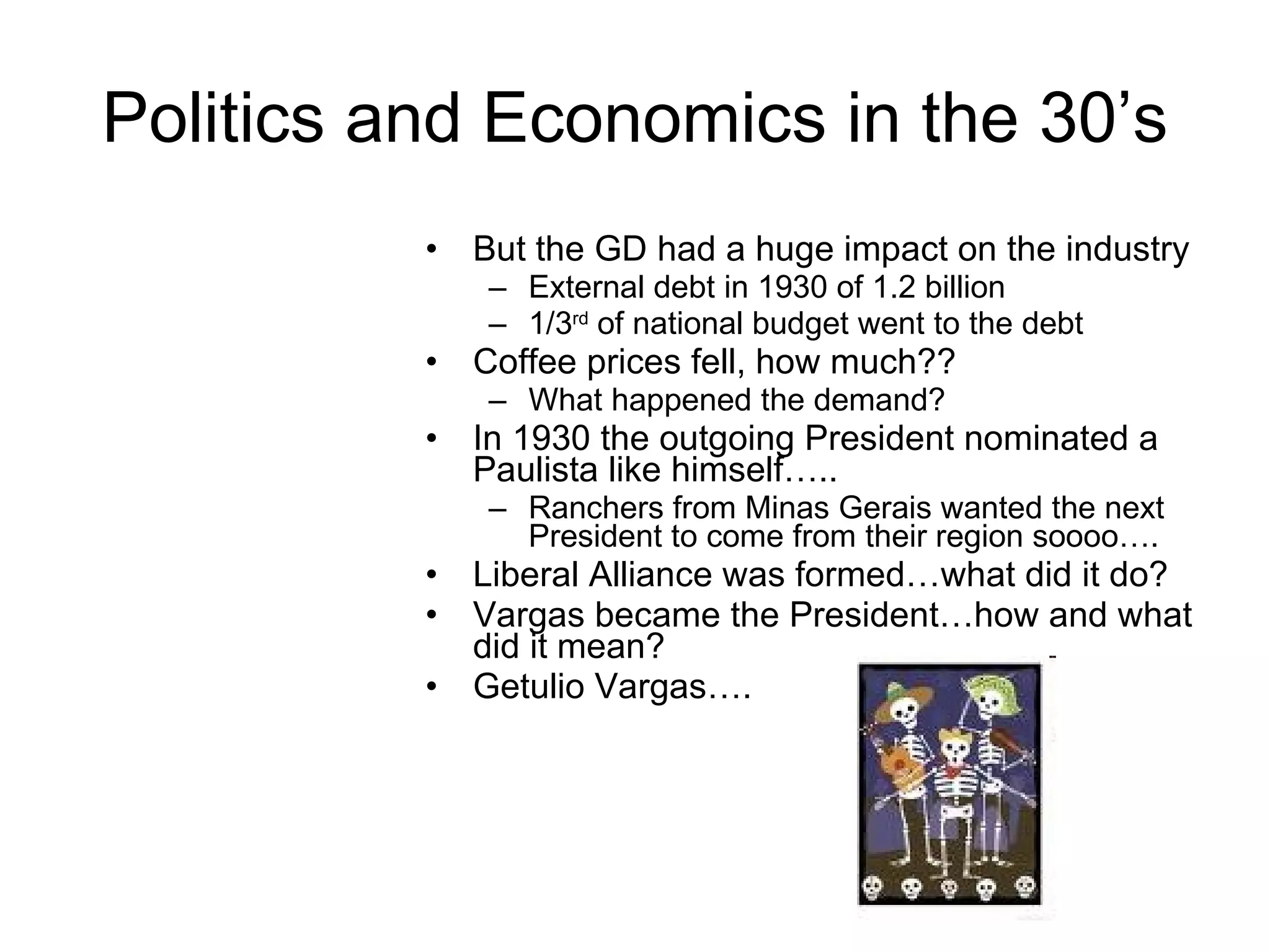
Politics and Economics in the 30’s But the GD had a huge impact on the industry External debt in 1930 of 1.2 billion 1/3 rd  of national budget went to the debt Coffee prices fell, how much?? What happened the demand? In 1930 the outgoing President nominated a Paulista like himself….. Ranchers from Minas Gerais wanted the next President to come from their region soooo…. Liberal Alliance was formed…what did it do? Vargas became the President…how and what did it mean? Getulio Vargas….
Background Was born in 1883 He first started with the military, then turned to law He and his wife had 5 children Came from a region called Rio Grande do Sul He served various roles in the government, including Secretary of the Treasury  He was a wealthy nationalist and anti-communist He favored a liberal, capitalist approach He lost a 1930 election, running on a populist platform He took part in the bloodless coup in 1930, installing Vargas as “provisional president”
Vargas’ Hold on Power.. He ruled over a coalition that was frustrated at the power of Sao Paulo Included growing middle class, intellectuals and tenant farmers, conservative landowners Pressured by blacks and women for better rights His first few years he challenged SP.  “ Interventers” were installed in every state except MG Loyalty to country, not state SP oligarchy led a revolt in 1932 The Constitutionalist Revolution was supported by all of SP It was squashed, Vargas pardoned the leaders to gain support and the debt was excused
Vargas Cont.  In 1932 he lowered the voting age from 21 to 18 and extended the vote to women Still 95% remained ineligible to vote (illiterate) But between 1930-1945 there were no national elections, only state 1934-New Constitution drafted Vargas was elected until 1938 by the national assembly Nationalized energy, defense, fixed minimum wage, guaranteed the right to strike, fixed the 8-hour day and created social security Strikes were repressed that weren’t supported by gov
Estado Novo The left led an armed uprising…squashed 15,000 imprisoned and many tortured or put to dealth 1937—Vargas cancelled 1938 elections, dissolved congress and assumed dictatorial status w/ new constitution Modeled by European Fascism Dissolved all political parties Arrested anyone against Vargas  Strict censorship was established The new regime was called the Estado Novo( New State) They regulated the economy and industrialization became the focus Vargas gave tax incentives, import quotas, lowered duties on imports needed for industrialization and low interest long term loans
Impact Industrial production doubled from 1931-1936 Increased trade with Germany German for SA established 300 branches By 1940 there was significant foreign capitol-especially with the US US/B signed a secret agreement to build airstrips in B B broke ties w/Germany in 1942 Led to G sinking B merchant ships In August a B transport shop was sunk, 257 soldiers died US sent anti-sub ships to B…finally declared war on 8/22/42 Vargas gave the US complete control over the B Navy and Air Force….why?
WWII and Brazil B became less strategic after front became Europe not N. Africa B thought committing soldiers meant post-war reconstructing In 44’ 25,344 troops were sent to Italy Brazilian Expeditionary Force All logistical support was supplied by the US Sent a fighter squadron as well Lost 1,889 soldiers  WWII led to rapid industrialization The US needed supplies The relationship with the US was mutually favorable…but how about fascism?  Vargas needed to acquire a façade of democracy He game amnesty for political prisoners, allowed political parties and set a date for elections Military thought he would not hold them….deposed him
Vargas….again? Ran in 1950 for President again in 1950 Ran on a platform of industrialization, nationalism (populism) and expansion of the social welfare program He won with 48% of the vote…but he found that…. Inflation rose which hurt the middle class He needed foreign investment… After a series of labor strikes he proposed a doubling of the minimum wage In 1954—The “Manifesto of Colonels” Due to a failed assassination attempt of his opponent, he was forced to resign  The day he was to leave office he committed suicide at the age of 72
Impact Under the Estado Novo society was controlled by the government Included all printed materials and radio programs Vargas did nothing to improve status of women or minorities  The promises made to the MC were never a reality…such as… When he died people were devastated….really? The masses were saddened, he appealed to the common people Education was not improved at all…in 1942 16% had completed more than three years of education Over all, his rhetoric did not match his realty…populism 

Populism Continued Vargas Web

  • 1.
    Brazil Originally calledthe United States of Brazil Each state was sovereign, almost a confederation Between 1889 and 1930, there was significant instability Social, political and economic Total dependency on their coffee industry Created artificial demand through storing excess coffee Plantations became violent because the workers lived in debt peonage Hired thugs were used to keep workers in line Brazil got into the war because U-boats sank B merchant ships B basically got involved with supplies not military Food production was neglected in favor of light industry and coffee…led to malnutrition, diseases and a lack of proper sanitation Average lifespan in 1920 was 28…low huh?
  • 2.
    Brazil continued 64%of the pop over the age of 15 were illiterate 3% of the pop voted Really meant nothing because elections were rigged anyway Coronels ruled The coronels of Sao Paulo and Minas Gerais cut a deal, between 1889 and 1930 6 presidents came from there So what was the impact???
  • 3.
    Politics and Economicsin the 30’s But the GD had a huge impact on the industry External debt in 1930 of 1.2 billion 1/3 rd of national budget went to the debt Coffee prices fell, how much?? What happened the demand? In 1930 the outgoing President nominated a Paulista like himself….. Ranchers from Minas Gerais wanted the next President to come from their region soooo…. Liberal Alliance was formed…what did it do? Vargas became the President…how and what did it mean? Getulio Vargas….
  • 4.
    Background Was bornin 1883 He first started with the military, then turned to law He and his wife had 5 children Came from a region called Rio Grande do Sul He served various roles in the government, including Secretary of the Treasury He was a wealthy nationalist and anti-communist He favored a liberal, capitalist approach He lost a 1930 election, running on a populist platform He took part in the bloodless coup in 1930, installing Vargas as “provisional president”
  • 5.
    Vargas’ Hold onPower.. He ruled over a coalition that was frustrated at the power of Sao Paulo Included growing middle class, intellectuals and tenant farmers, conservative landowners Pressured by blacks and women for better rights His first few years he challenged SP. “ Interventers” were installed in every state except MG Loyalty to country, not state SP oligarchy led a revolt in 1932 The Constitutionalist Revolution was supported by all of SP It was squashed, Vargas pardoned the leaders to gain support and the debt was excused
  • 6.
    Vargas Cont. In 1932 he lowered the voting age from 21 to 18 and extended the vote to women Still 95% remained ineligible to vote (illiterate) But between 1930-1945 there were no national elections, only state 1934-New Constitution drafted Vargas was elected until 1938 by the national assembly Nationalized energy, defense, fixed minimum wage, guaranteed the right to strike, fixed the 8-hour day and created social security Strikes were repressed that weren’t supported by gov
  • 7.
    Estado Novo Theleft led an armed uprising…squashed 15,000 imprisoned and many tortured or put to dealth 1937—Vargas cancelled 1938 elections, dissolved congress and assumed dictatorial status w/ new constitution Modeled by European Fascism Dissolved all political parties Arrested anyone against Vargas Strict censorship was established The new regime was called the Estado Novo( New State) They regulated the economy and industrialization became the focus Vargas gave tax incentives, import quotas, lowered duties on imports needed for industrialization and low interest long term loans
  • 8.
    Impact Industrial productiondoubled from 1931-1936 Increased trade with Germany German for SA established 300 branches By 1940 there was significant foreign capitol-especially with the US US/B signed a secret agreement to build airstrips in B B broke ties w/Germany in 1942 Led to G sinking B merchant ships In August a B transport shop was sunk, 257 soldiers died US sent anti-sub ships to B…finally declared war on 8/22/42 Vargas gave the US complete control over the B Navy and Air Force….why?
  • 9.
    WWII and BrazilB became less strategic after front became Europe not N. Africa B thought committing soldiers meant post-war reconstructing In 44’ 25,344 troops were sent to Italy Brazilian Expeditionary Force All logistical support was supplied by the US Sent a fighter squadron as well Lost 1,889 soldiers WWII led to rapid industrialization The US needed supplies The relationship with the US was mutually favorable…but how about fascism? Vargas needed to acquire a façade of democracy He game amnesty for political prisoners, allowed political parties and set a date for elections Military thought he would not hold them….deposed him
  • 10.
    Vargas….again? Ran in1950 for President again in 1950 Ran on a platform of industrialization, nationalism (populism) and expansion of the social welfare program He won with 48% of the vote…but he found that…. Inflation rose which hurt the middle class He needed foreign investment… After a series of labor strikes he proposed a doubling of the minimum wage In 1954—The “Manifesto of Colonels” Due to a failed assassination attempt of his opponent, he was forced to resign The day he was to leave office he committed suicide at the age of 72
  • 11.
    Impact Under theEstado Novo society was controlled by the government Included all printed materials and radio programs Vargas did nothing to improve status of women or minorities The promises made to the MC were never a reality…such as… When he died people were devastated….really? The masses were saddened, he appealed to the common people Education was not improved at all…in 1942 16% had completed more than three years of education Over all, his rhetoric did not match his realty…populism 