Organization
and
Management(BM101)
Prepared by:
Jona B. Villalas, LPT
NGIS-Annex
motivator1
1.1 Evolution of Management Theories
Management
A function that directs and coordinates the
efforts of the people to accomplish goals
and objectives by using available resources
efficiently and effectively.
Management
Includes planning, organizing, staffing,
leading or directing and controlling.
A process of accomplishing the
organization’s goals by working with and
through people.
Management according to Harold Koontz
Management is the art of
getting things done through &
with a formally organized
group
Copyright © 2010 Pearson Education, Inc. Publishing as Prentice Hall
1–5
What Is Management?
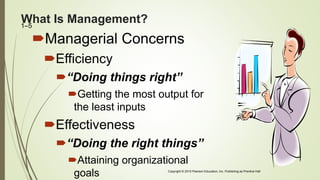
Managerial Concerns
Efficiency
“Doing things right”
Getting the most output for
the least inputs
Effectiveness
“Doing the right things”
Attaining organizational
goals
Copyright © 2010
Pearson
Education, Inc.
Publishing as
Prentice Hall
1–6
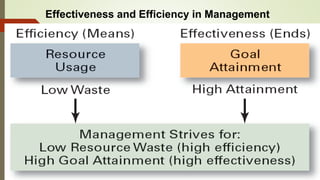
Effectiveness and Efficiency in Management
Industrial Revolution
The transition from hand production to
methods to the use of different machines.
New chemical manufacturing processes,
iron production processes, increasing use
of steam power and development of
machine tools.
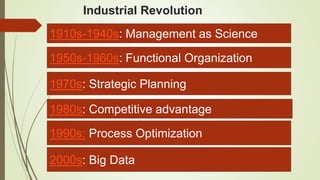
Industrial Revolution
1910s-1940s: Management as Science
1950s-1960s: Functional Organization
1970s: Strategic Planning
1980s: Competitive advantage
1990s: Process Optimization
2000s: Big Data
Henry Fayol (1841-1925)
Was a French industrialist
 proposed that there were
five (5) primary functions of
management and
fourteen(14) Principles of
Management
Functions of Management:
To organize
 To Plan and
forecast(Prevoyance)
 To command
 To control
 To coordinate
1.2 Principles of Management
Division of work
Authority & responsibility
Discipline
Unity of command
Unity of direction
Subordination of individual
interest
Principles of Management
Remuneration of personnel
The Degree of Centralization
Scalar Chain
Order
Equity
Stability of Tenure of Personnel
Initiative
Esprit De Corps
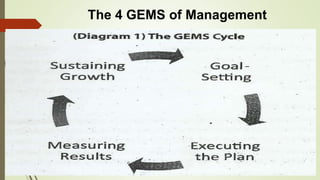
The 4 GEMS of Management
The 4 GEMS OF Management
(Management cycles)
Goal
Execution
Measurement
Sustenance
The GEMS Management Wheel
Stage 1: Goal Setting
1. Synthesizing Information
2. Formulating Alternative
3. Deciding on Courses of Action
4. Establishing Goals
Stage 2: Executing the Plan
5. Organizing
The GEMS Management Wheel
Stage 2: Executing the Plan
6. Communicating
7. Guiding
Stage 3: Measuring Results
Stage 4: Sustaining Growth
8. Promoting Change
9. Developing People
An individual who is in charge of a
certain group of tasks, or a certain
subset of a company.
What is a Manager?
Someone who coordinates and
oversees the work of other
people so that organizational
goals can be accomplished.
Copyright © 2010
Pearson
Education, Inc.
Publishing as
Prentice Hall
1–19
Classifying Managers
First-line Managers
manage the work of non-managerial
employees.
Middle Managers
manage the work of first-line managers.
Top Managers
responsible for making organization-wide
decisions and establishing plans and goals
that affect the entire organization.
Copyright © 2010
Pearson
Education, Inc.
Publishing as
Prentice Hall
1–20
Exhibit: Managerial Levels
Ability to understand
and use techniques,
knowledge and tools
and equipment of a
specific discipline or
department.
ability of someone to work
well with others and able to
provide a good customer
relation attitude. This is
usually referred to as
"people skills".
Human Skills
Responsibilities of a Manager
A. Staffing
B. Communication
C. Training
D. Administrative Investigation and Discipline
E. Employee Relations
F. Business Growth Sustainability
Case #1
Requirements of the Job
The Right Person for the Right
Job
Difference between Hard
Skills and Soft Skills
Job Competency
- the ability of an individual to
do a job properly.
- measurable or observable
knowledge, skills, abilities,
and behaviors (KSABs)
critical to successful job
performance
Some common core competencies:
- adaptability commitment
- creativity motivation
- foresight leadership
- independence
- emotional stability
- analytical reasoning
- communication skills
- customer focus
- teamwork and cooperation
- results orientation
The Iceberg Theory or “Theory of Omission”
skills
knowledge
values
Self-image
traits
motives
Samples of Levels of Proficiency in Job Competency
Minimal – minimal knowledge/no opportunity to
demonstrate
Basic – limited knowledge overview
Working – can do/has working knowledge
Proficient – can do very well, can guide others, very proficient
Expert – acknowledged expert, extensive and in depth experience
Mastery of competency
Excellence in competency, can be a mentor or coach
*PERSONAL VALUES
“VALOR” - STRENGTH
COMPANY’S CORE VALUES:
1.EXCELLENCE
2.CUSTOMER FOCUS
3.INTEGRITY
4.TEAMWORK
5.CREATIVITY AND INNOVATION
FILIPINO VALUES
“HIYA” –SENSE OF SHAME
“AMOR PROPIO” – SELF-ESTEEM
“BAHALA NA” – LEAVE IT TO
BATHALA – GOD
“PAKIKIRAMDAM” – SENSITIVE TO
NEEDS AND FEELINGS OF OTHERS
LANDA JOCANO(ANTHROPOLOGIST):
1.EXOGENOUS MODEL- FOREIGN
MODEL(FORMAL & LEGAL Ex. Bribery)
2.INDIGENOUS MODEL- TRADITIONAL
MODEL
(NON-FORMAL Ex., “UTANG NA LOOB”)
References:
Organization and Management by Ranulfo Payos
Wikipedia

Organization&mgt intro

  • 1.
  • 2.
    1.1 Evolution ofManagement Theories Management A function that directs and coordinates the efforts of the people to accomplish goals and objectives by using available resources efficiently and effectively.
  • 3.
    Management Includes planning, organizing,staffing, leading or directing and controlling. A process of accomplishing the organization’s goals by working with and through people.
  • 4.
    Management according toHarold Koontz Management is the art of getting things done through & with a formally organized group
  • 5.
    Copyright © 2010Pearson Education, Inc. Publishing as Prentice Hall 1–5 What Is Management? Managerial Concerns Efficiency “Doing things right” Getting the most output for the least inputs Effectiveness “Doing the right things” Attaining organizational goals
  • 6.
    Copyright © 2010 Pearson Education,Inc. Publishing as Prentice Hall 1–6 Effectiveness and Efficiency in Management
  • 7.
    Industrial Revolution The transitionfrom hand production to methods to the use of different machines. New chemical manufacturing processes, iron production processes, increasing use of steam power and development of machine tools.
  • 8.
    Industrial Revolution 1910s-1940s: Managementas Science 1950s-1960s: Functional Organization 1970s: Strategic Planning 1980s: Competitive advantage 1990s: Process Optimization 2000s: Big Data
  • 9.
    Henry Fayol (1841-1925) Wasa French industrialist  proposed that there were five (5) primary functions of management and fourteen(14) Principles of Management
  • 10.
    Functions of Management: Toorganize  To Plan and forecast(Prevoyance)  To command  To control  To coordinate
  • 11.
    1.2 Principles ofManagement Division of work Authority & responsibility Discipline Unity of command Unity of direction Subordination of individual interest
  • 12.
    Principles of Management Remunerationof personnel The Degree of Centralization Scalar Chain Order Equity Stability of Tenure of Personnel Initiative Esprit De Corps
  • 13.
    The 4 GEMSof Management
  • 14.
    The 4 GEMSOF Management (Management cycles) Goal Execution Measurement Sustenance
  • 16.
    The GEMS ManagementWheel Stage 1: Goal Setting 1. Synthesizing Information 2. Formulating Alternative 3. Deciding on Courses of Action 4. Establishing Goals Stage 2: Executing the Plan 5. Organizing
  • 17.
    The GEMS ManagementWheel Stage 2: Executing the Plan 6. Communicating 7. Guiding Stage 3: Measuring Results Stage 4: Sustaining Growth 8. Promoting Change 9. Developing People
  • 18.
    An individual whois in charge of a certain group of tasks, or a certain subset of a company. What is a Manager? Someone who coordinates and oversees the work of other people so that organizational goals can be accomplished.
  • 19.
    Copyright © 2010 Pearson Education,Inc. Publishing as Prentice Hall 1–19 Classifying Managers First-line Managers manage the work of non-managerial employees. Middle Managers manage the work of first-line managers. Top Managers responsible for making organization-wide decisions and establishing plans and goals that affect the entire organization.
  • 20.
    Copyright © 2010 Pearson Education,Inc. Publishing as Prentice Hall 1–20 Exhibit: Managerial Levels
  • 22.
    Ability to understand anduse techniques, knowledge and tools and equipment of a specific discipline or department.
  • 24.
    ability of someoneto work well with others and able to provide a good customer relation attitude. This is usually referred to as "people skills". Human Skills
  • 25.
    Responsibilities of aManager A. Staffing B. Communication C. Training D. Administrative Investigation and Discipline E. Employee Relations F. Business Growth Sustainability
  • 26.
  • 27.
    Requirements of theJob The Right Person for the Right Job Difference between Hard Skills and Soft Skills
  • 28.
    Job Competency - theability of an individual to do a job properly. - measurable or observable knowledge, skills, abilities, and behaviors (KSABs) critical to successful job performance
  • 29.
    Some common corecompetencies: - adaptability commitment - creativity motivation - foresight leadership - independence - emotional stability - analytical reasoning - communication skills - customer focus - teamwork and cooperation - results orientation
  • 30.
    The Iceberg Theoryor “Theory of Omission” skills knowledge values Self-image traits motives
  • 31.
    Samples of Levelsof Proficiency in Job Competency Minimal – minimal knowledge/no opportunity to demonstrate Basic – limited knowledge overview Working – can do/has working knowledge Proficient – can do very well, can guide others, very proficient Expert – acknowledged expert, extensive and in depth experience Mastery of competency Excellence in competency, can be a mentor or coach
  • 32.
    *PERSONAL VALUES “VALOR” -STRENGTH COMPANY’S CORE VALUES: 1.EXCELLENCE 2.CUSTOMER FOCUS 3.INTEGRITY 4.TEAMWORK 5.CREATIVITY AND INNOVATION
  • 33.
    FILIPINO VALUES “HIYA” –SENSEOF SHAME “AMOR PROPIO” – SELF-ESTEEM “BAHALA NA” – LEAVE IT TO BATHALA – GOD “PAKIKIRAMDAM” – SENSITIVE TO NEEDS AND FEELINGS OF OTHERS LANDA JOCANO(ANTHROPOLOGIST): 1.EXOGENOUS MODEL- FOREIGN MODEL(FORMAL & LEGAL Ex. Bribery) 2.INDIGENOUS MODEL- TRADITIONAL MODEL (NON-FORMAL Ex., “UTANG NA LOOB”)
  • 34.
    References: Organization and Managementby Ranulfo Payos Wikipedia