Unit I
INTRODUCTION TO MANAGEMENT AND HISTORICAL
DEVELOPMENT
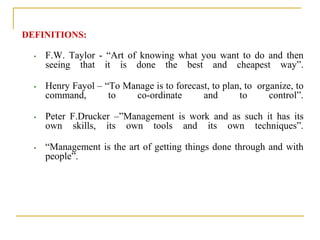
DEFINITIONS:
• F.W. Taylor - “Art of knowing what you want to do and then
seeing that it is done the best and cheapest way”.
• Henry Fayol – “To Manage is to forecast, to plan, to organize, to
command, to co-ordinate and to control”.
• Peter F.Drucker –”Management is work and as such it has its
own skills, its own tools and its own techniques”.
• “Management is the art of getting things done through and with
people”.
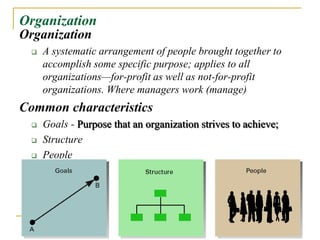
Organization
Organization
 A systematic arrangement of people brought together to
accomplish some specific purpose; applies to all
organizations—for-profit as well as not-for-profit
organizations. Where managers work (manage)
Common characteristics
 Goals - Purpose that an organization strives to achieve;
 Structure
 People
5 M’s of Management
1. Money
2. Manpower
3. Materials
4. Machinery
5. Methods
Efficiency and Effectiveness
Productivity
Implies effectiveness and efficiency in individual
and organizational performance
Efficiency:
Means doing the thing correctly; refers to the relationship
between inputs and outputs; seeks to minimize resource costs
Effectiveness:
Means doing the right things; goal attainment
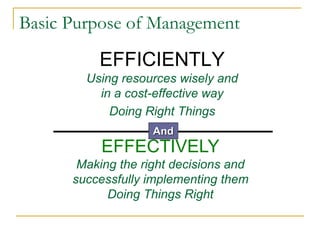
Basic Purpose of Management
EFFICIENTLY
Using resources wisely and
in a cost-effective way
Doing Right Things
EFFECTIVELY
Making the right decisions and
successfully implementing them
Doing Things Right
And
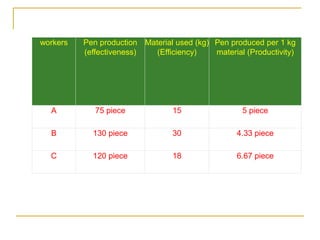
workers Pen production
(effectiveness)
Material used (kg)
(Efficiency)
Pen produced per 1 kg
material (Productivity)
A 75 piece 15 5 piece
B 130 piece 30 4.33 piece
C 120 piece 18 6.67 piece
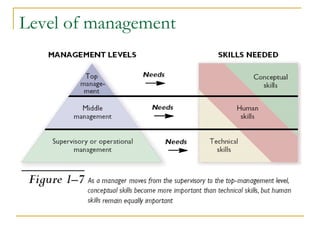
Level of management
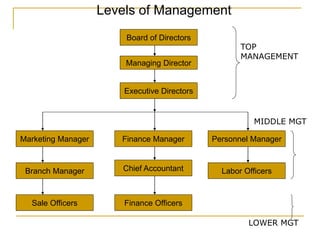
Levels of Management
Board of Directors
Managing Director
Executive Directors
Finance Manager
Marketing Manager
Branch Manager
Sale Officers
Chief Accountant
Finance Officers
Personnel Manager
Labor Officers
TOP
MANAGEMENT
MIDDLE MGT
LOWER MGT
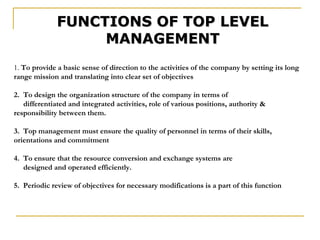
1. To provide a basic sense of direction to the activities of the company by setting its long
range mission and translating into clear set of objectives
2. To design the organization structure of the company in terms of
differentiated and integrated activities, role of various positions, authority &
responsibility between them.
3. Top management must ensure the quality of personnel in terms of their skills,
orientations and commitment
4. To ensure that the resource conversion and exchange systems are
designed and operated efficiently.
5. Periodic review of objectives for necessary modifications is a part of this function
FUNCTIONS OF TOP LEVEL
MANAGEMENT
FUNCTIONS OF MIDDLE LEVEL
MANAGEMENT
 To interpret and explain the plans and policies formulated by top
management
 To monitor & control the operating performance
 To cooperate among themselves so as to integrate the various
activities of a department
 To train, motivate and develop supervisory personnel; and
 To lay down rules & regulations to be followed by supervisory
personnel.
FUNCTIONS OF LOWER LEVEL MANAGEMENT
1. To plan day to day production within the goal laid down by higher
authorities
2. To assign jobs to workers and to make arrangements for their training
and development
3. To issue orders & instructions
4. To supervise & control workers’ operations and to maintain personal
contact with them
5. To arrange materials and tools and to maintain machinery
6. To advise & assist workers by explaining work procedures, solving their
problems etc.
7. To maintain discipline and good human relations among workers
8. To report feedback information and workers’ problems to the higher
authorities.
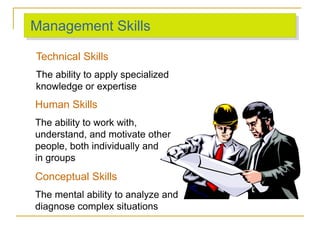
Management Skills
Technical Skills
The ability to apply specialized
knowledge or expertise
Human Skills
The ability to work with,
understand, and motivate other
people, both individually and
in groups
Conceptual Skills
The mental ability to analyze and
diagnose complex situations
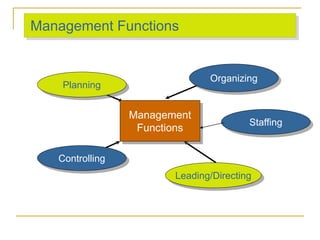
Management Functions
Planning
Organizing
Leading/Directing
Controlling
Management
Functions
Staffing
Management Functions (cont’d)
Planning
A process that includes defining goals,
establishing strategy, and developing plans
to coordinate activities
•Done towards Future.
•Future is uncertain so it includes
Forecasting
•What to Do? How to do? When to do?
Where to do? Why to do?
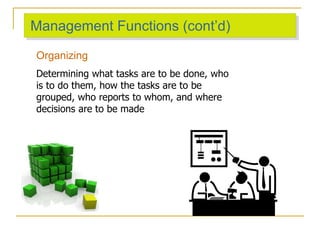
Management Functions (cont’d)
Organizing
Determining what tasks are to be done, who
is to do them, how the tasks are to be
grouped, who reports to whom, and where
decisions are to be made
Management Functions (cont’d)
Leading
A function that includes motivating
employees, directing others, selecting the
most effective communication channels,
and resolving conflicts
Management Functions (cont’d)
Controlling
Monitoring activities to ensure they are being
accomplished as planned and correcting any significant
deviations
Identifying Managers
 First-line managers
 Supervisors responsible for directing the day-to-day
activities of operative employees
 Middle managers
 Individuals at levels of management between the first-line
manager and top management
 Top managers
 Individuals who are responsible for making decisions about
the direction of the organization and establishing policies
that affect all organizational members
Specific Skills for Managers
Behaviors related to a manager’s effectiveness:
 Controlling the organization’s environment and its
resources.
 Organizing and coordinating.
 Handling information.
 Providing for growth and development.
 Motivating employees and handling conflicts.
 Strategic problem solving.
Role of managers
 Achievement of group goal
 Optimum utilization of resources
 Minimisation of cost
 Establishes sound organization
 Generation of employment
 Development the nation
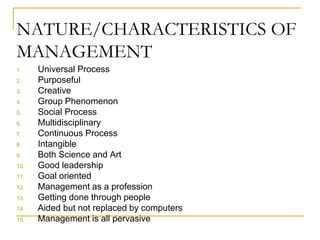
NATURE/CHARACTERISTICS OF
MANAGEMENT
1. Universal Process
2. Purposeful
3. Creative
4. Group Phenomenon
5. Social Process
6. Multidisciplinary
7. Continuous Process
8. Intangible
9. Both Science and Art
10. Good leadership
11. Goal oriented
12. Management as a profession
13. Getting done through people
14. Aided but not replaced by computers
15. Management is all pervasive
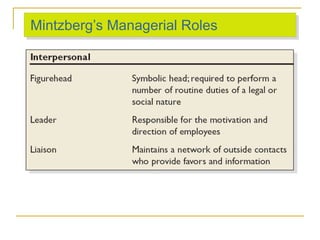
Mintzberg’s Managerial Roles
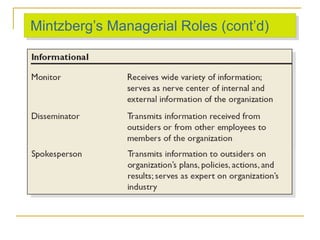
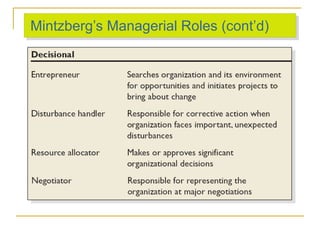
Mintzberg’s Managerial Roles (cont’d)
Management & Administration
 Controversy over the meaning of the terms
Management and Administration.
 Three schools of Thought- administration is
broader than management, administration is part of
management, management and administration are
identical.
 American School of thought: Administrators
think, managers act; administration is a top level
activity, management is a lower level function.
27
Management & Administration
 English School of thought: Management is
rule making and rule enforcing body,
Administration is just an implementing agency.
 Newman, Harold Koontz, McFarland , Ernst
Dale maintain that management and
administration are identical.
Development of Management thought
 Management is as old as human civilization. Ex: Egyptian
pyramids, Great Wall of China.
 During 1400’s: Venetian business enterprises and their
management practices
 During 1776: Adam Smith described the advantages of
division of labor and specialization.
 Beginning of 18th century: Industrial Revolution resulted in
the advent of machine power , mass production and
efficient transportation.
Development of Management thought
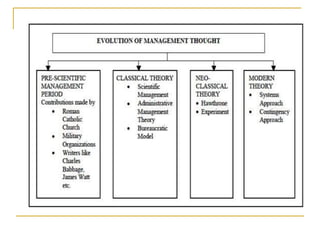
 Evolution of management thought can be studied in
two broad categories:
 Early management approaches (Scientific
management, administrative management theory and
human relations movement)
 Modern management approaches (behavioral,
quantitative, systems and contingency approaches) .
•Professor Charles Babbage (UK 1729 -1871): He was a
Professor of Mathematics at Cambridge University
• He felt that the methods of science and mathematics could be
applied to the solution of methods in the place of guess work for the
solution of business problems.
• the desirability of finding out the number of times each operation is
repeated each hour, the dividing of work into mental and physical
efforts, the determining of the precise cost for every process and the
paying of a bonus to the workers in proportion to his own efficiency
and the success of enterprise.
Robert Owens (UK 1771 - 1858): Robert Owens, the promoter of co-operative
and trade union movement in England, emphasized the recognition of human
element in industry. He firmly believed that workers' performance in industry
was influenced by the working conditions and treatment of workers.
He introduced new ideas of human relations - shorter working hours, housing
facilities, training of workers in hygiene, education of their children, provision of
canteen etc
Henry Robinson Towne (USA 1844 -1924): H.R Towne was the president of
the famous lock manufacturing company "Yale and Town". He urged the
combination of engineers and economists as industrial managers.
This combination of qualities, together with at least some skill as an
accountant, is essential to the successful management of industrial workers
Seebohm Rowntree (UK 1871- 1954): Rowntree created a public opinion on
the need of labour welfare scheme and improvement in industrial relations.
Prof. Charles Babbage, James Watt Junior and Mathew Robinson Boulton,
Robert Owen, Henry Robinson Towne and Rowntree were, no doubt,
pioneers of management thought. But, the impact of their contributions on the
industry as a whole was meagre. The real beginning of the science of
management did not occur until the last decade of the 19thcentury.
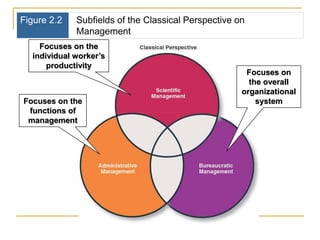
Figure 2.2 Subfields of the Classical Perspective on
Management
Focuses on the
individual worker’s
productivity
Focuses on the
functions of
management
Focuses on
the overall
organizational
system
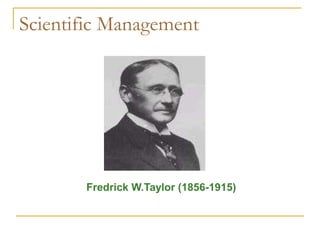
Scientific Management
Fredrick W.Taylor (1856-1915)
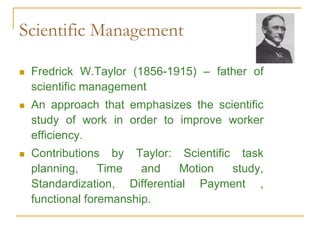
Scientific Management
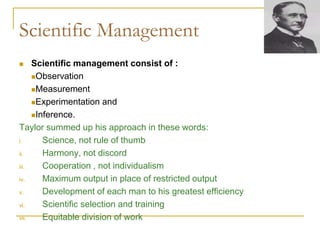
 Fredrick W.Taylor (1856-1915) – father of
scientific management
 An approach that emphasizes the scientific
study of work in order to improve worker
efficiency.
 Contributions by Taylor: Scientific task
planning, Time and Motion study,
Standardization, Differential Payment ,
functional foremanship.
Scientific Management
 Scientific management consist of :
Observation
Measurement
Experimentation and
Inference.
Taylor summed up his approach in these words:
i. Science, not rule of thumb
ii. Harmony, not discord
iii. Cooperation , not individualism
iv. Maximum output in place of restricted output
v. Development of each man to his greatest efficiency
vi. Scientific selection and training
vii. Equitable division of work
Elements of Scientific Management:
1. Scientific Task and Rate-setting, work improvement,
etc.
2. Planning the Task.
3. Vocational Selection and Training
4. Standardization (of working conditions, material
equipment etc.)
5. Specialization
6. Mental Revolution.
1. Scientific Task and Rate-Setting (work study):
Methods Study: The management should try to ensure that the plant is
laid out in the best manner and is equipped with the best tools and
machinery. The possibilities of eliminating or combining certain operations
may be studied.
Motion Study: It is a study of the movement, of an operator (or even of a
machine) in performing an operation with the purpose of eliminating useless
motions.
Time Study (work measurement): The basic purpose of time study is to
determine the proper time for performing the operation. Such study may be
conducted after the motion study. Both time study and motion study help in
determining the best method of doing a job and the standard time allowed
for it.
Fatigue Study: If, a standard task is set without providing for measures to
eliminate fatigue, it may either be beyond the workers or the workers may
over strain themselves to attain it. It is necessary, therefore, to regulate the
working hours and provide for rest pauses at scientifically determined
intervals.
Rate-setting: Taylor recommended the differential piece wage system,
under which workers performing the standard task within prescribed time
are paid a much higher rate per unit than inefficient workers who are not
able to come up to the standard set.
2. planning the Task: Having set the task which an average worker must
strive to perform to get wages at the higher piece-rate, necessary steps have
to be taken top lan the production thoroughly so that there is no bottlenecks
and the work goes on systematically.
3. Vocational Selection and Training :
Scientific Management requires a radical change in the methods and
procedures of selecting workers. It is therefore necessary to entrust the
task of selection to a central personnel department. The procedure of
selection will also have to be systematised.
4. Standardization:
Tools and equipment: The management must select and store standard
tools and implements which will be nearly the best or the best of their kind.
Speed: There is usually an optimum speed for every machine. If it is
exceeded, it is likely to result in damage to machinery.
Conditions of Work: To attain standard performance, the maintenance of
standard conditions of ventilation, heating, cooling, humidity, floor space,
safety etc., is very essential.
Materials: The efficiency of a worker depends on the quality of materials and
5.Specialization:
The Route Clerk: To lay down the sequence of operations and instruct the
workers concerned about it.
The Instruction Card Clerk: To prepare detailed instructions regarding different
aspects of work.
The Time and Cost Clerk: To send all information relating to their pay to
the workers and to secure proper returns of work from them.
The Shop Disciplinarian: To deal with cases of breach of discipline and
absenteeism.
The Gang Boss: To assemble and set up tools and machines and to teach the
workers to make all their personal motions in the quickest and best way.
The Speed Boss: To ensure that machines are run at their best speeds and
proper tools are used by the workers.
The Repair Boss: To ensure that each worker keeps his machine in good order
and maintains cleanliness around him and his machines.
The Inspector: To show to the worker how to do the work.
Henry Gannt
 Worked with Taylor at Midvale Steel
Company
 Specialized in incentive wage plans
 Introduced a differential piece rate system –
Task work with a bonus
 Permitted workers to improve the production
system
 Introduced a bonus for foremen based on the
number of their workers who earned bonus
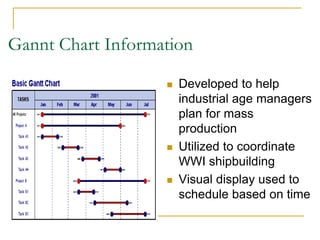
Gannt Chart Information
 Developed to help
industrial age managers
plan for mass
production
 Utilized to coordinate
WWI shipbuilding
 Visual display used to
schedule based on time
Scientific Management Pioneers
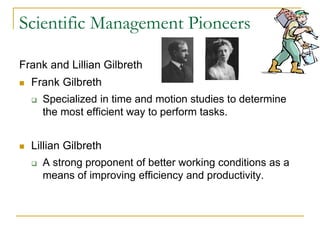
Frank and Lillian Gilbreth
 Frank Gilbreth
 Specialized in time and motion studies to determine
the most efficient way to perform tasks.
 Lillian Gilbreth
 A strong proponent of better working conditions as a
means of improving efficiency and productivity.
45
Scientific Management
Limitations:
i. Exploitative device
ii. Depersonalized work
iii. Unpsychological
iv. Undemocratic
v. Antisocial
vi. Unrealistic
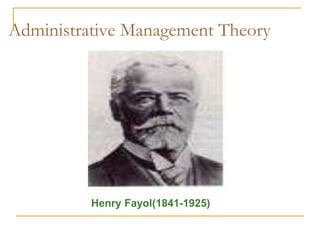
Administrative Management Theory
Henry Fayol(1841-1925)
Administrative Management Theory
 Henry Fayol(1841-1925) developed this theory.
 Focuses on principles that can be used by
managers to coordinate the internal activities of
organizations.
 Explains the process of managing an organization
from the top managerial perspective.
 Five functions to be performed by managers:
planning, organizing, Commanding, Coordination,
Controlling.
Administrative Management Theory
 Managers should apply 14 principles at the
operational level:
 Division of work
 Authority and Responsibility
 Discipline
 Unity of Command
 Unity of direction
 Subordination of individual interest to the common
good
Administrative Management Theory
 Remuneration of Personnel
 Order
 Centralization
 Scalar Chain
 Equity
 Stability of tenure
 Initiative
 Espirit de Corps
Administrative Management Theory
Limitations:
 Lack of empirical evidence
 Neglect of human factors
 False assumptions
 Pro-management bias
 Historical significance
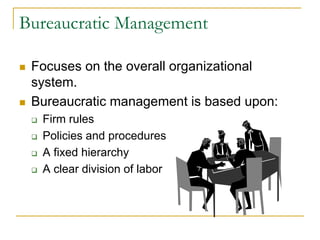
Bureaucratic Management
 Focuses on the overall organizational
system.
 Bureaucratic management is based upon:
 Firm rules
 Policies and procedures
 A fixed hierarchy
 A clear division of labor
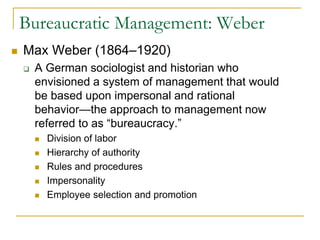
Bureaucratic Management: Weber
 Max Weber (1864–1920)
 A German sociologist and historian who
envisioned a system of management that would
be based upon impersonal and rational
behavior—the approach to management now
referred to as “bureaucracy.”
 Division of labor
 Hierarchy of authority
 Rules and procedures
 Impersonality
 Employee selection and promotion
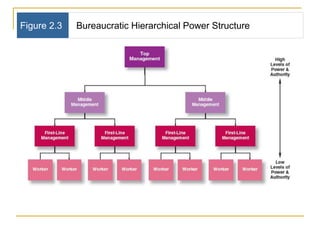
Figure 2.3 Bureaucratic Hierarchical Power Structure
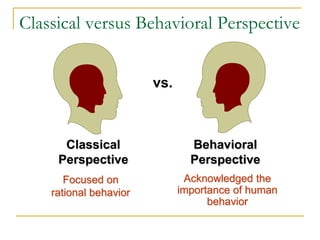
Classical versus Behavioral Perspective
Focused on
rational behavior
Classical
Perspective
Acknowledged the
importance of human
behavior
Behavioral
Perspective
vs.
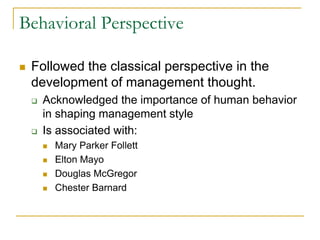
Behavioral Perspective
 Followed the classical perspective in the
development of management thought.
 Acknowledged the importance of human behavior
in shaping management style
 Is associated with:
 Mary Parker Follett
 Elton Mayo
 Douglas McGregor
 Chester Barnard
Mary Parker Follett
 Concluded that a key to effective
management was coordination.
 Felt that managers needed to coordinate and
harmonize group effort rather than force and
coerce people.
 Believed that management is a continuous,
dynamic process.
 Felt that the best decisions would be made
by people who were closest to the situation.
Follett on Effective Work Groups
 Four principles of coordination to promote
effective work groups:
1. Coordination requires that people be in direct
contact with one another.
2. Coordination is essential during the initial stages
of any endeavor.
3. Coordination must address all factors and
phases of any endeavor.
4. Coordination is a continuous, ongoing process.
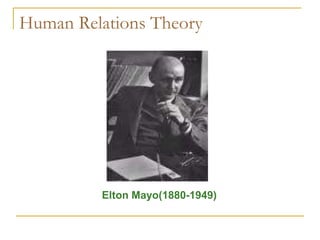
Human Relations Theory
Elton Mayo(1880-1949)
Human Relations Theory
 Elton Mayo(1880-1949) contributed to this
theory.
 It is a movement in management thinking and
practice that emphasized satisfaction of
employees’ basic needs as the key to
increased worker productivity.
 Compensated the deficiencies in scientific
management and administrative management.
 Gained popularity after studies of human
behavior at work situations during 1924-33.
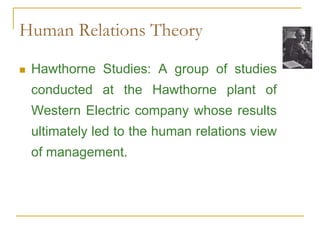
Human Relations Theory
 Hawthorne Studies: A group of studies
conducted at the Hawthorne plant of
Western Electric company whose results
ultimately led to the human relations view
of management.
The Hawthorne Studies (1927–1932)
 Conducted by Elton Mayo and associates at
Western Electric
 Illumination study—workplace lighting adjustments
affected both the control and the experimental
groups of production employees.
 Group study(relay assembly test room)—
 Implementation of piecework incentive plan caused
production workers to establish informal levels of acceptable
individual output.
 Over-producing workers were labeled “rate busters” and
under-producing workers were considered “chiselers.”
 Two five minutes rest – one in morning and other in
evening, which were introduced to ten minutes – productivity
increased
 Rest period was reduced to five minutes but frequency was
increased- the productivity decreased, girls complained
that frequent rest intervals affected the rhythm of the work.
 The number of was decreased to two of ten minutes of
each but in the morning, coffee or soup was served, along
with sandwich and in the evening snacks was provided –
the productivity increased.
 Change in the working hours and working day were
introduced. (Saturday leave, the employee allowed to leave
4.30 pm instead of 5.oo pm and later at 4.00 pm – but the
productivity increased. )
 Interview program—confirmed the importance of
human behavior in the workplace. (20000 interviews
were conducted) determine employee attitudes
towards company, supervision, insurance plans,
promotion and wages etc.,
 Bank wiring observation : these experiments were conducted with small
groups on the individual, a group of 14 male employees were formed a
small group. Hourly wages fixed on the basis of average output of each
worker. Bonus also payable on the basis of group effort.
 It was expected that highly efficient workers would bring pressure on less
efficient workers to increase output and take a advantage of group incentive
or wage plan.
 But this strategy does not work and workers established their own standard
of output and this was enforced vigrously by various methods of social
pressure.
 FINAL SUGGESTION :
 Social unit
 Group influence
 group behaviour
 Motivation
 Supervision
 Working condition
 Employee morale
 Communication
 Balanced approach
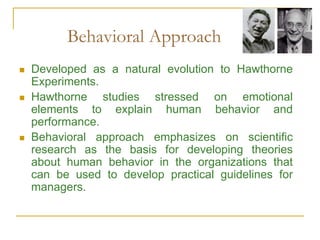
Behavioral Approach
 Developed as a natural evolution to Hawthorne
Experiments.
 Hawthorne studies stressed on emotional
elements to explain human behavior and
performance.
 Behavioral approach emphasizes on scientific
research as the basis for developing theories
about human behavior in the organizations that
can be used to develop practical guidelines for
managers.
Douglas McGregor
 Proposed the Theory X and Theory Y styles
of management.
 Theory X managers perceive that their
subordinates have an inherent dislike of work and
will avoid it if at all possible.
 Theory Y managers perceive that their
subordinates enjoy work and that they will gain
satisfaction from performing their jobs.
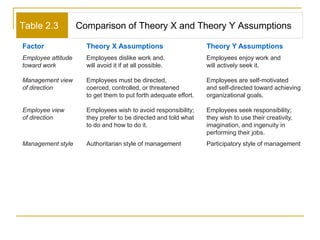
Table 2.3 Comparison of Theory X and Theory Y Assumptions
Factor Theory X Assumptions Theory Y Assumptions
Employee attitude Employees dislike work and. Employees enjoy work and
toward work will avoid it if at all possible. will actively seek it.
Management view Employees must be directed, Employees are self-motivated
of direction coerced, controlled, or threatened and self-directed toward achieving
to get them to put forth adequate effort. organizational goals.
Employee view Employees wish to avoid responsibility; Employees seek responsibility;
of direction they prefer to be directed and told what they wish to use their creativity,
to do and how to do it. imagination, and ingenuity in
performing their jobs.
Management style Authoritarian style of management Participatory style of management
Chester Barnard
 Felt that executives serve two primary functions:
 Must establish and maintain a communications system
among employees.
 Must establish the objectives of the organization and
motivate employees.
 Developed an acceptance theory of authority:
 Authority of a manager flows from the ability of
subordinates to accept or reject an order from the
manager once they:
 Comprehend what the order requires of them.
 Review the order’s consistency with organization goals.
 Perceive a personal benefit in obeying the order.
Quantitative Approach
 Features
 Offers quantitative aids to decision making,
develops quantitative tools to assist in providing
products and services.
 Managerial Choices depend on criteria such as
costs, revenues, ROI, etc
 Emphasis on computers and their assistance in
decision making alternatives.
 Promotes holistic view of factors influencing
decision making
Evolved out of the development of mathematical and statistical
solutions to military problems during World War II.
Involves the use of statistics, optimization models, information
models, and computer simulations to improve management
decision making for planning and control.

Quantitative Approach
 Eliminates subjective thinking in decision making
 Minimizes bias in decision making
 Aids in objective rational decision making.
 Limitations:
 All variables influencing decision can’t be identified.
 Less importance to human relationships
 Decision quality depends on the data inputted to
the computer.
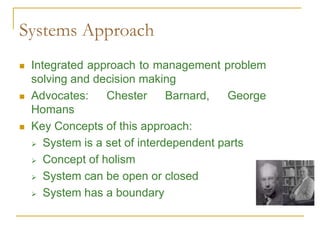
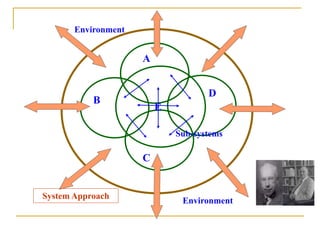
Systems Approach
 Integrated approach to management problem
solving and decision making
 Advocates: Chester Barnard, George
Homans
 Key Concepts of this approach:
 System is a set of interdependent parts
 Concept of holism
 System can be open or closed
 System has a boundary
Systems Approach
 A Model of process or operational management that
indicates how the various inputs are transformed
through the managerial functions of planning,
organizing, staffing, leading, and controlling.
 Defines a system as a set of interrelated and
interdependent parts arranged in a manner that
produces a unified whole
 Closed system : a system that is not influenced by and does not interact
with its environment
 Open system: a system that dynamically interacts with its environment
 Stakeholders: any group that is affected by organizational decisions and
policies
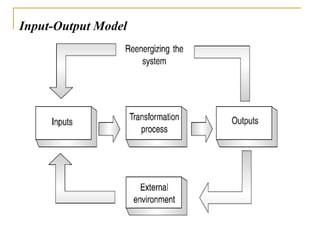
Input-Output Model
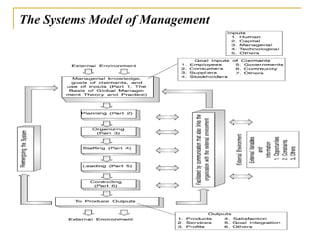
The Systems Model of Management
75
Systems Approach
 Tries to solve problems by diagnosing
them with in a frame work of inputs,
transformation processes, outputs and
feed back
 Good balance between the needs of
various functional parts of the enterprise
and goals of the firm as a whole.
 Conceptual frame work to understand
organization is too abstract.
 Does not identify situational differences
and factors
C
B
D
A
E
Sub-systems
Environment
Environment
System Approach
The Contingency Approach
 The situational approach to management
that replaces more simplistic systems and
integrates much of management theory
 Four popular contingency variables
 Organization size
 Routineness of task technology
 Environmental uncertainty
 Individual differences
Contingency Approach
 Also termed as Situational approach
 Based on the premise that situations dictate
managerial action
 Advocates: Selznic, Woodward, James Thompson
 Cause and effect relationship
 Appropriate managerial action depends on the
particular parameters of the situation
 Spells out the relationship of the organization to its
environment
 Concerned with structural adaptations of
organizations to its task environment.
Contingency Approach
 More pragmatic and action oriented. Integrates
theory and practice in a systems framework
 Advocates the managers to develop skills for
situational analysis
 Limitations:
 Defies empirical testing
 Reactive
 Not holistic in nature
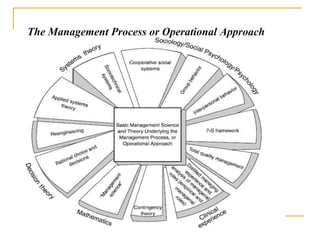
The Management Process or
Operational Approach
The Management Process or Operational Approach
Modern Management Thought Contributions
 Fredrick Herzberg – Motivation-Hygiene Theory or Two Factor
Theory
 Harold Koontz - His approach to management was "human
relations". He rightly said manage-men-t. where "t" stands for
tactfully.
 Douglas McGregor – X and Y Theory
 Abraham H Maslow – Hierarchy of Needs Theory
 Peter F Drucker - Contributed to the philosophical and
practical foundations of the modern business corporation He
was also a leader in the development of management education,
invented the concept known as management by objectives
 W Edwards Deming - Taught top management how to improve
design (and thus service), product quality, testing, and sales
 Business environment
 Case- Mr Steve has started a manufacturing unit at USA. He
implemented scientific management concept like rate setting, task
planning, method study, motion study and time study, fully
technological innovation is there and also followed some division of
labour, hierarchy, supervision, decentralization, authority power,
responsibility, incentive piece rate system, rest, but he may not get
expected out put..
 What is your observation?
 Can you assess the factors that are affecting productivity.
 With changes in the consumption habits of people, Neelesh, who was
running a sweet shop, shifted to the chocolate business. On the eve of
Diwali, he offered chocolates in attractive packages at reasonable prices.
He anticipated huge demand and created a website chocolove. com for
taking orders online. He got a lot of orders online and earned huge profits
by selling the chocolate.
 Identify and explain the dimensions of business environment discussed in
the above case
 Social environment: Social Environment
includes the social forces like customs and
traditions, values, social trends, society’s
expectations from business, etc.
 Technological environment: Technological
Environment includes forces relating to
scientific improvements and innovations
which provide new ways of producing goods
and services and new methods and
techniques of operating a business.
 ‘Accent Electronics Ltd.’ was operating its business in
Malaysia. The company started exporting its products to
India when the Prime Minister announced relaxation in
import duties on electronic items. The company
appointed retailers in India who had direct online links
with the suppliers to replenish stocks when needed.
 Identify and explain the dimensions of business
environment discussed in the above case.
 Political Environment: Political Environment
includes political conditions such as general
stability and peace in the country and specific
attitudes that elected government
representatives hold towards business.
 Technological Environment: Technological
Environment includes forces relating to
scientific improvements and innovations
which provide new ways of producing goods
and services and new methods and
techniques of operating a business.
 As per the directions issued by the Supreme Court, the government
passed an order to ban the sale of tobacco products within the area
of 200 meters of all educational institutions as:
 Its consumption is injurious to health.
 People are becoming more conscious about health and fitness. This
indicates the government’s attitude towards this business.
 Identify the business environment under three different
dimensions by quoting from above paragraph.
 The court passed an order to ban polythene bags as:
 These bags create many environmental problems which
affect the life of people.
 Society at large is more concerned about the quality of
life.
The government decided to give a subsidy to the jute
industry in order to promote this business. As a result,—
 Innovative techniques are being developed to manufacture jute
bags at low rates.
 Incomes are rising and people can afford to buy these bags.
Identify the different dimensions of business environment by
quoting lines from the above particulars.
ANSWER
 The various dimensions of business environment being referred to in
the above case are as follows:
 Legal Environment: “The court passed an order to ban polythene
bags.”
 Social Environment: “The bags create many environmental
problems which affect the life of people and society at large is more
concerned about the,,quality of life.”
 Political Environment: “The government decided to give a subsidy to
the jute industry in order to promote this business.”
 Technological environment: “Innovative techniques are being
developed to manufacture jute bags at low rate.”
 Economic Environment: “Incomes are rising and people can afford
to buy these bags.”
WHAT IS A BUSINESS ORGANISATION?
 The term "business organization" refers to how a business is structured. It
refers to a commercial or industrial enterprise and the people who
constitute it.
 WHAT IS THE RIGHT FORM OF OWNERSHIP ?
 There really is not one right form of ownership.
 • The correct form depends of the type of company, the goals of the
owners, and the plans of what the company may become.
 • Factors such as tax considerations, liability exposure, capital requirements
and structure and ownership control all play a role is determining which
form is correct for a business
 TYPES OF BUSINESS ORGANISATIONS •
 Private Sector
 • Sole Proprietorship
 • Joint Hindu Family Business
 • Partnership Firm
 Company
 Co-operative society
 • Joint Stock Company
 1) Private Limited 2) Public Limited
 SOLE PROPRIETERSHIP When the ownership and management of a
business are in control of one individual the form of business is called sole
proprietorship.
 The most common form of business organization.
 • Owned by one person, who performs most roles and owns everything
 • Very few legal requirements for setting it up.
 • Owner gets all profits, takes all the losses → called unlimited liability
 • Easiest and least expensive to set up
 • Easiest for tax purposes → income recorded under personal income
 JOINT HINDU FAMILY BUSINESS
 • A Hindu Undivided Family (HUF) or Joint Hindu Family (JHF) consist of
all persons who lineally descended from a common ancestor and includes
their wives and unmarried daughters (Hindu Law).
 • When a joint Hindu family carries on a business, it is called a joint Hindu
family firm.
 • The members of such firm are not called partners, but known as
coparceners.
 PARTNERSHIP FIRM A Partnership consists of two or more individuals
in business together Meaning of Partnership
 • A partnership is an association of two or more persons who agree to carry
on business for earning and sharing profit among them.
 • According to Indian Partnership Act, “Partnership is the relation between
persons who have agreed to share the profits of a business carried on by all
or any of them acting for all.”
 Company
 • According to companies act 1956, “Company” means a company formed
and registered under this act or an existing company formed and registered
under any of the previous companies law.
 • According to Prof. Haney, “ A company is an artificial person created by
law, having separate entity with a perpetual succession and common seal.”
 MEANING OF A CORPORATION
 The term ‘Co-operation’ has been derived by adding a prefix ‘Co’ with the word
‘operation’. ‘Co’ means together and ‘operation’ means work. Therefore the literal
meaning of the term co- operation is to work together.
 Co-operation means working together for a common good of all.
 CO-OPERATIVE SOCIETY It is a voluntary association of people or business to
achieve a an economic goal with a social perspective
 Joint Sector
 A Joint Sector Enterprise is one which is established in the partnership of
the public sector and the private sector.
 • It is refers to a form partnership between the Government and private
sector.
 • According to M. Adhikari, “Joint sector is a form of partnership between the
public sector and the private sector or between the government and
business.”
 PUBLIC Ltd., COMPANY
 • Stocks are held by a large number of people
 • Minimum 7 shareholders and no limit for maximum
 • Can be listed on stock exchange and can go public
 • Have to follow many laws with regards to the board composition and
AGM.
 PRIVATE Ltd., COMPANY
 • Closely held by a few people
 • Minimum 2 and maximum 50 shareholders
 • Stocks cannot be traded on exchanges and private equity cannot be raised
 • Less regulations as compared to Public Companies

Unit I-2018.ppt

  • 1.
    Unit I INTRODUCTION TOMANAGEMENT AND HISTORICAL DEVELOPMENT
  • 2.
    DEFINITIONS: • F.W. Taylor- “Art of knowing what you want to do and then seeing that it is done the best and cheapest way”. • Henry Fayol – “To Manage is to forecast, to plan, to organize, to command, to co-ordinate and to control”. • Peter F.Drucker –”Management is work and as such it has its own skills, its own tools and its own techniques”. • “Management is the art of getting things done through and with people”.
  • 3.
    Organization Organization  A systematicarrangement of people brought together to accomplish some specific purpose; applies to all organizations—for-profit as well as not-for-profit organizations. Where managers work (manage) Common characteristics  Goals - Purpose that an organization strives to achieve;  Structure  People
  • 4.
    5 M’s ofManagement 1. Money 2. Manpower 3. Materials 4. Machinery 5. Methods
  • 5.
    Efficiency and Effectiveness Productivity Implieseffectiveness and efficiency in individual and organizational performance Efficiency: Means doing the thing correctly; refers to the relationship between inputs and outputs; seeks to minimize resource costs Effectiveness: Means doing the right things; goal attainment
  • 6.
    Basic Purpose ofManagement EFFICIENTLY Using resources wisely and in a cost-effective way Doing Right Things EFFECTIVELY Making the right decisions and successfully implementing them Doing Things Right And
  • 7.
    workers Pen production (effectiveness) Materialused (kg) (Efficiency) Pen produced per 1 kg material (Productivity) A 75 piece 15 5 piece B 130 piece 30 4.33 piece C 120 piece 18 6.67 piece
  • 8.
  • 9.
    Levels of Management Boardof Directors Managing Director Executive Directors Finance Manager Marketing Manager Branch Manager Sale Officers Chief Accountant Finance Officers Personnel Manager Labor Officers TOP MANAGEMENT MIDDLE MGT LOWER MGT
  • 10.
    1. To providea basic sense of direction to the activities of the company by setting its long range mission and translating into clear set of objectives 2. To design the organization structure of the company in terms of differentiated and integrated activities, role of various positions, authority & responsibility between them. 3. Top management must ensure the quality of personnel in terms of their skills, orientations and commitment 4. To ensure that the resource conversion and exchange systems are designed and operated efficiently. 5. Periodic review of objectives for necessary modifications is a part of this function FUNCTIONS OF TOP LEVEL MANAGEMENT
  • 11.
    FUNCTIONS OF MIDDLELEVEL MANAGEMENT  To interpret and explain the plans and policies formulated by top management  To monitor & control the operating performance  To cooperate among themselves so as to integrate the various activities of a department  To train, motivate and develop supervisory personnel; and  To lay down rules & regulations to be followed by supervisory personnel.
  • 12.
    FUNCTIONS OF LOWERLEVEL MANAGEMENT 1. To plan day to day production within the goal laid down by higher authorities 2. To assign jobs to workers and to make arrangements for their training and development 3. To issue orders & instructions 4. To supervise & control workers’ operations and to maintain personal contact with them 5. To arrange materials and tools and to maintain machinery 6. To advise & assist workers by explaining work procedures, solving their problems etc. 7. To maintain discipline and good human relations among workers 8. To report feedback information and workers’ problems to the higher authorities.
  • 13.
    Management Skills Technical Skills Theability to apply specialized knowledge or expertise Human Skills The ability to work with, understand, and motivate other people, both individually and in groups Conceptual Skills The mental ability to analyze and diagnose complex situations
  • 14.
  • 15.
    Management Functions (cont’d) Planning Aprocess that includes defining goals, establishing strategy, and developing plans to coordinate activities •Done towards Future. •Future is uncertain so it includes Forecasting •What to Do? How to do? When to do? Where to do? Why to do?
  • 16.
    Management Functions (cont’d) Organizing Determiningwhat tasks are to be done, who is to do them, how the tasks are to be grouped, who reports to whom, and where decisions are to be made
  • 17.
    Management Functions (cont’d) Leading Afunction that includes motivating employees, directing others, selecting the most effective communication channels, and resolving conflicts
  • 18.
    Management Functions (cont’d) Controlling Monitoringactivities to ensure they are being accomplished as planned and correcting any significant deviations
  • 19.
    Identifying Managers  First-linemanagers  Supervisors responsible for directing the day-to-day activities of operative employees  Middle managers  Individuals at levels of management between the first-line manager and top management  Top managers  Individuals who are responsible for making decisions about the direction of the organization and establishing policies that affect all organizational members
  • 20.
    Specific Skills forManagers Behaviors related to a manager’s effectiveness:  Controlling the organization’s environment and its resources.  Organizing and coordinating.  Handling information.  Providing for growth and development.  Motivating employees and handling conflicts.  Strategic problem solving.
  • 21.
    Role of managers Achievement of group goal  Optimum utilization of resources  Minimisation of cost  Establishes sound organization  Generation of employment  Development the nation
  • 22.
    NATURE/CHARACTERISTICS OF MANAGEMENT 1. UniversalProcess 2. Purposeful 3. Creative 4. Group Phenomenon 5. Social Process 6. Multidisciplinary 7. Continuous Process 8. Intangible 9. Both Science and Art 10. Good leadership 11. Goal oriented 12. Management as a profession 13. Getting done through people 14. Aided but not replaced by computers 15. Management is all pervasive
  • 23.
  • 24.
  • 25.
  • 26.
    Management & Administration Controversy over the meaning of the terms Management and Administration.  Three schools of Thought- administration is broader than management, administration is part of management, management and administration are identical.  American School of thought: Administrators think, managers act; administration is a top level activity, management is a lower level function.
  • 27.
    27 Management & Administration English School of thought: Management is rule making and rule enforcing body, Administration is just an implementing agency.  Newman, Harold Koontz, McFarland , Ernst Dale maintain that management and administration are identical.
  • 28.
    Development of Managementthought  Management is as old as human civilization. Ex: Egyptian pyramids, Great Wall of China.  During 1400’s: Venetian business enterprises and their management practices  During 1776: Adam Smith described the advantages of division of labor and specialization.  Beginning of 18th century: Industrial Revolution resulted in the advent of machine power , mass production and efficient transportation.
  • 29.
    Development of Managementthought  Evolution of management thought can be studied in two broad categories:  Early management approaches (Scientific management, administrative management theory and human relations movement)  Modern management approaches (behavioral, quantitative, systems and contingency approaches) .
  • 31.
    •Professor Charles Babbage(UK 1729 -1871): He was a Professor of Mathematics at Cambridge University • He felt that the methods of science and mathematics could be applied to the solution of methods in the place of guess work for the solution of business problems. • the desirability of finding out the number of times each operation is repeated each hour, the dividing of work into mental and physical efforts, the determining of the precise cost for every process and the paying of a bonus to the workers in proportion to his own efficiency and the success of enterprise.
  • 32.
    Robert Owens (UK1771 - 1858): Robert Owens, the promoter of co-operative and trade union movement in England, emphasized the recognition of human element in industry. He firmly believed that workers' performance in industry was influenced by the working conditions and treatment of workers. He introduced new ideas of human relations - shorter working hours, housing facilities, training of workers in hygiene, education of their children, provision of canteen etc Henry Robinson Towne (USA 1844 -1924): H.R Towne was the president of the famous lock manufacturing company "Yale and Town". He urged the combination of engineers and economists as industrial managers. This combination of qualities, together with at least some skill as an accountant, is essential to the successful management of industrial workers
  • 33.
    Seebohm Rowntree (UK1871- 1954): Rowntree created a public opinion on the need of labour welfare scheme and improvement in industrial relations. Prof. Charles Babbage, James Watt Junior and Mathew Robinson Boulton, Robert Owen, Henry Robinson Towne and Rowntree were, no doubt, pioneers of management thought. But, the impact of their contributions on the industry as a whole was meagre. The real beginning of the science of management did not occur until the last decade of the 19thcentury.
  • 34.
    Figure 2.2 Subfieldsof the Classical Perspective on Management Focuses on the individual worker’s productivity Focuses on the functions of management Focuses on the overall organizational system
  • 35.
  • 36.
    Scientific Management  FredrickW.Taylor (1856-1915) – father of scientific management  An approach that emphasizes the scientific study of work in order to improve worker efficiency.  Contributions by Taylor: Scientific task planning, Time and Motion study, Standardization, Differential Payment , functional foremanship.
  • 37.
    Scientific Management  Scientificmanagement consist of : Observation Measurement Experimentation and Inference. Taylor summed up his approach in these words: i. Science, not rule of thumb ii. Harmony, not discord iii. Cooperation , not individualism iv. Maximum output in place of restricted output v. Development of each man to his greatest efficiency vi. Scientific selection and training vii. Equitable division of work
  • 38.
    Elements of ScientificManagement: 1. Scientific Task and Rate-setting, work improvement, etc. 2. Planning the Task. 3. Vocational Selection and Training 4. Standardization (of working conditions, material equipment etc.) 5. Specialization 6. Mental Revolution.
  • 39.
    1. Scientific Taskand Rate-Setting (work study): Methods Study: The management should try to ensure that the plant is laid out in the best manner and is equipped with the best tools and machinery. The possibilities of eliminating or combining certain operations may be studied. Motion Study: It is a study of the movement, of an operator (or even of a machine) in performing an operation with the purpose of eliminating useless motions. Time Study (work measurement): The basic purpose of time study is to determine the proper time for performing the operation. Such study may be conducted after the motion study. Both time study and motion study help in determining the best method of doing a job and the standard time allowed for it. Fatigue Study: If, a standard task is set without providing for measures to eliminate fatigue, it may either be beyond the workers or the workers may over strain themselves to attain it. It is necessary, therefore, to regulate the working hours and provide for rest pauses at scientifically determined intervals. Rate-setting: Taylor recommended the differential piece wage system, under which workers performing the standard task within prescribed time are paid a much higher rate per unit than inefficient workers who are not able to come up to the standard set.
  • 40.
    2. planning theTask: Having set the task which an average worker must strive to perform to get wages at the higher piece-rate, necessary steps have to be taken top lan the production thoroughly so that there is no bottlenecks and the work goes on systematically. 3. Vocational Selection and Training : Scientific Management requires a radical change in the methods and procedures of selecting workers. It is therefore necessary to entrust the task of selection to a central personnel department. The procedure of selection will also have to be systematised. 4. Standardization: Tools and equipment: The management must select and store standard tools and implements which will be nearly the best or the best of their kind. Speed: There is usually an optimum speed for every machine. If it is exceeded, it is likely to result in damage to machinery. Conditions of Work: To attain standard performance, the maintenance of standard conditions of ventilation, heating, cooling, humidity, floor space, safety etc., is very essential. Materials: The efficiency of a worker depends on the quality of materials and
  • 41.
    5.Specialization: The Route Clerk:To lay down the sequence of operations and instruct the workers concerned about it. The Instruction Card Clerk: To prepare detailed instructions regarding different aspects of work. The Time and Cost Clerk: To send all information relating to their pay to the workers and to secure proper returns of work from them. The Shop Disciplinarian: To deal with cases of breach of discipline and absenteeism. The Gang Boss: To assemble and set up tools and machines and to teach the workers to make all their personal motions in the quickest and best way. The Speed Boss: To ensure that machines are run at their best speeds and proper tools are used by the workers. The Repair Boss: To ensure that each worker keeps his machine in good order and maintains cleanliness around him and his machines. The Inspector: To show to the worker how to do the work.
  • 42.
    Henry Gannt  Workedwith Taylor at Midvale Steel Company  Specialized in incentive wage plans  Introduced a differential piece rate system – Task work with a bonus  Permitted workers to improve the production system  Introduced a bonus for foremen based on the number of their workers who earned bonus
  • 43.
    Gannt Chart Information Developed to help industrial age managers plan for mass production  Utilized to coordinate WWI shipbuilding  Visual display used to schedule based on time
  • 44.
    Scientific Management Pioneers Frankand Lillian Gilbreth  Frank Gilbreth  Specialized in time and motion studies to determine the most efficient way to perform tasks.  Lillian Gilbreth  A strong proponent of better working conditions as a means of improving efficiency and productivity.
  • 45.
    45 Scientific Management Limitations: i. Exploitativedevice ii. Depersonalized work iii. Unpsychological iv. Undemocratic v. Antisocial vi. Unrealistic
  • 46.
  • 47.
    Administrative Management Theory Henry Fayol(1841-1925) developed this theory.  Focuses on principles that can be used by managers to coordinate the internal activities of organizations.  Explains the process of managing an organization from the top managerial perspective.  Five functions to be performed by managers: planning, organizing, Commanding, Coordination, Controlling.
  • 48.
    Administrative Management Theory Managers should apply 14 principles at the operational level:  Division of work  Authority and Responsibility  Discipline  Unity of Command  Unity of direction  Subordination of individual interest to the common good
  • 49.
    Administrative Management Theory Remuneration of Personnel  Order  Centralization  Scalar Chain  Equity  Stability of tenure  Initiative  Espirit de Corps
  • 50.
    Administrative Management Theory Limitations: Lack of empirical evidence  Neglect of human factors  False assumptions  Pro-management bias  Historical significance
  • 51.
    Bureaucratic Management  Focuseson the overall organizational system.  Bureaucratic management is based upon:  Firm rules  Policies and procedures  A fixed hierarchy  A clear division of labor
  • 52.
    Bureaucratic Management: Weber Max Weber (1864–1920)  A German sociologist and historian who envisioned a system of management that would be based upon impersonal and rational behavior—the approach to management now referred to as “bureaucracy.”  Division of labor  Hierarchy of authority  Rules and procedures  Impersonality  Employee selection and promotion
  • 53.
    Figure 2.3 BureaucraticHierarchical Power Structure
  • 54.
    Classical versus BehavioralPerspective Focused on rational behavior Classical Perspective Acknowledged the importance of human behavior Behavioral Perspective vs.
  • 55.
    Behavioral Perspective  Followedthe classical perspective in the development of management thought.  Acknowledged the importance of human behavior in shaping management style  Is associated with:  Mary Parker Follett  Elton Mayo  Douglas McGregor  Chester Barnard
  • 56.
    Mary Parker Follett Concluded that a key to effective management was coordination.  Felt that managers needed to coordinate and harmonize group effort rather than force and coerce people.  Believed that management is a continuous, dynamic process.  Felt that the best decisions would be made by people who were closest to the situation.
  • 57.
    Follett on EffectiveWork Groups  Four principles of coordination to promote effective work groups: 1. Coordination requires that people be in direct contact with one another. 2. Coordination is essential during the initial stages of any endeavor. 3. Coordination must address all factors and phases of any endeavor. 4. Coordination is a continuous, ongoing process.
  • 58.
  • 59.
    Human Relations Theory Elton Mayo(1880-1949) contributed to this theory.  It is a movement in management thinking and practice that emphasized satisfaction of employees’ basic needs as the key to increased worker productivity.  Compensated the deficiencies in scientific management and administrative management.  Gained popularity after studies of human behavior at work situations during 1924-33.
  • 60.
    Human Relations Theory Hawthorne Studies: A group of studies conducted at the Hawthorne plant of Western Electric company whose results ultimately led to the human relations view of management.
  • 61.
    The Hawthorne Studies(1927–1932)  Conducted by Elton Mayo and associates at Western Electric  Illumination study—workplace lighting adjustments affected both the control and the experimental groups of production employees.  Group study(relay assembly test room)—  Implementation of piecework incentive plan caused production workers to establish informal levels of acceptable individual output.  Over-producing workers were labeled “rate busters” and under-producing workers were considered “chiselers.”  Two five minutes rest – one in morning and other in evening, which were introduced to ten minutes – productivity increased
  • 62.
     Rest periodwas reduced to five minutes but frequency was increased- the productivity decreased, girls complained that frequent rest intervals affected the rhythm of the work.  The number of was decreased to two of ten minutes of each but in the morning, coffee or soup was served, along with sandwich and in the evening snacks was provided – the productivity increased.  Change in the working hours and working day were introduced. (Saturday leave, the employee allowed to leave 4.30 pm instead of 5.oo pm and later at 4.00 pm – but the productivity increased. )  Interview program—confirmed the importance of human behavior in the workplace. (20000 interviews were conducted) determine employee attitudes towards company, supervision, insurance plans, promotion and wages etc.,
  • 63.
     Bank wiringobservation : these experiments were conducted with small groups on the individual, a group of 14 male employees were formed a small group. Hourly wages fixed on the basis of average output of each worker. Bonus also payable on the basis of group effort.  It was expected that highly efficient workers would bring pressure on less efficient workers to increase output and take a advantage of group incentive or wage plan.  But this strategy does not work and workers established their own standard of output and this was enforced vigrously by various methods of social pressure.  FINAL SUGGESTION :  Social unit  Group influence  group behaviour  Motivation  Supervision  Working condition  Employee morale  Communication  Balanced approach
  • 64.
    Behavioral Approach  Developedas a natural evolution to Hawthorne Experiments.  Hawthorne studies stressed on emotional elements to explain human behavior and performance.  Behavioral approach emphasizes on scientific research as the basis for developing theories about human behavior in the organizations that can be used to develop practical guidelines for managers.
  • 65.
    Douglas McGregor  Proposedthe Theory X and Theory Y styles of management.  Theory X managers perceive that their subordinates have an inherent dislike of work and will avoid it if at all possible.  Theory Y managers perceive that their subordinates enjoy work and that they will gain satisfaction from performing their jobs.
  • 66.
    Table 2.3 Comparisonof Theory X and Theory Y Assumptions Factor Theory X Assumptions Theory Y Assumptions Employee attitude Employees dislike work and. Employees enjoy work and toward work will avoid it if at all possible. will actively seek it. Management view Employees must be directed, Employees are self-motivated of direction coerced, controlled, or threatened and self-directed toward achieving to get them to put forth adequate effort. organizational goals. Employee view Employees wish to avoid responsibility; Employees seek responsibility; of direction they prefer to be directed and told what they wish to use their creativity, to do and how to do it. imagination, and ingenuity in performing their jobs. Management style Authoritarian style of management Participatory style of management
  • 67.
    Chester Barnard  Feltthat executives serve two primary functions:  Must establish and maintain a communications system among employees.  Must establish the objectives of the organization and motivate employees.  Developed an acceptance theory of authority:  Authority of a manager flows from the ability of subordinates to accept or reject an order from the manager once they:  Comprehend what the order requires of them.  Review the order’s consistency with organization goals.  Perceive a personal benefit in obeying the order.
  • 68.
    Quantitative Approach  Features Offers quantitative aids to decision making, develops quantitative tools to assist in providing products and services.  Managerial Choices depend on criteria such as costs, revenues, ROI, etc  Emphasis on computers and their assistance in decision making alternatives.  Promotes holistic view of factors influencing decision making
  • 69.
    Evolved out ofthe development of mathematical and statistical solutions to military problems during World War II. Involves the use of statistics, optimization models, information models, and computer simulations to improve management decision making for planning and control. 
  • 70.
    Quantitative Approach  Eliminatessubjective thinking in decision making  Minimizes bias in decision making  Aids in objective rational decision making.  Limitations:  All variables influencing decision can’t be identified.  Less importance to human relationships  Decision quality depends on the data inputted to the computer.
  • 71.
    Systems Approach  Integratedapproach to management problem solving and decision making  Advocates: Chester Barnard, George Homans  Key Concepts of this approach:  System is a set of interdependent parts  Concept of holism  System can be open or closed  System has a boundary
  • 72.
    Systems Approach  AModel of process or operational management that indicates how the various inputs are transformed through the managerial functions of planning, organizing, staffing, leading, and controlling.  Defines a system as a set of interrelated and interdependent parts arranged in a manner that produces a unified whole  Closed system : a system that is not influenced by and does not interact with its environment  Open system: a system that dynamically interacts with its environment  Stakeholders: any group that is affected by organizational decisions and policies
  • 73.
  • 74.
    The Systems Modelof Management
  • 75.
    75 Systems Approach  Triesto solve problems by diagnosing them with in a frame work of inputs, transformation processes, outputs and feed back  Good balance between the needs of various functional parts of the enterprise and goals of the firm as a whole.  Conceptual frame work to understand organization is too abstract.  Does not identify situational differences and factors
  • 76.
  • 77.
    The Contingency Approach The situational approach to management that replaces more simplistic systems and integrates much of management theory  Four popular contingency variables  Organization size  Routineness of task technology  Environmental uncertainty  Individual differences
  • 78.
    Contingency Approach  Alsotermed as Situational approach  Based on the premise that situations dictate managerial action  Advocates: Selznic, Woodward, James Thompson  Cause and effect relationship  Appropriate managerial action depends on the particular parameters of the situation  Spells out the relationship of the organization to its environment  Concerned with structural adaptations of organizations to its task environment.
  • 79.
    Contingency Approach  Morepragmatic and action oriented. Integrates theory and practice in a systems framework  Advocates the managers to develop skills for situational analysis  Limitations:  Defies empirical testing  Reactive  Not holistic in nature
  • 80.
    The Management Processor Operational Approach The Management Process or Operational Approach
  • 81.
    Modern Management ThoughtContributions  Fredrick Herzberg – Motivation-Hygiene Theory or Two Factor Theory  Harold Koontz - His approach to management was "human relations". He rightly said manage-men-t. where "t" stands for tactfully.  Douglas McGregor – X and Y Theory  Abraham H Maslow – Hierarchy of Needs Theory  Peter F Drucker - Contributed to the philosophical and practical foundations of the modern business corporation He was also a leader in the development of management education, invented the concept known as management by objectives  W Edwards Deming - Taught top management how to improve design (and thus service), product quality, testing, and sales
  • 82.
     Business environment Case- Mr Steve has started a manufacturing unit at USA. He implemented scientific management concept like rate setting, task planning, method study, motion study and time study, fully technological innovation is there and also followed some division of labour, hierarchy, supervision, decentralization, authority power, responsibility, incentive piece rate system, rest, but he may not get expected out put..  What is your observation?  Can you assess the factors that are affecting productivity.
  • 83.
     With changesin the consumption habits of people, Neelesh, who was running a sweet shop, shifted to the chocolate business. On the eve of Diwali, he offered chocolates in attractive packages at reasonable prices. He anticipated huge demand and created a website chocolove. com for taking orders online. He got a lot of orders online and earned huge profits by selling the chocolate.  Identify and explain the dimensions of business environment discussed in the above case
  • 84.
     Social environment:Social Environment includes the social forces like customs and traditions, values, social trends, society’s expectations from business, etc.  Technological environment: Technological Environment includes forces relating to scientific improvements and innovations which provide new ways of producing goods and services and new methods and techniques of operating a business.
  • 85.
     ‘Accent ElectronicsLtd.’ was operating its business in Malaysia. The company started exporting its products to India when the Prime Minister announced relaxation in import duties on electronic items. The company appointed retailers in India who had direct online links with the suppliers to replenish stocks when needed.  Identify and explain the dimensions of business environment discussed in the above case.
  • 86.
     Political Environment:Political Environment includes political conditions such as general stability and peace in the country and specific attitudes that elected government representatives hold towards business.  Technological Environment: Technological Environment includes forces relating to scientific improvements and innovations which provide new ways of producing goods and services and new methods and techniques of operating a business.
  • 87.
     As perthe directions issued by the Supreme Court, the government passed an order to ban the sale of tobacco products within the area of 200 meters of all educational institutions as:  Its consumption is injurious to health.  People are becoming more conscious about health and fitness. This indicates the government’s attitude towards this business.  Identify the business environment under three different dimensions by quoting from above paragraph.
  • 88.
     The courtpassed an order to ban polythene bags as:  These bags create many environmental problems which affect the life of people.  Society at large is more concerned about the quality of life. The government decided to give a subsidy to the jute industry in order to promote this business. As a result,—  Innovative techniques are being developed to manufacture jute bags at low rates.  Incomes are rising and people can afford to buy these bags. Identify the different dimensions of business environment by quoting lines from the above particulars.
  • 89.
    ANSWER  The variousdimensions of business environment being referred to in the above case are as follows:  Legal Environment: “The court passed an order to ban polythene bags.”  Social Environment: “The bags create many environmental problems which affect the life of people and society at large is more concerned about the,,quality of life.”  Political Environment: “The government decided to give a subsidy to the jute industry in order to promote this business.”  Technological environment: “Innovative techniques are being developed to manufacture jute bags at low rate.”  Economic Environment: “Incomes are rising and people can afford to buy these bags.”
  • 90.
    WHAT IS ABUSINESS ORGANISATION?  The term "business organization" refers to how a business is structured. It refers to a commercial or industrial enterprise and the people who constitute it.  WHAT IS THE RIGHT FORM OF OWNERSHIP ?  There really is not one right form of ownership.  • The correct form depends of the type of company, the goals of the owners, and the plans of what the company may become.  • Factors such as tax considerations, liability exposure, capital requirements and structure and ownership control all play a role is determining which form is correct for a business
  • 91.
     TYPES OFBUSINESS ORGANISATIONS •  Private Sector  • Sole Proprietorship  • Joint Hindu Family Business  • Partnership Firm  Company  Co-operative society  • Joint Stock Company  1) Private Limited 2) Public Limited
  • 92.
     SOLE PROPRIETERSHIPWhen the ownership and management of a business are in control of one individual the form of business is called sole proprietorship.  The most common form of business organization.  • Owned by one person, who performs most roles and owns everything  • Very few legal requirements for setting it up.  • Owner gets all profits, takes all the losses → called unlimited liability  • Easiest and least expensive to set up  • Easiest for tax purposes → income recorded under personal income  JOINT HINDU FAMILY BUSINESS  • A Hindu Undivided Family (HUF) or Joint Hindu Family (JHF) consist of all persons who lineally descended from a common ancestor and includes their wives and unmarried daughters (Hindu Law).  • When a joint Hindu family carries on a business, it is called a joint Hindu family firm.  • The members of such firm are not called partners, but known as coparceners.
  • 93.
     PARTNERSHIP FIRMA Partnership consists of two or more individuals in business together Meaning of Partnership  • A partnership is an association of two or more persons who agree to carry on business for earning and sharing profit among them.  • According to Indian Partnership Act, “Partnership is the relation between persons who have agreed to share the profits of a business carried on by all or any of them acting for all.”  Company  • According to companies act 1956, “Company” means a company formed and registered under this act or an existing company formed and registered under any of the previous companies law.  • According to Prof. Haney, “ A company is an artificial person created by law, having separate entity with a perpetual succession and common seal.”
  • 94.
     MEANING OFA CORPORATION  The term ‘Co-operation’ has been derived by adding a prefix ‘Co’ with the word ‘operation’. ‘Co’ means together and ‘operation’ means work. Therefore the literal meaning of the term co- operation is to work together.  Co-operation means working together for a common good of all.  CO-OPERATIVE SOCIETY It is a voluntary association of people or business to achieve a an economic goal with a social perspective  Joint Sector  A Joint Sector Enterprise is one which is established in the partnership of the public sector and the private sector.  • It is refers to a form partnership between the Government and private sector.  • According to M. Adhikari, “Joint sector is a form of partnership between the public sector and the private sector or between the government and business.”
  • 95.
     PUBLIC Ltd.,COMPANY  • Stocks are held by a large number of people  • Minimum 7 shareholders and no limit for maximum  • Can be listed on stock exchange and can go public  • Have to follow many laws with regards to the board composition and AGM.  PRIVATE Ltd., COMPANY  • Closely held by a few people  • Minimum 2 and maximum 50 shareholders  • Stocks cannot be traded on exchanges and private equity cannot be raised  • Less regulations as compared to Public Companies