ChapterChapter
11
1–1
Copyright © 2010 Pearson Education, Inc. Publishing as
Prentice Hall
Management
Stephen P. Robbins Mary Coulter
tenth edition
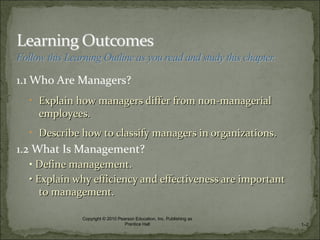
1.1 Who Are Managers?
• Explain how managers differ from non-managerialExplain how managers differ from non-managerial
employees.employees.
• Describe how to classify managers in organizations.Describe how to classify managers in organizations.
1.2 What Is Management?
• Define management.Define management.
•• Explain why efficiency and effectiveness are importantExplain why efficiency and effectiveness are important
to management.to management.
1–2
Copyright © 2010 Pearson Education, Inc. Publishing as
Prentice Hall
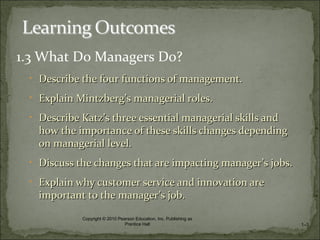
1.3 What Do Managers Do?
• Describe the four functions of management.Describe the four functions of management.
• Explain MintzbergExplain Mintzberg’s managerial roles.’s managerial roles.
• Describe KatzDescribe Katz’s three essential managerial skills and’s three essential managerial skills and
how the importance of these skills changes dependinghow the importance of these skills changes depending
on managerial level.on managerial level.
• Discuss the changes that are impacting managerDiscuss the changes that are impacting manager’s jobs.’s jobs.
• Explain why customer service and innovation areExplain why customer service and innovation are
important to the managerimportant to the manager’s job.’s job.
1–3
Copyright © 2010 Pearson Education, Inc. Publishing as
Prentice Hall
1.4 What Is An Organization?
• Explain the characteristics of an organization.Explain the characteristics of an organization.
• Describe how todayDescribe how today’s organizations are structured.’s organizations are structured.
1.5 Why Study Management?
• Discuss why itDiscuss why it’s important to understand’s important to understand
management.management.
• Explain the universality of management concept.Explain the universality of management concept.
• Describe the rewards and challenges of being aDescribe the rewards and challenges of being a
manager.manager.
1–4
Copyright © 2010 Pearson Education, Inc. Publishing as
Prentice Hall
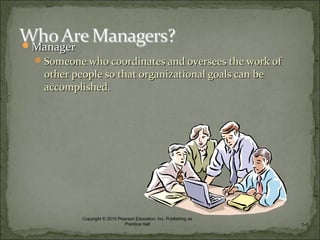
ManagerManager
Someone who coordinates and oversees the work ofSomeone who coordinates and oversees the work of
other people so that organizational goals can beother people so that organizational goals can be
accomplished.accomplished.
1–5
Copyright © 2010 Pearson Education, Inc. Publishing as
Prentice Hall
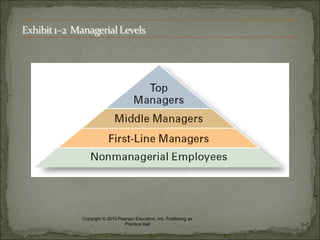
First-line ManagersFirst-line Managers
Individuals who manage the work of non-managerialIndividuals who manage the work of non-managerial
employees.employees.
Middle ManagersMiddle Managers
Individuals who manage the work of first-lineIndividuals who manage the work of first-line
managers.managers.
Top ManagersTop Managers
Individuals who are responsible for makingIndividuals who are responsible for making
organization-wide decisions and establishing plans andorganization-wide decisions and establishing plans and
goals that affect the entire organization.goals that affect the entire organization.
1–6
Copyright © 2010 Pearson Education, Inc. Publishing as
Prentice Hall
Copyright © 2010 Pearson Education, Inc. Publishing as
Prentice Hall 1–7
Management involves coordinating and overseeing
the work activities of others so that their activities are
completed efficiently and effectively.
1–8
Copyright © 2010 Pearson Education, Inc. Publishing as
Prentice Hall
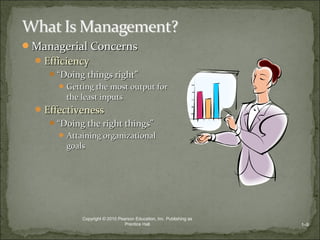
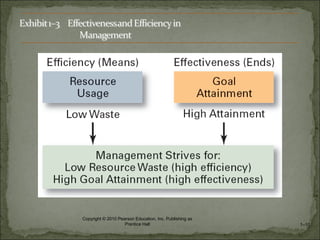
Managerial ConcernsManagerial Concerns
EfficiencyEfficiency
““Doing things right”Doing things right”
 Getting the most output forGetting the most output for
the least inputsthe least inputs
EffectivenessEffectiveness
““Doing the right things”Doing the right things”
 Attaining organizationalAttaining organizational
goalsgoals
Copyright © 2010 Pearson Education, Inc. Publishing as
Prentice Hall 1–9
Copyright © 2010 Pearson Education, Inc. Publishing as
Prentice Hall 1–10
Three Approaches to Defining What Managers Do.
 Functions they perform.
 Roles they play.
 Skills they need.
1–11
Copyright © 2010 Pearson Education, Inc. Publishing as
Prentice Hall
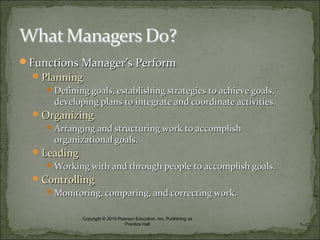
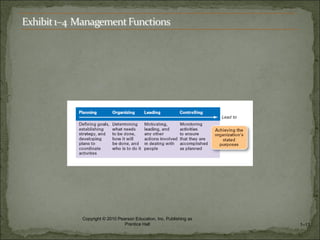
Functions ManagerFunctions Manager’s Perform’s Perform
PlanningPlanning
Defining goals, establishing strategies to achieve goals,Defining goals, establishing strategies to achieve goals,
developing plans to integrate and coordinate activities.developing plans to integrate and coordinate activities.
OrganizingOrganizing
Arranging and structuring work to accomplishArranging and structuring work to accomplish
organizational goals.organizational goals.
LeadingLeading
Working with and through people to accomplish goals.Working with and through people to accomplish goals.
ControllingControlling
Monitoring, comparing, and correcting work.Monitoring, comparing, and correcting work.
1–12
Copyright © 2010 Pearson Education, Inc. Publishing as
Prentice Hall
1–13
Copyright © 2010 Pearson Education, Inc. Publishing as
Prentice Hall
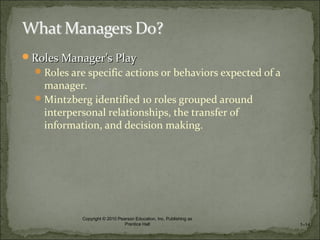
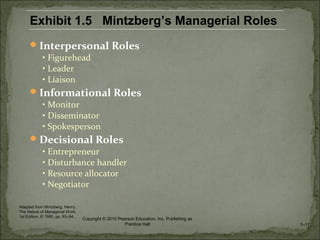
Roles ManagerRoles Manager’s Play’s Play
Roles are specific actions or behaviors expected of a
manager.
Mintzberg identified 10 roles grouped around
interpersonal relationships, the transfer of
information, and decision making.
1–14
Copyright © 2010 Pearson Education, Inc. Publishing as
Prentice Hall
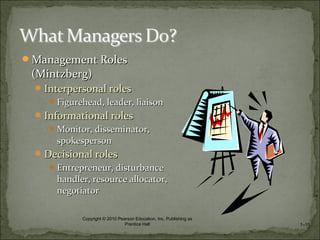
Management RolesManagement Roles
(Mintzberg)(Mintzberg)
Interpersonal rolesInterpersonal roles
Figurehead, leader, liaisonFigurehead, leader, liaison
Informational rolesInformational roles
Monitor, disseminator,Monitor, disseminator,
spokespersonspokesperson
Decisional rolesDecisional roles
Entrepreneur, disturbanceEntrepreneur, disturbance
handler, resource allocator,handler, resource allocator,
negotiatornegotiator
1–15
Copyright © 2010 Pearson Education, Inc. Publishing as
Prentice Hall
ActionsActions
thoughtful thinkingthoughtful thinking
practical doingpractical doing
1–16
Copyright © 2010 Pearson Education, Inc. Publishing as
Prentice Hall
Interpersonal Roles
• Figurehead
• Leader
• Liaison
Informational Roles
• Monitor
• Disseminator
• Spokesperson
Decisional Roles
• Entrepreneur
• Disturbance handler
• Resource allocator
• Negotiator
1–17
Copyright © 2010 Pearson Education, Inc. Publishing as
Prentice Hall
Exhibit 1.5 Mintzberg’s Managerial Roles
Adapted from Mintzberg, Henry,
The Nature of Managerial Work,
1st Edition, © 1980, pp. 93–94..
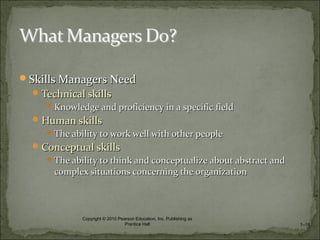
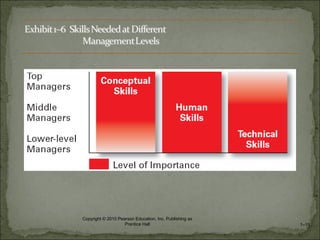
Skills Managers NeedSkills Managers Need
Technical skillsTechnical skills
Knowledge and proficiency in a specific fieldKnowledge and proficiency in a specific field
Human skillsHuman skills
The ability to work well with other peopleThe ability to work well with other people
Conceptual skillsConceptual skills
The ability to think and conceptualize about abstract andThe ability to think and conceptualize about abstract and
complex situations concerning the organizationcomplex situations concerning the organization
1–18
Copyright © 2010 Pearson Education, Inc. Publishing as
Prentice Hall
Copyright © 2010 Pearson Education, Inc. Publishing as
Prentice Hall 1–19
The Increasing Importance of CustomersThe Increasing Importance of Customers
Customers: the reason that organizations existCustomers: the reason that organizations exist
Managing customer relationships is the responsibility of allManaging customer relationships is the responsibility of all
managers and employees.managers and employees.
Consistent high quality customer service is essential forConsistent high quality customer service is essential for
survival.survival.
InnovationInnovation
Doing things differently, exploring new territory, andDoing things differently, exploring new territory, and
taking riskstaking risks
Managers should encourage employees to be aware of andManagers should encourage employees to be aware of and
act on opportunities for innovation.act on opportunities for innovation.
1–20
Copyright © 2010 Pearson Education, Inc. Publishing as
Prentice Hall
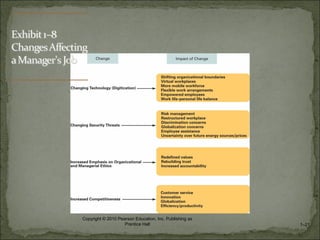
1–21
Copyright © 2010 Pearson Education, Inc. Publishing as
Prentice Hall
An Organization DefinedAn Organization Defined
A deliberate arrangement of people to accomplish someA deliberate arrangement of people to accomplish some
specific purpose (that individuals independently couldspecific purpose (that individuals independently could
not accomplish alone).not accomplish alone).
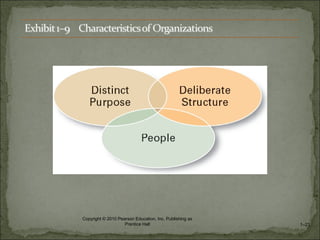
Common Characteristics of OrganizationsCommon Characteristics of Organizations
Have a distinct purpose (goal)Have a distinct purpose (goal)
Composed of peopleComposed of people
Have a deliberate structureHave a deliberate structure
1–22
Copyright © 2010 Pearson Education, Inc. Publishing as
Prentice Hall
Copyright © 2010 Pearson Education, Inc. Publishing as
Prentice Hall 1–23
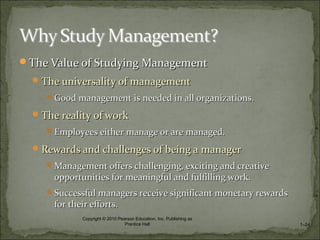
The Value of Studying ManagementThe Value of Studying Management
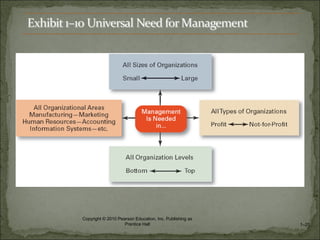
The universality of managementThe universality of management
Good management is needed in all organizations.Good management is needed in all organizations.
The reality of workThe reality of work
Employees either manage or are managed.Employees either manage or are managed.
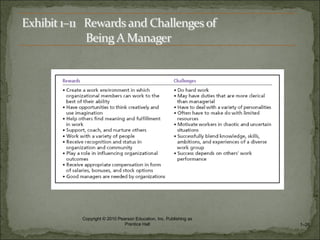
Rewards and challenges of being a managerRewards and challenges of being a manager
Management offers challenging, exciting and creativeManagement offers challenging, exciting and creative
opportunities for meaningful and fulfilling work.opportunities for meaningful and fulfilling work.
Successful managers receive significant monetary rewardsSuccessful managers receive significant monetary rewards
for their efforts.for their efforts.
1–24
Copyright © 2010 Pearson Education, Inc. Publishing as
Prentice Hall
Copyright © 2010 Pearson Education, Inc. Publishing as
Prentice Hall 1–25
1–26
Copyright © 2010 Pearson Education, Inc. Publishing as
Prentice Hall
Copyright © 2010 Pearson Education, Inc. Publishing as
Prentice Hall 1–27
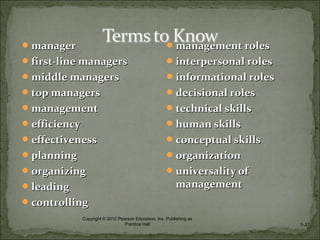
managermanager
first-line managersfirst-line managers
middle managersmiddle managers
top managerstop managers
managementmanagement
efficiencyefficiency
effectivenesseffectiveness
planningplanning
organizingorganizing
leadingleading
controllingcontrolling
management rolesmanagement roles
interpersonal rolesinterpersonal roles
informational rolesinformational roles
decisional rolesdecisional roles
technical skillstechnical skills
human skillshuman skills
conceptual skillsconceptual skills
organizationorganization
universality ofuniversality of
managementmanagement

Chapter 1management10theditionbyrobbinsandcoulter-130822064132-phpapp02

  • 1.
    ChapterChapter 11 1–1 Copyright © 2010Pearson Education, Inc. Publishing as Prentice Hall Management Stephen P. Robbins Mary Coulter tenth edition
  • 2.
    1.1 Who AreManagers? • Explain how managers differ from non-managerialExplain how managers differ from non-managerial employees.employees. • Describe how to classify managers in organizations.Describe how to classify managers in organizations. 1.2 What Is Management? • Define management.Define management. •• Explain why efficiency and effectiveness are importantExplain why efficiency and effectiveness are important to management.to management. 1–2 Copyright © 2010 Pearson Education, Inc. Publishing as Prentice Hall
  • 3.
    1.3 What DoManagers Do? • Describe the four functions of management.Describe the four functions of management. • Explain MintzbergExplain Mintzberg’s managerial roles.’s managerial roles. • Describe KatzDescribe Katz’s three essential managerial skills and’s three essential managerial skills and how the importance of these skills changes dependinghow the importance of these skills changes depending on managerial level.on managerial level. • Discuss the changes that are impacting managerDiscuss the changes that are impacting manager’s jobs.’s jobs. • Explain why customer service and innovation areExplain why customer service and innovation are important to the managerimportant to the manager’s job.’s job. 1–3 Copyright © 2010 Pearson Education, Inc. Publishing as Prentice Hall
  • 4.
    1.4 What IsAn Organization? • Explain the characteristics of an organization.Explain the characteristics of an organization. • Describe how todayDescribe how today’s organizations are structured.’s organizations are structured. 1.5 Why Study Management? • Discuss why itDiscuss why it’s important to understand’s important to understand management.management. • Explain the universality of management concept.Explain the universality of management concept. • Describe the rewards and challenges of being aDescribe the rewards and challenges of being a manager.manager. 1–4 Copyright © 2010 Pearson Education, Inc. Publishing as Prentice Hall
  • 5.
    ManagerManager Someone who coordinatesand oversees the work ofSomeone who coordinates and oversees the work of other people so that organizational goals can beother people so that organizational goals can be accomplished.accomplished. 1–5 Copyright © 2010 Pearson Education, Inc. Publishing as Prentice Hall
  • 6.
    First-line ManagersFirst-line Managers Individualswho manage the work of non-managerialIndividuals who manage the work of non-managerial employees.employees. Middle ManagersMiddle Managers Individuals who manage the work of first-lineIndividuals who manage the work of first-line managers.managers. Top ManagersTop Managers Individuals who are responsible for makingIndividuals who are responsible for making organization-wide decisions and establishing plans andorganization-wide decisions and establishing plans and goals that affect the entire organization.goals that affect the entire organization. 1–6 Copyright © 2010 Pearson Education, Inc. Publishing as Prentice Hall
  • 7.
    Copyright © 2010Pearson Education, Inc. Publishing as Prentice Hall 1–7
  • 8.
    Management involves coordinatingand overseeing the work activities of others so that their activities are completed efficiently and effectively. 1–8 Copyright © 2010 Pearson Education, Inc. Publishing as Prentice Hall
  • 9.
    Managerial ConcernsManagerial Concerns EfficiencyEfficiency ““Doingthings right”Doing things right”  Getting the most output forGetting the most output for the least inputsthe least inputs EffectivenessEffectiveness ““Doing the right things”Doing the right things”  Attaining organizationalAttaining organizational goalsgoals Copyright © 2010 Pearson Education, Inc. Publishing as Prentice Hall 1–9
  • 10.
    Copyright © 2010Pearson Education, Inc. Publishing as Prentice Hall 1–10
  • 11.
    Three Approaches toDefining What Managers Do.  Functions they perform.  Roles they play.  Skills they need. 1–11 Copyright © 2010 Pearson Education, Inc. Publishing as Prentice Hall
  • 12.
    Functions ManagerFunctions Manager’sPerform’s Perform PlanningPlanning Defining goals, establishing strategies to achieve goals,Defining goals, establishing strategies to achieve goals, developing plans to integrate and coordinate activities.developing plans to integrate and coordinate activities. OrganizingOrganizing Arranging and structuring work to accomplishArranging and structuring work to accomplish organizational goals.organizational goals. LeadingLeading Working with and through people to accomplish goals.Working with and through people to accomplish goals. ControllingControlling Monitoring, comparing, and correcting work.Monitoring, comparing, and correcting work. 1–12 Copyright © 2010 Pearson Education, Inc. Publishing as Prentice Hall
  • 13.
    1–13 Copyright © 2010Pearson Education, Inc. Publishing as Prentice Hall
  • 14.
    Roles ManagerRoles Manager’sPlay’s Play Roles are specific actions or behaviors expected of a manager. Mintzberg identified 10 roles grouped around interpersonal relationships, the transfer of information, and decision making. 1–14 Copyright © 2010 Pearson Education, Inc. Publishing as Prentice Hall
  • 15.
    Management RolesManagement Roles (Mintzberg)(Mintzberg) InterpersonalrolesInterpersonal roles Figurehead, leader, liaisonFigurehead, leader, liaison Informational rolesInformational roles Monitor, disseminator,Monitor, disseminator, spokespersonspokesperson Decisional rolesDecisional roles Entrepreneur, disturbanceEntrepreneur, disturbance handler, resource allocator,handler, resource allocator, negotiatornegotiator 1–15 Copyright © 2010 Pearson Education, Inc. Publishing as Prentice Hall
  • 16.
    ActionsActions thoughtful thinkingthoughtful thinking practicaldoingpractical doing 1–16 Copyright © 2010 Pearson Education, Inc. Publishing as Prentice Hall
  • 17.
    Interpersonal Roles • Figurehead •Leader • Liaison Informational Roles • Monitor • Disseminator • Spokesperson Decisional Roles • Entrepreneur • Disturbance handler • Resource allocator • Negotiator 1–17 Copyright © 2010 Pearson Education, Inc. Publishing as Prentice Hall Exhibit 1.5 Mintzberg’s Managerial Roles Adapted from Mintzberg, Henry, The Nature of Managerial Work, 1st Edition, © 1980, pp. 93–94..
  • 18.
    Skills Managers NeedSkillsManagers Need Technical skillsTechnical skills Knowledge and proficiency in a specific fieldKnowledge and proficiency in a specific field Human skillsHuman skills The ability to work well with other peopleThe ability to work well with other people Conceptual skillsConceptual skills The ability to think and conceptualize about abstract andThe ability to think and conceptualize about abstract and complex situations concerning the organizationcomplex situations concerning the organization 1–18 Copyright © 2010 Pearson Education, Inc. Publishing as Prentice Hall
  • 19.
    Copyright © 2010Pearson Education, Inc. Publishing as Prentice Hall 1–19
  • 20.
    The Increasing Importanceof CustomersThe Increasing Importance of Customers Customers: the reason that organizations existCustomers: the reason that organizations exist Managing customer relationships is the responsibility of allManaging customer relationships is the responsibility of all managers and employees.managers and employees. Consistent high quality customer service is essential forConsistent high quality customer service is essential for survival.survival. InnovationInnovation Doing things differently, exploring new territory, andDoing things differently, exploring new territory, and taking riskstaking risks Managers should encourage employees to be aware of andManagers should encourage employees to be aware of and act on opportunities for innovation.act on opportunities for innovation. 1–20 Copyright © 2010 Pearson Education, Inc. Publishing as Prentice Hall
  • 21.
    1–21 Copyright © 2010Pearson Education, Inc. Publishing as Prentice Hall
  • 22.
    An Organization DefinedAnOrganization Defined A deliberate arrangement of people to accomplish someA deliberate arrangement of people to accomplish some specific purpose (that individuals independently couldspecific purpose (that individuals independently could not accomplish alone).not accomplish alone). Common Characteristics of OrganizationsCommon Characteristics of Organizations Have a distinct purpose (goal)Have a distinct purpose (goal) Composed of peopleComposed of people Have a deliberate structureHave a deliberate structure 1–22 Copyright © 2010 Pearson Education, Inc. Publishing as Prentice Hall
  • 23.
    Copyright © 2010Pearson Education, Inc. Publishing as Prentice Hall 1–23
  • 24.
    The Value ofStudying ManagementThe Value of Studying Management The universality of managementThe universality of management Good management is needed in all organizations.Good management is needed in all organizations. The reality of workThe reality of work Employees either manage or are managed.Employees either manage or are managed. Rewards and challenges of being a managerRewards and challenges of being a manager Management offers challenging, exciting and creativeManagement offers challenging, exciting and creative opportunities for meaningful and fulfilling work.opportunities for meaningful and fulfilling work. Successful managers receive significant monetary rewardsSuccessful managers receive significant monetary rewards for their efforts.for their efforts. 1–24 Copyright © 2010 Pearson Education, Inc. Publishing as Prentice Hall
  • 25.
    Copyright © 2010Pearson Education, Inc. Publishing as Prentice Hall 1–25
  • 26.
    1–26 Copyright © 2010Pearson Education, Inc. Publishing as Prentice Hall
  • 27.
    Copyright © 2010Pearson Education, Inc. Publishing as Prentice Hall 1–27 managermanager first-line managersfirst-line managers middle managersmiddle managers top managerstop managers managementmanagement efficiencyefficiency effectivenesseffectiveness planningplanning organizingorganizing leadingleading controllingcontrolling management rolesmanagement roles interpersonal rolesinterpersonal roles informational rolesinformational roles decisional rolesdecisional roles technical skillstechnical skills human skillshuman skills conceptual skillsconceptual skills organizationorganization universality ofuniversality of managementmanagement