ORGANIZATIONAL STRUCTURE

                           BY
         ABIGAIL PUGAL-SOMERA
   Introduction
   Division of Labor
   Scalar Principle
   Authority, Responsibility and Accountability
   Span and Control
   Line and Staff Function
   Hierarchical or Horizontal
   Common Criticisms of Classical Organization Theory
   Organizational Structure
    ◦ The typically hierarchical arrangement of lines
      of authority, communications, rights and duties of an
      organization.
    ◦ determines how the roles, power and responsibilities are
      assigned, controlled, and coordinated, and how
      information flows between the different levels of
      management

    ◦ depends on the organization's objectives and strategy

   Centralized vs Decentralized Structure
    ◦ Depending on organization’s objectives and strategies
   Classical Organization Theory
    ◦ "the study of organizations for the benefit of identifying
      common themes for the purpose of solving problems,
      maximizing efficiency and productivity, and meeting the
      needs of stakeholders."[1] Organizational theory
      contains three subtopics: classical perspective,
      neoclassic perspective and environmental perspective.[2]
      It complements the studies of organizational behavior
      and human resource studies.

    ◦ Deals with essential elements in an institution:
        Division of Labor
        Delegation
        Authority
        Specialization
        Interdependence of Parts
•   Primary vehicle for translating the organization’s strategy into
    productive action

•   Partly determines the power of people in organizations, and
    affects perception of their roles.


   Can have a strong impact on job satisfaction.

   Construction vs Analysis
    ◦ Construction: Parts of a whole
    ◦ Analysis: Process of analysis
   Narrow specialization of tasks within a
    production process so that each worker can
    become a specialist in doing one thing, especially
    on an assembly line.

   In traditional industries, division of labor is a
    major motive force for economic-growth.

   In the era of mass customization (which requires
    multiple skills and very short machine change-
    over time), division of labor has become much
    more flexible. Also called specialization of labor.
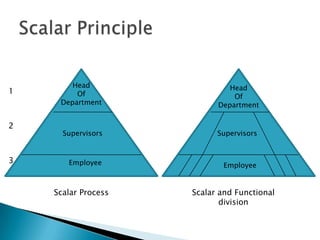
   The manner by which work is divided
    ◦ Scalar Process
      Provides a scale, or grading, of duties according to
       level of authority and responsibility.

    ◦ Functionalization
      Work must be divided into different kinds of duties.
   Classical-management rule that subordinates at
    every level should follow the chain of command,
    and communicate with their seniors only through
    the immediate or intermediate senior. According
    to its proponent, the French management
    pioneer Henri Fayol (1841-1925), a clear
    understanding of this principle is necessary for
    the proper management of any organization.

   Exists as long as there are at least two people in
    a supervisor-subordinate relationship.
Head                  Head
1        Of                    Of
     Department            Department

2
      Supervisors          Supervisors


3      Employee              Employee


    Scalar Process   Scalar and Functional
                            division
   Authority
    ◦ Power that is delegated formally. It includes a right to
      command a situation, commit resources, give orders and
      expect them to be obeyed, it is always accompanied by
      an equal responsibility for one's actions or a failure to
      act.


   Responsibility
    ◦ A duty or obligation to satisfactorily perform or
      complete a task (assigned by someone, or created by
      one's own promise or circumstances) that one must
      fulfill, and which has a consequent penalty for failure.
   Accountability
    ◦ The obligation of an individual or organization to
      account for its activities, accept responsibility for
      them, and to disclose the results in a transparent
      manner.

   Delegation
      Assignment of duties, authority and responsibility to
       others
   Acceptance Theory of Authority
    ◦ Delegation gives authority to a lower manager;
      however, the power of a manager to use that
      authority depends on the willingness of employees
      to accept it.

    ◦ Subordinate controls response to authority
   The number of subordinates that a manager
    or supervisor can directly control. This
    number varies with the type of work:
    complex, variable work reduces it to six,
    whereas routine, fixed work increases it to
    twenty or more.
   Line Function
    ◦ Decision making areas of an organization
      associated with its daily operations such as
      purchasing, manufacturing, and selling.


   Staff Function
    ◦ Advisory, analysis, and support functions such as
      accounting, planning, transportation provided to
      production (line) employees.
   Hierarchical
    ◦ Common, pyramid-like organization where one
      person is in charge of a functional area
      (engineering, finance, marketing) with one or more
      subordinates handling the sub-functions.

    ◦ In an hierarchical organization (whether business,
      military, political, or religious) higher levels imply
      greater superiority and domination than the lower
      ones, and the chain of command extends straight
      from the top to the bottom.
   Horizontal
    ◦ A decentralized power structure within an
      association or business.

    ◦ A business that is structured as a flat or horizontal
      organization where power is shared more broadly
      tends to allow more staff more control over
      business matters according to their expertise, and
      it is often supportive of considerable collaboration
      between employees.
   May lead to a work environment in which:
    ◦ Employees have minimal power over their jobs and
      working conditions
    ◦ Subordination, passivity and dependence are
      expected
    ◦ Work to a short term perspective
    ◦ Employees are lead to mediocrity
    ◦ Working conditions produce to psychological failure
      as a result of the belief that they are lower class
      employees performing menial tasks
   Organizational Behavior: Human Behavior at
    Work 9th Edition by John W Newstrom and
    Keith Davis

   Classical Organizational Theory powerpoint
    presentation by Vincent Myers and Nina
    Presuto

   http://www.businessdictionary.com

   http://www.wikipedia.com

Fundamentals of Organizational Designs and Studies

  • 1.
    ORGANIZATIONAL STRUCTURE BY ABIGAIL PUGAL-SOMERA
  • 2.
    Introduction  Division of Labor  Scalar Principle  Authority, Responsibility and Accountability  Span and Control  Line and Staff Function  Hierarchical or Horizontal  Common Criticisms of Classical Organization Theory
  • 3.
    Organizational Structure ◦ The typically hierarchical arrangement of lines of authority, communications, rights and duties of an organization. ◦ determines how the roles, power and responsibilities are assigned, controlled, and coordinated, and how information flows between the different levels of management ◦ depends on the organization's objectives and strategy  Centralized vs Decentralized Structure ◦ Depending on organization’s objectives and strategies
  • 4.
    Classical Organization Theory ◦ "the study of organizations for the benefit of identifying common themes for the purpose of solving problems, maximizing efficiency and productivity, and meeting the needs of stakeholders."[1] Organizational theory contains three subtopics: classical perspective, neoclassic perspective and environmental perspective.[2] It complements the studies of organizational behavior and human resource studies. ◦ Deals with essential elements in an institution:  Division of Labor  Delegation  Authority  Specialization  Interdependence of Parts
  • 5.
    Primary vehicle for translating the organization’s strategy into productive action • Partly determines the power of people in organizations, and affects perception of their roles.  Can have a strong impact on job satisfaction.  Construction vs Analysis ◦ Construction: Parts of a whole ◦ Analysis: Process of analysis
  • 6.
    Narrow specialization of tasks within a production process so that each worker can become a specialist in doing one thing, especially on an assembly line.  In traditional industries, division of labor is a major motive force for economic-growth.  In the era of mass customization (which requires multiple skills and very short machine change- over time), division of labor has become much more flexible. Also called specialization of labor.
  • 7.
    The manner by which work is divided ◦ Scalar Process  Provides a scale, or grading, of duties according to level of authority and responsibility. ◦ Functionalization  Work must be divided into different kinds of duties.
  • 8.
    Classical-management rule that subordinates at every level should follow the chain of command, and communicate with their seniors only through the immediate or intermediate senior. According to its proponent, the French management pioneer Henri Fayol (1841-1925), a clear understanding of this principle is necessary for the proper management of any organization.  Exists as long as there are at least two people in a supervisor-subordinate relationship.
  • 9.
    Head Head 1 Of Of Department Department 2 Supervisors Supervisors 3 Employee Employee Scalar Process Scalar and Functional division
  • 10.
    Authority ◦ Power that is delegated formally. It includes a right to command a situation, commit resources, give orders and expect them to be obeyed, it is always accompanied by an equal responsibility for one's actions or a failure to act.  Responsibility ◦ A duty or obligation to satisfactorily perform or complete a task (assigned by someone, or created by one's own promise or circumstances) that one must fulfill, and which has a consequent penalty for failure.
  • 11.
    Accountability ◦ The obligation of an individual or organization to account for its activities, accept responsibility for them, and to disclose the results in a transparent manner.  Delegation  Assignment of duties, authority and responsibility to others
  • 12.
    Acceptance Theory of Authority ◦ Delegation gives authority to a lower manager; however, the power of a manager to use that authority depends on the willingness of employees to accept it. ◦ Subordinate controls response to authority
  • 13.
    The number of subordinates that a manager or supervisor can directly control. This number varies with the type of work: complex, variable work reduces it to six, whereas routine, fixed work increases it to twenty or more.
  • 14.
    Line Function ◦ Decision making areas of an organization associated with its daily operations such as purchasing, manufacturing, and selling.  Staff Function ◦ Advisory, analysis, and support functions such as accounting, planning, transportation provided to production (line) employees.
  • 15.
    Hierarchical ◦ Common, pyramid-like organization where one person is in charge of a functional area (engineering, finance, marketing) with one or more subordinates handling the sub-functions. ◦ In an hierarchical organization (whether business, military, political, or religious) higher levels imply greater superiority and domination than the lower ones, and the chain of command extends straight from the top to the bottom.
  • 16.
    Horizontal ◦ A decentralized power structure within an association or business. ◦ A business that is structured as a flat or horizontal organization where power is shared more broadly tends to allow more staff more control over business matters according to their expertise, and it is often supportive of considerable collaboration between employees.
  • 17.
    May lead to a work environment in which: ◦ Employees have minimal power over their jobs and working conditions ◦ Subordination, passivity and dependence are expected ◦ Work to a short term perspective ◦ Employees are lead to mediocrity ◦ Working conditions produce to psychological failure as a result of the belief that they are lower class employees performing menial tasks
  • 18.
    Organizational Behavior: Human Behavior at Work 9th Edition by John W Newstrom and Keith Davis  Classical Organizational Theory powerpoint presentation by Vincent Myers and Nina Presuto  http://www.businessdictionary.com  http://www.wikipedia.com