ORGANISATION
AL STRUCTURE
13-2
Organizational
Structure;
Organizational structure
defines how job task are
divided, grouped and
coordinated.
13-3
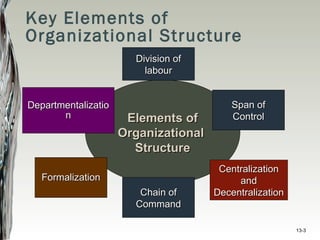
Key Elements of
Organizational Structure
Elements ofElements of
OrganizationalOrganizational
StructureStructure
Span ofSpan of
ControlControl
CentralizationCentralization
andand
DecentralizationDecentralization
DepartmentalizatioDepartmentalizatio
nn
FormalizationFormalization
Division ofDivision of
labourlabour
Chain ofChain of
CommandCommand
13-4
Division of Labor
 Subdividing work into separate
jobs assigned to different
people
 It is limited by ability to
coordinate work
 Increases work efficiency
13-5
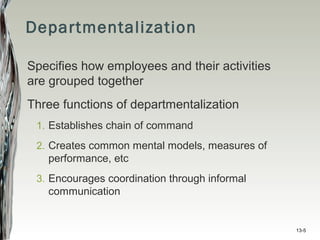
Departmentalization
Specifies how employees and their activities
are grouped together
Three functions of departmentalization
1. Establishes chain of command
2. Creates common mental models, measures of
performance, etc
3. Encourages coordination through informal
communication
13-6
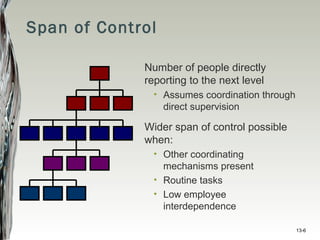
Span of Control
Number of people directly
reporting to the next level
• Assumes coordination through
direct supervision
Wider span of control possible
when:
• Other coordinating
mechanisms present
• Routine tasks
• Low employee
interdependence
13-7
Formalization
 The degree to which organizations standardize
behavior through rules, procedures, formal training,
and related mechanisms.
 Formalization increases as firms get older, larger,
and more regulated
 Problems with formalization
• Reduces organizational flexibility
• Discourages organizational learning/creativity
• Reduces work efficiency
• Increases job dissatisfaction and work stress
13-8
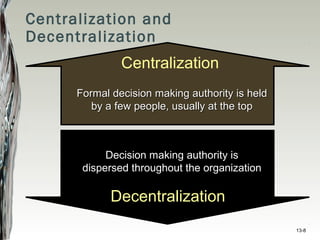
Formal decision making authority is heldFormal decision making authority is held
by a few people, usually at the topby a few people, usually at the top
Centralization
Decision making authority is
dispersed throughout the organization
Decentralization
Centralization and
Decentralization
13-9
Chain of command
It is an unbroken line of authority
It flows from top to bottom
It clarifies who reports to whom
Authority and unity of command are the two
complimentary concepts. Without these we cannot
discuss chain of command.
13-10
AUTHORITY AND UNITY OF
COMMAND
Authority-It is the position to give orders and
expect the given orders to be obeyed
Unity of Command- It is an idea that one
subordinate should have only one superior
13-11
Coordinating Work Activities
1. Informal communication
• Sharing information, forming common mental
models
• Allows flexibility
• Vital in non routine and ambiguous situations
• Easiest in small firms
• Applied in team-based structures
• Includes integrator roles
13-12
Coordinating Work Activities
2. Formal hierarchy
• Direct supervision
• Assigns formal (legitimate) power to manage
others
• Coordination strategy for departmentalization
2. Standardization
a)Standardized processes (e.g., job descriptions)
b)Standardized outputs (e.g., sales targets)
c) Standardized skills (e.g., training)
13-13
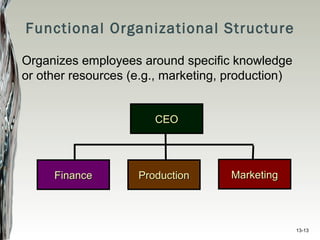
Organizes employees around specific knowledge
or other resources (e.g., marketing, production)
CEOCEO
FinanceFinance ProductionProduction MarketingMarketing
Functional Organizational Structure
13-14
Evaluating Functional
Structures
 Benefits
• Economy of scale
• Supports professional identity and career paths
• Easier supervision
 Limitations
• More emphasis on subunit than organizational
goals
• Higher dysfunctional conflict
• Poorer coordination -- requires more controls
13-15
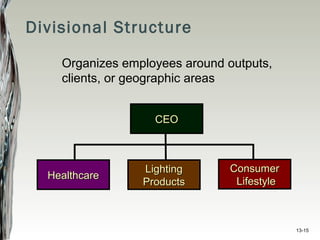
Organizes employees around outputs,
clients, or geographic areas
Divisional Structure
CEOCEO
HealthcareHealthcare
LightingLighting
ProductsProducts
ConsumerConsumer
LifestyleLifestyle
13-16
Divisional Structure
 Different forms of divisional structure
• Geographic structure
• Product structure
• Client structure
 Best form depends on environmental diversity
or uncertainty
 Movement away from geographic form
• Less need for local representation
• Reduced geographic variation
• More global clients
13-17
Evaluating Divisional Structures
 Benefits
• Building block structure -- accommodates growth
• Focuses on markets/products/clients
 Limitations
• Duplication, inefficient use of resources
• Specializations are dispersed--silos of knowledge
• Politics/conflict when two forms of equal value
13-18
Team-Based Structure
 Self-directed work teams
 Teams organized around work processes
 Typically organic structure
• Wide span of control – many employees work
without close supervision
• Decentralized with moderate/little formalization
 Usually found within divisionalized structure
13-19
Evaluating Team-Based
Structures
 Benefits
• Responsive, flexible
• Lower admin costs
• Quicker, more informed decisions
 Limitations
• Interpersonal training costs
• Slower during team development
• Role ambiguity increases stress
• Problems with supervisor role changes
• Duplication of resources
13-20
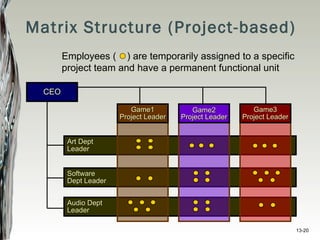
Audio DeptAudio Dept
LeaderLeader
SoftwareSoftware
Dept LeaderDept Leader
Art DeptArt Dept
LeaderLeader
Game1Game1
Project LeaderProject Leader
Game2Game2
Project LeaderProject Leader
Game3Game3
Project LeaderProject Leader
Matrix Structure (Project-based)
CEOCEO
Employees ( ) are temporarily assigned to a specific
project team and have a permanent functional unit
13-21
Evaluating Matrix Structures
 Benefits
• Uses resources and expertise effectively
• Improves communication, flexibility, innovation
• Focuses specialists on clients and products
• Supports knowledge sharing within specialty
• Solution when two divisions have equal importance
 Limitations
• Increases goal conflict and ambiguity
• Two bosses dilutes accountability
• More conflict, organizational politics, and stress
13-22
Effects of Organizational Size
As organizations grow, they have:
 More division of labor (job specialization)
 Greater use of standardization
 More hierarchy and formalization
 More decentralization
13-23
Technology and Structure
 Technology refers to mechanisms or
processes by which an organization turns out
its product or service
 Two contingencies:
• Variability -- the number of exceptions to standard
procedure that tend to occur.
• Analyzability -- the predictability or difficulty of the
required work
13-24
Organizational Strategy
 Structure follows strategy
• Strategy points to the environments in which the
organization will operate
• Leaders decide which structure to apply
 Differentiation strategy
• Providing unique products or attracting clients who
want customization
 Cost leadership strategy
• Maximize productivity in order to offer competitive
pricing
Organizational structure in Organization

Organizational structure in Organization

  • 1.
  • 2.
    13-2 Organizational Structure; Organizational structure defines howjob task are divided, grouped and coordinated.
  • 3.
    13-3 Key Elements of OrganizationalStructure Elements ofElements of OrganizationalOrganizational StructureStructure Span ofSpan of ControlControl CentralizationCentralization andand DecentralizationDecentralization DepartmentalizatioDepartmentalizatio nn FormalizationFormalization Division ofDivision of labourlabour Chain ofChain of CommandCommand
  • 4.
    13-4 Division of Labor Subdividing work into separate jobs assigned to different people  It is limited by ability to coordinate work  Increases work efficiency
  • 5.
    13-5 Departmentalization Specifies how employeesand their activities are grouped together Three functions of departmentalization 1. Establishes chain of command 2. Creates common mental models, measures of performance, etc 3. Encourages coordination through informal communication
  • 6.
    13-6 Span of Control Numberof people directly reporting to the next level • Assumes coordination through direct supervision Wider span of control possible when: • Other coordinating mechanisms present • Routine tasks • Low employee interdependence
  • 7.
    13-7 Formalization  The degreeto which organizations standardize behavior through rules, procedures, formal training, and related mechanisms.  Formalization increases as firms get older, larger, and more regulated  Problems with formalization • Reduces organizational flexibility • Discourages organizational learning/creativity • Reduces work efficiency • Increases job dissatisfaction and work stress
  • 8.
    13-8 Formal decision makingauthority is heldFormal decision making authority is held by a few people, usually at the topby a few people, usually at the top Centralization Decision making authority is dispersed throughout the organization Decentralization Centralization and Decentralization
  • 9.
    13-9 Chain of command Itis an unbroken line of authority It flows from top to bottom It clarifies who reports to whom Authority and unity of command are the two complimentary concepts. Without these we cannot discuss chain of command.
  • 10.
    13-10 AUTHORITY AND UNITYOF COMMAND Authority-It is the position to give orders and expect the given orders to be obeyed Unity of Command- It is an idea that one subordinate should have only one superior
  • 11.
    13-11 Coordinating Work Activities 1.Informal communication • Sharing information, forming common mental models • Allows flexibility • Vital in non routine and ambiguous situations • Easiest in small firms • Applied in team-based structures • Includes integrator roles
  • 12.
    13-12 Coordinating Work Activities 2.Formal hierarchy • Direct supervision • Assigns formal (legitimate) power to manage others • Coordination strategy for departmentalization 2. Standardization a)Standardized processes (e.g., job descriptions) b)Standardized outputs (e.g., sales targets) c) Standardized skills (e.g., training)
  • 13.
    13-13 Organizes employees aroundspecific knowledge or other resources (e.g., marketing, production) CEOCEO FinanceFinance ProductionProduction MarketingMarketing Functional Organizational Structure
  • 14.
    13-14 Evaluating Functional Structures  Benefits •Economy of scale • Supports professional identity and career paths • Easier supervision  Limitations • More emphasis on subunit than organizational goals • Higher dysfunctional conflict • Poorer coordination -- requires more controls
  • 15.
    13-15 Organizes employees aroundoutputs, clients, or geographic areas Divisional Structure CEOCEO HealthcareHealthcare LightingLighting ProductsProducts ConsumerConsumer LifestyleLifestyle
  • 16.
    13-16 Divisional Structure  Differentforms of divisional structure • Geographic structure • Product structure • Client structure  Best form depends on environmental diversity or uncertainty  Movement away from geographic form • Less need for local representation • Reduced geographic variation • More global clients
  • 17.
    13-17 Evaluating Divisional Structures Benefits • Building block structure -- accommodates growth • Focuses on markets/products/clients  Limitations • Duplication, inefficient use of resources • Specializations are dispersed--silos of knowledge • Politics/conflict when two forms of equal value
  • 18.
    13-18 Team-Based Structure  Self-directedwork teams  Teams organized around work processes  Typically organic structure • Wide span of control – many employees work without close supervision • Decentralized with moderate/little formalization  Usually found within divisionalized structure
  • 19.
    13-19 Evaluating Team-Based Structures  Benefits •Responsive, flexible • Lower admin costs • Quicker, more informed decisions  Limitations • Interpersonal training costs • Slower during team development • Role ambiguity increases stress • Problems with supervisor role changes • Duplication of resources
  • 20.
    13-20 Audio DeptAudio Dept LeaderLeader SoftwareSoftware DeptLeaderDept Leader Art DeptArt Dept LeaderLeader Game1Game1 Project LeaderProject Leader Game2Game2 Project LeaderProject Leader Game3Game3 Project LeaderProject Leader Matrix Structure (Project-based) CEOCEO Employees ( ) are temporarily assigned to a specific project team and have a permanent functional unit
  • 21.
    13-21 Evaluating Matrix Structures Benefits • Uses resources and expertise effectively • Improves communication, flexibility, innovation • Focuses specialists on clients and products • Supports knowledge sharing within specialty • Solution when two divisions have equal importance  Limitations • Increases goal conflict and ambiguity • Two bosses dilutes accountability • More conflict, organizational politics, and stress
  • 22.
    13-22 Effects of OrganizationalSize As organizations grow, they have:  More division of labor (job specialization)  Greater use of standardization  More hierarchy and formalization  More decentralization
  • 23.
    13-23 Technology and Structure Technology refers to mechanisms or processes by which an organization turns out its product or service  Two contingencies: • Variability -- the number of exceptions to standard procedure that tend to occur. • Analyzability -- the predictability or difficulty of the required work
  • 24.
    13-24 Organizational Strategy  Structurefollows strategy • Strategy points to the environments in which the organization will operate • Leaders decide which structure to apply  Differentiation strategy • Providing unique products or attracting clients who want customization  Cost leadership strategy • Maximize productivity in order to offer competitive pricing