Strategy Implementation
HCAD 5390
Organizational Structure
Organizational design
– Selecting the structure and control
systems that are most strategically
effective for pursuing sustainable
competitive advantage.
The role of structure and control
– To coordinate strategy implementation.
– To motivate and provide incentives for superior
performance.
The Role of Organizational
Structure
Building blocks of organizational structure
– Differentiation in the allocation of people and
resources to create value.
 Vertical differentiation in the
distribution of decision-making
authority.
 Horizontal differentiation in
dividing up people and tasks
into functions and divisions.
– Integration
 The means used in coordinating people and functions
to accomplish organizational tasks.
Differentiation, Integration,
Bureaucratic Costs
Bureaucratic costs and strategy implementation:
– Bureaucratic costs increase with
organizational complexity.
– More differentiation = more managers.
– More integration = more coordination.
– Better strategy implementation = better bottom-line
performance and profitability.
Vertical Differentiation
Span of control (division of authority)
– The number of subordinates that a single manager
directly manages.
Organizational hierarchy choices
– Flat structures
 Few organizational levels
 Wide spans of control
– Tall structures
 Many organizational levels
 Narrow spans of control
Tall and Flat Structures
Problems with Tall Structures
Principle of minimum chain of command
– Maintaining a hierarchy with the least number of
levels of authority needed to achieve a strategy.
Sources of bureaucratic costs:
Centralization or Decentralization
Authority patterns in organizations:
– Centralized
 Decision making retained in the
hands of upper-level managers.
– Decentralized
 Decisions delegated to lower
levels in the organization.
Centralization (Structural) Choice?
Advantages of
decentralization
– Reduced information
overload on upper
managers.
– Increased motivation and
accountability throughout
organization.
– Fewer managers; lower
bureaucratic costs.
Advantages of
centralization
– Easier coordination of
organizational activities.
– Decisions fitted to broad
organizational objectives.
– Exercise of strong
leadership in crisis.
– Faster decision making and
response.
Horizontal Differentiation
Focus is on division and grouping of tasks to
meet business objectives.
Simple structure:
– Characteristic of small entrepreneurial companies.
– Entrepreneur takes on most managerial roles.
– No formal organization arrangements.
– Horizontal differentiation is low.
11
 Structure Follows Strategy:
– Changes in corporate strategy lead to
changes in organizational structure
12
 Structure Follows Strategy:
• New strategy is created
• New administrative problems emerge
• Economic performance declines
• New appropriate structure is invented
• Profit returns to its previous levels
13
 Stages of corporate development
 Simple Structure
 Functional Structure
 Divisional Structure
 Beyond SBU’s
14
 Simple Structure:
– Stage I:
 Entrepreneur
– Decision making tightly controlled
– Little formal structure
– Planning short range/reactive
– Flexible and dynamic
15
 Functional Structure:
– Stage II:
 Management team
 Functional specialization
 Delegation decision making
 Concentration/specialization in industry
16
 Divisional Structure:
– Stage III:
 Diverse product lines
 Decentralized decision making
 SBU’s
 Almost unlimited resources
17
 Beyond SBU’s:
– Stage IV:
 Increasing environmental uncertainty
 Technological advances
 Size & scope of worldwide businesses
 Multi-industry competitive strategy
 Better educated personnel
Functional Structure
Advantages
– Task grouping facilitates
specialization and
productivity.
– Better monitoring of work
processes, reduced costs.
– Greater control over
organizational activities.
Disadvantages
– Functional orientation
creates communication
problems.
– Performance and
profitability measurement
problems.
– Location versus function
problems (coordination).
– Strategic problems due to
structural (vertical and
horizontal) mismatches.
Functional Structure
Mutlitdivisional Structure
Advantages
– Enhanced corporate
control by division
– Enhanced strategic
control of each SBU in
portfolio
– Growth is easier. New
units don’t have to be
integrated across
organization
– Stronger pursuit of
internal efficiencies.
Performance of individual
units is readily
measurable.
Disadvantages
– Establishing the divisional-
corporate authority
relationship
– Distortion of information by
divisions
– Competition for resources
by divisions
– Transfer pricing problems
between divisions
– Short-term research and
development focus
– Bureaucratic costs
Multidivisional Structure
Matrix Structure
Advantages
– Flexibility of the structure and membership
– Minimum of direct hierarchical control
– Maximizes use of employees’ skills
– Motivates employees;
frees up top management
Disadvantages
– High bureaucratic costs
– High costs (time and money) for building
relationships
– Two-boss employee’s role conflict
Matrix
Structure
 Two-boss employee
24
 Network Structure:
– “non structure” – elimination of in-house
business functions
– Termed “virtual organization”
 Useful in unstable environments
 Need for innovation and quick response
25
Network StructureNetwork Structure
Packagers
Designers Suppliers
Distributors
Corporate
Headquarters
(Broker)
Promotion/
Advertising
Agencies
Manufacturers
26
 Effective implementation requires:
– Leadership
 Leading people to use their abilities and skills
most effectively and efficiently to achieve
organizational objectives
27
 Staffing follows strategy:
– Matching the manager to the strategy
 Executive type
– Executives with a particular mix of skills and
experiences
28
 Executive Types:
– Dynamic industry expert
– Analytical portfolio manager
– Cautious profit planner
– Turnaround specialist
– Professional liquidator
29
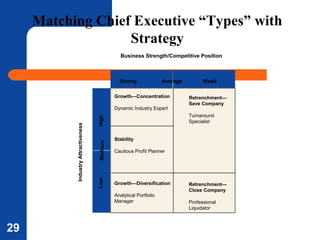
Matching Chief Executive “Types” with
Strategy
Average
HighLow
Business Strength/Competitive Position
Strong
Growth—Concentration
Dynamic Industry Expert
Stability
Cautious Profit Planner
Retrenchment—
Close Company
Professional
Liquidator
Retrenchment—
Save Company
Turnaround
Specialist
IndustryAttractiveness
Medium
Weak
Growth—Diversification
Analytical Portfolio
Manager
30
 Managing corporate culture:
– Corporate culture
 Affects firm’s ability to shift its strategic direction
 Strong tendency to resist change
 Corporate culture should support the strategy
31
 Strategy-Culture Compatibility:
– Consider the following:
 Is the planned strategy compatible with the firm’s
current culture?
 Can the culture be easily modified to make it more
compatible with new strategy?
 Is management willing to make major
organizational changes?
 Is management committed to implementing the
strategy?
32
 Managing corporate culture:
– Communication
 Key to effective management of change
 Rationale for strategic change should be
communicated to all
What Is Organizational Culture?
Culture
– The collection of values and norms shared by people and
groups in an organization.
– Shared values and a common culture increase integration
and improve coordination.
Values
– Beliefs and ideas about common goals and proper
behaviors.
Norms
– Act as guidelines or expectations that prescribe acceptable
behavior by organizational members.
Organizational Culture
Ways of transmitting organizational culture:
Culture and Strategic Leadership
The influence of the founder
– Initial cultural values and management
style is imprinted on the organization
by its founder.
Organizational structure
– Structure follows strategy.
Strategic leadership affects
the cultural norms and values
that develop in the organization.
Strategic Reward Systems
Individual reward systems
– Piecework plans
– Commission systems
– Bonus plans
– Promotion
Group and organizational
reward systems
– Group-based bonus systems
– Profit sharing systems
– Employee stock option systems
– Organization bonus systems

Strategyimplementation 150127011847-conversion-gate02

  • 1.
  • 2.
    Organizational Structure Organizational design –Selecting the structure and control systems that are most strategically effective for pursuing sustainable competitive advantage. The role of structure and control – To coordinate strategy implementation. – To motivate and provide incentives for superior performance.
  • 3.
    The Role ofOrganizational Structure Building blocks of organizational structure – Differentiation in the allocation of people and resources to create value.  Vertical differentiation in the distribution of decision-making authority.  Horizontal differentiation in dividing up people and tasks into functions and divisions. – Integration  The means used in coordinating people and functions to accomplish organizational tasks.
  • 4.
    Differentiation, Integration, Bureaucratic Costs Bureaucraticcosts and strategy implementation: – Bureaucratic costs increase with organizational complexity. – More differentiation = more managers. – More integration = more coordination. – Better strategy implementation = better bottom-line performance and profitability.
  • 5.
    Vertical Differentiation Span ofcontrol (division of authority) – The number of subordinates that a single manager directly manages. Organizational hierarchy choices – Flat structures  Few organizational levels  Wide spans of control – Tall structures  Many organizational levels  Narrow spans of control
  • 6.
    Tall and FlatStructures
  • 7.
    Problems with TallStructures Principle of minimum chain of command – Maintaining a hierarchy with the least number of levels of authority needed to achieve a strategy. Sources of bureaucratic costs:
  • 8.
    Centralization or Decentralization Authoritypatterns in organizations: – Centralized  Decision making retained in the hands of upper-level managers. – Decentralized  Decisions delegated to lower levels in the organization.
  • 9.
    Centralization (Structural) Choice? Advantagesof decentralization – Reduced information overload on upper managers. – Increased motivation and accountability throughout organization. – Fewer managers; lower bureaucratic costs. Advantages of centralization – Easier coordination of organizational activities. – Decisions fitted to broad organizational objectives. – Exercise of strong leadership in crisis. – Faster decision making and response.
  • 10.
    Horizontal Differentiation Focus ison division and grouping of tasks to meet business objectives. Simple structure: – Characteristic of small entrepreneurial companies. – Entrepreneur takes on most managerial roles. – No formal organization arrangements. – Horizontal differentiation is low.
  • 11.
    11  Structure FollowsStrategy: – Changes in corporate strategy lead to changes in organizational structure
  • 12.
    12  Structure FollowsStrategy: • New strategy is created • New administrative problems emerge • Economic performance declines • New appropriate structure is invented • Profit returns to its previous levels
  • 13.
    13  Stages ofcorporate development  Simple Structure  Functional Structure  Divisional Structure  Beyond SBU’s
  • 14.
    14  Simple Structure: –Stage I:  Entrepreneur – Decision making tightly controlled – Little formal structure – Planning short range/reactive – Flexible and dynamic
  • 15.
    15  Functional Structure: –Stage II:  Management team  Functional specialization  Delegation decision making  Concentration/specialization in industry
  • 16.
    16  Divisional Structure: –Stage III:  Diverse product lines  Decentralized decision making  SBU’s  Almost unlimited resources
  • 17.
    17  Beyond SBU’s: –Stage IV:  Increasing environmental uncertainty  Technological advances  Size & scope of worldwide businesses  Multi-industry competitive strategy  Better educated personnel
  • 18.
    Functional Structure Advantages – Taskgrouping facilitates specialization and productivity. – Better monitoring of work processes, reduced costs. – Greater control over organizational activities. Disadvantages – Functional orientation creates communication problems. – Performance and profitability measurement problems. – Location versus function problems (coordination). – Strategic problems due to structural (vertical and horizontal) mismatches.
  • 19.
  • 20.
    Mutlitdivisional Structure Advantages – Enhancedcorporate control by division – Enhanced strategic control of each SBU in portfolio – Growth is easier. New units don’t have to be integrated across organization – Stronger pursuit of internal efficiencies. Performance of individual units is readily measurable. Disadvantages – Establishing the divisional- corporate authority relationship – Distortion of information by divisions – Competition for resources by divisions – Transfer pricing problems between divisions – Short-term research and development focus – Bureaucratic costs
  • 21.
  • 22.
    Matrix Structure Advantages – Flexibilityof the structure and membership – Minimum of direct hierarchical control – Maximizes use of employees’ skills – Motivates employees; frees up top management Disadvantages – High bureaucratic costs – High costs (time and money) for building relationships – Two-boss employee’s role conflict
  • 23.
  • 24.
    24  Network Structure: –“non structure” – elimination of in-house business functions – Termed “virtual organization”  Useful in unstable environments  Need for innovation and quick response
  • 25.
    25 Network StructureNetwork Structure Packagers DesignersSuppliers Distributors Corporate Headquarters (Broker) Promotion/ Advertising Agencies Manufacturers
  • 26.
    26  Effective implementationrequires: – Leadership  Leading people to use their abilities and skills most effectively and efficiently to achieve organizational objectives
  • 27.
    27  Staffing followsstrategy: – Matching the manager to the strategy  Executive type – Executives with a particular mix of skills and experiences
  • 28.
    28  Executive Types: –Dynamic industry expert – Analytical portfolio manager – Cautious profit planner – Turnaround specialist – Professional liquidator
  • 29.
    29 Matching Chief Executive“Types” with Strategy Average HighLow Business Strength/Competitive Position Strong Growth—Concentration Dynamic Industry Expert Stability Cautious Profit Planner Retrenchment— Close Company Professional Liquidator Retrenchment— Save Company Turnaround Specialist IndustryAttractiveness Medium Weak Growth—Diversification Analytical Portfolio Manager
  • 30.
    30  Managing corporateculture: – Corporate culture  Affects firm’s ability to shift its strategic direction  Strong tendency to resist change  Corporate culture should support the strategy
  • 31.
    31  Strategy-Culture Compatibility: –Consider the following:  Is the planned strategy compatible with the firm’s current culture?  Can the culture be easily modified to make it more compatible with new strategy?  Is management willing to make major organizational changes?  Is management committed to implementing the strategy?
  • 32.
    32  Managing corporateculture: – Communication  Key to effective management of change  Rationale for strategic change should be communicated to all
  • 33.
    What Is OrganizationalCulture? Culture – The collection of values and norms shared by people and groups in an organization. – Shared values and a common culture increase integration and improve coordination. Values – Beliefs and ideas about common goals and proper behaviors. Norms – Act as guidelines or expectations that prescribe acceptable behavior by organizational members.
  • 34.
    Organizational Culture Ways oftransmitting organizational culture:
  • 35.
    Culture and StrategicLeadership The influence of the founder – Initial cultural values and management style is imprinted on the organization by its founder. Organizational structure – Structure follows strategy. Strategic leadership affects the cultural norms and values that develop in the organization.
  • 36.
    Strategic Reward Systems Individualreward systems – Piecework plans – Commission systems – Bonus plans – Promotion Group and organizational reward systems – Group-based bonus systems – Profit sharing systems – Employee stock option systems – Organization bonus systems