PowerPoint Presentation by Charlie Cook
Copyright © 2005 South-Western. All rights reserved.
Chapter 13
Organization
Structure and
Design
Copyright © 2005 South-Western. All rights reserved. 13–2
Learning Objectives
After reading and studying this chapter and doing the
exercises, you should be able to:
1. Identify and define the foundation concepts of organization
structure, including the informal organization.
2. Specify the basic features of the bureaucratic form of
organization structure, including how it is divided into
departments.
3. Describe three key modifications of a bureaucratic structure:
matrix, flat, and outsourcing.
4. Describe the two contemporary organizational designs
referred to as horizontal structures and network structures.
5. Specify the criteria for an effective organization design.
Copyright © 2005 South-Western. All rights reserved. 13–3
Learning Objectives (cont’d)
After reading and studying this chapter and doing the
exercises, you should be able to:
6. Understand why a new type of organization chart called an
organigraph can contribute to understanding organization
structure.
Copyright © 2005 South-Western. All rights reserved. 13–4
Organizations
• Organization
Is a collection of people working together to achieve a
common purpose (or simply a big group).
• Organization structure
Is the arrangement of people and tasks to accomplish
organizational goals.
• Organizational design
Is the process of creating a structure that best fits a
purpose, strategy, and environment.
Copyright © 2005 South-Western. All rights reserved. 13–5
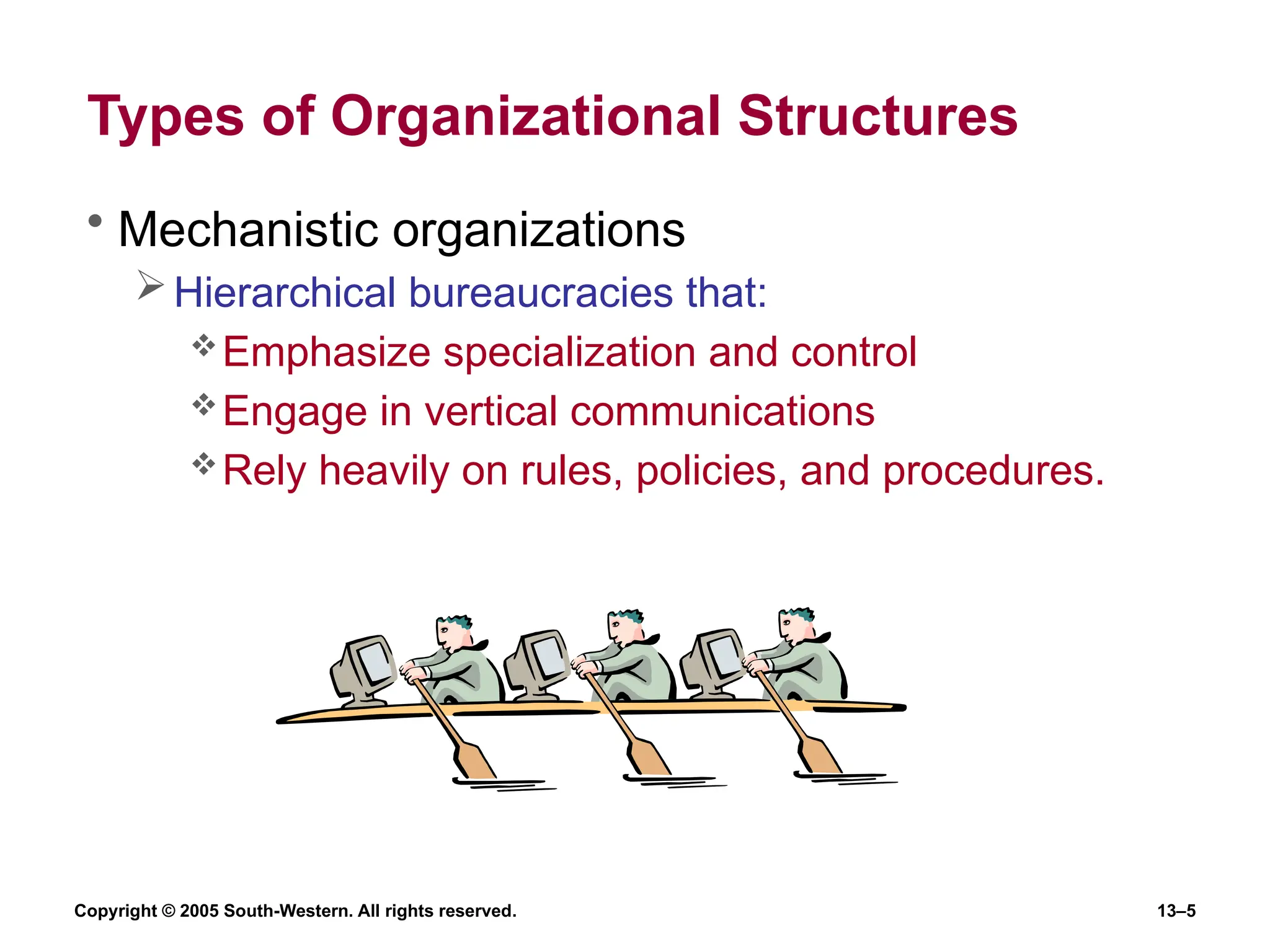
Types of Organizational Structures
• Mechanistic organizations
Hierarchical bureaucracies that:
Emphasize specialization and control
Engage in vertical communications
Rely heavily on rules, policies, and procedures.
Copyright © 2005 South-Western. All rights reserved. 13–6
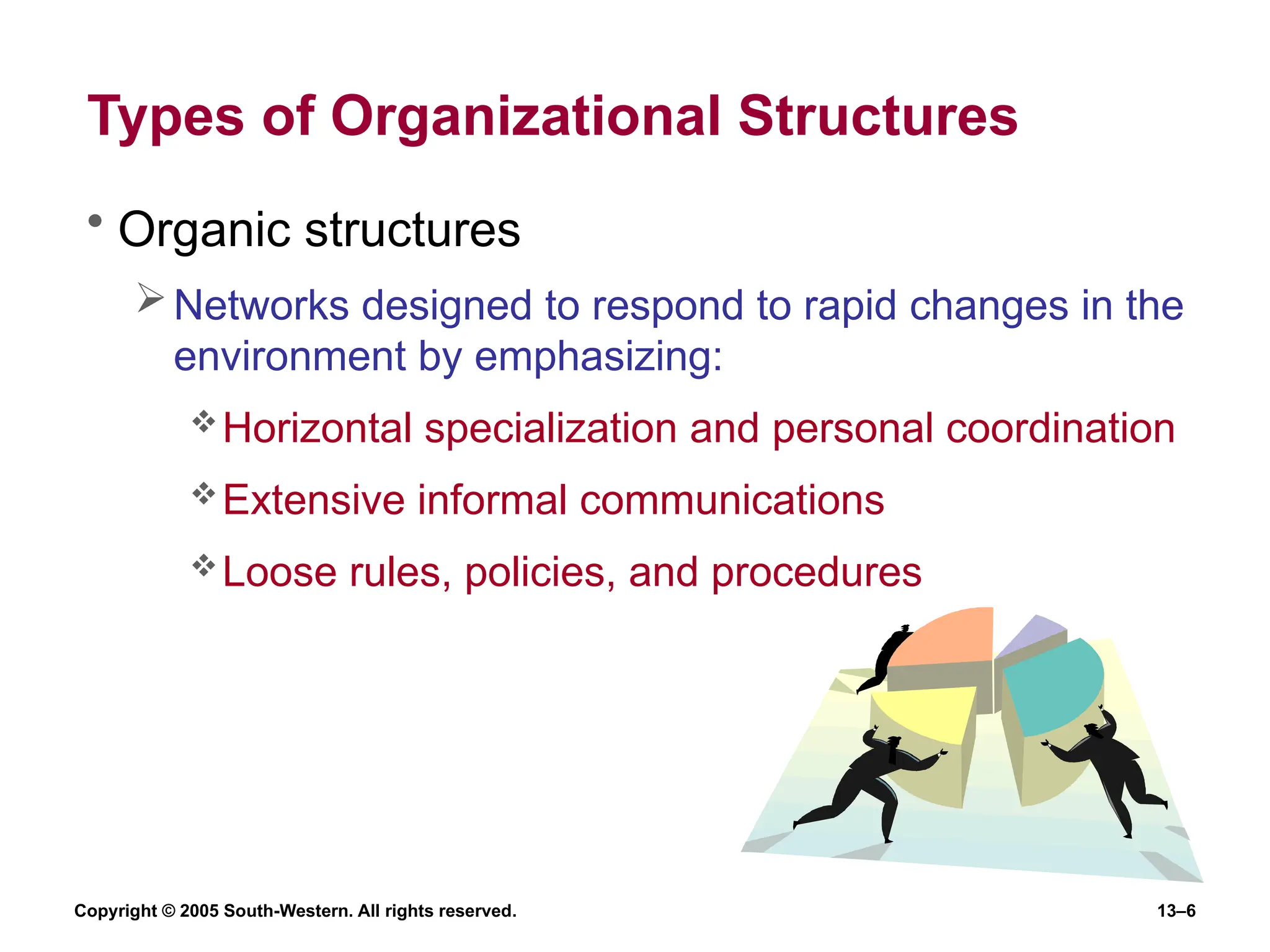
Types of Organizational Structures
• Organic structures
Networks designed to respond to rapid changes in the
environment by emphasizing:
Horizontal specialization and personal coordination
Extensive informal communications
Loose rules, policies, and procedures
Copyright © 2005 South-Western. All rights reserved. 13–7
Organizational Structures (cont’d)
• Formal organizational structure
Is an official statement of the reporting relationships,
rules, and regulations that guide and govern the
conduct of business by the organization.
• Informal organizational structure
Is a set of unofficial working relationships providing
the flexibility to take care of events and transactions
not covered by the formal structure.
Is revealed using social network analysis to trace
informal social relationships and communication
channels.
Copyright © 2005 South-Western. All rights reserved. 13–8
Organizational Structures (cont’d)
• Formalization
Is the degree to which expectations regarding the
methods of work are specified, written down, and
enforced.
Produces an organization with a highly specialized
labor and high delegation of authority.
Is associated with mechanistic (bureaucratic)
organizations.
Copyright © 2005 South-Western. All rights reserved. 13–9
Organizational Structures (cont’d)
• Centralization
Is the extent to which executives delegate authority to
lower organizational units.
Less delegation = more centralization.
Strategic decisions are more likely to be centralized
than operational decisions.
The use of functional units is a feature of
centralization.
Copyright © 2005 South-Western. All rights reserved. 13–10
Organizational Structures (cont’d)
• Complexity
Refers to the number of different job titles and
organizational units in an organization.
Complexity increases the difficulty of managing an
organization and typically increases with the size of
the organization.
• Differentiation
A horizontally differentiated organization will have
many different job titles.
A vertically differentiated organization will have many
different levels.
Copyright © 2005 South-Western. All rights reserved. 13–11
Organizational Structures (cont’d)
• Coupling
Is the extent to which organizational parts are
interdependent.
Tight coupling between parts is indicated if a minor
change in one part produces a large change in an
associated part.
Has increased due to the increasing interdependence
of the parts or subsystems of organizations today.
Organizational design is influenced by coupling and
the increased necessity for flexibility to meet
changing market conditions.
Copyright © 2005 South-Western. All rights reserved. 13–12
Weber’s Ideal Organization: the Bureaucracy
1. Rules and procedures controlling the organizational
structure
2. A high degree of differentiation among organizational
functions
3. A high degree of job specialization
4. An organization of offices determined by hierarchy, with
each unit reporting to a higher unit
5. A heavy emphasis on rules and norms to regulate behavior
6. Interpersonal relations characterized by impersonality in
place of favoritism
7. Selection and promotion based on merit
8. All administrative actions recorded in writing
Copyright © 2005 South-Western. All rights reserved. 13–13
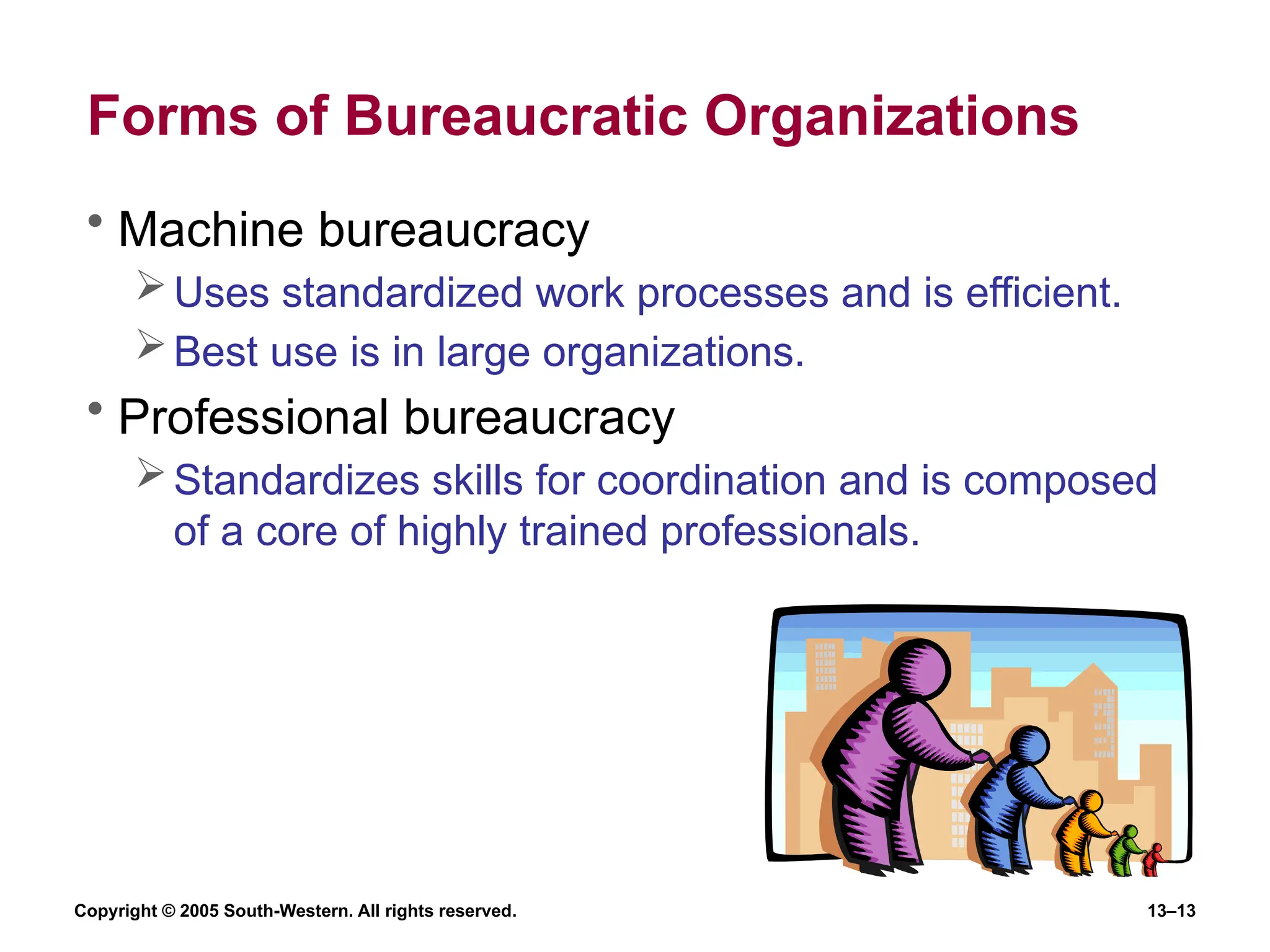
Forms of Bureaucratic Organizations
• Machine bureaucracy
Uses standardized work processes and is efficient.
Best use is in large organizations.
• Professional bureaucracy
Standardizes skills for coordination and is composed
of a core of highly trained professionals.
Copyright © 2005 South-Western. All rights reserved. 13–14
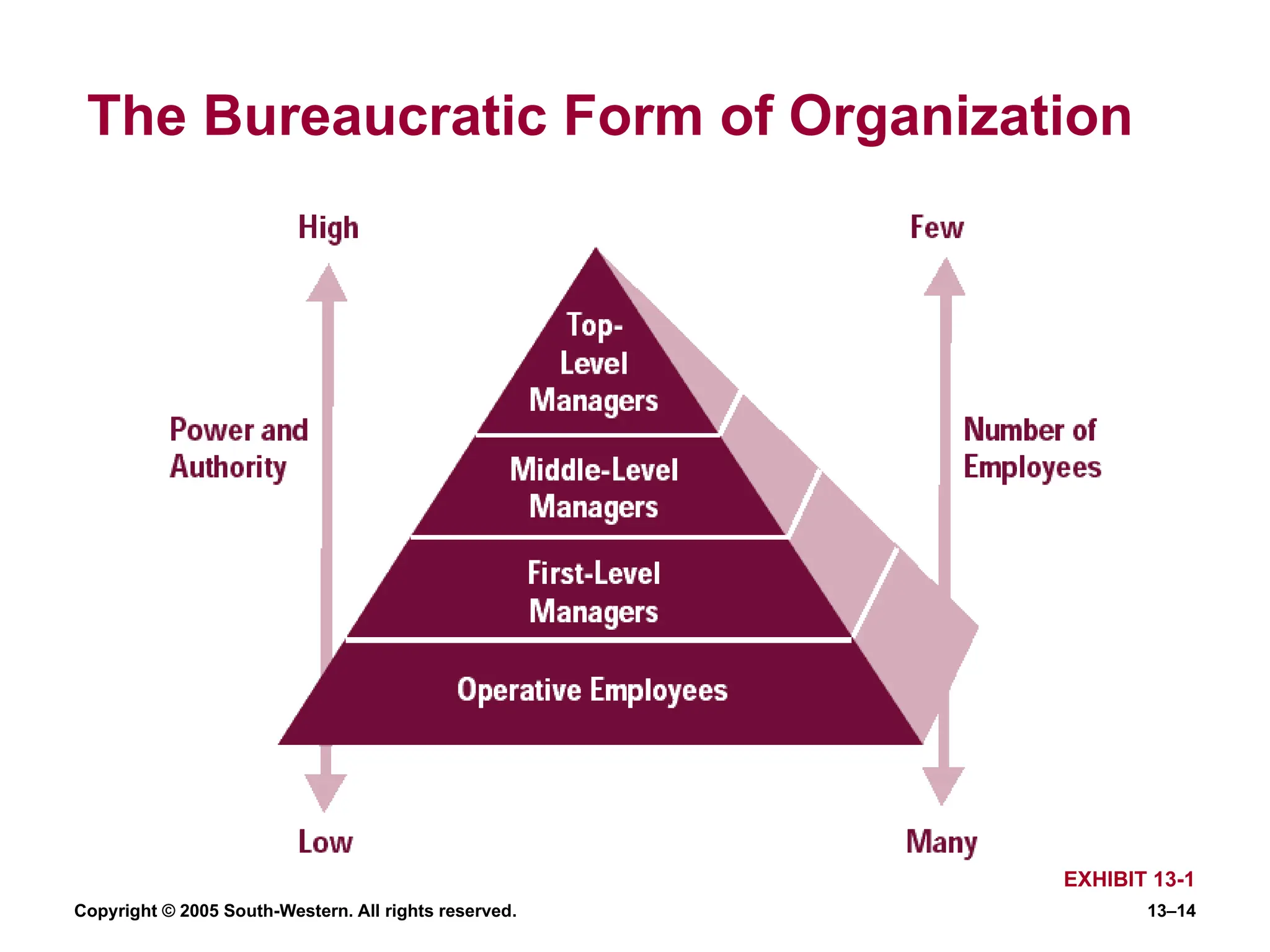
The Bureaucratic Form of Organization
EXHIBIT 13-1
Copyright © 2005 South-Western. All rights reserved. 13–15
Bureaucratic Organizations
• Contributions
Large-scale accomplishments
Accountability for results
Managers with precious skills and expertise
Valuable organizational memory
• Potential dysfunctions
Suppression of innovation and decision making
Lower productivity
Inconvenience and inefficiency
High worker frustration and low satisfaction
Copyright © 2005 South-Western. All rights reserved. 13–16
Departmentalization
• The process of subdividing work into specialized
departments.
Advantageous in enhancing product growth or
service to customers.
• Types of departmentalization:
Functional
Territorial
Product or service
Customer
Hybrid
Copyright © 2005 South-Western. All rights reserved. 13–17
Departmentalization (cont’d)
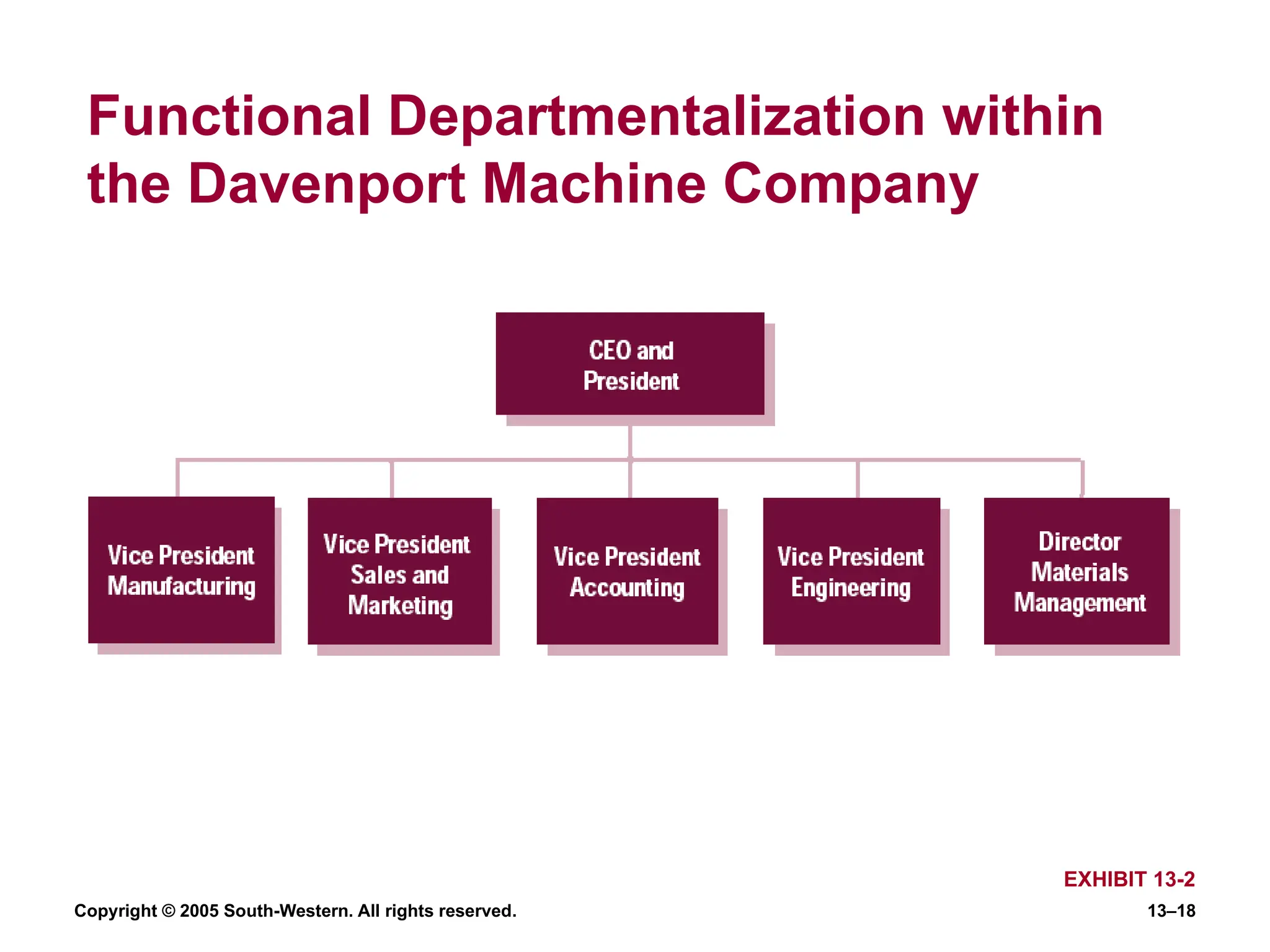
• Functional departmentalization
Grouping people according to their expertise
Most common type of organization
• Territorial departmentalization
Grouping subunits according to the geographic
areas that they serve.
Internationalization of business has increased the
need for organizing subunits territorially.
Copyright © 2005 South-Western. All rights reserved. 13–18
Functional Departmentalization within
the Davenport Machine Company
EXHIBIT 13-2
Copyright © 2005 South-Western. All rights reserved. 13–19
Departmentalization (cont’d)
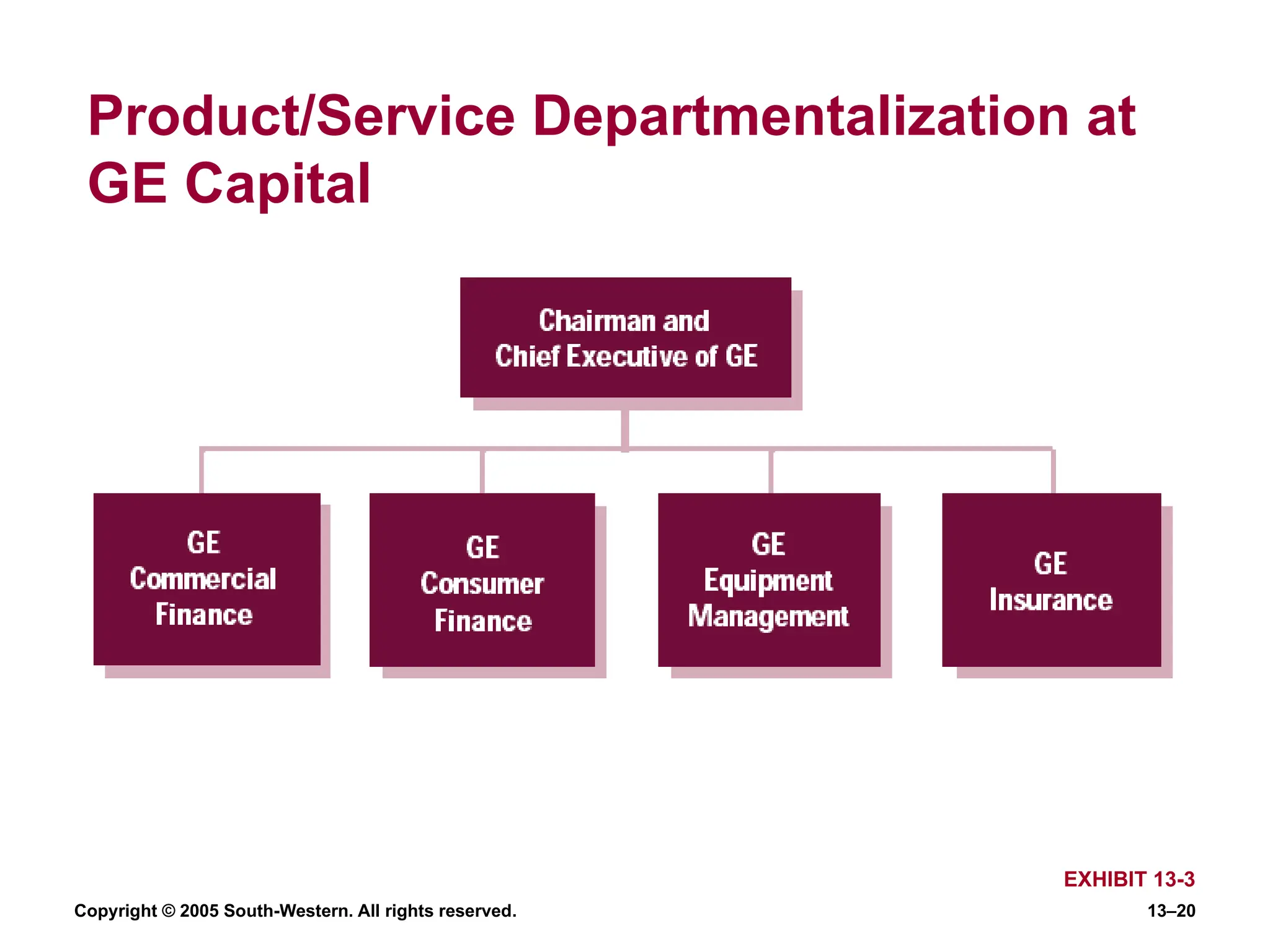
• Product/Service departmentalization
Is arranging units by the product or service they
provide.
• Customer departmentalization
Creates a structure based on customer needs.
Copyright © 2005 South-Western. All rights reserved. 13–20
Product/Service Departmentalization at
GE Capital
EXHIBIT 13-3
Copyright © 2005 South-Western. All rights reserved. 13–21
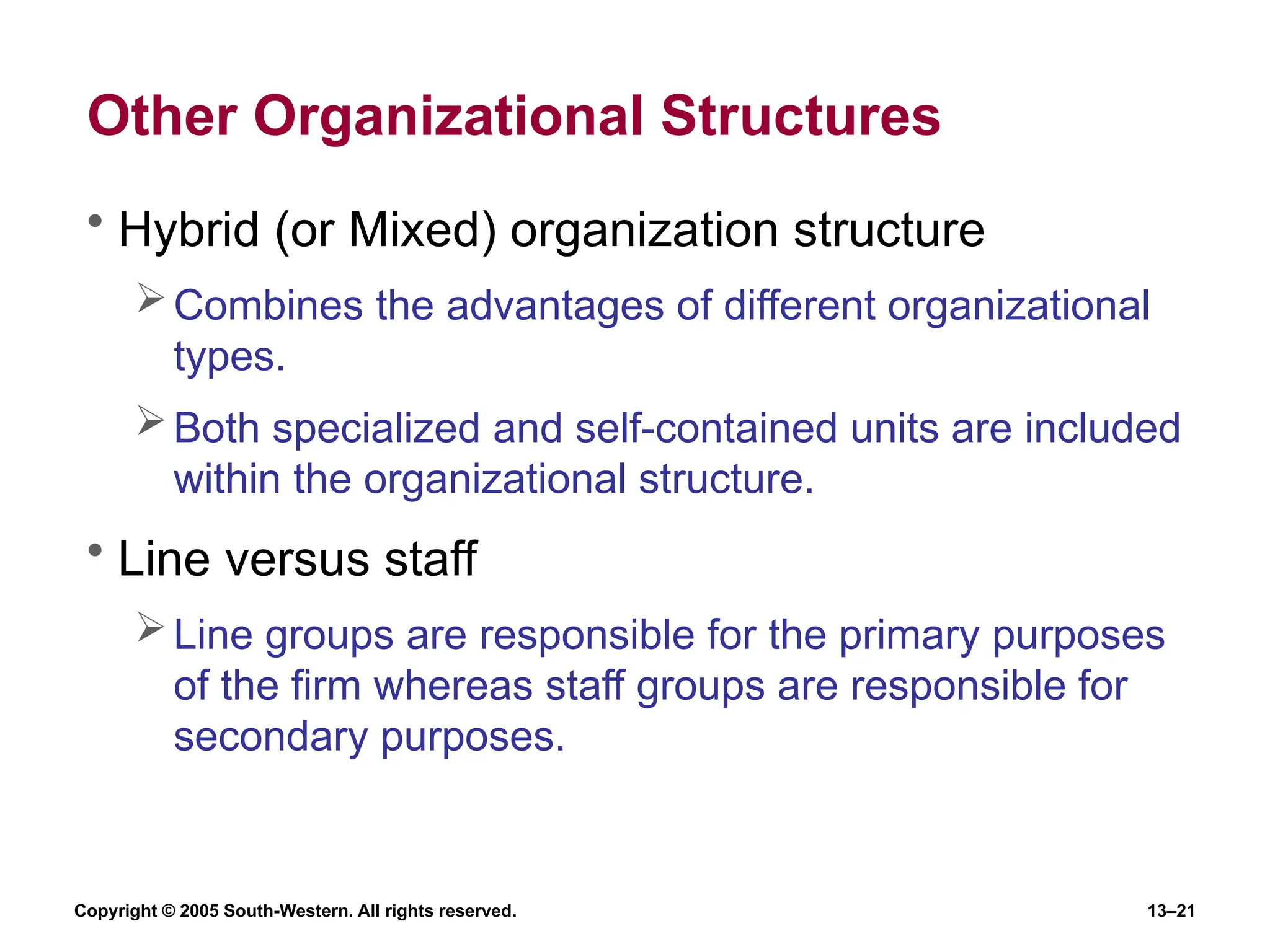
Other Organizational Structures
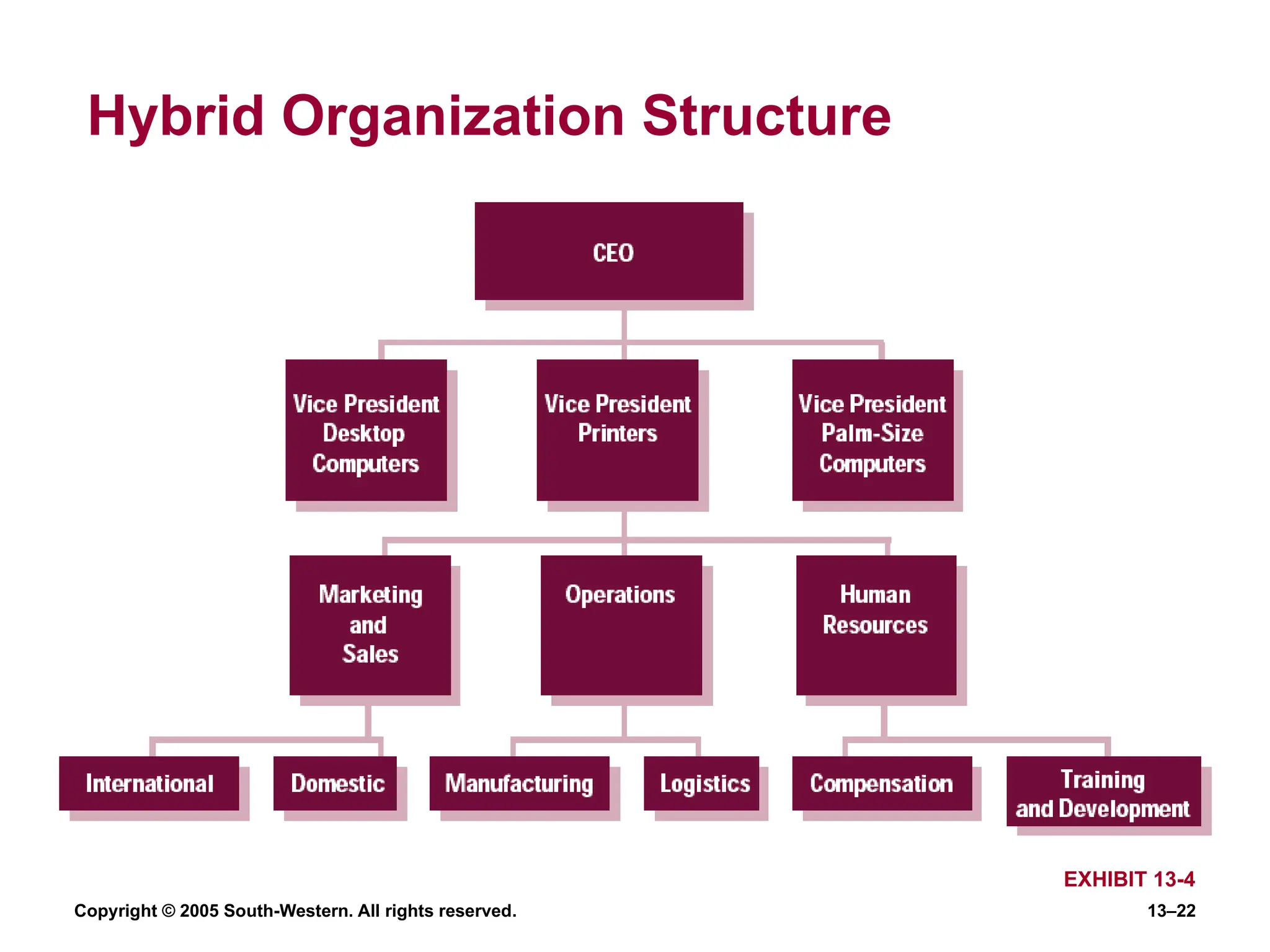
• Hybrid (or Mixed) organization structure
Combines the advantages of different organizational
types.
Both specialized and self-contained units are included
within the organizational structure.
• Line versus staff
Line groups are responsible for the primary purposes
of the firm whereas staff groups are responsible for
secondary purposes.
Copyright © 2005 South-Western. All rights reserved. 13–22
Hybrid Organization Structure
EXHIBIT 13-4
Copyright © 2005 South-Western. All rights reserved. 13–23
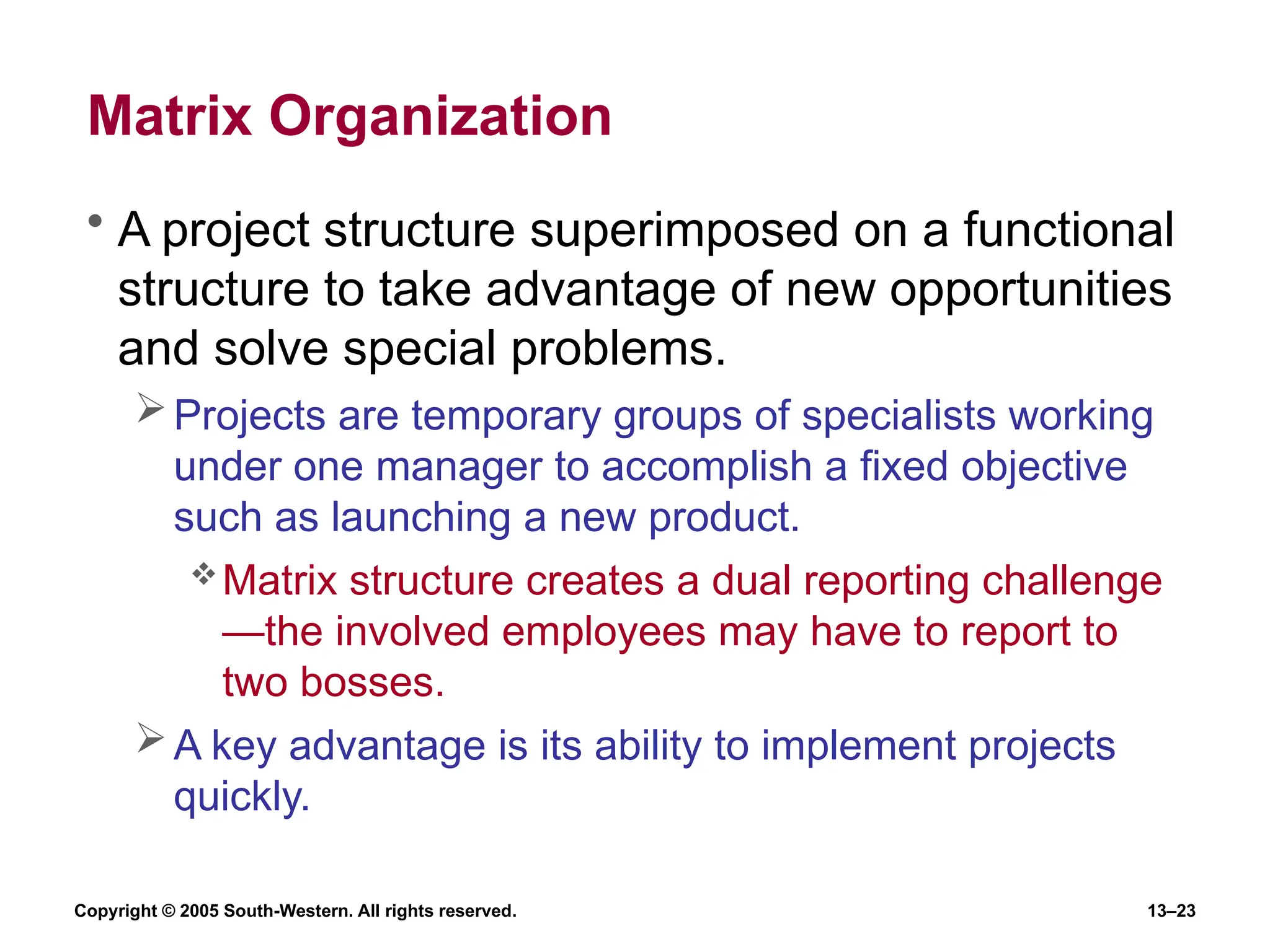
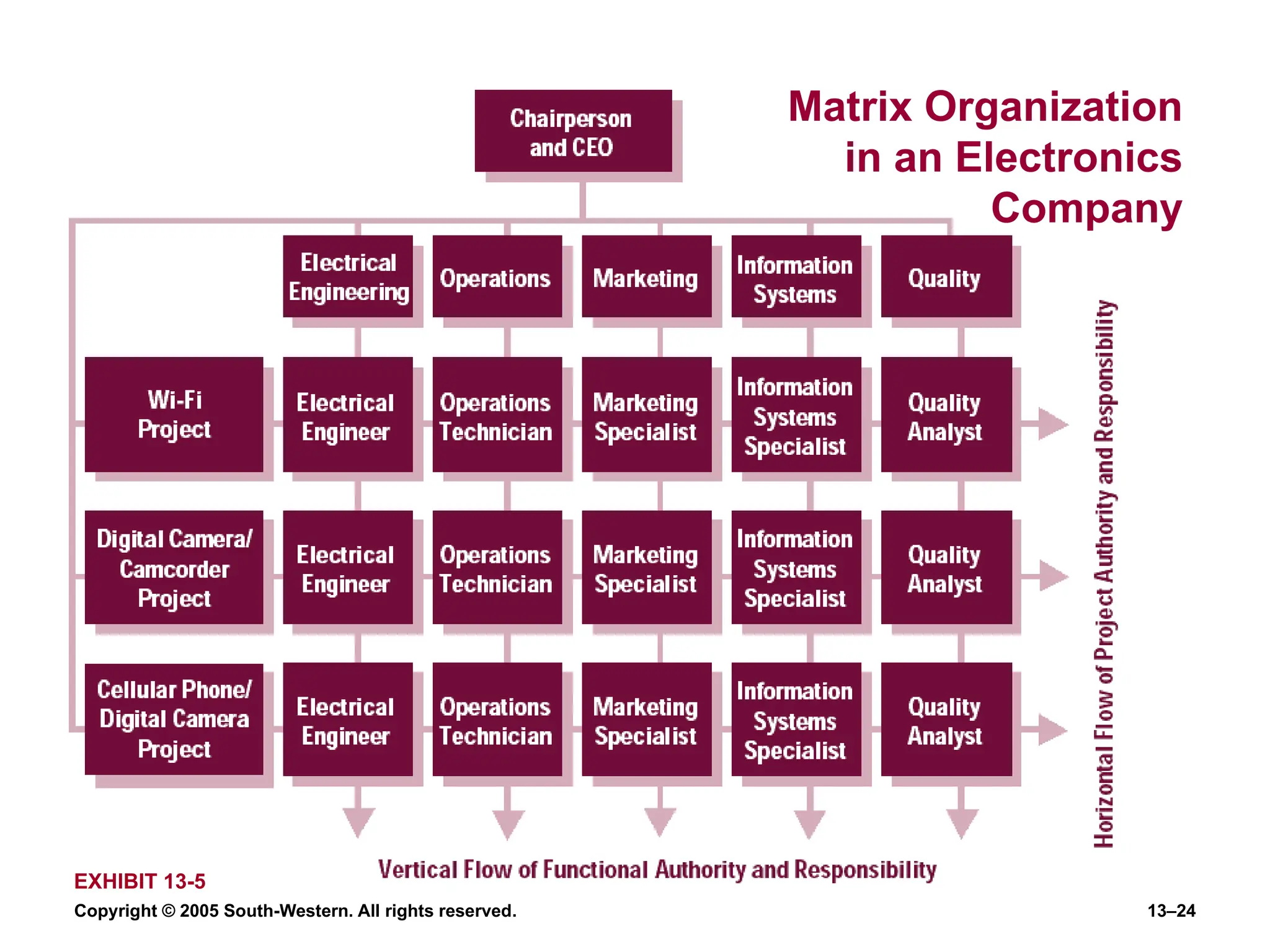
Matrix Organization
• A project structure superimposed on a functional
structure to take advantage of new opportunities
and solve special problems.
Projects are temporary groups of specialists working
under one manager to accomplish a fixed objective
such as launching a new product.
Matrix structure creates a dual reporting challenge
—the involved employees may have to report to
two bosses.
A key advantage is its ability to implement projects
quickly.
Copyright © 2005 South-Western. All rights reserved. 13–24
Matrix Organization
in an Electronics
Company
EXHIBIT 13-5
Copyright © 2005 South-Western. All rights reserved. 13–25
Organizational Structures (cont’d)
• Flat organization
Has relatively few levels
Is less bureaucratic because:
There are fewer managers available to review and
approve decisions.
The short chain-of-command creates less concern
about authority differences among people.
Are more efficient than tall organizations.
Downsizing to a flatter structure has strong effects on
surviving employees.
Copyright © 2005 South-Western. All rights reserved. 13–26
Outsourcing as an Organizational
Arrangement
• Outsourcing
Is having work done by other organizations as a
method of dividing the work between groups on the
outside with groups on the inside.
Reduces the need for employees and physical
assets and reduce payroll costs.
Can create ethical dilemmas for companies who
have no control over the actions of their
outsourcing supplier.
Can cause conflict with unions over outsourcing.
Copyright © 2005 South-Western. All rights reserved. 13–27
Leading-Edge Organization Structures
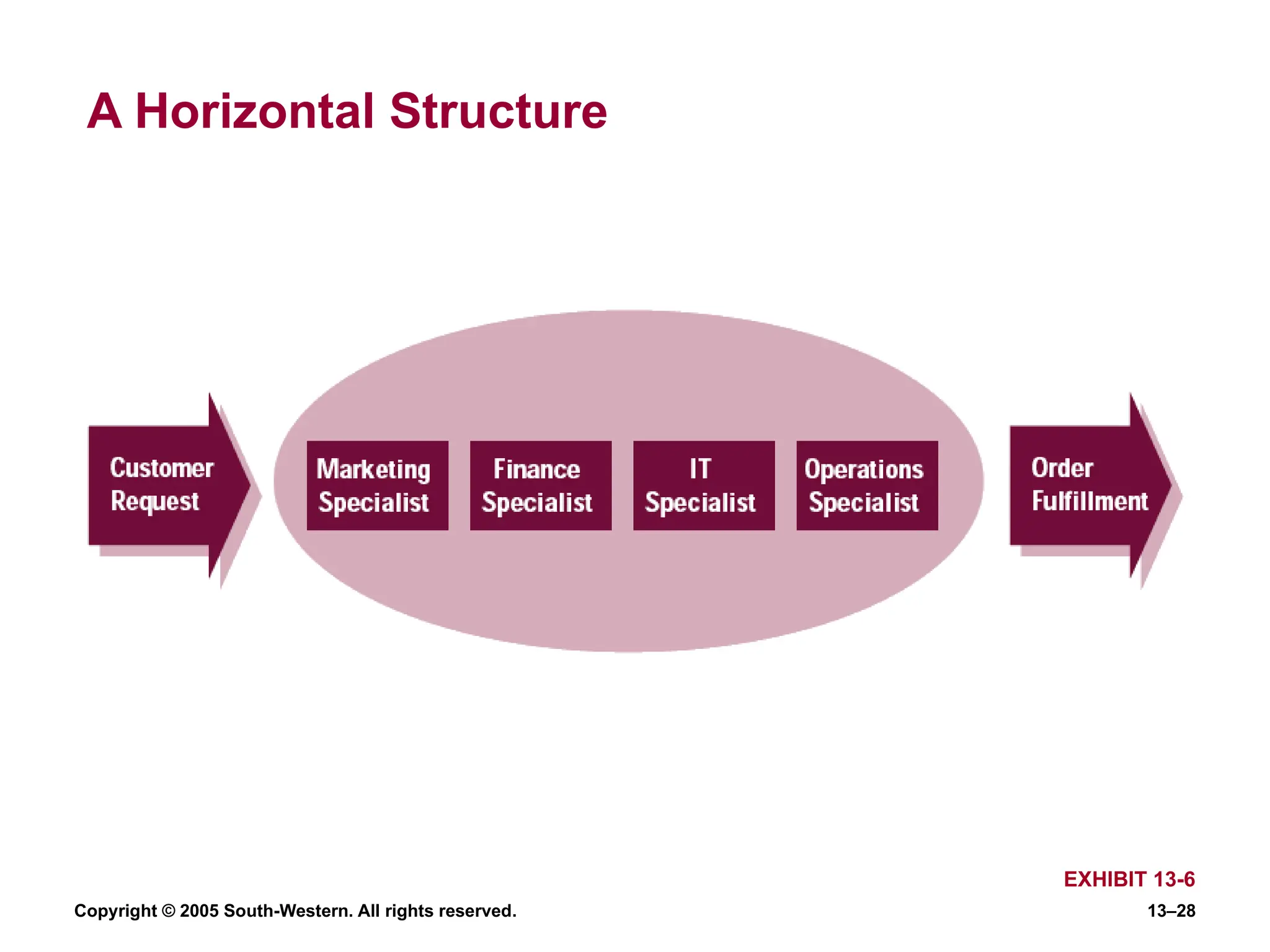
• The horizontal structure
Is the arrangement of work by teams that are
responsible accomplishing a process.
Is a structure in which employees take collective
responsibility for customers.
• Reengineering
Is the radical redesign of work to achieve substantial
improvements in performance.
Searches for the most efficient way to perform a task.
Organizes work horizontally rather than vertically.
Copyright © 2005 South-Western. All rights reserved. 13–28
A Horizontal Structure
EXHIBIT 13-6
Copyright © 2005 South-Western. All rights reserved. 13–29
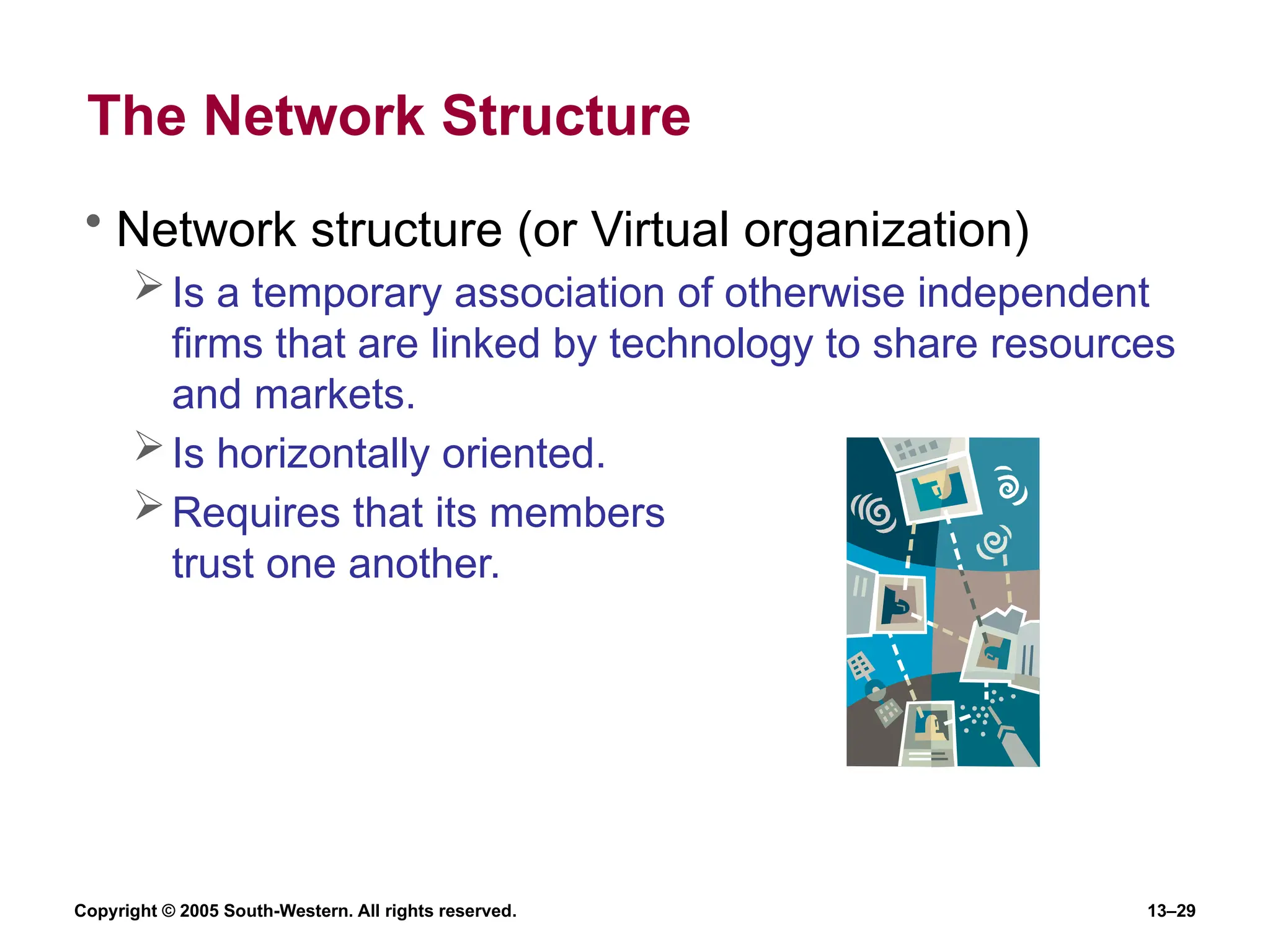
The Network Structure
• Network structure (or Virtual organization)
Is a temporary association of otherwise independent
firms that are linked by technology to share resources
and markets.
Is horizontally oriented.
Requires that its members
trust one another.
Copyright © 2005 South-Western. All rights reserved. 13–30
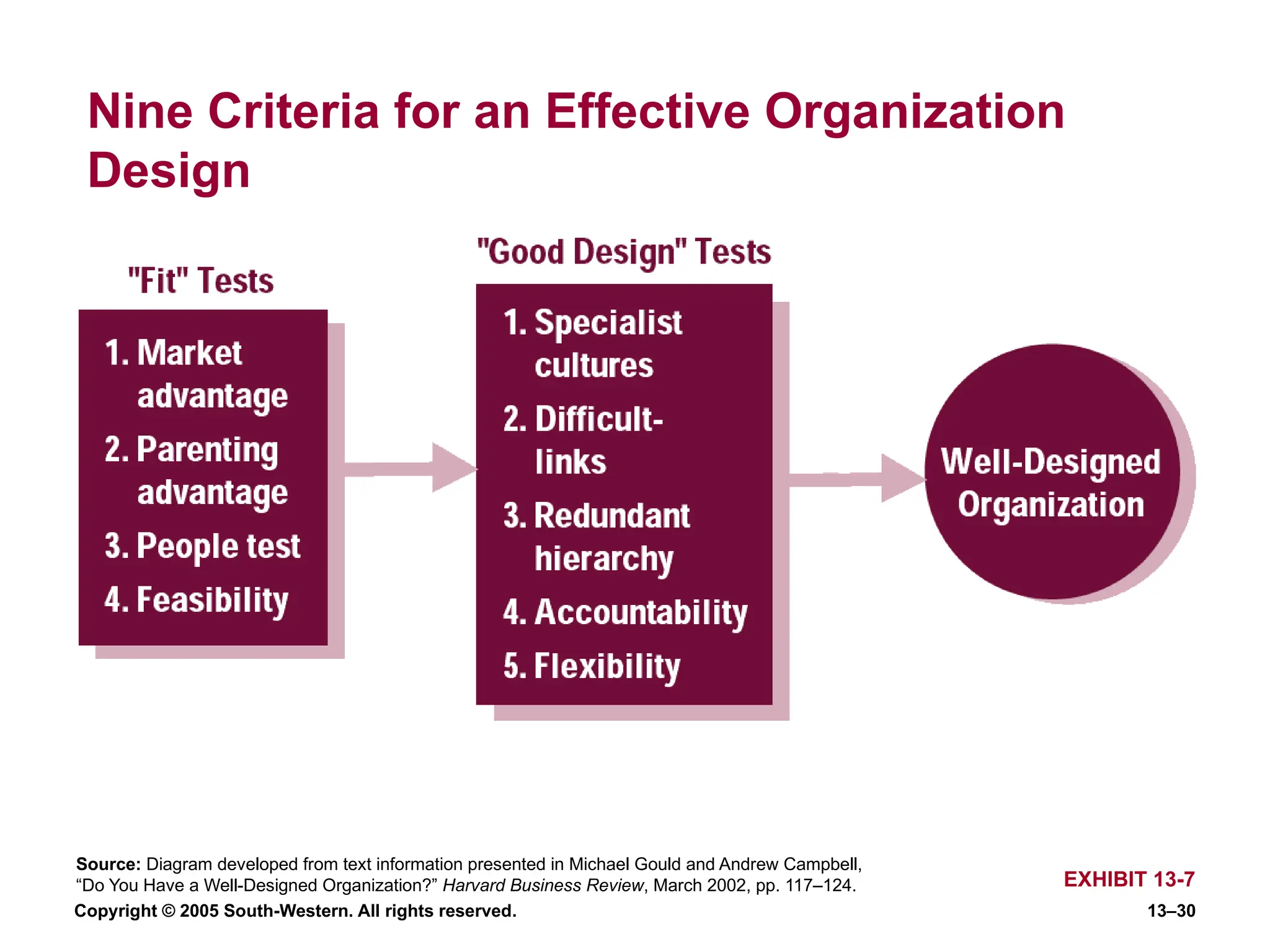
Nine Criteria for an Effective Organization
Design
EXHIBIT 13-7
Source: Diagram developed from text information presented in Michael Gould and Andrew Campbell,
“Do You Have a Well-Designed Organization?” Harvard Business Review, March 2002, pp. 117–124.
Copyright © 2005 South-Western. All rights reserved. 13–31
Organigraphs: Drawing How Companies
Really Work
• Organigraphs
A map that provides an overview of the company’s
functions and the way people organize themselves at
work.
Help in the understanding of organizational
functioning.
Assist in expanding into new markets and
identifying opportunities.

Organization Structure and Design (01) (1).ppt

  • 1.
    PowerPoint Presentation byCharlie Cook Copyright © 2005 South-Western. All rights reserved. Chapter 13 Organization Structure and Design
  • 2.
    Copyright © 2005South-Western. All rights reserved. 13–2 Learning Objectives After reading and studying this chapter and doing the exercises, you should be able to: 1. Identify and define the foundation concepts of organization structure, including the informal organization. 2. Specify the basic features of the bureaucratic form of organization structure, including how it is divided into departments. 3. Describe three key modifications of a bureaucratic structure: matrix, flat, and outsourcing. 4. Describe the two contemporary organizational designs referred to as horizontal structures and network structures. 5. Specify the criteria for an effective organization design.
  • 3.
    Copyright © 2005South-Western. All rights reserved. 13–3 Learning Objectives (cont’d) After reading and studying this chapter and doing the exercises, you should be able to: 6. Understand why a new type of organization chart called an organigraph can contribute to understanding organization structure.
  • 4.
    Copyright © 2005South-Western. All rights reserved. 13–4 Organizations • Organization Is a collection of people working together to achieve a common purpose (or simply a big group). • Organization structure Is the arrangement of people and tasks to accomplish organizational goals. • Organizational design Is the process of creating a structure that best fits a purpose, strategy, and environment.
  • 5.
    Copyright © 2005South-Western. All rights reserved. 13–5 Types of Organizational Structures • Mechanistic organizations Hierarchical bureaucracies that: Emphasize specialization and control Engage in vertical communications Rely heavily on rules, policies, and procedures.
  • 6.
    Copyright © 2005South-Western. All rights reserved. 13–6 Types of Organizational Structures • Organic structures Networks designed to respond to rapid changes in the environment by emphasizing: Horizontal specialization and personal coordination Extensive informal communications Loose rules, policies, and procedures
  • 7.
    Copyright © 2005South-Western. All rights reserved. 13–7 Organizational Structures (cont’d) • Formal organizational structure Is an official statement of the reporting relationships, rules, and regulations that guide and govern the conduct of business by the organization. • Informal organizational structure Is a set of unofficial working relationships providing the flexibility to take care of events and transactions not covered by the formal structure. Is revealed using social network analysis to trace informal social relationships and communication channels.
  • 8.
    Copyright © 2005South-Western. All rights reserved. 13–8 Organizational Structures (cont’d) • Formalization Is the degree to which expectations regarding the methods of work are specified, written down, and enforced. Produces an organization with a highly specialized labor and high delegation of authority. Is associated with mechanistic (bureaucratic) organizations.
  • 9.
    Copyright © 2005South-Western. All rights reserved. 13–9 Organizational Structures (cont’d) • Centralization Is the extent to which executives delegate authority to lower organizational units. Less delegation = more centralization. Strategic decisions are more likely to be centralized than operational decisions. The use of functional units is a feature of centralization.
  • 10.
    Copyright © 2005South-Western. All rights reserved. 13–10 Organizational Structures (cont’d) • Complexity Refers to the number of different job titles and organizational units in an organization. Complexity increases the difficulty of managing an organization and typically increases with the size of the organization. • Differentiation A horizontally differentiated organization will have many different job titles. A vertically differentiated organization will have many different levels.
  • 11.
    Copyright © 2005South-Western. All rights reserved. 13–11 Organizational Structures (cont’d) • Coupling Is the extent to which organizational parts are interdependent. Tight coupling between parts is indicated if a minor change in one part produces a large change in an associated part. Has increased due to the increasing interdependence of the parts or subsystems of organizations today. Organizational design is influenced by coupling and the increased necessity for flexibility to meet changing market conditions.
  • 12.
    Copyright © 2005South-Western. All rights reserved. 13–12 Weber’s Ideal Organization: the Bureaucracy 1. Rules and procedures controlling the organizational structure 2. A high degree of differentiation among organizational functions 3. A high degree of job specialization 4. An organization of offices determined by hierarchy, with each unit reporting to a higher unit 5. A heavy emphasis on rules and norms to regulate behavior 6. Interpersonal relations characterized by impersonality in place of favoritism 7. Selection and promotion based on merit 8. All administrative actions recorded in writing
  • 13.
    Copyright © 2005South-Western. All rights reserved. 13–13 Forms of Bureaucratic Organizations • Machine bureaucracy Uses standardized work processes and is efficient. Best use is in large organizations. • Professional bureaucracy Standardizes skills for coordination and is composed of a core of highly trained professionals.
  • 14.
    Copyright © 2005South-Western. All rights reserved. 13–14 The Bureaucratic Form of Organization EXHIBIT 13-1
  • 15.
    Copyright © 2005South-Western. All rights reserved. 13–15 Bureaucratic Organizations • Contributions Large-scale accomplishments Accountability for results Managers with precious skills and expertise Valuable organizational memory • Potential dysfunctions Suppression of innovation and decision making Lower productivity Inconvenience and inefficiency High worker frustration and low satisfaction
  • 16.
    Copyright © 2005South-Western. All rights reserved. 13–16 Departmentalization • The process of subdividing work into specialized departments. Advantageous in enhancing product growth or service to customers. • Types of departmentalization: Functional Territorial Product or service Customer Hybrid
  • 17.
    Copyright © 2005South-Western. All rights reserved. 13–17 Departmentalization (cont’d) • Functional departmentalization Grouping people according to their expertise Most common type of organization • Territorial departmentalization Grouping subunits according to the geographic areas that they serve. Internationalization of business has increased the need for organizing subunits territorially.
  • 18.
    Copyright © 2005South-Western. All rights reserved. 13–18 Functional Departmentalization within the Davenport Machine Company EXHIBIT 13-2
  • 19.
    Copyright © 2005South-Western. All rights reserved. 13–19 Departmentalization (cont’d) • Product/Service departmentalization Is arranging units by the product or service they provide. • Customer departmentalization Creates a structure based on customer needs.
  • 20.
    Copyright © 2005South-Western. All rights reserved. 13–20 Product/Service Departmentalization at GE Capital EXHIBIT 13-3
  • 21.
    Copyright © 2005South-Western. All rights reserved. 13–21 Other Organizational Structures • Hybrid (or Mixed) organization structure Combines the advantages of different organizational types. Both specialized and self-contained units are included within the organizational structure. • Line versus staff Line groups are responsible for the primary purposes of the firm whereas staff groups are responsible for secondary purposes.
  • 22.
    Copyright © 2005South-Western. All rights reserved. 13–22 Hybrid Organization Structure EXHIBIT 13-4
  • 23.
    Copyright © 2005South-Western. All rights reserved. 13–23 Matrix Organization • A project structure superimposed on a functional structure to take advantage of new opportunities and solve special problems. Projects are temporary groups of specialists working under one manager to accomplish a fixed objective such as launching a new product. Matrix structure creates a dual reporting challenge —the involved employees may have to report to two bosses. A key advantage is its ability to implement projects quickly.
  • 24.
    Copyright © 2005South-Western. All rights reserved. 13–24 Matrix Organization in an Electronics Company EXHIBIT 13-5
  • 25.
    Copyright © 2005South-Western. All rights reserved. 13–25 Organizational Structures (cont’d) • Flat organization Has relatively few levels Is less bureaucratic because: There are fewer managers available to review and approve decisions. The short chain-of-command creates less concern about authority differences among people. Are more efficient than tall organizations. Downsizing to a flatter structure has strong effects on surviving employees.
  • 26.
    Copyright © 2005South-Western. All rights reserved. 13–26 Outsourcing as an Organizational Arrangement • Outsourcing Is having work done by other organizations as a method of dividing the work between groups on the outside with groups on the inside. Reduces the need for employees and physical assets and reduce payroll costs. Can create ethical dilemmas for companies who have no control over the actions of their outsourcing supplier. Can cause conflict with unions over outsourcing.
  • 27.
    Copyright © 2005South-Western. All rights reserved. 13–27 Leading-Edge Organization Structures • The horizontal structure Is the arrangement of work by teams that are responsible accomplishing a process. Is a structure in which employees take collective responsibility for customers. • Reengineering Is the radical redesign of work to achieve substantial improvements in performance. Searches for the most efficient way to perform a task. Organizes work horizontally rather than vertically.
  • 28.
    Copyright © 2005South-Western. All rights reserved. 13–28 A Horizontal Structure EXHIBIT 13-6
  • 29.
    Copyright © 2005South-Western. All rights reserved. 13–29 The Network Structure • Network structure (or Virtual organization) Is a temporary association of otherwise independent firms that are linked by technology to share resources and markets. Is horizontally oriented. Requires that its members trust one another.
  • 30.
    Copyright © 2005South-Western. All rights reserved. 13–30 Nine Criteria for an Effective Organization Design EXHIBIT 13-7 Source: Diagram developed from text information presented in Michael Gould and Andrew Campbell, “Do You Have a Well-Designed Organization?” Harvard Business Review, March 2002, pp. 117–124.
  • 31.
    Copyright © 2005South-Western. All rights reserved. 13–31 Organigraphs: Drawing How Companies Really Work • Organigraphs A map that provides an overview of the company’s functions and the way people organize themselves at work. Help in the understanding of organizational functioning. Assist in expanding into new markets and identifying opportunities.