What Is Organizational Structure
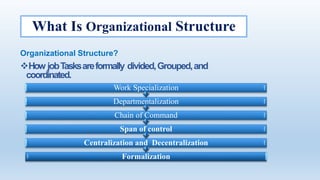
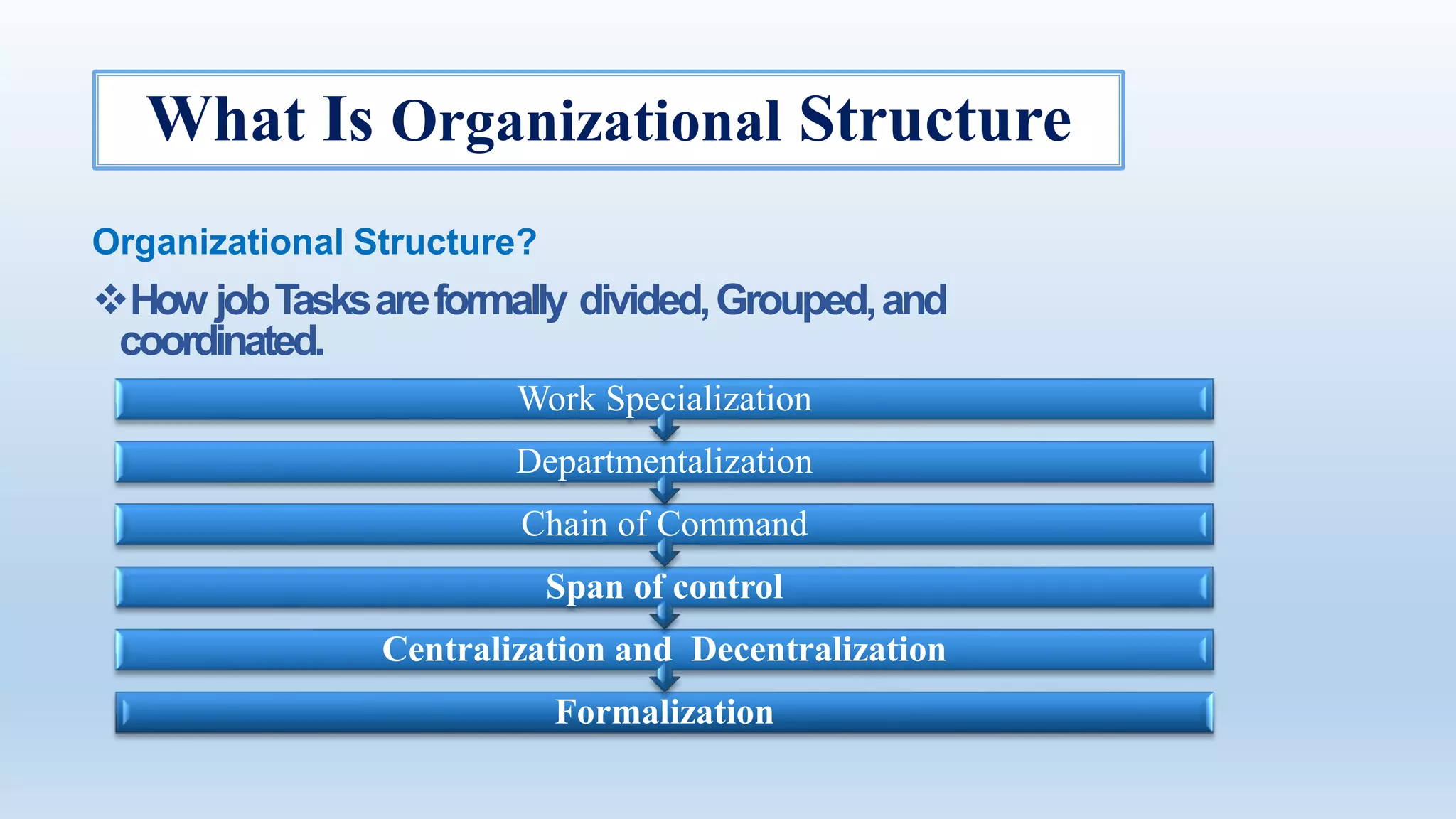
How jobTasksareformally divided,Grouped,and
coordinated.
Organizational Structure?
Formalization
Centralization and Decentralization
Span of control
Chain of Command
Departmentalization
Work Specialization
Increase efficiency of work
Consume less time to understand tools and
Equipment's
Assign Work According to Work Specialization
The Degree to Which Tasks in the Organization are Sub-
divided into Separate Jobs.
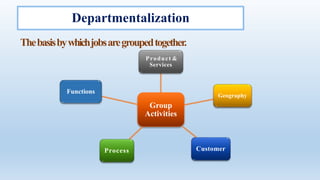
Departmentalization
Group
Activities
Product &
Services
Geography
CustomerProcess
Functions
Thebasisbywhichjobsaregroupedtogether.
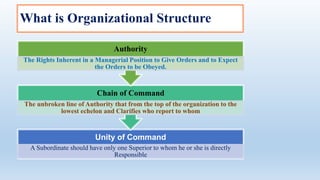
What is Organizational Structure
Unity of Command
A Subordinate should have only one Superior to whom he or she is directly
Responsible
Chain of Command
The unbroken line of Authority that from the top of the organization to the
lowest echelon and Clarifies who report to whom
Authority
The Rights Inherent in a Managerial Position to Give Orders and to Expect
the Orders to be Obeyed.
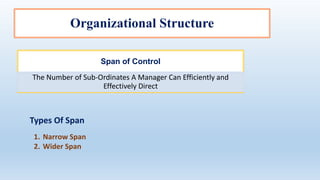
Organizational Structure
Span of Control
The Number of Sub-Ordinates A Manager Can Efficiently and
Effectively Direct
1. Narrow Span
2. Wider Span
Types Of Span
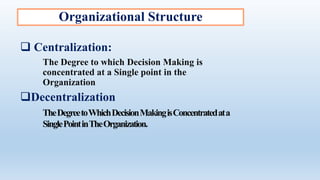
Organizational Structure
 Centralization:
The Degree to which Decision Making is
concentrated at a Single point in the
Organization
Decentralization
TheDegreetoWhichDecisionMakingisConcentratedata
SinglePointinTheOrganization.
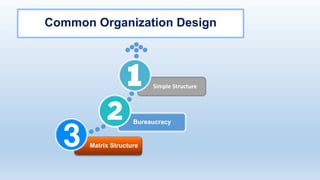
Common Organization Design
Matrix Structure
Bureaucracy
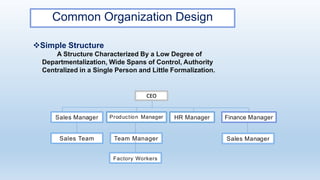
Simple Structure
CEO
Production Manager HR Manager Finance ManagerSales Manager
Sales Team Team Manager Sales Manager
Factory Workers
Common Organization Design
Simple Structure
A Structure Characterized By a Low Degree of
Departmentalization, Wide Spans of Control, Authority
Centralized in a Single Person and Little Formalization.
Common Organization Design
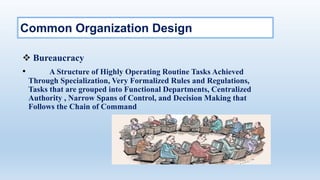
 Bureaucracy
• A Structure of Highly Operating Routine Tasks Achieved
Through Specialization, Very Formalized Rules and Regulations,
Tasks that are grouped into Functional Departments, Centralized
Authority , Narrow Spans of Control, and Decision Making that
Follows the Chain of Command
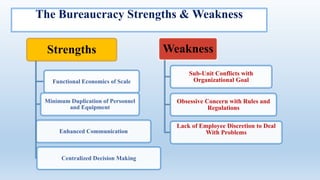
The Bureaucracy Strengths & Weakness
Strengths
Functional Economics of Scale
Minimum Duplication of Personnel
and Equipment
Enhanced Communication
Centralized Decision Making
Weakness
Sub-Unit Conflicts with
Organizational Goal
Obsessive Concern with Rules and
Regulations
Lack of Employee Discretion to Deal
With Problems
Common Organization Design
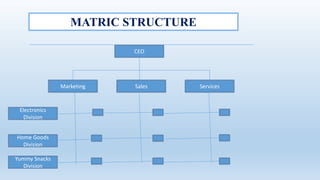
Matric Structure
A Structure That Create Dual Lines Of
Authority and Combines Functional and
Product Departmentalization.
MATRIC STRUCTURE
CEO
Marketing ServicesSales
Electronics
Division
Yummy Snacks
Division
Home Goods
Division
New Design Options
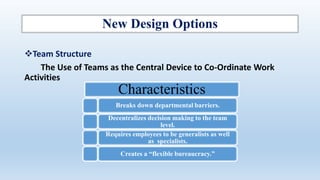
Team Structure
The Use of Teams as the Central Device to Co-Ordinate Work
Activities
Characteristics
Breaks down departmental barriers.
Decentralizes decision making to the team
level.
Requires employees to be generalists as well
as specialists.
Creates a “flexible bureaucracy.”
New Design Options
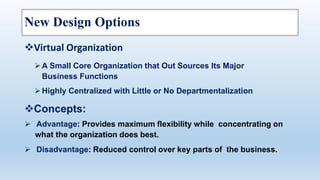
Concepts:
 Advantage: Provides maximum flexibility while concentrating on
what the organization does best.
 Disadvantage: Reduced control over key parts of the business.
Virtual Organization
A Small Core Organization that Out Sources Its Major
Business Functions
Highly Centralized with Little or No Departmentalization
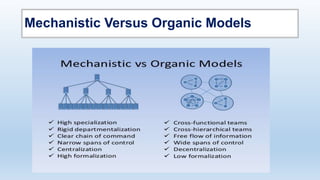
Why Do Structures Differ?
• Astructurecharacterizedbyextensive departmentalization,highformalization, alimited
informationnetwork,and centralization.
 Mechanistic Model
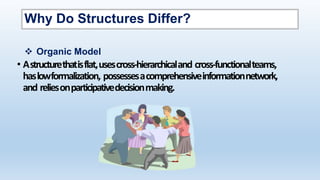
Why Do Structures Differ?
• Astructurethatisflat,usescross-hierarchicaland cross-functionalteams,
haslowformalization, possessesacomprehensiveinformationnetwork,
and reliesonparticipativedecisionmaking.
 Organic Model
Mechanistic Versus Organic Models
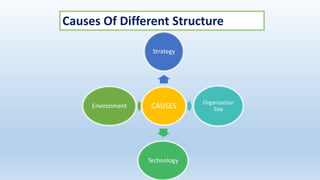
CAUSES
Strategy
Organization
Size
Technology
Environment
Causes Of Different Structure
The Strategy-Structure
Innovation
A strategy that emphasizes the introduction of major new products and
services
Organic structure is best for the implementation of this strategy
 Cost-minimization Strategy
A strategy that emphasizes tight cost controls, avoidance of unnecessary
innovation or marketing expenses, and price cutting
Mechanistic model is best for the implementation of this strategy.
 Imitation Strategy
A strategy that seeks to move into new products or new markets
only after their viability has already been proven
Mixture of the organic and mechanistic structure is best for the
implementation of this strategy
The Strategy-Structure
Causes Of Different Structure
Organization Size:
 Organization size’s significantly affects its structure
 Larger organization have more specialization.
 more formalization rather than smaller organization.
Technology:
• Theway in which an organization transfer its input
into output
• Technology also affects organization Structure
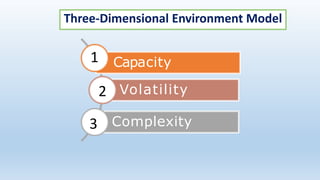
Capacity
Volatility
Complexity
1
2
3
Three-Dimensional Environment Model

Foudation of organization structure

  • 1.
    What Is OrganizationalStructure How jobTasksareformally divided,Grouped,and coordinated. Organizational Structure? Formalization Centralization and Decentralization Span of control Chain of Command Departmentalization Work Specialization
  • 2.
    Increase efficiency ofwork Consume less time to understand tools and Equipment's Assign Work According to Work Specialization The Degree to Which Tasks in the Organization are Sub- divided into Separate Jobs.
  • 3.
  • 4.
    What is OrganizationalStructure Unity of Command A Subordinate should have only one Superior to whom he or she is directly Responsible Chain of Command The unbroken line of Authority that from the top of the organization to the lowest echelon and Clarifies who report to whom Authority The Rights Inherent in a Managerial Position to Give Orders and to Expect the Orders to be Obeyed.
  • 5.
    Organizational Structure Span ofControl The Number of Sub-Ordinates A Manager Can Efficiently and Effectively Direct 1. Narrow Span 2. Wider Span Types Of Span
  • 6.
    Organizational Structure  Centralization: TheDegree to which Decision Making is concentrated at a Single point in the Organization Decentralization TheDegreetoWhichDecisionMakingisConcentratedata SinglePointinTheOrganization.
  • 7.
    Common Organization Design MatrixStructure Bureaucracy Simple Structure
  • 8.
    CEO Production Manager HRManager Finance ManagerSales Manager Sales Team Team Manager Sales Manager Factory Workers Common Organization Design Simple Structure A Structure Characterized By a Low Degree of Departmentalization, Wide Spans of Control, Authority Centralized in a Single Person and Little Formalization.
  • 9.
    Common Organization Design Bureaucracy • A Structure of Highly Operating Routine Tasks Achieved Through Specialization, Very Formalized Rules and Regulations, Tasks that are grouped into Functional Departments, Centralized Authority , Narrow Spans of Control, and Decision Making that Follows the Chain of Command
  • 10.
    The Bureaucracy Strengths& Weakness Strengths Functional Economics of Scale Minimum Duplication of Personnel and Equipment Enhanced Communication Centralized Decision Making Weakness Sub-Unit Conflicts with Organizational Goal Obsessive Concern with Rules and Regulations Lack of Employee Discretion to Deal With Problems
  • 11.
    Common Organization Design MatricStructure A Structure That Create Dual Lines Of Authority and Combines Functional and Product Departmentalization.
  • 12.
  • 13.
    New Design Options TeamStructure The Use of Teams as the Central Device to Co-Ordinate Work Activities Characteristics Breaks down departmental barriers. Decentralizes decision making to the team level. Requires employees to be generalists as well as specialists. Creates a “flexible bureaucracy.”
  • 14.
    New Design Options Concepts: Advantage: Provides maximum flexibility while concentrating on what the organization does best.  Disadvantage: Reduced control over key parts of the business. Virtual Organization A Small Core Organization that Out Sources Its Major Business Functions Highly Centralized with Little or No Departmentalization
  • 15.
    Why Do StructuresDiffer? • Astructurecharacterizedbyextensive departmentalization,highformalization, alimited informationnetwork,and centralization.  Mechanistic Model
  • 16.
    Why Do StructuresDiffer? • Astructurethatisflat,usescross-hierarchicaland cross-functionalteams, haslowformalization, possessesacomprehensiveinformationnetwork, and reliesonparticipativedecisionmaking.  Organic Model
  • 17.
  • 18.
  • 19.
    The Strategy-Structure Innovation A strategythat emphasizes the introduction of major new products and services Organic structure is best for the implementation of this strategy  Cost-minimization Strategy A strategy that emphasizes tight cost controls, avoidance of unnecessary innovation or marketing expenses, and price cutting Mechanistic model is best for the implementation of this strategy.
  • 20.
     Imitation Strategy Astrategy that seeks to move into new products or new markets only after their viability has already been proven Mixture of the organic and mechanistic structure is best for the implementation of this strategy The Strategy-Structure
  • 21.
    Causes Of DifferentStructure Organization Size:  Organization size’s significantly affects its structure  Larger organization have more specialization.  more formalization rather than smaller organization. Technology: • Theway in which an organization transfer its input into output • Technology also affects organization Structure
  • 22.