ORGANIZATIONAL
STRUCTURE
BY
AKSHATA, JYOTHI, PAVAN, MANOJ, SHANMUKHA
MP BIRLA INSTITUTE OF
MANAGEMENT
Agenda
Introduction types
importance Elements
Objectives
advantage
Introduction
3
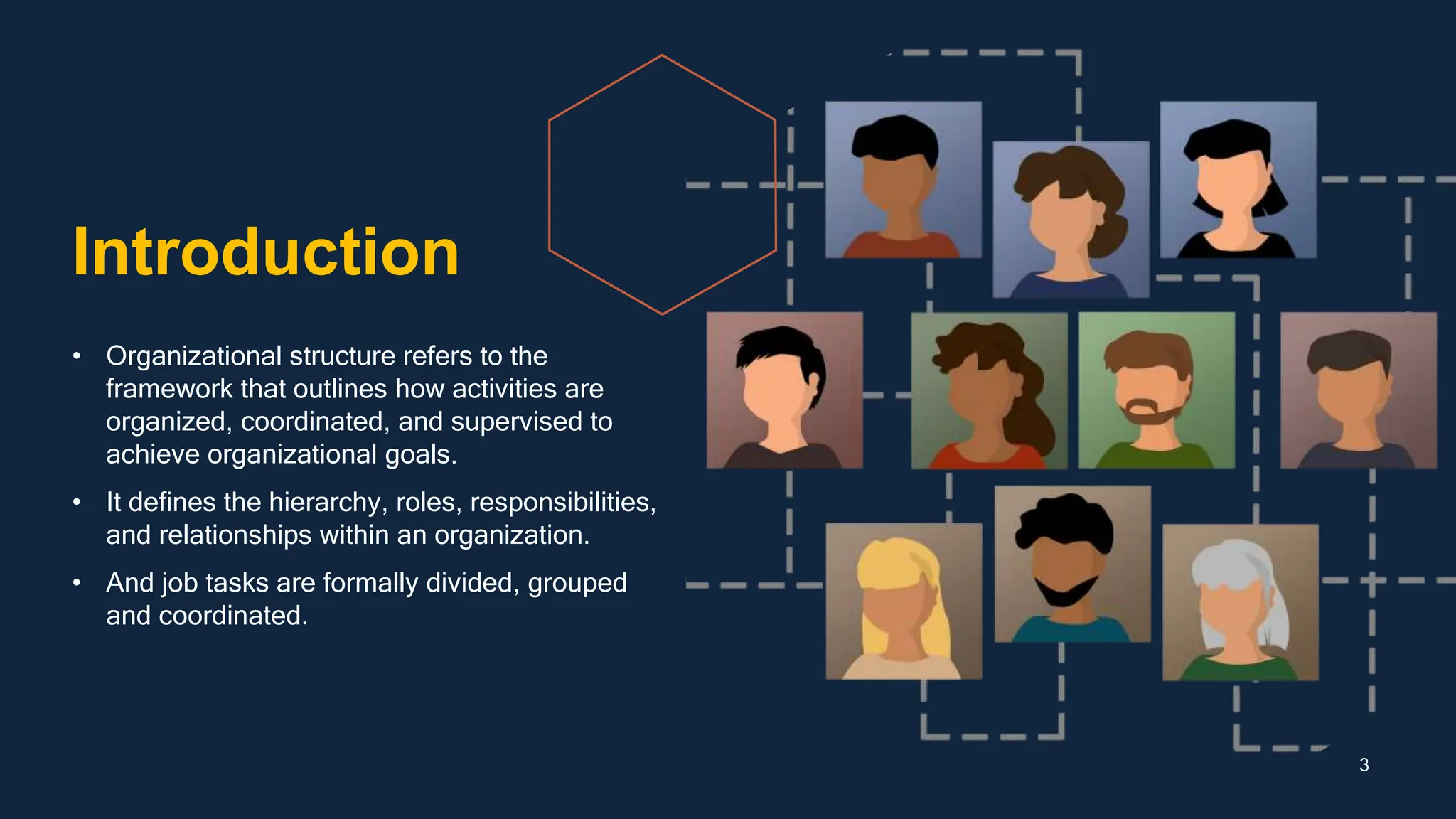
• Organizational structure refers to the
framework that outlines how activities are
organized, coordinated, and supervised to
achieve organizational goals.
• It defines the hierarchy, roles, responsibilities,
and relationships within an organization.
• And job tasks are formally divided, grouped
and coordinated.
Elements of Organizational
Structure
• Work specialization.
• Departmentation.
• Chain of command.
• Span of control.
• Centralization/Decentralization.
• Formalization
1.Work specializations
5
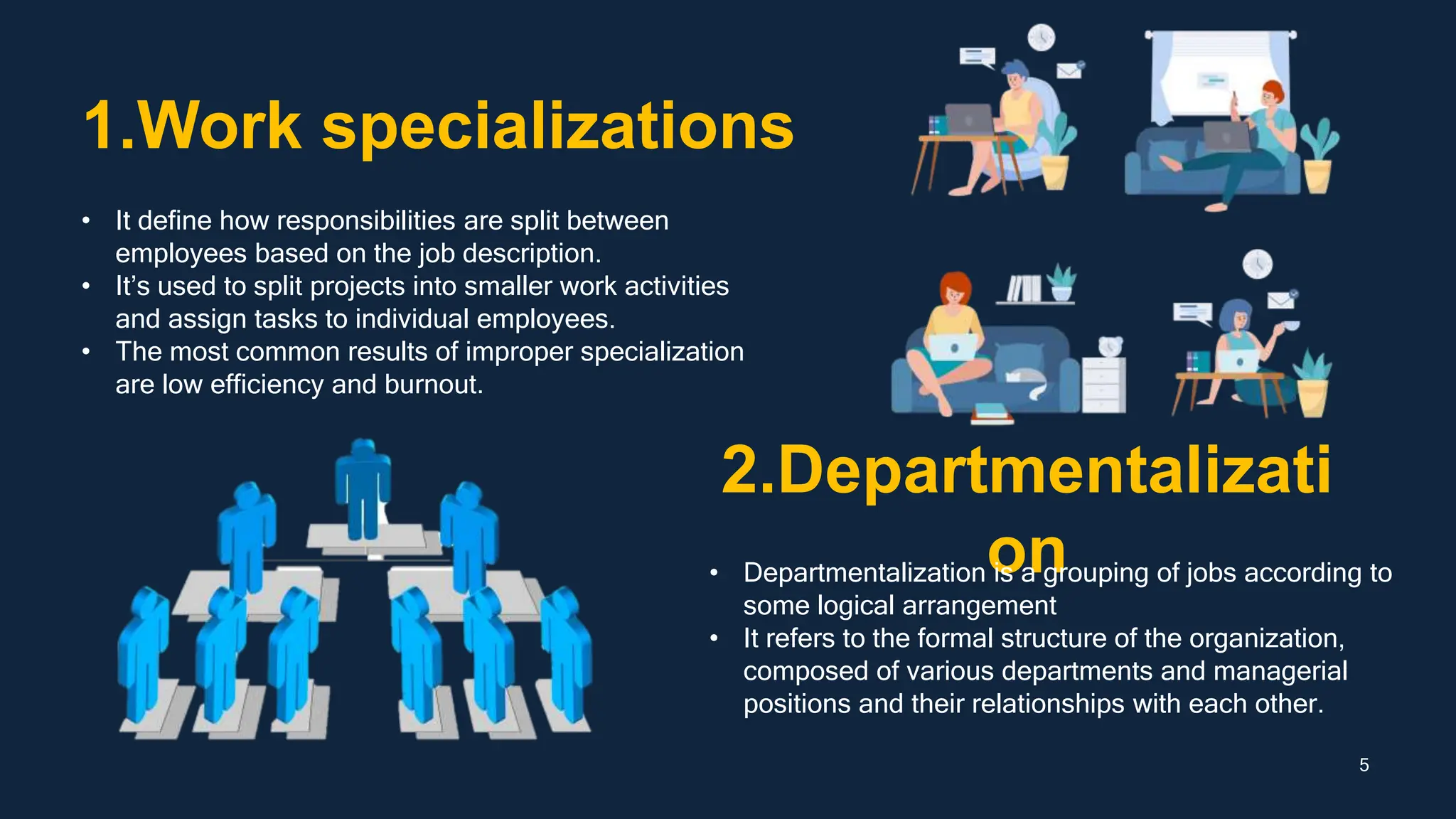
• It define how responsibilities are split between
employees based on the job description.
• It’s used to split projects into smaller work activities
and assign tasks to individual employees.
• The most common results of improper specialization
are low efficiency and burnout.
2.Departmentalizati
on
• Departmentalization is a grouping of jobs according to
some logical arrangement
• It refers to the formal structure of the organization,
composed of various departments and managerial
positions and their relationships with each other.
3.Chain of command
6
• The chain of command of a company describes the
business' hierarchy and can affect workplace culture
and the efficiency of work production. An
organizational chart can visually portray each
employee's place in the company hierarchy, and the
company may have a strict or flexible chain of
command.
4.Span of control
• it accounts for the number of people and a leader
supervises and the tasks they handle.
• it can depend on a variety of factors including:
• Workplace size
• Manager abilities
• Company goals
• Company structure
• Leadership style
5.Centralization and decentralization
7
• Centralization and decentralization refer to the senior
levels of employees who can influence company
decisions. Each company rests somewhere on a scale
of centralization
6.Formalization of
elements
• specifies the relationships and roles within a company.
Larger companies often have a more distinct
formalization of primary roles than smaller companies.
This is because employees may fill multiple roles in a
smaller company.
Common organizational
structure pyramid
Types
• Functional structure
• Divisional structure
• Matrix structure
• Team structure
• Network structure
• Hierarchical structure
• Flat organization structure
Functional structure
Presentation Title 11
• A functional structure groups employees into different
departments by work specialization.
• Each department has a designated leader highly experienced
in the job functions of each employee supervised by them
Divisional structure
Presentation Title 12
• A divisional structure organizes employees around a common
product or geographical location.
• Divisional organizations have teams focused on a specific
market or product line.
Matrix structure
Presentation Title 13
• Having multiple supervisors allows for company-wide
interaction and faster project delivery.
• For instance, when answering to functional managers and
project managers, employees have a chance to collect
experience outside their team.
Team structure
Presentation Title 14
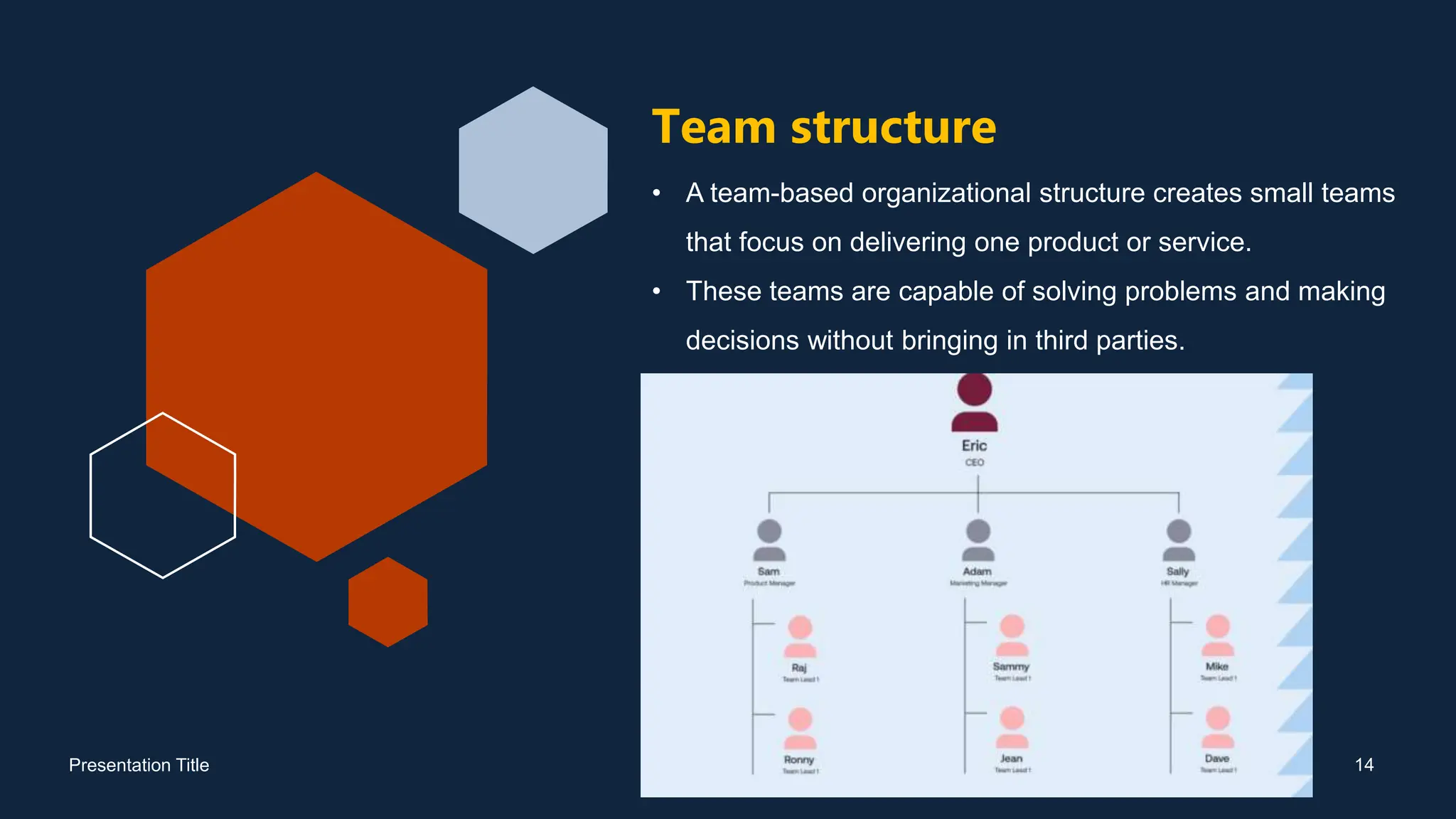
• A team-based organizational structure creates small teams
that focus on delivering one product or service.
• These teams are capable of solving problems and making
decisions without bringing in third parties.
Network structure
Presentation Title 15
• It’s an act of joining the efforts of two or more organizations
with the goal of delivering one product or service. Typically, a
network organization outsources independent contractors or
vendors to complete the work.
Hierarchical structure
Presentation Title 16
• It’s the most common organizational structure type that follows
a direct chain of command.
• A chain of command, in this case, goes from senior
management to general employees through a range of
executives on the departmental and team level.
• The highest-level executive has the highest power over the
decision-making process.
Flat organization structure
Presentation Title 17
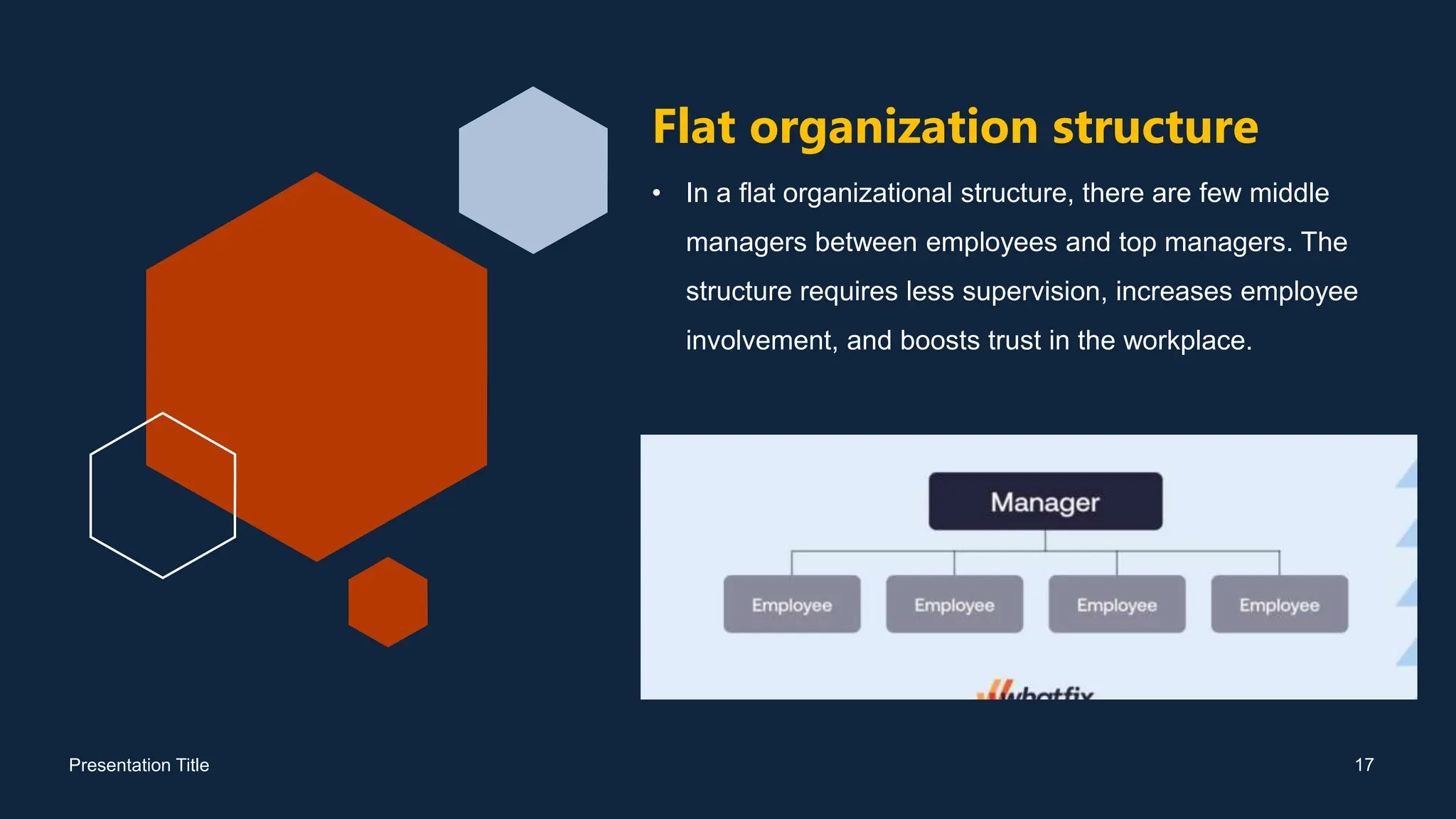
• In a flat organizational structure, there are few middle
managers between employees and top managers. The
structure requires less supervision, increases employee
involvement, and boosts trust in the workplace.
Objectives of organizational structure
18
• To remain adaptable to organizational changes
• To incorporate new aspects
• To ensure collaborations with the components
• To promote flexibility
• To supply required information
• Determinants of organizational structure
• Environment
• Strategy
• Size of organisation
• Organisational lifecycle
• Technology
• Organizational culture
Importance
Presentation Title 19
• Handling contingencies
• Competitive advantage
• Meaning diversity
• Efficiency and innovation
• Provides clarity
• Higher growth opportunity
• Motivates employees
Advantages
• Decision making
• communication
• Self development
• Efficiency
• Clarity
• Accountability
• Efficient communication
• Enhance employee skills
• Minimized cost
• Speed operations
• specialization
Limitations
• Rigidity
• Communication barriers
• Slow decision-making
• Lack of innovation
• Employee dissatisfaction
• Difficulty in collaboration
• Resistance to change
• Limited scalability
Thank you

ORG STRUCTURE presentation ppt --TEAM 1.pptx

  • 1.
    ORGANIZATIONAL STRUCTURE BY AKSHATA, JYOTHI, PAVAN,MANOJ, SHANMUKHA MP BIRLA INSTITUTE OF MANAGEMENT
  • 2.
  • 3.
    Introduction 3 • Organizational structurerefers to the framework that outlines how activities are organized, coordinated, and supervised to achieve organizational goals. • It defines the hierarchy, roles, responsibilities, and relationships within an organization. • And job tasks are formally divided, grouped and coordinated.
  • 4.
    Elements of Organizational Structure •Work specialization. • Departmentation. • Chain of command. • Span of control. • Centralization/Decentralization. • Formalization
  • 5.
    1.Work specializations 5 • Itdefine how responsibilities are split between employees based on the job description. • It’s used to split projects into smaller work activities and assign tasks to individual employees. • The most common results of improper specialization are low efficiency and burnout. 2.Departmentalizati on • Departmentalization is a grouping of jobs according to some logical arrangement • It refers to the formal structure of the organization, composed of various departments and managerial positions and their relationships with each other.
  • 6.
    3.Chain of command 6 •The chain of command of a company describes the business' hierarchy and can affect workplace culture and the efficiency of work production. An organizational chart can visually portray each employee's place in the company hierarchy, and the company may have a strict or flexible chain of command. 4.Span of control • it accounts for the number of people and a leader supervises and the tasks they handle. • it can depend on a variety of factors including: • Workplace size • Manager abilities • Company goals • Company structure • Leadership style
  • 7.
    5.Centralization and decentralization 7 •Centralization and decentralization refer to the senior levels of employees who can influence company decisions. Each company rests somewhere on a scale of centralization 6.Formalization of elements • specifies the relationships and roles within a company. Larger companies often have a more distinct formalization of primary roles than smaller companies. This is because employees may fill multiple roles in a smaller company.
  • 9.
  • 10.
    Types • Functional structure •Divisional structure • Matrix structure • Team structure • Network structure • Hierarchical structure • Flat organization structure
  • 11.
    Functional structure Presentation Title11 • A functional structure groups employees into different departments by work specialization. • Each department has a designated leader highly experienced in the job functions of each employee supervised by them
  • 12.
    Divisional structure Presentation Title12 • A divisional structure organizes employees around a common product or geographical location. • Divisional organizations have teams focused on a specific market or product line.
  • 13.
    Matrix structure Presentation Title13 • Having multiple supervisors allows for company-wide interaction and faster project delivery. • For instance, when answering to functional managers and project managers, employees have a chance to collect experience outside their team.
  • 14.
    Team structure Presentation Title14 • A team-based organizational structure creates small teams that focus on delivering one product or service. • These teams are capable of solving problems and making decisions without bringing in third parties.
  • 15.
    Network structure Presentation Title15 • It’s an act of joining the efforts of two or more organizations with the goal of delivering one product or service. Typically, a network organization outsources independent contractors or vendors to complete the work.
  • 16.
    Hierarchical structure Presentation Title16 • It’s the most common organizational structure type that follows a direct chain of command. • A chain of command, in this case, goes from senior management to general employees through a range of executives on the departmental and team level. • The highest-level executive has the highest power over the decision-making process.
  • 17.
    Flat organization structure PresentationTitle 17 • In a flat organizational structure, there are few middle managers between employees and top managers. The structure requires less supervision, increases employee involvement, and boosts trust in the workplace.
  • 18.
    Objectives of organizationalstructure 18 • To remain adaptable to organizational changes • To incorporate new aspects • To ensure collaborations with the components • To promote flexibility • To supply required information • Determinants of organizational structure • Environment • Strategy • Size of organisation • Organisational lifecycle • Technology • Organizational culture
  • 19.
    Importance Presentation Title 19 •Handling contingencies • Competitive advantage • Meaning diversity • Efficiency and innovation • Provides clarity • Higher growth opportunity • Motivates employees
  • 20.
    Advantages • Decision making •communication • Self development • Efficiency • Clarity • Accountability • Efficient communication • Enhance employee skills • Minimized cost • Speed operations • specialization
  • 21.
    Limitations • Rigidity • Communicationbarriers • Slow decision-making • Lack of innovation • Employee dissatisfaction • Difficulty in collaboration • Resistance to change • Limited scalability
  • 22.