1
Mohammad Kashani
December 2017
HP
2
 David Packard and Bill Hewlett 1st January 1963
 The company they founded would be called H-P or P-H.
 Originated in a garage.
 Designed the first personal computer.
HP PRODUCTS
3
1960
1980
1970
HP PRODUCTS
4
CHANGING
5
MAKING NEW ATMOSPHERE
6
John AndrewYoung Lewis Emmett Platt
DIGITAL REVOLUTION
7
THE MAIN ISSUE
8
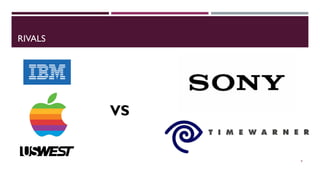
RIVALS
9
VS
RECOGNIZE THE NEED
10
Recognized
needs
New Product
 New Customer
Entering to the
New Market
THETRANSFORMATION HP
11
GOALS
12
1.Major structural transformation
2.Employee satisfaction
3.Enlightenment managing
THE PROCESS OF ACHIEVING GOALS IN HP
13
Identify
strengths
New strategy
The new process of decision
making
Renew the structure
Synchronization
ORGANIZATIONAL DESIGN
14
Organization:
• A pattern of people's relationships
• Managers
• Common goals
ORGANIZATIONAL DESIGN
15
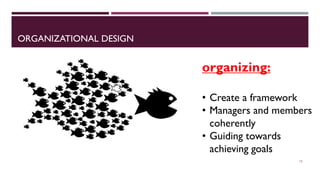
organizing:
• Create a framework
• Managers and members
coherently
• Guiding towards
achieving goals
ORGANIZATIONAL DESIGN
16
organizing
Organization's goals and
Strategic plans to achieve them
The necessary abilities
ORGANIZATIONAL DESIGN
17
Goals
Strategic
plans
Abilities
Environment
Managers Decisions
ORGANIZATIONAL STRUCTURE
18
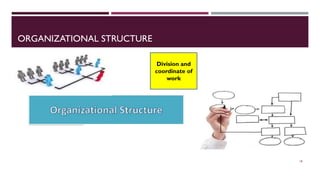
Division and
coordinate of
work
ORGANIZATIONAL STRUCTURE
19Coordination
The hierarchy of
organizational
authority
departmentalization
Division of work
Four pillars of
the organizing
• Simplifying works
• Specializing works
• Span of management control
• Chain of command
• Information flow Chain of command
• saving time
• Increased efficiency
COORDINATION
20
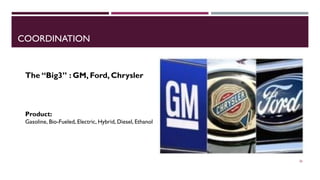
The “Big3” : GM, Ford, Chrysler
Product:
Gasoline, Bio-Fueled, Electric, Hybrid, Diesel, Ethanol
DIFFERENTIATION AND INTEGRATION
21
• Division of works
• Specializing works Differentiation
Integration• Coordination
Advantages:
• Giving identity to employees
• Impact on their role
• Create ways to communicate
with others
Disadvantages:
• Conflict between individuals
and units
EFFECTIVE COORDINATION
Methods to create
effective coordination
22
1. Main Principles of
Management:
A. Management hierarchy
B. Terms and Conditions
C. Plans and goals
2. Increased potential for
coordination:
A. Vertical information systems
B. Relationships at horizontal levels
3. Reduce the need for
coordination:
A. Create additional benefits
B. Create independent units
ORGANIZATIONAL DESIGN
23
Decision
process
appropriate
organizational
structure
Organization strategy
Environment
ORGANIZATIONAL DESIGN
24
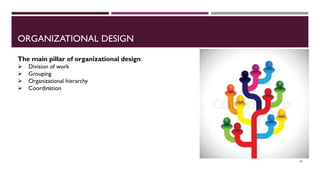
The main pillar of organizational design:
 Division of work
 Grouping
 Organizational hierarchy
 Coordination
ORGANIZATIONAL DESIGN
25
Classic attitudes
looking for the best way
Regulations
Chain of
Command
Meritocracy
Hierarchy
of authority
Professional
ization of
works
 weber
 Taylor
 Fayola
ORGANIZATIONAL DESIGN
Attitude based on work and technology
Structure
Organizatio
nal success
Work
technology
I. More sophisticated technology will increase
the number of managers and levels
II. In single-product companies, managers need
high skills.Their management area is smaller
III. The more complex the technology the
number of office and office employees will
be.The work becomes more specialized.
The effect of technology is more severe on smaller companies. 26
ORGANIZATIONAL DESIGN
27
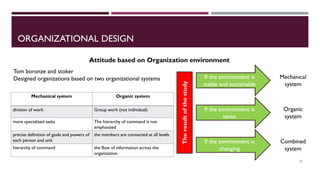
Tom boronze and stoker
Designed organizations based on two organizational systems
Attitude based on Organization environment
Mechanical system Organic system
division of work Group work (not individual)
more specialized tasks The hierarchy of command is not
emphasized
precise definition of goals and powers of
each person and unit
the members are connected at all levels
hierarchy of command the flow of information across the
organization
If the environment is
stable and sustainable
Mechanical
system
If the environment is
tense
Organic
system
If the environment is
changing
Combined
system
Theresultofthestudy
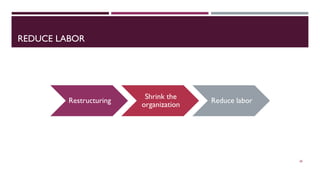
REDUCE LABOR
28
Restructuring
Shrink the
organization
Reduce labor
RESTRUCTURING ON HP
29
Merge
RESTRUCTURING ON HP
30
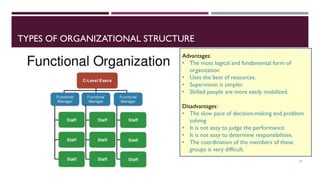
TYPES OF ORGANIZATIONAL STRUCTURE
31
Advantages:
• The most logical and fundamental form of
organization
• Uses the best of resources.
• Supervision is simpler.
• Skilled people are more easily mobilized.
Disadvantages:
• The slow pace of decision-making and problem
solving
• It is not easy to judge the performance.
• It is not easy to determine responsibilities.
• The coordination of the members of these
groups is very difficult.
ORGANIZATIONAL DESIGN
32
Advantages:
• Activities are focused so coordination is easier.
• The quality and speed of decision making are high.
• Units have more authority.
• Responsibilities are clear.
• The director's performance of each unit can be
easily judged.
Disadvantages:
• The interests of each unit are preferred to all the
goals of the entire organization.
• Administrative costs are rising.
ORGANIZATIONAL DESIGN
33
Advantages:
• Due to the specialized nature of the data, solving
complex problems is much easier.
• Flexible in terms of cost and output.
• Avoid rework.
• The recruitment of duplicate specialists is
prevented.
• Disadvantages:
• Adapting people to the system is time-consuming
and difficult.
• People need high skills in connecting with others.
• They must be flexible in working with others.
• The hierarchy of powers must be precisely
determined.
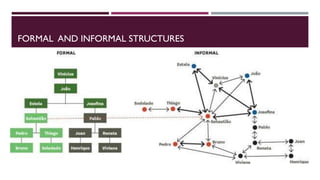
FORMAL AND INFORMAL STRUCTURES
34
FORMAL AND INFORMAL STRUCTURES
35
• Designed in a reasonable manner.
• shape and organization.
• Organizational strategy
• The structure is proportional to the strategy
James Brian quinn
Intelligent
enterprise
3 TYPES OF ORGANIZATIONAL STRUCTURE
36
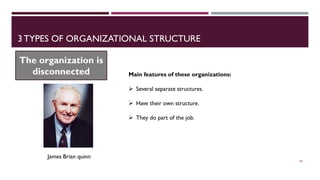
The organization is
disconnected
Virtual companies
Necessity of lack of
organization
James Brian quinnbusinessweektom peters
3 TYPES OF ORGANIZATIONAL STRUCTURE
37
Necessity of lack of
organization
tom peters
 Do not pay much attention to
organizational structures.
 All their attention is devoted to
helping solve problems.
 Bring together talented individuals
who work in organizations.
 The tasks are carried out in short and
flexible courses.
In this way, a new form of organization emerges every day.
Create
creativity
Quick
service
3 TYPES OF ORGANIZATIONAL STRUCTURE
38
Main features of these organizations:
 Technology
 Opportunism
 Confidence
 Borderlessness
 The most awesome
Virtual companies
BusinessWeek
3 TYPES OF ORGANIZATIONAL STRUCTURE
39
Main features of these organizations:
 Several separate structures.
 Have their own structure.
 They do part of the job.
The organization is
disconnected
James Brian quinn
STRUCTURE OF NIKE COMPANY
40
41
Thank you
and best
wishes
42
Selected References:
• A. Parsian, S. A. (2014). Management: Organizing, Leading, Controlling. Tehran: Cultural Research
Bureau.
• Auto, U. a. (1993). Philadelphia Inquirer, A1,A10.
• Daniel R. Gilbert, J. A. (2009). Management. Pearson.
• Hof, Q. i. (1993). Hewlett-Packard Digs Deep for a Digital Future. Business Week, p. 73.
• Mandel, B. o. (1990). This Time, the Downturn Is Dressed in Pinstripes. Business Week, p. 130. 4.

Organization structure

  • 1.
  • 2.
    HP 2  David Packardand Bill Hewlett 1st January 1963  The company they founded would be called H-P or P-H.  Originated in a garage.  Designed the first personal computer.
  • 3.
  • 4.
  • 5.
  • 6.
    MAKING NEW ATMOSPHERE 6 JohnAndrewYoung Lewis Emmett Platt
  • 7.
  • 8.
  • 9.
  • 10.
    RECOGNIZE THE NEED 10 Recognized needs NewProduct  New Customer Entering to the New Market
  • 11.
  • 12.
    GOALS 12 1.Major structural transformation 2.Employeesatisfaction 3.Enlightenment managing
  • 13.
    THE PROCESS OFACHIEVING GOALS IN HP 13 Identify strengths New strategy The new process of decision making Renew the structure Synchronization
  • 14.
    ORGANIZATIONAL DESIGN 14 Organization: • Apattern of people's relationships • Managers • Common goals
  • 15.
    ORGANIZATIONAL DESIGN 15 organizing: • Createa framework • Managers and members coherently • Guiding towards achieving goals
  • 16.
    ORGANIZATIONAL DESIGN 16 organizing Organization's goalsand Strategic plans to achieve them The necessary abilities
  • 17.
  • 18.
  • 19.
    ORGANIZATIONAL STRUCTURE 19Coordination The hierarchyof organizational authority departmentalization Division of work Four pillars of the organizing • Simplifying works • Specializing works • Span of management control • Chain of command • Information flow Chain of command • saving time • Increased efficiency
  • 20.
    COORDINATION 20 The “Big3” :GM, Ford, Chrysler Product: Gasoline, Bio-Fueled, Electric, Hybrid, Diesel, Ethanol
  • 21.
    DIFFERENTIATION AND INTEGRATION 21 •Division of works • Specializing works Differentiation Integration• Coordination Advantages: • Giving identity to employees • Impact on their role • Create ways to communicate with others Disadvantages: • Conflict between individuals and units
  • 22.
    EFFECTIVE COORDINATION Methods tocreate effective coordination 22 1. Main Principles of Management: A. Management hierarchy B. Terms and Conditions C. Plans and goals 2. Increased potential for coordination: A. Vertical information systems B. Relationships at horizontal levels 3. Reduce the need for coordination: A. Create additional benefits B. Create independent units
  • 23.
  • 24.
    ORGANIZATIONAL DESIGN 24 The mainpillar of organizational design:  Division of work  Grouping  Organizational hierarchy  Coordination
  • 25.
    ORGANIZATIONAL DESIGN 25 Classic attitudes lookingfor the best way Regulations Chain of Command Meritocracy Hierarchy of authority Professional ization of works  weber  Taylor  Fayola
  • 26.
    ORGANIZATIONAL DESIGN Attitude basedon work and technology Structure Organizatio nal success Work technology I. More sophisticated technology will increase the number of managers and levels II. In single-product companies, managers need high skills.Their management area is smaller III. The more complex the technology the number of office and office employees will be.The work becomes more specialized. The effect of technology is more severe on smaller companies. 26
  • 27.
    ORGANIZATIONAL DESIGN 27 Tom boronzeand stoker Designed organizations based on two organizational systems Attitude based on Organization environment Mechanical system Organic system division of work Group work (not individual) more specialized tasks The hierarchy of command is not emphasized precise definition of goals and powers of each person and unit the members are connected at all levels hierarchy of command the flow of information across the organization If the environment is stable and sustainable Mechanical system If the environment is tense Organic system If the environment is changing Combined system Theresultofthestudy
  • 28.
  • 29.
  • 30.
  • 31.
    TYPES OF ORGANIZATIONALSTRUCTURE 31 Advantages: • The most logical and fundamental form of organization • Uses the best of resources. • Supervision is simpler. • Skilled people are more easily mobilized. Disadvantages: • The slow pace of decision-making and problem solving • It is not easy to judge the performance. • It is not easy to determine responsibilities. • The coordination of the members of these groups is very difficult.
  • 32.
    ORGANIZATIONAL DESIGN 32 Advantages: • Activitiesare focused so coordination is easier. • The quality and speed of decision making are high. • Units have more authority. • Responsibilities are clear. • The director's performance of each unit can be easily judged. Disadvantages: • The interests of each unit are preferred to all the goals of the entire organization. • Administrative costs are rising.
  • 33.
    ORGANIZATIONAL DESIGN 33 Advantages: • Dueto the specialized nature of the data, solving complex problems is much easier. • Flexible in terms of cost and output. • Avoid rework. • The recruitment of duplicate specialists is prevented. • Disadvantages: • Adapting people to the system is time-consuming and difficult. • People need high skills in connecting with others. • They must be flexible in working with others. • The hierarchy of powers must be precisely determined.
  • 34.
    FORMAL AND INFORMALSTRUCTURES 34
  • 35.
    FORMAL AND INFORMALSTRUCTURES 35 • Designed in a reasonable manner. • shape and organization. • Organizational strategy • The structure is proportional to the strategy James Brian quinn Intelligent enterprise
  • 36.
    3 TYPES OFORGANIZATIONAL STRUCTURE 36 The organization is disconnected Virtual companies Necessity of lack of organization James Brian quinnbusinessweektom peters
  • 37.
    3 TYPES OFORGANIZATIONAL STRUCTURE 37 Necessity of lack of organization tom peters  Do not pay much attention to organizational structures.  All their attention is devoted to helping solve problems.  Bring together talented individuals who work in organizations.  The tasks are carried out in short and flexible courses. In this way, a new form of organization emerges every day. Create creativity Quick service
  • 38.
    3 TYPES OFORGANIZATIONAL STRUCTURE 38 Main features of these organizations:  Technology  Opportunism  Confidence  Borderlessness  The most awesome Virtual companies BusinessWeek
  • 39.
    3 TYPES OFORGANIZATIONAL STRUCTURE 39 Main features of these organizations:  Several separate structures.  Have their own structure.  They do part of the job. The organization is disconnected James Brian quinn
  • 40.
  • 41.
  • 42.
    42 Selected References: • A.Parsian, S. A. (2014). Management: Organizing, Leading, Controlling. Tehran: Cultural Research Bureau. • Auto, U. a. (1993). Philadelphia Inquirer, A1,A10. • Daniel R. Gilbert, J. A. (2009). Management. Pearson. • Hof, Q. i. (1993). Hewlett-Packard Digs Deep for a Digital Future. Business Week, p. 73. • Mandel, B. o. (1990). This Time, the Downturn Is Dressed in Pinstripes. Business Week, p. 130. 4.