Presented by
DEVESH KUMAR KANAUJIA
RISHES DWIVEDI
RISHI SINGH CHAUHAN
VISHAL SRIVASTAVA
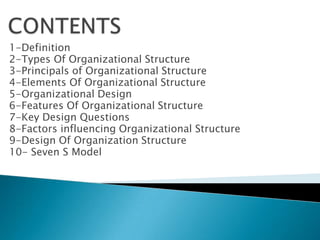
1-Definition
2-Types Of Organizational Structure
3-Principals of Organizational Structure
4-Elements Of Organizational Structure
5-Organizational Design
6-Features Of Organizational Structure
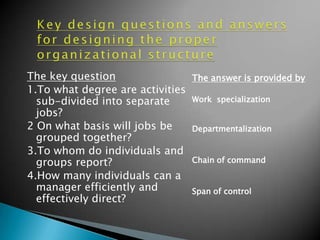
7-Key Design Questions
8-Factors influencing Organizational Structure
9-Design Of Organization Structure
10- Seven S Model
๏ฝ

๏ฝ

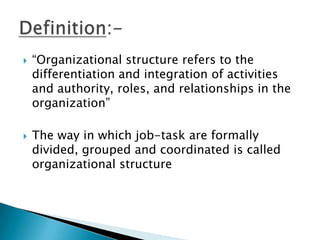
โ€œOrganizational structure refers to the
differentiation and integration of activities
and authority, roles, and relationships in the
organizationโ€

The way in which job-task are formally
divided, grouped and coordinated is called
organizational structure
๏ฝ Simple

Structure
๏ฝ Functional Structure
๏ฝ Divisional Structure
๏ฝ Matrix Structure
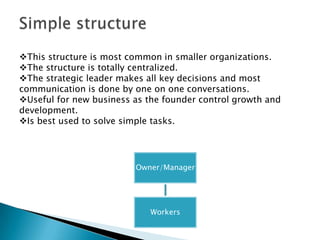
๏ถThis structure is most common in smaller organizations.
๏ถThe structure is totally centralized.
๏ถThe strategic leader makes all key decisions and most
communication is done by one on one conversations.
๏ถUseful for new business as the founder control growth and
development.
๏ถIs best used to solve simple tasks.

Owner/Manager

Workers
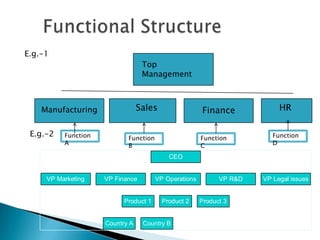
๏ถ It

is appropriate for medium sized firms, with
several related product lines.
๏ถ Employees tend to be specialist in the
business functions, such as marketing and
finance etc.
E.g.-1
Top
Management

Sales

Manufacturing

E.g.-2

Function
A

Finance

Function
B

Function
C

HR
Function
D

CEO

VP Marketing

VP Finance

VP Operations

Product 1

Country A

Product 2

Country B

VP R&D

Product 3

VP Legal issues
๏ถThe divisional structure groups each organizational function into
a division
๏ถIt is appropriate for a large corporation with many product lines in
several related industries.
๏ถEmployees tend to be functional specialist organized according to
product market distinction.
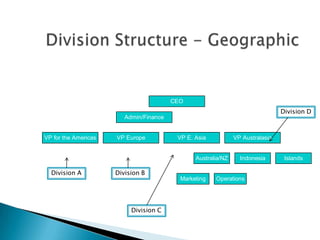
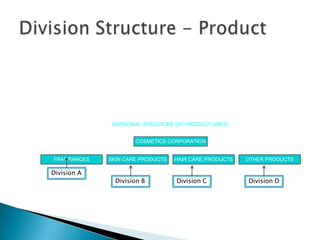
๏ถ It has 2 Types : Geographic & Product Basis
CEO

Division D

Admin/Finance

VP for the Americas

VP Europe

VP E. Asia

VP Australasia

Australia/NZ

Division A

Indonesia

Division B
Marketing

Division C

Operations

Islands
DIVISIONAL STRUCTURE (BY PRODUCT LINES)

COSMETICS CORPORATION

FRAGRANCES

Division A

SKIN CARE PRODUCTS

Division B

HAIR CARE PRODUCTS

Division C

OTHER PRODUCTS

Division D
๏ฝ

๏ฝ

๏ฝ

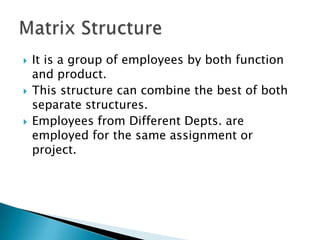
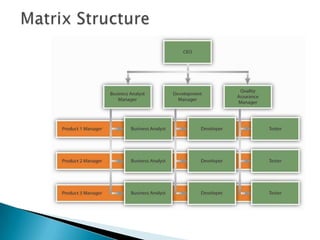
It is a group of employees by both function
and product.
This structure can combine the best of both
separate structures.
Employees from Different Depts. are
employed for the same assignment or
project.
๏ฝ
๏ฝ

๏ฝ
๏ฝ
๏ฝ
๏ฝ
๏ฝ
๏ฝ
๏ฝ
๏ฝ
๏ฝ

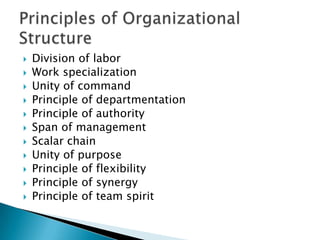
Division of labor
Work specialization
Unity of command
Principle of departmentation
Principle of authority
Span of management
Scalar chain
Unity of purpose
Principle of flexibility
Principle of synergy
Principle of team spirit
๏ฝ
๏ฝ
๏ฝ
๏ฝ
๏ฝ

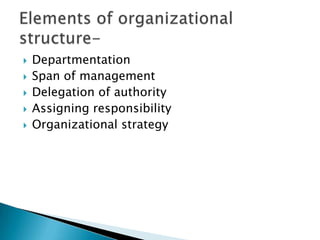
Departmentation
Span of management
Delegation of authority
Assigning responsibility
Organizational strategy
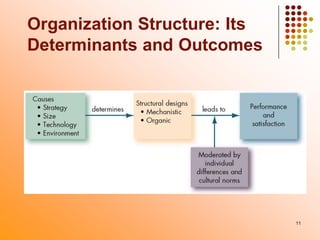
Organization Structure: Its
Determinants and Outcomes
11
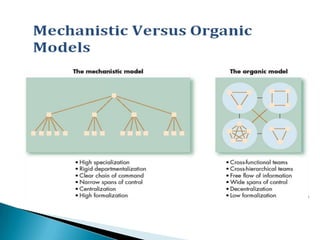
Organizational Designs range from highly
structured and standardized bureaucracy to
the loose and amorphous boundary less
organization.
One end โ€“ mechanistic model.
Other end- organic model.
๏ฝ
๏ฝ
๏ฝ
๏ฝ
๏ฝ

๏ฝ
๏ฝ
๏ฝ
๏ฝ

Simplicity
Flexibility
Clear line of authority
Application of ultimate responsibility
Proper delegation of authority
Minimum possible managerial levels
Principles of unity of direction and command
Proper emphasis on staff

Provision for top management
The key question
The answer is provided by
1.To what degree are activities
Work specialization
sub-divided into separate
jobs?
2 On what basis will jobs be
Departmentalization
grouped together?
3.To whom do individuals and
Chain of command
groups report?
4.How many individuals can a
manager efficiently and
Span of control
effectively direct?
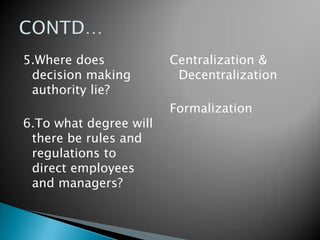
5.Where does
decision making
authority lie?
6.To what degree will
there be rules and
regulations to
direct employees
and managers?

Centralization &
Decentralization
Formalization
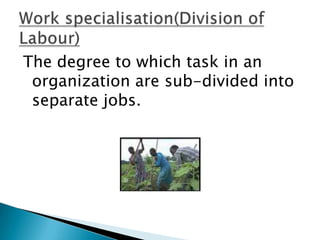
The degree to which task in an
organization are sub-divided into
separate jobs.
๏ฝ

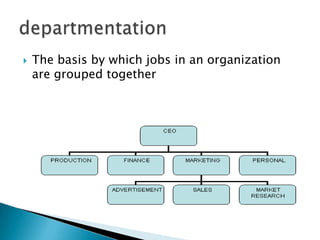
The basis by which jobs in an organization
are grouped together
๏ฝ

The unbroken line of authority that extends
from the top of the organization to the lowest
echelon and clerifies who reports to whom.
๏ฝ

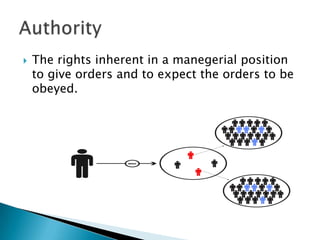
The rights inherent in a manegerial position
to give orders and to expect the orders to be
obeyed.
๏ฝ

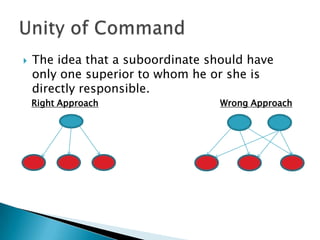
The idea that a suboordinate should have
only one superior to whom he or she is
directly responsible.
Right Approach

Wrong Approach
๏ฝ

The no. of suboordinates a manager can
efficiently and effectively direct.
๏ฝ

Centralization refers to the degree of which
decision making is concentrated at a single
point in the organization.
๏ฝ

In this organization decision making is
pushed down to the managers closed to the
action.
๏ฝ

The degree to which jobs with in an
organization are standardized.
The structure of an organization may influence
various factors. These factors may be internal
or externalto the organization. Some of the
important factors are :1.Internal factors
2.External factors
๏ฝ
๏ฝ
๏ฝ
๏ฝ

Strengths
Weaknesses
Opportunities
Threats
๏ฝ
๏ฝ
๏ฝ
๏ฝ
๏ฝ

๏ฝ
๏ฝ
๏ฝ

Political environment
Economic environment
Socio-culture environment
Technological environment
Market environment
Supplier environment
International environment
Regularity environment
๏ฝ
๏ฝ

๏ฝ

Defining clear objectives
Determining the appropriate type of
organizational structure
Defining scalar chain of command
๏ฝ

The seven S model was developed by one of
the most renowned organization, McKinsey
and categories organizational elements into
two types, namely hard or soft elements:

1-Hard Elements
2-Soft Elements
๏ฝ
๏ฝ
๏ฝ
๏ฝ
๏ฝ
๏ฝ
๏ฝ
๏ฝ

๏ฝ

Hard elementsStrategy
Structure
Systems

Soft elementsShared value
Style
Staff
Skills
๏ฝ
๏ฝ
๏ฝ

๏ฝ
๏ฝ

All Images-Google images
Organizational Behavior-Surpreet Ahluwalia
Organizational Behavior-Stephen P Robbins
Timothy A Judge
Niharika Vohra
Organizational Behavior- L M Prasad
Organizational Behavior- Surendra Jain
Sonia Bhargava
Thank You

Organizational structure By Vishal Srivastava

Editor's Notes

  • #8ย Functional structureEmployees within the functional divisions of an organization tend to perform a specialized set of tasks, for instance the engineering department would be staffed only with software engineers. This leads to operational efficiencies within that group. However it could also lead to a lack of communication between the functional groups within an organization, making the organization slow and inflexible.As a whole, a functional organization is best suited as a producer of standardized goods and services at large volume and low cost. Coordination and specialization of tasks are centralized in a functional structure, which makes producing a limited amount of products or services efficient and predictable. Moreover, efficiencies can further be realized as functional organizations integrate their activities vertically so that products are sold and distributed quickly and at low cost.[11] For instance, a small business could start making the components it requires for production of its products instead of procuring it from an external organization.But not only beneficial for organization but also for employees faiths.
  • #10ย Divisional structureAlso called a "product structure", the divisional structure groups each organizational function into a division. Each division within a divisional structure contains all the necessary resources and functions within it. Divisions can be categorized from different points of view. One might make distinctions on a geographical basis (a US division and an EU division, for example) or on product/service basis (different products for different customers: households or companies). In another example, an automobile company with a divisional structure might have one division for SUVs, another division for subcompact cars, and another division for sedans.Each division may have its own sales, engineering and marketing departments.
  • #13ย Matrix structureThe matrix structure groups employees by both function and product. This structure can combine the best of both separate structures. A matrix organization frequently uses teams of employees to accomplish work, in order to take advantage of the strengths, as well as make up for the weaknesses, of functional and decentralized forms. An example would be a company that produces two products, "product a" and "product b". Using the matrix structure, this company would organize functions within the company as follows: "product a" sales department, "product a" customer service department, "product a" accounting, "product b" sales department, "product b" customer service department, "product b" accounting department. Matrix structure is amongst the purest of organizational structures, a simple lattice emulating order and regularity demonstrated in nature.Weak/Functional Matrix: A project manager with only limited authority is assigned to oversee the cross- functional aspects of the project. The functional managers maintain control over their resources and project areas. Balanced/Functional Matrix: A project manager is assigned to oversee the project. Power is shared equally between the project manager and the functional managers. It brings the best aspects of functional and projectized organizations. However, this is the most difficult system to maintain as the sharing power is delicate proposition. Strong/Project Matrix: A project manager is primarily responsible for the project. Functional managers provide technical expertise and assign resources as needed. Among these matrixes, there is no best format; implementation success always depends on organization's purpose and function.
  • #14ย Advantagesuseful when teams are needed to innovate;when information sharing is important.Disadvantagespeople report to two or more bosses;increases structural complexity;can make it harder to work toward common goals.