Afable
Cabuslay
Namatame
David
Palo
Tandiama
ORGANIZATIONAL CULTURE AND
TECHNOLOGY
Organizational Culture
A common perception held by the organization’s members; a
system of shared meaning.
Characteristics:
1. Innovation and risk taking
2. Attention to detail
3. Outcome orientation
4. People orientation
5. Team orientation
6. Aggressiveness
7. Stability
WHAT IS ORGANIZATIONAL
CULTURE?
Dominant Culture
Expresses the core values that are shared by a majority
of the organization’s members.
Subcultures
Minicultures within an organization, typically defined by
department designations and geographical separation.
DO ORGANIZATIONS HAVE
UNIFORM CULTURES?
Core Values
The primary or dominant values that are accepted
throughout the organization.
Strong Culture
A culture in which the core values are intensely held and
widely shared.
DO ORGANIZATIONS HAVE
UNIFORM CULTURES?
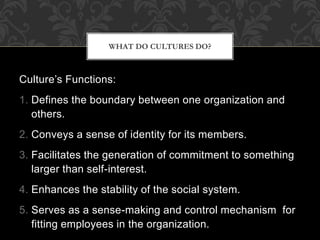
Culture’s Functions:
1. Defines the boundary between one organization and
others.
2. Conveys a sense of identity for its members.
3. Facilitates the generation of commitment to something
larger than self-interest.
4. Enhances the stability of the social system.
5. Serves as a sense-making and control mechanism for
fitting employees in the organization.
WHAT DO CULTURES DO?
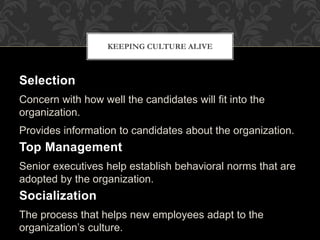
Selection
Concern with how well the candidates will fit into the
organization.
Provides information to candidates about the organization.
Top Management
Senior executives help establish behavioral norms that are
adopted by the organization.
Socialization
The process that helps new employees adapt to the
organization’s culture.
KEEPING CULTURE ALIVE
Prearrival Stage
The period of learning in the socialization process that
occurs before a new employee joins the organization.
Encounter Stage
The stage in the socialization process in which a new
employee sees what the organization is really like and
confronts the possibility that expectations and reality may
diverge.
Metamorphosis Stage
The stage in the socialization process in which a new
employee changes and adjusts to the work, work group,
STAGES IN THE SOCIALIZATION
PROCESS

Organizational culture and technology

  • 1.
  • 2.
    Organizational Culture A commonperception held by the organization’s members; a system of shared meaning. Characteristics: 1. Innovation and risk taking 2. Attention to detail 3. Outcome orientation 4. People orientation 5. Team orientation 6. Aggressiveness 7. Stability WHAT IS ORGANIZATIONAL CULTURE?
  • 3.
    Dominant Culture Expresses thecore values that are shared by a majority of the organization’s members. Subcultures Minicultures within an organization, typically defined by department designations and geographical separation. DO ORGANIZATIONS HAVE UNIFORM CULTURES?
  • 4.
    Core Values The primaryor dominant values that are accepted throughout the organization. Strong Culture A culture in which the core values are intensely held and widely shared. DO ORGANIZATIONS HAVE UNIFORM CULTURES?
  • 5.
    Culture’s Functions: 1. Definesthe boundary between one organization and others. 2. Conveys a sense of identity for its members. 3. Facilitates the generation of commitment to something larger than self-interest. 4. Enhances the stability of the social system. 5. Serves as a sense-making and control mechanism for fitting employees in the organization. WHAT DO CULTURES DO?
  • 6.
    Selection Concern with howwell the candidates will fit into the organization. Provides information to candidates about the organization. Top Management Senior executives help establish behavioral norms that are adopted by the organization. Socialization The process that helps new employees adapt to the organization’s culture. KEEPING CULTURE ALIVE
  • 7.
    Prearrival Stage The periodof learning in the socialization process that occurs before a new employee joins the organization. Encounter Stage The stage in the socialization process in which a new employee sees what the organization is really like and confronts the possibility that expectations and reality may diverge. Metamorphosis Stage The stage in the socialization process in which a new employee changes and adjusts to the work, work group, STAGES IN THE SOCIALIZATION PROCESS