Nishat Mills Ltd I
University of Education
Contents
Introduction:.................................................................................................................................... 3
Introduction of Organization:.......................................................................................................... 4
Company History....................................................................................................................... 4
Vision Statement........................................................................................................................ 5
Mission statement:..................................................................................................................... 6
Company Summary ................................................................................................................... 7
Profile of Management and BOD/Company ownership:.............................................................. 10
Management of Nishat Mills Limited/key to success:.................................................................. 16
General business environment in Pakistan: .................................................................................. 17
INTRODUCATION OF INDUSTRY:......................................................................................... 22
Company Locations and Facilities:............................................................................................... 24
Management Hierarchy..................................................................Error! Bookmark not defined.
Products and services:................................................................................................................... 28
SALES .......................................................................................................................................... 34
COMPETITVE FORCES OF NISHAT MILLS LTD.................................................................. 36
MAJOR COMPETITORS....................................................................................................... 36
Any Further Products and Services: ............................................................................................. 48
SWOT Analysis ............................................................................................................................ 53
SWOT Matrix of Nishat Textile Mills..................................................................................... 60
Nishat Mills Ltd II
University of Education
Pest Analysis:-............................................................................................................................... 61
Pest Analysis for Nishat Mills Ltd........................................................................................... 62
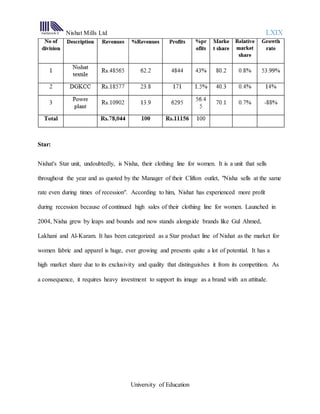
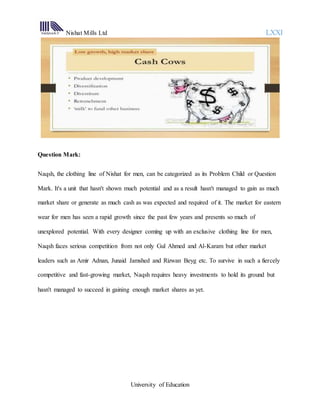
Portfolio Analysis: BCG Matrix ................................................................................................... 68
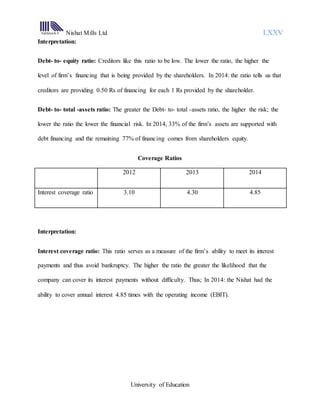
FINANCIAL ANALYSIS ............................................................................................................ 74
INTERNAL ANALYSIS......................................................................................................... 74
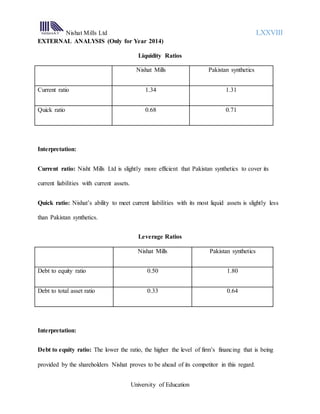
EXTERNAL ANALYSIS (Only for Year 2014) .................................................................... 78
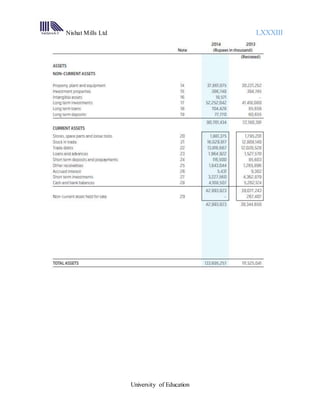
BALANCE SHEET ................................................................................................................. 82
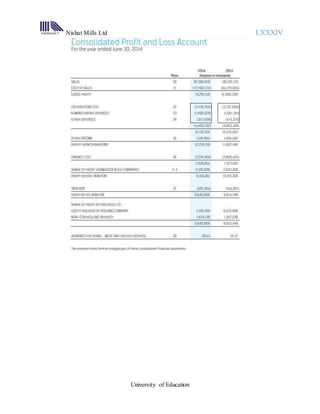
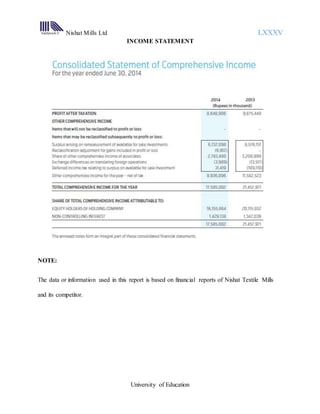
INCOME STATEMENT......................................................................................................... 85
CONCLUSION AND RECOMMENDATIONS: ........................................................................ 86
Conclusion:.............................................................................................................................. 86
Recommendations: .................................................................................................................. 86
References..................................................................................................................................... 87
Nishat Mills Ltd III
University of Education
Introduction:
Nishat Mills Limited aims to remain as leading Textile Company of the country. Our Human
Resource policy is based on principles that employees are our most valued asset and important
building block for sustainable growth. Management has developed excellent relations with
employees to achieve optimum level of performance and commitment to excellence. The
Company is an equal opportunity employer and hires people from various ethnicities and both
genders without prejudice or bias. The Company has a coherent and market driven performance
and reward policy which encourages employees to participate enthusiastically in the achievement
of company’s objectives.
Nishat group is one of the leading and most diversified groups in Pakistan with fixed/current
assets of over US $ 5 billion .It is ranked among the top five business houses of Pakistan . The
group has strong presence in three most important business sectors of the region namely textiles,
cement and financial services. In addition, the group also has reasonable market share in
Insurance (Adamjee insurance), Power generation and Aviation business .It also has the
distinction of being one of the largest players in each sector. The group has a remarkable position
in the market as good as any MNC operating locally in terms of its quality of products, services
and management skills.
Nishat Mills Ltd IV
University of Education
Introduction of Organization:
Company History
Nishat Mills Limited is the flagship company of Nishat Group. It was established in 1951. It is
one of the most modern, largest vertically integrated textile companies in Pakistan. Nishat Mills
Limited has 227,640 spindles, 789 Toyota air jet looms. The Company also has the most modern
textile dyeing and processing units, 2 stitching units for home textile, Two stitching units for
garments and Power Generation facilities with a capacity of 120 MW. The Company’s total
export for the year 2015 was Rs. 39.868 billion (US$ 393.683 million). Due to the application of
prudent management policies, consolidation of operations, a strong balance sheet and an
effective marketing strategy, the growth trend is expected to continue in the years to come. The
Company's production facilities comprise of spinning, weaving, processing, stitching and power
generation.
Nishat Mills Ltd V
University of Education
Vision Statement
To transform the Company into a modern and dynamic yarn, cloth and processed cloth and
finished product manufacturing Company that is fully equipped to play a meaningful role on
sustainable basis in the economy of Pakistan. To transform the Company into a modern and
dynamic power generating Company that is fully equipped to play a meaningful role on
sustainable basis in the economy of Pakistan.
Nishat Mills Ltd VI
University of Education
Missionstatement:
To provide quality products to customers and explore new markets to promote/expand sales of
the Company through good governance and foster a sound and dynamic team, so as to achieve
optimum prices of products of the Company for sustainable and equitable growth and prosperity
of the Company.
Nishat Mills Ltd VII
University of Education
Company Summary
Nishat Mills Limited (“the Company”) is the most modern and largest vertically integrated
textile Company in Pakistan. The Company commenced its business as a partnership firm in
1951 and was incorporated as a private limited Company in 1959. Later it was listed on the
Karachi, Lahore and Islamabad Stock Exchanges on 27 November 1961, 11 March 1989 and 10
August 1992 respectively.
The Company’s production facilities comprise of spinning, weaving, printing, dyeing, home
textile and garment stitching and power generation.
Overall, the Company has 32 manufacturing units each specializing in a specific product range
located in Faisalabad, Sheikhupura, Ferozewatwan and Lahore.
A major portion of the Company’s earnings is export based. Over the the years, the Company has
achieved significant geographical diversification in its export sales mix.
The Company has a very broad base of customers for its products outside Pakistan. It has a long
working relationship with the top brands of the world such as J.K.N. International, Levis, Next,
Pincroft Dyeing, Ocean Garments, Gap, Carreman, Tommy Hilfiger, Tommy Bahamas, Crate &
Barrel, Laura Ashley, American Living, Chaps, Hugo Boss, Revman and John Lewis.
Nishat Mills Limited is also called the flagship company of the Nishat Group. Nishat Group
(“the Group”) is a leading business entity in South Asia. Its net worth makes it the largest
business house of Pakistan. The Group has grown from a cotton export house into the premier
business group of the country. Highly diversified, the Group has a presence in all the major
sectors including Textiles, Cement, Banking, Insurance, Power Generation, Hotel Business,
Agriculture, Dairy, Real Estate, Aviation and Paper Products. Showcasing its varied expertise
Nishat Mills Ltd VIII
University of Education
and acumen in every facet of its operations, the group companies hold the distinction of being
among the leading players in each sector.
Textile Industry Overview
Textile industry is the most essential manufacturing sector of Pakistan as it serves as the
backbone of Pakistan’s economy. It has the longest production chain, with inherent potential for
value addition at each stage of processing, from cotton to ginning, spinning, fabric, dyeing and
finishing, made-ups and garments. Critical success factors of the textile industry are availability
of cheap and subsidized credit facilities, uninterrupted supply of gas and electricity at low rates,
consistent and industry friendly tax policies and establishment of new textile units in less
developed areas by giving incentives to the investors i.e. tax holiday. Due to unavailability of
these factors, negligible growth of 0.5 percent has been recorded in the current financial year
2014-15 as compared to the last year in Pakistan.
Government of Pakistan has promulgated Textile Policy 2014-19 to ensure the maintenance of
country’s reputation as a reliable source of high quality textile goods. Salient features of the
Policy are as follows:
• Draw-back for local taxes and levies are given to exporters of textile products on FOB values
of their enhanced exports if increased beyond 10% over last year’s exports at the following rates:
 Garments 4%
 Made ups 2%; &
 Processed fabric 1%.
• Markup rate for Export Refinance Scheme of State Bank of Pakistan was reduced from 9.40%
to 7.50% under the policy. This rate has been subsequently reduced further to 4.50 %.
Nishat Mills Ltd IX
University of Education
• Markup rates for Long Term Financing Facility (LTFF) provided to textile manufacturers in the
value added sector was reduced from 10.90% to 9.00 %. This rate has been subsequently reduced
further to 6.00 %.
Over the Years
1951 Nishat Mills Limited commenced its business as partnership.
1959 The company incorporated as private limited company.
1961 Nishat Mills Limited was listed on Karachi Stock Exchange.
1989 The Company was listed on Lahore Stock Exchange.
1992 The Company was listed on Islamabad Stock Exchange.
1996 Acquired the operating assets of Nishat Tek Limited and Nishat Fabrics Limited.
2005 Acquired the assets of Umer Fabrics Limited.
2008 Acquired the assets of Nishat Apparel Limited.
Nishat Mills Ltd X
University of Education
Profile of Management and BOD/Company ownership:
Nishat Mills Limited
Board of Directors
As on April 10, 2011
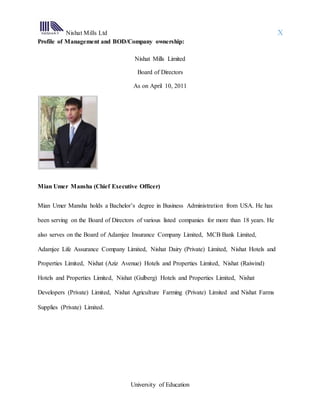
Mian Umer Mansha (Chief Executive Officer)
Mian Umer Mansha holds a Bachelor’s degree in Business Administration from USA. He has
been serving on the Board of Directors of various listed companies for more than 18 years. He
also serves on the Board of Adamjee Insurance Company Limited, MCB Bank Limited,
Adamjee Life Assurance Company Limited, Nishat Dairy (Private) Limited, Nishat Hotels and
Properties Limited, Nishat (Aziz Avenue) Hotels and Properties Limited, Nishat (Raiwind)
Hotels and Properties Limited, Nishat (Gulberg) Hotels and Properties Limited, Nishat
Developers (Private) Limited, Nishat Agriculture Farming (Private) Limited and Nishat Farms
Supplies (Private) Limited.
Nishat Mills Ltd XI
University of Education
Mian Hassan Mansha (Chairman)
Mian Hassan Mansha has been serving on the Board of various listed companies for several
years. He also serves on the Board of Nishat Power Limited, Security General Insurance
Company Limited, Lalpir Power Limited, Pakgen Power Limited, Nishat Hotels and Properties
Limited, Nishat (Aziz Avenue) Hotels and Properties Limited, Nishat (Raiwind) Hotels and
Properties Limited, Nishat (Gulberg) Hotels and Properties Limited, Nishat Hospitality (Private)
Limited, Nishat Dairy (Private)Limited, Pakistan Aviators and Aviation (Private) Limited,
Nishat Automobiles (Private) Limited, Nishat Real Estate Development Company (Private)
Limited, Nishat Agriculture Farming (Private) Limited and Nishat Farms Supplies (Private)
Limited.
Nishat Mills Ltd XII
University of Education
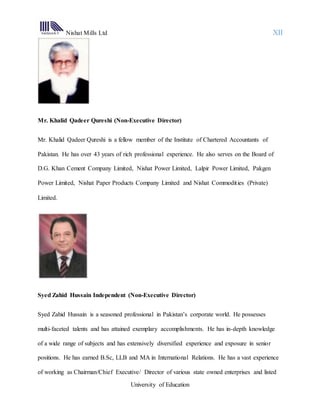
Mr. Khalid Qadeer Qureshi (Non-Executive Director)
Mr. Khalid Qadeer Qureshi is a fellow member of the Institute of Chartered Accountants of
Pakistan. He has over 43 years of rich professional experience. He also serves on the Board of
D.G. Khan Cement Company Limited, Nishat Power Limited, Lalpir Power Limited, Pakgen
Power Limited, Nishat Paper Products Company Limited and Nishat Commodities (Private)
Limited.
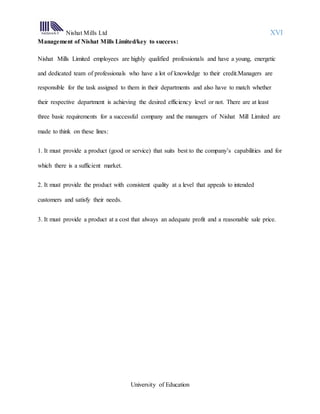
Syed Zahid Hussain Independent (Non-Executive Director)
Syed Zahid Hussain is a seasoned professional in Pakistan’s corporate world. He possesses
multi-faceted talents and has attained exemplary accomplishments. He has in-depth knowledge
of a wide range of subjects and has extensively diversified experience and exposure in senior
positions. He has earned B.Sc, LLB and MA in International Relations. He has a vast experience
of working as Chairman/Chief Executive/ Director of various state owned enterprises and listed
Nishat Mills Ltd XIII
University of Education
companies. He has also served as the High Commissioner/ Ambassador of Pakistan based in
Kenya, with accredited assignments of Ambassadorship in Tanzania, Uganda, Rwanda, Krundse,
Ethiopia and Eritrea. He is a fellow member of the Institute of Management, England,
International Biographical Center, the USA and the Institute of Marketing Management, Karachi.
Ms. Nabiha Shahnawaz Cheema (Non-Executive Director)
Ms. Nabiha Shahnawaz Cheema is a fellow member of the Institute of Chartered Accountants of
Pakistan and she is a Certified Director by completing the Director’s Training Program from
ICAP. She has more than 15 years of professional experience. She also serves on the Board of
Security General Insurance Company Limited, D.G. Khan Cement Company Limited and Nishat
Hospitality (Private) Limited.
Nishat Mills Ltd XIV
University of Education
Mr. Maqsood Ahmad (Executive Director)
Mr. Maqsood Ahmad holds a Masters degree and a rich professional experience of over 23 years
in the textile industry, especially in the spinning business. He is a Certified Director by
completing the Director’s Training Program from ICAP. He is actively involved in the strategic
decisions relating to the operations of the Company.
Mr. SaeedAhmad Alvi (Non-Executive Director)
Mr. Saeed Ahmad Alvi has served over 36 years in Pakistan Administrative Service (Ex-District
Management Group) and retired as a Federal Secretary. He brings with him a vast experience of
policy and program implementation, working at the executive tiers at the Sub-Divisional,
District, Divisional, Provincial and Federal levels. He has also served as ex-officio Director on
some of the Boards of public sector companies and special institutions. He obtained a Masters
Nishat Mills Ltd XV
University of Education
degree in Development Studies from UK in addition to Masters degrees in History and Pakistan
Studies from Pakistan and also a Bachelors degree in Law. Mr. Alvi is a Certified
Director by completing the Director’s Training Program from ICMAP. He also serves on the
Boards of Nishat Power Limited, Lalpir Power Limited, Nishat Hotels and Properties Limited,
Nishat (Gulberg) Hotels and Properties Limited, Nishat (Raiwind) Hotels and Properties
Limited, Nishat (Aziz Avenue) Hotels and Properties Limited and Nishat Real Estate
Development Company (Private) Limited.
Nishat Mills Ltd XVI
University of Education
Management of Nishat Mills Limited/key to success:
Nishat Mills Limited employees are highly qualified professionals and have a young, energetic
and dedicated team of professionals who have a lot of knowledge to their credit.Managers are
responsible for the task assigned to them in their departments and also have to match whether
their respective department is achieving the desired efficiency level or not. There are at least
three basic requirements for a successful company and the managers of Nishat Mill Limited are
made to think on these lines:
1. It must provide a product (good or service) that suits best to the company’s capabilities and for
which there is a sufficient market.
2. It must provide the product with consistent quality at a level that appeals to intended
customers and satisfy their needs.
3. It must provide a product at a cost that always an adequate profit and a reasonable sale price.
Nishat Mills Ltd XVII
University of Education
General business environment in Pakistan:
An organization must consider the success possibility of conducting operations in any country.
The study of business environment in a country includes the identification of risks and
opportunities found from an economic, political, natural and technological perspective.
Thus, a venture looking to conduct business in Pakistan must considerboth the opportunities and
the pitfalls. The business environment of Pakistan is discussed below, it includes:
 Economic environment
 Political environment
 Natural environment
 Technological environment
Economic Environment:
Despite repeated bouts with political instability, the Pakistani economy has been stable, if not
growing, for much of the past decade. However, several events have served to stress the
economy in recent years, forcing the government to re-allocate resources that has slowed down
growth in all sectors. According to the Pakistani Government, the basis for the economy is
agricultural with majorcrops including wheat, cotton, rice, and sugar cane and major industries
that include textiles andchemicals.
GDP in 2015 was about 271 billion USD. Although since 2005 the GDP has been growing an
average 5 percent a year, it is not enough to keep up with fast population growth.
Nishat Mills Ltd XVIII
University of Education
Pakistan annual inflation rate increased to 8.5 percent in March of 2014, from 6.6 a year earlier
and 7.9 percent recorded in February of 2014, as food, housing, water, electricity and gas prices
edged up.
Pakistan’s labour force consists of about 31 million (2012–13) people.
Labor-force by occupation: (2012-13 est.)
 Manufacturing: 13.3%
 Wholesale and retail: 9.2%
 Agriculture: 43%,
 Industry: 20.7%
 Services: 34.2%
 Transport and communication: 7.3%
In light of the many pressures faced by the Pakistani people, the economy has remained
Relatively stable. Though oil prices increased in the recent years, GDP growth rate still
improved. Its economy is stable and improving, yet suffers from corruption and high inflation.
The future economic prospects of Pakistan look promising but their actual realization would
depend upon a number of critical factors such as global economy, successful integration of
Pakistan into the global economy, sound macroeconomic policies, strong institutional and
governance framework, investment in infrastructure and human development and political
stability.
Technological Environment:
If one issue dominates any discussion of technology in Pakistan, it is the lack of electricity. As
the economy has improved over time, demand for electrical appliances has increased and the
Nishat Mills Ltd XIX
University of Education
corresponding demand for electricity has also increased. In the meantime, supply has not kept up
with demand. The cash strapped government has diverted resources that could be used for new
power supplies to other areas such as flood relief and the ever-existent conflicts on Pakistan’s
borders. The floods, in particular, caused as much as $125 million in damages to the power
sector alone. The supply/demand conundrum becomes particularly problematic during the
summer months; this has led to protests throughout the country, conflicts withpolice, and damage
to government buildings.
The lack of electricity has a drag effect on the overall economy. Pakistan’s textile industry has
been especially impacted and result was shutdowns. For example, the lack of productivity has led
to 200 plant closures and layoffs of 10% of the textile workforce in Faisalabad alone, Pakistan’s
third largest city. As a result, the World Bank ranks Pakistan 166 in the world (out of 183
economies) for “Getting Electricity”.
Natural environment:
Abundant natural resources are one of Pakistan’s major strengths. The main natural resources of
Pakistan include arable land, water, and natural gas reserves. Currently, 28% of Pakistan’s land
is under cultivation and is kept hydrated by the world’s largest irrigation system. Agriculture
alone accounts for 21% of Pakistan’s GDP and employs roughly 42% of the labour force.
Pakistan is home to the world’s second largest salt mine, fifth largest gold mine, fifth largest coal
reserves and seventh largest copper mine.
A large consumer market is one of Pakistan’s greatest strengths. With a population in excess of
180 million people, Pakistan is considered to have the world’s 9th largest consumer market.
Pakistan is generally made up of 3 large consumer markets - Karachi, Lahore, and Faisalabad. In
Nishat Mills Ltd XX
University of Education
addition to large numbers of people, the dispersion of the population is becoming more
concentrated in cities. With a booming economy, many of these individuals have increased their
standard of living and income substantially, giving them more spending ability. This can be a
great asset to businesses inside Pakistan as the growth of the population accompanied by a higher
standard of living has the ability to sustain substantial business growth.
The total number of Pakistan’s labour force is 55.8 million people, making it the 9th largest
workforce. The combination of a large workforce is a great asset to business in Pakistan and
abroad.
Pakistan’s geographic location is also a great asset in their ability to do business. Pakistan could
be considered a business corridor linking the Middle-East, China, Iran, Afghanistan, the Central
Asian Countries, and Asia Pacific. This strategic location makes Pakistan a viable business
partner in the region.
Political Environment:
The Pakistani government is organized as a federal republic comprised of four provinces: Sindh,
Punjab, Khyber Pakhtunkhwa, and Baluchistan. Additionally, the government maintains control
over one federal capital territory (Islamabad), a group of tribal areas. The legislative branch of
government includes a 342 member National Assembly and a 100 member Senate. The executive
branch is administered by a President (acting as the Head of State) and a Prime Minister (acting
as the Head of Government). The judicial branch of Pakistan is headed by Supreme Court.
Since its inception in August 1947, Pakistan has experienced periods of civilian control
interrupted by alternating periods of military rule. Meanwhile, Pakistan’s political relations with
India remain difficult to improve. Ever since both countries became independent of British
Nishat Mills Ltd XXI
University of Education
control in 1947, they have claimed and fought over the Kashmir territory located near Pakistan’s
northern region.
For an organization considering doing business in Pakistan, repetitive political instability means
an investment in the country may be considered risky.
Conclusion:
As we’ve discovered throughout our investigation, Pakistan’s business sector has many threats as
well as opportunities. The hostility in the region is perhaps the greatest threat to both the citizens
of Pakistan and their ability to conduct business. However, if Pakistani officials are able to reign
in the warring factions, make peace with their neighbours, and enhance their political standing,
there are a great many business opportunities to be had. Through enhancing their education
systems they can increase literacy rates, attracting foreign businesses looking to expand in the
emerging markets of Pakistan. .Education has to be given the utmost priority in order enhance
business opportunities in Pakistan.
As many countries and businesses are suffering economically, they are looking for ways to
enhance productivity while cutting costs. However, looking at Pakistan’s current situation and
their ability for growth, the country remains an attractive location for business ventures.
In Pakistan we discovered a nation that presents significant risks to do business while also
providing the opportunity for considerable rewards.
Nishat Mills Ltd XXII
University of Education
INTRODUCATION OF INDUSTRY:
The textile industry is often considered the backbone of the Islamic Republic of Pakistan’s
economy. When Pakistan came into being there was only 16 textile mills out of which only
12were in operation. Now a days there are 596-textile mills out of which 442 are in operation.
Some important points about the textile industry of Pakistan:
 Pakistan’s Textile Industry had proved its strength in global market during the last four
decades.
 The availability of cheap labor and basic raw cotton as raw material for textile industry
has played the principal role in the growth of the Cotton Textile Industry in Pakistan.
 The textile industry contributes approximately 46 percent to the total output or 8.5
percent of the country GDP.
 Pakistan’s textile Industry is the fourth Largest Cotton Producer.
 6th largest importer of raw cotton.
 The Third largest Consumer of raw cotton.
 In Asia, Pakistan is the 8th largest exporter of textile products.
 Pakistan is the 3rd largest exporter of raw cotton.
 It provides employment to 38% of the country workforce.
 The Textile and Clothing Industry has been the main driver of the economy for the last 50
years in terms of foreign currency earnings and jobs creation.
Nishat Mills Ltd XXIII
University of Education
TOTAL NUMBERS OF PRODUCERS:
Production process consists of spinning, weaving, processing, and finishing. The processing
includes dyeing, engraving. The textile capacity of the group is the largest in the country. An
addition of 20000 new spindles, 100 new air jets looms and new dyeing plant has increased
the existing capacity of 24000 spindles, 740 looms and dyeing and finis hing
capacity of 5 millio n meters. The group is the largest exporter of
textile products from Pakistan for more than a decade.
Nishat Mills Ltd XXIV
University of Education
Company Locations and Facilities:
Nishat Mills Ltd XXV
University of Education
Spinning units, Yarn Dyeing & Power plant
Nishatabad, Faisalabad.
Spinning unit & Power plant
20 K.M. Sheikhupura Faisalabad Road, Feroze Watwan.
Weaving units & Power plant
12 K.M. Faisalabad Road, Sheikhupura.
Weaving units, Dyeing & Finishing unit, Processing unit, Stitching unit and Power plant
5 K.M. Nishat Avenue Off 22 K.M. Ferozepur Road, Lahore.
Stitching unit
21 K.M. Ferozepur Road, Lahore.
Apparel Unit
7 K.M. Nishat Avenue Off 22 K.M. Ferozepur Road, Lahore.
Registeredoffice & Shares Department
Nishat House, 53 - A, Lawrence Road, Lahore.
Tel: 042-36360154,
042-111 113 333
Fax: 042-36367414
Nishat Mills Ltd XXVI
University of Education
Head Office
7, Main Gulberg, Lahore.
Tel: 042-35716351-59,
042-111 332 200
Fax: 042-35716349-50
E-mail: nishat@nishatmills.com
Website: www.nishatmillsltd.com
Liaison Office
Ist Floor, Karachi Chambers, Hasrat Mohani Road, Karachi.
Tel: 021-32414721-23
Fax: 021-3241293
Nishat Mills Ltd XXVII
University of Education
Nishat Mills Ltd XXVIII
University of Education
Products and services:
Spinning
Nishat Mills Spinning Division has over 227,640 spindles, which are operationally organized
into 8 spinning units. The entire machinery is from world-renowned manufactures. All yarns
made at Nishat are Ring Spun suitable for both knitting and weaving. Besides the best Pakistani
cotton, long stapled American, Egyptian and US Pima cotton is also used for fine counts. For our
strong belief in product development and innovation we have our own in house state of the art
cotton and yarn testing laboratories. Nishat spinning is one of the most trusted brands in the
market due to its efficient production and quality. Spinning production capacity for both Cotton
and Blended Yarns is 200 Tons / Day.
Nishat
Mills Ltd
Spinning
Weaving
Processing
Home
Textile
Garments
Power
Generation
Nishat Mills Ltd XXIX
University of Education
Cotton prices fell sharply at the start of financial year 2014-15 on the news of surplus cotton crop
in the local and international markets because huge stocks of cotton were already available with
the buyers. In fact, during the financial year under review, trading of cotton in international
markets was done at the rates which were the lowest in the past four years. The Company started
the procurement of cotton at the start of the cotton season and completed its purchase at optimal
price level.
Cotton prices had a bearish sentiment throughout this period. China played a key role in keeping
cotton prices low as their international cotton buying had reduced. Polyester fiber prices also
decreased due to sharp dip in oil prices.
Prices of cotton yarn also witnessed a fall which was relatively greater than the decrease in
cotton prices as the customers were aware of the cotton market scenario and expected further
reduction in cotton prices. Moreover, high cost of production mainly due to expensive electricity
and increased wages of workers, made selling yarn in local and international market a challenge
but our marketing team successfully secured a satisfactory sale of yarn mix.
Hong Kong and China once again remained main markets for our Company’s yarn while our
marketing team worked very hard to get business from Malaysia, Japan and Korea as well.
Demand of cotton yarn from Europe and the USA remained negligible.
Weaving
Nishat Mills Weaving division has 789 modern Air Jet looms which produce approximate 11.3
million meters of fabric per month and makes it the largest weaving facility of Pakistan catering
to home textile and apparel fabrics.
Nishat Mills Ltd XXX
University of Education
Financial year 2014-15 was one of the toughest period for textile industry. Cotton prices had a
bearish trend. Similarly, polyester fiber prices also fell due to sharp dip in oil prices. Both of
these factors created a sentiment for decline in the prices of grey fabric. Our Weaving Segment
faced a difficult time during the financial year under review.
Our primary export market has always been Europe but due to strengthening of US Dollar
against Euro, our cloth sales volumes decreased. Economic slowdown of some major European
nations such as Italy and Spain also worsened the situation. This year, winter season in Europe
was mild and short. Most of the big retailers in Europe had their shops full of winter clothes and
even some of them offered discounts during the season. Corduroy, which has always been our
major product in winters, experienced a sharp decrease in volume. Rise in sales was recorded in
summer season but we faced price pressure.
Our business in Japan also decreased. The reason for decline was again the decrease in the value
of Japanese Yen against US Dollar during the year. Export sales to China has also slowed down
during the last two months.
Turmoil in Middle East and war between Ukraine and Russia caused our work wear business to
slow down. Most of our customers for work wear were selling their products in these markets.
However as always, we have tried to diverse our product mix further by venturing into product
range like abrasive and technical fabrics. We are hopeful that by end of financial year 2015-16,
we shall be doing bulk business in these products
Processing
Our fabric processing facility is one of the largest and most modern factories of Pakistan. With
an array of custom-made machinery, it has the capacity to produce 104 million meters of fabric
Nishat Mills Ltd XXXI
University of Education
per annum. It is specially designed to handle heavy weight fabrics like twills, drills, canvases /
poplins, fabrics with minimum tension such as stretch fabrics and all high density weaves. The
advantage achieved by the customized design of its machines is the result of an extensive
research work with the help of world renowned machine makers. To ensure that our customers
get the very best we use more than 75% dyes and chemicals of European origin. The standards
are higher than ever, dedicated by fashion, efficient productivity and further automation is
engineered in the plant. To maintain quality and international standards, an on-line Quality
Control (QC) Department has been setup. The QC department is augmented by a fully equipped
Laboratory, which scrutinizes the fabric process flow at all levels. Our extra ordinary Research &
Development work and highly trained marketing personal are pivotal to sustain long term
business relationships.
Home Textile
With an array of 939 modern new generation sewing machines, the Home Textile Division
consists of 2 stitching facilities. The two facilities combined have an average production capacity
of approximately 24 million meters per annum. The product line is customized to manufacture
products of various styles and sizes according to the requirements of our customers, wholesalers,
retailers and contract textile business.
Garments
Nishat Mills Limited has state of art garment manufacturing facility both for men and women.
The Apparel division has deployed 1767 high end sewing machines such as Vibe Mac, Juki,
Mitusibishi and Brother. The Division has the capacity to produce 7.20 million garments per
Nishat Mills Ltd XXXII
University of Education
annum. The construction of a new garment unit with a capacity of 7.2 million garments per
annum is in progress.
The Garment wet process utilizes the modern techniques of Rinse, Enzyme Stone, Enzyme
Wash, Super Bleach, Reducer Wash, Tint Wash and Raisin Wash. In order to obtain best results,
our facility is geared with Tonello Washing machines, Maino dryers, Wrinkle Curing Hangers
and Barrel washing machines and Dryers for sampling. Our qualified team members utilize the
equipment to obtain optimal results and cater to the specific needs of the client.
Financial year 2014-15 was difficult for Garments Segments too. Consistent increase in wages
and strengthened Rupee has put a dent on our profitability. The demand for garments remained
weak throughout the year. European businesses also struggled due to a weak Euro.
To counter the industry challenges and achieve production efficiency, Garments Segment has
taken drastic steps in order to be a lean manufacturing unit. The brand new RFID technology
which we installed for sewing lines is the latest and most advanced method of calculating
efficiencies and wages. This will help in reducing precious down time and increase productivity
and lower wastage. The latest technology will facilitate shop floor management with real time
important data to streamline processes and manage issues on a fast track. The installation has
completed and the system is in operation.
Our aim for future is to remain competitive by bringing costs down through increased
efficiencies and focusing on large brands and retailers. Garments Segment has the privilege of
working with some of the best brands of the world and innovative product developments is the
key to our success
Nishat Mills Ltd XXXIII
University of Education
Power Generation
Nishat Mills has established state of the art, modern, highly reliable and extremely efficient
captive co-generation power plants to cater in house energy requirements at all its spinning,
weaving, processing, stitching and apparel units. These facilities are using Wartsila, Caterpillar,
Cummins, Daihatsu, Jenbacher & Mak engines for power generation. Gas, Furnace Oil, Diesel,
Coal & Biomass and Steam is being used as fuel for power generation.
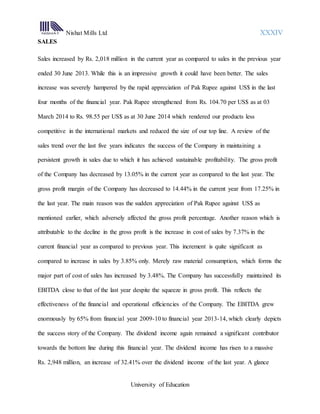
The Company invested in many projects in Power Division during the financial year 2014-15 to
achieve key strategic objective of cost efficiency. Three tri fuel and highly efficient Wartsila
Generators were commissioned at Bhikki, Ferozewatwan and Lahore.
A 22 ton Coal Fired Steam Boiler to meet the enhanced steam requirements of Weaving Division
at Bhikki has been commissioned. This boiler generates low cost steam as compared to the steam
generated on furnace oil and rice husk based boilers.
The 9 MW extension of coal fired power plant is in progress and will be completed soon. In
addition to electricity, it will also produce 25 tons of steam per hour
Nishat Mills Ltd XXXIV
University of Education
SALES
Sales increased by Rs. 2,018 million in the current year as compared to sales in the previous year
ended 30 June 2013. While this is an impressive growth it could have been better. The sales
increase was severely hampered by the rapid appreciation of Pak Rupee against US$ in the last
four months of the financial year. Pak Rupee strengthened from Rs. 104.70 per US$ as at 03
March 2014 to Rs. 98.55 per US$ as at 30 June 2014 which rendered our products less
competitive in the international markets and reduced the size of our top line. A review of the
sales trend over the last five years indicates the success of the Company in maintaining a
persistent growth in sales due to which it has achieved sustainable profitability. The gross profit
of the Company has decreased by 13.05% in the current year as compared to the last year. The
gross profit margin of the Company has decreased to 14.44% in the current year from 17.25% in
the last year. The main reason was the sudden appreciation of Pak Rupee against US$ as
mentioned earlier, which adversely affected the gross profit percentage. Another reason which is
attributable to the decline in the gross profit is the increase in cost of sales by 7.37% in the
current financial year as compared to previous year. This increment is quite significant as
compared to increase in sales by 3.85% only. Merely raw material consumption, which forms the
major part of cost of sales has increased by 3.48%. The Company has successfully maintained its
EBITDA close to that of the last year despite the squeeze in gross profit. This reflects the
effectiveness of the financial and operational efficiencies of the Company. The EBITDA grew
enormously by 65% from financial year 2009-10 to financial year 2013-14, which clearly depicts
the success story of the Company. The dividend income again remained a significant contributor
towards the bottom line during this financial year. The dividend income has risen to a massive
Rs. 2,948 million, an increase of 32.41% over the dividend income of the last year. A glance
Nishat Mills Ltd XXXV
University of Education
over the dividend income trend over the last five years reveals a constant growth, which has
reached 428% from the year 2009-10 to year 2013-14. The Company has built a strategic
investment portfolio which has become a substantial part of other income in terms of dividend
income and capital gains. In addition to dividend income, the Company also earned a capital gain
of Rs. 95 million during the year mainly on sale of partial investment in Lalpir Power Limited.
Although the Company executed many fixed capital expenditures under BMR and also invested
funds in associated companies, the finance cost of the Company remained stable in comparison
with the last year due
Nishat Mills Ltd XXXVI
University of Education
COMPETITVE FORCES OF NISHAT MILLS LTD
Nishat Mills Limited ("Nishat") is a public company incorporated in Pakistan and listed on all
three Pakistani stock exchanges. Nishat is engaged in textile manufacturing. Which involves
spinning, combing, weaving, bleaching, dyeing, and printing, stitching, buying, and selling of
textiles? They deal with yarn, linen, cloth and other goods including fabrics made from raw
cotton, synthetic fiber and cloth.
The Company is engaged in the business of textile manufacturing and of spinning, combing,
weaving, bleaching, dyeing printing, stitching, buying, selling and otherwise dealing in yarn,
linen, cloth and other goods and fabrics made from raw cotton, synthetic fiber and cloth, and to
generate, accumulate, distribute and supply electricity.
Company is providing quality products to its customers within the Pakistan and outside the
Pakistan. Presently company is exporting its all kinds if apparel products.
MAJOR COMPETITORS
Nishat competitors are
 Crescen
 Chenab
 Arzoo
 Alkarm
 Sitara
 Firdous
 Kohinoor
 Amtex
Nishat Mills Ltd XXXVII
University of Education
But main competitors of Nishat Mill are
 Crescent Textile Mills
 Chenab Textile
THREATS AND OPPERTUNITIES:
THREATS
New competitors
Nishat competitors are Crescen,t Chenab Arzoo, Alkarms, Sitara, Kohinoor, Amtex but main
competitors of Nishat Mill are" Crescent Textile Mills and" Chenab Textile" Though we cannot
avoid competition but we can always stay ahead of them by reforming our strategies and
educating our entrepreneurs so as to move one step forward in every aspect.
Fashion life cycle
Fashion changes day by day these days. Media has so much penetrated in our daily lives that we
easily adapt ourselves as it wants us to. This has resulted in shortening the fashion lifecycle thus
increasing the fashion risk.
Now the buyer does not want to wait long for his consignment because he is insecure that by the
time it will reach to him he will lost its demand due to change in fashion. Therefore, they prefer
to buy from neighboring countries even at higher cost to get their products instantly rather than
to wait weeks or months for their consignments to reach them.
Stiff competition from developing countries especially China and India.
Pricing pressure
Location disadvantage
International labor and environmental laws.
Nishat Mills Ltd XXXVIII
University of Education
OPPERTUNITIES:
Organization can expand product lines. Currently the Nishat not dealing in knitwear they
can expand their product line by producing knitwear. They have plants and the extra cost
for the production will be low for Nishat. And they also have better market repute.
Organization can reduce the cost by proper utilization of resources. If the cost of different
matters which is not utilizing properly is controlled by the Nishat management they can
produce more in a few costs. It has to develop a further systematic process for controlling
and managing resources.
Organization can hire more well-educated and experienced person. They can take
advantages by hiring more skilled people and they should hire young, fresh and energetic
staff for their betterment.
Shift in domestic market to branded readymade garments.
Increased disposable income.
Emerging mall culture and retail expansion.
Nishat Mills Ltd XXXIX
University of Education
PORTER’S 5 FORCES ANALYSIS OF NISHAT MILLS LTD
Michael porter an authority on competitive advantage contends that a corporation is most
concerned with the intensity of competition within its industry.
Bargaining power of suppliers
Bargaining power of customers
Rivalry among existing firms
Threat of new Entrants
Threat of substitute products
Nishat Mills Ltd XL
University of Education
BARGAINING POWER OF SUPPLIERS
The bargaining power of suppliers in an industry tries to evaluate the scene of the supply market
of the textile and clothing industry. The main raw material of textile and clothing industry is
cotton. The textile industry in Pakistan achieves cost advantage in the segment of apparel as well
as home textiles with the help of unending supply of local staple cotton which have been
domestically produced. Further, Government and other policy makers have taken definitive steps
for improving the amount and quality of cotton yield for making sure that higher productivity
can be achieved.
BARGAINING POWER OF CUSTOMERS
The bargaining power of customers is also a threat for a firm operating in industry. The buyers
affect the profitability in such a way that he wants discounts and other services which might
lower the margin of profit for the company. The demand forces inside the industry can be
evaluated with the help of bargaining power which the buyers of the industry possess.
RIVALRY AMONG EXISTING FIRMS
The amount of rivalry within the competitors who already exist in the industry is highly
dependent on the following factors: the structure of competition, the structure of industry costs,
strategic objectives, and degree of differentiation, entry and exit barriers, and switching costs
.Another threat for Nishat mills is the hyper competition in industry. The firms currently in the
industry are also the threat for Nishat mills because their actions affect the profitability of the
Nishat mills .Suppose if one competitor reduces the prices so Nishat will also have to reduce
which in result will affect the profitability of company.
Nishat Mills Ltd XLI
University of Education
THREAT OF NEW ENTRANTS
This factor that is threat of new entrants helps in increasing the competitive nature inside the
industry to a greater level. On the other hand the threat is also instrumental in bringing increased
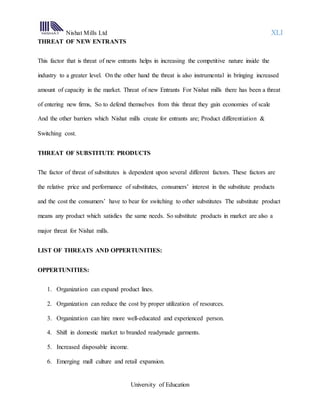
amount of capacity in the market. Threat of new Entrants For Nishat mills there has been a threat
of entering new firms, So to defend themselves from this threat they gain economies of scale
And the other barriers which Nishat mills create for entrants are; Product differentiation &
Switching cost.
THREAT OF SUBSTITUTE PRODUCTS
The factor of threat of substitutes is dependent upon several different factors. These factors are
the relative price and performance of substitutes, consumers’ interest in the substitute products
and the cost the consumers’ have to bear for switching to other substitutes The substitute product
means any product which satisfies the same needs. So substitute products in market are also a
major threat for Nishat mills.
LIST OF THREATS AND OPPERTUNITIES:
OPPERTUNITIES:
1. Organization can expand product lines.
2. Organization can reduce the cost by proper utilization of resources.
3. Organization can hire more well-educated and experienced person.
4. Shift in domestic market to branded readymade garments.
5. Increased disposable income.
6. Emerging mall culture and retail expansion.
Nishat Mills Ltd XLII
University of Education
7. There would be a great opportunity of increase in exports if NML follow the international
standards and provide high quality products to the customers at competitive prices.
8. NML should try to implement the latest ISO standards including ISO14000series, which
will improve their image and customer satisfaction in the local market as well as in
international market.
9. NML can explore the new markets for exports by giving the different incentives to its
employees in the export department, which will improve its profitability.
10. Nishat can introduce its garments in the local market by using the same stitching unit.
This is also a great opportunity.
THREATS:
Fashion life cycle.
Stiff competition from developing countries especially China and India.
Pricing pressure.
Location disadvantage.
International labour and environmental laws.
There is no consistency in the government policies regarding textile sector.
Incidents like September 11, 2001 attacks would also be a major threat.
Political conditions of the country affect both NML and its customers as well hesitate
before signing new contacts.
Increasing rate of electricity and GST are also big threats.
Currency fluctuations and exchange rates can also create problems for NML.
Government is focusing on the industrialization and is giving different incentives to the
investors. It is also a big threat because the number of competitors will increase.
Nishat Mills Ltd XLIII
University of Education
More and more competitors (National and International) are entering in the same markets
and offering attractive prices to the customers.
EXTERNAL FACTOR EVALUATION MATRIX (EFE MATRIX)
Nishat Mills Ltd XLIV
University of Education
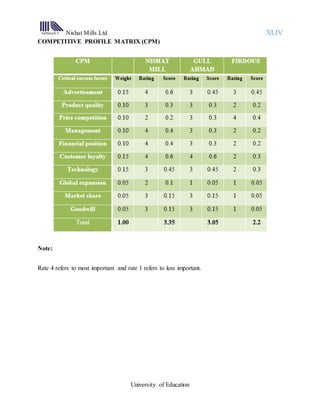
COMPETITIVE PROFILE MATRIX (CPM)
Note:
Rate 4 refers to most important and rate 1 refers to less important.
Nishat Mills Ltd XLV
University of Education
RESOURCE BASE VIEW
It’s an internal analysis of Nishat textile its show the resources, competences, core competences,
competitive advantage of Nishat textile, and sustain position.
Resources of Nishat textile huge amount of investment in business, assets machinery, brand
name, employees, infrastructure, and better quality of material. Competences of Nishat textile is
the use of resources in appropriate and better way so they are not wasted. Core competences of
Nishat textile is advance machineries and technology, well-educated employees ,well
management system , better coordination with employees and management, feedback system,
better MIS system. Competitive advantage of Nishat textile is high quality and standard
products, strong security system, highly motivated workforce, customer loyalty with brand, ISO
9001-2000 implementation, well discipline culture and environment that enables Nishat textile to
compete with other competitors and achieve the competitive advantage. Sustain competitive
advantage of Nishat textile is its product according to the trends and fashion to win its customer.
TECHNOLOGICAL FATORS:
In this era of advancement technology can help to touch the sky of success. Technology creates
new products and processes. It can also reduce the cost, improve quality and lead to innovation.
These developments can benefit the consumers as well as the organization.
Nishat is taking care of technological factors to be successful in today’s tough competition.
Nishat has a very well developed research and development department and facility members
who are working very hard to develop new and improved methods to reduce the production time.
Nishat has made extension in its present setup by installation of well advanced technology
imported from Japan, China and France. Mostly processes are automated. Modern cost and
Nishat Mills Ltd XLVI
University of Education
energy effective machines are taking place of workers and ultimately reducing the cost of
company. Internet development helps Nishat to reduce its advertisement cost and get quick
feedback from its customers.
New technologies create new products and new processes. Technology can reduce costs,
improve quality and lead to innovation. These developments can benefit consumers as well as
the organizations providing the products. Technological factors can lower barriers to entry,
reduce minimum efficient production levels, and influence outsourcing decisions.
Some technological factors include:
 Research & Development activity
 Automation
 Technology incentives
 Rate of technological change or rate of technological obsolescence.
NML is taking care of all these important factors to be successful in today’s severe competition.
Its research and development department is working to use cost and energy efficient machines to
produce best product for its customers. Mostly processes are automated. Modern machines are
taking place of workers and ultimately reducing the organizational costs. It provides the latest
software for the data entry system. Its IT department is working a lot to provide the best to
achieve the benchmarks set by the company. It provides intranet service to its employees to
create ease among work activities. Concerned persons can get access to the relevant data when
needed. So it overcomes its competitors by using latest technology and advanced information
technology system. It is using the latest machines and techniques in Spinning, Weaving, Dying
and stitching departments to produce fine garments.
Nishat Mills Ltd XLVII
University of Education
IMPORTS Textile Machinery
Import of textile machinery and equipment has picked up since 1997-98 when a bumper cotton
crop was harvested and the Textile Industry reaped massive profits due to lower input cost. In the
last five years more than Rs9 billion have been invested for the import of spinning
machinery. Nishat is one of the major customers in terms of importing Textile Machinery from
almost all developed countries.
It is expected that an additional Rs10 billion would be required for Balancing, Modernization
and Replacement (BMR) in the spinning sector during the next three years for producing
superior quality yarn besides several units are in various stages of installation in Karachi also.
These facilities would improve value-addition in fabrics, besides increasing the volume of
fabrics and quality garments exports from the country.
Textile is the only sector where investment has been substantial and regular during past three
years. The most encouraging factor of this investment is diversity.
The entrepreneurs, who earlier concentrated on Spinning and Weaving, have now established
compact units adding state-of-the-art finishing units and knitting machines to add value to their
products. The latest addition to this is the setting up of denim cloth producing units.
At present, the export competitiveness of the textile industry can be improved by aggressive
marketing techniques and quality improvements which have to be taken care of micro-level that
is each textile unit should make its own independent efforts to sell its products in different
international markets.
All the individual textile units should implement the ISO 9001 program for quality standard and
ISO 14000 for environmental standards to counter the threat of globalization.
Nishat Mills Ltd XLVIII
University of Education
Any Further Products and Services:
Nishat group of companies is a premier business house of Pakistan. The group has presence in all
major sectors including Textiles, Cement, Banking, Insurance, Power Generation, Hotel
Business, Agriculture, Dairy and Paper Products. Today, Nishat Group is considered to be at par
with multinationals operating locally in terms of its quality products and management skills.
Following is the list of companies in the group.
Textiles
Power Generation
Banking
Cement
TEXTILES
The textile business is further subdivided into 2-textile division:
Nishat Faislabad
Nishat Chunian
The textile capacity of the group is the largest in the country. An addition of 20,000 new
spindles, 100 new air jet looms and new dyeing plants has increased the existing capacity of
242,000 spindles, 740 looms and dyeing and finishing capacity of 5 million meters. The largest
exporters of textile products from Pakistan, for more then decade!
Nishat Mills Ltd XLIX
University of Education
POWER GENERATION
Nishat group has also been a pioneer in power generation in the private sector of the country.
Nishat setup the first power generation unit in the private sector in 1995.
CEMENT
In 1992, Nishat Group acquired D.G Khan Cement Company Limited (DGKCC) from the
second largest project of the group and is ideally located in the heart of the country, with easy
access to transportation all over Pakistan. DGKCC unit No. 1 has a capacity of 2,200 tons per
day. A new unit heaving the capacity of 3,300 tons was setup in 1997.
International Finance Corporation and common Wealth Development Corporation have financed
this unit. With the addition of unit No.2, DGKCC has become the largest manufacturer of cement
in Pakistan.
BANK
In 1991, Nishat Group ventured into the financial sector through the acquisition of Muslim
commercial Bank. MCB has grown ever since and is now the largest bank in the private sector.
MCB has a network of over 1200 branches employing over 12,000 people.
Subsidiary Companies
The company has annexed its consolidated financial statements along with its separate financial
statements in accordance with the requirements of International Accounting Standard – 27
(Consolidated and Separate Financial Statements).
Following is a brief description of all subsidiary companies of Nishat Mills Limited
Nishat Mills Ltd L
University of Education
1. Nishat Power Limited
The Company owns and controls 51.01% shares of this subsidiary. The subsidiary is listed on
Karachi Stock Exchange Limited and Lahore Stock Exchange Limited in Pakistan. The principle
business of the subsidiary is to build, operate and maintain a fuel powered station having gross
capacity of 200 MW in Jamber Kalan, Tehsil Pattoki, District Kasur, Punjab, Pakistan. The
subsidiary commenced its commercial production from 09 June 2010.
2. Nishat Linen (Private) Limited
This is a wholly owned subsidiary of the Company. The principal objects of the Subsidiary are to
operate retail outlets for sale of textile and other products and to sale the textile products by
processing the textile goods in own and outside manufacturing facilities. The subsidiary started
its operations in July 2011 and is presently operating 64 retail outlets in Pakistan.
3. Nishat Hospitality (Private) Limited
This is a wholly owned subsidiary of the Company. Subsidiary’s object is to run a chain of hotels
across the country. Currently it is operating a four star hotel in Lahore on international standards
under the name of “The Nishat St. James’ Hotel”. The subsidiary started its operations on 01
March 2014.
4. Nishat Commodities (Private) Limited
This is a wholly owned subsidiary of the Company. The object of the subsidiary is to carry on
the business of trading of commodities including fuels, coals, building material in any form or
shape manufactured, semi-manufactured, raw materials and their import and sale in Pakistan.
The incorporation date of Nishat Commodities (Private) Limited is 16 July 2015.
Nishat Mills Ltd LI
University of Education
5. Nishat Linen Trading LLC
This subsidiary is a limited liability company incorporated in Dubai, UAE. It is a wholly owned
subsidiary of the Company. The subsidiary is principally engaged in trading of textile, blankets,
towels, linens, ready-made garments, garments accessories and leather products along with
ancillaries thereto through retail outlets and warehouses across United Arab Emirates. The
subsidiary started its commercial operations in May 2011 is presently operating 9 retail outlets in
UAE
6. Nishat International FZE
This is also a wholly owned subsidiary of Nishat Mills Limited. It has been incorporated as a
Free Zone Establishment limited Liability Company in Jebel Ali Free Zone, Dubai according to
the laws of United Arab Emirates (UAE). It has been registered in the FZE register on February
7, 2013. The principal activity of the Subsidiary Company is trading in textile products such as
blankets, towels & linens, ready-made garments, garments accessories and leather products such
as shoes, handbags and all such ancillaries thereto.
7. Nishat Global China Company Limited
Nishat Global China Company Limited is incorporated in Yuexiu District, Guangzhou, China, as
Foreign Invested Commercial Enterprises “FICE”, in accordance with the Law of Peoples
Republic of China on Foreign-Capital enterprises and other relevant Laws and Regulations.
Nishat Global China Company Limited is a wholly owned subsidiary of Nishat International
FZE which is a wholly owned subsidiary of Nishat Mills Limited. The principal business of the
Subsidiary is wholesale, commission agency (excluding auction), import and export of textile
Nishat Mills Ltd LII
University of Education
goods and women fashion accessories. The subsidiary started its commercial operations in
January 2014.
8. Nishat USA Inc.
The subsidiary is a corporation service company incorporated in the State of New York. It is a
wholly owned subsidiary acquired by the Company on 01October 2008. The corporation is a
liaison office of the Company’s marketing department providing access, information and other
services relating to US Market.
9. Nishat UK (Private) Limited
Nishat UK (Private) Limited is a private limited company incorporated in England and Wales on
8 June 2015. It is a wholly owned subsidiary of Nishat International FZE which is a wholly
owned subsidiary of Nishat Mills Limited. The primary function of Nishat UK (Private) Limited
is sale of textile and related products in England and Wales through retail outletsand wholesale
operations.
Nishat Mills Ltd LIII
University of Education
SWOT Analysis
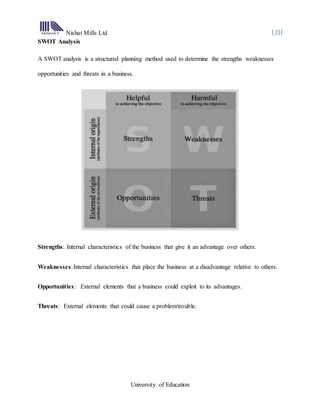
A SWOT analysis is a structured planning method used to determine the strengths weaknesses
opportunities and threats in a business.
Strengths: Internal characteristics of the business that give it an advantage over others.
Weaknesses:Internal characteristics that place the business at a disadvantage relative to others.
Opportunities: External elements that a business could exploit to its advantages.
Threats: External elements that could cause a problem/trouble.
Nishat Mills Ltd LIV
University of Education
SWOT analysis of Nishat Mills:
Strengths:
 Strong Security System
 Latest mechanized machinery
 Tremendous market positioning
 Highly Motivated Workforce
 Adequate financial resources
 Competitive advantage
 Own power generation plant
 Strong financial position
 High quality standards
 Professional management
Weaknesses:
 High cost of production
 Centralized decision making
 Small international market share
 Less promotional activities
 Lack of benefits and rewards for the employees
 Non availability of 100 % polyester processing
Nishat Mills Ltd LV
University of Education
Opportunities:
 Advanced technology
 New market segments
 Existing production capacity
 Lifestyle attitudes
 Population growth rate
 External relations
 New styles and demands
Threats:
 Political instability
 Change of government policies
 Economic downturn
 Emerging competition
 Increased taxes
 Intense price competition
Nishat Mills Ltd LVI
University of Education
Details of SWOT Analysis:
Strengths:
Strong Security System:
Nishat textile limited has a greater security system. There are different hidden security cameras
which capture the all moments.
Latest mechanized machinery:
They are using modern looms which they have purchased from Japan and France. And by using
that latest machinery the productivity of the employees are very high.
Tremendous market positioning:
Nishat textile is one of the pioneer textiles in the Pakistan so it got the position in the mind of its
customer. And being an old textile company people are loyal with it. Nishat has a better position
in the mind of its customers.
Highly Motivated Workforce:
They are providing better pay to their employees and also bonus to them which motivate the
workforce and they are doing well at work setting.
Adequate financial resources:
The owner of the Nishat is one of the richest persons of the Pakistan and they have more plant
and investment in other industries like cement, Bank, They have adequate financial resources to
meet their requirements.
Nishat Mills Ltd LVII
University of Education
Competitive advantage:
Because it is an old textile and it has still keep its position in the textile market on all others
competitors in the nationwide which is its competitive advantage.
Own power generation plant:
They have own power generation plant and Nishat is the pioneer in the private organization who
start the power generation. Nishat is also selling its produced power to WAPDA.
Weaknesses:
High cost of production
The production cost is high because of not properly utilization of its resources.
Centralized decision making
The decisions are made by the upper management which is weakness of the Nishat because they
have no proper idea about the situation and their decision can be not fruitful for the company.
Small international market share
Although Nishat has very strong in the national wide but it has small market share in the global
textile industry due to the sound competitors like china, and Bangladesh etc.
Less promotional activities:
The advertising and promotional cost of the Nishat textile is very low it can take advantage for
more turnouts.
Nishat Mills Ltd LVIII
University of Education
Lack of benefits and rewards for the employees:
Some facilities are provided to their employees like Transport and medical fee etc. Nishat is not
providing sufficient facilities to their employees because of which the productivity of the
employees decreases.
Opportunities:
Advanced technology:
Nishat has advanced and highly automated technology
New market segments:
Nishat can enter in new market segments easily due to its high standards and reputation.
Existing production capacity:
Nishat has sufficient existing production level or capacity that can be seen as company’s
opportunity.
Lifestyle attitudes:
Lifestyle attitudes are a major opportunity in this style-oriented world.
Population growth rate:
Increasing population is always handy as it increases the demand as well as the sales of the
company.
Nishat Mills Ltd LIX
University of Education
New styles and demands:
New demands and styles are considered to be an opportunity for Nishat as it has highly skilled
professional and designers.
Threats:
Political instability:
Political instability effects the Nishat because of the quota system the company can be restrict by
the government to export.
Changes in government policies:
Government policies are changing day to day so it is a threat for the Nishat to survive in such a
changeable situation.
Economic downturn:
Because of the economic instability the Nishat affected a lot. Dumping system which is
uncertainty in the world like 9/11 may affect also the overall export.
Emerging competition:
Emerging competition and increasing level of competitors is a significant threat to the
organization.
Increased taxes:
Increasing taxes is a major threat to the organization rising on daily basis in the world can create
many problems for the company and any firm.
Nishat Mills Ltd LX
University of Education
SWOT Matrix of Nishat Textile Mills
Helpful (to achieve objectives) Harmful (to achieve objectives)
Strengths:
 Strong Security System
 Latest mechanized machinery
 Tremendous market positioning
 Highly Motivated Workforce
 Adequate financial resources
 Competitive advantage
 Own power generation plant
 Strong financial position
 High quality standards
 Professional management
Weaknesses:
 High cost of production
 Centralized decision making
 Small international market share
 Less promotional activities
 Lack of benefits for the employees
 Non availability of 100 % polyester
Opportunities:
 Advanced technology
 New market segments
 Existing production capacity
 Lifestyle attitudes
 Population growth rate
 External relations
 New styles and demands
Threats:
 Political instability
 Change of government policies
 Economic downturn
 Emerging competition
 Increased taxes
 Intense price competition
ExternalInternal
Nishat Mills Ltd LXI
University of Education
Pest Analysis:-
There are also a number of outside or external factors that play a role in how successful
businesses can be. In order to determine how big a role those external factors play, many
organizations conduct a PEST analysis.
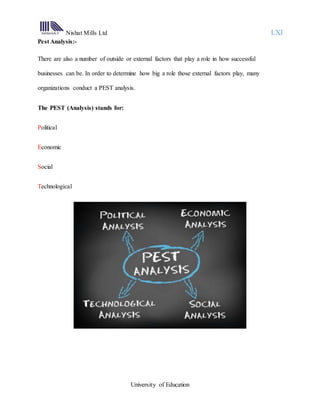
The PEST (Analysis) stands for:
Political
Economic
Social
Technological
Nishat Mills Ltd LXII
University of Education
A PEST (Political, Economic, Social and Technological) analysislooks at how the external
factors can affect a business's activities and performance, and it can be used in combination with
other tools, like SWOT analysis, to determine an organization's overall outlook for success.
PEST factors, however they are beyond the control of the company, play an important role in
company’s performance. Normally pest factors must be considered as either threats or
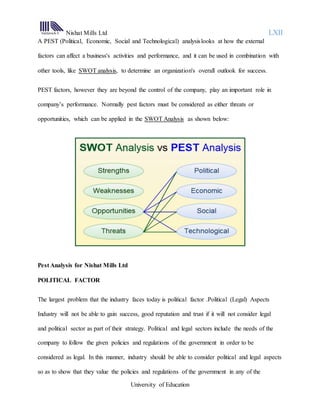
opportunities, which can be applied in the SWOT Analysis as shown below:
Pest Analysis for Nishat Mills Ltd
POLITICAL FACTOR
The largest problem that the industry faces today is political factor .Political (Legal) Aspects
Industry will not be able to gain success, good reputation and trust if it will not consider legal
and political sector as part of their strategy. Political and legal sectors include the needs of the
company to follow the given policies and regulations of the government in order to be
considered as legal. In this manner, industry should be able to consider political and legal aspects
so as to show that they value the policies and regulations of the government in any of the
Nishat Mills Ltd LXIII
University of Education
business operations. - Tax policy - Employment laws - Political stability - Environmental
regulations - Trade and tariff restrictions. Political Instability effect the textile industry and risk
level increase in this situation and policies are change and cost of production high because
overall industry faces troubles due to political instability and it’s a tough time because political
instability in country Govt. Policies it’s also effect the Nishat textile Law & Order govt. and
political parties insure this now Nawaz Sharif promote the business or industrial sector in
country but the Asif Zardari don’t focus to promote this sector so law and order change
according to the political parties and leaders Positive Relations its play a vital role to promote
this industry if political stability in our country so our export increases and business
opportunities increases day by day and govt. revenues increase and unemployment low and
develop country give different business opportunities Terrorism & Corruption its increases day
by day in our country .In Karachi and Rawalpindi cities faces very hard and sewer condition due
to terrorism so the business condition is very bad day by day and business shutdown and crises
level high and poorly level increase due to these factors .In this people purchasing power low
and textile faces a lot of problems Political Situation it’s not satisfactory due to rapid changes in
the govt. and every govt. set its own trade policies ,rules and laws and different tax policies so in
this govt. should apply sustainable policies for the beneficial of the exporter as well as invertors
Effect On International Market it’s also effect the international Nishat textile buyers e.g. UK,
Japan etc. Govt. Sanctions if relations are not positive to other country so it’s also effect on
Nishat textile export products e.g. India and Pakistan relations etc.
Nishat Mills Ltd LXIV
University of Education
ECONOMIC FACTORS
Economic Stability Growth has immensely contributed towards economic stability of the
country .Moreover, when the finished goods are domestically available, it helps keep prices
down and fluctuations due to international market influences are less likely to strike populace.
Improvement in Balance of Payments Textile industry has brought structural changes in the
pattern of foreign trade of the country. Today, the Textile sector account for about US$ 10.2
billion export of the country. On one hand, this sector helps reduce import bills of textile
products and on the other hand, it contributes in earning foreign exchange thereby helping
towards keeping balance of payment in control. Following table presents a comparison of years
2008-09 and 2009-10 with respect to exports of different textile products.
Greater Employment Nishat provides more employment opportunities to the unemployed people.
It is a source of providing employment opportunities.
Collateral Industrial Development of one industry leads to the development and expansion of
other industries. A number of industries and work opportunities are directly or indirectly related
with Textile Sector. For example, colors and dies, plastics, printing, machinery etc are equally
affected by booms or busts in Textile sector.
Enhanced Government Revenues Any industrial development is bound to increase government
revenues. Though textile sector is still zero rated for the purposes of sales tax on exports yet the
tax on domestic supply and income tax contribute greatly to government revenues.
Diversification of Economy Development in textile sector has helped in diversifying economy by
reducing dependence on mere production and export of raw material. It also instilled
Nishat Mills Ltd LXV
University of Education
diversification by stimulating collateral industrial development. It is also a source of Foreign
exchange earnings.
SOCIAL, CULTURE, DEMOGRAPHIS & ENVIRONMENTAL FORCES
Nishat Mills Ltd. is a large organization and according to its claims of social responsibility it
provides its employees with good attitude to work and leisure and a safe work environment. Now
what this organization is doing under corporate social responsibility is also venerable. Changes
in social trends can have impact on demand for a firm's products and the availability, attitudes to
work, income distribution and willingness of individuals to work. In social factors demographics
have a lot of importance.
Pakistan Culture is generally considered to be the basic identity of Pakistan nation as their trends,
History, Silent Features, rituals and way of life forms their culture of living, and this culture
becomes their distinctiveness. Pakistan has a very unique mixed culture in which the various
cultures from different provinces combines together to form an amalgamation of ethics, values,
norms and beliefs which forms a very charming and attractive national culture of Pakistan.
The people of Pakistan should stick to their own Pakistan culture and should always promote it
by being its brand ambassador so that the entire world show know and praise them due to their
exquisite culture of Pakistan.
Demographics include age structure of the population; gender; family size and composition;
changing nature of occupations etc. Some important social factors that affect Nishat Mills
Limited are as:
Health consciousness
Population growth rate
Nishat Mills Ltd LXVI
University of Education
Age distribution
Career attitudes
Emphasis on safety
Pakistan is facing all the problems mentioned above. The government has been unable to provide
the manufacturing sector with what it needs to flourish. International buyers are reluctant to do
business in Pakistan as orders placed in Pakistan are often delayed due to unavoidable
circumstances such as electricity shortages, gas shortages, and petroleum levy and sudden
increase in its prices. The high cost of doing business is because of intensive increase in the rate
of interest which has increased the problems of the industry.
The change in the lifestyle of the people affects the growing demand of the Nishat Mill Ltd
products. The change in the lifestyle and needs in different demographics also affect the demand
of the customers. Due to all these changes Nishat Mills Ltd is performing excellent for the
excellence organization as well as for the customer. As the lifestyle of people changes their
needs change, so Nishat Mills Ltd is there to fulfill their requirements regarding clothing
admirably. Its products are available for different age groups and gender.
Environmental factors include the weather and climate change. Changes in temperature can
impact on many industries including farming, tourism and insurance. With major climate
changes occurring due to global warming and with greater environmental awareness this external
factor is becoming a significant issue for firms to consider. The growing desire to protect the
environment is having an impact on many industries and Nishat Mills Ltd is one of them that are
conscious about what is good for the environment.
General moves towards more environmental friendly products and processes are affecting
demand patterns and creating business opportunities. Pakistan is beautiful country where all four
Nishat Mills Ltd LXVII
University of Education
weather seasons emerge. So Nishat has launched seasonal varieties to fit according to the
weather. On the other side to save the environment from being polluted it takes precautionary
measures like it has set up a water treatment plant.
Better Living Standards Textile sector development helped in increasing the value of output per
worker. The income of the labor, due to higher productivity increased resulting in better living
standards of growing middle class.
Growth in textile sector enhanced social welfare in a multitude of ways. Better and greater
employment opportunities, meeting domestic needs, generating revenue and thereby positively
affecting public social spending etc. all lead to social welfare.
Growth in textile sector enhanced social welfare in a multitude of ways. Better and greater
employment opportunities, meeting domestic needs, generating revenue and there by positively
affecting public social spending etc. all lead to social welfare.
TECHNOLOGICAL FACTORS
In this era of advancement technology can help to touch the sky of success. Technology creates
new products and processes. It can also reduce the cost, improve quality and lead to innovation.
These developments can benefit the consumers as well as the organization.
Nishat is taking care of technological factors to be successful in today’s tough competition.
Nishat has a very well developed research and development department and facility members
who are working very hard to develop new and improved methods to reduce the production time.
Nishat has made extension in its present setup by installation of well advanced technology
imported from Japan, China and France. Mostly processes are automated. Modern cost and
Nishat Mills Ltd LXVIII
University of Education
energy effective machines are taking place of workers and ultimately reducing the cost of
company. Internet development helps Nishat to reduce its advertisement cost and get quick
feedback from its customers.
Portfolio Analysis: BCG Matrix
Nishat Mills Ltd LXIX
University of Education
Star:
Nishat's Star unit, undoubtedly, is Nisha, their clothing line for women. It is a unit that sells
throughout the year and as quoted by the Manager of their Clifton outlet, "Nisha sells at the same
rate even during times of recession". According to him, Nishat has experienced more profit
during recession because of continued high sales of their clothing line for women. Launched in
2004, Nisha grew by leaps and bounds and now stands alongside brands like Gul Ahmed,
Lakhani and Al-Karam. It has been categorized as a Star product line of Nishat as the market for
women fabric and apparel is huge, ever growing and presents quite a lot of potential. It has a
high market share due to its exclusivity and quality that distinguishes it from its competition. As
a consequence, it requires heavy investment to support its image as a brand with an attitude.
Nishat Mills Ltd LXX
University of Education
Cash Cows:
Nishat's bed & kitchen linen and accessories can be categorized as the cash cows with which it
earns a healthy and steady cash flow throughout the year. The market demand for bed and
kitchen linen, though not dynamic, has always been there with a sustained and limited potential
for growth. Nishat, with its unique and discerning image, has managed to capture a significant
share of this slow-growing market, relative to its competitors like Ideas by Gul Ahmed, Identity
by Al-Karam and ofcourse, ChenOne. Its bed linen is not only in high demand locally but is also
one of its major imports.
Nishat Mills Ltd LXXI
University of Education
Question Mark:
Naqsh, the clothing line of Nishat for men, can be categorized as its Problem Child or Question
Mark. It's a unit that hasn't shown much potential and as a result hasn't managed to gain as much
market share or generate as much cash as was expected and required of it. The market for eastern
wear for men has seen a rapid growth since the past few years and presents so much of
unexplored potential. With every designer coming up with an exclusive clothing line for men,
Naqsh faces serious competition from not only Gul Ahmed and Al-Karam but other market
leaders such as Amir Adnan, Junaid Jamshed and Rizwan Beyg etc. To survive in such a fiercely
competitive and fast-growing market, Naqsh requires heavy investments to hold its ground but
hasn't managed to succeed in gaining enough market shares as yet.
Nishat Mills Ltd LXXII
University of Education
Dog:
Finally, fashion accessories of Nishat can be termed as Dog; unit with a low market share in a
moderately growing industry of accessories. The demand for fashion accessories like hand bags,
clutches etc, though has always been there, but it does not have that much of a growth potential.
With much of the investment being done in the other three units, Nishat hasn't paid heed to this
particular market offering. Known by the masses as a brand for clothing and bed linen, only a
niche segment of the market is aware of Nishat's accessories even when ingenuity and style is
maintained here as well. Hence, this unit generates just enough cash to maintain its market share.
Nishat Mills Ltd LXXIII
University of Education
Nishat Mills Ltd LXXIV
University of Education
FINANCIAL ANALYSIS
Nishat Textiles Mills Limited
INTERNAL ANALYSIS
Liquidity Ratios
2012 2013 2014
Current ratio 1.31 1.51 1.34
Quick ratio 0.60 0.83 0.68
Interpretation:
Current ratio: The Company is growing in a manner and in stable position to cover its current
liabilities with current assets.
Quick ratio: Shows a firm’s ability to meet current liabilities with its most liquid assets;
however these ratios are not in line with the industry but decreasing.
Leverage Ratios
2012 2013 2014
Debt to equity ratio 0.47 0.53 0.50
Debt to total asset ratio 0.32 0.35 0.33
Nishat Mills Ltd LXXV
University of Education
Interpretation:
Debt- to- equity ratio: Creditors like this ratio to be low. The lower the ratio, the higher the
level of firm’s financing that is being provided by the shareholders. In 2014: the ratio tells us that
creditors are providing 0.50 Rs of financing for each 1 Rs provided by the shareholder.
Debt- to- total -assets ratio: The greater the Debt- to- total -assets ratio, the higher the risk; the
lower the ratio the lower the financial risk. In 2014, 33% of the firm’s assets are supported with
debt financing and the remaining 77% of financing comes from shareholders equity.
Coverage Ratios
2012 2013 2014
Interest coverage ratio 3.10 4.30 4.85
Interpretation:
Interest coverage ratio: This ratio serves as a measure of the firm’s ability to meet its interest
payments and thus avoid bankruptcy. The higher the ratio the greater the likelihood that the
company can cover its interest payments without difficulty. Thus; In 2014: the Nishat had the
ability to cover annual interest 4.85 times with the operating income (EBIT).
Nishat Mills Ltd LXXVI
University of Education
Activity Ratios
2012 2013 2014
Receivable turnover (in days) 23.60 18.62 28.29
Inventory turnover( in days) 93.85 86.90 92.88
Total asset turnover 0.68 0.90 0.79
Interpretation:
Receivable turnover: The figures tell us about after how many number of days the receivables
are being collected. Receivable turnover (in days) is also called average collection period;
although too high an average collection period is usually bad but a very low average collection
period may not necessarily be good.
Inventory turnover: The figures tell us about how many days on average, before inventory in
turned into accounts receivables through sales. During the year 2014: after every 92.87 days, the
inventory was turned into accounts receivables through sales.
Total asset turnover: The total asset turnover tells us about the relative efficiency with which a
firm utilizes its total assets to generate sales. Nishat looks to be less efficient in this regard.
Nishat Mills Ltd LXXVII
University of Education
Profitability Ratios
2012 2013 2014
Gross profit margin 15.11% 17.25% 15%
Return on investment 6.3% 8.9% 6.2%
Return on equity 9.65% 12.10% 8.65%
Interpretation:
Net profit margin: The figures tell us about the profits relative to sales after we deduct the cost
producing the goods. In 2014, the Gross profit margin of Nishat was 15 %.
Return on investment: Indicates the profitability on the assets of the firm after all expenses and
taxes.
Return on equity: Indicates the profitability to the shareholders of the firm after all expenses
and taxes.
Nishat Mills Ltd LXXVIII
University of Education
EXTERNAL ANALYSIS (Only for Year 2014)
Liquidity Ratios
Nishat Mills Pakistan synthetics
Current ratio 1.34 1.31
Quick ratio 0.68 0.71
Interpretation:
Current ratio: Nisht Mills Ltd is slightly more efficient that Pakistan synthetics to cover its
current liabilities with current assets.
Quick ratio: Nishat’s ability to meet current liabilities with its most liquid assets is slightly less
than Pakistan synthetics.
Leverage Ratios
Nishat Mills Pakistan synthetics
Debt to equity ratio 0.50 1.80
Debt to total asset ratio 0.33 0.64
Interpretation:
Debt to equity ratio: The lower the ratio, the higher the level of firm’s financing that is being
provided by the shareholders Nishat proves to be ahead of its competitor in this regard.
Nishat Mills Ltd LXXIX
University of Education
Debt to total asset ratio: The greater the Debt- to- total -assets ratio, the higher the risk; the
lower the ratio the lower the financial risk. Nishat’s Debt- to- total -assets ratio is preferably
lower than Pakistan synthetics.
Coverage Ratios
Nishat Mills Pakistan synthetics
Interest coverage ratio 4.85 3.24
Interpretation:
Interest coverage ratio: The higher the ratio the greater the likelihood that the company can
cover its interest payments without difficulty. Thus, Nishat is leading in this regard.
Activity Ratios
Nishat Mills Pakistan synthetics
Receivable turnover(in days) 28.29 68.86
Inventory turnover (in days) 92.88 103.98
Total asset turnover 0.79 1.02
Nishat Mills Ltd LXXX
University of Education
Interpretation:
Receivable turnover: The figures tell us about after how many number of days the receivables
are being collected. Thus, Nishat collects them after every 28.29 days on average whereas
Pakistan synthetics collect them after every 68.86 days.
Inventory turnover: The figures tell us about how many days on average, before inventory in
turned into accounts receivables through sales. In this aspect, Pakistan synthetics are less
efficient.
Total asset turnover: The total asset turnover tells us about the relative efficiency with which a
firm utilizes its total assets to generate sales. In this aspect, Pakistan synthetics are more
efficient.
Profitability Ratio
Nishat Mills Pakistan synthetics
Gross profit margin 15% 4.24%
Return on investment 6.2% 5.3%
Return on equity 8.65% 6.7%
Interpretation:
Net profit margin: Nishat has considerably higher Gross profit margins than Pakistan
synthetics.
Nishat Mills Ltd LXXXI
University of Education
Return on investment: Nishat has higher Return on investment than Pakistan synthetics.
Return on equity: Nishat has considerably higher Return on equity than Pakistan synthetics.
Conclusion (future outlook):
The ensuing years appeared to be positive for NML, as the economy turns on to the road of
recovery. Rising local and international cotton prices will strain the profitability, but NML has
considerable sources to generate incomes from. NML has the plan to start the functioning of the
Operational Product Development Department to help it better focus on clients. NML’s plans to
harness the benefits from increasing international demand for apparel and garments particularly
in the western economies can help maintain a healthy bottom-line
Nishat Mills Ltd LXXXII
University of Education
BALANCE SHEET
Nishat Mills Ltd LXXXIII
University of Education
Nishat Mills Ltd LXXXIV
University of Education
Nishat Mills Ltd LXXXV
University of Education
INCOME STATEMENT
NOTE:
The data or information used in this report is based on financial reports of Nishat Textile Mills
and its competitor.
Nishat Mills Ltd LXXXVI
University of Education
CONCLUSION AND RECOMMENDATIONS:
Conclusion:
Nishat Mills Limited is one of the leading groups in Pakistan. The system, the management style,
the policies & decentralized decision making environment is really remarkable
In this era of technology, the “Information” is the key to success in the business. This means that
the successful businessman will be who will have the right information at the right time. This
comment leads to the conclusion that the Information Sharing Process should really be improved.
The overall analysis is indicating that the company’s progress has mainly attained through
dedication of employees. The effectiveness of its management, their willingness to take
advantage of opportunities and face challenges of changing economic picture, this all contributes
to the very much improved and sound position of company. This is really appreciable for the
devotion and hard work of all the employees of the company.
Recommendations:
Recommendations for Improvements are:
 At present facility of bonus is given only to production staff but such incentives should
also be given to Head office Staff.
 Medical facilities are given in mill but such facilities should also be given to
management.
 Different training courses should be arranged for the up lifting and improving the quality
of work for employees
Nishat Mills Ltd LXXXVII
University of Education
 They provide transportation facility to only female employees I think male should also be
provided with conveyance convenience. This will create the easiness for workers and
reduce the wastage of time.
 There is also a problem of work overload for the employees and it should be control
properly so that the employees are motivated.
 Employees should be paid extra for the work which they done after working hours.
References
Mr. SaeedNawaz (General Manager Weaving Department)
Mr. Fayaz Ahmed (Manager Accounts Department)
Javed Iqbal (Accounts Officer)
www.nishatmills.com
http://i4info.org/financial-ratio-analysis-of-nishat-mills-ltd/
http://www.oup.com/uk/orc/bin/9780199296378/01student/additional/page_12.htm
www.dgtrdt.gov.pk/Research/38th_syndicate_reports/6.pdf
http://www.pakonomy.com/2012/02/08/alarming-trends-in-textile-industry-of-pakistan/
http://www.smallbusinessnotes.com/business-finances/financial-ratios.html
http://www.youtube.com/watch?v=R2yEH2lyzW0&feature=related
http://www.pakonomy.com/2012/02/08/alarming-trends-in-textile-industry-of-pakistan/
Nishat Mills Ltd LXXXVIII
University of Education
http://www.oup.com/uk/orc/bin/9780199296378/01student/additional/page_12.htm
http://tutor2u.net/business/strategy/PEST_analysis.htm
http://www.quickmba.com/strategy/pest/
http://www.investopedia.com/terms/s/swot.asp
http://www.wikihow.com/Be-a-Good-Manager16.
http://www.is.wayne.edu/mnissani/SE/PrefaceTopics.html

Nishat mills LTd Final Project

  • 1.
    Nishat Mills LtdI University of Education Contents Introduction:.................................................................................................................................... 3 Introduction of Organization:.......................................................................................................... 4 Company History....................................................................................................................... 4 Vision Statement........................................................................................................................ 5 Mission statement:..................................................................................................................... 6 Company Summary ................................................................................................................... 7 Profile of Management and BOD/Company ownership:.............................................................. 10 Management of Nishat Mills Limited/key to success:.................................................................. 16 General business environment in Pakistan: .................................................................................. 17 INTRODUCATION OF INDUSTRY:......................................................................................... 22 Company Locations and Facilities:............................................................................................... 24 Management Hierarchy..................................................................Error! Bookmark not defined. Products and services:................................................................................................................... 28 SALES .......................................................................................................................................... 34 COMPETITVE FORCES OF NISHAT MILLS LTD.................................................................. 36 MAJOR COMPETITORS....................................................................................................... 36 Any Further Products and Services: ............................................................................................. 48 SWOT Analysis ............................................................................................................................ 53 SWOT Matrix of Nishat Textile Mills..................................................................................... 60
  • 2.
    Nishat Mills LtdII University of Education Pest Analysis:-............................................................................................................................... 61 Pest Analysis for Nishat Mills Ltd........................................................................................... 62 Portfolio Analysis: BCG Matrix ................................................................................................... 68 FINANCIAL ANALYSIS ............................................................................................................ 74 INTERNAL ANALYSIS......................................................................................................... 74 EXTERNAL ANALYSIS (Only for Year 2014) .................................................................... 78 BALANCE SHEET ................................................................................................................. 82 INCOME STATEMENT......................................................................................................... 85 CONCLUSION AND RECOMMENDATIONS: ........................................................................ 86 Conclusion:.............................................................................................................................. 86 Recommendations: .................................................................................................................. 86 References..................................................................................................................................... 87
  • 3.
    Nishat Mills LtdIII University of Education Introduction: Nishat Mills Limited aims to remain as leading Textile Company of the country. Our Human Resource policy is based on principles that employees are our most valued asset and important building block for sustainable growth. Management has developed excellent relations with employees to achieve optimum level of performance and commitment to excellence. The Company is an equal opportunity employer and hires people from various ethnicities and both genders without prejudice or bias. The Company has a coherent and market driven performance and reward policy which encourages employees to participate enthusiastically in the achievement of company’s objectives. Nishat group is one of the leading and most diversified groups in Pakistan with fixed/current assets of over US $ 5 billion .It is ranked among the top five business houses of Pakistan . The group has strong presence in three most important business sectors of the region namely textiles, cement and financial services. In addition, the group also has reasonable market share in Insurance (Adamjee insurance), Power generation and Aviation business .It also has the distinction of being one of the largest players in each sector. The group has a remarkable position in the market as good as any MNC operating locally in terms of its quality of products, services and management skills.
  • 4.
    Nishat Mills LtdIV University of Education Introduction of Organization: Company History Nishat Mills Limited is the flagship company of Nishat Group. It was established in 1951. It is one of the most modern, largest vertically integrated textile companies in Pakistan. Nishat Mills Limited has 227,640 spindles, 789 Toyota air jet looms. The Company also has the most modern textile dyeing and processing units, 2 stitching units for home textile, Two stitching units for garments and Power Generation facilities with a capacity of 120 MW. The Company’s total export for the year 2015 was Rs. 39.868 billion (US$ 393.683 million). Due to the application of prudent management policies, consolidation of operations, a strong balance sheet and an effective marketing strategy, the growth trend is expected to continue in the years to come. The Company's production facilities comprise of spinning, weaving, processing, stitching and power generation.
  • 5.
    Nishat Mills LtdV University of Education Vision Statement To transform the Company into a modern and dynamic yarn, cloth and processed cloth and finished product manufacturing Company that is fully equipped to play a meaningful role on sustainable basis in the economy of Pakistan. To transform the Company into a modern and dynamic power generating Company that is fully equipped to play a meaningful role on sustainable basis in the economy of Pakistan.
  • 6.
    Nishat Mills LtdVI University of Education Missionstatement: To provide quality products to customers and explore new markets to promote/expand sales of the Company through good governance and foster a sound and dynamic team, so as to achieve optimum prices of products of the Company for sustainable and equitable growth and prosperity of the Company.
  • 7.
    Nishat Mills LtdVII University of Education Company Summary Nishat Mills Limited (“the Company”) is the most modern and largest vertically integrated textile Company in Pakistan. The Company commenced its business as a partnership firm in 1951 and was incorporated as a private limited Company in 1959. Later it was listed on the Karachi, Lahore and Islamabad Stock Exchanges on 27 November 1961, 11 March 1989 and 10 August 1992 respectively. The Company’s production facilities comprise of spinning, weaving, printing, dyeing, home textile and garment stitching and power generation. Overall, the Company has 32 manufacturing units each specializing in a specific product range located in Faisalabad, Sheikhupura, Ferozewatwan and Lahore. A major portion of the Company’s earnings is export based. Over the the years, the Company has achieved significant geographical diversification in its export sales mix. The Company has a very broad base of customers for its products outside Pakistan. It has a long working relationship with the top brands of the world such as J.K.N. International, Levis, Next, Pincroft Dyeing, Ocean Garments, Gap, Carreman, Tommy Hilfiger, Tommy Bahamas, Crate & Barrel, Laura Ashley, American Living, Chaps, Hugo Boss, Revman and John Lewis. Nishat Mills Limited is also called the flagship company of the Nishat Group. Nishat Group (“the Group”) is a leading business entity in South Asia. Its net worth makes it the largest business house of Pakistan. The Group has grown from a cotton export house into the premier business group of the country. Highly diversified, the Group has a presence in all the major sectors including Textiles, Cement, Banking, Insurance, Power Generation, Hotel Business, Agriculture, Dairy, Real Estate, Aviation and Paper Products. Showcasing its varied expertise
  • 8.
    Nishat Mills LtdVIII University of Education and acumen in every facet of its operations, the group companies hold the distinction of being among the leading players in each sector. Textile Industry Overview Textile industry is the most essential manufacturing sector of Pakistan as it serves as the backbone of Pakistan’s economy. It has the longest production chain, with inherent potential for value addition at each stage of processing, from cotton to ginning, spinning, fabric, dyeing and finishing, made-ups and garments. Critical success factors of the textile industry are availability of cheap and subsidized credit facilities, uninterrupted supply of gas and electricity at low rates, consistent and industry friendly tax policies and establishment of new textile units in less developed areas by giving incentives to the investors i.e. tax holiday. Due to unavailability of these factors, negligible growth of 0.5 percent has been recorded in the current financial year 2014-15 as compared to the last year in Pakistan. Government of Pakistan has promulgated Textile Policy 2014-19 to ensure the maintenance of country’s reputation as a reliable source of high quality textile goods. Salient features of the Policy are as follows: • Draw-back for local taxes and levies are given to exporters of textile products on FOB values of their enhanced exports if increased beyond 10% over last year’s exports at the following rates:  Garments 4%  Made ups 2%; &  Processed fabric 1%. • Markup rate for Export Refinance Scheme of State Bank of Pakistan was reduced from 9.40% to 7.50% under the policy. This rate has been subsequently reduced further to 4.50 %.
  • 9.
    Nishat Mills LtdIX University of Education • Markup rates for Long Term Financing Facility (LTFF) provided to textile manufacturers in the value added sector was reduced from 10.90% to 9.00 %. This rate has been subsequently reduced further to 6.00 %. Over the Years 1951 Nishat Mills Limited commenced its business as partnership. 1959 The company incorporated as private limited company. 1961 Nishat Mills Limited was listed on Karachi Stock Exchange. 1989 The Company was listed on Lahore Stock Exchange. 1992 The Company was listed on Islamabad Stock Exchange. 1996 Acquired the operating assets of Nishat Tek Limited and Nishat Fabrics Limited. 2005 Acquired the assets of Umer Fabrics Limited. 2008 Acquired the assets of Nishat Apparel Limited.
  • 10.
    Nishat Mills LtdX University of Education Profile of Management and BOD/Company ownership: Nishat Mills Limited Board of Directors As on April 10, 2011 Mian Umer Mansha (Chief Executive Officer) Mian Umer Mansha holds a Bachelor’s degree in Business Administration from USA. He has been serving on the Board of Directors of various listed companies for more than 18 years. He also serves on the Board of Adamjee Insurance Company Limited, MCB Bank Limited, Adamjee Life Assurance Company Limited, Nishat Dairy (Private) Limited, Nishat Hotels and Properties Limited, Nishat (Aziz Avenue) Hotels and Properties Limited, Nishat (Raiwind) Hotels and Properties Limited, Nishat (Gulberg) Hotels and Properties Limited, Nishat Developers (Private) Limited, Nishat Agriculture Farming (Private) Limited and Nishat Farms Supplies (Private) Limited.
  • 11.
    Nishat Mills LtdXI University of Education Mian Hassan Mansha (Chairman) Mian Hassan Mansha has been serving on the Board of various listed companies for several years. He also serves on the Board of Nishat Power Limited, Security General Insurance Company Limited, Lalpir Power Limited, Pakgen Power Limited, Nishat Hotels and Properties Limited, Nishat (Aziz Avenue) Hotels and Properties Limited, Nishat (Raiwind) Hotels and Properties Limited, Nishat (Gulberg) Hotels and Properties Limited, Nishat Hospitality (Private) Limited, Nishat Dairy (Private)Limited, Pakistan Aviators and Aviation (Private) Limited, Nishat Automobiles (Private) Limited, Nishat Real Estate Development Company (Private) Limited, Nishat Agriculture Farming (Private) Limited and Nishat Farms Supplies (Private) Limited.
  • 12.
    Nishat Mills LtdXII University of Education Mr. Khalid Qadeer Qureshi (Non-Executive Director) Mr. Khalid Qadeer Qureshi is a fellow member of the Institute of Chartered Accountants of Pakistan. He has over 43 years of rich professional experience. He also serves on the Board of D.G. Khan Cement Company Limited, Nishat Power Limited, Lalpir Power Limited, Pakgen Power Limited, Nishat Paper Products Company Limited and Nishat Commodities (Private) Limited. Syed Zahid Hussain Independent (Non-Executive Director) Syed Zahid Hussain is a seasoned professional in Pakistan’s corporate world. He possesses multi-faceted talents and has attained exemplary accomplishments. He has in-depth knowledge of a wide range of subjects and has extensively diversified experience and exposure in senior positions. He has earned B.Sc, LLB and MA in International Relations. He has a vast experience of working as Chairman/Chief Executive/ Director of various state owned enterprises and listed
  • 13.
    Nishat Mills LtdXIII University of Education companies. He has also served as the High Commissioner/ Ambassador of Pakistan based in Kenya, with accredited assignments of Ambassadorship in Tanzania, Uganda, Rwanda, Krundse, Ethiopia and Eritrea. He is a fellow member of the Institute of Management, England, International Biographical Center, the USA and the Institute of Marketing Management, Karachi. Ms. Nabiha Shahnawaz Cheema (Non-Executive Director) Ms. Nabiha Shahnawaz Cheema is a fellow member of the Institute of Chartered Accountants of Pakistan and she is a Certified Director by completing the Director’s Training Program from ICAP. She has more than 15 years of professional experience. She also serves on the Board of Security General Insurance Company Limited, D.G. Khan Cement Company Limited and Nishat Hospitality (Private) Limited.
  • 14.
    Nishat Mills LtdXIV University of Education Mr. Maqsood Ahmad (Executive Director) Mr. Maqsood Ahmad holds a Masters degree and a rich professional experience of over 23 years in the textile industry, especially in the spinning business. He is a Certified Director by completing the Director’s Training Program from ICAP. He is actively involved in the strategic decisions relating to the operations of the Company. Mr. SaeedAhmad Alvi (Non-Executive Director) Mr. Saeed Ahmad Alvi has served over 36 years in Pakistan Administrative Service (Ex-District Management Group) and retired as a Federal Secretary. He brings with him a vast experience of policy and program implementation, working at the executive tiers at the Sub-Divisional, District, Divisional, Provincial and Federal levels. He has also served as ex-officio Director on some of the Boards of public sector companies and special institutions. He obtained a Masters
  • 15.
    Nishat Mills LtdXV University of Education degree in Development Studies from UK in addition to Masters degrees in History and Pakistan Studies from Pakistan and also a Bachelors degree in Law. Mr. Alvi is a Certified Director by completing the Director’s Training Program from ICMAP. He also serves on the Boards of Nishat Power Limited, Lalpir Power Limited, Nishat Hotels and Properties Limited, Nishat (Gulberg) Hotels and Properties Limited, Nishat (Raiwind) Hotels and Properties Limited, Nishat (Aziz Avenue) Hotels and Properties Limited and Nishat Real Estate Development Company (Private) Limited.
  • 16.
    Nishat Mills LtdXVI University of Education Management of Nishat Mills Limited/key to success: Nishat Mills Limited employees are highly qualified professionals and have a young, energetic and dedicated team of professionals who have a lot of knowledge to their credit.Managers are responsible for the task assigned to them in their departments and also have to match whether their respective department is achieving the desired efficiency level or not. There are at least three basic requirements for a successful company and the managers of Nishat Mill Limited are made to think on these lines: 1. It must provide a product (good or service) that suits best to the company’s capabilities and for which there is a sufficient market. 2. It must provide the product with consistent quality at a level that appeals to intended customers and satisfy their needs. 3. It must provide a product at a cost that always an adequate profit and a reasonable sale price.
  • 17.
    Nishat Mills LtdXVII University of Education General business environment in Pakistan: An organization must consider the success possibility of conducting operations in any country. The study of business environment in a country includes the identification of risks and opportunities found from an economic, political, natural and technological perspective. Thus, a venture looking to conduct business in Pakistan must considerboth the opportunities and the pitfalls. The business environment of Pakistan is discussed below, it includes:  Economic environment  Political environment  Natural environment  Technological environment Economic Environment: Despite repeated bouts with political instability, the Pakistani economy has been stable, if not growing, for much of the past decade. However, several events have served to stress the economy in recent years, forcing the government to re-allocate resources that has slowed down growth in all sectors. According to the Pakistani Government, the basis for the economy is agricultural with majorcrops including wheat, cotton, rice, and sugar cane and major industries that include textiles andchemicals. GDP in 2015 was about 271 billion USD. Although since 2005 the GDP has been growing an average 5 percent a year, it is not enough to keep up with fast population growth.
  • 18.
    Nishat Mills LtdXVIII University of Education Pakistan annual inflation rate increased to 8.5 percent in March of 2014, from 6.6 a year earlier and 7.9 percent recorded in February of 2014, as food, housing, water, electricity and gas prices edged up. Pakistan’s labour force consists of about 31 million (2012–13) people. Labor-force by occupation: (2012-13 est.)  Manufacturing: 13.3%  Wholesale and retail: 9.2%  Agriculture: 43%,  Industry: 20.7%  Services: 34.2%  Transport and communication: 7.3% In light of the many pressures faced by the Pakistani people, the economy has remained Relatively stable. Though oil prices increased in the recent years, GDP growth rate still improved. Its economy is stable and improving, yet suffers from corruption and high inflation. The future economic prospects of Pakistan look promising but their actual realization would depend upon a number of critical factors such as global economy, successful integration of Pakistan into the global economy, sound macroeconomic policies, strong institutional and governance framework, investment in infrastructure and human development and political stability. Technological Environment: If one issue dominates any discussion of technology in Pakistan, it is the lack of electricity. As the economy has improved over time, demand for electrical appliances has increased and the
  • 19.
    Nishat Mills LtdXIX University of Education corresponding demand for electricity has also increased. In the meantime, supply has not kept up with demand. The cash strapped government has diverted resources that could be used for new power supplies to other areas such as flood relief and the ever-existent conflicts on Pakistan’s borders. The floods, in particular, caused as much as $125 million in damages to the power sector alone. The supply/demand conundrum becomes particularly problematic during the summer months; this has led to protests throughout the country, conflicts withpolice, and damage to government buildings. The lack of electricity has a drag effect on the overall economy. Pakistan’s textile industry has been especially impacted and result was shutdowns. For example, the lack of productivity has led to 200 plant closures and layoffs of 10% of the textile workforce in Faisalabad alone, Pakistan’s third largest city. As a result, the World Bank ranks Pakistan 166 in the world (out of 183 economies) for “Getting Electricity”. Natural environment: Abundant natural resources are one of Pakistan’s major strengths. The main natural resources of Pakistan include arable land, water, and natural gas reserves. Currently, 28% of Pakistan’s land is under cultivation and is kept hydrated by the world’s largest irrigation system. Agriculture alone accounts for 21% of Pakistan’s GDP and employs roughly 42% of the labour force. Pakistan is home to the world’s second largest salt mine, fifth largest gold mine, fifth largest coal reserves and seventh largest copper mine. A large consumer market is one of Pakistan’s greatest strengths. With a population in excess of 180 million people, Pakistan is considered to have the world’s 9th largest consumer market. Pakistan is generally made up of 3 large consumer markets - Karachi, Lahore, and Faisalabad. In
  • 20.
    Nishat Mills LtdXX University of Education addition to large numbers of people, the dispersion of the population is becoming more concentrated in cities. With a booming economy, many of these individuals have increased their standard of living and income substantially, giving them more spending ability. This can be a great asset to businesses inside Pakistan as the growth of the population accompanied by a higher standard of living has the ability to sustain substantial business growth. The total number of Pakistan’s labour force is 55.8 million people, making it the 9th largest workforce. The combination of a large workforce is a great asset to business in Pakistan and abroad. Pakistan’s geographic location is also a great asset in their ability to do business. Pakistan could be considered a business corridor linking the Middle-East, China, Iran, Afghanistan, the Central Asian Countries, and Asia Pacific. This strategic location makes Pakistan a viable business partner in the region. Political Environment: The Pakistani government is organized as a federal republic comprised of four provinces: Sindh, Punjab, Khyber Pakhtunkhwa, and Baluchistan. Additionally, the government maintains control over one federal capital territory (Islamabad), a group of tribal areas. The legislative branch of government includes a 342 member National Assembly and a 100 member Senate. The executive branch is administered by a President (acting as the Head of State) and a Prime Minister (acting as the Head of Government). The judicial branch of Pakistan is headed by Supreme Court. Since its inception in August 1947, Pakistan has experienced periods of civilian control interrupted by alternating periods of military rule. Meanwhile, Pakistan’s political relations with India remain difficult to improve. Ever since both countries became independent of British
  • 21.
    Nishat Mills LtdXXI University of Education control in 1947, they have claimed and fought over the Kashmir territory located near Pakistan’s northern region. For an organization considering doing business in Pakistan, repetitive political instability means an investment in the country may be considered risky. Conclusion: As we’ve discovered throughout our investigation, Pakistan’s business sector has many threats as well as opportunities. The hostility in the region is perhaps the greatest threat to both the citizens of Pakistan and their ability to conduct business. However, if Pakistani officials are able to reign in the warring factions, make peace with their neighbours, and enhance their political standing, there are a great many business opportunities to be had. Through enhancing their education systems they can increase literacy rates, attracting foreign businesses looking to expand in the emerging markets of Pakistan. .Education has to be given the utmost priority in order enhance business opportunities in Pakistan. As many countries and businesses are suffering economically, they are looking for ways to enhance productivity while cutting costs. However, looking at Pakistan’s current situation and their ability for growth, the country remains an attractive location for business ventures. In Pakistan we discovered a nation that presents significant risks to do business while also providing the opportunity for considerable rewards.
  • 22.
    Nishat Mills LtdXXII University of Education INTRODUCATION OF INDUSTRY: The textile industry is often considered the backbone of the Islamic Republic of Pakistan’s economy. When Pakistan came into being there was only 16 textile mills out of which only 12were in operation. Now a days there are 596-textile mills out of which 442 are in operation. Some important points about the textile industry of Pakistan:  Pakistan’s Textile Industry had proved its strength in global market during the last four decades.  The availability of cheap labor and basic raw cotton as raw material for textile industry has played the principal role in the growth of the Cotton Textile Industry in Pakistan.  The textile industry contributes approximately 46 percent to the total output or 8.5 percent of the country GDP.  Pakistan’s textile Industry is the fourth Largest Cotton Producer.  6th largest importer of raw cotton.  The Third largest Consumer of raw cotton.  In Asia, Pakistan is the 8th largest exporter of textile products.  Pakistan is the 3rd largest exporter of raw cotton.  It provides employment to 38% of the country workforce.  The Textile and Clothing Industry has been the main driver of the economy for the last 50 years in terms of foreign currency earnings and jobs creation.
  • 23.
    Nishat Mills LtdXXIII University of Education TOTAL NUMBERS OF PRODUCERS: Production process consists of spinning, weaving, processing, and finishing. The processing includes dyeing, engraving. The textile capacity of the group is the largest in the country. An addition of 20000 new spindles, 100 new air jets looms and new dyeing plant has increased the existing capacity of 24000 spindles, 740 looms and dyeing and finis hing capacity of 5 millio n meters. The group is the largest exporter of textile products from Pakistan for more than a decade.
  • 24.
    Nishat Mills LtdXXIV University of Education Company Locations and Facilities:
  • 25.
    Nishat Mills LtdXXV University of Education Spinning units, Yarn Dyeing & Power plant Nishatabad, Faisalabad. Spinning unit & Power plant 20 K.M. Sheikhupura Faisalabad Road, Feroze Watwan. Weaving units & Power plant 12 K.M. Faisalabad Road, Sheikhupura. Weaving units, Dyeing & Finishing unit, Processing unit, Stitching unit and Power plant 5 K.M. Nishat Avenue Off 22 K.M. Ferozepur Road, Lahore. Stitching unit 21 K.M. Ferozepur Road, Lahore. Apparel Unit 7 K.M. Nishat Avenue Off 22 K.M. Ferozepur Road, Lahore. Registeredoffice & Shares Department Nishat House, 53 - A, Lawrence Road, Lahore. Tel: 042-36360154, 042-111 113 333 Fax: 042-36367414
  • 26.
    Nishat Mills LtdXXVI University of Education Head Office 7, Main Gulberg, Lahore. Tel: 042-35716351-59, 042-111 332 200 Fax: 042-35716349-50 E-mail: nishat@nishatmills.com Website: www.nishatmillsltd.com Liaison Office Ist Floor, Karachi Chambers, Hasrat Mohani Road, Karachi. Tel: 021-32414721-23 Fax: 021-3241293
  • 27.
    Nishat Mills LtdXXVII University of Education
  • 28.
    Nishat Mills LtdXXVIII University of Education Products and services: Spinning Nishat Mills Spinning Division has over 227,640 spindles, which are operationally organized into 8 spinning units. The entire machinery is from world-renowned manufactures. All yarns made at Nishat are Ring Spun suitable for both knitting and weaving. Besides the best Pakistani cotton, long stapled American, Egyptian and US Pima cotton is also used for fine counts. For our strong belief in product development and innovation we have our own in house state of the art cotton and yarn testing laboratories. Nishat spinning is one of the most trusted brands in the market due to its efficient production and quality. Spinning production capacity for both Cotton and Blended Yarns is 200 Tons / Day. Nishat Mills Ltd Spinning Weaving Processing Home Textile Garments Power Generation
  • 29.
    Nishat Mills LtdXXIX University of Education Cotton prices fell sharply at the start of financial year 2014-15 on the news of surplus cotton crop in the local and international markets because huge stocks of cotton were already available with the buyers. In fact, during the financial year under review, trading of cotton in international markets was done at the rates which were the lowest in the past four years. The Company started the procurement of cotton at the start of the cotton season and completed its purchase at optimal price level. Cotton prices had a bearish sentiment throughout this period. China played a key role in keeping cotton prices low as their international cotton buying had reduced. Polyester fiber prices also decreased due to sharp dip in oil prices. Prices of cotton yarn also witnessed a fall which was relatively greater than the decrease in cotton prices as the customers were aware of the cotton market scenario and expected further reduction in cotton prices. Moreover, high cost of production mainly due to expensive electricity and increased wages of workers, made selling yarn in local and international market a challenge but our marketing team successfully secured a satisfactory sale of yarn mix. Hong Kong and China once again remained main markets for our Company’s yarn while our marketing team worked very hard to get business from Malaysia, Japan and Korea as well. Demand of cotton yarn from Europe and the USA remained negligible. Weaving Nishat Mills Weaving division has 789 modern Air Jet looms which produce approximate 11.3 million meters of fabric per month and makes it the largest weaving facility of Pakistan catering to home textile and apparel fabrics.
  • 30.
    Nishat Mills LtdXXX University of Education Financial year 2014-15 was one of the toughest period for textile industry. Cotton prices had a bearish trend. Similarly, polyester fiber prices also fell due to sharp dip in oil prices. Both of these factors created a sentiment for decline in the prices of grey fabric. Our Weaving Segment faced a difficult time during the financial year under review. Our primary export market has always been Europe but due to strengthening of US Dollar against Euro, our cloth sales volumes decreased. Economic slowdown of some major European nations such as Italy and Spain also worsened the situation. This year, winter season in Europe was mild and short. Most of the big retailers in Europe had their shops full of winter clothes and even some of them offered discounts during the season. Corduroy, which has always been our major product in winters, experienced a sharp decrease in volume. Rise in sales was recorded in summer season but we faced price pressure. Our business in Japan also decreased. The reason for decline was again the decrease in the value of Japanese Yen against US Dollar during the year. Export sales to China has also slowed down during the last two months. Turmoil in Middle East and war between Ukraine and Russia caused our work wear business to slow down. Most of our customers for work wear were selling their products in these markets. However as always, we have tried to diverse our product mix further by venturing into product range like abrasive and technical fabrics. We are hopeful that by end of financial year 2015-16, we shall be doing bulk business in these products Processing Our fabric processing facility is one of the largest and most modern factories of Pakistan. With an array of custom-made machinery, it has the capacity to produce 104 million meters of fabric
  • 31.
    Nishat Mills LtdXXXI University of Education per annum. It is specially designed to handle heavy weight fabrics like twills, drills, canvases / poplins, fabrics with minimum tension such as stretch fabrics and all high density weaves. The advantage achieved by the customized design of its machines is the result of an extensive research work with the help of world renowned machine makers. To ensure that our customers get the very best we use more than 75% dyes and chemicals of European origin. The standards are higher than ever, dedicated by fashion, efficient productivity and further automation is engineered in the plant. To maintain quality and international standards, an on-line Quality Control (QC) Department has been setup. The QC department is augmented by a fully equipped Laboratory, which scrutinizes the fabric process flow at all levels. Our extra ordinary Research & Development work and highly trained marketing personal are pivotal to sustain long term business relationships. Home Textile With an array of 939 modern new generation sewing machines, the Home Textile Division consists of 2 stitching facilities. The two facilities combined have an average production capacity of approximately 24 million meters per annum. The product line is customized to manufacture products of various styles and sizes according to the requirements of our customers, wholesalers, retailers and contract textile business. Garments Nishat Mills Limited has state of art garment manufacturing facility both for men and women. The Apparel division has deployed 1767 high end sewing machines such as Vibe Mac, Juki, Mitusibishi and Brother. The Division has the capacity to produce 7.20 million garments per
  • 32.
    Nishat Mills LtdXXXII University of Education annum. The construction of a new garment unit with a capacity of 7.2 million garments per annum is in progress. The Garment wet process utilizes the modern techniques of Rinse, Enzyme Stone, Enzyme Wash, Super Bleach, Reducer Wash, Tint Wash and Raisin Wash. In order to obtain best results, our facility is geared with Tonello Washing machines, Maino dryers, Wrinkle Curing Hangers and Barrel washing machines and Dryers for sampling. Our qualified team members utilize the equipment to obtain optimal results and cater to the specific needs of the client. Financial year 2014-15 was difficult for Garments Segments too. Consistent increase in wages and strengthened Rupee has put a dent on our profitability. The demand for garments remained weak throughout the year. European businesses also struggled due to a weak Euro. To counter the industry challenges and achieve production efficiency, Garments Segment has taken drastic steps in order to be a lean manufacturing unit. The brand new RFID technology which we installed for sewing lines is the latest and most advanced method of calculating efficiencies and wages. This will help in reducing precious down time and increase productivity and lower wastage. The latest technology will facilitate shop floor management with real time important data to streamline processes and manage issues on a fast track. The installation has completed and the system is in operation. Our aim for future is to remain competitive by bringing costs down through increased efficiencies and focusing on large brands and retailers. Garments Segment has the privilege of working with some of the best brands of the world and innovative product developments is the key to our success
  • 33.
    Nishat Mills LtdXXXIII University of Education Power Generation Nishat Mills has established state of the art, modern, highly reliable and extremely efficient captive co-generation power plants to cater in house energy requirements at all its spinning, weaving, processing, stitching and apparel units. These facilities are using Wartsila, Caterpillar, Cummins, Daihatsu, Jenbacher & Mak engines for power generation. Gas, Furnace Oil, Diesel, Coal & Biomass and Steam is being used as fuel for power generation. The Company invested in many projects in Power Division during the financial year 2014-15 to achieve key strategic objective of cost efficiency. Three tri fuel and highly efficient Wartsila Generators were commissioned at Bhikki, Ferozewatwan and Lahore. A 22 ton Coal Fired Steam Boiler to meet the enhanced steam requirements of Weaving Division at Bhikki has been commissioned. This boiler generates low cost steam as compared to the steam generated on furnace oil and rice husk based boilers. The 9 MW extension of coal fired power plant is in progress and will be completed soon. In addition to electricity, it will also produce 25 tons of steam per hour
  • 34.
    Nishat Mills LtdXXXIV University of Education SALES Sales increased by Rs. 2,018 million in the current year as compared to sales in the previous year ended 30 June 2013. While this is an impressive growth it could have been better. The sales increase was severely hampered by the rapid appreciation of Pak Rupee against US$ in the last four months of the financial year. Pak Rupee strengthened from Rs. 104.70 per US$ as at 03 March 2014 to Rs. 98.55 per US$ as at 30 June 2014 which rendered our products less competitive in the international markets and reduced the size of our top line. A review of the sales trend over the last five years indicates the success of the Company in maintaining a persistent growth in sales due to which it has achieved sustainable profitability. The gross profit of the Company has decreased by 13.05% in the current year as compared to the last year. The gross profit margin of the Company has decreased to 14.44% in the current year from 17.25% in the last year. The main reason was the sudden appreciation of Pak Rupee against US$ as mentioned earlier, which adversely affected the gross profit percentage. Another reason which is attributable to the decline in the gross profit is the increase in cost of sales by 7.37% in the current financial year as compared to previous year. This increment is quite significant as compared to increase in sales by 3.85% only. Merely raw material consumption, which forms the major part of cost of sales has increased by 3.48%. The Company has successfully maintained its EBITDA close to that of the last year despite the squeeze in gross profit. This reflects the effectiveness of the financial and operational efficiencies of the Company. The EBITDA grew enormously by 65% from financial year 2009-10 to financial year 2013-14, which clearly depicts the success story of the Company. The dividend income again remained a significant contributor towards the bottom line during this financial year. The dividend income has risen to a massive Rs. 2,948 million, an increase of 32.41% over the dividend income of the last year. A glance
  • 35.
    Nishat Mills LtdXXXV University of Education over the dividend income trend over the last five years reveals a constant growth, which has reached 428% from the year 2009-10 to year 2013-14. The Company has built a strategic investment portfolio which has become a substantial part of other income in terms of dividend income and capital gains. In addition to dividend income, the Company also earned a capital gain of Rs. 95 million during the year mainly on sale of partial investment in Lalpir Power Limited. Although the Company executed many fixed capital expenditures under BMR and also invested funds in associated companies, the finance cost of the Company remained stable in comparison with the last year due
  • 36.
    Nishat Mills LtdXXXVI University of Education COMPETITVE FORCES OF NISHAT MILLS LTD Nishat Mills Limited ("Nishat") is a public company incorporated in Pakistan and listed on all three Pakistani stock exchanges. Nishat is engaged in textile manufacturing. Which involves spinning, combing, weaving, bleaching, dyeing, and printing, stitching, buying, and selling of textiles? They deal with yarn, linen, cloth and other goods including fabrics made from raw cotton, synthetic fiber and cloth. The Company is engaged in the business of textile manufacturing and of spinning, combing, weaving, bleaching, dyeing printing, stitching, buying, selling and otherwise dealing in yarn, linen, cloth and other goods and fabrics made from raw cotton, synthetic fiber and cloth, and to generate, accumulate, distribute and supply electricity. Company is providing quality products to its customers within the Pakistan and outside the Pakistan. Presently company is exporting its all kinds if apparel products. MAJOR COMPETITORS Nishat competitors are  Crescen  Chenab  Arzoo  Alkarm  Sitara  Firdous  Kohinoor  Amtex
  • 37.
    Nishat Mills LtdXXXVII University of Education But main competitors of Nishat Mill are  Crescent Textile Mills  Chenab Textile THREATS AND OPPERTUNITIES: THREATS New competitors Nishat competitors are Crescen,t Chenab Arzoo, Alkarms, Sitara, Kohinoor, Amtex but main competitors of Nishat Mill are" Crescent Textile Mills and" Chenab Textile" Though we cannot avoid competition but we can always stay ahead of them by reforming our strategies and educating our entrepreneurs so as to move one step forward in every aspect. Fashion life cycle Fashion changes day by day these days. Media has so much penetrated in our daily lives that we easily adapt ourselves as it wants us to. This has resulted in shortening the fashion lifecycle thus increasing the fashion risk. Now the buyer does not want to wait long for his consignment because he is insecure that by the time it will reach to him he will lost its demand due to change in fashion. Therefore, they prefer to buy from neighboring countries even at higher cost to get their products instantly rather than to wait weeks or months for their consignments to reach them. Stiff competition from developing countries especially China and India. Pricing pressure Location disadvantage International labor and environmental laws.
  • 38.
    Nishat Mills LtdXXXVIII University of Education OPPERTUNITIES: Organization can expand product lines. Currently the Nishat not dealing in knitwear they can expand their product line by producing knitwear. They have plants and the extra cost for the production will be low for Nishat. And they also have better market repute. Organization can reduce the cost by proper utilization of resources. If the cost of different matters which is not utilizing properly is controlled by the Nishat management they can produce more in a few costs. It has to develop a further systematic process for controlling and managing resources. Organization can hire more well-educated and experienced person. They can take advantages by hiring more skilled people and they should hire young, fresh and energetic staff for their betterment. Shift in domestic market to branded readymade garments. Increased disposable income. Emerging mall culture and retail expansion.
  • 39.
    Nishat Mills LtdXXXIX University of Education PORTER’S 5 FORCES ANALYSIS OF NISHAT MILLS LTD Michael porter an authority on competitive advantage contends that a corporation is most concerned with the intensity of competition within its industry. Bargaining power of suppliers Bargaining power of customers Rivalry among existing firms Threat of new Entrants Threat of substitute products
  • 40.
    Nishat Mills LtdXL University of Education BARGAINING POWER OF SUPPLIERS The bargaining power of suppliers in an industry tries to evaluate the scene of the supply market of the textile and clothing industry. The main raw material of textile and clothing industry is cotton. The textile industry in Pakistan achieves cost advantage in the segment of apparel as well as home textiles with the help of unending supply of local staple cotton which have been domestically produced. Further, Government and other policy makers have taken definitive steps for improving the amount and quality of cotton yield for making sure that higher productivity can be achieved. BARGAINING POWER OF CUSTOMERS The bargaining power of customers is also a threat for a firm operating in industry. The buyers affect the profitability in such a way that he wants discounts and other services which might lower the margin of profit for the company. The demand forces inside the industry can be evaluated with the help of bargaining power which the buyers of the industry possess. RIVALRY AMONG EXISTING FIRMS The amount of rivalry within the competitors who already exist in the industry is highly dependent on the following factors: the structure of competition, the structure of industry costs, strategic objectives, and degree of differentiation, entry and exit barriers, and switching costs .Another threat for Nishat mills is the hyper competition in industry. The firms currently in the industry are also the threat for Nishat mills because their actions affect the profitability of the Nishat mills .Suppose if one competitor reduces the prices so Nishat will also have to reduce which in result will affect the profitability of company.
  • 41.
    Nishat Mills LtdXLI University of Education THREAT OF NEW ENTRANTS This factor that is threat of new entrants helps in increasing the competitive nature inside the industry to a greater level. On the other hand the threat is also instrumental in bringing increased amount of capacity in the market. Threat of new Entrants For Nishat mills there has been a threat of entering new firms, So to defend themselves from this threat they gain economies of scale And the other barriers which Nishat mills create for entrants are; Product differentiation & Switching cost. THREAT OF SUBSTITUTE PRODUCTS The factor of threat of substitutes is dependent upon several different factors. These factors are the relative price and performance of substitutes, consumers’ interest in the substitute products and the cost the consumers’ have to bear for switching to other substitutes The substitute product means any product which satisfies the same needs. So substitute products in market are also a major threat for Nishat mills. LIST OF THREATS AND OPPERTUNITIES: OPPERTUNITIES: 1. Organization can expand product lines. 2. Organization can reduce the cost by proper utilization of resources. 3. Organization can hire more well-educated and experienced person. 4. Shift in domestic market to branded readymade garments. 5. Increased disposable income. 6. Emerging mall culture and retail expansion.
  • 42.
    Nishat Mills LtdXLII University of Education 7. There would be a great opportunity of increase in exports if NML follow the international standards and provide high quality products to the customers at competitive prices. 8. NML should try to implement the latest ISO standards including ISO14000series, which will improve their image and customer satisfaction in the local market as well as in international market. 9. NML can explore the new markets for exports by giving the different incentives to its employees in the export department, which will improve its profitability. 10. Nishat can introduce its garments in the local market by using the same stitching unit. This is also a great opportunity. THREATS: Fashion life cycle. Stiff competition from developing countries especially China and India. Pricing pressure. Location disadvantage. International labour and environmental laws. There is no consistency in the government policies regarding textile sector. Incidents like September 11, 2001 attacks would also be a major threat. Political conditions of the country affect both NML and its customers as well hesitate before signing new contacts. Increasing rate of electricity and GST are also big threats. Currency fluctuations and exchange rates can also create problems for NML. Government is focusing on the industrialization and is giving different incentives to the investors. It is also a big threat because the number of competitors will increase.
  • 43.
    Nishat Mills LtdXLIII University of Education More and more competitors (National and International) are entering in the same markets and offering attractive prices to the customers. EXTERNAL FACTOR EVALUATION MATRIX (EFE MATRIX)
  • 44.
    Nishat Mills LtdXLIV University of Education COMPETITIVE PROFILE MATRIX (CPM) Note: Rate 4 refers to most important and rate 1 refers to less important.
  • 45.
    Nishat Mills LtdXLV University of Education RESOURCE BASE VIEW It’s an internal analysis of Nishat textile its show the resources, competences, core competences, competitive advantage of Nishat textile, and sustain position. Resources of Nishat textile huge amount of investment in business, assets machinery, brand name, employees, infrastructure, and better quality of material. Competences of Nishat textile is the use of resources in appropriate and better way so they are not wasted. Core competences of Nishat textile is advance machineries and technology, well-educated employees ,well management system , better coordination with employees and management, feedback system, better MIS system. Competitive advantage of Nishat textile is high quality and standard products, strong security system, highly motivated workforce, customer loyalty with brand, ISO 9001-2000 implementation, well discipline culture and environment that enables Nishat textile to compete with other competitors and achieve the competitive advantage. Sustain competitive advantage of Nishat textile is its product according to the trends and fashion to win its customer. TECHNOLOGICAL FATORS: In this era of advancement technology can help to touch the sky of success. Technology creates new products and processes. It can also reduce the cost, improve quality and lead to innovation. These developments can benefit the consumers as well as the organization. Nishat is taking care of technological factors to be successful in today’s tough competition. Nishat has a very well developed research and development department and facility members who are working very hard to develop new and improved methods to reduce the production time. Nishat has made extension in its present setup by installation of well advanced technology imported from Japan, China and France. Mostly processes are automated. Modern cost and
  • 46.
    Nishat Mills LtdXLVI University of Education energy effective machines are taking place of workers and ultimately reducing the cost of company. Internet development helps Nishat to reduce its advertisement cost and get quick feedback from its customers. New technologies create new products and new processes. Technology can reduce costs, improve quality and lead to innovation. These developments can benefit consumers as well as the organizations providing the products. Technological factors can lower barriers to entry, reduce minimum efficient production levels, and influence outsourcing decisions. Some technological factors include:  Research & Development activity  Automation  Technology incentives  Rate of technological change or rate of technological obsolescence. NML is taking care of all these important factors to be successful in today’s severe competition. Its research and development department is working to use cost and energy efficient machines to produce best product for its customers. Mostly processes are automated. Modern machines are taking place of workers and ultimately reducing the organizational costs. It provides the latest software for the data entry system. Its IT department is working a lot to provide the best to achieve the benchmarks set by the company. It provides intranet service to its employees to create ease among work activities. Concerned persons can get access to the relevant data when needed. So it overcomes its competitors by using latest technology and advanced information technology system. It is using the latest machines and techniques in Spinning, Weaving, Dying and stitching departments to produce fine garments.
  • 47.
    Nishat Mills LtdXLVII University of Education IMPORTS Textile Machinery Import of textile machinery and equipment has picked up since 1997-98 when a bumper cotton crop was harvested and the Textile Industry reaped massive profits due to lower input cost. In the last five years more than Rs9 billion have been invested for the import of spinning machinery. Nishat is one of the major customers in terms of importing Textile Machinery from almost all developed countries. It is expected that an additional Rs10 billion would be required for Balancing, Modernization and Replacement (BMR) in the spinning sector during the next three years for producing superior quality yarn besides several units are in various stages of installation in Karachi also. These facilities would improve value-addition in fabrics, besides increasing the volume of fabrics and quality garments exports from the country. Textile is the only sector where investment has been substantial and regular during past three years. The most encouraging factor of this investment is diversity. The entrepreneurs, who earlier concentrated on Spinning and Weaving, have now established compact units adding state-of-the-art finishing units and knitting machines to add value to their products. The latest addition to this is the setting up of denim cloth producing units. At present, the export competitiveness of the textile industry can be improved by aggressive marketing techniques and quality improvements which have to be taken care of micro-level that is each textile unit should make its own independent efforts to sell its products in different international markets. All the individual textile units should implement the ISO 9001 program for quality standard and ISO 14000 for environmental standards to counter the threat of globalization.
  • 48.
    Nishat Mills LtdXLVIII University of Education Any Further Products and Services: Nishat group of companies is a premier business house of Pakistan. The group has presence in all major sectors including Textiles, Cement, Banking, Insurance, Power Generation, Hotel Business, Agriculture, Dairy and Paper Products. Today, Nishat Group is considered to be at par with multinationals operating locally in terms of its quality products and management skills. Following is the list of companies in the group. Textiles Power Generation Banking Cement TEXTILES The textile business is further subdivided into 2-textile division: Nishat Faislabad Nishat Chunian The textile capacity of the group is the largest in the country. An addition of 20,000 new spindles, 100 new air jet looms and new dyeing plants has increased the existing capacity of 242,000 spindles, 740 looms and dyeing and finishing capacity of 5 million meters. The largest exporters of textile products from Pakistan, for more then decade!
  • 49.
    Nishat Mills LtdXLIX University of Education POWER GENERATION Nishat group has also been a pioneer in power generation in the private sector of the country. Nishat setup the first power generation unit in the private sector in 1995. CEMENT In 1992, Nishat Group acquired D.G Khan Cement Company Limited (DGKCC) from the second largest project of the group and is ideally located in the heart of the country, with easy access to transportation all over Pakistan. DGKCC unit No. 1 has a capacity of 2,200 tons per day. A new unit heaving the capacity of 3,300 tons was setup in 1997. International Finance Corporation and common Wealth Development Corporation have financed this unit. With the addition of unit No.2, DGKCC has become the largest manufacturer of cement in Pakistan. BANK In 1991, Nishat Group ventured into the financial sector through the acquisition of Muslim commercial Bank. MCB has grown ever since and is now the largest bank in the private sector. MCB has a network of over 1200 branches employing over 12,000 people. Subsidiary Companies The company has annexed its consolidated financial statements along with its separate financial statements in accordance with the requirements of International Accounting Standard – 27 (Consolidated and Separate Financial Statements). Following is a brief description of all subsidiary companies of Nishat Mills Limited
  • 50.
    Nishat Mills LtdL University of Education 1. Nishat Power Limited The Company owns and controls 51.01% shares of this subsidiary. The subsidiary is listed on Karachi Stock Exchange Limited and Lahore Stock Exchange Limited in Pakistan. The principle business of the subsidiary is to build, operate and maintain a fuel powered station having gross capacity of 200 MW in Jamber Kalan, Tehsil Pattoki, District Kasur, Punjab, Pakistan. The subsidiary commenced its commercial production from 09 June 2010. 2. Nishat Linen (Private) Limited This is a wholly owned subsidiary of the Company. The principal objects of the Subsidiary are to operate retail outlets for sale of textile and other products and to sale the textile products by processing the textile goods in own and outside manufacturing facilities. The subsidiary started its operations in July 2011 and is presently operating 64 retail outlets in Pakistan. 3. Nishat Hospitality (Private) Limited This is a wholly owned subsidiary of the Company. Subsidiary’s object is to run a chain of hotels across the country. Currently it is operating a four star hotel in Lahore on international standards under the name of “The Nishat St. James’ Hotel”. The subsidiary started its operations on 01 March 2014. 4. Nishat Commodities (Private) Limited This is a wholly owned subsidiary of the Company. The object of the subsidiary is to carry on the business of trading of commodities including fuels, coals, building material in any form or shape manufactured, semi-manufactured, raw materials and their import and sale in Pakistan. The incorporation date of Nishat Commodities (Private) Limited is 16 July 2015.
  • 51.
    Nishat Mills LtdLI University of Education 5. Nishat Linen Trading LLC This subsidiary is a limited liability company incorporated in Dubai, UAE. It is a wholly owned subsidiary of the Company. The subsidiary is principally engaged in trading of textile, blankets, towels, linens, ready-made garments, garments accessories and leather products along with ancillaries thereto through retail outlets and warehouses across United Arab Emirates. The subsidiary started its commercial operations in May 2011 is presently operating 9 retail outlets in UAE 6. Nishat International FZE This is also a wholly owned subsidiary of Nishat Mills Limited. It has been incorporated as a Free Zone Establishment limited Liability Company in Jebel Ali Free Zone, Dubai according to the laws of United Arab Emirates (UAE). It has been registered in the FZE register on February 7, 2013. The principal activity of the Subsidiary Company is trading in textile products such as blankets, towels & linens, ready-made garments, garments accessories and leather products such as shoes, handbags and all such ancillaries thereto. 7. Nishat Global China Company Limited Nishat Global China Company Limited is incorporated in Yuexiu District, Guangzhou, China, as Foreign Invested Commercial Enterprises “FICE”, in accordance with the Law of Peoples Republic of China on Foreign-Capital enterprises and other relevant Laws and Regulations. Nishat Global China Company Limited is a wholly owned subsidiary of Nishat International FZE which is a wholly owned subsidiary of Nishat Mills Limited. The principal business of the Subsidiary is wholesale, commission agency (excluding auction), import and export of textile
  • 52.
    Nishat Mills LtdLII University of Education goods and women fashion accessories. The subsidiary started its commercial operations in January 2014. 8. Nishat USA Inc. The subsidiary is a corporation service company incorporated in the State of New York. It is a wholly owned subsidiary acquired by the Company on 01October 2008. The corporation is a liaison office of the Company’s marketing department providing access, information and other services relating to US Market. 9. Nishat UK (Private) Limited Nishat UK (Private) Limited is a private limited company incorporated in England and Wales on 8 June 2015. It is a wholly owned subsidiary of Nishat International FZE which is a wholly owned subsidiary of Nishat Mills Limited. The primary function of Nishat UK (Private) Limited is sale of textile and related products in England and Wales through retail outletsand wholesale operations.
  • 53.
    Nishat Mills LtdLIII University of Education SWOT Analysis A SWOT analysis is a structured planning method used to determine the strengths weaknesses opportunities and threats in a business. Strengths: Internal characteristics of the business that give it an advantage over others. Weaknesses:Internal characteristics that place the business at a disadvantage relative to others. Opportunities: External elements that a business could exploit to its advantages. Threats: External elements that could cause a problem/trouble.
  • 54.
    Nishat Mills LtdLIV University of Education SWOT analysis of Nishat Mills: Strengths:  Strong Security System  Latest mechanized machinery  Tremendous market positioning  Highly Motivated Workforce  Adequate financial resources  Competitive advantage  Own power generation plant  Strong financial position  High quality standards  Professional management Weaknesses:  High cost of production  Centralized decision making  Small international market share  Less promotional activities  Lack of benefits and rewards for the employees  Non availability of 100 % polyester processing
  • 55.
    Nishat Mills LtdLV University of Education Opportunities:  Advanced technology  New market segments  Existing production capacity  Lifestyle attitudes  Population growth rate  External relations  New styles and demands Threats:  Political instability  Change of government policies  Economic downturn  Emerging competition  Increased taxes  Intense price competition
  • 56.
    Nishat Mills LtdLVI University of Education Details of SWOT Analysis: Strengths: Strong Security System: Nishat textile limited has a greater security system. There are different hidden security cameras which capture the all moments. Latest mechanized machinery: They are using modern looms which they have purchased from Japan and France. And by using that latest machinery the productivity of the employees are very high. Tremendous market positioning: Nishat textile is one of the pioneer textiles in the Pakistan so it got the position in the mind of its customer. And being an old textile company people are loyal with it. Nishat has a better position in the mind of its customers. Highly Motivated Workforce: They are providing better pay to their employees and also bonus to them which motivate the workforce and they are doing well at work setting. Adequate financial resources: The owner of the Nishat is one of the richest persons of the Pakistan and they have more plant and investment in other industries like cement, Bank, They have adequate financial resources to meet their requirements.
  • 57.
    Nishat Mills LtdLVII University of Education Competitive advantage: Because it is an old textile and it has still keep its position in the textile market on all others competitors in the nationwide which is its competitive advantage. Own power generation plant: They have own power generation plant and Nishat is the pioneer in the private organization who start the power generation. Nishat is also selling its produced power to WAPDA. Weaknesses: High cost of production The production cost is high because of not properly utilization of its resources. Centralized decision making The decisions are made by the upper management which is weakness of the Nishat because they have no proper idea about the situation and their decision can be not fruitful for the company. Small international market share Although Nishat has very strong in the national wide but it has small market share in the global textile industry due to the sound competitors like china, and Bangladesh etc. Less promotional activities: The advertising and promotional cost of the Nishat textile is very low it can take advantage for more turnouts.
  • 58.
    Nishat Mills LtdLVIII University of Education Lack of benefits and rewards for the employees: Some facilities are provided to their employees like Transport and medical fee etc. Nishat is not providing sufficient facilities to their employees because of which the productivity of the employees decreases. Opportunities: Advanced technology: Nishat has advanced and highly automated technology New market segments: Nishat can enter in new market segments easily due to its high standards and reputation. Existing production capacity: Nishat has sufficient existing production level or capacity that can be seen as company’s opportunity. Lifestyle attitudes: Lifestyle attitudes are a major opportunity in this style-oriented world. Population growth rate: Increasing population is always handy as it increases the demand as well as the sales of the company.
  • 59.
    Nishat Mills LtdLIX University of Education New styles and demands: New demands and styles are considered to be an opportunity for Nishat as it has highly skilled professional and designers. Threats: Political instability: Political instability effects the Nishat because of the quota system the company can be restrict by the government to export. Changes in government policies: Government policies are changing day to day so it is a threat for the Nishat to survive in such a changeable situation. Economic downturn: Because of the economic instability the Nishat affected a lot. Dumping system which is uncertainty in the world like 9/11 may affect also the overall export. Emerging competition: Emerging competition and increasing level of competitors is a significant threat to the organization. Increased taxes: Increasing taxes is a major threat to the organization rising on daily basis in the world can create many problems for the company and any firm.
  • 60.
    Nishat Mills LtdLX University of Education SWOT Matrix of Nishat Textile Mills Helpful (to achieve objectives) Harmful (to achieve objectives) Strengths:  Strong Security System  Latest mechanized machinery  Tremendous market positioning  Highly Motivated Workforce  Adequate financial resources  Competitive advantage  Own power generation plant  Strong financial position  High quality standards  Professional management Weaknesses:  High cost of production  Centralized decision making  Small international market share  Less promotional activities  Lack of benefits for the employees  Non availability of 100 % polyester Opportunities:  Advanced technology  New market segments  Existing production capacity  Lifestyle attitudes  Population growth rate  External relations  New styles and demands Threats:  Political instability  Change of government policies  Economic downturn  Emerging competition  Increased taxes  Intense price competition ExternalInternal
  • 61.
    Nishat Mills LtdLXI University of Education Pest Analysis:- There are also a number of outside or external factors that play a role in how successful businesses can be. In order to determine how big a role those external factors play, many organizations conduct a PEST analysis. The PEST (Analysis) stands for: Political Economic Social Technological
  • 62.
    Nishat Mills LtdLXII University of Education A PEST (Political, Economic, Social and Technological) analysislooks at how the external factors can affect a business's activities and performance, and it can be used in combination with other tools, like SWOT analysis, to determine an organization's overall outlook for success. PEST factors, however they are beyond the control of the company, play an important role in company’s performance. Normally pest factors must be considered as either threats or opportunities, which can be applied in the SWOT Analysis as shown below: Pest Analysis for Nishat Mills Ltd POLITICAL FACTOR The largest problem that the industry faces today is political factor .Political (Legal) Aspects Industry will not be able to gain success, good reputation and trust if it will not consider legal and political sector as part of their strategy. Political and legal sectors include the needs of the company to follow the given policies and regulations of the government in order to be considered as legal. In this manner, industry should be able to consider political and legal aspects so as to show that they value the policies and regulations of the government in any of the
  • 63.
    Nishat Mills LtdLXIII University of Education business operations. - Tax policy - Employment laws - Political stability - Environmental regulations - Trade and tariff restrictions. Political Instability effect the textile industry and risk level increase in this situation and policies are change and cost of production high because overall industry faces troubles due to political instability and it’s a tough time because political instability in country Govt. Policies it’s also effect the Nishat textile Law & Order govt. and political parties insure this now Nawaz Sharif promote the business or industrial sector in country but the Asif Zardari don’t focus to promote this sector so law and order change according to the political parties and leaders Positive Relations its play a vital role to promote this industry if political stability in our country so our export increases and business opportunities increases day by day and govt. revenues increase and unemployment low and develop country give different business opportunities Terrorism & Corruption its increases day by day in our country .In Karachi and Rawalpindi cities faces very hard and sewer condition due to terrorism so the business condition is very bad day by day and business shutdown and crises level high and poorly level increase due to these factors .In this people purchasing power low and textile faces a lot of problems Political Situation it’s not satisfactory due to rapid changes in the govt. and every govt. set its own trade policies ,rules and laws and different tax policies so in this govt. should apply sustainable policies for the beneficial of the exporter as well as invertors Effect On International Market it’s also effect the international Nishat textile buyers e.g. UK, Japan etc. Govt. Sanctions if relations are not positive to other country so it’s also effect on Nishat textile export products e.g. India and Pakistan relations etc.
  • 64.
    Nishat Mills LtdLXIV University of Education ECONOMIC FACTORS Economic Stability Growth has immensely contributed towards economic stability of the country .Moreover, when the finished goods are domestically available, it helps keep prices down and fluctuations due to international market influences are less likely to strike populace. Improvement in Balance of Payments Textile industry has brought structural changes in the pattern of foreign trade of the country. Today, the Textile sector account for about US$ 10.2 billion export of the country. On one hand, this sector helps reduce import bills of textile products and on the other hand, it contributes in earning foreign exchange thereby helping towards keeping balance of payment in control. Following table presents a comparison of years 2008-09 and 2009-10 with respect to exports of different textile products. Greater Employment Nishat provides more employment opportunities to the unemployed people. It is a source of providing employment opportunities. Collateral Industrial Development of one industry leads to the development and expansion of other industries. A number of industries and work opportunities are directly or indirectly related with Textile Sector. For example, colors and dies, plastics, printing, machinery etc are equally affected by booms or busts in Textile sector. Enhanced Government Revenues Any industrial development is bound to increase government revenues. Though textile sector is still zero rated for the purposes of sales tax on exports yet the tax on domestic supply and income tax contribute greatly to government revenues. Diversification of Economy Development in textile sector has helped in diversifying economy by reducing dependence on mere production and export of raw material. It also instilled
  • 65.
    Nishat Mills LtdLXV University of Education diversification by stimulating collateral industrial development. It is also a source of Foreign exchange earnings. SOCIAL, CULTURE, DEMOGRAPHIS & ENVIRONMENTAL FORCES Nishat Mills Ltd. is a large organization and according to its claims of social responsibility it provides its employees with good attitude to work and leisure and a safe work environment. Now what this organization is doing under corporate social responsibility is also venerable. Changes in social trends can have impact on demand for a firm's products and the availability, attitudes to work, income distribution and willingness of individuals to work. In social factors demographics have a lot of importance. Pakistan Culture is generally considered to be the basic identity of Pakistan nation as their trends, History, Silent Features, rituals and way of life forms their culture of living, and this culture becomes their distinctiveness. Pakistan has a very unique mixed culture in which the various cultures from different provinces combines together to form an amalgamation of ethics, values, norms and beliefs which forms a very charming and attractive national culture of Pakistan. The people of Pakistan should stick to their own Pakistan culture and should always promote it by being its brand ambassador so that the entire world show know and praise them due to their exquisite culture of Pakistan. Demographics include age structure of the population; gender; family size and composition; changing nature of occupations etc. Some important social factors that affect Nishat Mills Limited are as: Health consciousness Population growth rate
  • 66.
    Nishat Mills LtdLXVI University of Education Age distribution Career attitudes Emphasis on safety Pakistan is facing all the problems mentioned above. The government has been unable to provide the manufacturing sector with what it needs to flourish. International buyers are reluctant to do business in Pakistan as orders placed in Pakistan are often delayed due to unavoidable circumstances such as electricity shortages, gas shortages, and petroleum levy and sudden increase in its prices. The high cost of doing business is because of intensive increase in the rate of interest which has increased the problems of the industry. The change in the lifestyle of the people affects the growing demand of the Nishat Mill Ltd products. The change in the lifestyle and needs in different demographics also affect the demand of the customers. Due to all these changes Nishat Mills Ltd is performing excellent for the excellence organization as well as for the customer. As the lifestyle of people changes their needs change, so Nishat Mills Ltd is there to fulfill their requirements regarding clothing admirably. Its products are available for different age groups and gender. Environmental factors include the weather and climate change. Changes in temperature can impact on many industries including farming, tourism and insurance. With major climate changes occurring due to global warming and with greater environmental awareness this external factor is becoming a significant issue for firms to consider. The growing desire to protect the environment is having an impact on many industries and Nishat Mills Ltd is one of them that are conscious about what is good for the environment. General moves towards more environmental friendly products and processes are affecting demand patterns and creating business opportunities. Pakistan is beautiful country where all four
  • 67.
    Nishat Mills LtdLXVII University of Education weather seasons emerge. So Nishat has launched seasonal varieties to fit according to the weather. On the other side to save the environment from being polluted it takes precautionary measures like it has set up a water treatment plant. Better Living Standards Textile sector development helped in increasing the value of output per worker. The income of the labor, due to higher productivity increased resulting in better living standards of growing middle class. Growth in textile sector enhanced social welfare in a multitude of ways. Better and greater employment opportunities, meeting domestic needs, generating revenue and thereby positively affecting public social spending etc. all lead to social welfare. Growth in textile sector enhanced social welfare in a multitude of ways. Better and greater employment opportunities, meeting domestic needs, generating revenue and there by positively affecting public social spending etc. all lead to social welfare. TECHNOLOGICAL FACTORS In this era of advancement technology can help to touch the sky of success. Technology creates new products and processes. It can also reduce the cost, improve quality and lead to innovation. These developments can benefit the consumers as well as the organization. Nishat is taking care of technological factors to be successful in today’s tough competition. Nishat has a very well developed research and development department and facility members who are working very hard to develop new and improved methods to reduce the production time. Nishat has made extension in its present setup by installation of well advanced technology imported from Japan, China and France. Mostly processes are automated. Modern cost and
  • 68.
    Nishat Mills LtdLXVIII University of Education energy effective machines are taking place of workers and ultimately reducing the cost of company. Internet development helps Nishat to reduce its advertisement cost and get quick feedback from its customers. Portfolio Analysis: BCG Matrix
  • 69.
    Nishat Mills LtdLXIX University of Education Star: Nishat's Star unit, undoubtedly, is Nisha, their clothing line for women. It is a unit that sells throughout the year and as quoted by the Manager of their Clifton outlet, "Nisha sells at the same rate even during times of recession". According to him, Nishat has experienced more profit during recession because of continued high sales of their clothing line for women. Launched in 2004, Nisha grew by leaps and bounds and now stands alongside brands like Gul Ahmed, Lakhani and Al-Karam. It has been categorized as a Star product line of Nishat as the market for women fabric and apparel is huge, ever growing and presents quite a lot of potential. It has a high market share due to its exclusivity and quality that distinguishes it from its competition. As a consequence, it requires heavy investment to support its image as a brand with an attitude.
  • 70.
    Nishat Mills LtdLXX University of Education Cash Cows: Nishat's bed & kitchen linen and accessories can be categorized as the cash cows with which it earns a healthy and steady cash flow throughout the year. The market demand for bed and kitchen linen, though not dynamic, has always been there with a sustained and limited potential for growth. Nishat, with its unique and discerning image, has managed to capture a significant share of this slow-growing market, relative to its competitors like Ideas by Gul Ahmed, Identity by Al-Karam and ofcourse, ChenOne. Its bed linen is not only in high demand locally but is also one of its major imports.
  • 71.
    Nishat Mills LtdLXXI University of Education Question Mark: Naqsh, the clothing line of Nishat for men, can be categorized as its Problem Child or Question Mark. It's a unit that hasn't shown much potential and as a result hasn't managed to gain as much market share or generate as much cash as was expected and required of it. The market for eastern wear for men has seen a rapid growth since the past few years and presents so much of unexplored potential. With every designer coming up with an exclusive clothing line for men, Naqsh faces serious competition from not only Gul Ahmed and Al-Karam but other market leaders such as Amir Adnan, Junaid Jamshed and Rizwan Beyg etc. To survive in such a fiercely competitive and fast-growing market, Naqsh requires heavy investments to hold its ground but hasn't managed to succeed in gaining enough market shares as yet.
  • 72.
    Nishat Mills LtdLXXII University of Education Dog: Finally, fashion accessories of Nishat can be termed as Dog; unit with a low market share in a moderately growing industry of accessories. The demand for fashion accessories like hand bags, clutches etc, though has always been there, but it does not have that much of a growth potential. With much of the investment being done in the other three units, Nishat hasn't paid heed to this particular market offering. Known by the masses as a brand for clothing and bed linen, only a niche segment of the market is aware of Nishat's accessories even when ingenuity and style is maintained here as well. Hence, this unit generates just enough cash to maintain its market share.
  • 73.
    Nishat Mills LtdLXXIII University of Education
  • 74.
    Nishat Mills LtdLXXIV University of Education FINANCIAL ANALYSIS Nishat Textiles Mills Limited INTERNAL ANALYSIS Liquidity Ratios 2012 2013 2014 Current ratio 1.31 1.51 1.34 Quick ratio 0.60 0.83 0.68 Interpretation: Current ratio: The Company is growing in a manner and in stable position to cover its current liabilities with current assets. Quick ratio: Shows a firm’s ability to meet current liabilities with its most liquid assets; however these ratios are not in line with the industry but decreasing. Leverage Ratios 2012 2013 2014 Debt to equity ratio 0.47 0.53 0.50 Debt to total asset ratio 0.32 0.35 0.33
  • 75.
    Nishat Mills LtdLXXV University of Education Interpretation: Debt- to- equity ratio: Creditors like this ratio to be low. The lower the ratio, the higher the level of firm’s financing that is being provided by the shareholders. In 2014: the ratio tells us that creditors are providing 0.50 Rs of financing for each 1 Rs provided by the shareholder. Debt- to- total -assets ratio: The greater the Debt- to- total -assets ratio, the higher the risk; the lower the ratio the lower the financial risk. In 2014, 33% of the firm’s assets are supported with debt financing and the remaining 77% of financing comes from shareholders equity. Coverage Ratios 2012 2013 2014 Interest coverage ratio 3.10 4.30 4.85 Interpretation: Interest coverage ratio: This ratio serves as a measure of the firm’s ability to meet its interest payments and thus avoid bankruptcy. The higher the ratio the greater the likelihood that the company can cover its interest payments without difficulty. Thus; In 2014: the Nishat had the ability to cover annual interest 4.85 times with the operating income (EBIT).
  • 76.
    Nishat Mills LtdLXXVI University of Education Activity Ratios 2012 2013 2014 Receivable turnover (in days) 23.60 18.62 28.29 Inventory turnover( in days) 93.85 86.90 92.88 Total asset turnover 0.68 0.90 0.79 Interpretation: Receivable turnover: The figures tell us about after how many number of days the receivables are being collected. Receivable turnover (in days) is also called average collection period; although too high an average collection period is usually bad but a very low average collection period may not necessarily be good. Inventory turnover: The figures tell us about how many days on average, before inventory in turned into accounts receivables through sales. During the year 2014: after every 92.87 days, the inventory was turned into accounts receivables through sales. Total asset turnover: The total asset turnover tells us about the relative efficiency with which a firm utilizes its total assets to generate sales. Nishat looks to be less efficient in this regard.
  • 77.
    Nishat Mills LtdLXXVII University of Education Profitability Ratios 2012 2013 2014 Gross profit margin 15.11% 17.25% 15% Return on investment 6.3% 8.9% 6.2% Return on equity 9.65% 12.10% 8.65% Interpretation: Net profit margin: The figures tell us about the profits relative to sales after we deduct the cost producing the goods. In 2014, the Gross profit margin of Nishat was 15 %. Return on investment: Indicates the profitability on the assets of the firm after all expenses and taxes. Return on equity: Indicates the profitability to the shareholders of the firm after all expenses and taxes.
  • 78.
    Nishat Mills LtdLXXVIII University of Education EXTERNAL ANALYSIS (Only for Year 2014) Liquidity Ratios Nishat Mills Pakistan synthetics Current ratio 1.34 1.31 Quick ratio 0.68 0.71 Interpretation: Current ratio: Nisht Mills Ltd is slightly more efficient that Pakistan synthetics to cover its current liabilities with current assets. Quick ratio: Nishat’s ability to meet current liabilities with its most liquid assets is slightly less than Pakistan synthetics. Leverage Ratios Nishat Mills Pakistan synthetics Debt to equity ratio 0.50 1.80 Debt to total asset ratio 0.33 0.64 Interpretation: Debt to equity ratio: The lower the ratio, the higher the level of firm’s financing that is being provided by the shareholders Nishat proves to be ahead of its competitor in this regard.
  • 79.
    Nishat Mills LtdLXXIX University of Education Debt to total asset ratio: The greater the Debt- to- total -assets ratio, the higher the risk; the lower the ratio the lower the financial risk. Nishat’s Debt- to- total -assets ratio is preferably lower than Pakistan synthetics. Coverage Ratios Nishat Mills Pakistan synthetics Interest coverage ratio 4.85 3.24 Interpretation: Interest coverage ratio: The higher the ratio the greater the likelihood that the company can cover its interest payments without difficulty. Thus, Nishat is leading in this regard. Activity Ratios Nishat Mills Pakistan synthetics Receivable turnover(in days) 28.29 68.86 Inventory turnover (in days) 92.88 103.98 Total asset turnover 0.79 1.02
  • 80.
    Nishat Mills LtdLXXX University of Education Interpretation: Receivable turnover: The figures tell us about after how many number of days the receivables are being collected. Thus, Nishat collects them after every 28.29 days on average whereas Pakistan synthetics collect them after every 68.86 days. Inventory turnover: The figures tell us about how many days on average, before inventory in turned into accounts receivables through sales. In this aspect, Pakistan synthetics are less efficient. Total asset turnover: The total asset turnover tells us about the relative efficiency with which a firm utilizes its total assets to generate sales. In this aspect, Pakistan synthetics are more efficient. Profitability Ratio Nishat Mills Pakistan synthetics Gross profit margin 15% 4.24% Return on investment 6.2% 5.3% Return on equity 8.65% 6.7% Interpretation: Net profit margin: Nishat has considerably higher Gross profit margins than Pakistan synthetics.
  • 81.
    Nishat Mills LtdLXXXI University of Education Return on investment: Nishat has higher Return on investment than Pakistan synthetics. Return on equity: Nishat has considerably higher Return on equity than Pakistan synthetics. Conclusion (future outlook): The ensuing years appeared to be positive for NML, as the economy turns on to the road of recovery. Rising local and international cotton prices will strain the profitability, but NML has considerable sources to generate incomes from. NML has the plan to start the functioning of the Operational Product Development Department to help it better focus on clients. NML’s plans to harness the benefits from increasing international demand for apparel and garments particularly in the western economies can help maintain a healthy bottom-line
  • 82.
    Nishat Mills LtdLXXXII University of Education BALANCE SHEET
  • 83.
    Nishat Mills LtdLXXXIII University of Education
  • 84.
    Nishat Mills LtdLXXXIV University of Education
  • 85.
    Nishat Mills LtdLXXXV University of Education INCOME STATEMENT NOTE: The data or information used in this report is based on financial reports of Nishat Textile Mills and its competitor.
  • 86.
    Nishat Mills LtdLXXXVI University of Education CONCLUSION AND RECOMMENDATIONS: Conclusion: Nishat Mills Limited is one of the leading groups in Pakistan. The system, the management style, the policies & decentralized decision making environment is really remarkable In this era of technology, the “Information” is the key to success in the business. This means that the successful businessman will be who will have the right information at the right time. This comment leads to the conclusion that the Information Sharing Process should really be improved. The overall analysis is indicating that the company’s progress has mainly attained through dedication of employees. The effectiveness of its management, their willingness to take advantage of opportunities and face challenges of changing economic picture, this all contributes to the very much improved and sound position of company. This is really appreciable for the devotion and hard work of all the employees of the company. Recommendations: Recommendations for Improvements are:  At present facility of bonus is given only to production staff but such incentives should also be given to Head office Staff.  Medical facilities are given in mill but such facilities should also be given to management.  Different training courses should be arranged for the up lifting and improving the quality of work for employees
  • 87.
    Nishat Mills LtdLXXXVII University of Education  They provide transportation facility to only female employees I think male should also be provided with conveyance convenience. This will create the easiness for workers and reduce the wastage of time.  There is also a problem of work overload for the employees and it should be control properly so that the employees are motivated.  Employees should be paid extra for the work which they done after working hours. References Mr. SaeedNawaz (General Manager Weaving Department) Mr. Fayaz Ahmed (Manager Accounts Department) Javed Iqbal (Accounts Officer) www.nishatmills.com http://i4info.org/financial-ratio-analysis-of-nishat-mills-ltd/ http://www.oup.com/uk/orc/bin/9780199296378/01student/additional/page_12.htm www.dgtrdt.gov.pk/Research/38th_syndicate_reports/6.pdf http://www.pakonomy.com/2012/02/08/alarming-trends-in-textile-industry-of-pakistan/ http://www.smallbusinessnotes.com/business-finances/financial-ratios.html http://www.youtube.com/watch?v=R2yEH2lyzW0&feature=related http://www.pakonomy.com/2012/02/08/alarming-trends-in-textile-industry-of-pakistan/
  • 88.
    Nishat Mills LtdLXXXVIII University of Education http://www.oup.com/uk/orc/bin/9780199296378/01student/additional/page_12.htm http://tutor2u.net/business/strategy/PEST_analysis.htm http://www.quickmba.com/strategy/pest/ http://www.investopedia.com/terms/s/swot.asp http://www.wikihow.com/Be-a-Good-Manager16. http://www.is.wayne.edu/mnissani/SE/PrefaceTopics.html