Adam Smith                     Work SpecializationBA-31 DO1ABy: VasylPyrozhyk, Sergey Ratman, Yoni YadgaranFall 2009
                              Adam Smith                                            (5 June 1723 – 17 July 1790)
BiographyBaptized June 16th 1723 in Kirkcaldy, Fife, ScotlandAs a youngster attended Burgh School of Kirkcaldy, at age 14 left for University of Glasgow to study under Francis HutchesonAt age of 17 won Snell Exhibition award and was accepted into Balliol College in Oxford.Between 1748 and 1763, Adam Smith Went on to lecture at Various Colleges on his ideas of Political and Economic Philosophies.In 1759 Published book The Theory of Moral SentimentsIn 1763 he accepts tutoring position teaching Henry Scott the Young Duke of Buccleuch which gave him opportunity to meat many intellectual peers alike himselfIn 1766 Henrys Scott younger brother dies, which results in Smiths moving back to Kirkcaldy where he wrote The Wealth Of Nations
Interesting FactsGot kidnapped by gypsies at age of 4Was absent minded, slightly eccentric with speech impairment, spoke and smiled to himselfWas highly intellectual, taught himself in the Oxford library Believed in deism Never sat down for a portrait
Age of EnlightenmentAge of Enlightenment is referring to the 18 century It was the age when reason became a primary source of legitimacy in most of European countries and, struggling for its independence , the United StatesMany ideas critical to our time evolved including centrality of freedom, democracy and reason as the most important values in societyFrench and American revolutionPhilosophy and Science increased in prominenceIndustrial Revolutions birth in Britain
Work SpecializationTheory of Work Specialization – Breaking down large jobs into smaller components, and delegating different parts to individual workersWas explained in his book Wealth of Nations, as Division of LaborPin Factory Example Saves time by eliminating the need to switch between jobsSmith underlined the possibility that workers would become dissatisfied and/or ignorant because of repetitionSmith stresses that assigning jobs that are best suited to workers strengthThe outcome should be productive labor which should be reinvested in the company
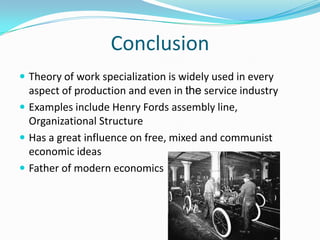
ConclusionTheory of work specialization is widely used in every aspect of production and even in the service industryExamples include Henry Fords assembly line, Organizational StructureHas a great influence on free, mixed and communist economic ideasFather of modern economics
نهايةКінецьEndefinalThe EndτέλοςLa Finkoniec終了結束Конецloppuunalla fineที่ สิ้นสุด

Work Specialization (Pow Ba31) V.3

  • 1.
    Adam Smith Work SpecializationBA-31 DO1ABy: VasylPyrozhyk, Sergey Ratman, Yoni YadgaranFall 2009
  • 2.
    Adam Smith (5 June 1723 – 17 July 1790)
  • 3.
    BiographyBaptized June 16th1723 in Kirkcaldy, Fife, ScotlandAs a youngster attended Burgh School of Kirkcaldy, at age 14 left for University of Glasgow to study under Francis HutchesonAt age of 17 won Snell Exhibition award and was accepted into Balliol College in Oxford.Between 1748 and 1763, Adam Smith Went on to lecture at Various Colleges on his ideas of Political and Economic Philosophies.In 1759 Published book The Theory of Moral SentimentsIn 1763 he accepts tutoring position teaching Henry Scott the Young Duke of Buccleuch which gave him opportunity to meat many intellectual peers alike himselfIn 1766 Henrys Scott younger brother dies, which results in Smiths moving back to Kirkcaldy where he wrote The Wealth Of Nations
  • 4.
    Interesting FactsGot kidnappedby gypsies at age of 4Was absent minded, slightly eccentric with speech impairment, spoke and smiled to himselfWas highly intellectual, taught himself in the Oxford library Believed in deism Never sat down for a portrait
  • 5.
    Age of EnlightenmentAgeof Enlightenment is referring to the 18 century It was the age when reason became a primary source of legitimacy in most of European countries and, struggling for its independence , the United StatesMany ideas critical to our time evolved including centrality of freedom, democracy and reason as the most important values in societyFrench and American revolutionPhilosophy and Science increased in prominenceIndustrial Revolutions birth in Britain
  • 6.
    Work SpecializationTheory ofWork Specialization – Breaking down large jobs into smaller components, and delegating different parts to individual workersWas explained in his book Wealth of Nations, as Division of LaborPin Factory Example Saves time by eliminating the need to switch between jobsSmith underlined the possibility that workers would become dissatisfied and/or ignorant because of repetitionSmith stresses that assigning jobs that are best suited to workers strengthThe outcome should be productive labor which should be reinvested in the company
  • 7.
    ConclusionTheory of workspecialization is widely used in every aspect of production and even in the service industryExamples include Henry Fords assembly line, Organizational StructureHas a great influence on free, mixed and communist economic ideasFather of modern economics
  • 8.