16–0 
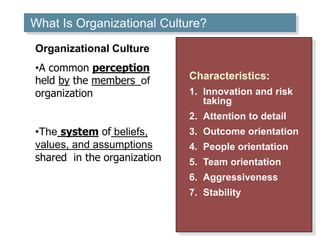
What Is Organizational Culture? 
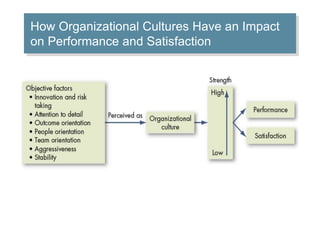
Characteristics: 
1. Innovation and risk 
taking 
2. Attention to detail 
3. Outcome orientation 
4. People orientation 
5. Team orientation 
6. Aggressiveness 
7. Stability 
Organizational Culture 
•A common perception 
held by the members of 
organization 
•The system of beliefs, 
values, and assumptions 
shared in the organization
Contrasting Organizational Cultures 
Organization A 
This organization is a manufacturing firm. Managers are expected to fully document 
all decisions; and “good managers” are those who can provide detailed data to 
support their recommendations. Creative decisions that incur significant change or 
risk are not encouraged. Because managers of failed projects are openly criticized 
and penalized, managers try not to implement ideas that deviate much from the 
status quo. One lower-level manager quoted an often used phrase in the company: 
“If it ain’t broke, don’t fix it.” 
There are extensive rules and regulations in this firm that employees are 
required to follow. Managers supervise employees closely to ensure there are no 
deviations. Management is concerned with high productivity, regardless of the 
impact on employee morale or turnover. 
Work activities are designed around individuals. There are distinct departments 
and lines of authority, and employees are expected to minimize formal contact with 
other employees outside their functional area or line of command. Performance 
evaluations and rewards emphasize individual effort, although seniority tends to be 
the primary factor in the determination of pay raises and promotions.
Contrasting Organizational Cultures (cont’d) 
Organization B 
This organization is also a manufacturing firm. Here, however, management 
encourages and rewards risk taking and change. Decisions based on intuition are 
valued as much as those that are well rationalized. Management prides itself on its 
history of experimenting with new technologies and its success in regularly 
introducing innovation products. Managers or employees who have a good idea are 
encouraged to “run with it.” And failures are treated as “learning experiences.” The 
company prides itself on being market-driven and rapidly responsive to the changing 
needs of its customers. 
There are few rules and regulations for employees to follow, and supervision is 
loose because management believes that its employees are hardworking and 
trustworthy. Management is concerned with high productivity, but believes that this 
comes through treating its people right. The company is proud of its reputation as 
being a good place to work. 
Job activities are designed around work teams, and team members are 
encouraged to interact with people across functions and authority levels. Employees 
talk positively about the competition between teams. Individuals and teams have 
goals, and bonuses are based on achievement of these outcomes. Employees are 
given considerable autonomy in choosing the means by which the goals are attained.
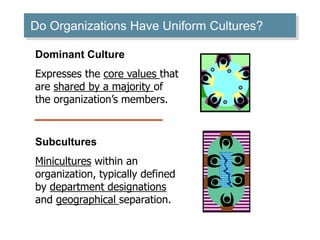
Do Organizations Have Uniform Cultures? 
Dominant Culture 
Expresses the core values that 
are shared by a majority of 
the organization’s members. 
Subcultures 
Minicultures within an 
organization, typically defined 
by department designations 
and geographical separation.
What Is Organizational Culture? (cont’d) 
 Culture Versus Formalization 
– A strong culture increases behavioral consistency and 
can act as a substitute for formalization. 
 Organizational Culture Versus National Culture 
– National culture has a greater impact on employees 
than does their organization’s culture. 
– Nationals selected to work for foreign companies may 
be atypical of the local/native population.
Role of Culture 
1. Defines the boundary between one organization 
and others. 
2. Conveys a sense of identity for its members. 
3. Facilitates the generation of commitment to 
something larger than self-interest. 
4. Enhances the stability of the social system. 
5. Serves as a sense-making and control mechanism 
for fitting employees in the organization.
Role of Culture 
Culture as a Liability: 
1. Barrier to change. 
2. Barrier to diversity 
3. Barrier to acquisitions and mergers
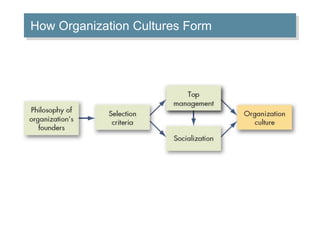
How Organization Cultures Form
How Organization Cultures Form 
 Founders hire and keep only employees who 
think and feel the same way they do. 
 Founders indoctrinate and socialize these 
employees to their way of thinking and feeling. 
 Philosophy of Organisations Founder 
The founders’ own behavior acts as a role model 
that encourages employees to identify with them 
and thereby internalize their beliefs, values, and 
assumptions.
How Organization Cultures Form 
 Selection Criteria 
– Based upon the Philosophy of Organisation’s Founder 
– Concern with how well the candidates will fit into the 
organization. 
 Top Management 
– Senior executives help establish behavioral norms that 
are adopted by the organization. 
 Socialization 
– The process that helps new employees adapt to the 
organization’s culture.
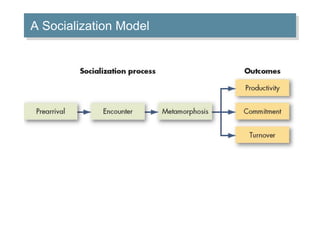
A Socialization Model
Stages in the Socialization Process 
Prearrival Stage 
The period of learning in the socialization process that occurs 
before a new employee joins the organization. 
Encounter Stage 
The stage in the socialization process in which a new employee 
sees what the organization is really like and confronts the 
possibility that expectations and reality may diverge. 
Metamorphosis Stage 
The stage in the socialization process in which a new employee 
changes and adjusts to the work, work group, and organization.
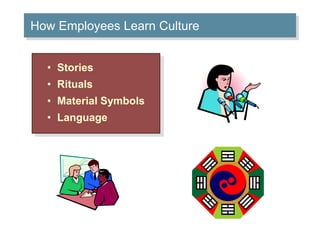
How Employees Learn Culture 
• Stories 
• Rituals 
• Material Symbols 
• Language
Creating An Ethical Organizational Culture 
 Ethical Organizational Culture 
– High tolerance for risk 
– Low to moderate in aggressiveness 
– Focus on means as well as outcomes 
 Promotion of an Ethical Culture 
– Being a visible role model. 
– Communicating ethical expectations. 
– Providing ethical training. 
– Rewarding ethical acts and punishing unethical ones. 
– Providing protective mechanisms.
Creating a Customer-Responsive Culture 
1. Low formalization: the freedom to 
meet customer service requirements. 
2. Empowering employees with 
decision-making discretion to please 
the customer. 
3. Good listening skills to understand 
customer messages. 
4. Role clarity
Creating a Customer-Responsive Culture (cont’d) 
Managerial Actions : 
• Select new employees with personality and 
attitudes consistent with high service 
orientation. 
• Train and socialize current employees to be 
more customer focused. 
• Change organizational structure to give 
employees more control. 
• Empower employees to make decision about 
their jobs.
Creating a Customer-Responsive Culture (cont’d) 
Managerial Actions (cont’d) : 
• Lead by conveying a customer-focused vision 
and demonstrating commitment to customers. 
• Conduct performance appraisals based on 
customer-focused employee behaviors. 
• Provide ongoing recognition for employees who 
make special efforts to please customers.
How Organizational Cultures Have an Impact 
on Performance and Satisfaction

Organisation culture12th july

  • 1.
    16–0 What IsOrganizational Culture? Characteristics: 1. Innovation and risk taking 2. Attention to detail 3. Outcome orientation 4. People orientation 5. Team orientation 6. Aggressiveness 7. Stability Organizational Culture •A common perception held by the members of organization •The system of beliefs, values, and assumptions shared in the organization
  • 2.
    Contrasting Organizational Cultures Organization A This organization is a manufacturing firm. Managers are expected to fully document all decisions; and “good managers” are those who can provide detailed data to support their recommendations. Creative decisions that incur significant change or risk are not encouraged. Because managers of failed projects are openly criticized and penalized, managers try not to implement ideas that deviate much from the status quo. One lower-level manager quoted an often used phrase in the company: “If it ain’t broke, don’t fix it.” There are extensive rules and regulations in this firm that employees are required to follow. Managers supervise employees closely to ensure there are no deviations. Management is concerned with high productivity, regardless of the impact on employee morale or turnover. Work activities are designed around individuals. There are distinct departments and lines of authority, and employees are expected to minimize formal contact with other employees outside their functional area or line of command. Performance evaluations and rewards emphasize individual effort, although seniority tends to be the primary factor in the determination of pay raises and promotions.
  • 3.
    Contrasting Organizational Cultures(cont’d) Organization B This organization is also a manufacturing firm. Here, however, management encourages and rewards risk taking and change. Decisions based on intuition are valued as much as those that are well rationalized. Management prides itself on its history of experimenting with new technologies and its success in regularly introducing innovation products. Managers or employees who have a good idea are encouraged to “run with it.” And failures are treated as “learning experiences.” The company prides itself on being market-driven and rapidly responsive to the changing needs of its customers. There are few rules and regulations for employees to follow, and supervision is loose because management believes that its employees are hardworking and trustworthy. Management is concerned with high productivity, but believes that this comes through treating its people right. The company is proud of its reputation as being a good place to work. Job activities are designed around work teams, and team members are encouraged to interact with people across functions and authority levels. Employees talk positively about the competition between teams. Individuals and teams have goals, and bonuses are based on achievement of these outcomes. Employees are given considerable autonomy in choosing the means by which the goals are attained.
  • 4.
    Do Organizations HaveUniform Cultures? Dominant Culture Expresses the core values that are shared by a majority of the organization’s members. Subcultures Minicultures within an organization, typically defined by department designations and geographical separation.
  • 5.
    What Is OrganizationalCulture? (cont’d)  Culture Versus Formalization – A strong culture increases behavioral consistency and can act as a substitute for formalization.  Organizational Culture Versus National Culture – National culture has a greater impact on employees than does their organization’s culture. – Nationals selected to work for foreign companies may be atypical of the local/native population.
  • 6.
    Role of Culture 1. Defines the boundary between one organization and others. 2. Conveys a sense of identity for its members. 3. Facilitates the generation of commitment to something larger than self-interest. 4. Enhances the stability of the social system. 5. Serves as a sense-making and control mechanism for fitting employees in the organization.
  • 7.
    Role of Culture Culture as a Liability: 1. Barrier to change. 2. Barrier to diversity 3. Barrier to acquisitions and mergers
  • 8.
  • 9.
    How Organization CulturesForm  Founders hire and keep only employees who think and feel the same way they do.  Founders indoctrinate and socialize these employees to their way of thinking and feeling.  Philosophy of Organisations Founder The founders’ own behavior acts as a role model that encourages employees to identify with them and thereby internalize their beliefs, values, and assumptions.
  • 10.
    How Organization CulturesForm  Selection Criteria – Based upon the Philosophy of Organisation’s Founder – Concern with how well the candidates will fit into the organization.  Top Management – Senior executives help establish behavioral norms that are adopted by the organization.  Socialization – The process that helps new employees adapt to the organization’s culture.
  • 11.
  • 12.
    Stages in theSocialization Process Prearrival Stage The period of learning in the socialization process that occurs before a new employee joins the organization. Encounter Stage The stage in the socialization process in which a new employee sees what the organization is really like and confronts the possibility that expectations and reality may diverge. Metamorphosis Stage The stage in the socialization process in which a new employee changes and adjusts to the work, work group, and organization.
  • 13.
    How Employees LearnCulture • Stories • Rituals • Material Symbols • Language
  • 14.
    Creating An EthicalOrganizational Culture  Ethical Organizational Culture – High tolerance for risk – Low to moderate in aggressiveness – Focus on means as well as outcomes  Promotion of an Ethical Culture – Being a visible role model. – Communicating ethical expectations. – Providing ethical training. – Rewarding ethical acts and punishing unethical ones. – Providing protective mechanisms.
  • 15.
    Creating a Customer-ResponsiveCulture 1. Low formalization: the freedom to meet customer service requirements. 2. Empowering employees with decision-making discretion to please the customer. 3. Good listening skills to understand customer messages. 4. Role clarity
  • 16.
    Creating a Customer-ResponsiveCulture (cont’d) Managerial Actions : • Select new employees with personality and attitudes consistent with high service orientation. • Train and socialize current employees to be more customer focused. • Change organizational structure to give employees more control. • Empower employees to make decision about their jobs.
  • 17.
    Creating a Customer-ResponsiveCulture (cont’d) Managerial Actions (cont’d) : • Lead by conveying a customer-focused vision and demonstrating commitment to customers. • Conduct performance appraisals based on customer-focused employee behaviors. • Provide ongoing recognition for employees who make special efforts to please customers.
  • 18.
    How Organizational CulturesHave an Impact on Performance and Satisfaction