Organizational cultureOrganizational culture
and rulesand rules
Presented by Dr, Zahir AjabPresented by Dr, Zahir Ajab
MD, MPHMD, MPH
Deputy DG, HPDDeputy DG, HPD
Federal Ministry of Health SudanFederal Ministry of Health Sudan
Presentation OBJECTIVESPresentation OBJECTIVES
 Understanding organizational cultureUnderstanding organizational culture
and its effect on performanceand its effect on performance
 How are members socialized andHow are members socialized and
acculturated?acculturated?
 Setting rules for our organizationSetting rules for our organization
ORGANIZATIONAL CULTUREORGANIZATIONAL CULTURE
What is Culture:What is Culture:
Culture is a system of values, beliefs, sharedCulture is a system of values, beliefs, shared
meanings, norms and traditions thatmeanings, norms and traditions that
distinguish one group from anotherdistinguish one group from another..
 Based on:Based on:
1.1. identityidentity
2.2. nationalitynationality
3.3. social classsocial class
4.4. gendergender
5.5. Racio-ethnicityRacio-ethnicity
6.6. the organizational itselfthe organizational itself
ORGANIZATIONAL CULTUREORGANIZATIONAL CULTURE
 Definition of Organizational Culture:Definition of Organizational Culture:
Socially acquired and shared rules ofSocially acquired and shared rules of
conduct that are manifested in theconduct that are manifested in the
organization’s artifacts, perspectives,organization’s artifacts, perspectives,
values, and assumptions.values, and assumptions.
 Organizational culture serves as aOrganizational culture serves as a
foundation for the management systemfoundation for the management system
and its behaviors and practicesand its behaviors and practices
Effects of Organizational CultureEffects of Organizational Culture
 Impacts employee motivationImpacts employee motivation
 Affects group productivity andAffects group productivity and
performanceperformance
 Constrains or supports organizationalConstrains or supports organizational
strategies and goalsstrategies and goals
 May foster or hinder innovationMay foster or hinder innovation
 Provides meaning and direction forProvides meaning and direction for
employeesemployees
Assumptions of Innovative VersusAssumptions of Innovative Versus
Stable CulturesStable Cultures
IINNOVATIONNNOVATION::
•People are proactivePeople are proactive
and can be trustedand can be trusted
•Truth is found byTruth is found by
personal investigationpersonal investigation
and testingand testing
•Future orientedFuture oriented
•We can master theWe can master the
environmentenvironment
•Relationships areRelationships are
based on mutualbased on mutual
respect and equalityrespect and equality
STABILITYSTABILITY::
•People are lazy andPeople are lazy and
can’t be trustedcan’t be trusted
•Truth resides in theTruth resides in the
BossBoss
•Oriented to the past orOriented to the past or
presentpresent
•We are controlled byWe are controlled by
our environmentour environment
•Relationships areRelationships are
based on authoritybased on authority
ORGANIZATIONALORGANIZATIONAL
SOCIALIZATIONSOCIALIZATION
The process of conveying the organization'sThe process of conveying the organization's
goals, norms and preferred ways of doinggoals, norms and preferred ways of doing
things to membersthings to members..
This is done by theThis is done by the::
 development of work abilitiesdevelopment of work abilities
 acquisition of appropriate role behaviorsacquisition of appropriate role behaviors
 adjustment to work group’s norms andadjustment to work group’s norms and
valuesvalues
ORGANIZATIONALORGANIZATIONAL
SOCIALIZATIONSOCIALIZATION
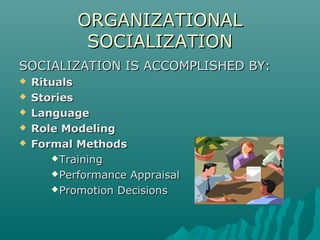
SOCIALIZATION IS ACCOMPLISHED BY:SOCIALIZATION IS ACCOMPLISHED BY:
 RitualsRituals
 StoriesStories
 LanguageLanguage
 Role ModelingRole Modeling
 Formal MethodsFormal Methods
TrainingTraining
Performance AppraisalPerformance Appraisal
Promotion DecisionsPromotion Decisions
ACCULTURATIONACCULTURATION
 Acculturation is the process for resolvingAcculturation is the process for resolving
cultural differences and of accomplishingcultural differences and of accomplishing
cultural change and adaptation betweencultural change and adaptation between
groupsgroups..
– Usually there is a merger with a dominantUsually there is a merger with a dominant
cultureculture..
– Often it is a process of cultural exchangeOften it is a process of cultural exchange
between entering members and thebetween entering members and the
organizational culture of their employersorganizational culture of their employers
Setting rules for our organizationSetting rules for our organization
 Purpose of the workPurpose of the work
 Using resourcesUsing resources
 Roles and responsibilitiesRoles and responsibilities
 Understand each other’s personalityUnderstand each other’s personality
 CommunicationCommunication
 Trust fairnessTrust fairness
 Monitoring and evaluationMonitoring and evaluation
 Learning CultureLearning Culture
HAVE WE MET OUR LEARNINGHAVE WE MET OUR LEARNING
OBJECTIVESOBJECTIVES??
 Understanding organizationalUnderstanding organizational
cultureculture
 How are members socialized andHow are members socialized and
acculturated?acculturated?
 Setting rules for our organizationSetting rules for our organization
Organizational rules and culture- ~شاهق ِتشلا

Organizational rules and culture- ~شاهق ِتشلا

  • 1.
    Organizational cultureOrganizational culture andrulesand rules Presented by Dr, Zahir AjabPresented by Dr, Zahir Ajab MD, MPHMD, MPH Deputy DG, HPDDeputy DG, HPD Federal Ministry of Health SudanFederal Ministry of Health Sudan
  • 2.
    Presentation OBJECTIVESPresentation OBJECTIVES Understanding organizational cultureUnderstanding organizational culture and its effect on performanceand its effect on performance  How are members socialized andHow are members socialized and acculturated?acculturated?  Setting rules for our organizationSetting rules for our organization
  • 3.
    ORGANIZATIONAL CULTUREORGANIZATIONAL CULTURE Whatis Culture:What is Culture: Culture is a system of values, beliefs, sharedCulture is a system of values, beliefs, shared meanings, norms and traditions thatmeanings, norms and traditions that distinguish one group from anotherdistinguish one group from another..  Based on:Based on: 1.1. identityidentity 2.2. nationalitynationality 3.3. social classsocial class 4.4. gendergender 5.5. Racio-ethnicityRacio-ethnicity 6.6. the organizational itselfthe organizational itself
  • 4.
    ORGANIZATIONAL CULTUREORGANIZATIONAL CULTURE Definition of Organizational Culture:Definition of Organizational Culture: Socially acquired and shared rules ofSocially acquired and shared rules of conduct that are manifested in theconduct that are manifested in the organization’s artifacts, perspectives,organization’s artifacts, perspectives, values, and assumptions.values, and assumptions.  Organizational culture serves as aOrganizational culture serves as a foundation for the management systemfoundation for the management system and its behaviors and practicesand its behaviors and practices
  • 5.
    Effects of OrganizationalCultureEffects of Organizational Culture  Impacts employee motivationImpacts employee motivation  Affects group productivity andAffects group productivity and performanceperformance  Constrains or supports organizationalConstrains or supports organizational strategies and goalsstrategies and goals  May foster or hinder innovationMay foster or hinder innovation  Provides meaning and direction forProvides meaning and direction for employeesemployees
  • 6.
    Assumptions of InnovativeVersusAssumptions of Innovative Versus Stable CulturesStable Cultures IINNOVATIONNNOVATION:: •People are proactivePeople are proactive and can be trustedand can be trusted •Truth is found byTruth is found by personal investigationpersonal investigation and testingand testing •Future orientedFuture oriented •We can master theWe can master the environmentenvironment •Relationships areRelationships are based on mutualbased on mutual respect and equalityrespect and equality STABILITYSTABILITY:: •People are lazy andPeople are lazy and can’t be trustedcan’t be trusted •Truth resides in theTruth resides in the BossBoss •Oriented to the past orOriented to the past or presentpresent •We are controlled byWe are controlled by our environmentour environment •Relationships areRelationships are based on authoritybased on authority
  • 7.
    ORGANIZATIONALORGANIZATIONAL SOCIALIZATIONSOCIALIZATION The process ofconveying the organization'sThe process of conveying the organization's goals, norms and preferred ways of doinggoals, norms and preferred ways of doing things to membersthings to members.. This is done by theThis is done by the::  development of work abilitiesdevelopment of work abilities  acquisition of appropriate role behaviorsacquisition of appropriate role behaviors  adjustment to work group’s norms andadjustment to work group’s norms and valuesvalues
  • 8.
    ORGANIZATIONALORGANIZATIONAL SOCIALIZATIONSOCIALIZATION SOCIALIZATION IS ACCOMPLISHEDBY:SOCIALIZATION IS ACCOMPLISHED BY:  RitualsRituals  StoriesStories  LanguageLanguage  Role ModelingRole Modeling  Formal MethodsFormal Methods TrainingTraining Performance AppraisalPerformance Appraisal Promotion DecisionsPromotion Decisions
  • 9.
    ACCULTURATIONACCULTURATION  Acculturation isthe process for resolvingAcculturation is the process for resolving cultural differences and of accomplishingcultural differences and of accomplishing cultural change and adaptation betweencultural change and adaptation between groupsgroups.. – Usually there is a merger with a dominantUsually there is a merger with a dominant cultureculture.. – Often it is a process of cultural exchangeOften it is a process of cultural exchange between entering members and thebetween entering members and the organizational culture of their employersorganizational culture of their employers
  • 10.
    Setting rules forour organizationSetting rules for our organization  Purpose of the workPurpose of the work  Using resourcesUsing resources  Roles and responsibilitiesRoles and responsibilities  Understand each other’s personalityUnderstand each other’s personality  CommunicationCommunication  Trust fairnessTrust fairness  Monitoring and evaluationMonitoring and evaluation  Learning CultureLearning Culture
  • 11.
    HAVE WE METOUR LEARNINGHAVE WE MET OUR LEARNING OBJECTIVESOBJECTIVES??  Understanding organizationalUnderstanding organizational cultureculture  How are members socialized andHow are members socialized and acculturated?acculturated?  Setting rules for our organizationSetting rules for our organization