Parking

   Lot

innovation
20%
             of
            the
employee’s time
            can
             be
      utilized
            for
     personal
     Projects.
ORGANIZATIONAL CULTURE

By

KAMALAKKANNAN G
VENKATESAN T
DEPARTMENT OF MANAGEMENT STUDIES
PONDICHERRY UNIVERSITY
Organizational Culture
Originated in 1940s

• organizational climate studies, was prominent during the
1960s and 1970s

• Popularized in early 1980s

• viewed the
        informal,
        nonmaterial,
        interpersonal,
        moral bases

of cooperation and commitment as perhaps more important
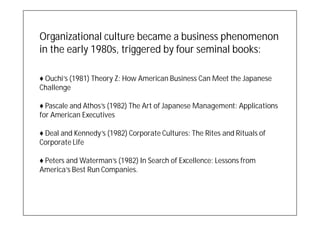
Organizational culture became a business phenomenon
in the early 1980s, triggered by four seminal books:

♦ Ouchi’s (1981) Theory Z: How American Business Can Meet the Japanese
Challenge

♦ Pascale and Athos’s (1982) The Art of Japanese Management: Applications
for American Executives

♦ Deal and Kennedy’s (1982) Corporate Cultures: The Rites and Rituals of
Corporate Life

♦ Peters and Waterman’s (1982) In Search of Excellence: Lessons from
America’s Best Run Companies.
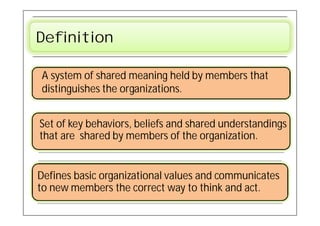
Definition

A system of shared meaning held by members that
distinguishes the organizations.


Set of key behaviors, beliefs and shared understandings
that are shared by members of the organization.


Defines basic organizational values and communicates
to new members the correct way to think and act.
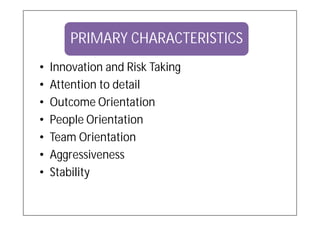
PRIMARY CHARACTERISTICS
•   Innovation and Risk Taking
•   Attention to detail
•   Outcome Orientation
•   People Orientation
•   Team Orientation
•   Aggressiveness
•   Stability
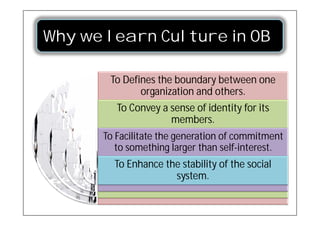
Why we learn Culture in OB

       To Defines the boundary between one
              organization and others.
         To Convey a sense of identity for its
                     members.
      To Facilitate the generation of commitment
         to something larger than self-interest.
                                   self-
        To Enhance the stability of the social
                     system.
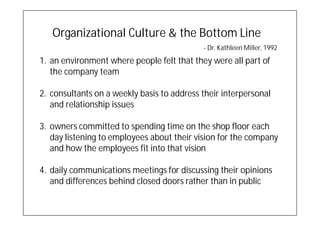
Organizational Culture & the Bottom Line
                                            - Dr. Kathleen Miller, 1992
1. an environment where people felt that they were all part of
   the company team

2. consultants on a weekly basis to address their interpersonal
   and relationship issues

3. owners committed to spending time on the shop floor each
   day listening to employees about their vision for the company
   and how the employees fit into that vision

4. daily communications meetings for discussing their opinions
   and differences behind closed doors rather than in public
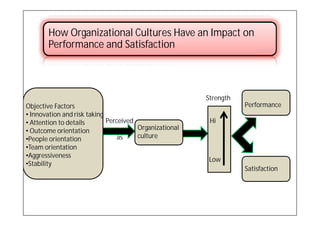
How Organizational Cultures Have an Impact on
       Performance and Satisfaction


                                                        Strength
Objective Factors                                                  Performance
• Innovation and risk taking
• Attention to details       Perceived                   Hi
• Outcome orientation                  Organizational
•People orientation              as    culture
•Team orientation
•Aggressiveness
                                                         Low
•Stability
                                                                   Satisfaction
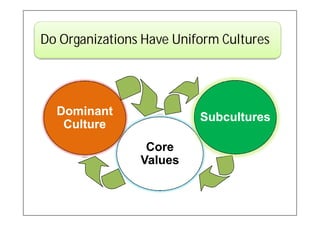
Do Organizations Have Uniform Cultures


  Dominant                Subcultures
   Culture
                 Core
                Values
Creating And Sustaining Culture
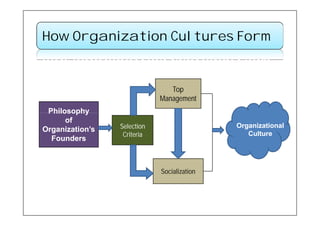
How Organization Cultures Form


                                Top
                             Management
 Philosophy
      of
Organization’s   Selection                   Organizational
                  Criteria                      Culture
  Founders


                             Socialization
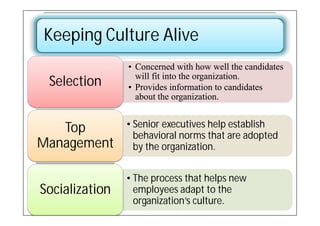
Keeping Culture Alive
                • Concerned with how well the candidates
 Selection        will fit into the organization.
                • Provides information to candidates
                  about the organization.


   Top          • Senior executives help establish
                  behavioral norms that are adopted
Management        by the organization.


                • The process that helps new
Socialization     employees adapt to the
                  organization’s culture.
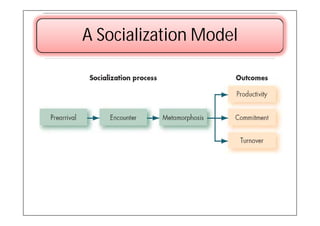
A Socialization Model
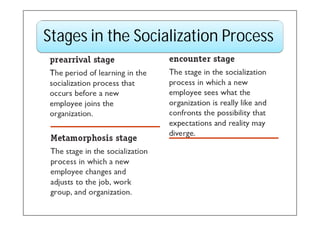
Stages in the Socialization Process
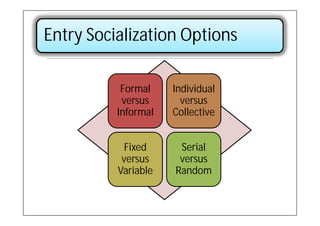
Entry Socialization Options

           Formal    Individual
           versus      versus
          Informal   Collective


            Fixed     Serial
           versus     versus
          Variable   Random
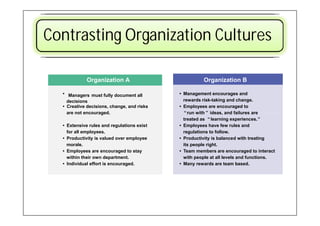
Contrasting Organization Cultures

             Organization A                           Organization B

  • Managers must fully document all        • Management encourages and
    decisions                                 rewards risk-taking and change.
  • Creative decisions, change, and risks   • Employees are encouraged to
    are not encouraged.                        “ run with ” ideas, and failures are
                                              treated as “ learning experiences.”
  • Extensive rules and regulations exist   • Employees have few rules and
    for all employees.                        regulations to follow.
  • Productivity is valued over employee    • Productivity is balanced with treating
    morale.                                   its people right.
  • Employees are encouraged to stay        • Team members are encouraged to interact
    within their own department.              with people at all levels and functions.
  • Individual effort is encouraged.        • Many rewards are team based.
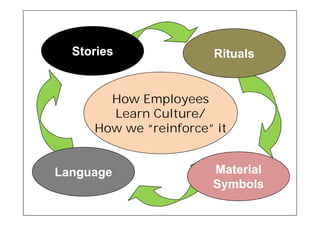
Stories              Rituals


       How Employees
       Learn Culture/
     How we “reinforce” it
             reinforce”


Language               Material
                       Symbols
Creating an Ethical Organizational Culture

Organizational Characteristics – Maintaining High Ethical Standards
    High in risk tolerance
    Low to moderate in aggressiveness
    Focus on means as well as outcomes

Ethical Culture can be Created by the following Steps
     Being a visible role model
     Communicating ethical expectations
     Providing ethical training
     Visibly rewarding ethical acts and punishing unethical ones
     Provide Protective Mechanism
Creating a Positive Organizational Culture

Positive Organizational Culture
    Builds on employee strengths
    Rewards more than it punishes
    Emphasizes individual vitality and growth
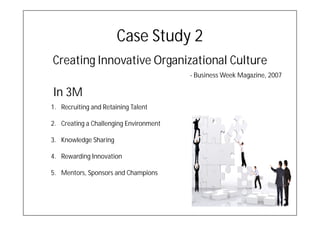
Case Study 2
Creating Innovative Organizational Culture
                                        - Business Week Magazine, 2007

In 3M
1. Recruiting and Retaining Talent

2. Creating a Challenging Environment

3. Knowledge Sharing

4. Rewarding Innovation

5. Mentors, Sponsors and Champions
Organizational Culture Final

Organizational Culture Final

  • 1.
    Parking Lot innovation
  • 2.
    20% of the employee’s time can be utilized for personal Projects.
  • 3.
    ORGANIZATIONAL CULTURE By KAMALAKKANNAN G VENKATESANT DEPARTMENT OF MANAGEMENT STUDIES PONDICHERRY UNIVERSITY
  • 4.
    Organizational Culture Originated in1940s • organizational climate studies, was prominent during the 1960s and 1970s • Popularized in early 1980s • viewed the informal, nonmaterial, interpersonal, moral bases of cooperation and commitment as perhaps more important
  • 5.
    Organizational culture becamea business phenomenon in the early 1980s, triggered by four seminal books: ♦ Ouchi’s (1981) Theory Z: How American Business Can Meet the Japanese Challenge ♦ Pascale and Athos’s (1982) The Art of Japanese Management: Applications for American Executives ♦ Deal and Kennedy’s (1982) Corporate Cultures: The Rites and Rituals of Corporate Life ♦ Peters and Waterman’s (1982) In Search of Excellence: Lessons from America’s Best Run Companies.
  • 6.
    Definition A system ofshared meaning held by members that distinguishes the organizations. Set of key behaviors, beliefs and shared understandings that are shared by members of the organization. Defines basic organizational values and communicates to new members the correct way to think and act.
  • 7.
    PRIMARY CHARACTERISTICS • Innovation and Risk Taking • Attention to detail • Outcome Orientation • People Orientation • Team Orientation • Aggressiveness • Stability
  • 8.
    Why we learnCulture in OB To Defines the boundary between one organization and others. To Convey a sense of identity for its members. To Facilitate the generation of commitment to something larger than self-interest. self- To Enhance the stability of the social system.
  • 9.
    Organizational Culture &the Bottom Line - Dr. Kathleen Miller, 1992 1. an environment where people felt that they were all part of the company team 2. consultants on a weekly basis to address their interpersonal and relationship issues 3. owners committed to spending time on the shop floor each day listening to employees about their vision for the company and how the employees fit into that vision 4. daily communications meetings for discussing their opinions and differences behind closed doors rather than in public
  • 10.
    How Organizational CulturesHave an Impact on Performance and Satisfaction Strength Objective Factors Performance • Innovation and risk taking • Attention to details Perceived Hi • Outcome orientation Organizational •People orientation as culture •Team orientation •Aggressiveness Low •Stability Satisfaction
  • 11.
    Do Organizations HaveUniform Cultures Dominant Subcultures Culture Core Values
  • 12.
  • 13.
    How Organization CulturesForm Top Management Philosophy of Organization’s Selection Organizational Criteria Culture Founders Socialization
  • 14.
    Keeping Culture Alive • Concerned with how well the candidates Selection will fit into the organization. • Provides information to candidates about the organization. Top • Senior executives help establish behavioral norms that are adopted Management by the organization. • The process that helps new Socialization employees adapt to the organization’s culture.
  • 15.
  • 16.
    Stages in theSocialization Process
  • 17.
    Entry Socialization Options Formal Individual versus versus Informal Collective Fixed Serial versus versus Variable Random
  • 18.
    Contrasting Organization Cultures Organization A Organization B • Managers must fully document all • Management encourages and decisions rewards risk-taking and change. • Creative decisions, change, and risks • Employees are encouraged to are not encouraged. “ run with ” ideas, and failures are treated as “ learning experiences.” • Extensive rules and regulations exist • Employees have few rules and for all employees. regulations to follow. • Productivity is valued over employee • Productivity is balanced with treating morale. its people right. • Employees are encouraged to stay • Team members are encouraged to interact within their own department. with people at all levels and functions. • Individual effort is encouraged. • Many rewards are team based.
  • 19.
    Stories Rituals How Employees Learn Culture/ How we “reinforce” it reinforce” Language Material Symbols
  • 21.
    Creating an EthicalOrganizational Culture Organizational Characteristics – Maintaining High Ethical Standards  High in risk tolerance  Low to moderate in aggressiveness  Focus on means as well as outcomes Ethical Culture can be Created by the following Steps  Being a visible role model  Communicating ethical expectations  Providing ethical training  Visibly rewarding ethical acts and punishing unethical ones  Provide Protective Mechanism
  • 22.
    Creating a PositiveOrganizational Culture Positive Organizational Culture  Builds on employee strengths  Rewards more than it punishes  Emphasizes individual vitality and growth
  • 23.
    Case Study 2 CreatingInnovative Organizational Culture - Business Week Magazine, 2007 In 3M 1. Recruiting and Retaining Talent 2. Creating a Challenging Environment 3. Knowledge Sharing 4. Rewarding Innovation 5. Mentors, Sponsors and Champions